parking brake MERCEDES-BENZ S-CLASS CABRIOLET 2018 Owner's Guide
[x] Cancel search | Manufacturer: MERCEDES-BENZ, Model Year: 2018, Model line: S-CLASS CABRIOLET, Model: MERCEDES-BENZ S-CLASS CABRIOLET 2018Pages: 502, PDF Size: 6.27 MB
Page 208 of 502
System limitations
No lane-cor recting brake application occurs in
th efo llowing situations:
RYo u clear lyand actively steer, brake or accel‐
erate.
RYo u ha veswitched on the turn signal indica‐
to r.
RA driving safe ty system inter venes, such as
ESP®, Ac tive Brake Assi stor Active Blind
Spot Assi st.
RYo u ha veadop ted a sporty driving style with
high cornering speeds or high rates of accel‐
eration.
RESP®is deactivated.
RIf a loss of tire pressure or a defective tire
has been de tected and displ ayed.
The sy stem may be impaired or may not function
in thefo llowing situations:
RIf th ere is poor visibility, e.g. due toinsuf fi‐
cient illumination of thero ad, highly variable
shade conditions, or due torain, sno w,fog or
heavy spr ay.
RThere is glare, e.g. from oncoming traf fic, the
sun or reflections.
RIf th ere is dirt on the windshield in the vicin‐
ity of the multifunction camera or the camera
is mis ted up, damaged or obscured.
RNo or se veral, unclear lane markings are
present for one lane, e.g. near roadwor ks.
RThe lane markings are worn, dark or co vered.
RThe dis tance totheve hicle in front is too
small and the lane markings thus cannot be
de tected.
RThe lane markings change quickl y,e.g. lanes
branch off, cross one ano ther or mer ge.
RThe roadw ayisvery nar row and winding.
Ve hicles with Driving Assistance pac kage or
Driving Assistance Plus pa ckage: Active Lane
Ke eping Assist uses radar sensors tomonitor
se veral areas around theve hicle. If thera dar
sensors in there ar bumper are dirty or co vered
with snow ,th e sy stem may be impaired or may
not function. If an obs tacle in the lane in which
yo u are driving has been de tected, no lane-cor‐
re cting brake application occurs .Ac
tivating Active Lane Keeping Assist
&
WARNING Risk of accident despite
Ac tive Lane Keeping Assist warning
A lane-cor recting brake application cannot
al wa ys bring theve hicle back into the origi‐
nal lane.
#Alw aysst eer, brake or accelera teyour‐
self, especially if Active Lane Keeping
Assist warnsyo u or makes a lane-cor‐
re cting brake application.
&
WARNING Risk of accident despite inter‐
ve ntion of Active Lane Keeping Assist
Ac tive Lane Keeping Assist does not de tect
traf fic conditions or road users. In very rare
cases, the sy stem may make an inappropri‐
ate brake application, e.g. af ter intentional ly
driving over a solid lane marking.
The brake application can be inter rupte d at
any time if yousteer slightly in the opposite
direction.
206 Driving and parking
Page 209 of 502
#Always make sure that there is suf fi‐
cient dist ancetothe side forot her traf‐
fi c or obs tacles.
&
WARNING Risk of accident despite Lane
Ke eping Assist
Lane Keeping Assist cannot always clearly
de tect lane markings.
In such cases, Lane Keeping Assist can:
Rgive an unnecessary warning
Rnot give a warning
#Alw ays pay particular attention tothe
traf fic situation and keep within the
lane, especially if Active Lane Keeping
Assist alerts you.
Re quirements
The driving speed is at least 40 mph (60 km/h).
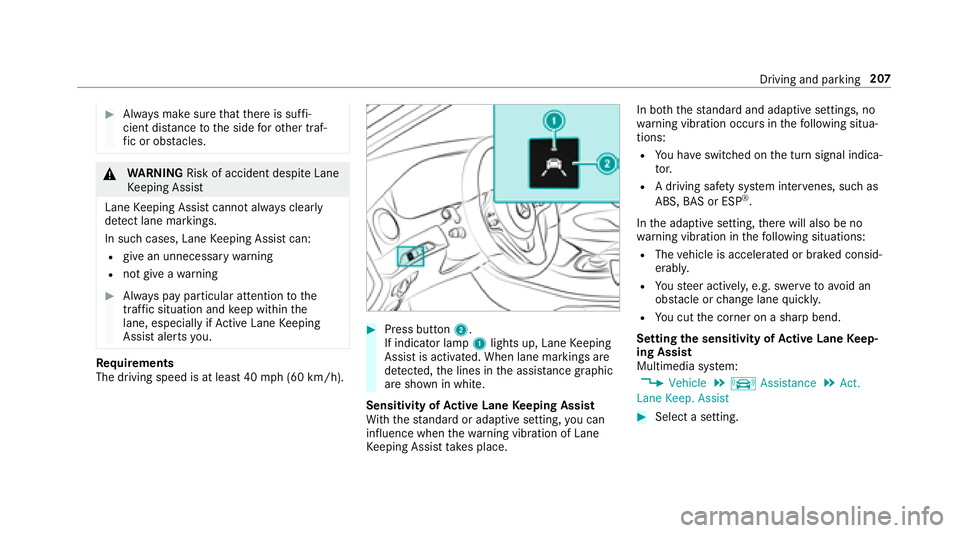
#Press button 2.
If indicator lamp 1lights up, Lane Keeping
Assist is activated. When lane markings are
de tected, the lines in the assis tance graphic
are shown in white.
Sensitivity of Active Lane Keeping Assist
Wi th th est andard or adaptive setting, you can
influence when thewa rning vibration of Lane
Ke eping Assist take s place. In bo
th thest andard and adaptive settings, no
wa rning vibration occurs in thefo llowing situa‐
tions:
RYo u ha veswitched on the turn signal indica‐
to r.
RA driving safe ty system inter venes, such as
ABS, BAS or ESP®.
In the adaptive setting, there will also be no
wa rning vibration in thefo llowing situations:
RThe vehicle is accelerated or braked consid‐
erably.
RYo usteer actively, e.g. swer vetoavo id an
obs tacle or change lane quickl y.
RYou cut the corner on a sharp bend.
Setting the sensitivity of Active Lane Keep‐
ing Assist
Multimedia sy stem:
,Vehicle.k Assistance.Act.
Lane Keep. Assist
#Select a setting.
Driving and parking 207
Page 340 of 502
Notes on care of vehicle parts
&
WARNING Risk of entrapment if the
windshield wipers are switch ed on while
th e windshield is being cleaned
If th e windshield wipers are set in motion
while you are cleaning the windshield or
wiper blades, you can betrapped bythe
wiper arm.
#Alw ays switch off the windshield wipers
and the ignition before cleaning the
windshield or wiper blades.
& WARNING Risk of burn s fromtailpipes
and tailpipe trim
The tailpipe and tailpipe trim can become
ve ry hot. If you come into contact withth ese
parts of theve hicle, you could burn yourself.
#Alw ays be particular lycareful around
th eta ilpipe and theta ilpipe trim.
#Allow theve hicle parts tocool down
before youto uch them.
Obser vethefo llowing information:
Information on cleaning and car eAvoiding vehicle damage
Wheels/rims Usewate r and acid-free wheel cleaners.
RDo not use acidic wheel cleaners toremo vebrake dust.
This could damage wheel bolts and brake components.
RTo avoid cor rosion of the brake discs and brake pads,
drive theve hicle for a few minutes af ter cleaning before
parking it. The brake discs and brake pads warm up and
dry out.
Wi ndo ws
Cleanthe windo wsonthe inside and outside using a damp
clo thand cleaning agents recommended byMercedes-Benz. Do not use dry clo
ths or abrasive or sol vent-based cleaning
agents toclean the inside of windo ws.
338
Maintenance and care
Page 354 of 502
RThe jumper/charging cable must not come
into contact with any parts which may move
when the engine is running.
RAlw ays make sure that nei ther you nor the
battery is elect rostatically charge d.
RKe ep away from fire and open flames.
RDo not lean overth e batter y.
RWhencharging: only use battery charge rs
te sted and appr oved byMercedes-Benz, and
please read the battery charge r's operating
instructions before charging the batter y.
Obser vethe additional following points during
st arting assis tance:
RSt arting assis tance may only be pr ovided
using batteries with a nominal voltage of
12 V.
RThe vehicles must not touch.
RGa soline engine: onlyaccept starting assis‐
ta nce if the engine and exhaust sy stem are
cold.
#Secure theve hicle byapplying the electric
parking brake.
#Au tomatic transmission: shiftthe transmis‐
sion toposition B.
#Make sure that the ignition and all electrical
consumers are switched off.
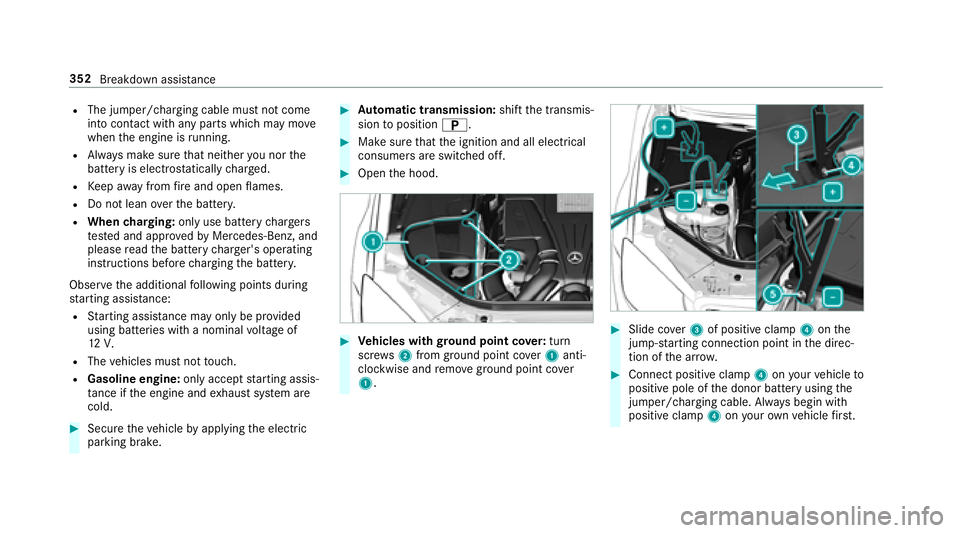
#Open the hood.
#Ve hicles with ground point co ver:tur n
sc rews 2 from ground point co ver1 anti-
clockwise and remo veground point co ver
1.#Slide co ver3 of positive clamp 4onthe
jump-s tarting connection point in the direc‐
tion of the ar row.
#Connect positive clamp 4onyour vehicle to
positive pole of the donor battery using the
jumper/charging cable. Alw ays begin with
positive clamp 4onyour ow nve hicle firs t.
352
Breakdown assist ance
Page 356 of 502
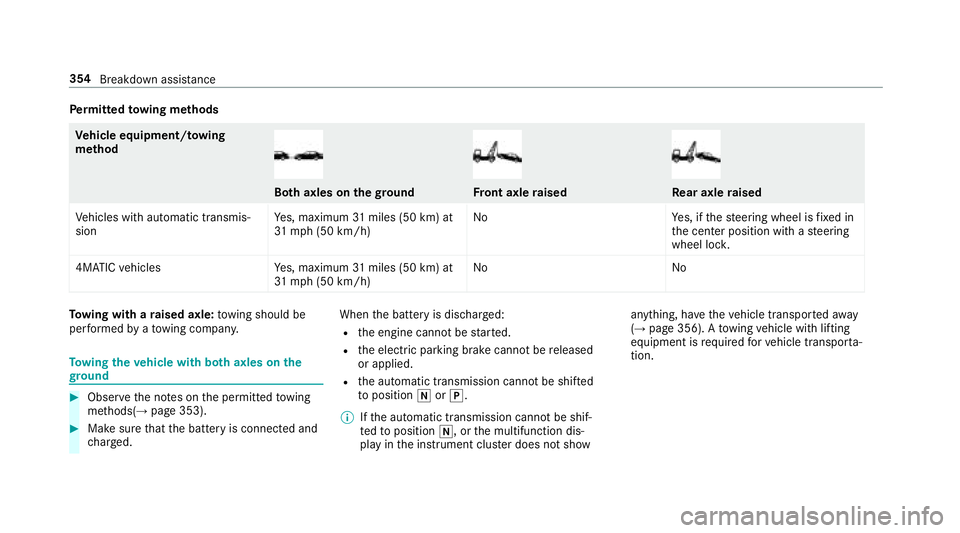
Perm itted towing me thods
Ve hicle equipment/to wing
me thod
Bo th axles on thegr oundFront axle raisedRe ar axle raised
Ve hicles with automatic transmis‐
sion Ye
s, maximum 31miles (50 km) at
31 mp h (50 km/h) No
Yes, if thesteering wheel is fixe d in
th e center position with a steering
wheel loc k.
4MATIC vehicles Yes, maximum 31miles (50 km) at
31 mp h (50 km/h) No
No
Towing wit h araised axle: towing should be
per form ed byato wing compan y.
Towing theve hicle with bo thaxles on the
gr ound
#Obser vethe no tes on the permitted towing
me thods(→page 353).
#Make sure that the battery is connected and
ch arge d. When
the battery is dischar ged:
Rthe engine cannot bestar ted.
Rth e electric parking brake cannot bereleased
or applied.
Rth e automatic transmission cann otbe shif ted
to position iorj.
% Ifth e automatic transmission cannot be shif‐
te dto position i, orthe multifunction dis‐
play in the instrument clus ter does not show anything, ha
vetheve hicle transpor tedaw ay
(
→page 356). A towing vehicle with lifting
equipment is requiredforve hicle transpor ta‐
tion.
354 Breakdown assist ance
Page 357 of 502
*NO
TEDama gedue to to wing away at
exc essively high speeds or over long dis‐
ta nces
The driv etra in could be damaged when tow‐
ing at excessively high speeds or over long
dis tances.
#A towing speed of 30 mph (50 km/h)
must not be exceeded.
#Atowing dis tance of 30 miles (50 km)
must not be exceeded.
&
WARNING Risk of accident when towing
a ve hicle which is too heavy
If th eve hicle being tow- star ted or towe d
aw ay is heavier than the permissible gross
mass of your vehicle, thefo llowing situations
can occur:
RThe towing eye may become de tach ed.
RThe vehicle/trailer combination may
swer veoreve nov erturn.
#If ano ther vehicle is tow- star ted or
to we daw ay, its weight must not exceed
the permissible gross mass of your ow n
ve hicle.
If a vehicle must be tow- star ted or towe daw ay,
its weight must not exceed the permissible gross
mass of theto wing vehicle.
#Information on the permissible gross mass of
th eve hicle can be found on theve hicle iden‐
tification plate (
→page 394).
#Do not open the driver's door or front
passenger door, otherwise the automatic
transmission automatically shifts toposition
j.
#Ins tallth eto wing eye (→page 358).
#Fa sten theto w bar.
* NO
TEDama gedue toincor rect connec‐
tion
#Only connect theto w rope or tow bar to
th eto wing eyes.
#Deactivate the automatic locking mechanism
(→page 63).
#Do not activate the HOLD function.
#Deactivate Active Brake Assi st(→page 159).
#Shift the automatic transmission toposition
i.
#Re lease the electric parking brake.
&
WARNING Risk of accident due tolimi‐
te d saf ety-re lated functions during the
to wing process
Saf ety-re lated functions are limited or no lon‐
ge rav ailable in thefo llowing situations:
Rth e ignition is switched off.
Rthe brake sy stem or po werst eering sys‐
te m is malfunctioning.
Rth e energy supply or the on-board electri‐
cal sy stem is malfunctioning.
When your vehicle is then towe daw ay, signif‐
icantly more ef fort may be requ ired tosteer
and brake than is no rmally requ ired.
#Use a tow bar.
Breakdown assis tance 355
Page 388 of 502
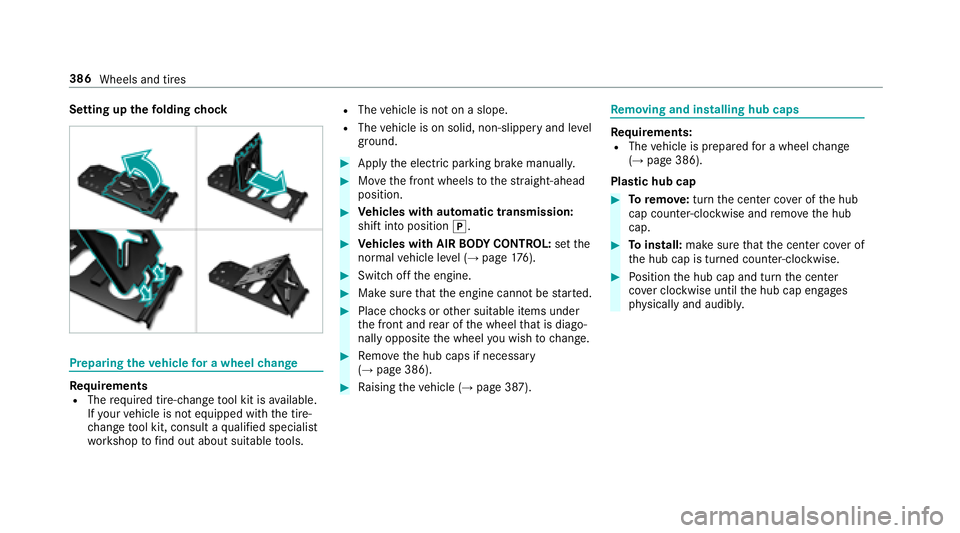
Setting upthefo lding chock
Prepa ring theve hicle for a wheel change
Re quirementsRThe requ ired tire-change tool kit is available.
If yo ur vehicle is not equipped with the tire-
ch ange tool kit, consult a qualified specialist
wo rkshop tofind out about suitable tools.
RThe vehicle is not on a slope.
RThe vehicle is on solid, non-slippery and le vel
ground .
#Applythe electric parking brake manually.
#Mo vethe front wheels tothest ra ight-ahead
position.
#Ve hicles with automatic transmission:
shift into position j.
#Vehicles with AIR BODY CONT ROL:set the
normal vehicle le vel (→page 176).
#Switch off the engine.
#Make sure that the engine cannot bestar ted.
#Place choc ks orother suitable items under
th e front and rear of the wheel that is diago‐
nally opposite the wheel youwish tochange.
#Re mo vethe hub caps if necessary
(→page 386).
#Ra ising theve hicle (→page 387).
Re moving and in stalling hub caps
Re quirements:RThe vehicle is prepared for a wheel change
(→page 386).
Plast ic hub cap
#Toremo ve:turn the center co ver of the hub
cap counter-clockwise and remo vethe hub
cap.
#To install: make sure that the center co ver of
th e hub cap is turned counter-clockwise.
#Po sition the hub cap and turn the center
co ver clockwise until the hub cap engages
ph ysically and audibly.
386
Wheels and tires
Page 389 of 502
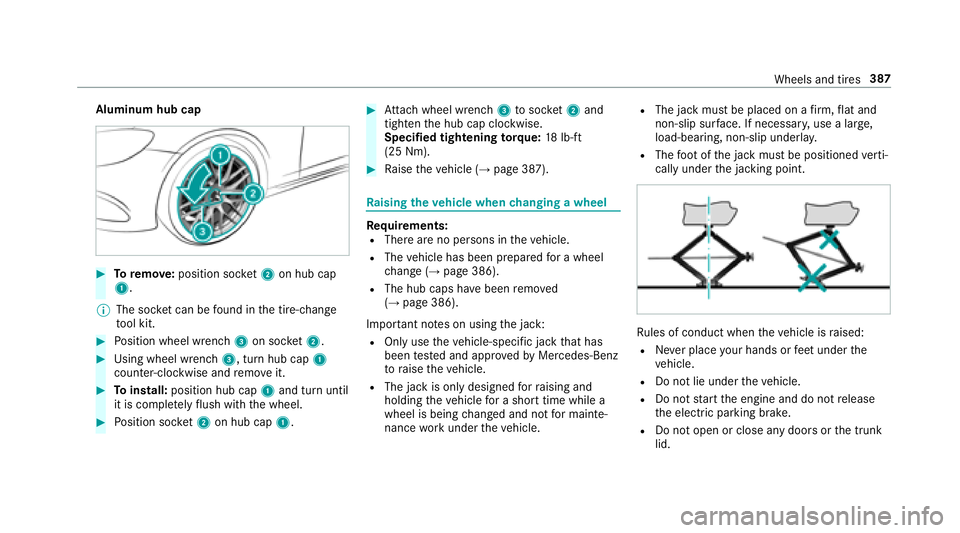
Aluminum hub cap
#Toremo ve:position soc ket2 on hub cap
1.
% The soc ket can be found inthe tire-change
to ol kit.
#Po sition wheel wrench 3on soc ket2.
#Using wheel wrench 3, turn hub cap1
counter-clo ckwise and remo veit.
#To install: position hub cap 1and turn until
it is comple tely flush withth e wheel.
#Po sition soc ket2 on hub cap 1.
#Attach wheel wrench 3tosoc ket2 and
tighten the hub cap clockwise.
Specified tightening torq ue: 18lb-ft
(25 Nm).
#Ra ise theve hicle (→page 387).
Ra ising theve hicle when changing a wheel
Re quirements:RThere are no persons in theve hicle.
RThe vehicle has been prepared for a wheel
ch ange (→page 386).
RThe hub caps ha vebeen remo ved
(→page 386).
Impor tant no tes on using the jack:
ROnly use theve hicle-specific jack that has
been tested and appr ovedby Mercedes-Benz
to raise theve hicle.
RThe jack is only designed forra ising and
holding theve hicle for a short time while a
wheel is being changed and not for mainte‐
nance workunder theve hicle.
RThe jack must be placed on a firm ,fl at and
non-slip sur face. If necessar y,use a lar ge,
load-bearing, non-slip underla y.
RThefoot ofthe jack must be positioned verti‐
cally under the jacking point.
Ru les of conduct when theve hicle is raised:
RNe ver place your hands or feet under the
ve hicle.
RDo not lie under theve hicle.
RDo not start the engine and do not release
th e electric parking brake.
RDo not open or close any doors or the trunk
lid.
Wheels and tires 387
Page 412 of 502

Displaymessages
Possible causes/consequences and MSolutions
F
(USA only)
!
(Canada only)
Turn On the Ignition to
Release the Parking Brake *
The redF (USA only) or !(Canada only) indicator lamp is lit.
Yo u ha veattem ptedto release the electric parking brake with the ignition switched off.
#Switch on the ignition.
F
(USA only)
!
(Canada only)
Please Release Parking
Brake *
The redF (USA only) or !(Canada only) indicator lamp flashes.
The electric parking brake is applied while driving:
RA condition for au tomatic release of the electric parking brake is not fulfilled .
RYo u are per form ing emer gency braking using the electric parking brake .
#Check that the conditions for au tomatic release of the electric parking brake are fulfilled.
#Re lease the electric parking brake manually.
41 0
Displ aymessage s andwarning/indicator lamps
Page 413 of 502

Displaymessages
Possible causes/consequences and MSolutions
F
(USA only)
!
(Canada only)
Parking Brake See Opera-
tor's Manual *
The yellow ! indicator lamp is lit. The elect ric park ing brake is malfunctioning.
To appl y:
#Switch off the ignition and turn it back on.
#Apply the electric parking brake manually .
If it is not possible toapply the electric parking brake:
#Visit a qualified specialist workshop.
#Where necessar y,also safeguard the par kedve hicle against rolling away.
The yellow ! andthere d F (USA only) or !(Canada only) indicator lamps are lit. The electri c parking
brake is malfunctioning.
To release:
#Swit choff the ignition and turn it back on.
#Re lease the electric parking brake manually .
or
#Re lease the electric parking brake automatically .
If it is still not possible torelease the electric parking brake:
#Do not continue driving under any circums tances. Consult a qualified specialist workshop.
The yellow ! indicator lamp is lit and there dF (USA only) or !(Canada only) indicator lamp is flashing.
The electric parking brake is malfunctioning.
The electric parking brake could not be applied or released.
Display messages and warning/indicator lamps 41
1