warning light MERCEDES-BENZ S-CLASS COUPE 2017 Owner's Manual
[x] Cancel search | Manufacturer: MERCEDES-BENZ, Model Year: 2017, Model line: S-CLASS COUPE, Model: MERCEDES-BENZ S-CLASS COUPE 2017Pages: 533, PDF Size: 10.75 MB
Page 130 of 533
Setting
thei nterior lighting switch-of fdelay
time Multimedia sy
stem:
, Vehicle .
÷ Light settings .
Inte-
rior light shut-off #
Setthe switch-of fdela ytime. Wi
ndscreen wiper sand windscreen washer
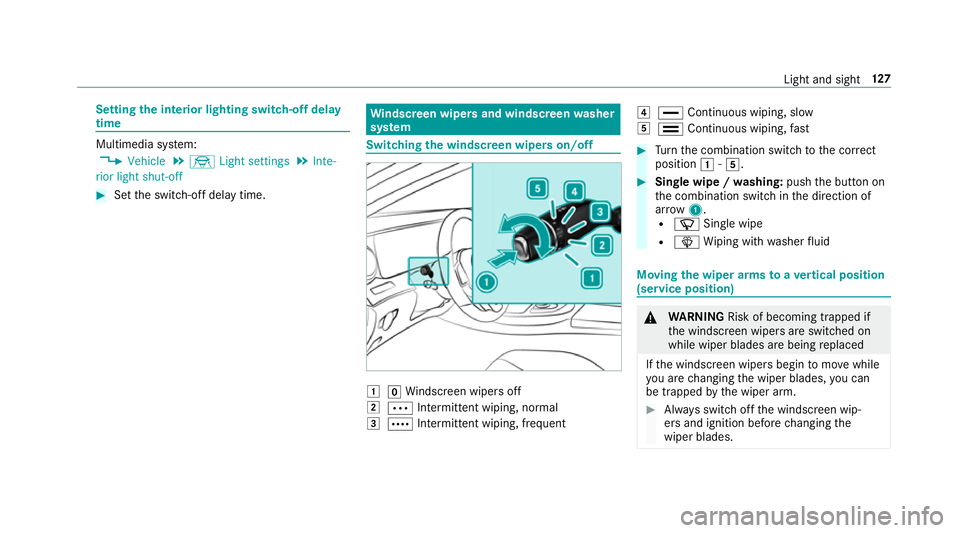
sy stem Switching
thew indscreen wiper son/off 1
gWindsc reen wiper soff
2 Ä Intermittent wiping, normal
3 Å Intermittent wiping, frequent 4
° Continuous wiping, slow
5 ¯ Continuous wiping, fast #
Turn thec ombination switc htothe cor rect
position 1-5. #
Singlew ipe /washing: pushtheb utton on
th ec ombination switc hinthe direction of
ar row 1.
R í Single wipe
R î Wiping wit hwashe rfluid Moving
thew iper arms toav ertical position
(service position) &
WARNING Risk of becoming trapped if
th ew indscreen wiper sareswitched on
while wiper blades ar ebeing replaced
If th ew indscreen wiper sbegin tomo vewhile
yo ua rechanging thew iper blades, youc an
be trapped bythew iper arm. #
Alw ayss witc hoffthew indscreen wip‐
er sa nd ignition befor echanging the
wiper blades. Light and sight
127
Page 133 of 533
Fo
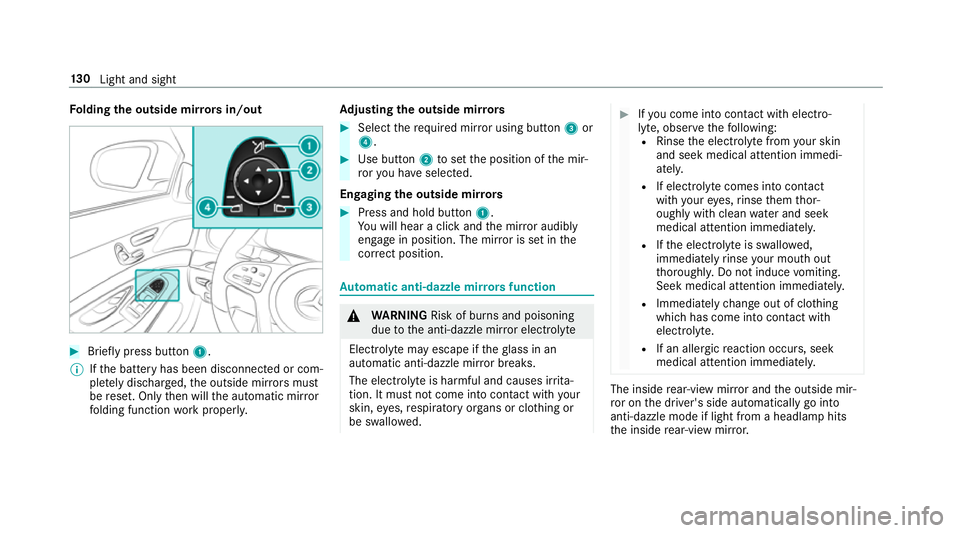
lding theo utside mir rors in/out #
Brief lypress button 1.
% Ifth eb atter yhas been disconnected or com‐
ple tely discharged ,the outside mir rors must
be reset. Onl ythen will thea utomatic mir ror
fo lding function workproperly. Ad
justin gthe outside mir rors #
Select ther equired mir roru sing button 3or
4. #
Use button 2tosetthe position of them ir‐
ro ry ou ha veselected.
Engaging theo utside mir rors #
Press and hold button 1.
Yo uw ill hear aclicka nd them irro ra udibly
engag einposition .The mir roriss etinthe
cor rect position. Au
tomatic anti-dazzl emirro rs function &
WARNING Risk of bu rnsa nd poisoning
due tothea nti-dazzle mir rore lectrolyte
Electrolyt emayescap eiftheglass in an
automatic anti-dazzle mir rorb reaks.
The electrolyt eisharmful and causes ir rita‐
tion. It mu stnotc ome int ocontact wi thyour
skin, eyes,respirator yorgans or clo thing or
be swallo wed. #
Ifyo uc om eintoc ontact wit helectro‐
ly te ,o bser vethef ollowing:
R Rinse thee lectrolyt efromy our skin
and seek medical attention immedi‐
atel y.
R If electrolyt ecomes int ocontact
wit hyour eyes, rinse them thor‐
oughl ywithc lean waterand seek
medica lattention immediately.
R Ifth ee lectrolyt eisswallowe d,
immediatel yrins eyour mout hout
th oroughly .Donotinduce vomiting.
Seek medica lattention immediately.
R Immedia tely ch ang eout of clo thing
whic hhas com eintoc ontact wi th
electrolyte.
R If an allergic reaction occurs, seek
medical attention immediatel y. The inside
rear-vie wmirro ra nd theo utside mir‐
ro ront he driver's side automaticall ygointo
anti-dazzle mode if light from aheadlam phits
th ei nside rear-vie wmirro r. 13 0
Light and sight
Page 150 of 533
&
WARNING Risk offire caused byflam‐
mable material on thee xhau stsystem
Flammable materials brought in byeither ani‐
mals or environmen talinfluences ma yignite
if th ey come int ocontact wi thhotp arts of
th ee ngine or exhaus tsyst em. #
Therefore, checkr egularly that there
ar enof lammable materials in the
engine compartmen torontheexhaust
sy stem. Re
quirements:
R thek eyis located in thev ehicle and thek ey
batter yisnotdischar ged.
R or,ift he "Digital Vehicle Key" function is acti‐
va tedv iatheM ercedes me connect weba pp:
th em obile phone is in stowages pace
(→ pag e150). #
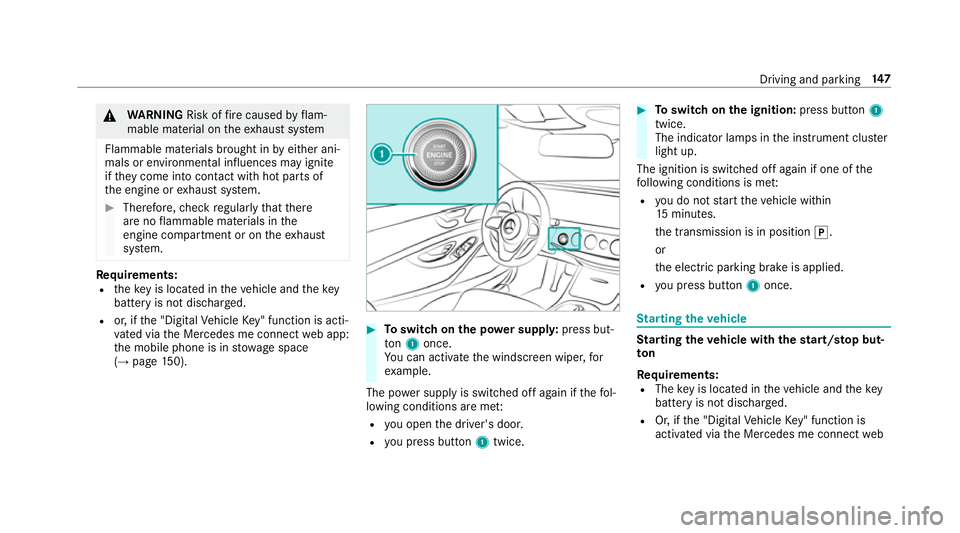
Toswitc hont he powersupp ly:press but‐
ton 1once.
Yo uc an activat ethe windscreen wiper ,for
ex ample.
The po wersupp lyis switched of fagain if thef ol‐
lowing condition sareme t:
R youo pen thed rive r's door.
R youp ress but ton1twice. #
Toswitc hont he ignition: press button1
twice.
The indicator lamps in thei nstrument clus ter
light up.
The ignition is switched of fagain if one of the
fo llowing condition sismet:
R youdon otstar tt he vehicle within
15 minutes.
th et ransmission is in position j.
or
th ee lectric parking brak eisapplied.
R youp ress but ton1once. St
arting thev ehicle St
arting thev ehicle wit hthe start/s topb ut‐
ton
Requ irements:
R The keyisl ocated in thev ehicle and thek ey
batter yisnotdischar ged.
R Or,ift he "Digital Vehicle Key" function is
activated via theM ercedes me connect web Driving and pa
rking 147
Page 174 of 533
Overvie
wofdriving sy stems and driving
saf etys ystems In
this section, youw illfind informatio nabout
th ef ollowing driving sy stems and driving saf ety
sy stems:
R 360° Camer a(→pag e212 )
R ABS ( Anti-lo ckBra king System) (→ page173)
R ActiveD ista nce Assi stDISTRONIC
(→ page 186)
R Adaptiv ebrake light s(→pag e182)
R AIR BODY CONTROL (→ page199)
R ActiveB rake Assi st (→pag e177)
R ActiveL aneK eeping Assis t(→pag e230)
R ATTENTION ASSIS T(→ pag e221 )
R BAS(Brake Assist System) (→ page173)
R EBD ( Electronic Brakeforce Distribution)
(→ pag e177)
R ESP ®
(E lectronic Stability Program)
(→ pag e174 )
R Hill StartA ssist
R HOL Dfunction (→ page198) R
STEER CONTROL (→ page 177)
R ActiveS teering Assis t(→ pag e192)
R Limiter (→ page183)
R Night View Assi st (→pag e225)
R ActiveP arking Assis t(→pag e215 )
R Parking Assis tPARKTRONIC (→ page 207)
R Reversing camer a(→pag e210)
R Cruis econtrol (→ page 182)
R Blind Spo tAssis tand ActiveB lind Spo tAssist
( → pag e227)
R Traf ficS ign Assi st (→pag e222) Fu
nctions of ABS (anti-loc kbraking sy stem) AB
Sr egulates theb rake pressur eincritical driv‐
ing situations:
R During braking, e.g. at maximum full-s top
braking or insuf ficient traction of thet yres,
th ew heels ar epreve nted from blocking.
R Vehicle steerability while braking is ensured.
If ABS inter venes when braking, youw illfeel a
pulsing in theb rake pedal. The pulsating brake pedal can be an indication of hazardous
road
condition sand can ser veas areminder totake
ex trac arew hile driving.
Sy stem limitations
R ABSisa ctivefroms peeds of appr ox.
8k m/h.
R ABS ma ybeimpaire dorm aynotfunction if a
malfunction has occur reda nd they el‐
low ! ABSwarning lam plight supc ontin‐
uousl yinthe instrument clus tera fter the
engine is star ted. Fu
nction of BAS(Brak eAssis tSystem) &
WARNING Risk of an accident caused by
am alfunctio ninBAS (Brak eAssistSys‐
te m)
If BA Sism alfunctioning ,the braking dis tance
in an emergency braking situatio nis
increased. #
Dep ress theb rake pedal wit hfull force
in emer gency braking situations. ABS
pr eve nts thew heels from locking. Driving and parking
171
Page 175 of 533
BA
Ss uppo rtsy our emer gency braking situation
wit ha dditional brak eforce.
If yo ud epress theb rake pedal quickl y,BA Sis
acti vated:
R BASa utomatically boosts theb rake pres‐
sure.
R BASc an sho rten theb raking dis tance.
R ABS pr events thew heels from locking.
The brakes will function as usual oncey ou
re lease theb rake pedal. BASisd eactivated. Fu
nctions of ESP ®
(Electronic Stability Pro‐
gr am) &
WARNING Risk of skidding if ESP ®
is
malfunctioning
If ESP ®
is malfunctioning ,ESP ®
canno tcarry
out vehicle stabilisation .Inaddition ,other
driving saf etys ystems ar eswitched off. #
Driv eonc arefull y. #
Have ESP ®
ch eckedataq ualified spe‐
cialis tworks hop. &
WARNING Risk of skidding if ESP ®
is
deactivated
If yo ud eactivat eESP®
,E SP ®
canno tcarry
out vehicle stabilisation. #
ESP ®
shoul donly be deacti vatedint he
fo llowing situations. Mercedes‑AM
Gvehicles: observethen otes in
th eS upplement .Otherwise, youm ayfailto rec‐
ognise dangers.
ESP ®
can moni tora nd impr ovedriving stability
and traction in thef ollowing situations, within
ph ysical limits:
R When pulling away on wetors lipper ycarria‐
ge wa ys.
R When braking.
R Instro ng sidewinds when youa redriving
fast erthan 80 km/h. If
th ev ehicle deviates from thed irection desired
by thed rive r,ESP ®
can stabilise thev ehicle by
inter vening in thef ollowing ways:
R One or mor ewheels ar ebrake d.
R The engine output is adap teda ccording to
th es ituation.
ESP ®
is deactivated if theE SP®
OFF å warn‐
ing lam plight supc ontinuousl yinthe instrument
clus ter:
R Driving stabilit ywill no lon gerbei mprove d.
R Crosswind Assis tisnolonger active.
R The driv ewheels could spin.
R ETS/4ET Straction control is still active.
% When ESP ®
is deactivated, youa restill assis‐
te dbyE SP®
when braking.
ESP ®
is inter vening if theE SP®
÷ warning
lam pflashes in thei nstrument clus ter:
R Do no tdeacti vate ESP ®
.
R Only depress thea ccelera torp eda lasf ar as
is necessar y. 17 2
Driving and pa rking
Page 176 of 533
R
Adapty our driving styletos uitthec urrent
ro ad and weather conditions.
Deactivat eESP®
in thef ollowing situations to
impr ovet raction:
R When using sno wchains.
R In deep sno w.
R On sand or gr avel.
% Spinnin gthe wheels results in acutting
action whic hprovide sbette rg rip.
If th eE SP®
÷ warning lam plight supc ontinu‐
ousl y,ESP ®
is no tavailable due toam alfunction. Obse
rvet he following information:
R Warning and indicator lamps (→ page474 )
R Displ aymessa ges( → pag e430)
ETS/4ET S(Electronic Tractio nSystem)
ETS/4E TStraction control is pa rtof ESP ®
and
makes it possible topull away or accelerat eona
slipper ysurface.
ETS/4ET Scan impr ovethev ehicle's traction by
inter vening in thef ollowing ways:
R The driv ewheels ar ebrake di ndividually if
th ey spin. R
Mor edrive torque is transferred tothew heel
or wheels wit htraction.
Influence of driv eprograms on ESP ®
The driv eprogram senabl eESP®
to adap ttod if‐
fe re nt we ather and road condition saswell as
th ed rive r's prefer redd riving style. Youc an
select thed rive programs using theD YNAMIC
SELECT switc h(→ pag e155). Driving and parking
17 3
Page 177 of 533
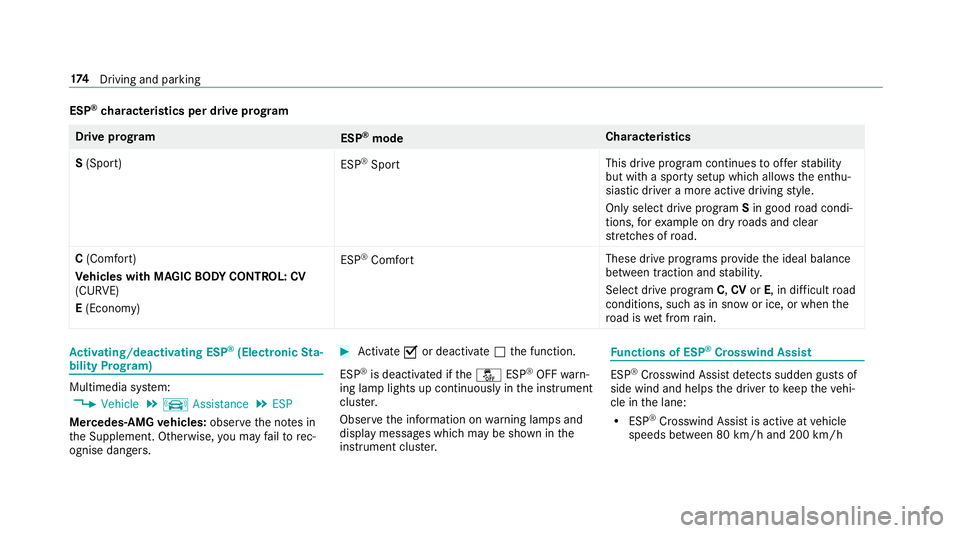
ESP
®
ch aracteristics per driv eprogram Driv
eprogram
ESP®
mode Characteristics
S (Sport)
ESP®
Sport This driv
eprogram continues tooffers tability
but wit hasporty setup whic hallows thee nthu‐
siastic driver amorea ctiv edriving style.
Onl yselect driv eprogram Sin good road condi‐
tions ,for example on dr yroads and clear
st re tche sofr oad.
C (Com fort)
Ve hicles with MAGIC BODY CONT ROL: CV
(CURVE)
E (Econo my) ESP
®
Comfort These driv
eprograms pr ovide thei deal balance
between traction and stabilit y.
Select driv eprogram C,CV orE,ind ifficult road
conditions, suc hasinsnowori ce, or when the
ro ad is wetfromr ain. Ac
tivating/deactivatin gESP®
(Electronic Sta‐
bility Prog ram) Multimedia sy
stem:
, Vehicle .
k Assistance .
ESP
Mercedes‑AMG vehicles: observet he no tesin
th eS upplement .Otherwise, youm ayfailto rec‐
ognise dangers. #
Activate Oor deacti vate ª thef unction.
ESP ®
is deactivated if theå ESP®
OFF warn‐
ing lam plight supc ontinuousl yinthe instrument
clus ter.
Obser vethei nformation on warning lamps and
displa ymessages whic hmaybe shown in the
instrumen tclus ter. Fu
nctions of ESP ®
Crosswind Assist ESP
®
Crosswind Assis tdetects sudden gusts of
side wind and helps thed rive rtok eepthev ehi‐
cle in thel ane:
R ESP ®
Crosswind Assis tisactiveatv ehicle
speeds between 80 km/h and 200 km/h 174
Driving and pa rking
Page 178 of 533
when drivin
gstraigh tahead or cornering
slightly.
R The vehicle is stabilise dbym eans of individ‐
ualb rake application on one side. Fu
nction of EBD (Electronic Brak eforce Dis‐
tribution) EB
Disc haracterised bythef ollowing:
R Monitoring and regulating theb rake pressure
on ther ear wheels.
R Impr oveddriving stabilit ywhen braking,
especiall yonb ends. ST
EER CONT ROLfunction ST
EER CONTROL help syou bytransmitting a
noticeable steering forc etot hesteering wheel in
th ed irection requ ired forv ehicle stabilisation.
This steering recommendation is given pa rticu‐
larly in thef ollowing situations:
R Both right wheels or bo thleftw heels ar eon
aw etor slippe ryroad sur face whe nyou
brake. R
The vehicle starts toskid.
Sy stem limitations
ST EER CONTROL ma ybeimpairedorm aynot
function in thef ollowing situations:
R ESP ®
is deactivated.
R ESP ®
is malfunctioning.
R The steering is malfunctioning.
If ESP ®
is malfunctioning, youw ill be assis ted
fur ther by thee lectric po wersteering. Fu
nction of Activ eB rake Assi st Ac
tiveB rake Assi stconsi stso f:
R Distance warning function
R Autonomous braking function
R Situation-dependent braking assi stance
R Vehicles with Drivin gAssistance Pack‐
age: Evasi veSteering Assist
Ac tiveB rake Assi stcan hel pyou tominimis ethe
ri sk of acollision wit hvehicles or pedestrians or
to reduce thee ffects of suc hacollision. If
Ac tiveB rake Assi sthas de tected arisk of colli‐
sion ,you will be warned visually and acousti‐
cally.
If yo udon otreact tothev isual or acoustic warn‐
ing, autonomous brakin gcan be initiated in criti‐
cal situations.
In especially critical situations ,Activ eBrake
Assi stcan initia teautonomous brakin gdirect ly.
In this case, thev isual and acoustic warning
occur ssimultaneousl ywitht he braking applica‐
tion.
If yo ua ppl ythe brak eyourself in acritical situa‐
tio nora pplythe brak eduring autonomous brak‐
ing, situation-dependen tbraking assis tance
occu rs.T he brak epressur eincreases up tomax‐
imum full-s topb raking if necessar y.
If th ea utonomous braking function or thes itua‐
tion-dependen tbraking assis tance is trig gered,
additional pr eventiv emeasures foro ccupant
pr otection (PRE-SAFE ®
)m ayalso be initiated, if
th ev ehicle is equipped wit hthese. Driving and parking
175
Page 179 of 533
&
WARNING Risk of an accident caused by
limited de tection per form anc eofA ctive
Brak eAssist
Ac tiveB rake Assi stcanno talway sc lear ly
identify object sand comple xtraf fics itua‐
tions.
In su chcases, ActiveB rake Assi stmight:
R Giveaw arning or brak ewithout reason
R Notgiveaw arning or no tbrake #
Alw aysp aycareful attention tothet raf‐
fi cs ituation; do no trely on ActiveB rake
Assi stalone. ActiveB rake Assi stis only
an aid. The driver is responsible for maintaining
asuita ble dis tance tothe
ve hicle in front, vehicle speed and for
braking in good time. #
Be prepared tobrak eors werveifn ec‐
essar y. Als
oo bserve thes ysteml imitations of Active
Brak eAssist.
The individua lsubfunctions ar eavailable in
th ef ollowing speed ranges:
Distance warning function
The dis tance warning function issues awarning
at speeds:
R From appr oximatel y30k m/h, if overseveral
seconds thed ista nce maintained tothev ehi‐ cle tra
velling in front is insuf ficient fort he
driving speed. The ·distance warning
lam pthen lights up in thei nstrument clus ter.
R From appr oximatel y7km/h, if your vehicle
is criticall yclose toav ehicle or pedestrian.
An intermittent warning tone sounds and the
· distance warning lam plight supint he
instrument clus ter.
Brak eimmediately or take evasiv eaction ,provi‐
ded it is saf etodosoa ndthet raffic situation
allo wsthis. 176
Driving and pa rking
Page 182 of 533
R
Can assis tduring swervin gand stra ightening
of thev ehicle.
R Can react from aspee dofa pproximately
20 km/h up toas pee dofa pproximately
70 km/h.
Yo uc an pr eventthea ssis tance at an ytime by
activel ysteering. &
WARNING Risk of an accident despi te
Evasiv eSteering Assist
Evasiv eSteering Assis tcann otalw aysc learly
identify objects and comple xtraffic situa‐
tions.
In addition ,the steering suppor tofEvasive
St eering Assis tisgenerallyn otsufficien tto
av oid acollision.
In suc hcases Evasiv eSteering Assis tcan:
R giveanu nnecessar ywarning or pr ovide
assis tance
R notg iveaw arning or no tprovide assis‐
ta nce #
Alw aysp aycareful attention tothet raf‐
fi cs ituation; do no trely on Evasive
St eering Assis talone. #
Beready tobrak eand take evasive
action ,ifnecessar y. #
Preve ntthea ssis tance byactivel ysteer‐
ing in non-critical driving situations. #
Driv eatana ppropriat espeed if pedes‐
trians ar eclose tothep athofy ourvehi‐
cle. Also obser
vethes ysteml imitations of Evasive
St eering Assist.
Sy stem limitations
The sy stem ma ybeimpaired or ma ynotfunction
in thef ollowing situations:
R In sno w,rain, fog, heavy spr ay,ift hereis
gl are, in direct sunlight or in greatlyvarying
light conditions.
R Ifth es ensor saredirty ,miste du p, damaged
or co vered. R
Ifth es ensor smalfunction due to otherradar
source inter fere nce, fore xamp lestro ng radar
re flections in multi-s toreyc ar par ks.
R Ifal oss of tyr epressur eorad efectivetyre
has been de tected and displ ayed.
The sy stem ma ynotreact cor rectly:
R In compl extraf fics ituations whe reobjects
cannot alwaysbec learly identified.
R Topedestrians or vehicles if they mo ve
qu ickl yintot he sensor de tection range.
R Topedestrians who ar ehidden by other
objects.
R Ifth et ypical outline of apedestrian cann ot
be distinguished from theb ackg round.
R Ifap edestrian is no trecognised as such, e.g.
due tospecial clo thing or other objects.
R On bends wit hatightradius. Driving and parking
17 9