check engine light MERCEDES-BENZ SPRINTER 2005 Service User Guide
[x] Cancel search | Manufacturer: MERCEDES-BENZ, Model Year: 2005, Model line: SPRINTER, Model: MERCEDES-BENZ SPRINTER 2005Pages: 1232, PDF Size: 39.23 MB
Page 283 of 1232
WIPERS/WASHERS
TABLE OF CONTENTS
page page
WIPERS/WASHERS
DESCRIPTION..........................1
OPERATION............................3
DIAGNOSIS AND TESTING - WIPER &
WASHER SYSTEM.....................5
CLEANING - WIPER & WASHER SYSTEM.....5
INSPECTION - WIPER & WASHER SYSTEM . . . 6
CHECK VALVE
DESCRIPTION..........................7
OPERATION............................7
REMOVAL.............................7
INSTALLATION..........................7
WASHER FLUID LEVEL SWITCH
DESCRIPTION..........................7
OPERATION............................8
WASHER HOSES/TUBES
DESCRIPTION..........................8
OPERATION............................9
WASHER NOZZLE
DESCRIPTION..........................9
OPERATION............................9
REMOVAL.............................9
INSTALLATION..........................9
WASHER PUMP/MOTOR
DESCRIPTION..........................9
OPERATION...........................10
REMOVAL.............................10
INSTALLATION.........................10
WASHER RESERVOIR
DESCRIPTION.........................11OPERATION...........................11
REMOVAL.............................11
INSTALLATION.........................12
WIPER ARM
DESCRIPTION.........................13
OPERATION...........................14
REMOVAL.............................14
INSTALLATION.........................14
WIPER BLADE
DESCRIPTION.........................15
OPERATION...........................15
REMOVAL.............................16
INSTALLATION.........................16
WIPER LINKAGE
DESCRIPTION.........................17
OPERATION...........................17
REMOVAL.............................17
INSTALLATION.........................18
WIPER MOTOR
DESCRIPTION.........................19
OPERATION...........................19
REMOVAL.............................19
INSTALLATION.........................19
WIPER RELAY
DESCRIPTION.........................20
OPERATION...........................21
REMOVAL.............................22
INSTALLATION.........................22
WIPERS/WASHERS
DESCRIPTION
An electrically operated intermittent wiper and
washer system is standard factory-installed safety
equipment on this model (Fig. 1). The wiper and
washer system includes the following major compo-
nents, which are described in further detail else-
where in this service information:
²Check Valve- The washer system check valve
is integral to the plumbing fitting located in the
washer plumbing between the cowl plenum washer
hose and the two washer nozzle hoses, and is located
beneath the cowl top panel at the base of the wind-
shield in the engine compartment.
²Multi-Function Switch- The multi-function
switch is secured to the top of the steering column,just below the steering wheel. Only the left (lighting),
right (wiper) control stalks and the hazard warning
switch button for the multi-function switch are visi-
ble, the remainder of the switch is concealed beneath
the steering column shrouds. The multi-function
switch contains all of the switches for both the wiper
and washer systems.(Refer to 8 - ELECTRICAL/
LAMPS/LIGHTING - EXTERIOR/MULTI-FUNC-
TION SWITCH - DESCRIPTION)
²Washer Fluid Level Switch- The optional
washer fluid level switch is integral to a unique ver-
sion of the washer pump/motor unit, which is located
in a dedicated hole on the top of the sump area near
the back of the windshield washer reservoir on the
right front fender wheel house in the engine com-
partment.
²Washer Nozzle- A single washer nozzle with
three separate orifices is secured with integral snap
VAWIPERS/WASHERS 8R - 1
Page 311 of 1232
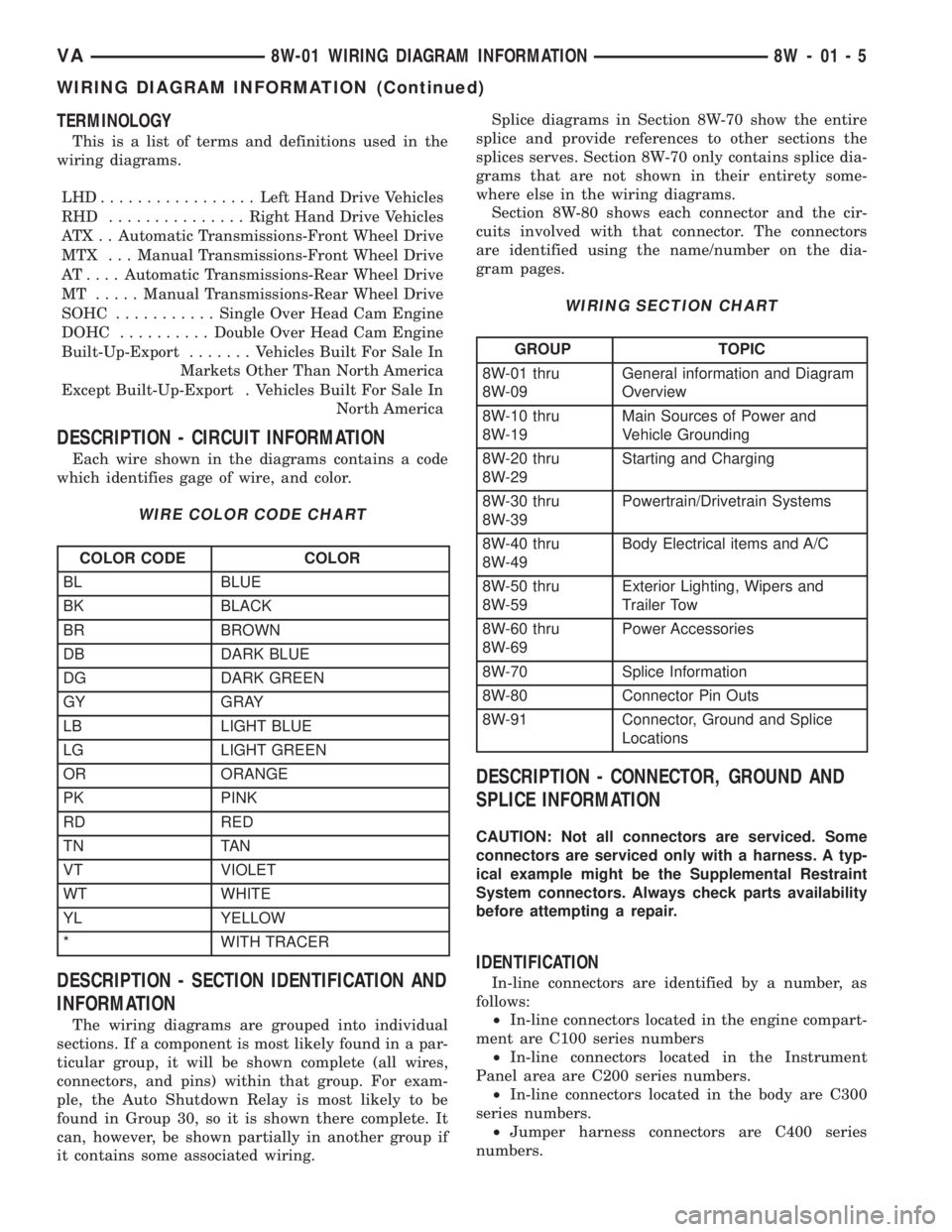
TERMINOLOGY
This is a list of terms and definitions used in the
wiring diagrams.
LHD.................Left Hand Drive Vehicles
RHD ...............Right Hand Drive Vehicles
ATX . . Automatic Transmissions-Front Wheel Drive
MTX . . . Manual Transmissions-Front Wheel Drive
AT....Automatic Transmissions-Rear Wheel Drive
MT .....Manual Transmissions-Rear Wheel Drive
SOHC...........Single Over Head Cam Engine
DOHC..........Double Over Head Cam Engine
Built-Up-Export....... Vehicles Built For Sale In
Markets Other Than North America
Except Built-Up-Export . Vehicles Built For Sale In
North America
DESCRIPTION - CIRCUIT INFORMATION
Each wire shown in the diagrams contains a code
which identifies gage of wire, and color.
WIRE COLOR CODE CHART
COLOR CODE COLOR
BL BLUE
BK BLACK
BR BROWN
DB DARK BLUE
DG DARK GREEN
GY GRAY
LB LIGHT BLUE
LG LIGHT GREEN
OR ORANGE
PK PINK
RD RED
TN TAN
VT VIOLET
WT WHITE
YL YELLOW
* WITH TRACER
DESCRIPTION - SECTION IDENTIFICATION AND
INFORMATION
The wiring diagrams are grouped into individual
sections. If a component is most likely found in a par-
ticular group, it will be shown complete (all wires,
connectors, and pins) within that group. For exam-
ple, the Auto Shutdown Relay is most likely to be
found in Group 30, so it is shown there complete. It
can, however, be shown partially in another group if
it contains some associated wiring.Splice diagrams in Section 8W-70 show the entire
splice and provide references to other sections the
splices serves. Section 8W-70 only contains splice dia-
grams that are not shown in their entirety some-
where else in the wiring diagrams.
Section 8W-80 shows each connector and the cir-
cuits involved with that connector. The connectors
are identified using the name/number on the dia-
gram pages.
WIRING SECTION CHART
GROUP TOPIC
8W-01 thru
8W-09General information and Diagram
Overview
8W-10 thru
8W-19Main Sources of Power and
Vehicle Grounding
8W-20 thru
8W-29Starting and Charging
8W-30 thru
8W-39Powertrain/Drivetrain Systems
8W-40 thru
8W-49Body Electrical items and A/C
8W-50 thru
8W-59Exterior Lighting, Wipers and
Trailer Tow
8W-60 thru
8W-69Power Accessories
8W-70 Splice Information
8W-80 Connector Pin Outs
8W-91 Connector, Ground and Splice
Locations
DESCRIPTION - CONNECTOR, GROUND AND
SPLICE INFORMATION
CAUTION: Not all connectors are serviced. Some
connectors are serviced only with a harness. A typ-
ical example might be the Supplemental Restraint
System connectors. Always check parts availability
before attempting a repair.
IDENTIFICATION
In-line connectors are identified by a number, as
follows:
²In-line connectors located in the engine compart-
ment are C100 series numbers
²In-line connectors located in the Instrument
Panel area are C200 series numbers.
²In-line connectors located in the body are C300
series numbers.
²Jumper harness connectors are C400 series
numbers.
VA8W-01 WIRING DIAGRAM INFORMATION 8W - 01 - 5
WIRING DIAGRAM INFORMATION (Continued)
Page 815 of 1232
Low turbocharger boost pressure and low engine
performance can be caused by leaks in the charge air
cooler or it's plumbing. The following procedure out-
lines how to check for leaks in the charge air cooler
system.
(1) Loosen clamp and remove turbocharger to air
inlet duct rubber sleeve from turbocharger.
(2) Insert Special Tool 8442 Adapter into the rub-
ber sleeve. Tighten existing clamp to 8 N´m (72
in.lbs.).
CAUTION: Do not apply more than 138 kpa (20 psi)
air pressure to the charge air cooler system, sever
damage to the charge air cooler system may occur.
(3) Connect regulated air supply to air fitting on
Special Tool 8442 Adapter. Set air pressure to a Max-
imum of 138 kpa (20 psi).
(4) Using soapy water check the air inlet ducts,
rubber sleeves, charge air cooler and intake manifold
for leaks.
REMOVAL
(1) Remove front bumper.
(2) Remove headlamp assemblies.
(3) Remove front cross member together with front
grille.
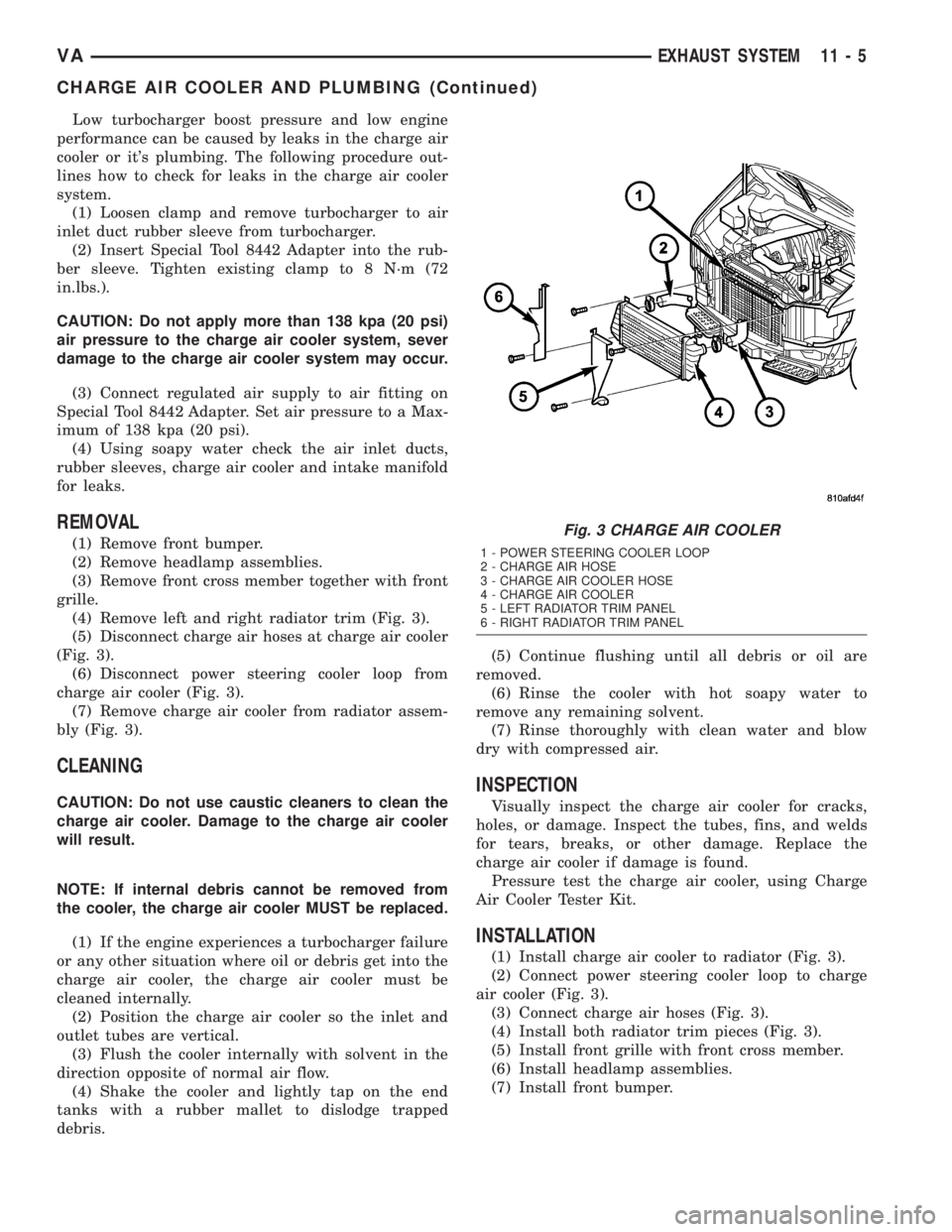
(4) Remove left and right radiator trim (Fig. 3).
(5) Disconnect charge air hoses at charge air cooler
(Fig. 3).
(6) Disconnect power steering cooler loop from
charge air cooler (Fig. 3).
(7) Remove charge air cooler from radiator assem-
bly (Fig. 3).
CLEANING
CAUTION: Do not use caustic cleaners to clean the
charge air cooler. Damage to the charge air cooler
will result.
NOTE: If internal debris cannot be removed from
the cooler, the charge air cooler MUST be replaced.
(1) If the engine experiences a turbocharger failure
or any other situation where oil or debris get into the
charge air cooler, the charge air cooler must be
cleaned internally.
(2) Position the charge air cooler so the inlet and
outlet tubes are vertical.
(3) Flush the cooler internally with solvent in the
direction opposite of normal air flow.
(4) Shake the cooler and lightly tap on the end
tanks with a rubber mallet to dislodge trapped
debris.(5) Continue flushing until all debris or oil are
removed.
(6) Rinse the cooler with hot soapy water to
remove any remaining solvent.
(7) Rinse thoroughly with clean water and blow
dry with compressed air.
INSPECTION
Visually inspect the charge air cooler for cracks,
holes, or damage. Inspect the tubes, fins, and welds
for tears, breaks, or other damage. Replace the
charge air cooler if damage is found.
Pressure test the charge air cooler, using Charge
Air Cooler Tester Kit.
INSTALLATION
(1) Install charge air cooler to radiator (Fig. 3).
(2) Connect power steering cooler loop to charge
air cooler (Fig. 3).
(3) Connect charge air hoses (Fig. 3).
(4) Install both radiator trim pieces (Fig. 3).
(5) Install front grille with front cross member.
(6) Install headlamp assemblies.
(7) Install front bumper.
Fig. 3 CHARGE AIR COOLER
1 - POWER STEERING COOLER LOOP
2 - CHARGE AIR HOSE
3 - CHARGE AIR COOLER HOSE
4 - CHARGE AIR COOLER
5 - LEFT RADIATOR TRIM PANEL
6 - RIGHT RADIATOR TRIM PANEL
VAEXHAUST SYSTEM 11 - 5
CHARGE AIR COOLER AND PLUMBING (Continued)
Page 874 of 1232
SPECIFICATIONS - TORQUE CHART
TORQUE SPECIFICATIONS
DESCRIPTION N´m Ft. Lbs. In. Lbs.
Power Steering Pump To
Timing Case Cover/
Support21 15 185
High Pressure Flexible
Hose To Power Steering
Pump38 28 336
Power Steering Pulley To
Pump30 22 265
FLUID
STANDARD PROCEDURE
POWER STEERING PUMP FILL AND BLEED
PROCEDURE
(1) Remove the cap from the fluid reservoir.
Check cap seal for damage and replace if
needed.
(2) Fill the power steering pump with Mopar
ATF+4 Automatic Transmission fluid or equivalent.
Do not fill fluid beyond the MAX mark.
(3) Raise the vehicles front wheels off the ground.
(4) With the engine off turn the steering wheel
from right to left.Perform this step until all the
bubble formations can no longer be seen in the
power steering reservoir.
(5) Start the engine and turn the steering wheel
with the engine at idle speed then shut the engine off
and check for correct oil level and no bubble in the
system.
(6) Reinstall power steering cap tightly.
(7) Test the system for leaks and proper operation.
FLUID COOLER TUBE
REMOVAL
(1) Siphon as much power steering fluid as possi-
ble out of the reservoir.
(2) Remove the grille (Refer to 23 - BODY/EXTE-
RIOR/GRILLE - REMOVAL).
(3) Remove the left headlight assembly.
(4) Disconnect the return lines from the cooler
tube.
(5) Remove the radiator clips (2).
(6) Remove the heat shield bolt for the turbo at
the core support.
(7) Remove the right headlight assembly.(8) Remove the core support bolts (4) and discon-
nect the hood latch cable.
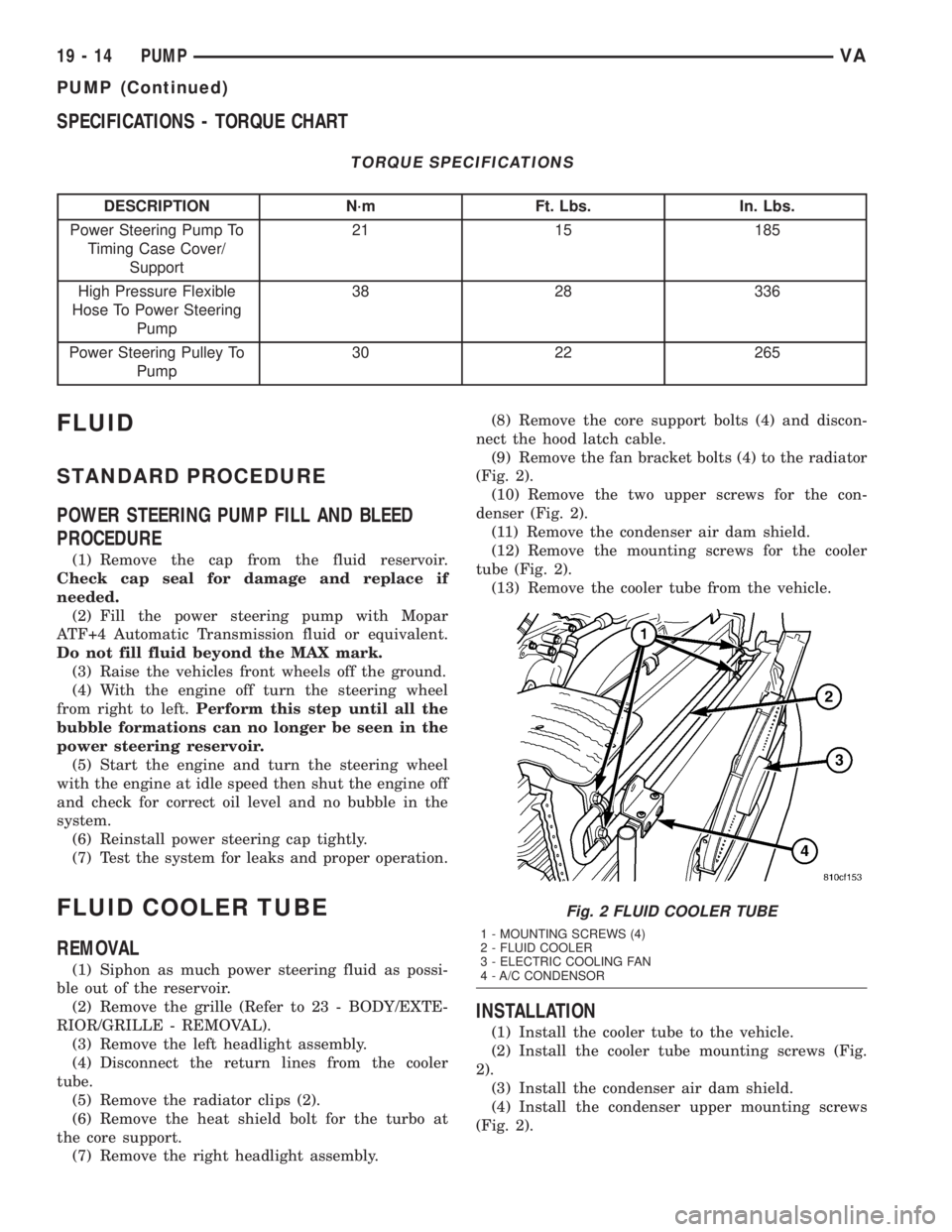
(9) Remove the fan bracket bolts (4) to the radiator
(Fig. 2).
(10) Remove the two upper screws for the con-
denser (Fig. 2).
(11) Remove the condenser air dam shield.
(12) Remove the mounting screws for the cooler
tube (Fig. 2).
(13) Remove the cooler tube from the vehicle.
INSTALLATION
(1) Install the cooler tube to the vehicle.
(2) Install the cooler tube mounting screws (Fig.
2).
(3) Install the condenser air dam shield.
(4) Install the condenser upper mounting screws
(Fig. 2).
Fig. 2 FLUID COOLER TUBE
1 - MOUNTING SCREWS (4)
2 - FLUID COOLER
3 - ELECTRIC COOLING FAN
4 - A/C CONDENSOR
19 - 14 PUMPVA
PUMP (Continued)
Page 1009 of 1232
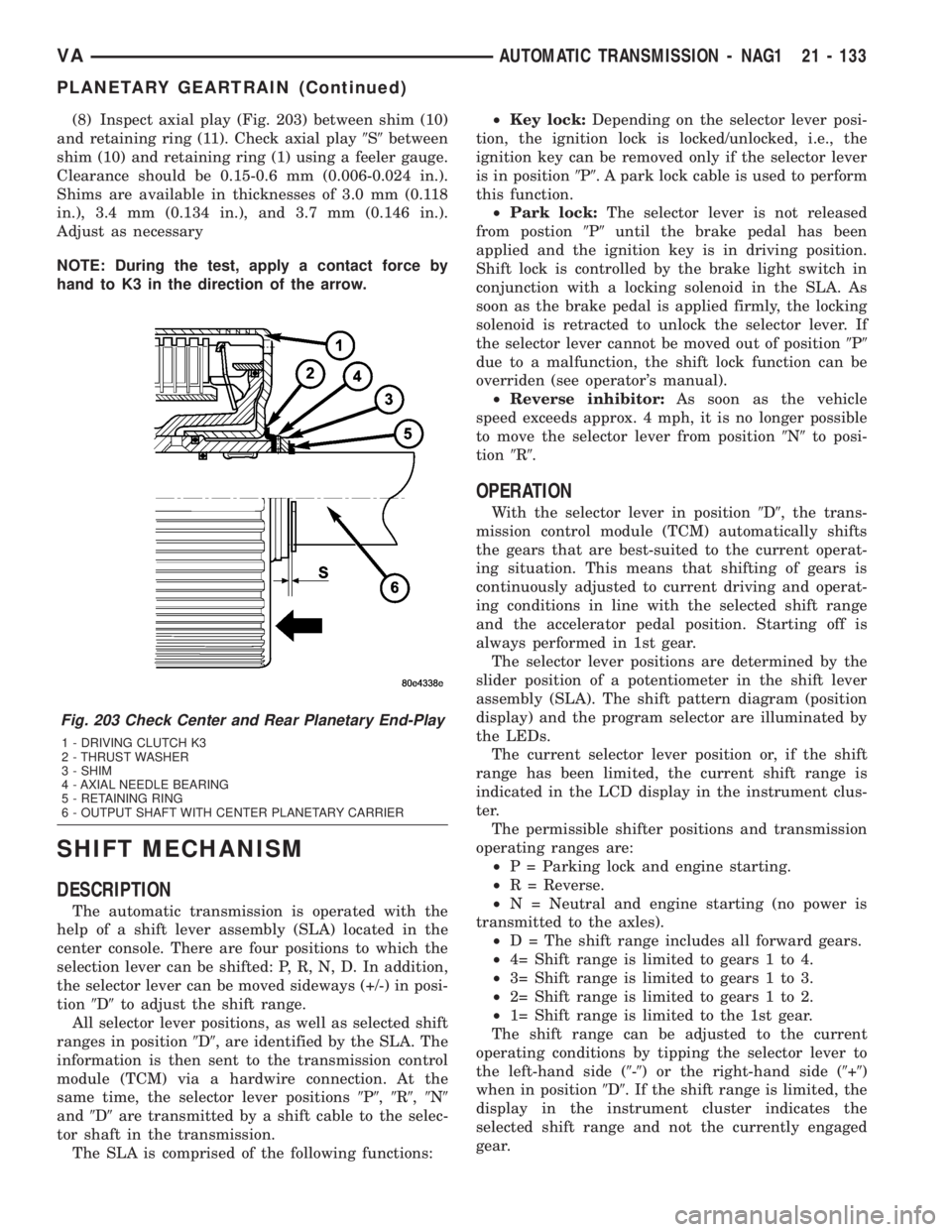
(8) Inspect axial play (Fig. 203) between shim (10)
and retaining ring (11). Check axial play9S9between
shim (10) and retaining ring (1) using a feeler gauge.
Clearance should be 0.15-0.6 mm (0.006-0.024 in.).
Shims are available in thicknesses of 3.0 mm (0.118
in.), 3.4 mm (0.134 in.), and 3.7 mm (0.146 in.).
Adjust as necessary
NOTE: During the test, apply a contact force by
hand to K3 in the direction of the arrow.
SHIFT MECHANISM
DESCRIPTION
The automatic transmission is operated with the
help of a shift lever assembly (SLA) located in the
center console. There are four positions to which the
selection lever can be shifted: P, R, N, D. In addition,
the selector lever can be moved sideways (+/-) in posi-
tion9D9to adjust the shift range.
All selector lever positions, as well as selected shift
ranges in position9D9, are identified by the SLA. The
information is then sent to the transmission control
module (TCM) via a hardwire connection. At the
same time, the selector lever positions9P9,9R9,9N9
and9D9are transmitted by a shift cable to the selec-
tor shaft in the transmission.
The SLA is comprised of the following functions:²Key lock:Depending on the selector lever posi-
tion, the ignition lock is locked/unlocked, i.e., the
ignition key can be removed only if the selector lever
is in position9P9. A park lock cable is used to perform
this function.
²Park lock:The selector lever is not released
from postion9P9until the brake pedal has been
applied and the ignition key is in driving position.
Shift lock is controlled by the brake light switch in
conjunction with a locking solenoid in the SLA. As
soon as the brake pedal is applied firmly, the locking
solenoid is retracted to unlock the selector lever. If
the selector lever cannot be moved out of position9P9
due to a malfunction, the shift lock function can be
overriden (see operator's manual).
²Reverse inhibitor:As soon as the vehicle
speed exceeds approx. 4 mph, it is no longer possible
to move the selector lever from position9N9to posi-
tion9R9.
OPERATION
With the selector lever in position9D9, the trans-
mission control module (TCM) automatically shifts
the gears that are best-suited to the current operat-
ing situation. This means that shifting of gears is
continuously adjusted to current driving and operat-
ing conditions in line with the selected shift range
and the accelerator pedal position. Starting off is
always performed in 1st gear.
The selector lever positions are determined by the
slider position of a potentiometer in the shift lever
assembly (SLA). The shift pattern diagram (position
display) and the program selector are illuminated by
the LEDs.
The current selector lever position or, if the shift
range has been limited, the current shift range is
indicated in the LCD display in the instrument clus-
ter.
The permissible shifter positions and transmission
operating ranges are:
²P = Parking lock and engine starting.
²R = Reverse.
²N = Neutral and engine starting (no power is
transmitted to the axles).
²D = The shift range includes all forward gears.
²4= Shift range is limited to gears 1 to 4.
²3= Shift range is limited to gears 1 to 3.
²2= Shift range is limited to gears 1 to 2.
²1= Shift range is limited to the 1st gear.
The shift range can be adjusted to the current
operating conditions by tipping the selector lever to
the left-hand side (9-9) or the right-hand side (9+9)
when in position9D9. If the shift range is limited, the
display in the instrument cluster indicates the
selected shift range and not the currently engaged
gear.
Fig. 203 Check Center and Rear Planetary End-Play
1 - DRIVING CLUTCH K3
2 - THRUST WASHER
3 - SHIM
4 - AXIAL NEEDLE BEARING
5 - RETAINING RING
6 - OUTPUT SHAFT WITH CENTER PLANETARY CARRIER
VAAUTOMATIC TRANSMISSION - NAG1 21 - 133
PLANETARY GEARTRAIN (Continued)
Page 1022 of 1232
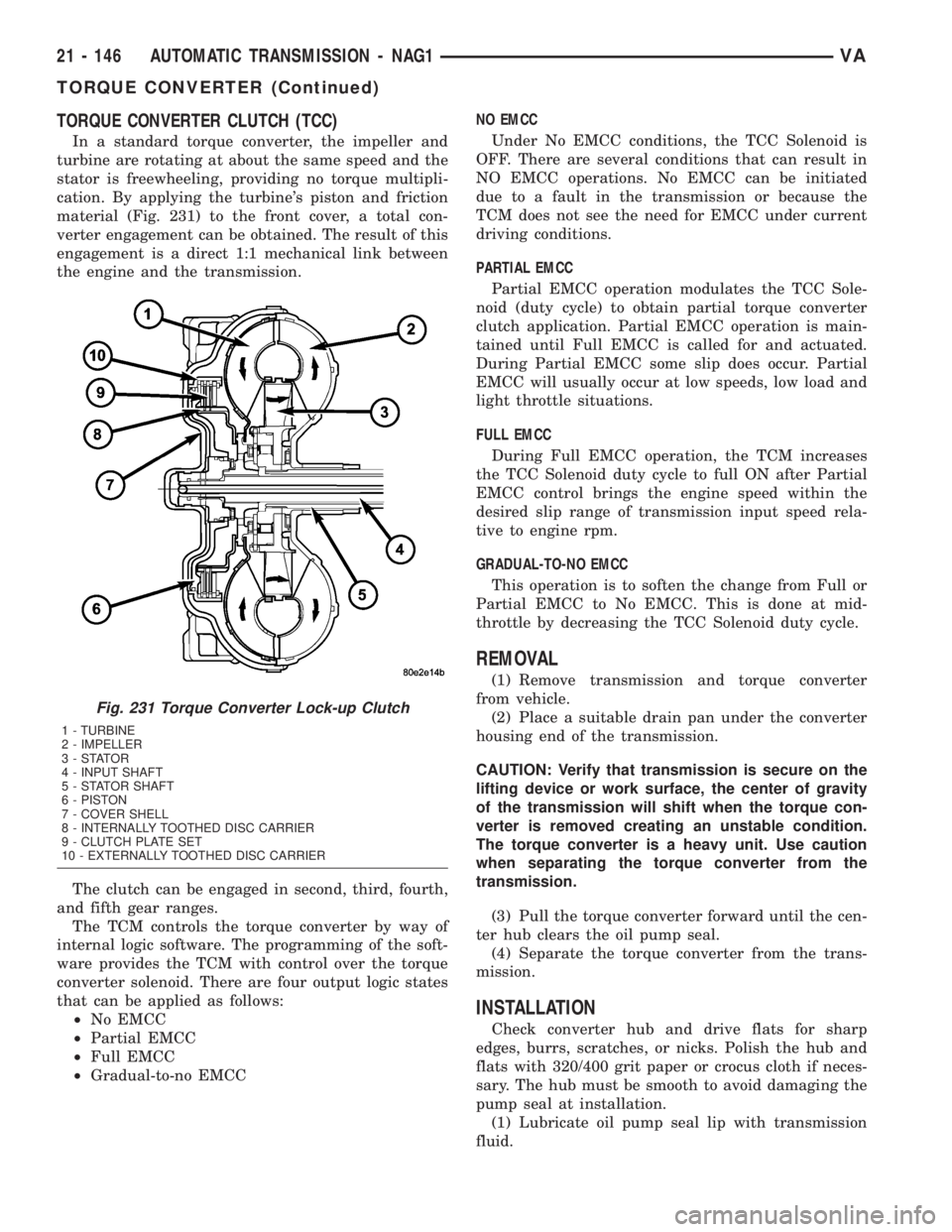
TORQUE CONVERTER CLUTCH (TCC)
In a standard torque converter, the impeller and
turbine are rotating at about the same speed and the
stator is freewheeling, providing no torque multipli-
cation. By applying the turbine's piston and friction
material (Fig. 231) to the front cover, a total con-
verter engagement can be obtained. The result of this
engagement is a direct 1:1 mechanical link between
the engine and the transmission.
The clutch can be engaged in second, third, fourth,
and fifth gear ranges.
The TCM controls the torque converter by way of
internal logic software. The programming of the soft-
ware provides the TCM with control over the torque
converter solenoid. There are four output logic states
that can be applied as follows:
²No EMCC
²Partial EMCC
²Full EMCC
²Gradual-to-no EMCCNO EMCC
Under No EMCC conditions, the TCC Solenoid is
OFF. There are several conditions that can result in
NO EMCC operations. No EMCC can be initiated
due to a fault in the transmission or because the
TCM does not see the need for EMCC under current
driving conditions.
PARTIAL EMCC
Partial EMCC operation modulates the TCC Sole-
noid (duty cycle) to obtain partial torque converter
clutch application. Partial EMCC operation is main-
tained until Full EMCC is called for and actuated.
During Partial EMCC some slip does occur. Partial
EMCC will usually occur at low speeds, low load and
light throttle situations.
FULL EMCC
During Full EMCC operation, the TCM increases
the TCC Solenoid duty cycle to full ON after Partial
EMCC control brings the engine speed within the
desired slip range of transmission input speed rela-
tive to engine rpm.
GRADUAL-TO-NO EMCC
This operation is to soften the change from Full or
Partial EMCC to No EMCC. This is done at mid-
throttle by decreasing the TCC Solenoid duty cycle.
REMOVAL
(1) Remove transmission and torque converter
from vehicle.
(2) Place a suitable drain pan under the converter
housing end of the transmission.
CAUTION: Verify that transmission is secure on the
lifting device or work surface, the center of gravity
of the transmission will shift when the torque con-
verter is removed creating an unstable condition.
The torque converter is a heavy unit. Use caution
when separating the torque converter from the
transmission.
(3) Pull the torque converter forward until the cen-
ter hub clears the oil pump seal.
(4) Separate the torque converter from the trans-
mission.
INSTALLATION
Check converter hub and drive flats for sharp
edges, burrs, scratches, or nicks. Polish the hub and
flats with 320/400 grit paper or crocus cloth if neces-
sary. The hub must be smooth to avoid damaging the
pump seal at installation.
(1) Lubricate oil pump seal lip with transmission
fluid.
Fig. 231 Torque Converter Lock-up Clutch
1 - TURBINE
2 - IMPELLER
3-STATOR
4 - INPUT SHAFT
5 - STATOR SHAFT
6 - PISTON
7 - COVER SHELL
8 - INTERNALLY TOOTHED DISC CARRIER
9 - CLUTCH PLATE SET
10 - EXTERNALLY TOOTHED DISC CARRIER
21 - 146 AUTOMATIC TRANSMISSION - NAG1VA
TORQUE CONVERTER (Continued)
Page 1132 of 1232
c. With the engine running, duct temperature
should not be less than 2É C (35É F) or than 12É C
(54É F).
(7) If the compressor has not cycled off and the
duct temperature is less than 2É C (35É F) , check the
evaporator temperature sensor and circuit by per-
forming the ATC Function Test (Refer to 24 - HEAT-
ING & AIR CONDITIONING - DIAGNOSIS AND
TESTING).
(8) If duct output temperature is not within speci-
fications, check the refrigerant system for leaks and
proper refrigerant charge (Refer to 24 - HEATING &
AIR CONDITIONING/PLUMBING - DIAGNOSIS
AND TESTING) and (Refer to 24 - HEATING & AIR
CONDITIONING/PLUMBING - STANDARD PRO-
CEDURE).
DIAGNOSIS AND TESTING - HEATER
PERFORMANCE
Before performing the following tests, perform the
ATC Function Test using the DRBIIItand refer toCooling for the procedures to check the radiator cool-
ant level, serpentine drive belt tension, radiator air
flow and the radiator fan operation.
MAXIMUM HEATER OUTPUT
Engine coolant is provided to the heater core
through a heater valve and heater hose. With the
engine idling at normal operating temperature, set
the heater-A/C controls as follows:
²Temperature control in the full hot position
²Mode control in the floor heat position
²Blower motor control in the highest speed posi-
tion
Using a test thermometer, check the temperature
of the air being discharged at the floor outlets. Com-
pare the test thermometer reading to the Tempera-
ture Reference chart.
TEMPERATURE REFERENCE CHART
Ambient Temperature Minimum Floor Outlet Temperature
Celsius Fahreheit Celsius Fahreheit
15.5É 60É 62.2É 144É
21.1É 70É 63.8É 147É
26.6É 80É 65.5É 150É
32.2É 90É 67.2É 153É
If the floor outlet air temperature is insufficient,
check for a faulty heater valve (perform ATC Func-
tion Test) and verify that the cooling system is oper-
ating to specifications (Refer to 7 - COOLING/
ENGINE/COOLANT - DIAGNOSIS AND TESTING).
Both of the heater hoses should be HOT to the touch
(the coolant return heater hose should be slightly
cooler than the supply hose. If the coolant return
hose is much cooler than the supply hose, locate and
repair the engine coolant flow obstruction in the
heater system.
POSSIBLE LOCATIONS OR CAUSE OF
OBSTRUCTED COOLANT FLOW
²Pinched or kinked heater hoses.
²Improper heater hose routing.
²Plugged heater hoses or supply and return ports
at the cooling system connections.
²Inoperative or stuck heater water valve.
²Plugged heater core.If proper coolant flow is verified, and heater floor
outlet air temperature is insufficient, a mechanical
problem may exist.
POSSIBLE LOCATIONS OR CAUSE OF
INSUFFICIENT HEAT
²An obstructed cowl air intake.
²Obstructed heater system outlets.
²Heater water valve not functioning properly.
TEMPERATURE CONTROL
If outlet air temperature cannot be adjusted with
the A/C-heater temperature control, one of the follow-
ing could require service:
²Faulty A/C-heater control switch.
²Faulty temperature sensor.
²Faulty A/C-heater control cable or actuator.
²Faulty A/C-heater control module.
24 - 4 HEATING & AIR CONDITIONINGVA
HEATING & AIR CONDITIONING (Continued)
Page 1155 of 1232
SOLENOID VALVE
DESCRIPTION
The rear A/C solenoid valve is a two-position elec-
trically operated shut-off valve, which is used to con-
trol refrigerant flow to the rear A/C evaporator from
the A/C compressor. The solenoid valve is located in
the rear A/C evaporator housing and is attached by a
bracket.
OPERATION
The solenoid valve is used by the rear A/C control
module to control rear A/C output temperature and
to prevent evaporator freezing. Evaporator tempera-
ture is controlled by cycling the solenoid valve open
and closed, thereby controlling refrigerant flow to the
rear evaporator. The normally closed valve only
allows refrigerant to flow through it when power is
supplied to the solenoid by the rear A/C control mod-
ule.
DIAGNOSIS AND TESTING
For circuit descriptions and diagrams, refer to Air
Conditioning/Heater in Group 8W - Wiring Diagrams.
NOTE: Prior to performing the following checks,
verify that the front A/C system is operating prop-
erly.
(1) With the engine running, the front A/C switch
in the On position and the rear A/C blower switch in
the Off position, check that the rear evaporator is not
colder than the ambient temperature. If the evapora-
tor temperature is colder than the ambient tempera-
ture, the solenoid is allowing refrigerant to flow
through the rear evaporator when in the closed posi-
tion. If OK, go to Step 2. If not OK, replace the rear
A/C solenoid valve (Refer to 24 - HEATING & AIR
CONDITIONING/CONTROLS/SOLENOID - REMOV-
AL).
(2) With the ignition switch in the Off position and
the rear A/C solenoid valve wire harness discon-
nected, check for continuity between the two solenoid
valve terminals. If OK, go to Step 3. If not OK,
replace the solenoid valve (Refer to 24 - HEATING &
AIR CONDITIONING/CONTROLS/SOLENOID -
REMOVAL).
(3) With the ignition switch in the Off position and
the rear A/C solenoid valve wire harness discon-
nected, check the solenoid valve ground circuits for a
good ground at all times. If OK, go to Step 4. If not
OK, repair the open circuit to ground as required.(4) With the ignition switch and the front A/C
switch in the On position and the rear A/C solenoid
valve wire harness disconnected, check the harness
for battery power at terminal 2. If OK, replace the
solenoid valve (Refer to 24 - HEATING & AIR CON-
DITIONING/CONTROLS/SOLENOID - REMOVAL).
If not OK, test the A/C control module as required
(Refer to 24 - HEATING & AIR CONDITIONING/
CONTROLS/POWER MODULE - DIAGNOSIS AND
TESTING).
REMOVAL
(1) Recover the refrigerant from the refrigerant
system (Refer to 24 - HEATING & AIR CONDITION-
ING/PLUMBING - STANDARD PROCEDURE).
(2) Disconnect and isolate the battery negative
cable.
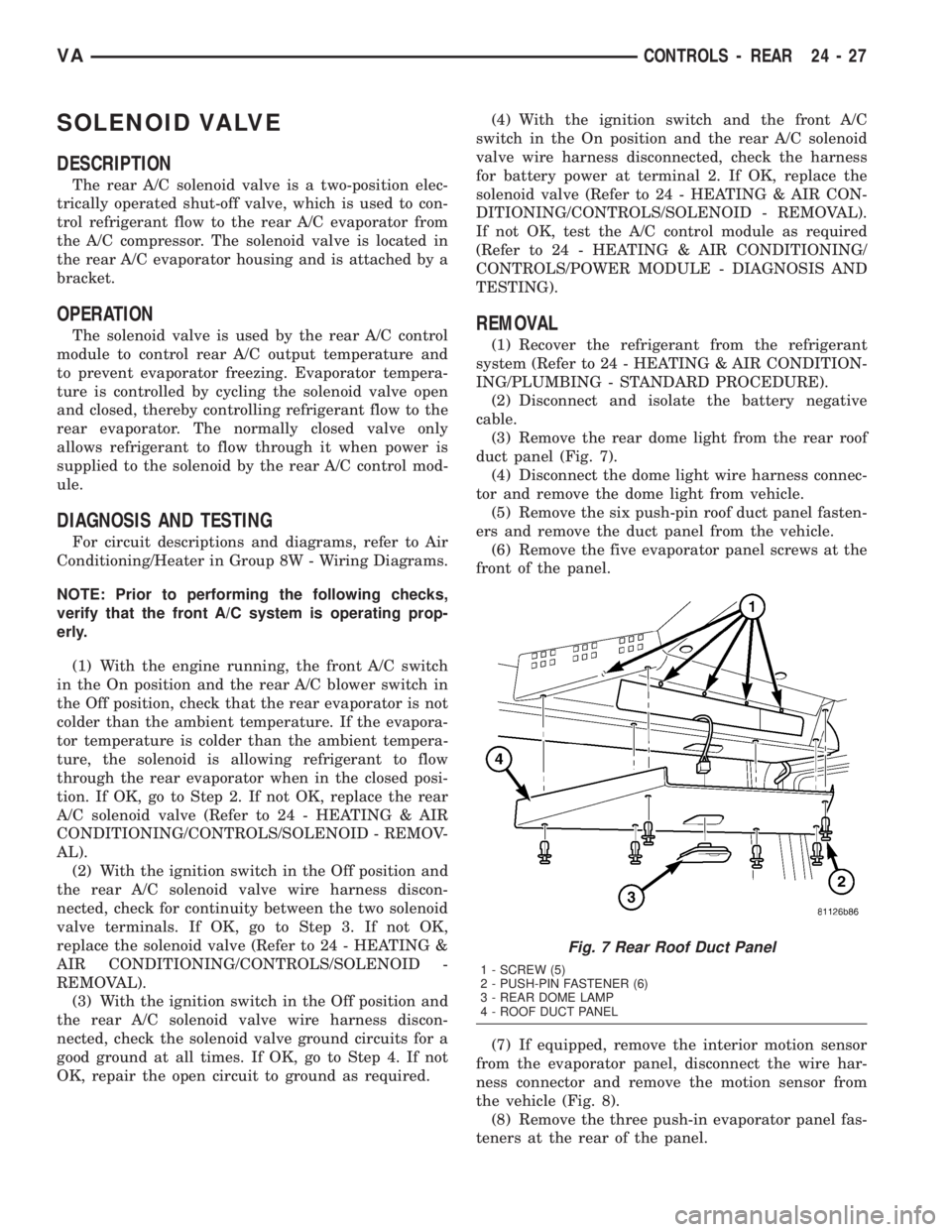
(3) Remove the rear dome light from the rear roof
duct panel (Fig. 7).
(4) Disconnect the dome light wire harness connec-
tor and remove the dome light from vehicle.
(5) Remove the six push-pin roof duct panel fasten-
ers and remove the duct panel from the vehicle.
(6) Remove the five evaporator panel screws at the
front of the panel.
(7) If equipped, remove the interior motion sensor
from the evaporator panel, disconnect the wire har-
ness connector and remove the motion sensor from
the vehicle (Fig. 8).
(8) Remove the three push-in evaporator panel fas-
teners at the rear of the panel.
Fig. 7 Rear Roof Duct Panel
1 - SCREW (5)
2 - PUSH-PIN FASTENER (6)
3 - REAR DOME LAMP
4 - ROOF DUCT PANEL
VACONTROLS - REAR 24 - 27
Page 1216 of 1232
DUAL REAR WHEEL INSTALLATION -
STANDARD PROCEDURE...............22-12
DUAL REAR WHEELS - INSTALLATION,
AXLE SHAFTS........................3-19
DUAL REAR WHEELS - REMOVAL, AXLE
SHAFTS.............................3-19
DUCTS - INSTALLATION, DEFROSTER....24-33
DUCTS - INSTALLATION, FLOOR
DISTRIBUTION.......................24-34
DUCTS - INSTALLATION, INSTRUMENT
PANEL.............................24-38
DUCTS - REMOVAL, DEFROSTER........24-33
DUCTS - REMOVAL, FLOOR
DISTRIBUTION.......................24-33
DUCTS - REMOVAL, INSTRUMENT
PANEL.............................24-37
EFFECTS OF INCORRECT FLUID LEVEL -
DIAGNOSIS AND TESTING............21-102
ELECTRIC COOLANT PUMP -
DESCRIPTION.......................24-57
ELECTRIC COOLANT PUMP -
INSTALLATION.......................24-57
ELECTRIC COOLANT PUMP - OPERATION . 24-57
ELECTRIC COOLANT PUMP - REMOVAL . . . 24-57
ELECTRICAL - DESCRIPTION............5-29
ELECTRICAL - OPERATION..............5-29
ELECTROHYDRAULIC UNIT - ASSEMBLY . . 21-95
ELECTROHYDRAULIC UNIT -
DESCRIPTION.......................21-82
ELECTROHYDRAULIC UNIT -
DISASSEMBLY.......................21-92
ELECTROHYDRAULIC UNIT -
INSTALLATION......................21-100
ELECTROHYDRAULIC UNIT - OPERATION . . 21-87
ELECTROHYDRAULIC UNIT - REMOVAL . . . 21-92
ELECTROLYTE LEVEL - STANDARD
PROCEDURE, CHECKING BATTERY.......8F-12
ELECTROSTATIC DISCHARGE (ESD)
SENSITIVE DEVICES - STANDARD
PROCEDURE......................8W-01-7
ELEMENT - DESCRIPTION, HEATED SEAT . . 8G-3
ELEMENT - DIAGNOSIS AND TESTING,
HEATED SEAT ........................8G-3
ELEMENT - INSTALLATION, AIR
CLEANER............................9-20
ELEMENT - OPERATION, HEATED SEAT....8G-3
ELEMENT - REMOVAL, AIR CLEANER......9-20
END - DIAGNOSIS AND TESTING, OUTER
TIE ROD............................19-10
END - INSTALLATION, TIE ROD.........19-11
END - REMOVAL, TIE ROD.............19-11
ENGINE - DESCRIPTION.................9-2
ENGINE - DESCRIPTION, FUEL
REQUIREMENTS - DIESEL...............0-1
ENGINE - DIAGNOSIS AND TESTING,
DIESEL.............................11-2
ENGINE - STANDARD PROCEDURE,
COMPRESSION TESTING................9-3
ENGINE BLOCK HEATER - INSTALLATION . . . 7-14
ENGINE BLOCK HEATER - REMOVAL......7-14
ENGINE CONTROL MODULE -
DESCRIPTION........................8E-3
ENGINE CONTROL MODULE -
INSTALLATION........................8E-4
ENGINE CONTROL MODULE - REMOVAL . . . 8E-4
ENGINE COOLANT - DESCRIPTION.........0-1
ENGINE COOLANT TEMP SENSOR -
DESCRIPTION........................7-14
ENGINE COOLANT TEMP SENSOR -
INSTALLATION........................7-15
ENGINE COOLANT TEMP SENSOR -
REMOVAL...........................7-14
ENGINE COOLANT THERMOSTAT -
INSTALLATION........................7-16
ENGINE COOLANT THERMOSTAT -
REMOVAL...........................7-15
ENGINE CORE AND OIL GALLERY PLUGS
- STANDARD PROCEDURE, REPLACING....9-34
ENGINE COVER - INSTALLATION..........9-7
ENGINE COVER - REMOVAL
..............9-4
ENGINE CRADLE CROSSMEMBER -
INSTALLATION
........................13-8
ENGINE CRADLE CROSSMEMBER -
REMOVAL
...........................13-6
ENGINE OIL - DIESEL ENGINES -
DESCRIPTION
.........................0-3
ENGINE TEMPERATURE GAUGE -
DESCRIPTION
.......................8J-15ENGINE TEMPERATURE GAUGE -
OPERATION.........................8J-15
ENGINES - DESCRIPTION, ENGINE OIL -
DIESEL..............................0-3
ENTRY MODULE - DESCRIPTION,
SENTRY KEY REMOTE.................8Q-2
ENTRY MODULE - INSTALLATION,
SENTRY KEY REMOTE.................8Q-4
ENTRY MODULE - OPERATION, SENTRY
KEY REMOTE........................8Q-3
ENTRY MODULE - REMOVAL, SENTRY
KEY REMOTE........................8Q-3
ENTRY TRANSMITTER - DESCRIPTION,
REMOTE KEYLESS....................8N-2
ENTRY/EXIT LAMP BULB -
INSTALLATION.......................8L-32
ENTRY/EXIT LAMP BULB - REMOVAL.....8L-31
ENTRY/EXIT LAMP UNIT - INSTALLATION . 8L-32
ENTRY/EXIT LAMP UNIT - REMOVAL.....8L-32
EQUIPMENT - STANDARD PROCEDURE,
REFRIGERANT SYSTEM SERVICE........24-46
EVACUATE - STANDARD PROCEDURE,
REFRIGERANT SYSTEM...............24-47
EVAPORATOR - DESCRIPTION, A/C.......24-54
EVAPORATOR - INSTALLATION, A/C......24-55
EVAPORATOR - INSTALLATION, REAR....24-61
EVAPORATOR - OPERATION, A/C........24-54
EVAPORATOR - REMOVAL, A/C..........24-55
EVAPORATOR - REMOVAL, REAR........24-60
EVAPORATOR TEMPERATURE SENSOR -
DESCRIPTION....................24-17,24-25
EVAPORATOR TEMPERATURE SENSOR -
DIAGNOSIS AND TESTING.............24-26
EVAPORATOR TEMPERATURE SENSOR -
INSTALLATION..................24-18,24-26
EVAPORATOR TEMPERATURE SENSOR -
OPERATION....................24-18,24-26
EVAPORATOR TEMPERATURE SENSOR -
REMOVAL.....................24-18,24-26
EXHAUST MANIFOLD - INSTALLATION.....9-59
EXHAUST MANIFOLD - REMOVAL.........9-59
EXHAUST PIPE - INSTALLATION..........11-3
EXHAUST PIPE - REMOVAL.............11-3
EXHAUST TUBE - INSTALLATION........24-73
EXHAUST TUBE - REMOVAL............24-73
EXPANSION VALVE - DESCRIPTION, A/C . . 24-55
EXPANSION VALVE - DIAGNOSIS AND
TESTING, A/C.......................24-56
EXPANSION VALVE - INSTALLATION, A/C . . 24-56
EXPANSION VALVE - INSTALLATION,
REAR..............................24-63
EXPANSION VALVE - OPERATION, A/C....24-55
EXPANSION VALVE - REMOVAL, A/C.....24-56
EXPANSION VALVE - REMOVAL, REAR....24-62
EXTERIOR - DESCRIPTION, LAMPS/
LIGHTING...........................8L-2
EXTERIOR - OPERATION, LAMPS/
LIGHTING...........................8L-3
EXTERIOR - SPECIFICATIONS,
LAMPS/LIGHTING.....................8L-5
EXTERIOR HANDLE - INSTALLATION.....23-16,
23-33,23-36
EXTERIOR HANDLE - REMOVAL . . . 23-16,23-32,
23-36
FAN - INSTALLATION, RADIATOR.........7-13
FAN - REMOVAL, RADIATOR.............7-13
FAN DRIVE VISCOUS CLUTCH -
INSTALLATION........................7-16
FAN DRIVE VISCOUS CLUTCH -
REMOVAL...........................7-16
FASCIA - INSTALLATION, FRONT.........13-2
FASCIA - INSTALLATION, REAR..........13-3
FASCIA - REMOVAL, FRONT.............13-2
FASCIA - REMOVAL, REAR..............13-3
FASTENER IDENTIFICATION -
DESCRIPTION......................Intro.-2
FASTENER USAGE - DESCRIPTION......Intro.-5
FILL - STANDARD PROCEDURE, DRAIN....3-11
FILL - STANDARD PROCEDURE,
TRANSMISSION.....................21-103
FILL AND BLEED PROCEDURE,
STANDARD PROCEDURE - POWER
STEERING PUMP
.....................19-14
FILL DOOR - INSTALLATION, FUEL
.......23-47
FILL DOOR - REMOVAL, FUEL
..........23-47
FILL/CHECK LOCATIONS - INSPECTION,
FLUID
...............................0-4
FILTER - DESCRIPTION, FLUID
.........21-101FILTER - DESCRIPTION, FUEL............14-5
FILTER - INSTALLATION, AIR......24-31,24-39
FILTER - INSTALLATION, FUEL...........14-6
FILTER - INSTALLATION, OIL............9-51
FILTER - OPERATION, FLUID...........21-101
FILTER - OPERATION, FUEL.............14-5
FILTER - REMOVAL, AIR..........24-31,24-39
FILTER - REMOVAL, FUEL...............14-5
FILTER - REMOVAL, OIL................9-51
FILTER - STANDARD PROCEDURES,
DRAINING WATER FROM FUEL...........14-2
FILTER CLOGGED INDICATOR -
DESCRIPTION, FUEL..................8J-15
FILTER CLOGGED INDICATOR -
OPERATION, FUEL....................8J-15
FINESSE SANDING/BUFFING & POLISH -
DESCRIPTION.......................23-75
FINISH - DESCRIPTION, BASECOAT/
CLEARCOAT.........................23-74
FITTING - STANDARD PROCEDURE,
PISTON RING........................9-46
FLARING - STANDARD PROCEDURE,
DOUBLE INVERTED.....................5-8
FLARING - STANDARD PROCEDURE, ISO....5-8
FLOOR DISTRIBUTION DUCTS -
INSTALLATION.......................24-34
FLOOR DISTRIBUTION DUCTS -
REMOVAL..........................24-33
FLOOR MATS - INSTALLATION, CARPETS . 23-70
FLOOR MATS - REMOVAL, CARPETS.......23-69
FLOW (MAF) SENSOR - DESCRIPTION,
MANIFOLD AIR......................14-30
FLOW (MAF) SENSOR - INSTALLATION,
MANIFOLD AIR......................14-31
FLOW (MAF) SENSOR - OPERATION,
MANIFOLD AIR......................14-30
FLOW (MAF) SENSOR - REMOVAL,
MANIFOLD AIR......................14-31
FLUID - DESCRIPTION, BRAKE............0-3
FLUID - DESCRIPTION, POWER
STEERING............................0-3
FLUID - DIAGNOSIS AND TESTING,
CAUSES OF BURNT..................21-102
FLUID - NAG1 - DESCRIPTION,
AUTOMATIC TRANSMISSION.............0-4
FLUID - OPERATION, AUTOMATIC
TRANSMISSION.......................0-4
FLUID AND FILTER - DESCRIPTION.....21-101
FLUID AND FILTER - OPERATION.......21-101
FLUID CAPACITIES - SPECIFICATIONS......0-4
FLUID CONTAMINATION - DIAGNOSIS
AND TESTING......................21-102
FLUID CONTAMINATION - DIAGNOSIS
AND TESTING, BRAKE..................5-14
FLUID COOLER TUBE - INSTALLATION....19-14
FLUID COOLER TUBE - REMOVAL.......19-14
FLUID FILL/CHECK LOCATIONS -
INSPECTION..........................0-4
FLUID INDICATOR - DESCRIPTION,
WASHER...........................8J-27
FLUID INDICATOR - OPERATION,
WASHER...........................8J-27
FLUID LEVEL - DIAGNOSIS AND
TESTING, EFFECTS OF INCORRECT......21-102
FLUID LEVEL - STANDARD PROCEDURE,
BRAKE..............................5-14
FLUID LEVEL SWITCH - DESCRIPTION,
WASHER............................8R-7
FLUID LEVEL SWITCH - OPERATION,
WASHER............................8R-8
FLUID RESERVOIR - INSTALLATION.......5-15
FLUID RESERVOIR - REMOVAL..........5-15
FLUID, SPECIFICATIONS - BRAKE.........5-14
FLUID/FILTER SERVICE - STANDARD
PROCEDURE.......................21-104
FLUSH - SPECIFICATIONS, GAP.........23-88
FLUSHING POWER STEERING SYSTEM -
STANDARD PROCEDURE...............19-13
FLYWHEEL - REMOVAL.................9-39
FOG LAMP BULB - INSTALLATION.......8L-10
FOG LAMP BULB - REMOVAL...........8L-10
FOG LAMP RELAY - INSTALLATION......8L-11
FOG LAMP RELAY - REMOVAL..........8L-10
FOG LAMP SWITCH - INSTALLATION
.....8L-12
FOG LAMP SWITCH - REMOVAL
.........8L-11
FRAME DIMENSIONS - SPECIFICATIONS
. . . 13-4
FREEWHEELING CLUTCH - ASSEMBLY
. . . 21-107
FREEWHEELING CLUTCH - DESCRIPTION
. 21-105
6 INDEXVA
Description Group-Page Description Group-Page Description Group-Page
Page 1220 of 1232
LATCH STRIKER - REMOVAL, REAR......23-41
LEAD - DIAGNOSIS AND TESTING,
TIRE/VEHICLE........................22-8
LEAK DOWN TEST - STANDARD
PROCEDURE, CYLINDER.................9-3
LEAKAGE - DIAGNOSIS AND TESTING,
PUMP.............................19-12
LEAKS - DIAGNOSIS AND TESTING,
CHARGE AIR COOLER SYSTEM..........11-4
LEAKS - DIAGNOSIS AND TESTING,
COOLING SYSTEM....................7-10
LEAKS - DIAGNOSIS AND TESTING,
REFRIGERANT SYSTEM...............24-46
LEAKS - DIAGNOSIS AND TESTING,
WATER .............................23-1
LEAKS - STANDARD PROCEDURE,
REPAIRING.........................22-10
LEFT MOUNT - INSTALLATION...........9-49
LEFT MOUNT - REMOVAL...............9-49
LEVEL - DIAGNOSIS AND TESTING,
EFFECTS OF INCORRECT FLUID........21-102
LEVEL - STANDARD PROCEDURE,
BRAKE FLUID........................5-14
LEVEL - STANDARD PROCEDURE,
CHECK OIL........................21-102
LEVEL - STANDARD PROCEDURE,
CHECKING BATTERY ELECTROLYTE......8F-12
LEVEL - STANDARD PROCEDURE,
REFRIGERANT OIL...................24-65
LEVEL INDICATOR - DESCRIPTION, LOW
OIL................................8J-18
LEVEL INDICATOR - OPERATION, LOW
OIL.................................8J-18
LEVEL SENDING UNIT / SENSOR -
DESCRIPTION, FUEL..................14-15
LEVEL SENDING UNIT / SENSOR -
INSTALLATION, FUEL.................14-15
LEVEL SENDING UNIT / SENSOR -
REMOVAL, FUEL.....................14-15
LEVEL SENSOR - INSTALLATION,
COOLANT............................7-13
LEVEL SENSOR - REMOVAL, COOLANT....7-13
LEVEL SWITCH - DESCRIPTION,
WASHER FLUID......................8R-7
LEVEL SWITCH - OPERATION, WASHER
FLUID..............................8R-8
LEVELING MOTOR - INSTALLATION,
HEADLAMP.........................8L-16
LEVELING MOTOR - REMOVAL,
HEADLAMP.........................8L-15
LEVELING SWITCH - INSTALLATION,
HEADLAMP.........................8L-17
LEVELING SWITCH - REMOVAL,
HEADLAMP.........................8L-16
LEVER - INSTALLATION................5-26
LEVER - INSTALLATION, ALB............5-15
LEVER - REMOVAL....................5-26
LEVER - REMOVAL, ALB................5-15
LICENSE PLATE BRACKET -
INSTALLATION.......................23-47
LICENSE PLATE BRACKET - REMOVAL....23-47
LICENSE PLATE LAMP BULB -
INSTALLATION.......................8L-18
LICENSE PLATE LAMP BULB - REMOVAL . . 8L-17
LICENSE PLATE LAMP UNIT -
INSTALLATION.......................8L-18
LICENSE PLATE LAMP UNIT - REMOVAL . . 8L-18
LIGHTER LAMP UNIT - INSTALLATION,
ASH RECEIVER/CIGAR.................8L-27
LIGHTER LAMP UNIT - REMOVAL, ASH
RECEIVER/CIGAR.....................8L-27
LIGHTER OUTLET - DESCRIPTION,
CIGAR...........................8W-97-1
LIGHTER OUTLET - DIAGNOSIS AND
TESTING, CIGAR...................8W-97-2
LIGHTER OUTLET - OPERATION, CIGAR . 8W-97-2
LIGHTER OUTLET - REMOVAL, CIGAR . . 8W-97-2
LIGHTING - SPECIFICATIONS, INTERIOR . . 8L-26
LINE - DESCRIPTION, REFRIGERANT.....24-44
LINE - INSTALLATION, A/C DISCHARGE . . . 24-54
LINE - INSTALLATION, FUEL............24-76
LINE - INSTALLATION, LIQUID..........24-59
LINE - INSTALLATION, SUCTION.........24-66
LINE - OPERATION, REFRIGERANT
.......24-44
LINE - REMOVAL, A/C DISCHARGE
.......24-53
LINE - REMOVAL, FUEL
................24-75
LINE - REMOVAL, LIQUID
..............24-58
LINE - REMOVAL, SUCTION
............24-66LINE FROM PUMP TO COOLER TUBE -
INSTALLATION, RETURN...............19-15
LINE FROM PUMP TO COOLER TUBE -
REMOVAL, RETURN..................19-15
LINES - DIAGNOSIS AND TESTING, HIGH
PRESSURE FUEL......................14-1
LINES - INSTALLATION, HIGH PRESSURE . . 14-7
LINES - INSTALLATION, OIL COOLER......9-50
LINES - INSTALLATION, UNDERBODY....24-69
LINES - REMOVAL, HIGH PRESSURE......14-6
LINES - REMOVAL, OIL COOLER.........9-50
LINES - REMOVAL, UNDERBODY........24-68
LINES - STANDARD PROCEDURE,
DISCONNECTING AND CONNECTING
FUEL...............................14-2
LINK - INSTALLATION, STABILIZER....2-16,2-9
LINK - REMOVAL, STABILIZER........2-16,2-9
LINKAGE - DESCRIPTION, WIPER.......8R-17
LINKAGE - INSTALLATION, WIPER.......8R-18
LINKAGE - OPERATION, WIPER.........8R-17
LINKAGE - REMOVAL, WIPER...........8R-17
LIQUID LINE - INSTALLATION...........24-59
LIQUID LINE - REMOVAL..............24-58
LOADS - STANDARD PROCEDURE,
TESTING FOR A SHORT TO GROUND
ON FUSES POWERING SEVERAL......8W-01-8
LOCATION - DESCRIPTION, CONNECTOR/
GROUND/SPLICE...................8W-91-1
LOCATIONS - INSPECTION, FLUID
FILL/CHECK............................0-4
LOCK CABLE - INSTALLATION, PARK....21-126
LOCK CABLE - REMOVAL, PARK........21-125
LOCK CONTROL - INSTALLATION, LATCH . . 23-40
LOCK CONTROL - REMOVAL, LATCH.....23-39
LOCK CYLINDER - INSTALLATION.......23-18
LOCK CYLINDER - REMOVAL...........23-18
LOCK MOTOR - INSTALLATION, DOOR....8N-1
LOCK MOTOR - REMOVAL, DOOR........8N-1
LOCK SWITCH - DESCRIPTION, MASTER . . . 8N-2
LOCK SWITCH - DIAGNOSIS AND
TESTING, MASTER....................8N-2
LOCK SWITCH - INSTALLATION, MASTER . . 8N-2
LOCK SWITCH - REMOVAL, MASTER......8N-2
LOCKS - DESCRIPTION, POWER.........8N-1
LOOP ADJUSTER - INSTALLATION, SEAT
BELT TURNING......................8O-34
LOOP ADJUSTER - REMOVAL, SEAT
BELT TURNING......................8O-33
LOSS - STANDARD PROCEDURE,
DETERMINING CYLINDER PRESSURE......9-4
LOW BEAM HEADLAMP BULB -
INSTALLATION.......................8L-19
LOW BEAM HEADLAMP BULB -
REMOVAL..........................8L-18
LOW FUEL INDICATOR - DESCRIPTION . . . 8J-18
LOW FUEL INDICATOR - OPERATION.....8J-18
LOW INDICATOR - DESCRIPTION,
COOLANT...........................8J-14
LOW INDICATOR - OPERATION,
COOLANT...........................8J-14
LOW OIL LEVEL INDICATOR -
DESCRIPTION.......................8J-18
LOW OIL LEVEL INDICATOR -
OPERATION.........................8J-18
LOW PRESSURE FUEL PUMP TEST -
STANDARD PROCEDURE................14-3
LOW PRESSURE PUMP - DESCRIPTION . . . 14-7
LOW PRESSURE PUMP - INSTALLATION . . 14-11
LOW PRESSURE PUMP - OPERATION.....14-8
LOW PRESSURE PUMP - REMOVAL
.......14-9
LOWER BALL JOINT - INSTALLATION
......2-6
LOWER BALL JOINT - REMOVAL
..........2-6
LOWER CONTROL ARM - INSTALLATION
....2-6
LOWER CONTROL ARM - REMOVAL
.......2-6
LOWER ROLLER ARM - INSTALLATION
. . . 23-38
LOWER ROLLER ARM - REMOVAL
.......23-38
LUBRICANT RECOMMENDATIONS -
STANDARD PROCEDURE, PARTS
..........0-5
MAINTENANCE INDICATOR -
DESCRIPTION
.......................8J-19
MAINTENANCE INDICATOR - OPERATION
. . 8J-19
MAINTENANCE SCHEDULES -
DESCRIPTION
.........................0-7
MALFUNCTION INDICATOR -
DESCRIPTION, TRACTION CONTROL
.....8J-25
MALFUNCTION INDICATOR -
OPERATION, TRACTION CONTROL
.......8J-25MALFUNCTION INDICATOR LAMP (MIL) -
DESCRIPTION.......................8J-20
MALFUNCTION INDICATOR LAMP (MIL) -
OPERATION.........................8J-20
MANIFOLD - INSTALLATION, EXHAUST....9-59
MANIFOLD - INSTALLATION, INTAKE......9-58
MANIFOLD - REMOVAL, EXHAUST........9-59
MANIFOLD - REMOVAL, INTAKE..........9-57
MANIFOLD AIR FLOW (MAF) SENSOR -
DESCRIPTION.......................14-30
MANIFOLD AIR FLOW (MAF) SENSOR -
INSTALLATION.......................14-31
MANIFOLD AIR FLOW (MAF) SENSOR -
OPERATION.........................14-30
MANIFOLD AIR FLOW (MAF) SENSOR -
REMOVAL..........................14-31
MANUAL - INSTALLATION, WINDOW
REGULATOR........................23-23
MANUAL - REMOVAL, WINDOW
REGULATOR........................23-22
MANUAL BLEEDING - STANDARD
PROCEDURE..........................5-4
MARKER LAMP BULB - INSTALLATION,
FRONT TURN/PARK/SIDE..............8L-15
MARKER LAMP BULB - INSTALLATION,
REAR SIDE.........................8L-21
MARKER LAMP BULB - REMOVAL,
FRONT TURN/PARK/SIDE..............8L-14
MARKER LAMP BULB - REMOVAL, REAR
SIDE..............................8L-21
MASTER CYLINDER - INSTALLATION......5-18
MASTER CYLINDER - REMOVAL...........5-17
MASTER CYLINDER BLEEDING -
STANDARD PROCEDURE................5-17
MASTER CYLINDER/POWER BOOSTER -
DIAGNOSIS AND TESTING..............5-16
MASTER LOCK SWITCH - DESCRIPTION . . . 8N-2
MASTER LOCK SWITCH - DIAGNOSIS
AND TESTING........................8N-2
MASTER LOCK SWITCH - INSTALLATION . . 8N-2
MASTER LOCK SWITCH - REMOVAL......8N-2
MATCH MOUNTING - STANDARD
PROCEDURE.........................22-2
MATS - INSTALLATION, CARPETS AND
FLOOR.............................23-70
MATS - REMOVAL, CARPETS AND
FLOOR.............................23-69
MEASURE CRANKSHAFT AND BLOCK
JOURNALS - STANDARD PROCEDURE.....9-35
MEASURE CYLINDER HEAD SURFACE -
STANDARD PROCEDURE................9-21
MEASURING CYLINDER BORES -
STANDARD PROCEDURE................9-34
MEASURING PISTON PROTRUSION -
STANDARD PROCEDURE................9-42
MECHANISM - DESCRIPTION, SHIFT....21-133
MECHANISM - INSTALLATION, SHIFT....21-135
MECHANISM - OPERATION, SHIFT......21-133
MECHANISM - REMOVAL, SHIFT.......21-134
METRIC SYSTEM - DESCRIPTION......Intro.-5
MICRO 420 BATTERY TESTER -
STANDARD PROCEDURE, USING........8F-11
MIRROR - GLASS - INSTALLATION, SIDE
VIEW..............................23-49
MIRROR - GLASS - REMOVAL, SIDE
VIEW..............................23-49
MIRROR - INSTALLATION, SIDE VIEW....23-48
MIRROR - REMOVAL, REAR VIEW.......23-72
MIRROR - REMOVAL, SIDE VIEW
........23-48
MIRROR SUPPORT BRACKET -
INSTALLATION, REAR VIEW
............23-72
MIRROR SWITCH - DIAGNOSIS AND
TESTING, POWER
.....................8N-3
MIRROR SWITCH - INSTALLATION,
POWER
.............................8N-4
MIRROR SWITCH - REMOVAL, POWER
....8N-3
MIRRORS - DESCRIPTION, POWER
.......8N-3
MODE DOOR CABLES - INSTALLATION
. . . 24-19
MODE DOOR CABLES - REMOVAL
.......24-19
MODULE - DESCRIPTION, AIRBAG
CONTROL
...........................8O-8
MODULE - DESCRIPTION, CENTRAL
TIMER
..............................8E-1
MODULE - DESCRIPTION, CONTROL
.....24-24
MODULE - DESCRIPTION, ENGINE
CONTROL
...........................8E-3
MODULE - DESCRIPTION, FUEL TANK
....14-13
10 INDEXVA
Description Group-Page Description Group-Page Description Group-Page