fuse MERCEDES-BENZ SPRINTER 2006 Service Manual
[x] Cancel search | Manufacturer: MERCEDES-BENZ, Model Year: 2006, Model line: SPRINTER, Model: MERCEDES-BENZ SPRINTER 2006Pages: 2305, PDF Size: 48.12 MB
Page 988 of 2305
POWER MIRRORS
TABLE OF CONTENTS
page page
POWER MIRRORS
DESCRIPTION..........................3
POWER MIRROR SWITCH
DIAGNOSIS AND TESTING - POWER MIRROR
SWITCH.............................3REMOVAL.............................3
INSTALLATION..........................4
POWER MIRRORS
DESCRIPTION
The power operated outside rear view mirrors
allow the driver to adjust both outside mirrors elec-
trically from the driver side front seat position by
operating a switch on the driver side front door trim
panel. The power mirrors receive a non-switched bat-
tery feed through a fuse so that the system will
remain operational, regardless of the ignition switch
position.
POWER MIRROR SWITCH
DIAGNOSIS AND TESTING - POWER MIRROR
SWITCH
(1) Disconnect and isolate the battery negative
cable.
(2) Remove power mirror switch (Refer to 8 -
ELECTRICAL/POWER MIRRORS/POWER MIRROR
SWITCH - REMOVAL).
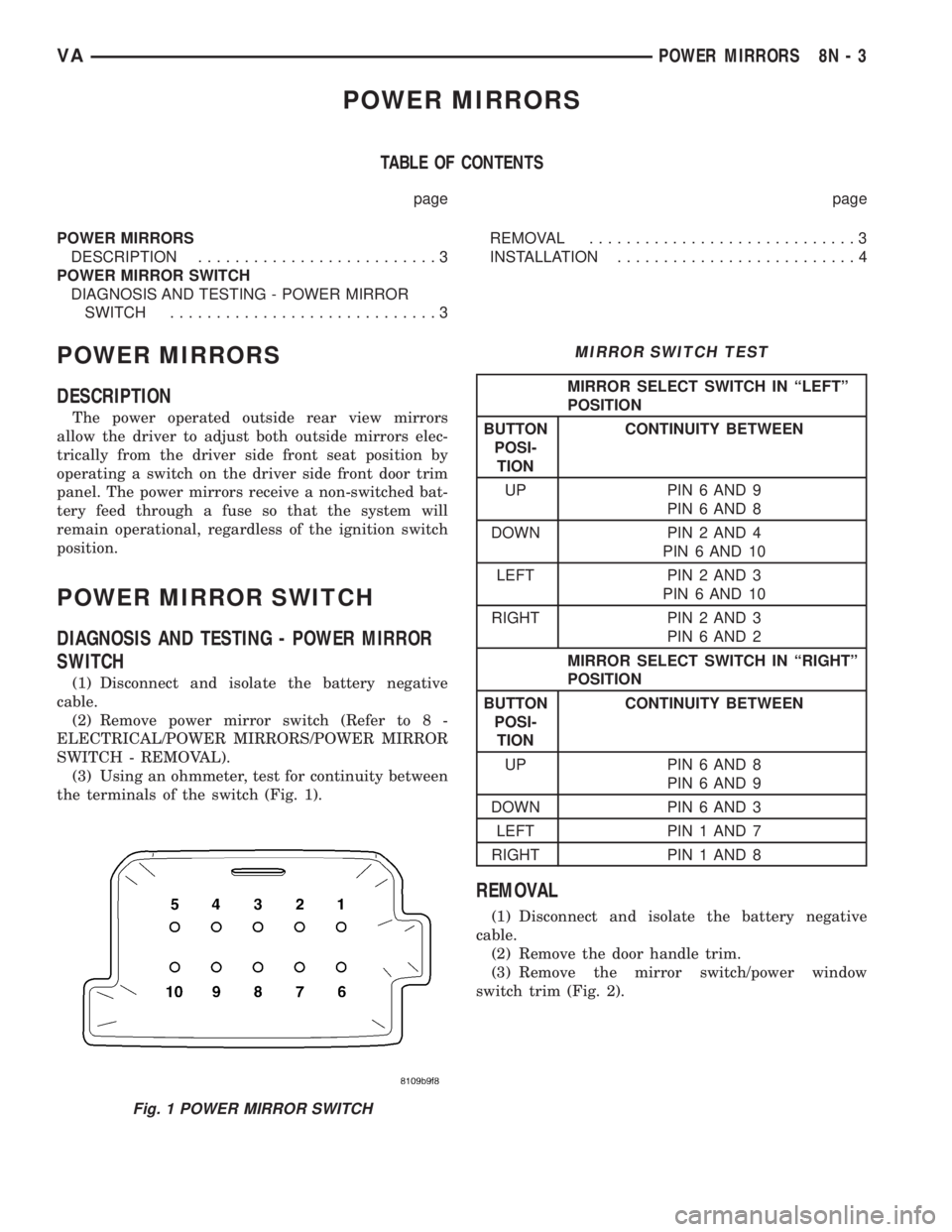
(3) Using an ohmmeter, test for continuity between
the terminals of the switch (Fig. 1).
MIRROR SWITCH TEST
MIRROR SELECT SWITCH IN ªLEFTº
POSITION
BUTTON
POSI-
TIONCONTINUITY BETWEEN
UP PIN 6 AND 9
PIN 6 AND 8
DOWN PIN 2 AND 4
PIN 6 AND 10
LEFT PIN 2 AND 3
PIN 6 AND 10
RIGHT PIN 2 AND 3
PIN 6 AND 2
MIRROR SELECT SWITCH IN ªRIGHTº
POSITION
BUTTON
POSI-
TIONCONTINUITY BETWEEN
UP PIN 6 AND 8
PIN 6 AND 9
DOWN PIN 6 AND 3
LEFT PIN 1 AND 7
RIGHT PIN 1 AND 8
REMOVAL
(1) Disconnect and isolate the battery negative
cable.
(2) Remove the door handle trim.
(3) Remove the mirror switch/power window
switch trim (Fig. 2).
Fig. 1 POWER MIRROR SWITCH
VAPOWER MIRRORS 8N - 3
Page 1000 of 2305
Communication Interface (SCI) data bus line for sup-
plemental restraint system programming or diagno-
sis and testing through the 16-way Data Link
Connector (DLC) located on the dash panel below the
driver side end of the instrument panel. A hard wired
output from the ACM is used for control of the airbag
indicator in the ElectroMechanical Instrument Clus-
ter (EMIC). (Refer to 8 - ELECTRICAL/INSTRU-
MENT CLUSTER/AIRBAG INDICATOR -
OPERATION).
The ACM microprocessor continuously monitors all
of the supplemental restraint system electrical cir-
cuits to determine the system readiness. If the ACM
detects a monitored system fault, it sets an appropri-
ate Diagnostic Trouble Code (DTC) and sends an out-
put to the EMIC to turn on the airbag indicator. The
ACM illuminates the indicator for about four seconds
each time the ignition switch is turned to the On
position as a bulb test. If the indicator remains illu-
minated for about ten seconds after the ignition
switch is turned to the On position, the ACM has
detected a non-critical fault that poses no danger to
the vehicle occupants. If the airbag indicator illumi-
nates solid (not flashing) while driving or stays on
longer than ten seconds following the bulb test, the
ACM has detected a critical fault that may cause the
airbags not to deploy when required or to deploy
when not required. An active fault only remains for
the duration of the fault, or in some cases, for the
duration of the current ignition switch cycle, while a
stored fault causes a DTC to be stored in memory by
the ACM.
The ACM receives battery current through a fused
ignition switch output circuit. The ACM receives
ground through a ground circuit and take out of the
vehicle wire harness. This take out has an eyelet ter-
minal connector secured by a nut to a ground stud on
the floor panel directly below the ACM within the
driver side seat riser. A case ground is also provided
for the ACM through a ground circuit and eyelet ter-
minal connector secured under the left rear ACM
mounting screw. These connections allow the ACM to
be operational whenever the ignition switch is in the
On position.
The ACM also contains an energy-storage capaci-
tor. When the ignition switch is in the On position,
this capacitor is continually being charged with
enough electrical energy to deploy the supplemental
restraint components for up to one second following a
battery disconnect or failure. The purpose of the
capacitor is to provide backup supplemental restraint
system protection in case there is a loss of battery
current supply to the ACM during an impact.
Two sensors are contained within the ACM, an
electronic impact sensor and a safing sensor. These
electronic sensors are accelerometers that sense the
rate of vehicle deceleration, which provide verifica-
tion of the direction and severity of an impact. Onmodels equipped with optional side curtain airbags,
the ACM also monitors inputs from two remote side
impact sensors located within the left and right front
door step wells to control deployment of the side cur-
tain airbag units.
The safing sensor is an electronic accelerometer
sensor within the ACM that provides an additional
logic input to the ACM microprocessor. The safing
sensor is used to verify the need for a supplemental
restraint deployment by detecting impact energy of a
lesser magnitude than that of the primary electronic
impact sensors, and must exceed a safing threshold
in order for the airbags to deploy. Vehicles equipped
with optional side curtain airbags feature a second
safing sensor within the ACM to provide confirma-
tion to the ACM microprocessor of side impact forces.
This second safing sensor is a bi-directional unit that
detects impact forces from either side of the vehicle.
Pre-programmed decision algorithms in the ACM
microprocessor determine when the deceleration rate
as signaled by the impact sensors and the safing sen-
sors indicate an impact that is severe enough to
require supplemental restraint system protection.
When the programmed conditions are met, the ACM
sends the proper electrical signals to deploy the front
airbags and seat belt tensioners and, if the vehicle is
so equipped, either side curtain airbag unit.
The ACM also provides a hard wired electrical
crash signal output following a supplemental
restraint deployment event. This output is used to
signal other electronic modules in the vehicle to pro-
vide their enhanced accident response features,
which include automatically disabling the engine
from running and unlocking all of the doors. How-
ever, these responses are each dependent upon the
circuits, components, and modules controlling these
features remaining intact from collateral damage
incurred during the vehicle impact.
A single ACM is used for all variations of the sup-
plemental restraint system available in this vehicle.
This ACM is programmable and in order to function
properly it must be programmed for the correct vehi-
cle supplemental restraint system equipment using
an initialization procedure. The initialization proce-
dure requires the use of a diagnostic scan tool. Refer
to the appropriate diagnostic information. The hard
wired inputs and outputs for the ACM may be diag-
nosed and tested using conventional diagnostic tools
and procedures. However, conventional diagnostic
methods will not prove conclusive in the diagnosis of
the ACM or the supplemental restraint system. The
most reliable, efficient, and accurate means to diag-
nose the ACM or the supplemental restraint system
requires the use of a diagnostic scan tool. Refer to
the appropriate diagnostic information.
VARESTRAINTS 8O - 9
Page 1006 of 2305
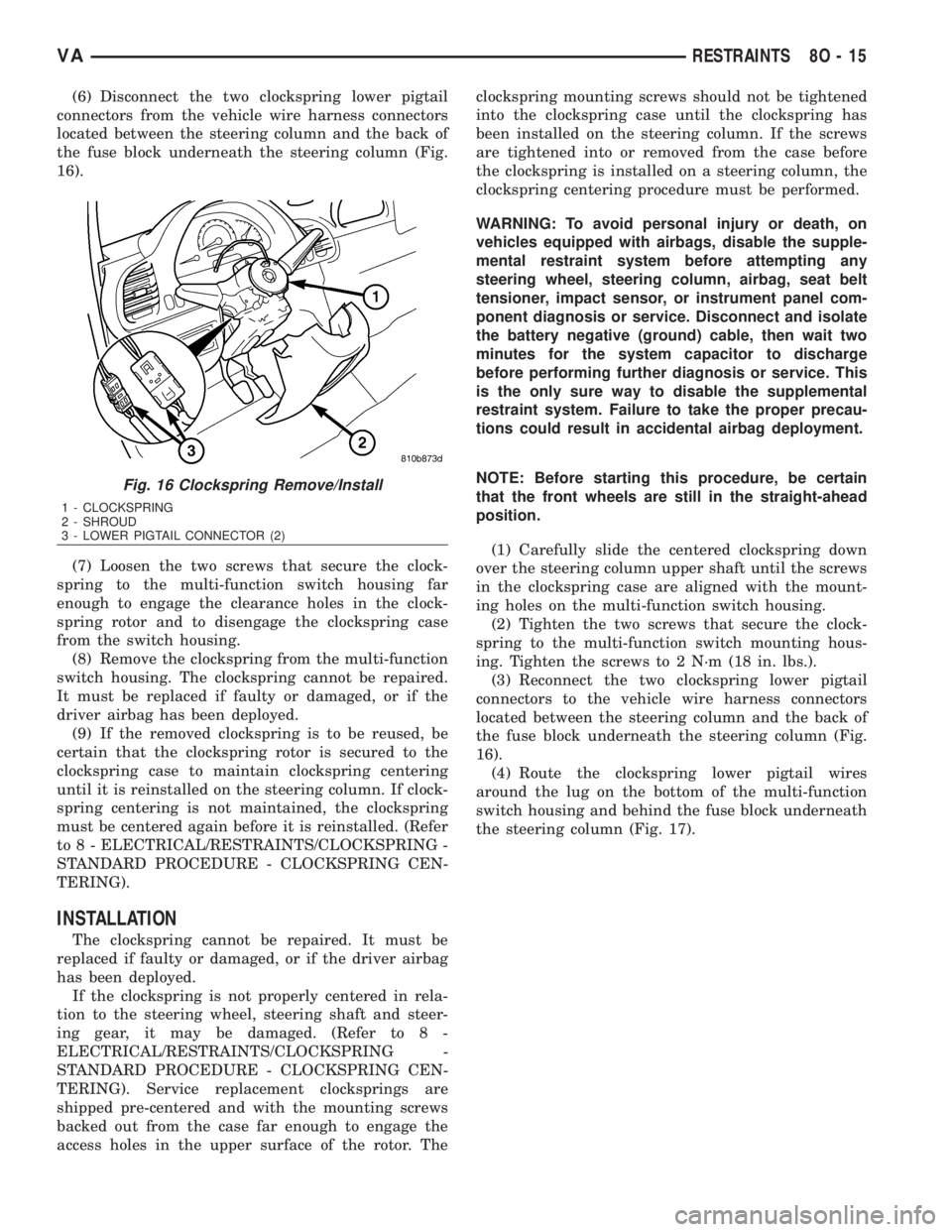
(6) Disconnect the two clockspring lower pigtail
connectors from the vehicle wire harness connectors
located between the steering column and the back of
the fuse block underneath the steering column (Fig.
16).
(7) Loosen the two screws that secure the clock-
spring to the multi-function switch housing far
enough to engage the clearance holes in the clock-
spring rotor and to disengage the clockspring case
from the switch housing.
(8) Remove the clockspring from the multi-function
switch housing. The clockspring cannot be repaired.
It must be replaced if faulty or damaged, or if the
driver airbag has been deployed.
(9) If the removed clockspring is to be reused, be
certain that the clockspring rotor is secured to the
clockspring case to maintain clockspring centering
until it is reinstalled on the steering column. If clock-
spring centering is not maintained, the clockspring
must be centered again before it is reinstalled. (Refer
to 8 - ELECTRICAL/RESTRAINTS/CLOCKSPRING -
STANDARD PROCEDURE - CLOCKSPRING CEN-
TERING).
INSTALLATION
The clockspring cannot be repaired. It must be
replaced if faulty or damaged, or if the driver airbag
has been deployed.
If the clockspring is not properly centered in rela-
tion to the steering wheel, steering shaft and steer-
ing gear, it may be damaged. (Refer to 8 -
ELECTRICAL/RESTRAINTS/CLOCKSPRING -
STANDARD PROCEDURE - CLOCKSPRING CEN-
TERING). Service replacement clocksprings are
shipped pre-centered and with the mounting screws
backed out from the case far enough to engage the
access holes in the upper surface of the rotor. Theclockspring mounting screws should not be tightened
into the clockspring case until the clockspring has
been installed on the steering column. If the screws
are tightened into or removed from the case before
the clockspring is installed on a steering column, the
clockspring centering procedure must be performed.
WARNING: To avoid personal injury or death, on
vehicles equipped with airbags, disable the supple-
mental restraint system before attempting any
steering wheel, steering column, airbag, seat belt
tensioner, impact sensor, or instrument panel com-
ponent diagnosis or service. Disconnect and isolate
the battery negative (ground) cable, then wait two
minutes for the system capacitor to discharge
before performing further diagnosis or service. This
is the only sure way to disable the supplemental
restraint system. Failure to take the proper precau-
tions could result in accidental airbag deployment.
NOTE: Before starting this procedure, be certain
that the front wheels are still in the straight-ahead
position.
(1) Carefully slide the centered clockspring down
over the steering column upper shaft until the screws
in the clockspring case are aligned with the mount-
ing holes on the multi-function switch housing.
(2) Tighten the two screws that secure the clock-
spring to the multi-function switch mounting hous-
ing. Tighten the screws to 2 N´m (18 in. lbs.).
(3) Reconnect the two clockspring lower pigtail
connectors to the vehicle wire harness connectors
located between the steering column and the back of
the fuse block underneath the steering column (Fig.
16).
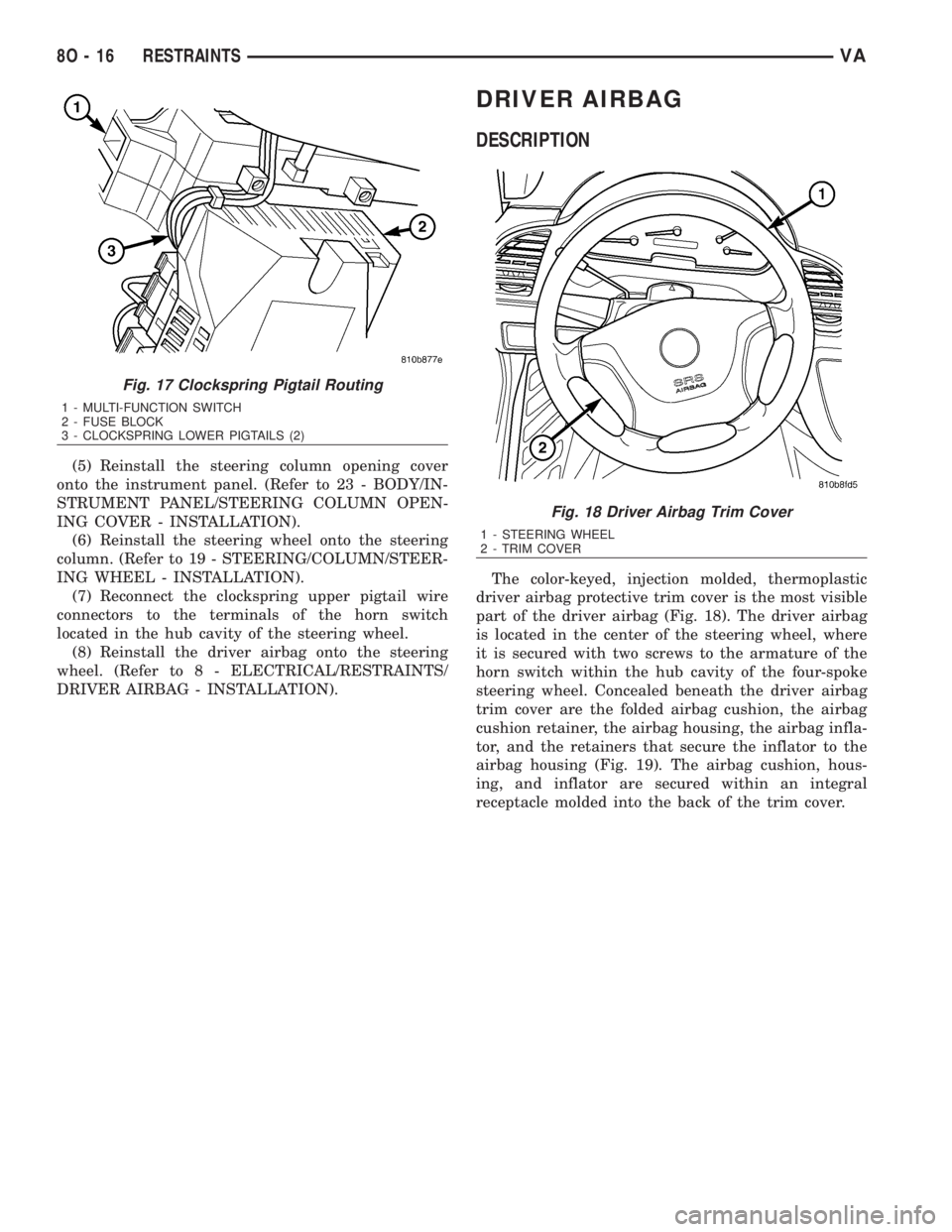
(4) Route the clockspring lower pigtail wires
around the lug on the bottom of the multi-function
switch housing and behind the fuse block underneath
the steering column (Fig. 17).
Fig. 16 Clockspring Remove/Install
1 - CLOCKSPRING
2 - SHROUD
3 - LOWER PIGTAIL CONNECTOR (2)
VARESTRAINTS 8O - 15
Page 1007 of 2305
(5) Reinstall the steering column opening cover
onto the instrument panel. (Refer to 23 - BODY/IN-
STRUMENT PANEL/STEERING COLUMN OPEN-
ING COVER - INSTALLATION).
(6) Reinstall the steering wheel onto the steering
column. (Refer to 19 - STEERING/COLUMN/STEER-
ING WHEEL - INSTALLATION).
(7) Reconnect the clockspring upper pigtail wire
connectors to the terminals of the horn switch
located in the hub cavity of the steering wheel.
(8) Reinstall the driver airbag onto the steering
wheel. (Refer to 8 - ELECTRICAL/RESTRAINTS/
DRIVER AIRBAG - INSTALLATION).
DRIVER AIRBAG
DESCRIPTION
The color-keyed, injection molded, thermoplastic
driver airbag protective trim cover is the most visible
part of the driver airbag (Fig. 18). The driver airbag
is located in the center of the steering wheel, where
it is secured with two screws to the armature of the
horn switch within the hub cavity of the four-spoke
steering wheel. Concealed beneath the driver airbag
trim cover are the folded airbag cushion, the airbag
cushion retainer, the airbag housing, the airbag infla-
tor, and the retainers that secure the inflator to the
airbag housing (Fig. 19). The airbag cushion, hous-
ing, and inflator are secured within an integral
receptacle molded into the back of the trim cover.
Fig. 17 Clockspring Pigtail Routing
1 - MULTI-FUNCTION SWITCH
2 - FUSE BLOCK
3 - CLOCKSPRING LOWER PIGTAILS (2)
Fig. 18 Driver Airbag Trim Cover
1 - STEERING WHEEL
2 - TRIM COVER
8O - 16 RESTRAINTSVA
Page 1008 of 2305
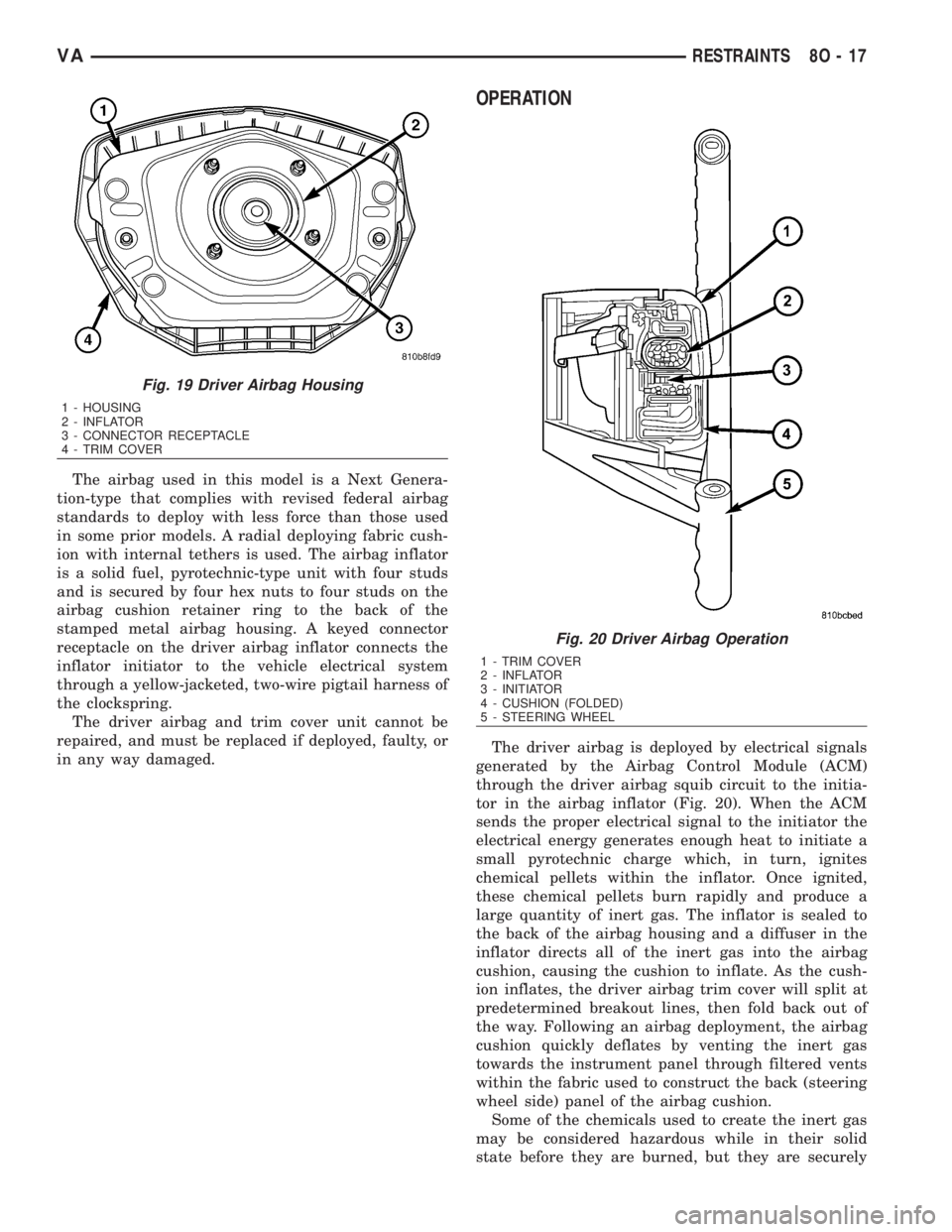
The airbag used in this model is a Next Genera-
tion-type that complies with revised federal airbag
standards to deploy with less force than those used
in some prior models. A radial deploying fabric cush-
ion with internal tethers is used. The airbag inflator
is a solid fuel, pyrotechnic-type unit with four studs
and is secured by four hex nuts to four studs on the
airbag cushion retainer ring to the back of the
stamped metal airbag housing. A keyed connector
receptacle on the driver airbag inflator connects the
inflator initiator to the vehicle electrical system
through a yellow-jacketed, two-wire pigtail harness of
the clockspring.
The driver airbag and trim cover unit cannot be
repaired, and must be replaced if deployed, faulty, or
in any way damaged.
OPERATION
The driver airbag is deployed by electrical signals
generated by the Airbag Control Module (ACM)
through the driver airbag squib circuit to the initia-
tor in the airbag inflator (Fig. 20). When the ACM
sends the proper electrical signal to the initiator the
electrical energy generates enough heat to initiate a
small pyrotechnic charge which, in turn, ignites
chemical pellets within the inflator. Once ignited,
these chemical pellets burn rapidly and produce a
large quantity of inert gas. The inflator is sealed to
the back of the airbag housing and a diffuser in the
inflator directs all of the inert gas into the airbag
cushion, causing the cushion to inflate. As the cush-
ion inflates, the driver airbag trim cover will split at
predetermined breakout lines, then fold back out of
the way. Following an airbag deployment, the airbag
cushion quickly deflates by venting the inert gas
towards the instrument panel through filtered vents
within the fabric used to construct the back (steering
wheel side) panel of the airbag cushion.
Some of the chemicals used to create the inert gas
may be considered hazardous while in their solid
state before they are burned, but they are securely
Fig. 19 Driver Airbag Housing
1 - HOUSING
2 - INFLATOR
3 - CONNECTOR RECEPTACLE
4 - TRIM COVER
Fig. 20 Driver Airbag Operation
1 - TRIM COVER
2 - INFLATOR
3 - INITIATOR
4 - CUSHION (FOLDED)
5 - STEERING WHEEL
VARESTRAINTS 8O - 17
Page 1015 of 2305
(3) If the vehicle is so equipped, snap the plastic
cover over the screw that secures the front seat belt
buckle lower anchor to the inboard side of the seat
frame.
(4) On the driver side only, reconnect the seat belt
switch pigtail wire to the vehicle wire harness and
push the joined connectors through the clearance
hole in the seat riser cover.
(5) On the driver side only, route and secure the
seat belt switch pigtail wire to the seat frame with
wire ties.
PASSENGER AIRBAG
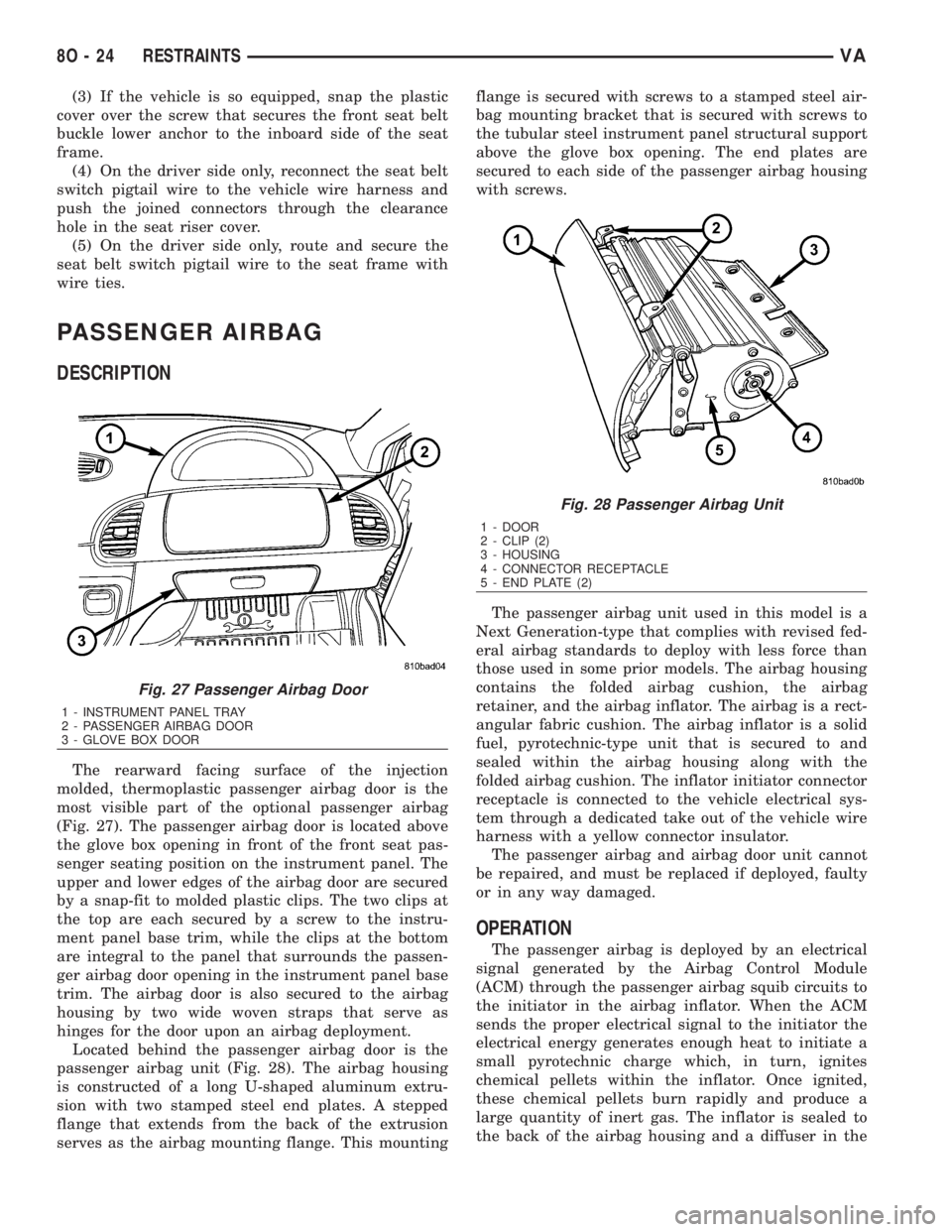
DESCRIPTION
The rearward facing surface of the injection
molded, thermoplastic passenger airbag door is the
most visible part of the optional passenger airbag
(Fig. 27). The passenger airbag door is located above
the glove box opening in front of the front seat pas-
senger seating position on the instrument panel. The
upper and lower edges of the airbag door are secured
by a snap-fit to molded plastic clips. The two clips at
the top are each secured by a screw to the instru-
ment panel base trim, while the clips at the bottom
are integral to the panel that surrounds the passen-
ger airbag door opening in the instrument panel base
trim. The airbag door is also secured to the airbag
housing by two wide woven straps that serve as
hinges for the door upon an airbag deployment.
Located behind the passenger airbag door is the
passenger airbag unit (Fig. 28). The airbag housing
is constructed of a long U-shaped aluminum extru-
sion with two stamped steel end plates. A stepped
flange that extends from the back of the extrusion
serves as the airbag mounting flange. This mountingflange is secured with screws to a stamped steel air-
bag mounting bracket that is secured with screws to
the tubular steel instrument panel structural support
above the glove box opening. The end plates are
secured to each side of the passenger airbag housing
with screws.
The passenger airbag unit used in this model is a
Next Generation-type that complies with revised fed-
eral airbag standards to deploy with less force than
those used in some prior models. The airbag housing
contains the folded airbag cushion, the airbag
retainer, and the airbag inflator. The airbag is a rect-
angular fabric cushion. The airbag inflator is a solid
fuel, pyrotechnic-type unit that is secured to and
sealed within the airbag housing along with the
folded airbag cushion. The inflator initiator connector
receptacle is connected to the vehicle electrical sys-
tem through a dedicated take out of the vehicle wire
harness with a yellow connector insulator.
The passenger airbag and airbag door unit cannot
be repaired, and must be replaced if deployed, faulty
or in any way damaged.
OPERATION
The passenger airbag is deployed by an electrical
signal generated by the Airbag Control Module
(ACM) through the passenger airbag squib circuits to
the initiator in the airbag inflator. When the ACM
sends the proper electrical signal to the initiator the
electrical energy generates enough heat to initiate a
small pyrotechnic charge which, in turn, ignites
chemical pellets within the inflator. Once ignited,
these chemical pellets burn rapidly and produce a
large quantity of inert gas. The inflator is sealed to
the back of the airbag housing and a diffuser in the
Fig. 27 Passenger Airbag Door
1 - INSTRUMENT PANEL TRAY
2 - PASSENGER AIRBAG DOOR
3 - GLOVE BOX DOOR
Fig. 28 Passenger Airbag Unit
1 - DOOR
2 - CLIP (2)
3 - HOUSING
4 - CONNECTOR RECEPTACLE
5 - END PLATE (2)
8O - 24 RESTRAINTSVA
Page 1046 of 2305
both the wiper and washer systems. (Refer to 8 -
ELECTRICAL/LAMPS/LIGHTING - EXTERIOR/
MULTI-FUNCTION SWITCH - DESCRIPTION)
²Rain Sensor- Vehicles equipped with an
optional automatic wiper feature have an electronic
rain sensor concealed within the base of the rear
view mirror unit on the inside of the laminated wind-
shield glass.
²Rain Sensor Control Module- Vehicles
equipped with an optional automatic wiper feature
have an electronic rain sensor control module located
under the lower instrument panel above the acceler-
ator pedal in the passenger compartment of the vehi-
cle.
²Washer Fluid Level Switch- The optional
washer fluid level switch is integral to a unique ver-
sion of the washer pump/motor unit, which is located
in a dedicated hole on the top of the sump area near
the back of the windshield washer reservoir on the
right front fender wheel house in the engine com-
partment.
²Washer Nozzle- A single washer nozzle with
three separate orifices is secured with integral snap
features to each wiper arm. The hoses for the washer
nozzles are concealed beneath a molded plastic guide
on the underside of each wiper arm and routed to the
engine compartment through unique molded plastic
elbow fittings located near each wiper pivot at the
base of the windshield.
²Washer Pump/Motor- Two different washer
pump/motor units are available for this model. One
version has an integral washer fluid level switch that
provides a hard wired input to the instrument cluster
for control of the optional washer fluid indicator. The
washer pump/motor unit is located in a dedicated
hole on the top of the sump area near the back of the
windshield washer reservoir on the right front fender
wheel house in the engine compartment.
²Washer Reservoir- The washer reservoir is
located on the right front fender wheel house in the
engine compartment. The washer reservoir filler is
accessed from the right front corner of the engine
compartment.
²Wiper Arm- The two unequal length wiper
arms are secured to the two wiper pivots, which
extend through the cowl panel near the base of the
windshield. The longer arm is installed on the left
(driver) side of the windshield.
²Wiper Blade- The two unequal length wiper
blades are secured to the two wiper arms, and are
parked on the glass near the bottom of the wind-
shield when the wiper system is not in operation.
The longer blade is installed on the left (driver) side
of the windshield.
²Wiper Linkage- The wiper pivots are the only
visible components of the wiper linkage. The remain-
der of the linkage is concealed within the engine
compartment just behind the hood opening. Thewiper linkage module includes the two wiper drive
links, the wiper motor crank arm, the two wiper piv-
ots, and the linkage and motor mounting bracket.
²Wiper Motor- The wiper motor is secured to
the wiper linkage module bracket on the underside of
the cowl panel within the engine compartment. The
wiper motor output shaft and crank arm extend
through a clearance hole in the mounting bracket,
where they are connected to a crank arm that drives
the wiper linkage.
²Wiper Relay- The wiper relay is located in a
dedicated receptacle on the lower left surface of the
fuse block underneath the steering column behind
the fuse access panel and the steering column open-
ing panel. The wiper relay is a passive component on
vehicles equipped with the optional automatic wiper
system.
²Wiper, Turn Signals, Engine Start Control
Module- The wiper, turn signals and engine start
control module is integral to the fuse block located
underneath the steering column. The fuse block is
concealed behind the fuse access panel and the steer-
ing column opening panel, where it is secured with
screws to the steering column. The wiper system
functions of this module are passive on vehicles
equipped with the optional automatic wiper system.
Hard wired circuitry connects the wiper and
washer system components to the electrical system of
the vehicle. These hard wired circuits are integral to
several wire harnesses, which are routed throughout
the vehicle and retained by many different methods.
These circuits may be connected to each other, to the
vehicle electrical system and to the wiper and washer
system components through the use of a combination
of soldered splices, splice block connectors, and many
different types of wire harness terminal connectors
and insulators. Refer to the appropriate wiring infor-
mation. The wiring information includes wiring dia-
grams, proper wire and connector repair procedures,
further details on wire harness routing and reten-
tion, as well as pin-out and location views for the
various wire harness connectors, splices and grounds.
OPERATION
The wiper and washer system is designed to pro-
vide the vehicle operator with a convenient, safe, and
reliable means of maintaining visibility through the
windshield glass. The various components of this sys-
tem are designed to convert electrical energy pro-
duced by the vehicle electrical system into the
mechanical action of the wiper blades to wipe the
outside surface of the glass, as well as into the
hydraulic action of the washer system to apply
washer fluid stored in an on-board reservoir to the
area of the glass to be wiped. When combined, these
components provide the means to effectively main-
tain clear visibility for the vehicle operator by remov-
ing excess accumulations of rain, snow, bugs, mud, or
VAWIPERS/WASHERS 8R - 3
Page 1047 of 2305
other minor debris from the outside windshield glass
surface that might be encountered while driving the
vehicle under numerous types of inclement operating
conditions.
Two wiper systems are available: the standard
intermittent wipe system, or an optional automatic
wipe system. The vehicle operator initiates all wiper
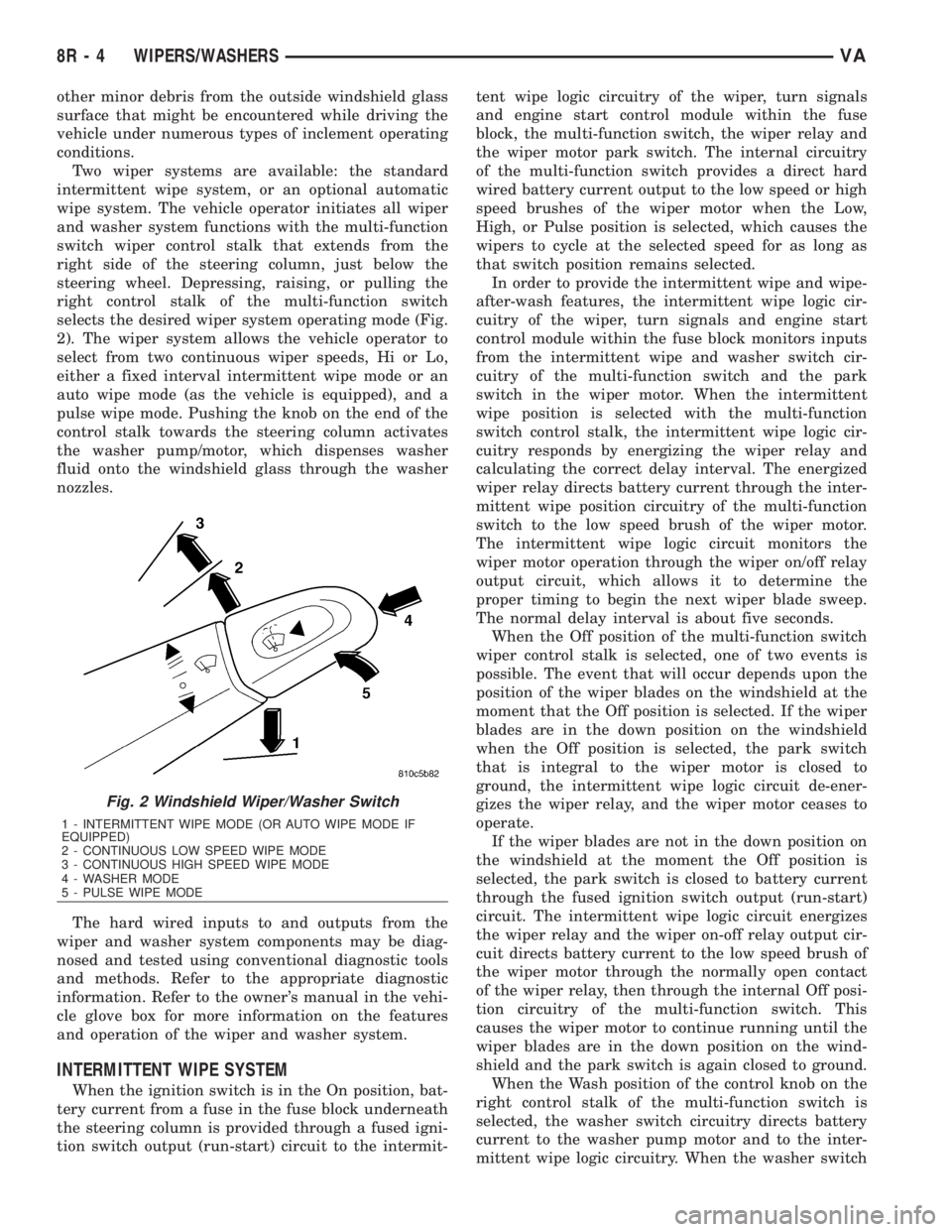
and washer system functions with the multi-function
switch wiper control stalk that extends from the
right side of the steering column, just below the
steering wheel. Depressing, raising, or pulling the
right control stalk of the multi-function switch
selects the desired wiper system operating mode (Fig.
2). The wiper system allows the vehicle operator to
select from two continuous wiper speeds, Hi or Lo,
either a fixed interval intermittent wipe mode or an
auto wipe mode (as the vehicle is equipped), and a
pulse wipe mode. Pushing the knob on the end of the
control stalk towards the steering column activates
the washer pump/motor, which dispenses washer
fluid onto the windshield glass through the washer
nozzles.
The hard wired inputs to and outputs from the
wiper and washer system components may be diag-
nosed and tested using conventional diagnostic tools
and methods. Refer to the appropriate diagnostic
information. Refer to the owner's manual in the vehi-
cle glove box for more information on the features
and operation of the wiper and washer system.
INTERMITTENT WIPE SYSTEM
When the ignition switch is in the On position, bat-
tery current from a fuse in the fuse block underneath
the steering column is provided through a fused igni-
tion switch output (run-start) circuit to the intermit-tent wipe logic circuitry of the wiper, turn signals
and engine start control module within the fuse
block, the multi-function switch, the wiper relay and
the wiper motor park switch. The internal circuitry
of the multi-function switch provides a direct hard
wired battery current output to the low speed or high
speed brushes of the wiper motor when the Low,
High, or Pulse position is selected, which causes the
wipers to cycle at the selected speed for as long as
that switch position remains selected.
In order to provide the intermittent wipe and wipe-
after-wash features, the intermittent wipe logic cir-
cuitry of the wiper, turn signals and engine start
control module within the fuse block monitors inputs
from the intermittent wipe and washer switch cir-
cuitry of the multi-function switch and the park
switch in the wiper motor. When the intermittent
wipe position is selected with the multi-function
switch control stalk, the intermittent wipe logic cir-
cuitry responds by energizing the wiper relay and
calculating the correct delay interval. The energized
wiper relay directs battery current through the inter-
mittent wipe position circuitry of the multi-function
switch to the low speed brush of the wiper motor.
The intermittent wipe logic circuit monitors the
wiper motor operation through the wiper on/off relay
output circuit, which allows it to determine the
proper timing to begin the next wiper blade sweep.
The normal delay interval is about five seconds.
When the Off position of the multi-function switch
wiper control stalk is selected, one of two events is
possible. The event that will occur depends upon the
position of the wiper blades on the windshield at the
moment that the Off position is selected. If the wiper
blades are in the down position on the windshield
when the Off position is selected, the park switch
that is integral to the wiper motor is closed to
ground, the intermittent wipe logic circuit de-ener-
gizes the wiper relay, and the wiper motor ceases to
operate.
If the wiper blades are not in the down position on
the windshield at the moment the Off position is
selected, the park switch is closed to battery current
through the fused ignition switch output (run-start)
circuit. The intermittent wipe logic circuit energizes
the wiper relay and the wiper on-off relay output cir-
cuit directs battery current to the low speed brush of
the wiper motor through the normally open contact
of the wiper relay, then through the internal Off posi-
tion circuitry of the multi-function switch. This
causes the wiper motor to continue running until the
wiper blades are in the down position on the wind-
shield and the park switch is again closed to ground.
When the Wash position of the control knob on the
right control stalk of the multi-function switch is
selected, the washer switch circuitry directs battery
current to the washer pump motor and to the inter-
mittent wipe logic circuitry. When the washer switch
Fig. 2 Windshield Wiper/Washer Switch
1 - INTERMITTENT WIPE MODE (OR AUTO WIPE MODE IF
EQUIPPED)
2 - CONTINUOUS LOW SPEED WIPE MODE
3 - CONTINUOUS HIGH SPEED WIPE MODE
4 - WASHER MODE
5 - PULSE WIPE MODE
8R - 4 WIPERS/WASHERSVA
Page 1048 of 2305
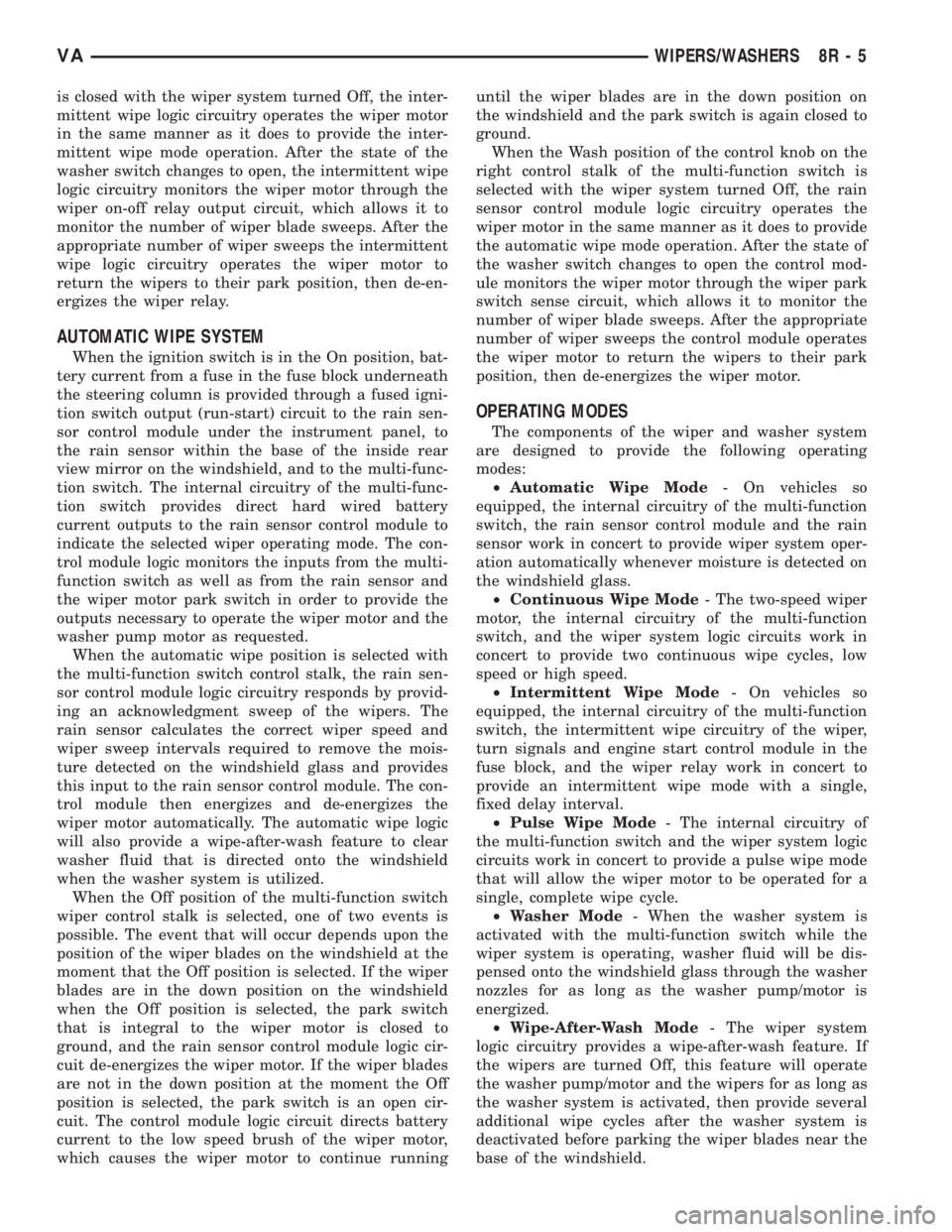
is closed with the wiper system turned Off, the inter-
mittent wipe logic circuitry operates the wiper motor
in the same manner as it does to provide the inter-
mittent wipe mode operation. After the state of the
washer switch changes to open, the intermittent wipe
logic circuitry monitors the wiper motor through the
wiper on-off relay output circuit, which allows it to
monitor the number of wiper blade sweeps. After the
appropriate number of wiper sweeps the intermittent
wipe logic circuitry operates the wiper motor to
return the wipers to their park position, then de-en-
ergizes the wiper relay.
AUTOMATIC WIPE SYSTEM
When the ignition switch is in the On position, bat-
tery current from a fuse in the fuse block underneath
the steering column is provided through a fused igni-
tion switch output (run-start) circuit to the rain sen-
sor control module under the instrument panel, to
the rain sensor within the base of the inside rear
view mirror on the windshield, and to the multi-func-
tion switch. The internal circuitry of the multi-func-
tion switch provides direct hard wired battery
current outputs to the rain sensor control module to
indicate the selected wiper operating mode. The con-
trol module logic monitors the inputs from the multi-
function switch as well as from the rain sensor and
the wiper motor park switch in order to provide the
outputs necessary to operate the wiper motor and the
washer pump motor as requested.
When the automatic wipe position is selected with
the multi-function switch control stalk, the rain sen-
sor control module logic circuitry responds by provid-
ing an acknowledgment sweep of the wipers. The
rain sensor calculates the correct wiper speed and
wiper sweep intervals required to remove the mois-
ture detected on the windshield glass and provides
this input to the rain sensor control module. The con-
trol module then energizes and de-energizes the
wiper motor automatically. The automatic wipe logic
will also provide a wipe-after-wash feature to clear
washer fluid that is directed onto the windshield
when the washer system is utilized.
When the Off position of the multi-function switch
wiper control stalk is selected, one of two events is
possible. The event that will occur depends upon the
position of the wiper blades on the windshield at the
moment that the Off position is selected. If the wiper
blades are in the down position on the windshield
when the Off position is selected, the park switch
that is integral to the wiper motor is closed to
ground, and the rain sensor control module logic cir-
cuit de-energizes the wiper motor. If the wiper blades
are not in the down position at the moment the Off
position is selected, the park switch is an open cir-
cuit. The control module logic circuit directs battery
current to the low speed brush of the wiper motor,
which causes the wiper motor to continue runninguntil the wiper blades are in the down position on
the windshield and the park switch is again closed to
ground.
When the Wash position of the control knob on the
right control stalk of the multi-function switch is
selected with the wiper system turned Off, the rain
sensor control module logic circuitry operates the
wiper motor in the same manner as it does to provide
the automatic wipe mode operation. After the state of
the washer switch changes to open the control mod-
ule monitors the wiper motor through the wiper park
switch sense circuit, which allows it to monitor the
number of wiper blade sweeps. After the appropriate
number of wiper sweeps the control module operates
the wiper motor to return the wipers to their park
position, then de-energizes the wiper motor.
OPERATING MODES
The components of the wiper and washer system
are designed to provide the following operating
modes:
²Automatic Wipe Mode- On vehicles so
equipped, the internal circuitry of the multi-function
switch, the rain sensor control module and the rain
sensor work in concert to provide wiper system oper-
ation automatically whenever moisture is detected on
the windshield glass.
²Continuous Wipe Mode- The two-speed wiper
motor, the internal circuitry of the multi-function
switch, and the wiper system logic circuits work in
concert to provide two continuous wipe cycles, low
speed or high speed.
²Intermittent Wipe Mode- On vehicles so
equipped, the internal circuitry of the multi-function
switch, the intermittent wipe circuitry of the wiper,
turn signals and engine start control module in the
fuse block, and the wiper relay work in concert to
provide an intermittent wipe mode with a single,
fixed delay interval.
²Pulse Wipe Mode- The internal circuitry of
the multi-function switch and the wiper system logic
circuits work in concert to provide a pulse wipe mode
that will allow the wiper motor to be operated for a
single, complete wipe cycle.
²Washer Mode- When the washer system is
activated with the multi-function switch while the
wiper system is operating, washer fluid will be dis-
pensed onto the windshield glass through the washer
nozzles for as long as the washer pump/motor is
energized.
²Wipe-After-Wash Mode- The wiper system
logic circuitry provides a wipe-after-wash feature. If
the wipers are turned Off, this feature will operate
the washer pump/motor and the wipers for as long as
the washer system is activated, then provide several
additional wipe cycles after the washer system is
deactivated before parking the wiper blades near the
base of the windshield.
VAWIPERS/WASHERS 8R - 5
Page 1049 of 2305
DIAGNOSIS AND TESTING - WIPER &
WASHER SYSTEM
If the wiper motor operates, but the wipers do not
move on the windshield, replace the faulty wiper
linkage module. If the washer pump/motor operates,
but no washer fluid is dispensed on the glass; or, if
the wipers operate, but chatter, lift, or do not clear
the glass, clean and inspect the wiper and washer
system components as required. (Refer to 8 - ELEC-
TRICAL/WIPERS/WASHERS - CLEANING) and
(Refer to 8 - ELECTRICAL/WIPERS/WASHERS -
INSPECTION). For diagnosis and testing of the
multi-function switch (Refer to 8 - ELECTRICAL/
LAMPS/LIGHTING - EXTERIOR/MULTI-FUNC-
TION SWITCH - DIAGNOSIS AND TESTING).
Refer to the appropriate wiring information. The wir-
ing information includes wiring diagrams, proper
wire and connector repair procedures, details of wire
harness routing and retention, connector pin-out
information and location views for the various wire
harness connectors, splices and grounds.
The hard wired circuits and components of the
wiper and washer system may be diagnosed andtested using conventional diagnostic tools and proce-
dures. However, conventional diagnostic methods
may not prove conclusive in the diagnosis of the
intermittent wipe logic circuitry contained within the
fuse block underneath the steering column, the rain
sensor within the base of the rear view mirror on the
windshield, or the rain sensor control module under
the instrument panel.
WARNING: To avoid personal injury or death, on
vehicles equipped with airbags, disable the supple-
mental restraint system before attempting any
steering wheel, steering column, airbag, seat belt
tensioner, or instrument panel component diagno-
sis or service. Disconnect and isolate the battery
negative (ground) cable, then wait two minutes for
the system capacitor to discharge before perform-
ing further diagnosis or service. This is the only
sure way to disable the supplemental restraint sys-
tem. Failure to take the proper precautions could
result in accidental airbag deployment.
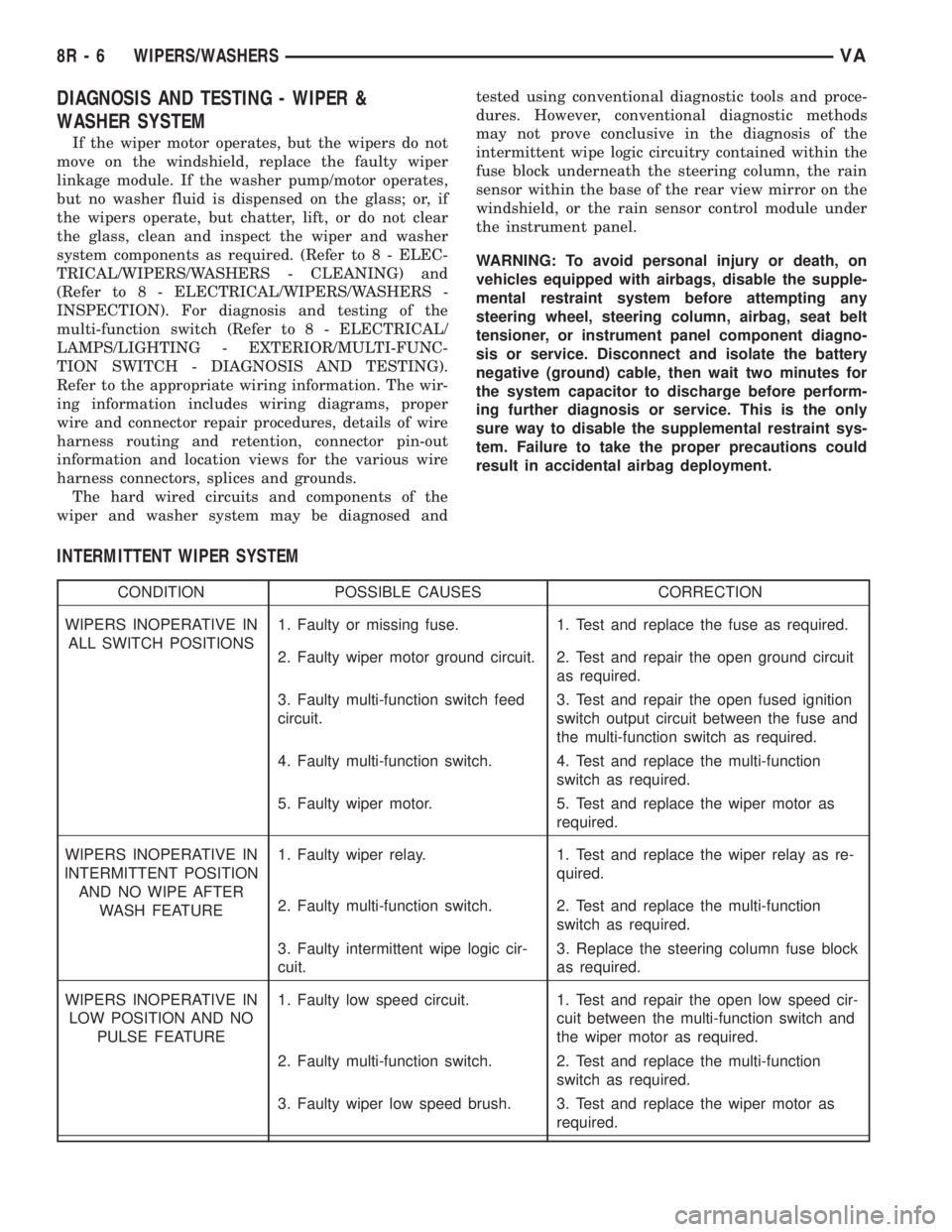
INTERMITTENT WIPER SYSTEM
CONDITION POSSIBLE CAUSES CORRECTION
WIPERS INOPERATIVE IN
ALL SWITCH POSITIONS1. Faulty or missing fuse. 1. Test and replace the fuse as required.
2. Faulty wiper motor ground circuit. 2. Test and repair the open ground circuit
as required.
3. Faulty multi-function switch feed
circuit.3. Test and repair the open fused ignition
switch output circuit between the fuse and
the multi-function switch as required.
4. Faulty multi-function switch. 4. Test and replace the multi-function
switch as required.
5. Faulty wiper motor. 5. Test and replace the wiper motor as
required.
WIPERS INOPERATIVE IN
INTERMITTENT POSITION
AND NO WIPE AFTER
WASH FEATURE1. Faulty wiper relay. 1. Test and replace the wiper relay as re-
quired.
2. Faulty multi-function switch. 2. Test and replace the multi-function
switch as required.
3. Faulty intermittent wipe logic cir-
cuit.3. Replace the steering column fuse block
as required.
WIPERS INOPERATIVE IN
LOW POSITION AND NO
PULSE FEATURE1. Faulty low speed circuit. 1. Test and repair the open low speed cir-
cuit between the multi-function switch and
the wiper motor as required.
2. Faulty multi-function switch. 2. Test and replace the multi-function
switch as required.
3. Faulty wiper low speed brush. 3. Test and replace the wiper motor as
required.
8R - 6 WIPERS/WASHERSVA