heating MERCEDES-BENZ SPRINTER 2006 Service Manual
[x] Cancel search | Manufacturer: MERCEDES-BENZ, Model Year: 2006, Model line: SPRINTER, Model: MERCEDES-BENZ SPRINTER 2006Pages: 2305, PDF Size: 48.12 MB
Page 2091 of 2305
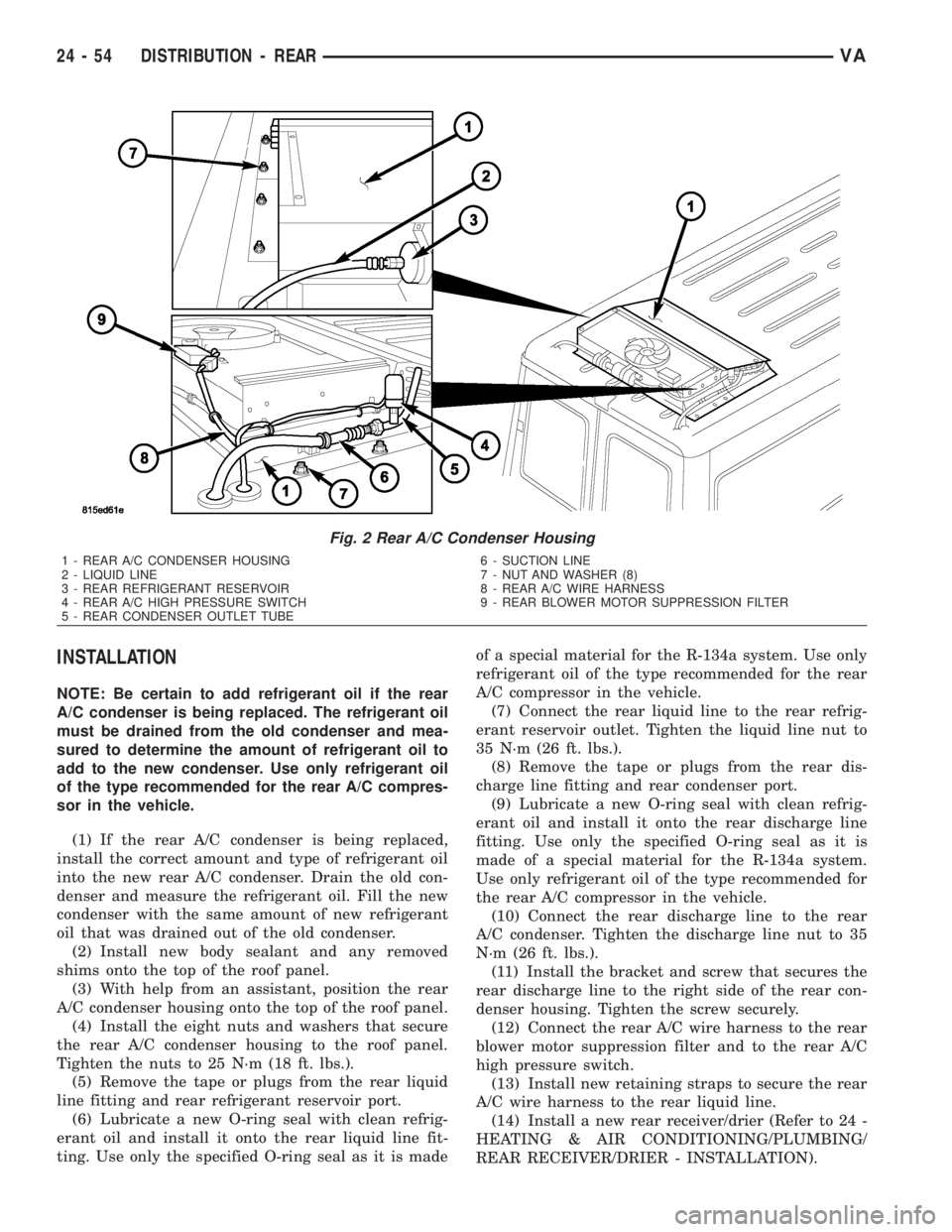
INSTALLATION
NOTE: Be certain to add refrigerant oil if the rear
A/C condenser is being replaced. The refrigerant oil
must be drained from the old condenser and mea-
sured to determine the amount of refrigerant oil to
add to the new condenser. Use only refrigerant oil
of the type recommended for the rear A/C compres-
sor in the vehicle.
(1) If the rear A/C condenser is being replaced,
install the correct amount and type of refrigerant oil
into the new rear A/C condenser. Drain the old con-
denser and measure the refrigerant oil. Fill the new
condenser with the same amount of new refrigerant
oil that was drained out of the old condenser.
(2) Install new body sealant and any removed
shims onto the top of the roof panel.
(3) With help from an assistant, position the rear
A/C condenser housing onto the top of the roof panel.
(4) Install the eight nuts and washers that secure
the rear A/C condenser housing to the roof panel.
Tighten the nuts to 25 N´m (18 ft. lbs.).
(5) Remove the tape or plugs from the rear liquid
line fitting and rear refrigerant reservoir port.
(6) Lubricate a new O-ring seal with clean refrig-
erant oil and install it onto the rear liquid line fit-
ting. Use only the specified O-ring seal as it is madeof a special material for the R-134a system. Use only
refrigerant oil of the type recommended for the rear
A/C compressor in the vehicle.
(7) Connect the rear liquid line to the rear refrig-
erant reservoir outlet. Tighten the liquid line nut to
35 N´m (26 ft. lbs.).
(8) Remove the tape or plugs from the rear dis-
charge line fitting and rear condenser port.
(9) Lubricate a new O-ring seal with clean refrig-
erant oil and install it onto the rear discharge line
fitting. Use only the specified O-ring seal as it is
made of a special material for the R-134a system.
Use only refrigerant oil of the type recommended for
the rear A/C compressor in the vehicle.
(10) Connect the rear discharge line to the rear
A/C condenser. Tighten the discharge line nut to 35
N´m (26 ft. lbs.).
(11) Install the bracket and screw that secures the
rear discharge line to the right side of the rear con-
denser housing. Tighten the screw securely.
(12) Connect the rear A/C wire harness to the rear
blower motor suppression filter and to the rear A/C
high pressure switch.
(13) Install new retaining straps to secure the rear
A/C wire harness to the rear liquid line.
(14) Install a new rear receiver/drier (Refer to 24 -
HEATING & AIR CONDITIONING/PLUMBING/
REAR RECEIVER/DRIER - INSTALLATION).
Fig. 2 Rear A/C Condenser Housing
1 - REAR A/C CONDENSER HOUSING
2 - LIQUID LINE
3 - REAR REFRIGERANT RESERVOIR
4 - REAR A/C HIGH PRESSURE SWITCH
5 - REAR CONDENSER OUTLET TUBE6 - SUCTION LINE
7 - NUT AND WASHER (8)
8 - REAR A/C WIRE HARNESS
9 - REAR BLOWER MOTOR SUPPRESSION FILTER
24 - 54 DISTRIBUTION - REARVA
Page 2092 of 2305
(15) Reconnect the negative battery cable.
(16) Evacuate the rear refrigerant system (Refer to
24 - HEATING & AIR CONDITIONING/PLUMBING
- STANDARD PROCEDURE - REFRIGERANT SYS-
TEM EVACUATE).
(17) Charge the rear refrigerant system (Refer to
24 - HEATING & AIR CONDITIONING/PLUMBING
- STANDARD PROCEDURE - REFRIGERANT SYS-
TEM CHARGE).
(18) Install the rear air filter (Refer to 24 - HEAT-
ING & AIR CONDITIONING/DISTRIBUTION -
REAR/AIR FILTER - INSTALLATION).
(19) Install the cover onto the rear A/C condenser
housing (Refer to 24 - HEATING & AIR CONDI-
TIONING/DISTRIBUTION - REAR/A/C CON-
DENSER COVER - INSTALLATION).
A/CEVAPORATOR COVER
REMOVAL
(1) Disconnect and isolate the negative battery
cable.
(2) Remove the rear dome lamps from the center
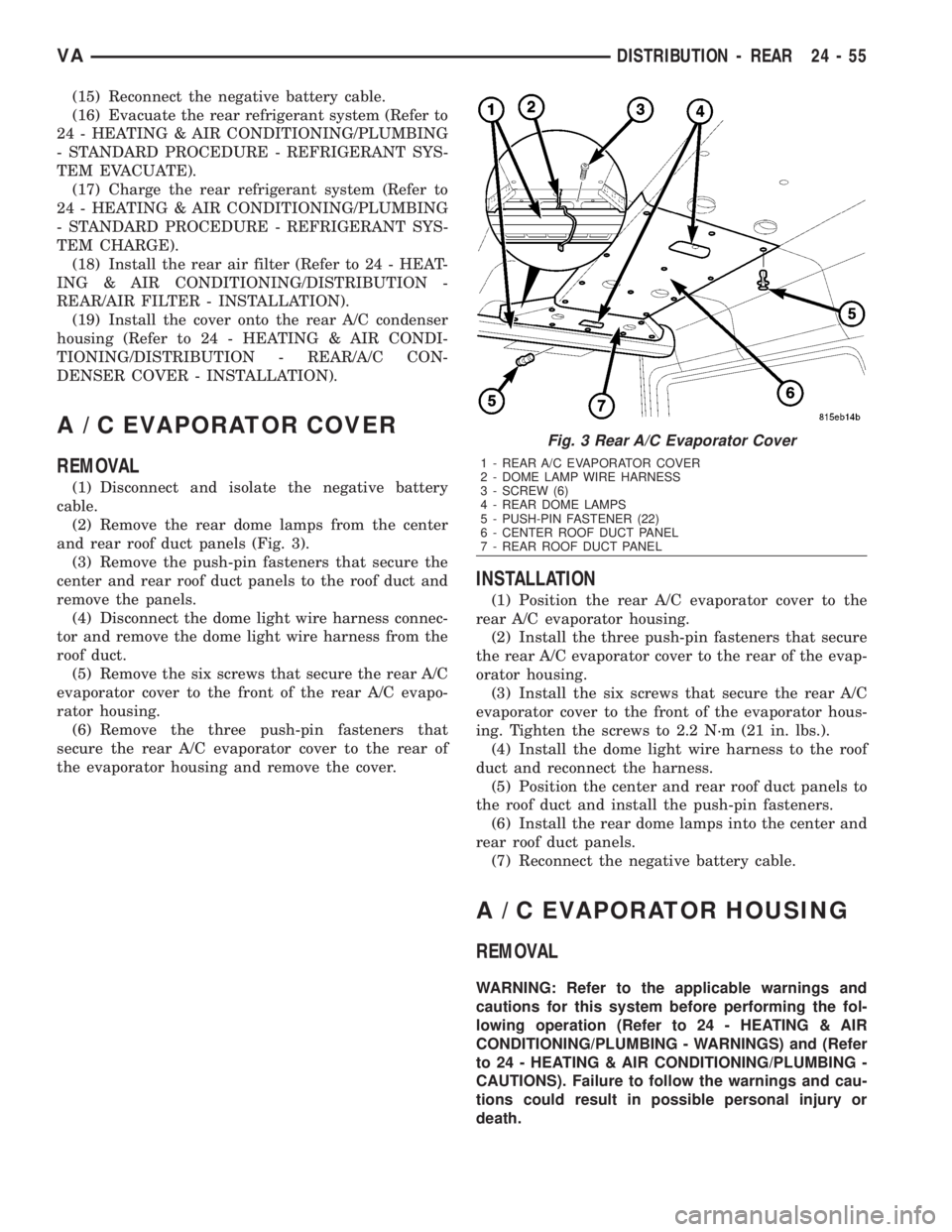
and rear roof duct panels (Fig. 3).
(3) Remove the push-pin fasteners that secure the
center and rear roof duct panels to the roof duct and
remove the panels.
(4) Disconnect the dome light wire harness connec-
tor and remove the dome light wire harness from the
roof duct.
(5) Remove the six screws that secure the rear A/C
evaporator cover to the front of the rear A/C evapo-
rator housing.
(6) Remove the three push-pin fasteners that
secure the rear A/C evaporator cover to the rear of
the evaporator housing and remove the cover.
INSTALLATION
(1) Position the rear A/C evaporator cover to the
rear A/C evaporator housing.
(2) Install the three push-pin fasteners that secure
the rear A/C evaporator cover to the rear of the evap-
orator housing.
(3) Install the six screws that secure the rear A/C
evaporator cover to the front of the evaporator hous-
ing. Tighten the screws to 2.2 N´m (21 in. lbs.).
(4) Install the dome light wire harness to the roof
duct and reconnect the harness.
(5) Position the center and rear roof duct panels to
the roof duct and install the push-pin fasteners.
(6) Install the rear dome lamps into the center and
rear roof duct panels.
(7) Reconnect the negative battery cable.
A/CEVAPORATOR HOUSING
REMOVAL
WARNING: Refer to the applicable warnings and
cautions for this system before performing the fol-
lowing operation (Refer to 24 - HEATING & AIR
CONDITIONING/PLUMBING - WARNINGS) and (Refer
to 24 - HEATING & AIR CONDITIONING/PLUMBING -
CAUTIONS). Failure to follow the warnings and cau-
tions could result in possible personal injury or
death.
Fig. 3 Rear A/C Evaporator Cover
1 - REAR A/C EVAPORATOR COVER
2 - DOME LAMP WIRE HARNESS
3 - SCREW (6)
4 - REAR DOME LAMPS
5 - PUSH-PIN FASTENER (22)
6 - CENTER ROOF DUCT PANEL
7 - REAR ROOF DUCT PANEL
VADISTRIBUTION - REAR 24 - 55
Page 2093 of 2305
(1) Disconnect and isolate the negative battery
cable.
(2) Remove the cover from the rear A/C evaporator
housing (Refer to 24 - HEATING & AIR CONDI-
TIONING/DISTRIBUTION - REAR/A/C EVAPORA-
TOR COVER-REAR - REMOVAL).
(3) Recover the refrigerant from the rear refriger-
ant system (Refer to 24 - HEATING & AIR CONDI-
TIONING/PLUMBING - STANDARD PROCEDURE -
REFRIGERANT RECOVERY).
(4) Remove the cover from the rear A/C condenser
housing (Refer to 24 - HEATING & AIR CONDI-
TIONING/DISTRIBUTION - REAR/A/C CON-
DENSER COVER - REMOVAL).
(5) Disconnect the rear A/C wire harness from the
rear condenser fan suppression filter and the rear
A/C high pressure switch and remove the retaining
straps that secure the wire harness to the rear liquid
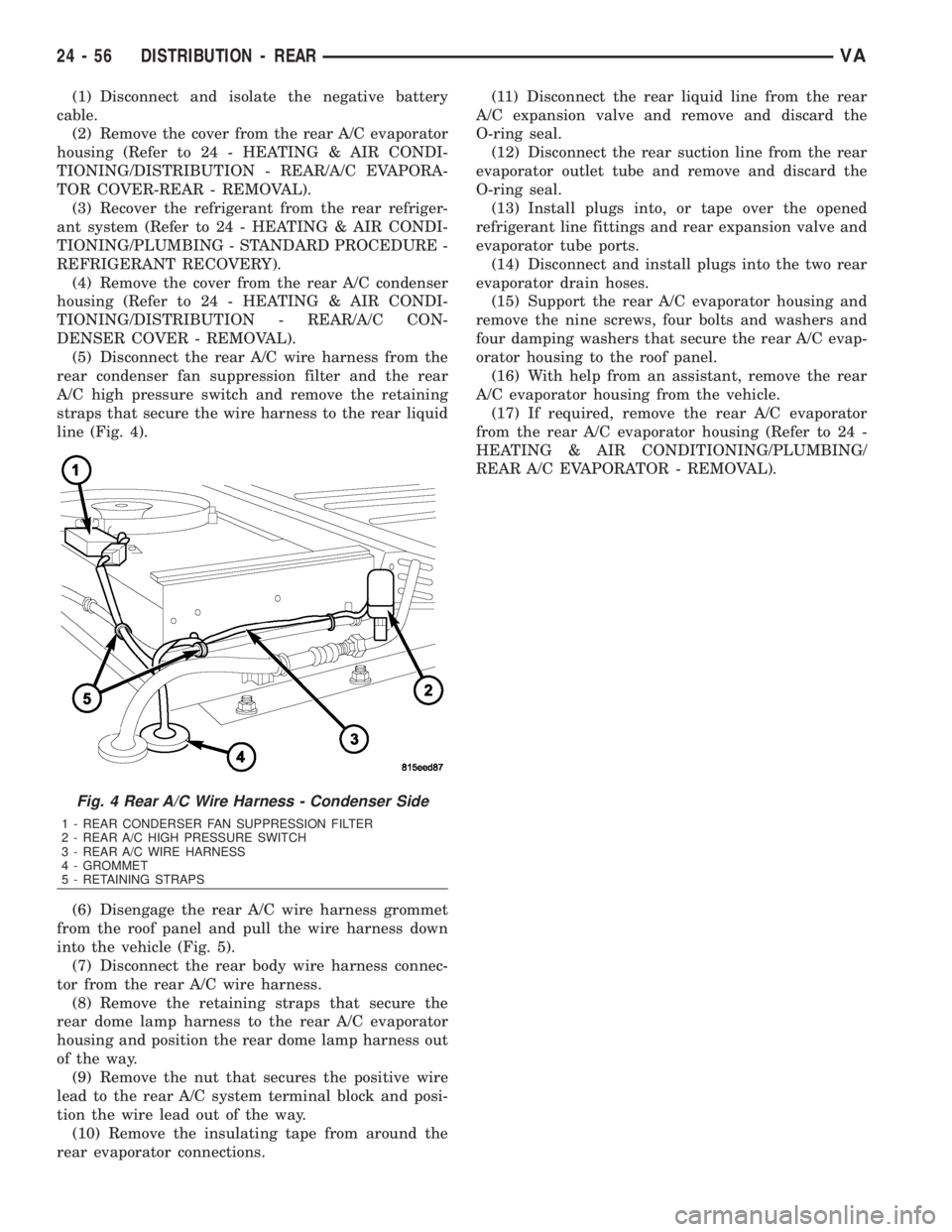
line (Fig. 4).
(6) Disengage the rear A/C wire harness grommet
from the roof panel and pull the wire harness down
into the vehicle (Fig. 5).
(7) Disconnect the rear body wire harness connec-
tor from the rear A/C wire harness.
(8) Remove the retaining straps that secure the
rear dome lamp harness to the rear A/C evaporator
housing and position the rear dome lamp harness out
of the way.
(9) Remove the nut that secures the positive wire
lead to the rear A/C system terminal block and posi-
tion the wire lead out of the way.
(10) Remove the insulating tape from around the
rear evaporator connections.(11) Disconnect the rear liquid line from the rear
A/C expansion valve and remove and discard the
O-ring seal.
(12) Disconnect the rear suction line from the rear
evaporator outlet tube and remove and discard the
O-ring seal.
(13) Install plugs into, or tape over the opened
refrigerant line fittings and rear expansion valve and
evaporator tube ports.
(14) Disconnect and install plugs into the two rear
evaporator drain hoses.
(15) Support the rear A/C evaporator housing and
remove the nine screws, four bolts and washers and
four damping washers that secure the rear A/C evap-
orator housing to the roof panel.
(16) With help from an assistant, remove the rear
A/C evaporator housing from the vehicle.
(17) If required, remove the rear A/C evaporator
from the rear A/C evaporator housing (Refer to 24 -
HEATING & AIR CONDITIONING/PLUMBING/
REAR A/C EVAPORATOR - REMOVAL).
Fig. 4 Rear A/C Wire Harness - Condenser Side
1 - REAR CONDERSER FAN SUPPRESSION FILTER
2 - REAR A/C HIGH PRESSURE SWITCH
3 - REAR A/C WIRE HARNESS
4 - GROMMET
5 - RETAINING STRAPS
24 - 56 DISTRIBUTION - REARVA
Page 2095 of 2305
(10) Lubricate a new O-ring seal with clean refrig-
erant oil and install it onto the rear suction line fit-
ting. Use only the specified O-ring seal as it is made
of a special material for the R-134a system. Use only
refrigerant oil of the type recommended for the rear
A/C compressor in the vehicle.
(11) Connect the rear suction line to the rear evap-
orator outlet tube. Tighten the suction line nut to 35
N´m (26 ft. lbs.).
(12) Install new insulating tape around the rear
evaporator connections.
(13) Install the positive wire lead onto the rear
A/C system terminal block and install the retaining
nut. Tighten the nut securely.
(14) Reposition the rear dome lamp harness and
install the retaining straps that secure the harness
to the rear A/C evaporator housing.
(15) Connect the rear A/C wire harness connector
to the rear body wire harness.
(16) Route the rear A/C wire harness up through
the roof panel and install the grommet.
(17) Connect the rear A/C wire harness to the rear
condenser fan suppression filter and the rear A/C
high pressure switch and install the retaining straps
that secure the wire harness to the rear liquid line.
(18) Reconnect the negative battery cable.
(19) Evacuate the rear refrigerant system (Refer to
24 - HEATING & AIR CONDITIONING/PLUMBING
- STANDARD PROCEDURE - REFRIGERANT SYS-
TEM EVACUATE).
(20) Charge the rear refrigerant system (Refer to
24 - HEATING & AIR CONDITIONING/PLUMBING
- STANDARD PROCEDURE - REFRIGERANT SYS-
TEM CHARGE).
(21) Install the cover onto the rear A/C evaporator
housing (Refer to 24 - HEATING & AIR CONDI-
TIONING/DISTRIBUTION - REAR/A/C EVAPORA-
TOR COVER-REAR - INSTALLATION).
(22) Install the cover onto the rear A/C condenser
housing (Refer to 24 - HEATING & AIR CONDI-
TIONING/DISTRIBUTION - REAR/A/C CON-
DENSER COVER - INSTALLATION).
AIR FILTER
REMOVAL
(1) Unlock the eight quick-release fasteners by
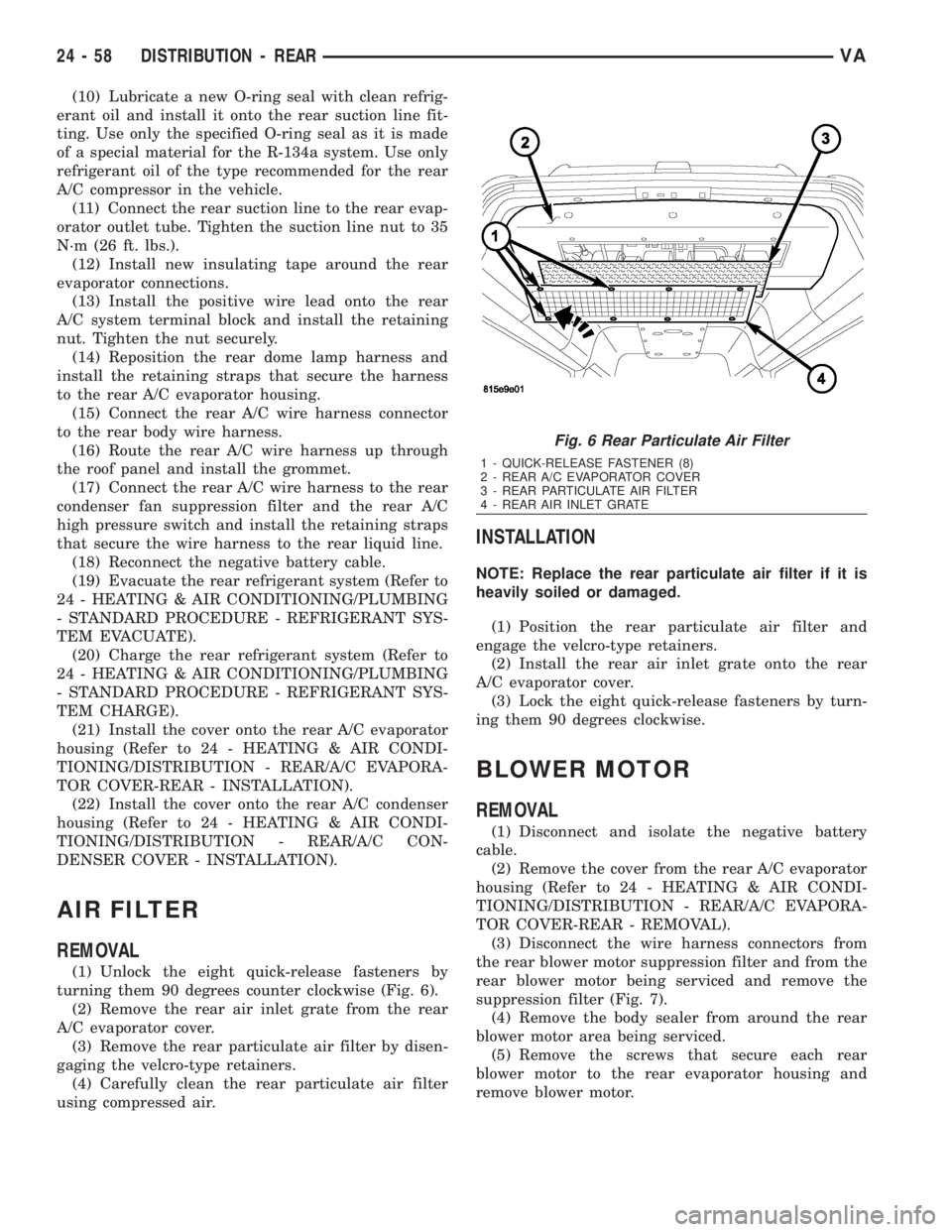
turning them 90 degrees counter clockwise (Fig. 6).
(2) Remove the rear air inlet grate from the rear
A/C evaporator cover.
(3) Remove the rear particulate air filter by disen-
gaging the velcro-type retainers.
(4) Carefully clean the rear particulate air filter
using compressed air.
INSTALLATION
NOTE: Replace the rear particulate air filter if it is
heavily soiled or damaged.
(1) Position the rear particulate air filter and
engage the velcro-type retainers.
(2) Install the rear air inlet grate onto the rear
A/C evaporator cover.
(3) Lock the eight quick-release fasteners by turn-
ing them 90 degrees clockwise.
BLOWER MOTOR
REMOVAL
(1) Disconnect and isolate the negative battery
cable.
(2) Remove the cover from the rear A/C evaporator
housing (Refer to 24 - HEATING & AIR CONDI-
TIONING/DISTRIBUTION - REAR/A/C EVAPORA-
TOR COVER-REAR - REMOVAL).
(3) Disconnect the wire harness connectors from
the rear blower motor suppression filter and from the
rear blower motor being serviced and remove the
suppression filter (Fig. 7).
(4) Remove the body sealer from around the rear
blower motor area being serviced.
(5) Remove the screws that secure each rear
blower motor to the rear evaporator housing and
remove blower motor.
Fig. 6 Rear Particulate Air Filter
1 - QUICK-RELEASE FASTENER (8)
2 - REAR A/C EVAPORATOR COVER
3 - REAR PARTICULATE AIR FILTER
4 - REAR AIR INLET GRATE
24 - 58 DISTRIBUTION - REARVA
Page 2096 of 2305
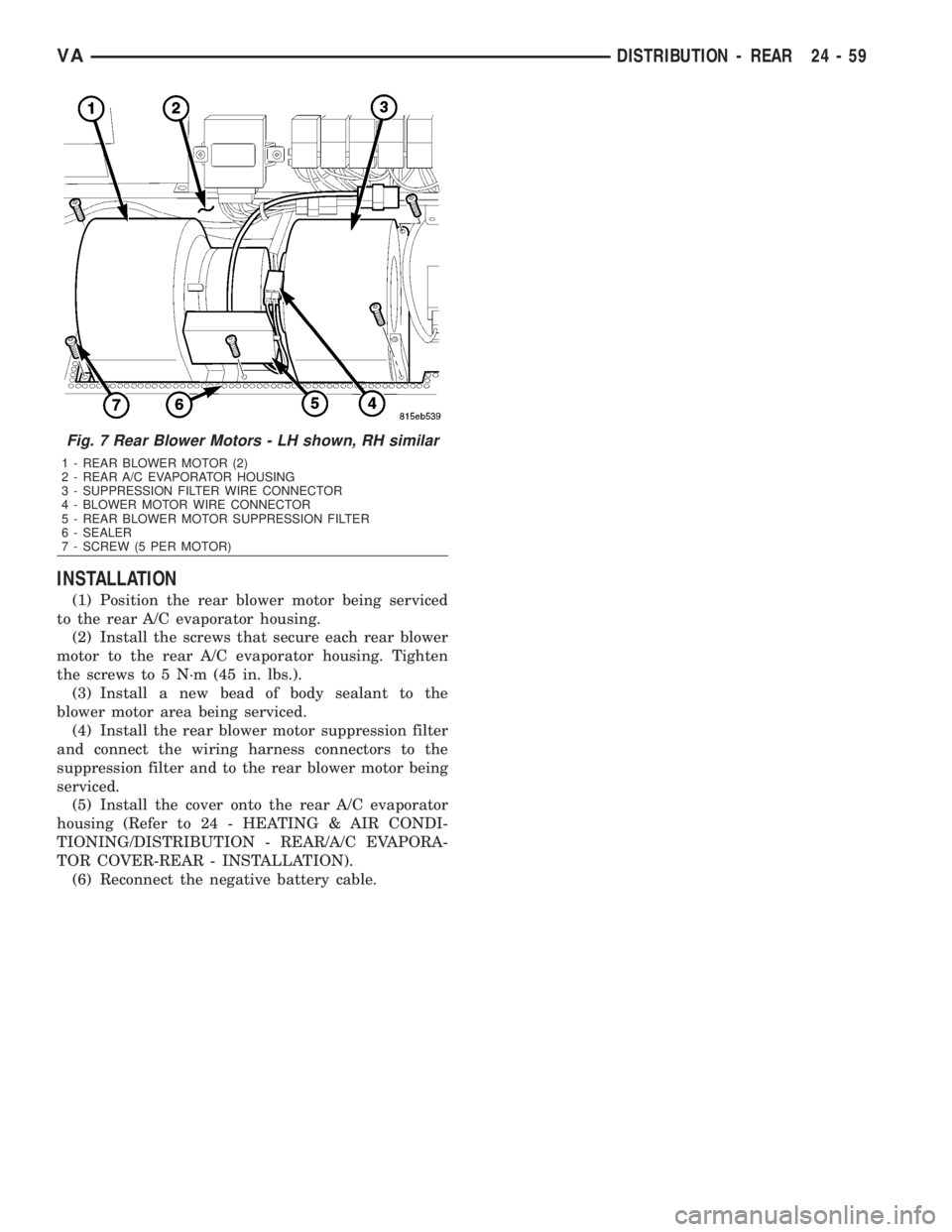
INSTALLATION
(1) Position the rear blower motor being serviced
to the rear A/C evaporator housing.
(2) Install the screws that secure each rear blower
motor to the rear A/C evaporator housing. Tighten
the screws to 5 N´m (45 in. lbs.).
(3) Install a new bead of body sealant to the
blower motor area being serviced.
(4) Install the rear blower motor suppression filter
and connect the wiring harness connectors to the
suppression filter and to the rear blower motor being
serviced.
(5) Install the cover onto the rear A/C evaporator
housing (Refer to 24 - HEATING & AIR CONDI-
TIONING/DISTRIBUTION - REAR/A/C EVAPORA-
TOR COVER-REAR - INSTALLATION).
(6) Reconnect the negative battery cable.
Fig. 7 Rear Blower Motors - LH shown, RH similar
1 - REAR BLOWER MOTOR (2)
2 - REAR A/C EVAPORATOR HOUSING
3 - SUPPRESSION FILTER WIRE CONNECTOR
4 - BLOWER MOTOR WIRE CONNECTOR
5 - REAR BLOWER MOTOR SUPPRESSION FILTER
6 - SEALER
7 - SCREW (5 PER MOTOR)
VADISTRIBUTION - REAR 24 - 59
Page 2100 of 2305
SYSTEM EMPTY
(1) Evacuate the refrigerant system to the lowest
degree of vacuum possible (approximately 28 in Hg.)
(Refer to 24 - HEATING & AIR CONDITIONING/
PLUMBING - STANDARD PROCEDURE - REFRIG-
ERANT SYSTEM EVACUATE). Determine if the
system holds a vacuum for 15 minutes. If vacuum is
held, a leak is probably not present. If system will
not maintain vacuum level, proceed to Step 2.
(2) Prepare and dispense 0.284 kilograms (10
ounces) of R-134a refrigerant into the evacuated
refrigerant system (Refer to 24 - HEATING & AIR
CONDITIONING/PLUMBING - STANDARD PRO-
CEDURE - REFRIGERANT SYSTEM CHARGE) and
proceed to Step 1 of the System Low procedure.
SYSTEM LOW
(1) Position the vehicle in a wind free work area.
This will aid in detecting small leaks.
(2) Operate the heating-A/C system with the
engine at idle under the following conditions for at
least five minutes.
²Doors or windows open
²Transmission in Park
²A/C-heater controls set to outside air, full cool,
panel mode, high blower and with A/C compressor
engaged
CAUTION: A leak detector only designed for R-12
refrigerant will not detect leaks in a R-134a refriger-
ant system.
(3) Shut the vehicle Off and wait 2-7 minutes.
Then use an electronic leak detector that is designed
to detect R-134a refrigerant and search for leaks. Fit-
tings, lines or components that appear to be oily usu-
ally indicate a refrigerant leak. To inspect the A/C
evaporator for leaks, insert the leak detector probe
into the drain tube opening or an air outlet. A dye for
R-134a is available to aid in leak detection. Use only
DaimlerChrysler approved refrigerant dye.
STANDARD PROCEDURE
REFRIGERANT SYSTEM SERVICE EQUIPMENT
WARNING: Eye protection must be worn when ser-
vicing an A/C refrigerant system. Turn off (rotate
clockwise) all valves on the equipment being used,
before connecting to or disconnecting from the
refrigerant system. Failure to observe these warn-
ings may result in possible personal injury.
WARNING: Refer to the applicable warnings and
cautions for this system before performing the fol-
lowing operation (Refer to 24 - HEATING & AIR
CONDITIONING/PLUMBING - WARNINGS) and (Referto 24 - HEATING & AIR CONDITIONING/PLUMBING -
CAUTIONS). Failure to follow the warnings and cau-
tions could result in possible personal injury or
death.
When servicing the air conditioning system, a
R-134a refrigerant recovery/recycling/charging sta-
tion that meets SAE Standard J2210 must be used.
Contact an automotive service equipment supplier for
refrigerant recovery/recycling/charging equipment.
Refer to the operating instructions supplied by the
equipment manufacturer for proper care and use of
this equipment.
A manifold gauge set may be needed with some
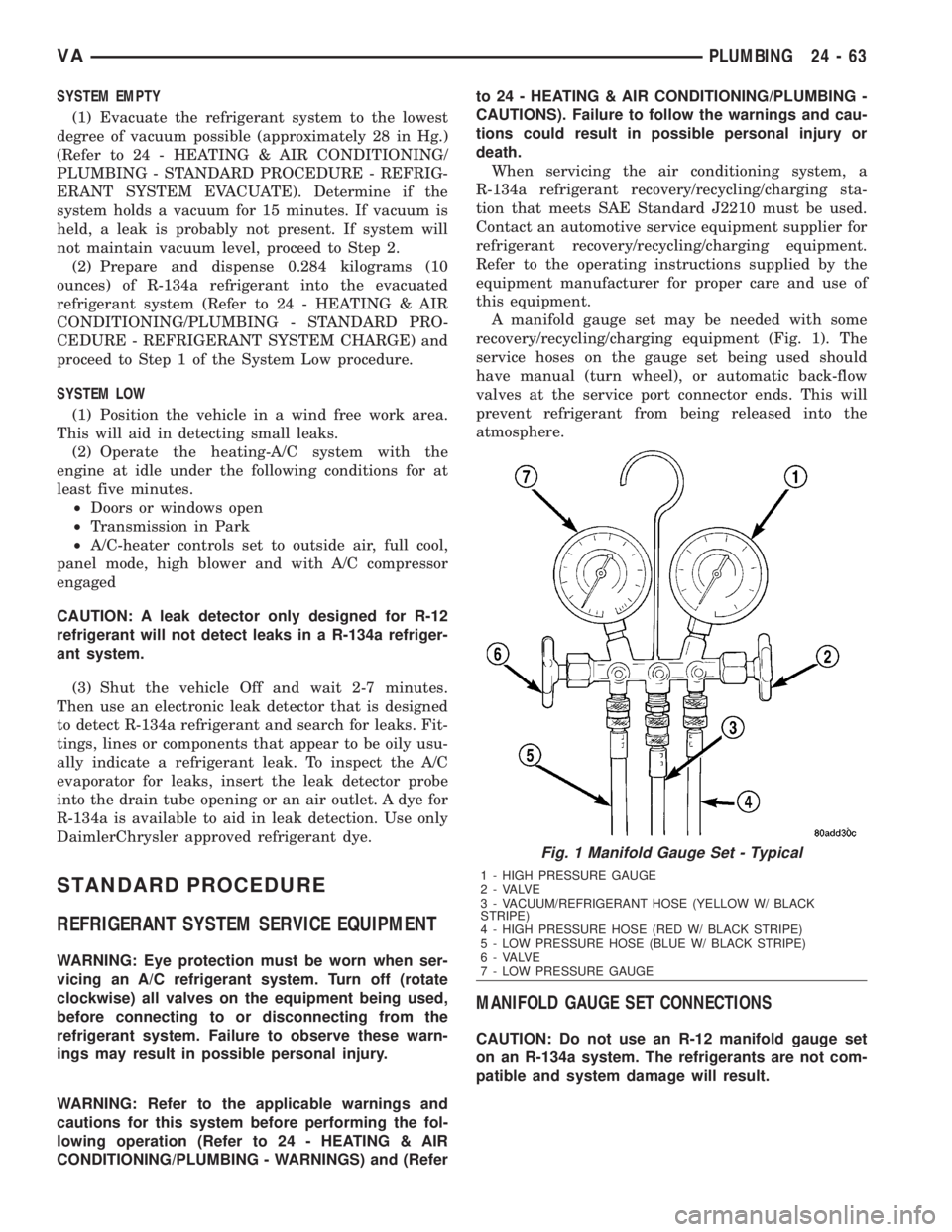
recovery/recycling/charging equipment (Fig. 1). The
service hoses on the gauge set being used should
have manual (turn wheel), or automatic back-flow
valves at the service port connector ends. This will
prevent refrigerant from being released into the
atmosphere.
MANIFOLD GAUGE SET CONNECTIONS
CAUTION: Do not use an R-12 manifold gauge set
on an R-134a system. The refrigerants are not com-
patible and system damage will result.
Fig. 1 Manifold Gauge Set - Typical
1 - HIGH PRESSURE GAUGE
2 - VALVE
3 - VACUUM/REFRIGERANT HOSE (YELLOW W/ BLACK
STRIPE)
4 - HIGH PRESSURE HOSE (RED W/ BLACK STRIPE)
5 - LOW PRESSURE HOSE (BLUE W/ BLACK STRIPE)
6 - VALVE
7 - LOW PRESSURE GAUGE
VAPLUMBING 24 - 63
Page 2101 of 2305
FRONTA/CSYSTEM
²LOW PRESSURE GAUGE HOSEÐThe low
pressure hose (Blue with Black stripe) attaches to
the suction line service port. This port is located on
the suction line near the dash panel.
²HIGH PRESSURE GAUGE HOSEÐThe high
pressure hose (Red with Black stripe) attaches to the
discharge line service port. This port is located on the
liquid line between the condenser and the reciver-
drier.
²RECOVERY/RECYCLING/EVACUATION/
CHARGING HOSEÐThe center manifold hose (Yel-
low, or White, with Black stripe) is used to recover,
evacuate, and charge the refrigerant system. When
the low or high pressure valves on the manifold
gauge set are opened, the refrigerant in the system
will escape through this hose.
REARA/CSYSTEM
²LOW PRESSURE GAUGE HOSEÐThe low
pressure hose (Blue with Black stripe) attaches to
the suction line service port. This port is located
within the rear A/C evaporator housing near the left
side of the evaporator, below the high-pressure ser-
vice port.
²HIGH PRESSURE GAUGE HOSEÐThe high
pressure hose (Red with Black stripe) attaches to the
liquid line service port. This port is located within
the rear A/C evaporator housing near the left side of
the evaporator, above the low-pressure service port.
²RECOVERY/RECYCLING/EVACUATION/
CHARGING HOSEÐThe center manifold hose (Yel-
low, or White, with Black stripe) is used to recover,
evacuate, and charge the refrigerant system. When
the low or high pressure valves on the manifold
gauge set are opened, the refrigerant in the system
will escape through this hose.
REFRIGERANT SYSTEM RECOVERY
WARNING: Refer to the applicable warnings and
cautions for this system before performing the fol-
lowing operation (Refer to 24 - HEATING & AIR
CONDITIONING/PLUMBING - WARNINGS) and (Refer
to 24 - HEATING & AIR CONDITIONING/PLUMBING -
CAUTIONS). Failure to follow the warnings and cau-
tions could result in possible personal injury or
death.
A R-134a refrigerant recovery/recycling/charging
station that meets SAE Standard J2210 must be
used to recover the refrigerant from an R-134a refrig-
erant system. Refer to the operating instructions sup-
plied by the equipment manufacturer for the proper
care and use of this equipment.
REFRIGERANT SYSTEM EVACUATE
WARNING: Refer to the applicable warnings and
cautions for this system before performing the fol-
lowing operation (Refer to 24 - HEATING & AIR
CONDITIONING/PLUMBING - WARNINGS) and (Refer
to 24 - HEATING & AIR CONDITIONING/PLUMBING -
CAUTIONS). Failure to follow the warnings and cau-
tions could result in possible personal injury or
death.
If the refrigerant system has been open to the
atmosphere, it must be evacuated before the system
can be charged. If moisture and air enters the system
and becomes mixed with the refrigerant, the com-
pressor head pressure will rise above acceptable
operating levels. This will reduce the performance of
the air conditioner and damage the compressor.
Evacuating the refrigerant system will remove the
air and boil the moisture out of the system at near
room temperature. To evacuate the refrigerant sys-
tem, use the following procedure:
(1) Connect a R-134a refrigerant recovery/recy-
cling/charging station that meets SAE Standard
J2210 and a manifold gauge set to the refrigerant
system of the vehicle.
(2) Open the low and high side valves and start
the charging station vacuum pump. When the suc-
tion gauge reads 88 kPa (26 in. Hg.) vacuum or
greater, close all of the valves and turn off the vac-
uum pump.
(a) If the refrigerant system fails to reach the
specified vacuum, the system has a leak that must
be corrected. (Refer to 24 - HEATING & AIR CON-
DITIONING/PLUMBING - DIAGNOSIS AND
TESTING - REFRIGERANT SYSTEM LEAKS)
(b) If the refrigerant system maintains the spec-
ified vacuum for five minutes, restart the vacuum
pump, open the suction and discharge valves and
evacuate the system for an additional ten minutes.
(3) Close all of the valves, and turn off the charg-
ing station vacuum pump.
(4) The refrigerant system is now ready to be
charged with R-134a refrigerant. (Refer to 24 -
HEATING & AIR CONDITIONING/PLUMBING -
STANDARD PROCEDURE - REFRIGERANT SYS-
TEM CHARGE)
REFRIGERANT SYSTEM CHARGE
WARNING: Refer to the applicable warnings and
cautions for this system before performing the fol-
lowing operation (Refer to 24 - HEATING & AIR
CONDITIONING/PLUMBING - WARNINGS) and (Refer
to 24 - HEATING & AIR CONDITIONING/PLUMBING -
CAUTIONS). Failure to follow the warnings and cau-
tions could result in possible personal injury or
death.
24 - 64 PLUMBINGVA
Page 2102 of 2305
CAUTION: A small amount of refrigerant oil is
removed from the A/C system each time the refrig-
erant system is recovered and evacuated. Before
charging the A/C system, you MUST replenish any
oil lost during the recovery process. Refer the
equipment manufacturer instructions for more infor-
mation.
After the refrigerant system has been tested for
leaks and evacuated, a refrigerant charge can be
injected into the system. (Refer to 24 - HEATING &
AIR CONDITIONING/PLUMBING - SPECIFICA-
TIONS - CHARGE CAPACITY)
A R-134a refrigerant recovery/recycling/charging
station that meets SAE Standard J2210 must be
used to charge the refrigerant system with R-134a
refrigerant. Refer to the operating instructions sup-
plied by the equipment manufacturer for proper care
and use of this equipment.
PARTIAL CHARGE METHOD
The partial charge method is used to add a partial
charge to a refrigerant system that is low on refrig-
erant. To perform this procedure the evaporator inlet
and outlet tube temperatures are measured. The
temperature difference is measured with a tempera-
ture meter with one or two clamp-on thermocouple
probes. The difference between the evaporator inlet
and outlet tube temperatures will determine the
amount of refrigerant needed.
Before adding a partial refrigerant charge, check
for refrigerant system leaks. (Refer to 24 - HEATING
& AIR CONDITIONING/PLUMBING - DIAGNOSIS
AND TESTING - REFRIGERANT SYSTEM LEAKS)
If a leak is found, make the necessary repairs before
attempting a full or partial refrigerant charge.
(1) Attach a manifold gauge set to the refrigerant
system service ports.
(2) Attach the two clamp-on thermocouple probes
to the inlet and outlet tubes of the evaporator coil.
²If a single thermocouple probe is used, attach
the probe to the evaporator inlet tube just before the
collar of the refrigerant line connector fitting. The
probe must make contact with the bottom surface of
the evaporator inlet tube.
²If dual thermocouple probes are used, attach
probe 1 to the evaporator inlet tube, and probe 2 to
the evaporator outlet tube. Attach both probes to the
evaporator tubes just before the collar of the refrig-erant line connector fittings. The probes must make
contact with the bottom surfaces of the evaporator
inlet and outlet tubes.
(3) Open all of the windows or doors of the passen-
ger compartment.
(4) Set the A/C button on the A/C Heater controls
to the on position, the temperature control knob in
the full cool position, select Recirculation Mode, and
place the blower motor switch in the highest speed
position.
(5) Start the engine and hold the engine idle speed
at 1,000 rpm. Allow the engine to warm up to normal
operating temperature.
(6) The compressor clutch may cycle, depending
upon ambient temperature, humidity, and the refrig-
erant system charge level.
(7) Hold the engine idle speed at 1,000 rpm.
(8) Allow three to five minutes for the refrigerant
system to stabilize, then record the temperatures of
the evaporator inlet and outlet tubes.
²If a single probe is used, record the temperature
of the evaporator inlet tube. Then remove the probe
from the inlet tube and attach it to the evaporator
outlet tube just before the collar of the refrigerant
line connector fitting. The probe must make contact
with the bottom surface of the evaporator outlet tube.
Allow the thermocouple and meter time to stabilize,
then record the temperature of the evaporator outlet
tube. Subtract the inlet tube temperature reading
from the outlet tube temperature reading.
²If dual probes are used, record the temperatures
of both the evaporator inlet and outlet tubes. Then
subtract the inlet tube temperature reading from the
outlet tube temperature reading.
(9) If the measured temperature differential is
higher than 22É C to 26É C (40É F to 47É F), add 0.4
kilograms (14 ounces) of refrigerant.
(10) Allow three to five minutes for the refrigerant
system to stabilize, then take a second set of thermo-
couple measurements. Record the temperature differ-
ence to determine if an additional charge is required.
(11) Record the compressor discharge pressure. If
the reading is higher than the pressure shown in the
Compressor Discharge Pressure Chart, the system
could be overcharged. If the reading is equal to, or
lower, than the pressure shown in the chart, continue
with this procedure.
Compressor Discharge Pressure Chart
Ambient Tempera-
ture16ÉC
(60ÉF)21ÉC
(70ÉF)27ÉC
(80ÉF)32ÉC
(90ÉF)38ÉC
(100ÉF)43ÉC
(110ÉF)
Compressor Dis-
charge Pressure1378 kPa
(200 psi)1516 kPa
(220 psi)1723 kPa
(250psi)1930 kPa
(280 psi)2206 kPa
(320 psi)2413 kPa
(350 psi)
VAPLUMBING 24 - 65
Page 2104 of 2305
mounting brackets, or a loose compressor clutch
assembly.
Drive belts are speed sensitive. At different engine
speeds and depending upon belt tension, belts can
develop noises that are mistaken for a compressor
noise. Improper belt tension can cause a misleading
noise when the compressor clutch is engaged, which
may not occur when the compressor clutch is disen-
gaged. Check the serpentine drive belt condition and
tension as described in Cooling before beginning this
procedure.
(1) Select a quiet area for testing. Duplicate the
complaint conditions as much as possible. Switch the
compressor on and off several times to clearly iden-
tify the compressor noise. Listen to the compressor
while the clutch is engaged and disengaged. Probe
the compressor with an engine stethoscope or a long
screwdriver with the handle held to your ear to bet-
ter localize the source of the noise.
(2) Loosen all of the compressor mounting hard-
ware and retighten. Tighten the compressor clutch
mounting nut. Be certain that the clutch coil is
mounted securely to the compressor, and that the
clutch plate and pulley are properly aligned and have
the correct air gap. (Refer to 24 - HEATING & AIR
CONDITIONING/CONTROLS/A/C COMPRESSOR
CLUTCH - INSTALLATION)
(3) To duplicate a high-ambient temperature condi-
tion (high head pressure), restrict the air flow
through the condenser. Install a manifold gauge set
to be certain that the discharge pressure does not
exceed 2760 kPa (400 psi).
(4) Check the refrigerant system plumbing for
incorrect routing, rubbing or interference, which can
cause unusual noises. Also check the refrigerant lines
for kinks or sharp bends that will restrict refrigerant
flow, which can cause noises. (Refer to 24 - HEAT-
ING & AIR CONDITIONING/PLUMBING - CAU-
TION - REFRIGERANT HOSES/LINES/TUBES
PRECAUTIONS)
(5) If the noise is from opening and closing of the
high pressure relief valve, reclaim, evacuate, and
recharge the refrigerant system. (Refer to 24 - HEAT-
ING & AIR CONDITIONING/PLUMBING - STAN-
DARD PROCEDURE - REFRIGERANT RECOVERY)
(Refer to 24 - HEATING & AIR CONDITIONING/
PLUMBING - STANDARD PROCEDURE - REFRIG-
ERANT SYSTEM EVACUATE) (Refer to 24 -
HEATING & AIR CONDITIONING/PLUMBING -
STANDARD PROCEDURE - REFRIGERANT SYS-
TEM CHARGE) If the high pressure relief valve still
does not seat properly, replace the a/c compressor.
(Refer to 24 - HEATING & AIR CONDITIONING/
PLUMBING/A/C COMPRESSOR - REMOVAL)
(6) If the noise is from liquid slugging on the suc-
tion line, check the refrigerant oil level and the
refrigerant system charge. (Refer to 24 - HEATING
& AIR CONDITIONING/PLUMBING/REFRIGER-ANT OIL - STANDARD PROCEDURE) (Refer to 24 -
HEATING & AIR CONDITIONING/PLUMBING -
SPECIFICATIONS - CHARGE CAPACITY).
(7) If the noise continues, replace the compressor
and repeat Step 1.
REMOVAL
DENSO 7SBU16CA/CCOMPRESSOR
WARNING: Refer to the applicable warnings and
cautions for this system before performing the fol-
lowing operation (Refer to 24 - HEATING & AIR
CONDITIONING/PLUMBING - WARNINGS) and (Refer
to 24 - HEATING & AIR CONDITIONING/PLUMBING -
CAUTIONS). Failure to follow the warnings and cau-
tions could result in possible personal injury or
death.
NOTE: The A/C compressor may be removed and
repositioned without disconnecting the refrigerant
lines or discharging the refrigerant system. Dis-
charging is not necessary if servicing the compres-
sor clutch, clutch coil or the engine.
NOTE: If an internal failure of the A/C compressor
has occurred, the receiver/drier must be replaced.
(1) Disconnect and isolate the negative battery
cable.
(2) Recover the refrigerant from the refrigerant
system (Refer to 24 - HEATING & AIR CONDITION-
ING/PLUMBING - STANDARD PROCEDURE -
REFRIGERANT SYSTEM RECOVERY).
(3) Remove the serpentine drive belt (Refer to 7 -
COOLING/ACCESSORY DRIVE/BELTS-DRIVE -
REMOVAL).
(4) Disconnect the wire harness connector from the
A/C compressor clutch coil.
(5) Remove the bolts that secure the A/C suction
and discharge lines to the A/C compressor.
(6) Disconnect the A/C suction and discharge lines
from the A/C compressor and remove and discard the
O-ring seals (Fig. 4).
(7) Install plugs in, or tape over the opened refrig-
erant line fittings and the compressor ports.
(8) Raise the vehicle on a hoist.
(9) If equipped with an add-on rear A/C system,
remove the lower A/C compressor and position it out
of the way (Refer to 24 - HEATING & AIR CONDI-
TIONING/PLUMBING/A/C COMPRESSOR -
REMOVAL - DENSO 10S17).
(10) Support the A/C compressor and remove the
compressor mounting bolts.
(11) Remove the A/C compressor from the engine
compartment.
VAPLUMBING 24 - 67
Page 2105 of 2305
DENSO 10S17A/CCOMPRESSOR
WARNING: Refer to the applicable warnings and
cautions for this system before performing the fol-
lowing operation (Refer to 24 - HEATING & AIR
CONDITIONING/PLUMBING - WARNINGS) and (Refer
to 24 - HEATING & AIR CONDITIONING/PLUMBING -
CAUTIONS). Failure to follow the warnings and cau-
tions could result in possible personal injury or
death.
NOTE: The A/C compressor may be removed and
repositioned without disconnecting the refrigerant
lines or discharging the refrigerant system. Dis-
charging is not necessary if servicing the compres-
sor clutch, clutch coil or the engine.
NOTE: If an internal failure of the A/C compressor
has occurred, the receiver/drier must be replaced.
(1) Recover the refrigerant from the refrigerant
system (Refer to 24 - HEATING & AIR CONDITION-
ING/PLUMBING - STANDARD PROCEDURE -
REFRIGERANT SYSTEM RECOVERY).
(2) Disconnect and isolate the negative battery
cable.
(3) Raise and support the vehicle.(4) Remove the accessory drive belt (Refer to 7 -
COOLING/ACCESSORY DRIVE/BELTS-DRIVE -
REMOVAL).
(5) Disconnect the wire harness connector from the
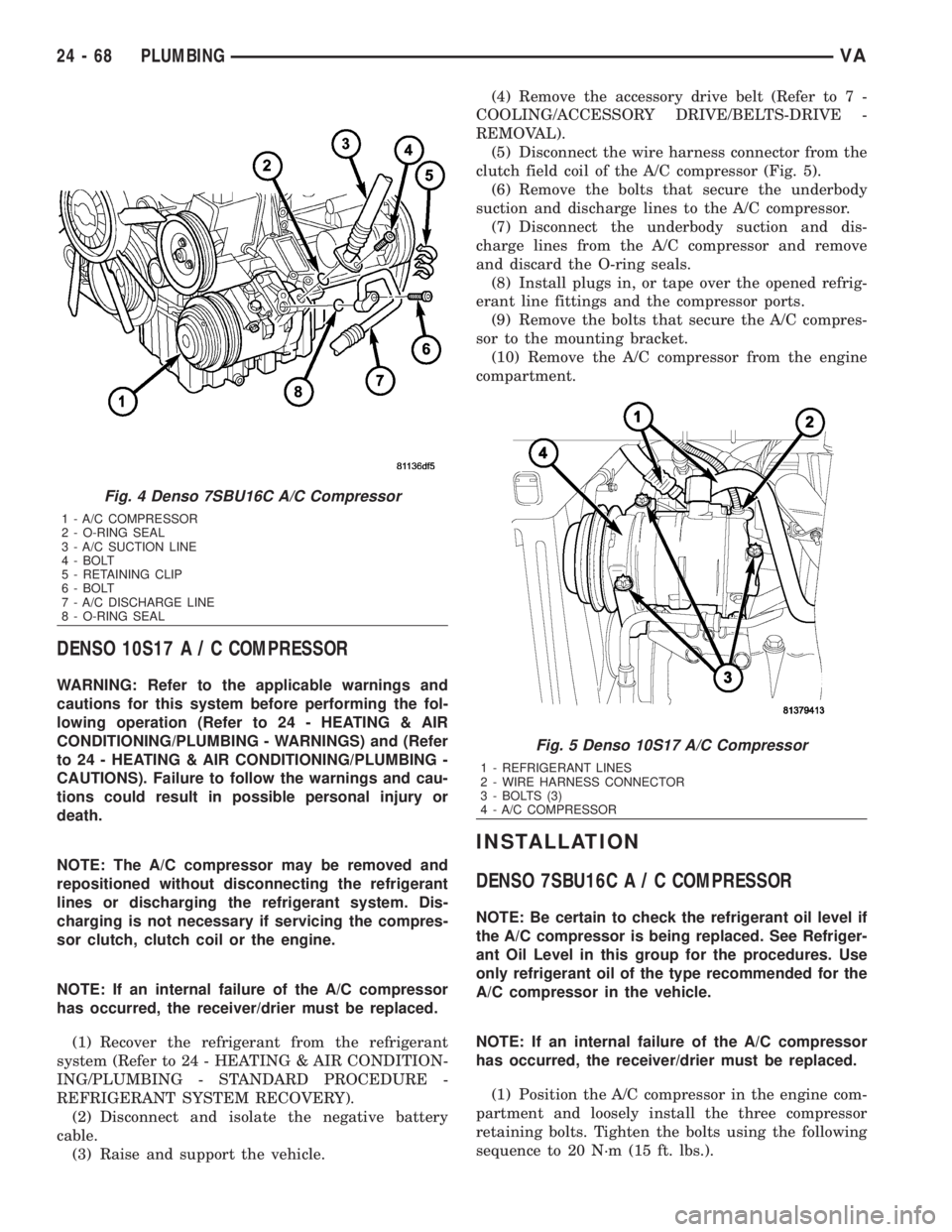
clutch field coil of the A/C compressor (Fig. 5).
(6) Remove the bolts that secure the underbody
suction and discharge lines to the A/C compressor.
(7) Disconnect the underbody suction and dis-
charge lines from the A/C compressor and remove
and discard the O-ring seals.
(8) Install plugs in, or tape over the opened refrig-
erant line fittings and the compressor ports.
(9) Remove the bolts that secure the A/C compres-
sor to the mounting bracket.
(10) Remove the A/C compressor from the engine
compartment.
INSTALLATION
DENSO 7SBU16CA/CCOMPRESSOR
NOTE: Be certain to check the refrigerant oil level if
the A/C compressor is being replaced. See Refriger-
ant Oil Level in this group for the procedures. Use
only refrigerant oil of the type recommended for the
A/C compressor in the vehicle.
NOTE: If an internal failure of the A/C compressor
has occurred, the receiver/drier must be replaced.
(1) Position the A/C compressor in the engine com-
partment and loosely install the three compressor
retaining bolts. Tighten the bolts using the following
sequence to 20 N´m (15 ft. lbs.).
Fig. 4 Denso 7SBU16C A/C Compressor
1 - A/C COMPRESSOR
2 - O-RING SEAL
3 - A/C SUCTION LINE
4 - BOLT
5 - RETAINING CLIP
6 - BOLT
7 - A/C DISCHARGE LINE
8 - O-RING SEAL
Fig. 5 Denso 10S17 A/C Compressor
1 - REFRIGERANT LINES
2 - WIRE HARNESS CONNECTOR
3 - BOLTS (3)
4 - A/C COMPRESSOR
24 - 68 PLUMBINGVA