service MERCEDES-BENZ SPRINTER 2006 Service Manual
[x] Cancel search | Manufacturer: MERCEDES-BENZ, Model Year: 2006, Model line: SPRINTER, Model: MERCEDES-BENZ SPRINTER 2006Pages: 2305, PDF Size: 48.12 MB
Page 471 of 2305
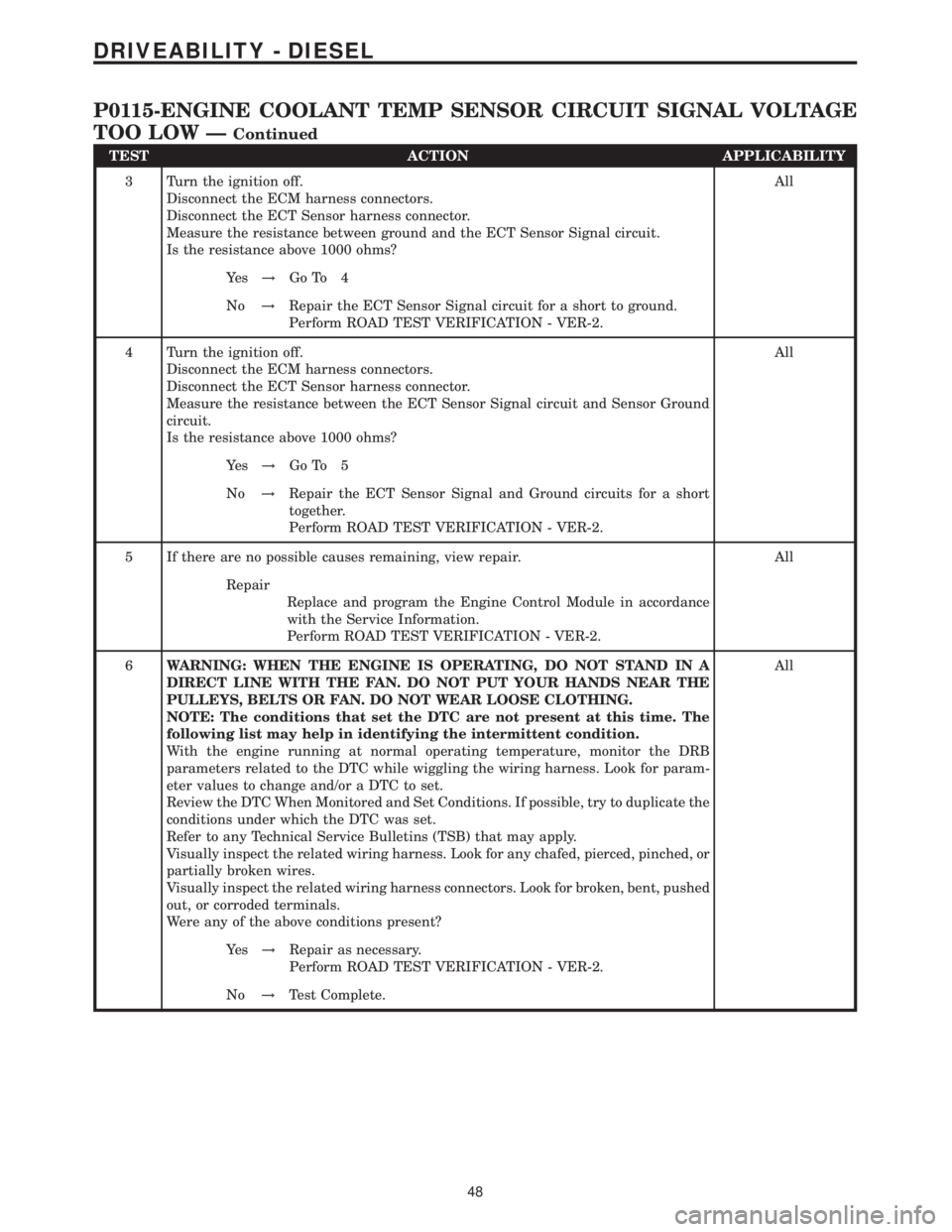
TEST ACTION APPLICABILITY
3 Turn the ignition off.
Disconnect the ECM harness connectors.
Disconnect the ECT Sensor harness connector.
Measure the resistance between ground and the ECT Sensor Signal circuit.
Is the resistance above 1000 ohms?All
Ye s!Go To 4
No!Repair the ECT Sensor Signal circuit for a short to ground.
Perform ROAD TEST VERIFICATION - VER-2.
4 Turn the ignition off.
Disconnect the ECM harness connectors.
Disconnect the ECT Sensor harness connector.
Measure the resistance between the ECT Sensor Signal circuit and Sensor Ground
circuit.
Is the resistance above 1000 ohms?All
Ye s!Go To 5
No!Repair the ECT Sensor Signal and Ground circuits for a short
together.
Perform ROAD TEST VERIFICATION - VER-2.
5 If there are no possible causes remaining, view repair. All
Repair
Replace and program the Engine Control Module in accordance
with the Service Information.
Perform ROAD TEST VERIFICATION - VER-2.
6WARNING: WHEN THE ENGINE IS OPERATING, DO NOT STAND IN A
DIRECT LINE WITH THE FAN. DO NOT PUT YOUR HANDS NEAR THE
PULLEYS, BELTS OR FAN. DO NOT WEAR LOOSE CLOTHING.
NOTE: The conditions that set the DTC are not present at this time. The
following list may help in identifying the intermittent condition.
With the engine running at normal operating temperature, monitor the DRB
parameters related to the DTC while wiggling the wiring harness. Look for param-
eter values to change and/or a DTC to set.
Review the DTC When Monitored and Set Conditions. If possible, try to duplicate the
conditions under which the DTC was set.
Refer to any Technical Service Bulletins (TSB) that may apply.
Visually inspect the related wiring harness. Look for any chafed, pierced, pinched, or
partially broken wires.
Visually inspect the related wiring harness connectors. Look for broken, bent, pushed
out, or corroded terminals.
Were any of the above conditions present?All
Ye s!Repair as necessary.
Perform ROAD TEST VERIFICATION - VER-2.
No!Test Complete.
48
DRIVEABILITY - DIESEL
P0115-ENGINE COOLANT TEMP SENSOR CIRCUIT SIGNAL VOLTAGE
TOO LOW Ð
Continued
Page 472 of 2305
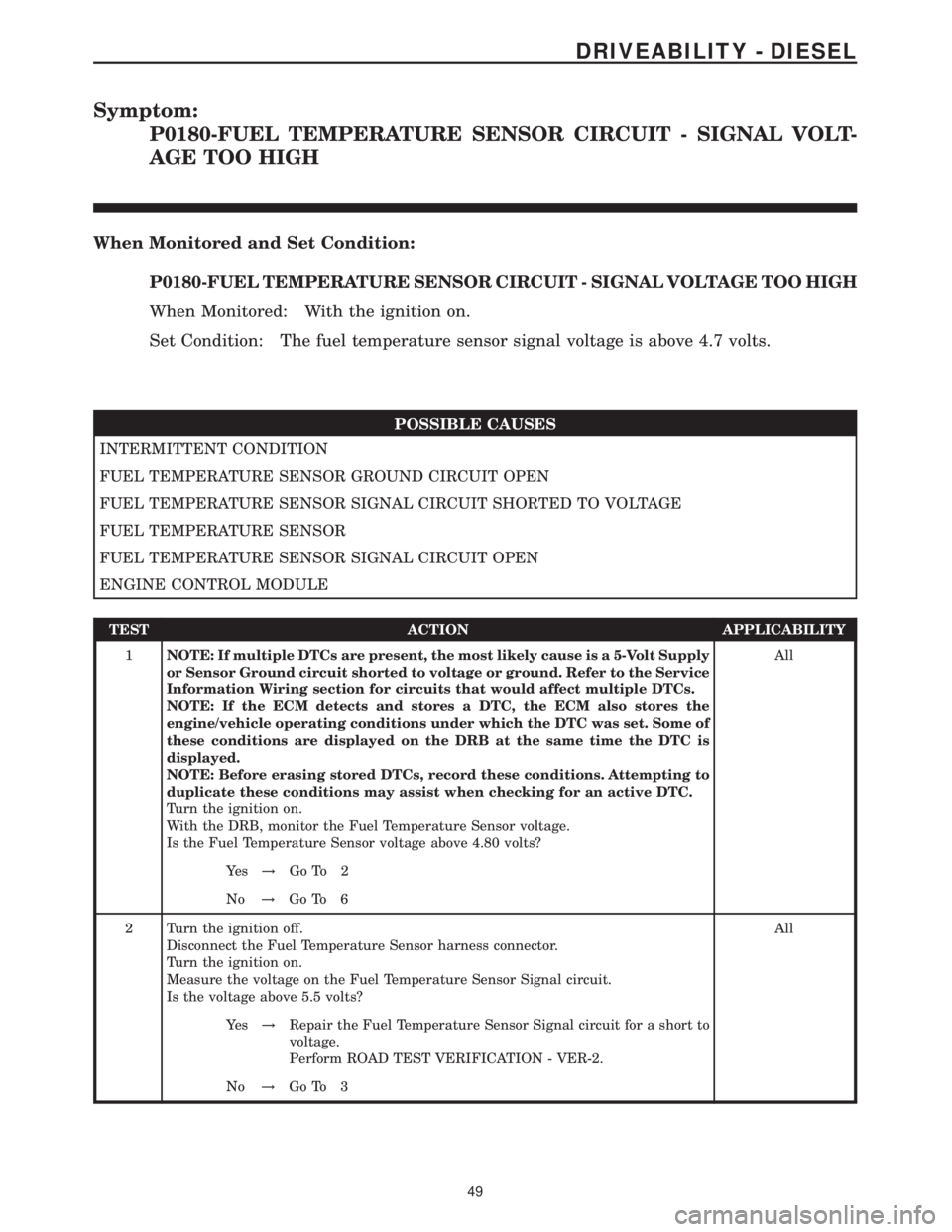
Symptom:
P0180-FUEL TEMPERATURE SENSOR CIRCUIT - SIGNAL VOLT-
AGE TOO HIGH
When Monitored and Set Condition:
P0180-FUEL TEMPERATURE SENSOR CIRCUIT - SIGNAL VOLTAGE TOO HIGH
When Monitored: With the ignition on.
Set Condition: The fuel temperature sensor signal voltage is above 4.7 volts.
POSSIBLE CAUSES
INTERMITTENT CONDITION
FUEL TEMPERATURE SENSOR GROUND CIRCUIT OPEN
FUEL TEMPERATURE SENSOR SIGNAL CIRCUIT SHORTED TO VOLTAGE
FUEL TEMPERATURE SENSOR
FUEL TEMPERATURE SENSOR SIGNAL CIRCUIT OPEN
ENGINE CONTROL MODULE
TEST ACTION APPLICABILITY
1NOTE: If multiple DTCs are present, the most likely cause is a 5-Volt Supply
or Sensor Ground circuit shorted to voltage or ground. Refer to the Service
Information Wiring section for circuits that would affect multiple DTCs.
NOTE: If the ECM detects and stores a DTC, the ECM also stores the
engine/vehicle operating conditions under which the DTC was set. Some of
these conditions are displayed on the DRB at the same time the DTC is
displayed.
NOTE: Before erasing stored DTCs, record these conditions. Attempting to
duplicate these conditions may assist when checking for an active DTC.
Turn the ignition on.
With the DRB, monitor the Fuel Temperature Sensor voltage.
Is the Fuel Temperature Sensor voltage above 4.80 volts?All
Ye s!Go To 2
No!Go To 6
2 Turn the ignition off.
Disconnect the Fuel Temperature Sensor harness connector.
Turn the ignition on.
Measure the voltage on the Fuel Temperature Sensor Signal circuit.
Is the voltage above 5.5 volts?All
Ye s!Repair the Fuel Temperature Sensor Signal circuit for a short to
voltage.
Perform ROAD TEST VERIFICATION - VER-2.
No!Go To 3
49
DRIVEABILITY - DIESEL
Page 473 of 2305
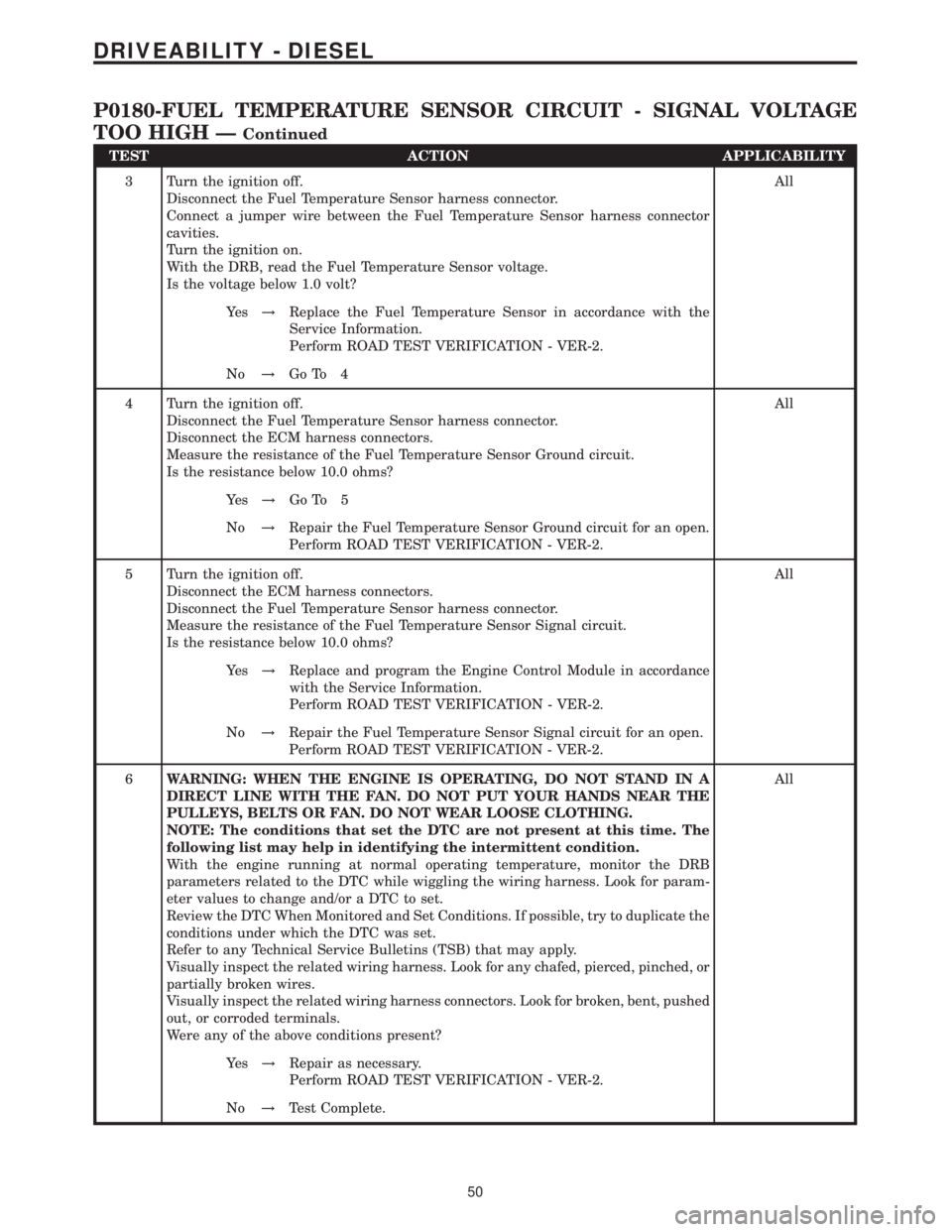
TEST ACTION APPLICABILITY
3 Turn the ignition off.
Disconnect the Fuel Temperature Sensor harness connector.
Connect a jumper wire between the Fuel Temperature Sensor harness connector
cavities.
Turn the ignition on.
With the DRB, read the Fuel Temperature Sensor voltage.
Is the voltage below 1.0 volt?All
Ye s!Replace the Fuel Temperature Sensor in accordance with the
Service Information.
Perform ROAD TEST VERIFICATION - VER-2.
No!Go To 4
4 Turn the ignition off.
Disconnect the Fuel Temperature Sensor harness connector.
Disconnect the ECM harness connectors.
Measure the resistance of the Fuel Temperature Sensor Ground circuit.
Is the resistance below 10.0 ohms?All
Ye s!Go To 5
No!Repair the Fuel Temperature Sensor Ground circuit for an open.
Perform ROAD TEST VERIFICATION - VER-2.
5 Turn the ignition off.
Disconnect the ECM harness connectors.
Disconnect the Fuel Temperature Sensor harness connector.
Measure the resistance of the Fuel Temperature Sensor Signal circuit.
Is the resistance below 10.0 ohms?All
Ye s!Replace and program the Engine Control Module in accordance
with the Service Information.
Perform ROAD TEST VERIFICATION - VER-2.
No!Repair the Fuel Temperature Sensor Signal circuit for an open.
Perform ROAD TEST VERIFICATION - VER-2.
6WARNING: WHEN THE ENGINE IS OPERATING, DO NOT STAND IN A
DIRECT LINE WITH THE FAN. DO NOT PUT YOUR HANDS NEAR THE
PULLEYS, BELTS OR FAN. DO NOT WEAR LOOSE CLOTHING.
NOTE: The conditions that set the DTC are not present at this time. The
following list may help in identifying the intermittent condition.
With the engine running at normal operating temperature, monitor the DRB
parameters related to the DTC while wiggling the wiring harness. Look for param-
eter values to change and/or a DTC to set.
Review the DTC When Monitored and Set Conditions. If possible, try to duplicate the
conditions under which the DTC was set.
Refer to any Technical Service Bulletins (TSB) that may apply.
Visually inspect the related wiring harness. Look for any chafed, pierced, pinched, or
partially broken wires.
Visually inspect the related wiring harness connectors. Look for broken, bent, pushed
out, or corroded terminals.
Were any of the above conditions present?All
Ye s!Repair as necessary.
Perform ROAD TEST VERIFICATION - VER-2.
No!Test Complete.
50
DRIVEABILITY - DIESEL
P0180-FUEL TEMPERATURE SENSOR CIRCUIT - SIGNAL VOLTAGE
TOO HIGH Ð
Continued
Page 475 of 2305
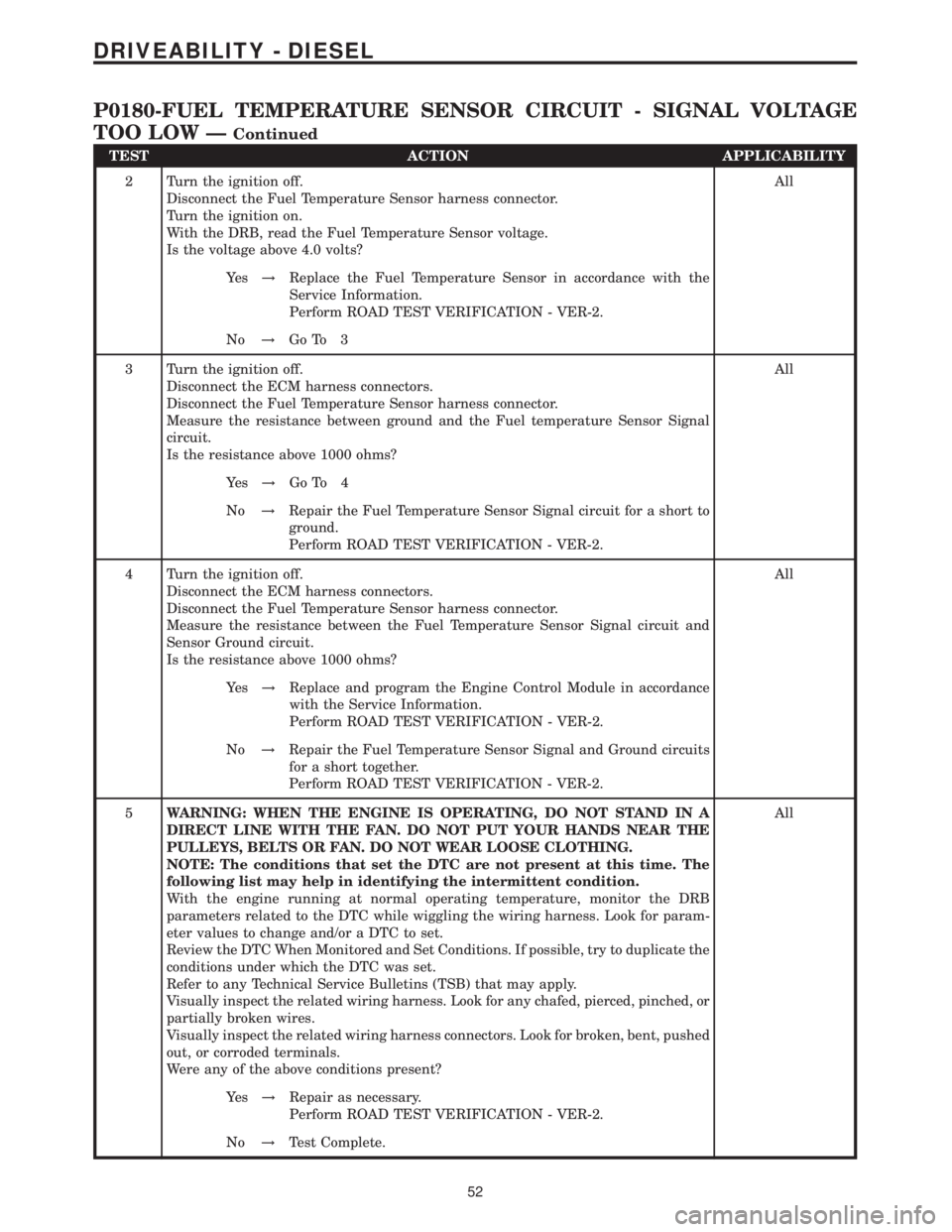
TEST ACTION APPLICABILITY
2 Turn the ignition off.
Disconnect the Fuel Temperature Sensor harness connector.
Turn the ignition on.
With the DRB, read the Fuel Temperature Sensor voltage.
Is the voltage above 4.0 volts?All
Ye s!Replace the Fuel Temperature Sensor in accordance with the
Service Information.
Perform ROAD TEST VERIFICATION - VER-2.
No!Go To 3
3 Turn the ignition off.
Disconnect the ECM harness connectors.
Disconnect the Fuel Temperature Sensor harness connector.
Measure the resistance between ground and the Fuel temperature Sensor Signal
circuit.
Is the resistance above 1000 ohms?All
Ye s!Go To 4
No!Repair the Fuel Temperature Sensor Signal circuit for a short to
ground.
Perform ROAD TEST VERIFICATION - VER-2.
4 Turn the ignition off.
Disconnect the ECM harness connectors.
Disconnect the Fuel Temperature Sensor harness connector.
Measure the resistance between the Fuel Temperature Sensor Signal circuit and
Sensor Ground circuit.
Is the resistance above 1000 ohms?All
Ye s!Replace and program the Engine Control Module in accordance
with the Service Information.
Perform ROAD TEST VERIFICATION - VER-2.
No!Repair the Fuel Temperature Sensor Signal and Ground circuits
for a short together.
Perform ROAD TEST VERIFICATION - VER-2.
5WARNING: WHEN THE ENGINE IS OPERATING, DO NOT STAND IN A
DIRECT LINE WITH THE FAN. DO NOT PUT YOUR HANDS NEAR THE
PULLEYS, BELTS OR FAN. DO NOT WEAR LOOSE CLOTHING.
NOTE: The conditions that set the DTC are not present at this time. The
following list may help in identifying the intermittent condition.
With the engine running at normal operating temperature, monitor the DRB
parameters related to the DTC while wiggling the wiring harness. Look for param-
eter values to change and/or a DTC to set.
Review the DTC When Monitored and Set Conditions. If possible, try to duplicate the
conditions under which the DTC was set.
Refer to any Technical Service Bulletins (TSB) that may apply.
Visually inspect the related wiring harness. Look for any chafed, pierced, pinched, or
partially broken wires.
Visually inspect the related wiring harness connectors. Look for broken, bent, pushed
out, or corroded terminals.
Were any of the above conditions present?All
Ye s!Repair as necessary.
Perform ROAD TEST VERIFICATION - VER-2.
No!Test Complete.
52
DRIVEABILITY - DIESEL
P0180-FUEL TEMPERATURE SENSOR CIRCUIT - SIGNAL VOLTAGE
TOO LOW Ð
Continued
Page 477 of 2305
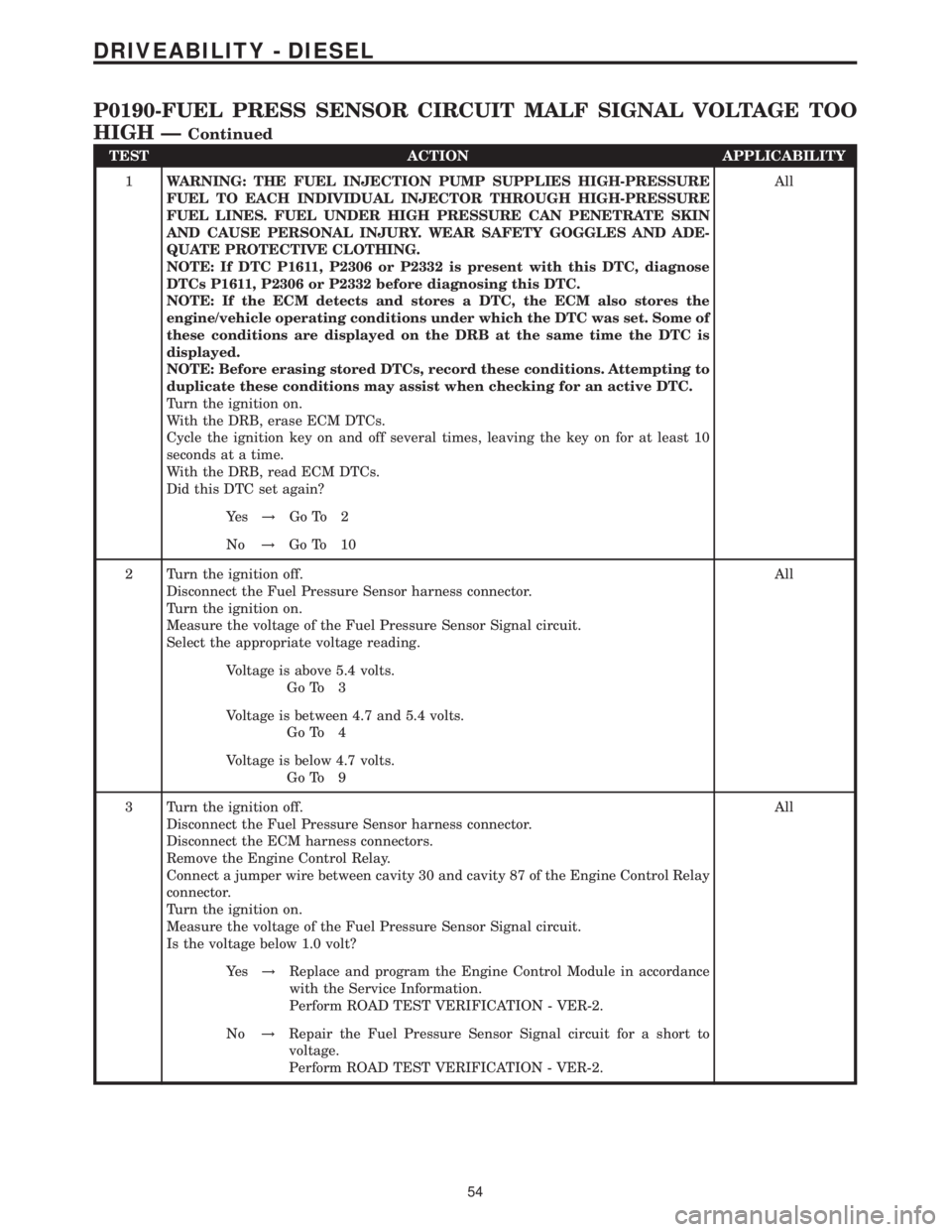
TEST ACTION APPLICABILITY
1WARNING: THE FUEL INJECTION PUMP SUPPLIES HIGH-PRESSURE
FUEL TO EACH INDIVIDUAL INJECTOR THROUGH HIGH-PRESSURE
FUEL LINES. FUEL UNDER HIGH PRESSURE CAN PENETRATE SKIN
AND CAUSE PERSONAL INJURY. WEAR SAFETY GOGGLES AND ADE-
QUATE PROTECTIVE CLOTHING.
NOTE: If DTC P1611, P2306 or P2332 is present with this DTC, diagnose
DTCs P1611, P2306 or P2332 before diagnosing this DTC.
NOTE: If the ECM detects and stores a DTC, the ECM also stores the
engine/vehicle operating conditions under which the DTC was set. Some of
these conditions are displayed on the DRB at the same time the DTC is
displayed.
NOTE: Before erasing stored DTCs, record these conditions. Attempting to
duplicate these conditions may assist when checking for an active DTC.
Turn the ignition on.
With the DRB, erase ECM DTCs.
Cycle the ignition key on and off several times, leaving the key on for at least 10
seconds at a time.
With the DRB, read ECM DTCs.
Did this DTC set again?All
Ye s!Go To 2
No!Go To 10
2 Turn the ignition off.
Disconnect the Fuel Pressure Sensor harness connector.
Turn the ignition on.
Measure the voltage of the Fuel Pressure Sensor Signal circuit.
Select the appropriate voltage reading.All
Voltage is above 5.4 volts.
Go To 3
Voltage is between 4.7 and 5.4 volts.
Go To 4
Voltage is below 4.7 volts.
Go To 9
3 Turn the ignition off.
Disconnect the Fuel Pressure Sensor harness connector.
Disconnect the ECM harness connectors.
Remove the Engine Control Relay.
Connect a jumper wire between cavity 30 and cavity 87 of the Engine Control Relay
connector.
Turn the ignition on.
Measure the voltage of the Fuel Pressure Sensor Signal circuit.
Is the voltage below 1.0 volt?All
Ye s!Replace and program the Engine Control Module in accordance
with the Service Information.
Perform ROAD TEST VERIFICATION - VER-2.
No!Repair the Fuel Pressure Sensor Signal circuit for a short to
voltage.
Perform ROAD TEST VERIFICATION - VER-2.
54
DRIVEABILITY - DIESEL
P0190-FUEL PRESS SENSOR CIRCUIT MALF SIGNAL VOLTAGE TOO
HIGH Ð
Continued
Page 478 of 2305
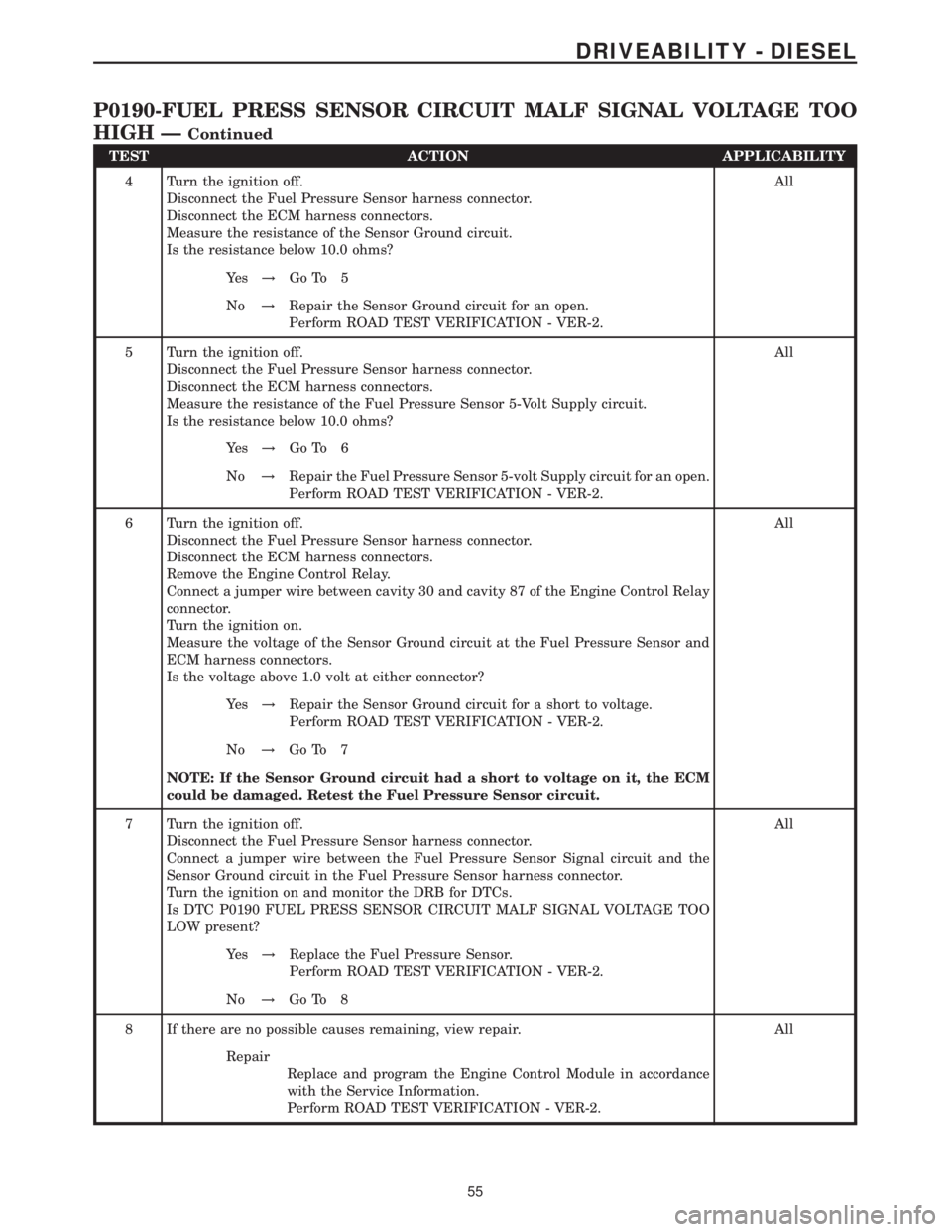
TEST ACTION APPLICABILITY
4 Turn the ignition off.
Disconnect the Fuel Pressure Sensor harness connector.
Disconnect the ECM harness connectors.
Measure the resistance of the Sensor Ground circuit.
Is the resistance below 10.0 ohms?All
Ye s!Go To 5
No!Repair the Sensor Ground circuit for an open.
Perform ROAD TEST VERIFICATION - VER-2.
5 Turn the ignition off.
Disconnect the Fuel Pressure Sensor harness connector.
Disconnect the ECM harness connectors.
Measure the resistance of the Fuel Pressure Sensor 5-Volt Supply circuit.
Is the resistance below 10.0 ohms?All
Ye s!Go To 6
No!Repair the Fuel Pressure Sensor 5-volt Supply circuit for an open.
Perform ROAD TEST VERIFICATION - VER-2.
6 Turn the ignition off.
Disconnect the Fuel Pressure Sensor harness connector.
Disconnect the ECM harness connectors.
Remove the Engine Control Relay.
Connect a jumper wire between cavity 30 and cavity 87 of the Engine Control Relay
connector.
Turn the ignition on.
Measure the voltage of the Sensor Ground circuit at the Fuel Pressure Sensor and
ECM harness connectors.
Is the voltage above 1.0 volt at either connector?All
Ye s!Repair the Sensor Ground circuit for a short to voltage.
Perform ROAD TEST VERIFICATION - VER-2.
No!Go To 7
NOTE: If the Sensor Ground circuit had a short to voltage on it, the ECM
could be damaged. Retest the Fuel Pressure Sensor circuit.
7 Turn the ignition off.
Disconnect the Fuel Pressure Sensor harness connector.
Connect a jumper wire between the Fuel Pressure Sensor Signal circuit and the
Sensor Ground circuit in the Fuel Pressure Sensor harness connector.
Turn the ignition on and monitor the DRB for DTCs.
Is DTC P0190 FUEL PRESS SENSOR CIRCUIT MALF SIGNAL VOLTAGE TOO
LOW present?All
Ye s!Replace the Fuel Pressure Sensor.
Perform ROAD TEST VERIFICATION - VER-2.
No!Go To 8
8 If there are no possible causes remaining, view repair. All
Repair
Replace and program the Engine Control Module in accordance
with the Service Information.
Perform ROAD TEST VERIFICATION - VER-2.
55
DRIVEABILITY - DIESEL
P0190-FUEL PRESS SENSOR CIRCUIT MALF SIGNAL VOLTAGE TOO
HIGH Ð
Continued
Page 479 of 2305
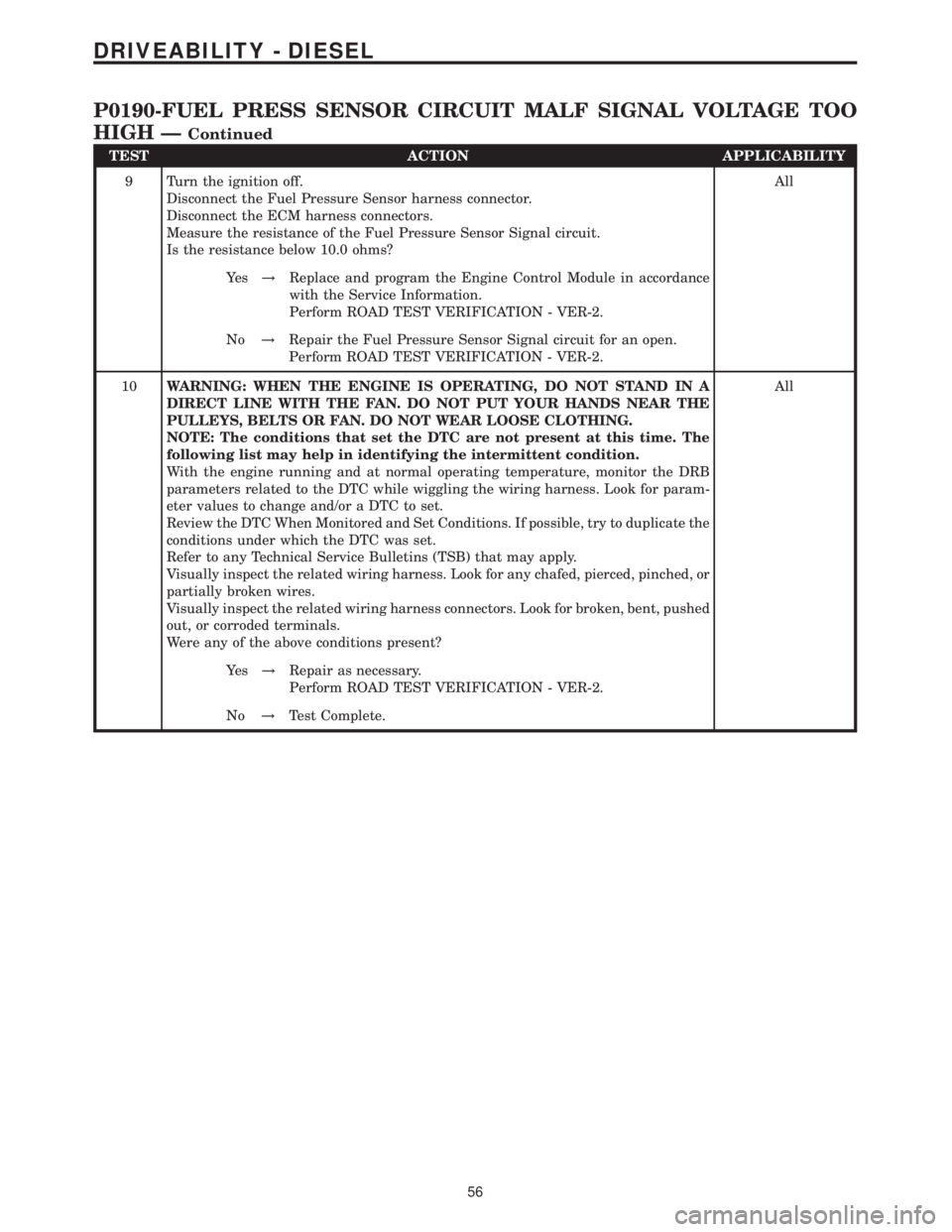
TEST ACTION APPLICABILITY
9 Turn the ignition off.
Disconnect the Fuel Pressure Sensor harness connector.
Disconnect the ECM harness connectors.
Measure the resistance of the Fuel Pressure Sensor Signal circuit.
Is the resistance below 10.0 ohms?All
Ye s!Replace and program the Engine Control Module in accordance
with the Service Information.
Perform ROAD TEST VERIFICATION - VER-2.
No!Repair the Fuel Pressure Sensor Signal circuit for an open.
Perform ROAD TEST VERIFICATION - VER-2.
10WARNING: WHEN THE ENGINE IS OPERATING, DO NOT STAND IN A
DIRECT LINE WITH THE FAN. DO NOT PUT YOUR HANDS NEAR THE
PULLEYS, BELTS OR FAN. DO NOT WEAR LOOSE CLOTHING.
NOTE: The conditions that set the DTC are not present at this time. The
following list may help in identifying the intermittent condition.
With the engine running and at normal operating temperature, monitor the DRB
parameters related to the DTC while wiggling the wiring harness. Look for param-
eter values to change and/or a DTC to set.
Review the DTC When Monitored and Set Conditions. If possible, try to duplicate the
conditions under which the DTC was set.
Refer to any Technical Service Bulletins (TSB) that may apply.
Visually inspect the related wiring harness. Look for any chafed, pierced, pinched, or
partially broken wires.
Visually inspect the related wiring harness connectors. Look for broken, bent, pushed
out, or corroded terminals.
Were any of the above conditions present?All
Ye s!Repair as necessary.
Perform ROAD TEST VERIFICATION - VER-2.
No!Test Complete.
56
DRIVEABILITY - DIESEL
P0190-FUEL PRESS SENSOR CIRCUIT MALF SIGNAL VOLTAGE TOO
HIGH Ð
Continued
Page 481 of 2305
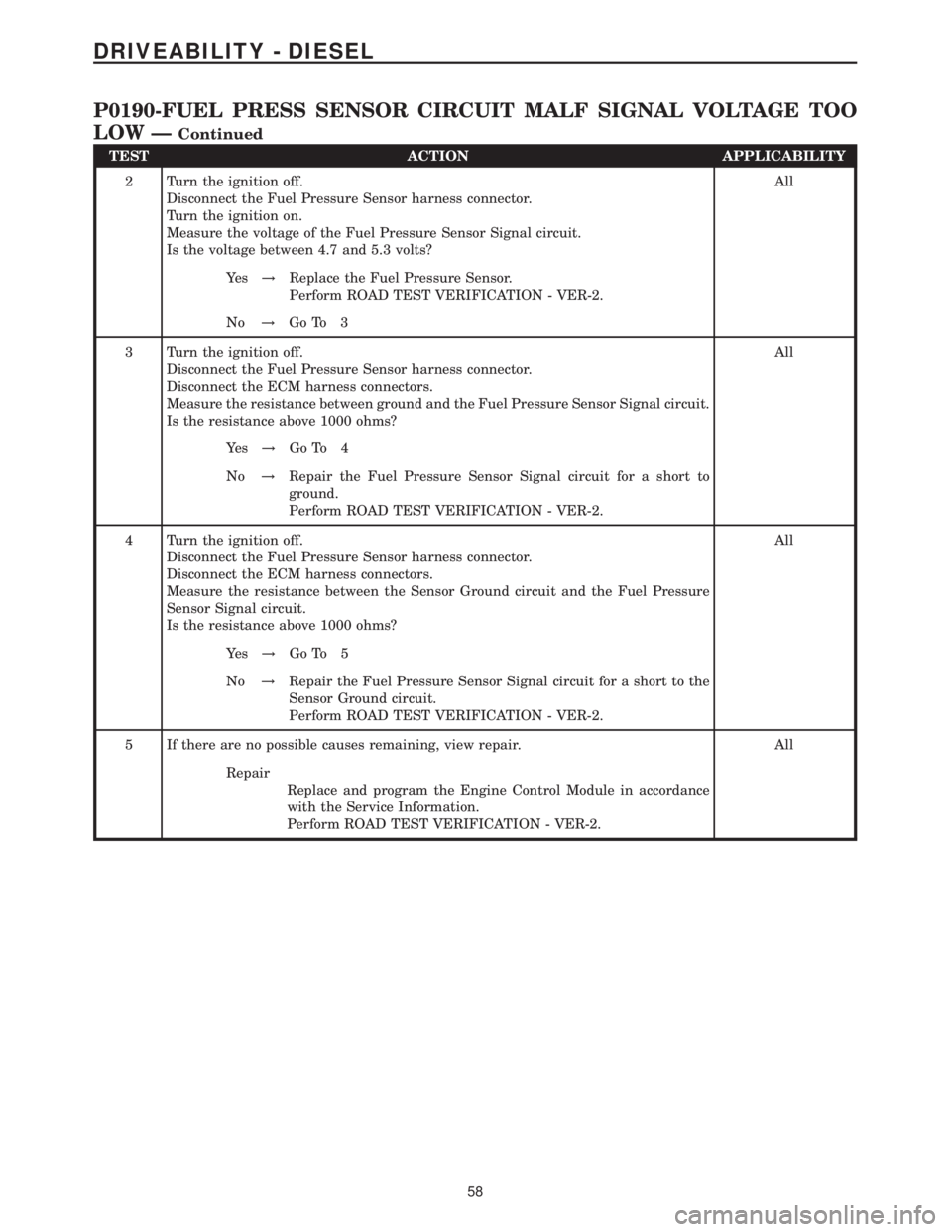
TEST ACTION APPLICABILITY
2 Turn the ignition off.
Disconnect the Fuel Pressure Sensor harness connector.
Turn the ignition on.
Measure the voltage of the Fuel Pressure Sensor Signal circuit.
Is the voltage between 4.7 and 5.3 volts?All
Ye s!Replace the Fuel Pressure Sensor.
Perform ROAD TEST VERIFICATION - VER-2.
No!Go To 3
3 Turn the ignition off.
Disconnect the Fuel Pressure Sensor harness connector.
Disconnect the ECM harness connectors.
Measure the resistance between ground and the Fuel Pressure Sensor Signal circuit.
Is the resistance above 1000 ohms?All
Ye s!Go To 4
No!Repair the Fuel Pressure Sensor Signal circuit for a short to
ground.
Perform ROAD TEST VERIFICATION - VER-2.
4 Turn the ignition off.
Disconnect the Fuel Pressure Sensor harness connector.
Disconnect the ECM harness connectors.
Measure the resistance between the Sensor Ground circuit and the Fuel Pressure
Sensor Signal circuit.
Is the resistance above 1000 ohms?All
Ye s!Go To 5
No!Repair the Fuel Pressure Sensor Signal circuit for a short to the
Sensor Ground circuit.
Perform ROAD TEST VERIFICATION - VER-2.
5 If there are no possible causes remaining, view repair. All
Repair
Replace and program the Engine Control Module in accordance
with the Service Information.
Perform ROAD TEST VERIFICATION - VER-2.
58
DRIVEABILITY - DIESEL
P0190-FUEL PRESS SENSOR CIRCUIT MALF SIGNAL VOLTAGE TOO
LOW Ð
Continued
Page 482 of 2305
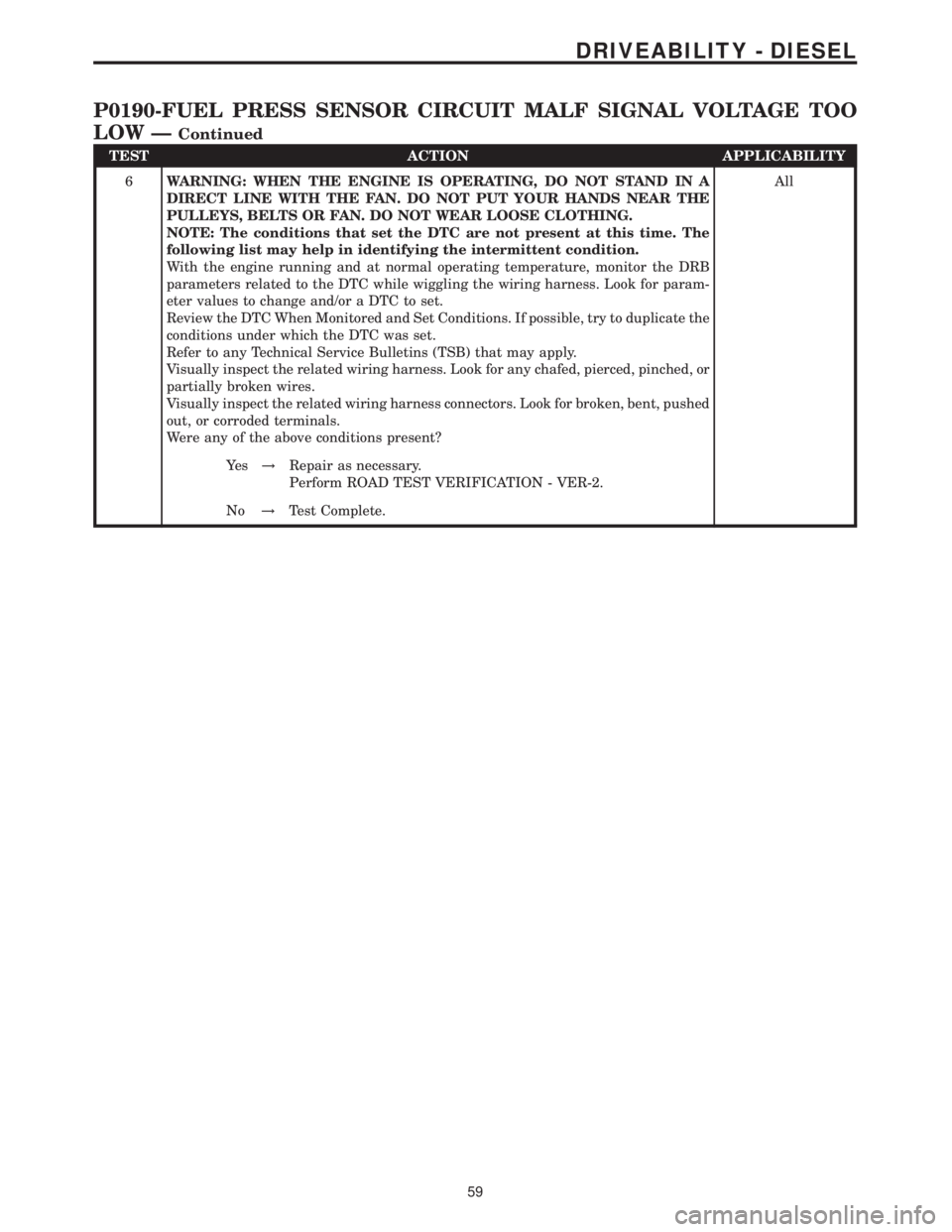
TEST ACTION APPLICABILITY
6WARNING: WHEN THE ENGINE IS OPERATING, DO NOT STAND IN A
DIRECT LINE WITH THE FAN. DO NOT PUT YOUR HANDS NEAR THE
PULLEYS, BELTS OR FAN. DO NOT WEAR LOOSE CLOTHING.
NOTE: The conditions that set the DTC are not present at this time. The
following list may help in identifying the intermittent condition.
With the engine running and at normal operating temperature, monitor the DRB
parameters related to the DTC while wiggling the wiring harness. Look for param-
eter values to change and/or a DTC to set.
Review the DTC When Monitored and Set Conditions. If possible, try to duplicate the
conditions under which the DTC was set.
Refer to any Technical Service Bulletins (TSB) that may apply.
Visually inspect the related wiring harness. Look for any chafed, pierced, pinched, or
partially broken wires.
Visually inspect the related wiring harness connectors. Look for broken, bent, pushed
out, or corroded terminals.
Were any of the above conditions present?All
Ye s!Repair as necessary.
Perform ROAD TEST VERIFICATION - VER-2.
No!Test Complete.
59
DRIVEABILITY - DIESEL
P0190-FUEL PRESS SENSOR CIRCUIT MALF SIGNAL VOLTAGE TOO
LOW Ð
Continued
Page 488 of 2305
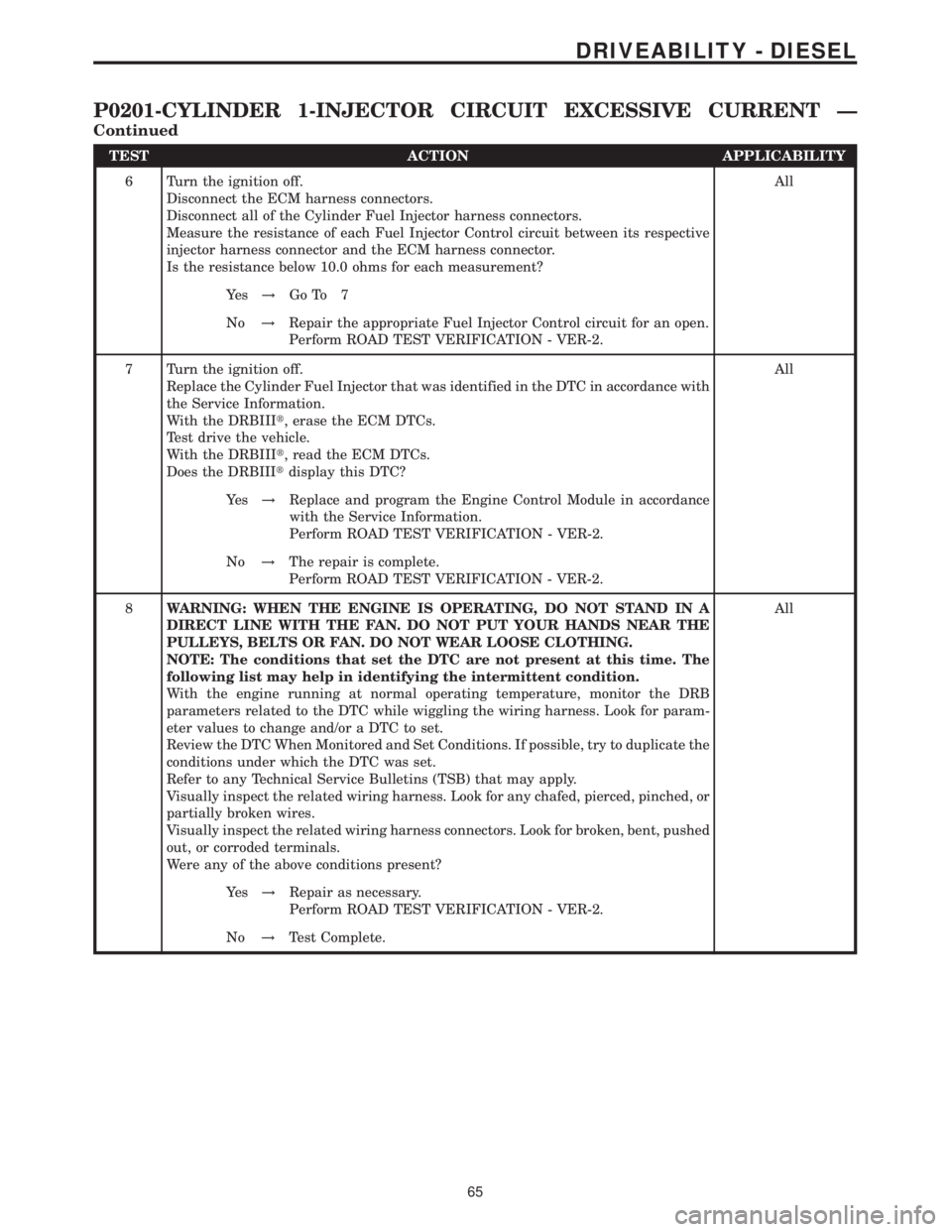
TEST ACTION APPLICABILITY
6 Turn the ignition off.
Disconnect the ECM harness connectors.
Disconnect all of the Cylinder Fuel Injector harness connectors.
Measure the resistance of each Fuel Injector Control circuit between its respective
injector harness connector and the ECM harness connector.
Is the resistance below 10.0 ohms for each measurement?All
Ye s!Go To 7
No!Repair the appropriate Fuel Injector Control circuit for an open.
Perform ROAD TEST VERIFICATION - VER-2.
7 Turn the ignition off.
Replace the Cylinder Fuel Injector that was identified in the DTC in accordance with
the Service Information.
With the DRBIIIt, erase the ECM DTCs.
Test drive the vehicle.
With the DRBIIIt, read the ECM DTCs.
Does the DRBIIItdisplay this DTC?All
Ye s!Replace and program the Engine Control Module in accordance
with the Service Information.
Perform ROAD TEST VERIFICATION - VER-2.
No!The repair is complete.
Perform ROAD TEST VERIFICATION - VER-2.
8WARNING: WHEN THE ENGINE IS OPERATING, DO NOT STAND IN A
DIRECT LINE WITH THE FAN. DO NOT PUT YOUR HANDS NEAR THE
PULLEYS, BELTS OR FAN. DO NOT WEAR LOOSE CLOTHING.
NOTE: The conditions that set the DTC are not present at this time. The
following list may help in identifying the intermittent condition.
With the engine running at normal operating temperature, monitor the DRB
parameters related to the DTC while wiggling the wiring harness. Look for param-
eter values to change and/or a DTC to set.
Review the DTC When Monitored and Set Conditions. If possible, try to duplicate the
conditions under which the DTC was set.
Refer to any Technical Service Bulletins (TSB) that may apply.
Visually inspect the related wiring harness. Look for any chafed, pierced, pinched, or
partially broken wires.
Visually inspect the related wiring harness connectors. Look for broken, bent, pushed
out, or corroded terminals.
Were any of the above conditions present?All
Ye s!Repair as necessary.
Perform ROAD TEST VERIFICATION - VER-2.
No!Test Complete.
65
DRIVEABILITY - DIESEL
P0201-CYLINDER 1-INJECTOR CIRCUIT EXCESSIVE CURRENT Ð
Continued