light MERCEDES-BENZ SPRINTER 2006 Owner's Manual
[x] Cancel search | Manufacturer: MERCEDES-BENZ, Model Year: 2006, Model line: SPRINTER, Model: MERCEDES-BENZ SPRINTER 2006Pages: 2305, PDF Size: 48.12 MB
Page 165 of 2305
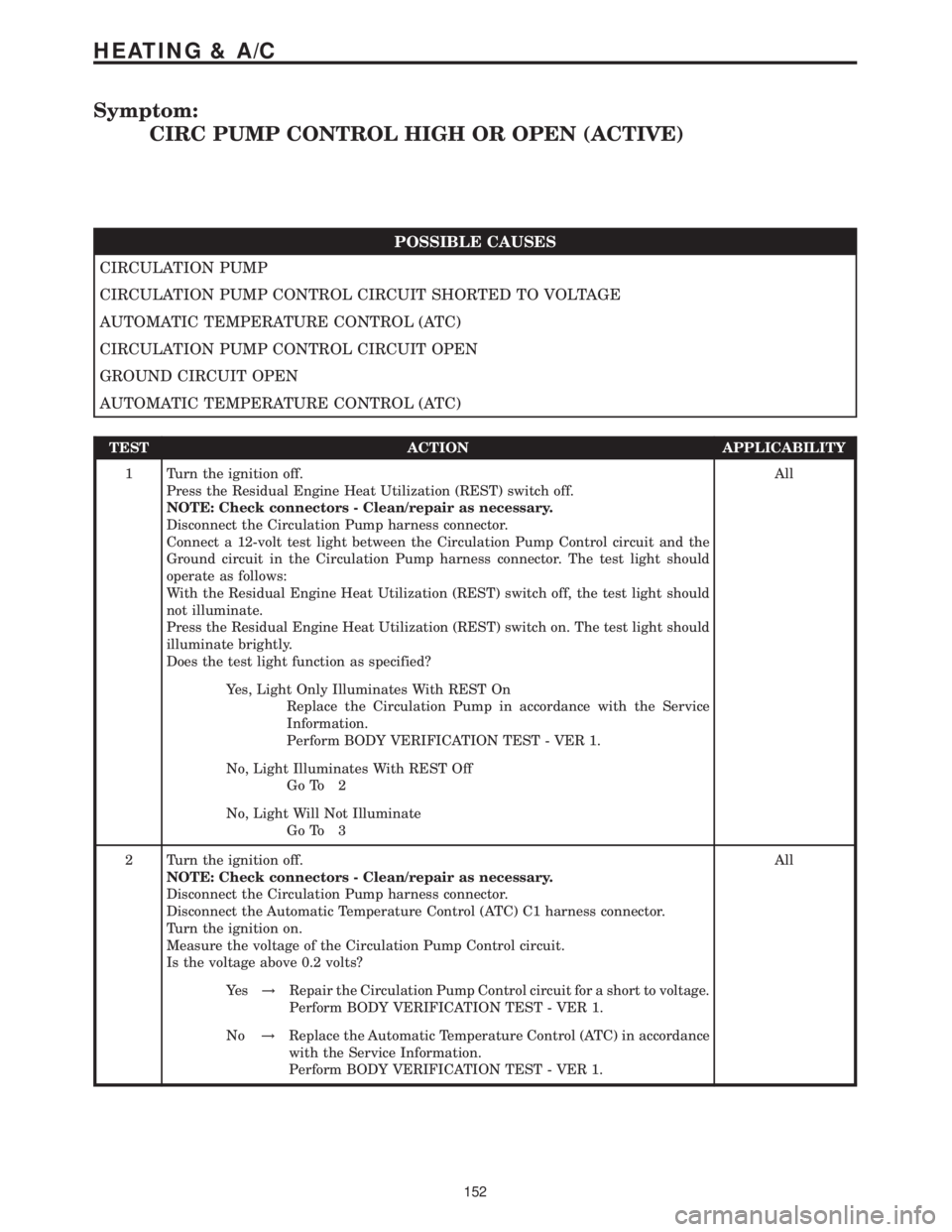
Symptom:
CIRC PUMP CONTROL HIGH OR OPEN (ACTIVE)
POSSIBLE CAUSES
CIRCULATION PUMP
CIRCULATION PUMP CONTROL CIRCUIT SHORTED TO VOLTAGE
AUTOMATIC TEMPERATURE CONTROL (ATC)
CIRCULATION PUMP CONTROL CIRCUIT OPEN
GROUND CIRCUIT OPEN
AUTOMATIC TEMPERATURE CONTROL (ATC)
TEST ACTION APPLICABILITY
1 Turn the ignition off.
Press the Residual Engine Heat Utilization (REST) switch off.
NOTE: Check connectors - Clean/repair as necessary.
Disconnect the Circulation Pump harness connector.
Connect a 12-volt test light between the Circulation Pump Control circuit and the
Ground circuit in the Circulation Pump harness connector. The test light should
operate as follows:
With the Residual Engine Heat Utilization (REST) switch off, the test light should
not illuminate.
Press the Residual Engine Heat Utilization (REST) switch on. The test light should
illuminate brightly.
Does the test light function as specified?All
Yes, Light Only Illuminates With REST On
Replace the Circulation Pump in accordance with the Service
Information.
Perform BODY VERIFICATION TEST - VER 1.
No, Light Illuminates With REST Off
Go To 2
No, Light Will Not Illuminate
Go To 3
2 Turn the ignition off.
NOTE: Check connectors - Clean/repair as necessary.
Disconnect the Circulation Pump harness connector.
Disconnect the Automatic Temperature Control (ATC) C1 harness connector.
Turn the ignition on.
Measure the voltage of the Circulation Pump Control circuit.
Is the voltage above 0.2 volts?All
Ye s!Repair the Circulation Pump Control circuit for a short to voltage.
Perform BODY VERIFICATION TEST - VER 1.
No!Replace the Automatic Temperature Control (ATC) in accordance
with the Service Information.
Perform BODY VERIFICATION TEST - VER 1.
152
HEATING & A/C
Page 180 of 2305
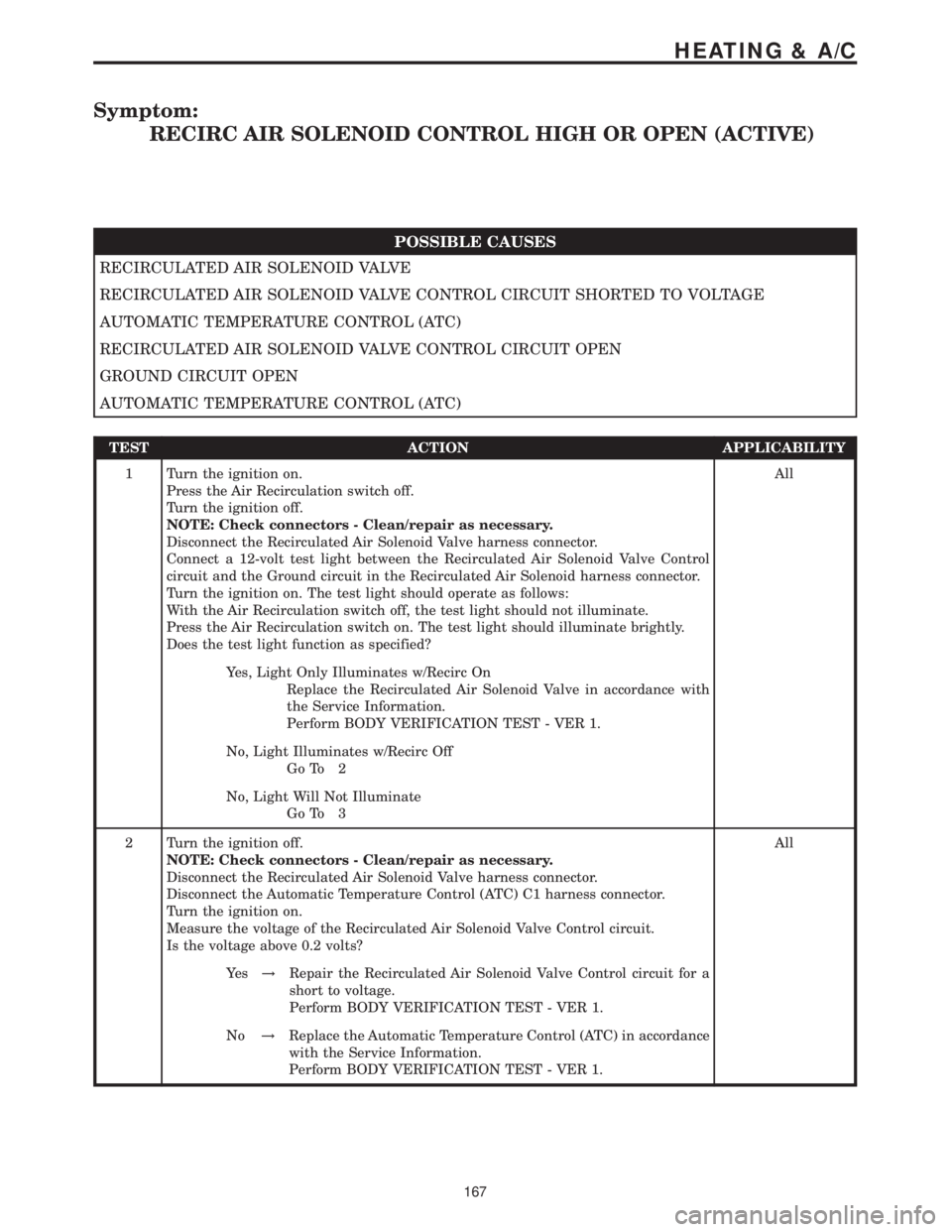
Symptom:
RECIRC AIR SOLENOID CONTROL HIGH OR OPEN (ACTIVE)
POSSIBLE CAUSES
RECIRCULATED AIR SOLENOID VALVE
RECIRCULATED AIR SOLENOID VALVE CONTROL CIRCUIT SHORTED TO VOLTAGE
AUTOMATIC TEMPERATURE CONTROL (ATC)
RECIRCULATED AIR SOLENOID VALVE CONTROL CIRCUIT OPEN
GROUND CIRCUIT OPEN
AUTOMATIC TEMPERATURE CONTROL (ATC)
TEST ACTION APPLICABILITY
1 Turn the ignition on.
Press the Air Recirculation switch off.
Turn the ignition off.
NOTE: Check connectors - Clean/repair as necessary.
Disconnect the Recirculated Air Solenoid Valve harness connector.
Connect a 12-volt test light between the Recirculated Air Solenoid Valve Control
circuit and the Ground circuit in the Recirculated Air Solenoid harness connector.
Turn the ignition on. The test light should operate as follows:
With the Air Recirculation switch off, the test light should not illuminate.
Press the Air Recirculation switch on. The test light should illuminate brightly.
Does the test light function as specified?All
Yes, Light Only Illuminates w/Recirc On
Replace the Recirculated Air Solenoid Valve in accordance with
the Service Information.
Perform BODY VERIFICATION TEST - VER 1.
No, Light Illuminates w/Recirc Off
Go To 2
No, Light Will Not Illuminate
Go To 3
2 Turn the ignition off.
NOTE: Check connectors - Clean/repair as necessary.
Disconnect the Recirculated Air Solenoid Valve harness connector.
Disconnect the Automatic Temperature Control (ATC) C1 harness connector.
Turn the ignition on.
Measure the voltage of the Recirculated Air Solenoid Valve Control circuit.
Is the voltage above 0.2 volts?All
Ye s!Repair the Recirculated Air Solenoid Valve Control circuit for a
short to voltage.
Perform BODY VERIFICATION TEST - VER 1.
No!Replace the Automatic Temperature Control (ATC) in accordance
with the Service Information.
Perform BODY VERIFICATION TEST - VER 1.
167
HEATING & A/C
Page 183 of 2305
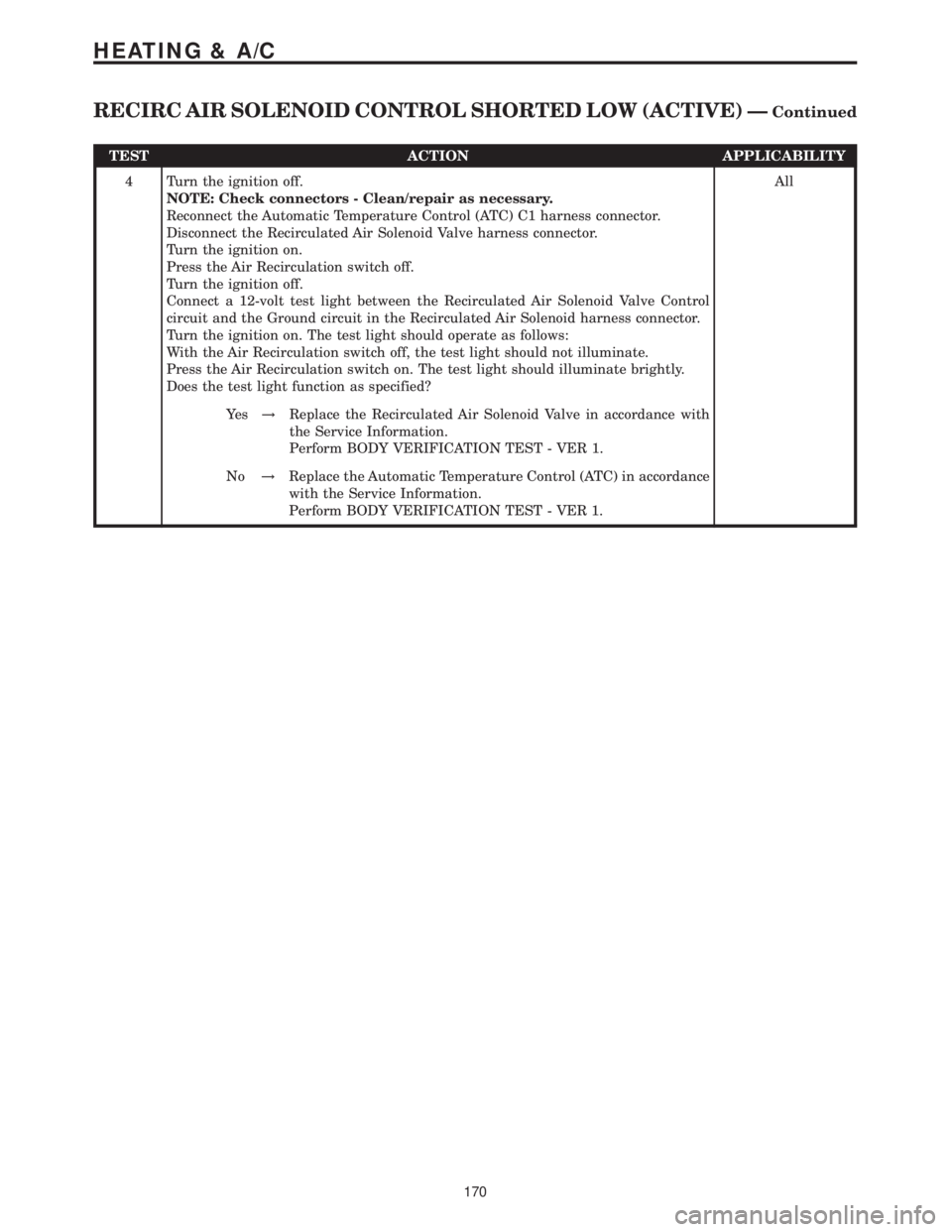
TEST ACTION APPLICABILITY
4 Turn the ignition off.
NOTE: Check connectors - Clean/repair as necessary.
Reconnect the Automatic Temperature Control (ATC) C1 harness connector.
Disconnect the Recirculated Air Solenoid Valve harness connector.
Turn the ignition on.
Press the Air Recirculation switch off.
Turn the ignition off.
Connect a 12-volt test light between the Recirculated Air Solenoid Valve Control
circuit and the Ground circuit in the Recirculated Air Solenoid harness connector.
Turn the ignition on. The test light should operate as follows:
With the Air Recirculation switch off, the test light should not illuminate.
Press the Air Recirculation switch on. The test light should illuminate brightly.
Does the test light function as specified?All
Ye s!Replace the Recirculated Air Solenoid Valve in accordance with
the Service Information.
Perform BODY VERIFICATION TEST - VER 1.
No!Replace the Automatic Temperature Control (ATC) in accordance
with the Service Information.
Perform BODY VERIFICATION TEST - VER 1.
170
HEATING & A/C
RECIRC AIR SOLENOID CONTROL SHORTED LOW (ACTIVE) ÐContinued
Page 188 of 2305
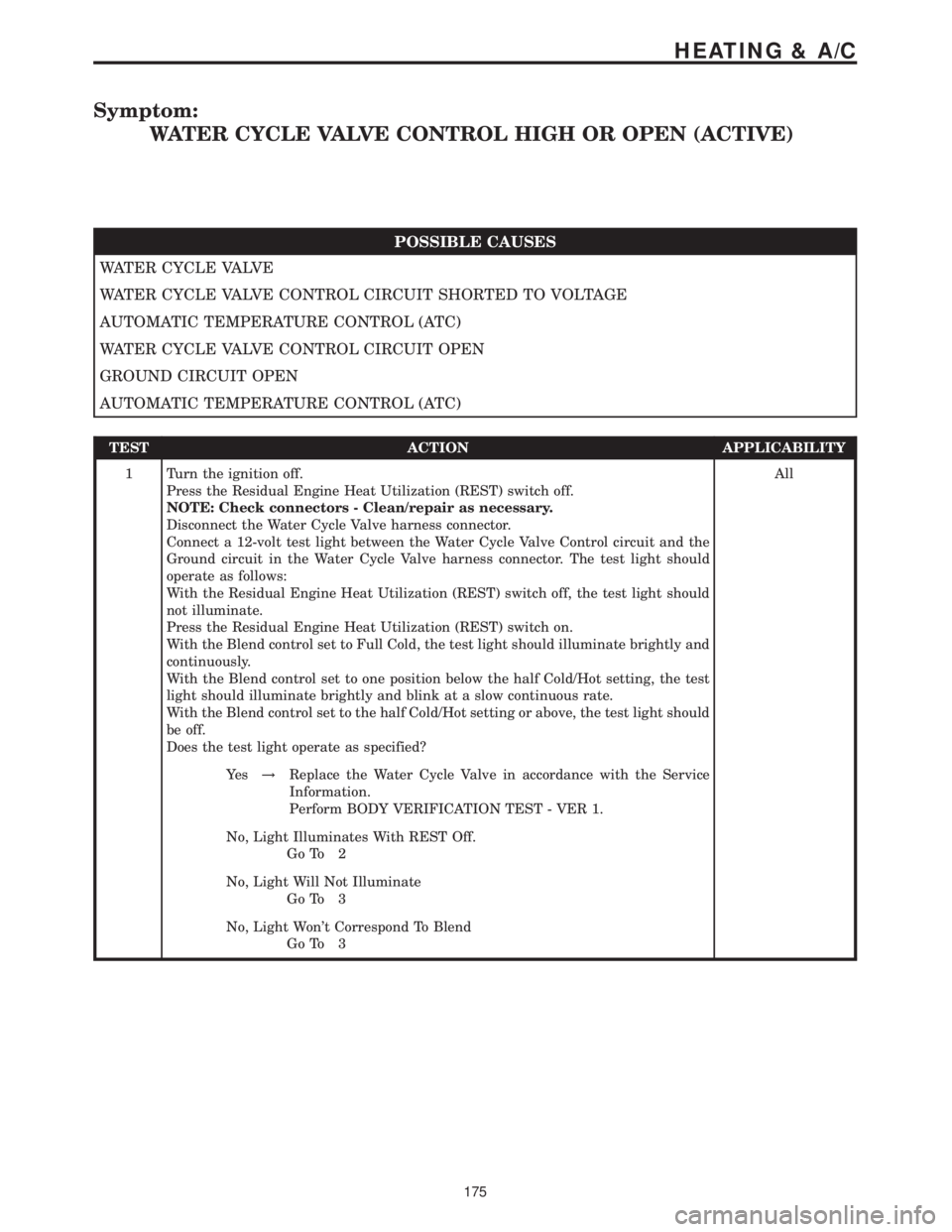
Symptom:
WATER CYCLE VALVE CONTROL HIGH OR OPEN (ACTIVE)
POSSIBLE CAUSES
WATER CYCLE VALVE
WATER CYCLE VALVE CONTROL CIRCUIT SHORTED TO VOLTAGE
AUTOMATIC TEMPERATURE CONTROL (ATC)
WATER CYCLE VALVE CONTROL CIRCUIT OPEN
GROUND CIRCUIT OPEN
AUTOMATIC TEMPERATURE CONTROL (ATC)
TEST ACTION APPLICABILITY
1 Turn the ignition off.
Press the Residual Engine Heat Utilization (REST) switch off.
NOTE: Check connectors - Clean/repair as necessary.
Disconnect the Water Cycle Valve harness connector.
Connect a 12-volt test light between the Water Cycle Valve Control circuit and the
Ground circuit in the Water Cycle Valve harness connector. The test light should
operate as follows:
With the Residual Engine Heat Utilization (REST) switch off, the test light should
not illuminate.
Press the Residual Engine Heat Utilization (REST) switch on.
With the Blend control set to Full Cold, the test light should illuminate brightly and
continuously.
With the Blend control set to one position below the half Cold/Hot setting, the test
light should illuminate brightly and blink at a slow continuous rate.
With the Blend control set to the half Cold/Hot setting or above, the test light should
be off.
Does the test light operate as specified?All
Ye s!Replace the Water Cycle Valve in accordance with the Service
Information.
Perform BODY VERIFICATION TEST - VER 1.
No, Light Illuminates With REST Off.
Go To 2
No, Light Will Not Illuminate
Go To 3
No, Light Won't Correspond To Blend
Go To 3
175
HEATING & A/C
Page 191 of 2305
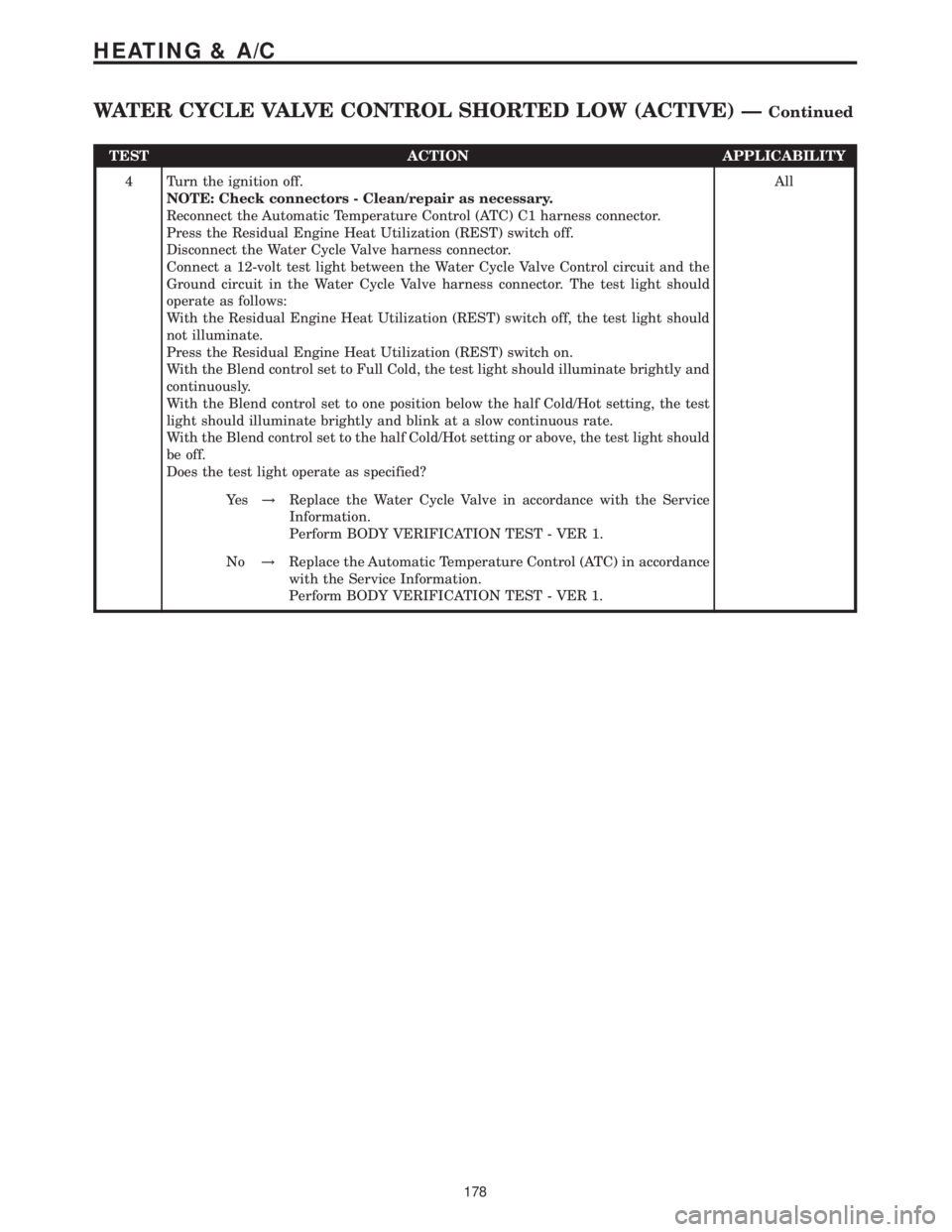
TEST ACTION APPLICABILITY
4 Turn the ignition off.
NOTE: Check connectors - Clean/repair as necessary.
Reconnect the Automatic Temperature Control (ATC) C1 harness connector.
Press the Residual Engine Heat Utilization (REST) switch off.
Disconnect the Water Cycle Valve harness connector.
Connect a 12-volt test light between the Water Cycle Valve Control circuit and the
Ground circuit in the Water Cycle Valve harness connector. The test light should
operate as follows:
With the Residual Engine Heat Utilization (REST) switch off, the test light should
not illuminate.
Press the Residual Engine Heat Utilization (REST) switch on.
With the Blend control set to Full Cold, the test light should illuminate brightly and
continuously.
With the Blend control set to one position below the half Cold/Hot setting, the test
light should illuminate brightly and blink at a slow continuous rate.
With the Blend control set to the half Cold/Hot setting or above, the test light should
be off.
Does the test light operate as specified?All
Ye s!Replace the Water Cycle Valve in accordance with the Service
Information.
Perform BODY VERIFICATION TEST - VER 1.
No!Replace the Automatic Temperature Control (ATC) in accordance
with the Service Information.
Perform BODY VERIFICATION TEST - VER 1.
178
HEATING & A/C
WATER CYCLE VALVE CONTROL SHORTED LOW (ACTIVE) ÐContinued
Page 254 of 2305
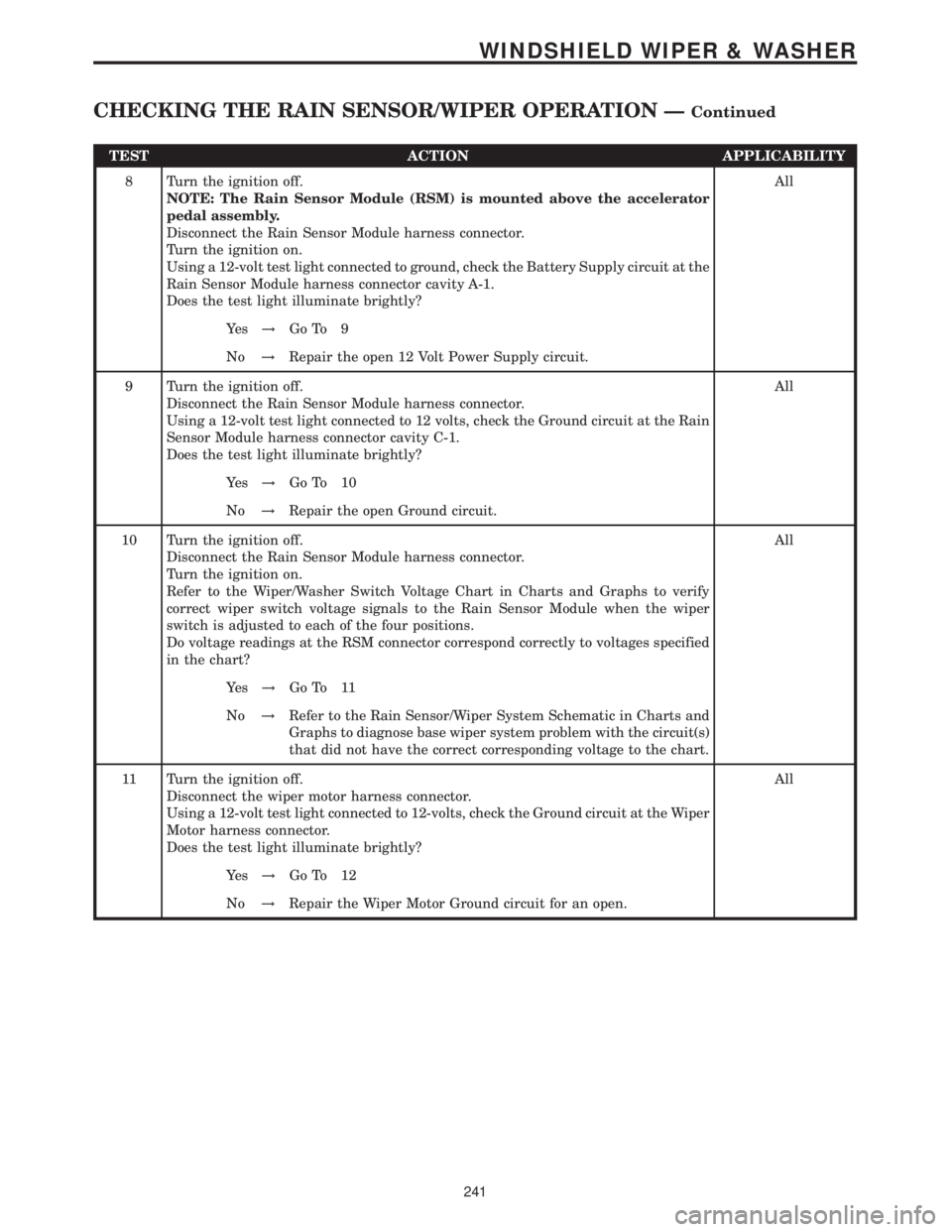
TEST ACTION APPLICABILITY
8 Turn the ignition off.
NOTE: The Rain Sensor Module (RSM) is mounted above the accelerator
pedal assembly.
Disconnect the Rain Sensor Module harness connector.
Turn the ignition on.
Using a 12-volt test light connected to ground, check the Battery Supply circuit at the
Rain Sensor Module harness connector cavity A-1.
Does the test light illuminate brightly?All
Ye s!Go To 9
No!Repair the open 12 Volt Power Supply circuit.
9 Turn the ignition off.
Disconnect the Rain Sensor Module harness connector.
Using a 12-volt test light connected to 12 volts, check the Ground circuit at the Rain
Sensor Module harness connector cavity C-1.
Does the test light illuminate brightly?All
Ye s!Go To 10
No!Repair the open Ground circuit.
10 Turn the ignition off.
Disconnect the Rain Sensor Module harness connector.
Turn the ignition on.
Refer to the Wiper/Washer Switch Voltage Chart in Charts and Graphs to verify
correct wiper switch voltage signals to the Rain Sensor Module when the wiper
switch is adjusted to each of the four positions.
Do voltage readings at the RSM connector correspond correctly to voltages specified
in the chart?All
Ye s!Go To 11
No!Refer to the Rain Sensor/Wiper System Schematic in Charts and
Graphs to diagnose base wiper system problem with the circuit(s)
that did not have the correct corresponding voltage to the chart.
11 Turn the ignition off.
Disconnect the wiper motor harness connector.
Using a 12-volt test light connected to 12-volts, check the Ground circuit at the Wiper
Motor harness connector.
Does the test light illuminate brightly?All
Ye s!Go To 12
No!Repair the Wiper Motor Ground circuit for an open.
241
WINDSHIELD WIPER & WASHER
CHECKING THE RAIN SENSOR/WIPER OPERATION ÐContinued
Page 324 of 2305
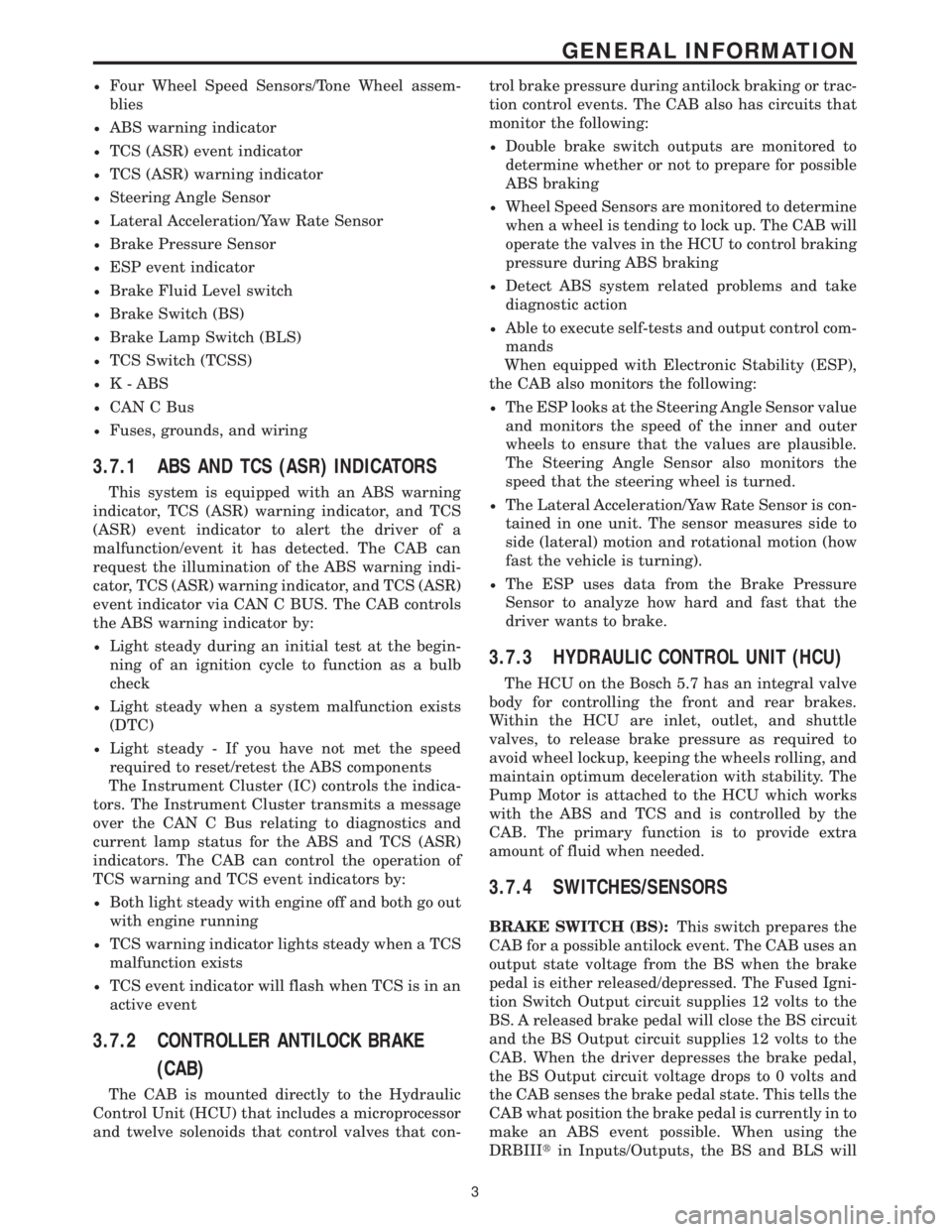
²Four Wheel Speed Sensors/Tone Wheel assem-
blies
²ABS warning indicator
²TCS (ASR) event indicator
²TCS (ASR) warning indicator
²Steering Angle Sensor
²Lateral Acceleration/Yaw Rate Sensor
²Brake Pressure Sensor
²ESP event indicator
²Brake Fluid Level switch
²Brake Switch (BS)
²Brake Lamp Switch (BLS)
²TCS Switch (TCSS)
²K - ABS
²CAN C Bus
²Fuses, grounds, and wiring
3.7.1 ABS AND TCS (ASR) INDICATORS
This system is equipped with an ABS warning
indicator, TCS (ASR) warning indicator, and TCS
(ASR) event indicator to alert the driver of a
malfunction/event it has detected. The CAB can
request the illumination of the ABS warning indi-
cator, TCS (ASR) warning indicator, and TCS (ASR)
event indicator via CAN C BUS. The CAB controls
the ABS warning indicator by:
²Light steady during an initial test at the begin-
ning of an ignition cycle to function as a bulb
check
²Light steady when a system malfunction exists
(DTC)
²Light steady - If you have not met the speed
required to reset/retest the ABS components
The Instrument Cluster (IC) controls the indica-
tors. The Instrument Cluster transmits a message
over the CAN C Bus relating to diagnostics and
current lamp status for the ABS and TCS (ASR)
indicators. The CAB can control the operation of
TCS warning and TCS event indicators by:
²Both light steady with engine off and both go out
with engine running
²TCS warning indicator lights steady when a TCS
malfunction exists
²TCS event indicator will flash when TCS is in an
active event
3.7.2 CONTROLLER ANTILOCK BRAKE
(CAB)
The CAB is mounted directly to the Hydraulic
Control Unit (HCU) that includes a microprocessor
and twelve solenoids that control valves that con-trol brake pressure during antilock braking or trac-
tion control events. The CAB also has circuits that
monitor the following:
²Double brake switch outputs are monitored to
determine whether or not to prepare for possible
ABS braking
²Wheel Speed Sensors are monitored to determine
when a wheel is tending to lock up. The CAB will
operate the valves in the HCU to control braking
pressure during ABS braking
²Detect ABS system related problems and take
diagnostic action
²Able to execute self-tests and output control com-
mands
When equipped with Electronic Stability (ESP),
the CAB also monitors the following:
²The ESP looks at the Steering Angle Sensor value
and monitors the speed of the inner and outer
wheels to ensure that the values are plausible.
The Steering Angle Sensor also monitors the
speed that the steering wheel is turned.
²The Lateral Acceleration/Yaw Rate Sensor is con-
tained in one unit. The sensor measures side to
side (lateral) motion and rotational motion (how
fast the vehicle is turning).
²The ESP uses data from the Brake Pressure
Sensor to analyze how hard and fast that the
driver wants to brake.
3.7.3 HYDRAULIC CONTROL UNIT (HCU)
The HCU on the Bosch 5.7 has an integral valve
body for controlling the front and rear brakes.
Within the HCU are inlet, outlet, and shuttle
valves, to release brake pressure as required to
avoid wheel lockup, keeping the wheels rolling, and
maintain optimum deceleration with stability. The
Pump Motor is attached to the HCU which works
with the ABS and TCS and is controlled by the
CAB. The primary function is to provide extra
amount of fluid when needed.
3.7.4 SWITCHES/SENSORS
BRAKE SWITCH (BS):This switch prepares the
CAB for a possible antilock event. The CAB uses an
output state voltage from the BS when the brake
pedal is either released/depressed. The Fused Igni-
tion Switch Output circuit supplies 12 volts to the
BS. A released brake pedal will close the BS circuit
and the BS Output circuit supplies 12 volts to the
CAB. When the driver depresses the brake pedal,
the BS Output circuit voltage drops to 0 volts and
the CAB senses the brake pedal state. This tells the
CAB what position the brake pedal is currently in to
make an ABS event possible. When using the
DRBIIItin Inputs/Outputs, the BS and BLS will
3
GENERAL INFORMATION
Page 326 of 2305
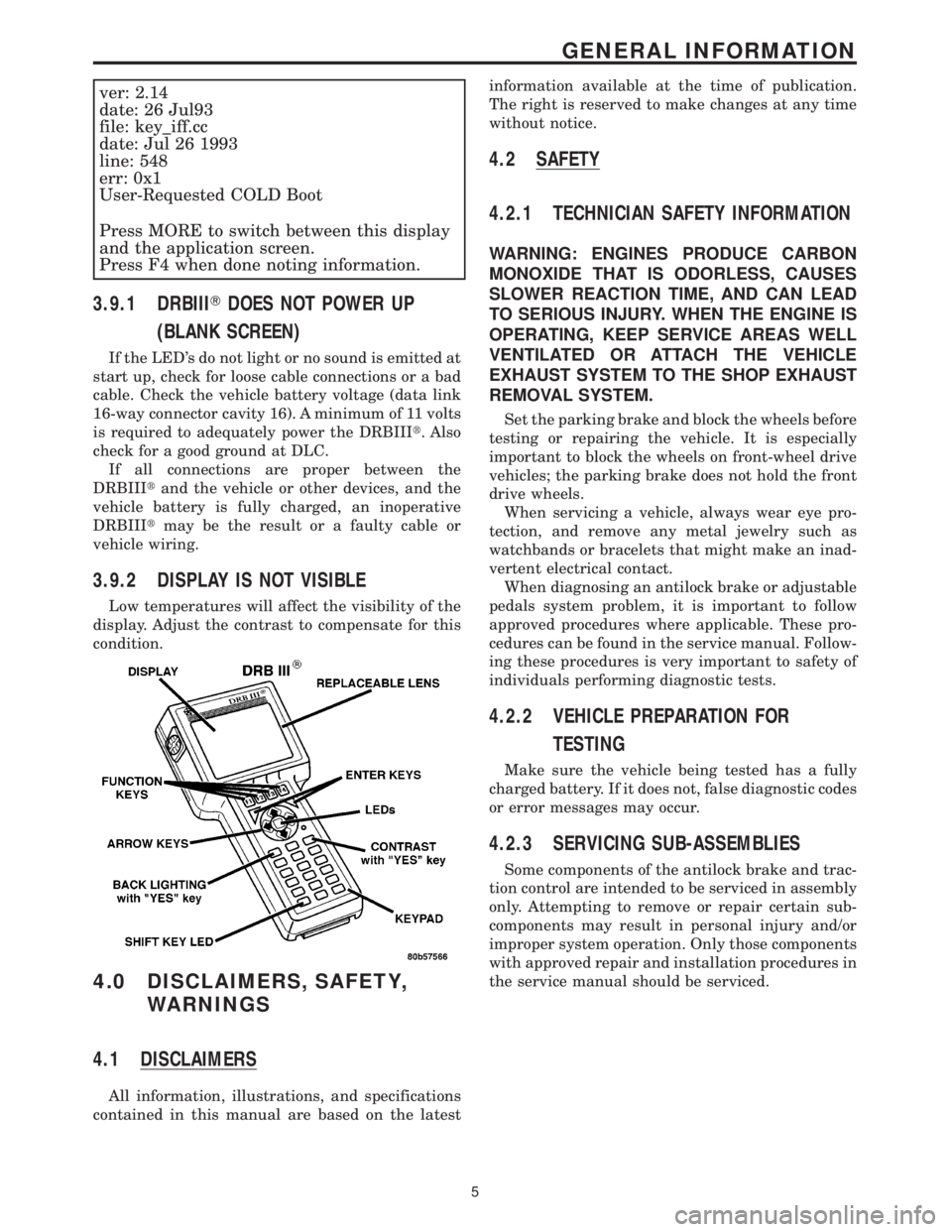
ver: 2.14
date: 26 Jul93
file: key_iff.cc
date: Jul 26 1993
line: 548
err: 0x1
User-Requested COLD Boot
Press MORE to switch between this display
and the application screen.
Press F4 when done noting information.
3.9.1 DRBIIITDOES NOT POWER UP
(BLANK SCREEN)
If the LED's do not light or no sound is emitted at
start up, check for loose cable connections or a bad
cable. Check the vehicle battery voltage (data link
16-way connector cavity 16). A minimum of 11 volts
is required to adequately power the DRBIIIt. Also
check for a good ground at DLC.
If all connections are proper between the
DRBIIItand the vehicle or other devices, and the
vehicle battery is fully charged, an inoperative
DRBIIItmay be the result or a faulty cable or
vehicle wiring.
3.9.2 DISPLAY IS NOT VISIBLE
Low temperatures will affect the visibility of the
display. Adjust the contrast to compensate for this
condition.
4.0 DISCLAIMERS, SAFETY,
WARNINGS
4.1 DISCLAIMERS
All information, illustrations, and specifications
contained in this manual are based on the latestinformation available at the time of publication.
The right is reserved to make changes at any time
without notice.
4.2 SAFETY
4.2.1 TECHNICIAN SAFETY INFORMATION
WARNING: ENGINES PRODUCE CARBON
MONOXIDE THAT IS ODORLESS, CAUSES
SLOWER REACTION TIME, AND CAN LEAD
TO SERIOUS INJURY. WHEN THE ENGINE IS
OPERATING, KEEP SERVICE AREAS WELL
VENTILATED OR ATTACH THE VEHICLE
EXHAUST SYSTEM TO THE SHOP EXHAUST
REMOVAL SYSTEM.
Set the parking brake and block the wheels before
testing or repairing the vehicle. It is especially
important to block the wheels on front-wheel drive
vehicles; the parking brake does not hold the front
drive wheels.
When servicing a vehicle, always wear eye pro-
tection, and remove any metal jewelry such as
watchbands or bracelets that might make an inad-
vertent electrical contact.
When diagnosing an antilock brake or adjustable
pedals system problem, it is important to follow
approved procedures where applicable. These pro-
cedures can be found in the service manual. Follow-
ing these procedures is very important to safety of
individuals performing diagnostic tests.
4.2.2 VEHICLE PREPARATION FOR
TESTING
Make sure the vehicle being tested has a fully
charged battery. If it does not, false diagnostic codes
or error messages may occur.
4.2.3 SERVICING SUB-ASSEMBLIES
Some components of the antilock brake and trac-
tion control are intended to be serviced in assembly
only. Attempting to remove or repair certain sub-
components may result in personal injury and/or
improper system operation. Only those components
with approved repair and installation procedures in
the service manual should be serviced.
5
GENERAL INFORMATION
Page 328 of 2305
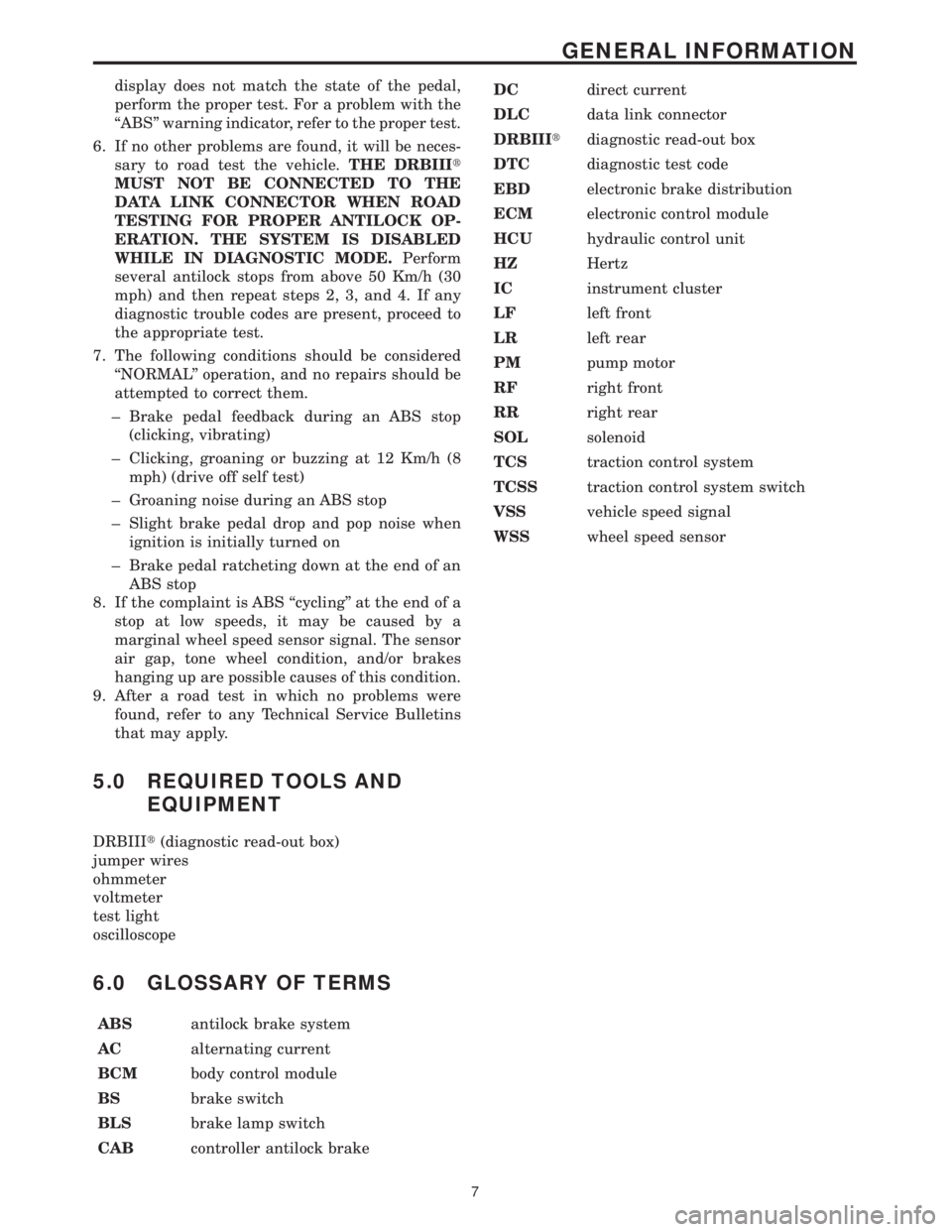
display does not match the state of the pedal,
perform the proper test. For a problem with the
ªABSº warning indicator, refer to the proper test.
6. If no other problems are found, it will be neces-
sary to road test the vehicle.THE DRBIIIt
MUST NOT BE CONNECTED TO THE
DATA LINK CONNECTOR WHEN ROAD
TESTING FOR PROPER ANTILOCK OP-
ERATION. THE SYSTEM IS DISABLED
WHILE IN DIAGNOSTIC MODE.Perform
several antilock stops from above 50 Km/h (30
mph) and then repeat steps 2, 3, and 4. If any
diagnostic trouble codes are present, proceed to
the appropriate test.
7. The following conditions should be considered
``NORMAL'' operation, and no repairs should be
attempted to correct them.
± Brake pedal feedback during an ABS stop
(clicking, vibrating)
± Clicking, groaning or buzzing at 12 Km/h (8
mph) (drive off self test)
± Groaning noise during an ABS stop
± Slight brake pedal drop and pop noise when
ignition is initially turned on
± Brake pedal ratcheting down at the end of an
ABS stop
8. If the complaint is ABS ``cycling'' at the end of a
stop at low speeds, it may be caused by a
marginal wheel speed sensor signal. The sensor
air gap, tone wheel condition, and/or brakes
hanging up are possible causes of this condition.
9. After a road test in which no problems were
found, refer to any Technical Service Bulletins
that may apply.
5.0 REQUIRED TOOLS AND
EQUIPMENT
DRBIIIt(diagnostic read-out box)
jumper wires
ohmmeter
voltmeter
test light
oscilloscope
6.0 GLOSSARY OF TERMS
ABSantilock brake system
ACalternating current
BCMbody control module
BSbrake switch
BLSbrake lamp switch
CABcontroller antilock brakeDCdirect current
DLCdata link connector
DRBIIItdiagnostic read-out box
DTCdiagnostic test code
EBDelectronic brake distribution
ECMelectronic control module
HCUhydraulic control unit
HZHertz
ICinstrument cluster
LFleft front
LRleft rear
PMpump motor
RFright front
RRright rear
SOLsolenoid
TCStraction control system
TCSStraction control system switch
VSSvehicle speed signal
WSSwheel speed sensor
7
GENERAL INFORMATION
Page 332 of 2305
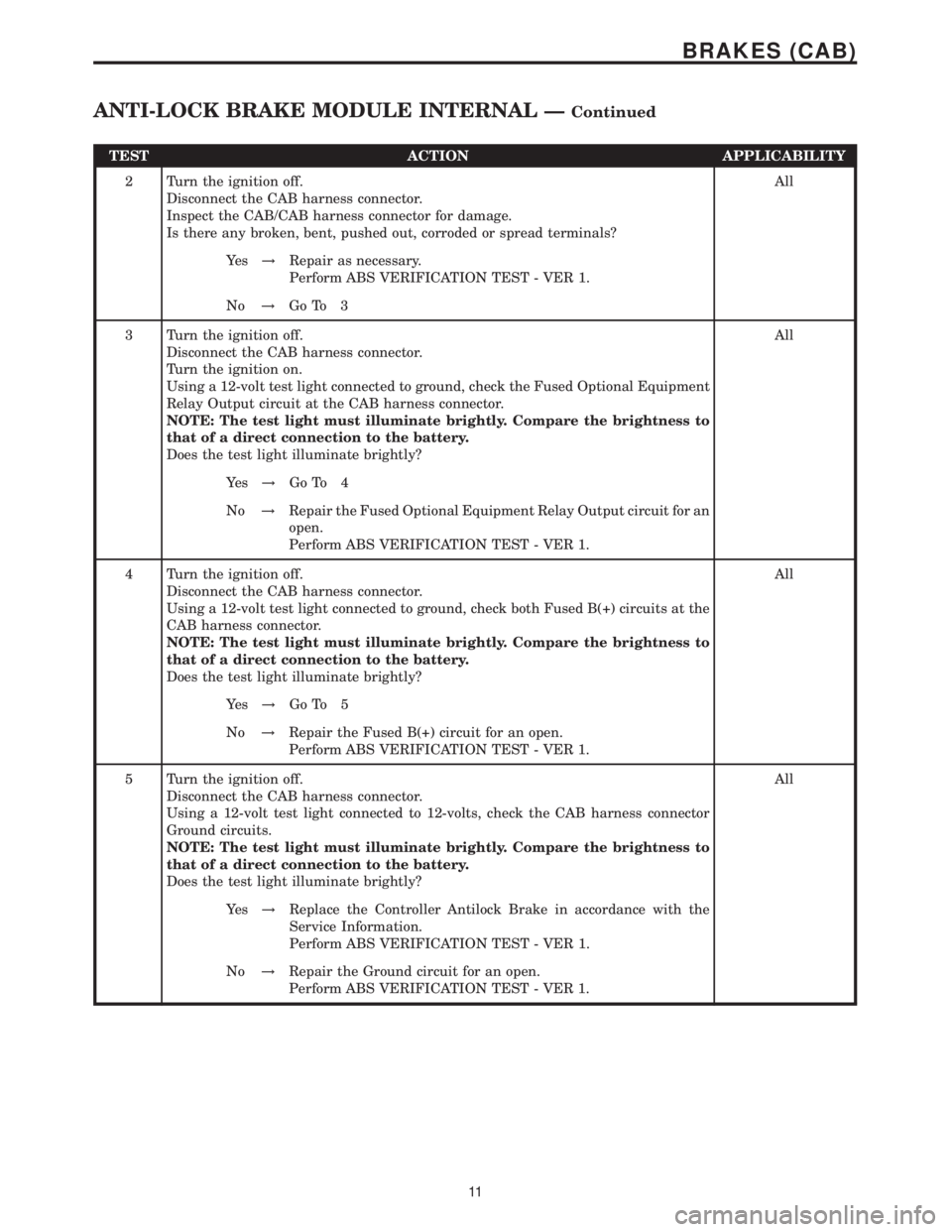
TEST ACTION APPLICABILITY
2 Turn the ignition off.
Disconnect the CAB harness connector.
Inspect the CAB/CAB harness connector for damage.
Is there any broken, bent, pushed out, corroded or spread terminals?All
Ye s!Repair as necessary.
Perform ABS VERIFICATION TEST - VER 1.
No!Go To 3
3 Turn the ignition off.
Disconnect the CAB harness connector.
Turn the ignition on.
Using a 12-volt test light connected to ground, check the Fused Optional Equipment
Relay Output circuit at the CAB harness connector.
NOTE: The test light must illuminate brightly. Compare the brightness to
that of a direct connection to the battery.
Does the test light illuminate brightly?All
Ye s!Go To 4
No!Repair the Fused Optional Equipment Relay Output circuit for an
open.
Perform ABS VERIFICATION TEST - VER 1.
4 Turn the ignition off.
Disconnect the CAB harness connector.
Using a 12-volt test light connected to ground, check both Fused B(+) circuits at the
CAB harness connector.
NOTE: The test light must illuminate brightly. Compare the brightness to
that of a direct connection to the battery.
Does the test light illuminate brightly?All
Ye s!Go To 5
No!Repair the Fused B(+) circuit for an open.
Perform ABS VERIFICATION TEST - VER 1.
5 Turn the ignition off.
Disconnect the CAB harness connector.
Using a 12-volt test light connected to 12-volts, check the CAB harness connector
Ground circuits.
NOTE: The test light must illuminate brightly. Compare the brightness to
that of a direct connection to the battery.
Does the test light illuminate brightly?All
Ye s!Replace the Controller Antilock Brake in accordance with the
Service Information.
Perform ABS VERIFICATION TEST - VER 1.
No!Repair the Ground circuit for an open.
Perform ABS VERIFICATION TEST - VER 1.
11
BRAKES (CAB)
ANTI-LOCK BRAKE MODULE INTERNAL ÐContinued