light MERCEDES-BENZ SPRINTER 2006 Workshop Manual
[x] Cancel search | Manufacturer: MERCEDES-BENZ, Model Year: 2006, Model line: SPRINTER, Model: MERCEDES-BENZ SPRINTER 2006Pages: 2305, PDF Size: 48.12 MB
Page 396 of 2305
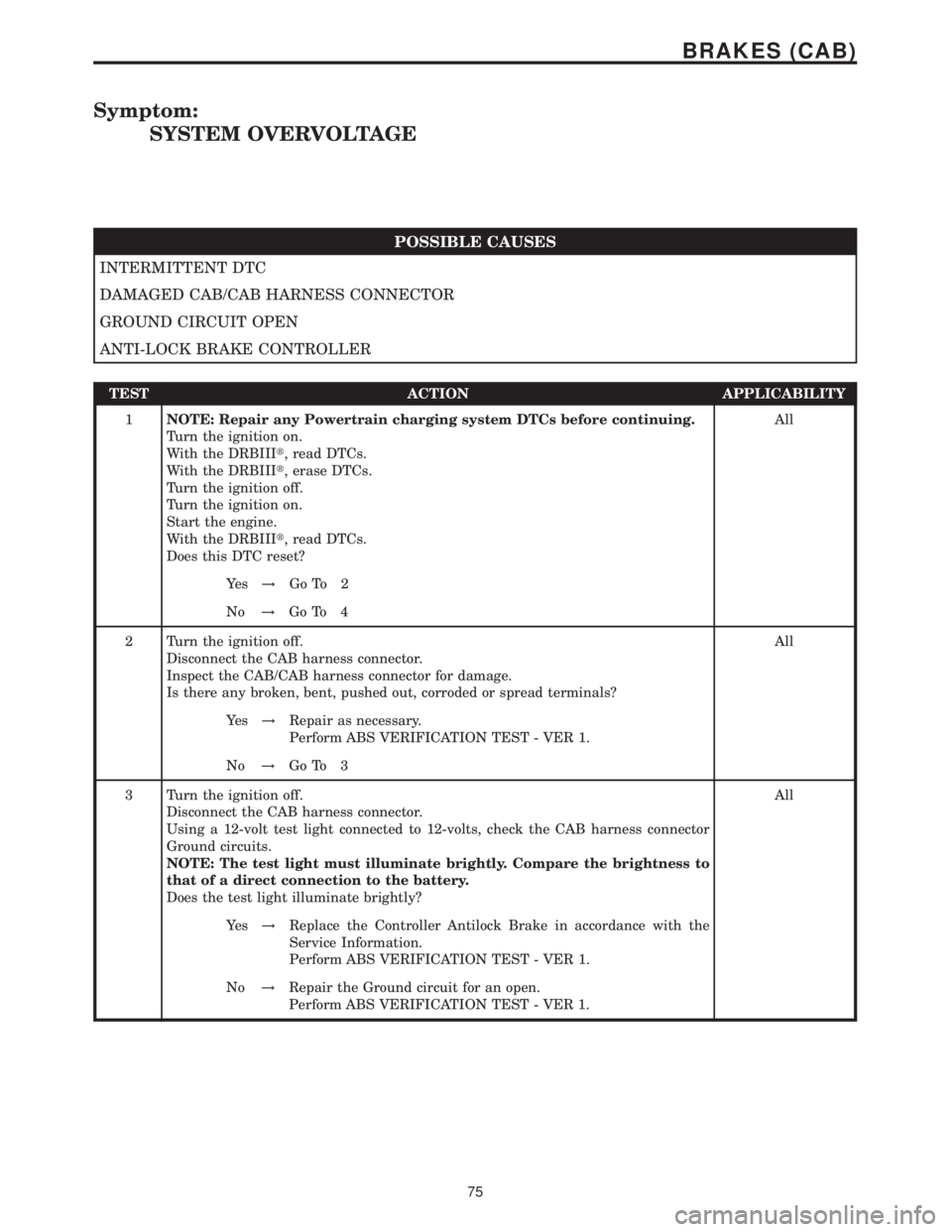
Symptom:
SYSTEM OVERVOLTAGE
POSSIBLE CAUSES
INTERMITTENT DTC
DAMAGED CAB/CAB HARNESS CONNECTOR
GROUND CIRCUIT OPEN
ANTI-LOCK BRAKE CONTROLLER
TEST ACTION APPLICABILITY
1NOTE: Repair any Powertrain charging system DTCs before continuing.
Turn the ignition on.
With the DRBIIIt, read DTCs.
With the DRBIIIt, erase DTCs.
Turn the ignition off.
Turn the ignition on.
Start the engine.
With the DRBIIIt, read DTCs.
Does this DTC reset?All
Ye s!Go To 2
No!Go To 4
2 Turn the ignition off.
Disconnect the CAB harness connector.
Inspect the CAB/CAB harness connector for damage.
Is there any broken, bent, pushed out, corroded or spread terminals?All
Ye s!Repair as necessary.
Perform ABS VERIFICATION TEST - VER 1.
No!Go To 3
3 Turn the ignition off.
Disconnect the CAB harness connector.
Using a 12-volt test light connected to 12-volts, check the CAB harness connector
Ground circuits.
NOTE: The test light must illuminate brightly. Compare the brightness to
that of a direct connection to the battery.
Does the test light illuminate brightly?All
Ye s!Replace the Controller Antilock Brake in accordance with the
Service Information.
Perform ABS VERIFICATION TEST - VER 1.
No!Repair the Ground circuit for an open.
Perform ABS VERIFICATION TEST - VER 1.
75
BRAKES (CAB)
Page 398 of 2305
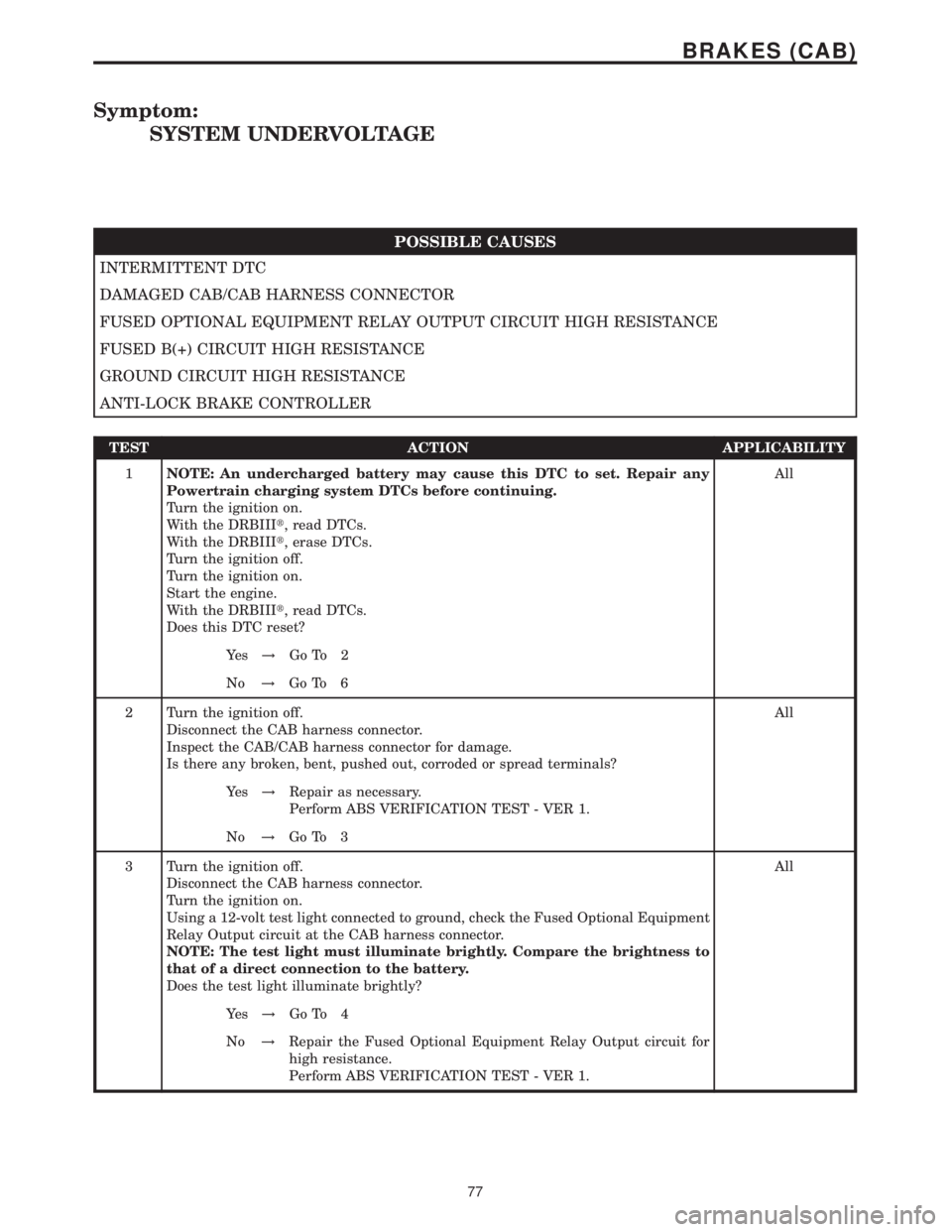
Symptom:
SYSTEM UNDERVOLTAGE
POSSIBLE CAUSES
INTERMITTENT DTC
DAMAGED CAB/CAB HARNESS CONNECTOR
FUSED OPTIONAL EQUIPMENT RELAY OUTPUT CIRCUIT HIGH RESISTANCE
FUSED B(+) CIRCUIT HIGH RESISTANCE
GROUND CIRCUIT HIGH RESISTANCE
ANTI-LOCK BRAKE CONTROLLER
TEST ACTION APPLICABILITY
1NOTE: An undercharged battery may cause this DTC to set. Repair any
Powertrain charging system DTCs before continuing.
Turn the ignition on.
With the DRBIIIt, read DTCs.
With the DRBIIIt, erase DTCs.
Turn the ignition off.
Turn the ignition on.
Start the engine.
With the DRBIIIt, read DTCs.
Does this DTC reset?All
Ye s!Go To 2
No!Go To 6
2 Turn the ignition off.
Disconnect the CAB harness connector.
Inspect the CAB/CAB harness connector for damage.
Is there any broken, bent, pushed out, corroded or spread terminals?All
Ye s!Repair as necessary.
Perform ABS VERIFICATION TEST - VER 1.
No!Go To 3
3 Turn the ignition off.
Disconnect the CAB harness connector.
Turn the ignition on.
Using a 12-volt test light connected to ground, check the Fused Optional Equipment
Relay Output circuit at the CAB harness connector.
NOTE: The test light must illuminate brightly. Compare the brightness to
that of a direct connection to the battery.
Does the test light illuminate brightly?All
Ye s!Go To 4
No!Repair the Fused Optional Equipment Relay Output circuit for
high resistance.
Perform ABS VERIFICATION TEST - VER 1.
77
BRAKES (CAB)
Page 399 of 2305
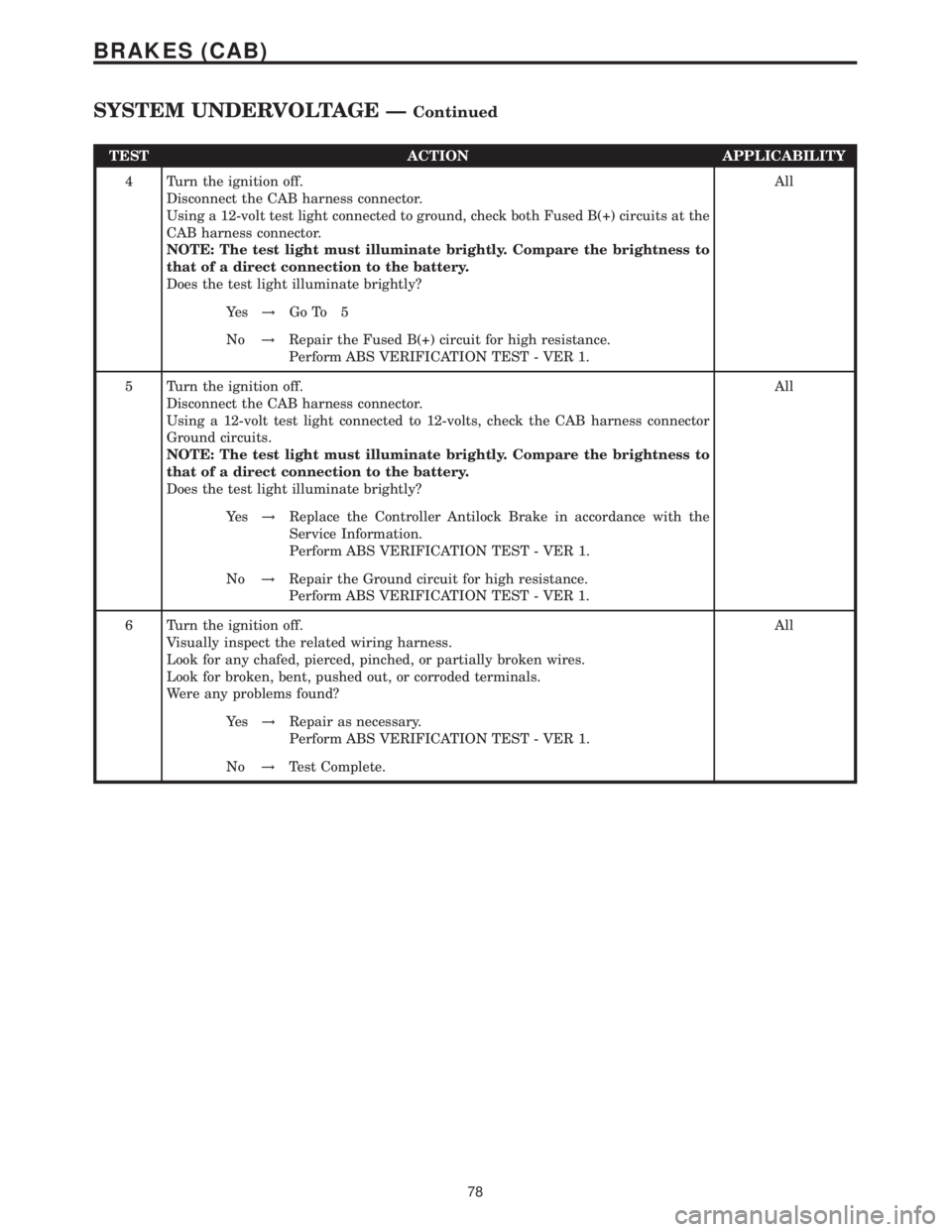
TEST ACTION APPLICABILITY
4 Turn the ignition off.
Disconnect the CAB harness connector.
Using a 12-volt test light connected to ground, check both Fused B(+) circuits at the
CAB harness connector.
NOTE: The test light must illuminate brightly. Compare the brightness to
that of a direct connection to the battery.
Does the test light illuminate brightly?All
Ye s!Go To 5
No!Repair the Fused B(+) circuit for high resistance.
Perform ABS VERIFICATION TEST - VER 1.
5 Turn the ignition off.
Disconnect the CAB harness connector.
Using a 12-volt test light connected to 12-volts, check the CAB harness connector
Ground circuits.
NOTE: The test light must illuminate brightly. Compare the brightness to
that of a direct connection to the battery.
Does the test light illuminate brightly?All
Ye s!Replace the Controller Antilock Brake in accordance with the
Service Information.
Perform ABS VERIFICATION TEST - VER 1.
No!Repair the Ground circuit for high resistance.
Perform ABS VERIFICATION TEST - VER 1.
6 Turn the ignition off.
Visually inspect the related wiring harness.
Look for any chafed, pierced, pinched, or partially broken wires.
Look for broken, bent, pushed out, or corroded terminals.
Were any problems found?All
Ye s!Repair as necessary.
Perform ABS VERIFICATION TEST - VER 1.
No!Test Complete.
78
BRAKES (CAB)
SYSTEM UNDERVOLTAGE ÐContinued
Page 431 of 2305
3.3.4 HANDLING NO TROUBLE CODE
PROBLEMS
After reading Section 3.0 (System Description
and Functional Operation), you should have a bet-
ter understanding of the theory and operation of the
on-board diagnostics and how this relates to the
diagnosis of a vehicle that may have a driveability-
related symptom or complaint. When there are no
trouble codes present, refer to the no trouble code
(*) tests.
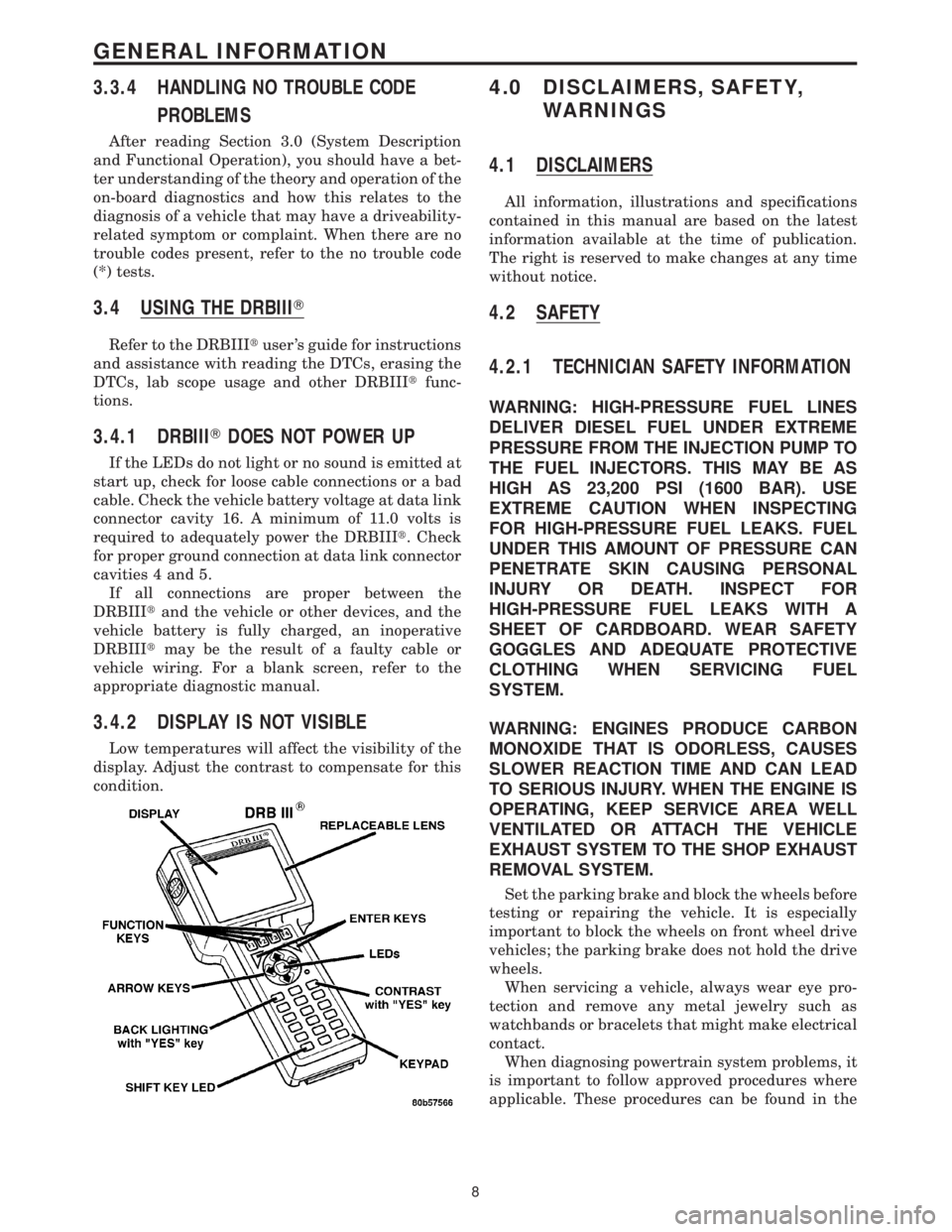
3.4 USING THE DRBIIIT
Refer to the DRBIIItuser 's guide for instructions
and assistance with reading the DTCs, erasing the
DTCs, lab scope usage and other DRBIIItfunc-
tions.
3.4.1 DRBIIITDOES NOT POWER UP
If the LEDs do not light or no sound is emitted at
start up, check for loose cable connections or a bad
cable. Check the vehicle battery voltage at data link
connector cavity 16. A minimum of 11.0 volts is
required to adequately power the DRBIIIt. Check
for proper ground connection at data link connector
cavities 4 and 5.
If all connections are proper between the
DRBIIItand the vehicle or other devices, and the
vehicle battery is fully charged, an inoperative
DRBIIItmay be the result of a faulty cable or
vehicle wiring. For a blank screen, refer to the
appropriate diagnostic manual.
3.4.2 DISPLAY IS NOT VISIBLE
Low temperatures will affect the visibility of the
display. Adjust the contrast to compensate for this
condition.
4.0 DISCLAIMERS, SAFETY,
WARNINGS
4.1 DISCLAIMERS
All information, illustrations and specifications
contained in this manual are based on the latest
information available at the time of publication.
The right is reserved to make changes at any time
without notice.
4.2 SAFETY
4.2.1 TECHNICIAN SAFETY INFORMATION
WARNING: HIGH-PRESSURE FUEL LINES
DELIVER DIESEL FUEL UNDER EXTREME
PRESSURE FROM THE INJECTION PUMP TO
THE FUEL INJECTORS. THIS MAY BE AS
HIGH AS 23,200 PSI (1600 BAR). USE
EXTREME CAUTION WHEN INSPECTING
FOR HIGH-PRESSURE FUEL LEAKS. FUEL
UNDER THIS AMOUNT OF PRESSURE CAN
PENETRATE SKIN CAUSING PERSONAL
INJURY OR DEATH. INSPECT FOR
HIGH-PRESSURE FUEL LEAKS WITH A
SHEET OF CARDBOARD. WEAR SAFETY
GOGGLES AND ADEQUATE PROTECTIVE
CLOTHING WHEN SERVICING FUEL
SYSTEM.
WARNING: ENGINES PRODUCE CARBON
MONOXIDE THAT IS ODORLESS, CAUSES
SLOWER REACTION TIME AND CAN LEAD
TO SERIOUS INJURY. WHEN THE ENGINE IS
OPERATING, KEEP SERVICE AREA WELL
VENTILATED OR ATTACH THE VEHICLE
EXHAUST SYSTEM TO THE SHOP EXHAUST
REMOVAL SYSTEM.
Set the parking brake and block the wheels before
testing or repairing the vehicle. It is especially
important to block the wheels on front wheel drive
vehicles; the parking brake does not hold the drive
wheels.
When servicing a vehicle, always wear eye pro-
tection and remove any metal jewelry such as
watchbands or bracelets that might make electrical
contact.
When diagnosing powertrain system problems, it
is important to follow approved procedures where
applicable. These procedures can be found in the
8
GENERAL INFORMATION
Page 435 of 2305
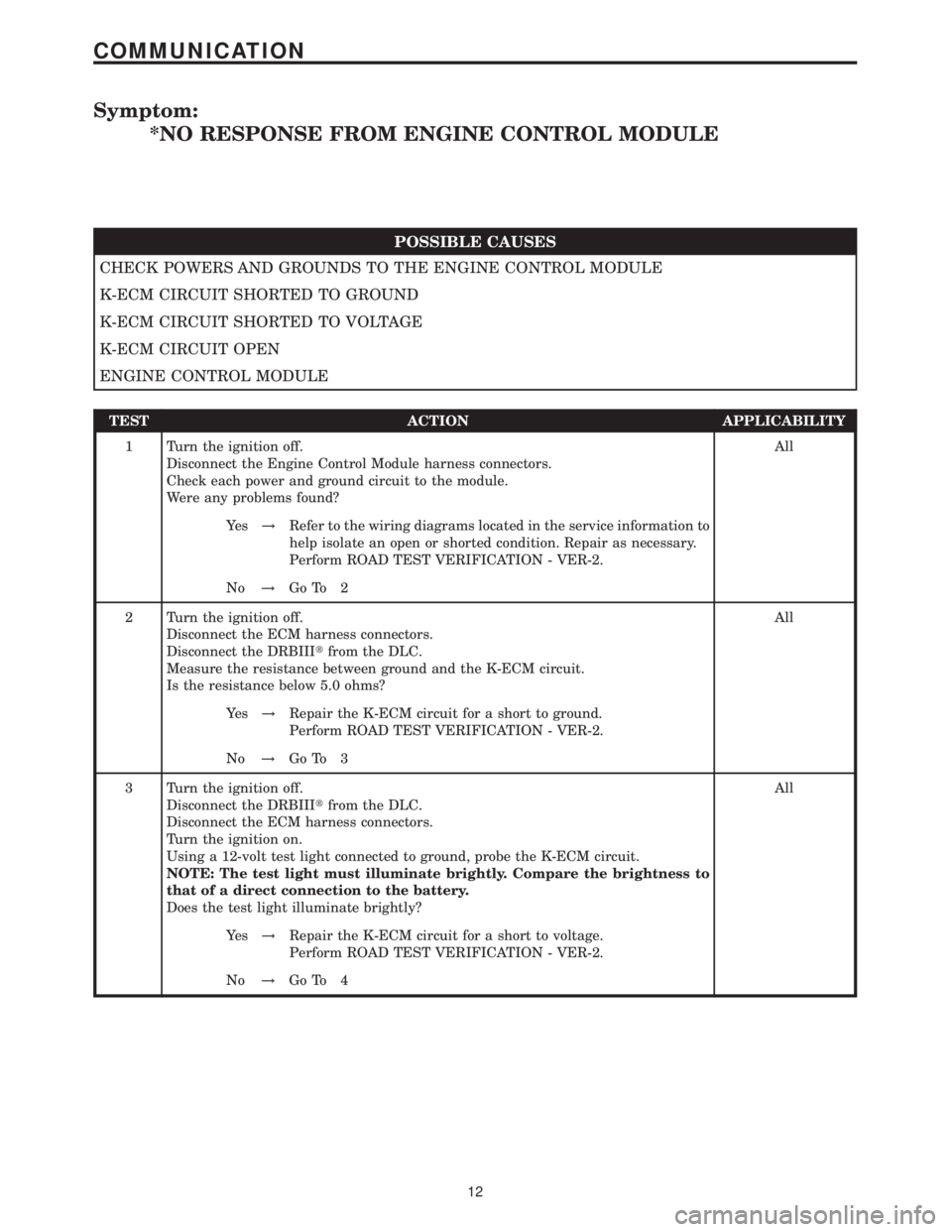
Symptom:
*NO RESPONSE FROM ENGINE CONTROL MODULE
POSSIBLE CAUSES
CHECK POWERS AND GROUNDS TO THE ENGINE CONTROL MODULE
K-ECM CIRCUIT SHORTED TO GROUND
K-ECM CIRCUIT SHORTED TO VOLTAGE
K-ECM CIRCUIT OPEN
ENGINE CONTROL MODULE
TEST ACTION APPLICABILITY
1 Turn the ignition off.
Disconnect the Engine Control Module harness connectors.
Check each power and ground circuit to the module.
Were any problems found?All
Ye s!Refer to the wiring diagrams located in the service information to
help isolate an open or shorted condition. Repair as necessary.
Perform ROAD TEST VERIFICATION - VER-2.
No!Go To 2
2 Turn the ignition off.
Disconnect the ECM harness connectors.
Disconnect the DRBIIItfrom the DLC.
Measure the resistance between ground and the K-ECM circuit.
Is the resistance below 5.0 ohms?All
Ye s!Repair the K-ECM circuit for a short to ground.
Perform ROAD TEST VERIFICATION - VER-2.
No!Go To 3
3 Turn the ignition off.
Disconnect the DRBIIItfrom the DLC.
Disconnect the ECM harness connectors.
Turn the ignition on.
Using a 12-volt test light connected to ground, probe the K-ECM circuit.
NOTE: The test light must illuminate brightly. Compare the brightness to
that of a direct connection to the battery.
Does the test light illuminate brightly?All
Ye s!Repair the K-ECM circuit for a short to voltage.
Perform ROAD TEST VERIFICATION - VER-2.
No!Go To 4
12
COMMUNICATION
Page 437 of 2305
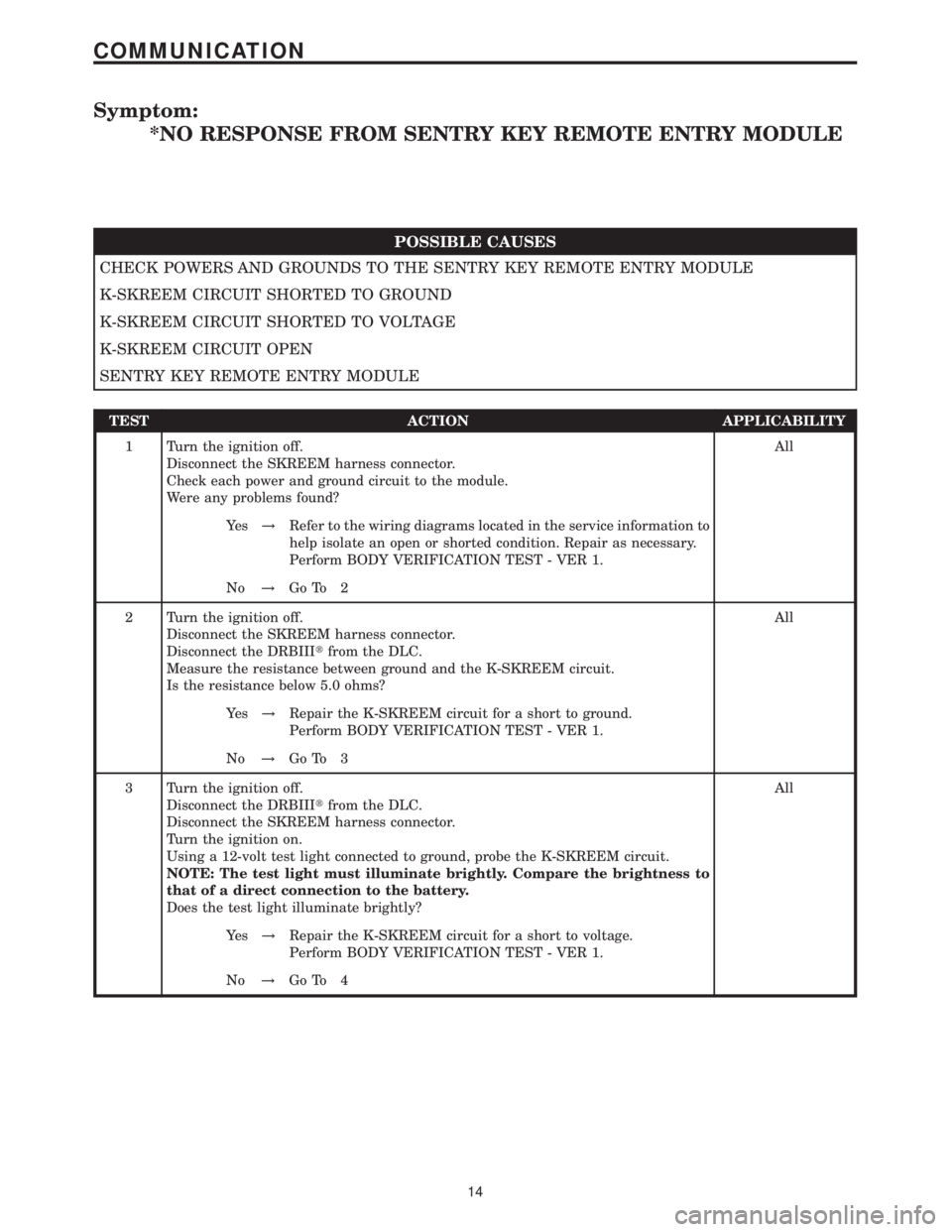
Symptom:
*NO RESPONSE FROM SENTRY KEY REMOTE ENTRY MODULE
POSSIBLE CAUSES
CHECK POWERS AND GROUNDS TO THE SENTRY KEY REMOTE ENTRY MODULE
K-SKREEM CIRCUIT SHORTED TO GROUND
K-SKREEM CIRCUIT SHORTED TO VOLTAGE
K-SKREEM CIRCUIT OPEN
SENTRY KEY REMOTE ENTRY MODULE
TEST ACTION APPLICABILITY
1 Turn the ignition off.
Disconnect the SKREEM harness connector.
Check each power and ground circuit to the module.
Were any problems found?All
Ye s!Refer to the wiring diagrams located in the service information to
help isolate an open or shorted condition. Repair as necessary.
Perform BODY VERIFICATION TEST - VER 1.
No!Go To 2
2 Turn the ignition off.
Disconnect the SKREEM harness connector.
Disconnect the DRBIIItfrom the DLC.
Measure the resistance between ground and the K-SKREEM circuit.
Is the resistance below 5.0 ohms?All
Ye s!Repair the K-SKREEM circuit for a short to ground.
Perform BODY VERIFICATION TEST - VER 1.
No!Go To 3
3 Turn the ignition off.
Disconnect the DRBIIItfrom the DLC.
Disconnect the SKREEM harness connector.
Turn the ignition on.
Using a 12-volt test light connected to ground, probe the K-SKREEM circuit.
NOTE: The test light must illuminate brightly. Compare the brightness to
that of a direct connection to the battery.
Does the test light illuminate brightly?All
Ye s!Repair the K-SKREEM circuit for a short to voltage.
Perform BODY VERIFICATION TEST - VER 1.
No!Go To 4
14
COMMUNICATION
Page 444 of 2305
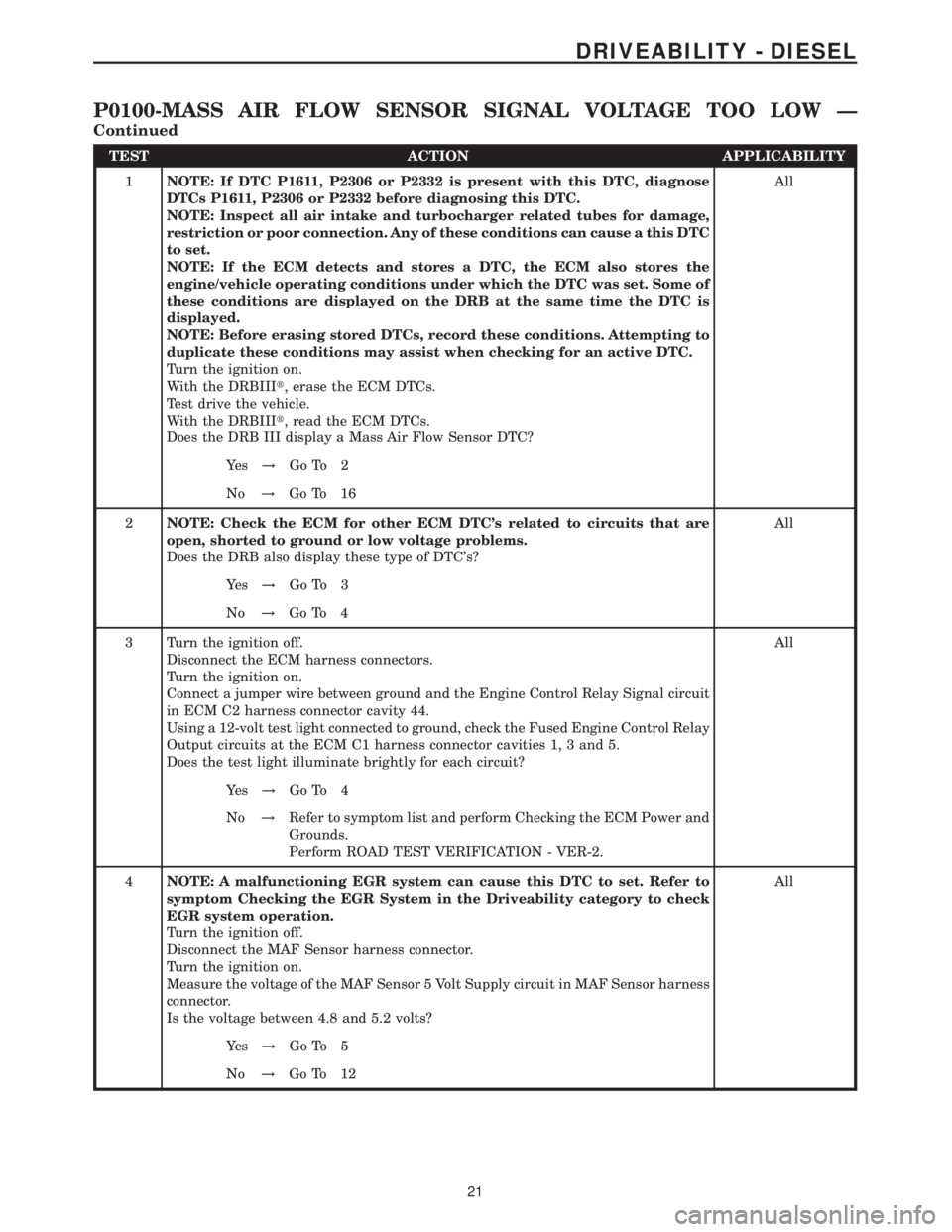
TEST ACTION APPLICABILITY
1NOTE: If DTC P1611, P2306 or P2332 is present with this DTC, diagnose
DTCs P1611, P2306 or P2332 before diagnosing this DTC.
NOTE: Inspect all air intake and turbocharger related tubes for damage,
restriction or poor connection. Any of these conditions can cause a this DTC
to set.
NOTE: If the ECM detects and stores a DTC, the ECM also stores the
engine/vehicle operating conditions under which the DTC was set. Some of
these conditions are displayed on the DRB at the same time the DTC is
displayed.
NOTE: Before erasing stored DTCs, record these conditions. Attempting to
duplicate these conditions may assist when checking for an active DTC.
Turn the ignition on.
With the DRBIIIt, erase the ECM DTCs.
Test drive the vehicle.
With the DRBIIIt, read the ECM DTCs.
Does the DRB III display a Mass Air Flow Sensor DTC?All
Ye s!Go To 2
No!Go To 16
2NOTE: Check the ECM for other ECM DTC's related to circuits that are
open, shorted to ground or low voltage problems.
Does the DRB also display these type of DTC's?All
Ye s!Go To 3
No!Go To 4
3 Turn the ignition off.
Disconnect the ECM harness connectors.
Turn the ignition on.
Connect a jumper wire between ground and the Engine Control Relay Signal circuit
in ECM C2 harness connector cavity 44.
Using a 12-volt test light connected to ground, check the Fused Engine Control Relay
Output circuits at the ECM C1 harness connector cavities 1, 3 and 5.
Does the test light illuminate brightly for each circuit?All
Ye s!Go To 4
No!Refer to symptom list and perform Checking the ECM Power and
Grounds.
Perform ROAD TEST VERIFICATION - VER-2.
4NOTE: A malfunctioning EGR system can cause this DTC to set. Refer to
symptom Checking the EGR System in the Driveability category to check
EGR system operation.
Turn the ignition off.
Disconnect the MAF Sensor harness connector.
Turn the ignition on.
Measure the voltage of the MAF Sensor 5 Volt Supply circuit in MAF Sensor harness
connector.
Is the voltage between 4.8 and 5.2 volts?All
Ye s!Go To 5
No!Go To 12
21
DRIVEABILITY - DIESEL
P0100-MASS AIR FLOW SENSOR SIGNAL VOLTAGE TOO LOW Ð
Continued
Page 446 of 2305
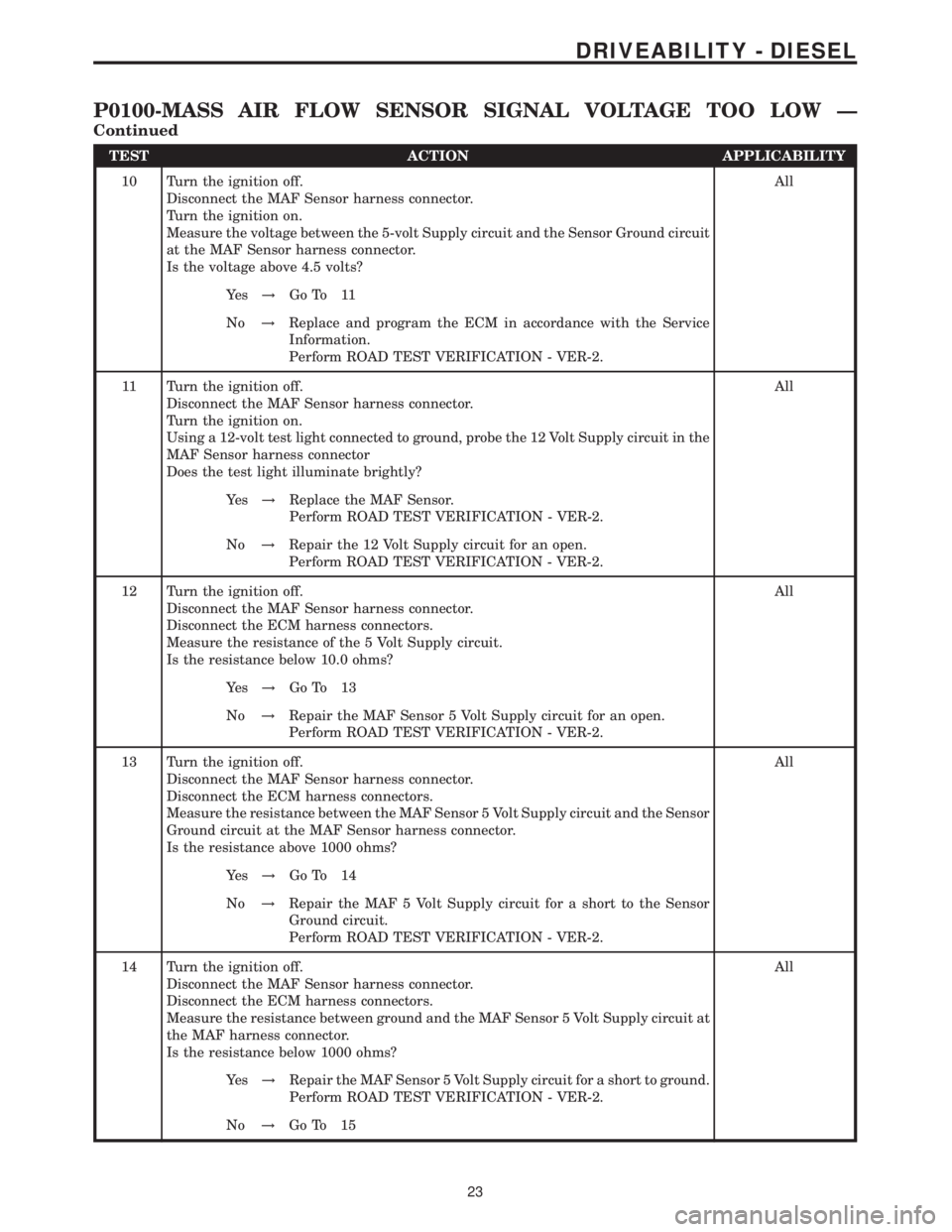
TEST ACTION APPLICABILITY
10 Turn the ignition off.
Disconnect the MAF Sensor harness connector.
Turn the ignition on.
Measure the voltage between the 5-volt Supply circuit and the Sensor Ground circuit
at the MAF Sensor harness connector.
Is the voltage above 4.5 volts?All
Ye s!Go To 11
No!Replace and program the ECM in accordance with the Service
Information.
Perform ROAD TEST VERIFICATION - VER-2.
11 Turn the ignition off.
Disconnect the MAF Sensor harness connector.
Turn the ignition on.
Using a 12-volt test light connected to ground, probe the 12 Volt Supply circuit in the
MAF Sensor harness connector
Does the test light illuminate brightly?All
Ye s!Replace the MAF Sensor.
Perform ROAD TEST VERIFICATION - VER-2.
No!Repair the 12 Volt Supply circuit for an open.
Perform ROAD TEST VERIFICATION - VER-2.
12 Turn the ignition off.
Disconnect the MAF Sensor harness connector.
Disconnect the ECM harness connectors.
Measure the resistance of the 5 Volt Supply circuit.
Is the resistance below 10.0 ohms?All
Ye s!Go To 13
No!Repair the MAF Sensor 5 Volt Supply circuit for an open.
Perform ROAD TEST VERIFICATION - VER-2.
13 Turn the ignition off.
Disconnect the MAF Sensor harness connector.
Disconnect the ECM harness connectors.
Measure the resistance between the MAF Sensor 5 Volt Supply circuit and the Sensor
Ground circuit at the MAF Sensor harness connector.
Is the resistance above 1000 ohms?All
Ye s!Go To 14
No!Repair the MAF 5 Volt Supply circuit for a short to the Sensor
Ground circuit.
Perform ROAD TEST VERIFICATION - VER-2.
14 Turn the ignition off.
Disconnect the MAF Sensor harness connector.
Disconnect the ECM harness connectors.
Measure the resistance between ground and the MAF Sensor 5 Volt Supply circuit at
the MAF harness connector.
Is the resistance below 1000 ohms?All
Ye s!Repair the MAF Sensor 5 Volt Supply circuit for a short to ground.
Perform ROAD TEST VERIFICATION - VER-2.
No!Go To 15
23
DRIVEABILITY - DIESEL
P0100-MASS AIR FLOW SENSOR SIGNAL VOLTAGE TOO LOW Ð
Continued
Page 487 of 2305
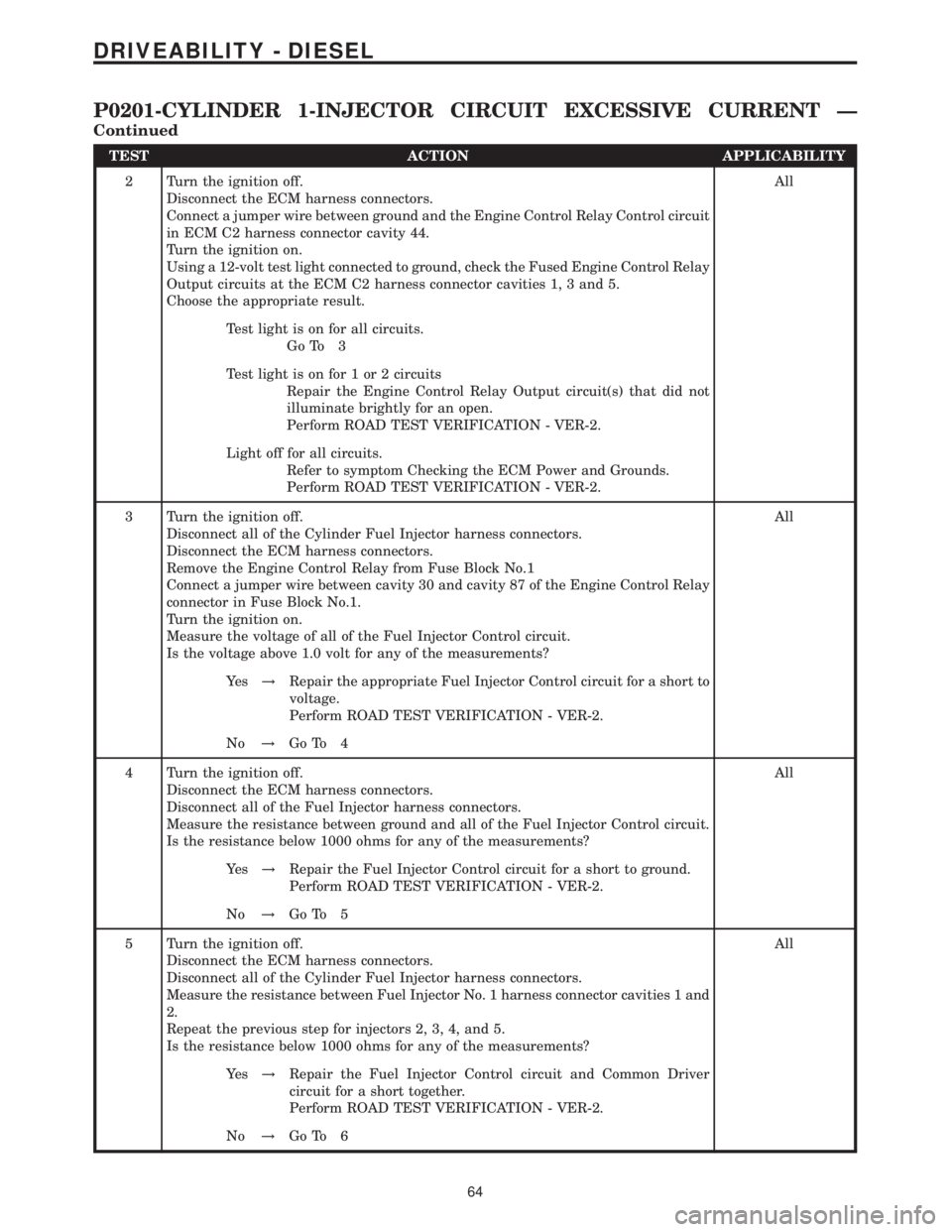
TEST ACTION APPLICABILITY
2 Turn the ignition off.
Disconnect the ECM harness connectors.
Connect a jumper wire between ground and the Engine Control Relay Control circuit
in ECM C2 harness connector cavity 44.
Turn the ignition on.
Using a 12-volt test light connected to ground, check the Fused Engine Control Relay
Output circuits at the ECM C2 harness connector cavities 1, 3 and 5.
Choose the appropriate result.All
Test light is on for all circuits.
Go To 3
Test light is on for 1 or 2 circuits
Repair the Engine Control Relay Output circuit(s) that did not
illuminate brightly for an open.
Perform ROAD TEST VERIFICATION - VER-2.
Light off for all circuits.
Refer to symptom Checking the ECM Power and Grounds.
Perform ROAD TEST VERIFICATION - VER-2.
3 Turn the ignition off.
Disconnect all of the Cylinder Fuel Injector harness connectors.
Disconnect the ECM harness connectors.
Remove the Engine Control Relay from Fuse Block No.1
Connect a jumper wire between cavity 30 and cavity 87 of the Engine Control Relay
connector in Fuse Block No.1.
Turn the ignition on.
Measure the voltage of all of the Fuel Injector Control circuit.
Is the voltage above 1.0 volt for any of the measurements?All
Ye s!Repair the appropriate Fuel Injector Control circuit for a short to
voltage.
Perform ROAD TEST VERIFICATION - VER-2.
No!Go To 4
4 Turn the ignition off.
Disconnect the ECM harness connectors.
Disconnect all of the Fuel Injector harness connectors.
Measure the resistance between ground and all of the Fuel Injector Control circuit.
Is the resistance below 1000 ohms for any of the measurements?All
Ye s!Repair the Fuel Injector Control circuit for a short to ground.
Perform ROAD TEST VERIFICATION - VER-2.
No!Go To 5
5 Turn the ignition off.
Disconnect the ECM harness connectors.
Disconnect all of the Cylinder Fuel Injector harness connectors.
Measure the resistance between Fuel Injector No. 1 harness connector cavities 1 and
2.
Repeat the previous step for injectors 2, 3, 4, and 5.
Is the resistance below 1000 ohms for any of the measurements?All
Ye s!Repair the Fuel Injector Control circuit and Common Driver
circuit for a short together.
Perform ROAD TEST VERIFICATION - VER-2.
No!Go To 6
64
DRIVEABILITY - DIESEL
P0201-CYLINDER 1-INJECTOR CIRCUIT EXCESSIVE CURRENT Ð
Continued
Page 499 of 2305
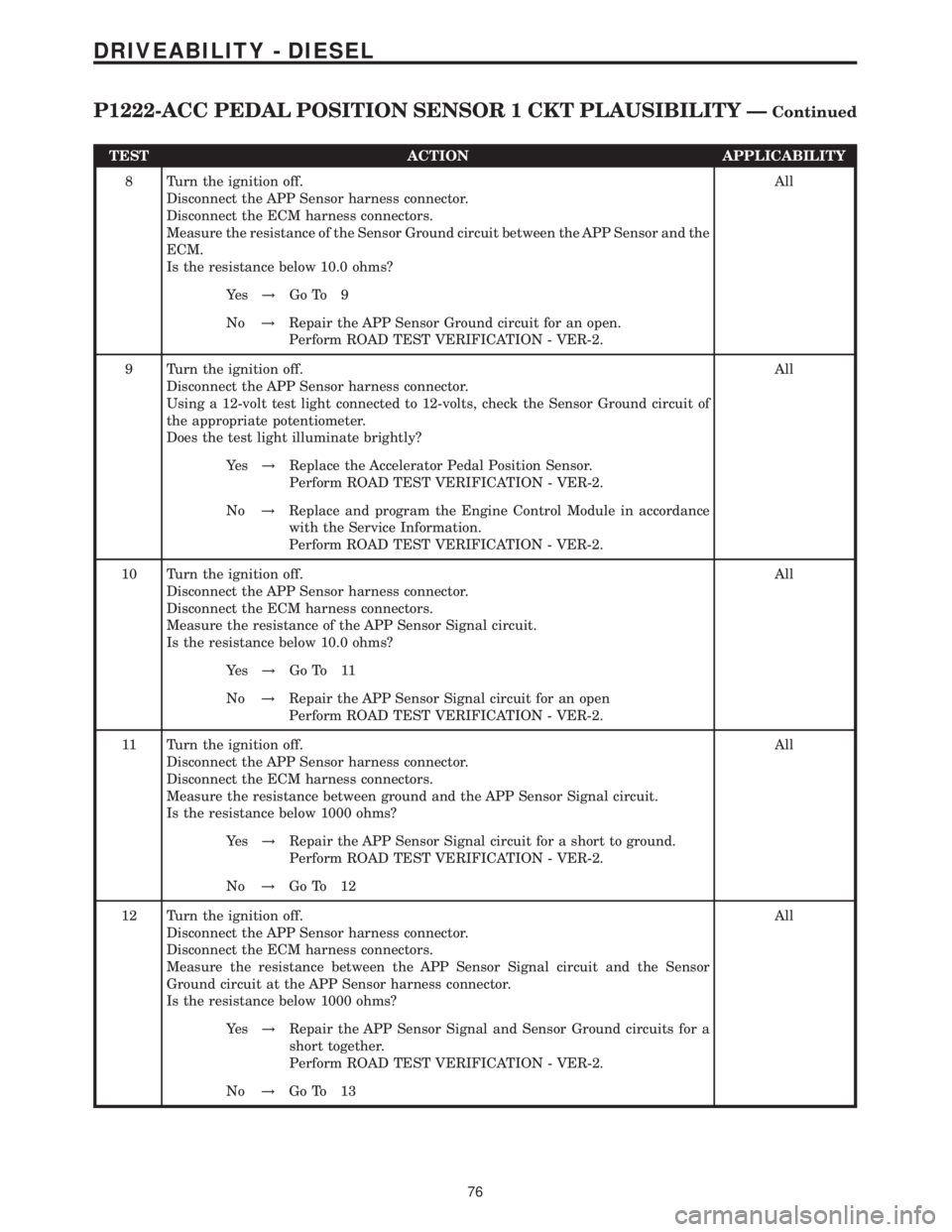
TEST ACTION APPLICABILITY
8 Turn the ignition off.
Disconnect the APP Sensor harness connector.
Disconnect the ECM harness connectors.
Measure the resistance of the Sensor Ground circuit between the APP Sensor and the
ECM.
Is the resistance below 10.0 ohms?All
Ye s!Go To 9
No!Repair the APP Sensor Ground circuit for an open.
Perform ROAD TEST VERIFICATION - VER-2.
9 Turn the ignition off.
Disconnect the APP Sensor harness connector.
Using a 12-volt test light connected to 12-volts, check the Sensor Ground circuit of
the appropriate potentiometer.
Does the test light illuminate brightly?All
Ye s!Replace the Accelerator Pedal Position Sensor.
Perform ROAD TEST VERIFICATION - VER-2.
No!Replace and program the Engine Control Module in accordance
with the Service Information.
Perform ROAD TEST VERIFICATION - VER-2.
10 Turn the ignition off.
Disconnect the APP Sensor harness connector.
Disconnect the ECM harness connectors.
Measure the resistance of the APP Sensor Signal circuit.
Is the resistance below 10.0 ohms?All
Ye s!Go To 11
No!Repair the APP Sensor Signal circuit for an open
Perform ROAD TEST VERIFICATION - VER-2.
11 Turn the ignition off.
Disconnect the APP Sensor harness connector.
Disconnect the ECM harness connectors.
Measure the resistance between ground and the APP Sensor Signal circuit.
Is the resistance below 1000 ohms?All
Ye s!Repair the APP Sensor Signal circuit for a short to ground.
Perform ROAD TEST VERIFICATION - VER-2.
No!Go To 12
12 Turn the ignition off.
Disconnect the APP Sensor harness connector.
Disconnect the ECM harness connectors.
Measure the resistance between the APP Sensor Signal circuit and the Sensor
Ground circuit at the APP Sensor harness connector.
Is the resistance below 1000 ohms?All
Ye s!Repair the APP Sensor Signal and Sensor Ground circuits for a
short together.
Perform ROAD TEST VERIFICATION - VER-2.
No!Go To 13
76
DRIVEABILITY - DIESEL
P1222-ACC PEDAL POSITION SENSOR 1 CKT PLAUSIBILITY ÐContinued