wheel MERCEDES-BENZ SPRINTER 2011 MY11 Operator’s Manual
[x] Cancel search | Manufacturer: MERCEDES-BENZ, Model Year: 2011, Model line: SPRINTER, Model: MERCEDES-BENZ SPRINTER 2011Pages: 292, PDF Size: 6.75 MB
Page 228 of 292
X
Hook tire sealant bottle 006F into the upper
vent hole in the wheel using hook 0072.
X Push angled connecting piece 0074 located
on the hose of tire sealant filler bottle 006F
as far
as
it will go on to valve core extractor
0071 and fix it in place.
X Make sure that the pressure release screw
on pressure gauge 0086 is closed.
X Connect connector 0087 to the 12 V socket
(12 V, 25 A, 300 W) on the center console
(Y page 133).
! Only use the 12 V socket on the center
console to connect the electric air pump.
You could otherwise damage the vehicle's
electrics.
X Start the engine.
X Press I on tire inflation compressor
switch 0046.
The tire inflation compressor is activated.
The tire
sealant
is then pumped into the tire
and the tire pressure is increased. Let the
tire inflation compressor run for at least 10
minutes until tire sealant bottle 006F is
completely empty and the tire pressure is
at least 43.5 psi (3.0 bar).
! Do not
run
the electric air pump for longer
than 20 minutes without a break; otherwise
it may overheat.
The air pump can be used again once it has
cooled down.
X Inflate the tire using the tire inflation
compressor until the recommended tire
pressure ( Y page 281) is reached.
X Then, press 0 on tire inflation compressor
switch 0046.
The tire inflation compressor is
deactivated.
X Slide knob 0073 quickly to the stop in valve
core extractor 0071.
X Turn knob 0073 clockwise
until
the valve core
is firmly screwed into tire valve 0075.i
Do not pull the valve core extractor from
the tire valve while the valve core is
unscrewed from the
tire valve. Tire sealant
could otherwise escape and make you
dirty.
The tire sealant is water-soluble. If tire
sealant escapes, you can wash it away with
water.
X Pull knob 0073 out of valve core extractor
0071 as far as it will go.
X Unscrew valve core extractor 0071 counter-
clockwise from tire valve 0075.
X Screw valve extension 0070 onto tire valve
0075 and tighten it.
X Screw the valve cap onto valve extension
0070.
After filling with tire sealant, ( Y page 228).
Twin tires, outer wheel The tire valve is located on the inside of the
outer wheel and should be positioned
horizontally on the left side of the wheel for
the repair process.
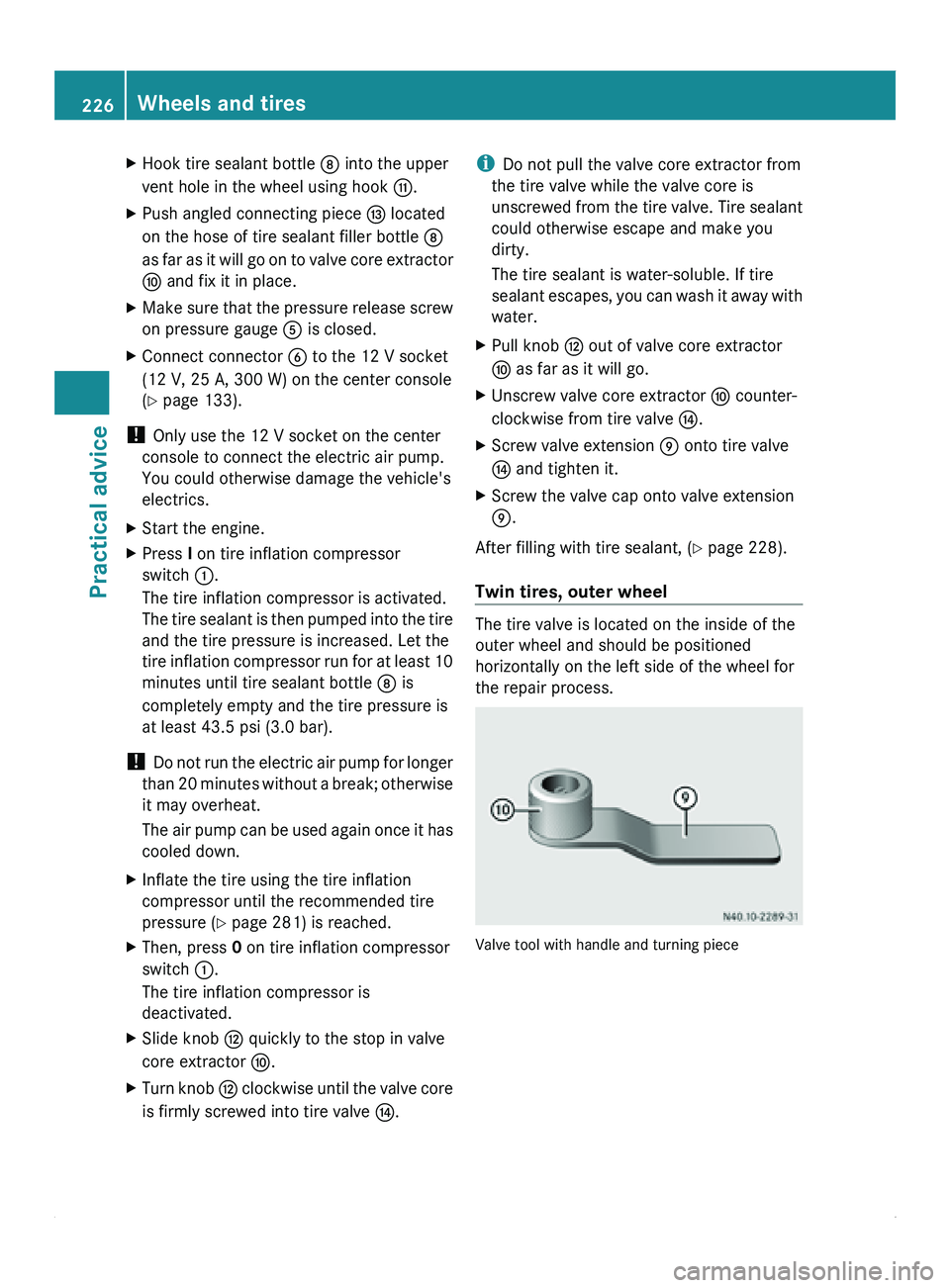
Valve tool with handle and turning piece226
Wheels and tires
Practical advice
Page 229 of 292
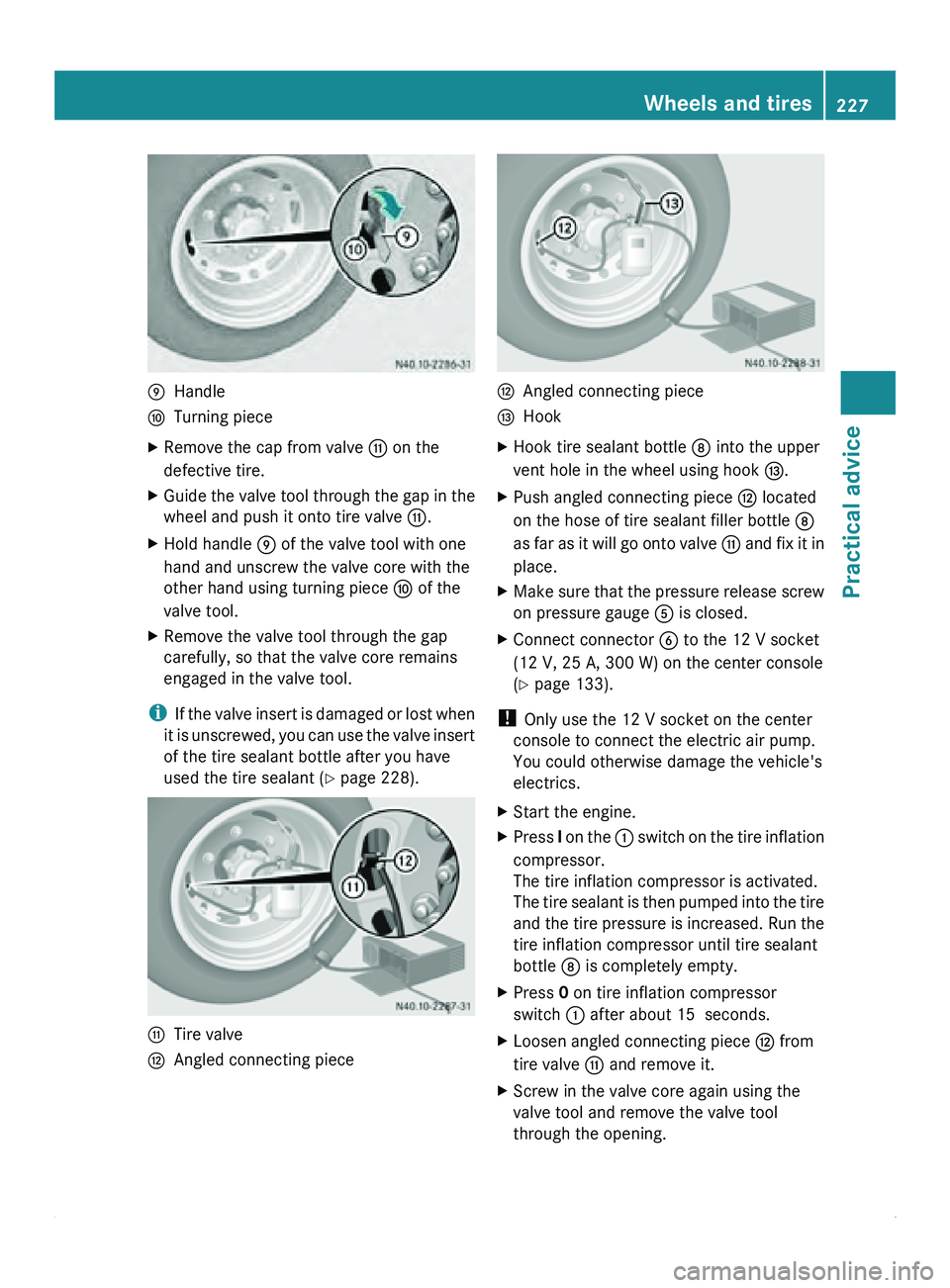
0070
Handle
0071 Turning piece
X Remove the cap from valve 0072 on the
defective tire.
X Guide the valve tool through the gap in the
wheel and push it onto tire valve 0072.
X Hold handle 0070 of the valve tool with one
hand and unscrew the valve core with the
other hand using turning piece 0071 of the
valve tool.
X Remove the valve tool through the gap
carefully, so that the valve core remains
engaged in the valve tool.
i If the
valve
insert is damaged or lost when
it is unscrewed, you can use the valve insert
of the tire sealant bottle after you have
used the tire sealant ( Y page 228).0072
Tire valve
0073 Angled connecting piece 0073
Angled connecting piece
0074 Hook
X Hook tire sealant bottle 006F into the upper
vent hole in the wheel using hook 0074.
X Push angled connecting piece 0073 located
on the hose of tire sealant filler bottle 006F
as far
as
it will go onto valve 0072 and fix it in
place.
X Make sure that the pressure release screw
on pressure gauge 0086 is closed.
X Connect connector 0087 to the 12 V socket
(12 V, 25 A, 300 W) on the center console
(Y page 133).
! Only use the 12 V socket on the center
console to connect the electric air pump.
You could otherwise damage the vehicle's
electrics.
X Start the engine.
X Press I on the 0046
switch on the tire inflation
compressor.
The tire inflation compressor is activated.
The tire sealant is then pumped into the tire
and the tire pressure is increased. Run the
tire inflation compressor until tire sealant
bottle 006F is completely empty.
X Press 0 on tire inflation compressor
switch 0046 after about 15 seconds.
X Loosen angled connecting piece 0073 from
tire valve 0072 and remove it.
X Screw in the valve core again using the
valve tool and remove the valve tool
through the opening. Wheels and tires
227
Practical advice Z
Page 230 of 292
i
If the valve
insert is damaged or lost when
it is unscrewed, you can use the valve insert
of the tire sealant bottle after you have
used the tire sealant.
X Unscrew the valve insert from the valve of
the tire sealant bottle using the valve
extractor.
! Do not run
the electric air pump for longer
than 20 minutes without a break; otherwise
it may overheat.
The air pump can be used again once it has
cooled down.
X Push angled connecting piece 0047 located
on tire inflation
compressor hose 008A as far
as it will go onto valve 0072 and fix it in place.
X Push I on tire inflation compressor
switch 0046 and inflate the tire to the
recommended tire pressure ( Y page 281).
X Then, press 0 on tire inflation compressor
switch 0046.
The tire inflation compressor is
deactivated.
i The tire sealant is water-soluble. If tire
sealant escapes,
you
can wash it away with
water.
X Screw the valve cap onto tire valve 0072.
After filling with tire sealant, ( Y page 228).
After filling with tire sealant X
Turn the pressure release screw on
pressure gauge 0086 counter-clockwise and
bleed the system.
X Turn the key to position 0 in the ignition
lock.
X Pull the tire inflation compressor connector
out of the 12 V socket.
X Stow the tire inflation compressor, tire
sealant bottle 006F with the valve core
extractor and/or valve tool, the warning triangle and hazard warning lights inside
the vehicle.
X Remove angled connecting piece 0047 from
valve 006E of tire sealant filler bottle 006F and
screw the valve cap onto the valve. G
Warning
You must not exceed a maximum speed of
50 mph (80 km/h) .
The "max.
50 mph" (80 km/h) sticker must be
affixed within the driver's field of vision.
The vehicle's handling characteristics may be
affected.
X Pull away immediately.
This enables the tire sealant to distribute
inside the tire and create a more effective
seal.
X Stop after driving for about three minutes
and check the tire pressure using the tire
inflation compressor, for example.
i You must connect the angled connecting
piece on hose 008A of the tire inflation
compressor directly to
the tire valve on the
tire.
X Correct the tire pressure accordingly if it
does not correspond to the recommended
tire pressure ( Y page 281).
X To increase the tire pressure: switch on
the tire inflation compressor.
X To reduce the tire pressure: open the
pressure release screw on pressure
gauge 0086.
X Drive to the nearest workshop and have the
tire repaired or replaced.
X Clean the valve core extractor with clean
water.
X Have tire sealant bottle 006F replaced as
soon as possible at a qualified specialist
workshop, e.g. an authorized Sprinter
Dealer.228
Wheels and tires
Practical advice
Page 231 of 292
G
Warning
If the minimum tire pressure of 43.5 psi
(3 bar) still cannot
be achieved, the tire is too
badly damaged.
Do not drive any further. Consult a qualified
specialist workshop which has the necessary
specialist knowledge and tools to carry out
the work required.
For this reason, we recommend an authorized
Sprinter Dealer. In particular, work relevant to
safety or on safety-related systems must be
carried out at a qualified specialist workshop.
0040Environmental note
Have the used tire sealant disposed of at a
qualified specialist workshop, e.g. an
authorized Sprinter Dealer.
! Have the tire sealant bottle replaced
every eight years at a qualified specialist
workshop, e.g. an authorized Sprinter
Dealer. Changing a
wheel in the event of a flat
tire G
Warning
To avoid the risk of serious or even fatal injury
and to avoid damage to the vehicle, observe
the following:
R the vehicle's jack is intended only to raise
the vehicle for
a short time when changing
a wheel.
R position the jack on the appropriate jacking
point only. Make sure that the jack is
correctly positioned under the jacking point
before raising the vehicle.
R the jack must be placed on a firm, flat
surface.
R before raising the vehicle, you should also
secure it against rolling away, e.g. by
placing chocks under the wheels. Never
release the parking brake while the vehicle
is raised. R
make sure that the distance between the
underside
of the
tires and the ground does
not exceed 1.2 in (3 cm). The vehicle could
otherwise slip off the jack or tip over.
R never place your hands or feet under the
raised vehicle.
R never start the engine, and prevent other
jolts or vibrations while the vehicle is
raised. The vehicle could otherwise slip off
the jack.
Preparing to change a wheel X
Prepare the vehicle as described
(Y
page 222).
X Secure the vehicle against rolling away
using chocks or similar items.
Use the chock ( Y
page 183) to do so. G
Warning
The vehicle
could slip off the jack on uphill and
downhill gradients.
To avoid the risk of causing serious or even
fatal injury or damage to the vehicle, do not
change wheels on uphill and downhill
gradients.
On a level road:
X Place chocks in front of and behind the
wheel which is diagonally opposite the
wheel you wish to change.
X Take the vehicle tool kit and the jack from
the footwell on the co-driver's side
(Y page 182).
X Remove the spare wheel from the spare
wheel bracket ( Y page 185).
X On wheels with wheel bolts, remove the
hub cap.
X Assemble the lug wrench extension using
the middle rod
and the rod with the largest
diameter from the three-piece jack pump
lever.
X Starting with the middle rod, slide the lug
wrench extension as far as it will go onto
the lug wrench. Wheels and tires
229
Practical advice Z
Page 232 of 292
!
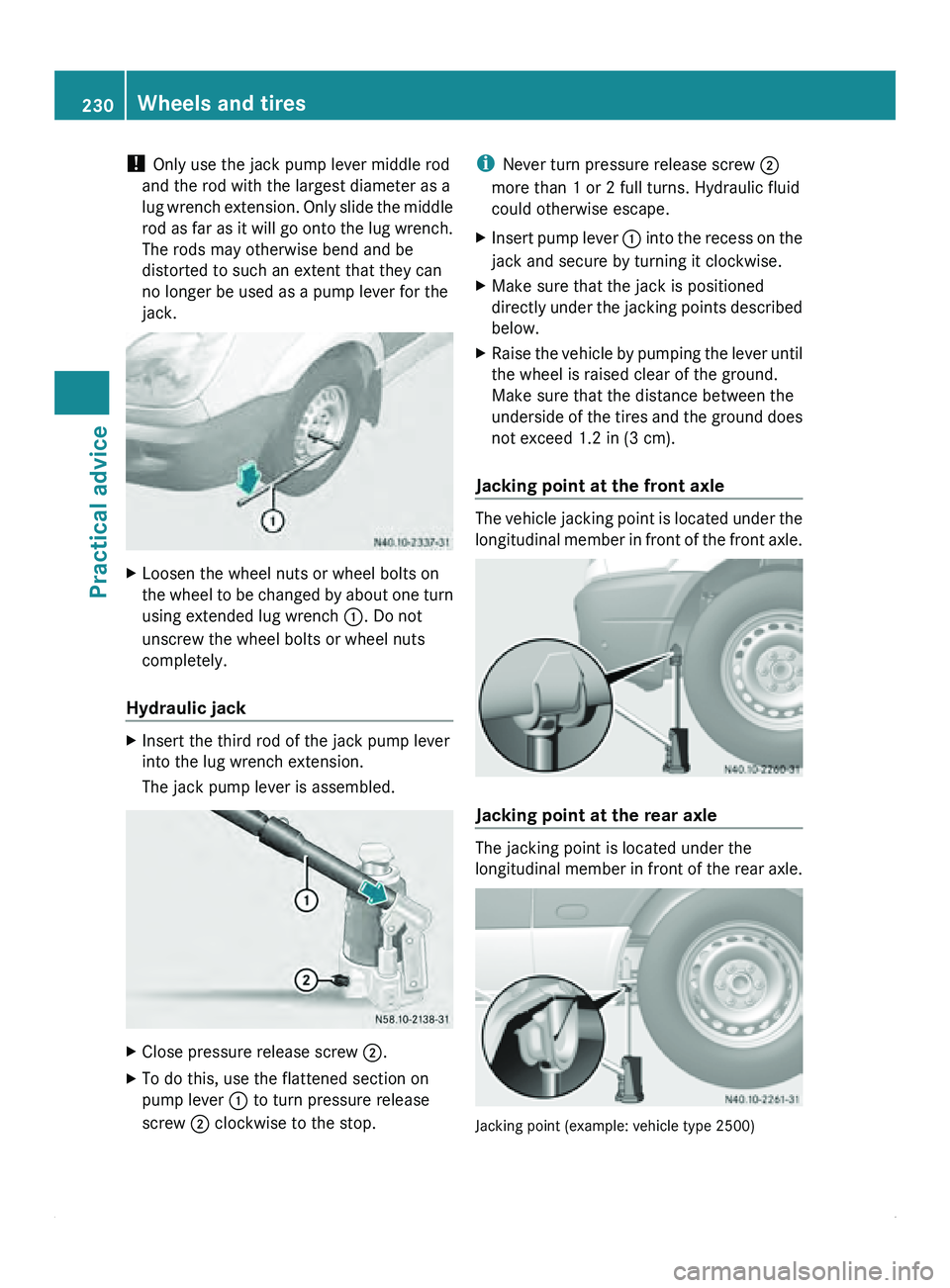
Only use the jack pump lever middle rod
and the rod with the largest diameter as a
lug wrench extension.
Only slide the middle
rod as far as it will go onto the lug wrench.
The rods may otherwise bend and be
distorted to such an extent that they can
no longer be used as a pump lever for the
jack. X
Loosen the wheel nuts or wheel bolts on
the wheel to
be changed by about one turn
using extended lug wrench 0046. Do not
unscrew the wheel bolts or wheel nuts
completely.
Hydraulic jack X
Insert the third rod of the jack pump lever
into the lug wrench extension.
The jack pump lever is assembled. X
Close pressure release screw 0047.
X To do this, use the flattened section on
pump lever 0046 to turn pressure release
screw 0047 clockwise to the stop. i
Never turn pressure release screw 0047
more than 1 or 2 full turns. Hydraulic fluid
could otherwise escape.
X Insert pump lever 0046 into the
recess on the
jack and secure by turning it clockwise.
X Make sure that the jack is positioned
directly under the
jacking points described
below.
X Raise the vehicle by pumping the lever until
the wheel is raised clear of the ground.
Make sure that the distance between the
underside of the
tires and the ground does
not exceed 1.2 in (3 cm).
Jacking point at the front axle The vehicle jacking point is located under the
longitudinal member
in
front of the front axle. Jacking point at the rear axle
The jacking point is located under the
longitudinal member
in
front of the rear axle. Jacking point (example: vehicle type 2500)230
Wheels and tires
Practical advice
Page 233 of 292
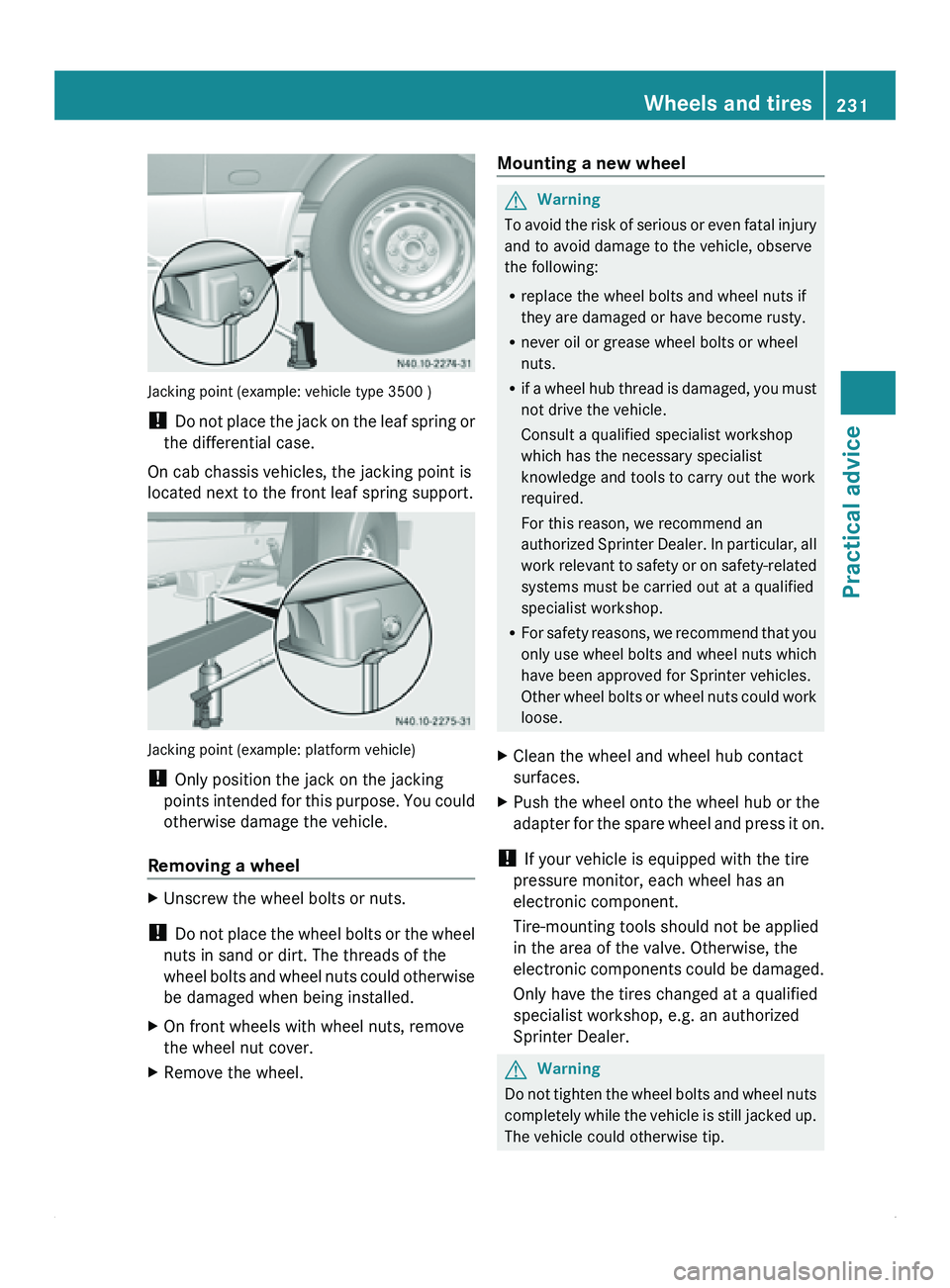
Jacking point (example: vehicle type 3500 )
!
Do not place
the jack on the leaf spring or
the differential case.
On cab chassis vehicles, the jacking point is
located next to the front leaf spring support. Jacking point (example: platform vehicle)
!
Only position the jack on the jacking
points intended for
this purpose. You could
otherwise damage the vehicle.
Removing a wheel X
Unscrew the wheel bolts or nuts.
! Do not place
the wheel bolts or the wheel
nuts in sand or dirt. The threads of the
wheel bolts and wheel nuts could otherwise
be damaged when being installed.
X On front wheels with wheel nuts, remove
the wheel nut cover.
X Remove the wheel. Mounting a new wheel G
Warning
To avoid the risk of serious or even fatal injury
and to avoid damage to the vehicle, observe
the following:
R replace the wheel bolts and wheel nuts if
they are damaged or have become rusty.
R never oil or grease wheel bolts or wheel
nuts.
R if a wheel
hub thread is damaged, you must
not drive the vehicle.
Consult a qualified specialist workshop
which has the necessary specialist
knowledge and tools to carry out the work
required.
For this reason, we recommend an
authorized Sprinter Dealer. In particular, all
work relevant to safety or on safety-related
systems must be carried out at a qualified
specialist workshop.
R For safety reasons, we recommend that you
only use wheel bolts and wheel nuts which
have been approved for Sprinter vehicles.
Other wheel bolts or wheel nuts could work
loose.
X Clean the wheel and wheel hub contact
surfaces.
X Push the wheel onto the wheel hub or the
adapter for the
spare wheel and press it on.
! If your vehicle is equipped with the tire
pressure monitor, each wheel has an
electronic component.
Tire-mounting tools should not be applied
in the area of the valve. Otherwise, the
electronic components could
be damaged.
Only have the tires changed at a qualified
specialist workshop, e.g. an authorized
Sprinter Dealer. G
Warning
Do not tighten the wheel bolts and wheel nuts
completely while the
vehicle is still jacked up.
The vehicle could otherwise tip. Wheels and tires
231
Practical advice Z
Page 234 of 292
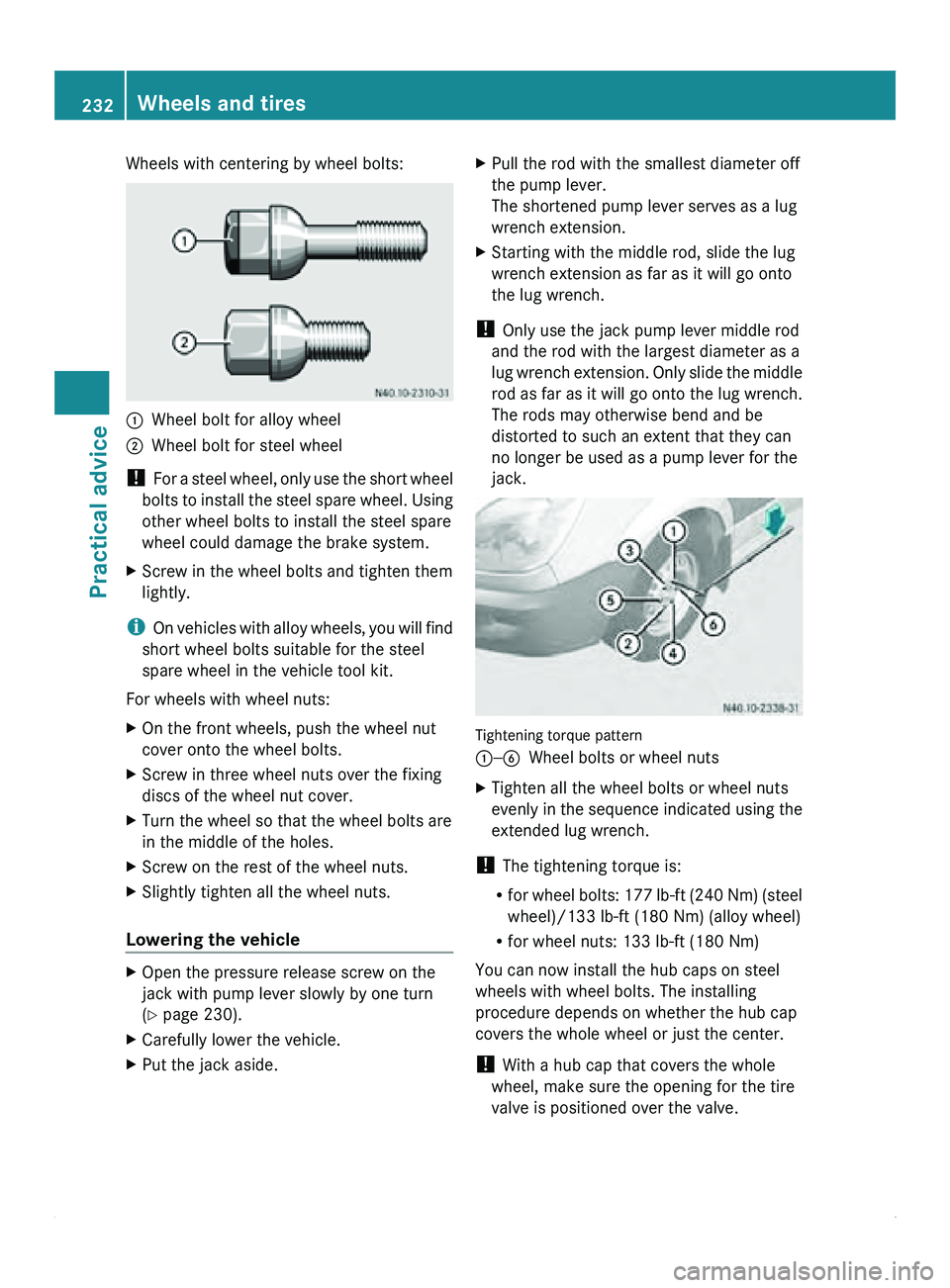
Wheels with centering by wheel bolts:
0046
Wheel bolt for alloy wheel
0047 Wheel bolt for steel wheel
! For a
steel
wheel, only use the short wheel
bolts to install the steel spare wheel. Using
other wheel bolts to install the steel spare
wheel could damage the brake system.
X Screw in the wheel bolts and tighten them
lightly.
i On vehicles with
alloy wheels, you will find
short wheel bolts suitable for the steel
spare wheel in the vehicle tool kit.
For wheels with wheel nuts:
X On the front wheels, push the wheel nut
cover onto the wheel bolts.
X Screw in three wheel nuts over the fixing
discs of the wheel nut cover.
X Turn the wheel so that the wheel bolts are
in the middle of the holes.
X Screw on the rest of the wheel nuts.
X Slightly tighten all the wheel nuts.
Lowering the vehicle X
Open the pressure release screw on the
jack with pump lever slowly by one turn
(Y page 230).
X Carefully lower the vehicle.
X Put the jack aside. X
Pull the rod with the smallest diameter off
the pump lever.
The shortened pump lever serves as a lug
wrench extension.
X Starting with the middle rod, slide the lug
wrench extension as far as it will go onto
the lug wrench.
! Only use the jack pump lever middle rod
and the rod with the largest diameter as a
lug wrench extension.
Only slide the middle
rod as far as it will go onto the lug wrench.
The rods may otherwise bend and be
distorted to such an extent that they can
no longer be used as a pump lever for the
jack. Tightening torque pattern
0046—0087
Wheel bolts or wheel nuts
X Tighten all the wheel bolts or wheel nuts
evenly in the
sequence indicated using the
extended lug wrench.
! The tightening torque is:
R for wheel bolts:
177 lb-ft (240 Nm) (steel
wheel)/133 lb-ft (180 Nm) (alloy wheel)
R for wheel nuts: 133 lb-ft (180 Nm)
You can now install the hub caps on steel
wheels with wheel bolts. The installing
procedure depends on whether the hub cap
covers the whole wheel or just the center.
! With a hub cap that covers the whole
wheel, make sure the opening for the tire
valve is positioned over the valve. 232
Wheels and tires
Practical advice
Page 235 of 292
X
Push the edge of the hub cap with both
hands against the wheel until it clicks into
place.
! With a hub
cap for the middle of the wheel,
make sure that the clamping lugs of the
cover are positioned over the wheel bolts.
X Hit the middle of the hub cap to engage it
on the wheel.
X Push the piston on the hydraulic jack in
again and close the pressure release
screw.
X Secure the faulty wheel in the spare wheel
bracket (Y page 185).
X Stow the jack and the vehicle tool kit.
X Check the tire pressure and correct if
necessary ( Y page 280).
X Retighten the wheel bolts or wheel nuts to
the specified tightening torque after the
vehicle has been driven for 30 miles
(50 km). Retightening wheel nuts/wheel bolts
G
Warning
After changing a wheel, for safety reasons you
must:
R have the tightening torque checked. For
wheel bolts, the tightening torque is
177 lb-ft (240 Nm) (steel wheel)/ 133 lb-ft
(180
Nm) (alloy wheel). For wheel nuts, the
tightening torque is 133 lb-ft (180 Nm). The
wheels could otherwise work loose.
R check the tire pressure and correct it if
necessary.
R have the wheel bolts/wheel nuts
retightened after driving a distance of 30
miles (50 km). The tightening torque for
wheel bolts is 177 lb-ft (240 Nm)(steel
wheel)/133 lb-ft (180 Nm) (alloy wheel).
The tightening torque for wheel nuts is
133 lb-ft (180 Nm).
R if using new or painted rims, have the wheel
bolts and wheel nuts retightened at the specified tightening torque after the vehicle
has been driven for approximately 600 to
3000 miles (1000 to
5000 km)
.
R have the direction of rotation corrected, if
reversed, as soon as possible at a qualified
specialist workshop, e.g. an authorized
Sprinter Dealer. The vehicle handling
characteristics could otherwise be
affected.
Otherwise, the operating reliability and road
safety of the vehicle could be jeopardized.
This could cause you to lose control of your
vehicle, resulting in an accident and injuring
yourself or others. Electrical system
Notes on changing bulbs
The bulbs and lamps are an essential
component of vehicle
safety. Therefore, make
sure that each bulb is always working. G
Warning
Bulbs and lamps can become very hot. For
this reason, allow them to cool down before
changing them. Otherwise, you could burn
yourself when you touch them.
Keep bulbs out of the reach of children.
Otherwise, they could, for example, damage
the bulbs and injure themselves.
Never use a bulb which has been dropped.
Such a bulb may explode and injure you.
Halogen bulbs are pressurized and could
explode when you change them, especially if
they are very hot. You should therefore wear
eye protection and gloves when you are
changing them. G
Warning
Xenon bulbs are under high voltage. You could
get an electric
shock and be seriously or even
fatally injured if you touch the electric
contacts on Xenon bulbs. Therefore, do not
remove the cover on Xenon bulbs. Electrical system
233
Practical advice
Z
Page 251 of 292
You could otherwise become locked out
when pushing or towing the vehicle.
! Do not exceed the towing speed of
31 mph (50 km/h). You could otherwise
damage the transmission.
X Turn the key to position 2
in the ignition
lock.
X For a towing distance of up to 30 miles
(50 km), move the selector lever to
position N. G
Warning
A propeller shaft could fall off as it is being
removed and injure
you. Secure the propeller
shaft before removal to prevent it from falling
down, e.g. with the aid of another person or
by tying the propeller shaft up.
X For a towing distance greater than
30 miles(50 km), remove the propeller
shafts to the driven axles.
! Always use new bolts when installing the
propeller shafts.
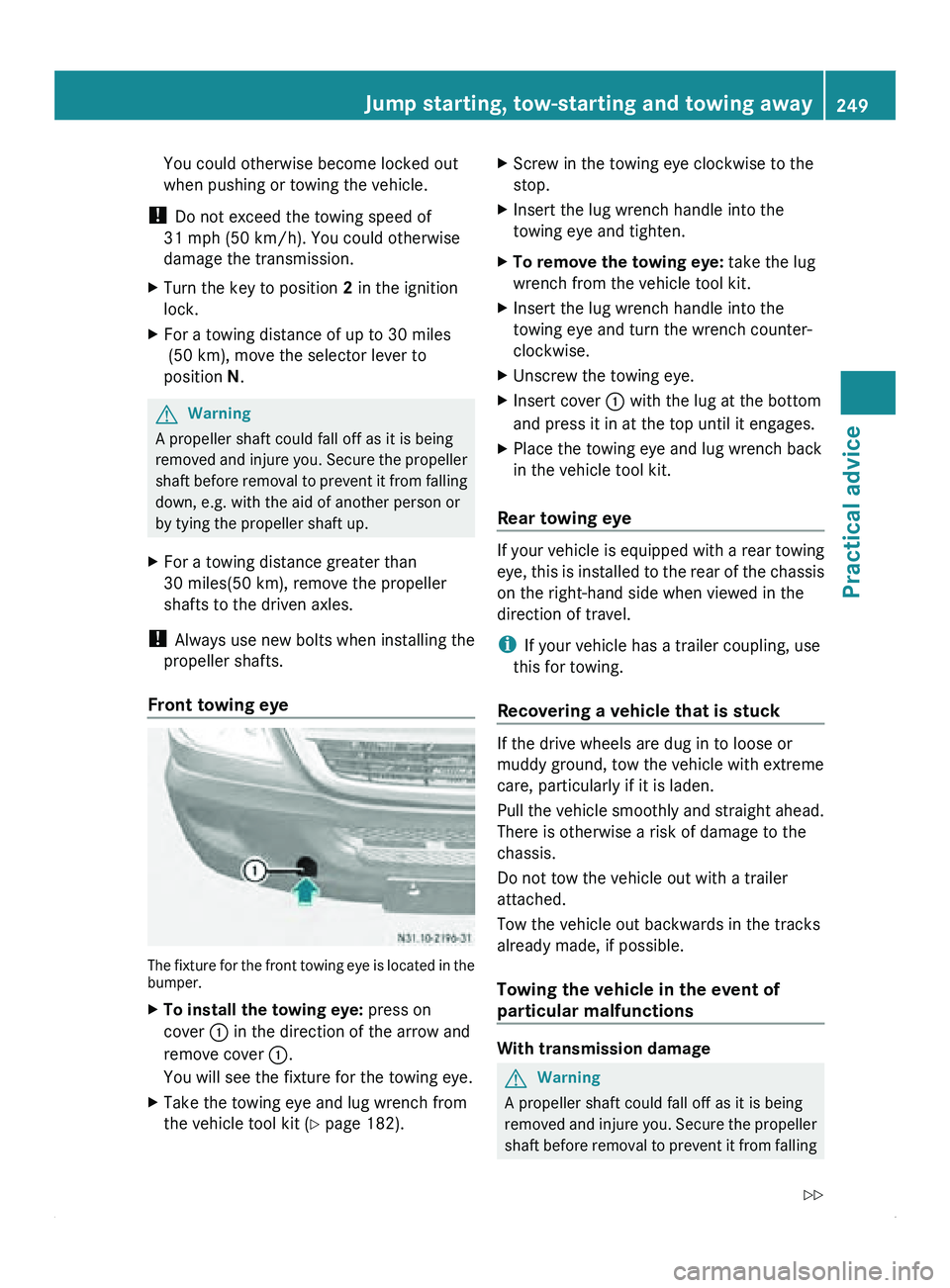
Front towing eye The fixture for the front towing eye is located in the
bumper.
X
To install the towing eye: press on
cover 0046 in the direction of the arrow and
remove cover 0046.
You will see the fixture for the towing eye.
X Take the towing eye and lug wrench from
the vehicle tool kit (Y page 182). X
Screw in the towing eye clockwise to the
stop.
X Insert the lug wrench handle into the
towing eye and tighten.
X To remove the towing eye: take the lug
wrench from the vehicle tool kit.
X Insert the lug wrench handle into the
towing eye and turn the wrench counter-
clockwise.
X Unscrew the towing eye.
X Insert cover 0046 with the lug at the bottom
and press it in at the top until it engages.
X Place the towing eye and lug wrench back
in the vehicle tool kit.
Rear towing eye If your vehicle is equipped with a rear towing
eye, this
is
installed to the rear of the chassis
on the right-hand side when viewed in the
direction of travel.
i If your vehicle has a trailer coupling, use
this for towing.
Recovering a vehicle that is stuck If the drive wheels are dug in to loose or
muddy ground, tow the vehicle with extreme
care, particularly if it is laden.
Pull the
vehicle
smoothly and straight ahead.
There is otherwise a risk of damage to the
chassis.
Do not tow the vehicle out with a trailer
attached.
Tow the vehicle out backwards in the tracks
already made, if possible.
Towing the vehicle in the event of
particular malfunctions With transmission damage
G
Warning
A propeller shaft could fall off as it is being
removed and injure
you. Secure the propeller
shaft before removal to prevent it from falling Jump starting, tow-starting and towing away
249
Practical advice
Z
Page 252 of 292
down, e.g. with the aid of another person or
by tying the propeller shaft up.
X Always remove the propeller shafts leading
to the driven axles.
! Always use new bolts when installing the
propeller shafts.
With front axle damage
X Turn the key to position 1 in the ignition
lock.
X Raise the front axle. G
Warning
A propeller shaft could fall off as it is being
removed and injure
you. Secure the propeller
shaft before removal to prevent it from falling
down, e.g. with the aid of another person or
by tying the propeller shaft up.
! The ignition must be switched off if the
vehicle is being towed with the front or rear
axle raised. Otherwise, ESP ®
may intervene
and damage the brake system.
With rear axle damage
X Turn the key to position 1 in the ignition
lock.
X Raise the rear axle.
Malfunction in the electrical system
If the battery is defective, the automatic
transmission will be locked in position P. To
shift the automatic transmission to
position N, you must provide power to the
vehicle's electrical system in the same way
as jump-starting ( Y page 247).
Have the vehicle
transported on a transporter
or trailer.
Transporting the vehicle The towing
eye can be used to pull the vehicle
onto a special transporter or trailer for
transportation.
! Only lash the
vehicle down by the wheels
or rims, not by vehicle parts such as axle or steering components. There is otherwise a
risk of damage to the vehicle.
X Move the selector lever of the automatic
transmission to position N.250
Jump starting, tow-starting and towing away
Practical advice