wheel MERCEDES-BENZ SPRINTER 2011 MY11 Operator’s Manual
[x] Cancel search | Manufacturer: MERCEDES-BENZ, Model Year: 2011, Model line: SPRINTER, Model: MERCEDES-BENZ SPRINTER 2011Pages: 292, PDF Size: 6.75 MB
Page 142 of 292
Before driving off-road
X
If the surface demands it, temporarily
deactivate acceleration skid control (ASR)
when pulling away ( Y
page 49).
X Safely stow or secure any items of luggage
or loads ( Y page 144).
i We recommend that you additionally
carry a shovel and a recovery rope with
shackle in the vehicle.
After driving off-road G
Warning
Damage caused to the vehicle when driving
off-road may cause consequential damage,
the failure of mechanical assemblies as well
as accidents. Clean and inspect the vehicle
after any off-road use. Repair any damage
before using the vehicle again.
X Activate the acceleration skid control
system (ASR) ( Y page 49).
X Clean the vehicle (Y page 165).
X Check the vehicle for damage. Transport by rail
Transporting your vehicle by rail may be
subject to certain restrictions or require
special measures to be taken in some
countries due to varying tunnel heights and
loading standards.
You may obtain information about this from
any authorized Sprinter Dealer. Fuel consumption
Fuel consumption depends on:
R the vehicle version
R the style of driving
R the operating conditions
R the type or quality of the fuel used The vehicle will use more fuel than usual in
the following situations:
R
at very low temperatures
R in city traffic
R on short trips
R when towing a trailer
R in mountainous terrain
Observe the advice in the "Protection of the
environment" section to keep fuel
consumption low .
The following components of the different
vehicle versions influence fuel consumption:
R tire sizes, tire tread, tire pressure, tire
condition
R body
R drive unit gear ratios
R additional equipment (e.g. air-conditioning
system, auxiliary heating system).
Details concerning fuel consumption are
recorded in the on-board computer; use the
steering wheel buttons to call up the Trip
computer menu (Y page 85). DEF consumption
Depending on the vehicle version, the DEF
consumption of:
R a Cargo Van/Passenger Van is
approximately 2322 MPG
(0.10 l/100 km)
R a Chassis Cab
is approximately 1720 MPG
(0.14 l/100 km)
In each case, the stated consumption figure
is a mean value between urban and extra-
urban driving cycles. The consumption figure
does not refer to a specific vehicle, but is
provided for the purposes of comparison
between different vehicle types.
DEF consumption, like fuel consumption, is
very dependent on the driving style and the
operating conditions. This means that the real
consumption figures during operation of your
vehicle may deviate from those stated. 140
Driving tips
Operation
Page 149 of 292
journey, and correct an incorrectly or
inadequately secured load if necessary.
i
You can obtain information about
securing the load correctly from the
manufacturer of the load securing aids or
tie down for securing the load.
X Fill spaces between the load and the cargo
compartment walls or wheel arches (form-
locking). Use rigid
load securing aids, such
as wedges, wooden fixings or padding.
X Attach secured and stabilized loads in all
directions to the cargo tie-down points,
cargo tie-down rings
and loading rails in the
cargo compartment or on the load surface,
depending on the equipment in the vehicle.
Only use tie downs, such as lashing rods or
lashing nets and lashing straps, that have
been tested in accordance with current
standards (e.g. DIN EN).
Always use the cargo tie-down rings closest
to the load to secure it and pad sharp edges
for protection.
i Tie-downs which have been tested in
accordance with current standards (e.g.
DIN EN) can be obtained from specialist
firms or an authorized Sprinter Dealer.
Loads, and
heavy loads in particular, should
preferably be secured using the cargo tie-
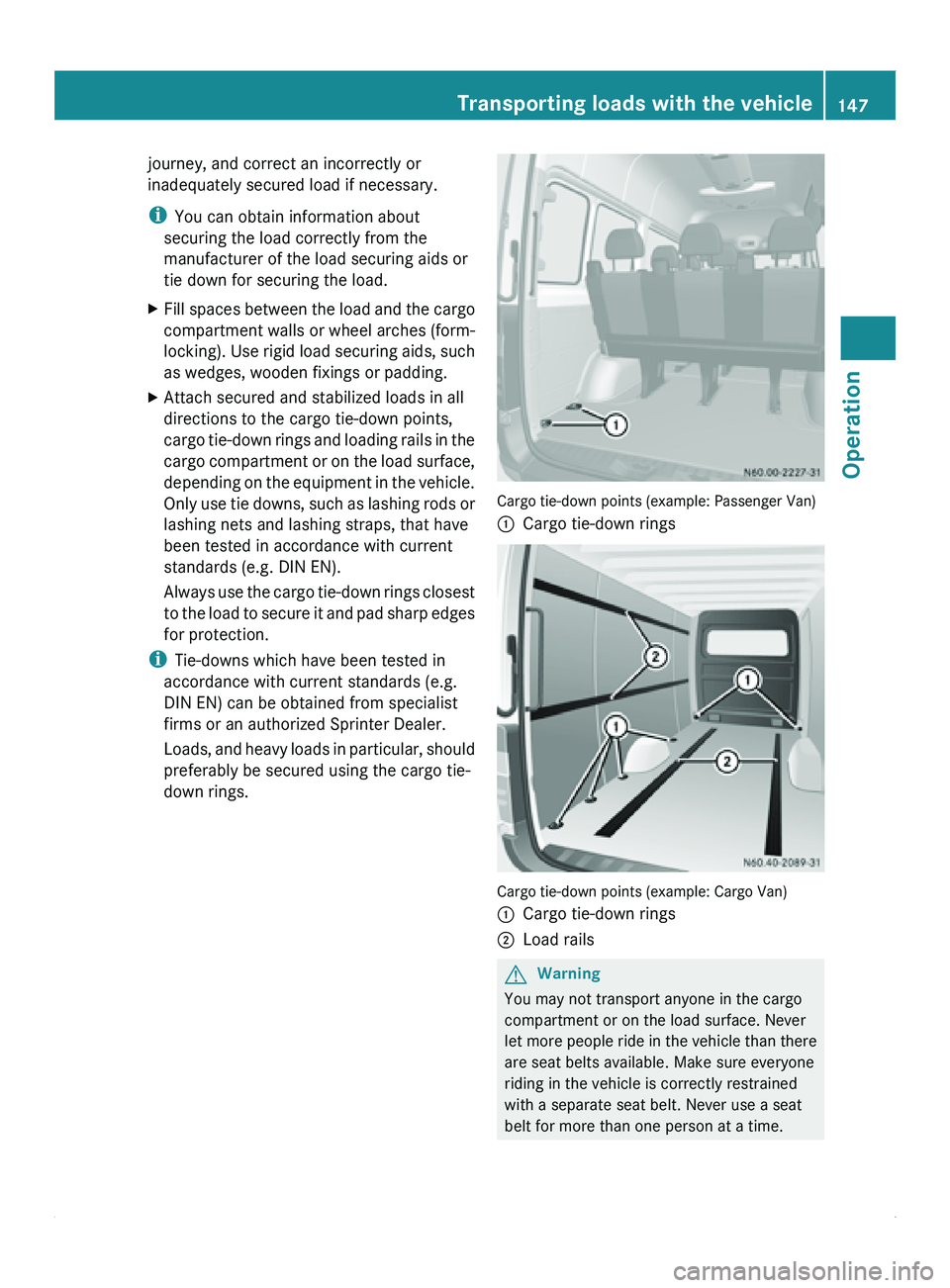
down rings. Cargo tie-down points (example: Passenger Van)
0046
Cargo tie-down rings Cargo tie-down points (example: Cargo Van)
0046
Cargo tie-down rings
0047 Load rails G
Warning
You may not transport anyone in the cargo
compartment or on the load surface. Never
let more people
ride in the vehicle than there
are seat belts available. Make sure everyone
riding in the vehicle is correctly restrained
with a separate seat belt. Never use a seat
belt for more than one person at a time. Transporting loads with the vehicle
147
Operation Z
Page 153 of 292
X
Make sure that the automatic transmission
is set to position P.
X Engage the vehicle's parking brake.
X Close the rear doors.
X Couple the trailer.
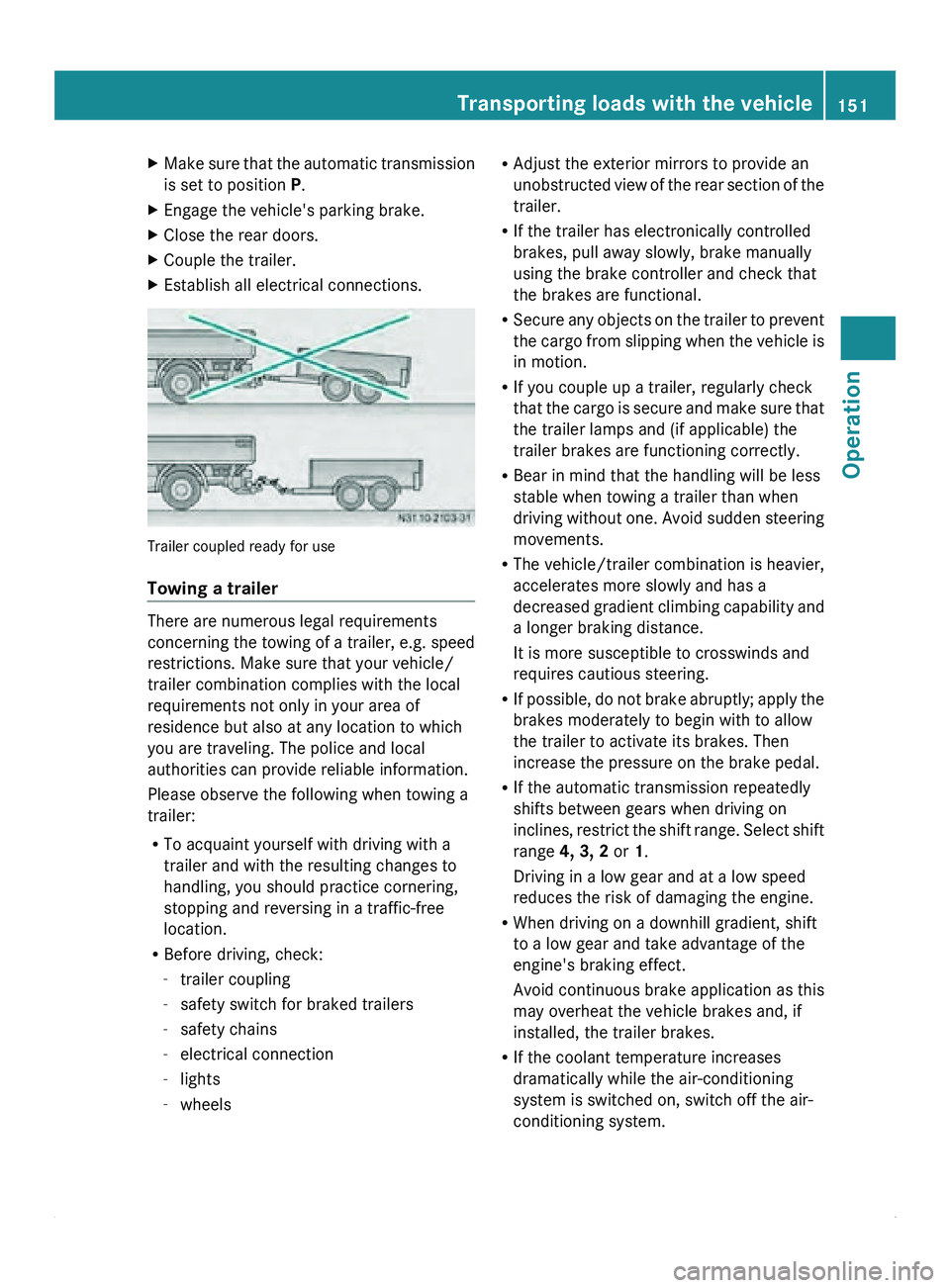
X Establish all electrical connections. Trailer coupled ready for use
Towing a trailer
There are numerous legal requirements
concerning the
towing
of a trailer, e.g. speed
restrictions. Make sure that your vehicle/
trailer combination complies with the local
requirements not only in your area of
residence but also at any location to which
you are traveling. The police and local
authorities can provide reliable information.
Please observe the following when towing a
trailer:
R To acquaint yourself with driving with a
trailer and with the resulting changes to
handling, you should practice cornering,
stopping and reversing in a traffic-free
location.
R Before driving, check:
-trailer coupling
- safety switch for braked trailers
- safety chains
- electrical connection
- lights
- wheels R
Adjust the exterior mirrors to provide an
unobstructed view of
the rear section of the
trailer.
R If the trailer has electronically controlled
brakes, pull away slowly, brake manually
using the brake controller and check that
the brakes are functional.
R Secure any objects on the trailer to prevent
the cargo from slipping when the vehicle is
in motion.
R If you couple up a trailer, regularly check
that the cargo is secure and make sure that
the trailer lamps and (if applicable) the
trailer brakes are functioning correctly.
R Bear in mind that the handling will be less
stable when towing a trailer than when
driving without one. Avoid sudden steering
movements.
R The vehicle/trailer combination is heavier,
accelerates more slowly and has a
decreased gradient climbing capability and
a longer braking distance.
It is more susceptible to crosswinds and
requires cautious steering.
R If possible, do not brake abruptly; apply the
brakes moderately to begin with to allow
the trailer to activate its brakes. Then
increase the pressure on the brake pedal.
R If the automatic transmission repeatedly
shifts between gears when driving on
inclines, restrict the shift range. Select shift
range 4, 3, 2 or 1.
Driving in a low gear and at a low speed
reduces the risk of damaging the engine.
R When driving on a downhill gradient, shift
to a low gear and take advantage of the
engine's braking effect.
Avoid continuous brake application as this
may overheat the vehicle brakes and, if
installed, the trailer brakes.
R If the coolant temperature increases
dramatically while the air-conditioning
system is switched on, switch off the air-
conditioning system. Transporting loads with the vehicle
151
Operation Z
Page 155 of 292
Verify compliance with weight limitations on
a weighbridge.
Trailer power supply
Your vehicle may be equipped with various
electrical fittings for trailer towing.
Depending on your trailer, you may need an
adapter to allow your trailer to be connected
to the vehicle. Information about your
vehicle's electrical equipment is available
from any authorized Sprinter Dealer.
!
Faulty wiring of the connector plug could
in certain circumstances cause other
electronic systems to
malfunction. For this
reason, we recommend having the wiring
of the connector plug performed at an
authorized Sprinter Dealer. Operation in winter
General notes
Have your vehicle winterized at a qualified
specialist workshop, e.g. an authorized
Sprinter Dealer, at the onset of winter.
This service includes the following:
R oil change, if the engine oil currently used
does not have adequate low temperature
characteristics or if these are no longer
sufficient due to aging
R the antifreeze/anticorrosion
concentration in the coolant is checked.
R the addition of a concentrated cleaning
agent to the water in the windshield
washer/headlamp cleaning system
R battery check
R a tire change
Prior to the
onset of winter, ensure that snow
chains are available in the vehicle.
Do not cover the surface of the radiator or the
radiator grill, even in winter. Doing so could
cause the engine diagnostics to record false
or incorrect data. Recording of engine
diagnostic data is legally prescribed and must therefore be correct, clear and
comprehensible at all times.
You
will find
information about diesel fuel for
use at low outside temperatures in the
"Operation" section ( Y page 154).
Please also observe the information about
winter driving (Y page 111).
You will find information about winter tires
and about driving with snow chains in the
"Wheel and tires" section (Y page 153). Service products
Fuel
G
Warning
Fuel is highly flammable. Fire, naked flames
and smoking as well as the use of auxiliary
heaters (sparks) are therefore prohibited
when handling fuel.
Switch off the
engine and the auxiliary heating
before refueling. G
Warning
Avoid any contact with fuels.
You can damage your health if your skin
comes into direct contact with fuel or if you
inhale fuel vapors.
! Filter the fuel
before transferring it to the
vehicle if you are refueling the vehicle from
barrels or containers.
This will prevent malfunctions in the fuel
system due to contaminated fuel.
! Refuel only with commercially available
vehicle diesel fuel, ULTRA-LOW SULFUR
DIESEL with a sulfur content no greater
than 15 ppm. Fuels such as fatty acid
methyl ester FAME (bio-diesel fuels),
marine diesel, heating oil etc. may not be
used as a diesel fuel mixture.
Refuel with B5 bio-diesel only if it fulfills the
requirements listed under "Fuel quality". Service products
153
Operation Z
Page 164 of 292
G
Warning
Never use openings in the bodywork as steps.
You may otherwise
damage the vehicle or lose
your footing and injure yourself or others.
If you have to clean the upper areas of the
vehicle, always use suitable ladders or other
secure climbing aids. G
Warning
Dirty or
iced-up steps and entrances create a
risk of slipping or falling.
Keep steps, entrances
and footwear free from
dirt (e.g. mud, clay, snow and ice). Cleaning the interior of the vehicle
Seat belts !
Observe the following notes on cleaning
the seat belts:
R Remove any stains or dirt immediately.
This will avoid residue or damage.
R Do not bleach
or dye the seat belts. This
could impair the function of the seat
belts.
R Do not dry the seat belts in direct
sunlight or at temperatures above
176 ‡ (80 †).
Steering wheel boss and cockpit G
Warning!
When cleaning the steering wheel boss and
dashboard, do not use cockpit sprays or
cleaning agents containing
solvents. Cleaning
agents containing solvents cause the surface
to become porous, and as a result, plastic
parts may break away and be thrown around
the interior when an air bag is deployed, which
may result in severe injuries.
Use a damp, clean and lint-free cloth to clean
the plastic components and the cockpit. If
particularly dirty, use a mild detergent. !
Do not use
dry, coarse or hard cloths and
do not scrub. You could otherwise scratch
or damage the surfaces.
Radio and monitor display X
Switch off the radio or rear-view camera
monitor and let it cool.
X Clean the display surface with a
commercially available microfiber cloth
and cleaner for TFT/LCD displays.
X After drying,
polish the display surface with
a dry microfiber cloth, applying only light
pressure.
! Do not use dry, rough or hard cloths or
abrasive products, solvents or cleaning
agents containing solvents. Do not scrub.
Only apply light pressure when cleaning.
Otherwise, you will damage the display
surface, as it is sensitive to pressure and
susceptible to scratches.
Windows !
Do not use
dry cloths, abrasive products,
solvents or cleaning agents containing
solvents to clean the inside of the windows.
Clean the inside of the windows with a
damp cloth or a commercially available
glass cleaner.
Do not touch the inside of the rear and side
windows with hard objects, e.g. an ice
scraper or ring. You could otherwise
damage the windows or the rear window
defroster. Cleaning the exterior of the vehicle
General notes Scratches, corrosive
deposits, areas affected
by corrosion and damage caused by neglect
or inadequate care cannot always be
completely remedied. In this case, visit a
qualified specialist workshop, e.g. the
nearest authorized Sprinter Dealer. 162
Cleaning and care
Operation
Page 165 of 292
!
In order to avoid consequential damage,
repair damage caused by loose chippings
and remove any dirt immediately, in
particular:
R insect remains
R bird droppings
R flash rust
R tree resin
R oils and grease
R fuels
R tar stains
R salt residue
Wash your vehicle
more frequently if it gets
dirty more often.
! Do not park the vehicle for an extended
period right after cleaning it, particularly
after having cleaned the wheels with wheel
cleaner. Wheel cleaners could cause
increased corrosion of the brake discs and
brake pads/linings. Generally, park the
vehicle at operating temperature after
cleaning.
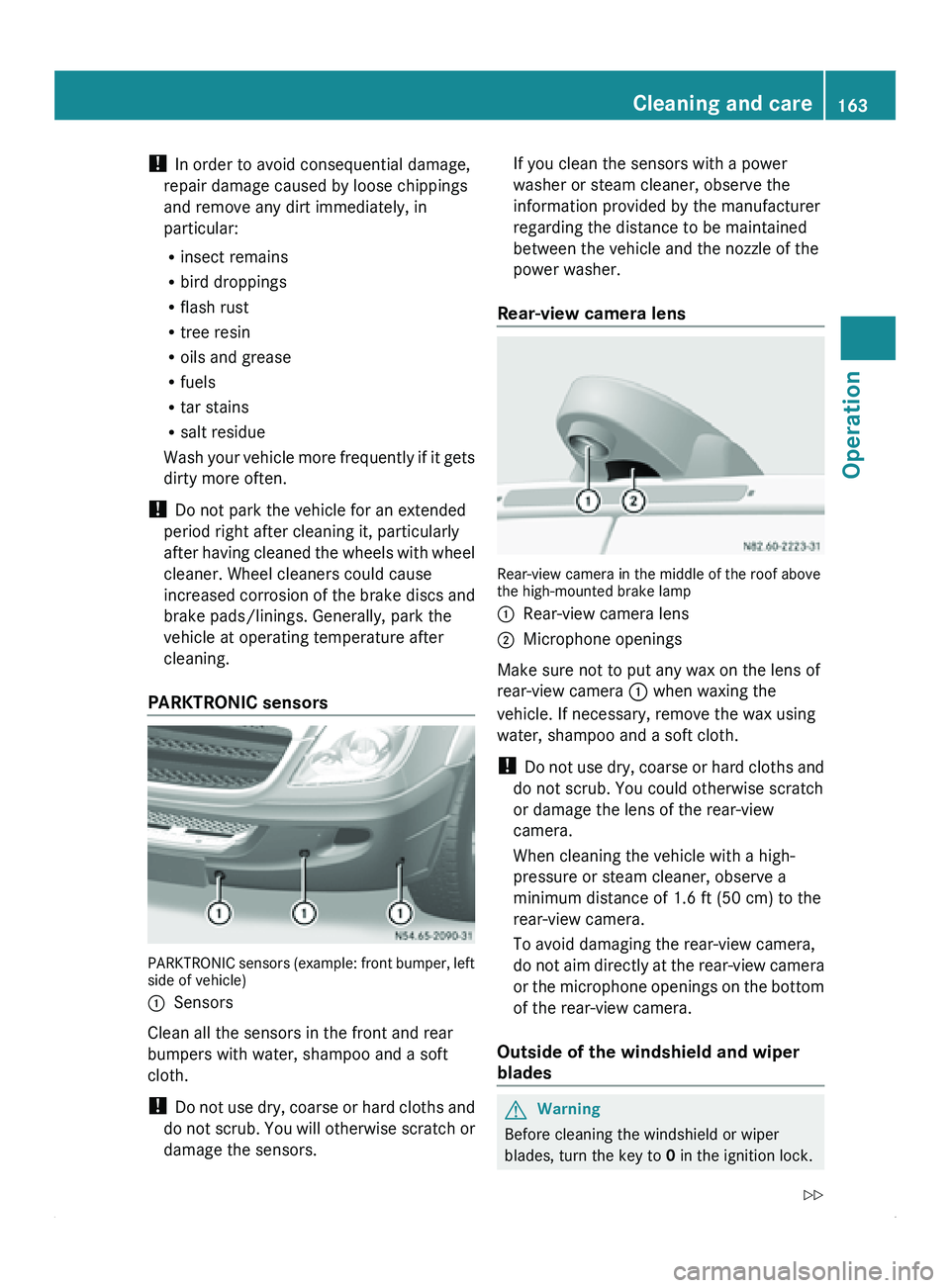
PARKTRONIC sensors PARKTRONIC sensors (example: front bumper, left
side of vehicle)
0046
Sensors
Clean all the sensors in the front and rear
bumpers with water, shampoo and a soft
cloth.
! Do not
use
dry, coarse or hard cloths and
do not scrub. You will otherwise scratch or
damage the sensors. If you clean the sensors with a power
washer or steam cleaner, observe the
information provided by the manufacturer
regarding the distance to be maintained
between the vehicle and the nozzle of the
power washer.
Rear-view camera lens Rear-view camera in the middle of the roof above
the high-mounted brake lamp
0046
Rear-view camera lens
0047 Microphone openings
Make sure not to put any wax on the lens of
rear-view camera 0046 when waxing the
vehicle. If necessary, remove the wax using
water, shampoo and a soft cloth.
! Do not
use
dry, coarse or hard cloths and
do not scrub. You could otherwise scratch
or damage the lens of the rear-view
camera.
When cleaning the vehicle with a high-
pressure or steam cleaner, observe a
minimum distance of 1.6 ft (50 cm) to the
rear-view camera.
To avoid damaging the rear-view camera,
do not aim directly at the rear-view camera
or the microphone openings on the bottom
of the rear-view camera.
Outside of the windshield and wiper
blades G
Warning
Before cleaning the windshield or wiper
blades, turn the key to 0 in the ignition lock. Cleaning and care
163
Operation
Z
Page 167 of 292
from the windshield and the wiper blades to
prevent smearing.
Smears
impair the driver's
view, and their effect is made worse in
conditions where visibility is poor (e.g. glare,
mist, darkness, snow). You may therefore fail
to recognize dangers, or not recognize them
in time, and thereby cause an accident.
! Make sure that the automatic car wash is
suitable for the size of the vehicle.
Before washing the vehicle in an automatic
car wash, fold in the exterior mirrors and
remove the radio/telephone antenna.
Otherwise, the exterior mirror, antenna or
the vehicle itself could be damaged.
Make sure that the antenna is installed and
that the exterior mirrors are fully folded out
again when you leave the automatic car
wash.
! Make sure that the side windows are
completely closed, that the ventilation/
heating is switched off and that the
windshield wiper switch is set to 0.
Otherwise, the rain/light sensor could be
activated, triggering unintended wiper
movements. This can cause damage to the
vehicle.
After putting the vehicle through an
automatic car wash, wipe off wax from:
R the rear-view camera lens ( Y page 163)
R the windshield and the wiper blades. This
prevents smears and reduces wiping noise
which can be caused by residue on the
windshield. Cleaning the engine
! Water must not
enter intake or ventilation
openings. When cleaning with high
pressure water or steam cleaners, the
spray must not be aimed directly at
electrical components or the terminals of
electrical lines. Preserve the engine after the engine has
been cleaned.
Protect
the belt drive system
from exposure to the preservative agent. Alloy wheels
Clean the alloy wheels regularly.
! Do not use
any acidic or alkaline cleaning
agents. They can cause corrosion on the
wheel bolts (wheel nuts) or the retainer
springs for the wheel-balancing weights. After driving off-road or on
construction sites
G
Warning
Dirt on the vehicle can affect road and
operating safety.
It can specifically result in the following
dangers:
Stone impact. Stones trapped between the
tires can be thrown out while driving. This
could injure other
road users or damage other
vehicles (especially windscreens).
Risk of skidding. Dirt and mud on the tires/
on the road reduce the grip of the tires on the
road. This especially applies when the surface
is wet. The vehicle could then start to skid.
Risk of injury. Dirt and mud on the steps and
entrance can make the steps unsafe. This
could cause you to slip off the steps and be
injured.
For this reason, you should always clean your
vehicle carefully after driving off-road or on
construction sites before driving on public
roads. Observe the corresponding safety
notices in this chapter if you use a power
washer or an automatic car wash to clean your
vehicle.
X Clean the vehicle, paying special attention
to the following:
R
Lighting system
R Windows and exterior mirrors
R Access steps and entrances Cleaning and care
165
Operation Z
Page 168 of 292
R
Grab handles
R Wheels, tires and wheel arches
R License plates
X Remove any trapped foreign objects, e.g.
stones.
X Check the wheel suspension for damage. G
Warning
Dirty brake discs and brake pads/linings can
impair braking performance (up to the point
of total failure).
This could lead to an accident.
Check the brake system for operating safety
by testing the brakes before driving the
vehicle on public roads.
In the event of impaired braking, stop the
vehicle while paying attention to the traffic
conditions and contact a qualified specialist
workshop which has the necessary specialist
knowledge and tools for the work required.
For this, we recommend an authorized
Sprinter Dealer. In particular, work relevant to
safety or on safety-related systems must be
carried out at a qualified specialist workshop.
After driving in mud, sand, water or in similar
conditions:
R check the brake system for operating
safety.
R clean the wheels, chassis and brake
system.
R check the wheels, chassis and brake
system for damage. Have any damage
repaired at a qualified specialist workshop,
e.g. an authorized Sprinter Dealer. Maintenance
General notes
The scope and regularity of the maintenance
work primarily depend on the often diverse
operating conditions.
The vehicle Maintenance Booklet describes
the scope and frequency of maintenance
work and contains additional notes on the New Vehicle Limited Warranty and on service
products.
Specialist knowledge beyond the scope of
these Operating
Instructions
is required when
carrying out testing and maintenance work.
Have this work carried out by trained
personnel.
i Maintenance services must be carried out
in accordance with the provisions and
recommendations in the Maintenance
Booklet.
Not doing so could void the warranty claim
and lead to refusal of goodwill gestures
after the manufacturer has submitted a
damage report. G
Warning
Before carrying out maintenance operations
and repairs, you must read the sections
referring to maintenance operations and
repairs:
R this includes relevant sections of the
technical documentation, such as the
operating instructions and workshop
information.
R you should also
familiarize yourself with the
legal requirements, such as work safety
regulations and accident prevention
measures.
You could otherwise fail to recognize dangers
and thereby injure yourself or others.
You must secure the vehicle on axle stands of
sufficient load bearing capacity if work is
being carried out beneath it.
Never use the vehicle jack instead of stands.
The jack could slip and the vehicle could drop.
This could result in serious injury to yourself
or others.
The vehicle jack is intended only to raise the
vehicle for a short time.
Always have maintenance work carried out at
a qualified specialist workshop. The workshop
must have the necessary specialist
knowledge and tools to carry out the work
required. For this, we recommend an 166
Maintenance
Operation
Page 169 of 292
authorized Sprinter Dealer. All work relevant
to safety or on safety-related systems must
be carried out at a qualified specialist
workshop.
Observe the notes on parts in the "Technical
data" section ( Y page 276).
0040 Environmental note
Observe measures to protect the
environment when working on the vehicle.
You must observe the legal requirements
when disposing of service products, e.g.
engine oil. This
also includes all components,
e.g. filters, which have come into contact with
service products.
Any qualified specialist workshop, e.g. an
authorized Sprinter Dealer, can provide
information about this.
Dispose of empty containers, cleaning cloths
and care products in an environmentally-
responsible manner. Comply with the
instructions for use of the care products.
Do not run the engine for longer than
necessary when the vehicle is stationary. Active Service System (ASSYST)
The ASSYST service indicator informs you of
the next service due date.
A service that is due is displayed about a
month in advance. A message is then
displayed while the vehicle is in motion or
while the ignition is switched on.
i Periods when the
battery is disconnected
will not be recorded by ASSYST. To make
sure that you have the vehicle serviced at
the correct time, you should therefore
subtract periods when the battery is
disconnected from the days shown.
The service indicator does not provide
information about the oil level. The service
indicator should therefore not be confused
with the 00B5 engine oil level display. i
The service due date is displayed in days
or miles (kilometers), depending on the
total distance driven.
The symbols or
letters in the service indicator
show the service due.
009B or A for a minor service
009C or B for a major service
Service due date indicator Vehicles with steering wheel buttons
The following messages may be displayed:
R
009B
Service A in ... days
R 009B Service A in ... mi (km)
R 009B Service A due now
Vehicles without steering wheel buttons
The following messages may be displayed:
R 009B for service A
R 009C for service B
Additionally you will see the remaining
distance in
miles
(mi) or kilometers ( km) or the
remaining time in days ( d).
Service due date exceeded A qualified specialist workshop, e.g. an
authorized Sprinter
Dealer,
resets the service
indicator when the service has been carried
out.
Vehicles with steering wheel buttons
If you have missed the service due date, one
of the following messages appears in the
display:
R 009B Service A overdue by ... days
R 009B Service A overdue by ... mi
(km)
Additionally a warning tone sounds.
Vehicles without steering wheel buttons
If the service due date has been exceeded,
ten seconds after switching on the ignition
the 009B or 009C symbol flashes for the Maintenance
167
Operation Z
Page 170 of 292
service. You will also see a minus sign before
the service due date.
Calling up the service due date
X
Turn the key to position 2 in the ignition
lock.
The display is activated.
Vehicles with steering wheel buttons
X Press the 0059 or 0058 button on the
steering wheel repeatedly
until you see the
standard display (Y page 77).
X Press the 0029 or 002D button on the
steering wheel repeatedly
until you see the
following in the display, for example:
R 009B Service A in ... days
R 009B Service A in ... mi (km)
Vehicles without steering wheel buttons
X Press the 007B menu button on the
instrument cluster repeatedly until the
009B or 009C symbol for the service
appears.
Additionally you will see the remaining
distance in miles ( mi) or kilometers ( km) or
the remaining time in days ( d).Hood
Opening the hood G
Warning
Do not pull the release lever while the vehicle
is in motion.
If you do so, the hood may open
up and block your view. G
Warning!
There is a risk of injury if the hood is open,
even if the engine is not running.
Some engine components can become very
hot.
To avoid the risk of burns, only touch those
components described in the Operator's
Manual and observe
the relevant safety notes. G
Warning
The radiator fan between the radiator and the
engine can start
automatically, even if the key
has been removed from the ignition lock.
Keep away from the area of rotation of the fan
blades. You could otherwise be injured.
The electronic injector control operates at
high voltage. For this reason, you must never
touch injection system components while:
R the engine is running.
R the engine is being started.
R the ignition is switched on.
You could otherwise receive an electric shock
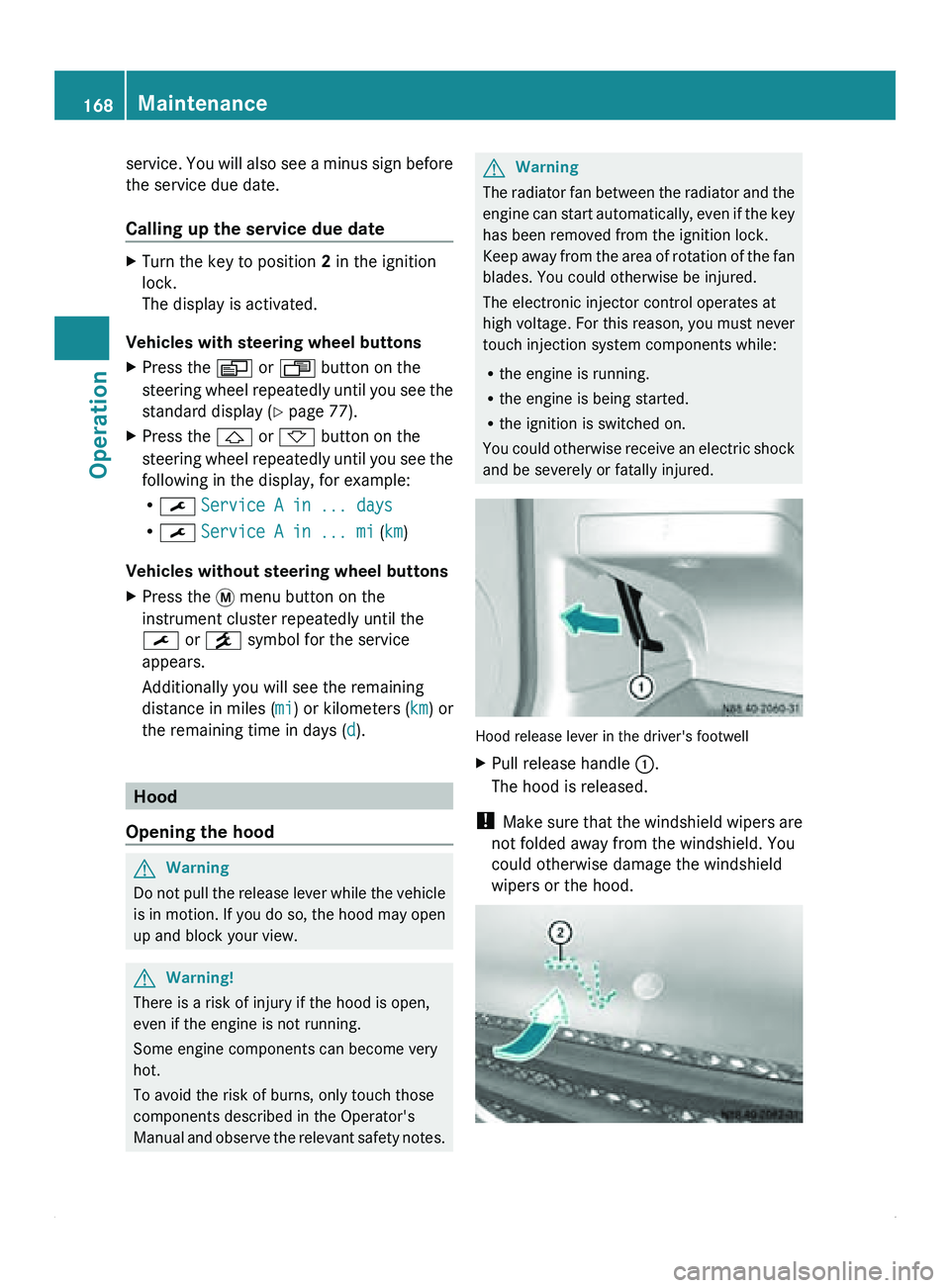
and be severely or fatally injured. Hood release lever in the driver's footwell
X
Pull release handle 0046.
The hood is released.
! Make sure
that
the windshield wipers are
not folded away from the windshield. You
could otherwise damage the windshield
wipers or the hood. 168
Maintenance
Operation