lock MERCEDES-BENZ SPRINTER 2011 MY11 Operator’s Manual
[x] Cancel search | Manufacturer: MERCEDES-BENZ, Model Year: 2011, Model line: SPRINTER, Model: MERCEDES-BENZ SPRINTER 2011Pages: 292, PDF Size: 6.75 MB
Page 24 of 292

Cockpit
Cockpit
i
This Operator's Manual describes all the
standard and optional
equipment available
for your vehicle at the time of purchase.
Country specific differences are possible.
Please note that your vehicle might not be
equipped with all the functions described
here. This also includes safety relevant
systems and functions. Function Page
0046
Door control panel 28
0047
Light switch 89
008A
Combination switch:
• turn signals 90
• high-beam headlamps 90
• windshield wipers 94
• rear window wiper 94
0088
Cruise control lever 118
0086
Horn
0087
Steering wheel without/
with buttons
26 Function Page
006E
Instrument cluster 24
006F
Stowage compartment
0070
• Stowage compartment
with interior light
92
• Overhead control panel 27
0071
Rear-view mirror 69
0072
Rear-view camera monitor 122
0073
PARKTRONIC warning
display
119
0074
Opens/closes the right-
hand side window
60
0075
Jack and vehicle tool kit 182
0076
Glove box 131
0077
Center console 26
0078
Ignition lock 56
0079
Additional switch unit 2822
Cockpit
At a glance
Page 29 of 292

Switch units
Center console
Function Page
0072
Switches the left/right-
hand seat heating on/off
68
0087
Switches the windshield
heating on/off
95
0073
Switches the rear window
defroster on/off
95
0069
Activates/deactivates
PARKTRONIC
122
003B
Switches the hazard
warning lamps on/off
91
00E3
Activates/deactivates ASR 48
00BF
00C0
Central locking, interior/
rear compartment
54 Roof
Function Page
0046
Microphone for the
telephone
134
0047
Switches the right-hand
reading lamp on/off
92
008A
Switches the automatic
interior lighting on/off
92
0088
• Eyeglasses compartment
or 131
• Anti-theft alarm system
(ATA)
61
0086
Switches the interior
lighting on/off
92
0087
Switches the left-hand
reading lamp on/off
92Switch units
27
At a glance
Page 31 of 292
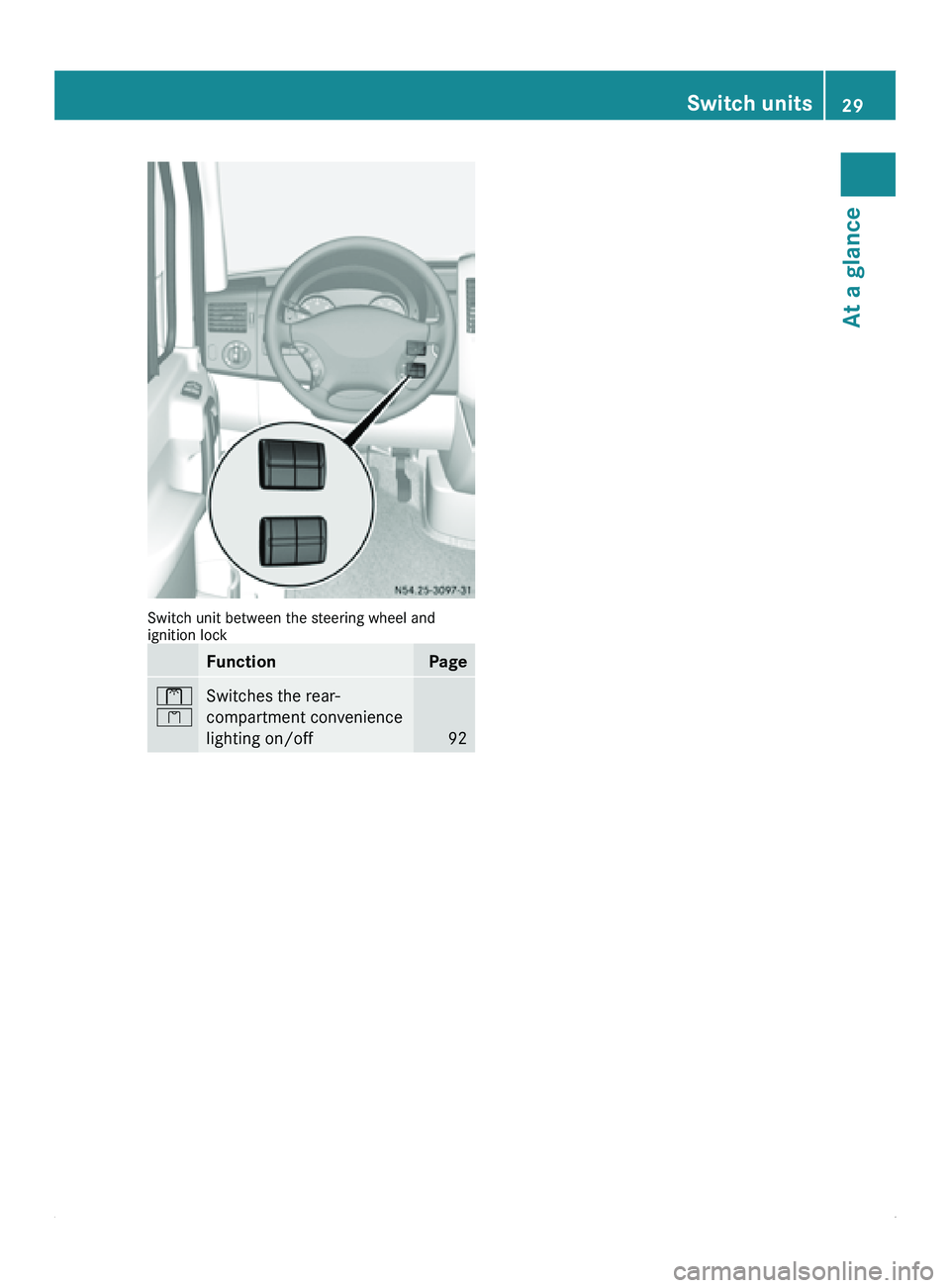
Switch unit between the steering wheel and
ignition lock
Function Page
0045
0044
Switches the rear-
compartment convenience
lighting on/off
92 Switch units
29At a glance
Page 43 of 292
R
independently of the front air bags
R independently of the Emergency
Tensioning Devices
The side impact air bags are generally not
deployed in the
event of a rollover, unless the
system detects high vehicle deceleration or
acceleration in a lateral direction and
determines that they can offer additional
protection to that provided by the seat belt.
The side impact air bags are not deployed in
side impacts which do not exceed the
system's deployment threshold.
Window curtain air bags G
Warning
Observe "Important safety notes"
(Y page 38).
The window curtain air bags enhance
protection for the head (but not the chest or
arms) of the
vehicle occupants on the side of
the vehicle on which the impact occurs.
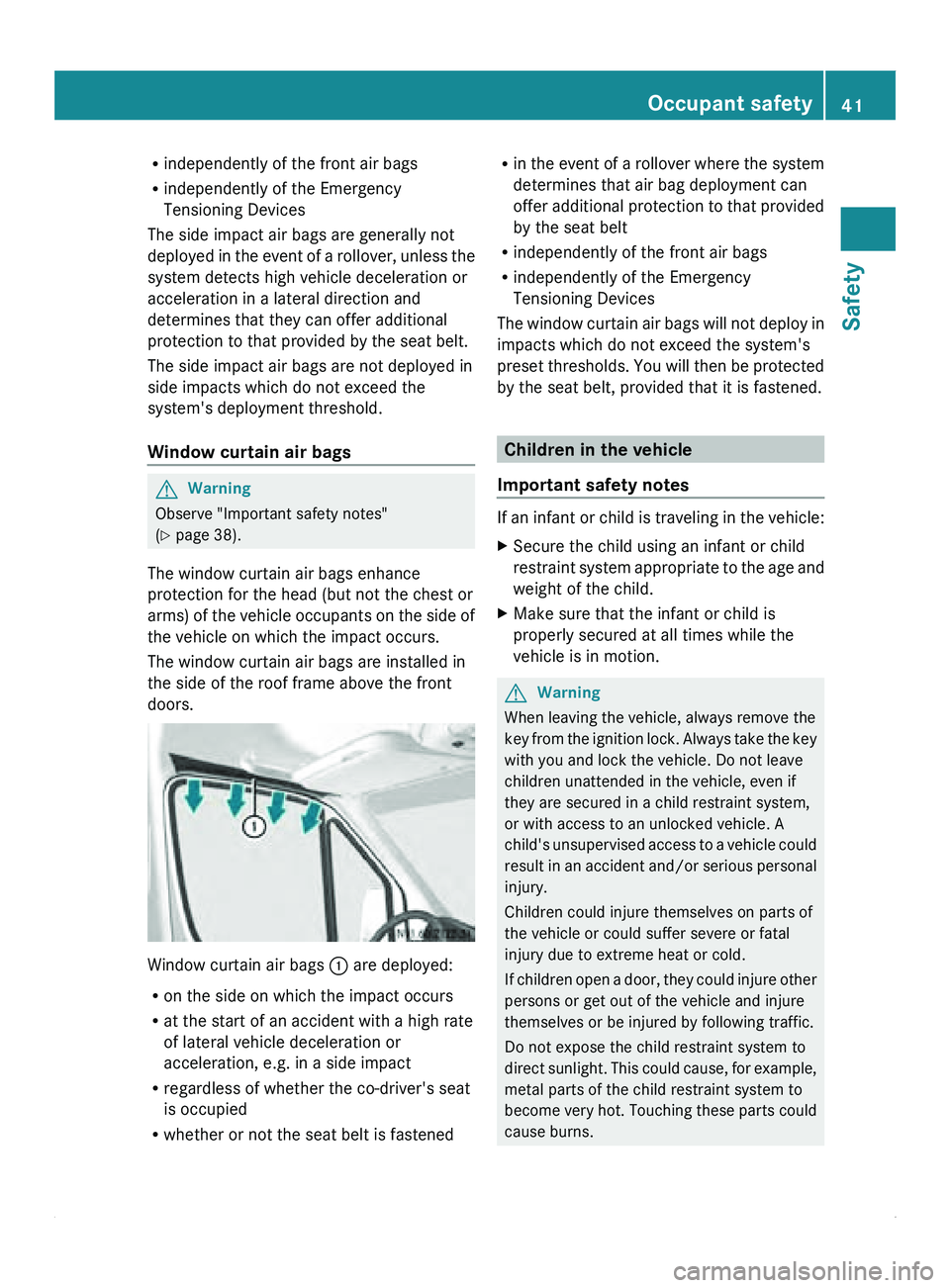
The window curtain air bags are installed in
the side of the roof frame above the front
doors. Window curtain air bags
0046 are deployed:
R on the side on which the impact occurs
R at the start of an accident with a high rate
of lateral vehicle deceleration or
acceleration, e.g. in a side impact
R regardless of whether the co-driver's seat
is occupied
R whether or not the seat belt is fastened R
in the event
of a rollover where the system
determines that air bag deployment can
offer additional protection to that provided
by the seat belt
R independently of the front air bags
R independently of the Emergency
Tensioning Devices
The window curtain air bags will not deploy in
impacts which do not exceed the system's
preset thresholds. You will then be protected
by the seat belt, provided that it is fastened. Children in the vehicle
Important safety notes If an infant or child is traveling in the vehicle:
X
Secure the child using an infant or child
restraint system appropriate
to the age and
weight of the child.
X Make sure that the infant or child is
properly secured at all times while the
vehicle is in motion. G
Warning
When leaving the vehicle, always remove the
key from the
ignition lock. Always take the key
with you and lock the vehicle. Do not leave
children unattended in the vehicle, even if
they are secured in a child restraint system,
or with access to an unlocked vehicle. A
child's unsupervised access to a vehicle could
result in an accident and/or serious personal
injury.
Children could injure themselves on parts of
the vehicle or could suffer severe or fatal
injury due to extreme heat or cold.
If children open a door, they could injure other
persons or get out of the vehicle and injure
themselves or be injured by following traffic.
Do not expose the child restraint system to
direct sunlight. This could cause, for example,
metal parts of the child restraint system to
become very hot. Touching these parts could
cause burns. Occupant safety
41
Safety Z
Page 47 of 292
X
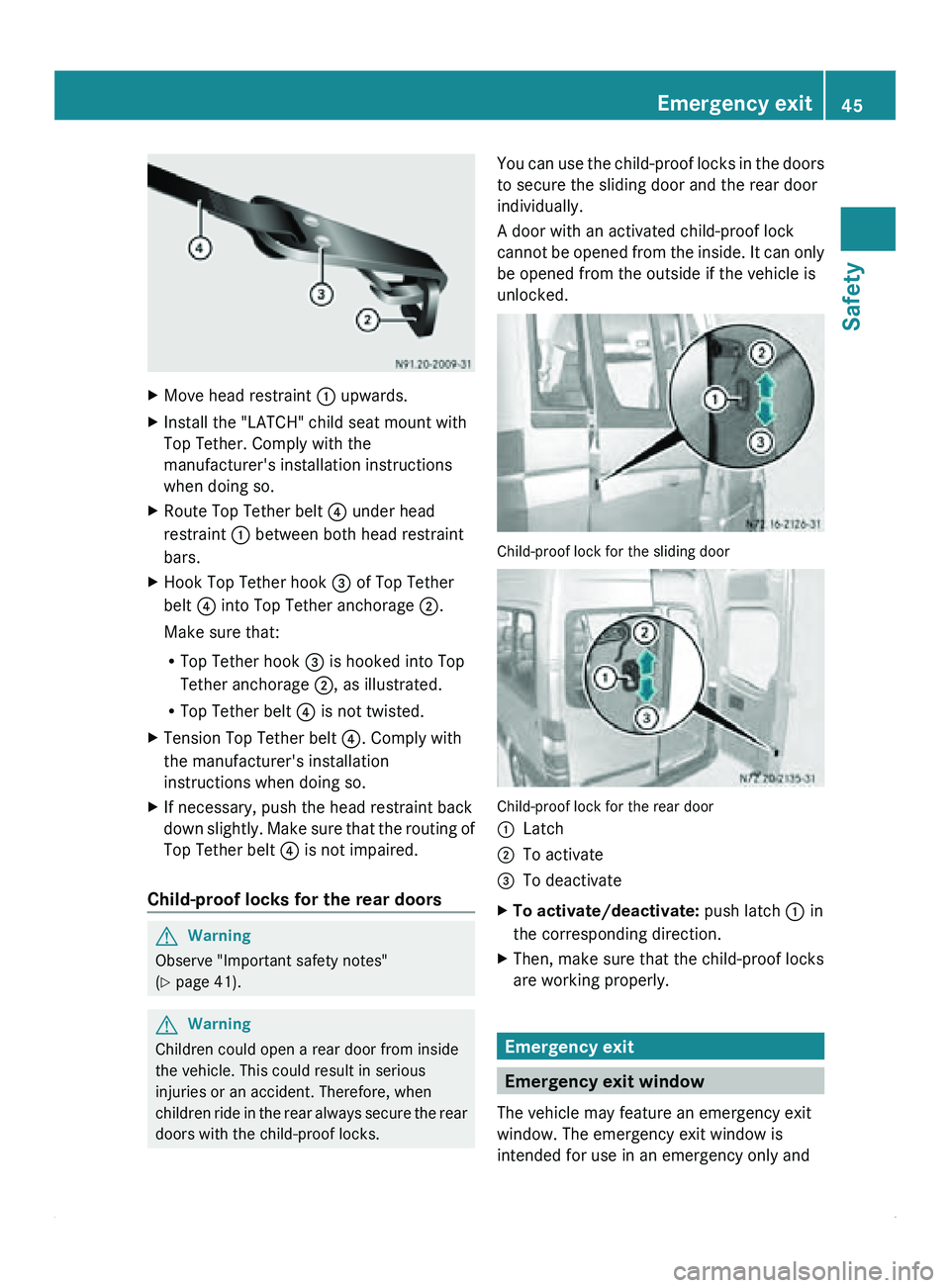
Move head restraint 0046 upwards.
X Install the "LATCH" child seat mount with
Top Tether. Comply with the
manufacturer's installation instructions
when doing so.
X Route Top Tether belt 0088 under head
restraint 0046 between both head restraint
bars.
X Hook Top Tether hook 008A of Top Tether
belt 0088 into Top Tether anchorage
0047.
Make sure that:
R Top Tether hook 008A is hooked into Top
Tether anchorage 0047
, as illustrated.
R Top Tether belt 0088 is not twisted.
X Tension Top Tether belt 0088
. Comply with
the manufacturer's installation
instructions when doing so.
X If necessary, push the head restraint back
down slightly. Make sure that the routing of
Top Tether belt 0088 is not impaired.
Child-proof locks for the rear doors G
Warning
Observe "Important safety notes"
(Y page 41). G
Warning
Children could open a rear door from inside
the vehicle. This could result in serious
injuries or an accident. Therefore, when
children ride in the rear always secure the rear
doors with the child-proof locks. You can use the child-proof locks in the doors
to secure the sliding door and the rear door
individually.
A door with an activated child-proof lock
cannot be opened from the inside. It can only
be opened from the outside if the vehicle is
unlocked.
Child-proof lock for the sliding door
Child-proof lock for the rear door
0046
Latch
0047 To activate
008A To deactivate
X To activate/deactivate: push latch 0046 in
the corresponding direction.
X Then, make sure that the child-proof locks
are working properly. Emergency exit
Emergency exit window
The vehicle may feature an emergency exit
window. The emergency exit window is
intended for use in an emergency only and Emergency exit
45
Safety Z
Page 48 of 292
must not be opened unless the vehicle is
stationary.
In an emergency, or after an accident, the
vehicle occupants can exit the vehicle
through the emergency exit window.
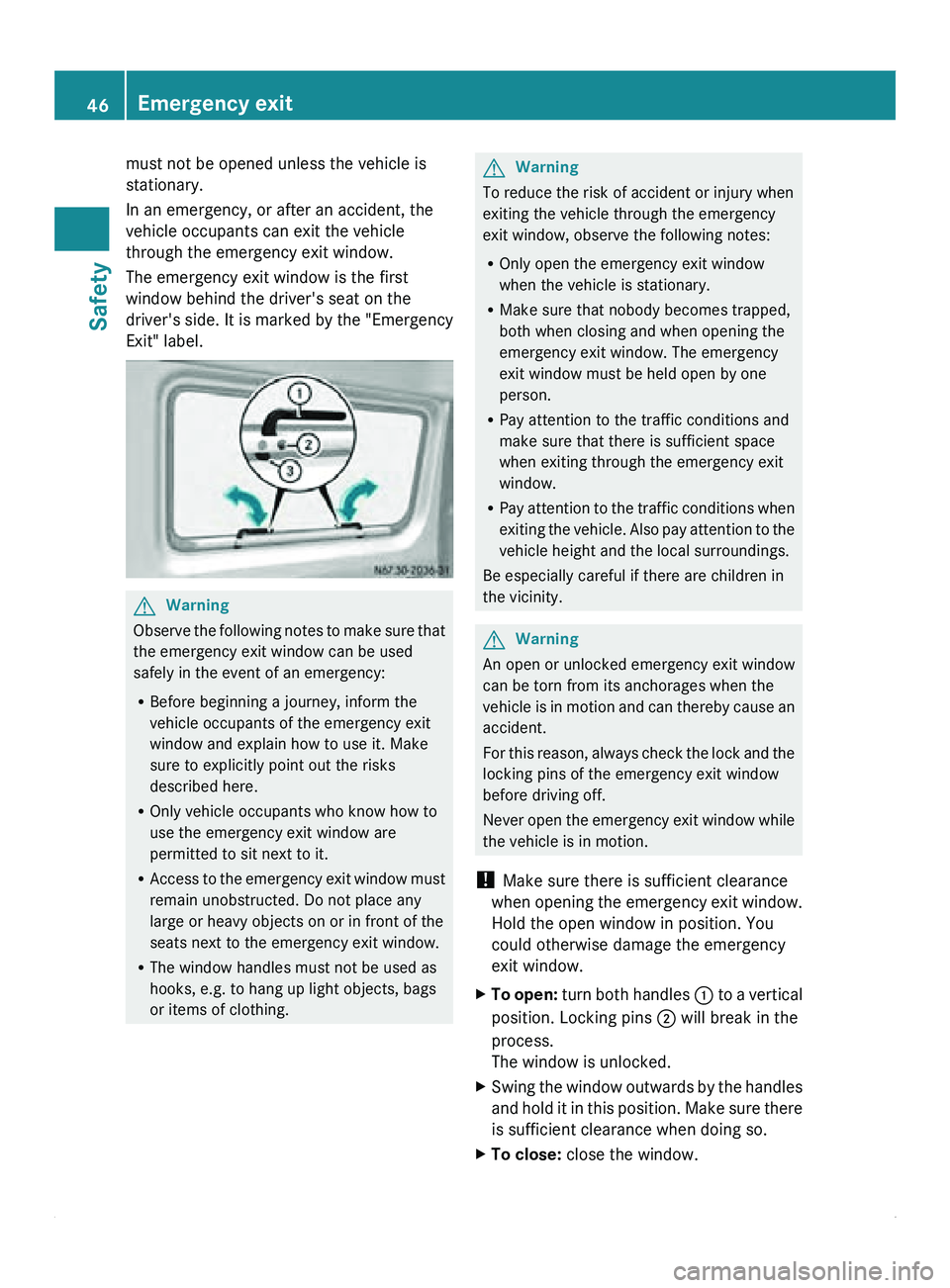
The emergency exit window is the first
window behind the driver's seat on the
driver's side.
It
is marked by the "Emergency
Exit" label. G
Warning
Observe the following notes to make sure that
the emergency exit window can be used
safely in the event of an emergency:
R Before beginning a journey, inform the
vehicle occupants of the emergency exit
window and explain how to use it. Make
sure to explicitly point out the risks
described here.
R Only vehicle occupants who know how to
use the emergency exit window are
permitted to sit next to it.
R Access to the
emergency exit window must
remain unobstructed. Do not place any
large or heavy objects on or in front of the
seats next to the emergency exit window.
R The window handles must not be used as
hooks, e.g. to hang up light objects, bags
or items of clothing. G
Warning
To reduce the risk of accident or injury when
exiting the vehicle through the emergency
exit window, observe the following notes:
R Only open the emergency exit window
when the vehicle is stationary.
R Make sure that nobody becomes trapped,
both when closing and when opening the
emergency exit window. The emergency
exit window must be held open by one
person.
R Pay attention to the traffic conditions and
make sure that there is sufficient space
when exiting through the emergency exit
window.
R Pay attention to
the traffic conditions when
exiting the vehicle. Also pay attention to the
vehicle height and the local surroundings.
Be especially careful if there are children in
the vicinity. G
Warning
An open or unlocked emergency exit window
can be torn from its anchorages when the
vehicle is in
motion and can thereby cause an
accident.
For this reason, always check the lock and the
locking pins of the emergency exit window
before driving off.
Never open the emergency exit window while
the vehicle is in motion.
! Make sure there is sufficient clearance
when opening the emergency exit window.
Hold the open window in position. You
could otherwise damage the emergency
exit window.
X To open: turn both handles 0046
to a vertical
position. Locking pins 0047 will break in the
process.
The window is unlocked.
X Swing the window outwards by the handles
and hold
it
in this position. Make sure there
is sufficient clearance when doing so.
X To close: close the window.46
Emergency exit
Safety
Page 49 of 292
X
Turn both handles 0046 to a horizontal
position. Make sure that locks 008A are in
front of the window frame on the inside.
The window is locked.
X Replace locking pins 0047 before
beginning a
new journey at the latest.
You may obtain information about this from
any authorized Sprinter Dealer. Driving safety systems
Important safety notes
G
Warning
The following factors increase the risk of
accidents:
R Excessive speed, especially in turns
R Wet and slippery road surfaces
R Following another vehicle too closely
The driving safety systems described in this
section cannot reduce these risks or prevent
the natural laws
of physics from acting on the
vehicle. They cannot increase braking or
steering efficiency beyond that afforded by
the condition of the vehicle brakes and tires
or the traction afforded.
Only a safe, attentive, and skillful driver can
prevent accidents.
The capabilities of a vehicle equipped with the
driving safety systems described in this
section must never be exploited in a reckless
or dangerous manner which could jeopardize
the user's safety or the safety of others.
Always adjust your driving style to the
prevailing road and weather conditions and
keep a safe distance to other road users and
objects on the street.
If a driving system malfunctions, other driving
safety systems may also switch off. Observe
indicator and warning lamps that may come
on as well as messages in the multifunction
display that may appear.
i In wintry driving conditions, always use
winter tires (M+S tires) and if necessary, snow chains. Only in this way will the
driving safety systems described in this
section work as effectively as possible.
Overview
In this section,
you will find information about
the following driving safety systems:
R ABS ( Anti-lock Braking System)
R BAS ( Brake Assist System)
R ESP ®
(Electronic Stability Program)
R ASR (Acceleration Skid Control)
R EBD ( Electronic Brake force Distribution) ABS (Anti-lock Braking System)
Important safety notes G
Warning
Observe "Important safety notes"
(Y page 47). G
Warning!
Do not pump the brake pedal. Use firm, steady
brake pedal pressure instead. Pumping the
brake pedal reduces the braking effect.
ABS regulates brake pressure in such a way
that the wheels do not lock during braking.
This allows you
to maintain the ability to steer
your vehicle.
ABS works from a speed of about 3 mph
(5 km/h) upwards, regardless of road-surface
conditions. ABS works on slippery surfaces,
even when you only brake gently.
The 0031 warning lamp in the instrument
cluster lights up when the ignition is switched
on. It goes out when the engine is running.
Braking If ABS intervenes when braking, you will feel
a pulsating in the brake pedal.
If the
0067 warning lamp flashes, this may
indicate dangerous road conditions and Driving safety systems
47
Safety Z
Page 50 of 292
serves as a reminder to take extra care while
driving.
X
If ABS intervenes: continue to depress the
brake pedal with force until the braking
situation is over.
X To make a full brake application:
depress the brake pedal with full force. G
Warning
If the ABS malfunctions, other driving systems
such as the
BAS or the ESP ®
are also switched
off. Observe indicator and warning lamps that
may come on as well as messages in the
multifunction display that may appear.
If the ABS malfunctions, the wheels may lock
during hard braking, reducing the steering
capability and extending the braking distance. BAS (Brake Assist System)
G
Warning
Observe "Important safety notes"
(Y page 47).
BAS operates in emergency braking
situations. If you depress the brake pedal
quickly, BAS automatically
boosts the braking
force, potentially reducing the stopping
distance.
X Keep the brake pedal firmly depressed until
the emergency braking situation is over.
ABS prevents the wheels from locking.
The brakes will function as usual once you
release the brake pedal. BAS is deactivated. G
Warning
If the BAS malfunctions, the brake system still
functions, but without the additional brake
boost available that the BAS would normally
provide in an emergency braking maneuver.
Therefore, the braking
distance may increase. EBD (Electronic Brake force
Distribution)
G
Warning
Observe "Important safety notes"
(Y page 47).
EBD monitors and controls the brake
pressure on the rear wheels to improve
driving stability while braking. G
Warning
If the 009E, 003D, 0031 and 0065 indicator
lamps light up while the vehicle is in motion,
EBD may be defective.
If EBD malfunctions,
the brake system will still
function with full brake boost. However, the
rear wheels could lock up during emergency
braking situations, for example. You could
lose control of the vehicle and cause an
accident.
Adapt your driving style to the changed
driving characteristics. ASR (acceleration skid control)
Important safety notes G
Warning
Observe "Important safety notes"
(Y page 47).
ASR can significantly improve traction, i.e.
the transmission of power from the tires to
the road surface, and thus may increase the
vehicle's driving stability. ASR assists in
pulling away and
accelerating, particularly on
smooth and slippery surfaces.
ASR can brake individual wheels and limits
the engine torque to help prevent the drive
wheels from spinning.
If ASR intervenes, the 0067 warning lamp
flashes in the instrument cluster. 48
Driving safety systems
Safety
Page 54 of 292
Vehicle equipment
i Diese Betriebsanleitung beschreibt alle
Modelle, Serien- und
Sonderausstattungen
Ihres Fahrzeugs, die zum Zeitpunkt des
Redaktionsschlusses dieser
Betriebsanleitung erhältlich waren.
Länderspezifische Abweichungen sind
möglich. Beachten Sie, dass Ihr Fahrzeug
nicht mit allen beschriebenen Funktionen
ausgestattet sein könnte. Dies betrifft auch
sicherheitsrelevante Systeme und
Funktionen. Opening and closing
Vehicle key
The vehicle comes equipped with 2 or 4
remote controls with an integrated folding
key, or 4 keys.
You must have
any keys that are not delivered
with the vehicle programmed before use.
Further information can be obtained at any
authorized Sprinter Dealer.
Always take the key with you when leaving the
vehicle, even if you are only leaving it for a
short time.
Information on unlocking and locking the
vehicle with a key can be found in the
"Locking/unlocking the vehicle using the
remote control with integrated key"
(Y page 54) G
Warning
Do not leave children unsupervised in the
vehicle, even if they are secured in a child
restraint system. Children could otherwise
injure themselves on parts of the vehicle.
They could be
severely or even fatally injured
by prolonged exposure to intense heat or
cold. If children open a door, they could:
R
injure other people
R get out of the vehicle and thereby injure
themselves or be injured by a passing
vehicle
R severely injure themselves
by falling down,
in particular due to the vehicle height
Always take the key with you when leaving the
vehicle, even if you are only leaving for a short
time. Key with remote control
The vehicle comes
equipped with two or four
remote controls with an integrated folding
key, which are referred to simply as key in this
manual. You must have any keys that are not
delivered with the vehicle programmed
before use. Further information can be
obtained at any authorized Sprinter Dealer.
The key's remote control conforms to the
FCC regulations (part 15) and the Canadian
Industrial Standard RSS-210 and has a range
of up to 32 ft (10 m).
The key's remote control locks/unlocks the
driver's door and/or the vehicle centrally, if
set at the factory:
R the driver's and the co-driver's door
R the sliding doors
R the rear doors
i If the driver's or co-driver's door is not
closed, the corresponding door is not
locked. If a sliding door or a rear door is not
closed properly, none of the rear doors are
locked.
If there is a key is in the ignition lock, the
remote control is inoperative. Always observe
the turn signal flashing sequence and check
the door locking knobs when locking/
unlocking the vehicle. G
Warning
Do not leave children unsupervised in the
vehicle, even if they are secured in a child 52
Opening and closing
Controls
Page 55 of 292
restraint system. Children could otherwise
injure themselves on parts of the vehicle.
They could
be
severely or even fatally injured
by prolonged exposure to intense heat or
cold.
If children open a door, they could:
R injure other people
R get out of the vehicle and thereby injure
themselves or be injured by a passing
vehicle
R severely injure themselves by falling down,
in particular due to the vehicle height
Always take the key with you when leaving the
vehicle, even if you are only leaving for a short
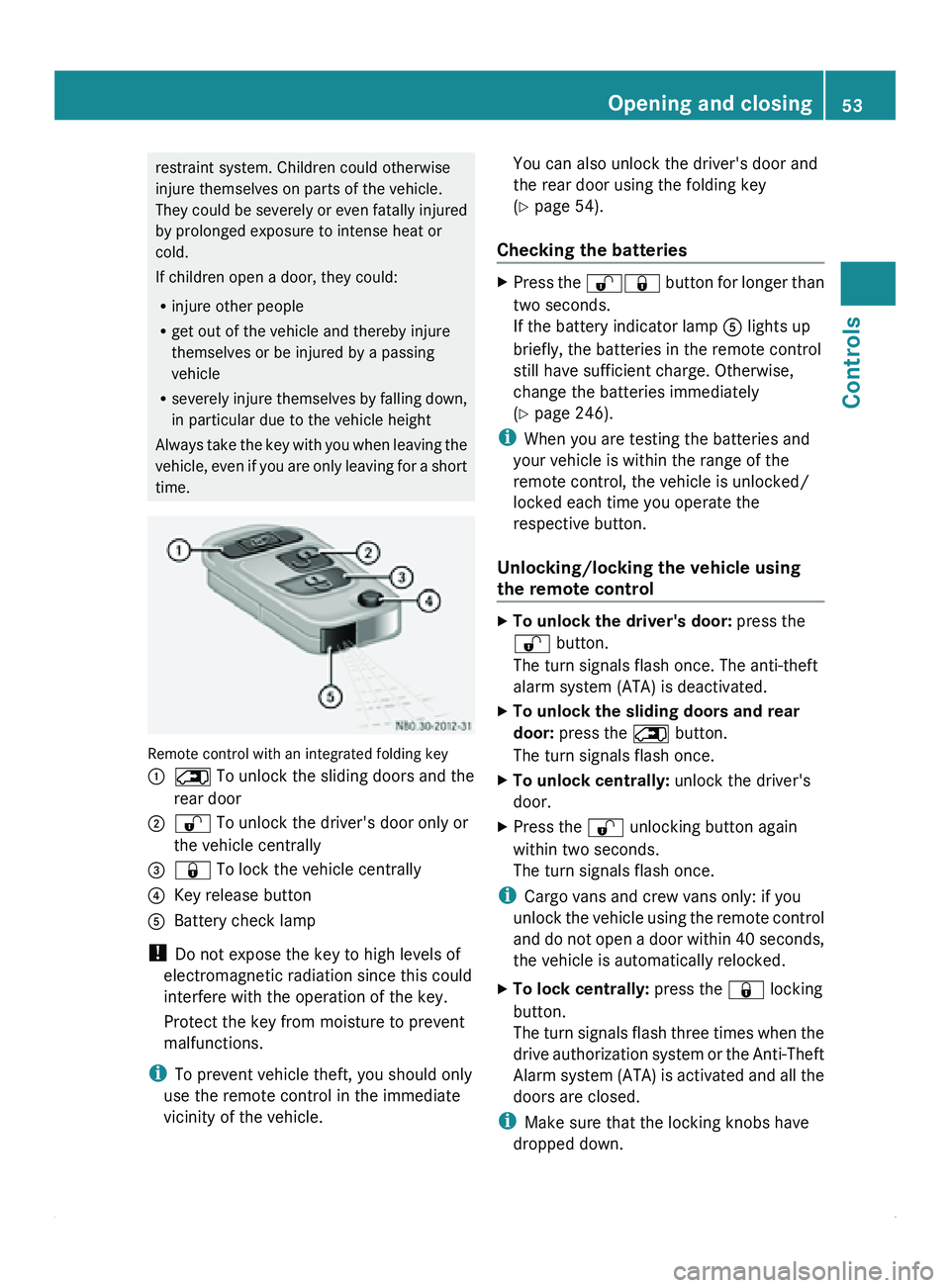
time. Remote control with an integrated folding key
0046
0042 To unlock the sliding doors and the
rear door
0047 0036
To unlock the driver's door only or
the vehicle centrally
008A 0037 To lock the vehicle centrally
0088 Key release button
0086 Battery check lamp
! Do not expose the key to high levels of
electromagnetic radiation since this could
interfere with the operation of the key.
Protect the key from moisture to prevent
malfunctions.
i To prevent vehicle theft, you should only
use the remote control in the immediate
vicinity of the vehicle. You can also unlock the driver's door and
the rear door using the folding key
(Y page 54).
Checking the batteries X
Press the 00360037 button
for
longer than
two seconds.
If the battery indicator lamp 0086 lights up
briefly, the batteries in the remote control
still have sufficient charge. Otherwise,
change the batteries immediately
(Y page 246).
i When you are testing the batteries and
your vehicle is within the range of the
remote control, the vehicle is unlocked/
locked each time you operate the
respective button.
Unlocking/locking the vehicle using
the remote control X
To unlock the driver's door: press the
0036
button.
The turn signals flash once. The anti-theft
alarm system (ATA) is deactivated.
X To unlock the sliding doors and rear
door: press the 0042 button.
The turn signals flash once.
X To unlock centrally: unlock the driver's
door.
X Press the 0036 unlocking button again
within two seconds.
The turn signals flash once.
i Cargo vans and crew vans only: if you
unlock the vehicle
using the remote control
and do not open a door within 40 seconds,
the vehicle is automatically relocked.
X To lock centrally: press the 0037 locking
button.
The turn signals
flash three times when the
drive authorization system or the Anti-Theft
Alarm system (ATA) is activated and all the
doors are closed.
i Make sure that the locking knobs have
dropped down. Opening and closing
53
Controls Z