change time MERCEDES-BENZ SPRINTER 2011 MY11 Operator’s Manual
[x] Cancel search | Manufacturer: MERCEDES-BENZ, Model Year: 2011, Model line: SPRINTER, Model: MERCEDES-BENZ SPRINTER 2011Pages: 292, PDF Size: 6.75 MB
Page 223 of 292
Engine
Draining the fuel filter
If the 00BA
indicator lamp lights up, you must
drain the fuel filter.
! When the 00BA indicator lamp lights up,
drain the fuel filter with water separator
immediately. Otherwise, the engine may be
damaged.
0040Environmental note
When handling, storing and disposing of
diesel and diesel mixtures, please observe
the relevant regulations.
To this end, have the fuel filter with water
separator drained at a qualified specialist
workshop which
has
the necessary specialist
knowledge and tools to carry out the work
required, e.g. an authorized Sprinter Dealer.
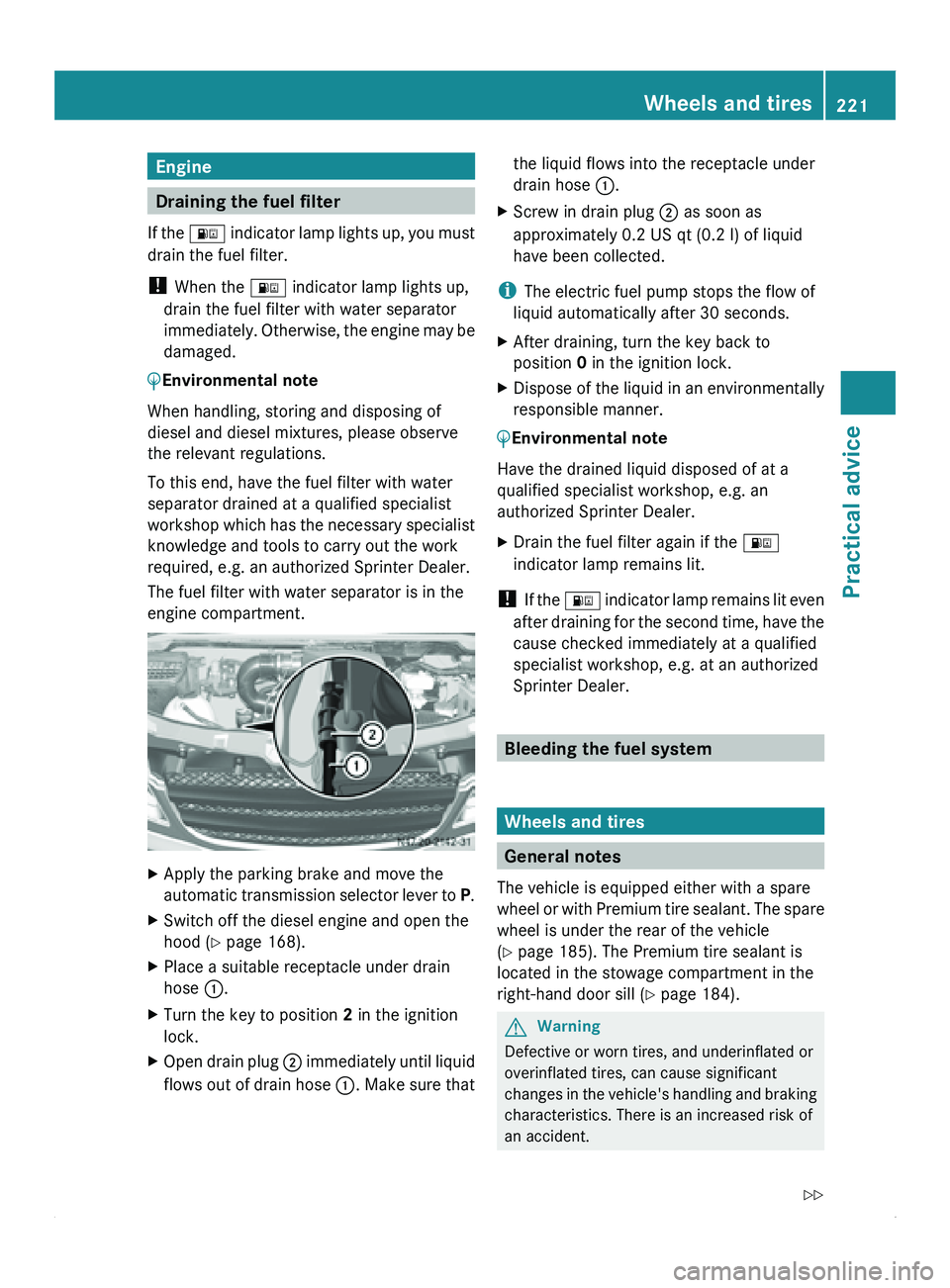
The fuel filter with water separator is in the
engine compartment. X
Apply the parking brake and move the
automatic
transmission selector
lever to P.
X Switch off the diesel engine and open the
hood ( Y page 168).
X Place a suitable receptacle under drain
hose 0046.
X Turn the key to position 2 in the ignition
lock.
X Open drain plug 0047
immediately until
liquid
flows out of drain hose 0046. Make sure that the liquid flows into the receptacle under
drain hose
0046.
X Screw in drain plug 0047 as soon as
approximately 0.2 US qt (0.2 l) of liquid have been collected.
i The electric fuel pump stops the flow of
liquid automatically after 30 seconds.
X After draining, turn the key back to
position
0 in the ignition lock.
X Dispose of the liquid in an environmentally
responsible manner.
0040Environmental note
Have the drained liquid disposed of at a
qualified specialist workshop, e.g. an
authorized Sprinter Dealer.
X Drain the fuel filter again if the 00BA
indicator lamp remains lit.
! If the
00BA
indicator lamp remains lit even
after draining for the second time, have the
cause checked immediately at a qualified
specialist workshop, e.g. at an authorized
Sprinter Dealer. Bleeding the fuel system
Wheels and tires
General notes
The vehicle is equipped either with a spare
wheel or with
Premium tire sealant. The spare
wheel is under the rear of the vehicle
(Y page 185). The Premium tire sealant is
located in the stowage compartment in the
right-hand door sill ( Y page 184). G
Warning
Defective or worn tires, and underinflated or
overinflated tires, can cause significant
changes in the
vehicle's handling and braking
characteristics. There is an increased risk of
an accident. Wheels and tires
221
Practical advice
Z
Page 231 of 292
G
Warning
If the minimum tire pressure of 43.5 psi
(3 bar) still cannot
be achieved, the tire is too
badly damaged.
Do not drive any further. Consult a qualified
specialist workshop which has the necessary
specialist knowledge and tools to carry out
the work required.
For this reason, we recommend an authorized
Sprinter Dealer. In particular, work relevant to
safety or on safety-related systems must be
carried out at a qualified specialist workshop.
0040Environmental note
Have the used tire sealant disposed of at a
qualified specialist workshop, e.g. an
authorized Sprinter Dealer.
! Have the tire sealant bottle replaced
every eight years at a qualified specialist
workshop, e.g. an authorized Sprinter
Dealer. Changing a
wheel in the event of a flat
tire G
Warning
To avoid the risk of serious or even fatal injury
and to avoid damage to the vehicle, observe
the following:
R the vehicle's jack is intended only to raise
the vehicle for
a short time when changing
a wheel.
R position the jack on the appropriate jacking
point only. Make sure that the jack is
correctly positioned under the jacking point
before raising the vehicle.
R the jack must be placed on a firm, flat
surface.
R before raising the vehicle, you should also
secure it against rolling away, e.g. by
placing chocks under the wheels. Never
release the parking brake while the vehicle
is raised. R
make sure that the distance between the
underside
of the
tires and the ground does
not exceed 1.2 in (3 cm). The vehicle could
otherwise slip off the jack or tip over.
R never place your hands or feet under the
raised vehicle.
R never start the engine, and prevent other
jolts or vibrations while the vehicle is
raised. The vehicle could otherwise slip off
the jack.
Preparing to change a wheel X
Prepare the vehicle as described
(Y
page 222).
X Secure the vehicle against rolling away
using chocks or similar items.
Use the chock ( Y
page 183) to do so. G
Warning
The vehicle
could slip off the jack on uphill and
downhill gradients.
To avoid the risk of causing serious or even
fatal injury or damage to the vehicle, do not
change wheels on uphill and downhill
gradients.
On a level road:
X Place chocks in front of and behind the
wheel which is diagonally opposite the
wheel you wish to change.
X Take the vehicle tool kit and the jack from
the footwell on the co-driver's side
(Y page 182).
X Remove the spare wheel from the spare
wheel bracket ( Y page 185).
X On wheels with wheel bolts, remove the
hub cap.
X Assemble the lug wrench extension using
the middle rod
and the rod with the largest
diameter from the three-piece jack pump
lever.
X Starting with the middle rod, slide the lug
wrench extension as far as it will go onto
the lug wrench. Wheels and tires
229
Practical advice Z
Page 274 of 292
characteristics could otherwise be
affected.
Otherwise, the operating reliability and road
safety of the vehicle could be jeopardized.
This could cause you to lose control of your
vehicle, resulting in an accident and injuring
yourself or others.
The vehicle tires
are an essential component
in the overall performance and stability of the
vehicle. The service life of tires is dependent
upon and proportional to tire type, speed
rating, environmental conditions, tire load,
tire pressure, road quality and individual
driving style.
For this reason, we recommend regularly
checking wear and correct tire pressure as
well as – according to the appropriate tire
configuration of the vehicle – regularly
rotating the tires.
The wear patterns on the front and rear tires
differ, depending on the operating conditions.
Rotate the wheels before a clear wear pattern
has formed on the tires. Front tires typically
wear more on the shoulders and the rear tires
in the center.
If your vehicle's tire configuration allows, you
can rotate the wheels according to the
intervals in the tire manufacturer's warranty
book in your vehicle documents. If no
warranty book is available, the tires should be
rotated every 3000 to 6000 miles
(5000 to 10000 km), or earlier if tire wear
requires. Do not change the direction of
rotation.
Clean the contact surfaces of the wheel and
the brake disc thoroughly every time a wheel
is rotated. Check the tire pressures.
! If your vehicle is equipped with the tire
pressure monitor, each wheel has an
electronic component.
Tire-mounting tools should not be applied
in the area of the valve. Otherwise, the
electronic components could be damaged. Only have the tires changed at a qualified
specialist workshop, e.g. an authorized
Sprinter Dealer.
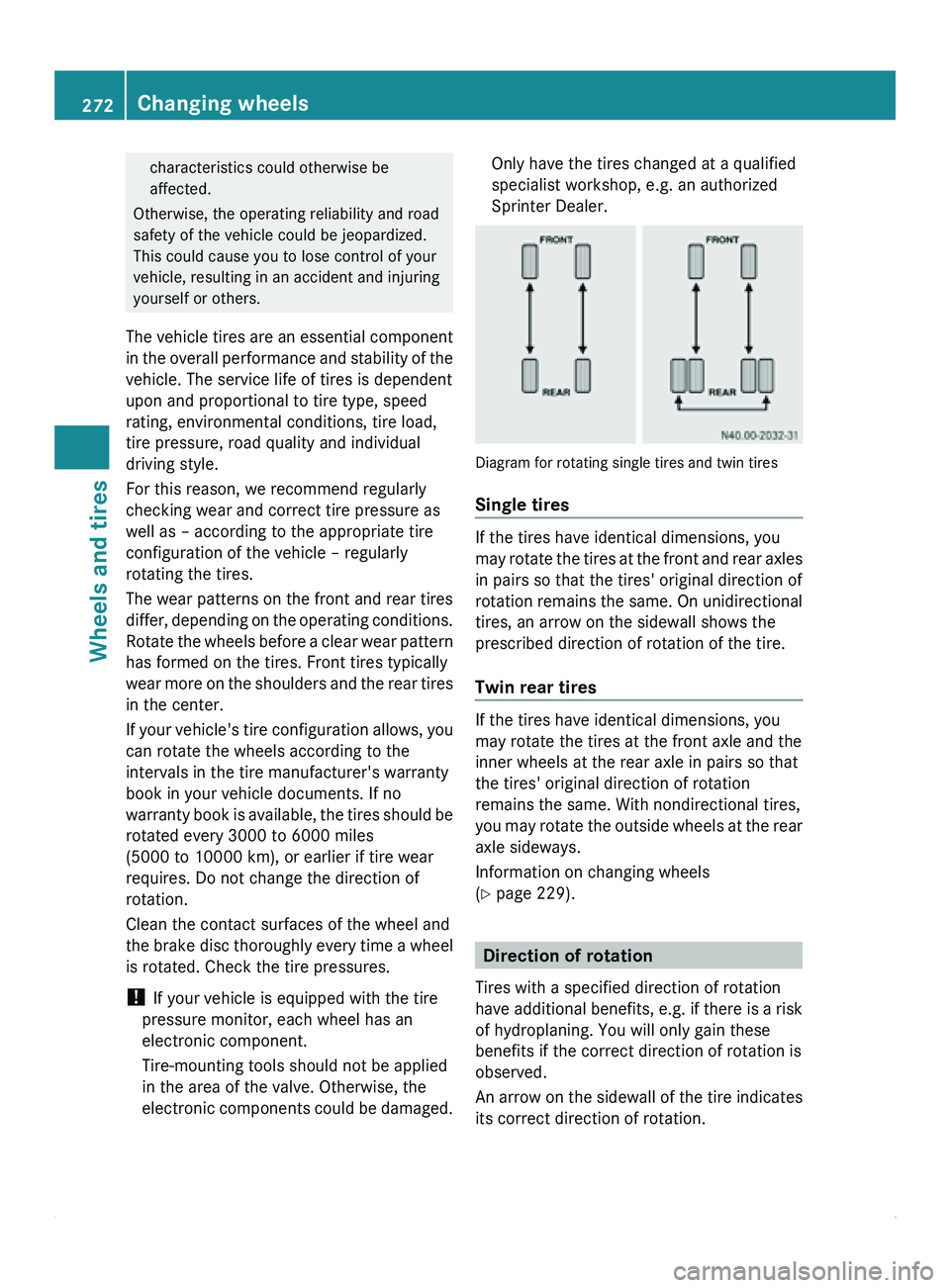
Diagram for rotating single tires and twin tires
Single tires
If the tires have identical dimensions, you
may rotate
the
tires at the front and rear axles
in pairs so that the tires' original direction of
rotation remains the same. On unidirectional
tires, an arrow on the sidewall shows the
prescribed direction of rotation of the tire.
Twin rear tires If the tires have identical dimensions, you
may rotate the tires at the front axle and the
inner wheels at the rear axle in pairs so that
the tires' original direction of rotation
remains the same. With nondirectional tires,
you may
rotate
the outside wheels at the rear
axle sideways.
Information on changing wheels
(Y page 229). Direction of rotation
Tires with a specified direction of rotation
have
additional benefits,
e.g. if there is a risk
of hydroplaning. You will only gain these
benefits if the correct direction of rotation is
observed.
An arrow on the sidewall of the tire indicates
its correct direction of rotation. 272
Changing wheels
Wheels and tires