fuel MERCEDES-BENZ SPRINTER 2011 MY11 Operator’s Manual
[x] Cancel search | Manufacturer: MERCEDES-BENZ, Model Year: 2011, Model line: SPRINTER, Model: MERCEDES-BENZ SPRINTER 2011Pages: 292, PDF Size: 6.75 MB
Page 271 of 292
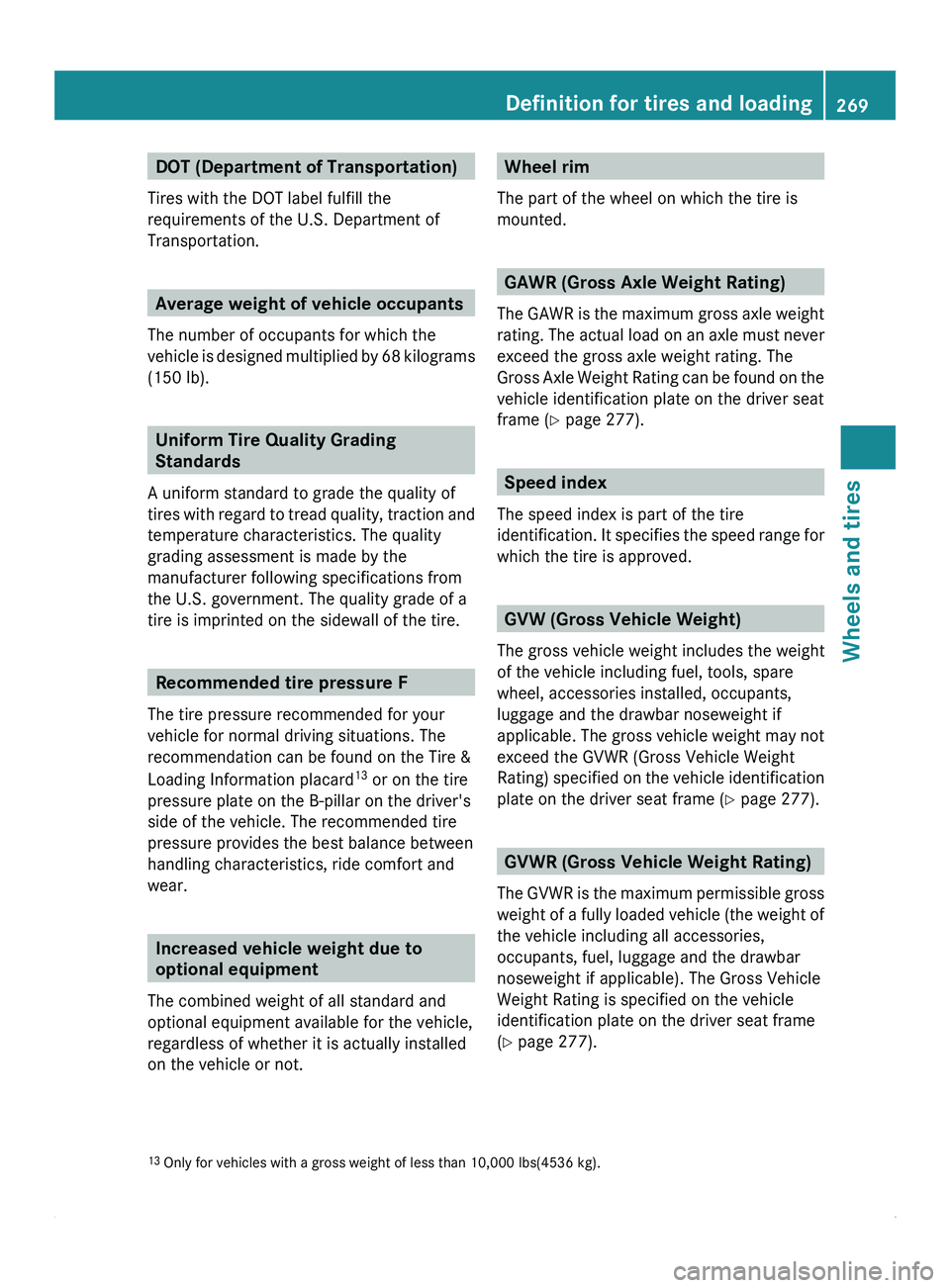
DOT (Department of Transportation)
Tires with the DOT label fulfill the
requirements of the U.S. Department of
Transportation. Average weight of vehicle occupants
The number of occupants for which the
vehicle is designed
multiplied by 68 kilograms
(150 lb). Uniform Tire Quality Grading
Standards
A uniform standard to grade the quality of
tires with regard
to tread quality, traction and
temperature characteristics. The quality
grading assessment is made by the
manufacturer following specifications from
the U.S. government. The quality grade of a
tire is imprinted on the sidewall of the tire. Recommended tire pressure F
The tire pressure recommended for your
vehicle for normal driving situations. The
recommendation can be found on the Tire &
Loading Information placard 13
or on the tire
pressure plate on the B-pillar on the driver's
side of the vehicle. The recommended tire
pressure provides the best balance between
handling characteristics, ride comfort and
wear. Increased vehicle weight due to
optional equipment
The combined weight of all standard and
optional equipment available for the vehicle,
regardless of whether it is actually installed
on the vehicle or not. Wheel rim
The part of the wheel on which the tire is
mounted. GAWR (Gross Axle Weight Rating)
The GAWR is
the maximum gross axle weight
rating. The actual load on an axle must never
exceed the gross axle weight rating. The
Gross Axle Weight Rating can be found on the
vehicle identification plate on the driver seat
frame (Y page 277). Speed index
The speed index is part of the tire
identification. It specifies
the speed range for
which the tire is approved. GVW (Gross Vehicle Weight)
The gross vehicle weight includes the weight
of the vehicle including fuel, tools, spare
wheel, accessories installed, occupants,
luggage and the drawbar noseweight if
applicable. The gross
vehicle weight may not
exceed the GVWR (Gross Vehicle Weight
Rating) specified on the vehicle identification
plate on the driver seat frame ( Y page 277). GVWR (Gross Vehicle Weight Rating)
The GVWR is
the maximum permissible gross
weight of a fully loaded vehicle (the weight of
the vehicle including all accessories,
occupants, fuel, luggage and the drawbar
noseweight if applicable). The Gross Vehicle
Weight Rating is specified on the vehicle
identification plate on the driver seat frame
(Y page 277).
13 Only for vehicles with a gross weight of less than 10,000 lbs(4536 kg). Definition for tires and loading
269
Wheels and tires Z
Page 272 of 292
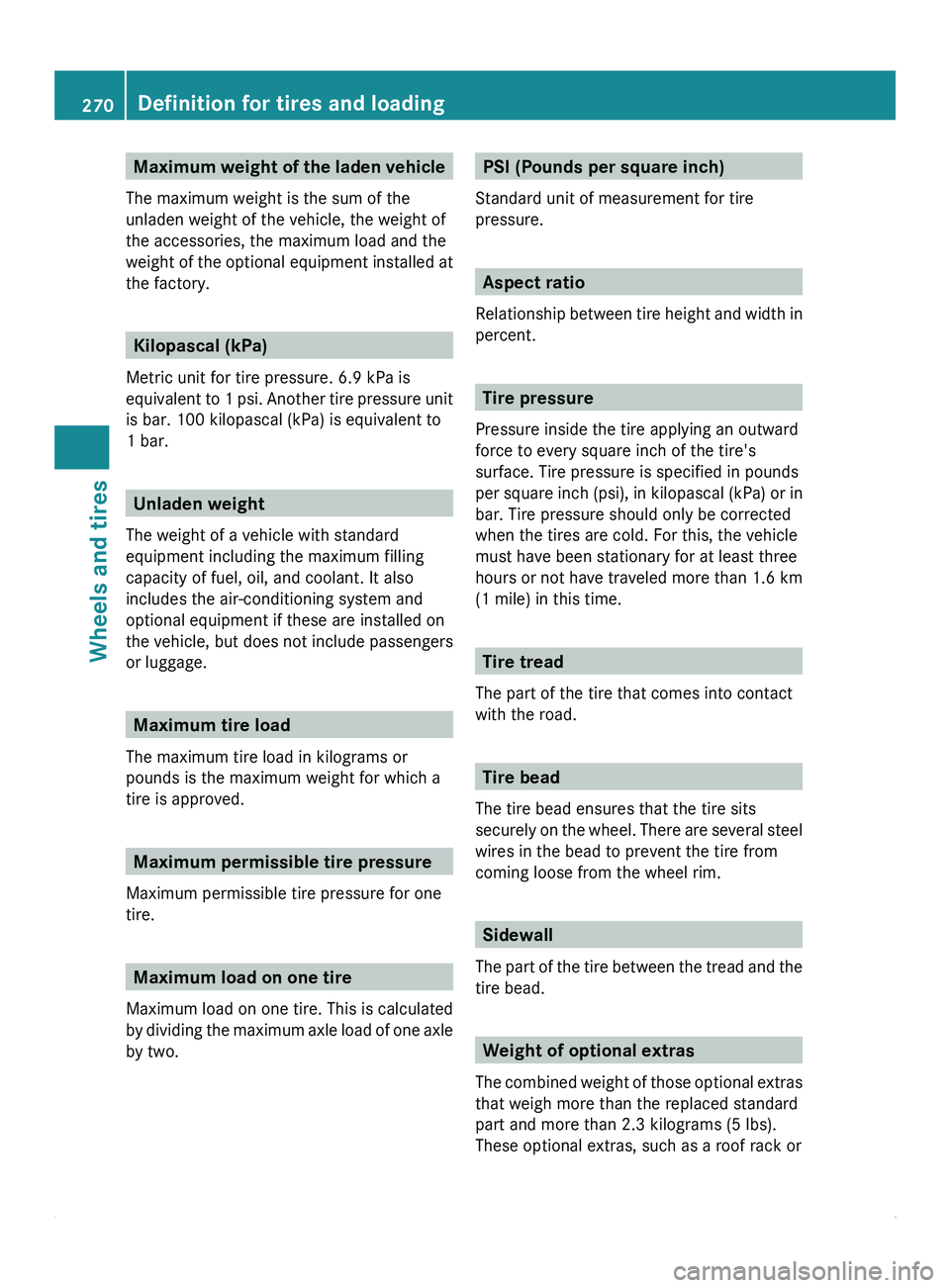
Maximum weight of the laden vehicle
The maximum weight is the sum of the
unladen weight of the vehicle, the weight of
the accessories, the maximum load and the
weight of the
optional equipment installed at
the factory. Kilopascal (kPa)
Metric unit for tire pressure. 6.9 kPa is
equivalent to
1 psi. Another tire pressure unit
is bar. 100 kilopascal (kPa) is equivalent to
1 bar. Unladen weight
The weight of a vehicle with standard
equipment including the maximum filling
capacity of fuel, oil, and coolant. It also
includes the air-conditioning system and
optional equipment if these are installed on
the vehicle, but does not include passengers
or luggage. Maximum tire load
The maximum tire load in kilograms or
pounds is the maximum weight for which a
tire is approved. Maximum permissible tire pressure
Maximum permissible tire pressure for one
tire. Maximum load on one tire
Maximum load on one tire. This is calculated
by dividing the
maximum axle load of one axle
by two. PSI (Pounds per square inch)
Standard unit of measurement for tire
pressure. Aspect ratio
Relationship between tire
height and width in
percent. Tire pressure
Pressure inside the tire applying an outward
force to every square inch of the tire's
surface. Tire pressure is specified in pounds
per square inch
(psi), in kilopascal (kPa) or in
bar. Tire pressure should only be corrected
when the tires are cold. For this, the vehicle
must have been stationary for at least three
hours or not have traveled more than 1.6 km
(1 mile) in this time. Tire tread
The part of the tire that comes into contact
with the road. Tire bead
The tire bead ensures that the tire sits
securely on the
wheel. There are several steel
wires in the bead to prevent the tire from
coming loose from the wheel rim. Sidewall
The part of
the tire between the tread and the
tire bead. Weight of optional extras
The combined weight
of those optional extras
that weigh more than the replaced standard
part and more than 2.3 kilograms (5 lbs).
These optional extras, such as a roof rack or 270
Definition for tires and loading
Wheels and tires
Page 275 of 292
You may mount a spare wheel against the
direction of rotation. Observe the time
restriction on use as well as the speed
limitation specified on the spare wheel.
Storing wheels
Store wheels that
are not being used in a cool,
dry and preferably dark place. Protect the
tires from contact with oil, grease and fuel. Cleaning wheels
G
Warning
Do not use power washers with circular jet
nozzles (concentrated-power jets) to clean
your vehicle, especially
for cleaning tires. You
could otherwise damage the tires and cause
an accident. Changing wheels
273
Wheels and tires Z
Page 289 of 292
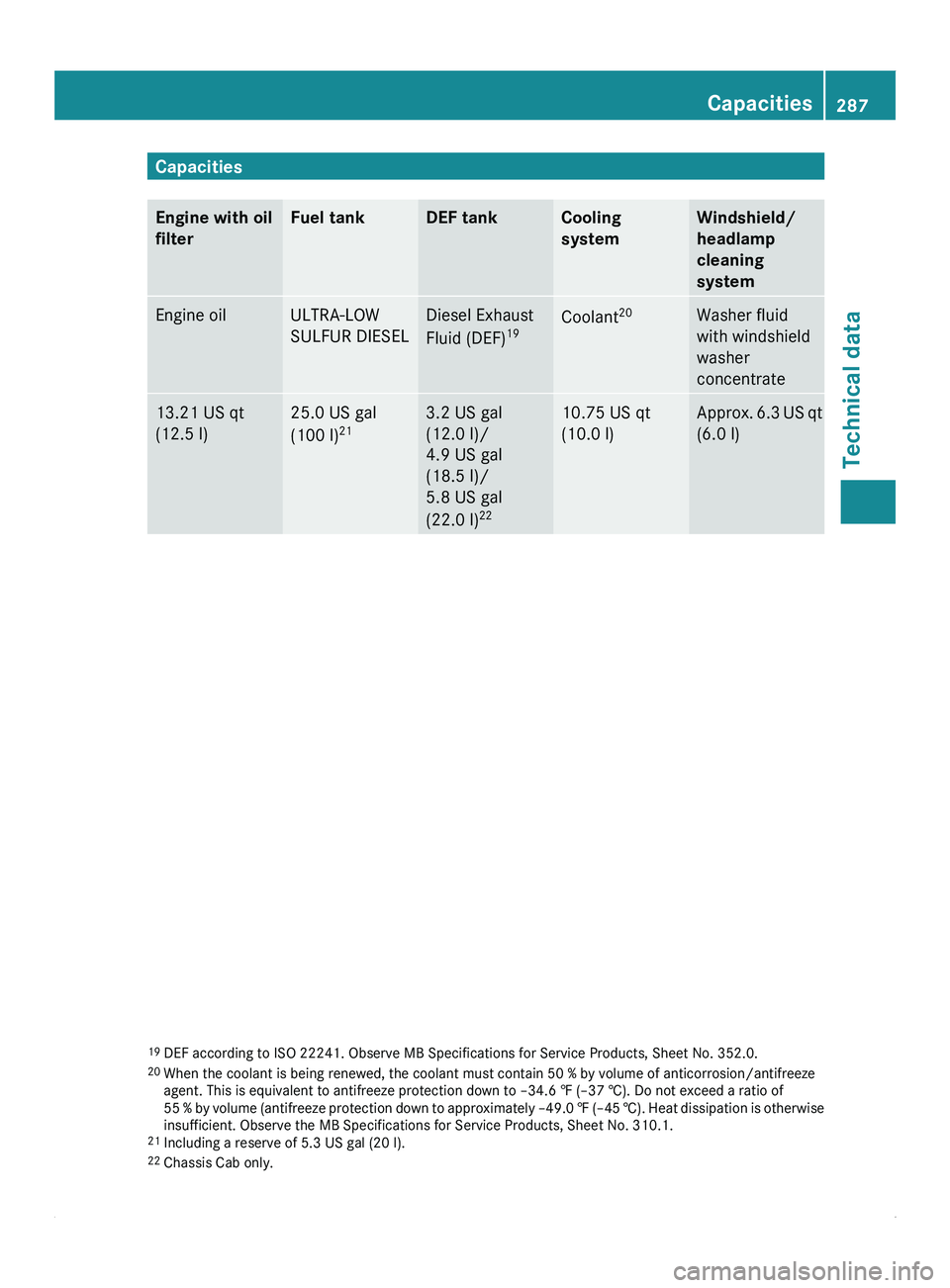
Capacities
Engine with oil
filter Fuel tank DEF tank Cooling
system Windshield/
headlamp
cleaning
system
Engine oil ULTRA-LOW
SULFUR DIESEL Diesel Exhaust
Fluid (DEF)
19 Coolant
20 Washer fluid
with windshield
washer
concentrate
13.21 US qt
(12.5 l) 25.0 US gal
(100 l)
21 3.2 US gal
(12.0 l)/
4.9 US gal
(18.5 l)/
5.8 US gal
(22.0 l)
22 10.75 US qt
(10.0 l) Approx. 6.3 US qt
(6.0 l) 19
DEF according to ISO 22241 . Observe MB Specifications for Service Products,
Sheet No. 352.0.
20 When the coolant is being renewed, the coolant must contain 50 % by volume of anticorrosion/antifreeze
agent. This is equivalent to antifreeze protection down to –34.6 ‡ (–37 †). Do not exceed a ratio of
55 % by volume (antifreeze protection down to approximately –49.0 ‡ (–45 †). Heat dissipation is otherwise
insufficient. Observe the MB Specifications for Service Products, Sheet No. 310.1.
21 Including a reserve of 5.3 US gal (20 l).
22 Chassis Cab only. Capacities
287
Technical data Z