oil MERCEDES-BENZ SPRINTER 2012 MY12 Operator’s Manual
[x] Cancel search | Manufacturer: MERCEDES-BENZ, Model Year: 2012, Model line: SPRINTER, Model: MERCEDES-BENZ SPRINTER 2012Pages: 292, PDF Size: 6.75 MB
Page 176 of 292
X
To install the air filter: insert the filter
mat.
X Put cover 0046 on. Vehicle assemblies
Check the assemblies regularly for leaks. If
fluid is being lost (e.g. there are oil stains
where the vehicle is parked), have the cause
found and rectified
immediately at a qualified
specialist workshop, e.g. an authorized
Sprinter Dealer.
0040Environmental note
When used improperly, service products are
harmful to the environment.
Do not allow service products to enter the
sewage system, surface
waters, ground water
or soil. Replacing the wiper blades
G
Warning
If the windshield wipers are set to intermittent
wipe or the rain/light sensor is active, the
windshield wipers could start moving at any
time and injure you or others.
Always remove the
key from the ignition lock
before replacing the wiper blades. G
Warning
Wiper blades are wear parts. Change the
wiper blades every six months, ideally in the
spring and fall.
Otherwise, the windshield and
rear window will not be wiped properly. This
may prevent you from observing the traffic
conditions, thereby causing an accident.
! Do not open the hood when a wiper arm
is folded away from the windshield.
Otherwise, you could damage the hood.
Do not fold the wiper arms back onto the
windshield without wiper blades fitted as
this could scratch the windshield. !
Only touch the windshield wiper where it
connects to the wiper arm. You could
otherwise damage the
wiper blade inserts.
Removing X
Apply the parking brake.
X On vehicles with automatic transmission,
move the selector lever to position P.
X Turn the key to position 1 in the ignition
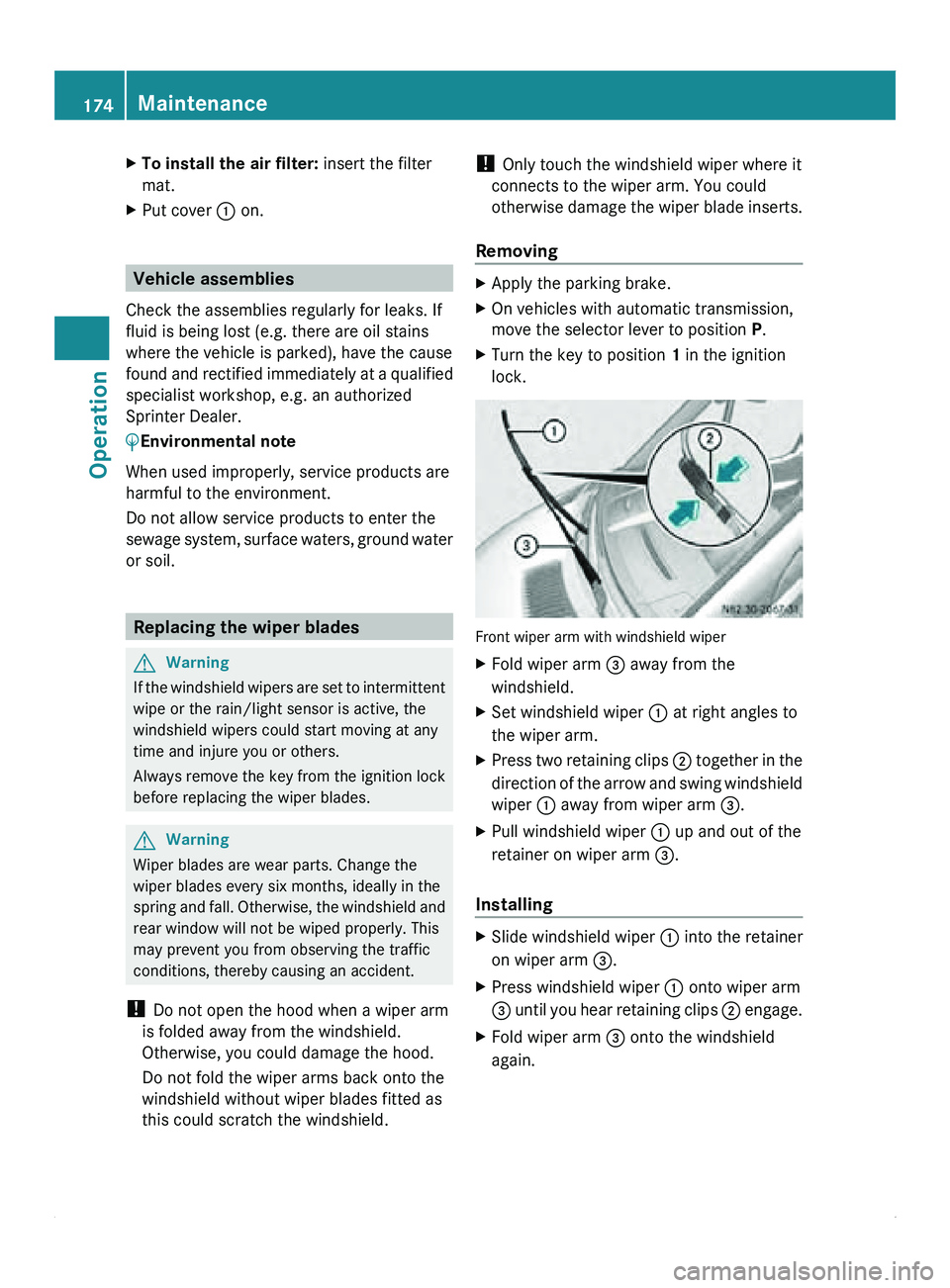
lock. Front wiper arm with windshield wiper
X
Fold wiper arm 008A away from the
windshield.
X Set windshield wiper 0046 at right angles to
the wiper arm.
X Press two retaining clips 0047 together
in
the
direction of the arrow and swing windshield
wiper 0046 away from wiper arm 008A.
X Pull windshield wiper 0046 up and out of the
retainer on wiper arm 008A.
Installing X
Slide windshield wiper 0046 into the retainer
on wiper arm 008A.
X Press windshield wiper 0046 onto wiper arm
008A until you
hear retaining clips 0047 engage.
X Fold wiper arm 008A onto the windshield
again. 174
Maintenance
Operation
Page 194 of 292
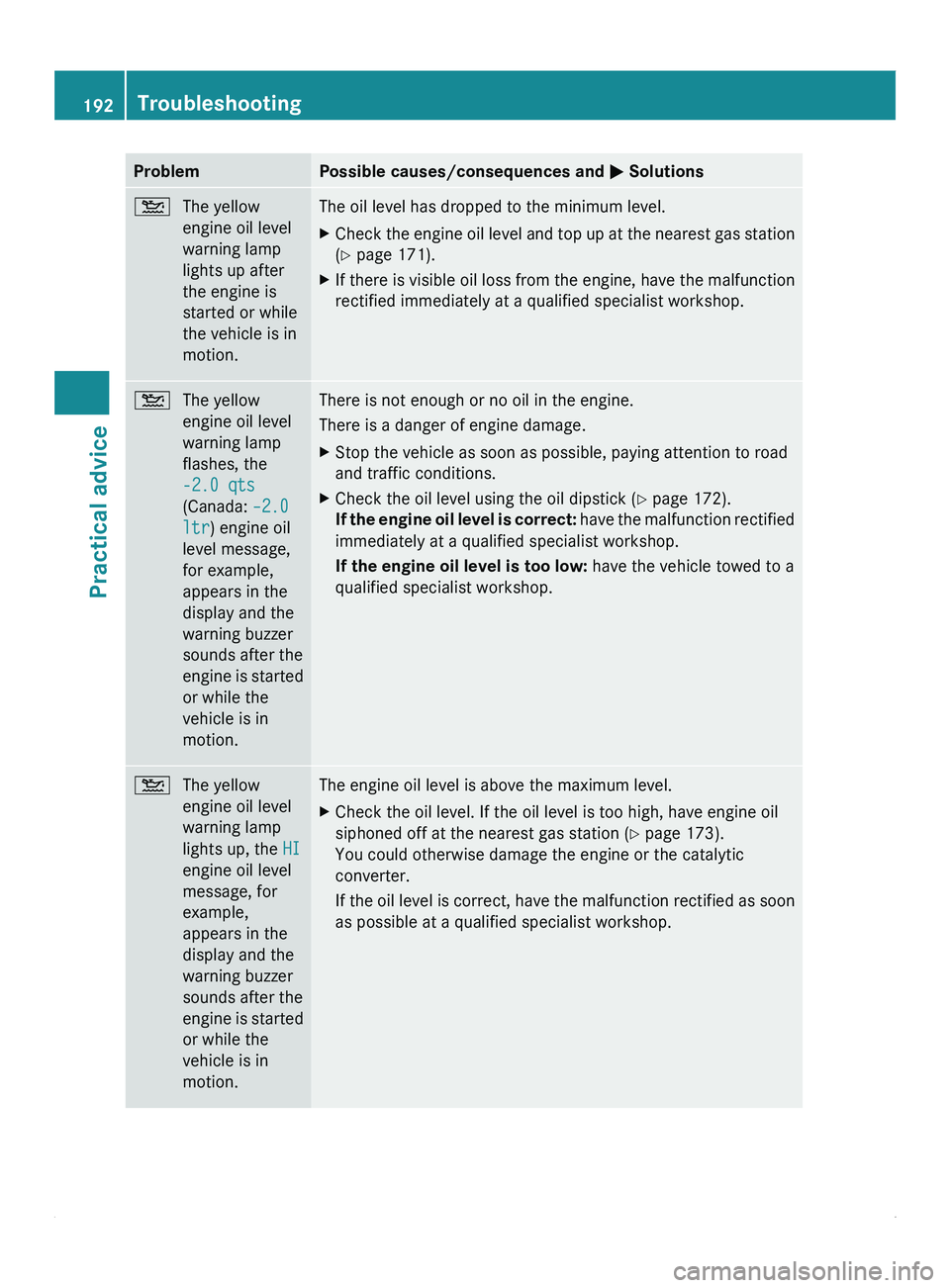
Problem Possible causes/consequences and
0050 Solutions00B4
The yellow
engine oil level
warning lamp
lights up after
the engine is
started or while
the vehicle is in
motion. The oil level has dropped to the minimum level.
X
Check the engine oil level and top up at the nearest gas station
(Y page 171).
X If there is visible oil loss from the engine, have the malfunction
rectified immediately at a qualified specialist workshop. 00B4
The yellow
engine oil level
warning lamp
flashes, the
-2.0 qts
(Canada: –2.0
ltr) engine oil
level message,
for example,
appears in the
display and the
warning buzzer
sounds after the
engine is started
or while the
vehicle is in
motion. There is not enough or no oil in the engine.
There is a danger of engine damage.
X
Stop the vehicle as soon as possible, paying attention to road
and traffic conditions.
X Check the oil level using the oil dipstick ( Y page 172).
If the engine oil level is correct: have the malfunction rectified
immediately at a qualified specialist workshop.
If the engine oil level is too low: have the vehicle towed to a
qualified specialist workshop. 00B4
The yellow
engine oil level
warning lamp
lights up, the HI
engine oil level
message, for
example,
appears in the
display and the
warning buzzer
sounds after the
engine is
started
or while the
vehicle is in
motion. The engine oil level is above the maximum level.
X
Check the oil level. If the oil level is too high, have engine oil
siphoned off at the nearest gas station (Y page 173).
You could otherwise damage the engine or the catalytic
converter.
If the oil
level is correct, have the malfunction rectified as soon
as possible at a qualified specialist workshop. 192
Troubleshooting
Practical advice
Page 195 of 292
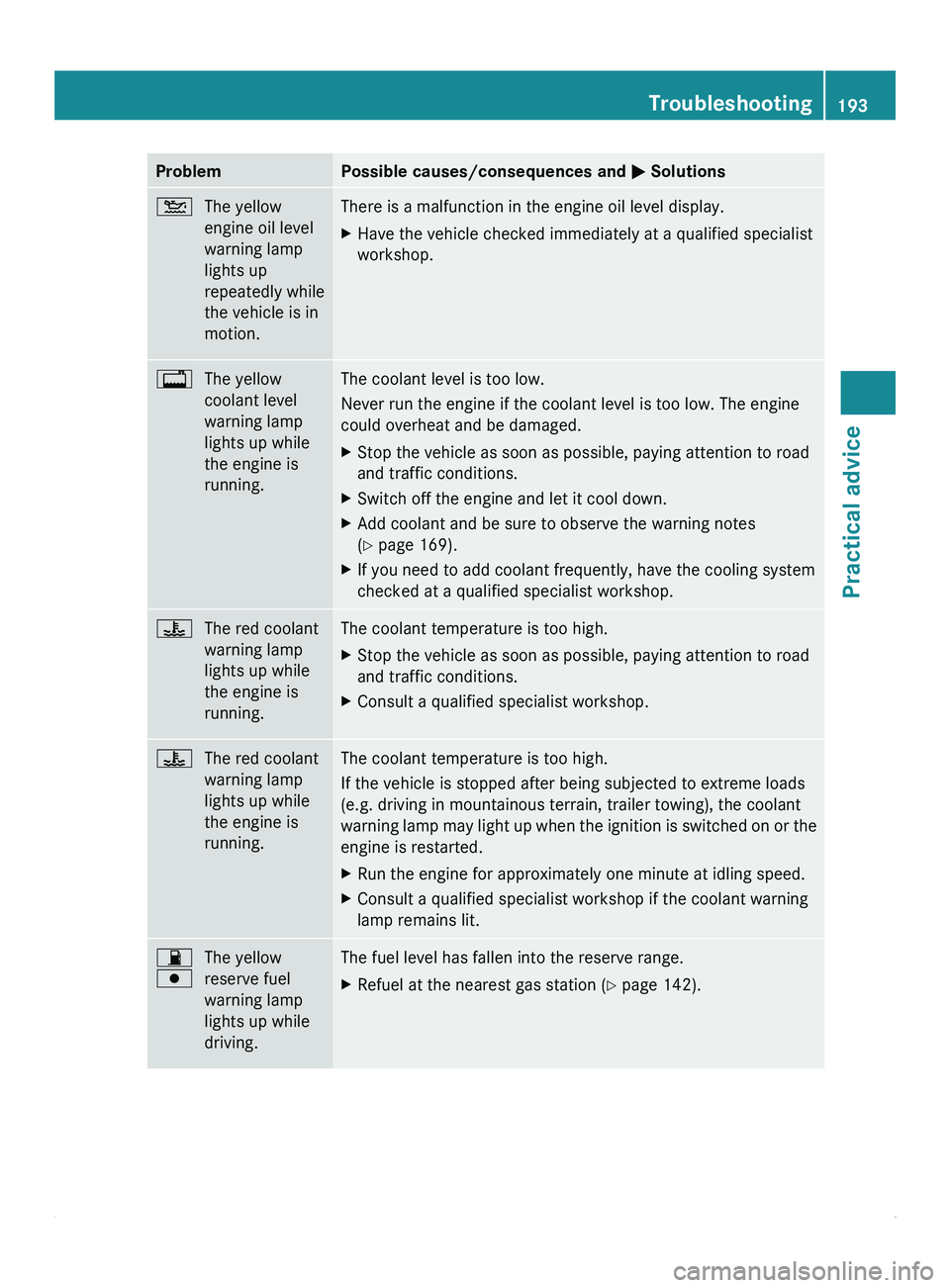
Problem Possible causes/consequences and
0050 Solutions00B4
The yellow
engine oil level
warning lamp
lights up
repeatedly while
the vehicle is in
motion. There is a malfunction in the engine oil level display.
X
Have the vehicle checked immediately at a qualified specialist
workshop. 0041
The yellow
coolant level
warning lamp
lights up while
the engine is
running. The coolant level is too low.
Never run the engine if the coolant level is too low. The engine
could overheat and be damaged.
X
Stop the vehicle as soon as possible, paying attention to road
and traffic conditions.
X Switch off the engine and let it cool down.
X Add coolant and be sure to observe the warning notes
(Y page 169).
X If you need to add coolant frequently, have the cooling system
checked at a qualified specialist workshop. 00AE
The red coolant
warning lamp
lights up while
the engine is
running. The coolant temperature is too high.
X
Stop the vehicle as soon as possible, paying attention to road
and traffic conditions.
X Consult a qualified specialist workshop. 00AE
The red coolant
warning lamp
lights up while
the engine is
running. The coolant temperature is too high.
If the vehicle is stopped after being subjected to extreme loads
(e.g. driving in mountainous terrain, trailer towing), the coolant
warning lamp may
light up when the ignition is switched on or the
engine is restarted.
X Run the engine for approximately one minute at idling speed.
X Consult a qualified specialist workshop if the coolant warning
lamp remains lit. 00B7
0080
The yellow
reserve fuel
warning lamp
lights up while
driving. The fuel level has fallen into the reserve range.
X
Refuel at the nearest gas station ( Y page 142). Troubleshooting
193
Practical advice Z
Page 209 of 292
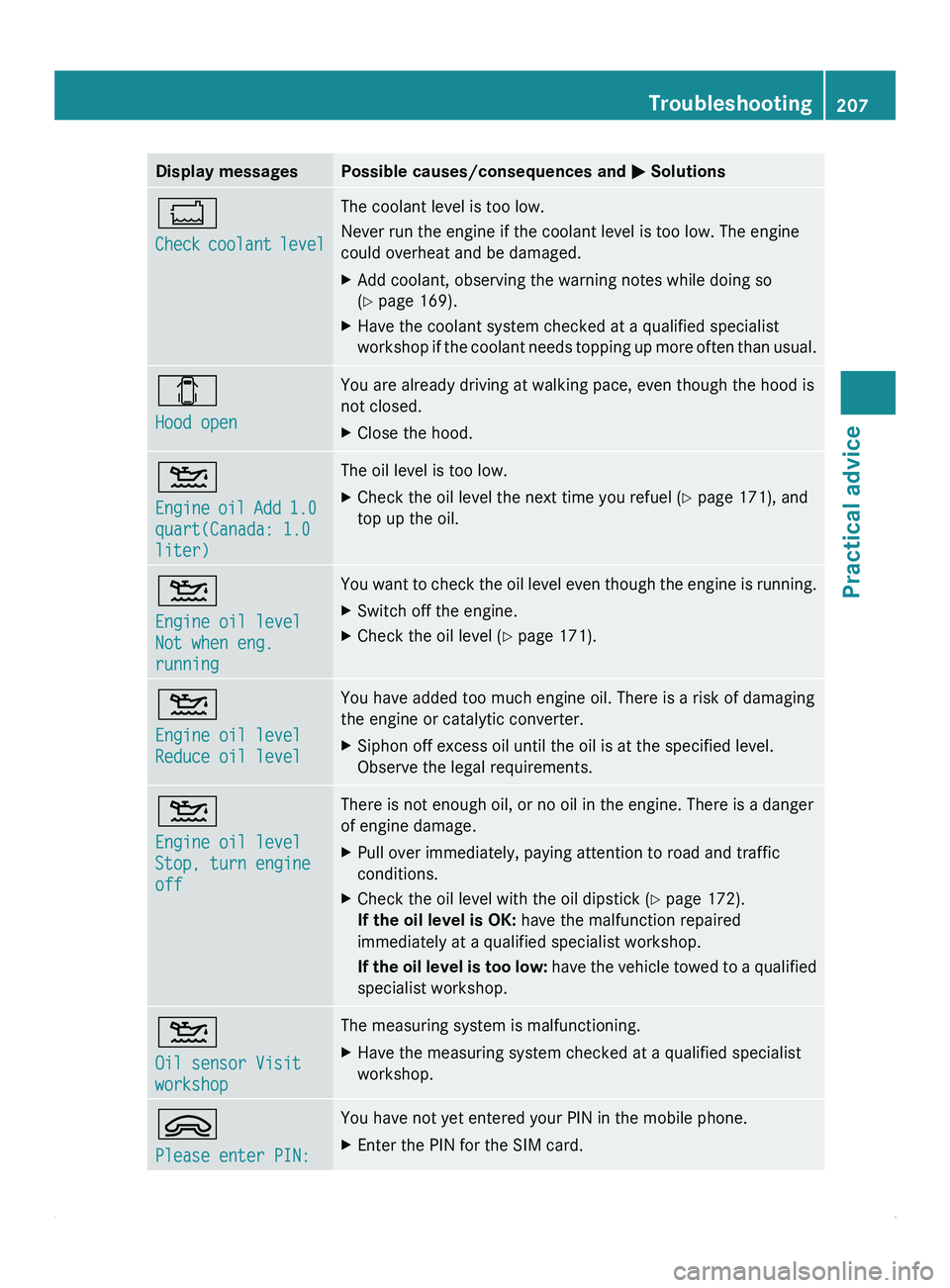
Display messages Possible causes/consequences and
0050 Solutions00BE
Check coolant
level The coolant level is too low.
Never run the engine if the coolant level is too low. The engine
could overheat and be damaged.
X
Add coolant, observing the warning notes while doing so
(Y page 169).
X Have the coolant system checked at a qualified specialist
workshop if the
coolant needs topping up more often than usual.003E
Hood open You are already driving at walking pace, even though the hood is
not closed.
X
Close the hood. 00B4
Engine oil
Add
1.0
quart(Canada: 1.0
liter) The oil level is too low.
X
Check the oil level the next time you refuel ( Y page 171), and
top up the oil. 00B4
Engine oil level
Not when eng.
running You want to check the oil level even though the engine is running.
X
Switch off the engine.
X Check the oil level (Y page 171). 00B4
Engine oil level
Reduce oil level You have added too much engine oil. There is a risk of damaging
the engine or catalytic converter.
X
Siphon off excess oil until the oil is at the specified level.
Observe the legal requirements. 00B4
Engine oil level
Stop, turn engine
off There is not enough oil, or no oil in the engine. There is a danger
of engine damage.
X
Pull over immediately, paying attention to road and traffic
conditions.
X Check the oil level with the oil dipstick ( Y page 172).
If the oil level is OK: have the malfunction repaired
immediately at a qualified specialist workshop.
If the oil
level is too low: have the vehicle towed to a qualified
specialist workshop. 00B4
Oil sensor Visit
workshop The measuring system is malfunctioning.
X
Have the measuring system checked at a qualified specialist
workshop. 006D
Please enter PIN: You have not yet entered your PIN in the mobile phone.
X
Enter the PIN for the SIM card. Troubleshooting
207
Practical advice Z
Page 216 of 292
Problem Possible causes/consequences and
0050 SolutionsThe engine does not
start.
The starter motor
cannot be heard. The battery is discharged or faulty.
X
Check the battery for damage.
X Charge the battery ( Y page 178).The engine does not
start.
The starter motor
cannot be heard. The starter is faulty.
X
Have the starter checked at a qualified specialist workshop. Automatic transmission
G
Warning
The operating safety of your vehicle could be jeopardized if maintenance work is carried out
incorrectly. As a
result, you could lose control of the vehicle and cause an accident. In addition,
the safety systems may no longer be able to protect you or others as they are designed to do.
Always have maintenance work carried out at a qualified specialist workshop. The qualified
specialist workshop must have the necessary specialist knowledge and tools to carry out the
work required. We recommend visiting an authorized Sprinter Dealer. In particular, work relevant
to safety or on safety-related systems must be carried out at a qualified specialist workshop. Problem Possible causes/consequences and
0050 SolutionsThe transmission no
longer changes gear
correctly. The transmission is losing oil.
X
Have the transmission checked immediately at a qualified
specialist workshop. The acceleration
characteristics have
deteriorated
noticeably.
The transmission does
not shift. The transmission is in emergency mode.
It is only possible to shift into second gear or reverse gear.
X
Stop the vehicle.
X Depress the brake pedal.
X Move the selector lever to position P.
X Switch off the engine.
X Wait at least 10 seconds before restarting the engine.
X Depress the brake pedal.
X Move the selector lever to position D or R.
X In position D, the transmission shifts into second gear; in
position R, the transmission shits into reverse gear.
X Have the transmission checked immediately at a qualified
specialist workshop.214
Troubleshooting
Practical advice
Page 233 of 292
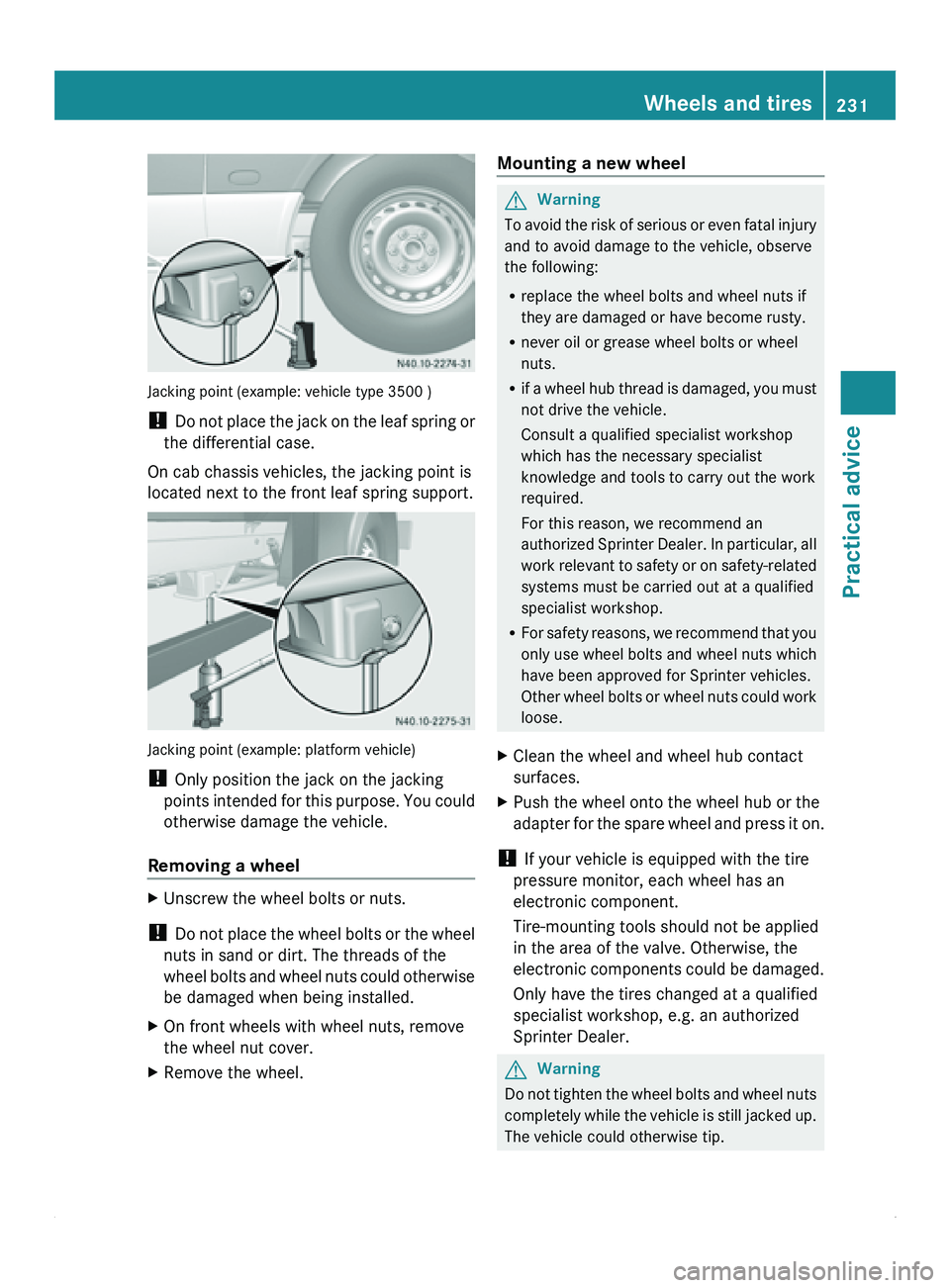
Jacking point (example: vehicle type 3500 )
!
Do not place
the jack on the leaf spring or
the differential case.
On cab chassis vehicles, the jacking point is
located next to the front leaf spring support. Jacking point (example: platform vehicle)
!
Only position the jack on the jacking
points intended for
this purpose. You could
otherwise damage the vehicle.
Removing a wheel X
Unscrew the wheel bolts or nuts.
! Do not place
the wheel bolts or the wheel
nuts in sand or dirt. The threads of the
wheel bolts and wheel nuts could otherwise
be damaged when being installed.
X On front wheels with wheel nuts, remove
the wheel nut cover.
X Remove the wheel. Mounting a new wheel G
Warning
To avoid the risk of serious or even fatal injury
and to avoid damage to the vehicle, observe
the following:
R replace the wheel bolts and wheel nuts if
they are damaged or have become rusty.
R never oil or grease wheel bolts or wheel
nuts.
R if a wheel
hub thread is damaged, you must
not drive the vehicle.
Consult a qualified specialist workshop
which has the necessary specialist
knowledge and tools to carry out the work
required.
For this reason, we recommend an
authorized Sprinter Dealer. In particular, all
work relevant to safety or on safety-related
systems must be carried out at a qualified
specialist workshop.
R For safety reasons, we recommend that you
only use wheel bolts and wheel nuts which
have been approved for Sprinter vehicles.
Other wheel bolts or wheel nuts could work
loose.
X Clean the wheel and wheel hub contact
surfaces.
X Push the wheel onto the wheel hub or the
adapter for the
spare wheel and press it on.
! If your vehicle is equipped with the tire
pressure monitor, each wheel has an
electronic component.
Tire-mounting tools should not be applied
in the area of the valve. Otherwise, the
electronic components could
be damaged.
Only have the tires changed at a qualified
specialist workshop, e.g. an authorized
Sprinter Dealer. G
Warning
Do not tighten the wheel bolts and wheel nuts
completely while the
vehicle is still jacked up.
The vehicle could otherwise tip. Wheels and tires
231
Practical advice Z
Page 272 of 292
Maximum weight of the laden vehicle
The maximum weight is the sum of the
unladen weight of the vehicle, the weight of
the accessories, the maximum load and the
weight of the
optional equipment installed at
the factory. Kilopascal (kPa)
Metric unit for tire pressure. 6.9 kPa is
equivalent to
1 psi. Another tire pressure unit
is bar. 100 kilopascal (kPa) is equivalent to
1 bar. Unladen weight
The weight of a vehicle with standard
equipment including the maximum filling
capacity of fuel, oil, and coolant. It also
includes the air-conditioning system and
optional equipment if these are installed on
the vehicle, but does not include passengers
or luggage. Maximum tire load
The maximum tire load in kilograms or
pounds is the maximum weight for which a
tire is approved. Maximum permissible tire pressure
Maximum permissible tire pressure for one
tire. Maximum load on one tire
Maximum load on one tire. This is calculated
by dividing the
maximum axle load of one axle
by two. PSI (Pounds per square inch)
Standard unit of measurement for tire
pressure. Aspect ratio
Relationship between tire
height and width in
percent. Tire pressure
Pressure inside the tire applying an outward
force to every square inch of the tire's
surface. Tire pressure is specified in pounds
per square inch
(psi), in kilopascal (kPa) or in
bar. Tire pressure should only be corrected
when the tires are cold. For this, the vehicle
must have been stationary for at least three
hours or not have traveled more than 1.6 km
(1 mile) in this time. Tire tread
The part of the tire that comes into contact
with the road. Tire bead
The tire bead ensures that the tire sits
securely on the
wheel. There are several steel
wires in the bead to prevent the tire from
coming loose from the wheel rim. Sidewall
The part of
the tire between the tread and the
tire bead. Weight of optional extras
The combined weight
of those optional extras
that weigh more than the replaced standard
part and more than 2.3 kilograms (5 lbs).
These optional extras, such as a roof rack or 270
Definition for tires and loading
Wheels and tires
Page 275 of 292
You may mount a spare wheel against the
direction of rotation. Observe the time
restriction on use as well as the speed
limitation specified on the spare wheel.
Storing wheels
Store wheels that
are not being used in a cool,
dry and preferably dark place. Protect the
tires from contact with oil, grease and fuel. Cleaning wheels
G
Warning
Do not use power washers with circular jet
nozzles (concentrated-power jets) to clean
your vehicle, especially
for cleaning tires. You
could otherwise damage the tires and cause
an accident. Changing wheels
273
Wheels and tires Z
Page 281 of 292
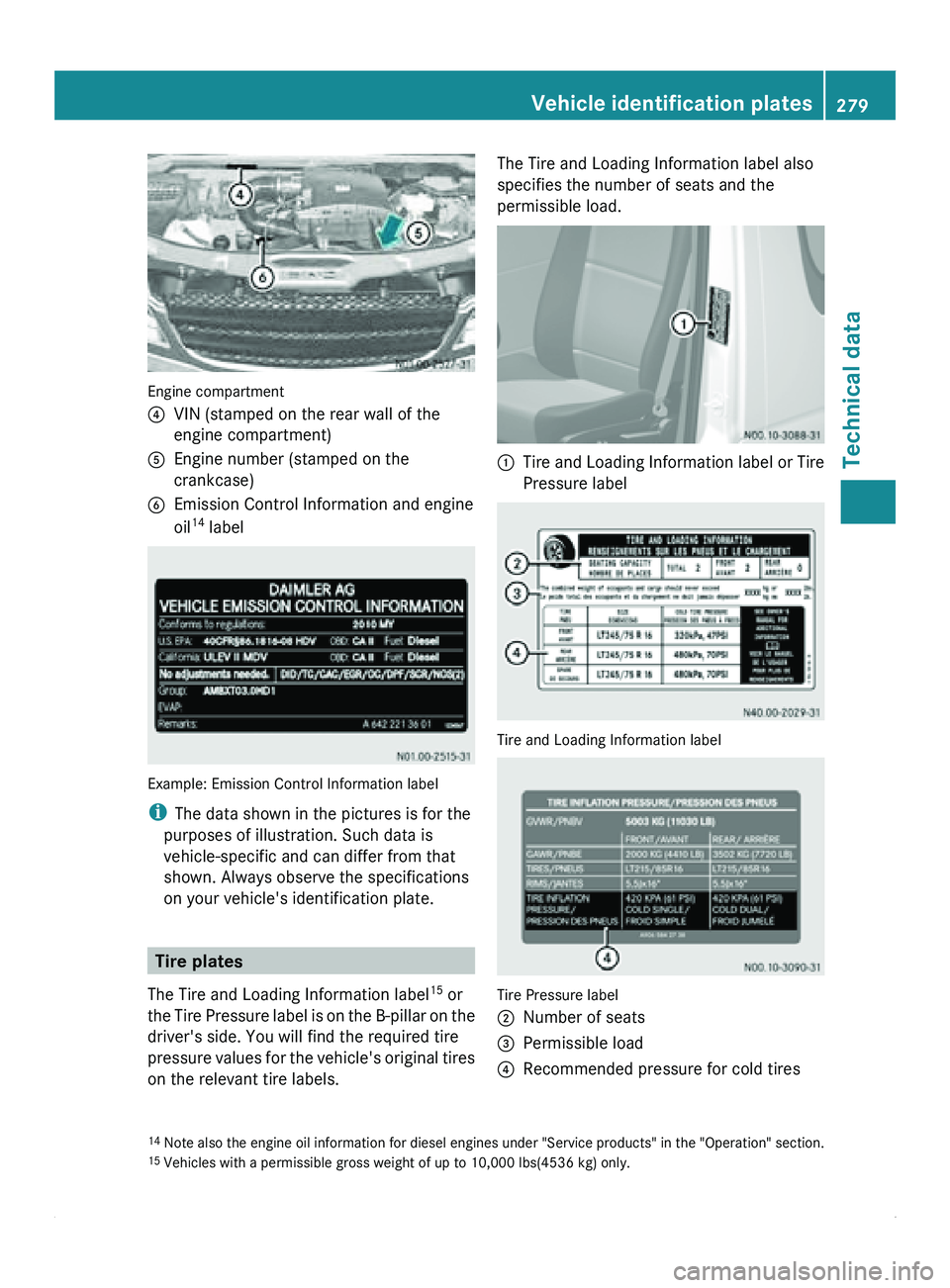
Engine compartment
0088
VIN (stamped on the rear wall of the
engine compartment)
0086 Engine number (stamped on the
crankcase)
0087 Emission Control Information and engine
oil14
label Example: Emission Control Information label
i
The data shown in the pictures is for the
purposes of illustration. Such data is
vehicle-specific and can differ from that
shown. Always observe the specifications
on your vehicle's identification plate. Tire plates
The Tire and Loading Information label 15
or
the Tire Pressure
label is on the B-pillar on the
driver's side. You will find the required tire
pressure values for the vehicle's original tires
on the relevant tire labels. The Tire and Loading Information label also
specifies the number of seats and the
permissible load.
0046
Tire and Loading Information label or Tire
Pressure label Tire and Loading Information label
Tire Pressure label
0047
Number of seats
008A Permissible load
0088 Recommended pressure for cold tires
14 Note also the
engine oil information for diesel engines under "Service products" in the "Operation" section.
15 Vehicles with a permissible gross weight of up to 10,000 lbs(4536 kg) only. Vehicle identification plates
279
Technical data Z
Page 289 of 292
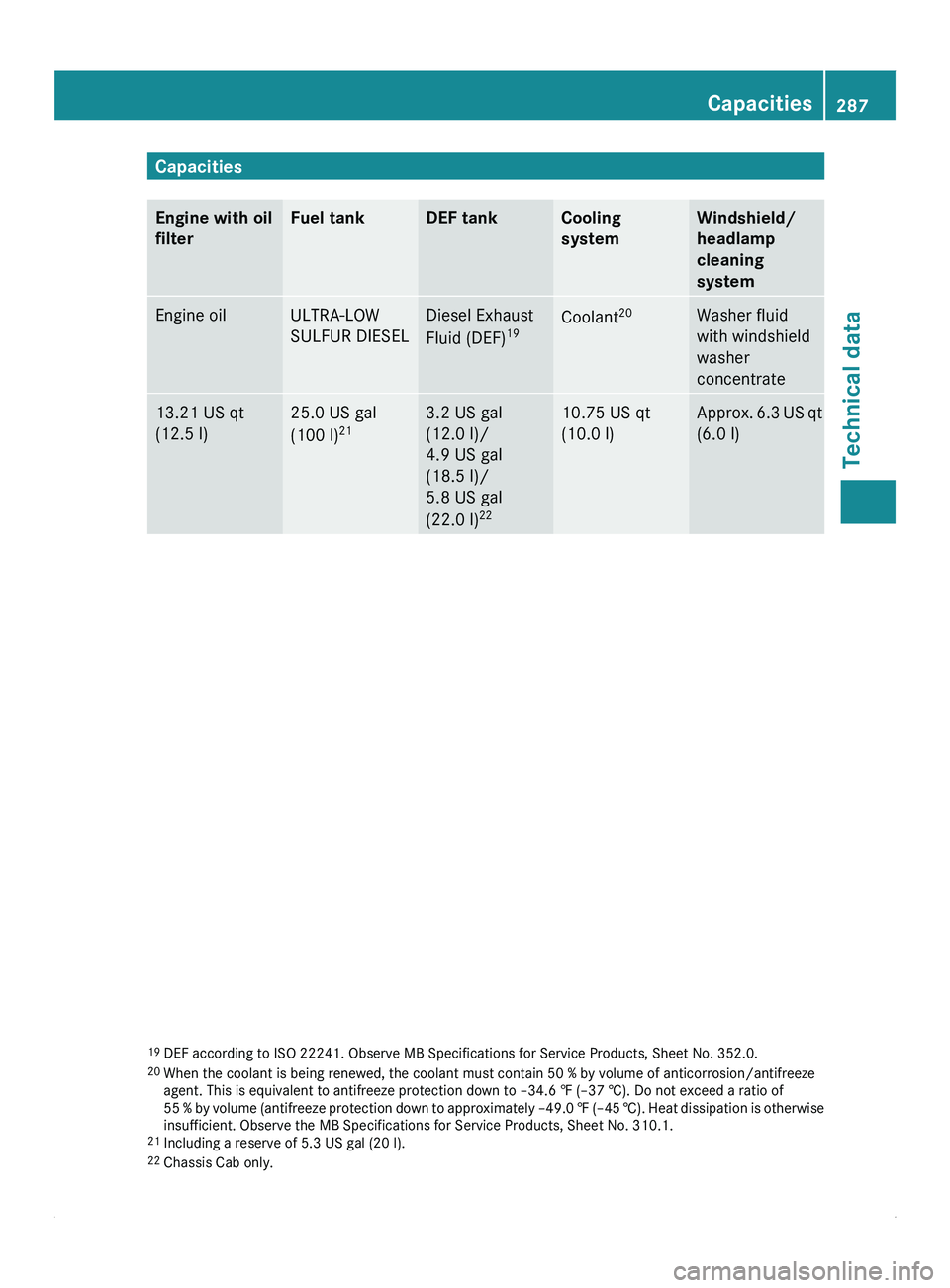
Capacities
Engine with oil
filter Fuel tank DEF tank Cooling
system Windshield/
headlamp
cleaning
system
Engine oil ULTRA-LOW
SULFUR DIESEL Diesel Exhaust
Fluid (DEF)
19 Coolant
20 Washer fluid
with windshield
washer
concentrate
13.21 US qt
(12.5 l) 25.0 US gal
(100 l)
21 3.2 US gal
(12.0 l)/
4.9 US gal
(18.5 l)/
5.8 US gal
(22.0 l)
22 10.75 US qt
(10.0 l) Approx. 6.3 US qt
(6.0 l) 19
DEF according to ISO 22241 . Observe MB Specifications for Service Products,
Sheet No. 352.0.
20 When the coolant is being renewed, the coolant must contain 50 % by volume of anticorrosion/antifreeze
agent. This is equivalent to antifreeze protection down to –34.6 ‡ (–37 †). Do not exceed a ratio of
55 % by volume (antifreeze protection down to approximately –49.0 ‡ (–45 †). Heat dissipation is otherwise
insufficient. Observe the MB Specifications for Service Products, Sheet No. 310.1.
21 Including a reserve of 5.3 US gal (20 l).
22 Chassis Cab only. Capacities
287
Technical data Z