child lock MERCEDES-BENZ SPRINTER 2013 MY13 Operator’s Manual
[x] Cancel search | Manufacturer: MERCEDES-BENZ, Model Year: 2013, Model line: SPRINTER, Model: MERCEDES-BENZ SPRINTER 2013Pages: 334, PDF Size: 3.88 MB
Page 68 of 334
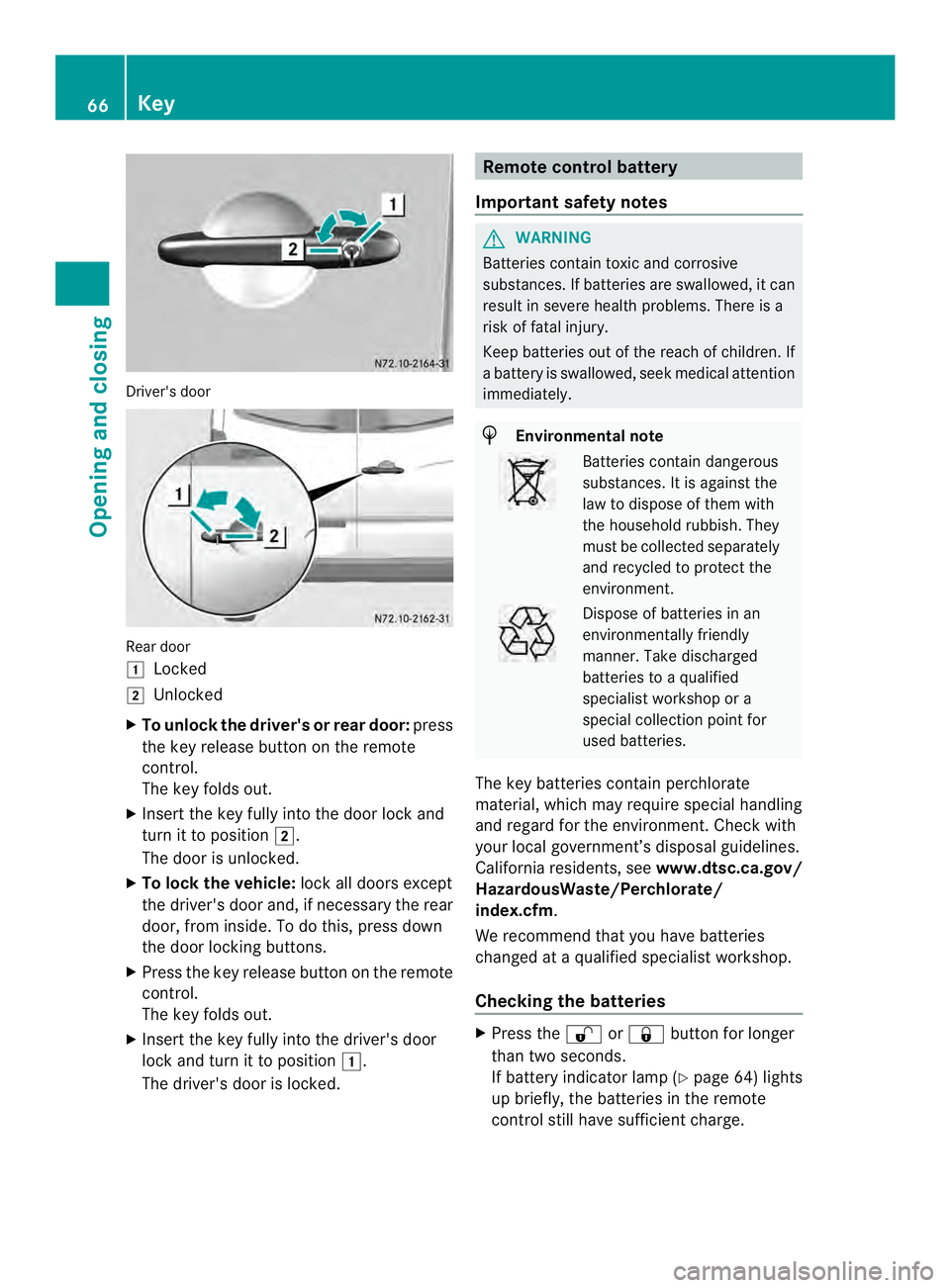
Driver's door
Rear door
0008
Locked
0009 Unlocked
X To unlock the driver' sor rear door: press
the key release button on the remote
control.
The key folds out.
X Insert the key fully into the door lock and
turn it to position 0009.
The door is unlocked.
X To lock the vehicle: lock all doors except
the driver's door and, if necessary the rear
door, fro minside .To do this, press down
the door locking buttons.
X Press the key release button on the remote
control.
The key folds out.
X Insert the key fully into the driver's door
lock and turn it to position 0008.
The driver's door is locked. Remote control battery
Important safety notes G
WARNING
Batteries contain toxic and corrosive
substances. If batteries are swallowed, it can
result in severe health problems. There is a
risk of fatal injury.
Keep batteries out of the reach of children. If
a battery is swallowed, seek medical attention
immediately. H
Environmental note Batteries contain dangerous
substances. It is against the
law to dispose of them with
the household rubbish. They
must be collected separately
and recycled to protect the
environment.
Dispose of batteries in an
environmentally friendly
manner
.Take discharged
batteries to a qualified
specialist workshop or a
special collectio npoint for
used batteries.
The key batteries contain perchlorate
material, which may require special handling
and regard for the environment. Check with
your local government’s disposal guidelines.
California residents, see www.dtsc.ca.gov/
HazardousWaste/Perchlorate/
index.cfm.
We recommend that you have batteries
changed at a qualified specialist workshop.
Checking the batteries X
Press the 0009or0008 button for longer
than two seconds.
If battery indicator lamp (Y page 64) lights
up briefly, the batteries in the remote
control still have sufficient charge. 66
KeyOpening and closing
Page 71 of 334
Central locking
Important safety notes
G
WARNING
Activate the child-proof door locks if children
are traveling in the vehicle .The children could
otherwise open the doors while the vehicle is
in motion, injuring themselves and others. G
WARNING
Do not leave children unsupervised in the
vehicle, even if they are secured in a child
restraint system. Children could otherwise
injure themselves on parts of the vehicle.
They could be severely or even fatally injured
by prolonged exposure to intense heat or
cold.
If children open a door, they could:
R injure other people
R get out of the vehicle and thereby injure
themselves or be injured by a passing
vehicle
R severely injure themselves by falling down,
in particular due to the vehicle height
Always take the key with you when leaving the
vehicle, even if you are only leaving for a short
time.
You can open a locked front door from the
inside at any time. You can only open a locked
sliding door or rear door from the inside if the
child-proof locks have not been activated. Locking and unlocking manually
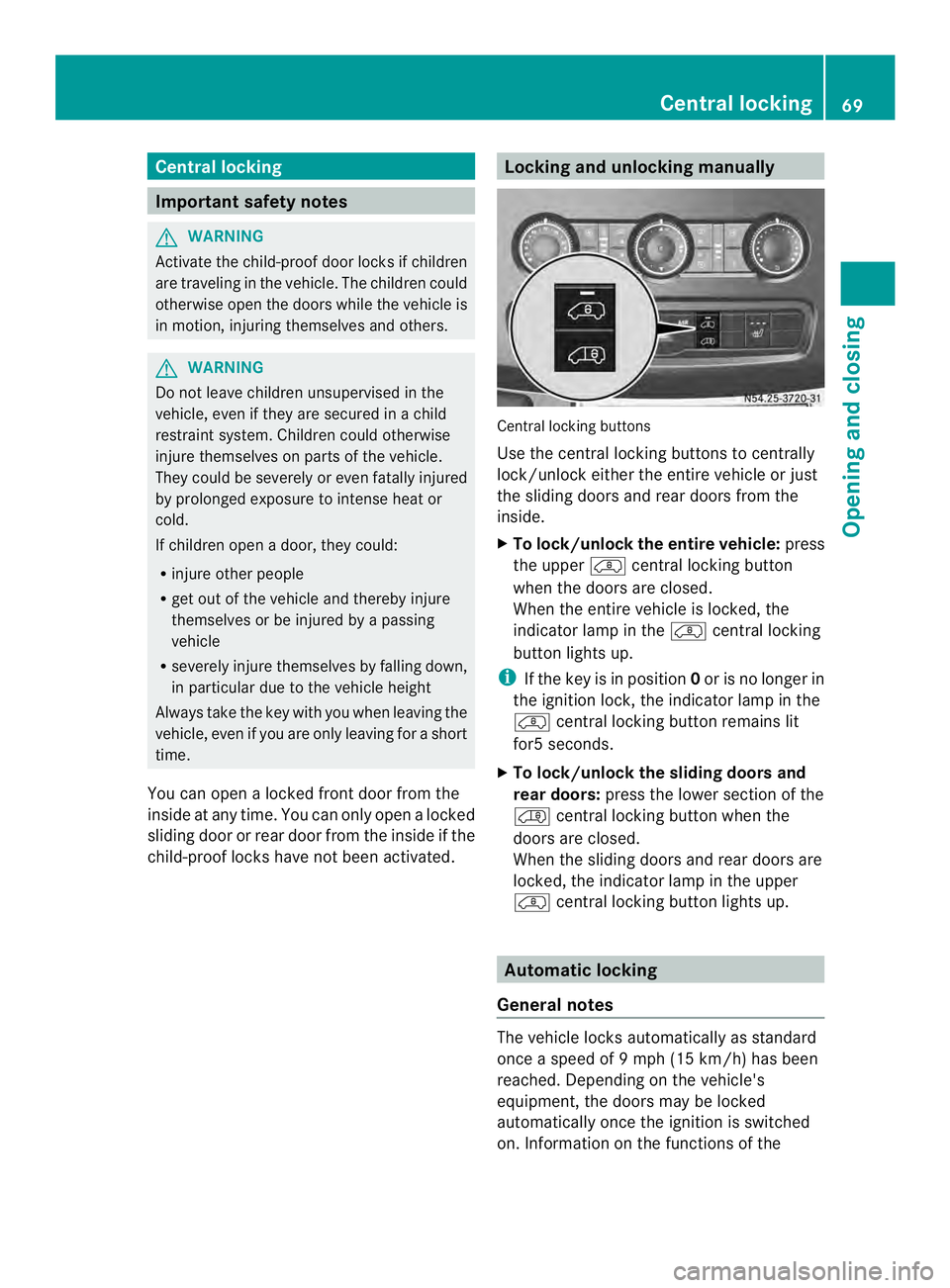
Central locking buttons
Use the central locking buttons to centrally
lock/unlocke
itherthe entire vehicle or just
the sliding doors and rear doors from the
inside.
X To lock/unlock the entire vehicle: press
the upper 0006central locking button
when the doors are closed.
When the entire vehicle is locked, the
indicator lamp in the 0006central locking
button lights up.
i If the key is in position 0or is no longer in
the ignition lock, the indicator lamp in the
0006 central locking button remains lit
for5 seconds.
X To lock/unlock the sliding doors and
rear doors: press the lower section of the
0001 central locking button when the
doors are closed.
When the sliding doors and rear doors are
locked, the indicator lamp in the upper
0006 central locking button lights up. Automatic locking
General notes The vehicle locks automatically as standard
once a speed of
9mph (15 km/h) has been
reached. Depending on the vehicle's
equipment, the doors may be locked
automatically once the ignition is switched
on. Information on the functions of the Central locking
69Opening and closing Z
Page 73 of 334
opening and closing the sliding door
(Y
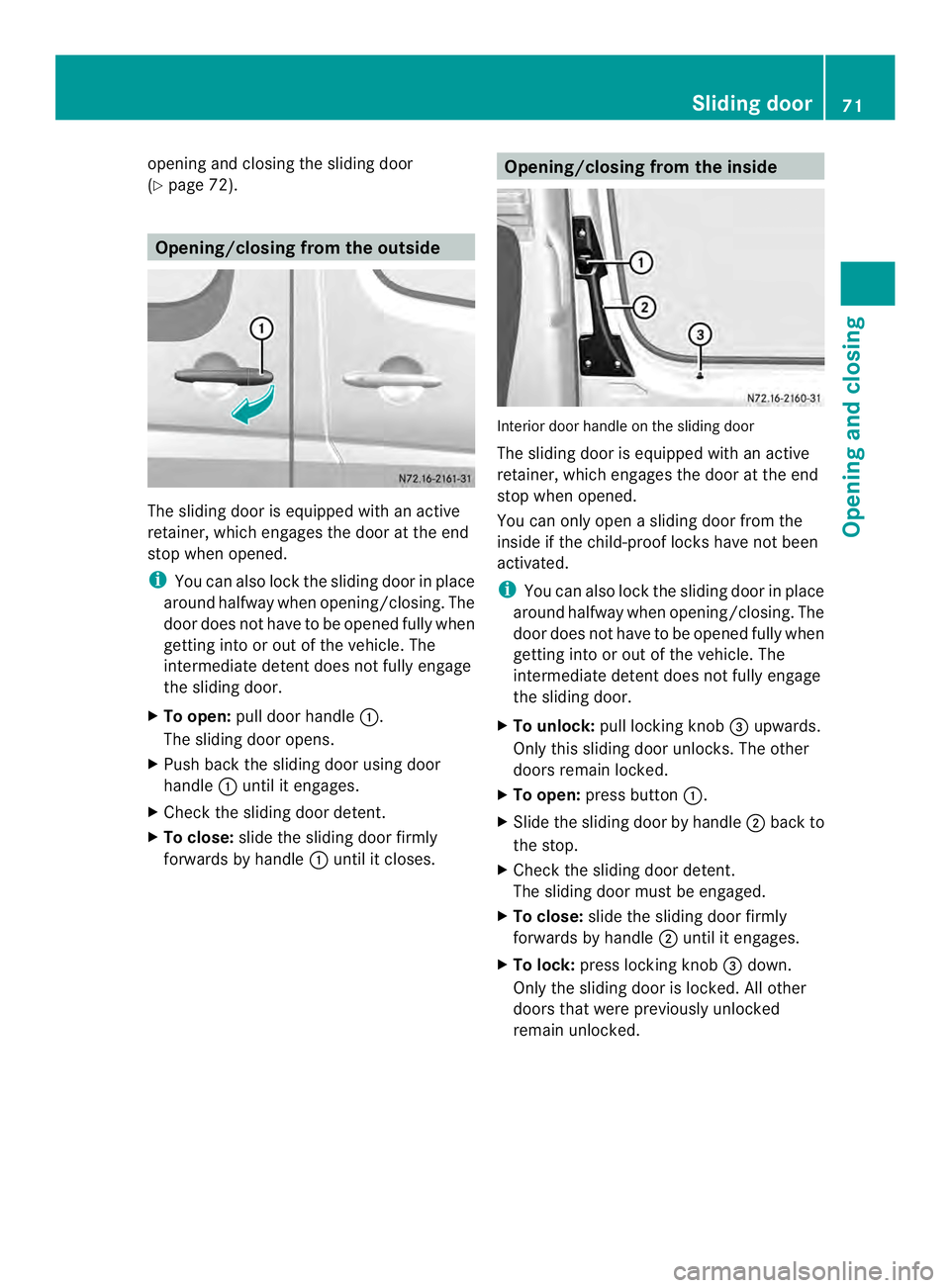
page 72). Opening/closing from the outside
The sliding door is equipped with an active
retainer, which engages the door at the end
stop when opened.
i You can also lock the sliding door in place
around halfway when opening/closing. The
door does not have to be opened fully when
getting into or out of the vehicle. The
intermediate detent does not fully engage
the sliding door.
X To open: pull door handle 0005.
The sliding door opens.
X Push back the sliding door using door
handle 0005until it engages.
X Check the sliding door detent.
X To close: slide the sliding door firmly
forwards by handle 0005until it closes. Opening/closing from the inside
Interior door handle on the sliding door
The sliding door is equipped with an active
retainer, which engages the door at the end
stop when opened.
You can only open a sliding door from the
inside if the child-proof locks have not been
activated.
i
You can also lock the sliding door in place
around halfway when opening/closing. The
door does not have to be opened fully when
getting into or out of the vehicle. The
intermediate detent does not fully engage
the sliding door.
X To unlock: pull locking knob 0026upwards.
Only this sliding door unlocks. The other
doors remain locked.
X To open: press button 0005.
X Slide the sliding door by handle 0006back to
the stop.
X Check the sliding door detent.
The sliding door must be engaged.
X To close: slide the sliding door firmly
forwards by handle 0006until it engages.
X To lock: press locking knob 0026down.
Only the sliding door is locked. All other
doors that were previously unlocked
remain unlocked. Sliding door
71Opening and closing Z
Page 77 of 334
and will no
tswivel back to its original
position.
Before closing the door, release door
retainer 0005from th edetent and return it to
its original position.
Closing the rear doors from the outside X
Pull the rear door away from magnetic door
retainer.
X Close the left-hand rear door firmly from
the outside.
X Close the right-hand rear door firmly from
the outside. Opening/closing from the inside
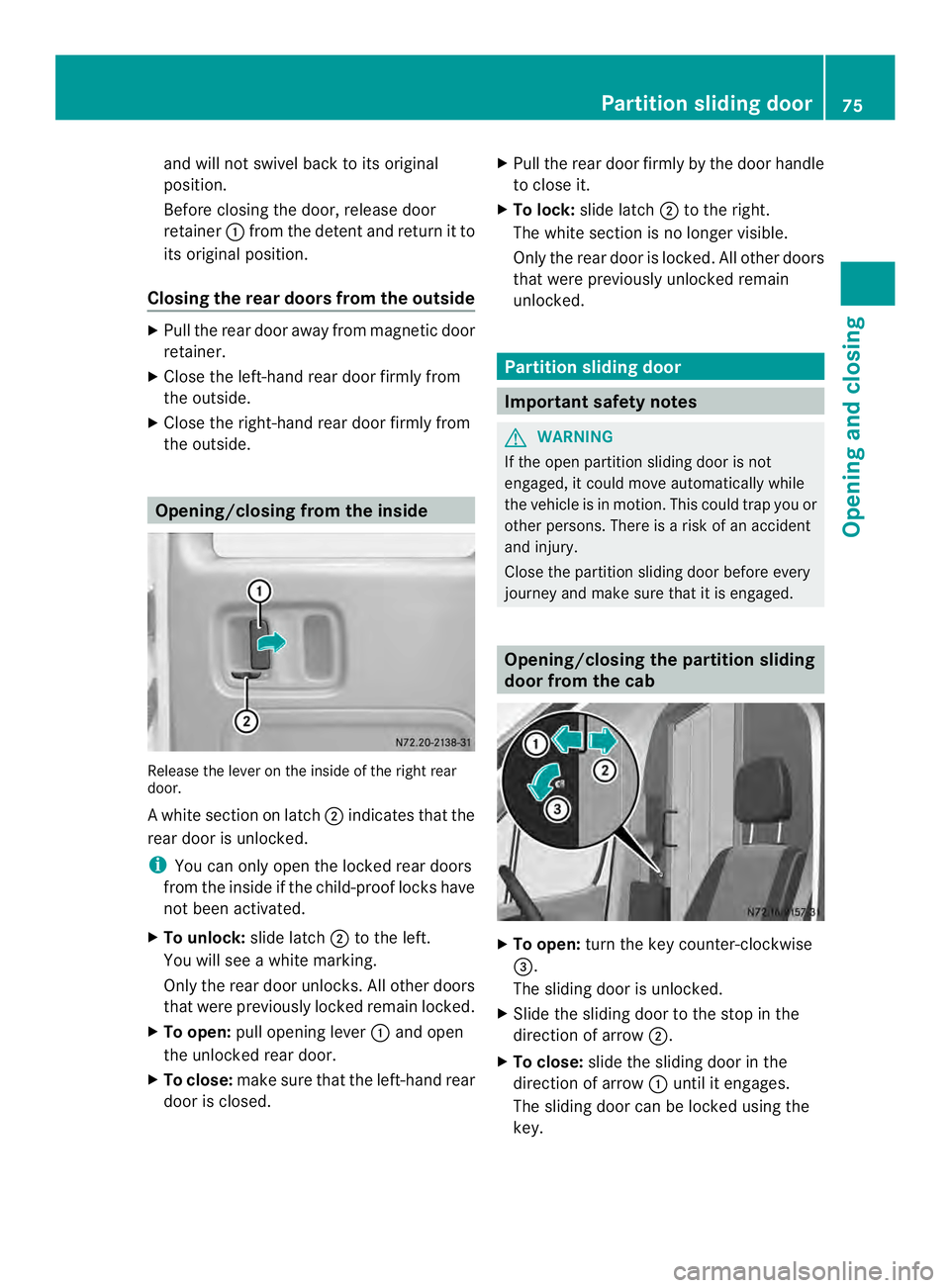
Release the lever on the inside of the right rear
door.
Aw
hite section on latch 0006indicates that the
rear door is unlocked.
i You can only open the locked rear doors
from the inside if the child-proof locks have
not been activated.
X To unlock: slide latch0006to the left.
You will see a white marking.
Only the rear door unlocks. All other doors
that were previously locked remain locked.
X To open: pull opening lever 0005and open
the unlocked rear door.
X To close: make sure that the left-hand rear
door is closed. X
Pull the rear door firmly by the door handle
to close it.
X To lock: slide latch 0006to the right.
The white section is no longer visible.
Only the rear door is locked. All other doors
that were previously unlocked remain
unlocked. Partition sliding door
Important safety notes
G
WARNING
If the open partition sliding door is not
engaged, it could move automatically while
the vehicle is in motion. This could trap you or
other persons. There is a risk of an accident
and injury.
Close the partition sliding door before every
journey and make sure that it is engaged. Opening/closing the partition sliding
door from the cab
X
To open: turn the key counter-clockwise
0026.
The sliding door is unlocked.
X Slide the sliding door to the stop in the
direction of arrow 0006.
X To close: slide the sliding door in the
direction of arrow 0005until it engages.
The sliding door can be locked using the
key. Partition sliding door
75Opening and closing Z
Page 78 of 334
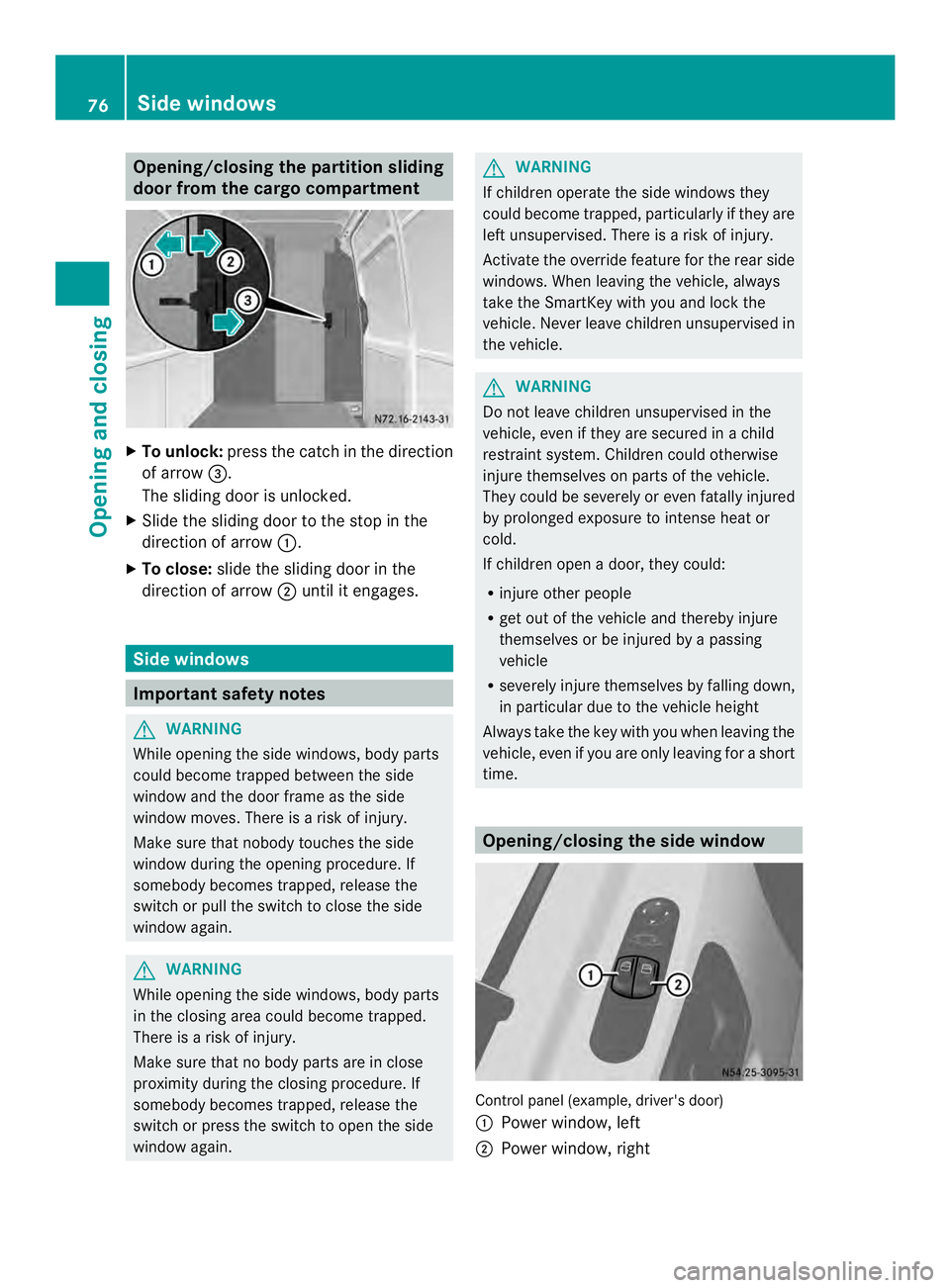
Opening/closing the partition sliding
door from the cargo compartment
X
To unlock: press the catch in the direction
of arrow 0026.
The sliding door is unlocked.
X Slide the sliding door to the stop in the
direction of arrow 0005.
X To close: slide the sliding door in the
direction of arrow 0006until it engages. Side windows
Important safety notes
G
WARNING
While opening the side windows, body parts
could become trapped between the side
window and the door frame as the side
window moves. There is a risk of injury.
Make sure that nobody touches the side
window during the opening procedure. If
somebody becomes trapped, release the
switch or pull the switch to close the side
window again. G
WARNING
While opening the side windows, body parts
in the closing area could become trapped.
There is a risk of injury.
Make sure that no body parts are in close
proximity during the closing procedure. If
somebody becomes trapped, release the
switch or press the switch to open the side
window again. G
WARNING
If children operate the side windows they
could become trapped, particularly if they are
left unsupervised. There is a risk of injury.
Activate the override feature for the rear side
windows. When leaving the vehicle, always
take the SmartKey with you and lock the
vehicle. Never leave children unsupervised in
the vehicle. G
WARNING
Do not leave children unsupervised in the
vehicle, even if they are secured in a child
restraint system. Children could otherwise
injure themselves on parts of the vehicle.
They could be severely or even fatally injured
by prolonged exposure to intense heat or
cold.
If children open a door, they could:
R injure other people
R get out of the vehicle and thereby injure
themselves or be injured by a passing
vehicle
R severely injure themselves by falling down,
in particular due to the vehicle height
Always take the key with you when leaving the
vehicle, even if you are only leaving for a short
time. Opening/closing the side window
Control panel (example, driver's door)
0005
Power window, left
0006 Power window, right 76
Side windowsOpening and closing
Page 82 of 334
Useful information
This Operator's Manual describes all models
as well as standard and optional equipment
of your vehicle that were available at the time
of going to print. Country-specific variations
are possible. Note that your vehicle may not
be equipped with all of the described
functions. This also applies to systems and
functions relevant to safety.
Read the information on qualified specialist
workshops (Y page 26). Seats
Important safety notes
G
WARNING
If the driver's seat is not engaged, it could
move unexpectedly while the vehicle is in
motion. This could cause you to lose control
of the vehicle. There is a risk of an accident.
Always make sure that the driver's seat is
engaged before starting the engine. G
WARNING
When you adjust a seat, you or other vehicle
occupants could become trapped, e.g. on the
seat guide rail. There is arisk of injury.
Make sure when adjusting aseat that no one
has any body parts in the sweep of the seat. G
WARNING
If head restraints are not installed and
adjusted correctly, they cannot provide
protection as intended. There is an increased
risk of injury in the head and neck area, e.g.
in the event of an accident or when braking.
Always drive with the head restraints
installed. Before driving off, make sure for
every vehicle occupant that the center of the
head restraint supports the back of the head
at about eye level. Observe also the safety notes in the sections
on "Air bags" (Y
page 44) and "Children in the
vehicle" ( Ypage 50).
Do not change over the head restraints for the
fron tand rea rseats. Otherwise, it will not be
possible to correctly adjust the height and
angle of the head restraints.
Use the head restraint pad to adjust the head
restraint so that it is as close as possible to
the back of your head.
Before the journey, make sure the head
restraints have been correctly set for each of
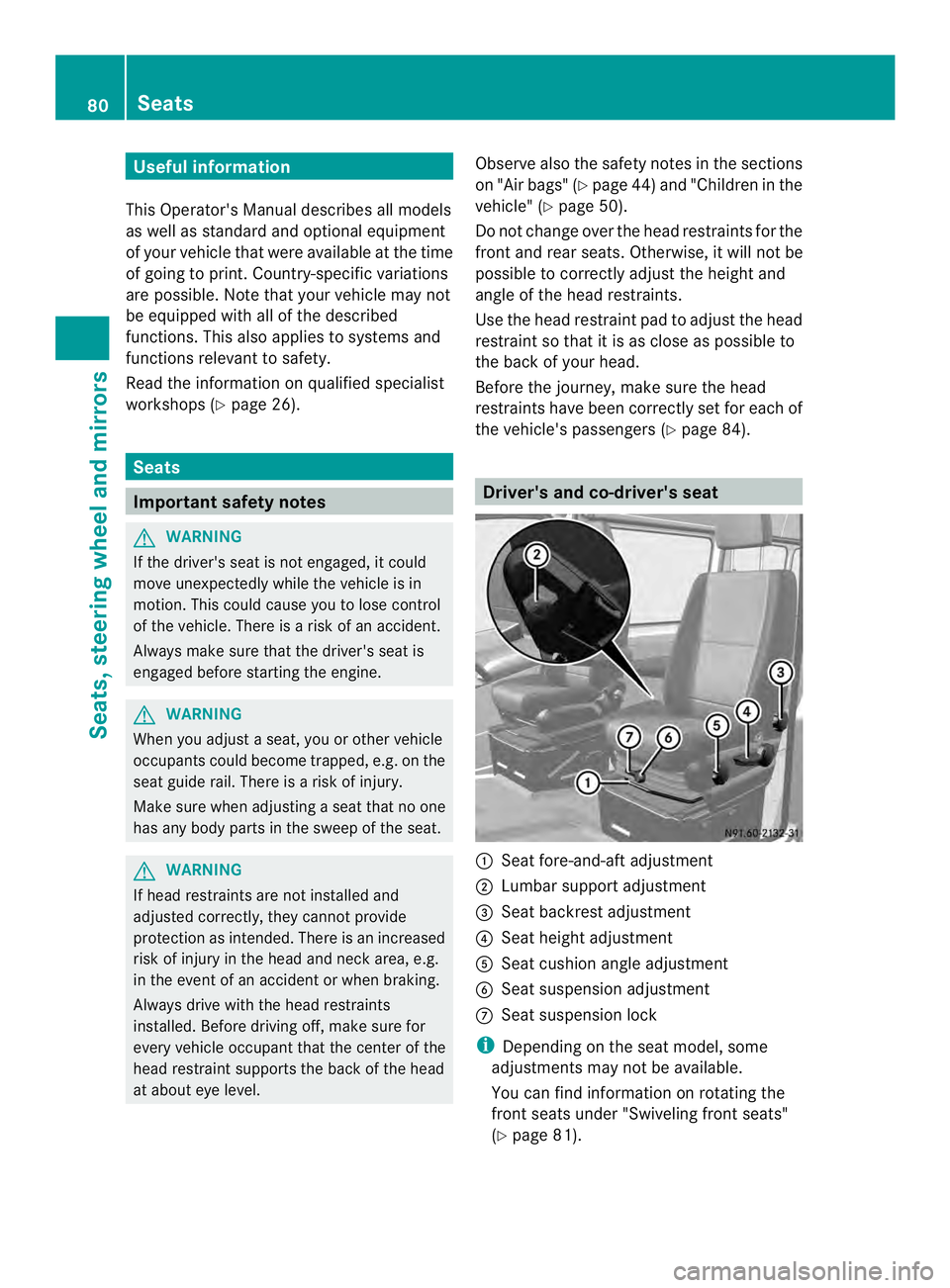
the vehicle's passengers (Y page 84). Driver's and co-driver's seat
0005
Seat fore-and-aft adjustment
0006 Lumbar support adjustment
0026 Seat backrest adjustment
0025 Seat height adjustment
0023 Seat cushion angle adjustment
0024 Seat suspension adjustment
0018 Seat suspension lock
i Depending on the seat model, some
adjustments may not be available.
You can find information on rotating the
fron tseats under "Swiveling fron tseats"
(Y page 81). 80
SeatsSeats, steering wheel and mirrors
Page 87 of 334
Seat heating
G
WARNING
Repeatedly switching on the seat heating can
cause the seat cushion and backrest pads to
become very hot. The health of persons with
limited temperature sensitivity or a limited
ability to react to excessively high
temperatures may be affected or they may
even suffer burn-like injuries. There is a risk
of injury.
Therefore, do not switch the seat heating on
repeatedly.
! When you leave your seat, do not place
anything on the seat and switch off the seat
heating. Do not switch the seat heating on
when the seat is not occupied, e.g. when
driving without a co-driver. The seat
heating may otherwise overheat, causing
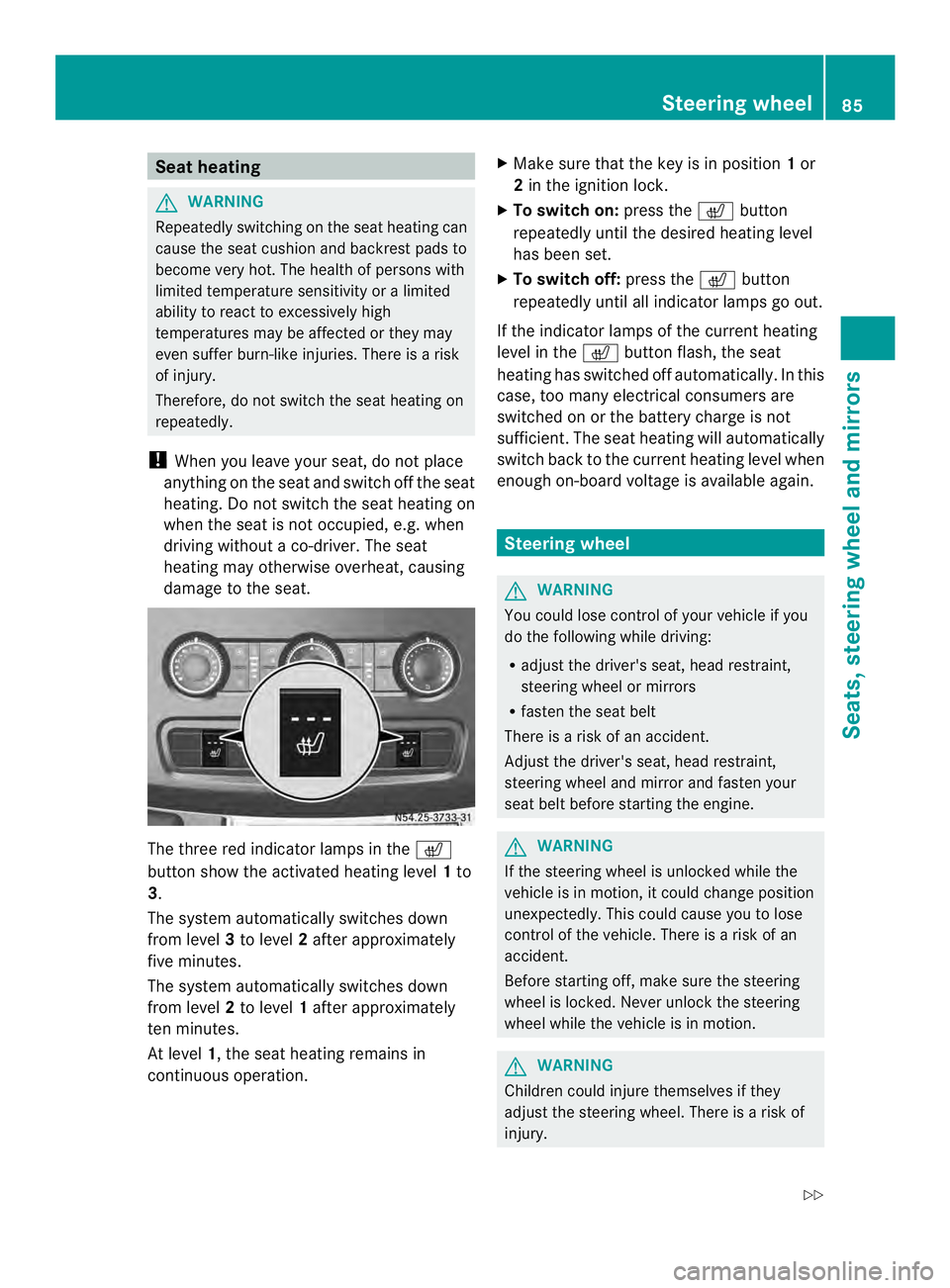
damage to the seat. The three red indicator lamps in the
0007
button show the activated heating level 1to
3.
The system automatically switches down
from level 3to level 2after approximately
five minutes.
The system automatically switches down
from level 2to level 1after approximately
ten minutes.
At level 1, the seat heating remains in
continuous operation. X
Make sure that the key is in position 1or
2 in the ignition lock.
X To switch on: press the0007button
repeatedly until the desired heating level
has been set.
X To switch off: press the0007button
repeatedly until all indicator lamps go out.
If the indicator lamps of the current heating
level in the 0007button flash, the seat
heating has switched off automatically. In this
case, too many electrical consumers are
switched on or the battery charge is not
sufficient. The seat heating will automatically
switch back to the current heating level when
enough on-board voltage is available again. Steering wheel
G
WARNING
You could lose control of your vehicle if you
do the following while driving:
R adjust the driver's seat, head restraint,
steering wheel or mirrors
R fasten the seat belt
There is a risk of an accident.
Adjust the driver's seat, head restraint,
steering wheel and mirror and fasten your
seat belt before starting the engine. G
WARNING
If the steering wheel is unlocked while the
vehicle is in motion, it could change position
unexpectedly. This could cause you to lose
control of the vehicle. There is a risk of an
accident.
Before starting off, make sure the steering
wheel is locked. Never unlock the steering
wheel while the vehicle is in motion. G
WARNING
Children could injure themselves if they
adjust the steering wheel. There is a risk of
injury. Steering wheel
85Seats, steering wheel and mirrors
Z
Page 88 of 334

When leaving the vehicle, always take the
SmartKey with you and lock the vehicle. Never
leave children unsupervised in the vehicle.
The steering wheel can still be adjusted if the
key has been removed. 0005
Steering column fore-and-aft adjustment
0006 Steering column height
0026 Lever
X To set the steering wheel: swing lever
0026 down until it engages.
The steering wheel is unlocked.
X Move the steering wheel to the desired
position.
X Pull lever 0026up to the stop.
The steering wheel is locked again. Mirrors
Rear-view mirror
X
Anti-glare mode: push anti-glare lever 0005
in the direction of the arrow. Exterior mirrors
Important safety notes G
WARNING
The additional mirrors in the exterior mirrors
reduce the size of the image. Objects visible
in the mirrors are closer than they appear. You
could misjudge the distance from road users
driving behind you when changing lanes, for
instance. There is a risk of an accident.
You should therefore always determine the
actual distance from road users driving
behind you, e.g.:
R by looking over your shoulder
R by looking in the main mirror in the exterior
mirror.
Adjusting manually X
Before starting off, manually adjust the
exterior mirrors in such a way that you can
get a good overview of road and traffic
conditions. 86
MirrorsSeats, steering wheel and mirrors
Page 128 of 334
At an outside temperature of up to
39 ‡(4 †) the fuel-fired heate
rbooster
system heats the vehicle interior as quickly
as possible when the engine is running.
The auxiliary heating automatically switches
to heater booster mode after the engine is
started.
At an outside temperature above 39 ‡(4 †)
the auxiliary heating system and the heater
booster function switch off automatically.
If you switch off the engine without switching
off the heater booster function, the system
will be switched on the next time the engine
is started (memory function).
i Switch the auxiliary heating on or off with
the 0020 button (Y page 119).
X To switch on/off: press the0013switch.
If the indicator lamp in the button lights up,
the heater booster function is switched on.
After switching off, the auxiliary heating
operates for about another three minutes and
then switches off automatically. Replacing the remote control battery
G
WARNING
Batteries contain toxic and corrosive
substances. If batteries are swallowed, it can
result in severe health problems. There is a
risk of fatal injury.
Keep batteries out of the reach of children. If
a battery is swallowed, seek medical attention
immediately. H
Environmental note Batteries contain dangerous
substances. It is against the
law to dispose of them with
the household rubbish. They
must be collected separately
and recycled to protect the
environment.
Dispose of batteries in an
environmentally friendly
manner
.Take discharged
batteries to a qualified
specialist workshop or a
special collectio npoint for
used batteries.
If the indicator lamp on the remote control
flashes red rapidly, the remote control battery
is discharged. You should replace the remote
control battery.
You need a battery of the type CR2430, which
can be obtained at any qualified specialist
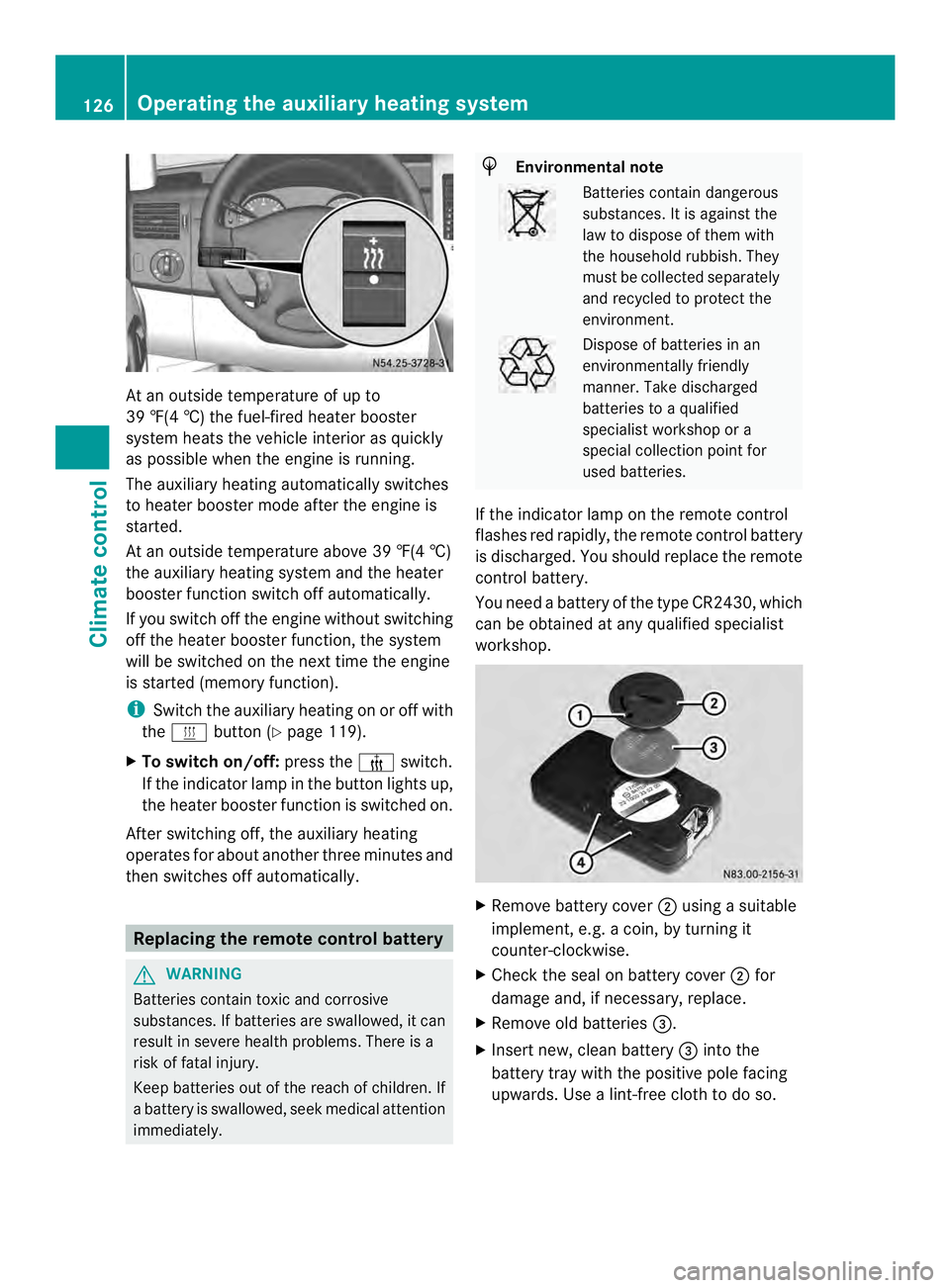
workshop. X
Remove battery cover 0006using a suitable
implement, e.g. a coin, by turning it
counter-clockwise.
X Check the seal on battery cover 0006for
damage and, if necessary, replace.
X Remove old batteries 0026.
X Insert new, clean battery 0026into the
battery tray with the positive pole facing
upwards. Use a lint-free cloth to do so. 126
Operating the auxiliary heating systemClimate control
Page 144 of 334
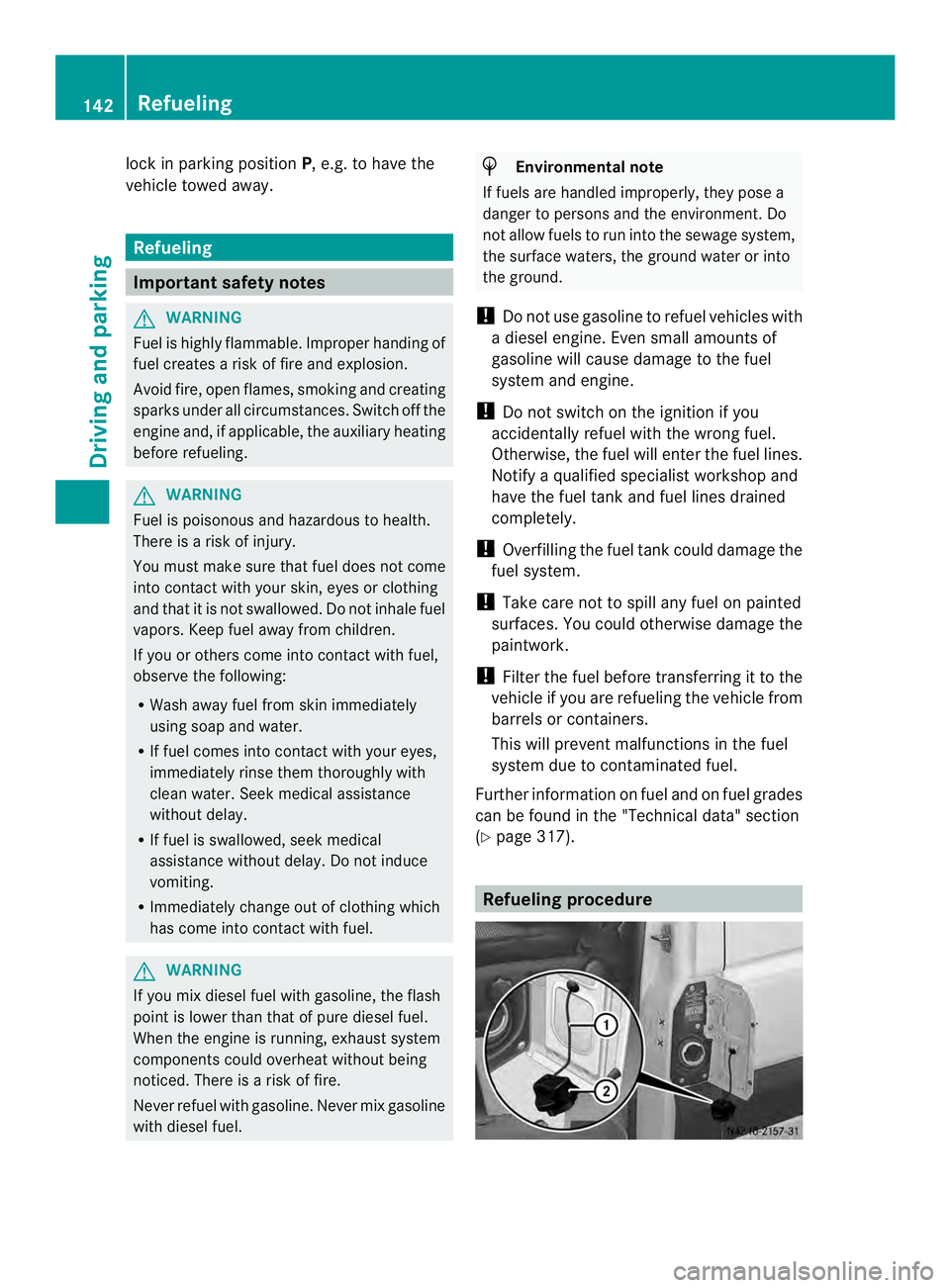
lock in parking position
P, e.g. to have the
vehicle towed away. Refueling
Important safety notes
G
WARNING
Fuel is highly flammable. Improper handing of
fuel creates a risk of fire and explosion.
Avoid fire, open flames ,smoking and creating
sparks under all circumstances. Switch off the
engine and, if applicable, the auxiliary heating
before refueling. G
WARNING
Fuel is poisonous and hazardous to health.
There is a risk of injury.
You must make sure that fuel does not come
into contact with your skin, eyes or clothing
and that it is not swallowed. Do not inhale fuel
vapors .Keep fuel away from children.
If you or others come into contact with fuel,
observe the following:
R Wash away fuel from skin immediately
using soap and water.
R If fuel comes into contact with your eyes,
immediately rinse them thoroughly with
clean water. Seek medical assistance
without delay.
R If fuel is swallowed, seek medical
assistance without delay. Do not induce
vomiting.
R Immediately change out of clothing which
has come into contact with fuel. G
WARNING
If you mix diesel fuel with gasoline, the flash
point is lower than that of pure diesel fuel.
When the engine is running, exhaust system
components could overheat without being
noticed. There is a risk of fire.
Never refuel with gasoline. Never mix gasoline
with diesel fuel. H
Environmental note
If fuels are handled improperly, they pose a
danger to persons and the environment. Do
not allow fuels to run into the sewage system,
the surface waters, the ground water or into
the ground.
! Do not use gasoline to refuel vehicles with
a diesel engine. Even small amounts of
gasoline will cause damage to the fuel
system and engine.
! Do not switch on the ignition if you
accidentally refuel with the wrong fuel.
Otherwise, the fuel will enter the fuel lines.
Notify a qualified specialist workshop and
have the fuel tank and fuel lines drained
completely.
! Overfilling the fuel tank could damage the
fuel system.
! Take care not to spill any fuel on painted
surfaces. You could otherwise damage the
paintwork.
! Filter the fuel before transferring it to the
vehicle if you are refueling the vehicle from
barrels or containers.
This will preven tmalfunctions in the fuel
system due to contaminate dfuel.
Further information on fuel and on fuel grades
can be found in the "Technical data" section
(Y page 317). Refueling procedure142
RefuelingDriving and pa
rking