flat tire MERCEDES-BENZ SPRINTER 2013 MY13 Operator’s Manual
[x] Cancel search | Manufacturer: MERCEDES-BENZ, Model Year: 2013, Model line: SPRINTER, Model: MERCEDES-BENZ SPRINTER 2013Pages: 334, PDF Size: 3.88 MB
Page 275 of 334
Useful information
............................274
Important safety notes ....................274
Operation ........................................... 274
Operation in winter ...........................276
Tire pressure ..................................... 278
Loading the vehicle ..........................286
What you should know about
wheels and tires ............................... 289
Flat tire .............................................. 295
Changing wheels ............................... 302
Wheel and tire combination .............308
Spare wheel ....................................... 308 273Wheels and tires
Page 276 of 334
Useful information
This Operator's Manual describes all models
as well as standard and optional equipment
of your vehicle that were available at the time
of going to print. Country-specific variations
are possible. Note that your vehicle may not
be equipped with all of the described
functions. This also applies to systems and
functions relevant to safety.
Read the information on qualified specialist
workshops (Y page 26). Important safety notes
G
Warning
Af lat tire severely impairs the driving,
steering and braking characteristics of the
vehicle. There is a risk of an accident.
do not drive with aflat tire. Immediately
replace the flat tire with your spare wheel, or
consult a qualified specialist workshop. G
WARNING
If wheels and tires of the wrong size are used,
the wheel brakes or suspension components
may be damaged. There is arisk of an
accident.
Always replace wheels and tires with those
that fulfill the specifications of the original
part.
When replacing wheels, make sure to use the
correct:
R designation
R model
When replacing tires, make sure to use the
correct:
R designation
R manufacturer
R model
Accessories that are not approved for your
vehicle or are not being used correctly can
impair operating safety. Before purchasing and using non-approved
accessories, visit a qualified specialist
workshop and inquire about:
R
suitability
R legal stipulations
R factory recommendations
Contact an authorized Sprinter dealer if you
require information on tested and
recommended wheels and tires for summer
and winter driving. Advice on purchasing and
caring for tires is also available there.
Informatio nontire and wheel dimensions and
types as well as the recommended tire
pressure for your vehicle can be found in the
"Tire pressure" section (Y page 285).
This data can also be foun donthe Tire and
Loading Information placard on the B-pillar.
Modifications to the brake system or wheels
are not permitted. The use of wheel spacers
or brake dust shields is not permitted. This
invalidates the general operating permit for
the vehicle.
i Further information on wheels and tires
can be obtained at any qualified specialist
workshop. Operation
Information for a journey
If the vehicle is heavily laden, check the tire
pressures, and correct them, if necessary.
While driving, pay attention to vibrations,
noises and unusual handling characteristics,
e.g. pulling to one side. This may indicate that
the wheels or tires are damaged. If you
suspect that a tire is defective, reduce your
speed immediately. Stop the vehicle as soon
as possible to check the wheels and tires for
damage. Hidden tire damage could also be
causing the unusual handling characteristics.
If you find no signs of damage, have the tires
and wheels checked at a qualified specialist
workshop. 274
OperationWheels and tires
Page 277 of 334
When parking your vehicle, make sure that
the tires do not get deformed by the curb or
other obstacles. If it is necessary to drive over
curbs, speed humps or similar elevations, try
to do so slowly and not at a sharp angle.
Otherwise, the tires, particularly the
sidewalls, can get damaged. Regular wheel and tirec
hecksG
WARNING
Damaged tires can cause tire inflation
pressure loss .As a result, you could lose
control of your vehicle. There is a risk of
accident.
Check the tires regularly for signs of damage
and replace any damaged tires immediately.
Check the wheels and tires of your vehicle for
damage regularly, i.e. at least every two
weeks, as well as after driving off-road or on
rough roads. Damaged wheels can cause a
loss of tire pressure. Pay particular attention
to damage such as:
R cuts in the tires
R punctures
R tears in the tires
R bulges on tires
R deformation or severe corrosion on wheels
Regularly check the tire tread depth and the
condition of the tread across the whole width
of the tire (Y page 275). If necessary, turn
the front wheels to full lock in order to inspect
the inner side of the tire surface.
All wheels must have a valve cap to protect
the valve against dirt and moisture. Do not
install anything onto the valve other than the
standard valve cap or other valve caps
approved for your vehicle by dealers listed on
the inside of the front cover. Do not install any
other valve caps or systems, e.g. tire pressure
monitor systems.
Regularly check the pressure of all the tires,
particularly prior to long trips. Adjust the tire
pressure if necessary (Y page 278).The service life of tires depends on various
factors, including the following:
R
driving style
R tire pressure
R mileage Tire tread
G
WARNING
Insufficient tire tread will reduce tire traction.
The tire is no longer able to dissipate water.
This means that on wet road surfaces, the risk
of hydroplaning increases, in particular where
speed is not adapted to suit the driving
conditions. There is a risk of accident.
If the tire pressure is too high or too low, tires
may exhibit different levels of wear at
different locations on the tire tread. Thus, you
should regularly check the tread depth and
the condition of the tread across the entire
width of all tires.
Minimum tire tread depth for:
R Summer tires: 000Cin (3 mm)
R M+S tires: 000Din (4 mm)
For safety reasons, replace the tires before
the legally prescribed limit for the minimum
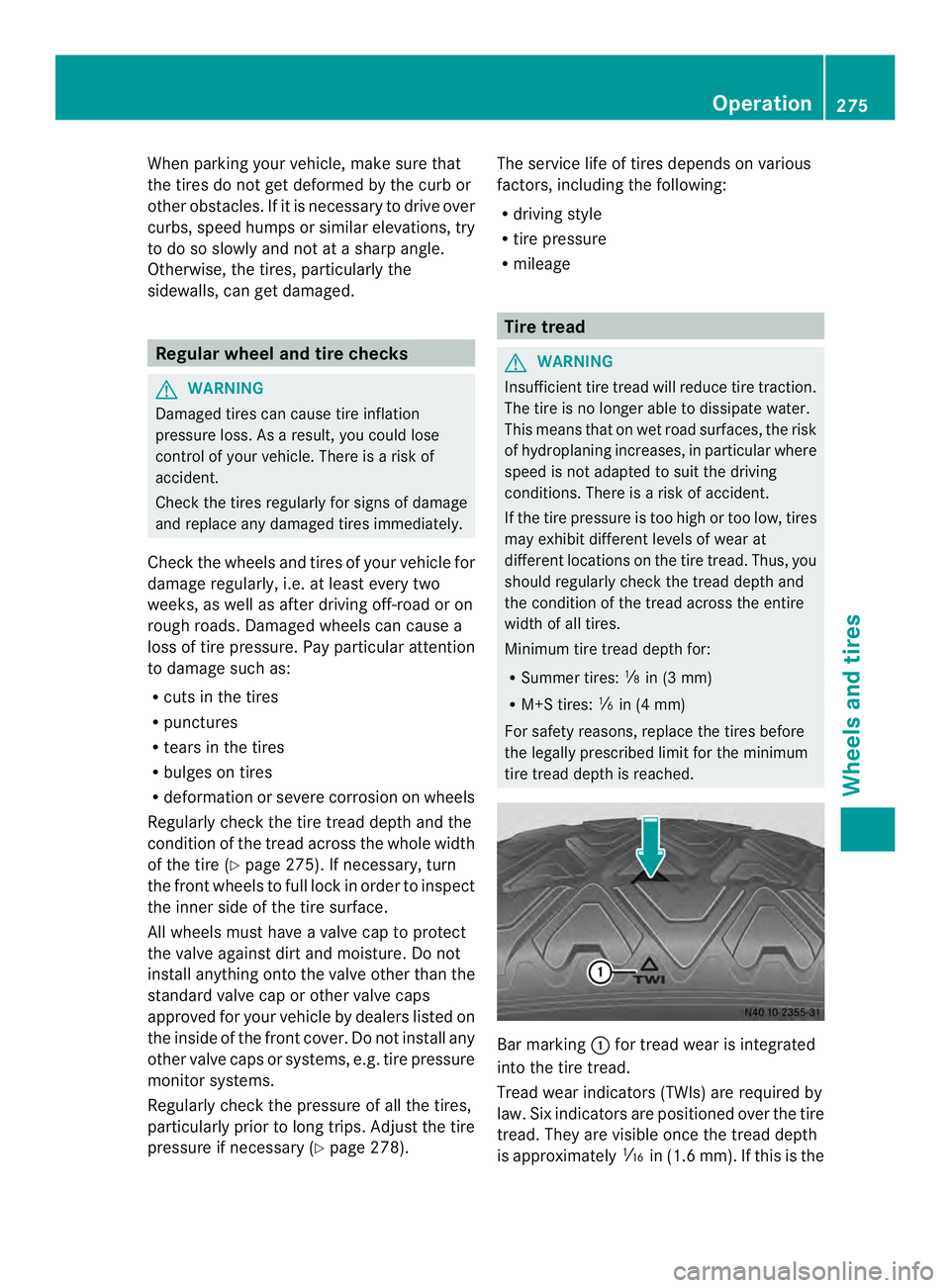
tire tread depth is reached. Bar marking
0005for tread wear is integrated
into the tire tread.
Tread wear indicators (TWIs) are required by
law. Six indicators are positioned over the tire
tread. They are visible once the tread depth
is approximately 000Bin (1.6 mm). If this is the Operation
275Wheels and tires Z
Page 280 of 334
Tire pressure
Tire pressure specifications
Important safety notes G
WARNING
Underinflated or overinflated tires pose the
following risks:
R the tires may burst, especially as the load
and vehicle speed increase.
R the tires may wear excessively and/or
unevenly, which may greatly impai rtire
traction.
R the driving characteristics, as well as
steering and braking, may be greatly
impaired.
There is a risk of an accident.
Follow recommended tire inflation pressures
and chec kthe pressure of all the tires
including the spare wheel:
R monthly, at least
R if the load changes
R before beginning a long journey
R under different operating conditions, e.g.
off-road driving
If necessary, correct the tire pressure.
i The specifications shown on the sample
Tire and Loading Information placard and
tire pressure table are examples. Tire
pressure data are vehicle-specific and may
deviate from the data illustrated here. The
tire pressure data applicable to your
vehicle can be found on the Tire &Loading
Information placard or tire pressure plate
of your vehicle. H
Environmental note
Check the tire pressure regularly, at least
every 14 days. General notes You will find information on tire pressure for
the vehicle's factory-mounted tires on the
plates described here.
You will find a table of recommended tire
pressures on the Tire and Loading
Information placard
5
or on the tire pressure
table on the B-pillar on the driver's side of the
vehicle.
Further information on tire pressure can be
obtained at a qualified specialist workshop.
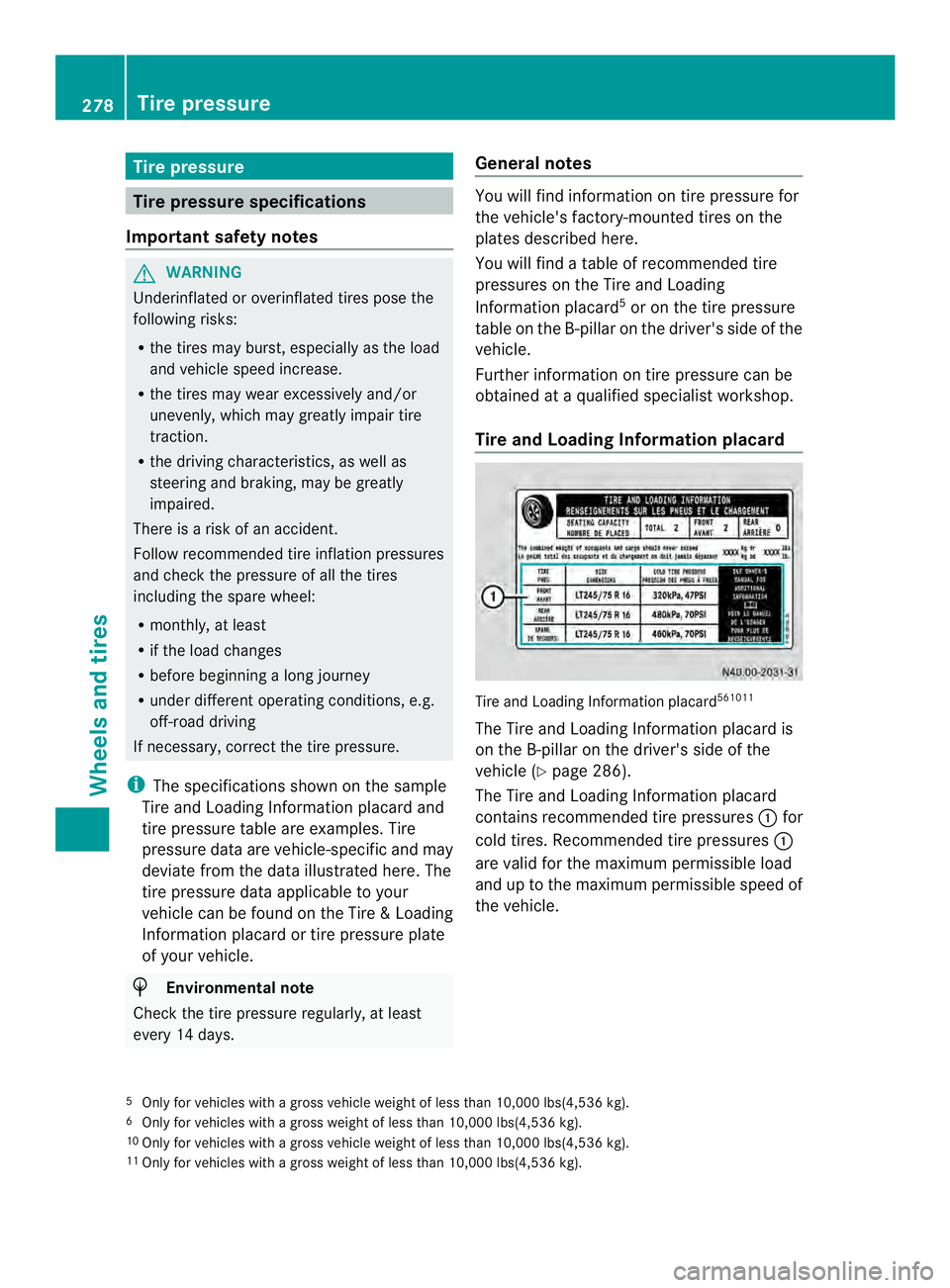
Tire and Loading Information placard Tire and Loading Information placard
561011
The Tire and Loading Information placard is
on the B-pillar on the driver's side of the
vehicle (Y page 286).
The Tire and Loading Information placard
contains recommended tire pressures 0005for
cold tires. Recommended tire pressures 0005
are valid for the maximum permissible load
and up to the maximum permissible speed of
the vehicle.
5 Only for vehicles with a gross vehicle weight of less than 10,000 lbs(4,536 kg).
6 Only for vehicles with a gross weight of less than 10,000 lbs(4,536 kg).
10 Only for vehicles with a gross vehicle weight of less than 10,000 lbs(4,536 kg).
11 Only for vehicles with a gross weight of less than 10,000 lbs(4,536 kg). 278
Tire pressureWheels and tires
Page 281 of 334
Tire pressure plate
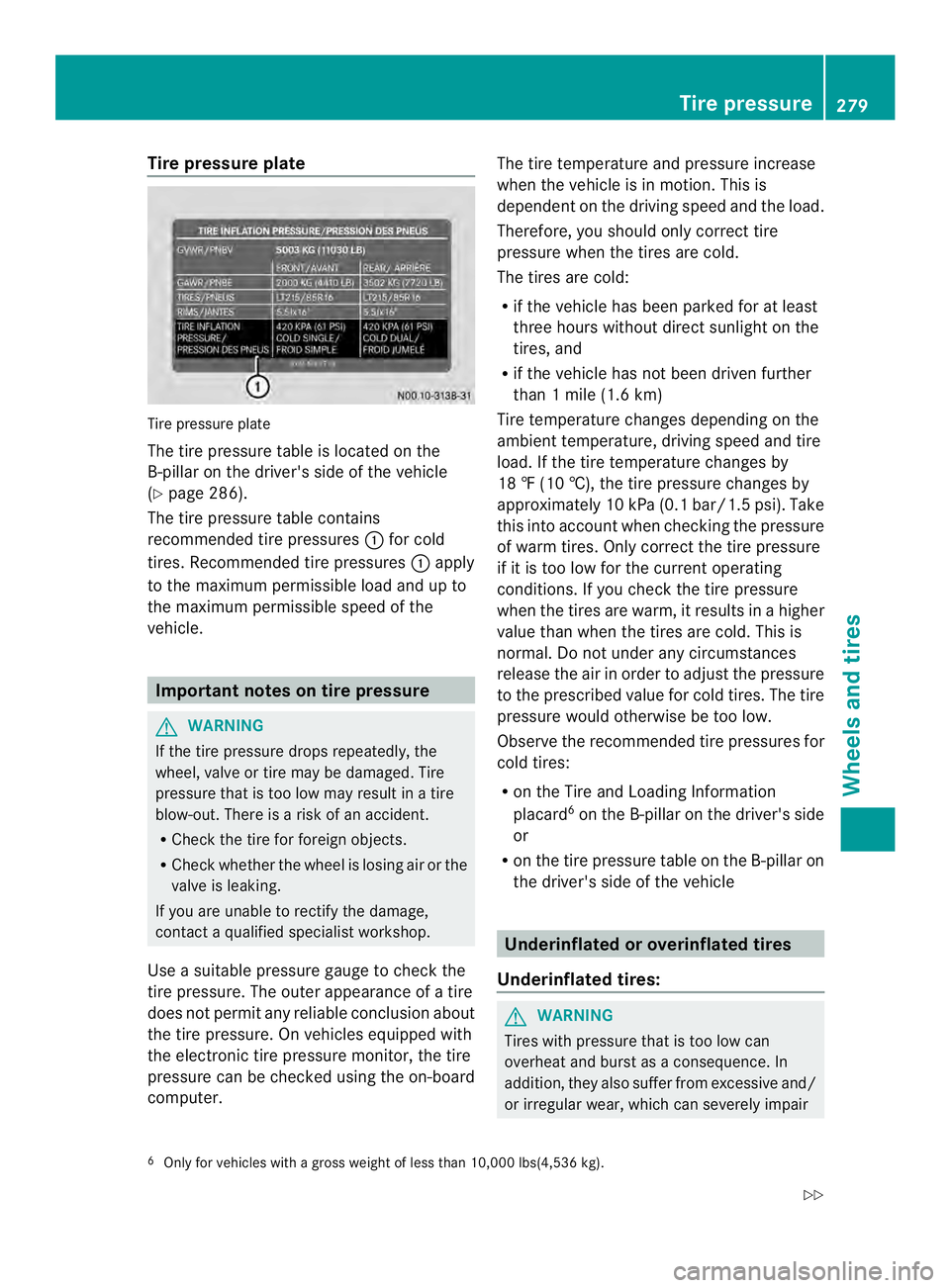
Tire pressure plate
The tire pressure table is located on the
B-pillar on the driver's side of the vehicle
(Y page 286).
The tire pressure table contains
recommended tire pressures 0005for cold
tires. Recommended tire pressures 0005apply
to the maximum permissible load and up to
the maximum permissible speed of the
vehicle. Important notes on tire pressure
G
WARNING
If the tire pressure drops repeatedly, the
wheel, valve or tire ma ybe damaged. Tire
pressure that is too low may result in a tire
blow-out. There is a risk of an accident.
R Check the tire for foreign objects.
R Check whether the wheel is losing air or the
valve is leaking.
If you are unable to rectify the damage,
contact a qualified specialist workshop.
Use a suitable pressure gauge to chec kthe
tire pressure. The outer appearance of a tire
does not permit any reliable conclusion about
the tire pressure. On vehicles equipped with
the electronic tire pressure monitor, the tire
pressure can be checked using the on-board
computer. The tire temperature and pressure increase
when the vehicle is in motion. This is
dependent on the driving speed and the load.
Therefore, you should only correct tire
pressure when the tires are cold.
The tires are cold:
R
if the vehicle has been parked for at least
three hours without direct sunlight on the
tires, and
R if the vehicle has not been driven further
than 1 mile (1.6 km)
Tire temperature changes depending on the
ambient temperature, driving speed and tire
load. If the tire temperature changes by
18 ‡(10 †), the tire pressure changes by
approximately 10 kPa (0. 1bar/1. 5psi). Take
this into account when checking the pressure
of warm tires. Only correct the tire pressure
if it is too low for the current operating
conditions. If you check the tire pressure
when the tires are warm, it results in a higher
value than when the tires are cold. This is
normal. Do not under any circumstances
release the air in order to adjust the pressure
to the prescribed value for cold tires. The tire
pressure would otherwise be too low.
Observe the recommended tire pressures for
cold tires:
R on the Tire and Loading Information
placard 6
on the B-pillar on the driver's side
or
R on the tire pressure table on the B-pillar on
the driver's side of the vehicle Underinflated or overinflated tires
Underinflated tires: G
WARNING
Tires with pressure that is too low can
overheat and burst as a consequence. In
addition, they also suffer from excessive and/
or irregularw ear, which can severely impair
6 Only for vehicles with a gross weight of less than 10,00 0lbs(4,536 kg). Tire pressure
279Wheels and tires
Z
Page 282 of 334
the braking properties and the driving
characteristics .There is a risk of an accident.
Avoid tire pressures that are too low in all the
tires, including the spare wheel.
Underinflated tires can:
R fail from being overheated
R adversely affect handling
R wear excessively and/or unevenly
R have an adverse effect on fuel consumption
Overinflated tires G
WARNING
Tires with excessively high pressure can burst
because they are damaged more easily by
road debris, potholes etc. In addition, they
also suffer from irregular wear, which can
severely impair the braking properties and the
driving characteristics. There is a risk of an
accident.
Avoid tire pressures that are too high in all the
tires, including the spare wheel.
Overinflated tires can:
R increase the braking distance
R adversely affect handling
R wear excessively and/or unevenly
R adversely affect ride comfort
R be more susceptible to damage
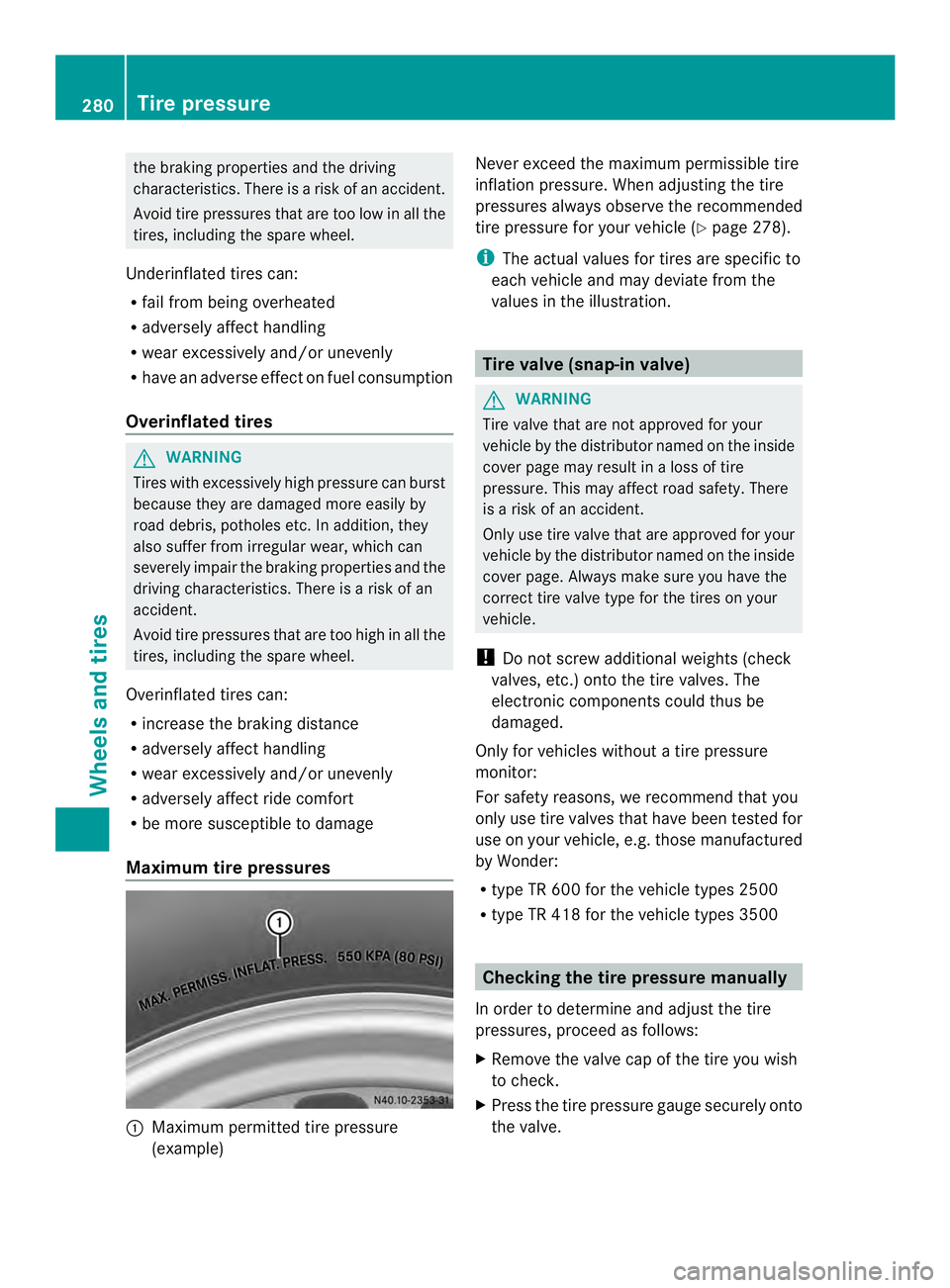
Maximum tire pressures 0005
Maximum permitted tire pressure
(example) Never exceed the maximum permissible tire
inflation pressure. When adjusting the tire
pressures always observe the recommended
tire pressure for your vehicle (Y
page 278).
i The actual values for tires are specific to
each vehicle and may deviate from the
values in the illustration. Tire valve (snap-in valve)
G
WARNING
Tire valve that are not approved for your
vehicle by the distributor named on the inside
cover page may result in a loss of tire
pressure. This may affect road safety. There
is a risk of an accident.
Only use tire valve that are approved for your
vehicle by the distributor named on the inside
cover page. Always make sure you have the
correct tire valve type for the tires on your
vehicle.
! Do not screw additional weights (check
valves, etc.) onto the tire valves. The
electronic components could thus be
damaged.
Only for vehicles without atire pressure
monitor:
For safety reasons, we recommend that you
only use tire valves that have been tested for
use on your vehicle, e.g. those manufactured
by Wonder:
R type TR 600 for the vehicle types 2500
R type TR 418 for the vehicle types 3500 Checking the tire pressure manually
In order to determine and adjust the tire
pressures, proceed as follows:
X Remove the valve cap of the tire you wish
to check.
X Press the tire pressure gauge securely onto
the valve. 280
Tire pressureWheels and tires
Page 283 of 334
X
Read the tire pressure and compare it with
the recommended value on the loading
information table or th etire pressure table
(Y page 278).
X If the tire pressure is too low, increase it to
the recommended value.
X If the tire pressure is too high, release air
by pressing down the metal pin in the valve.
Use the tip of a pen, for example. Then,
chec kthe tire pressure again using the tire
pressure gauge.
X Screw the valve cap onto the valve.
X Repeatt he steps for the other tires. Tire pressure monitor
Important safety notes G
WARNING
Each tire, including the spare (if provided),
should be checked at least once a month
when cold and inflated to the pressure
recommended by the vehicle manufacturer
on the Tire and Loading Information placard
on the driver's door B-pillar or the tire
pressure label on the inside of the fuel filler
flap. If your vehicle has tires of a different size
than the size indicated on the Tire and Loading
Information placard or the tire pressure label,
you should determine the proper tire pressure
for those tires.
As an added safety feature, your vehicle has
been equipped with a tire pressure monitoring
system (TPMS) that illuminates a low tire
pressure telltale when one or more of your
tires are significantly underinflated.
Accordingly, when the low tire pressure
telltale illuminates, you should stop and check
your tires as soon as possible, and inflate
them to the proper pressure. Driving on a
significantly underinflated tire causes the tire
to overheat and can lead to tire failure.
Underinflation also reduces fuel efficiency
and tire tread life, and may affect the vehicle's
handling and stopping ability. Please note that the TPMS is not a substitute
for proper tire maintenance, and it is the
driver's responsibility to maintain correct tire
pressure, even if underinflation has not
reached the level to trigger illumination of the
TPMS low tire pressure telltale.
USA only:
Your vehicle has also been equipped with a
TPMS malfunction indicator to indicate if the
system is not operating properly. The TPMS
malfunction indicator is combined with the
low tire pressure telltale. When the system
detects a malfunction, the warning lamp will
flash for approximately a minute and then
remain continuously illuminated. This
sequence will be repeated every time the
vehicle is started as long as the malfunction
exists.
When the malfunction indicator is illuminated,
the system may not be able to detect or signal
low tire pressure as intended. TPMS
malfunctions may occur for a variety of
reasons, including the installation of
incompatible replacement or alternate tires
or wheels on the vehicle that prevent the
TPMS from functioning properly. Always
check the TPMS malfunction telltale after
replacing one or more tires or wheels on your
vehicle to ensure that the replacement or
alternate tires and wheels allow the TPMS to
continue to function properly.
Vehicles with a tire pressure monitor are
equipped with sensors in the wheels that
monitor the tire pressure of all four tires. The
tire pressure monitor monitors the pressure
in all four tires; you set this pressure when
you activate the tire pressure monitor. The
tire pressure monitor warns you when the
pressure drops in one or more of the tires. The
tire pressure monitor only functions if the
corresponding sensors are installed to all
wheels.
You should always adjust the tire pressure
according to the vehicle load. Restart the tire
pressure monitor if you change the tire
pressure. Tire pressure
281Wheels and tires Z
Page 284 of 334
The tire pressure monitor does not warn you
if a tire pressure is incorrect. Observe the
notes on the recommended tire pressure
(Y page 278).
The tire pressure monitor is not able to warn
you of a sudden loss of pressure, e.g.
following penetration by a foreign object .In
this event, brake the vehicle until it comes to
a standstill. Do not carry ou tany sudden
steering maneuvers.
The tire pressure monitor has a yellow 000A
warning lamp in the instrument cluster for
indicating pressure loss/malfunctions (USA)
or pressure loss (Canada). Depending on how
the warning lamp flashes or lights up, an
underinflated tire or a malfunction in the tire
pressure monitor is displayed:
R if the 000A warning lamp is li tcontinuously,
the tire pressure on one or more tires is
significantly too low. The tire pressure
monitor is not malfunctioning.
R USA only: if the 000Awarning lamp flashes
for 60 seconds and then remains lit
constantly, the tire pressure monitor is
malfunctioning.
Only vehicles with steerin gwheel buttons: the
on-board computer displays information on
tire pressure. After a few minutes of driving,
the current tire pressure of each tire is shown
in the on-board computer.
USA only: if the tire pressure monitor is
malfunctioning, it may be more than
10 minutes before the malfunction is shown.
The 000A tire pressure warning lamp flashes
for 60 seconds and then remains lit. When the
malfunction has been rectified, the 000Atire
pressure warning lamp goes out after a few
minutes of driving.
The tire pressure values indicated by the on-
board computer may differ from those
measured at a gas station with a pressure
gauge. The tire pressures shown by the on-
board computer refer to those measured at
sea level. At high altitudes, the tire pressure
value indicated by a pressure gauge are
higher than those shown by the on-board computer. In this case, do not reduce the tire
pressures.
If radio transmitting equipment (e.g. wireless
headphones, two-way radios) is operated
inside the vehicle or in the vicinity of the
vehicle, this can interfere with the operation
of the tire pressure monitor.
Checking the tire pressure
electronically (vehicles with steering
wheel buttons)
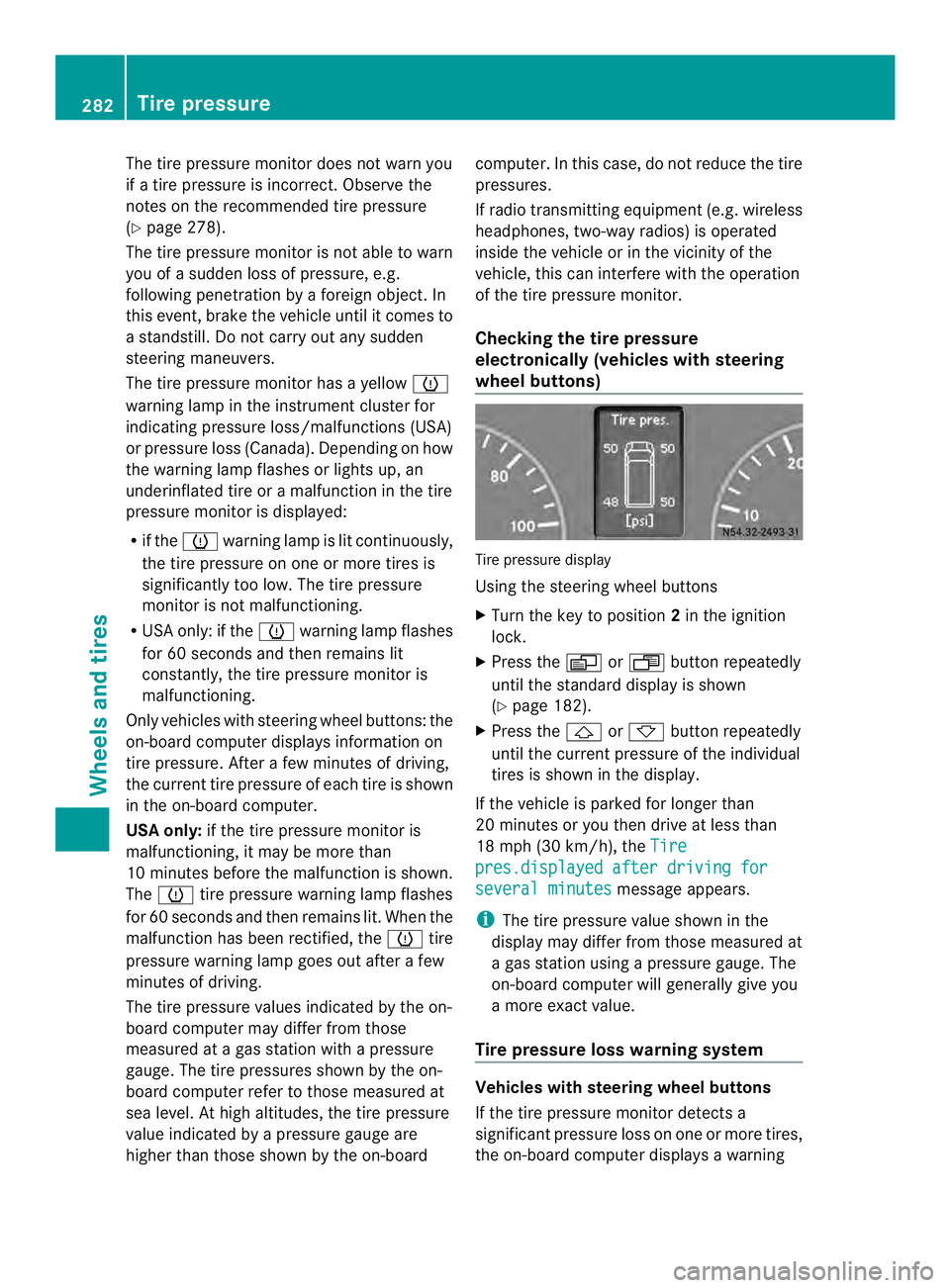
Tire pressure display
Using the steering wheel buttons
X
Turn the key to position 2in the ignition
lock.
X Press the 0010or0007 button repeatedly
until the standard display is shown
(Y page 182).
X Press the 0001or0009 button repeatedly
until the current pressure of the individual
tires is shown in the display.
If the vehicle is parked for longer than
20 minutes or you then drive at less than
18 mph (30 km/h), the Tire pres.displayed after driving for
several minutes message appears.
i The tire pressure value shown in the
display may differ from those measured at
a gas station using a pressure gauge. The
on-board computer will generally give you
a more exact value.
Tire pressure loss warning system Vehicles with steering wheel buttons
If the tire pressure monitor detects a
significant pressure loss on one or more tires,
the on-board computer displays a warning282
Tire pressureWheels and tires
Page 297 of 334
Traction
Traction is the result of friction between the
tires and the road surface.
TWR (permissible trailer drawbar load)
The TWR is the maximu mpermissible weight
that may act on the ball coupling of the trailer
tow hitch.
Wear indicator
Narrow bars (tread wear bars) that are
distributed over the tire tread. If the tire tread
is level with the bars, the wear limit of 000Bin
(1.6 mm) has been reached.
Distribution of the vehicle occupants
The distribution of vehicle occupants over
designated seat positions in avehicle.
Maximum permissible payload weight
Nominal load and goods/luggage load plus
68 kg (150 lbs) multiplied by the number of
seats in the vehicle. Flat tire
General notes
Your vehicle may be equipped with Premium
tire sealant or with a spare wheel. The spare
wheel is under the vehicle at the rear
(Y page 308). The Premium tire sealant is
located in the stowage compartment in the
right-hand door sill (Y page 264).
You can find information on changing/
mounting wheels in the "Wheel change"
section (Y page 303).
When you replace a tire, we recommend that
you also replace the tire valve. Please observe
the safety-relevant information on tire valve
(Y page 280). Vehicle preparation
X Stop the vehicle as far away as possible
from traffic and on a level, firm and non-slip
surface.
X Switch on the hazard warning lamps if the
vehicle poses a hazard to passing vehicles.
X Turn the fron twheels to the straight-ahead
position.
X Move the selector lever of the automatic
transmission to position P.
X Switch off the engine.
X Passengers should leave the vehicle. Make
sure that the passengers are not
endangered as they do so.
X Make sure that no one is near the danger
area while a wheel is being changed.
Anyone who is not directly assisting in the
wheel change should, for example, stand
behind the barrier.
X Place the warning triangle or warning lamp
at a suitable distance.
Observe legal requirements. Using Premium tire sealant
Using Premium tire sealant You can use Premium tire sealant to seal
punctures of up to 0.23 in (6 mm), particularly
those in the tire tread. Tire sealant can be
used at outside temperatures down to
002722 ‡ (002730 †).
G
WARNING
In the following situations, the tire sealant is
unable to provide sufficient breakdown
assistance, as it is unable to seal the tire
properly:
R there are cuts or punctures in the tire larger
than those mentioned above.
R the wheel rim is damaged.
R you have driven at very low tire pressures
or on a flat tire.
There is a risk of an accident. Flat tire
295Wheels and tires
Z
Page 298 of 334

Do not drive any further. Contact a qualified
specialis tworkshop. G
WARNING
The tire sealant is harmful and causes
irritation. It must not come into contact with
your skin, eyes or clothing or be swallowed.
Do not inhale TIREFIT fumes. Keep tire sealant
away from children. There is a risk of injury.
If you come into contact with the tire sealant,
observe the following:
R Rinse off the tire sealant from your skin
immediately with water.
R If the tire sealant comes into contact with
your eyes, immediately rinse them
thoroughly with clean water.
R If tire sealant is swallowed, immediately
rinse your mouth out thoroughly and drink
plenty of water. Do not induce vomiting,
and seek medical attention immediately.
R Immediately change out of clothing which
has come into contact with tire sealant.
R If an allergic reaction occurs, seek medical
attention immediately.
In addition, observe the manufacturer's
safety instructions on the sticker on the tire
inflation compressor and on the sticker on the
tire sealant bottle.
The tire sealant is water-soluble. If tire sealant
escapes, you can wash it off with water.
i Have the tire sealant replaced every
8y ears at a qualified specialist workshop.
! The tire inflation compressor should only
be connected to the 12 V socket in the
center console. You may otherwise
damage the vehicle's electrics.
! Do not operate the tire inflation
compressor for longer than 20 minutes at
a time without a break. The tire inflation
compressor may otherwise overheat.
The tire inflation compressor can be
operated again once it has cooled down. H
Environmental note
Have the used tire sealant bottle disposed of
professionally, e.g. at aqualified specialist
workshop.
X Prepare the vehicle as described
(Y page 295).
X If possible, remove the foreign object that
has pierced the tire, e.g .the screw or the
nail.
It is beneficial to the sealing process if the
foreign body that has pierced the tire is
removed.
X Remove the Premium tire sealant, the
accompanying
"max 50 mph"("max80 km/h") sticker and
the tire inflation compressor from the
stowage compartmentint he right-hand
doorway (Y page 264).
X Affix the sticker within the driver's field of
vision. Tire inflation compressor
0005
Switch
0006 Angled connecting piece
0026 Tire inflation compressor hose
0025 Flap
0023 Pressure gauge with pressure release
screw
0024 Connector with cable
X Open flap 0025on the tire inflation
compressor.
X Pull connector 0024and hose 0026with
pressure gauge 0023from the housing. 296
Flat tireWheels and tires