tow bar MERCEDES-BENZ SPRINTER 2013 MY13 Operator’s Manual
[x] Cancel search | Manufacturer: MERCEDES-BENZ, Model Year: 2013, Model line: SPRINTER, Model: MERCEDES-BENZ SPRINTER 2013Pages: 334, PDF Size: 3.88 MB
Page 173 of 334
is installed and secured correctly before every
journey.
If your vehicle is equipped with a Sprinter
trailer tow hitch, you need a ball coupling that
is approved for the trailer tow hitch.
When mounting and removin gthe approved
ball coupling, observe the relevant
information in the operating instructions of
the ball coupling manufacturer.
If you cannot mount the ball coupling
correctly, remove it. In this case, the ball
coupling may not be used for towing a trailer.
Notes on the permissible dimensions and
weights can also be found on the
identification plate of the trailer tow hitch.
You can obtain advice from a qualified
specialist workshop. Coupling up a trailer
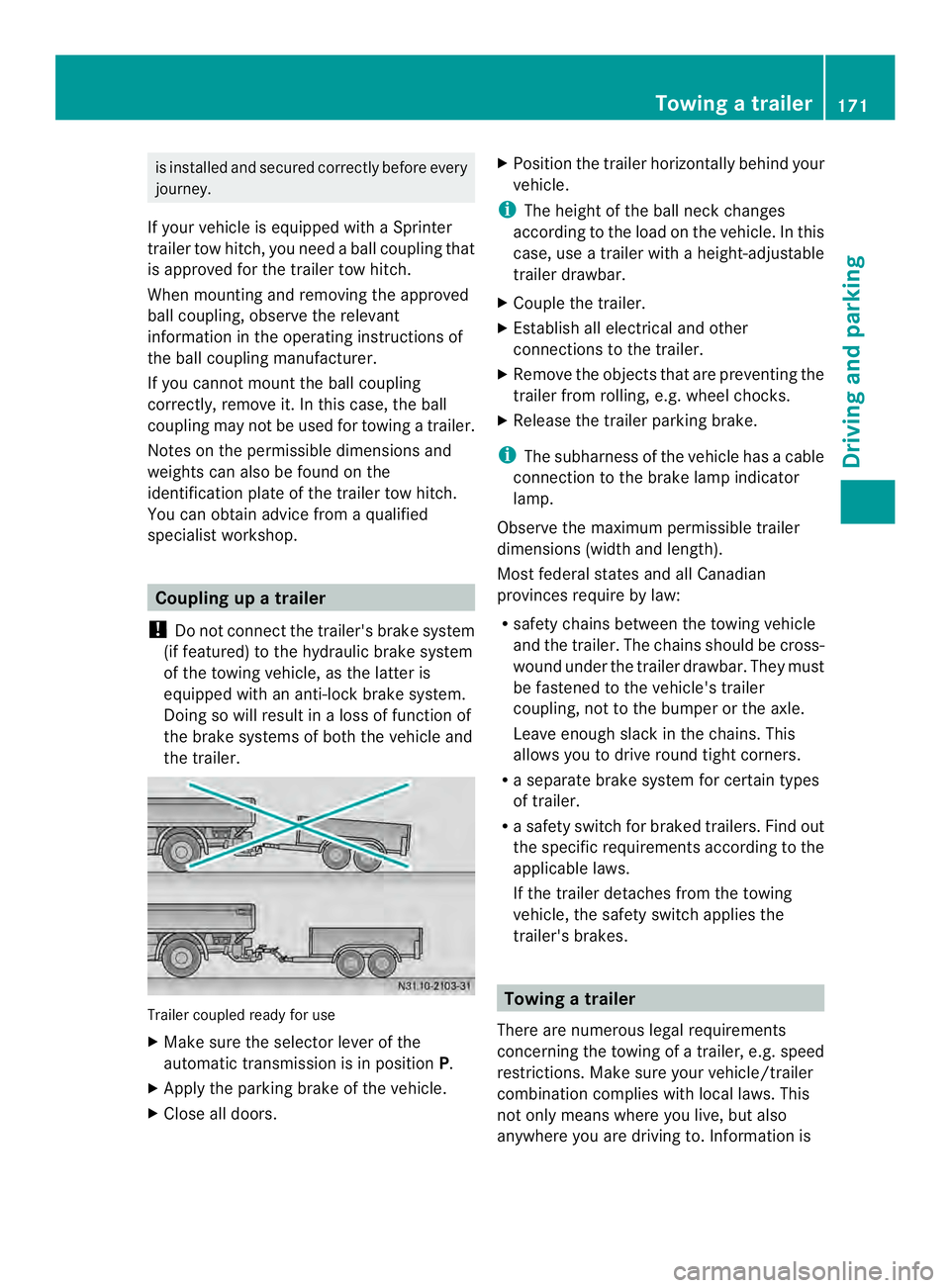
! Do not connect the trailer's brake system
(if featured) to the hydraulic brake system
of the towing vehicle, as the latter is
equipped with an anti-lock brake system.
Doing so will result in a loss of function of
the brake systems of both the vehicle and
the trailer. Trailer coupled ready for use
X
Make sure the selector lever of the
automatic transmission is in position P.
X Apply the parking brake of the vehicle.
X Close all doors. X
Position the trailer horizontally behind your
vehicle.
i The height of the ball neck changes
according to the load on the vehicle. In this
case, use a trailer with aheight-adjustable
trailer drawbar.
X Couple the trailer.
X Establish all electrical and other
connections to the trailer.
X Remove the objects that are preventing the
trailer from rolling, e.g. wheel chocks.
X Release the trailer parking brake.
i The subharness of the vehicle has a cable
connection to the brake lamp indicator
lamp.
Observe the maximum permissible trailer
dimensions (width and length).
Most federal states and all Canadian
provinces require by law:
R safety chains between the towing vehicle
and the trailer. The chains should be cross-
wound under the trailer drawbar. They must
be fastened to the vehicle's trailer
coupling, not to the bumper or the axle.
Leave enough slack in the chains. This
allows you to drive round tight corners.
R a separate brake system for certain types
of trailer.
R a safety switch for braked trailers. Find out
the specific requirements according to the
applicable laws.
If the trailer detaches from the towing
vehicle, the safety switch applies the
trailer's brakes. Towing
atrailer
There are numerous legal requirements
concerning the towing of a trailer, e.g .speed
restrictions. Make sure your vehicle/trailer
combination complies with local laws. This
not only means where you live, but also
anywhere you are driving to. Information is Towing
atrailer
171Driving an d parking Z
Page 174 of 334
available from the police and local
authorities.
Observe the following when towing a trailer:
R
Practice driving around bends, stopping
and backing up at a place where there is no
traffic. This enables you to gain experience
and get used to the new handling
characteristics.
R Before driving, check:
-that the trailer tow hitch and ball
coupling are secure
- that the safety switch for a braked trailer
is functioning properly
- that the safety chains are secure and not
damaged
- that the electrical connections are
secure
- that the lights are working
- that the wheels are in good order and the
tire pressure is correct
R Adjust the exterior mirrors to provide an
unobstructed view of the rear sectio nofthe
trailer.
R If the trailer has electronically controlled
brakes, pull the vehicle/trailer
combination away carefully. Brake
manually using the brake controller and
check that the brakes are working.
R Secure the load on the trailer according to
the applicable specifications and current
standards on securing loads
(Y page 234).
R When driving with a trailer, check at regular
intervals that the load is secured and that
the brakes and lights are working.
R Bear in mind that the handling will be less
stable when towing a trailer than when
driving without one. Avoid sudden steering
movements.
R The vehicle/trailer combination is heavier,
accelerates more slowly and has a
decreased gradient climbing capability and
a longer braking distance.
It is more susceptible to crosswinds and
requires cautious steering. R
If possible, do not brake suddenly, but
rather moderately at first so that the trailer
can activate its brakes. Then increase the
force on the brake pedal.
R If the automatic transmission repeatedly
shifts between gears when driving on
inclines, restrict the shift range. Select shift
range 4,3,2or 1.
Driving in a low gear and at a low speed
reduces the risk of damaging the engine.
R When driving on a downhill gradient, shift
to a low gear and take advantage of the
engine's braking effect.
Avoid continuous brake application as this
may overheat the vehicle brakes and, if
installed, the trailer brakes.
R If the coolant temperature increases
dramatically while the air-conditioning
system is switched on, switch off the air-
conditioning system.
Coolant heat can also be dissipated by
switching the airflow and the temperature
of the heater/air conditioning to the
maximum level. Open the windows if
necessary.
R When overtaking, pay particular attention
to the extended length of your vehicle/
trailer combination.
Due to the length of your vehicle/trailer
combination you need an additional
distance before you can return to your
original lane. Uncoupling
atrailer G
WARNING
If you uncouple a trailer with the overrun
brake engaged, you could trap your hand
between the vehicle and the trailer drawbar.
There is a risk of injury.
Do not uncouple a trailer if the overru nbrake
is engaged.
! Do not disconnect a trailer with an
engaged overru nbrake. Otherwise, your 172
Towing
atrailerDriving an d parking
Page 175 of 334
vehicle could be damaged by the
rebounding of the overru
nbrake.
X Make sure the selector leve rofthe
automatic transmission is in position P.
X Apply the parking brake of the vehicle.
X Close all doors.
X Apply the parking brake of the trailer.
X In addition, secure the trailer against rolling
away with a wheel chock or similar object.
X Remove the trailer cable and safety chains
and decouple the trailer. Permissible trailer loads and trailer
drawbar noseweights
Weight information !
On vehicles with a permissible gross
vehicle weight of 11030 lbs (5003 kg), the
permissible gross combination weight is
less than the total of the permissible gross
vehicle weight and the permissible trailer
load. Exceeding the permissible gross
combination weight can lea dto damage to
the drivetrain, to the transmission or to the
trailer tow hitch.
If the vehicle or the trailer is fully laden, the
relevant value for the permissible gross
vehicle weight or the permissible trailer
load is therefore lower. In this case, the
trailer or the vehicle may only be partially
loaded.
The gross trailer weight (GTW) is calculated
by adding the weight of the trailer to the
weight of the load and equipment.
The maximum gross vehicle weight is vehicle-
specific and equipment-dependent:
5,000 lbs (2,268 kg) or 7,500 lbs (3,402 kg).
The maximum permissible trailer drawbar
noseweight on the ball coupling is 500 lbs
(227 kg) or 750 lbs (340 kg). The actual
noseweight may not exceed the value given
on the identification plates of the trailer tow
hitch or the trailer. If the values vary, the
lowest value always applies. The gross combination weight rating (GCWR)
is calculated by adding the gross weight of the
trailer to the gross vehicle weight including a
driver's weight of approximately 150 lbs
(68 kg). The permissible Gross Combination
Weight Rating is vehicle-specific and depends
on the equipment level.
When driving with a trailer, you should not
exceed the permitted Gross Combination
Weight Rating (GCWR).
The permissible values, which must not be
exceeded, can be found in your vehicle
documents and on the trailer tow hitch type
plates for the trailer and the vehicle
(Y page 315). The basic values approved by
the manufacturer can also be found in the
"Technical data" section ( Ypage 328). If the
values vary, the lowest value always applies.
Loading atrailer !
Utilize the maximum permissible
noseweigh tas fully as possible.D o not
allow the weight to fall below the minimum
permissible noseweight, otherwise the
trailer may come loose.
R You must distribute the load on the vehicle
and trailer so that the permitted maximum
values for the gross vehicle weight (GVWR),
gross trailer weight (GTW) and gross
combined weight (GCWR) as well as
permitted gross axle loads (GAWR) and
noseweight (TWR) of your vehicle are not
exceeded.
R Add the drawbar noseweight on the ball
coupling (TWR) to the rear axle load. This
will prevent you from exceeding the
permissible gross axle weight (GAWR).
R Add the drawbar noseweight on the ball
coupling (TWR) to the vehicle payload. This
will prevent you from exceeding the
permissible gross vehicle weight (GVWR). Towing
atrailer
173Driving an d parking Z
Page 176 of 334
Checking the vehicle and trailer weight
R
Make sure the weights of the towing vehicle
and the trailer comply with the maximum
permissible values .Have the vehicle/
trailer combinatio nweighed on a calibrated
weighbridge. The vehicle/trailer
combination consists of the towing vehicle
including the driver, passengers and load,
as well as the loaded trailer.
R Check the maximum permissible gross axle
weight rating of the front and rear axles
(GAWR), the gross trailer weight (GTW), the
gross combination weight rating (GCWR)
and the noseweight of the trailer drawbar
(TWR). Trailer power supply
! Incorrect wiring of the connector plug
could, under certain circumstances, cause
malfunctions in the vehicle's other
electronic systems. We therefore
recommend having the connector plug
wired at a qualified specialist workshop.
! You can connecta ccessories with a
maximum power consumption of 240 Wto
the permanent powe rsupply.
You must no tcharge a trailer battery using
the power supply.
Your vehicle may be equipped with various
electrical installations for trailer towing.
Depending on your trailer, you may need an
adapter to connect the electrical system of
the trailer with that of the vehicle.
The trailer socket of your vehicle is equipped
at the factory with apermanen tpower supply.
The permanent power supply is on the trailer
socket pin assignment 4.
Note that the permanent power supply of the
trailer is not switched off when the on-board
voltage is low. This can completely discharge
the starter battery of your vehicle.
The turn signals on the trailer are only
guaranteed to function when incandescent
bulbs are used. Further information on the electrical
equipment currently installed on your vehicle
and on installing trailer electrics can be
obtained at any qualified specialist workshop.174
Towing
atrailerDriving an d parking
Page 270 of 334
Tow-starting and towing away
Important safety notes
G
WARNING
Functions relevant to safety are restricted or
no longe ravailable if:
R the engine is not running.
R the brake system or the powe rsteering is
malfunctioning.
R there is a malfunctio ninthe voltage supply
or the vehicle's electrical system.
If your vehicle is being towed, much more
force may be necessary to steer or brake.
There is a risk of an accident.
In such cases, use a tow bar. Before towing,
make sure that the steering moves freely. G
WARNING
You can no longer steer the vehicle if the
steering wheel lock has been engaged. There
is a risk of an accident.
Always switch off the ignition when towing the
vehicle with a tow cable or a tow bar. G
WARNING
If the weight of the vehicle to be towed or tow-
started is greater than the permissible gross
weight of your vehicle:
R the towing eye could detach itself
R the vehicle/trailer combination could
rollover.
There is a risk of an accident.
When towing or tow-starting another vehicle,
its weight should not be greater than the
permissible gross weight of your vehicle.
Information on your vehicle's gross vehicle
weight rating can be found on the vehicle
identification plate (Y page 315).
! Only secure the tow rope or tow bar at the
towing eyes. Otherwise, the vehicle could
be damaged. !
Observe the following points when towing
with a tow rope:
R Secure the tow rope on the same side on
both vehicles.
R Ensure that the tow cable is not longer
than legally permitted. Mark the tow
cable in the middle, e.g. with a white
cloth (30 x 30 cm). This will make other
road users aware that the vehicle is being
towed.
R Only secure the tow cable to the towing
eye.
R Observe the brake lamps of the towing
vehicle while driving. Always maintain a
distance so that the tow rope does not
sag.
R Do not use steel cables or chains to tow
your vehicle. You could otherwise
damage the vehicle.
! Do not use the towing eye for recovery,
this could damage the vehicle. If in doubt,
recover the vehicle with acrane.
! When towing, pull away slowly and
smoothly .Ifthe tractive power is too high,
the vehicles could be damaged.
Observe the legal requirements for the
relevant country when towing.
It is preferable to have the vehicle
transported on a transporter or trailer instead
of towing it.
The automatic transmission selector lever
must be in the Nposition when towing the
vehicle.
The battery must be connected and charged.
Otherwise, you:
R cannot turn the key in the ignition lock to
position 2
R cannot move the selector lever to position
Non vehicles with automatic transmission.
i Switch off the automatic locking feature
before the vehicle is towed (Y page 69). You
could otherwise lock yourself out of the
vehicle when pushing or towing away the
vehicle. 268
Tow-starting and towing awayBreakdown assistance
Page 272 of 334
!
Always use new bolts when installing the
propeller shafts.
Observe the following before towing a vehicle
with a raised front or rear axle:
R the information on towing in the event of
malfunctions (Y page 269) and
R the important safety notes (Y page 268).
If the front axle is damaged, raise the vehicle
at the front axle and if the rear axle is
damaged, raise the vehicle at the rear axle.
Towing If the front axle is raised, the vehicle may be
towed
amaximum of 30 miles (50 km). For a
towing distance of over 30 miles (50 km), you
must remove the propeller shafts to the
drive naxles.
X Turn the key to position 2in the ignition
lock.
X Depress the brake pedal and keep it
depressed.
X Shift the automatic transmission to
position N.
X Release the brake pedal.
X Release the parking brake.
X Turn the key to position 1in the ignition
lock and leave it in this position.
X Switch on the hazard warning lamps
(Y page 93).
X If the front axle is raised, do not exceed the
towing speed of 30 mph (50 km/h) and the
towing distance of 30 miles (50 km). Towing the vehicle with both axles on
the ground
Important safety notes G
WARNING
You can no longe rstee rthe vehicle if the
steering wheel lock has been engaged. There
is a risk of an accident. Always switch off the ignition when towing the
vehicle with a tow cable or a tow bar.
! Do not exceed a towing speed of
31 mph (50 km/h). You could otherwise
damage the transmission.
! Always use new bolts when installing the
propeller shafts.
Before towing the vehicle, observe the
following:
R the information on towing in the event of
malfunctions (Y page 269) and
R the important safety notes (Y page 268).
Towing You may only tow the vehicle a maximum
distance of 30 miles (50 km). For a towing
distance of over 30 miles (50 km), you must
remove the propeller shafts to the driven
axles.
X
Turn the key to position 2in the ignition
lock.
X Depress the brake pedal and keep it
depressed.
X Shift the automatic transmission to
position N.
X Release the brake pedal.
X Release the parking brake.
X Leave the key in position 2in the ignition
lock.
X Switch on the hazard warning lamps
(Y page 93).
X Do not exceed the towing speed of
30 mph (50 km/h) and the towing distance
of 30 miles (50 km). Recovering
avehicle that is stuck
! Pull away smoothly, slowly, and in a
straigh tline when pulling out a vehicle that
has become stuck. Excessive tractive
power could damage the vehicles. 270
Tow-starting and towing awayBreakdown assistance
Page 297 of 334
Traction
Traction is the result of friction between the
tires and the road surface.
TWR (permissible trailer drawbar load)
The TWR is the maximu mpermissible weight
that may act on the ball coupling of the trailer
tow hitch.
Wear indicator
Narrow bars (tread wear bars) that are
distributed over the tire tread. If the tire tread
is level with the bars, the wear limit of 000Bin
(1.6 mm) has been reached.
Distribution of the vehicle occupants
The distribution of vehicle occupants over
designated seat positions in avehicle.
Maximum permissible payload weight
Nominal load and goods/luggage load plus
68 kg (150 lbs) multiplied by the number of
seats in the vehicle. Flat tire
General notes
Your vehicle may be equipped with Premium
tire sealant or with a spare wheel. The spare
wheel is under the vehicle at the rear
(Y page 308). The Premium tire sealant is
located in the stowage compartment in the
right-hand door sill (Y page 264).
You can find information on changing/
mounting wheels in the "Wheel change"
section (Y page 303).
When you replace a tire, we recommend that
you also replace the tire valve. Please observe
the safety-relevant information on tire valve
(Y page 280). Vehicle preparation
X Stop the vehicle as far away as possible
from traffic and on a level, firm and non-slip
surface.
X Switch on the hazard warning lamps if the
vehicle poses a hazard to passing vehicles.
X Turn the fron twheels to the straight-ahead
position.
X Move the selector lever of the automatic
transmission to position P.
X Switch off the engine.
X Passengers should leave the vehicle. Make
sure that the passengers are not
endangered as they do so.
X Make sure that no one is near the danger
area while a wheel is being changed.
Anyone who is not directly assisting in the
wheel change should, for example, stand
behind the barrier.
X Place the warning triangle or warning lamp
at a suitable distance.
Observe legal requirements. Using Premium tire sealant
Using Premium tire sealant You can use Premium tire sealant to seal
punctures of up to 0.23 in (6 mm), particularly
those in the tire tread. Tire sealant can be
used at outside temperatures down to
002722 ‡ (002730 †).
G
WARNING
In the following situations, the tire sealant is
unable to provide sufficient breakdown
assistance, as it is unable to seal the tire
properly:
R there are cuts or punctures in the tire larger
than those mentioned above.
R the wheel rim is damaged.
R you have driven at very low tire pressures
or on a flat tire.
There is a risk of an accident. Flat tire
295Wheels and tires
Z
Page 303 of 334
X
Loosen angled valve adapter 001Dfrom tire
valve 001Cand remove it.
X Screw in the valve core again using the
valve tool and remove the valve tool
through the opening.
i If the valve insert is damaged or lost when
it is unscrewed, you can use the valve insert
from tire sealant bottle 0019after you have
used the tire sealant.
X Unscrew the valve insert from the valve of
tire sealant bottle 0019using the valve
extractor.
X Push angled valve adapter 0006located on
hose 0026of the tire inflatio ncompressor as
far as it will go ontot ire valve001Cand clamp
it in place.
X Press tire inflation compressor switch 0005
to Iand inflate the tire.
If possible, inflate the tire to the
recommended tire pressure. You will find a
table of recommended tir epressure on the
Tire and Loading Information placard 10
or
the tire pressure plate on the B-pillar on the
driver's side of the vehicle (Y page 278).
X Then press 0on tire inflation compressor
switch 0005.
The tire inflation compresso ris
deactivated.
X Screw the valve cap onto tire valve 001C.
X Observe the following notes and
instructions:
R
Tire pressure of 300 kPa (3.0 bar/
43.5 psi) not reached (Y page 301).
R Tire pressure of 300 kPa (3.0 bar/
43. 5psi) reached (Y page 301).
Tire pressure of 300 kPa (3.0 bar/
43.5 psi) not reached G
WARNING
If the specified tire pressure is not reached,
the tire is too severely damaged.T he tire
sealant cannot offer assistance with a flat tire in this case. Damaged tires as well as tire
pressure that is too low can impair the braking
and driving characteristics. There is a risk of
an accident.
Do not drive any further. Notify a qualified
specialist workshop.
i The Mercedes-Benz Service24h
telephone numbers can be found on a
sticker in the driver's door entrance area
and in the vehicle Maintenance Booklet.
Tire pressure of 300 kPa (3.0 bar/
43.5 psi) reached G
WARNING
At ire temporarily sealed with tire sealant
impairs the driving characteristics and is not
suitable for higher speeds. There is a risk of
accident.
You should therefore adapt your driving style
accordingly and drive carefully. Do not exceed
the specified maximum speed with a tire that
has been repaired using tire sealant.
The maximum speed for a tire sealed with tire
sealant is 50 mph (80 km/h).
The "max. 50 mph" (80 km/h) sticker must
be affixed within the driver's field of vision.
X Turn the pressure release screw on
pressure gauge 0023counter-clockwise and
bleed the system.
X Turn the key in the ignition lock to
position 0.
X Pull connector 0024on the tire inflation
compressor out of the 12 V socket.
X Clean the valve core extractor with clean
water.
X Remove angled valve adapter 0006from valve
0018 of tire sealant filler bottle 0019and screw
the valve cap onto valve 0018.
X Stow the tire inflation compressor, tire
sealant bottle 0019with valve core extractor
10 Only for vehicles with a gross vehicle weight of less than 10,000 lbs(4,536 kg). Flat tire
301Wheels and tires Z