battery MERCEDES-BENZ SPRINTER 2013 MY13 Operator’s Manual
[x] Cancel search | Manufacturer: MERCEDES-BENZ, Model Year: 2013, Model line: SPRINTER, Model: MERCEDES-BENZ SPRINTER 2013Pages: 334, PDF Size: 3.88 MB
Page 129 of 334
X
Position battery cover 0006so that mark 0005
on the raised area points between two
recesses 0025.
X Turn battery cover 0006using a suitable
implement, e.g. a coin, clockwise to the
stop.
X Check all the functions of the remote
control (Y page 121). Operating the auxiliary heating system
127Climate control Z
Page 130 of 334
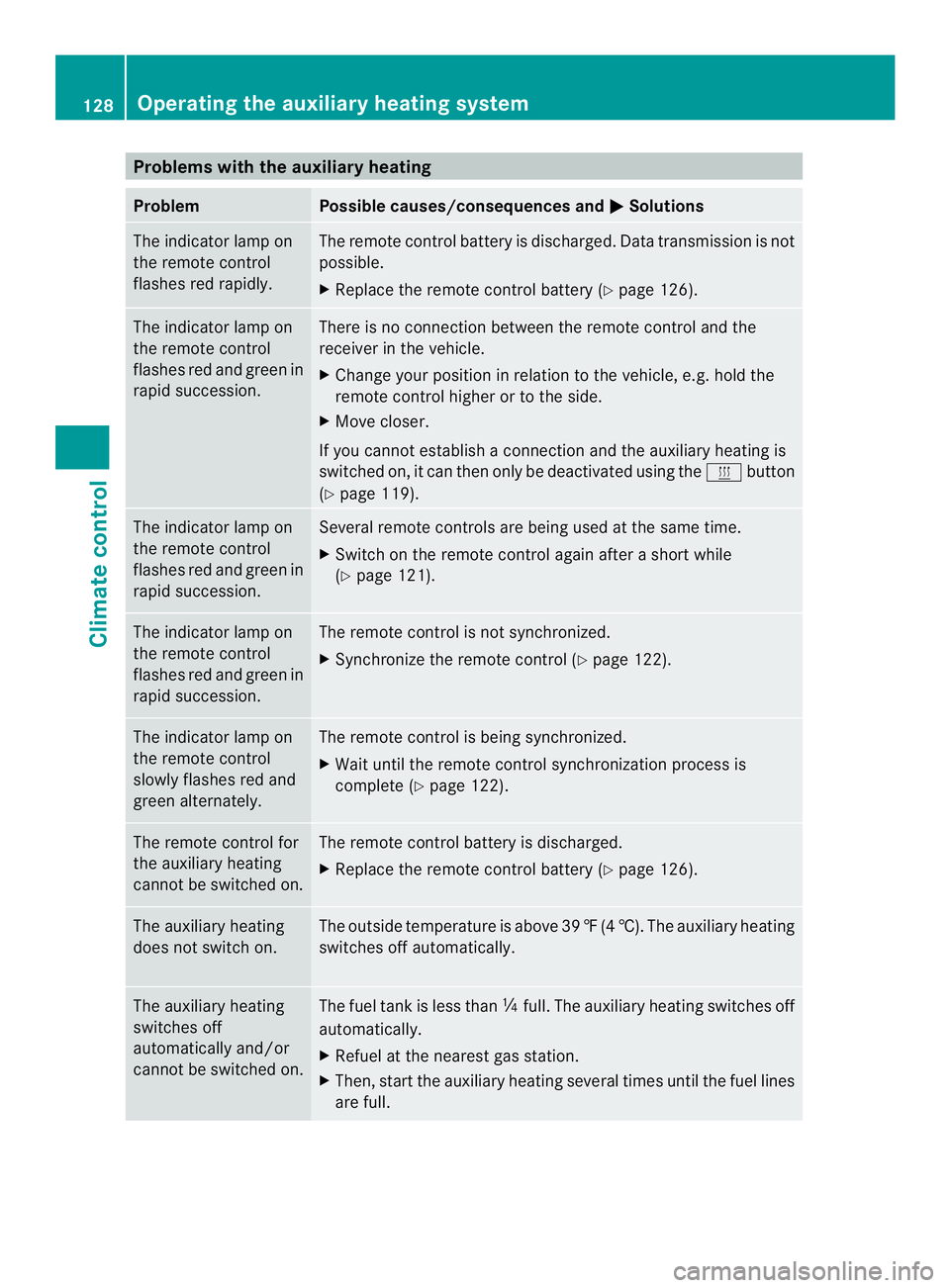
Problems with the auxiliary heating
Problem Possible causes/consequences and
0004 Solutions
The indicator lamp on
the remote control
flashes red rapidly. The remote control battery is discharged. Data transmission is not
possible.
X
Replace the remote control battery (Y page 126).The indicator lamp on
the remote control
flashes red and green in
rapid succession. There is no connection between the remote control and the
receiver in the vehicle.
X
Change your position in relation to the vehicle, e.g. hold the
remote control higher or to the side.
X Move closer.
If you cannot establish aconnection and the auxiliary heating is
switched on, it can then only be deactivated using the 0020button
(Y page 119). The indicator lamp on
the remote control
flashes red and green in
rapid succession. Several remote controls are being used at the same time.
X
Switch on the remote control again after a short while
(Y page 121). The indicator lamp on
the remote control
flashes red and green in
rapid succession. The remote control is not synchronized.
X
Synchronize the remote control (Y page 122).The indicator lamp on
the remote control
slowly flashes red and
green alternately. The remote control is being synchronized.
X
Wait until the remote control synchronization process is
complete (Y page 122). The remote control for
the auxiliary heating
cannot be switched on. The remote control battery is discharged.
X
Replace the remote control battery (Y page 126).The auxiliary heating
does not switch on. The outside temperature is above 39
‡(4† ). The auxiliary heating
switches off automatically. The auxiliary heating
switches off
automatically and/or
cannot be switched on. The fuel tan
kis less than 0002full. The auxiliary heating switches off
automatically.
X Refuel at the nearest gas station.
X Then, start the auxiliary heating several times until the fuel lines
are full. 128
Operating the auxiliary heating systemClimate control
Page 131 of 334
Problem Possible causes/consequences and
0004 Solutions
The auxiliary heating
switches off
automatically and/or
cannot be switched on. The low-voltage protection system integrated in the control unit
switches off the auxiliary heating because the on-board voltage is
less than 10 V.
X Have the alternator and battery checked. The auxiliary heating
switches off
automatically and/or
cannot be switched on. The fuse is blown.
X
Replace the fuse; see the "Fuse allocation" supplement.
X Have the cause of the blown fuse determined at a qualified
specialist workshop. The auxiliary heating
switches off
automatically and/or
cannot be switched on. A malfunction has occurred.
X
Switch the ignition on and off twice.
If the auxiliary heating still cannot be switched on, the heating
device is faulty.
X Have the auxiliary heating checked at a qualified specialist
workshop. The auxiliary heating is
overheated. The coolant level is too low.
X
Check the coolant level and add more coolant if necessary
(Y page 244). Operating the cargo compartment air
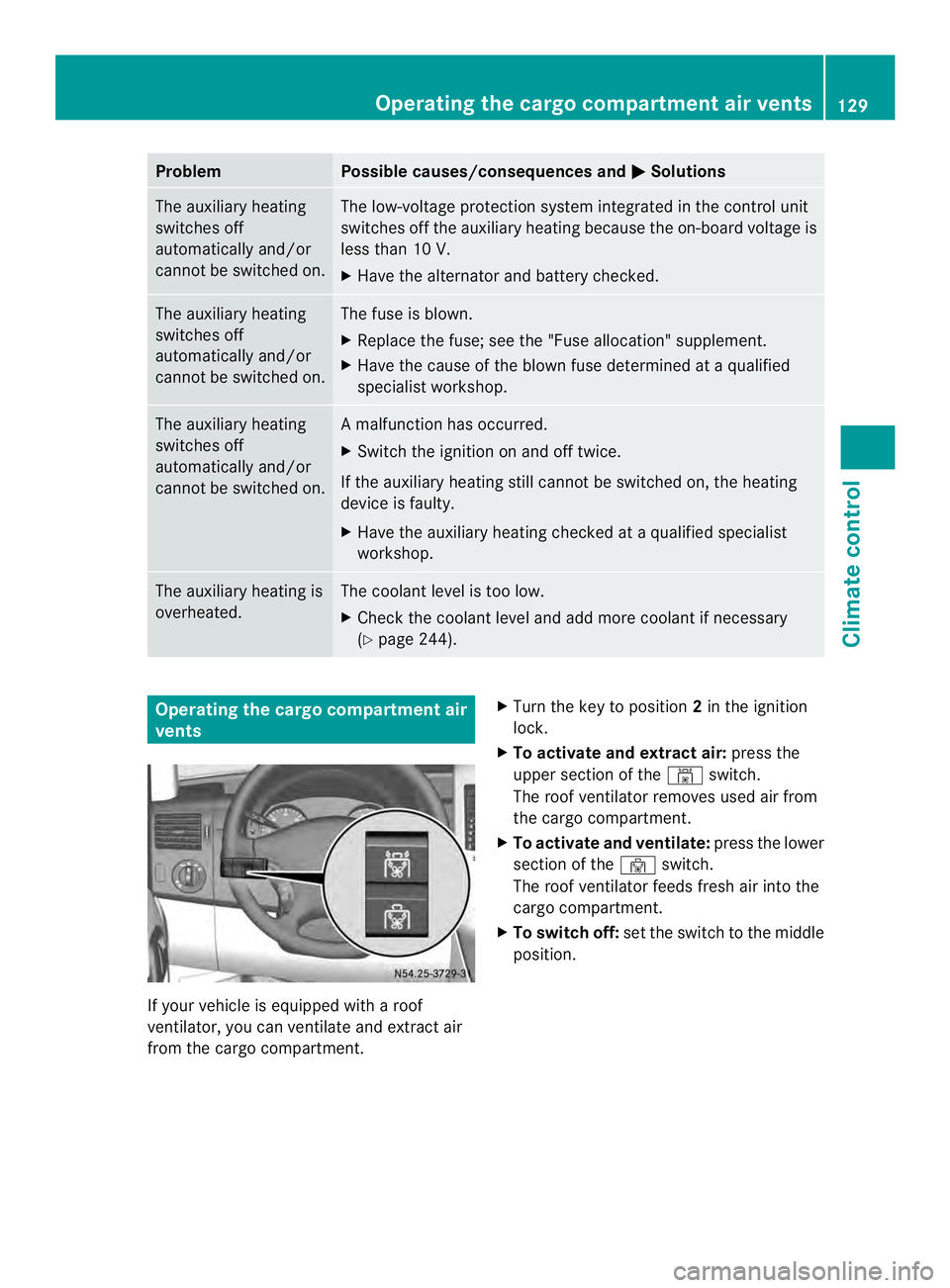
vents
If your vehicle is equipped with a roof
ventilator, you can ventilate and extract air
from the cargo compartment. X
Turn the key to position 2in the ignition
lock.
X To activate and extract air: press the
upper section of the 0009switch.
The roof ventilator removes used air from
the cargo compartment.
X To activate and ventilate: press the lower
section of the 0010switch.
The roof ventilator feeds fresh air into the
cargo compartment.
X To switch off: set the switch to the middle
position. Operating the cargo compartment air vents
129Climate control Z
Page 134 of 334
Useful information
This Operator's Manual describes all models
as well as standard and optional equipment
of your vehicle that were available at the time
of going to print. Country-specific variations
are possible. Note that your vehicle may not
be equipped with all of the described
functions. This also applies to systems and
functions relevant to safety.
Read the information on qualified specialist
workshops (Y page 26). Breaking-in notes
The first 1,000 miles (1,500 km)
New or replaced brake pads and brake disks
only reach their optimum braking effec tafter
100 miles (a few hundred kilometers). Until
then, compensate for this by applying greater
force to the brake pedal.
For the service life and economy of your
vehicle it is crucial that you brea kinthe
engine with due care.
R Therefore, protect the engine for the first
1,000 miles (1,500 km) by driving at
varying vehicle and engine speeds.
R Avoid overstraining the vehicle and high
engine speeds during this period, e.g.
driving at full throttle. Do not exceed 0001of
the maximum speed for each gear.
R Do not change down a gear manually in
order to brake.
R Try to avoid depressing the accelerator
pedal beyond the point of resistance
(kickdown).
R The shift ranges 3,2or 1should only be
engaged when driving slowly, e.g. when
driving in mountainous terrain.
After 1,000 miles (1,500 km), you can
increase the engine speed gradually and
accelerate the vehicle up to full speed.
i You should also observe these notes on
breaking-in if the engine or parts of the drive train on your vehicle have been
replaced. Driving
Important safety notes
G
WARNING
If you switch off the ignition while driving,
safety-relevant functions are only available
with limitations, or not at all. This could affect,
for example, the power steering and the brake
boosting effect.Y ou will require considerably
more effort to steer and brake. There is a risk
of an accident.
Do not switch off the ignition while driving. G
WARNING
If the parking brake has not been fully
released when driving, the parking brake can:
R overheat and cause a fire
R lose its hold function.
There is a risk of fire and an accident .Release
the parking brake fully before driving off. Battery isolating switch
Important safety notes !
Make sure that the key is in position 0in
the ignition lock and wait at least
20 seconds before disconnecting or
connecting the battery isolating switch.
You could otherwise damage electrical
system components.
You can use the battery isolating switch to
disconnect the power supply to all your
vehicle's consumers. This will prevent
uncontrolled battery discharge caused by off-
load curren tconsumption.
If your vehicle is equipped with an auxiliary
battery in the engine compartment, you will
need to disconnect both batteries. Only then
is the electrical system fully disconnected
from the power supply. 132
DrivingDriving and parking
Page 135 of 334
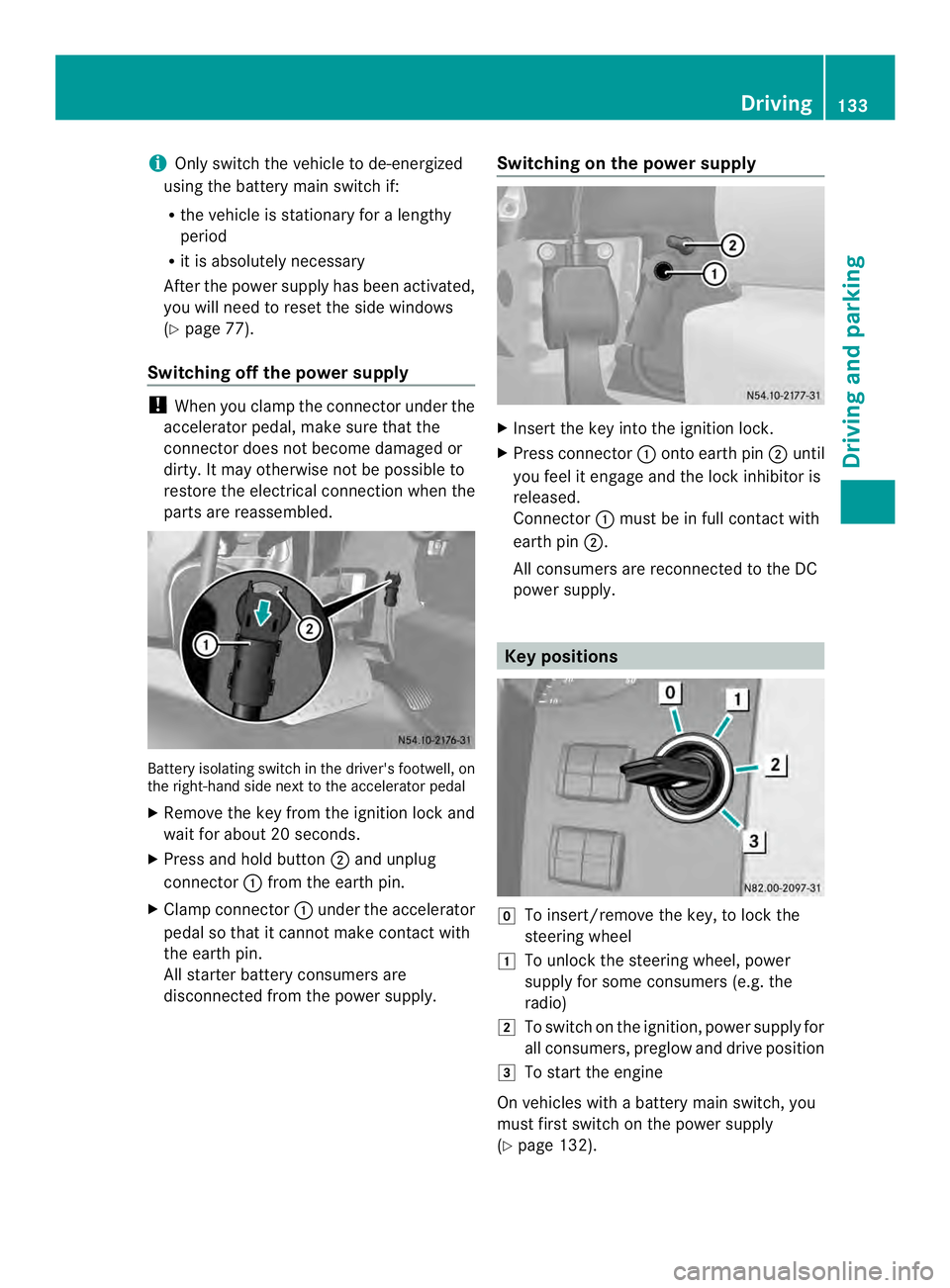
i
Only switch the vehicle to de-energized
using the battery main switch if:
R the vehicle is stationary for a lengthy
period
R it is absolutely necessary
After the power supply has been activated,
you will need to reset the side windows
(Y page 77).
Switching off the power supply !
When you clamp the connector under the
accelerator pedal, make sure that the
connector does not become damaged or
dirty. It may otherwise not be possible to
restore the electrical connection when the
parts are reassembled. Battery isolating switch in the driver's footwell, on
the right-hand side next to the accelerator pedal
X Remove the key from the ignition lock and
waitf or about 20 seconds.
X Press and hold button 0006and unplug
connector 0005from the earth pin.
X Clamp connector 0005under the accelerator
pedal so that it cannot make contact with
the earth pin.
All starter battery consumers are
disconnected from the power supply. Switching on the power supply X
Insert the key into the ignition lock.
X Press connector 0005onto earth pin 0006until
you feel it engage and the lock inhibitor is
released.
Connector 0005must be in full contact with
earth pin 0006.
All consumers are reconnected to the DC
power supply. Key positions
0011
To insert/remove the key, to lock the
steering wheel
0008 To unlock the steering wheel, power
supply for some consumers (e.g. the
radio)
0009 To switch on the ignition, power supply for
all consumers, preglow and drive position
000A To start the engine
On vehicles with a battery main switch, you
must first switch on the power supply
(Y page 132). Driving
133Driving and parking Z
Page 139 of 334
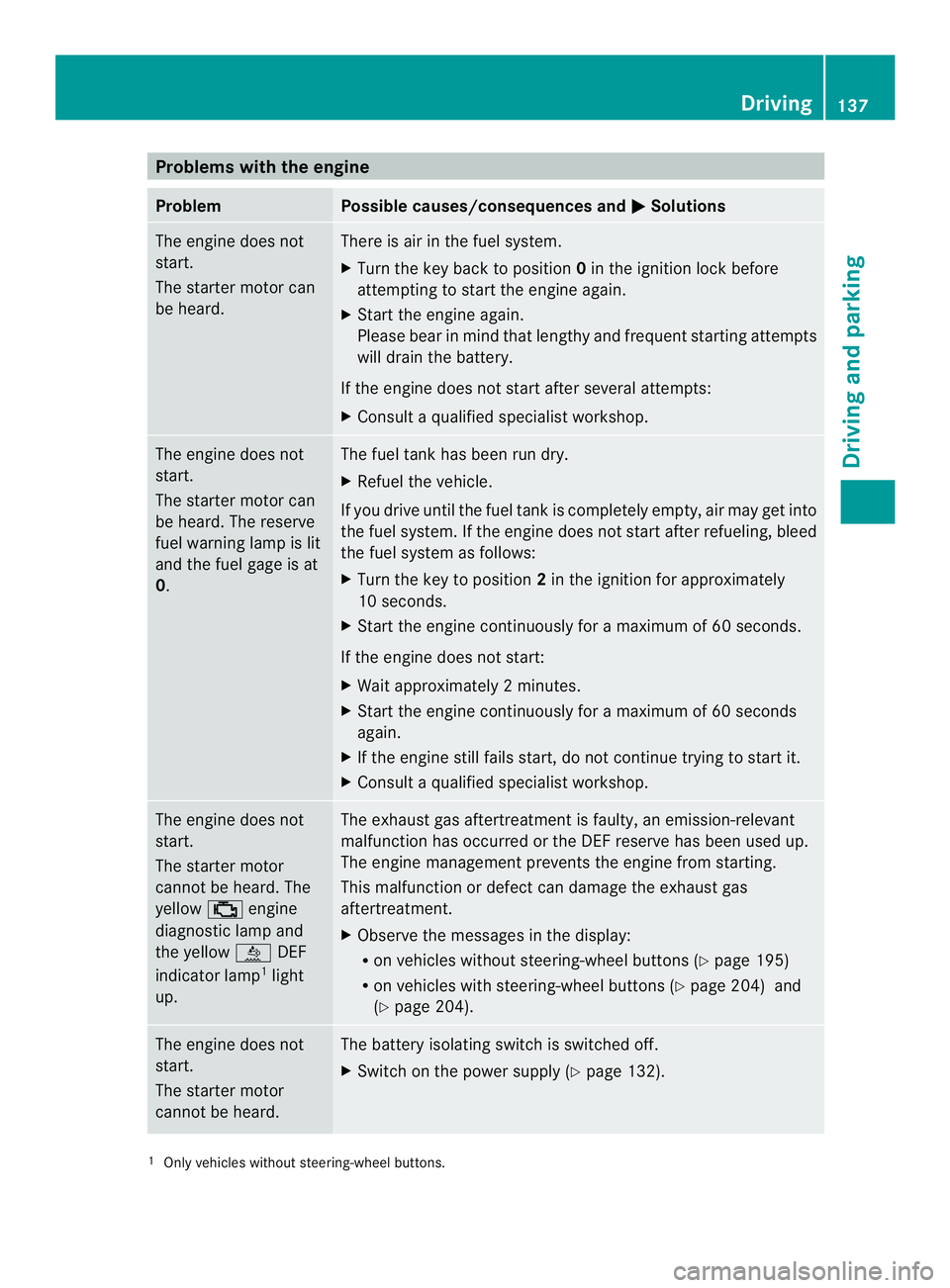
Problems with the engine
Problem Possible causes/consequences and
0004 Solutions
The engine does not
start.
The starter motor can
be heard. There is air in the fuel system.
X
Turn the key back to position 0in the ignition lock before
attempting to start the engine again.
X Start the engine again.
Please bear in mind that lengthy and frequent starting attempts
will drain the battery.
If the engine does not start after several attempts:
X Consult a qualified specialist workshop. The engine does not
start.
The starter motor can
be heard. The reserve
fuel warning lamp is lit
and the fuel gage is at
0. The fuel tank has been run dry.
X
Refuel the vehicle.
If you drive until the fuel tank is completely empty, air may get into
the fuel system. If the engine does not start after refueling, bleed
the fuel system as follows:
X Turn the key to position 2in the ignition for approximately
10 seconds.
X Start the engine continuously for a maximum of 60 seconds.
If the engine does not start:
X Wait approximately 2minutes.
X Start the engine continuously for a maximum of 60 seconds
again.
X If the engine still fails start, do not continue trying to start it.
X Consult a qualified specialist workshop. The engine does not
start.
The starter motor
cannot be heard. The
yellow
0018engine
diagnostic lamp and
the yellow 0009DEF
indicator lamp 1
light
up. The exhaust gas aftertreatmen
tis faulty, an emission-relevant
malfunction has occurred or the DEF reserve has been used up.
The engine management prevents the engine from starting.
This malfunction or defect can damage the exhaust gas
aftertreatment.
X Observe the messages in the display:
R on vehicles without steering-wheel buttons (Y page 195)
R on vehicles with steering-wheel buttons (Y page 204) and
(Y page 204). The engine does not
start.
The starter motor
cannot be heard. The battery isolating switch is switched off.
X
Switch on the power supply (Y page 132).1
Only vehicles without steering-wheel buttons. Driving
137Driving and parking Z
Page 140 of 334
Problem Possible causes/consequences and
0004 Solutions
The engine does not
start.
The starter motor
cannot be heard. The on-board voltage is too low. The battery is too weak or
discharged.
X
Jump-start the vehicle (Y page 267).
If the engine cannot be jump-started, the starter motor is faulty.
X Consult a qualified specialist workshop. The engine does not
start.
The starter motor
cannot be heard. The battery is discharged or faulty.
X
Check the battery for damage.
X Charge the battery (Y page 254).Automatic transmission
Important safety notes
G
WARNING
If the engine speed is above the idling speed
and you engage transmission position Dor
R, the vehicle could pull away suddenly. There
is a risk of an accident.
When engaging transmission position Dor R,
always firmly depress the brake pedal and do
not simultaneously accelerate.
! Vehicles with automatic transmission
may roll only briefly in the neutral position
N.P rolonged rolling of the wheels, e.g.
when being towed, will result in
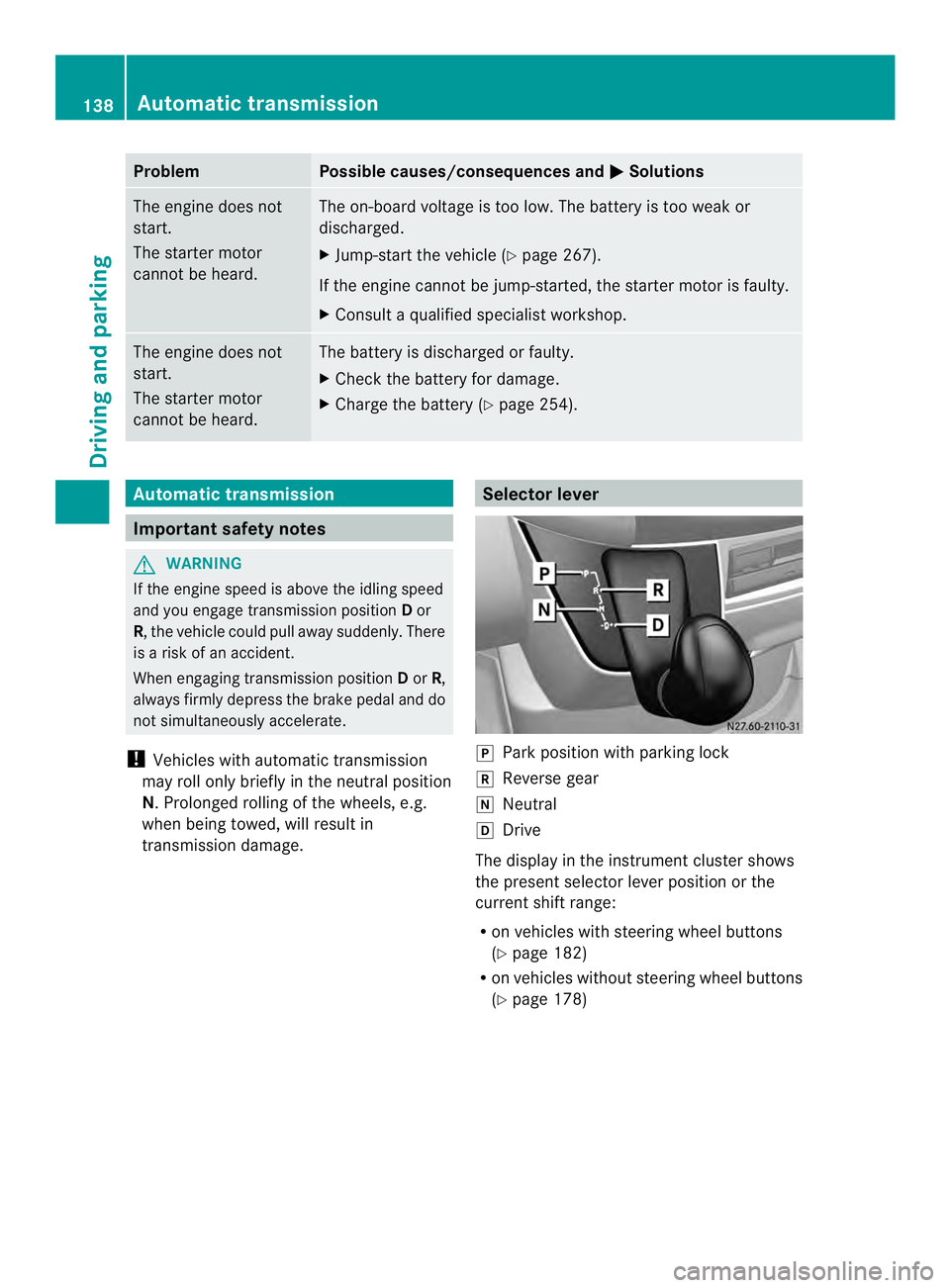
transmission damage. Selector lever
0016
Park position with parking lock
0012 Reverse gear
0013 Neutral
0015 Drive
The display in the instrument cluster shows
the present selector leve rposition or the
current shift range:
R on vehicles with steering wheel buttons
(Y page 182)
R on vehicles without steerin gwheel buttons
(Y page 178) 138
Automatic transmissionDriving and parking
Page 147 of 334
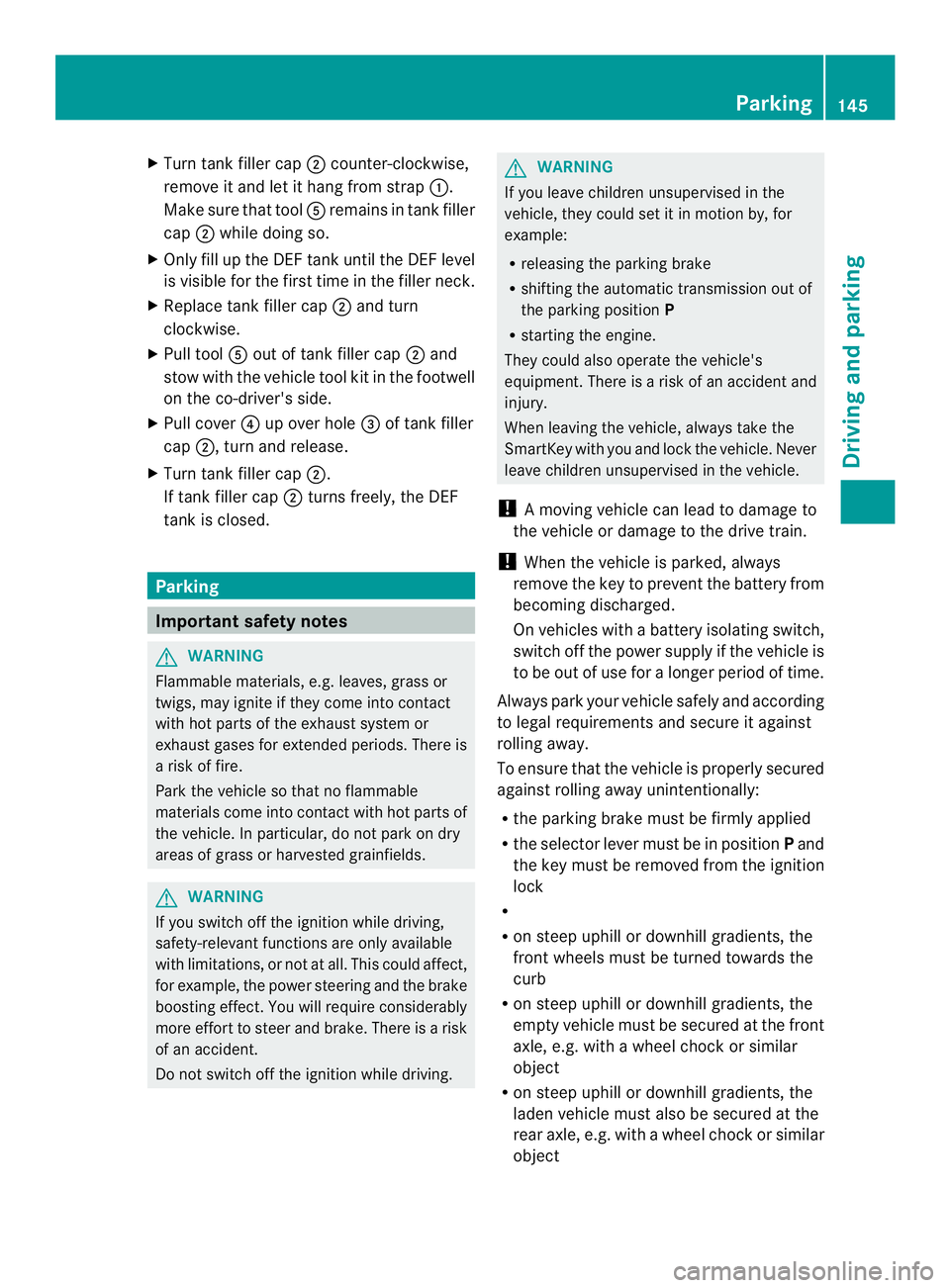
X
Turn tank filler cap 0006counter-clockwise,
remove it and let it hang from strap 0005.
Make sure that tool 0023remains in tank filler
cap 0006while doing so.
X Only fill up the DEFt ank until the DEFlevel
is visible for the first time in the filler neck.
X Replace tank filler cap 0006and turn
clockwise.
X Pull tool 0023out of tank filler cap 0006and
stow with the vehicle tool kit in the footwell
on the co-driver's side.
X Pull cover 0025up over hole 0026of tank filler
cap 0006, turn and release.
X Turn tank filler cap 0006.
If tank filler cap 0006turns freely, the DEF
tank is closed. Parking
Important safety notes
G
WARNING
Flammable materials, e.g. leaves, grass or
twigs, may ignite if they come into contact
with hot parts of the exhaust system or
exhaust gases for extended periods. There is
a risk of fire.
Park the vehicle so that no flammable
materials come into contact with hot parts of
the vehicle. In particular, do not park on dry
areas of grass or harvested grainfields. G
WARNING
If you switch off the ignition while driving,
safety-relevant function sare only available
with limitations, or not at all.T his could affect,
for example, the power steering and the brake
boosting effect.Y ou will require considerably
more effort to steer and brake. There is a risk
of an accident.
Do not switch off the ignition while driving. G
WARNING
If you leave children unsupervised in the
vehicle, they could set it in motion by, for
example:
R releasing the parking brake
R shifting the automatic transmission out of
the parking position P
R starting the engine.
They could also operate the vehicle's
equipment. There is a risk of an accident and
injury.
When leaving the vehicle, always take the
SmartKey with you and lock the vehicle. Never
leave children unsupervised in the vehicle.
! Am oving vehicle can lead to damage to
the vehicle or damage to the drive train.
! When the vehicle is parked, always
remove the key to prevent the battery from
becoming discharged.
On vehicles with a battery isolating switch,
switch off the power supply if the vehicle is
to be out of use for a longer period of time.
Always park your vehicle safely and according
to legal requirements and secure it against
rolling away.
To ensure that the vehicle is properly secured
against rolling away unintentionally:
R the parking brake must be firmly applied
R the selector lever must be in position Pand
the key must be removed from the ignition
lock
R
R on steep uphill or downhill gradients, the
front wheels must be turned towards the
curb
R on steep uphill or downhill gradients, the
empty vehicle must be secured at the front
axle, e.g. with a wheel chock or similar
object
R on steep uphill or downhill gradients, the
laden vehicle must also be secured at the
rear axle, e.g. with a wheel chock or similar
object Parking
145Driving and parking Z
Page 149 of 334
X
Apply the parking brake.
X Turn the key to position 0in the ignition
lock and remove it.
The immobilize ris activated.
X Secure the vehicle to prevent it from rolling
away (Y page 145). Wheel chock
Use the wheel chock or asimilar object to
prevent the vehicle fro mrolling away, e.g.
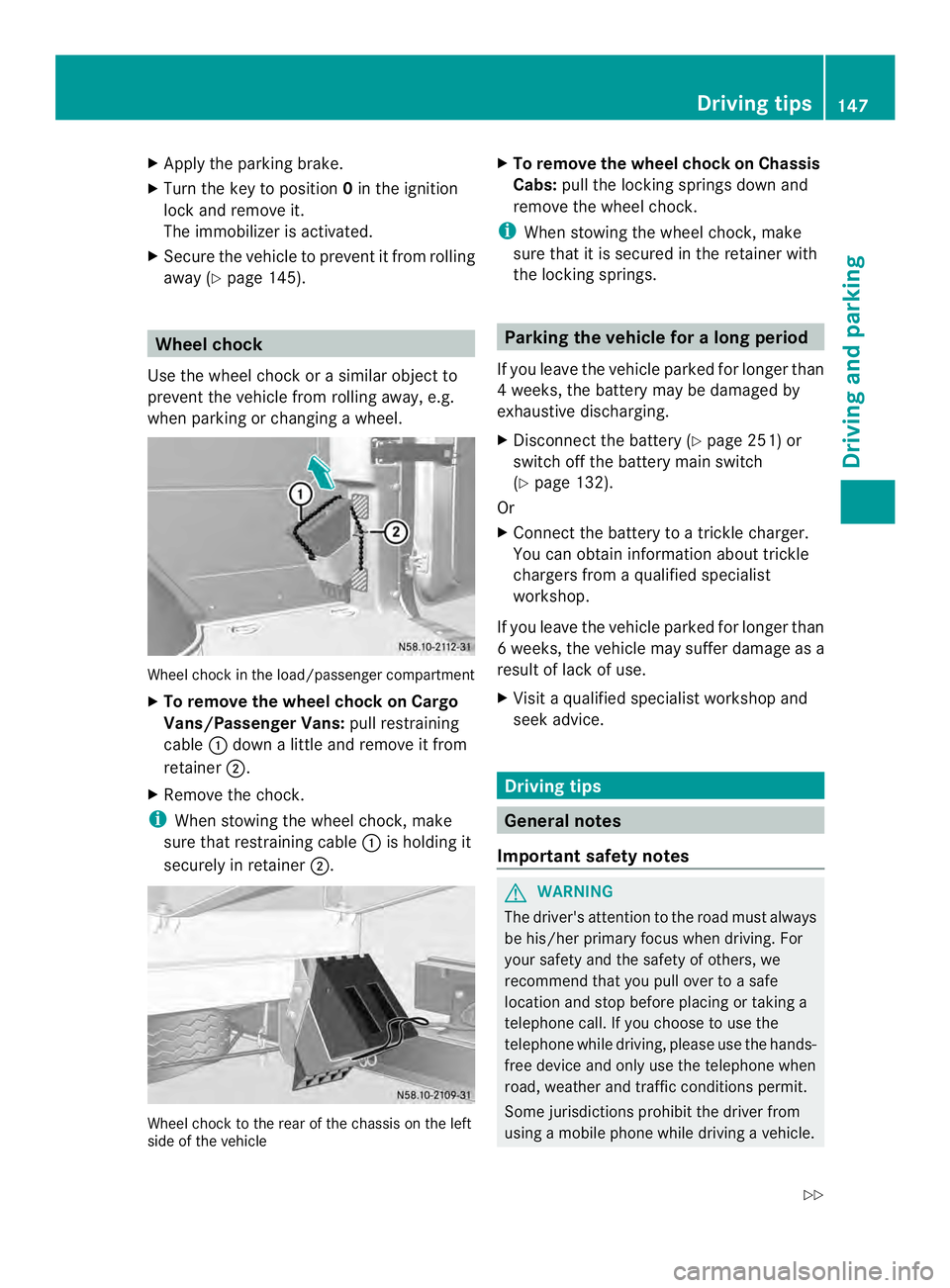
when parking or changing awheel. Wheel chock in the load/passenger compartment
X To remove the wheel chock on Cargo
Vans/Passenger Vans: pull restraining
cable 0005down a little and remove it from
retainer 0006.
X Remove the chock.
i When stowing the wheel chock, make
sure that restraining cable 0005is holding it
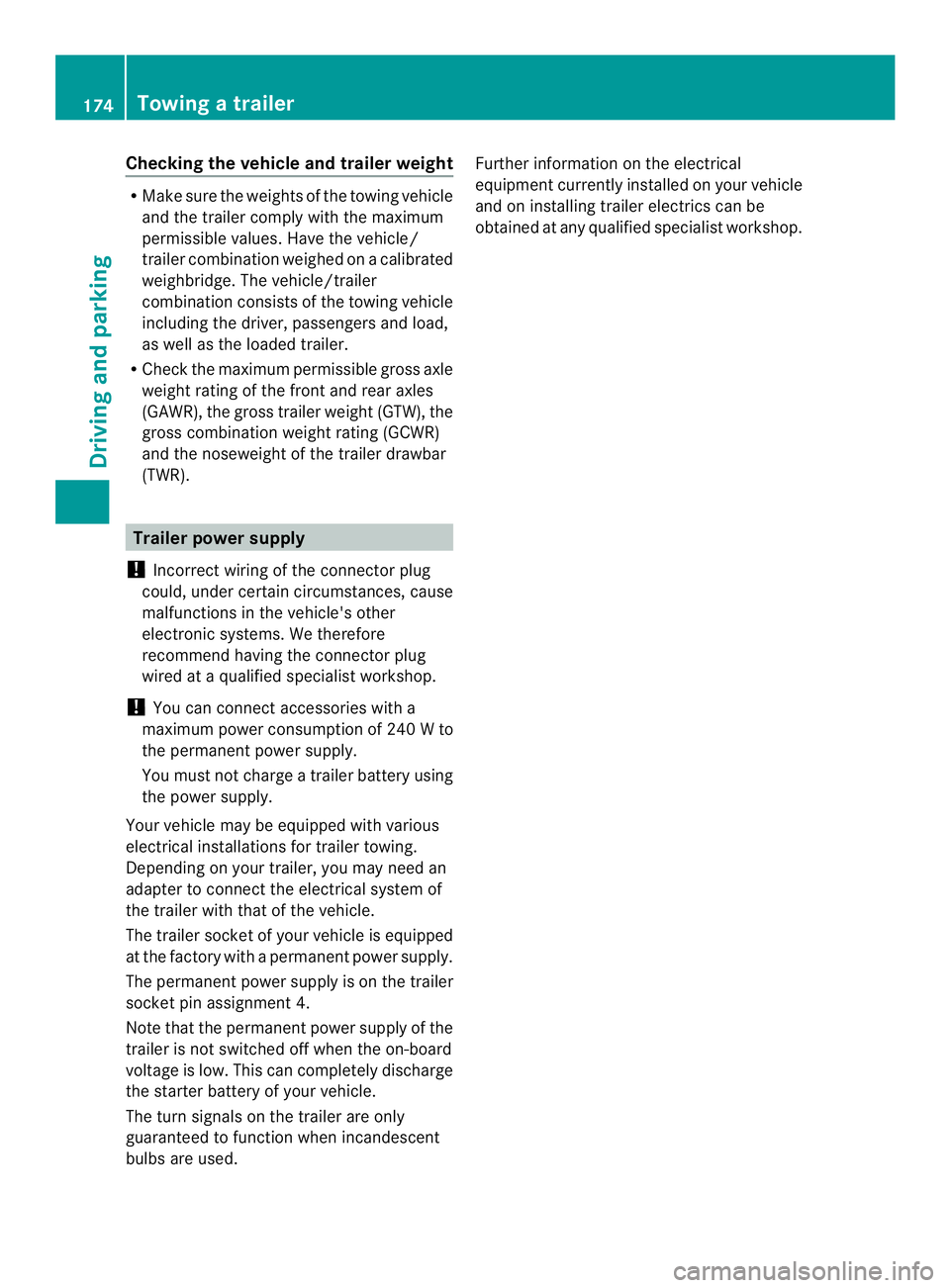
securely in retainer 0006. Wheel chock to the rear of the chassis on the left
side of the vehicle X
To remove the wheel chock on Chassis
Cabs: pull the locking springs down and
remove the wheel chock.
i When stowing the wheel chock, make
sure that it is secured in the retainer with
the locking springs. Parking the vehicle for
along period
If you leave the vehicle parked for longer than
4w eeks, the battery may be damaged by
exhaustive discharging.
X Disconnect the batter y(Ypage 251) or
switch off the battery main switch
(Y page 132).
Or
X Connect the battery to a trickle charger.
You can obtain information about trickle
chargers from a qualified specialist
workshop.
If you leave the vehicle parked for longer than
6w eeks, the vehicle may suffer damage as a
result of lack of use.
X Visit a qualified specialist workshop and
seek advice. Driving tips
General notes
Important safety notes G
WARNING
The driver's attention to the road must always
be his/her primary focus when driving. For
your safety and the safety of others, we
recommend that you pull over to a safe
location and stop before placing or taking a
telephone call. If you choose to use the
telephone while driving, please use the hands-
free device and only use the telephone when
road, weather and traffic conditions permit.
Some jurisdictions prohibit the driver from
using a mobile phone while driving a vehicle. Driving tips
147Driving and parking
Z
Page 176 of 334
Checking the vehicle and trailer weight
R
Make sure the weights of the towing vehicle
and the trailer comply with the maximum
permissible values .Have the vehicle/
trailer combinatio nweighed on a calibrated
weighbridge. The vehicle/trailer
combination consists of the towing vehicle
including the driver, passengers and load,
as well as the loaded trailer.
R Check the maximum permissible gross axle
weight rating of the front and rear axles
(GAWR), the gross trailer weight (GTW), the
gross combination weight rating (GCWR)
and the noseweight of the trailer drawbar
(TWR). Trailer power supply
! Incorrect wiring of the connector plug
could, under certain circumstances, cause
malfunctions in the vehicle's other
electronic systems. We therefore
recommend having the connector plug
wired at a qualified specialist workshop.
! You can connecta ccessories with a
maximum power consumption of 240 Wto
the permanent powe rsupply.
You must no tcharge a trailer battery using
the power supply.
Your vehicle may be equipped with various
electrical installations for trailer towing.
Depending on your trailer, you may need an
adapter to connect the electrical system of
the trailer with that of the vehicle.
The trailer socket of your vehicle is equipped
at the factory with apermanen tpower supply.
The permanent power supply is on the trailer
socket pin assignment 4.
Note that the permanent power supply of the
trailer is not switched off when the on-board
voltage is low. This can completely discharge
the starter battery of your vehicle.
The turn signals on the trailer are only
guaranteed to function when incandescent
bulbs are used. Further information on the electrical
equipment currently installed on your vehicle
and on installing trailer electrics can be
obtained at any qualified specialist workshop.174
Towing
atrailerDriving an d parking