brake MERCEDES-BENZ SPRINTER 2013 MY13 Operator’s Manual
[x] Cancel search | Manufacturer: MERCEDES-BENZ, Model Year: 2013, Model line: SPRINTER, Model: MERCEDES-BENZ SPRINTER 2013Pages: 334, PDF Size: 3.88 MB
Page 213 of 334
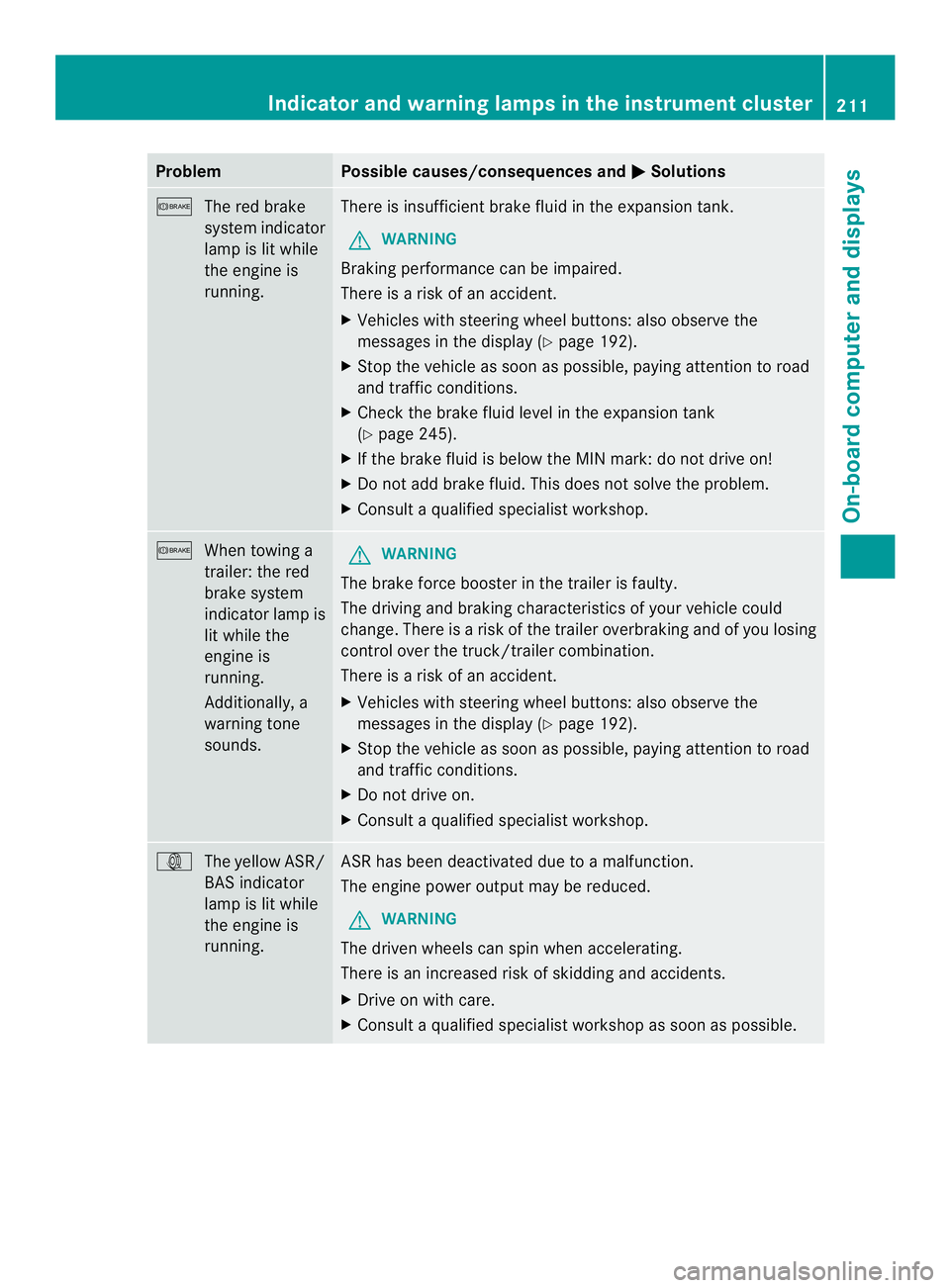
Problem Possible causes/consequences and
0004 Solutions
0008
The red brake
system indicator
lamp is lit while
the engine is
running. There is insufficient brake fluid in the expansion tank.
G WARNING
Braking performance can be impaired.
There is a risk of an accident.
X Vehicles with steering wheel buttons:a lso observe the
messages in the display (Y page 192).
X Stop the vehicle as soon as possible, paying attention to road
and traffic conditions.
X Check the brake fluid level in the expansion tank
(Y page 245).
X If the brake fluid is below the MIN mark: do not drive on!
X Do not add brake fluid. This does not solve the problem.
X Consult a qualified specialist workshop. 0008
When towing a
trailer: the red
brake system
indicator lamp is
lit while the
engine is
running.
Additionally, a
warning tone
sounds. G
WARNING
The brake force booster in the trailer is faulty.
The driving and braking characteristics of your vehicle could
change. There is a risk of the trailer overbraking and of you losing
control over the truck/trailer combination.
There is a risk of an accident.
X Vehicles with steering wheel buttons :also observe the
messages in the display (Y page 192).
X Stop the vehicle as soon as possible, paying attention to road
and traffic conditions.
X Do not drive on.
X Consult a qualified specialist workshop. 000A
The yellow ASR/
BAS indicator
lamp is lit while
the engine is
running. ASR has been deactivated due to a malfunction.
The engine power output may be reduced.
G WARNING
The drive nwheels can spin when accelerating.
There is an increased risk of skidding and accidents.
X Drive on with care.
X Consult a qualified specialist workshop as soon as possible. Indicator and warning lamps in the instrument cluster
211On-board computer and displays Z
Page 214 of 334
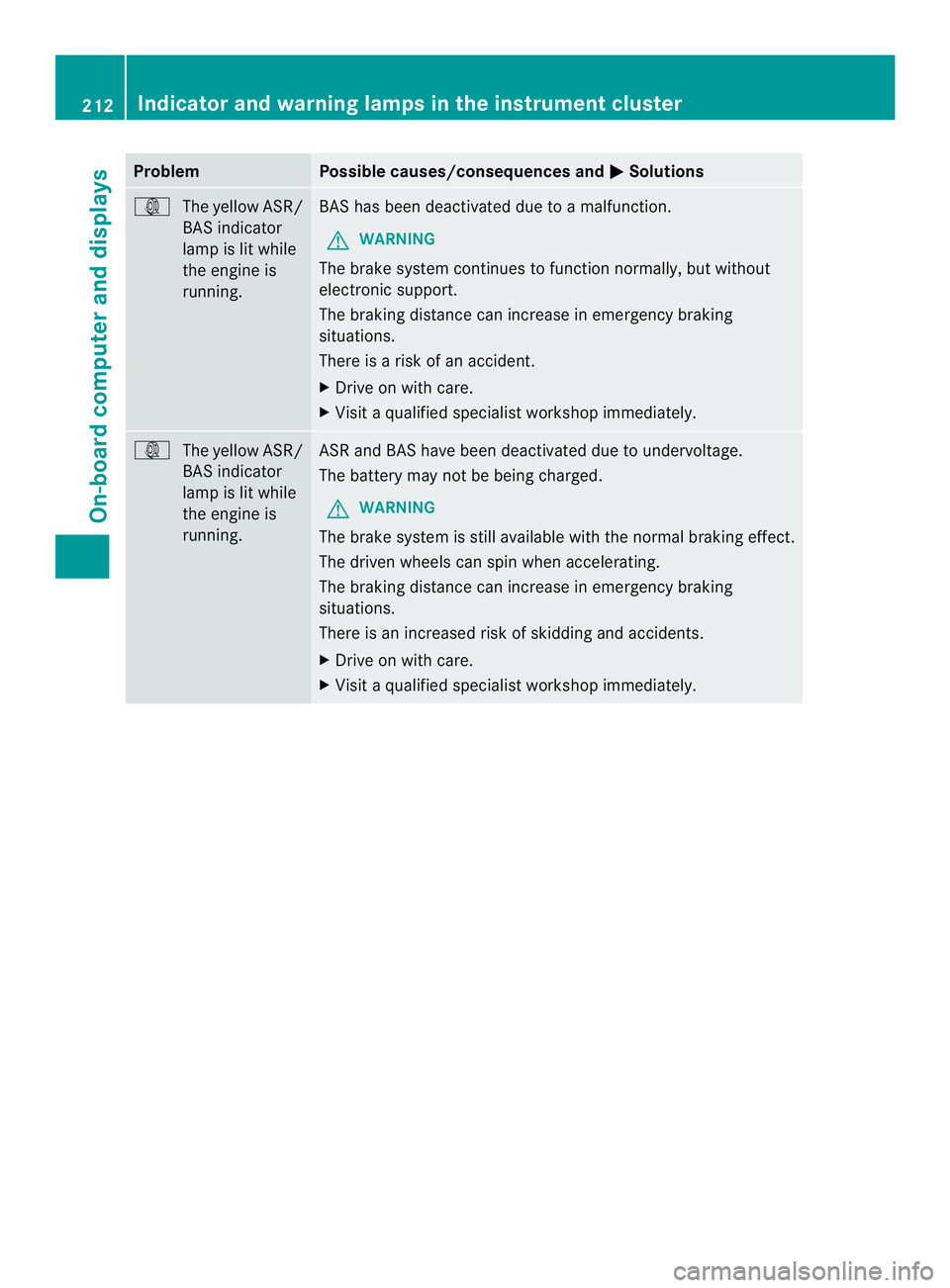
Problem Possible causes/consequences and
0004 Solutions
000A
The yellow ASR/
BAS indicator
lamp is lit while
the engine is
running. BAS has been deactivated due to a malfunction.
G WARNING
The brake system continues to function normally, but without
electronic support.
The braking distance can increase in emergency braking
situations.
There is a risk of an accident.
X Drive on with care.
X Visit a qualified specialist workshop immediately. 000A
The yellow ASR/
BAS indicator
lamp is lit while
the engine is
running. ASR and BAS have been deactivated due to undervoltage.
The battery may not be being charged.
G WARNING
The brake system is still available with the normal braking effect.
The driven wheels can spin when accelerating.
The braking distance can increase in emergency braking
situations.
There is an increased risk of skidding and accidents.
X Drive on with care.
X Visit a qualified specialist workshop immediately. 212
Indicator and warning lamps in the instrument clusterOn-board computer and displays
Page 215 of 334
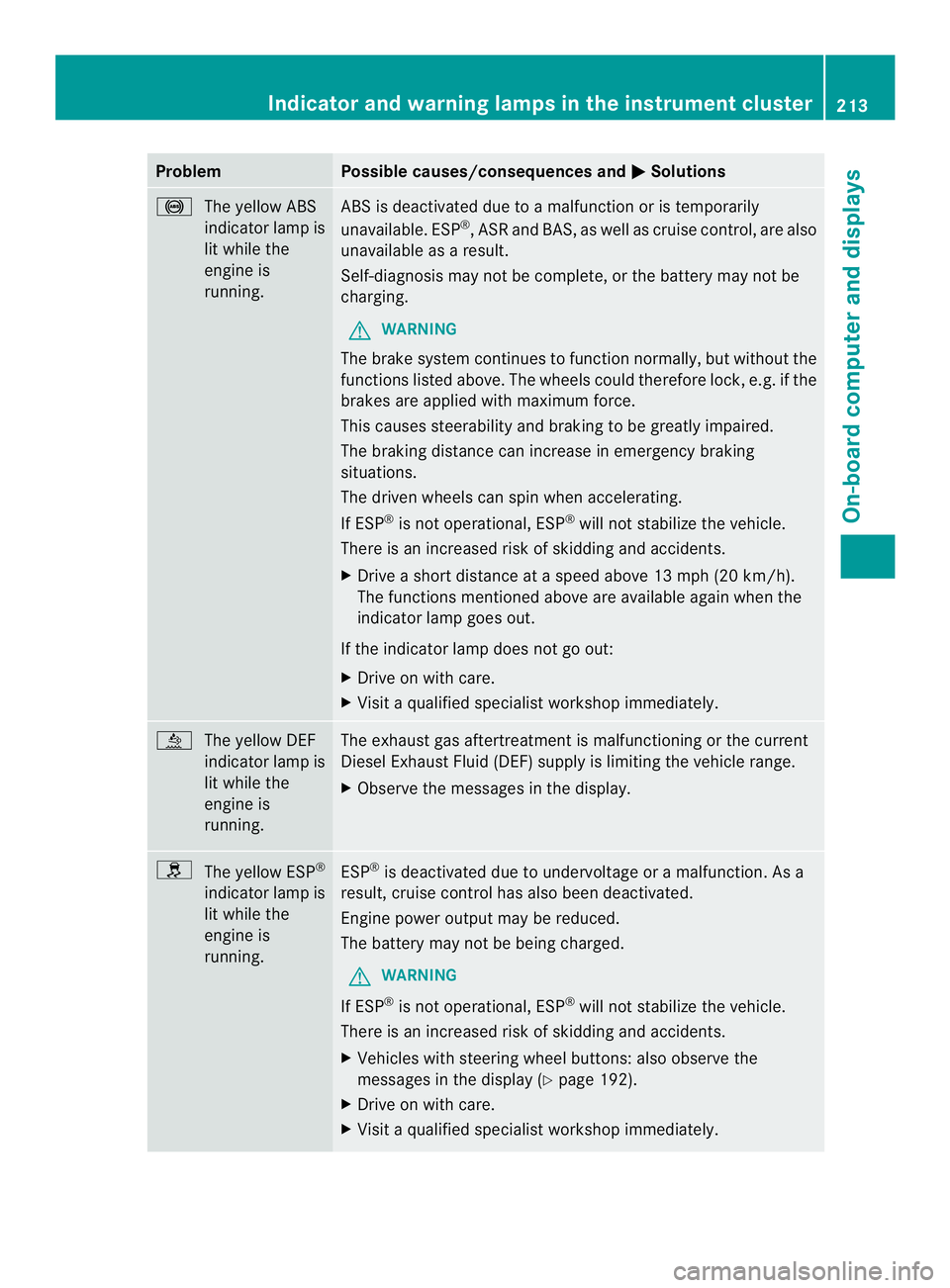
Problem Possible causes/consequences and
0004 Solutions
000E
The yellow ABS
indicator lamp is
lit while the
engine is
running. ABS is deactivated due to a malfunction or is temporarily
unavailable. ESP ®
, ASR and BAS, as well as cruise control, are also
unavailable as a result.
Self-diagnosis may not be complete, or the battery may not be
charging.
G WARNING
The brake system continues to function normally, but without the
functions listed above. The wheels could therefore lock, e.g. if the
brakes are applied with maximum force.
This causes steerability and braking to be greatly impaired.
The braking distance can increase in emergency braking
situations.
The driven wheels can spin when accelerating.
If ESP ®
is not operational, ESP ®
will not stabilize the vehicle.
There is an increased risk of skidding and accidents.
X Drive a short distance at a speed above 13 mph (20 km/h).
The functions mentioned above are available again when the
indicator lamp goes out.
If the indicator lamp does not go out:
X Drive on with care.
X Visit a qualified specialist workshop immediately. 0009
The yellow DEF
indicator lamp is
lit while the
engine is
running. The exhaust gas aftertreatment is malfunctioning or the current
Diesel Exhaust Fluid (DEF) supply is limiting the vehicle range.
X
Observe the messages in the display. 0002
The yellow ESP ®
indicator lamp is
lit while the
engine is
running. ESP
®
is deactivated due to undervoltage or a malfunction .As a
result, cruise control has also been deactivated.
Engine power output may be reduced.
The battery may not be being charged.
G WARNING
If ESP ®
is not operational, ESP ®
will not stabilize the vehicle.
There is an increased risk of skidding and accidents.
X Vehicles with steering wheel buttons: also observe the
messages in the display (Y page 192).
X Drive on with care.
X Visit a qualified specialist workshop immediately. Indicator and warning lamps in the instrument cluster
213On-board computer and displays Z
Page 216 of 334
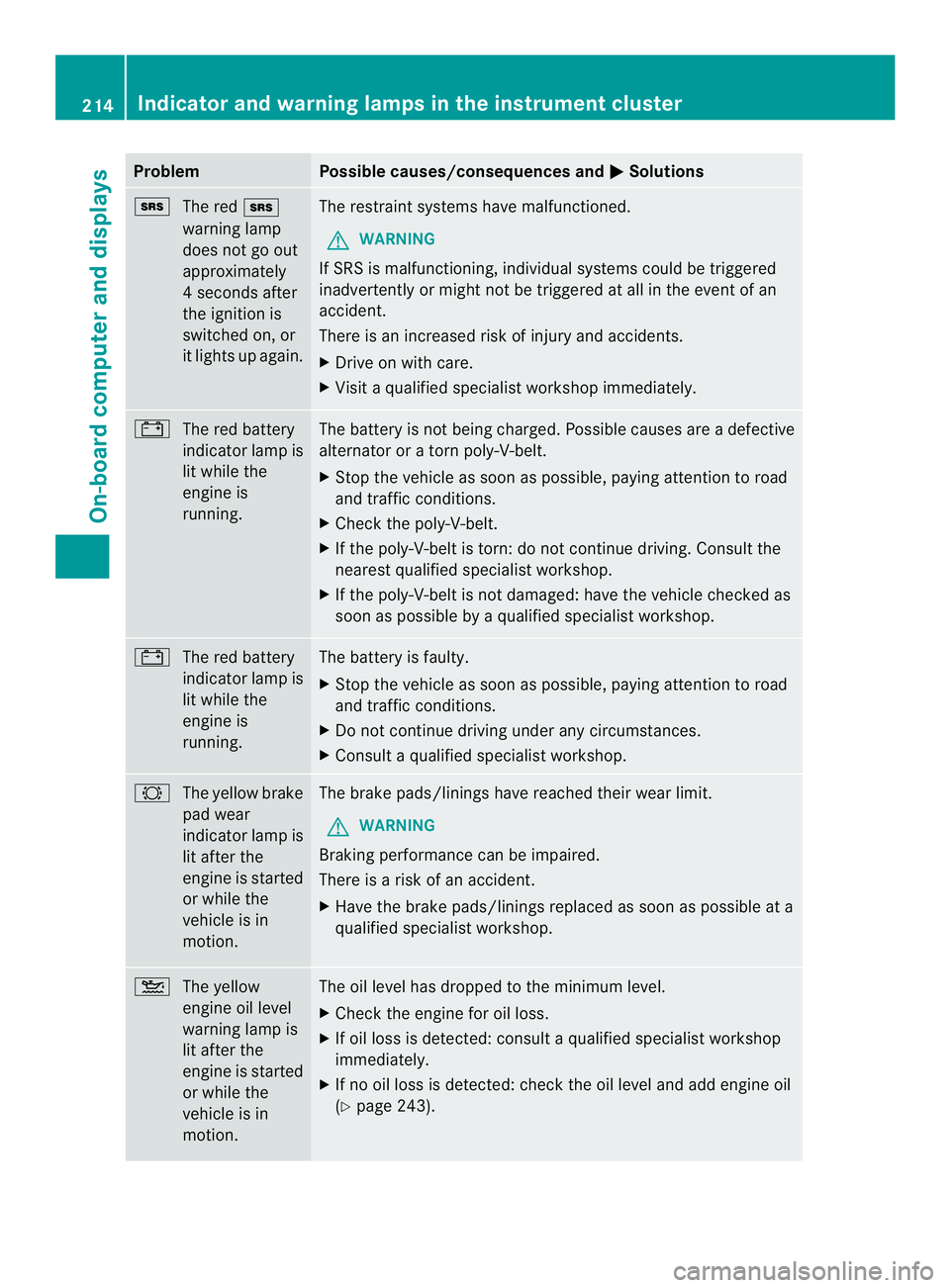
Problem Possible causes/consequences and
0004 Solutions
0008
The red 0008
warning lamp
does not go out
approximately
4s econds after
the ignition is
switched on, or
it lights up again. The restraint systems have malfunctioned.
G WARNING
If SRS is malfunctioning, individual systems could be triggered
inadvertently or might not be triggered at all in the event of an
accident.
There is an increased risk of injury and accidents.
X Drive on with care.
X Visit a qualified specialist workshop immediately. 0010
The red battery
indicator lamp is
lit while the
engine is
running. The battery is not being charged. Possible causes are a defective
alternator or a torn poly-V-belt.
X
Stop the vehicle as soon as possible, paying attention to road
and traffic conditions.
X Check the poly-V-belt.
X If the poly-V-belt is torn: do not continue driving. Consult the
nearest qualified specialist workshop.
X If the poly-V-belt is not damaged: have the vehicle checked as
soon as possible by a qualified specialist workshop. 0010
The red battery
indicator lamp is
lit while the
engine is
running. The battery is faulty.
X
Stop the vehicle as soon as possible, paying attention to road
and traffic conditions.
X Do not continue driving under any circumstances.
X Consult a qualified specialist workshop. 0005
The yellow brake
pad wear
indicator lamp is
lit after the
engine is started
or while the
vehicle is in
motion. The brake pads/linings have reached their wear limit.
G WARNING
Braking performance can be impaired.
There is a risk of an accident.
X Have the brake pads/linings replaced as soon as possible at a
qualified specialist workshop. 001D
The yellow
engine oil level
warning lamp is
lit after the
engine is started
or while the
vehicle is in
motion. The oil level has dropped to the minimum level.
X
Check the engine for oil loss.
X If oil loss is detected: consult a qualified specialist workshop
immediately.
X If no oil loss is detected: chec kthe oil level and add engine oil
(Y page 243). 214
Indicator and warning lamps in the instrument clusterOn-board computer and displays
Page 237 of 334
!
Observe the information on the maximum
loading capacity of the individual cargo tie-
down points.
If you use several cargo tie-down points to
secure a load, you must always take the
maximum loading capacity of the weakest
cargo tie-down point into account.
If you brake hard, for example, the forces
acting could be up to several times the
weight force of the load. Always use
multiple cargo tie-down points in order to
distribute the force absorption. Load the
anchorages evenly.
Spread the load evenly between the cargo tie-
down points or tie-down rings.
Please also refer to the notes aboutq ualified
specialist workshops (Y page 26).
Always observe the operating instructions or
the notes of the lashing strap manufacturer
for the operation of th elashing strap.
Information about the maximum loading
capacity of the cargo tie-down points can be
found in the "Technical data" section
(Y page 327).
As the driver, you are responsible for ensuring
that:
R The applicable requirements and
guidelines relating to load-securing
practices must be met.
If this is no tthe case, this may constitute a
punishable offense, depending on local
legislation and any ensuing consequences.
You should therefore observe the
respective legal requirements for the
relevant country.
Make sure that the load is secure before every
journey and at regular intervals during a long
journey. Correct an incorrectly or
inadequately secured load if necessary.
You can obtain information about securing
the load correctly from the manufacturer of
the load securing aids or tie down for securing
the load.
X Fill spaces between the load and the cargo
compartmentw alls or wheel housings (form-locking). Use rigid load securing aids,
such as wedges, woode
nfixings or
padding.
X Attach secured and stabilized loads in all
directions. Use the carg otie-down points
or cargo tie-down rings and the loading rails
in the cargo compartmen toronthe loading
area.
Only use tie downs, such as lashing rods or
lashing nets and lashing straps, that have
been tested in accordance with current
standards (e.g. DIN EN).
Always use the cargo tie-down rings closest
to the load to secure it and pad sharp edges
for protection.
Loads, and heavy loads in particular, should
preferably be secured using the cargo tie-
down rings.
i Tie downs tested in accordance with
current standards (e.g. DIN EN) are
available at any qualified specialist
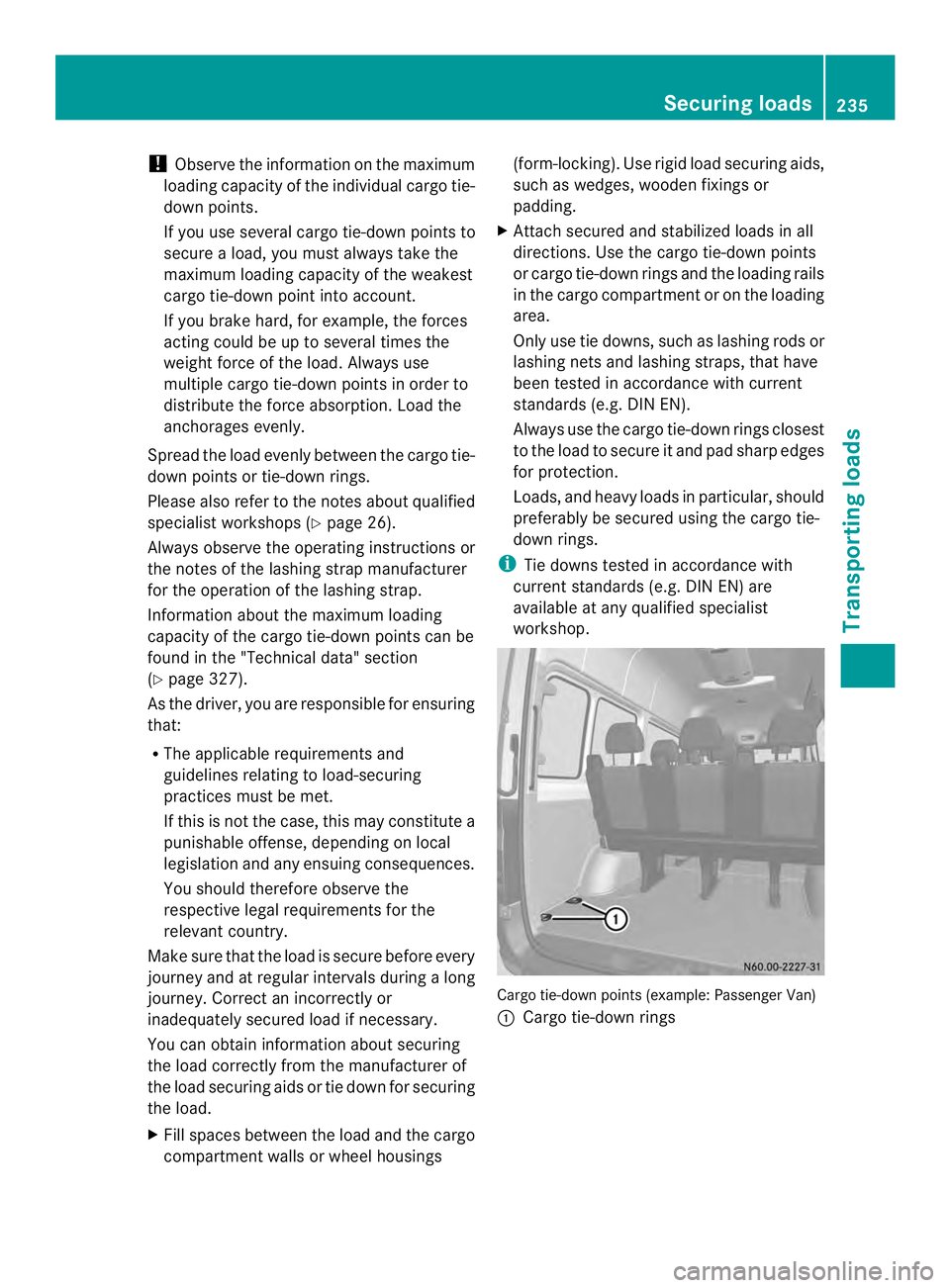
workshop. Cargo tie-down points (example: Passenger Van)
0005
Cargo tie-down rings Securing loads
235Transporting loads Z
Page 244 of 334
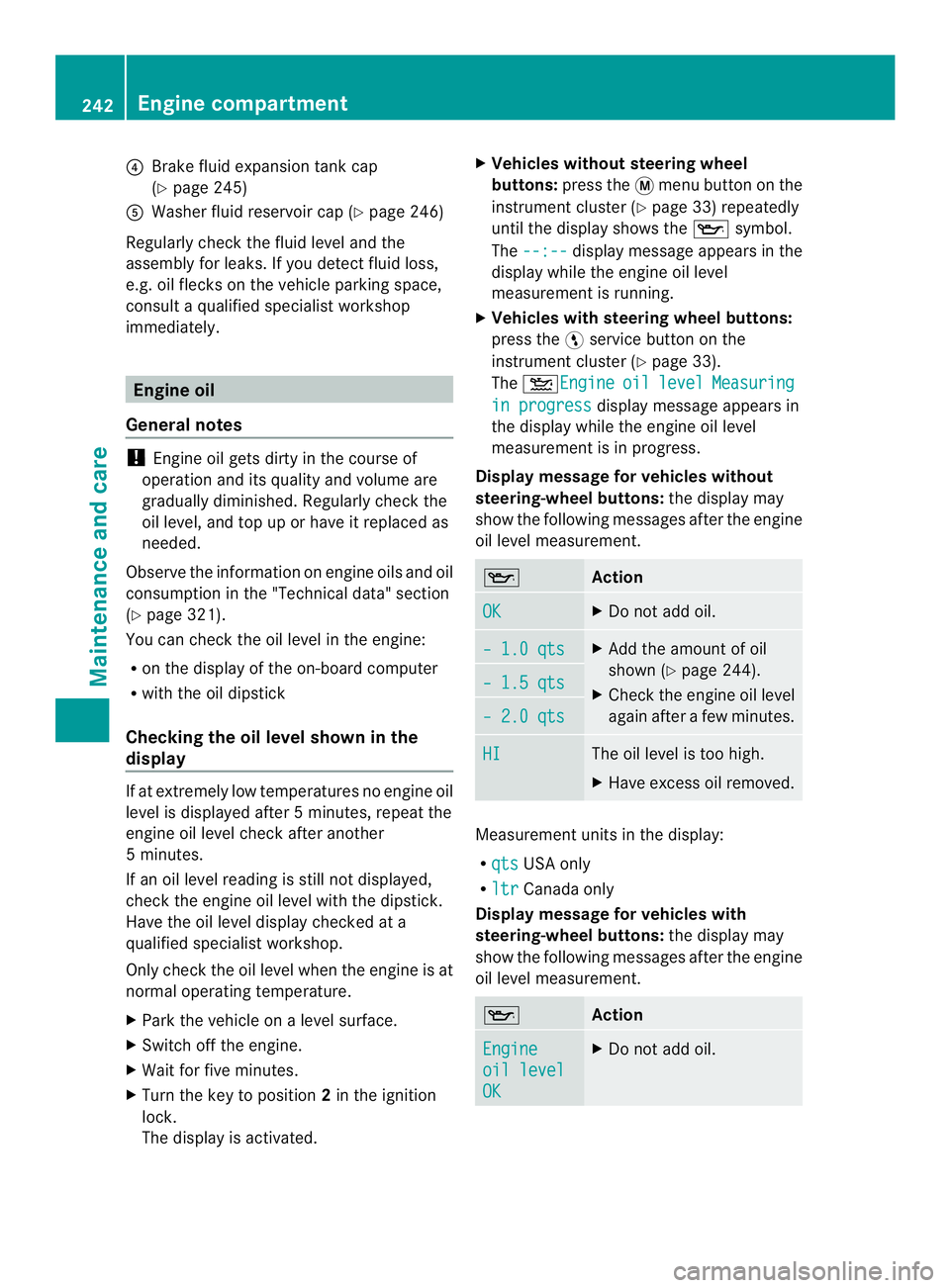
0025
Brake fluid expansion tank cap
(Ypage 245)
0023 Washe rfluid reservoir cap (Y page 246)
Regularly chec kthe fluid level and the
assembly for leaks. If you detect fluid loss,
e.g. oil flecks on the vehicle parking space,
consult a qualified specialist workshop
immediately. Engine oil
General notes !
Engine oil gets dirty in the course of
operation and its quality and volume are
gradually diminished. Regularly check the
oil level, and top up or have it replaced as
needed.
Observe the information on engine oils and oil
consumption in the "Technical data" section
(Y page 321).
You can check the oil level in the engine:
R on the display of the on-board computer
R with the oil dipstick
Checking the oil level shown in the
display If at extremely low temperatures no engine oil
level is displayed after
5minutes, repeat the
engine oil level chec kafter another
5 minutes.
If an oil level reading is still not displayed,
check the engine oil level with the dipstick.
Have the oil level display checked at a
qualified specialist workshop.
Only check the oil leve lwhen the engine is at
normal operating temperature.
X Park the vehicle on a level surface.
X Switch off the engine.
X Wait for five minutes.
X Turn the key to position 2in the ignition
lock.
The display is activated. X
Vehicles without steering wheel
buttons: press the 0004menu button on the
instrument cluster (Y page 33) repeatedly
until the display shows the 0015symbol.
The --:-- display message appears in the
display while the engine oil level
measurement is running.
X Vehicles with steering wheel buttons:
press the 0012service button on the
instrument cluster (Y page 33).
The 001DEngine oil level Measuring
in progress display message appears in
the display while the engine oil level
measurement is in progress.
Display message for vehiclesw ithout
steering-wheel buttons: the display may
show the following messages afte rthe engine
oil level measurement. 0015
Action
OK X
Do not add oil. – 1.0 qts X
Add the amount of oil
shown (Y page 244).
X Check the engine oil level
again after a few minutes. – 1.5 qts
– 2.0 qts
HI The oil level is too high.
X
Have excess oil removed. Measurement units in the display:
R
qts USA only
R ltr Canada only
Display message for vehiclesw ith
steering-wheel buttons: the display may
show the following messages afte rthe engine
oil level measurement. 0015
Action
Engine
oil level
OK X
Do not add oil. 242
Engine compartmentMaintenance and care
Page 247 of 334
G
WARNING
Coolant contains glycol and is therefore toxic.
Do not swallow the coolant. See a doctor
immediately if you swallow coolant.
Make sure that coolant does not come into
contact with skin, eyesorc lothing. In case of
contac twith eyes, rinse immediately with
plenty of clean water .Clean affected areas of
skin and clothing with soap and water
immediately. Change any affected clothing
immediately. G
WARNING
If antifreeze comes into contact with hot
components in the engine compartment, it
may ignite. There is a risk of fire and injury.
Let the engine cool down before you add
antifreeze. Make sure that antifreeze is not
spilled nex tto the filler neck.T horoughly
clean the antifreeze from components before
starting the engine.
! Take care not to spill any coolant on
painted surfaces. You could otherwise
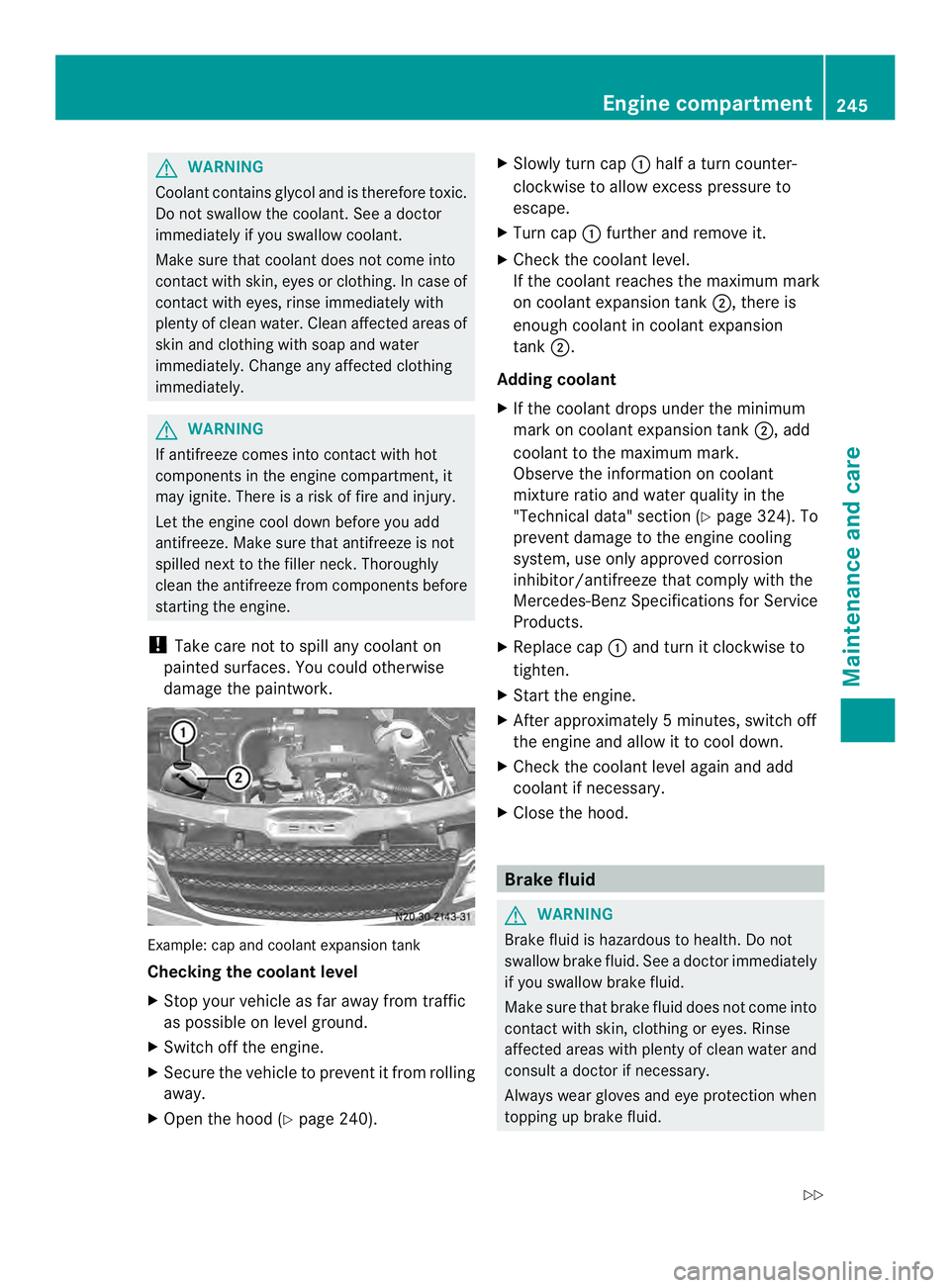
damage the paintwork. Example: cap and coolant expansion tank
Checking the coolant level
X
Stop your vehicle as far away from traffic
as possible on level ground.
X Switch off the engine.
X Secure the vehicle to prevent it from rolling
away.
X Open the hood (Y page 240). X
Slowly turn cap 0005half a turn counter-
clockwise to allow excess pressure to
escape.
X Turn cap 0005further and remove it.
X Check the coolant level.
If the coolant reaches the maximum mark
on coolant expansion tank 0006, there is
enough coolant in coolant expansion
tank 0006.
Adding coolant
X If the coolant drops under the minimum
mark on coolant expansion tank 0006, add
coolant to the maximum mark.
Observe the information on coolant
mixture ratio and water quality in the
"Technical data" section (Y page 324). To
prevent damage to the engine cooling
system, use only approved corrosion
inhibitor/antifreeze that comply with the
Mercedes-Benz Specifications for Service
Products.
X Replace cap 0005and turn it clockwise to
tighten.
X Start the engine.
X After approximately 5minutes, switch off
the engine and allow it to cool down.
X Check the coolan tlevel again and add
coolant if necessary.
X Close the hood. Brake fluid
G
WARNING
Brake fluid is hazardous to health. Do not
swallow brake fluid. See adoctor immediately
if you swallow brake fluid.
Make sure that brake fluid does not come into
contact with skin, clothing or eyes. Rinse
affected areas with plenty of clean water and
consult a doctor if necessary.
Always wear gloves and eye protection when
topping up brake fluid. Engine compartment
245Maintenance and care
Z
Page 248 of 334
Store brake fluid only in the original closed
container and keep it out of the reach of
children. Comply with safety regulations
when handling brake fluid.
! Brake fluid corrodes paint, plastic and
rubber .Ifpaint, plastic or rubbe rhas come
into contact with brake fluid, rinse with
wate rimmediately. G
WARNING
The brake fluid constantly absorbs moisture
from the air. This lowers the boiling point of
the brake fluid. If the boiling point of the brake
fluid is too low, vapo rpockets may form in the
brake system when the brakes are applied
hard. This would impair braking efficiency.
There is a risk of an accident.
You should have the brake fluid renewed at
the specified intervals.
! If the brake fluid level in the brake fluid
reservoir has fallen to the MIN mark or
below, check the brake system
immediately for leaks. Also check the
thickness of the brake linings. Visit a
qualified specialist workshop immediately.
Do not add brake fluid. This does not
correct the malfunction.
Have the brake fluid renewed every two
years.
Observe the information on brake fluid in the
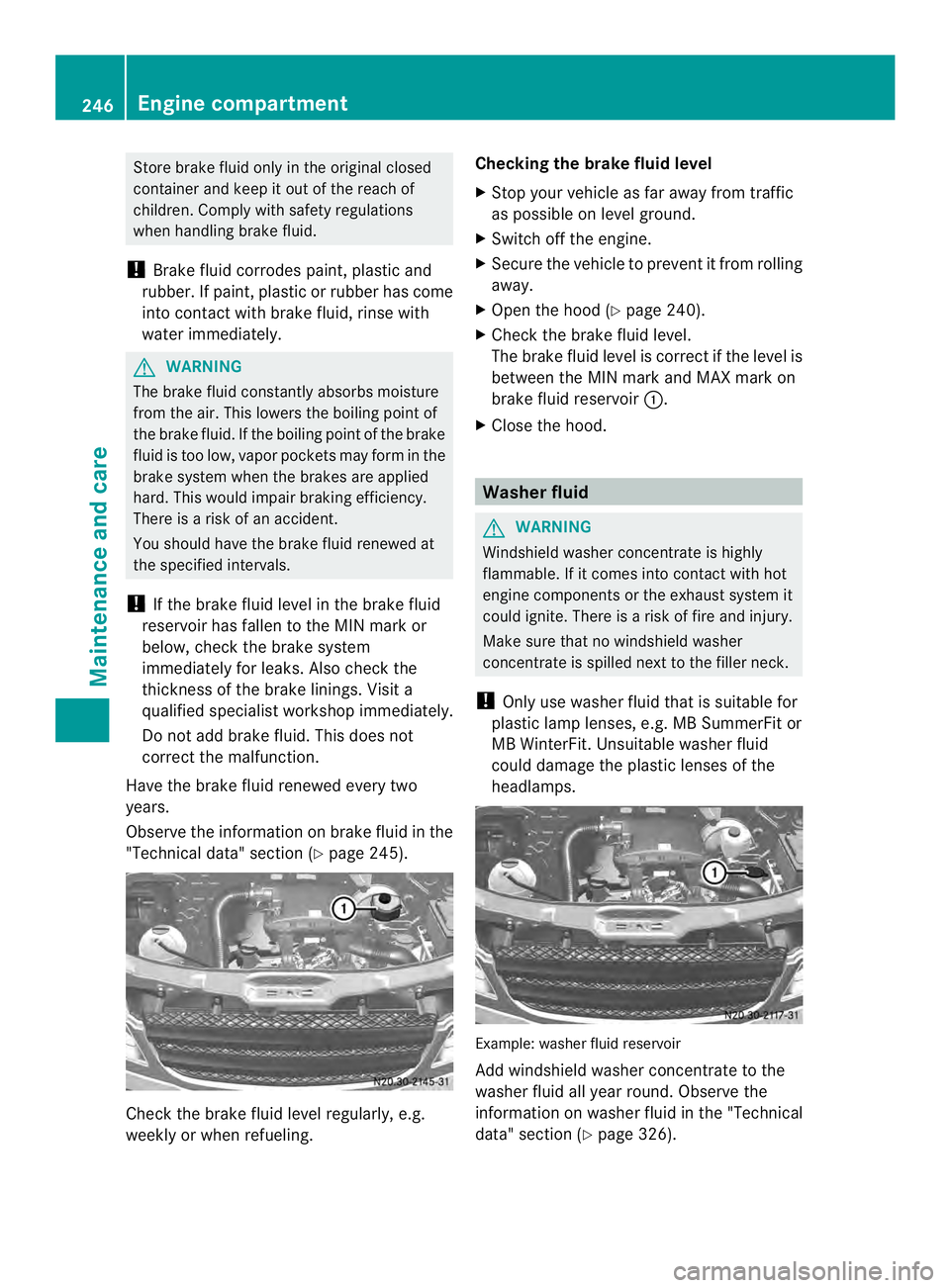
"Technical data" section ( Ypage 245). Check the brake fluid level regularly, e.g.
weekly or when refueling. Checking the brake fluid level
X
Stop your vehicle as far away from traffic
as possible on level ground.
X Switch off the engine.
X Secure the vehicle to prevent it from rolling
away.
X Open the hood (Y page 240).
X Check the brake fluid level.
The brake fluid level is correc tifthe level is
between the MIN mark and MAX mark on
brake fluid reservoir 0005.
X Close the hood. Washer fluid
G
WARNING
Windshield washer concentrate is highly
flammable. If it comes into contact with hot
engine components or the exhaust system it
could ignite. There is a risk of fire and injury.
Make sure that no windshield washer
concentrate is spilled next to the filler neck.
! Only use washer fluid that is suitable for
plastic lamp lenses, e.g. MB SummerFit or
MB WinterFit. Unsuitable washer fluid
could damage the plastic lenses of the
headlamps. Example: washer fluid reservoir
Add windshield washer concentrate to the
washer fluid all year round. Observe the
information on washer fluid in the "Technical
data" section (Y
page 326).246
Engine compartmentMaintenance and care
Page 257 of 334
X
Recharge the removed battery. Observe
the notes in the operating instructions for
your battery charger.
X Install the battery. Observe the notes on
reconnecting the battery.
i If batteries are no tbeing used, you should
charge them once a month.
It is also possible to charge the starter
battery using the jump-starting connection
point in the engine compartment
(Y page 267). Care
! Dirty battery clamps and battery surfaces
cause leak currents which lead to the
batteries discharging.
! Do not use cleaning agents containing
fuel. Cleaning agents containing fuel
corrode the battery housing.
! If dirt gets into the battery cell, battery
self-discharge will increase and the battery
may be damaged.
The following points on battery care must be
observed:
X Regularly chec kthe battery terminals and
the fastening of the negative cable to the
chassis to ensure that they are firmly
seated.
X Always keep the battery terminals and
battery surfaces clean and dry.
X Lightly grease the undersides of the battery
terminals with acid-resistant grease.
X Only clean the batteries when the caps are
screwed on.
Otherwise, dirt could get into the battery
cells.
X Unscrew the caps and clean blocked
breathers with a suitable tool such as a
piece of wire.
If you do not unscrew the caps for cleaning,
there is a risk of short circuit. The breathers in the caps and the cell
ventilation tubes must be open. Otherwise,
gas cannot escape.
X Only clean the battery casing with a
commercially available cleaning product. Care
Notes on care
G
WARNING
If you use openings in the bodywork or
detachable parts as steps, you could:
R slip and/or fall
R damage the vehicle and cause yourself to
fall.
There is a risk of injury.
Always use secure climbing aids, e.g. a
suitable ladder.
! For cleaning your vehicle, do not use any
of the following:
R dry, rough or hard cloths
R abrasive cleaning agents
R solvents
R cleaning agents containing solvents
Do not scrub.
Do not touch the surfaces or protective
films with hard objects, e.g. a ring or ice
scraper. You could otherwise scratch or
damage the surfaces and protective film.
! Do not park the vehicle for an extended
period straight after cleaning it, particularly
after having cleaned the wheels with wheel
cleaner. Wheel cleaners could cause
increased corrosion of the brake discs and
brake pads/linings. For this reason, you
should drive for a few minutes after
cleaning. Braking heats the brake discs and
the brake pads/linings, thus drying them.
The vehicle can then be parked. Care
255Maintenance and care Z
Page 258 of 334
H
Environmental note
Only clean your vehicle at specially designed
wash bays. Dispose of empt ycontainers and
used cleaning products in an environmentally
responsible manner. H
Environmental note
Dispose of empty packaging and cleaning
cloths in an environmentally responsible
manner.
Regula rcare of your vehicle is a condition for
retaining the quality in the long term.
Use care products and cleaning agents
recommended and approved for Sprinter
vehicles. Washing the vehicle and cleaning the
paintwork
Automatic car wash G
WARNING
Braking efficiency is reduced after washing
the vehicle .There is a risk of an accident.
After the vehicle has been washed, brake
carefully while paying attention to the traffic
conditions until full braking power is restored.
! Never clean your vehicle in a Touchless
Automatic Car Wash as these use special
cleaning agents. These cleaning agents can
damage the paintwork or plastic parts.
! Make sure that the automatic car wash is
suitable for the size of the vehicle.
Before washing the vehicle in an automatic
car wash, fold in the exterior mirrors and
remove any additional antennas.
Otherwise, the exterior mirror, antenna or
the vehicle itself could be damaged.
Make sure that the exterior mirrors are fully
folded out again and that any additional
antennas are re-installed when you leave
the automatic car wash. !
Make sure that:
R the side windows and the roof are
completely closed
R the climate control blower is switched off
R the windshield wiper switch is at position
0
The vehicle could otherwise be damaged.
You can wash the vehicle in an automatic car
wash from the very start.
Wash off excess dirt before cleaning the
vehicle in an automatic car wash.
After putting the vehicle through an
automatic car wash, wipe off wax from:
R the rear view camera lens (Y page 259)
R the windshield
R the windshield wiper blades
This will prevent smears and reduce wiping
noises caused by residue on the
windshield.
Washing by hand In some countries, washing by hand is only
allowed at specially equipped washing bays.
Observe the legal requirements for each
individual country.
X
Do not use hot water and do not wash the
vehicle in direct sunlight.
X Use a soft car sponge.
X Use a mild cleaning agent, e.g. a car
shampoo approved for use with Sprinter
vehicles.
X Thoroughly hose down the vehicle with a
gentle jet of water.
X Do not point the water jet directly towards
the air inlets.
X Use plenty of water and rinse out the
sponge frequently.
X Rinse the vehicle with clean water and dry
thoroughly with a chamois.
X Do not let the cleaning agents dry on the
paintwork. 256
CareMaintenance and care