ESP MERCEDES-BENZ SPRINTER 2013 MY13 Operator’s Manual
[x] Cancel search | Manufacturer: MERCEDES-BENZ, Model Year: 2013, Model line: SPRINTER, Model: MERCEDES-BENZ SPRINTER 2013Pages: 334, PDF Size: 3.88 MB
Page 308 of 334
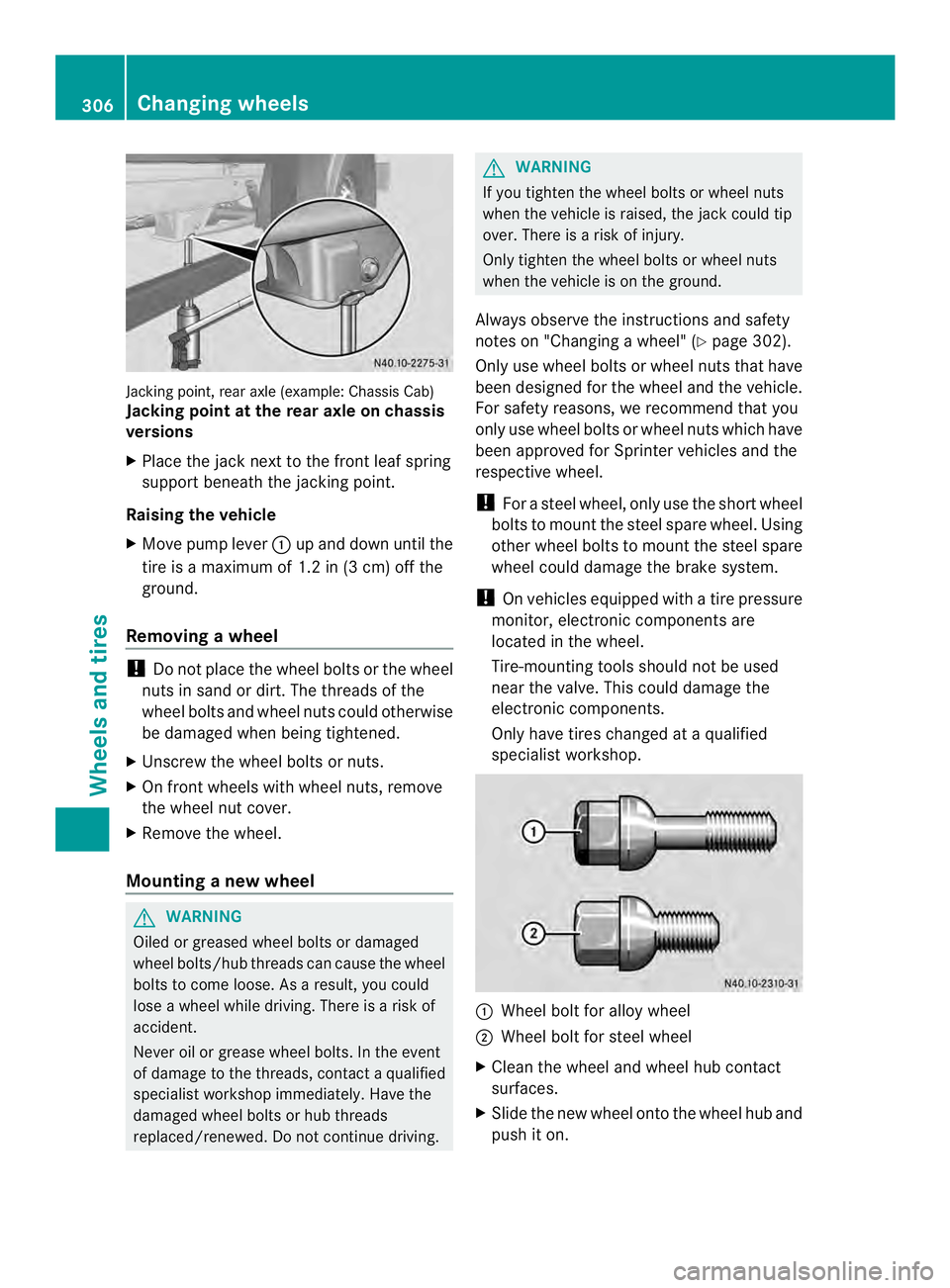
Jacking point, rear axle (example: Chassis Cab)
Jacking point at the rear axle on chassis
versions
X
Place the jack next to the front leaf spring
suppor tbeneath the jacking point.
Raising the vehicle
X Move pump lever 0005up and down until the
tire is a maximum of 1.2 in (3 cm) off the
ground.
Removing awheel !
Do not place the wheel bolts or the wheel
nuts in sand or dirt. The threads of the
wheel bolts and wheel nuts could otherwise
be damaged whe nbeing tightened.
X Unscrew the wheel bolts or nuts.
X On fron twheels with wheel nuts, remove
the wheel nut cover.
X Remove the wheel.
Mounting anew wheel G
WARNING
Oiled or greased wheel bolts or damaged
wheel bolts/hub threads can cause the wheel
bolts to come loose .As a result, you could
lose a wheel while driving. There is a risk of
accident.
Never oil or grease wheel bolts. In the event
of damage to the threads, contact a qualified
specialist workshop immediately.H ave the
damaged wheel bolts or hub threads
replaced/renewed. Do no tcontinue driving. G
WARNING
If you tighten the wheel bolts or wheel nuts
when the vehicle is raised, the jack could tip
over. There is a risk of injury.
Only tighten the wheel bolts or wheel nuts
when the vehicle is on the ground.
Always observe the instructions and safety
notes on "Changing a wheel" (Y page 302).
Only use wheel bolts or wheel nuts that have
been designed for the wheel and the vehicle.
For safety reasons, we recommend that you
only use wheel bolts or wheel nuts which have
been approved for Sprinter vehicles and the
respective wheel.
! For a steel wheel, only use the short wheel
bolts to mount the steel spare wheel. Using
other wheel bolts to mount the steel spare
wheel could damage the brake system.
! On vehicles equipped with a tire pressure
monitor, electronic components are
located in the wheel.
Tire-mounting tools should not be used
near the valve. This could damage the
electronic components.
Only have tires changed at a qualified
specialist workshop. 0005
Wheel bolt for alloy wheel
0006 Wheel bolt for steel wheel
X Clean the wheel and wheel hub contact
surfaces.
X Slide the new wheel onto the wheel hub and
push it on. 306
Changing wheelsWheels and tires
Page 311 of 334
R
only use a spare wheel that differs from the
wheel to be replaced for a short time.
R do not deactivate ESP ®
.
R have a spare wheel that differs from the
wheel that has been changed replaced at
the nearest qualified specialist workshop.
You must observe the correc twheel and
tire dimensions as well as the wheel type.
When using a spare wheel of a different size,
do not exceed the maximum speed of
80 km/h. General notes
! Check the spare wheel regularly to see
that it is secure and has the prescribed tire
pressure.
The procedure for mounting the spare wheel
is described in "Mounting awheel"
(Y page 303).
The following should be checked regularly,
particularly prior to long journeys:
R the tire pressure of the spare wheel, which
should then be corrected if necessary
(Y page 278).
R the fastenings of the spare wheel bracket.
The spare wheel is located in a spare wheel
bracket under the rear of the vehicle.
Replace the tires after 6years at the latest,
regardless of wear. This also applies to the
spare wheel.
i If you have mounted a spare wheel, the
tire pressure monitor (Y page 281) will not
function for this wheel. The spare wheel is
not equipped with a sensor for monitoring
tire pressure. Removing and installing the spare
wheel
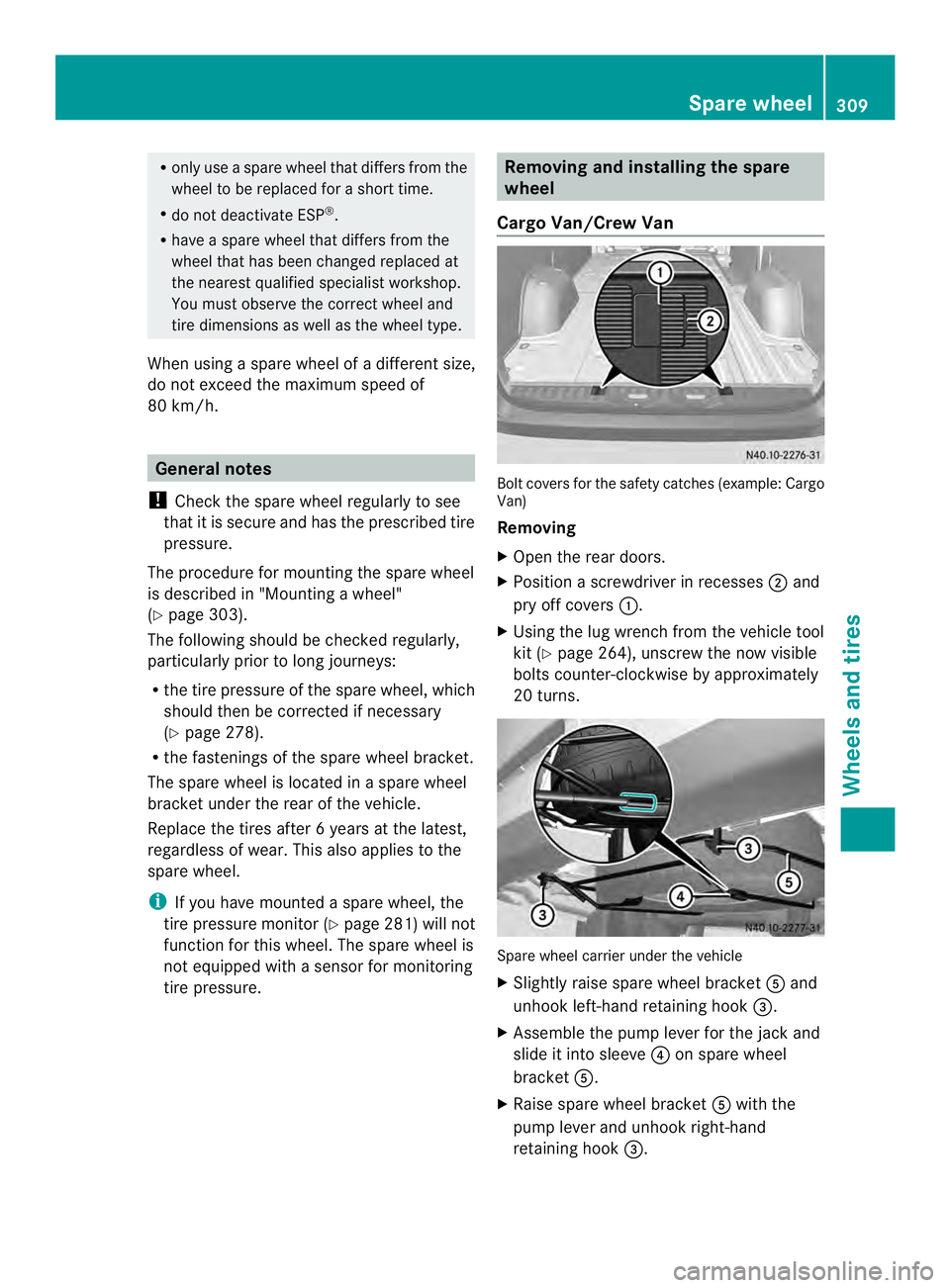
Cargo Van/Crew Van Bolt covers for the safety catches (example: Cargo
Van)
Removing
X
Open the rear doors.
X Position a screwdriver in recesses 0006and
pry off covers 0005.
X Using the lug wrench from the vehicle tool
kit (Y page 264), unscrew the now visible
bolts counter-clockwise by approximately
20 turns. Spare wheel carrier under the vehicle
X
Slightly raise spare wheel bracket 0023and
unhook left-hand retaining hook 0026.
X Assemble the pump lever for the jack and
slide it into sleeve 0025on spare wheel
bracket 0023.
X Raise spare wheel bracket 0023with the
pump lever and unhook right-hand
retaining hook 0026. Spare wheel
309Wheels and tires Z
Page 316 of 334
Genuine Sprinter parts
! Air bags and Emergency Tensioning
Devices, as well as control units and
sensors for these restraint systems, may be
installed in the following areas of your
vehicle:
R doors
R door pillars
R door sills
R seats
R cockpit
R instrument cluster
R center console
Do not install accessories such as audio
systems in these areas. Do not carry out
repairs or welding. You could impair the
operating efficiency of the restraint
systems.
Have aftermarket accessories installed at
a qualified specialist workshop. H
Environmental note
We supply reconditioned assembliesa nd
parts which are of the same quality as new
parts. The same New Vehicl eLimited
Warranty applies as for new parts.
We tes tgenuine Sprinter parts, as well as
conversion parts and accessories that have
been specifically approved for the type of
vehicle, for:
R reliability
R safety
R suitability
Despite ongoing market research, we are
unable to assess other parts. If individual or
official approval is given, we assume no
responsibility for use in Sprinter vehicles.
In some countries, certain parts are only
officially approved for installation or
modification if they comply with legal
requirements. All genuine Sprinter parts
satisfy these requirements. Make sure that all
parts are suitable for your vehicle. All authorized Sprinter Dealers maintain a
supply of genuine Sprinter parts for required
service and repair work. Also, the
strategically distributed parts delivery
centers provide quick and reliable parts
service.
Always specify the vehicle identification
number (VIN) and engin
enumbe rwhen
ordering genuine Sprinter parts
(Y page 315). Vehicle electronics
Tampering with the engine
electronics
G
WARNING
Always have work on the engine electronics
and related components carried out at a
qualified specialist workshop. Otherwise, the
vehicle's operating safety could be affected.
! Only have engine electronics and the
corresponding parts, such as control units,
sensors or connector leads, serviced in a
qualified specialist workshop. Otherwise,
the vehicle parts may wear more quickly.
This can lead to loss of the New Vehicle
Limited Warranty. Installing electrical or electronic
equipment
G
WARNING
You and others may damage your health due
to excessive electromagnetic radiation. By
using an external antenna, the possible health
risks of electromagnetic fields, which are
under discussion among the scientific
community, should be largely prevented.
Therefore, only have the exterior antenna
installed at a qualified specialist workshop.
Electrical and electronic devices may have a
detrimental effect on both the comfort and
the operating safety of the vehicle. If 314
Vehicle electronicsTechnical data
Page 318 of 334
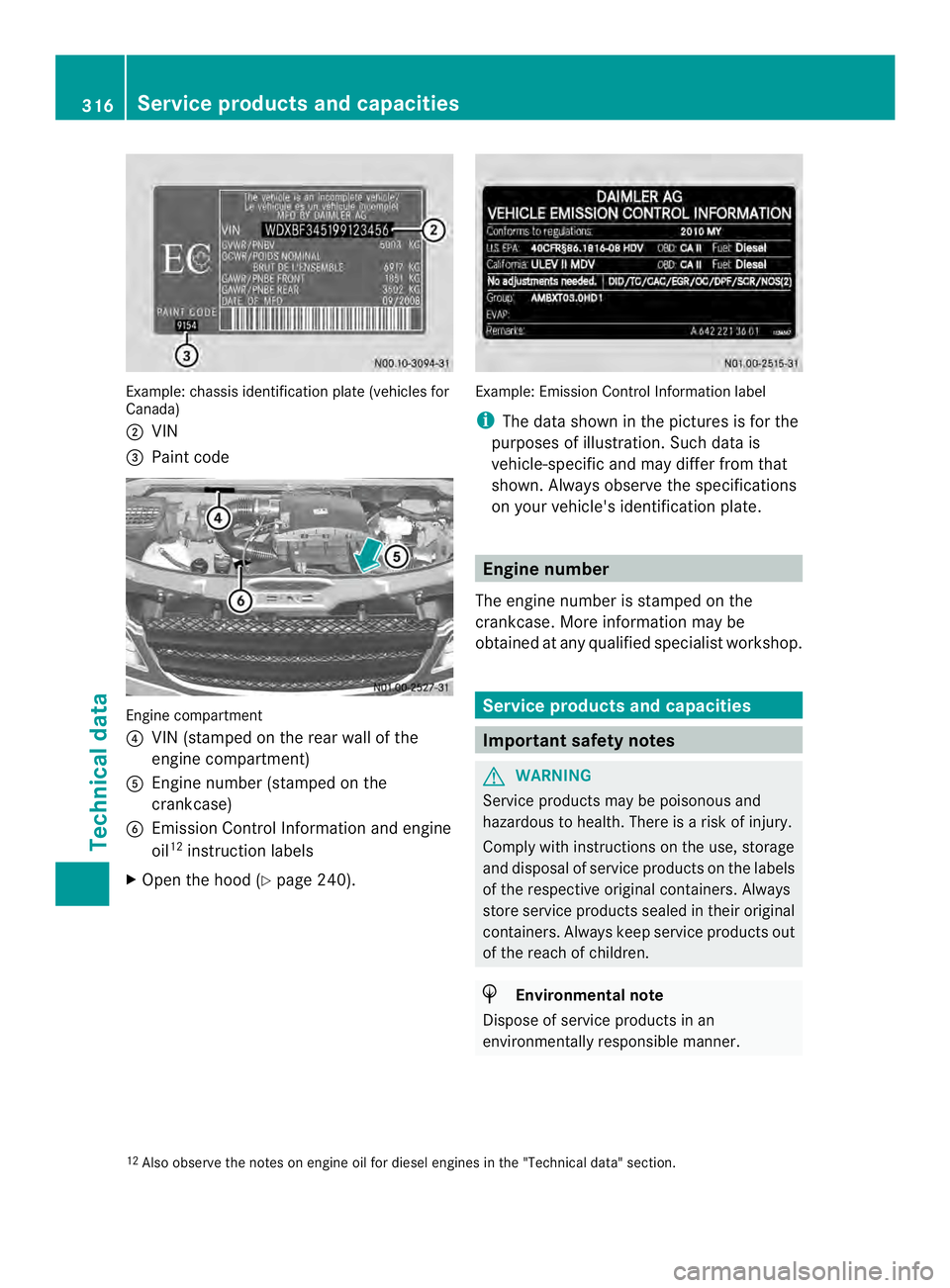
Example: chassis identification plate (vehicles for
Canada)
0006 VIN
0026 Paint code Engine compartment
0025
VIN (stamped on the rear wall of the
engine compartment)
0023 Engine numbe r(stamped on the
crankcase)
0024 Emission Control Information and engine
oil12
instruction labels
X Open the hood (Y page 240). Example: Emission Control Information label
i
The data shown in the pictures is for the
purposes of illustration. Such data is
vehicle-specific and may differ from that
shown. Always observe the specifications
on your vehicle's identification plate. Engine number
The engine number is stamped on the
crankcase. More information may be
obtained at any qualified specialist workshop. Service products and capacities
Important safety notes
G
WARNING
Service products may be poisonous and
hazardous to health. There is a risk of injury.
Comply with instructions on the use, storage
and disposal of service products on the labels
of the respective original containers. Always
store service products sealed in their original
containers. Always keep service products out
of the reach of children. H
Environmental note
Dispose of service products in an
environmentally responsible manner.
12 Also observe the notes on engine oil for diesel engines in the "Technical data" section. 316
Service products and capacitiesTechnical data
Page 319 of 334
Service products include the following:
R Fuels, e.g. diesel
R Additives for the exhaus tgas
aftertreatment, e.g .Diesel Exhaust Fluid
(DEF)
R Lubricants, e.g. engine oil, transmission oil
R Coolant
R Brake fluid
R Washer fluid
R Climate control system refrigerants
Approved service products comply with the
highes tquality standards and are listed in the
MB Specifications for Service Products. Only
use service products approved for the
vehicle. This is an important condition for the
warranty.
You will recognize the approved service
products by the inscription on the container:
MB Approval (e.g. MB Approval 228.5)
Other identifications and recommendations
refer to quality level or a specification
according to an MB Sheet Number (e.g. MB
228.5). They are therefore not necessarily
approved.
Further information can be obtained at any
qualified specialist workshop.
Additives for approved service products are
neither required no rpermitted. Approved fuel
additives are the exception .Additives can
cause engine damage and must therefore not
be added to the service products.
The use of additives is always the
responsibility of the vehicle operator .The use
of additives may result in the restriction or
loss of your Limited Warranty entitlements. Fuel
Important safety notes G
WARNING
Fuel is highly flammable. Improper handing of
fuel creates a risk of fire and explosion. Avoid fire, open flames, smoking and creating
sparks under all circumstances. Switch off the
engine and, if applicable, the auxiliary heating
before refueling.
G
WARNING
Fuel is poisonous and hazardous to health.
There is a risk of injury.
You must make sure that fuel does not come
into contact with your skin, eyes or clothing
and that it is not swallowed. Do not inhale fuel
vapors. Keep fuel away from children.
If you or others come into contact with fuel,
observe the following:
R Wash away fuel from skin immediately
using soap and water.
R If fuel comes into contact with your eyes,
immediately rinse them thoroughly with
clean water. Seek medical assistance
without delay.
R If fuel is swallowed, seek medical
assistance without delay.Don ot induce
vomiting.
R Immediately change out of clothing which
has come into contact with fuel.
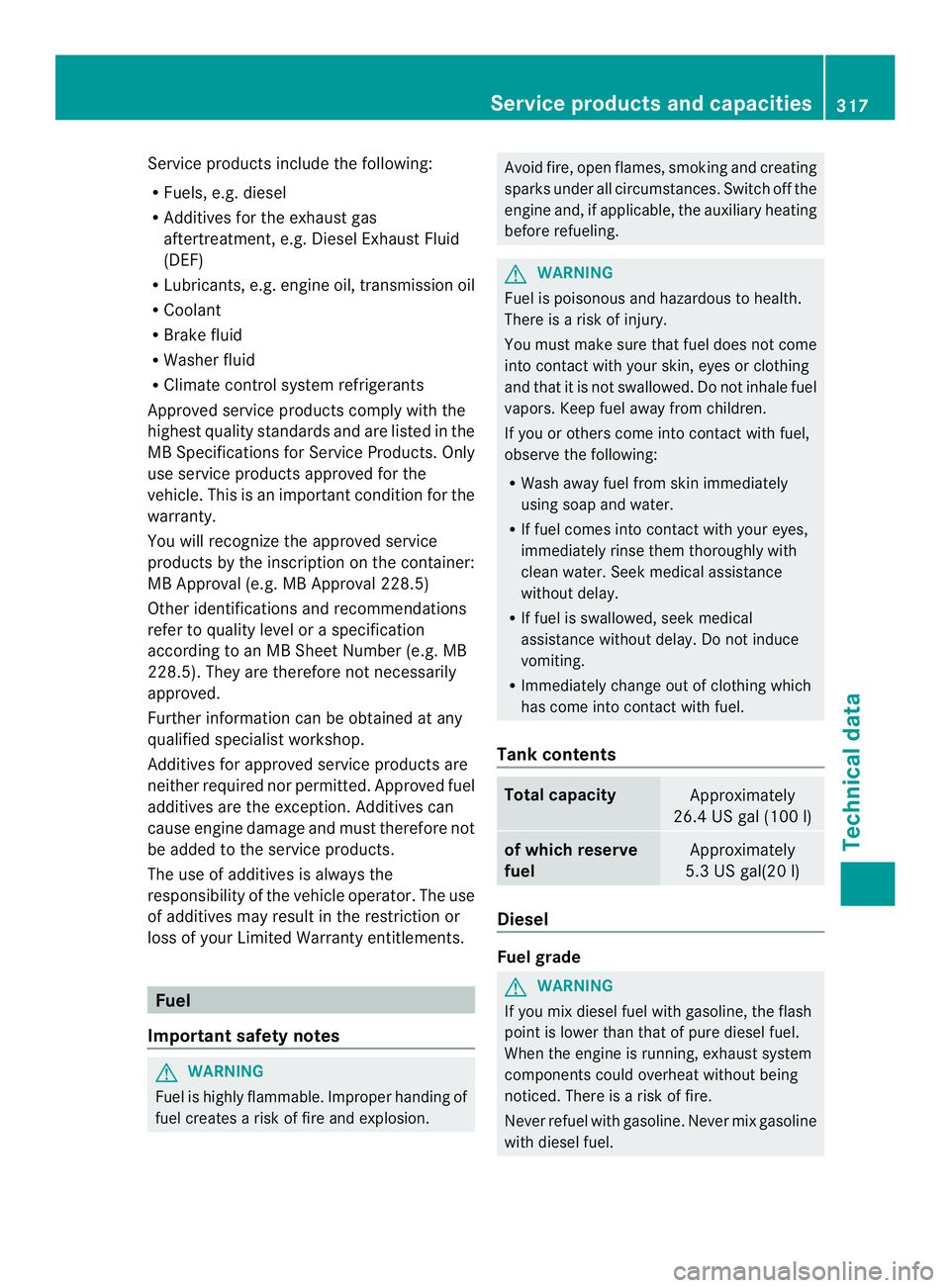
Tank contents Total capacity
Approximately
26.4 US gal (100 l) of which reserve
fuel
Approximately
5.3 US gal(20 l) Diesel
Fuel grade
G
WARNING
If you mix diesel fuel with gasoline, the flash
point is lower than that of pure diesel fuel.
When the engine is running, exhaust system
components could overheat without being
noticed. There is a risk of fire.
Never refuel with gasoline. Never mix gasoline
with diesel fuel. Service products and capacities
317Technical data Z
Page 321 of 334
This can result in damage to the fuel
injection system, for example.
Flow improvers are fuel additives used to
improve the flow characteristics of diesel
fuels.
The effectiveness of flow improvers cannot be
guaranteed with all fuels. Observe the
manufacturer's recommendations.
Information about approved flow improvers is
available from any authorized Sprinter Dealer.
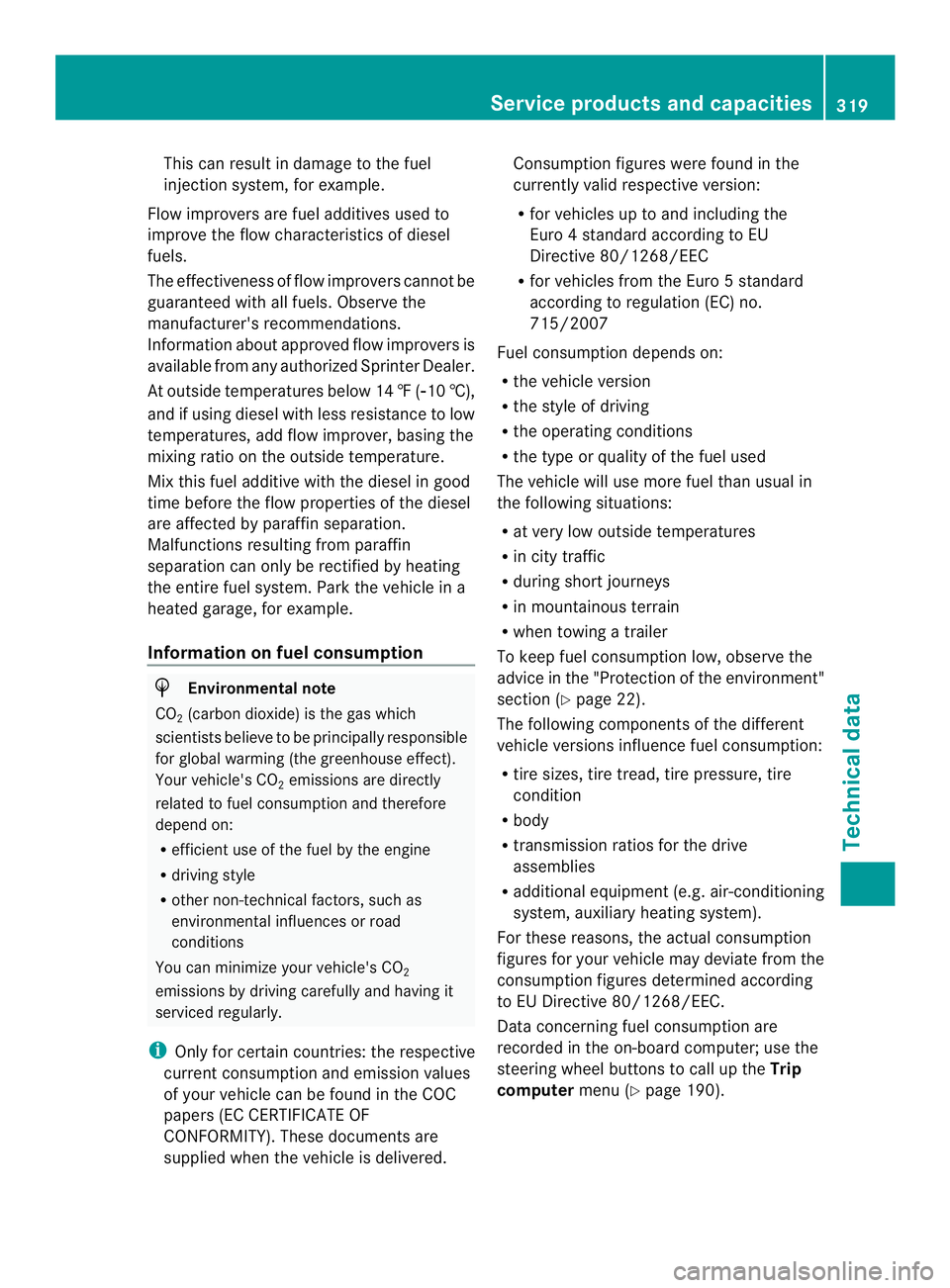
At outside temperatures below 14 ‡(002710 †),
and if using diesel with less resistance to low
temperatures, add flow improver, basing the
mixing ratio on the outside temperature.
Mix this fuel additive with the diesel in good
time before the flow properties of the diesel
are affected by paraffi nseparation.
Malfunctions resulting from paraffin
separation can only be rectified by heating
the entire fuel system. Park the vehicle in a
heated garage, for example.
Information on fuel consumption H
Environmental note
CO 2(carbon dioxide) is the gas which
scientists believe to be principally responsible
for global warming (the greenhouse effect).
Your vehicle's CO 2emissions are directly
related to fuel consumption and therefore
depend on:
R efficien tuse of the fuel by the engine
R driving style
R other non-technical factors, such as
environmental influences or road
conditions
You can minimize your vehicle's CO 2
emissions by driving carefully and having it
serviced regularly.
i Only for certain countries: the respective
current consumption and emission values
of your vehicle can be found in the COC
papers (EC CERTIFICATE OF
CONFORMITY). These documents are
supplied when the vehicle is delivered. Consumption figures were found in the
currently valid respective version:
R
for vehicles up to and including the
Euro 4 standard according to EU
Directive 80/1268/EEC
R for vehicles from the Euro 5 standard
according to regulation (EC) no.
715/2007
Fuel consumption depends on:
R the vehicle version
R the style of driving
R the operating conditions
R the type or quality of the fuel used
The vehicle will use more fuel than usual in
the following situations:
R at very low outside temperatures
R in city traffic
R during short journeys
R in mountainous terrain
R when towing a trailer
To keep fuel consumption low, observe the
advice in the "Protection of the environment"
section (Y page 22).
The following components of the different
vehicle versions influence fuel consumption:
R tire sizes, tire tread, tire pressure, tire
condition
R body
R transmission ratios for the drive
assemblies
R additional equipment (e.g. air-conditioning
system, auxiliary heating system).
For these reasons, the actual consumption
figures for your vehicle may deviate from the
consumption figures determined according
to EU Directive 80/1268/EEC.
Data concerning fuel consumption are
recorded in the on-board computer; use the
steering wheel buttons to call up the Trip
computer menu (Ypage 190). Service products and capacities
319Technical data Z
Page 322 of 334
Diesel Exhaust Flui
d(DEF)
General notes !
Only use DEF in accordance with
ISO 22241. The exhaus tgas aftertreatment
system may otherwise be damaged.
Observe the MB Specifications for Service
Products, Sheet No. 352.0.
Damage caused by the use of other
reducing agents will invalidat ethe New
Vehicle Limited Warranty.
! If DEF comes into contact with a painted
or aluminum surface, wash the surface off
immediately with plenty of water.
High ambient temperatures When opening the DEF tank filler cap at high
outside temperatures, ammonia vapors may
escape. Ammonia vapors have a pungent
odor and are particularly irritating for your
skin, respiratory organs and eyes. This may
result in burning eyes, nose and throat, as
well as coughing and watering eyes. Do not
inhale ammonia vapors.
If DEF in the DEF reservoir heats up to
temperatures above 122 ‡
(50†) foralong
period of time (e.g. due to direct sunlight),
ammonia vapors form.
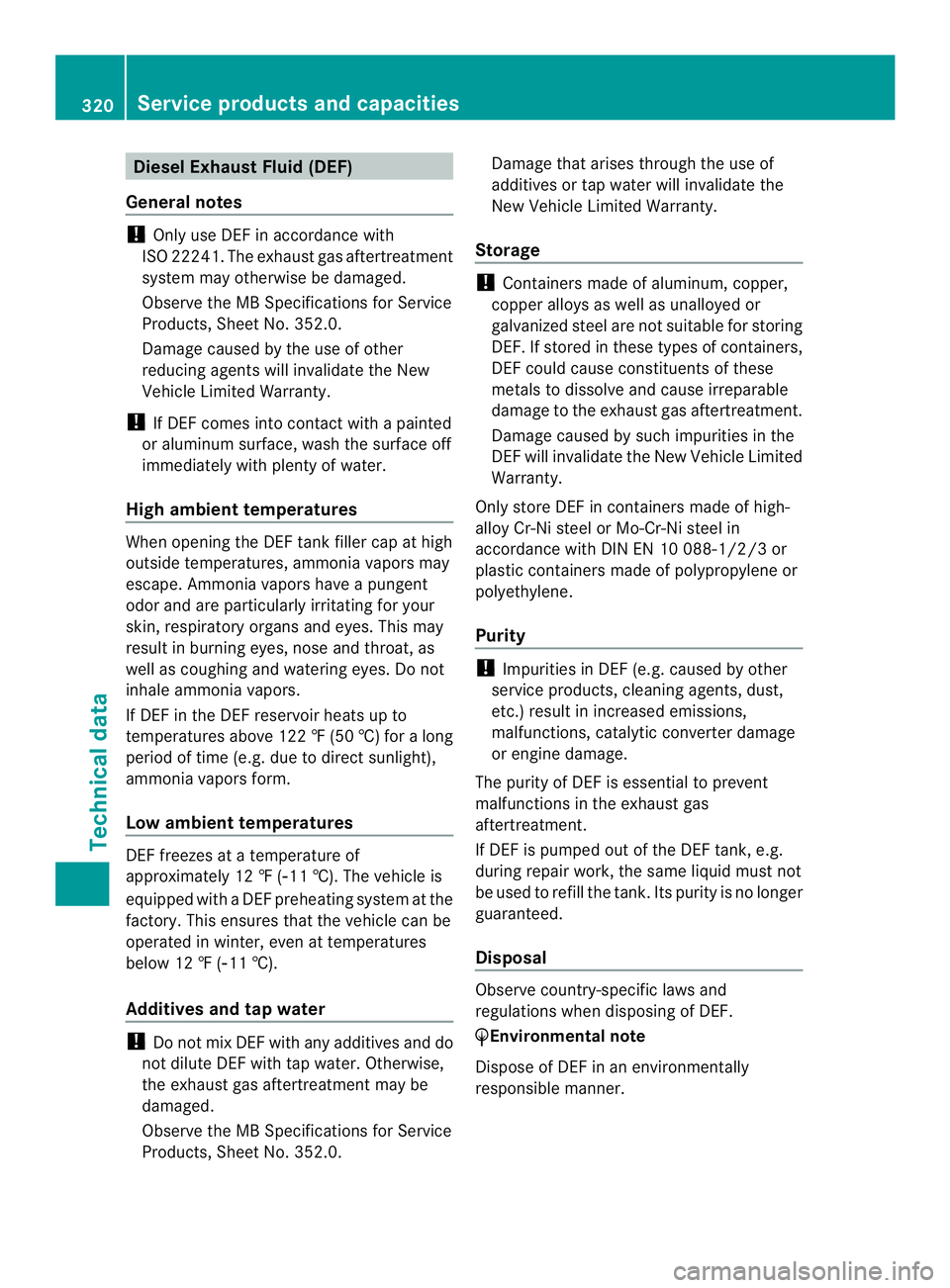
Low ambient temperatures DEF freezes at a temperature of
approximately 12
‡(002711 †). The vehicle is
equipped with a DEF preheating system at the
factory .This ensures that the vehicle can be
operated in winter, even at temperatures
below 12 ‡(002711 †).
Additives and tap water !
Do not mix DEF with any additives and do
not dilute DEF with tap water. Otherwise,
the exhaust gas aftertreatment may be
damaged.
Observe the MB Specifications for Service
Products, Sheet No. 352.0. Damage that arises through the use of
additives or tap water will invalidate the
New Vehicle Limited Warranty.
Storage !
Containers made of aluminum, copper,
coppe ralloys as well as unalloyed or
galvanized steel are not suitable for storing
DEF. If stored in these types of containers,
DE Fc ould cause constituents of these
metals to dissolve and cause irreparable
damage to the exhaust gas aftertreatment.
Damage caused by such impurities in the
DEFw ill invalidate the New Vehicle Limited
Warranty.
Only store DEF in containers made of high-
alloy Cr-Ni steel or Mo-Cr-Ni steel in
accordance with DIN EN 10 088-1/2/3 or
plastic containers made of polypropylene or
polyethylene.
Purity !
Impurities in DE F(e.g. caused by other
service products, cleaning agents, dust,
etc.) result in increased emissions,
malfunctions, catalytic converter damage
or engine damage.
The purity of DEFi s essential to prevent
malfunctions in the exhaust gas
aftertreatment.
If DEF is pumped out of the DEF tank, e.g.
during repair work, the same liquid must not
be used to refill the tank. Its purity is no longer
guaranteed.
Disposal Observe country-specific laws and
regulations when disposing of DEF.
0017Environmental note
Dispose of DEF in an environmentally
responsible manner.320
Service products and capacitiesTechnical data
Page 324 of 334
significantly due to aging in use, especially
at low outside temperatures.
We recommend that you change the engine
oil before the cold season commences. Use
an approved engine oil of the specified SAE
class.
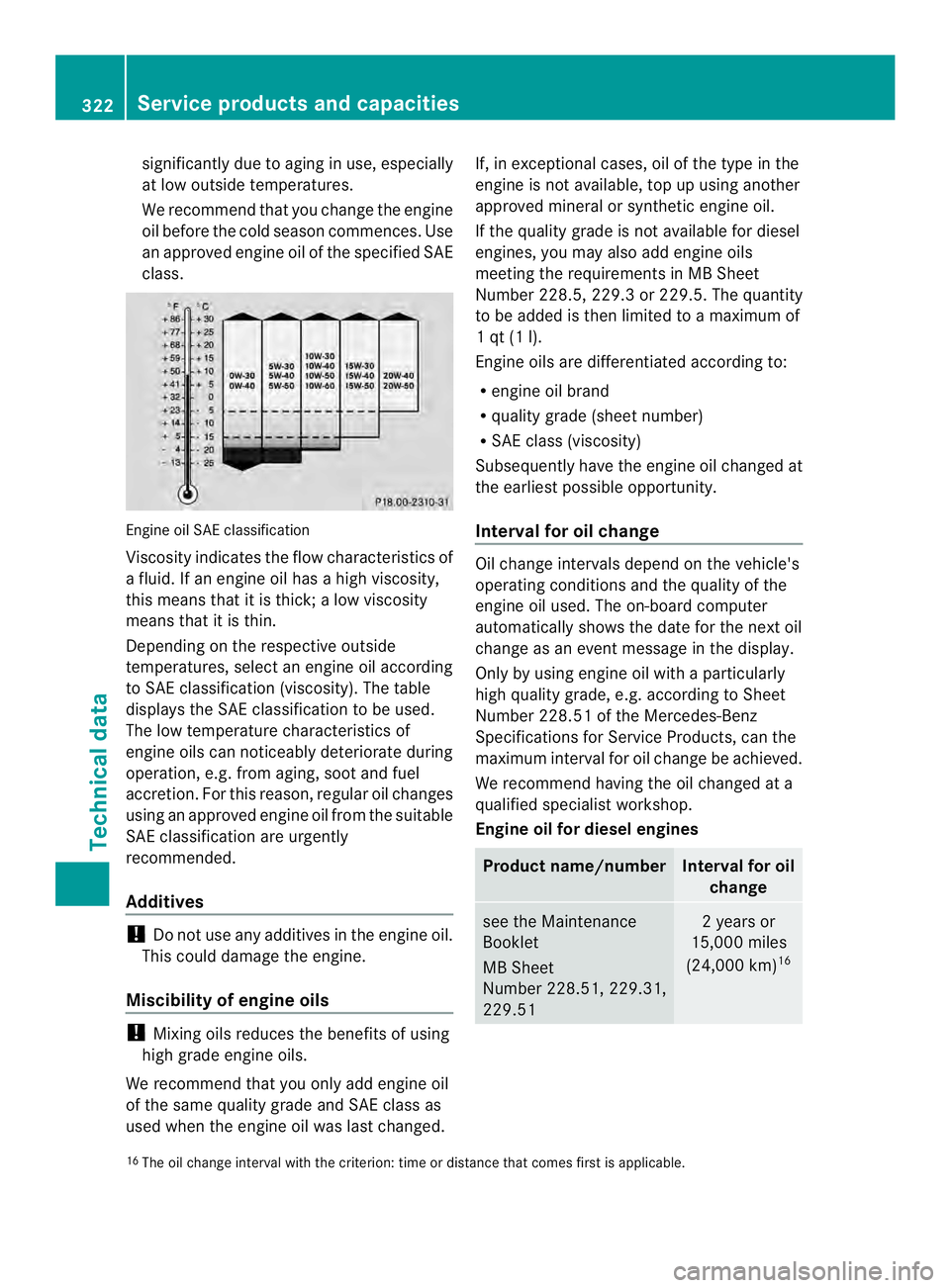
Engine oil SAE classification
Viscosity indicates the flow characteristics of
a fluid. If an engine oil has a high viscosity,
this means that it is thick; a low viscosity
means that it is thin.
Depending on the respective outside
temperatures, select an engine oil according
to SAE classification (viscosity). The table
displays the SAE classification to be used.
The low temperature characteristics of
engine oils can noticeably deteriorate during
operation, e.g. from aging, soot and fuel
accretion. For this reason, regularo il changes
using an approved engine oil fro mthe suitable
SAE classification are urgently
recommended.
Additives !
Do not use any additives in the engine oil.
This could damage the engine.
Miscibility of engine oils !
Mixing oils reduces the benefits of using
high grade engine oils.
We recommend that you only add engine oil
of the same quality grade and SAE class as
used when the engine oil was last changed. If, in exceptional cases, oil of the type in the
engine is not available, top up using another
approved mineral or synthetic engine oil.
If the quality grade is not available for diesel
engines, you may also add engine oils
meeting the requirements in MB Sheet
Number 228.5, 229.3 or 229.5. The quantity
to be added is then limited to a maximum of
1 qt (1 l).
Engine oils are differentiated according to:
R
engine oil brand
R quality grade (sheet number)
R SAE class (viscosity)
Subsequently have the engine oil changed at
the earliest possible opportunity.
Interval for oil change Oil change intervals depend on the vehicle's
operating conditions and the quality of the
engine oil used. The on-board computer
automatically shows the date for the next oil
change as an event message in the display.
Only by using engine oil with a particularly
high quality grade, e.g. according to Sheet
Number 228.51 of the Mercedes-Benz
Specifications for Service Products, can the
maximum interval for oil change be achieved.
We recommend having the oil changed at a
qualified specialist workshop.
Engine oil for diesel engines
Product name/number Interval for oil
change see the Maintenance
Booklet
MB Sheet
Number 228.51, 229.31,
229.51 2y
ears or
15,000 miles
(24,000 km) 16 16
The oil change interval with the criterion: time or distance that comes first is applicable. 322
Service products and capacitiesTechnical data