fuel consumption MERCEDES-BENZ SPRINTER 2013 MY13 Operator’s Manual
[x] Cancel search | Manufacturer: MERCEDES-BENZ, Model Year: 2013, Model line: SPRINTER, Model: MERCEDES-BENZ SPRINTER 2013Pages: 334, PDF Size: 3.88 MB
Page 12 of 334
Engine speed setting (working
mode)
............................................ 168
Irregularr unning............................ 137
Jump-starting ................................. 267
Operating safety .............................. 25
Starting .......................................... 134
Starting problems ..........................137
Switching off .................................. 146
Tow-starting (vehicle) ..................... 271
Engine, jump-starting .......................267
Engine electronics Notes ............................................. 314
Problem (malfunction) ...................137
Engine oil
Adding ........................................... 244
Additives ........................................ 322
Checking the oil level (on-board
computer) ...................................... 242
Checking the oil level using the
dipstick .......................................... 243
Display message ............................ 206
Filling capacity ............................... 323
Information about oil
consumption .................................. 323
Mixing ............................................ 322
Notes about oil grades ................... 321
Oil change ...................................... 322
Oil leve l(note) ............................... 242
Viscosity ........................................ 321
Warning lamp ................................. 214
Engine spee dsetting (working
mode) ................................................. 167
Equipment/conversions .....................27
ESP ®
(Electronic Stability
Program) Display message ............................ 200
Function/notes ................................ 57
Indicator lamp ................................ 213
Warning lamp ................................. 210
Exhaus tcheck ................................... 148
Exhaust gas aftertreatment ...............27
DEF leve lindicato r......................... 178
DEF reducing agent .................27, 320
Diesel Exhaus tFluid (DEF) .............320
Display messages (vehicles
without steering wheel buttons) ....195
Display messages (vehicles with
steering wheel buttons) .................204Indicator lamp ................................ 213
Malfunction ...................................
.204
Refilling DEF .................................. 143
Exterior lighting
Daytime running lamp mode
(vehicles without steering wheel
buttons) ......................................... 179
Daytime running lamp mode
(vehicles with steering wheel
buttons) ......................................... 187
see Lights
Exterior mirrors
Adjusting ......................................... 86
Important safety notes ....................86
Eyeglasses compartment .................223 F
FAME fuel Bio-diesel ....................................... 317
Fire extinguisher ............................... 266
First-aid kit ......................................... 266
Flat tire Changing a wheel/mounting the
spare wheel ................................... 303
General notes ................................ 295
Preparing the vehicle .....................295
Using tire sealant ........................... 295
Fog lamps
Switching on/off .............................. 91
Folding seat ......................................... 82
Folding table ...................................... 225
Frequencies Mobile phone ................................. 314
Two-way radio ................................ 314
Front fog lamps
Changing the bulbs ..........................98
Switching on/off .............................. 91
Fron tinterior light
Changing bulbs .............................. 102
Fron twindshield
see Windshield
Fuel
Additives (diesel) ........................... 318
Bio-diesel (FAME fuel ).................... 317
Consumption information ..............319
Consumption statistics ..................19010
Index
Page 24 of 334
Protection of the environment
General notes
H
Environmental note
Daimler's declared policy is one of
comprehensive environmental protection.
The objectives are for the natural resources
that form the basis of our existence on this
planet to be used sparingly and in a manner
that takes the requirements of both nature
and humanity into account.
You too can help to protect the environment
by operating your vehicle in an
environmentally responsible manner.
Fuel consumption and the rate of engine,
transmission, brake and tire wear are affected
by these factors:
R operating conditions of your vehicle
R your personal driving style
You can influence both factors. You should
bear the following in mind:
Operating conditions:
R avoid short trips as these increase fuel
consumption.
R always make sure that the tire pressures
are correct.
R do not carry any unnecessary weight.
R remove roof racks once you no longer need
them.
R a regularly serviced vehicle will contribute
to environmental protection. You should
therefore adhere to the service intervals.
R always have service work carried out at a
qualified specialist workshop.
Personal driving style:
R do not depress the accelerator pedal when
starting the engine.
R do not warm up the engine when the vehicle
is stationary.
R drive carefully and maintain a safe distance
from the vehicle in front.
R avoid frequent, sudden acceleration and
braking. R
change gear in good time and use each gear
only up to 0004of its maximum engine speed.
R switch off the engine in stationary traffic.
R keep an eye on the vehicle's fuel
consumption. Environmental issues and
recommendations
When prompted by this Operator's Manual to
dispose of materials, please try to regenerate
and recycle these materials. Observe all
relevant environmental guidelines and
regulations when disposing of materials. This
helps to protect the environment. Product information
We recommend original Sprinter parts and
conversion parts and accessories that have
been approved expressly for the type of
vehicle concerned.
We test genuine Sprinter parts, as well as
conversion parts and accessories that have
been specifically approved for the type of
vehicle, for:
R reliability
R safety
R suitability
Despite ongoing market research, we are
unable to assess other parts. We therefore
accept no responsibility for the use of such
parts in a Sprinter, even if they have been
independently or officially approved.
Genuine Sprinter parts, as well as specifically
approved conversion parts and accessories,
can be obtained at an authorized Sprinter
Dealer. Here you will receive advice about
permissible technical modifications, and the
parts will be professionally installed. 22
Introduction
Page 150 of 334
Bear in mind that at a speed of just 30 mph
(approximately 50 km/h), your vehicle covers
a distance of 44 feet (approximatel
y14 m)
every second. G
WARNING
If you switch off the ignition while driving,
safety-relevant functions are only available
with limitations, or not at all. This could affect,
for example, the power steering and the brake
boosting effect. You will require considerably
more effort to steer and brake .There is a risk
of an accident.
Do not switch off the ignition while driving.
! Always observe the ground clearance of
the vehicle and avoid obstacles. On
vehicles with a step, ground clearance is
further restricted. Obstacles can damage
the vehicle.
If you must drive over obstacles, drive
especially slowly and carefully. If
necessary, have another person direct you.
Drive sensibly–s ave fuelIn orde
rto save fuel, observe the following
tips:
X The tires should always be inflated to the
recommended tire pressure.
X Remove unnecessary loads.
X Remove roof carriers when they are not
needed.
X Warm up the engine at low engine speeds.
X Avoid frequent acceleration or braking.
X Have all maintenance work carried out as
indicated by the service intervals in the
Maintenance Booklet or by the service
interval display.
Fuel consumption also increases when
driving in cold weather, in stop-start traffic
and in mountainous terrain. Overrun cutoff If you are in overrun mode and take your foot
off the accelerator pedal, the fuel supply is
cut off when the engine speed is out of the
idle speed control range.
Drinking and driving
G
WARNING
Drinking and driving and/or taking drugs and
driving are very dangerous combinations.
Even a small amount of alcohol or drugs can
affect your reflexes, perceptions and
judgment.
The possibility of a serious or even fatal
accident are greatly increased when you drink
or take drugs and drive.
Do not drink or take drugs and drive or allow
anyone to drive who has been drinking or
taking drugs.
Emission control G
WARNING
Combustion engines emit poisonous exhaust
gases such as carbon monoxide. Inhaling
these exhaust gases leads to poisoning. There
is a risk of fatal injury. Therefore never leave
the engine running in enclosed spaces
without sufficient ventilation.
Certain engine systems are designed to keep
the level of poisonous substances in exhaust
fumes within legal limits.
These systems only work optimally if they are
maintained exactly in accordance with the
manufacturer's specifications. Any work on
the engine should therefore be carried out by
qualified and authorized technicians at a
Sprinter dealer.
The engine settings must not be changed
under any circumstances. In addition, all
specific maintenance work must be carried
out at regular intervals and in accordance
with the service requirements of the dealer 148
Driving tipsDriving and parking
Page 179 of 334
R
press the 0007reset button
R switch on the lights
The display switches off automatically after
approximately 30 seconds if:
R the vehicle lighting is not switched on.
R the key is in position 0in the ignition lock. Instrument lighting
When the lights are switched on, you can
adjust the brightness of the instrument
cluster lighting using the 000Eand 000Fbuttons.
X To brighten: press the000Ebutton.
X To dim: press the 000Fbutton.
i Vehicles with automatic headlamp mode:
the instrument lighting also adapts to
automatic headlamp mode. Tachometer
! Do not drive in the overrevving range, as
this could damage the engine. H
Environmental note
Avoid driving at high engine speeds. This
unnecessarily increases the fuel consumption
of your vehicle and harms the environmen tas
a result of increased emissions.
The red band in the tachometer indicates the
engine's overrevving range.
To protect the engine, the fuel supply is
interrupted when the red band is reached. Outside temperature
You should pay special attention to road
conditions when temperatures are around
the freezing point.
On vehicles without steering wheel buttons
(Y page 178) and on vehicles with steering
wheel buttons (Y page 182), the outside
temperature display is in the display. Changes in the outside temperature are
displayed after a shor
tdelay. Speedometer
The speed can also be shown in the display.
You can find information on the digital
speedometer for vehicles without steering
wheel buttons under (Y page 178) and for
vehicles with steering wheel buttons under
(Y page 182).
i In some countries, a warning sounds
when the vehicle reaches the maximum
speed limit, e.g. at 75 mph ( 120 km/h). Trip odometer
X To reset: make sure that the display is
showing the trip odometer if you have a
vehicle with steering wheel buttons
(Y page 182).
X Press and hold the 0007reset button until the
trip odometer is reset to 0.0 .
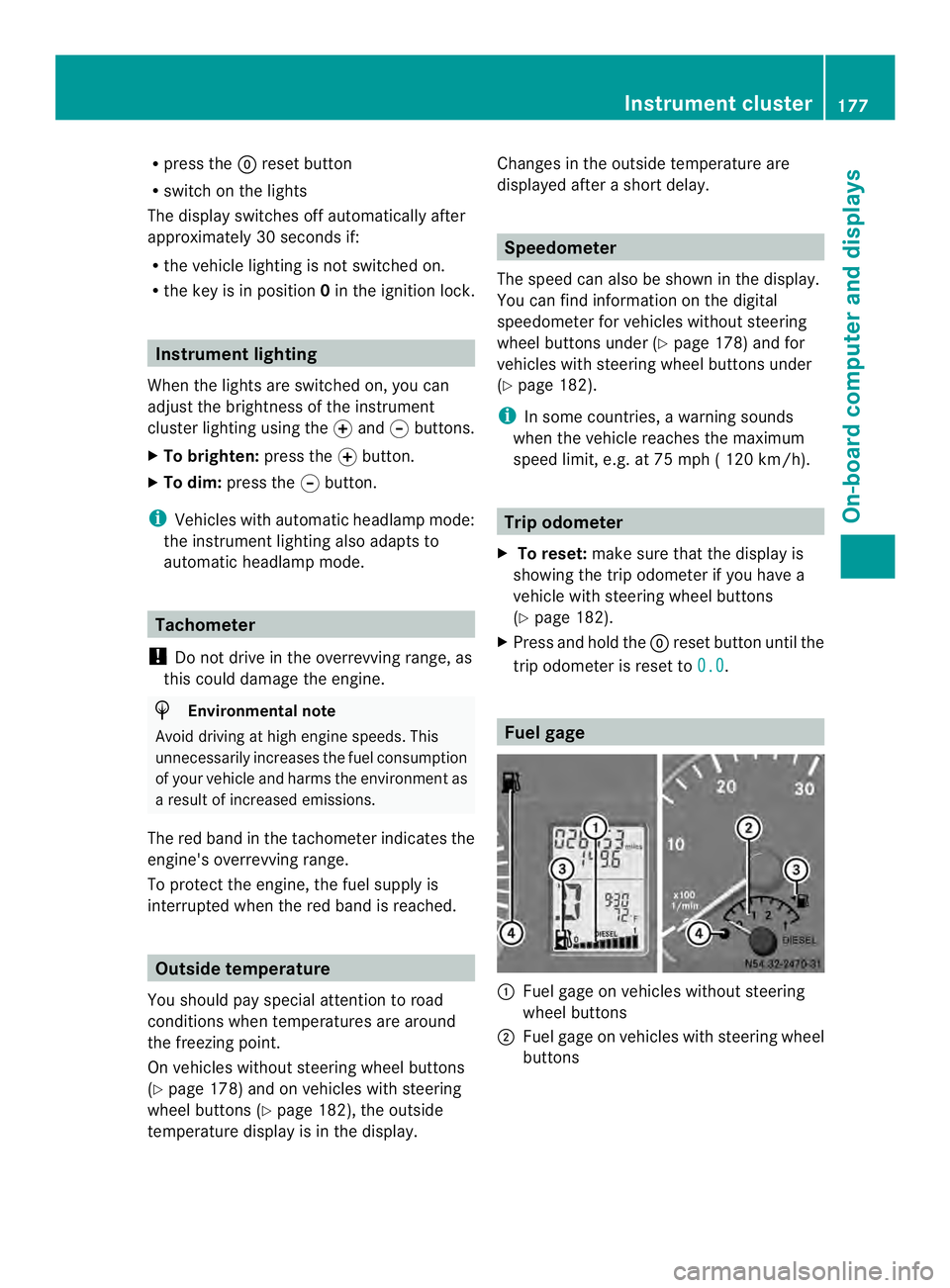
Fuel gage
0005
Fuel gage on vehicles without steering
wheel buttons
0006 Fuel gage on vehicles with steering wheel
buttons Instrument cluster
177On-board computer and displays Z
Page 180 of 334
0026
Fuel fille rflap location indicator 000F: the
fuel filler flap is on the left-hand side. Fuel
filler flap location indicator 001E:the fuel
filler flap is on the right-hand side
0025 Reserve fuel warning lamp (Y page 216)DEF gauge
Vehicles without steering wheel
buttons If the supply of DEF is less than 1.5 US gal
(5.5 l), the 0009indicator lamp lights up and
the 0002dEF Chk display message appears.
If the supply of DEF falls below the reserve
range of 0.8 US gal (3.0 l), the 0009indicator
lamp lights up and the 0002StArtS RExxdisplay message appears. In the display,
xxcorresponds to the number of possible
remaining engine starts (16
to
0 ).
Further information on DEF consumption can
be found in the "Service products and filling
capacity" section (Y page 320).
Vehicles with steering wheel buttons If the supply of DEF is less than 1.5 US gal
(5.5 l), the Check Diesel Exhaust Fluid See Operator's Manual message is shown
in the display.
If the supply of DEF falls below the reserve
range of 0.8 US gal (3.0 l), the 0009xxstarts remaining message is displayed. In
the display, xx corresponds to the number of
possible remaining engine starts (16 to
0 ).
Further information on DEF consumption can
be found in the "Service products and filling
capacity" section (Y page 320). On-board computer (vehicles without
steering wheel buttons)
Operating the on-board computer
General notes The on-board computer is activated as soon
as you turn the key to position
1in the ignition
lock.
The on-board computer shows vehicle
information and settings in the display.
You can control the displaya nd the settings
in the on-board compute rusing the
adjustment buttons on the instrument
cluster.
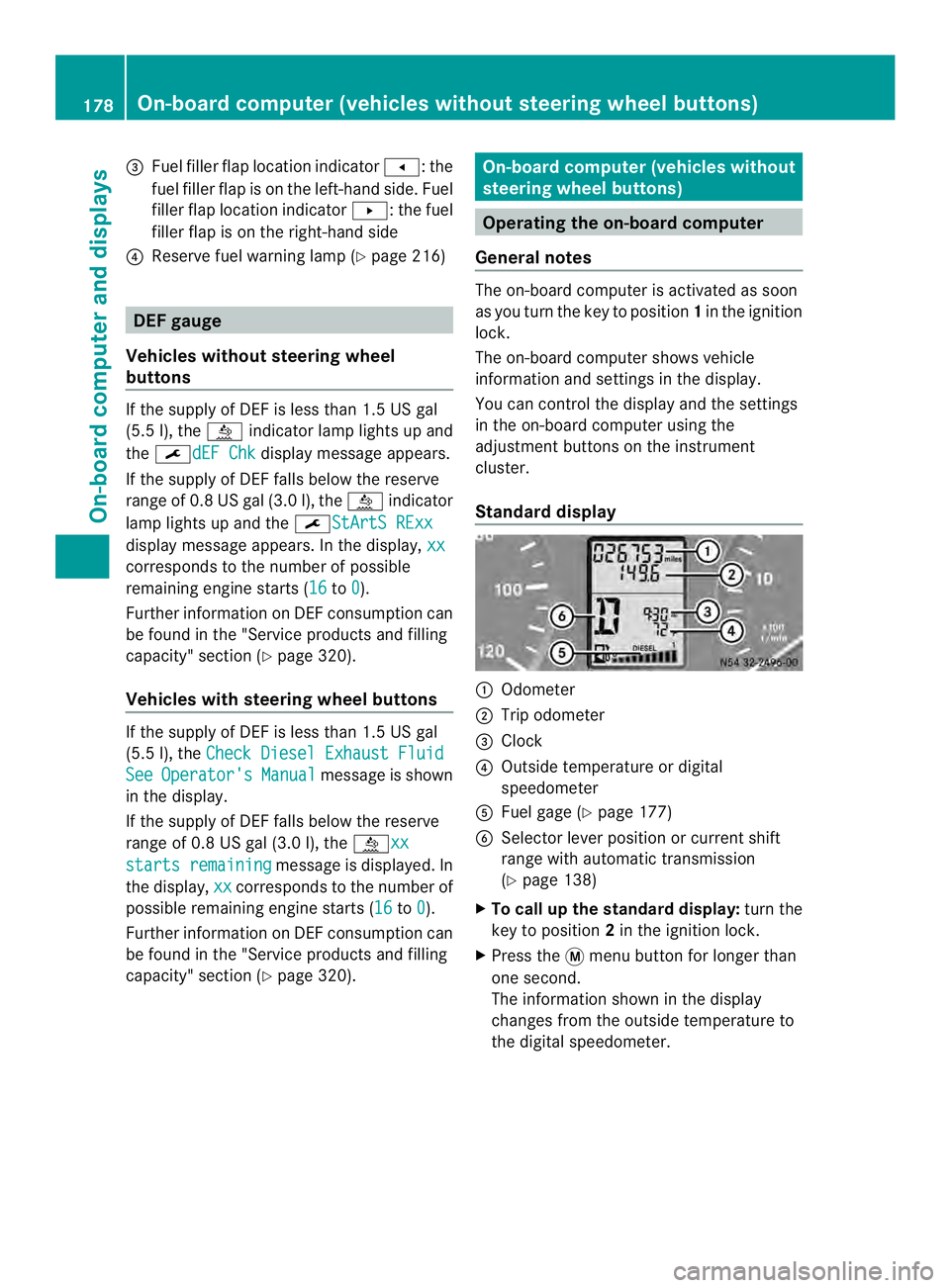
Standard display 0005
Odometer
0006 Trip odometer
0026 Clock
0025 Outside temperature or digital
speedometer
0023 Fuel gage (Y page 177)
0024 Selector lever position or current shift
range with automatic transmission
(Ypage 138)
X To call up the standard display: turn the
key to position 2in the ignition lock.
X Press the 0004menu button for longer than
one second.
The information shown in the display
changes from the outside temperature to
the digital speedometer. 178
On-board computer (vehicles without steering wheel buttons)On-board computer and displays
Page 192 of 334
i
When you call up the trip computer again,
it displays the last function called up.
The units of the statistical information
displayed are set permanently for each
specific country, and are therefore
independen tofthe units selected in the
Settings menu.
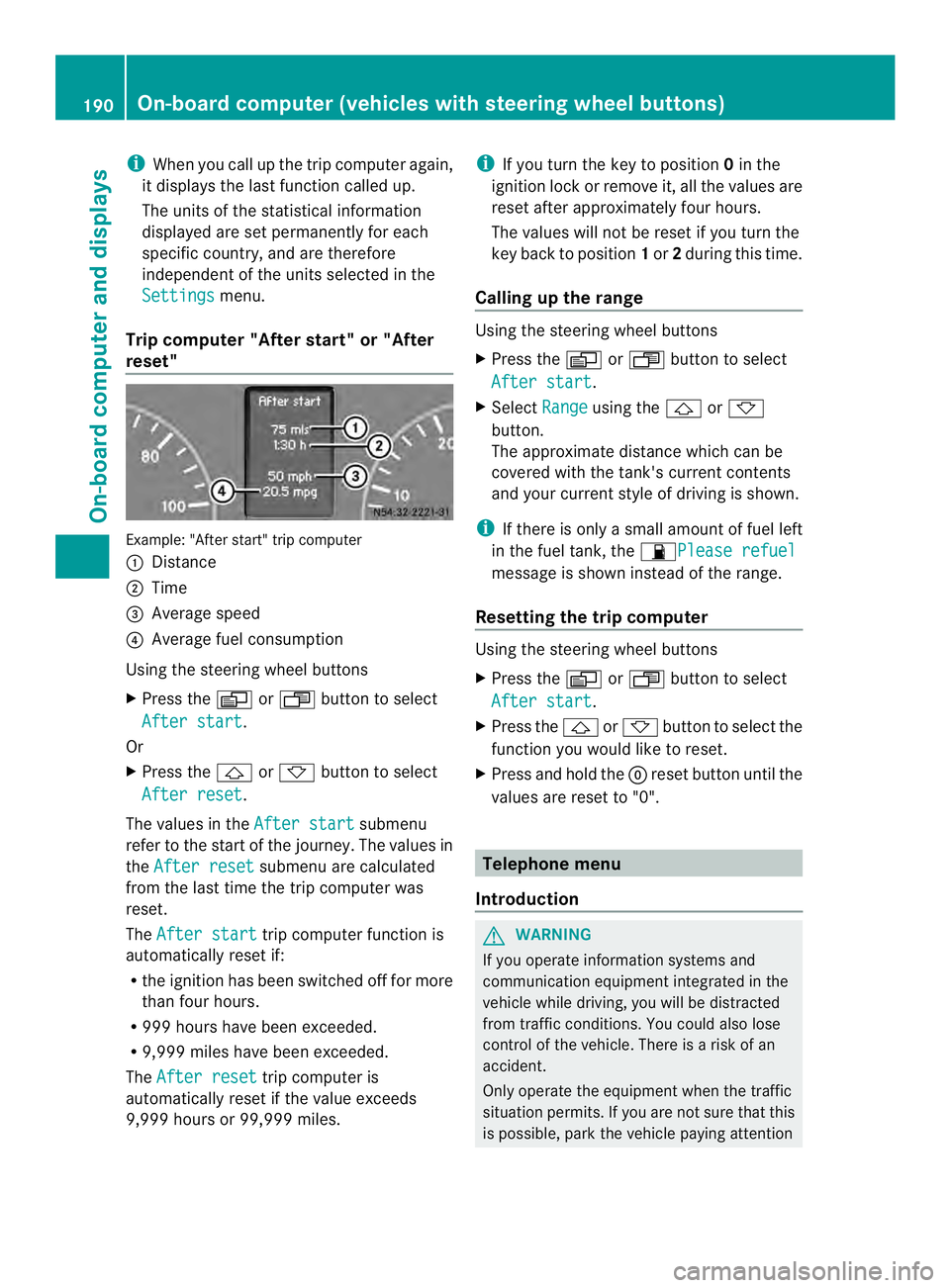
Trip computer "After start" or "After
reset" Example: "After start" trip computer
0005
Distance
0006 Time
0026 Average speed
0025 Average fuel consumption
Using the steering wheel buttons
X Press the 0010or0007 button to select
After start .
Or
X Press the 0001or0009 button to select
After reset .
The values in the After start submenu
refer to the start of the journey. The values in
the After reset submenu are calculated
from the last time the trip computer was
reset.
The After start trip computer function is
automatically reset if:
R the ignition has been switched off for more
than four hours.
R 999 hours have been exceeded.
R 9,999 miles have been exceeded.
The After reset trip computer is
automatically reset if the value exceeds
9,999 hours or 99,999 miles. i
If you turn the key to position 0in the
ignition lock or remove it, all the values are
reset after approximately four hours.
The values will not be reset if you turn the
key back to position 1or 2during this time.
Calling up the range Using the steering wheel buttons
X
Press the 0010or0007 button to select
After start .
X Select Range using the
0001or0009
button.
The approximate distance which can be
covered with the tank's current contents
and your current style of driving is shown.
i If there is only a small amount of fuel left
in the fuel tank, the 0016Please refuel message is shown instead of the range.
Resetting the trip computer Using the steering wheel buttons
X
Press the 0010or0007 button to select
After start .
X Press the 0001or0009 button to select the
function you would like to reset.
X Press and hold the 0007reset button until the
values are reset to "0". Telephone menu
Introduction G
WARNING
If you operate information systems and
communication equipment integrated in the
vehicle while driving, you will be distracted
from traffic conditions. You could also lose
control of the vehicle. There is a risk of an
accident.
Only operate the equipment when the traffic
situation permits. If you are not sure that this
is possible, park the vehicle paying attention 190
On-board computer (vehicles with steering wheel buttons)On-board computer and displays
Page 282 of 334
the braking properties and the driving
characteristics .There is a risk of an accident.
Avoid tire pressures that are too low in all the
tires, including the spare wheel.
Underinflated tires can:
R fail from being overheated
R adversely affect handling
R wear excessively and/or unevenly
R have an adverse effect on fuel consumption
Overinflated tires G
WARNING
Tires with excessively high pressure can burst
because they are damaged more easily by
road debris, potholes etc. In addition, they
also suffer from irregular wear, which can
severely impair the braking properties and the
driving characteristics. There is a risk of an
accident.
Avoid tire pressures that are too high in all the
tires, including the spare wheel.
Overinflated tires can:
R increase the braking distance
R adversely affect handling
R wear excessively and/or unevenly
R adversely affect ride comfort
R be more susceptible to damage
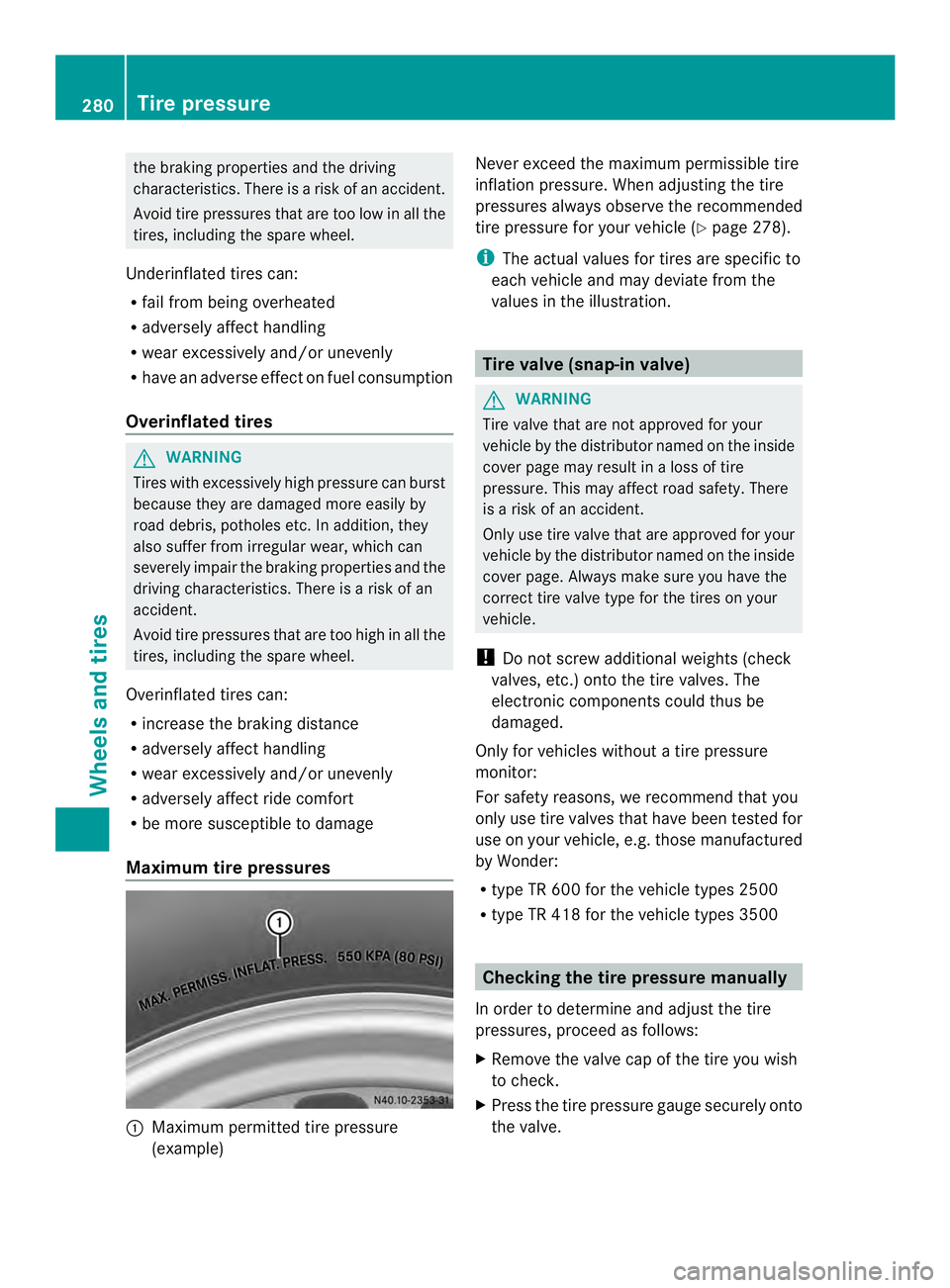
Maximum tire pressures 0005
Maximum permitted tire pressure
(example) Never exceed the maximum permissible tire
inflation pressure. When adjusting the tire
pressures always observe the recommended
tire pressure for your vehicle (Y
page 278).
i The actual values for tires are specific to
each vehicle and may deviate from the
values in the illustration. Tire valve (snap-in valve)
G
WARNING
Tire valve that are not approved for your
vehicle by the distributor named on the inside
cover page may result in a loss of tire
pressure. This may affect road safety. There
is a risk of an accident.
Only use tire valve that are approved for your
vehicle by the distributor named on the inside
cover page. Always make sure you have the
correct tire valve type for the tires on your
vehicle.
! Do not screw additional weights (check
valves, etc.) onto the tire valves. The
electronic components could thus be
damaged.
Only for vehicles without atire pressure
monitor:
For safety reasons, we recommend that you
only use tire valves that have been tested for
use on your vehicle, e.g. those manufactured
by Wonder:
R type TR 600 for the vehicle types 2500
R type TR 418 for the vehicle types 3500 Checking the tire pressure manually
In order to determine and adjust the tire
pressures, proceed as follows:
X Remove the valve cap of the tire you wish
to check.
X Press the tire pressure gauge securely onto
the valve. 280
Tire pressureWheels and tires
Page 321 of 334
This can result in damage to the fuel
injection system, for example.
Flow improvers are fuel additives used to
improve the flow characteristics of diesel
fuels.
The effectiveness of flow improvers cannot be
guaranteed with all fuels. Observe the
manufacturer's recommendations.
Information about approved flow improvers is
available from any authorized Sprinter Dealer.
At outside temperatures below 14 ‡(002710 †),
and if using diesel with less resistance to low
temperatures, add flow improver, basing the
mixing ratio on the outside temperature.
Mix this fuel additive with the diesel in good
time before the flow properties of the diesel
are affected by paraffi nseparation.
Malfunctions resulting from paraffin
separation can only be rectified by heating
the entire fuel system. Park the vehicle in a
heated garage, for example.
Information on fuel consumption H
Environmental note
CO 2(carbon dioxide) is the gas which
scientists believe to be principally responsible
for global warming (the greenhouse effect).
Your vehicle's CO 2emissions are directly
related to fuel consumption and therefore
depend on:
R efficien tuse of the fuel by the engine
R driving style
R other non-technical factors, such as
environmental influences or road
conditions
You can minimize your vehicle's CO 2
emissions by driving carefully and having it
serviced regularly.
i Only for certain countries: the respective
current consumption and emission values
of your vehicle can be found in the COC
papers (EC CERTIFICATE OF
CONFORMITY). These documents are
supplied when the vehicle is delivered. Consumption figures were found in the
currently valid respective version:
R
for vehicles up to and including the
Euro 4 standard according to EU
Directive 80/1268/EEC
R for vehicles from the Euro 5 standard
according to regulation (EC) no.
715/2007
Fuel consumption depends on:
R the vehicle version
R the style of driving
R the operating conditions
R the type or quality of the fuel used
The vehicle will use more fuel than usual in
the following situations:
R at very low outside temperatures
R in city traffic
R during short journeys
R in mountainous terrain
R when towing a trailer
To keep fuel consumption low, observe the
advice in the "Protection of the environment"
section (Y page 22).
The following components of the different
vehicle versions influence fuel consumption:
R tire sizes, tire tread, tire pressure, tire
condition
R body
R transmission ratios for the drive
assemblies
R additional equipment (e.g. air-conditioning
system, auxiliary heating system).
For these reasons, the actual consumption
figures for your vehicle may deviate from the
consumption figures determined according
to EU Directive 80/1268/EEC.
Data concerning fuel consumption are
recorded in the on-board computer; use the
steering wheel buttons to call up the Trip
computer menu (Ypage 190). Service products and capacities
319Technical data Z
Page 323 of 334
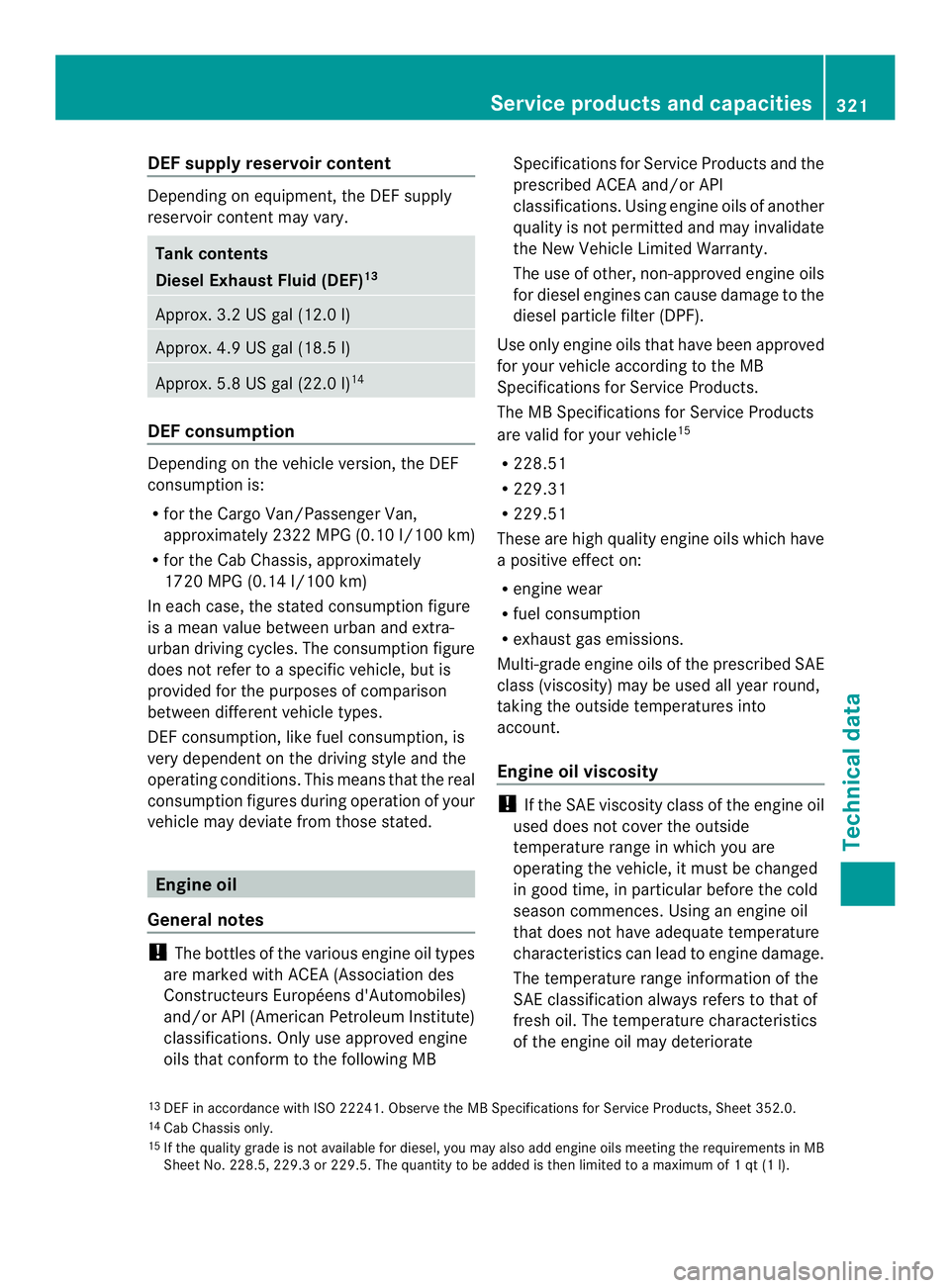
DEF supply reservoir content
Depending on equipment, th
eDEF supply
reservoir content may vary. Tank contents
Diesel Exhaus
tFluid (DEF) 13 Approx. 3.2 US gal (12.0 l)
Approx. 4.9 US gal (18.5 l)
Approx. 5.8 US gal (22.0 l)
14DEF consumption
Depending on the vehicle version, the DEF
consumption is:
R for the Cargo Van/Passenger Van,
approximately 2322 MPG (0.10 l/100 km)
R for the Cab Chassis, approximately
1720 MPG (0.14 l/100 km)
In each case, the stated consumption figure
is a mea nvalue between urban and extra-
urban driving cycles. The consumption figure
does no trefer to a specific vehicle, but is
provided for the purposes of comparison
between differen tvehicle types.
DEFc onsumption, like fuel consumption, is
very dependent on the driving style and the
operating conditions. This means that the real
consumption figures during operation of your
vehicle may deviate from those stated. Engine oil
General notes !
The bottles of the various engine oil types
are marked with ACEA (Association des
Constructeurs Européens d'Automobiles)
and/or API (American Petroleum Institute)
classifications. Only use approved engine
oils that conform to the following MB Specifications for Service Products and the
prescribed ACEA and/or API
classifications. Using engine oils of another
quality is not permitted and may invalidate
the New Vehicle Limited Warranty.
The use of other, non-approved engine oils
for diesel engines can cause damage to the
diesel particle filter (DPF).
Use only engine oils that have been approved
for your vehicle according to the MB
Specifications for Service Products.
The MB Specifications for Service Products
are valid for your vehicle 15
R 228.51
R 229.31
R 229.51
These are high quality engine oils which have
a positive effect on:
R engine wear
R fuel consumption
R exhaust gas emissions.
Multi-grade engine oils of the prescribed SAE
class (viscosity) may be used all year round,
taking the outside temperatures into
account.
Engine oil viscosity !
If the SAE viscosity class of the engine oil
used does not cover the outside
temperature range in which you are
operating the vehicle, it must be changed
in good time, in particular before the cold
season commences. Using an engine oil
that does not have adequate temperature
characteristics can lead to engine damage.
The temperature range information of the
SAE classification always refers to that of
fresh oil. The temperature characteristics
of the engine oil may deteriorate
13 DEF in accordance with ISO 22241. Observe the MB Specifications for Service Products, Sheet 352.0.
14 Cab Chassis only.
15 If the quality grade is not available for diesel, you may also add engine oils meeting the requirements in MB
Sheet No. 228.5, 229.3 or 229.5. The quantity to be added is then limited to a maximum of 1 qt (1 l). Service products and capacities
321Technical data Z
Page 325 of 334
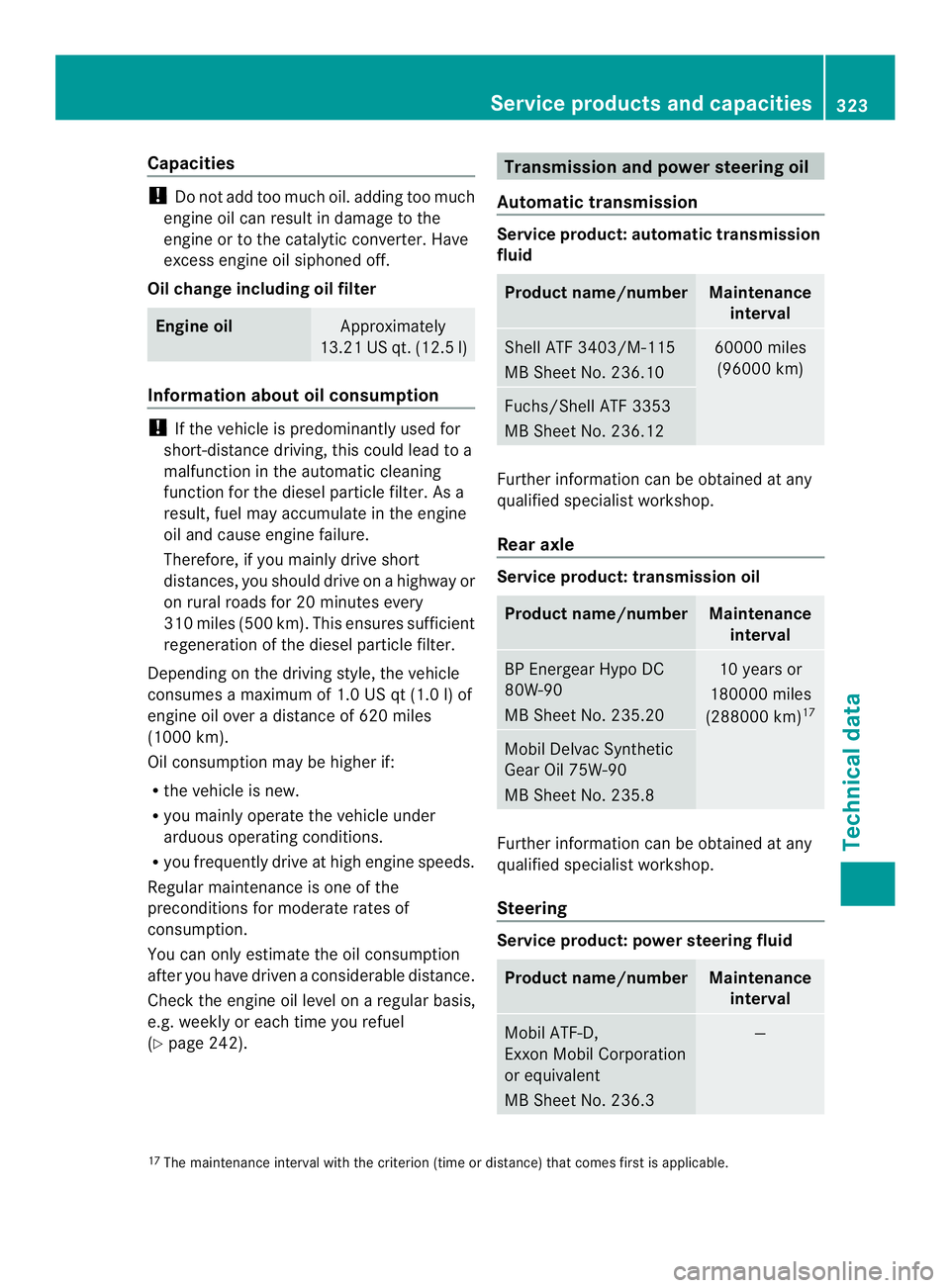
Capacities
!
Do no tadd too much oil. adding too much
engine oil can result in damage to the
engine or to the catalytic converter. Have
excess engine oil siphoned off.
Oil change including oil filter Engine oil
Approximately
13.21 US qt. (12.5 l) Information about oil consumption
!
If the vehicle is predominantly used for
short-distance driving, this could lead to a
malfunction in the automatic cleaning
function for the diesel particle filter. As a
result, fuel may accumulate in the engine
oil and cause engine failure.
Therefore, if you mainly drive short
distances, you should drive on a highway or
on rural roads for 20 minutes every
310 miles (500 km). This ensures sufficient
regeneration of the diesel particle filter.
Depending on the driving style, the vehicle
consumes a maximum of 1.0 US qt (1.0 l)of
engine oil over a distance of 620 miles
(1000 km).
Oil consumption may be higher if:
R the vehicle is new.
R you mainly operate the vehicle under
arduous operating conditions.
R you frequently drive at high engine speeds.
Regula rmaintenance is one of the
preconditions for moderate rates of
consumption.
You can only estimate th eoil consumption
after you have drive naconsiderable distance.
Check the engine oil level on a regular basis,
e.g. weekly or each time you refuel
(Y page 242). Transmission and power steering oil
Automatic transmission Service product: automatic transmission
fluid
Product name/number Maintenance
interval Shell ATF 3403/M-115
MB Sheet No. 236.10 60000 miles
(96000 km) Fuchs/Shell ATF 3353
MB Sheet No. 236.12
Further information can be obtained at any
qualified specialist workshop.
Rear axle
Service product: transmission oil
Product name/number Maintenance
interval BP Energear Hypo DC
80W-90
MB Sheet No. 235.20 10 years or
180000 miles
(288000 km) 17 Mobil Delvac Synthetic
Gear Oil 75W-90
MB Sheet No. 235.8
Further information can be obtained at any
qualified specialist workshop.
Steering
Service product: power steering fluid
Product name/number Maintenance
interval Mobil ATF-D,
Exxon Mobil Corporation
or equivalent
MB Sheet No. 236.3 —
17
The maintenance interval with the criterion (time or distance) that comes first is applicable. Service products and capacities
323Technical data Z