oil capacities MERCEDES-BENZ SPRINTER 2013 MY13 Operator’s Manual
[x] Cancel search | Manufacturer: MERCEDES-BENZ, Model Year: 2013, Model line: SPRINTER, Model: MERCEDES-BENZ SPRINTER 2013Pages: 334, PDF Size: 3.88 MB
Page 23 of 334
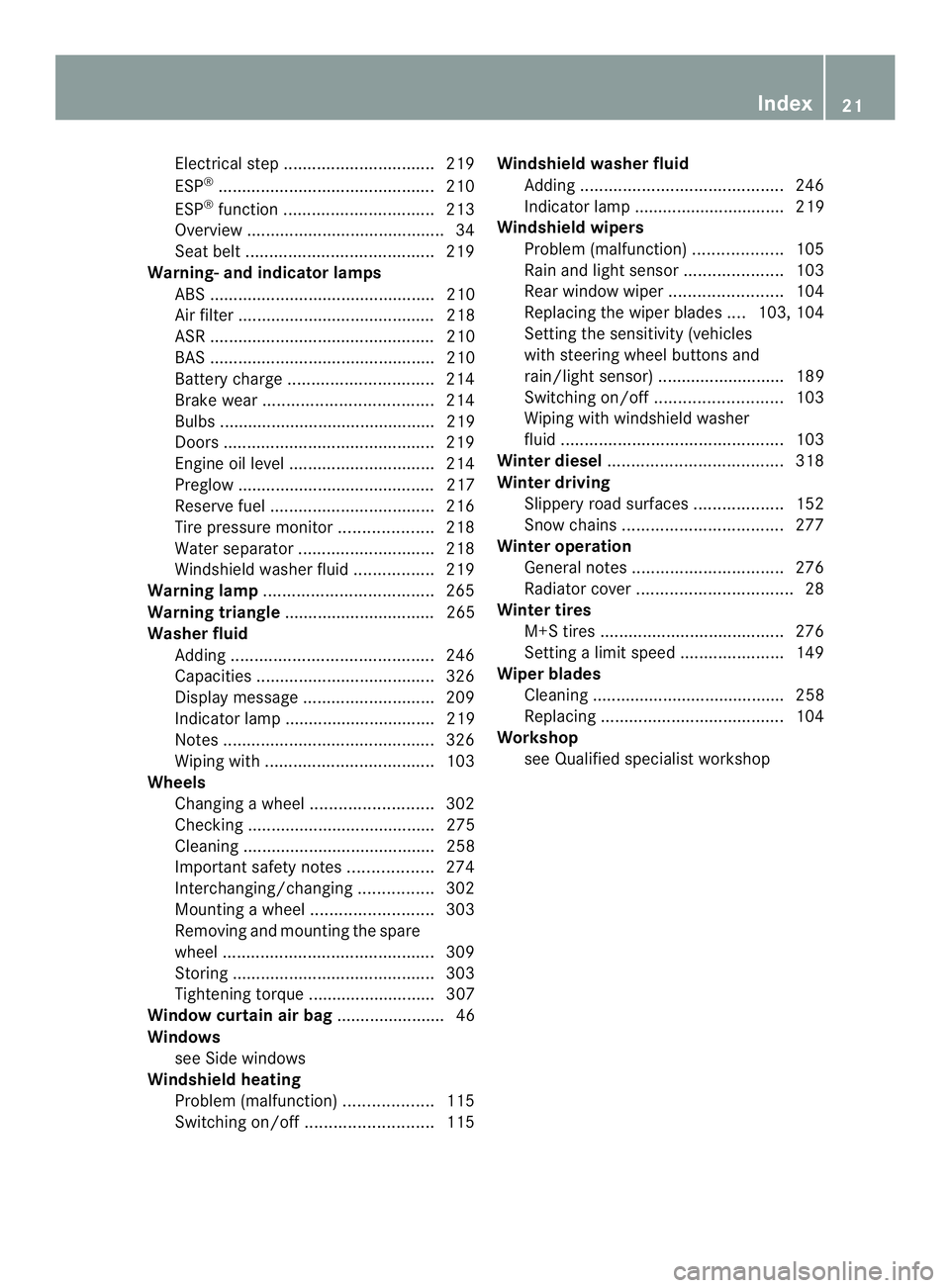
Electrical ste
p................................ 219
ESP ®
.............................................. 210
ESP ®
function ................................ 213
Overview .......................................... 34
Seat bel t........................................ 219
Warning- and indicator lamps
ABS ................................................ 210
Air filter .......................................... 218
ASR ................................................ 210
BAS ................................................ 210
Battery charg e............................... 214
Brake wea r.................................... 214
Bulbs .............................................. 219
Doors ............................................. 219
Engine oil leve l............................... 214
Preglow .......................................... 217
Reserve fuel ................................... 216
Tire pressure monitor ....................218
Water separator ............................. 218
Windshield washer fluid .................219
Warning lamp .................................... 265
Warning triangle ................................ 265
Washer fluid Adding ........................................... 246
Capacities ...................................... 326
Display message ............................ 209
Indicator lamp ................................ 219
Notes ............................................. 326
Wiping with .................................... 103
Wheels
Changing awheel .......................... 302
Checking ........................................ 275
Cleaning ......................................... 258
Important safety notes ..................274
Interchanging/changing ................302
Mounting awheel .......................... 303
Removing and mounting the spare
wheel ............................................. 309
Storing ........................................... 303
Tightening torque ........................... 307
Window curtain air bag ....................... 46
Windows see Side windows
Windshiel dheating
Problem (malfunction) ...................115
Switching on/off ........................... 115Windshiel
dwasher fluid
Adding ........................................... 246
Indicator lamp ................................ 219
Windshiel dwipers
Problem (malfunction) ...................105
Rain and light sensor .....................103
Rea rwindow wiper ........................ 104
Replacing the wiper blades ....103, 104
Setting the sensitivity (vehicles
with steering wheel buttons and
rain/light sensor) ........................... 189
Switching on/off ........................... 103
Wiping with windshield washer
fluid ............................................... 103
Winte rdiesel ..................................... 318
Winte rdriving
Slippery roa dsurface s................... 152
Snow chains .................................. 277
Winter operation
General notes ................................ 276
Radiator cover ................................. 28
Winter tires
M+S tires ....................................... 276
Setting alimit speed ...................... 149
Wiper blades
Cleaning ......................................... 258
Replacing ....................................... 104
Workshop
see Qualified specialist workshop Index
21
Page 151 of 334
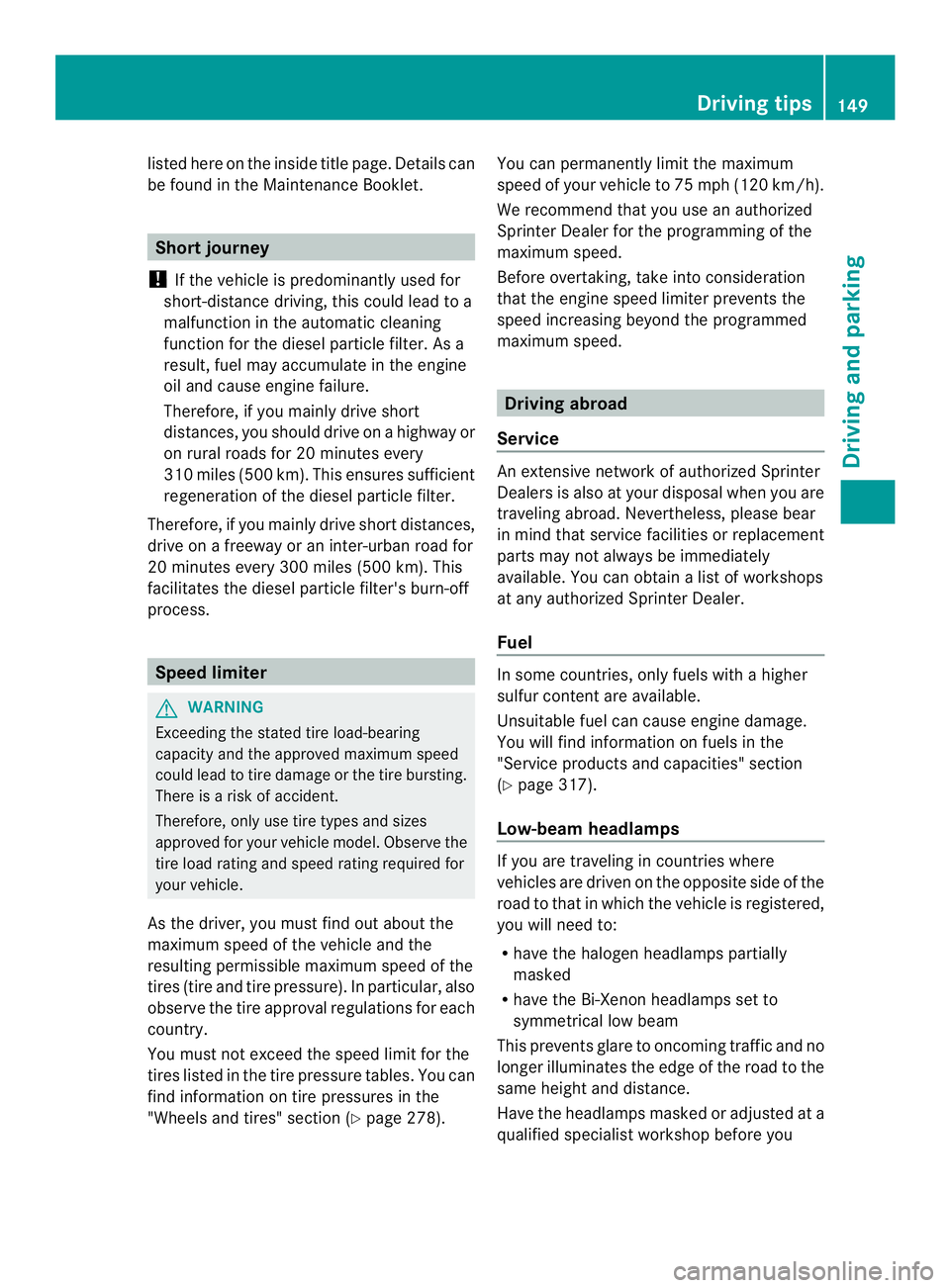
listed here on the inside title page. Details can
be found in the Maintenance Booklet. Short journey
! If the vehicle is predominantly used for
short-distance driving, this could lead to a
malfunction in the automatic cleaning
function for the diesel particle filter. As a
result, fuel may accumulate in the engine
oil and cause engine failure.
Therefore, if you mainly drive short
distances, you should drive on a highway or
on rural roads for 20 minutes every
310 miles (50 0km). This ensures sufficient
regeneration of the diesel particle filter.
Therefore, if you mainl ydrive short distances,
drive on a freeway or an inter-urban road for
20 minutes every 300 miles (500 km). This
facilitates the diesel particl efilter's burn-off
process. Speed limiter
G
WARNING
Exceeding the stated tir eload-bearing
capacity and the approved maximum speed
could lead to tire damage or the tire bursting.
There is a risk of accident.
Therefore, only use tire types and sizes
approved for your vehicle model. Observe the
tire load rating and speed rating required for
your vehicle.
As the driver, you must find out about the
maximum speed of the vehicle and the
resulting permissible maximum speed of the
tires (tire and tire pressure). In particular, also
observe the tire approval regulations for each
country.
You must not exceed the speed limit for the
tires listed in the tire pressure tables. You can
find information on tire pressures in the
"Wheels and tires" section (Y page 278).You can permanently limit the maximum
speed of your vehicle to 75 mph (120 km/h).
We recommend that you use an authorized
Sprinter Dealer for the programming of the
maximum speed.
Before overtaking, take into consideration
that the engine speed limiter prevents the
speed increasing beyond the programmed
maximum speed. Driving abroad
Service An extensive network of authorized Sprinter
Dealers is also at your disposal when you are
traveling abroad. Nevertheless, please bear
in mind that service facilities or replacement
parts may not always be immediately
available. You can obtain
alist of workshops
at any authorized Sprinter Dealer.
Fuel In some countries, only fuels with a higher
sulfur conten
tare available.
Unsuitable fuel can cause engine damage.
You will find information on fuels in the
"Service products and capacities" section
(Y page 317).
Low-beam headlamps If you are traveling in countries where
vehicles are drive
nonthe opposite side of the
road to that in which the vehicle is registered,
you will need to:
R have the halogen headlamps partially
masked
R have the Bi-Xenon headlamps set to
symmetrical low beam
This prevents glare to oncoming traffic and no
longer illuminates the edge of the road to the
same height and distance.
Have the headlamps masked or adjusted at a
qualified specialist workshop before you Driving tips
149Driving and parking Z
Page 318 of 334
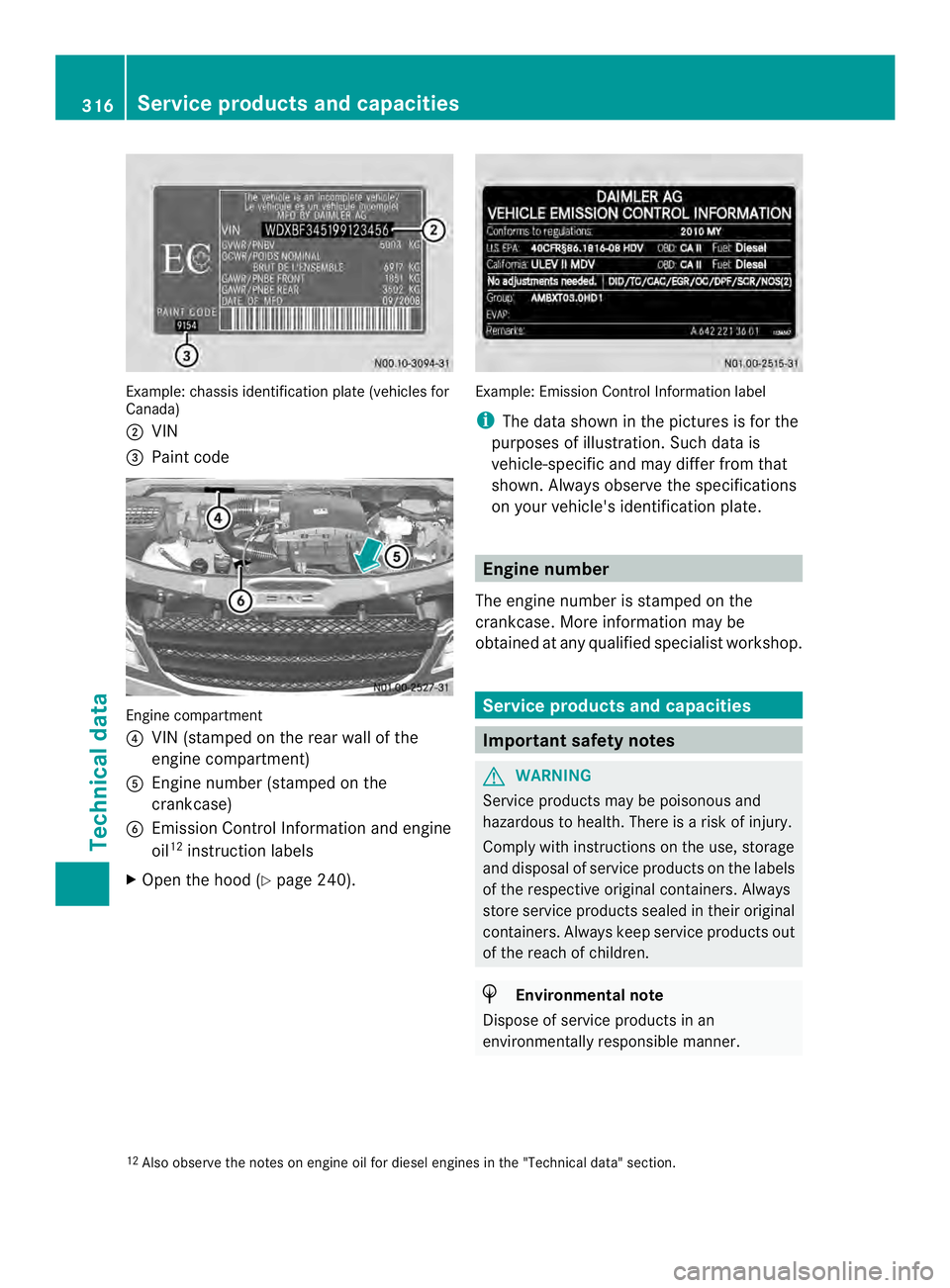
Example: chassis identification plate (vehicles for
Canada)
0006 VIN
0026 Paint code Engine compartment
0025
VIN (stamped on the rear wall of the
engine compartment)
0023 Engine numbe r(stamped on the
crankcase)
0024 Emission Control Information and engine
oil12
instruction labels
X Open the hood (Y page 240). Example: Emission Control Information label
i
The data shown in the pictures is for the
purposes of illustration. Such data is
vehicle-specific and may differ from that
shown. Always observe the specifications
on your vehicle's identification plate. Engine number
The engine number is stamped on the
crankcase. More information may be
obtained at any qualified specialist workshop. Service products and capacities
Important safety notes
G
WARNING
Service products may be poisonous and
hazardous to health. There is a risk of injury.
Comply with instructions on the use, storage
and disposal of service products on the labels
of the respective original containers. Always
store service products sealed in their original
containers. Always keep service products out
of the reach of children. H
Environmental note
Dispose of service products in an
environmentally responsible manner.
12 Also observe the notes on engine oil for diesel engines in the "Technical data" section. 316
Service products and capacitiesTechnical data
Page 319 of 334
Service products include the following:
R Fuels, e.g. diesel
R Additives for the exhaus tgas
aftertreatment, e.g .Diesel Exhaust Fluid
(DEF)
R Lubricants, e.g. engine oil, transmission oil
R Coolant
R Brake fluid
R Washer fluid
R Climate control system refrigerants
Approved service products comply with the
highes tquality standards and are listed in the
MB Specifications for Service Products. Only
use service products approved for the
vehicle. This is an important condition for the
warranty.
You will recognize the approved service
products by the inscription on the container:
MB Approval (e.g. MB Approval 228.5)
Other identifications and recommendations
refer to quality level or a specification
according to an MB Sheet Number (e.g. MB
228.5). They are therefore not necessarily
approved.
Further information can be obtained at any
qualified specialist workshop.
Additives for approved service products are
neither required no rpermitted. Approved fuel
additives are the exception .Additives can
cause engine damage and must therefore not
be added to the service products.
The use of additives is always the
responsibility of the vehicle operator .The use
of additives may result in the restriction or
loss of your Limited Warranty entitlements. Fuel
Important safety notes G
WARNING
Fuel is highly flammable. Improper handing of
fuel creates a risk of fire and explosion. Avoid fire, open flames, smoking and creating
sparks under all circumstances. Switch off the
engine and, if applicable, the auxiliary heating
before refueling.
G
WARNING
Fuel is poisonous and hazardous to health.
There is a risk of injury.
You must make sure that fuel does not come
into contact with your skin, eyes or clothing
and that it is not swallowed. Do not inhale fuel
vapors. Keep fuel away from children.
If you or others come into contact with fuel,
observe the following:
R Wash away fuel from skin immediately
using soap and water.
R If fuel comes into contact with your eyes,
immediately rinse them thoroughly with
clean water. Seek medical assistance
without delay.
R If fuel is swallowed, seek medical
assistance without delay.Don ot induce
vomiting.
R Immediately change out of clothing which
has come into contact with fuel.
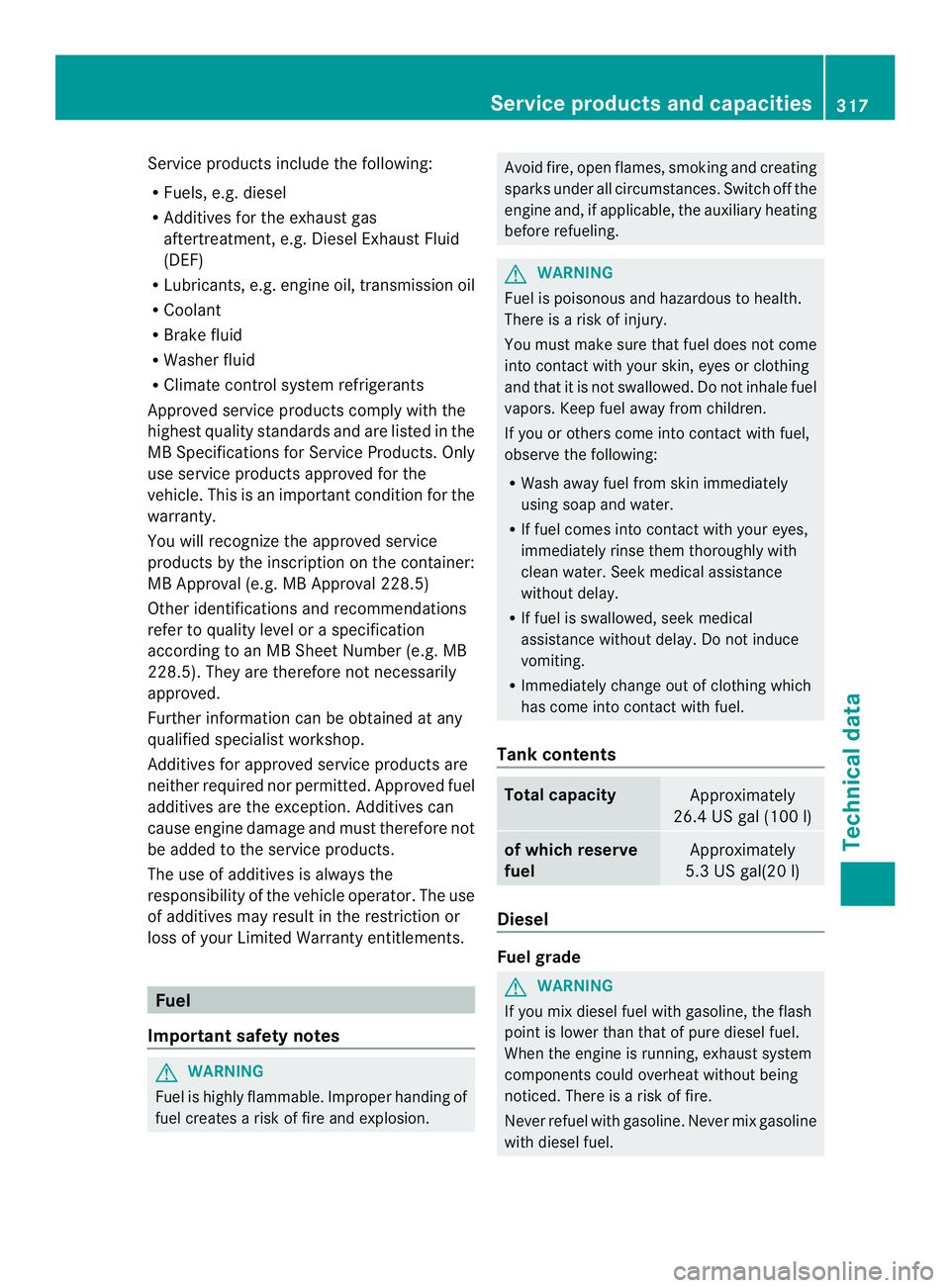
Tank contents Total capacity
Approximately
26.4 US gal (100 l) of which reserve
fuel
Approximately
5.3 US gal(20 l) Diesel
Fuel grade
G
WARNING
If you mix diesel fuel with gasoline, the flash
point is lower than that of pure diesel fuel.
When the engine is running, exhaust system
components could overheat without being
noticed. There is a risk of fire.
Never refuel with gasoline. Never mix gasoline
with diesel fuel. Service products and capacities
317Technical data Z
Page 320 of 334
!
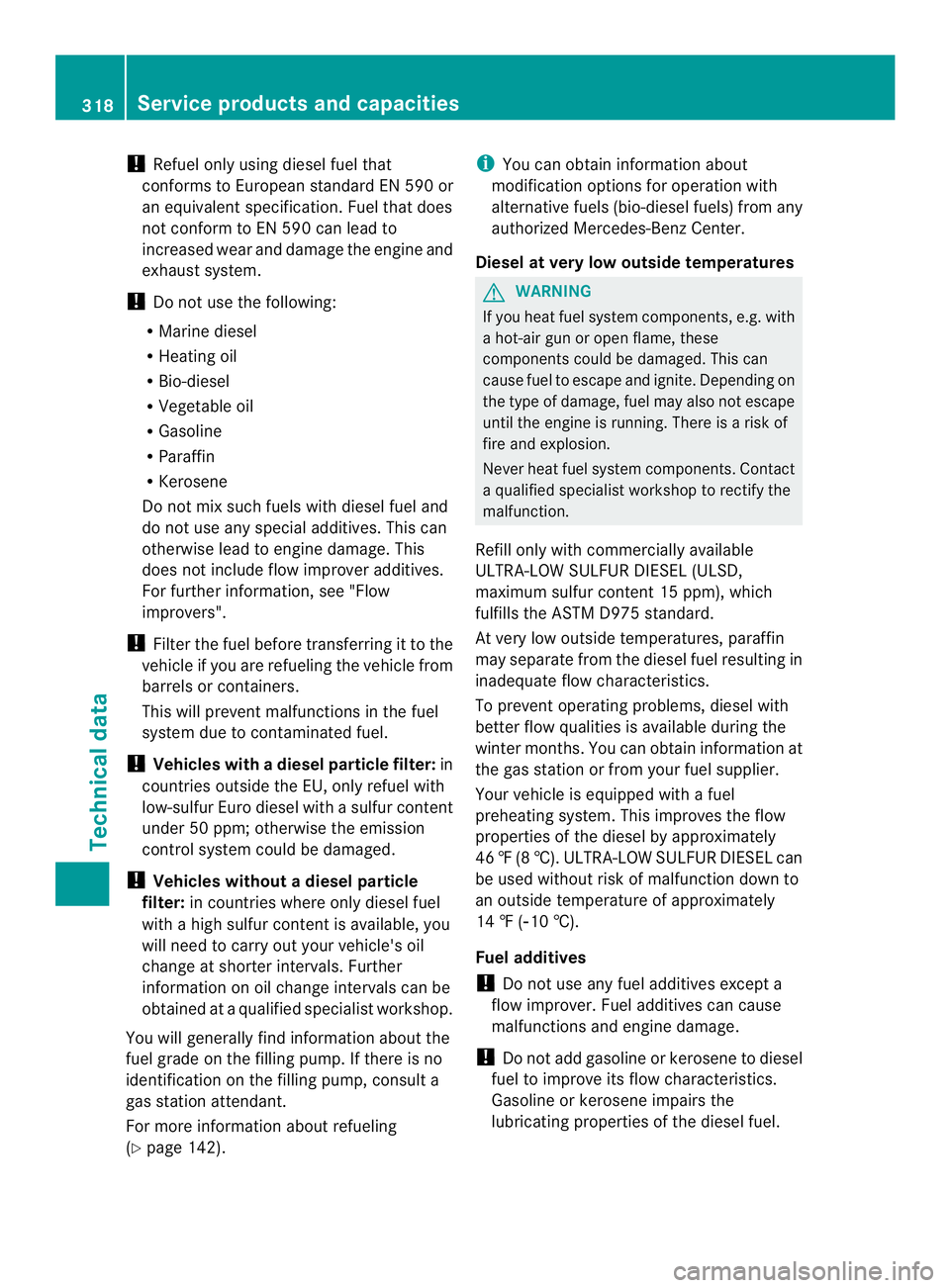
Refuel only using diesel fuel that
conforms to European standard EN 590 or
an equivalent specification. Fuel that does
not conform to EN 590 can lead to
increased wear and damage the engine and
exhaust system.
! Do not use the following:
R Marine diesel
R Heating oil
R Bio-diesel
R Vegetable oil
R Gasoline
R Paraffin
R Kerosene
Do not mix such fuels with diesel fuel and
do not use any special additives. This can
otherwise lead to engine damage.T his
does not include flow improver additives.
For further information, see "Flow
improvers".
! Filter the fuel before transferring it to the
vehicle if you are refueling the vehicle from
barrels or containers.
This will prevent malfunctions in the fuel
system due to contaminated fuel.
! Vehicles with adiesel particle filter: in
countries outside the EU, only refuel with
low-sulfur Euro diesel with a sulfur content
under 50 ppm; otherwise the emission
control syste mcould be damaged.
! Vehicles without adiesel particle
filter: in countries where only diesel fuel
with a high sulfur conten tis available, you
will need to carry out your vehicle's oil
change at shorter intervals. Further
information on oil change intervals can be
obtained at a qualified specialist workshop.
You will generally find information aboutt he
fuel grade on the filling pump. If there is no
identification on the filling pump, consult a
gas station attendant.
For more information about refueling
(Y page 142). i
You can obtain information about
modification options for operation with
alternative fuels (bio-diesel fuels) from any
authorized Mercedes-Ben zCenter.
Diesel at very low outside temperatures G
WARNING
If you heat fuel system components, e.g. with
a hot-air gun or open flame, these
components could be damaged. This can
cause fuel to escape and ignite. Depending on
the type of damage, fuel may also not escape
until the engine is running. There is a risk of
fire and explosion.
Never heat fuel system components. Contact
a qualified specialist workshop to rectify the
malfunction.
Refill only with commercially available
ULTRA-LOW SULFUR DIESEL (ULSD,
maximum sulfur content 15 ppm), which
fulfills the ASTM D975s tandard.
At very low outside temperatures, paraffin
may separate fro mthe diesel fuel resulting in
inadequate flow characteristics.
To prevent operating problems, diesel with
better flow qualities is available during the
winter months. You can obtain information at
the gas station or from your fuel supplier.
Your vehicle is equipped with afuel
preheating system. This improves the flow
properties of the diesel by approximately
46 ‡(8 †). ULTRA-LOW SULFUR DIESEL can
be used without risk of malfunction dow nto
an outside temperature of approximately
14 ‡ (002710 †).
Fuel additives
! Do no tuse any fuel additives except a
flow improver. Fuel additives can cause
malfunctions and engine damage.
! Do not add gasoline or kerosene to diesel
fuel to improve its flow characteristics.
Gasoline or kerosene impairs the
lubricating properties of the diesel fuel. 318
Service products and capacitiesTechnical data
Page 323 of 334
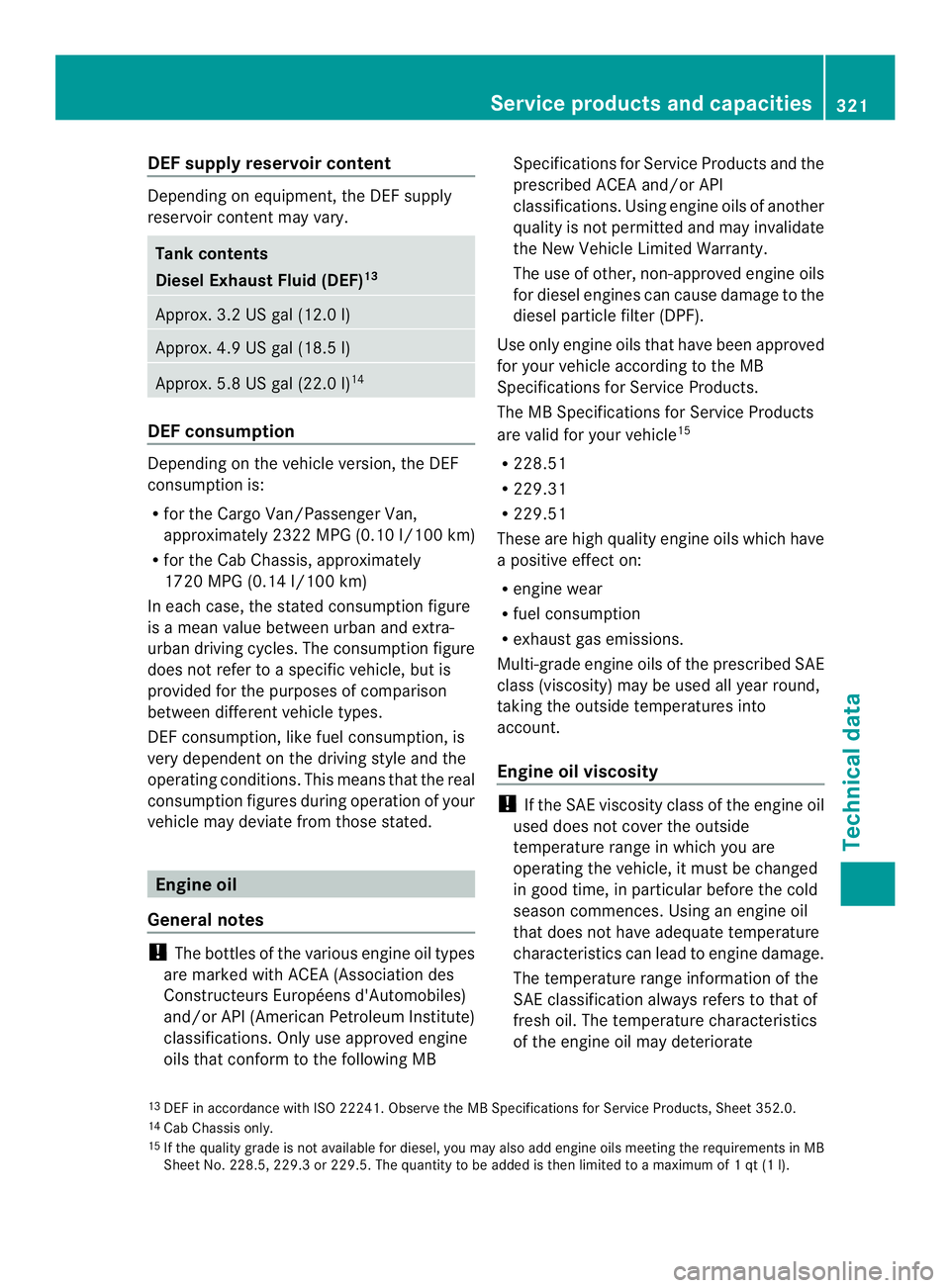
DEF supply reservoir content
Depending on equipment, th
eDEF supply
reservoir content may vary. Tank contents
Diesel Exhaus
tFluid (DEF) 13 Approx. 3.2 US gal (12.0 l)
Approx. 4.9 US gal (18.5 l)
Approx. 5.8 US gal (22.0 l)
14DEF consumption
Depending on the vehicle version, the DEF
consumption is:
R for the Cargo Van/Passenger Van,
approximately 2322 MPG (0.10 l/100 km)
R for the Cab Chassis, approximately
1720 MPG (0.14 l/100 km)
In each case, the stated consumption figure
is a mea nvalue between urban and extra-
urban driving cycles. The consumption figure
does no trefer to a specific vehicle, but is
provided for the purposes of comparison
between differen tvehicle types.
DEFc onsumption, like fuel consumption, is
very dependent on the driving style and the
operating conditions. This means that the real
consumption figures during operation of your
vehicle may deviate from those stated. Engine oil
General notes !
The bottles of the various engine oil types
are marked with ACEA (Association des
Constructeurs Européens d'Automobiles)
and/or API (American Petroleum Institute)
classifications. Only use approved engine
oils that conform to the following MB Specifications for Service Products and the
prescribed ACEA and/or API
classifications. Using engine oils of another
quality is not permitted and may invalidate
the New Vehicle Limited Warranty.
The use of other, non-approved engine oils
for diesel engines can cause damage to the
diesel particle filter (DPF).
Use only engine oils that have been approved
for your vehicle according to the MB
Specifications for Service Products.
The MB Specifications for Service Products
are valid for your vehicle 15
R 228.51
R 229.31
R 229.51
These are high quality engine oils which have
a positive effect on:
R engine wear
R fuel consumption
R exhaust gas emissions.
Multi-grade engine oils of the prescribed SAE
class (viscosity) may be used all year round,
taking the outside temperatures into
account.
Engine oil viscosity !
If the SAE viscosity class of the engine oil
used does not cover the outside
temperature range in which you are
operating the vehicle, it must be changed
in good time, in particular before the cold
season commences. Using an engine oil
that does not have adequate temperature
characteristics can lead to engine damage.
The temperature range information of the
SAE classification always refers to that of
fresh oil. The temperature characteristics
of the engine oil may deteriorate
13 DEF in accordance with ISO 22241. Observe the MB Specifications for Service Products, Sheet 352.0.
14 Cab Chassis only.
15 If the quality grade is not available for diesel, you may also add engine oils meeting the requirements in MB
Sheet No. 228.5, 229.3 or 229.5. The quantity to be added is then limited to a maximum of 1 qt (1 l). Service products and capacities
321Technical data Z
Page 324 of 334
significantly due to aging in use, especially
at low outside temperatures.
We recommend that you change the engine
oil before the cold season commences. Use
an approved engine oil of the specified SAE
class.
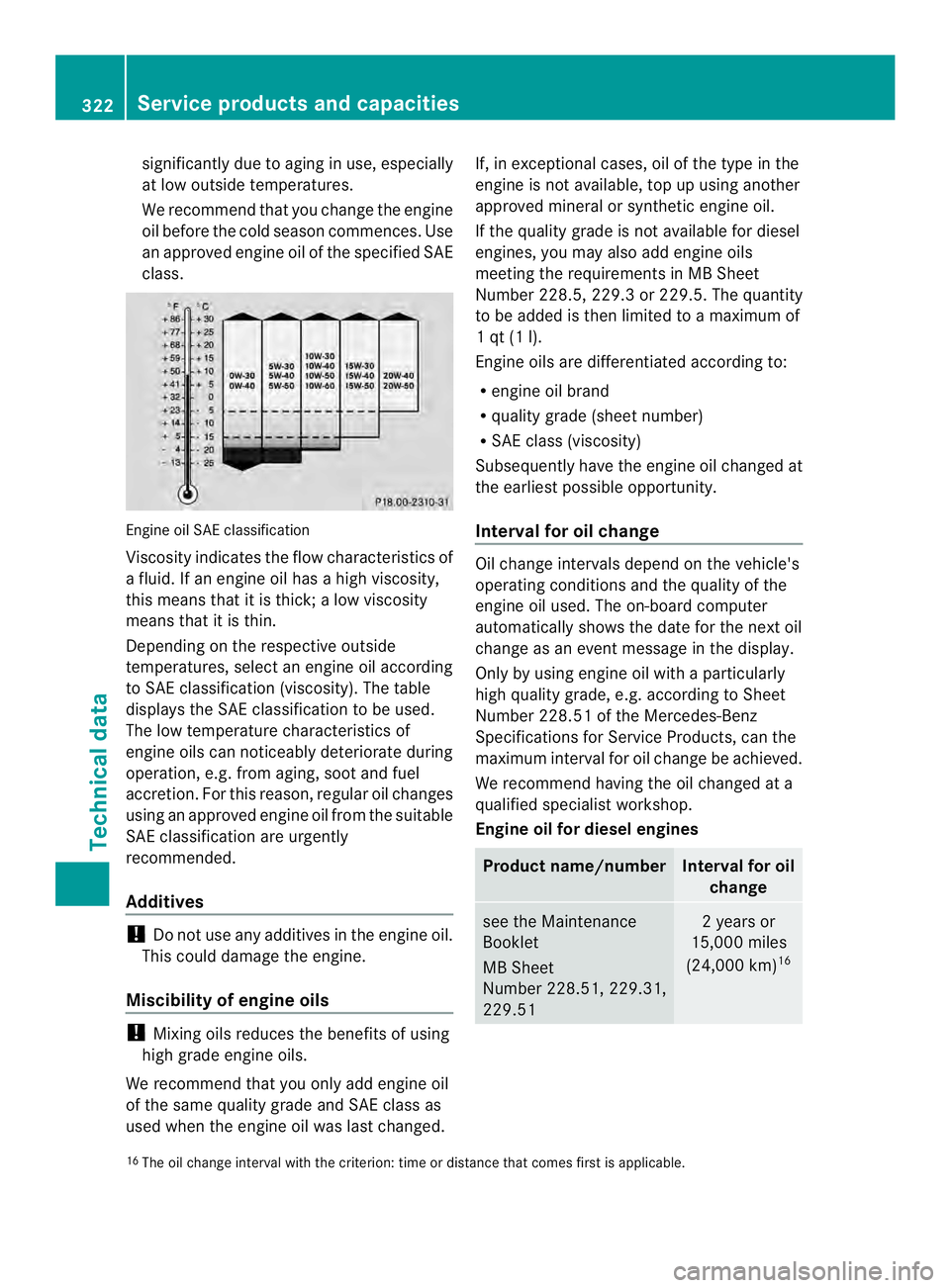
Engine oil SAE classification
Viscosity indicates the flow characteristics of
a fluid. If an engine oil has a high viscosity,
this means that it is thick; a low viscosity
means that it is thin.
Depending on the respective outside
temperatures, select an engine oil according
to SAE classification (viscosity). The table
displays the SAE classification to be used.
The low temperature characteristics of
engine oils can noticeably deteriorate during
operation, e.g. from aging, soot and fuel
accretion. For this reason, regularo il changes
using an approved engine oil fro mthe suitable
SAE classification are urgently
recommended.
Additives !
Do not use any additives in the engine oil.
This could damage the engine.
Miscibility of engine oils !
Mixing oils reduces the benefits of using
high grade engine oils.
We recommend that you only add engine oil
of the same quality grade and SAE class as
used when the engine oil was last changed. If, in exceptional cases, oil of the type in the
engine is not available, top up using another
approved mineral or synthetic engine oil.
If the quality grade is not available for diesel
engines, you may also add engine oils
meeting the requirements in MB Sheet
Number 228.5, 229.3 or 229.5. The quantity
to be added is then limited to a maximum of
1 qt (1 l).
Engine oils are differentiated according to:
R
engine oil brand
R quality grade (sheet number)
R SAE class (viscosity)
Subsequently have the engine oil changed at
the earliest possible opportunity.
Interval for oil change Oil change intervals depend on the vehicle's
operating conditions and the quality of the
engine oil used. The on-board computer
automatically shows the date for the next oil
change as an event message in the display.
Only by using engine oil with a particularly
high quality grade, e.g. according to Sheet
Number 228.51 of the Mercedes-Benz
Specifications for Service Products, can the
maximum interval for oil change be achieved.
We recommend having the oil changed at a
qualified specialist workshop.
Engine oil for diesel engines
Product name/number Interval for oil
change see the Maintenance
Booklet
MB Sheet
Number 228.51, 229.31,
229.51 2y
ears or
15,000 miles
(24,000 km) 16 16
The oil change interval with the criterion: time or distance that comes first is applicable. 322
Service products and capacitiesTechnical data
Page 325 of 334
Capacities
!
Do no tadd too much oil. adding too much
engine oil can result in damage to the
engine or to the catalytic converter. Have
excess engine oil siphoned off.
Oil change including oil filter Engine oil
Approximately
13.21 US qt. (12.5 l) Information about oil consumption
!
If the vehicle is predominantly used for
short-distance driving, this could lead to a
malfunction in the automatic cleaning
function for the diesel particle filter. As a
result, fuel may accumulate in the engine
oil and cause engine failure.
Therefore, if you mainly drive short
distances, you should drive on a highway or
on rural roads for 20 minutes every
310 miles (500 km). This ensures sufficient
regeneration of the diesel particle filter.
Depending on the driving style, the vehicle
consumes a maximum of 1.0 US qt (1.0 l)of
engine oil over a distance of 620 miles
(1000 km).
Oil consumption may be higher if:
R the vehicle is new.
R you mainly operate the vehicle under
arduous operating conditions.
R you frequently drive at high engine speeds.
Regula rmaintenance is one of the
preconditions for moderate rates of
consumption.
You can only estimate th eoil consumption
after you have drive naconsiderable distance.
Check the engine oil level on a regular basis,
e.g. weekly or each time you refuel
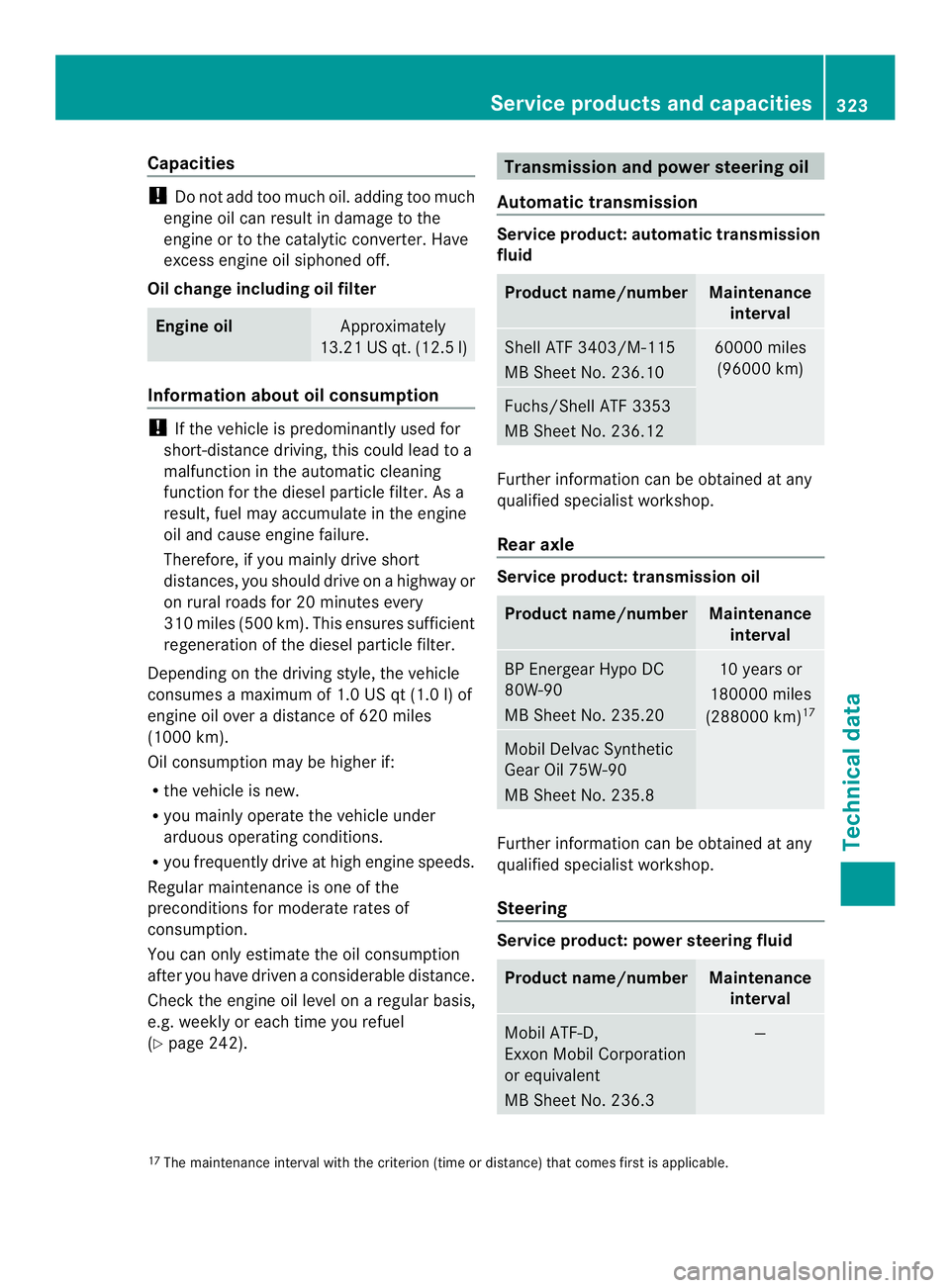
(Y page 242). Transmission and power steering oil
Automatic transmission Service product: automatic transmission
fluid
Product name/number Maintenance
interval Shell ATF 3403/M-115
MB Sheet No. 236.10 60000 miles
(96000 km) Fuchs/Shell ATF 3353
MB Sheet No. 236.12
Further information can be obtained at any
qualified specialist workshop.
Rear axle
Service product: transmission oil
Product name/number Maintenance
interval BP Energear Hypo DC
80W-90
MB Sheet No. 235.20 10 years or
180000 miles
(288000 km) 17 Mobil Delvac Synthetic
Gear Oil 75W-90
MB Sheet No. 235.8
Further information can be obtained at any
qualified specialist workshop.
Steering
Service product: power steering fluid
Product name/number Maintenance
interval Mobil ATF-D,
Exxon Mobil Corporation
or equivalent
MB Sheet No. 236.3 —
17
The maintenance interval with the criterion (time or distance) that comes first is applicable. Service products and capacities
323Technical data Z
Page 326 of 334
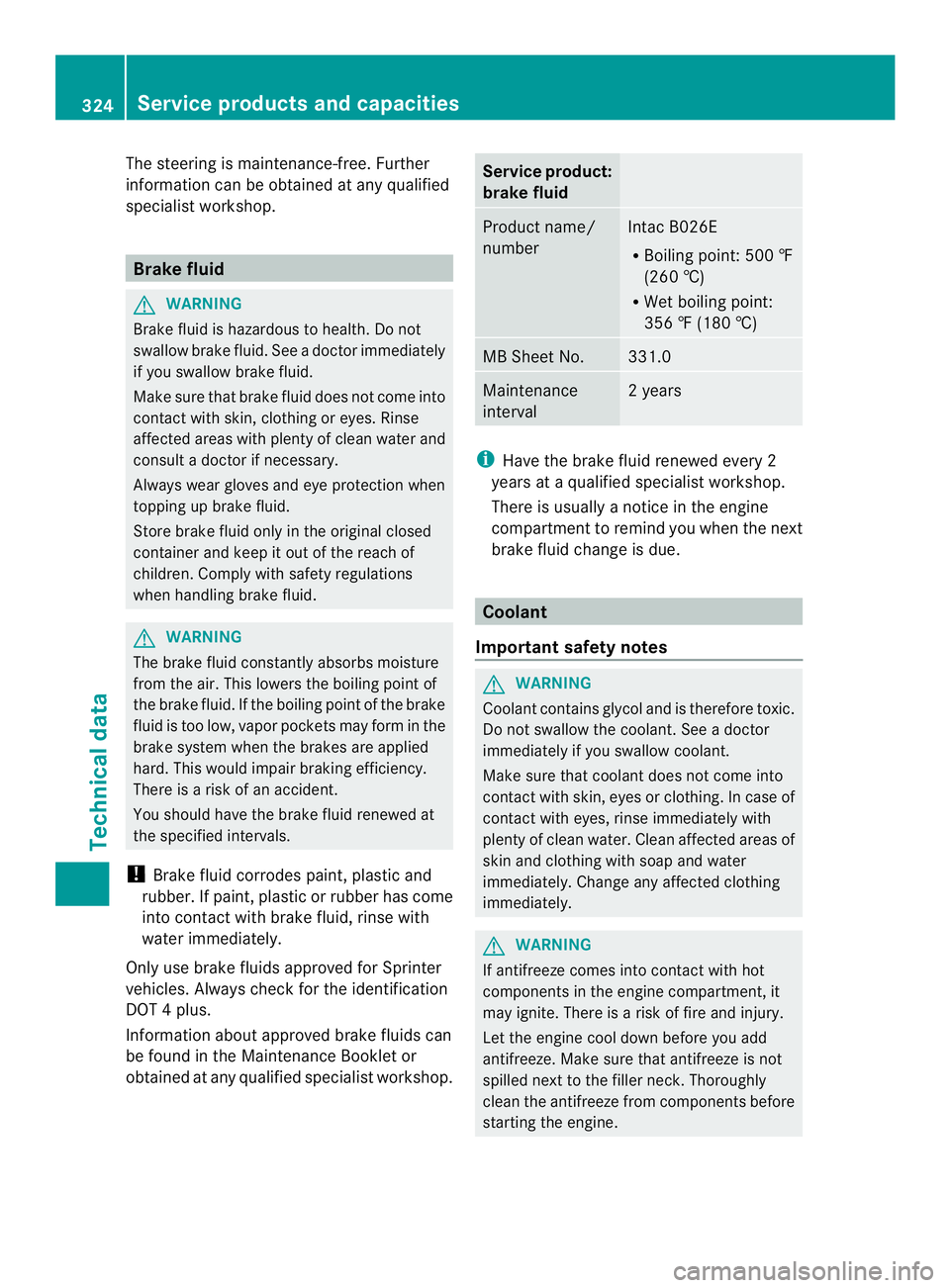
The steering is maintenance-free. Further
information can be obtained at any qualified
specialist workshop.
Brake fluid
G
WARNING
Brake fluid is hazardous to health. Do not
swallow brake fluid. See adoctor immediately
if you swallow brake fluid.
Make sure that brake fluid does not come into
contact with skin, clothing or eyes. Rinse
affected areas with plenty of clean water and
consult a doctor if necessary.
Always wear gloves and eye protection when
topping up brake fluid.
Store brake fluid only in the original closed
container and keep it out of the reach of
children. Comply with safety regulations
when handling brake fluid. G
WARNING
The brake fluid constantly absorbs moisture
from the air. This lowers the boiling point of
the brake fluid. If the boiling point of the brake
fluid is too low, vapor pockets may form in the
brake system when the brakes are applied
hard. This would impair braking efficiency.
There is a risk of an accident.
You should have the brake fluid renewed at
the specified intervals.
! Brake fluid corrodes paint, plastic and
rubber. If paint, plastic or rubber has come
into contact with brake fluid, rinse with
water immediately.
Only use brake fluids approved for Sprinter
vehicles. Always check for the identification
DOT 4plus.
Information about approved brake fluids can
be found in the Maintenance Booklet or
obtained at any qualified specialist workshop. Service product:
brake fluid Produc
tname/
number Intac B026E
R
Boiling point: 500 ‡
(260 †)
R Wet boiling point:
356 ‡ (180 †) MB Sheet No. 331.0
Maintenance
interval 2y
ears i
Have the brake fluid renewed every 2
years at a qualified specialist workshop.
There is usually a notice in the engine
compartment to remind you when the next
brake fluid change is due. Coolant
Important safety notes G
WARNING
Coolant contains glycol and is therefore toxic.
Do not swallow the coolant .See a doctor
immediately if you swallow coolant.
Make sure that coolant does not come into
contact with skin, eyes or clothing. In case of
contact with eyes, rinse immediately with
plenty of clean water. Clean affected areas of
skin and clothing with soap and water
immediately. Change any affected clothing
immediately. G
WARNING
If antifreeze comes into contact with hot
components in the engine compartment, it
may ignite. There is a risk of fire and injury.
Let the engine cool down before you add
antifreeze. Make sure that antifreeze is not
spilled nextt o the filler neck.T horoughly
clean the antifreeze from components before
starting the engine. 324
Service products and capacitiesTechnical data
Page 327 of 334
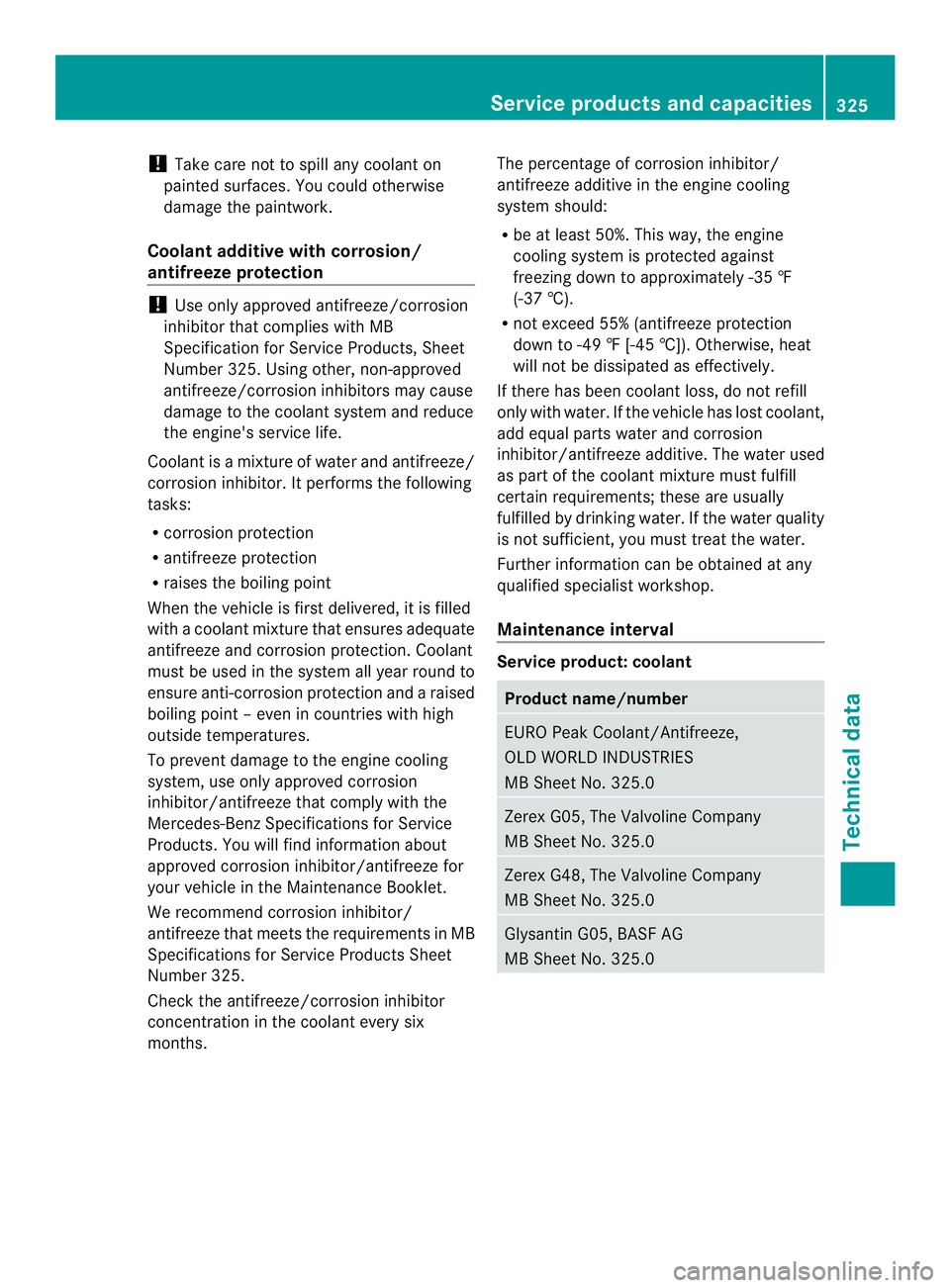
!
Take care not to spill any coolant on
painted surfaces. You could otherwise
damage the paintwork.
Coolant additive with corrosion/
antifreeze protection !
Use only approved antifreeze/corrosion
inhibitor that complies with MB
Specification for Service Products, Sheet
Number 325. Using other, non-approved
antifreeze/corrosion inhibitors may cause
damage to the coolant system and reduce
the engine's service life.
Coolant is a mixture of water and antifreeze/
corrosion inhibitor. It performs the following
tasks:
R corrosion protection
R antifreeze protection
R raises the boiling point
When the vehicle is first delivered, it is filled
with a coolant mixture that ensures adequate
antifreeze and corrosion protection. Coolant
must be used in the system all yearr ound to
ensure anti-corrosion protection and a raised
boiling point –even in countries with high
outside temperatures.
To prevent damage to the engine cooling
system, use only approved corrosion
inhibitor/antifreeze that comply with the
Mercedes-Benz Specifications for Service
Products. You will find information about
approved corrosio ninhibitor/antifreeze for
your vehicle in the Maintenance Booklet.
We recommend corrosion inhibitor/
antifreeze tha tmeets the requirements in MB
Specifications for Service Products Sheet
Number 325.
Check the antifreeze/corrosion inhibitor
concentration in the coolant every six
months. The percentage of corrosion inhibitor/
antifreeze additive in the engine cooling
system should:
R
be at least 50%. This way, the engine
cooling system is protected against
freezing down to approximately -35 ‡
(-37 †).
R not exceed 55% (antifreeze protection
down to -49 ‡ [-45 †]). Otherwise, heat
will not be dissipated as effectively.
If there has been coolant loss, do not refill
only with water. If the vehicle has lost coolant,
add equal parts water and corrosion
inhibitor/antifreeze additive. The water used
as part of the coolant mixture must fulfill
certain requirements; these are usually
fulfilled by drinking water. If the water quality
is not sufficient, you must treat the water.
Further information can be obtained at any
qualified specialist workshop.
Maintenance interval Service product: coolant
Product name/number
EURO Peak Coolant/Antifreeze,
OLD WORLD INDUSTRIES
MB Sheet No. 325.0
Zerex G05, The Valvoline Company
MB Sheet No. 325.0
Zerex G48, The Valvoline Company
MB Sheet No. 325.0
Glysantin G05, BASF AG
MB Sheet No. 325.0Service products and capacities
325Technical data Z