warning light MERCEDES-BENZ SPRINTER 2014 MY14 Operator’s Manual
[x] Cancel search | Manufacturer: MERCEDES-BENZ, Model Year: 2014, Model line: SPRINTER, Model: MERCEDES-BENZ SPRINTER 2014Pages: 338, PDF Size: 6.78 MB
Page 230 of 338
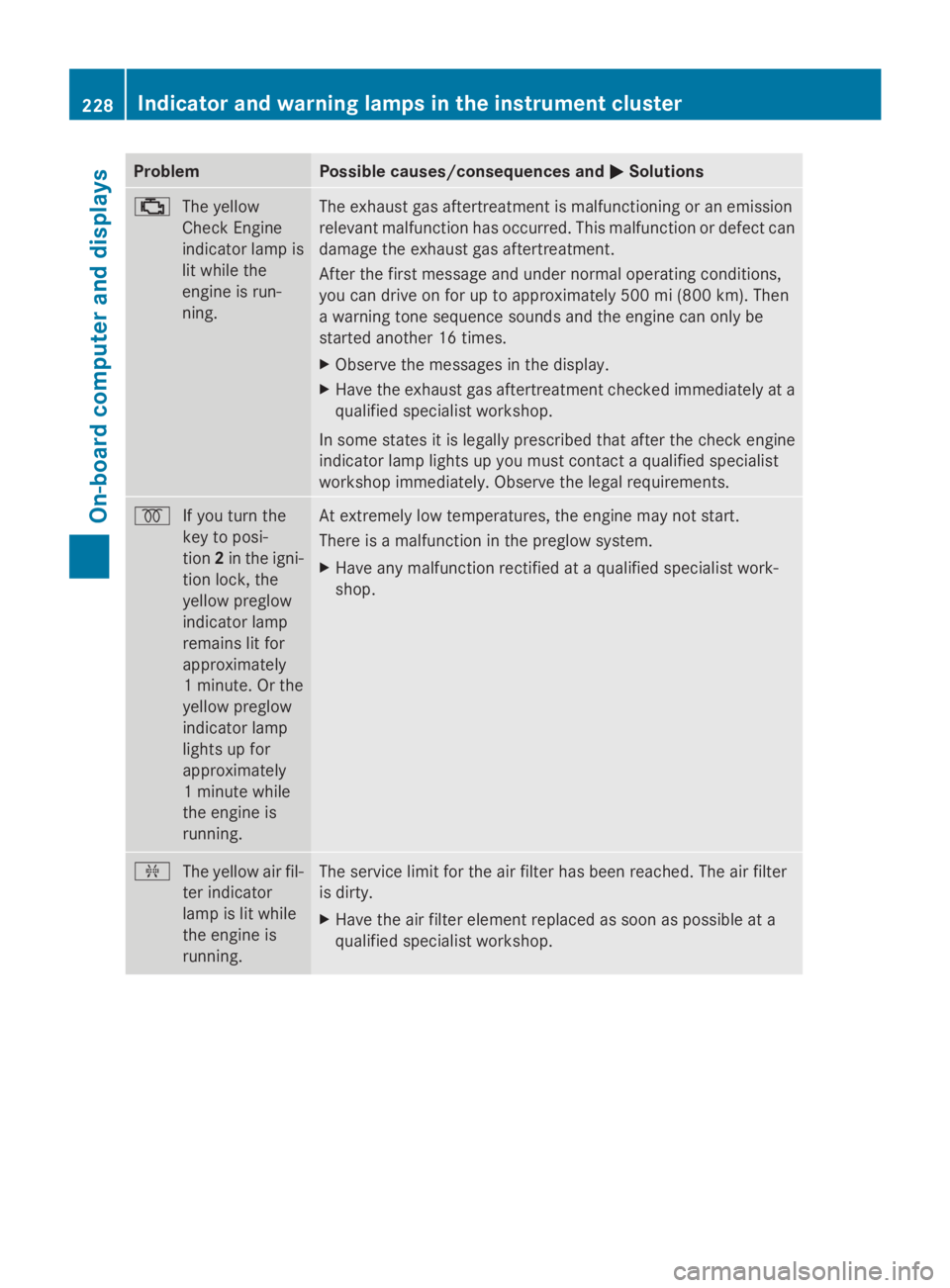
Problem Possible causes/consequences and
0050
0050Solutions 00B9
The yellow
Check Engine
indicator lamp is
lit while the
engine is run-
ning. The exhaust gas aftertreatment is malfunctioning or an emission
relevant malfunction has occurred. This malfunction or defect can
damage the exhaust gas aftertreatment.
After the first message and under normal operating conditions,
you can drive on for up to approximately 500 mi (800 km). Then
a warning tone sequence sounds and the engine can only be
started another 16 times.
X
Observe the messages in the display.
X Have the exhaust gas aftertreatment checked immediately at a
qualified specialist workshop.
In some states it is legally prescribed that after the check engine
indicator lamp lights up you must contact a qualified specialist
workshop immediately. Observe the legal requirements. 0028
If you turn the
key to posi-
tion2in the igni-
tion lock, the
yellow preglow
indicator lamp
remains lit for
approximately
1 minute. Or the
yellow preglow
indicator lamp
lights up for
approximately
1 minute while
the engine is
running. At extremely low temperatures, the engine may not start.
There is a malfunction in the preglow system.
X
Have any malfunction rectified at a qualified specialist work-
shop. 009F
The yellow air fil-
ter indicator
lamp is lit while
the engine is
running. The service limit for the air filter has been reached. The air filter
is dirty.
X
Have the air filter element replaced as soon as possible at a
qualified specialist workshop. 228
Indicator and warning lamps in the instrument clusterOn-board computer and displays
Page 231 of 338
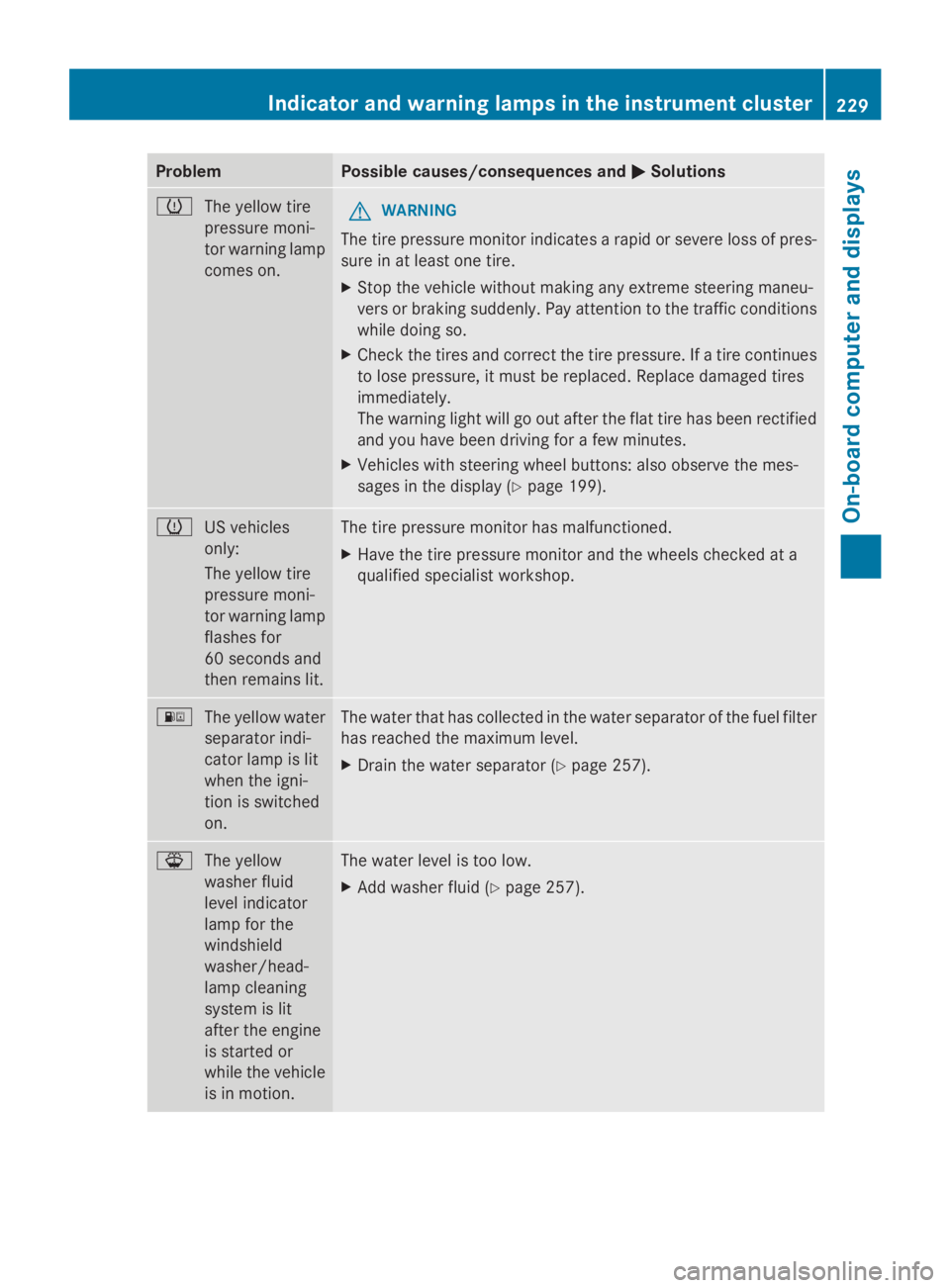
Problem Possible causes/consequences and
0050
0050Solutions 0077
The yellow tire
pressure moni-
tor warning lamp
comes on. G
WARNING
The tire pressure monitor indicates a rapid or severe loss of pres-
sure in at least one tire.
X Stop the vehicle without making any extreme steering maneu-
vers or braking suddenly. Pay attention to the traffic conditions
while doing so.
X Check the tires and correct the tire pressure. If a tire continues
to lose pressure, it must be replaced. Replace damaged tires
immediately.
The warning light will go out after the flat tire has been rectified
and you have been driving for a few minutes.
X Vehicles with steering wheel buttons: also observe the mes-
sages in the display (Y page 199).0077
US vehicles
only:
The yellow tire
pressure moni-
tor warning lamp
flashes for
60 seconds and
then remains lit. The tire pressure monitor has malfunctioned.
X
Have the tire pressure monitor and the wheels checked at a
qualified specialist workshop. 00B8
The yellow water
separator indi-
cator lamp is lit
when the igni-
tion is switched
on. The water that has collected in the water separator of the fuel filter
has reached the maximum level.
X
Drain the water separator (Y page 257).00B1
The yellow
washer fluid
level indicator
lamp for the
windshield
washer/head-
lamp cleaning
system is lit
after the engine
is started or
while the vehicle
is in motion. The water level is too low.
X
Add washer fluid (Y page 257). Indicator and warning lamps in the instrument cluster
229On-board computer and displays Z
Page 232 of 338
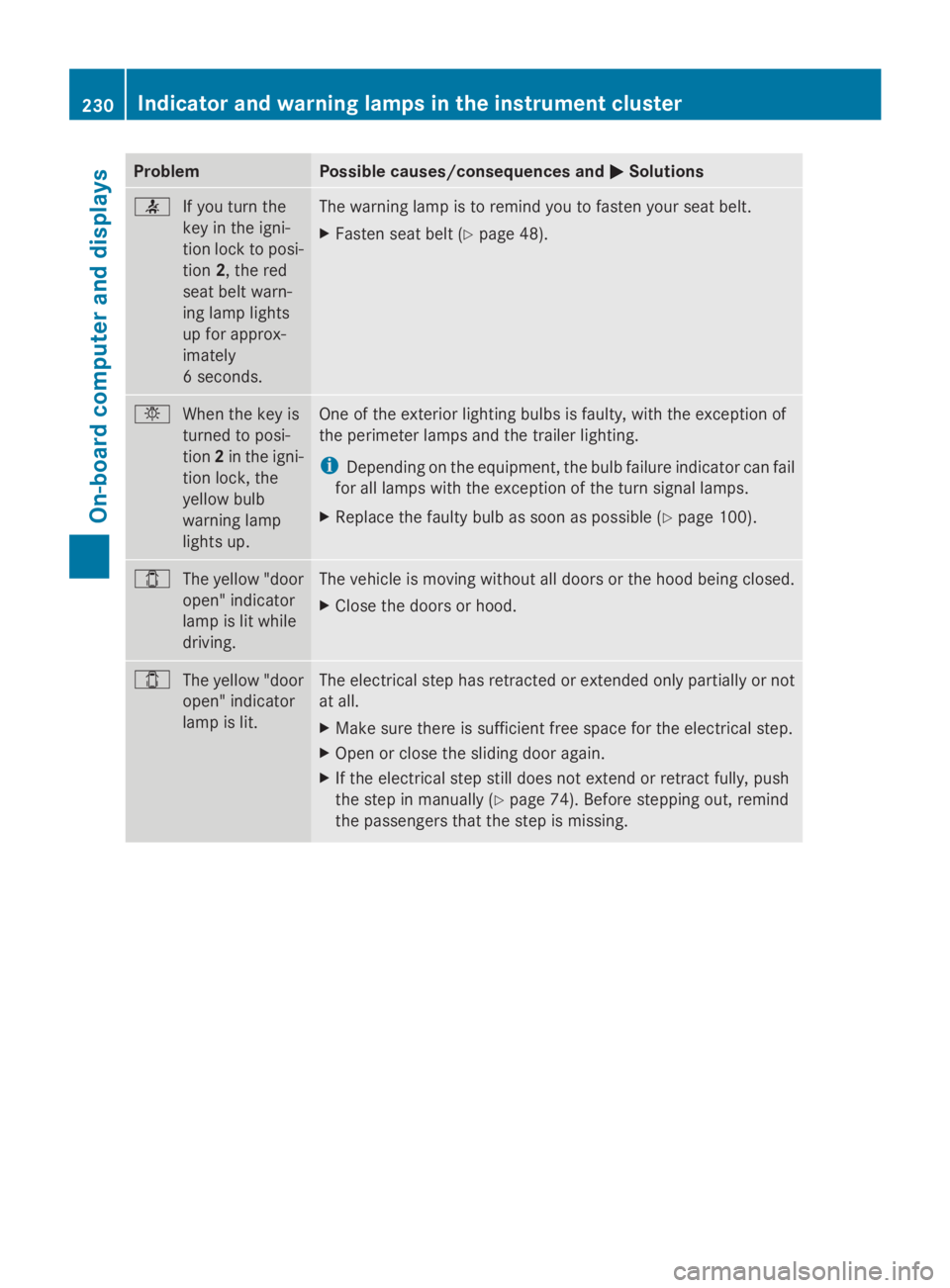
Problem Possible causes/consequences and
0050
0050Solutions 0076
If you turn the
key in the igni-
tion lock to posi-
tion2, the red
seat belt warn-
ing lamp lights
up for approx-
imately
6 seconds. The warning lamp is to remind you to fasten your seat belt.
X
Fasten seat belt (Y page 48).0049
When the key is
turned to posi-
tion2in the igni-
tion lock, the
yellow bulb
warning lamp
lights up. One of the exterior lighting bulbs is faulty, with the exception of
the perimeter lamps and the trailer lighting.
i
Depending on the equipment, the bulb failure indicator can fail
for all lamps with the exception of the turn signal lamps.
X Replace the faulty bulb as soon as possible (Y page 100).003E
The yellow "door
open" indicator
lamp is lit while
driving. The vehicle is moving without all doors or the hood being closed.
X
Close the doors or hood. 003E
The yellow "door
open" indicator
lamp is lit. The electrical step has retracted or extended only partially or not
at all.
X
Make sure there is sufficient free space for the electrical step.
X Open or close the sliding door again.
X If the electrical step still does not extend or retract fully, push
the step in manually (Y page 74). Before stepping out, remind
the passengers that the step is missing. 230
Indicator and warning lamps in the instrument clusterOn-board computer and displays
Page 237 of 338
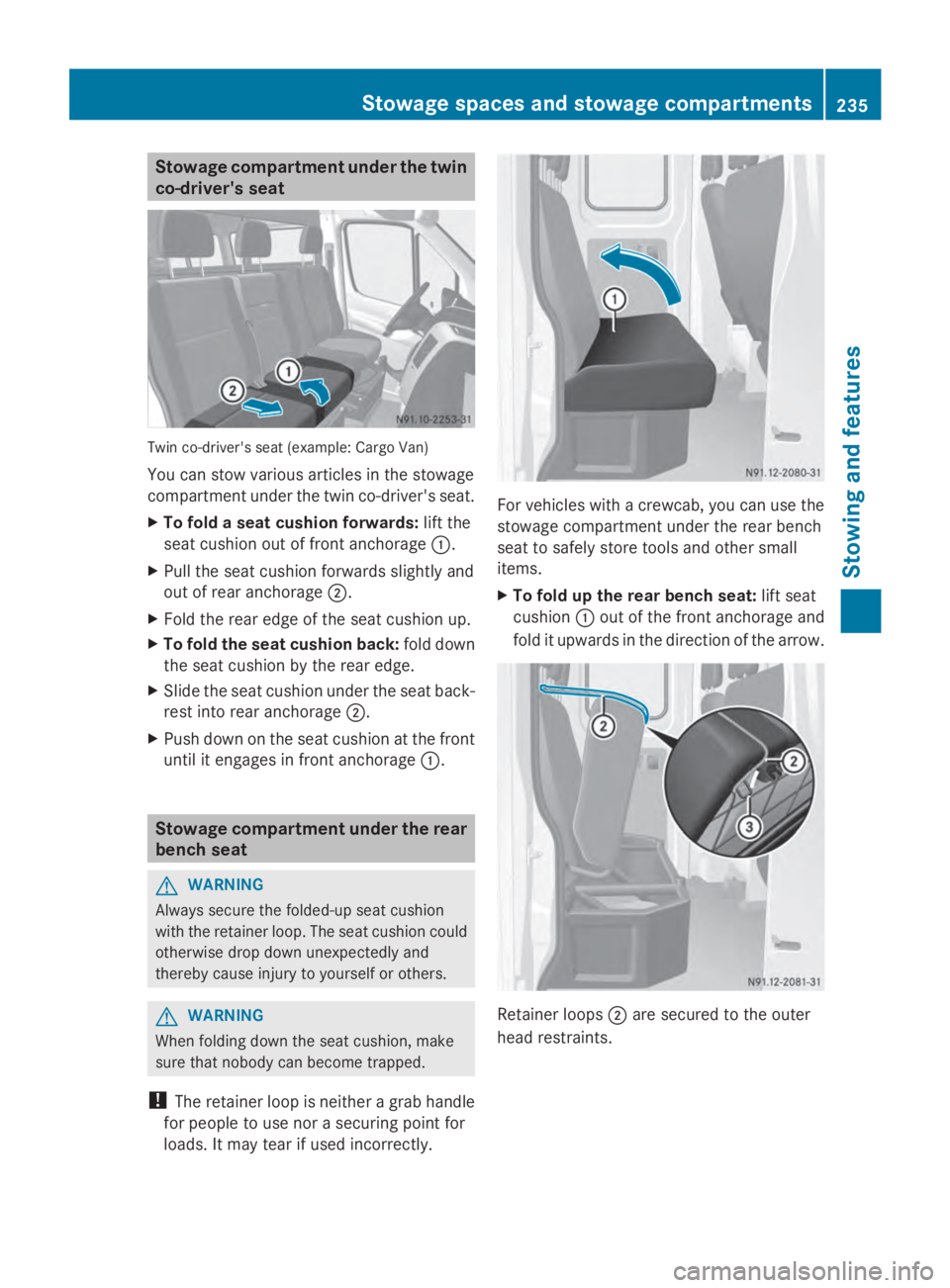
Stowage compartment under the twin
co-driver's seat Twin co-driver's seat (example: Cargo Van)
You can stow various articles in the stowage
compartment under the twin co-driver's seat.
X To fold a seat cushion forwards: lift the
seat cushion out of front anchorage 0043.
X Pull the seat cushion forwards slightly and
out of rear anchorage 0044.
X Fold the rear edge of the seat cushion up.
X To fold the seat cushion back: fold down
the seat cushion by the rear edge.
X Slide the seat cushion under the seat back-
rest into rear anchorage 0044.
X Push down on the seat cushion at the front
until it engages in front anchorage 0043.Stowage compartment under the rear
bench seat G
WARNING
Always secure the folded-up seat cushion
with the retainer loop. The seat cushion could
otherwise drop down unexpectedly and
thereby cause injury to yourself or others. G
WARNING
When folding down the seat cushion, make
sure that nobody can become trapped.
! The retainer loop is neither a grab handle
for people to use nor a securing point for
loads. It may tear if used incorrectly. For vehicles with a crewcab, you can use the
stowage compartment under the rear bench
seat to safely store tools and other small
items.
X
To fold up the rear bench seat: lift seat
cushion 0043out of the front anchorage and
fold it upwards in the direction of the arrow. Retainer loops
0044are secured to the outer
head restraints. Stowage spaces and stowage compartments
235Stowing and features Z
Page 240 of 338
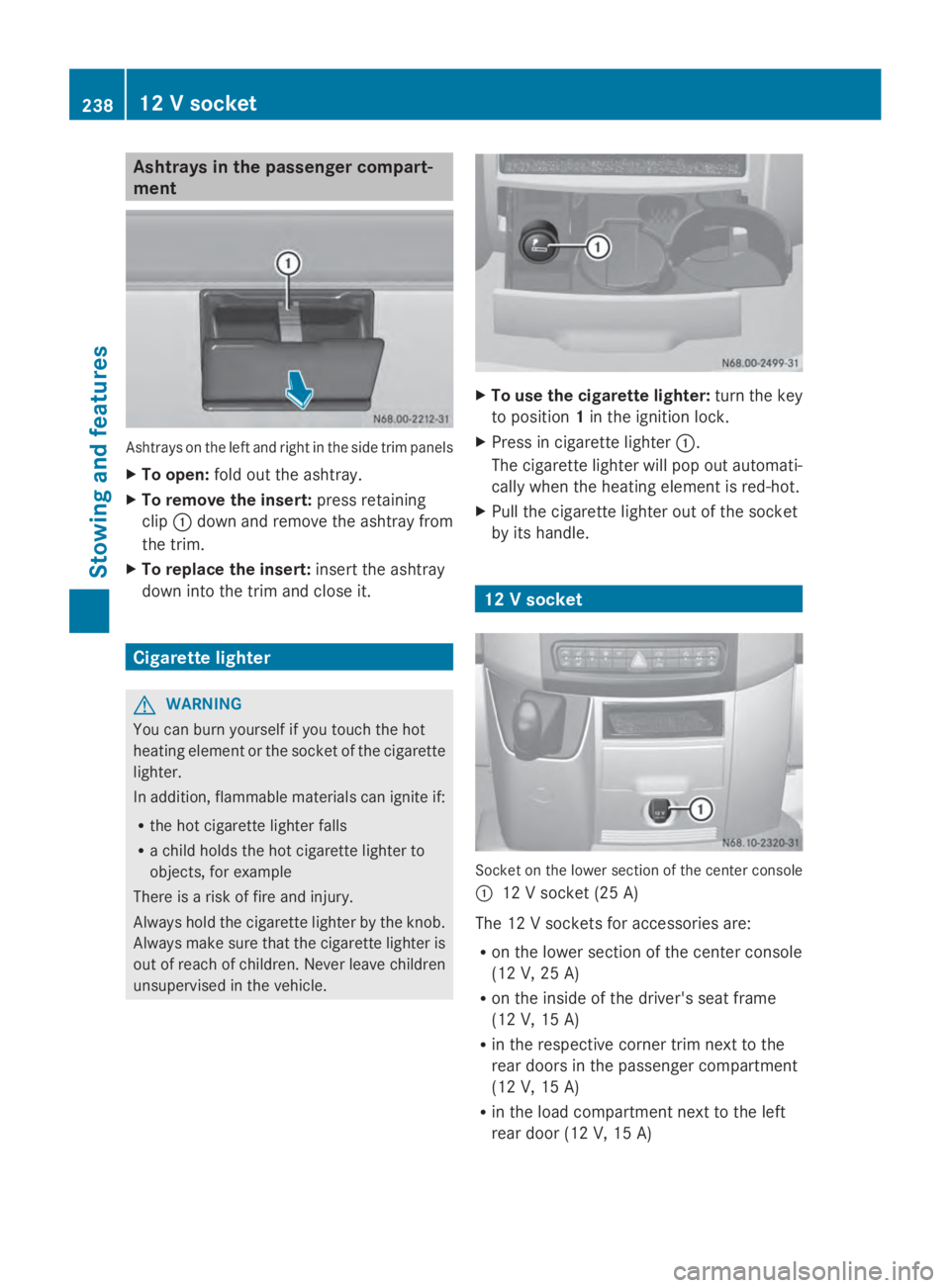
Ashtrays in the passenger compart-
ment Ashtrays on the left and right in the side trim panels
X To open: fold out the ashtray.
X To remove the insert: press retaining
clip 0043down and remove the ashtray from
the trim.
X To replace the insert: insert the ashtray
down into the trim and close it. Cigarette lighter
G
WARNING
You can burn yourself if you touch the hot
heating element or the socket of the cigarette
lighter.
In addition, flammable materials can ignite if:
R the hot cigarette lighter falls
R a child holds the hot cigarette lighter to
objects, for example
There is a risk of fire and injury.
Always hold the cigarette lighter by the knob.
Always make sure that the cigarette lighter is
out of reach of children. Never leave children
unsupervised in the vehicle. X
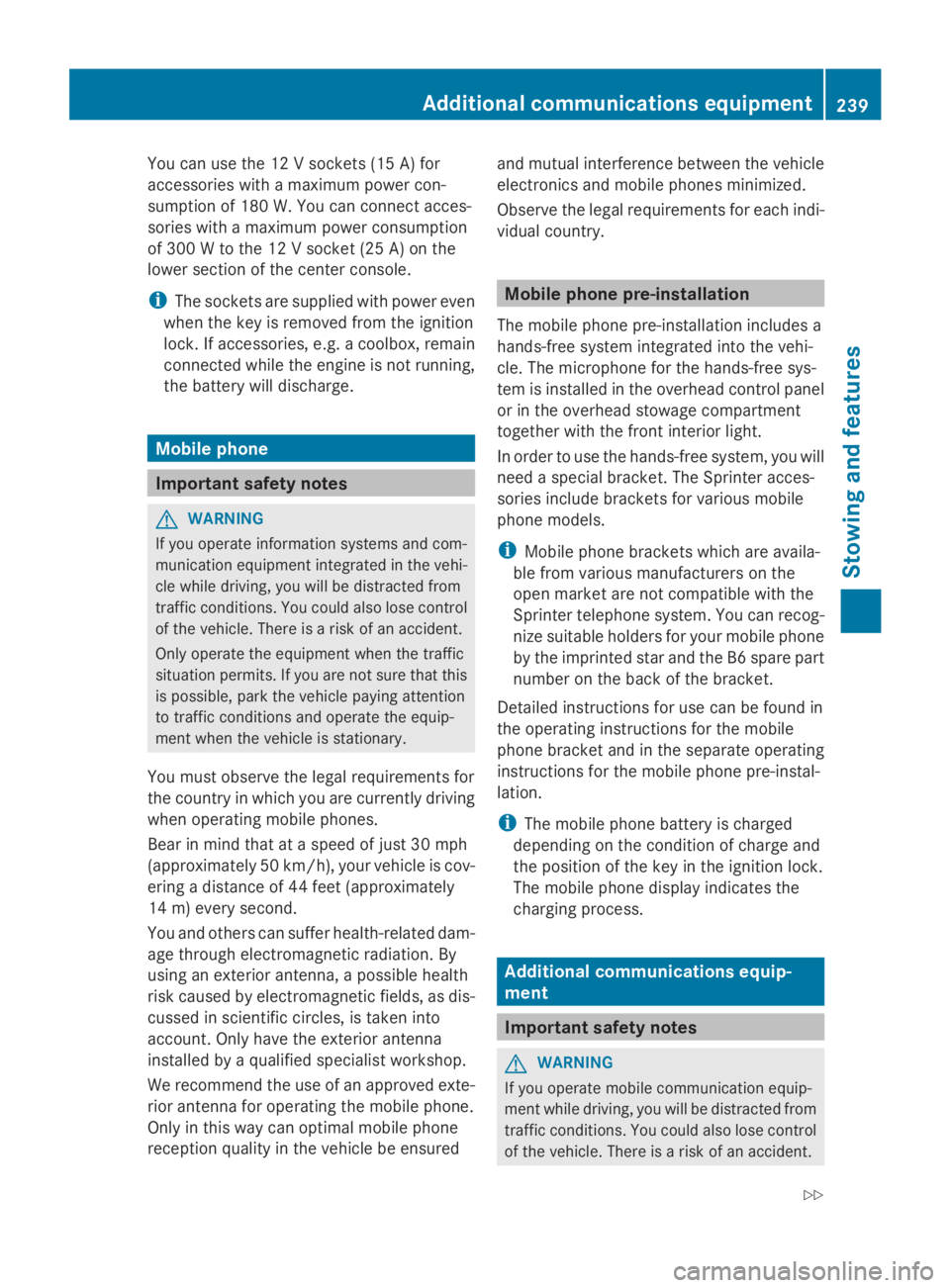
To use the cigarette lighter: turn the key
to position 1in the ignition lock.
X Press in cigarette lighter 0043.
The cigarette lighter will pop out automati-
cally when the heating element is red-hot.
X Pull the cigarette lighter out of the socket
by its handle. 12 V socket
Socket on the lower section of the center console
0043 12 V socket (25 A)
The 12 V sockets for accessories are:
R on the lower section of the center console
(12 V, 25 A)
R on the inside of the driver's seat frame
(12 V, 15 A)
R in the respective corner trim next to the
rear doors in the passenger compartment
(12 V, 15 A)
R in the load compartment next to the left
rear door (12 V, 15 A) 238
12 V socketStowing and featu
res
Page 241 of 338
You can use the 12 V sockets (15 A) for
accessories with a maximum power con-
sumption of 180 W. You can connect acces-
sories with a maximum power consumption
of 300 W to the 12 V socket (25 A) on the
lower section of the center console.
i The sockets are supplied with power even
when the key is removed from the ignition
lock. If accessories, e.g. a coolbox, remain
connected while the engine is not running,
the battery will discharge. Mobile phone
Important safety notes
G
WARNING
If you operate information systems and com-
munication equipment integrated in the vehi-
cle while driving, you will be distracted from
traffic conditions. You could also lose control
of the vehicle. There is a risk of an accident.
Only operate the equipment when the traffic
situation permits. If you are not sure that this
is possible, park the vehicle paying attention
to traffic conditions and operate the equip-
ment when the vehicle is stationary.
You must observe the legal requirements for
the country in which you are currently driving
when operating mobile phones.
Bear in mind that at a speed of just 30 mph
(approximately 50 km/h), your vehicle is cov-
ering a distance of 44 feet (approximately
14 m) every second.
You and others can suffer health-related dam-
age through electromagnetic radiation. By
using an exterior antenna, a possible health
risk caused by electromagnetic fields, as dis-
cussed in scientific circles, is taken into
account. Only have the exterior antenna
installed by a qualified specialist workshop.
We recommend the use of an approved exte-
rior antenna for operating the mobile phone.
Only in this way can optimal mobile phone
reception quality in the vehicle be ensured and mutual interference between the vehicle
electronics and mobile phones minimized.
Observe the legal requirements for each indi-
vidual country. Mobile phone pre-installation
The mobile phone pre-installation includes a
hands-free system integrated into the vehi-
cle. The microphone for the hands-free sys-
tem is installed in the overhead control panel
or in the overhead stowage compartment
together with the front interior light.
In order to use the hands-free system, you will
need a special bracket. The Sprinter acces-
sories include brackets for various mobile
phone models.
i Mobile phone brackets which are availa-
ble from various manufacturers on the
open market are not compatible with the
Sprinter telephone system. You can recog-
nize suitable holders for your mobile phone
by the imprinted star and the B6 spare part
number on the back of the bracket.
Detailed instructions for use can be found in
the operating instructions for the mobile
phone bracket and in the separate operating
instructions for the mobile phone pre-instal-
lation.
i The mobile phone battery is charged
depending on the condition of charge and
the position of the key in the ignition lock.
The mobile phone display indicates the
charging process. Additional communications equip-
ment
Important safety notes
G
WARNING
If you operate mobile communication equip-
ment while driving, you will be distracted from
traffic conditions. You could also lose control
of the vehicle. There is a risk of an accident. Additional communications equipment
239Stowing and features
Z
Page 248 of 338
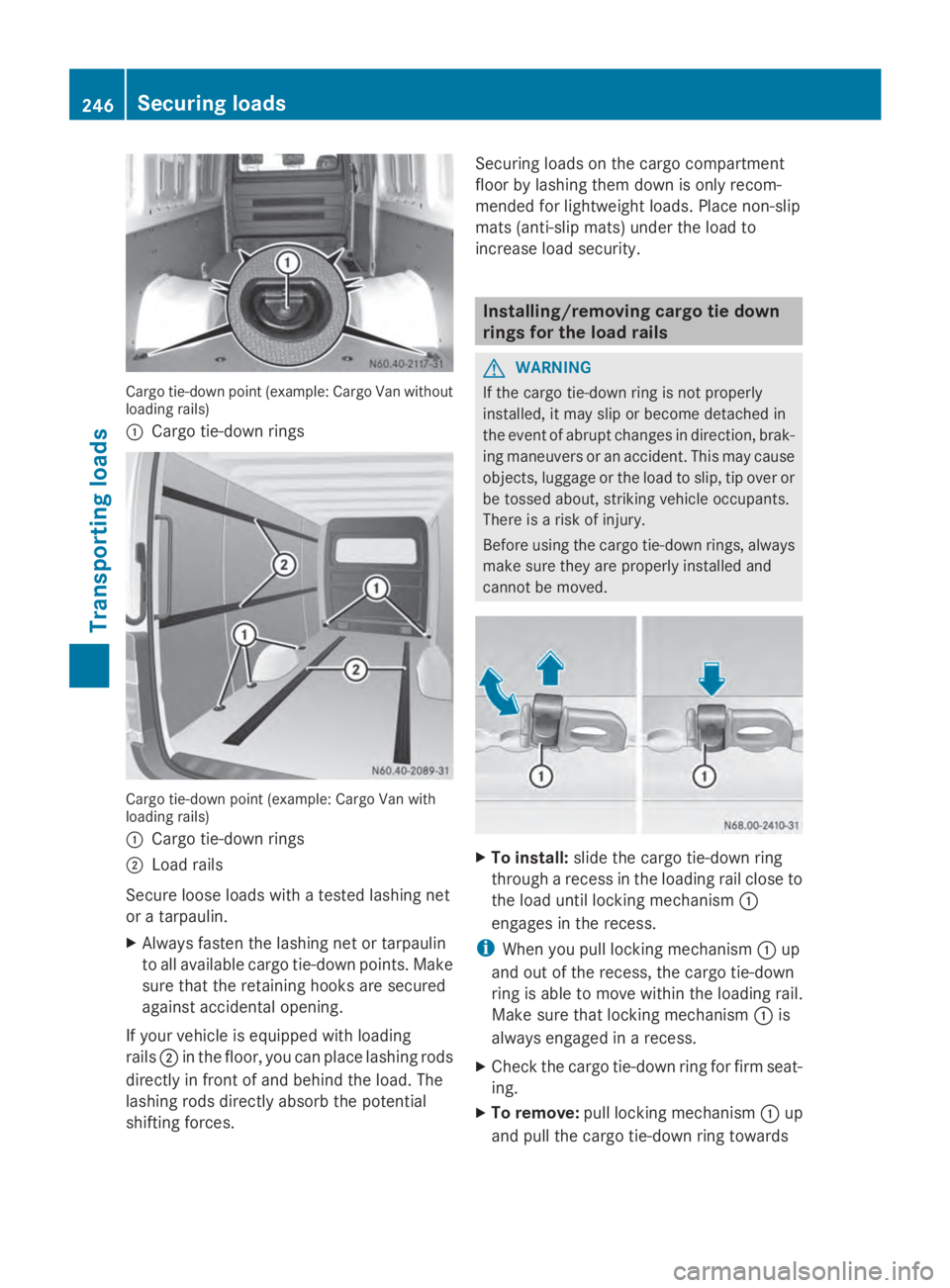
Cargo tie-down point (example: Cargo Van without
loading rails)
0043 Cargo tie-down rings Cargo tie-down point (example: Cargo Van with
loading rails)
0043 Cargo tie-down rings
0044 Load rails
Secure loose loads with a tested lashing net
or a tarpaulin.
X Always fasten the lashing net or tarpaulin
to all available cargo tie-down points. Make
sure that the retaining hooks are secured
against accidental opening.
If your vehicle is equipped with loading
rails 0044in the floor, you can place lashing rods
directly in front of and behind the load. The
lashing rods directly absorb the potential
shifting forces. Securing loads on the cargo compartment
floor by lashing them down is only recom-
mended for lightweight loads. Place non-slip
mats (anti-slip mats) under the load to
increase load security. Installing/removing cargo tie down
rings for the load rails
G
WARNING
If the cargo tie-down ring is not properly
installed, it may slip or become detached in
the event of abrupt changes in direction, brak-
ing maneuvers or an accident. This may cause
objects, luggage or the load to slip, tip over or
be tossed about, striking vehicle occupants.
There is a risk of injury.
Before using the cargo tie-down rings, always
make sure they are properly installed and
cannot be moved. X
To install: slide the cargo tie-down ring
through a recess in the loading rail close to
the load until locking mechanism 0043
engages in the recess.
i When you pull locking mechanism 0043up
and out of the recess, the cargo tie-down
ring is able to move within the loading rail.
Make sure that locking mechanism 0043is
always engaged in a recess.
X Check the cargo tie-down ring for firm seat-
ing.
X To remove: pull locking mechanism 0043up
and pull the cargo tie-down ring towards 246
Securing loadsTransporting loads
Page 253 of 338
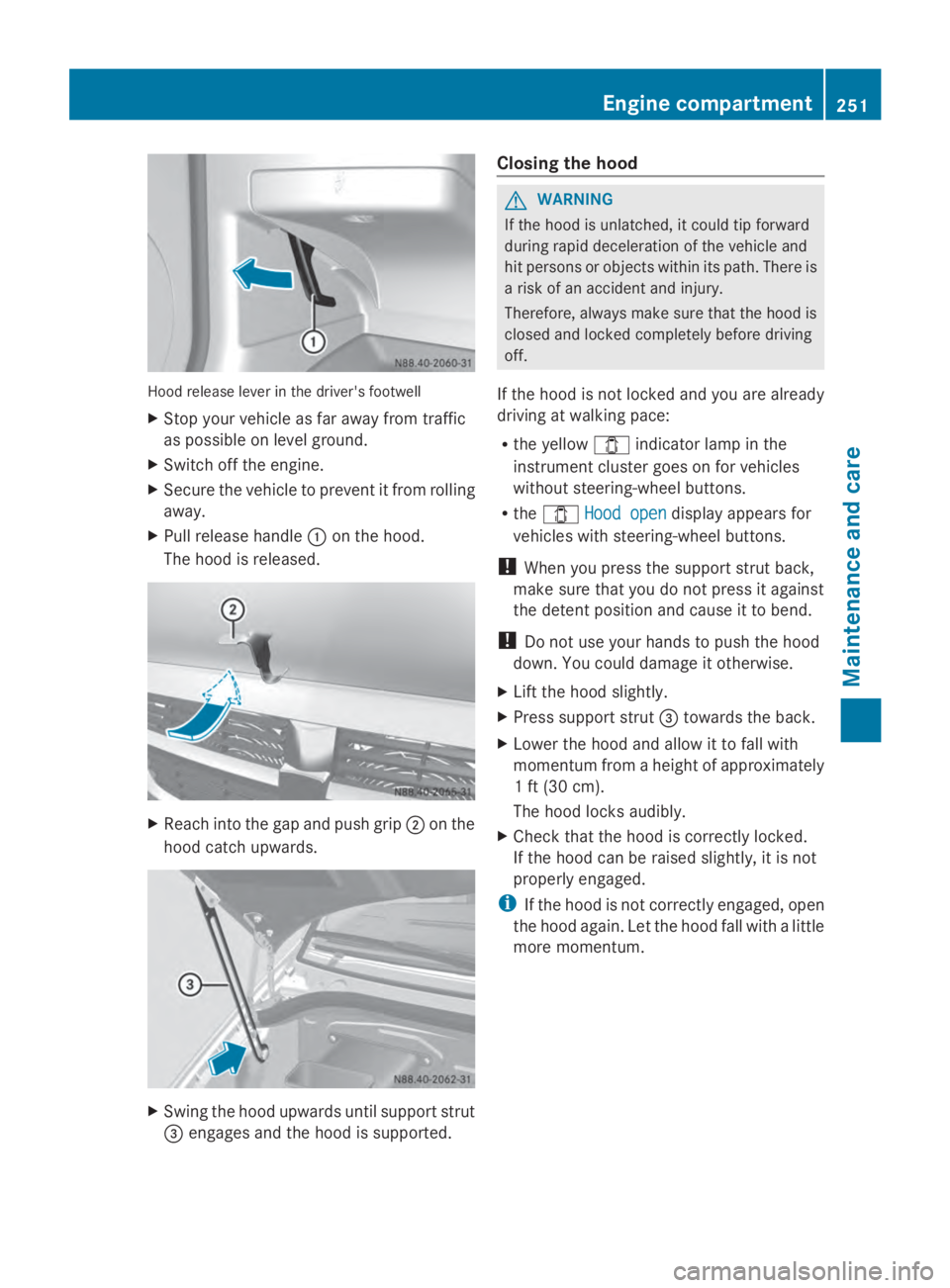
Hood release lever in the driver's footwell
X Stop your vehicle as far away from traffic
as possible on level ground.
X Switch off the engine.
X Secure the vehicle to prevent it from rolling
away.
X Pull release handle 0043on the hood.
The hood is released. X
Reach into the gap and push grip 0044on the
hood catch upwards. X
Swing the hood upwards until support strut
0087 engages and the hood is supported. Closing the hood G
WARNING
If the hood is unlatched, it could tip forward
during rapid deceleration of the vehicle and
hit persons or objects within its path. There is
a risk of an accident and injury.
Therefore, always make sure that the hood is
closed and locked completely before driving
off.
If the hood is not locked and you are already
driving at walking pace:
R the yellow 003Eindicator lamp in the
instrument cluster goes on for vehicles
without steering-wheel buttons.
R the 003E Hood open Hood open display appears for
vehicles with steering-wheel buttons.
! When you press the support strut back,
make sure that you do not press it against
the detent position and cause it to bend.
! Do not use your hands to push the hood
down. You could damage it otherwise.
X Lift the hood slightly.
X Press support strut 0087towards the back.
X Lower the hood and allow it to fall with
momentum from a height of approximately
1 ft (30 cm).
The hood locks audibly.
X Check that the hood is correctly locked.
If the hood can be raised slightly, it is not
properly engaged.
i If the hood is not correctly engaged, open
the hood again. Let the hood fall with a little
more momentum. Engine compartment
251Maintenance and care Z
Page 259 of 338
Washer fluid
G
WARNING
Windshield washer concentrate is highly flam-
mable. If it comes into contact with hot engine
components or the exhaust system it could
ignite. There is a risk of fire and injury.
Make sure that no windshield washer con-
centrate is spilled next to the filler neck.
! Only use washer fluid that is suitable for
plastic lamp lenses, e.g. MB SummerFit or
MB WinterFit. Unsuitable washer fluid
could damage the plastic lenses of the
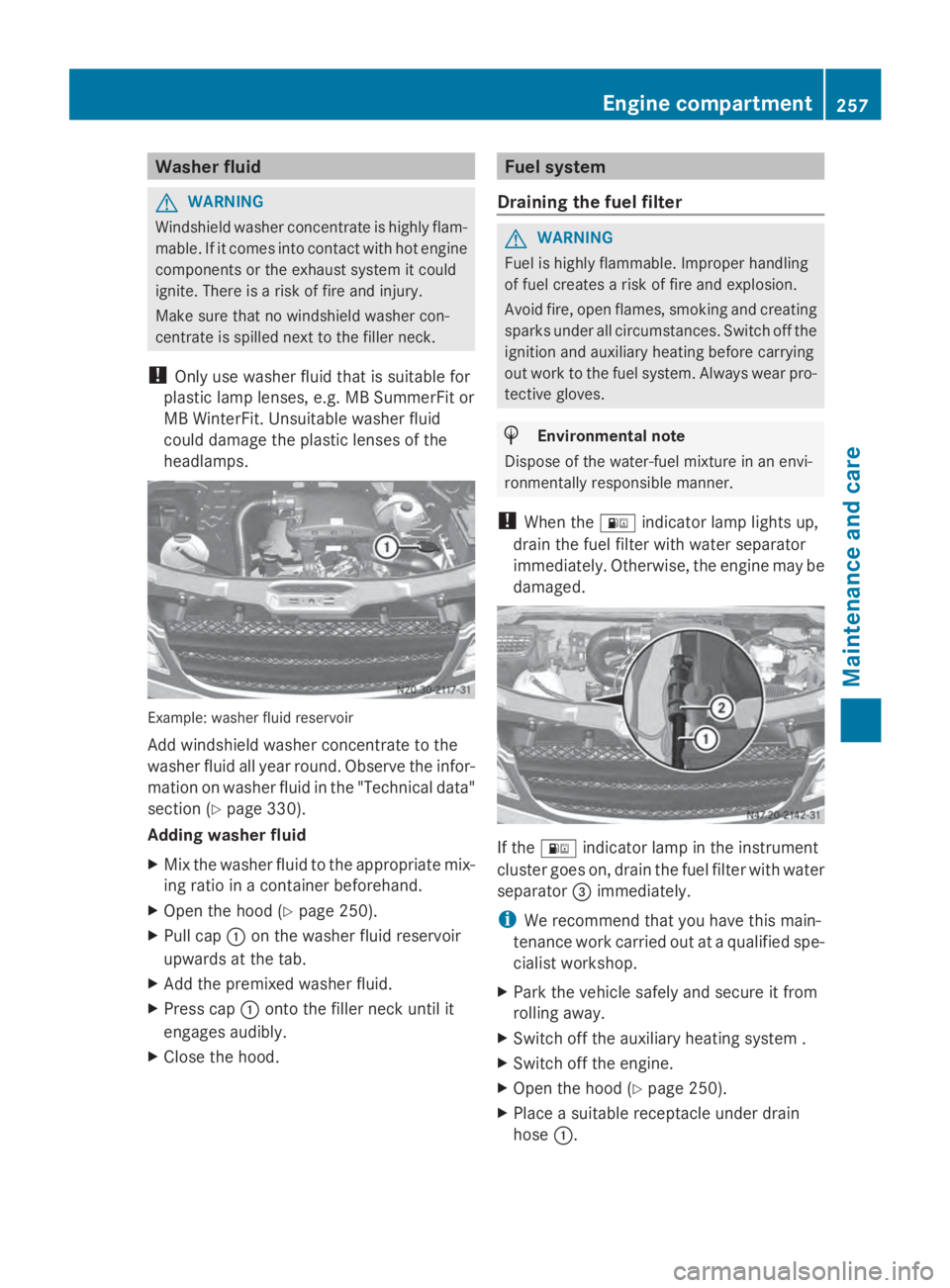
headlamps. Example: washer fluid reservoir
Add windshield washer concentrate to the
washer fluid all year round. Observe the infor-
mation on washer fluid in the "Technical data"
section (Y
page 330).
Adding washer fluid
X Mix the washer fluid to the appropriate mix-
ing ratio in a container beforehand.
X Open the hood (Y page 250).
X Pull cap 0043on the washer fluid reservoir
upwards at the tab.
X Add the premixed washer fluid.
X Press cap 0043onto the filler neck until it
engages audibly.
X Close the hood. Fuel system
Draining the fuel filter G
WARNING
Fuel is highly flammable. Improper handling
of fuel creates a risk of fire and explosion.
Avoid fire, open flames, smoking and creating
sparks under all circumstances. Switch off the
ignition and auxiliary heating before carrying
out work to the fuel system. Always wear pro-
tective gloves. H
Environmental note
Dispose of the water-fuel mixture in an envi-
ronmentally responsible manner.
! When the 00B8indicator lamp lights up,
drain the fuel filter with water separator
immediately. Otherwise, the engine may be
damaged. If the
00B8 indicator lamp in the instrument
cluster goes on, drain the fuel filter with water
separator 0087immediately.
i We recommend that you have this main-
tenance work carried out at a qualified spe-
cialist workshop.
X Park the vehicle safely and secure it from
rolling away.
X Switch off the auxiliary heating system .
X Switch off the engine.
X Open the hood (Y page 250).
X Place a suitable receptacle under drain
hose 0043. Engine compartment
257Maintenance and care Z
Page 268 of 338
Installing and removing the auxiliary
battery (base of the driver's seat)
Removing the auxiliary battery X
Disconnect the battery (Y page 265).
X Loosen the bolts holding the retainer that
prevents the battery from moving around in
the base of the driver's seat.
X Remove the battery holder and take out the
battery.
Installing the auxiliary battery X
Insert the battery into the battery case.
X Insert the battery holder.
X Tighten the bolts holding the retainer that
prevents the battery from moving around in
the base of the driver's seat.
X Connect the battery (Y page 265).Charging
G
WARNING
During charging and jump-starting, explosive
gases can escape from the battery. There is a
risk of an explosion.
Particularly avoid fire, open flames, creating
sparks and smoking. Ensure there is sufficient
ventilation while charging and jump-starting.
Do not lean over a battery. G
WARNING
Battery acid is caustic. There is a risk of injury.
Avoid contact with the skin, eyes or clothing.
Do not inhale any battery gases. Do not lean
over the battery. Keep children away from
batteries. Wash battery acid immediately with
water and seek medical attention.
! Only charge the installed battery with a
battery charger that has been tested and
approved by the distributor named on the
inside of the front cover. This device allows
the battery to be charged when it is instal- led in the vehicle. The vehicle's electronics
may otherwise be damaged.
X Recharge the removed battery. Observe
the notes in the operating instructions for
your battery charger.
X Install the battery. Observe the notes on
reconnecting the battery.
i If batteries are not being used, you should
charge them once a month.
It is also possible to charge the starter bat-
tery using the jump-starting connection
point in the engine compartment
(Y page 278). Care
! Dirty battery clamps and battery surfaces
cause leak currents which lead to the bat-
teries discharging.
! Do not use cleaning agents containing
fuel. Cleaning agents containing fuel cor-
rode the battery housing.
! If dirt gets into the battery cell, battery
self-discharge will increase and the battery
may be damaged.
The following points on battery care must be
observed:
X Regularly check the battery terminals and
the fastening of the negative cable to the
chassis to ensure that they are firmly
seated.
X Always keep the battery terminals and bat-
tery surfaces clean and dry.
X Lightly grease the undersides of the battery
terminals with acid-resistant grease.
X Only clean the batteries when the caps are
screwed on.
Otherwise, dirt could get into the battery
cells.
X Unscrew the caps and clean blocked
breathers with a suitable tool such as a
piece of wire. 266
BatteryMaintenance and care