fuel cap MERCEDES-BENZ SPRINTER 2015 MY15 Operator’s Manual
[x] Cancel search | Manufacturer: MERCEDES-BENZ, Model Year: 2015, Model line: SPRINTER, Model: MERCEDES-BENZ SPRINTER 2015Pages: 334, PDF Size: 5.94 MB
Page 320 of 334
Service products and capacities
Important safety notes
G
WARNING
Service products may be poisonous and haz-
ardous to health. There is a risk of injury.
Comply with instructions on the use, storage
and disposal of service products on the labels of the respective original containers. Always
store service products sealed in their original containers. Always keep service products out
of the reach of children. H
Environmental note
Dispose of service products in an environ-
mentally responsible manner.
Service products include the following:
R Fuels, e.g. diesel
R Additives for the exhaust gas aftertreat-
ment, e.g. Diesel Exhaust Fluid (DEF)
R Lubricants, e.g. engine oil, transmission oil
R Coolant
R Brake fluid
R Washer fluid
R Climate control system refrigerants
Approved service products comply with the
highest quality standards and are listed in the MB Specifications for Service Products. Only
use service products approved for the vehi-
cle. This is an important condition for the war-
ranty.
You will recognize the approved service prod- ucts by the inscription on the container: MB
Approval (e.g. MB Approval 228.5)
Other identifications and recommendations
refer to quality level or a specification accord-
ing to an MB Sheet Number (e.g. MB 228.5).
They are therefore not necessarily approved.
Further information can be obtained at any
qualified specialist workshop.
Additives for approved service products are
neither required nor permitted. Approved fuel additives are the exception. Additives can cause engine damage and must therefore not
be added to the service products.
The use of additives is always the responsi-
bility of the vehicle operator. The use of addi- tives may result in the restriction or loss of
your Limited Warranty entitlements. Fuel
Important safety notes G
WARNING
Fuel is highly flammable. Improper handling of fuel creates a risk of fire and explosion.
Avoid fire, open flames, smoking and creatingsparks under all circumstances. Switch off the
engine and, if applicable, the auxiliary heating before refueling. G
WARNING
Fuel is poisonous and hazardous to health.
There is a risk of injury.
You must make sure that fuel does not come into contact with your skin, eyes or clothing
and that it is not swallowed. Do not inhale fuel
vapors. Keep fuel away from children.
If you or others come into contact with fuel,
observe the following:
R Wash away fuel from skin immediately
using soap and water.
R If fuel comes into contact with your eyes,
immediately rinse them thoroughly with
clean water. Seek medical assistance with-
out delay.
R If fuel is swallowed, seek medical assis-
tance without delay. Do not induce vomit-
ing.
R Immediately change out of clothing which
has come into contact with fuel.
When handling, storing and disposing of fuels,
please observe the relevant regulations. 318
Service products and capacitiesTechnical data
Page 321 of 334
Tank contents
Depending on equipment, the total capacity
of the fuel tank may vary.
Total capacity
2500
3500 Approx-
imately
26.4 US gal (100 l) of which reserve fuel
Models with a total capacity
of approximately
26.4 US gal (100 l) Approx-
imately
5.3 US gal (20 l) Diesel
Fuel grade
G
WARNING
If you mix diesel fuel with gasoline, the flash
point is lower than that of pure diesel fuel.
When the engine is running, exhaust system
components could overheat without being
noticed. There is a risk of fire.
Never refuel with gasoline. Never mix gasoline with diesel fuel.
! Filter the fuel before transferring it to the
vehicle if you are refueling the vehicle from
barrels or containers.
This will prevent malfunctions in the fuel
system due to contaminated fuel.
! Vehicles without a diesel particle fil-
ter: in countries where only diesel fuel with
a high sulfur content is available, you will
need to carry out your vehicle's oil change
at shorter intervals. Further information on
oil change intervals can be obtained at a
qualified specialist workshop.
! Sprinter diesel engine
You will damage the diesel engine if you do not refuel with ultra-low sulfur diesel or use a diesel fuel with a sulfur content greater
than 15 ppm.
! Do not use the following:
R Marine diesel
R Heating oil
R Bio-diesel
R Vegetable oil
R Gasoline
R Paraffin
R Kerosene
Do not mix such fuels with diesel fuel and
do not use any special additives. This can
otherwise lead to engine damage. This
does not include flow improver additives.
For further information, see "Flow improv-
ers".
You will generally find information about the
fuel grade on the filling pump. If there is no
identification on the filling pump, consult a
gas station attendant.
For more information about refueling
(Y page 145).
Diesel at very low outside temperatures G
WARNING
If you heat fuel system components, e.g. with a hot-air gun or open flame, these compo-
nents could be damaged. This can cause fuel to escape and ignite. Depending on the type
of damage, fuel may also not escape until the
engine is running. There is a risk of fire and
explosion.
Never heat fuel system components. Contact a qualified specialist workshop to rectify the
malfunction.
Refill only with commercially available
ULTRA-LOW SULFUR DIESEL (ULSD, maxi-
mum sulfur content 15 ppm), which fulfills the
ASTM D975 standard.
The flow properties of diesel may be inade-
quate at low outside temperatures due to
paraffin separation. Service products and capacities
319Technical data Z
Page 322 of 334
i
Malfunctions resulting from paraffin sep-
aration can only be rectified by heating the
entire fuel system. Park the vehicle in a
heated garage, for example.
To prevent operating problems, diesel with
better flow qualities is available during the
winter months. You can obtain information at the gas station or from your fuel supplier.
Your vehicle is equipped with a fuel preheat-
ing system. This improves the flow properties
of the diesel by approximately 46 ‡ (8 †).
ULTRA-LOW SULFUR DIESEL can be used
without risk of malfunction down to an out-
side temperature of approximately 14 ‡
(00F810 †).
Fuel additives
! Do not add gasoline or kerosene to diesel
fuel to improve its flow characteristics.
Gasoline or kerosene impairs the lubricat-
ing properties of the diesel fuel. This can
result in damage to the fuel injection sys-
tem, for example.
Information on fuel consumption H
Environmental note
CO 2(carbon dioxide) is the gas which scien-
tists believe to be principally responsible for
global warming (the greenhouse effect). Your
vehicle's CO 2emissions are directly related to
fuel consumption and therefore depend on:
R efficient use of the fuel by the engine
R driving style
R other non-technical factors, such as envi-
ronmental influences, road conditions or
traffic flow
You can minimize your vehicle's CO 2emis-
sions by driving carefully and having it serv-
iced regularly.
Fuel consumption depends on: R the vehicle version
R the style of driving R
the operating conditions
R the type or quality of the fuel used
The vehicle will use more fuel than usual in the following situations:
R at very low outside temperatures
R in city traffic
R during short journeys
R on mountainous terrain
R when towing a trailer
To keep fuel consumption low, observe the
advice in the "Protection of the environment" section (Y page 23).
The following components of the different
vehicle versions influence fuel consumption:
R tire sizes, tire tread, tire pressure, tire con-
dition
R body
R transmission ratios for the drive assem-
blies
R additional equipment (e.g. air-conditioning
system, auxiliary heating system)
For these reasons, the actual consumption
figures for your vehicle may deviate from the
consumption figures determined according
to EU Directive 80/1268/EEC.
Data concerning fuel consumption are recor- ded in the on-board computer; use the steer-
ing wheel buttons to call up the Trip com-
puter menu (Y page 195).
Diesel Exhaust Fluid (DEF) General notes
! Only use DEF in accordance with
ISO 22241. The exhaust gas aftertreatment system may otherwise be damaged.
Observe the MB Specifications for Service
Products, Sheet No. 352.0.
Damage caused by the use of other reduc-
ing agents will invalidate the New Vehicle
Limited Warranty. 320
Service products and capacitiesTechnical data
Page 324 of 334
For vehicles with a 6-cylinder, in-line
engine (OM 642), the DEF consumption of
the vehicle is:
R as a Cargo Van/Passenger Van, approx.
2322 MPG (0.10 l/100 km)
R as a Cab Chassis approx. 1720 MPG
(0.14 l/100 km)
In each case, the stated consumption figure is a mean value between urban and extra-urban
driving cycles. The consumption figure does
not refer to a specific vehicle, but is provided for the purposes of comparison between dif-
ferent vehicle types.
DEF consumption, like fuel consumption, is
very dependent on the driving style and the
operating conditions. This means that the real
consumption figures during operation of your
vehicle may deviate from those stated. Engine oil
General notes !
The bottles of the various engine oil types
are marked with ACEA (Association des
Constructeurs Européens d'Automobiles)
and/or API (American Petroleum Institute) classifications. Only use approved engine
oils that conform to the following MB Spec-
ifications for Service Products and the pre- scribed ACEA and/or API classifications.
Using engine oils of another quality is not
permitted and may invalidate the New Vehi-
cle Limited Warranty.
The use of other, non-approved engine oils
for diesel engines can cause damage to the
diesel particle filter (DPF).
Use only engine oils that have been approved for your vehicle according to the MB Specifi-
cations for Service Products. The MB Specifications for Service Products
are valid for your vehicle 13
R 228.51
R 229.31
R 229.51
These are high quality engine oils which have
a positive effect on:
R engine wear
R fuel consumption
R exhaust gas emissions
Multi-grade engine oils of the prescribed SAE class (viscosity) may be used all year round,
taking the outside temperatures into
account.
Engine oil viscosity !
If the SAE viscosity class of the engine oil
used does not cover the outside tempera-
ture range in which you are operating the
vehicle, it must be changed in good time, in
particular before the cold season commen- ces. Using an engine oil that does not have adequate temperature characteristics can
lead to engine damage.
The temperature range information of the
SAE classification always refers to that of
fresh oil. The temperature characteristics
of the engine oil may deteriorate signifi-
cantly due to aging in use, especially at low outside temperatures.
We recommend that you change the engine
oil before the cold season commences. Use
an approved engine oil of the specified SAE
class.
13 If the quality grade is not available for diesel, you may also add engine oils meeting the requirements in MB
Sheet No. 228.5, 229.3 or 229.5. The quantity to be added is then limited to a maximum of 1 qt (1 l). 322
Service products and capacitiesTechnical data
Page 325 of 334
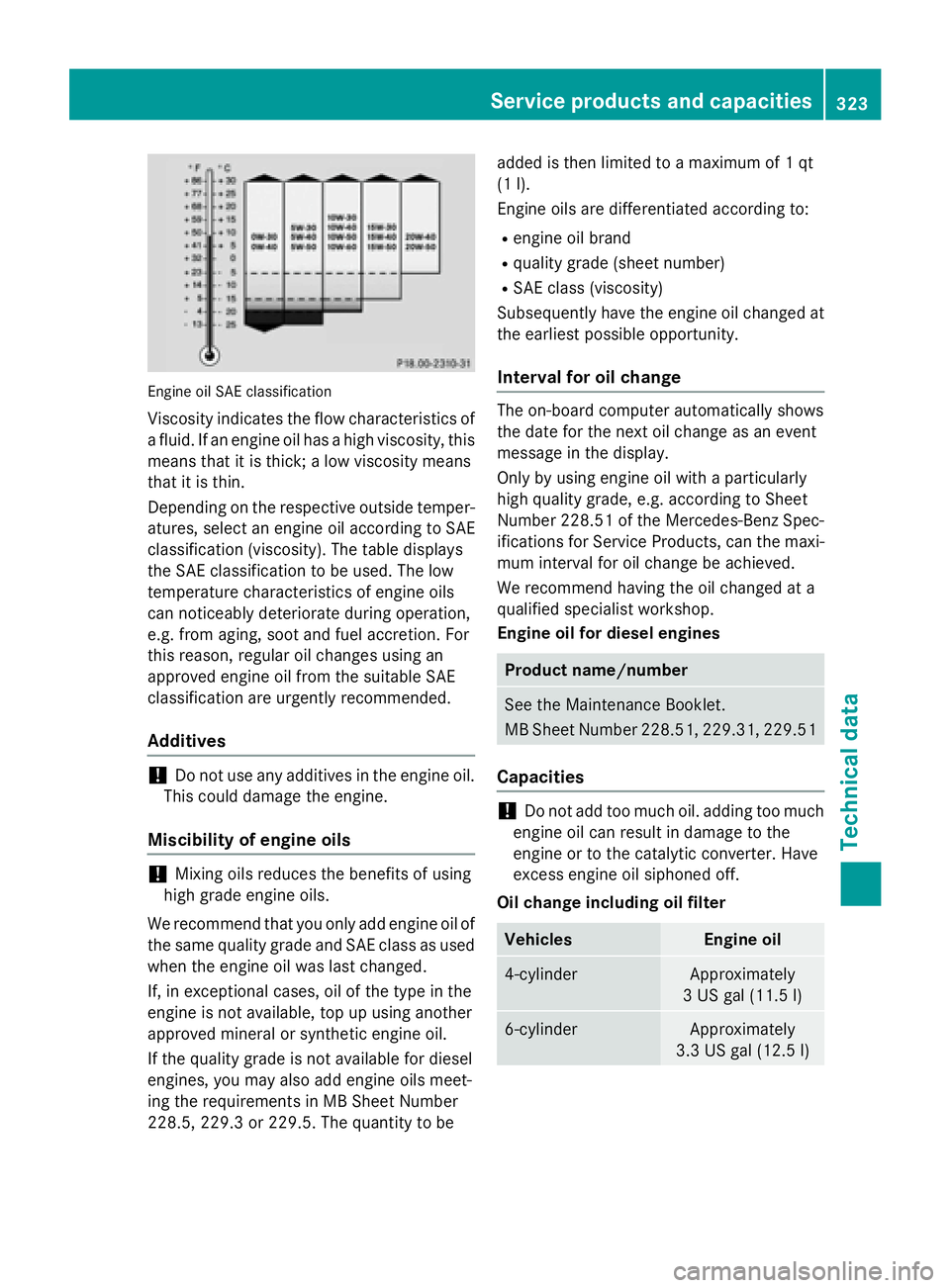
Engine oil SAE classification
Viscosity indicates the flow characteristics of a fluid. If an engine oil has a high viscosity, thismeans that it is thick; a low viscosity means
that it is thin.
Depending on the respective outside temper- atures, select an engine oil according to SAE
classification (viscosity). The table displays
the SAE classification to be used. The low
temperature characteristics of engine oils
can noticeably deteriorate during operation,
e.g. from aging, soot and fuel accretion. For
this reason, regular oil changes using an
approved engine oil from the suitable SAE
classification are urgently recommended.
Additives !
Do not use any additives in the engine oil.
This could damage the engine.
Miscibility of engine oils !
Mixing oils reduces the benefits of using
high grade engine oils.
We recommend that you only add engine oil of
the same quality grade and SAE class as used when the engine oil was last changed.
If, in exceptional cases, oil of the type in the
engine is not available, top up using another
approved mineral or synthetic engine oil.
If the quality grade is not available for diesel
engines, you may also add engine oils meet-
ing the requirements in MB Sheet Number
228.5, 229.3 or 229.5. The quantity to be added is then limited to a maximum of 1 qt
(1 l).
Engine oils are differentiated according to:
R engine oil brand
R quality grade (sheet number)
R SAE class (viscosity)
Subsequently have the engine oil changed at
the earliest possible opportunity.
Interval for oil change The on-board computer automatically shows
the date for the next oil change as an event
message in the display.
Only by using engine oil with a particularly
high quality grade, e.g. according to Sheet
Number 228.51 of the Mercedes-Benz Spec-
ifications for Service Products, can the maxi-
mum interval for oil change be achieved.
We recommend having the oil changed at a
qualified specialist workshop.
Engine oil for diesel engines Product name/number
See the Maintenance Booklet.
MB Sheet Number 228.51, 229.31, 229.51
Capacities
!
Do not add too much oil. adding too much
engine oil can result in damage to the
engine or to the catalytic converter. Have
excess engine oil siphoned off.
Oil change including oil filter Vehicles Engine oil
4-cylinder Approximately
3 US gal (11.5 l) 6-cylinder Approximately
3.3 US gal (12.5 l) Service products and capacities
323Technical data Z
Page 326 of 334
Information about oil consumption
!
If the vehicle is predominantly used for
short-distance driving, this could lead to a
malfunction in the automatic cleaning func- tion for the diesel particle filter. As a result,
fuel may accumulate in the engine oil and
cause engine failure.
Therefore, if you mainly drive short distan-
ces, you should drive on a highway or on
rural roads for 20 minutes every 310 miles
(500 km). This ensures sufficient regener-
ation of the diesel particle filter.
Depending on the driving style, the vehicle
consumes a maximum of 1.0 US qt (1.0 l) of
engine oil over a distance of 620 miles
(1000 km).
Oil consumption may be higher if:
R the vehicle is new.
R you mainly operate the vehicle under ardu-
ous operating conditions.
R you frequently drive at high engine speeds.
Regular maintenance is one of the precondi-
tions for moderate rates of consumption.
You can only estimate the oil consumption
after you have driven a considerable distance.
Check the engine oil level on a regular basis,
e.g. weekly or each time you refuel
(Y page 250). Transmission and power steering oil
Automatic transmission Service product: automatic transmission
fluid Product name/number Maintenance
interval Shell ATF 3403/M-115
MB Sheet No. 236.10 —
Fuchs/Shell ATF 3353
MB Sheet No. 236.12 Further information can be obtained at any
qualified specialist workshop.
Rear axle Service product: transmission oil
Product name/number Maintenance
interval BP Energear Hypo DC
80W-90
MB Sheet No. 235.20 —
Mobil Delvac Synthetic
Gear Oil 75W-90
MB Sheet No. 235.8 Further information can be obtained at any
qualified specialist workshop.
Steering Service product: power steering fluid
Product name/number Maintenance
interval Mobil ATF‑
D,
Exxon Mobil Corporation
or equivalent
MB Sheet No. 236.3 —
The steering is maintenance-free. Further
information can be obtained at any qualified
specialist workshop. Brake fluid
G
WARNING
Brake fluid is hazardous to health. Do not
swallow brake fluid. See a doctor immediately if you swallow brake fluid.
Make sure that brake fluid does not come into
contact with skin, clothing or eyes. Rinse
affected areas with plenty of clean water and
consult a doctor if necessary. 324
Service products and capacitiesTechnical data