tires MERCEDES-BENZ SPRINTER 2015 MY15 Operator’s Manual
[x] Cancel search | Manufacturer: MERCEDES-BENZ, Model Year: 2015, Model line: SPRINTER, Model: MERCEDES-BENZ SPRINTER 2015Pages: 334, PDF Size: 5.94 MB
Page 217 of 334
Display messages
Possible causes/consequences and
0050
0050Solutions Recognition by the radar sensor system can be impaired in the
case of:
R dirt on the sensors or anything else covering the sensors
R it is snowing or raining heavily
R there is interference from other radar sources
R there are strong radar reflections, for example in parking
garages
R a narrow vehicle traveling in front, e.g. a motorbike
R a vehicle traveling in front on a different line
X Clean the radar sensor system area. Intervention Intervention
Crosswind Assist Crosswind Assist The
0072 indicator lamp also flashes in the instrument cluster.
Crosswind Assist has intervened perceptibly. Tires
Display messages
Possible causes/consequences and
0050
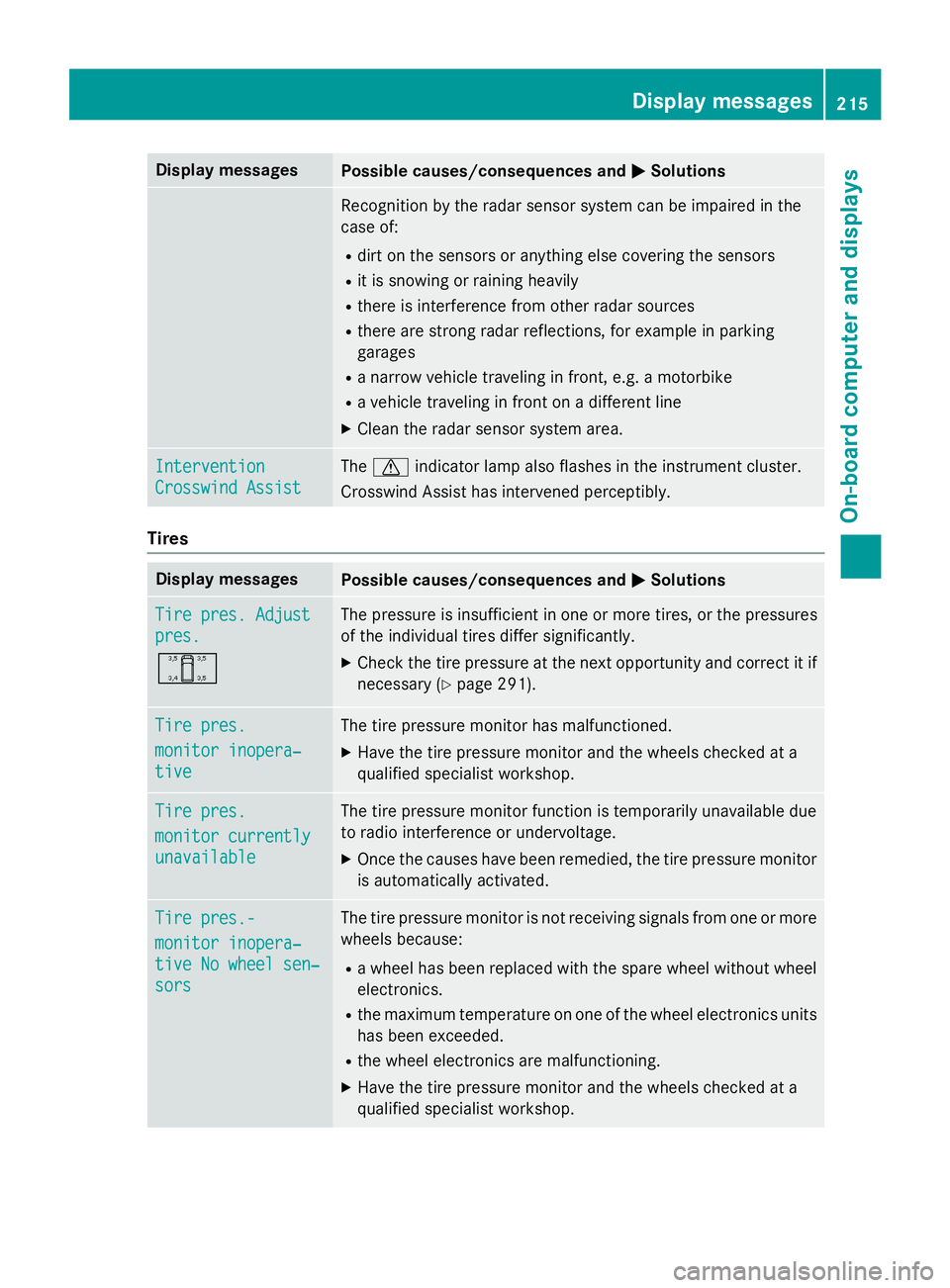
0050Solutions Tire pres. Adjust
Tire pres. Adjust
pres. pres.
0054 The pressure is insufficient in one or more tires, or the pressures
of the individual tires differ significantly.
X Check the tire pressure at the next opportunity and correct it if
necessary (Y page 291). Tire pres. Tire pres.
monitor inopera‐ monitor inopera‐
tive tive The tire pressure monitor has malfunctioned.
X Have the tire pressure monitor and the wheels checked at a
qualified specialist workshop. Tire pres.
Tire pres.
monitor currently monitor currently
unavailable unavailable The tire pressure monitor function is temporarily unavailable due
to radio interference or undervoltage.
X Once the causes have been remedied, the tire pressure monitor
is automatically activated. Tire pres.- Tire pres.-
monitor inopera‐ monitor inopera‐
tive No wheel sen‐ tive No wheel sen‐
sors sors The tire pressure monitor is not receiving signals from one or more
wheels because:
R a wheel has been replaced with the spare wheel without wheel
electronics.
R the maximum temperature on one of the wheel electronics units
has been exceeded.
R the wheel electronics are malfunctioning.
X Have the tire pressure monitor and the wheels checked at a
qualified specialist workshop. Display
messages
215On-board computer and displays Z
Page 218 of 334
Display messages
Possible causes/consequences and
0050
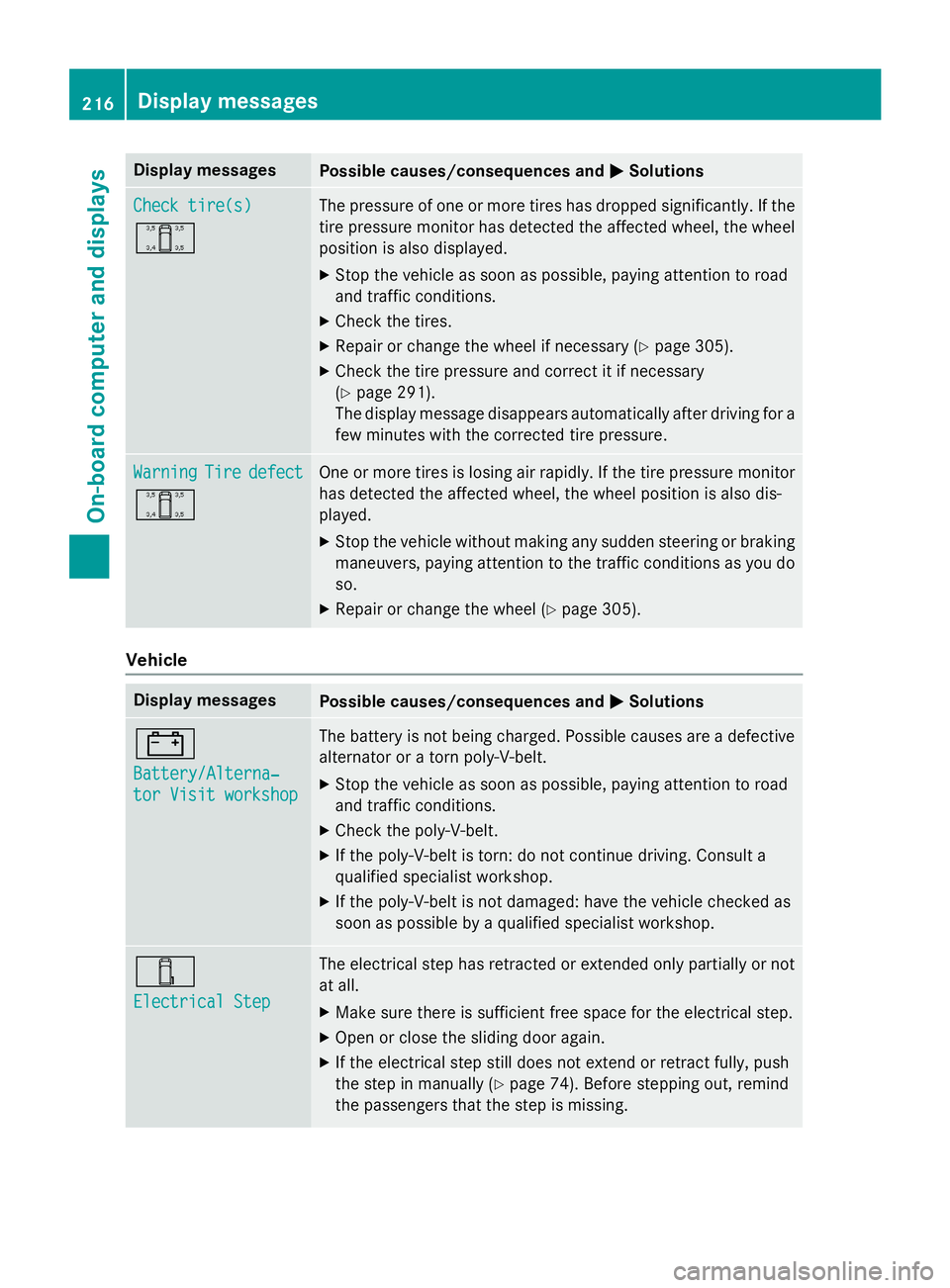
0050Solutions Check tire(s)
Check tire(s)
0054 The pressure of one or more tires has dropped significantly. If the
tire pressure monitor has detected the affected wheel, the wheel
position is also displayed.
X Stop the vehicle as soon as possible, paying attention to road
and traffic conditions.
X Check the tires.
X Repair or change the wheel if necessary (Y page 305).
X Check the tire pressure and correct it if necessary
(Y page 291).
The display message disappears automatically after driving for a
few minutes with the corrected tire pressure. Warning Warning
Tire
Tiredefect
defect
0054 One or more tires is losing air rapidly. If the tire pressure monitor
has detected the affected wheel, the wheel position is also dis-
played.
X Stop the vehicle without making any sudden steering or braking
maneuvers, paying attention to the traffic conditions as you do so.
X Repair or change the wheel (Y page 305).Vehicle
Display messages
Possible causes/consequences and
0050 0050Solutions 003D
Battery/Alterna‐ Battery/Alterna‐
tor Visit workshop tor Visit workshop The battery is not being charged. Possible causes are a defective
alternator or a torn poly-V-belt.
X Stop the vehicle as soon as possible, paying attention to road
and traffic conditions.
X Check the poly-V-belt.
X If the poly-V-belt is torn: do not continue driving. Consult a
qualified specialist workshop.
X If the poly-V-belt is not damaged: have the vehicle checked as
soon as possible by a qualified specialist workshop. 00E6
Electrical Step Electrical Step The electrical step has retracted or extended only partially or not
at all.
X Make sure there is sufficient free space for the electrical step.
X Open or close the sliding door again.
X If the electrical step still does not extend or retract fully, push
the step in manually (Y page 74). Before stepping out, remind
the passengers that the step is missing. 216
Display
messagesOn-board computer and displays
Page 228 of 334
Problem
Possible causes/consequences and
0050
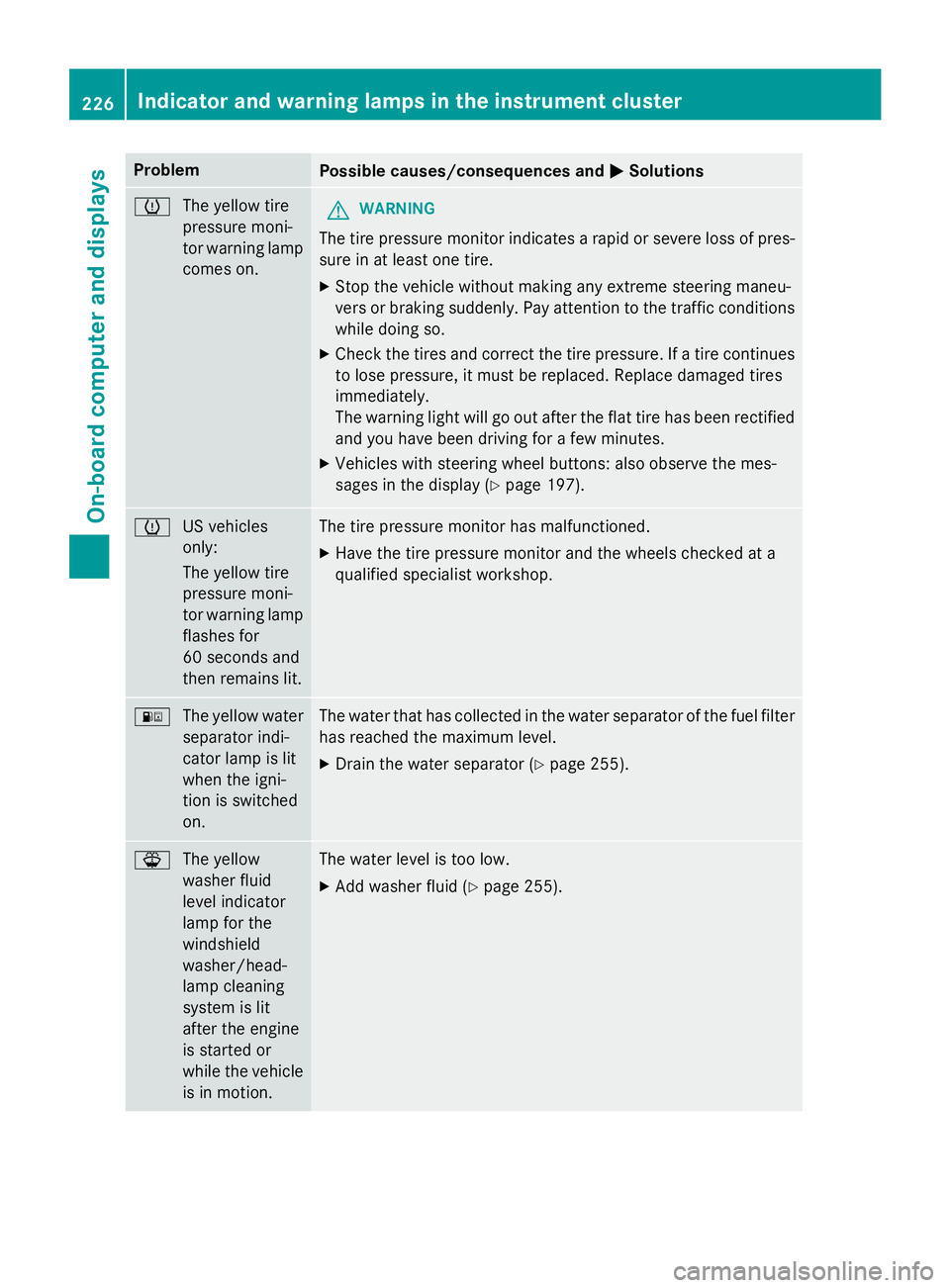
0050Solutions 0077
The yellow tire
pressure moni-
tor warning lamp
comes on. G
WARNING
The tire pressure monitor indicates a rapid or severe loss of pres- sure in at least one tire.
X Stop the vehicle without making any extreme steering maneu-
vers or braking suddenly. Pay attention to the traffic conditions
while doing so.
X Check the tires and correct the tire pressure. If a tire continues
to lose pressure, it must be replaced. Replace damaged tires
immediately.
The warning light will go out after the flat tire has been rectified
and you have been driving for a few minutes.
X Vehicles with steering wheel buttons: also observe the mes-
sages in the display (Y page 197).0077
US vehicles
only:
The yellow tire
pressure moni-
tor warning lamp
flashes for
60 seconds and
then remains lit. The tire pressure monitor has malfunctioned.
X Have the tire pressure monitor and the wheels checked at a
qualified specialist workshop. 00B8
The yellow water
separator indi-
cator lamp is lit
when the igni-
tion is switched
on. The water that has collected in the water separator of the fuel filter
has reached the maximum level.
X Drain the water separator (Y page 255).00B1
The yellow
washer fluid
level indicator
lamp for the
windshield
washer/head-
lamp cleaning
system is lit
after the engine
is started or
while the vehicle
is in motion. The water level is too low.
X
Add washer fluid (Y page 255).226
Indicator and warning lamps in the instrument clusterOn-board computer and displays
Page 242 of 334
Useful information
This Operator's Manual describes all models
as well as standard and optional equipment of your vehicle that were available at the time of going to print. Country-specific variations are
possible. Note that your vehicle may not be
equipped with all of the described functions.
This also applies to systems and functions
relevant to safety.
Read the information on qualified specialist
workshops (Y page 25). Loading guidelines
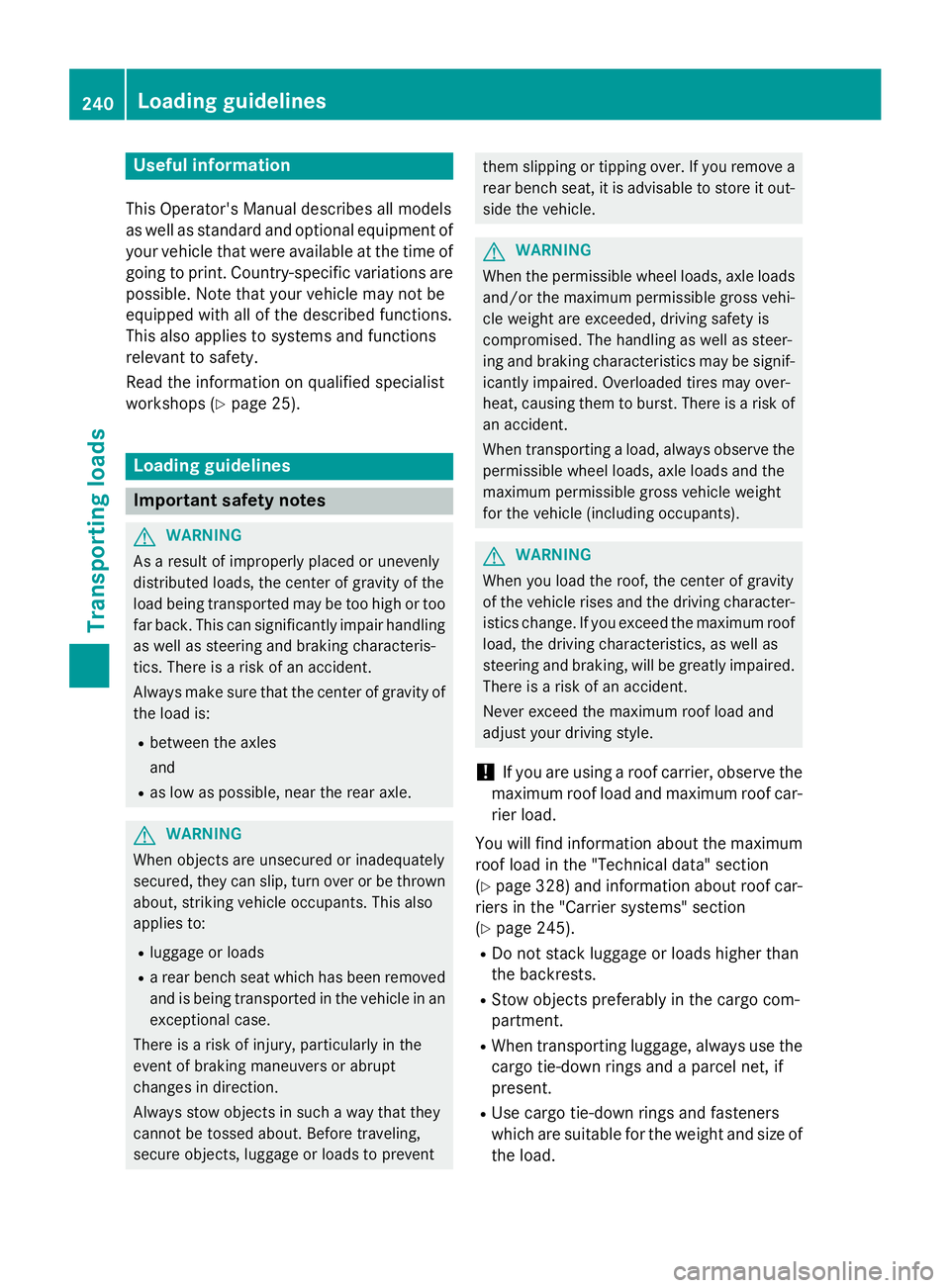
Important safety notes
G
WARNING
As a result of improperly placed or unevenly
distributed loads, the center of gravity of the
load being transported may be too high or too far back. This can significantly impair handlingas well as steering and braking characteris-
tics. There is a risk of an accident.
Always make sure that the center of gravity of
the load is:
R between the axles
and
R as low as possible, near the rear axle. G
WARNING
When objects are unsecured or inadequately
secured, they can slip, turn over or be thrown about, striking vehicle occupants. This also
applies to:
R luggage or loads
R a rear bench seat which has been removed
and is being transported in the vehicle in an
exceptional case.
There is a risk of injury, particularly in the
event of braking maneuvers or abrupt
changes in direction.
Always stow objects in such a way that they
cannot be tossed about. Before traveling,
secure objects, luggage or loads to prevent them slipping or tipping over. If you remove a
rear bench seat, it is advisable to store it out- side the vehicle. G
WARNING
When the permissible wheel loads, axle loads and/or the maximum permissible gross vehi-
cle weight are exceeded, driving safety is
compromised. The handling as well as steer-
ing and braking characteristics may be signif- icantly impaired. Overloaded tires may over-
heat, causing them to burst. There is a risk ofan accident.
When transporting a load, always observe the
permissible wheel loads, axle loads and the
maximum permissible gross vehicle weight
for the vehicle (including occupants). G
WARNING
When you load the roof, the center of gravity
of the vehicle rises and the driving character- istics change. If you exceed the maximum roof
load, the driving characteristics, as well as
steering and braking, will be greatly impaired.There is a risk of an accident.
Never exceed the maximum roof load and
adjust your driving style.
! If you are using a roof carrier, observe the
maximum roof load and maximum roof car-
rier load.
You will find information about the maximum roof load in the "Technical data" section
(Y page 328) and information about roof car-
riers in the "Carrier systems" section
(Y page 245).
R Do not stack luggage or loads higher than
the backrests.
R Stow objects preferably in the cargo com-
partment.
R When transporting luggage, always use the
cargo tie-down rings and a parcel net, if
present.
R Use cargo tie-down rings and fasteners
which are suitable for the weight and size of the load. 240
Loading guidelinesTransporting loads
Page 268 of 334
The vehicle could otherwise be damaged.
You can wash the vehicle in an automatic car
wash from the very start.
Wash off excess dirt before cleaning the vehi- cle in an automatic car wash.
After putting the vehicle through an auto-
matic car wash, wipe off wax from:
R the rear view camera lens (Y page 269)
R the windshield
R the windshield wiper blades
This will prevent smears and reduce wiping noises caused by residue on the wind-
shield.
Washing by hand In some countries, washing by hand is only
allowed at specially equipped washing bays.
Observe the legal requirements of the coun-
try you are currently in when washing by
hand.
X Do not use hot water and do not wash the
vehicle in direct sunlight.
X Use a soft car sponge.
X Use a mild cleaning agent, e.g. a car sham-
poo approved for use with Sprinter vehi-
cles.
X Thoroughly hose down the vehicle with a
gentle jet of water.
X Do not point the water jet directly towards
the air inlets.
X Use plenty of water and rinse out the
sponge frequently.
X Rinse the vehicle with clean water and dry
thoroughly with a chamois.
X Do not let the cleaning agents dry on the
paintwork.
When using the vehicle in winter, remove all
traces of road salt deposits carefully and as
soon as possible. Power washers G
WARNING
The water jet from a circular jet nozzle (dirt
blasters) can cause invisible exterior damage to the tires or chassis components. Compo-
nents damaged in this way may fail unexpect-edly. There is a risk of an accident.
Do not use power washers with circular jet
nozzles to clean the vehicle. Have damaged
tires or chassis components replaced imme-
diately.
! Under no circumstances use power wash-
ers in the vehicle interior. The pressurized
water and associated spray produced by
the power washer could cause extensive
damage to the vehicle.
! Observe the minimum distance to be
maintained between the nozzle of the
power washer and object to be cleaned, as
outlined below:
R approximately 2.2 ft(70 cm) when using
round-jet nozzles
R approximately 1 ft (30 cm) when using
25°flat-spray jets and dirt blasters
Keep the water jet moving while cleaning.
To avoid causing damage, do not point the
water jet directly at:
R door joints
R brake hoses
R electrical components
R electrical connections
R seals
R drive train, especially not at the inter-
mediate bearing of the propeller shaft
R rear view camera (camera lens and
microphone opening on the bottom)
Keep a minimum distance of
1.6 ft(50 cm).
Cleaning the engine !
Water must not enter intake or ventilation
openings. When cleaning with high pres- 266
CareMaintenance and care
Page 270 of 334
brake pads/linings. For this reason, you
should drive for a few minutes after clean-
ing. Braking heats the brake discs and the
brake pads/linings, thus drying them. The
vehicle can then be parked.
If you clean the wheels with a power washer,
observe the safety notes for the power
washer (Y page 266). You could otherwise
damage the tires.
Cleaning the wiper blades G
WARNING
You could become trapped by the windshield wipers if they start moving while cleaning the
windshield or wiper blades. There is a risk of
injury.
Always switch off the windshield wipers and
the ignition before cleaning the windshield or
wiper blades.
! Do not fold the windshield wipers away
from the windshield unless the hood is
closed. Otherwise, you could damage the
hood.
! Do not pull the wiper blade. Otherwise,
the wiper blade could be damaged.
! Do not clean wiper blades too often and
do not rub them too hard. Otherwise, the
graphite coating could be damaged. This
could cause wiper noise.
! Hold the wiper arm securely when folding
back. The windshield could be damaged if
the wiper arm smacks against it suddenly.
X Turn the key to position 0in the ignition
lock or remove it.
X Fold the windshield wiper arms away from
the windshield until you feel them engage.
X Carefully clean the wiper blades with a
damp cloth.
X Fold back the wiper arms before switching
on the ignition. Cleaning the exterior lighting !
Only use cleaning agents or cleaning
cloths which are suitable for plastic light
lenses. Unsuitable cleaning agents or
cleaning cloths could scratch or damage
the plastic light lenses.
X Clean the plastic covers of the exterior
lighting with a damp sponge and a mild
cleaning agent, e.g. car shampoo for
Sprinter vehicles, or with cleaning cloths.
Cleaning the mirror turn signal !
Only use cleaning agents or cleaning
cloths that are suitable for plastic lenses.
Unsuitable cleaning agents or cleaning
cloths could scratch or damage the plastic lenses of the mirror turn signals.
X Clean the plastic lenses of the mirror turn
signals in the exterior mirror housing using
a wet sponge and mild cleaning agent, e.g.
car shampoo or cleaning cloths.
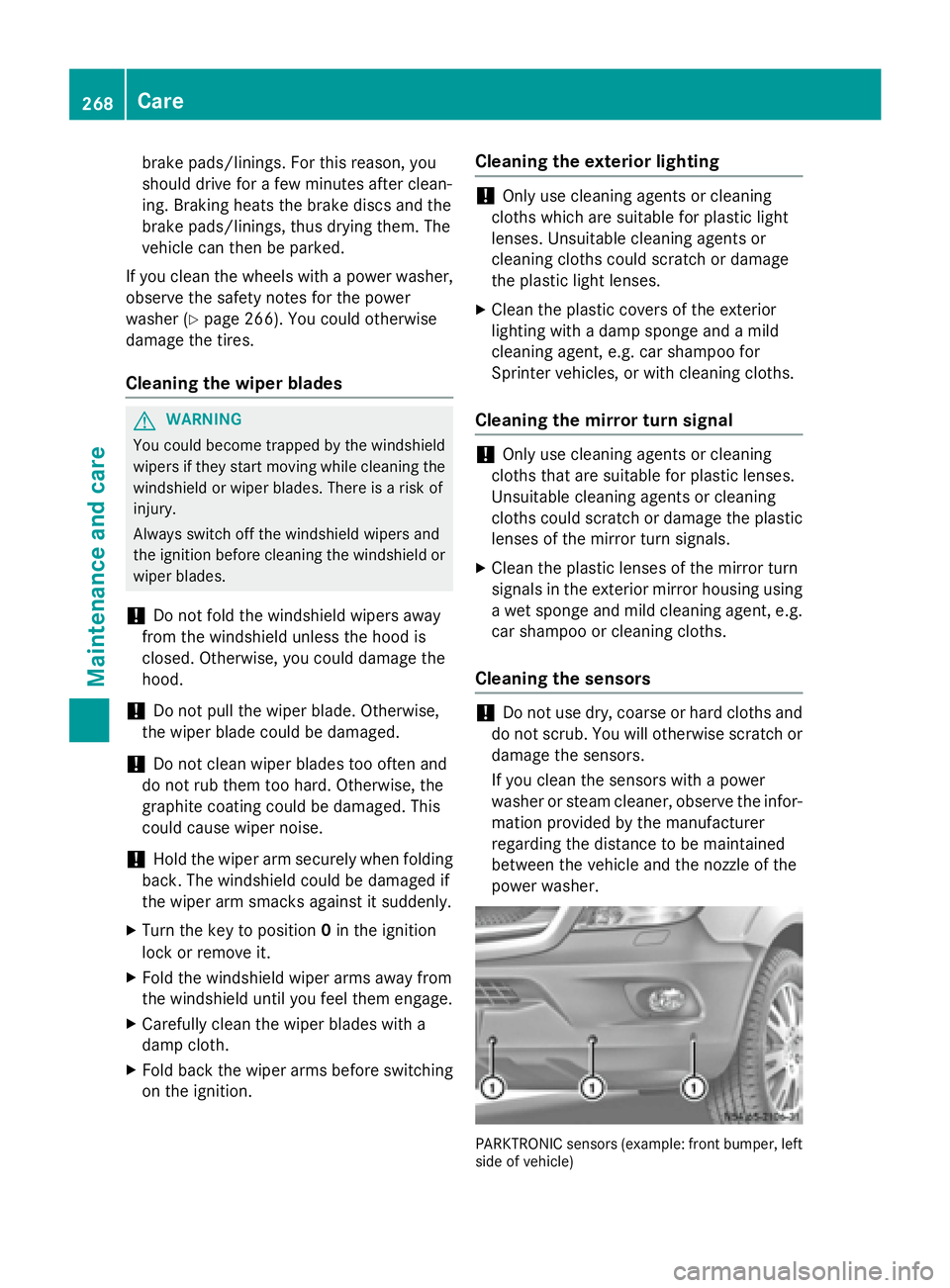
Cleaning the sensors !
Do not use dry, coarse or hard cloths and
do not scrub. You will otherwise scratch or
damage the sensors.
If you clean the sensors with a power
washer or steam cleaner, observe the infor- mation provided by the manufacturer
regarding the distance to be maintained
between the vehicle and the nozzle of the
power washer. PARKTRONIC sensors (example: front bumper, left
side of vehicle) 268
CareMaintenance and care
Page 278 of 334
X
Take first-aid kit 0087out of the retainer.
X Fold the cover up and turn the quick-
release fasteners to position 0047.
The cover is locked.
i Check the expiration date on the first-aid
kit at least once a year. Replace any expired or missing contents. Fire extinguisher
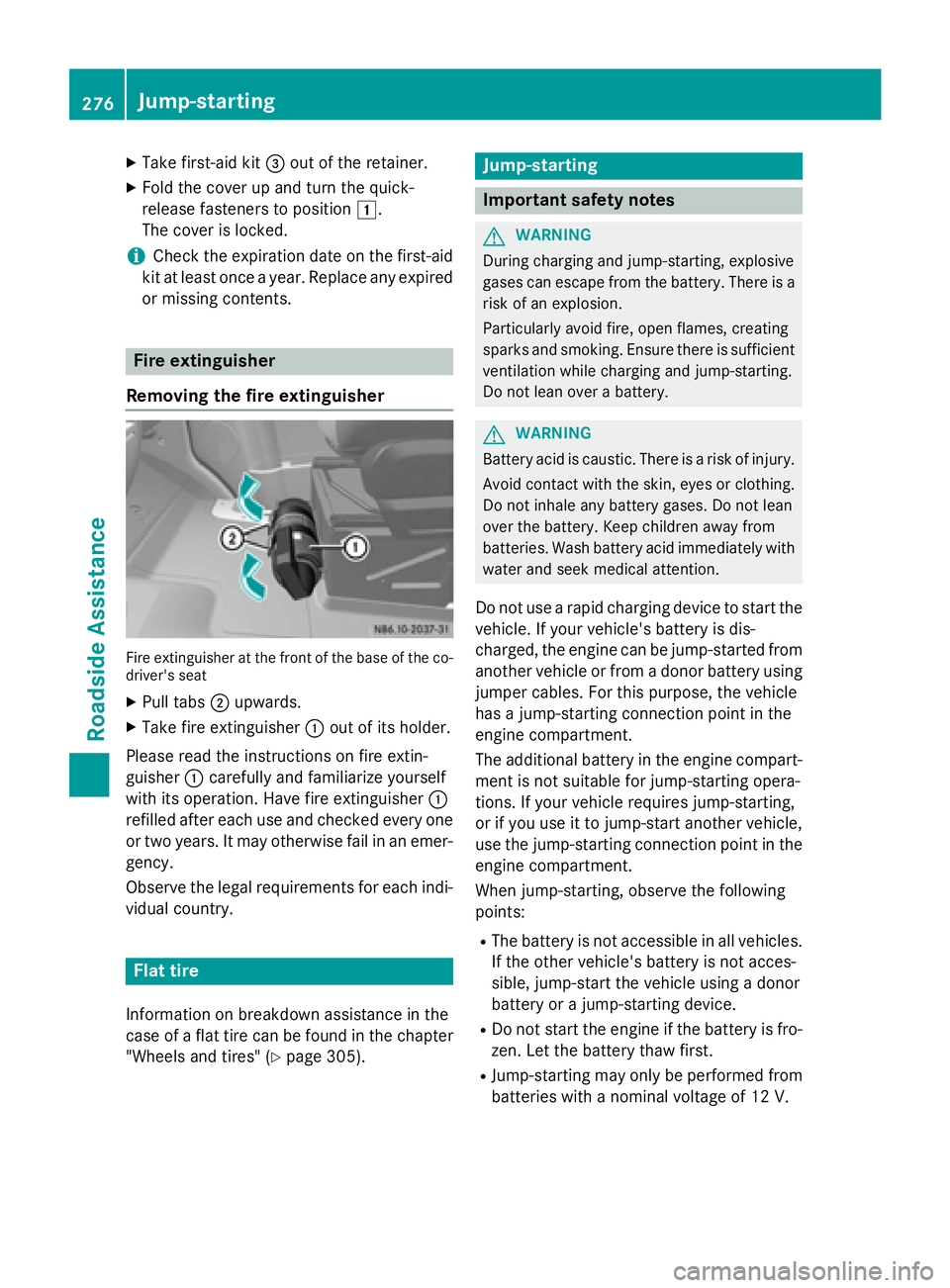
Removing the fire extinguisher Fire extinguisher at the front of the base of the co-
driver's seat
X Pull tabs 0044upwards.
X Take fire extinguisher 0043out of its holder.
Please read the instructions on fire extin-
guisher 0043carefully and familiarize yourself
with its operation. Have fire extinguisher 0043
refilled after each use and checked every one or two years. It may otherwise fail in an emer-
gency.
Observe the legal requirements for each indi- vidual country. Flat tire
Information on breakdown assistance in the
case of a flat tire can be found in the chapter "Wheels and tires" (Y page 305). Jump-starting
Important safety notes
G
WARNING
During charging and jump-starting, explosive
gases can escape from the battery. There is a risk of an explosion.
Particularly avoid fire, open flames, creating
sparks and smoking. Ensure there is sufficient
ventilation while charging and jump-starting.
Do not lean over a battery. G
WARNING
Battery acid is caustic. There is a risk of injury. Avoid contact with the skin, eyes or clothing.
Do not inhale any battery gases. Do not lean
over the battery. Keep children away from
batteries. Wash battery acid immediately with water and seek medical attention.
Do not use a rapid charging device to start the
vehicle. If your vehicle's battery is dis-
charged, the engine can be jump-started from another vehicle or from a donor battery using
jumper cables. For this purpose, the vehicle
has a jump-starting connection point in the
engine compartment.
The additional battery in the engine compart- ment is not suitable for jump-starting opera-
tions. If your vehicle requires jump-starting,
or if you use it to jump-start another vehicle,
use the jump-starting connection point in the
engine compartment.
When jump-starting, observe the following
points:
R The battery is not accessible in all vehicles.
If the other vehicle's battery is not acces-
sible, jump-start the vehicle using a donor
battery or a jump-starting device.
R Do not start the engine if the battery is fro-
zen. Let the battery thaw first.
R Jump-starting may only be performed from
batteries with a nominal voltage of 12 V. 276
Jump-startingRoadside Assistance
Page 285 of 334
Useful information
............................284
Important safety notes .....................284
Operation ........................................... 284
Operation in winter ...........................286
Tire pressure ..................................... 288
Loading the vehicle ..........................295
What you should know about
wheels and tires ................................ 299
Flat tire .............................................. 305
Changing wheels ............................... 305
Wheel and tire combination .............311
Spare wheel ....................................... 312 283Wheels and tires
Page 286 of 334
Useful information
This Operator's Manual describes all models
as well as standard and optional equipment of your vehicle that were available at the time of going to print. Country-specific variations are
possible. Note that your vehicle may not be
equipped with all of the described functions.
This also applies to systems and functions
relevant to safety.
Read the information on qualified specialist
workshops (Y page 25). Important safety notes
G
Warning
A flat tire severely impairs the driving, steer-
ing and braking characteristics of the vehicle.
There is a risk of an accident.
do not drive with a flat tire. Immediately
replace the flat tire with your spare wheel, or
consult a qualified specialist workshop. G
WARNING
If wheels and tires of the wrong size are used, the wheel brakes or suspension components
may be damaged. There is a risk of an acci-
dent.
Always replace wheels and tires with those
that fulfill the specifications of the original
part.
When replacing wheels, make sure to use the
correct:
R designation
R model
When replacing tires, make sure to use the
correct:
R designation
R manufacturer
R model
Accessories that are not approved for your
vehicle by Mercedes-Benz or are not being
used correctly can impair operating safety. Before purchasing and using non-approved
accessories, visit a qualified specialist work-
shop and inquire about:
R suitability
R legal stipulations
R factory recommendations
Contact an authorized Sprinter dealer if you
require information on tested and recommen- ded wheels and tires for summer and winter
driving. Advice on purchasing and caring for
tires is also available there.
Information on tire and wheel dimensions and
types as well as the recommended tire pres-
sure for your vehicle can be found in the "Tire pressure" section (Y page 294).
This data can also be found on the Tire and
Loading Information placard on the B-pillar.
Modifications to the brake system or wheels
are not permitted. The use of wheel spacers
or brake dust shields is not permitted. This
invalidates the general operating permit for
the vehicle.
i Further information on wheels and tires
can be obtained at any qualified specialist
workshop. Operation
Information for a journey
If the vehicle is heavily laden, check the tire
pressures, and correct them, if necessary
(Y page 288).
While driving, pay attention to vibrations,
noises and unusual handling characteristics,
e.g. pulling to one side. This may indicate that
the wheels or tires are damaged. If you sus-
pect that a tire is defective, reduce your
speed immediately. Stop the vehicle as soon
as possible to check the wheels and tires for
damage. Hidden tire damage could also be
causing the unusual handling characteristics. If you find no signs of damage, have the tires
and wheels checked at a qualified specialist
workshop. 284
OperationWheels and tires
Page 287 of 334
When parking your vehicle, make sure that
the tires do not get deformed by the curb or
other obstacles. If it is necessary to drive over
curbs, speed humps or similar elevations, try to do so slowly and not at a sharp angle. Oth- erwise, the tires, particularly the sidewalls,
can get damaged. Regular wheel and tire checks
G
WARNING
Damaged tires can cause tire inflation pres-
sure loss. As a result, you could lose control of your vehicle. There is a risk of accident.
Check the tires regularly for signs of damage
and replace any damaged tires immediately.
Check the wheels and tires of your vehicle for damage regularly, i.e. at least every two
weeks, as well as after driving off-road or on
rough roads. Damaged wheels can cause a
loss of tire pressure. Pay particular attention
to damage such as:
R cuts in the tires
R punctures
R tears in the tires
R bulges on tires
R deformation or severe corrosion on wheels
Regularly check the tire tread depth and the
condition of the tread across the whole width of the tire (Y page 285). If necessary, turn the
front wheels to full lock in order to inspect the
inner side of the tire surface.
All wheels must have a valve cap to protect
the valve against dirt and moisture. Do not
install anything onto the valve other than the
standard valve cap or other valve caps
approved for your vehicle by dealers listed on
the inside of the front cover. Do not install any
other valve caps or systems, e.g. tire pressure
monitor systems.
Regularly check the pressure of all the tires,
particularly prior to long trips. Adjust the tire pressure if necessary (Y page 288).The service life of tires depends on various
factors, including the following:
R driving style
R tire pressure
R mileage Tire tread
G
WARNING
Insufficient tire tread will reduce tire traction.
The tire is no longer able to dissipate water.
This means that on wet road surfaces, the risk of hydroplaning increases, in particular where speed is not adapted to suit the driving con-
ditions. There is a risk of accident.
If the tire pressure is too high or too low, tires
may exhibit different levels of wear at differ-
ent locations on the tire tread. Thus, you
should regularly check the tread depth and
the condition of the tread across the entire
width of all tires.
Minimum tire tread depth for:
R Summer tires: 00CEin (3 mm)
R M+S tires: 00CFin (4 mm)
For safety reasons, replace the tires before
the legally prescribed limit for the minimum
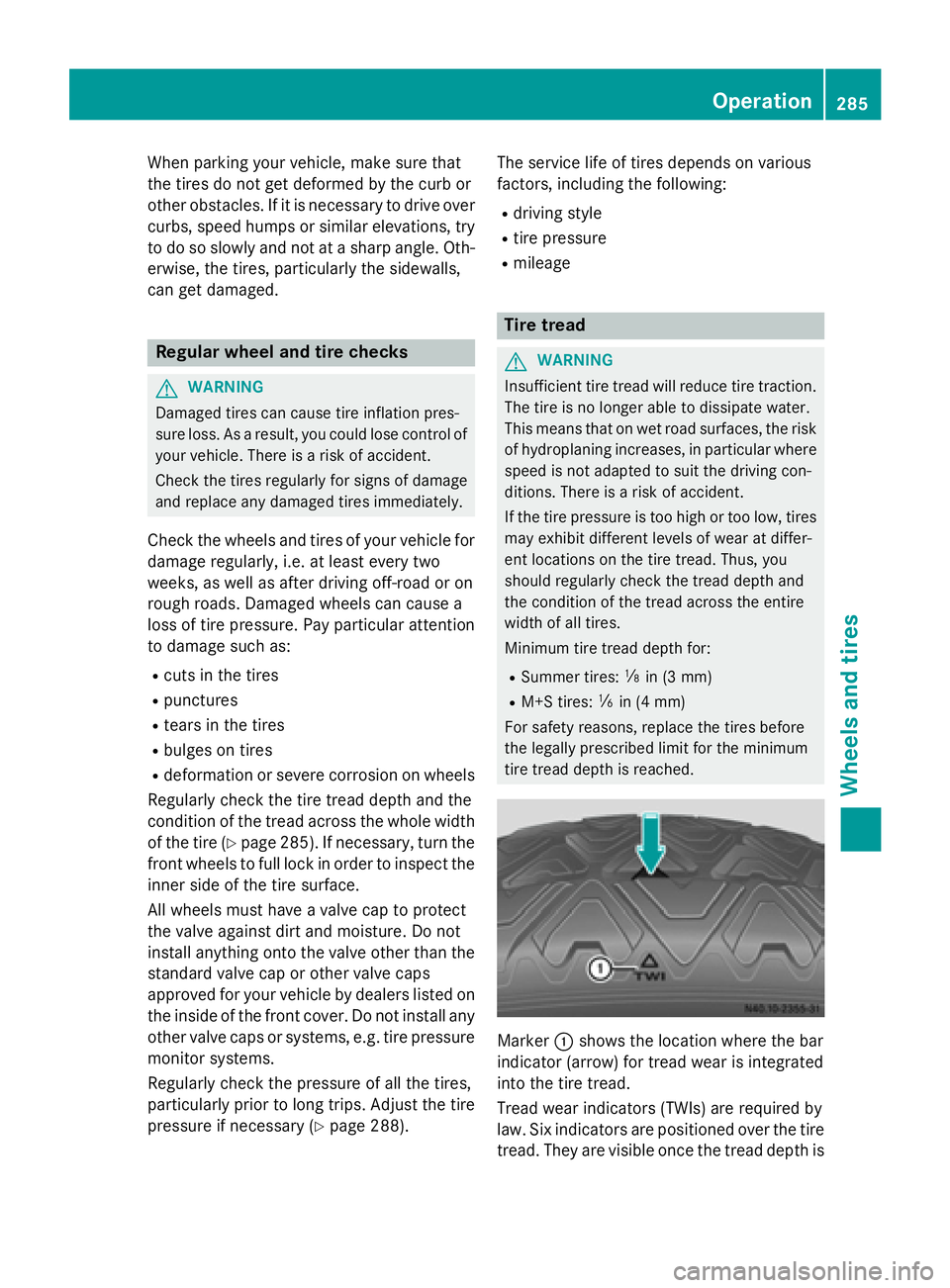
tire tread depth is reached. Marker
0043shows the location where the bar
indicator (arrow) for tread wear is integrated
into the tire tread.
Tread wear indicators (TWIs) are required by
law. Six indicators are positioned over the tire
tread. They are visible once the tread depth is Operation
285Wheels and tires Z