tires MERCEDES-BENZ SPRINTER 2015 MY15 Operator’s Manual
[x] Cancel search | Manufacturer: MERCEDES-BENZ, Model Year: 2015, Model line: SPRINTER, Model: MERCEDES-BENZ SPRINTER 2015Pages: 334, PDF Size: 5.94 MB
Page 308 of 334
Single tires:
if the tires are of identical
dimensions, you can rotate both wheels on
both the front and rear axles so that the tires'
original direction of rotation is maintained. On unidirectional tires, an arrow on the sidewall
shows the prescribed direction of rotation of
the tire.
Twin rear tires: if the tires are of identical
dimensions, you can rotate the wheels on the
front axle and the inner wheels on the rear
axle in pairs such that the original direction of
tire rotation is retained. With unidirectional
tires, you may rotate the outside wheels at
the rear axle from one side to the other. Direction of rotation
Tires with a specified direction of rotation
have additional benefits, e.g. if there is a risk
of hydroplaning. You will only gain these ben-
efits if the correct direction of rotation is
observed.
An arrow on the sidewall of the tire indicates its correct direction of rotation.
You may mount a spare wheel against the
direction of rotation. Observe the time
restriction on use as well as the speed limi-
tation specified on the spare wheel. Storing wheels
Store wheels that are not being used in a cool, dry and preferably dark place. Protect the
tires from contact with oil, grease and fuel. Mounting a wheel
Vehicle preparation X
Stop the vehicle as far away as possible
from traffic and on a level, firm and non-slip
surface.
X If your vehicle poses a risk to approaching
traffic, switch on the hazard warning lamps.
X Apply the parking brake. X
Turn the front wheels to the straight-ahead
position.
X Move the selector lever of the automatic
transmission to position P.
X Switch off the engine.
X Passengers should leave the vehicle. Make
sure that the passengers are not endan-
gered as they do so.
X Make sure that no one is near the danger
area while the wheel is being changed. Any-
one who is not directly assisting in the
wheel change should, for example, stand
behind the barrier.
X Place the warning triangle or warning lamp
at a suitable distance.
Observe legal requirements.
X Secure the vehicle to prevent it from rolling
away.
i Observe the safety notes on parking in the
section on "Driving and parking"
(Y page 149).
X On level terrain: place chocks or other
suitable objects under the front and rear of the wheel that is diagonally opposite the
wheel to be changed.
X On slight inclines: place chocks or other
suitable objects under the wheels on the
front and rear axles opposite the wheel to
be changed.
X Take the vehicle tool kit and the jack from
the footwell on the co-driver's side
(Y page 274).
X Remove the spare wheel from the spare
wheel bracket (Y page 313). Observe the
safety notes in the "Spare wheel" section
(Y page 312).
X On wheels with wheel bolts, remove the
hub caps. 306
Changing wheelsWheels and tires
Page 309 of 334
X
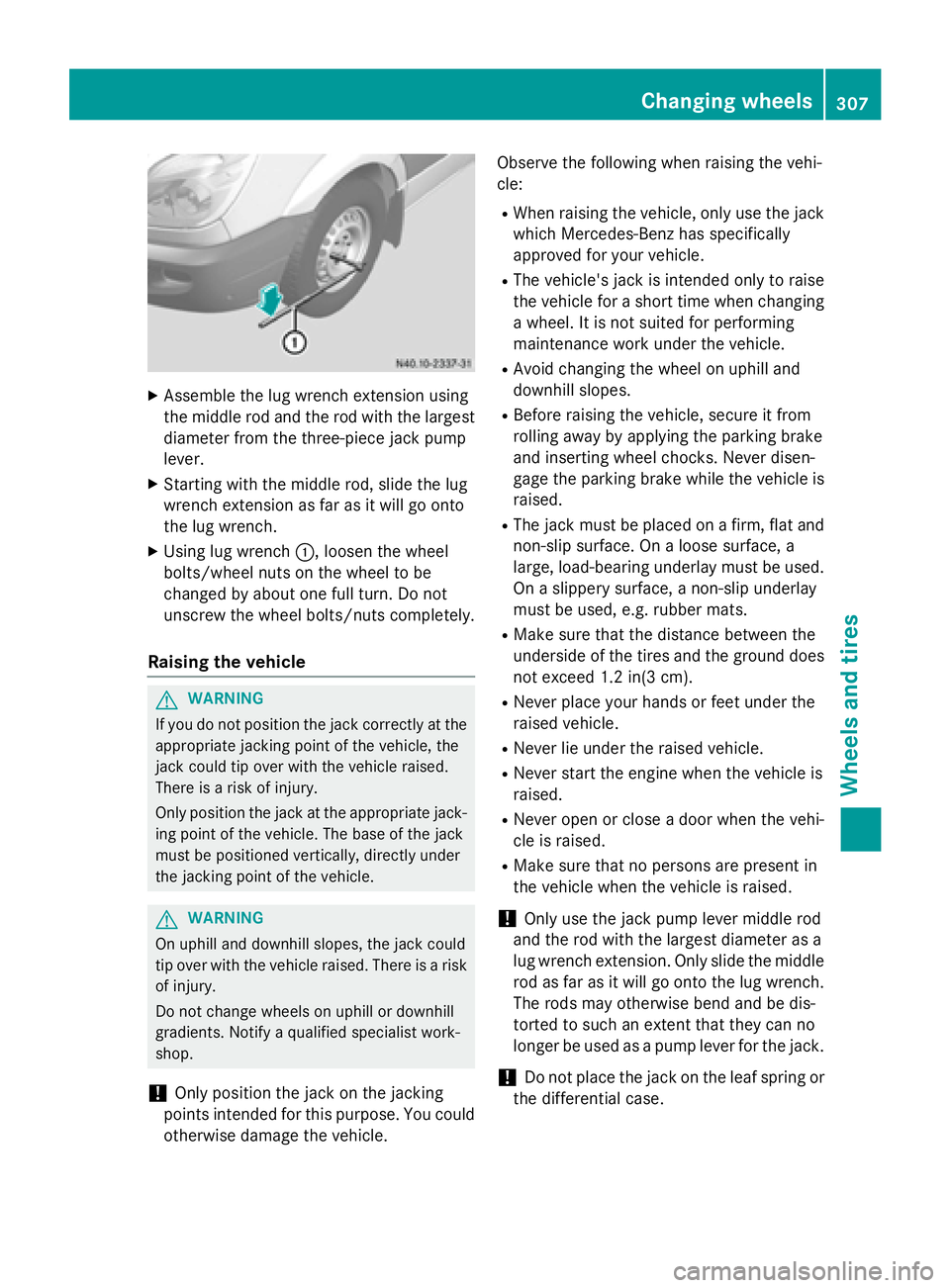
Assemble the lug wrench extension using
the middle rod and the rod with the largest diameter from the three-piece jack pump
lever.
X Starting with the middle rod, slide the lug
wrench extension as far as it will go onto
the lug wrench.
X Using lug wrench 0043, loosen the wheel
bolts/wheel nuts on the wheel to be
changed by about one full turn. Do not
unscrew the wheel bolts/nuts completely.
Raising the vehicle G
WARNING
If you do not position the jack correctly at the appropriate jacking point of the vehicle, the
jack could tip over with the vehicle raised.
There is a risk of injury.
Only position the jack at the appropriate jack-
ing point of the vehicle. The base of the jack
must be positioned vertically, directly under
the jacking point of the vehicle. G
WARNING
On uphill and downhill slopes, the jack could
tip over with the vehicle raised. There is a risk of injury.
Do not change wheels on uphill or downhill
gradients. Notify a qualified specialist work-
shop.
! Only position the jack on the jacking
points intended for this purpose. You could
otherwise damage the vehicle. Observe the following when raising the vehi-
cle:
R When raising the vehicle, only use the jack
which Mercedes-Benz has specifically
approved for your vehicle.
R The vehicle's jack is intended only to raise
the vehicle for a short time when changing
a wheel. It is not suited for performing
maintenance work under the vehicle.
R Avoid changing the wheel on uphill and
downhill slopes.
R Before raising the vehicle, secure it from
rolling away by applying the parking brake
and inserting wheel chocks. Never disen-
gage the parking brake while the vehicle is
raised.
R The jack must be placed on a firm, flat and
non-slip surface. On a loose surface, a
large, load-bearing underlay must be used. On a slippery surface, a non-slip underlay
must be used, e.g. rubber mats.
R Make sure that the distance between the
underside of the tires and the ground does
not exceed 1.2 in(3 cm).
R Never place your hands or feet under the
raised vehicle.
R Never lie under the raised vehicle.
R Never start the engine when the vehicle is
raised.
R Never open or close a door when the vehi-
cle is raised.
R Make sure that no persons are present in
the vehicle when the vehicle is raised.
! Only use the jack pump lever middle rod
and the rod with the largest diameter as a
lug wrench extension. Only slide the middle rod as far as it will go onto the lug wrench. The rods may otherwise bend and be dis-
torted to such an extent that they can no
longer be used as a pump lever for the jack.
! Do not place the jack on the leaf spring or
the differential case. Changing wheels
307Wheels and tires Z
Page 310 of 334
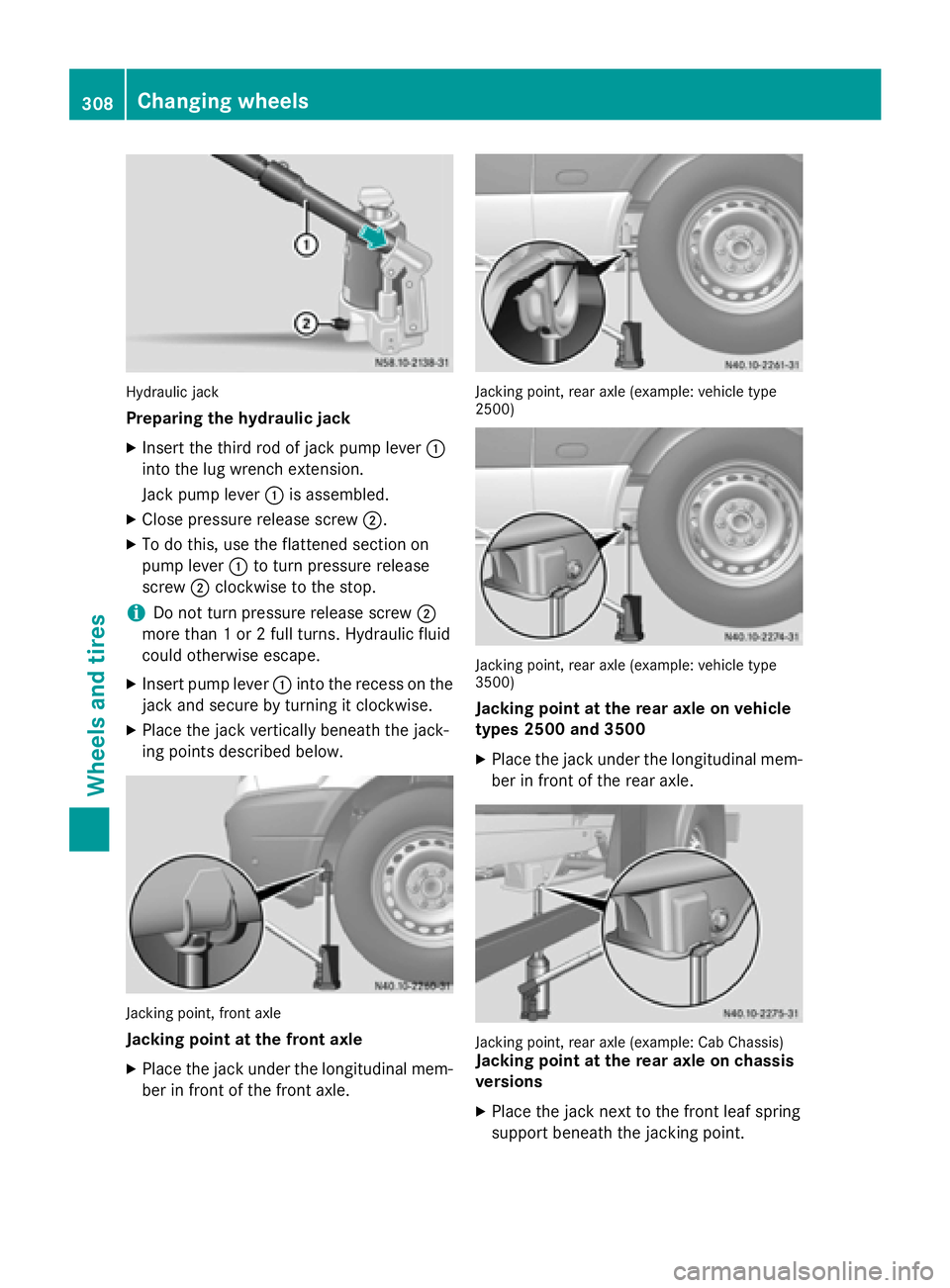
Hydraulic jack
Preparing the hydraulic jack
X Insert the third rod of jack pump lever 0043
into the lug wrench extension.
Jack pump lever 0043is assembled.
X Close pressure release screw 0044.
X To do this, use the flattened section on
pump lever 0043to turn pressure release
screw 0044clockwise to the stop.
i Do not turn pressure release screw
0044
more than 1 or 2 full turns. Hydraulic fluid
could otherwise escape.
X Insert pump lever 0043into the recess on the
jack and secure by turning it clockwise.
X Place the jack vertically beneath the jack-
ing points described below. Jacking point, front axle
Jacking point at the front axle
X Place the jack under the longitudinal mem-
ber in front of the front axle. Jacking point, rear axle (example: vehicle type
2500) Jacking point, rear axle (example: vehicle type
3500)
Jacking point at the rear axle on vehicle
types 2500 and 3500
X Place the jack under the longitudinal mem-
ber in front of the rear axle. Jacking point, rear axle (example: Cab Chassis)
Jacking point at the rear axle on chassis
versions
X Place the jack next to the front leaf spring
support beneath the jacking point. 308
Changing wheelsWheels and tires
Page 311 of 334
Removing a wheel
!
Do not place the wheel bolts or the wheel
nuts in sand or dirt. The threads of the
wheel bolts and wheel nuts could otherwise
be damaged when being tightened.
X Unscrew the wheel bolts or nuts.
X On front wheels with wheel nuts, remove
the wheel nut cover.
X Remove the wheel.
Installing the adapter G
WARNING
If you tighten the adapter bolts when the vehi- cle is raised, the jack could tip over. There is a risk of injury.
Make sure that the vehicle is properly pre-
pared for a wheel change. Tighten the adapter
bolts with particular care and attention.
Always observe the instructions and safety
notes on "Changing a wheel" (Y page 305).G
WARNING
If you do not tighten the bolts of the adapter to the specified tightening torque, the adapter
may come loose with the spare wheel. There
is a risk of an accident.
Tighten the bolts of the adapter to the speci-
fied tightening torque. Have the spare wheel
replaced with a complete wheel and an extra- wide tire at a qualified specialist workshop
immediately.
! Vehicles with Super Single tires:
if you
install the spare wheel, do not exceed the
maximum speed of 40 mph (60 km/h) and
do not drive further than 65 miles(100 km).
The transmission could otherwise be dam-
aged by the difference in wheel rotation
speeds.
On vehicles with Super Single tires, you must
attach the narrow spare wheel to the rear axle by means of an adapter. The adapter is bolted
to the spare wheel using the adapter bolts for transportation. The handling characteristics of your vehicle
are affected when driving with a spare wheel
installed. After changing a wheel, drive to the
nearest specialist workshop and have the
spare wheel replaced with a wheel and tire
assembly that has a Super Single tire.
X Clean the wheel and wheel hub contact
surfaces.
X Unscrew the six adapter bolts on the spare
wheel and remove the adapter.
X Tighten the adapter with the six adapter
bolts evenly in a crosswise pattern through
the outer holes on the wheel hub.
X Tighten the six adapter bolts on the wheel
hub to a tightening torque of 177 lb-ft
(240 Nm).
X Push the wheel onto the adapter and attach
it.
Mounting a new wheel G
WARNING
Oiled or greased wheel bolts or damaged
wheel bolts/hub threads can cause the wheel bolts to come loose. As a result, you could
lose a wheel while driving. There is a risk of
accident.
Never oil or grease wheel bolts. In the event of damage to the threads, contact a qualified
specialist workshop immediately. Have the
damaged wheel bolts or hub threads
replaced/renewed. Do not continue driving. G
WARNING
If you tighten the wheel bolts or wheel nuts
when the vehicle is raised, the jack could tip
over. There is a risk of injury.
Only tighten the wheel bolts or wheel nuts
when the vehicle is on the ground.
Always observe the instructions and safety
notes on "Changing a wheel" (Y page 305).
Only use wheel bolts or wheel nuts that have
been designed for the wheel and the vehicle. For safety reasons, we recommend that you
only use wheel bolts or wheel nuts which have Changing wheels
309Wheels and tires Z
Page 312 of 334
been approved for Sprinter vehicles and the
respective wheel.
! For a steel wheel, only use the short wheel
bolts to mount the steel spare wheel. Using other wheel bolts to mount the steel spare wheel could damage the brake system.
! On vehicles equipped with a tire pressure
monitor, electronic components are loca-
ted in the wheel.
Tire-mounting tools should not be used
near the valve. This could damage the elec-
tronic components.
Only have tires changed at a qualified spe- cialist workshop. 0043
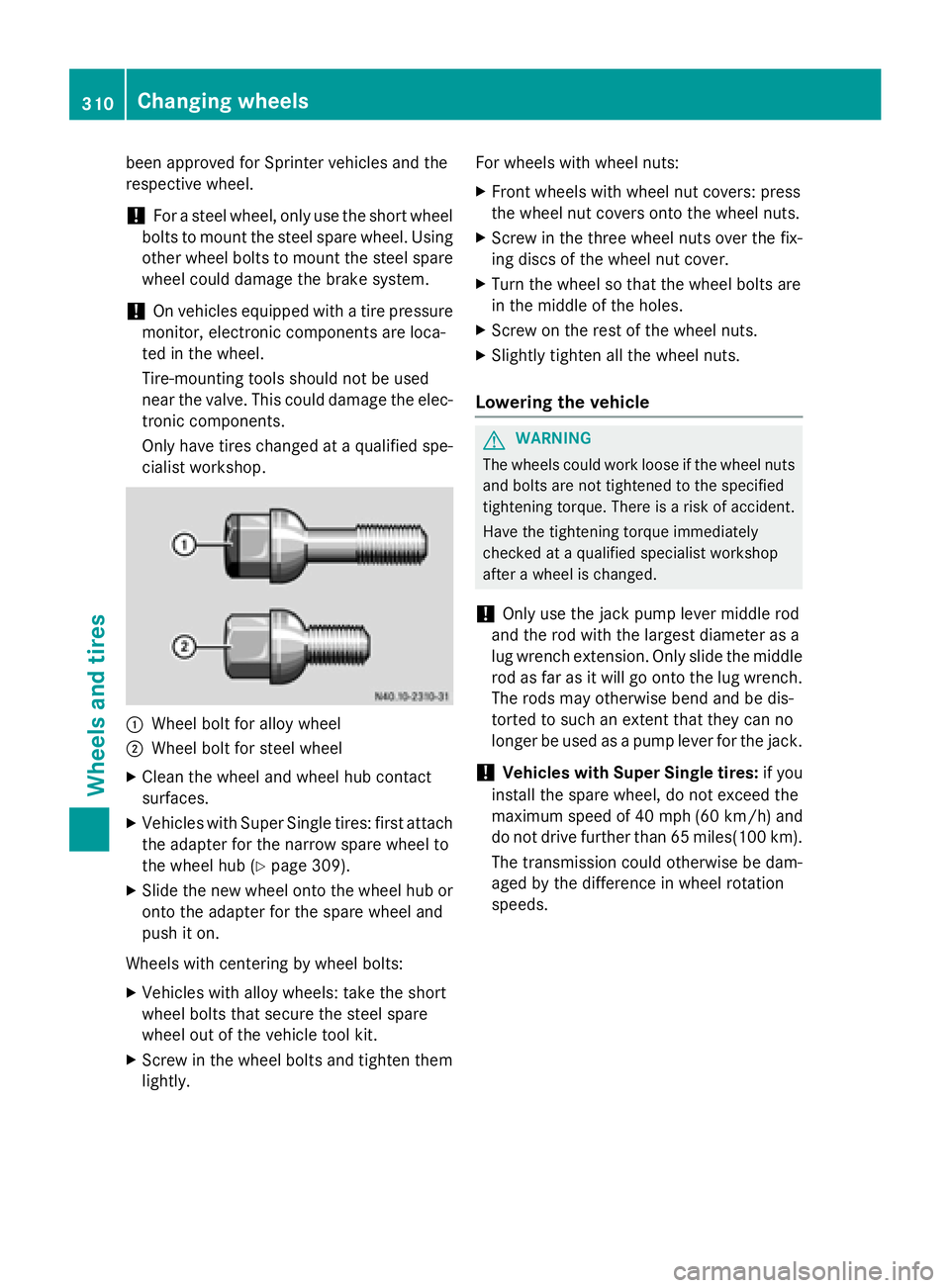
Wheel bolt for alloy wheel
0044 Wheel bolt for steel wheel
X Clean the wheel and wheel hub contact
surfaces.
X Vehicles with Super Single tires: first attach
the adapter for the narrow spare wheel to
the wheel hub (Y page 309).
X Slide the new wheel onto the wheel hub or
onto the adapter for the spare wheel and
push it on.
Wheels with centering by wheel bolts:
X Vehicles with alloy wheels: take the short
wheel bolts that secure the steel spare
wheel out of the vehicle tool kit.
X Screw in the wheel bolts and tighten them
lightly. For wheels with wheel nuts:
X Front wheels with wheel nut covers: press
the wheel nut covers onto the wheel nuts.
X Screw in the three wheel nuts over the fix-
ing discs of the wheel nut cover.
X Turn the wheel so that the wheel bolts are
in the middle of the holes.
X Screw on the rest of the wheel nuts.
X Slightly tighten all the wheel nuts.
Lowering the vehicle G
WARNING
The wheels could work loose if the wheel nuts and bolts are not tightened to the specified
tightening torque. There is a risk of accident.
Have the tightening torque immediately
checked at a qualified specialist workshop
after a wheel is changed.
! Only use the jack pump lever middle rod
and the rod with the largest diameter as a
lug wrench extension. Only slide the middle rod as far as it will go onto the lug wrench. The rods may otherwise bend and be dis-
torted to such an extent that they can no
longer be used as a pump lever for the jack.
! Vehicles with Super Single tires:
if you
install the spare wheel, do not exceed the
maximum speed of 40 mph (60 km/ h)and
do not drive further than 65 miles(100 km ).
The transmission could otherwise be dam-
aged by the difference in wheel rotation
speeds. 310
Changing wheelsWheels and tires
Page 313 of 334
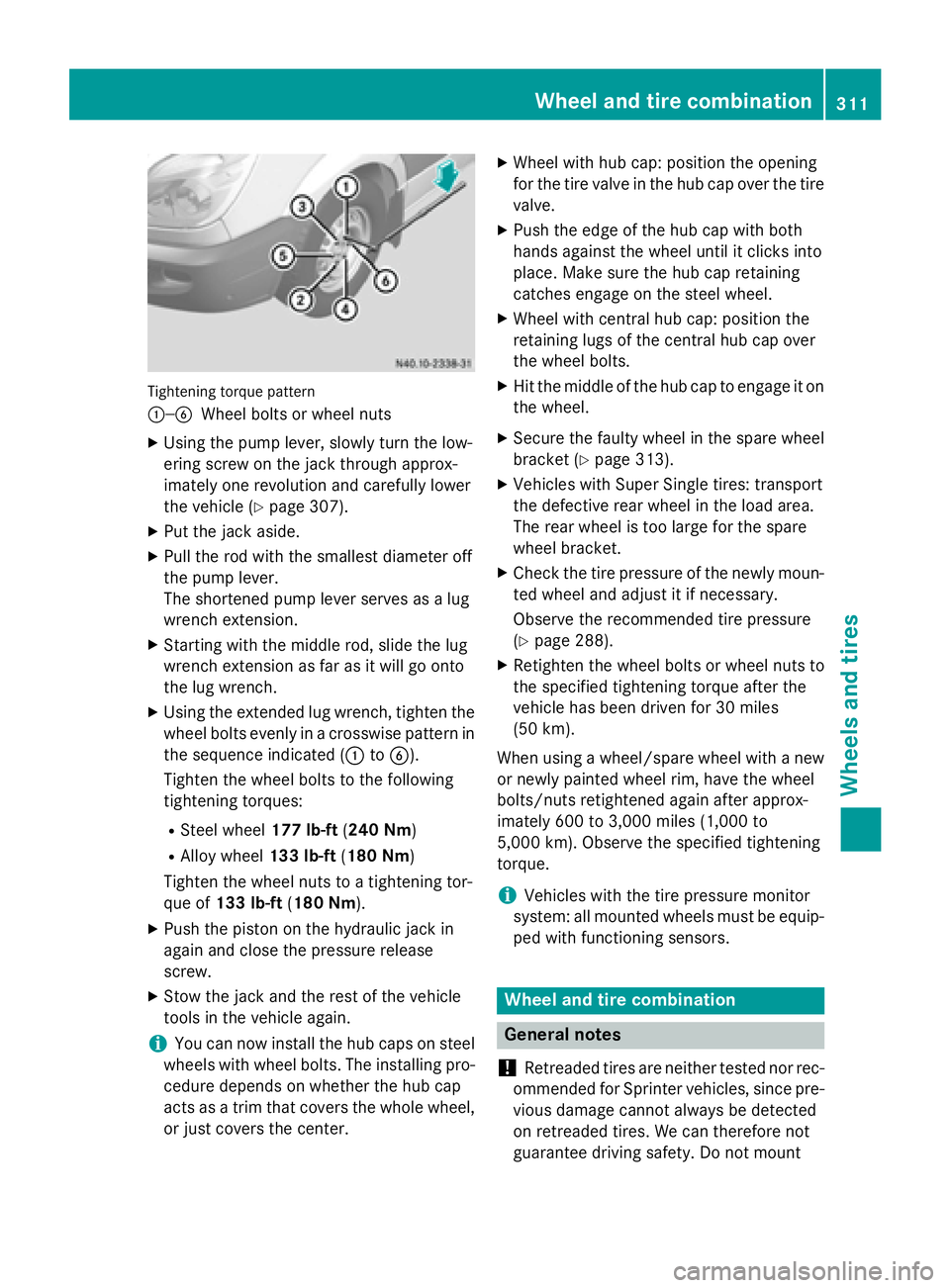
Tightening torque pattern
0043—0084
Wheel bolts or wheel nuts
X Using the pump lever, slowly turn the low-
ering screw on the jack through approx-
imately one revolution and carefully lower
the vehicle (Y page 307).
X Put the jack aside.
X Pull the rod with the smallest diameter off
the pump lever.
The shortened pump lever serves as a lug
wrench extension.
X Starting with the middle rod, slide the lug
wrench extension as far as it will go onto
the lug wrench.
X Using the extended lug wrench, tighten the
wheel bolts evenly in a crosswise pattern in the sequence indicated (0043 to0084).
Tighten the wheel bolts to the following
tightening torques:
R Steel wheel 177 lb-ft(240 Nm)
R Alloy wheel 133 lb-ft(180 Nm)
Tighten the wheel nuts to a tightening tor-
que of 133 lb-ft (180 Nm).
X Push the piston on the hydraulic jack in
again and close the pressure release
screw.
X Stow the jack and the rest of the vehicle
tools in the vehicle again.
i You can now install the hub caps on steel
wheels with wheel bolts. The installing pro-
cedure depends on whether the hub cap
acts as a trim that covers the whole wheel,
or just covers the center. X
Wheel with hub cap: position the opening
for the tire valve in the hub cap over the tire
valve.
X Push the edge of the hub cap with both
hands against the wheel until it clicks into
place. Make sure the hub cap retaining
catches engage on the steel wheel.
X Wheel with central hub cap: position the
retaining lugs of the central hub cap over
the wheel bolts.
X Hit the middle of the hub cap to engage it on
the wheel.
X Secure the faulty wheel in the spare wheel
bracket (Y page 313).
X Vehicles with Super Single tires: transport
the defective rear wheel in the load area.
The rear wheel is too large for the spare
wheel bracket.
X Check the tire pressure of the newly moun-
ted wheel and adjust it if necessary.
Observe the recommended tire pressure
(Y page 288).
X Retighten the wheel bolts or wheel nuts to
the specified tightening torque after the
vehicle has been driven for 30 miles
(50 km).
When using a wheel/spare wheel with a new
or newly painted wheel rim, have the wheel
bolts/nuts retightened again after approx-
imately 600 to 3,000 miles (1,000 to
5,000 km). Observe the specified tightening
torque.
i Vehicles with the tire pressure monitor
system: all mounted wheels must be equip- ped with functioning sensors. Wheel and tire combination
General notes
! Retreaded tires are neither tested nor rec-
ommended for Sprinter vehicles, since pre-
vious damage cannot always be detected
on retreaded tires. We can therefore not
guarantee driving safety. Do not mount Wheel and tire combination
311Wheels and tires Z
Page 314 of 334
used tires if you have no information about
their previous usage.
The recommended tire pressures can be
found:
R on the Tire and Loading Information plac-
ard 10
on the B-pillar on the driver's side
R on the tire pressure table on the B-pillar on
the driver's side
The recommended tire pressure can also be
found in the "Tire pressure table" section in
this Operator's Manual (Y page 294). The
wheel/tire combination for your vehicle can
be found on the tire pressure table. Further
information on wheel/tire combination can
be obtained at any qualified specialist work-
shop.
Check tire pressures regularly and only when
the tires are cold. Observe the notes on the
recommended tire pressure (Y page 288).
Follow the maintenance recommendations in the tire manufacturer's warranty book in your
vehicle documents.
Notes on the vehicle equipment – always
equip the vehicle:
R with tires of the same size across an axle
(left/right)
R with the same type of tires on all wheels at
a given time (summer tires, winter tires)
Tires that have been specially designed and
approved for your vehicle are marked with
MO or MO1 (Mercedes-Benz Original). You
can find this identification on the tires them-
selves and in the following table.
i Not all wheel/tire combinations can be
installed at the factory in all countries. Spare wheel
Important safety notes
G
WARNING
Wheel and tire dimensions as well as the type of tire can vary between the spare wheel and the wheel to be replaced. When the spare
wheel is mounted, driving characteristics may be severely affected. There is a risk of an acci-
dent.
In order to reduce risks:
R you should therefore adapt your driving
style and drive carefully.
R never mount more than one spare wheel
that differs from the wheel to be replaced.
R only use a spare wheel that differs from the
wheel to be replaced for a short time.
R do not deactivate ESP ®
.
R have a spare wheel that differs from the
wheel that has been changed replaced at
the nearest qualified specialist workshop.
You must observe the correct wheel and
tire dimensions as well as the wheel type.
When using a spare wheel of a different size,
do not exceed the maximum speed of
80 km/h. General notes
! Check the spare wheel regularly to see
that it is secure and has the prescribed tire
pressure.
The procedure for mounting the spare wheel
is described in "Mounting a wheel"
(Y page 306).
The following should be checked regularly,
particularly prior to long journeys:
R the tire pressure of the spare wheel, which
should then be corrected if necessary
(Y page 288).
R the fastenings of the spare wheel bracket.
The spare wheel is located in a spare wheel
bracket under the rear of the vehicle.
Replace the tires after 6 years at the latest,
regardless of wear. This also applies to the
spare wheel.
10 Only for vehicles with a gross weight of less than 10,000 lbs (4,536 kg). 312
Spare wheelWheels and ti
res
Page 315 of 334
i
If you have mounted a spare wheel, the
tire pressure monitor (Y page 291) will not
function for this wheel. The spare wheel is
not equipped with a sensor for monitoring
tire pressure. Removing and installing the spare
wheel
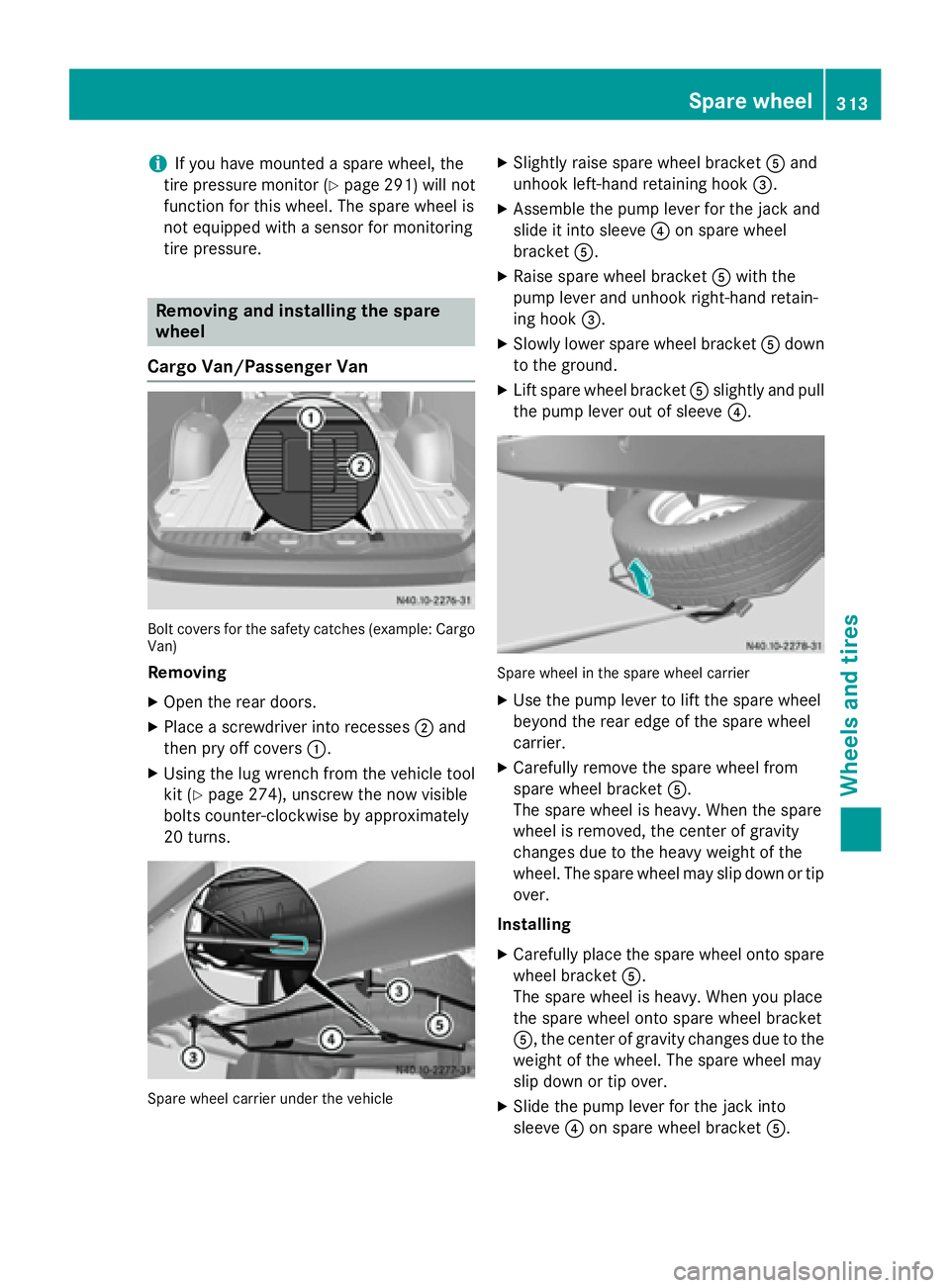
Cargo Van/Passenger Van Bolt covers for the safety catches (example: Cargo
Van)
Removing
X Open the rear doors.
X Place a screwdriver into recesses 0044and
then pry off covers 0043.
X Using the lug wrench from the vehicle tool
kit (Y page 274), unscrew the now visible
bolts counter-clockwise by approximately
20 turns. Spare wheel carrier under the vehicle X
Slightly raise spare wheel bracket 0083and
unhook left-hand retaining hook 0087.
X Assemble the pump lever for the jack and
slide it into sleeve 0085on spare wheel
bracket 0083.
X Raise spare wheel bracket 0083with the
pump lever and unhook right-hand retain-
ing hook 0087.
X Slowly lower spare wheel bracket 0083down
to the ground.
X Lift spare wheel bracket 0083slightly and pull
the pump lever out of sleeve 0085. Spare wheel in the spare wheel carrier
X Use the pump lever to lift the spare wheel
beyond the rear edge of the spare wheel
carrier.
X Carefully remove the spare wheel from
spare wheel bracket 0083.
The spare wheel is heavy. When the spare
wheel is removed, the center of gravity
changes due to the heavy weight of the
wheel. The spare wheel may slip down or tip over.
Installing X Carefully place the spare wheel onto spare
wheel bracket 0083.
The spare wheel is heavy. When you place
the spare wheel onto spare wheel bracket
0083, the center of gravity changes due to the
weight of the wheel. The spare wheel may
slip down or tip over.
X Slide the pump lever for the jack into
sleeve 0085on spare wheel bracket 0083. Spare wheel
313Wheels and tires Z
Page 316 of 334
X
Raise spare wheel bracket 0083with the
pump lever and attach right-hand retaining hook 0087.
X Slightly raise spare wheel bracket 0083and
attach left-hand retaining hook 0087.
X Pull the pump lever out of sleeve 0085.
X Using the lug wrench, tighten the retaining
hook bolts by turning them clockwise.
X Replace and engage covers 0043.
X Close the rear doors.
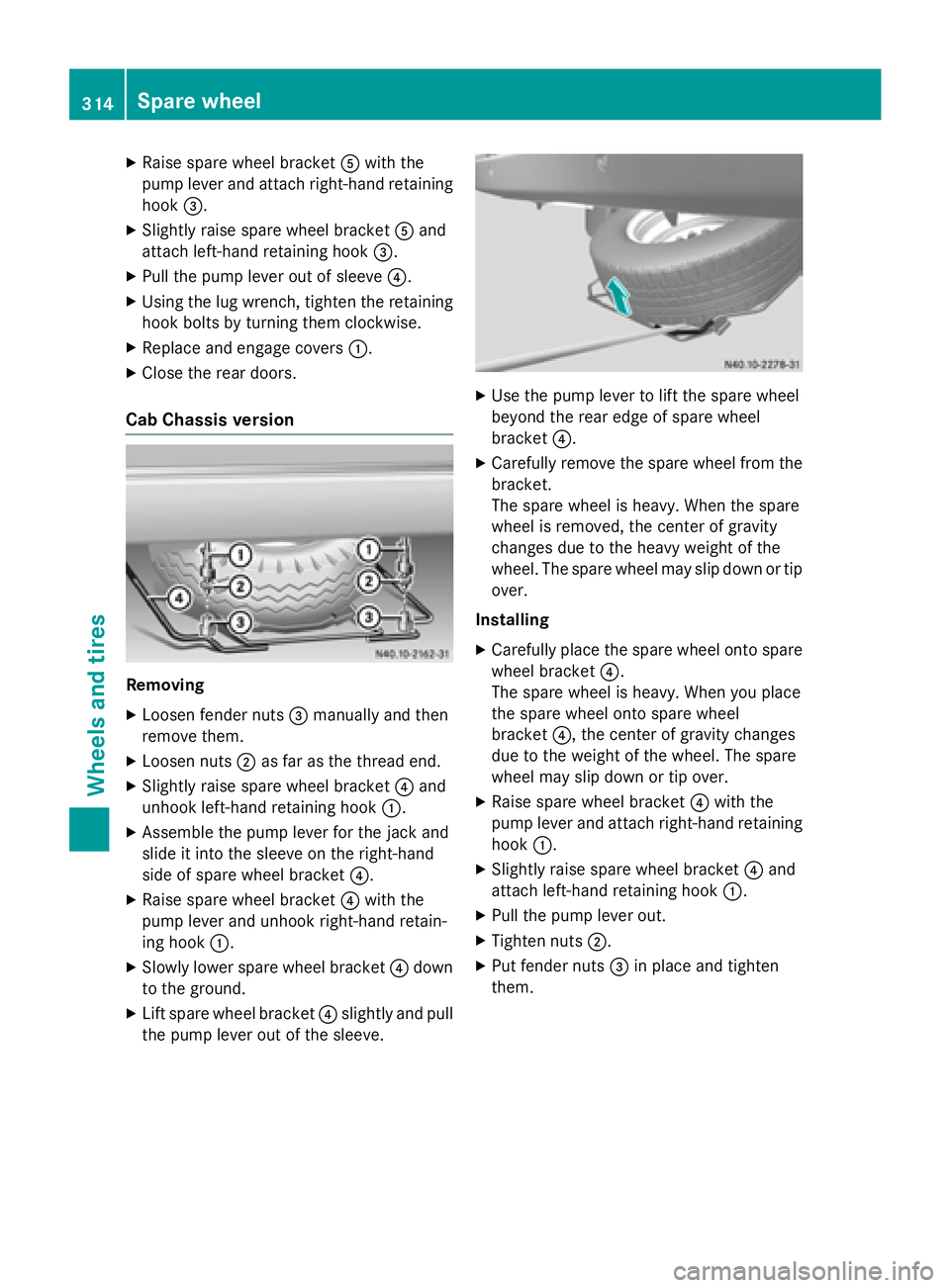
Cab Chassis version Removing
X Loosen fender nuts 0087manually and then
remove them.
X Loosen nuts 0044as far as the thread end.
X Slightly raise spare wheel bracket 0085and
unhook left-hand retaining hook 0043.
X Assemble the pump lever for the jack and
slide it into the sleeve on the right-hand
side of spare wheel bracket 0085.
X Raise spare wheel bracket 0085with the
pump lever and unhook right-hand retain-
ing hook 0043.
X Slowly lower spare wheel bracket 0085down
to the ground.
X Lift spare wheel bracket 0085slightly and pull
the pump lever out of the sleeve. X
Use the pump lever to lift the spare wheel
beyond the rear edge of spare wheel
bracket 0085.
X Carefully remove the spare wheel from the
bracket.
The spare wheel is heavy. When the spare
wheel is removed, the center of gravity
changes due to the heavy weight of the
wheel. The spare wheel may slip down or tip over.
Installing X Carefully place the spare wheel onto spare
wheel bracket 0085.
The spare wheel is heavy. When you place
the spare wheel onto spare wheel
bracket 0085, the center of gravity changes
due to the weight of the wheel. The spare
wheel may slip down or tip over.
X Raise spare wheel bracket 0085with the
pump lever and attach right-hand retaining hook 0043.
X Slightly raise spare wheel bracket 0085and
attach left-hand retaining hook 0043.
X Pull the pump lever out.
X Tighten nuts 0044.
X Put fender nuts 0087in place and tighten
them. 314
Spare wheelWheels and
tires