belt MERCEDES-BENZ SPRINTER 2015 MY15 Operator’s Manual
[x] Cancel search | Manufacturer: MERCEDES-BENZ, Model Year: 2015, Model line: SPRINTER, Model: MERCEDES-BENZ SPRINTER 2015Pages: 334, PDF Size: 5.94 MB
Page 269 of 334
sure water or steam cleaners, the spray
must not be aimed directly at electrical
components or the terminals of electrical
lines.
Preserve the engine after the engine has
been cleaned. Protect the belt drive system from exposure to the preservative agent.
Also observe the information under "Power
washers" (Y page 266).
Cleaning the paintwork !
Do not affix:
R stickers
R films
R magnetic plates or similar items
to painted surfaces. You could otherwise
damage the paintwork.
Scratches, corrosive deposits, areas affected
by corrosion and damage caused by inade-
quate care cannot always be completely
repaired. In such cases, visit a qualified spe-
cialist workshop.
X Remove impurities immediately, where
possible, whilst avoiding rubbing too hard.
X Soak insect remains with insect remover
and rinse off the treated areas afterwards.
X Soak bird droppings with water and rinse
off the treated areas afterwards.
X Remove coolant, brake fluid, tree resin,
oils, fuels and greases by rubbing gently
with a cloth soaked in petroleum ether or
lighter fluid.
X Use tar remover to remove tar stains.
X Use silicone remover to remove wax.
Cleaning the windows G
WARNING
You could become trapped by the windshield wipers if they start moving while cleaning the
windshield or wiper blades. There is a risk of
injury. Always switch off the windshield wipers and
the ignition before cleaning the windshield or
wiper blades.
! Do not fold the windshield wipers away
from the windshield unless the hood is
closed. Otherwise, you could damage the
hood.
! Hold the wiper arm securely when folding
back. The windshield could be damaged if
the wiper arm smacks against it suddenly.
! Do not use dry cloths, abrasive products,
solvents or cleaning agents containing sol- vents to clean the inside of the windows. Do
not touch the insides of the windows with
hard objects, e.g. an ice scraper or ring.
There is otherwise a risk of damaging the
windows.
Before cleaning the windshield
X Turn the key to position 0in the ignition
lock or remove it.
X Fold the windshield wiper arms away from
the windshield until you feel them engage.
Before switching the ignition on again, fold
the windshield wipers back into position.
Cleaning the windows X Clean the inside and outside of the win-
dows with a damp cloth and a cleaning
agent that is recommended and approved
for Sprinter vehicles. Exterior
Cleaning the wheels !
Do not use any acidic or alkaline cleaning
agents. They can cause corrosion on the
wheel bolts (wheel nuts) or the retainer
springs for the wheel-balancing weights.
! Do not park the vehicle for an extended
period straight after cleaning it, particularly after having cleaned the wheels with wheel cleaner. Wheel cleaners could cause
increased corrosion of the brake discs and Care
267Maintenance and care Z
Page 273 of 334
ishes or waxes. There is otherwise a risk of
damaging the surface.
X Wipe the trim elements with a damp, lint-
free cloth, e.g. a microfiber cloth.
X Heavy soiling: use care products and
cleaning agents recommended and
approved for Sprinter vehicles.
Cleaning the seat covers !
Do not use microfiber cloths to clean arti-
ficial leather covers. If used often, a micro- fiber cloth can damage the cover.
! Clean:
R artificial leather covers with a cloth mois-
tened with a solution containing 1%
detergent, e.g. dish washing liquid.
R cloth covers with a microfiber cloth mois-
tened with a solution containing 1%
detergent, e.g. dish washing liquid. Wipeentire seat sections carefully to avoid
leaving visible lines. Leave the seat to dry
afterwards. Cleaning results depend on
the type of dirt and how long it has been
there.
Cleaning the seat belts G
WARNING
Seat belts can become severely weakened if
bleached or dyed. This could cause the seat
belts to tear or fail, for instance, in the event of an accident. This poses an increased risk of
injury or fatal injury.
Never bleach or dye the seat belts.
! Do not clean the seat belts using chemical
cleaning agents. Do not dry the seat belts
by heating at temperatures above 176 ‡
(80 †) or in direct sunlight.
Remove any stains or dirt immediately. This
will avoid residue or damage.
X Use clean, lukewarm water and soap solu-
tion. Cleaning the headliner X
Use a soft brush or dry shampoo to remove
heavy soiling.
Cleaning the curtains !
The curtains must not be washed. Wash-
ing could cause the curtains to shrink and
lose their fire-retardant properties. Always
have the curtains dry-cleaned. Care
271Maintenance and care Z
Page 279 of 334
R
Only use jumper cables that have a suffi-
cient cross-section and insulated terminal
clamps.
R If the battery is fully discharged, attach the
battery of another vehicle for a few minutes before attempting to start. This charges the
empty battery a little.
R Make sure that the two vehicles do not
touch.
Make sure that:
R the jumper cables are not damaged.
R bare parts of the terminal clamps do not
come into contact with other metal parts
while the jumper cables are connected to
the battery.
R the jumper cables cannot come into con-
tact with parts such as the V-belt pulley or
the fan. These parts move when the engine
is started and while it is running.
i Jumper cables and further information
regarding jump starting can be obtained at any qualified specialist workshop. Before connecting the jumper cables
On vehicles with a battery main switch, check whether the battery main switch is switched
on (Y page 137).
X Apply the parking brake.
X Move the selector lever of the automatic
transmission to position P.
X Switch off all electrical consumers, e.g.
audio equipment, blower.
X Turn the key to position 0in the ignition
lock and remove it (Y page 138).
X Open the hood (Y page 248). Tow-starting and towing away
Important safety notes
G
WARNING
Functions relevant to safety are restricted or
no longer available if:
R the engine is not running.
R the brake system or the power steering is
malfunctioning.
R there is a malfunction in the voltage supply
or the vehicle's electrical system.
If your vehicle is being towed, much more
force may be necessary to steer or brake.
There is a risk of an accident.
In such cases, use a tow bar. Before towing,
make sure that the steering moves freely. G
WARNING
You can no longer steer the vehicle if the
steering wheel lock has been engaged. There is a risk of an accident.
Always switch off the ignition when towing the
vehicle with a tow cable or a tow bar. G
WARNING
When towing or tow-starting another vehicle
and its weight is greater than the permissible gross weight of your vehicle, the:
R the towing eye could detach itself
R the vehicle/trailer combination could roll-
over.
There is a risk of an accident.
When towing or tow-starting another vehicle,
its weight should not be greater than the per- missible gross weight of your vehicle.
Information on the gross vehicle weight can
be found on the vehicle identification plate
(Y page 316).
! Only secure the tow rope or tow bar at the
towing eyes. Otherwise, the vehicle could
be damaged. Tow-starting and towing away
277Roadside Assistance Z
Page 304 of 334
Loading Information placard on the B-pilla
ron
the driver's side (Y page 295).
i The actual values for tires are specific to
each vehicle and may deviate from the val-
ues in the illustration.
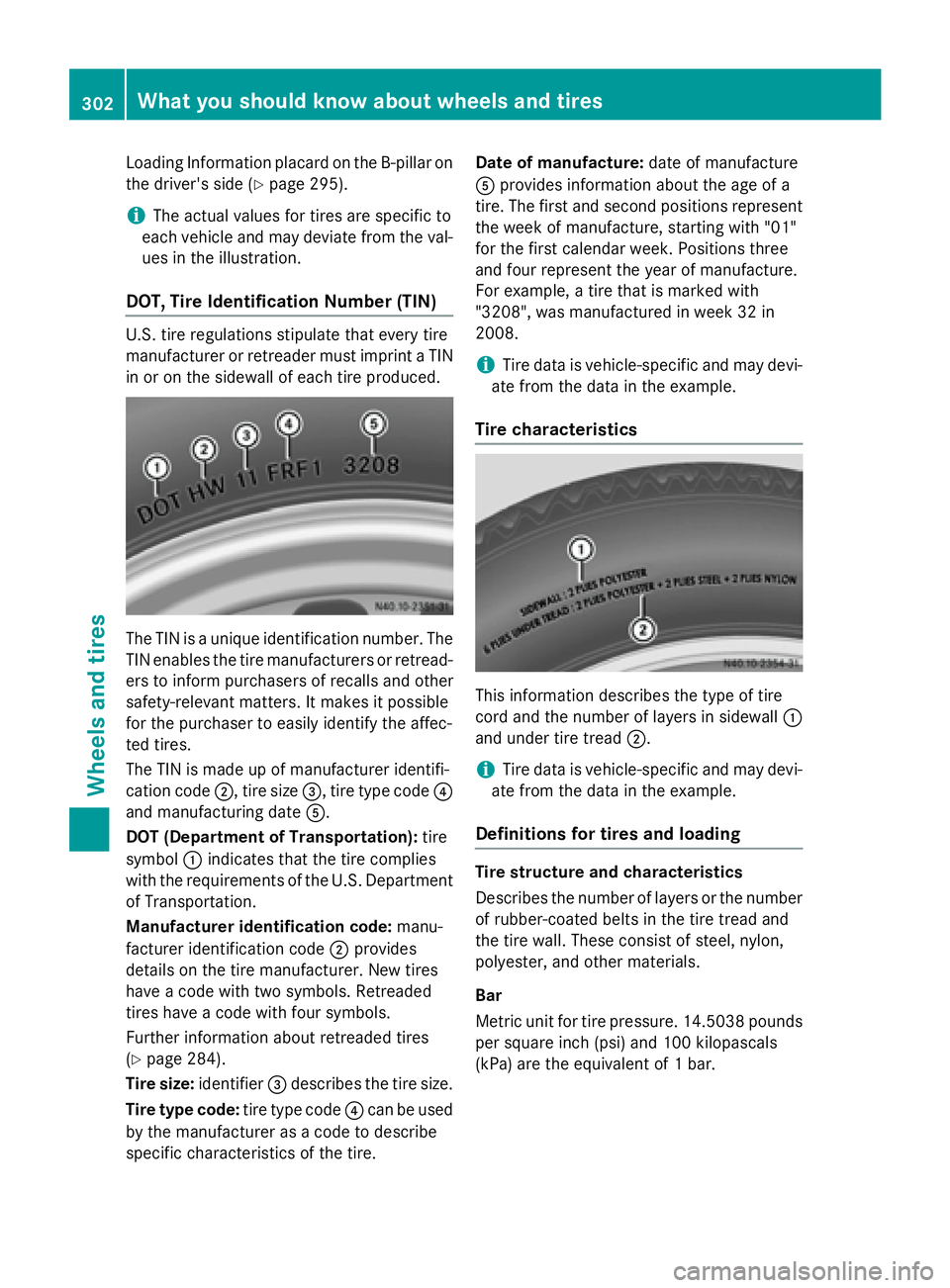
DOT, Tire Identification Number (TIN) U.S. tire regulations stipulate that every tire
manufacturer or retreader must imprint a TIN
in or on the sidewall of each tire produced. The TIN is a unique identification number. The
TIN enables the tire manufacturers or retread- ers to inform purchasers of recalls and other
safety-relevant matters. It makes it possible
for the purchaser to easily identify the affec-
ted tires.
The TIN is made up of manufacturer identifi-
cation code 0044, tire size0087, tire type code 0085
and manufacturing date 0083.
DOT (Department of Transportation): tire
symbol 0043indicates that the tire complies
with the requirements of the U.S. Department
of Transportation.
Manufacturer identification code: manu-
facturer identification code 0044provides
details on the tire manufacturer. New tires
have a code with two symbols. Retreaded
tires have a code with four symbols.
Further information about retreaded tires
(Y page 284).
Tire size: identifier0087describes the tire size.
Tire type code: tire type code0085can be used
by the manufacturer as a code to describe
specific characteristics of the tire. Date of manufacture:
date of manufacture
0083 provides information about the age of a
tire. The first and second positions represent the week of manufacture, starting with "01"
for the first calendar week. Positions three
and four represent the year of manufacture.
For example, a tire that is marked with
"3208", was manufactured in week 32 in
2008.
i Tire data is vehicle-specific and may devi-
ate from the data in the example.
Tire characteristics This information describes the type of tire
cord and the number of layers in sidewall
0043
and under tire tread 0044.
i Tire data is vehicle-specific and may devi-
ate from the data in the example.
Definitions for tires and loading Tire structure and characteristics
Describes the number of layers or the number
of rubber-coated belts in the tire tread and
the tire wall. These consist of steel, nylon,
polyester, and other materials.
Bar
Metric unit for tire pressure. 14.5038 pounds per square inch (psi) and 100 kilopascals
(kPa) are the equivalent of 1 bar. 302
What you should kno
w about wheels andtiresWheels and tires