warning MERCEDES-BENZ SPRINTER 2016 MY16 Operator’s Manual
[x] Cancel search | Manufacturer: MERCEDES-BENZ, Model Year: 2016, Model line: SPRINTER, Model: MERCEDES-BENZ SPRINTER 2016Pages: 290, PDF Size: 6.44 MB
Page 271 of 290
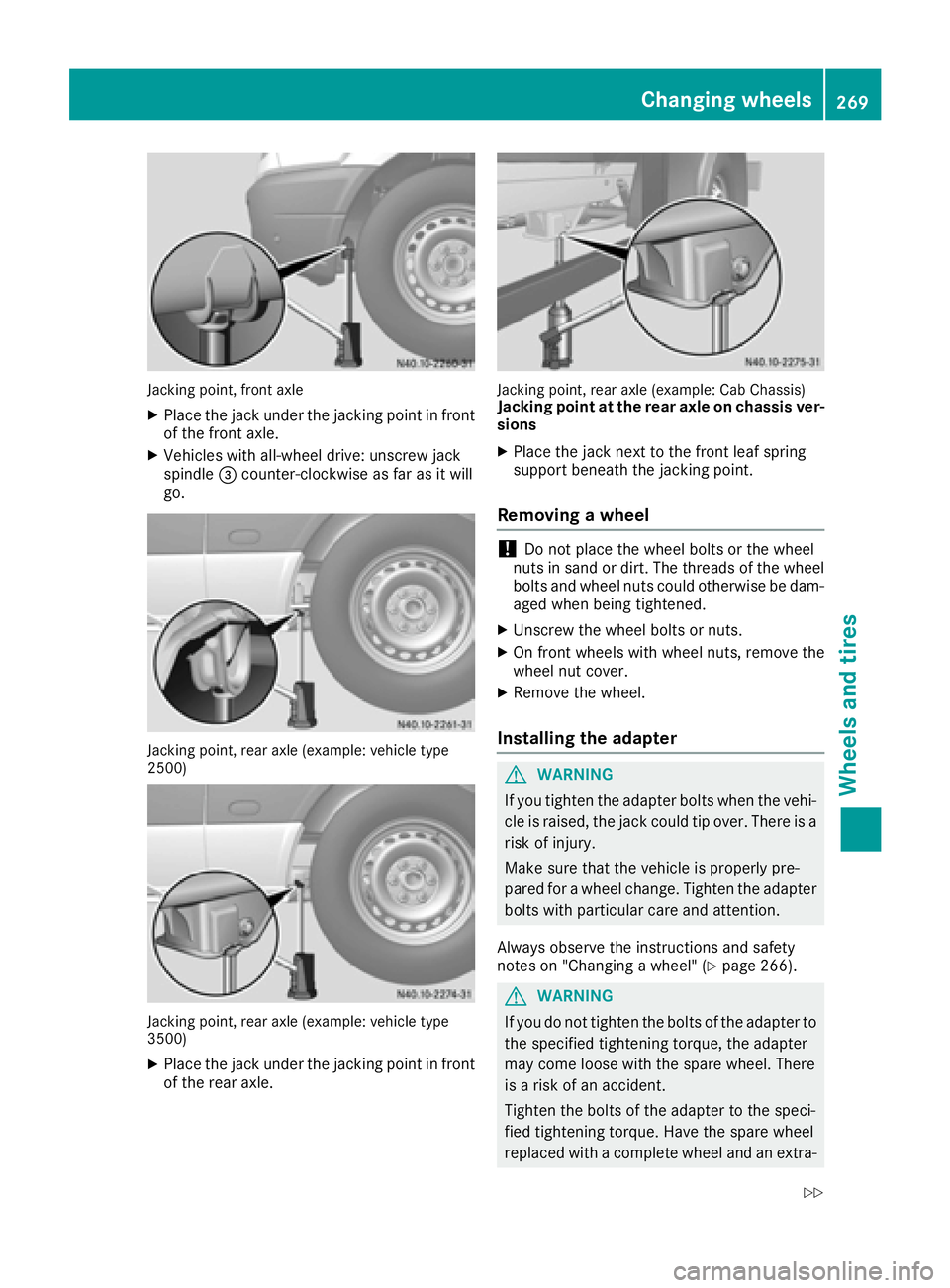
Jacking point, front axle
XPlace the jack under the jacking point in frontof the front axle.
XVehicles with all-wheel drive: unscrew jack
spindle =counter-clockwise as far as it will
go.
Jacking point, rear axle (example: vehicle type
2500)
Jacking point, rear axle (example: vehicle type
3500)
XPlace the jack under the jacking point in front
of the rear axle.
Jacking point, rear axle (example: Cab Chassis)Jacking point at the rear axle on chassis ver-
sions
XPlace the jack next to the front leaf spring
support beneath the jacking point.
Removing a wheel
!Do not place the wheel bolts or the wheel
nuts in sand or dirt. The threads of the wheel
bolts and wheel nuts could otherwise be dam-
aged when being tightened.
XUnscrew the wheel bolts or nuts.
XOn front wheels with wheel nuts, remove the
wheel nut cover.
XRemove the wheel.
Installing the adapter
GWARNING
If you tighten the adapter bolts when the vehi-
cle is raised, the jack could tip over. There is a risk of injury.
Make sure that the vehicle is properly pre-
pared for a wheel change. Tighten the adapter
bolts with particular care and attention.
Always observe the instructions and safety
notes on "Changing a wheel" (
Ypage 266).
GWARNING
If you do not tighten the bolts of the adapter to
the specified tightening torque, the adapter
may come loose with the spare wheel. There
is a risk of an accident.
Tighten the bolts of the adapter to the speci-
fied tightening torque. Have the spare wheel
replaced with a complete wheel and an extra-
Changing wheels269
Wheels and tires
Z
Page 272 of 290
wide tire at a qualified specialist workshop
immediately.
!Vehicles with Super Single tires:if you
install the spare wheel, do not exceed the
maximum speed of 40 mph (60 km/h) and do
not drive further than 65 miles(100 km).
The transmission could otherwise be dam-
aged by the difference in wheel rotation
speeds.
On vehicles with Super Single tires, you must
attach the narrow spare wheel to the rear axle by
means of an adapter. The adapter is bolted to
the spare wheel using the adapter bolts for
transportation.
The handling characteristics of your vehicle are affected when driving with a spare wheel instal-
led. After changing a wheel, drive to the nearest
specialist workshop and have the spare wheel
replaced with a wheel and tire assembly that hasa Super Single tire.
XClean the wheel and wheel hub contact sur-
faces.
XUnscrew the six adapter bolts on the spare
wheel and remove the adapter.
XTighten the adapter with the six adapter boltsevenly in a crosswise pattern through the
outer holes on the wheel hub.
XTighten the six adapter bolts on the wheel hub
to a tightening torque of 177 lb-ft(240 Nm).
XPush the wheel onto the adapter and attach it.
Mounting a new wheel
GWARNING
Oiled or greased wheel bolts or damaged
wheel bolts/hub threads can cause the wheel bolts to come loose. As a result, you could
lose a wheel while driving. There is a risk of
accident.
Never oil or grease wheel bolts. In the event of
damage to the threads, contact a qualified
specialist workshop immediately. Have the
damaged wheel bolts or hub threads
replaced/renewed. Do not continue driving.
GWARNING
If you tighten the wheel bolts or wheel nuts
when the vehicle is raised, the jack could tip
over. There is a risk of injury.
Only tighten the wheel bolts or wheel nuts
when the vehicle is on the ground.
Always observe the instructions and safety
notes on "Changing a wheel" (
Ypage 266).
Only use wheel bolts or wheel nuts that have
been designed for the wheel and the vehicle. For safety reasons, we recommend that you only
use wheel bolts or wheel nuts which have been
approved for Sprinter vehicles and the respec-
tive wheel.
!For a steel wheel, only use the short wheel
bolts to mount the steel spare wheel. Using
other wheel bolts to mount the steel spare
wheel could damage the brake system.
!On vehicles equipped with a tire pressure
monitor, electronic components are located
in the wheel.
Tire-mounting tools should not be used near
the valve. This could damage the electronic
components.
Only have tires changed at a qualified spe-
cialist workshop.
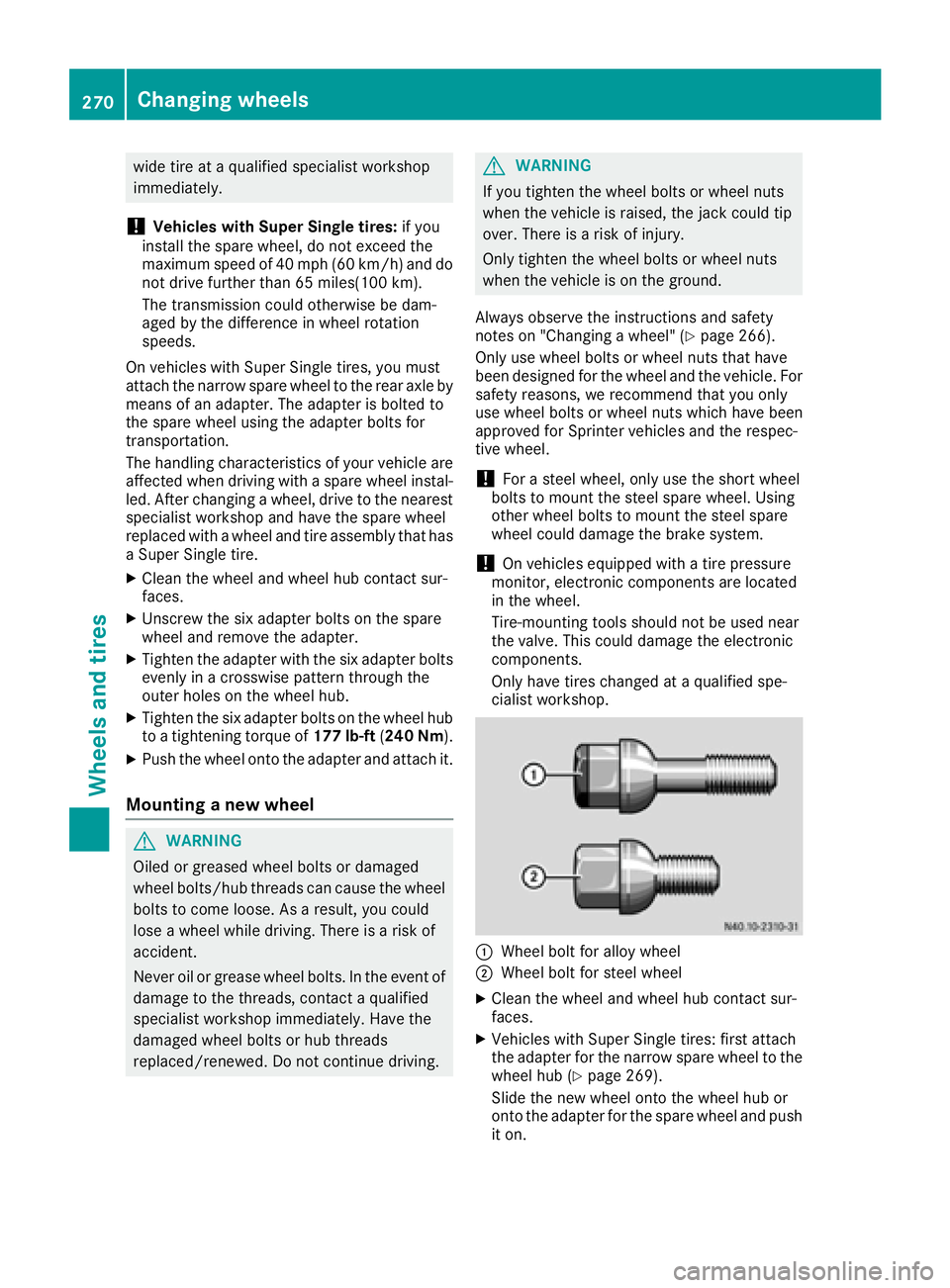
:Wheel bolt for alloy wheel
;Wheel bolt for steel wheel
XClean the wheel and wheel hub contact sur-
faces.
XVehicles with Super Single tires: first attach
the adapter for the narrow spare wheel to the
wheel hub (
Ypage 269).
Slide the new wheel onto the wheel hub or
onto the adapter for the spare wheel and push
it on.
270Changing wheels
Wheels and tires
Page 273 of 290
Slide the new wheel onto the wheel hub and
push it on.
Wheels with centering by wheel bolts:
XVehicles with alloy wheels: take the short
wheel bolts that secure the steel spare wheel
out of the vehicle tool kit.
XScrew in the wheel bolts and tighten them
lightly.
For wheels with wheel nuts:
XFront wheels with wheel nut covers: press the
wheel nut covers onto the wheel nuts.
XScrew in the three wheel nuts over the fixing
discs of the wheel nut cover.
XTurn the wheel so that the wheel bolts are in
the middle of the holes.
XScrew on the rest of the wheel nuts.
XSlightly tighten all the wheel nuts.
Lowering the vehicle
GWARNING
The wheels could work loose if the wheel nuts and bolts are not tightened to the specified
tightening torque. There is a risk of accident.
Have the tightening torque immediately
checked at a qualified specialist workshop
after a wheel is changed.
!Only use the jack pump lever middle rod and
the rod with the largest diameter as a lug
wrench extension. Only slide the middle rod
as far as it will go onto the lug wrench. The
rods may otherwise bend and be distorted to
such an extent that they can no longer be
used as a pump lever for the jack.
!Vehicles with Super Single tires: if you
install the spare wheel, do not exceed the
maximum speed of 40 mph (60 km/h) and do
not drive further than 65 miles(100 km).
The transmission could otherwise be dam-
aged by the difference in wheel rotation
speeds.
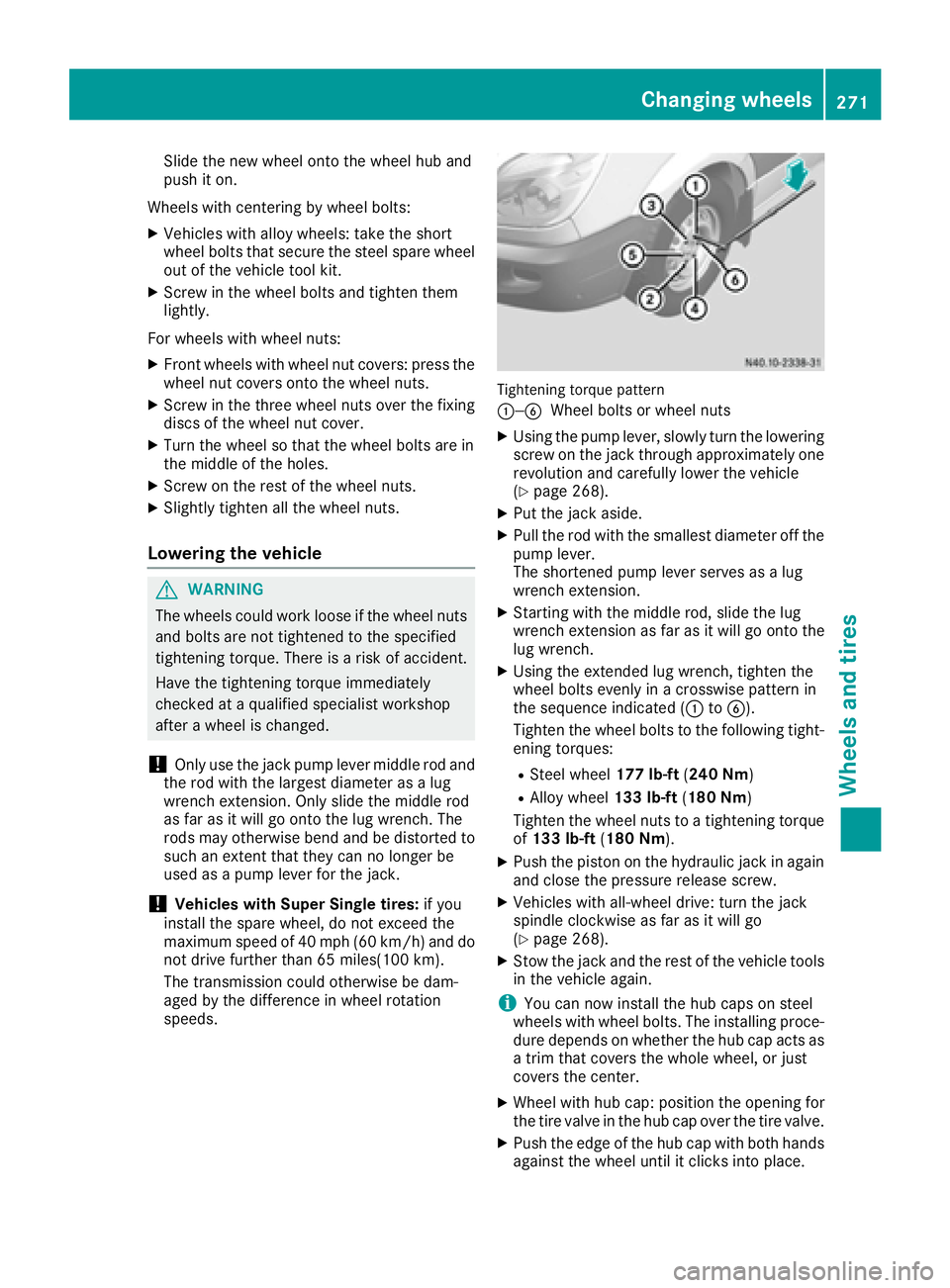
Tightening torque pattern
:—B
Wheel bolts or wheel nuts
XUsing the pump lever, slowly turn the lowering
screw on the jack through approximately one revolution and carefully lower the vehicle
(
Ypage 268).
XPut the jack aside.
XPull the rod with the smallest diameter off the
pump lever.
The shortened pump lever serves as a lug
wrench extension.
XStarting with the middle rod, slide the lug
wrench extension as far as it will go onto the
lug wrench.
XUsing the extended lug wrench, tighten the
wheel bolts evenly in a crosswise pattern in
the sequence indicated ( :toB).
Tighten the wheel bolts to the following tight-
ening torques:
RSteel wheel 177 lb-ft(240 Nm)
RAlloy wheel 133 lb-ft(180 Nm)
Tighten the wheel nuts to a tightening torque
of 133 lb-ft (180 Nm).
XPush the piston on the hydraulic jack in again
and close the pressure release screw.
XVehicles with all-wheel drive: turn the jack
spindle clockwise as far as it will go
(
Ypage 268).
XStow the jack and the rest of the vehicle tools
in the vehicle again.
iYou can now install the hub caps on steel
wheels with wheel bolts. The installing proce-
dure depends on whether the hub cap acts as
a trim that covers the whole wheel, or just
covers the center.
XWheel with hub cap: position the opening for
the tire valve in the hub cap over the tire valve.
XPush the edge of the hub cap with both hands against the wheel until it clicks into place.
Changing wheels271
Wheels and tires
Z
Page 274 of 290
Make sure the hub cap retaining catches
engage on the steel wheel.
XWheel with central hub cap: position the
retaining lugs of the central hub cap over the
wheel bolts.
XHit the middle of the hub cap to engage it on
the wheel.
XSecure the faulty wheel in the spare wheel
bracket (Ypage 273).
XVehicles with Super Single tires: transport the
defective rear wheel in the load area. The rear
wheel is too large for the spare wheel bracket.
XCheck the tire pressure of the newly mounted
wheel and adjust it if necessary.
Observe the recommended tire pressure
(
Ypage 250).
XRetighten the wheel bolts or wheel nuts to the
specified tightening torque after the vehicle
has been driven for 30 miles (50 km).
When using a wheel or spare wheel with a new or
newly painted wheel rim, have the wheel bolts or
nuts retightened again after approximately 600
to 3,000 miles (1,000 to 5,000 km). Observe the
specified tightening torque.
iVehicles with the tire pressure monitor sys-
tem: all mounted wheels must be equipped
with functioning sensors.
Wheel and tire combination
General notes
!
Retreaded tires are neither tested nor rec-
ommended for Sprinter vehicles, since previ-
ous damage cannot always be detected on
retreaded tires. We can therefore not guar-
antee driving safety. Do not mount used tires if you have no information about their previ-
ous usage.
The recommended tire pressures can be found:
Ron the Tire and Loading Information placard9
on the B-pillar on the driver's side
Ron the tire pressure table on the B-pillar on the driver's side
The recommended tire pressure can also be
found in the "Tire pressure table" section in this
Operator's Manual (
Ypage 257). The wheel/tire
combination for your vehicle can be found on the tire pressure table. Further information on
wheel/tire combination can be obtained at any
qualified specialist workshop.
Check tire pressures regularly and only when
the tires are cold. Observe the notes on the rec-
ommended tire pressure (
Ypage 250).
Follow the maintenance recommendations in
the tire manufacturer's warranty book in your
vehicle documents.
Notes on the vehicle equipment – always equip
the vehicle:
Rwith tires of the same size across an axle (left
and right)
Rwith the same type of tires on all wheels at a
given time (summer tires, winter tires)
Tires that have been specially designed and
approved for your vehicle are marked with MO
(Mercedes-Benz Original). You can find this
identification on the tires themselves and in the
following table.
iNot all wheel/tire combinations can be
installed at the factory in all countries.
Spare wheel
Important safety notes
GWARNING
Wheel and tire dimensions as well as the type of tire can vary between the spare wheel and
the wheel to be replaced. When the spare
wheel is mounted, driving characteristics may be severely affected. There is a risk of an acci-
dent.
In order to reduce risks:
Ryou should therefore adapt your driving
style and drive carefully.
Rnever mount more than one spare wheel
that differs from the wheel to be replaced.
Ronly use a spare wheel that differs from the
wheel to be replaced for a short time.
Rdo not deactivate ESP®.
Rhave a spare wheel that differs from the
wheel that has been changed replaced at
the nearest qualified specialist workshop.
9Only for vehicles with a gross weight of less than 10,000 lbs (4,536 kg).
272Spare wheel
Wheels and tires
Page 277 of 290
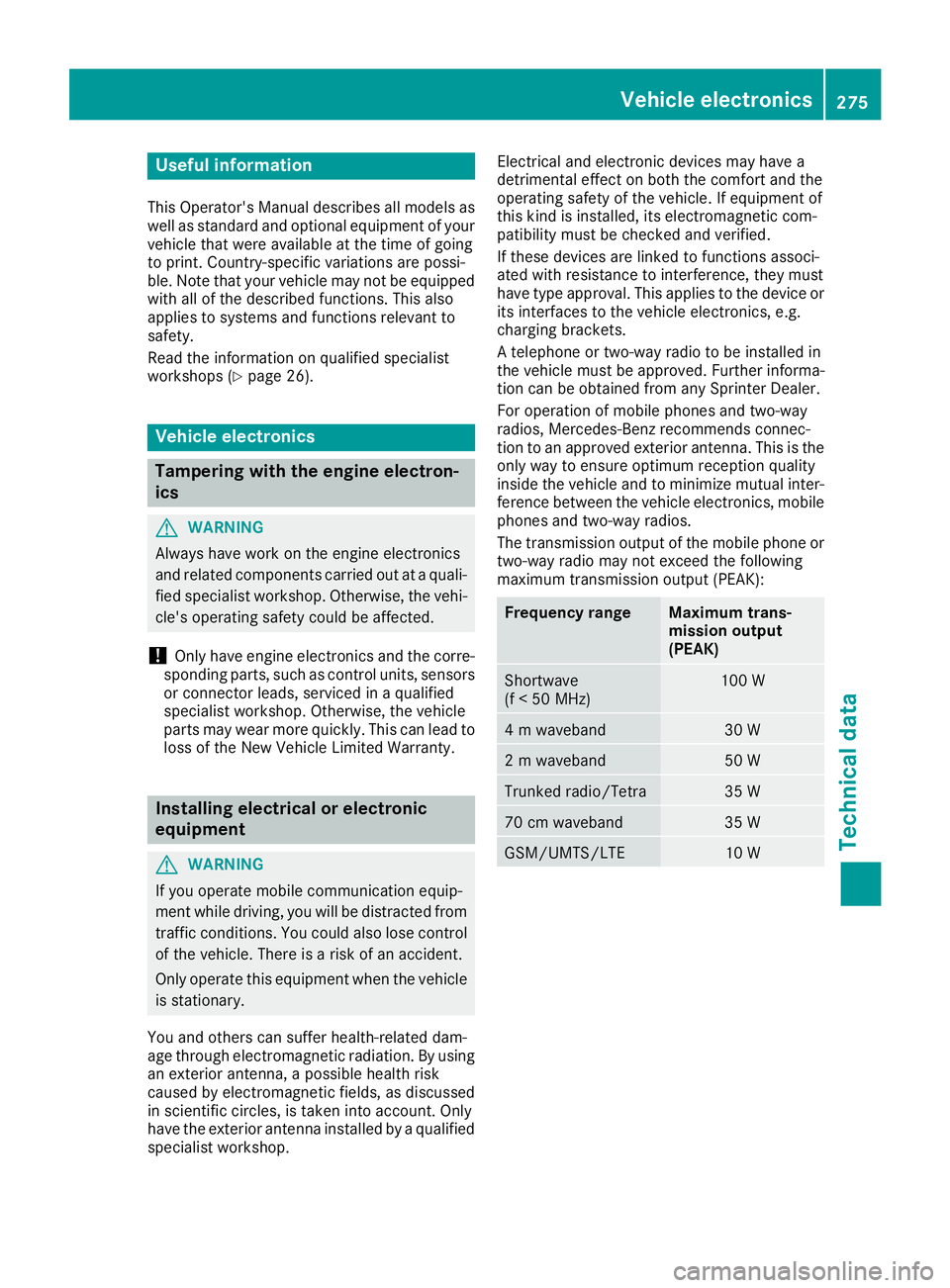
Useful information
This Operator's Manual describes all models as
well as standard and optional equipment of your
vehicle that were available at the time of going
to print. Country-specific variations are possi-
ble. Note that your vehicle may not be equipped
with all of the described functions. This also
applies to systems and functions relevant to
safety.
Read the information on qualified specialist
workshops (
Ypage 26).
Vehicle electronics
Tampering with the engine electron-
ics
GWARNING
Always have work on the engine electronics
and related components carried out at a quali-
fied specialist workshop. Otherwise, the vehi-
cle's operating safety could be affected.
!Only have engine electronics and the corre-
sponding parts, such as control units, sensors or connector leads, serviced in a qualified
specialist workshop. Otherwise, the vehicle
parts may wear more quickly. This can lead to
loss of the New Vehicle Limited Warranty.
Installing electrical or electronic
equipment
GWARNING
If you operate mobile communication equip-
ment while driving, you will be distracted from traffic conditions. You could also lose control
of the vehicle. There is a risk of an accident.
Only operate this equipment when the vehicle
is stationary.
You and others can suffer health-related dam-
age through electromagnetic radiation. By using an exterior antenna, a possible health risk
caused by electromagnetic fields, as discussed
in scientific circles, is taken into account. Only
have the exterior antenna installed by a qualified
specialist workshop. Electrical and electronic devices may have a
detrimental effect on both the comfort and the
operating safety of the vehicle. If equipment of
this kind is installed, its electromagnetic com-
patibility must be checked and verified.
If these devices are linked to functions associ-
ated with resistance to interference, they must
have type approval. This applies to the device or
its interfaces to the vehicle electronics, e.g.
charging brackets.
A telephone or two-way radio to be installed in
the vehicle must be approved. Further informa-
tion can be obtained from any Sprinter Dealer.
For operation of mobile phones and two-way
radios, Mercedes-Benz recommends connec-
tion to an approved exterior antenna. This is the
only way to ensure optimum reception quality
inside the vehicle and to minimize mutual inter-
ference between the vehicle electronics, mobile
phones and two-way radios.
The transmission output of the mobile phone or
two-way radio may not exceed the following
maximum transmission output (PEAK):
Frequency rangeMaximum trans-
mission output
(PEAK)
Shortwave
(f < 50 MHz)100 W
4 m waveband30 W
2 m waveband50 W
Trunked radio/Tetra35 W
70 cm waveband35 W
GSM/UMTS/LTE10 W
Vehicle electronics275
Technical data
Z
Page 279 of 290
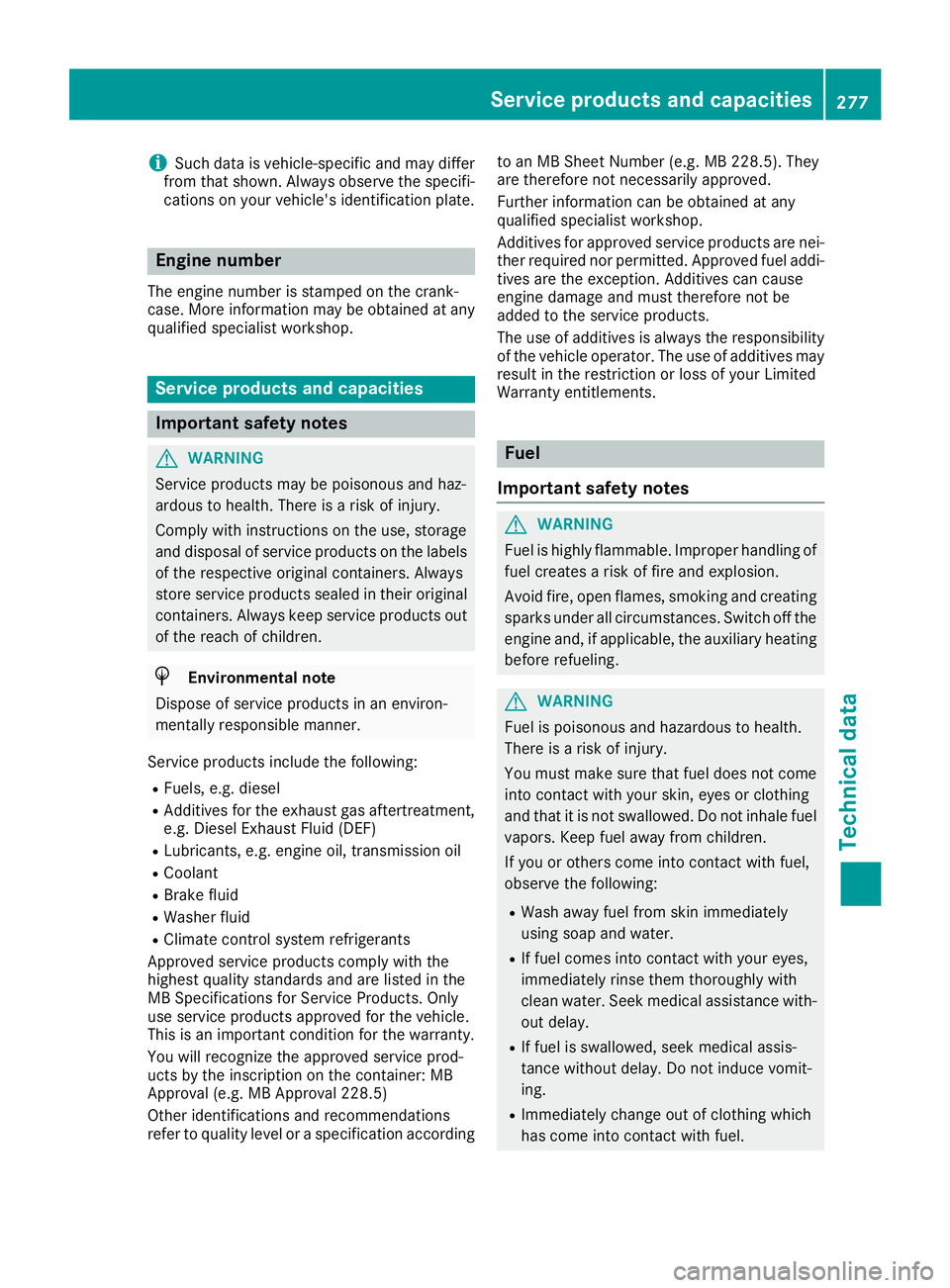
iSuch data is vehicle-specific and may differ
from that shown. Always observe the specifi-
cations on your vehicle's identification plate.
Engine number
The engine number is stamped on the crank-
case. More information may be obtained at any
qualified specialist workshop.
Service products and capacities
Important safety notes
GWARNING
Service products may be poisonous and haz-
ardous to health. There is a risk of injury.
Comply with instructions on the use, storage
and disposal of service products on the labels
of the respective original containers. Always
store service products sealed in their original
containers. Always keep service products out
of the reach of children.
HEnvironmental note
Dispose of service products in an environ-
mentally responsible manner.
Service products include the following:
RFuels, e.g. diesel
RAdditives for the exhaust gas aftertreatment,
e.g. Diesel Exhaust Fluid (DEF)
RLubricants, e.g. engine oil, transmission oil
RCoolant
RBrake fluid
RWasher fluid
RClimate control system refrigerants
Approved service products comply with the
highest quality standards and are listed in the
MB Specifications for Service Products. Only
use service products approved for the vehicle.
This is an important condition for the warranty.
You will recognize the approved service prod-
ucts by the inscription on the container: MB
Approval (e.g. MB Approval 228.5)
Other identifications and recommendations
refer to quality level or a specification according to an MB Sheet Number (e.g. MB 228.5). They
are therefore not necessarily approved.
Further information can be obtained at any
qualified specialist workshop.
Additives for approved service products are nei-
ther required nor permitted. Approved fuel addi- tives are the exception. Additives can cause
engine damage and must therefore not be
added to the service products.
The use of additives is always the responsibility
of the vehicle operator. The use of additives may
result in the restriction or loss of yo ur Li
mited
Warranty entitlements.
Fuel
Important safety notes
GWARNING
Fuel is highly flammable. Improper handling of
fuel creates a risk of fire and explosion.
Avoid fire, open flames, smoking and creating
sparks under all circumstances. Switch off the
engine and, if applicable, the auxiliary heating
before refueling.
GWARNING
Fuel is poisonous and hazardous to health.
There is a risk of injury.
You must make sure that fuel does not come into contact with your skin, eyes or clothing
and that it is not swallowed. Do not inhale fuel
vapors. Keep fuel away from children.
If you or others come into contact with fuel,
observe the following:
RWash away fuel from skin immediately
using soap and water.
RIf fuel comes into contact with your eyes,
immediately rinse them thoroughly with
clean water. Seek medical assistance with-
out delay.
RIf fuel is swallowed, seek medical assis-
tance without delay. Do not induce vomit-
ing.
RImmediately change out of clothing which
has come into contact with fuel.
Service products and capacities277
Technical data
Z
Page 280 of 290
When handling, storing and disposing of fuels,
please observe the relevant regulations.
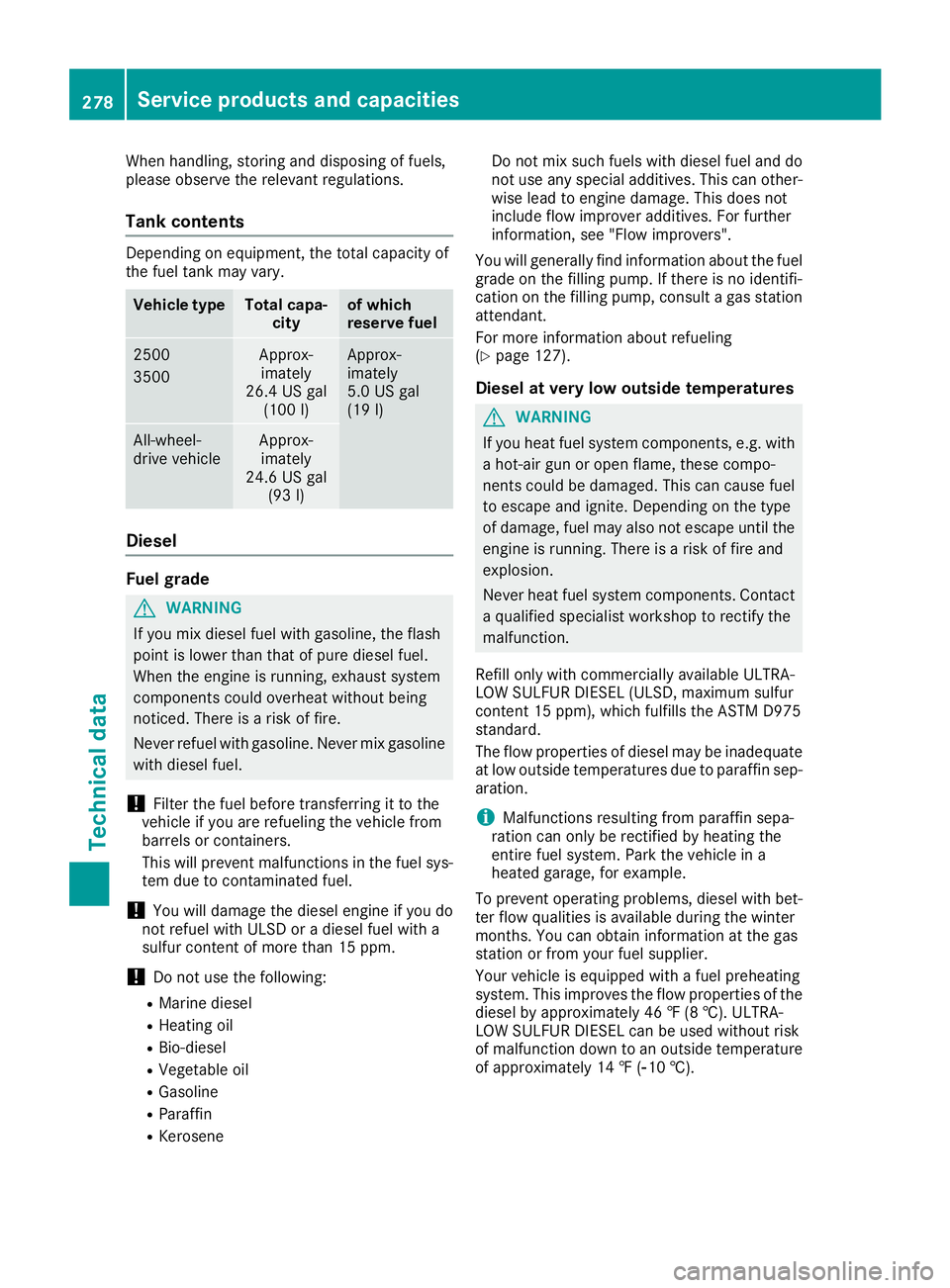
Tank contents
Depending on equipment, the total capacity of
the fuel tank may vary.
Vehicle typeTotal capa-cityof which
reserve fuel
2500
3500Approx-imately
26.4 US gal (100 l)Approx-
imately
5.0 US gal
(19 l)
All-wheel-
drive vehicleApprox-
imately
24.6 US gal (93 l)
Diesel
Fuel grade
GWARNING
If you mix diesel fuel with gasoline, the flash
point is lower than that of pure diesel fuel.
When the engine is running, exhaust system
components could overheat without being
noticed. There is a risk of fire.
Never refuel with gasoline. Never mix gasoline with diesel fuel.
!Filter the fuel before transferring it to the
vehicle if you are refueling the vehicle from
barrels or containers.
This will prevent malfunctions in the fuel sys-
tem due to contaminated fuel.
!You will damage the diesel engine if you do
not refuel with ULSD or a diesel fuel with a
sulfur content of more than 15 ppm.
!Do not use the following:
RMarine diesel
RHeating oil
RBio-diesel
RVegetable oil
RGasoline
RParaffin
RKerosene Do not mix such fuels with diesel fuel and do
not use any special additives. This can other-
wise lead to engine damage. This does not
include flow improver additives. For further
information, see "Flow improvers".
You will generally find information about the fuel
grade on the filling pump. If there is no identifi-
cation on the filling pump, consult a gas station
attendant.
For more information ab out re
fueling
(Ypage 127).
Diesel at very low outside temperatures
GWARNING
If you heat fuel system components, e.g. with
a hot-air gun or open flame, these compo-
nents could be damaged. This can cause fuel
to escape and ignite. Depending on the type
of damage, fuel may also not escape until the
engine is running. There is a risk of fire and
explosion.
Never heat fuel system components. Contact
a qualified specialist workshop to rectify the
malfunction.
Refill only with commercially available ULTRA-
LOW SULFUR DIESEL (ULSD, maximum sulfur
content 15 ppm), which fulfills the ASTM D975
standard.
The flow properties of diesel may be inadequate
at low outside temperatures due to paraffin sep-
aration.
iMalfunctions resulting from paraffin sepa-
ration can only be rectified by heating the
entire fuel system. Park the vehicle in a
heated garage, for example.
To prevent operating problems, diesel with bet-
ter flow qualities is available during the winter
months. You can obtain information at the gas
station or from your fuel supplier.
Your vehicle is equipped with a fuel preheating
system. This improves the flow properties of the
diesel by approximately 46 ‡ (8 †). ULTRA-
LOW SULFUR DIESEL can be used without ris k
o
f malfunction down to an outside temperature
of approximately 14 ‡ ( Ò10 †).
278Service products and capacities
Technical data
Page 281 of 290
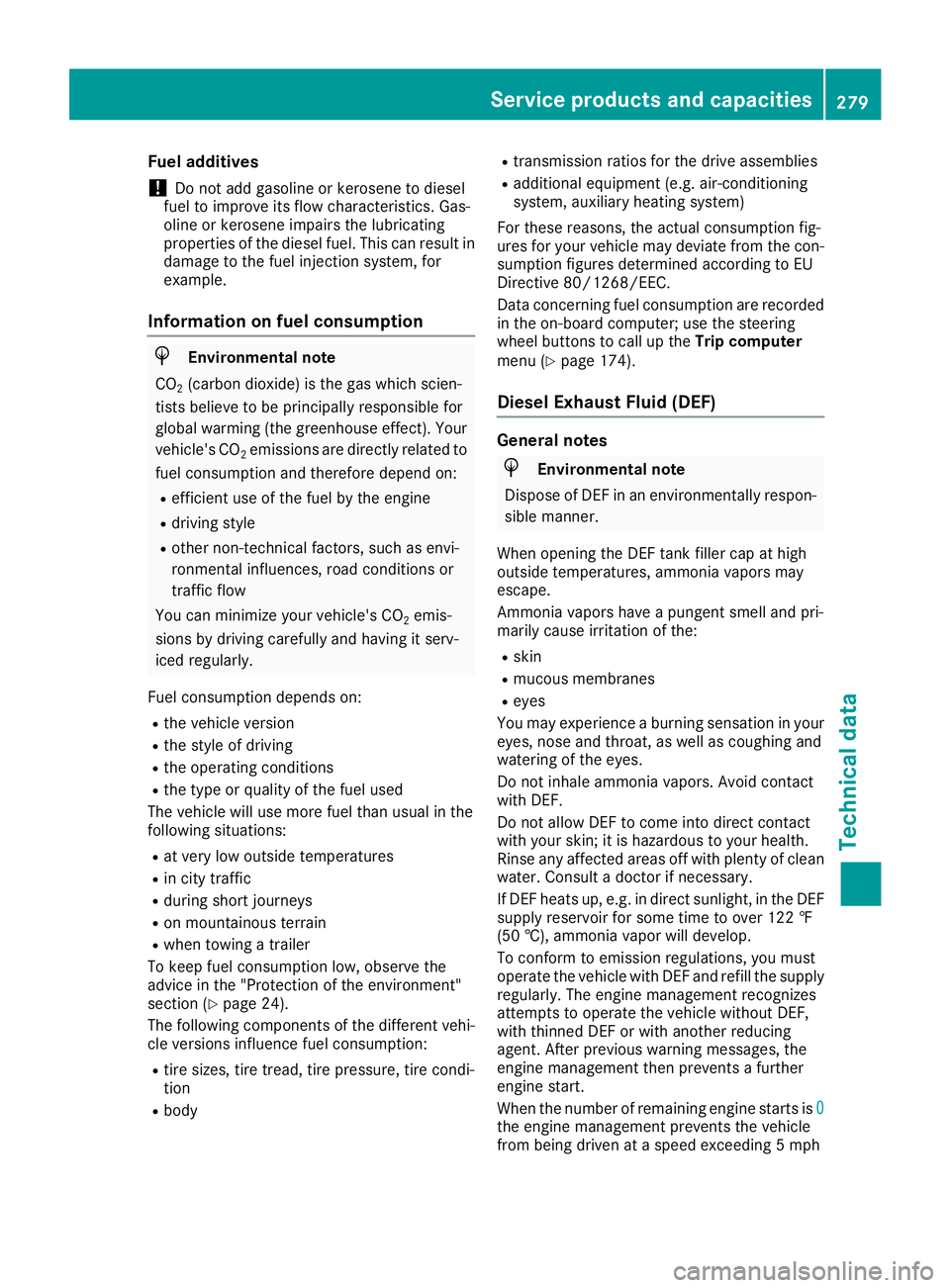
Fuel additives
!Do not add gasoline or kerosene todiesel
fuel to improve its flow characteristics. Gas-
olin e or kerosene impairs the lubricating
properties of the diesel fuel. This can result in
damage to the fuel injection system, for
example.
Information on fuel consumption
HEnvironmental note
CO
2(carbon dioxide) is the gaswhich scien-
tists believe to be prin cipally responsible for
global warming (the greenhouse effect). Your veh icle'sCO
2emissions are directly related to
fuel consumption and therefore depend on:
Reff icie nt use of the fuel bythe engine
Rdriv ing style
Rother non-technical factors, such as envi-
ronmental influences, road conditions or
traff icflow
You can min imize your veh icle'sCO
2emis-
sions by driv ing carefully and having itserv-
iced regularly.
Fuel consumption depends on:
Rthe vehicleversion
Rthe style of driving
Rthe operating conditions
Rthe type or quality of the fuel used
The veh icle will use more fuel than usual inthe
fol lowin g situations:
Rat very low outside temperatures
Rincity traff ic
Rduring short journeys
Ron mountainous terrain
Rwhen to winga trailer
To keep fuel consumption low,observe the
advice inthe "Protection of the environment"
section (
Ypage 24).
The fol lowing components of the different veh i-
cle versions influence fuel consumption:
Rtire sizes, tire tread, tire pressure, tire cond i-
tion
Rbody
Rtransmission ratios for the drive assemblies
Radditional equipment (e.g. air-conditioning
system, auxil iary heating system)
For these reasons, the actual consumption fig-
ures for your vehicle may deviate from the con-
sumption figures determined according to EU
Directive 80 /1268/EE C.
Data concerning fuel consumption are recorded
in the on-board computer; use the steering
wheel buttons to call up the Trip computer
menu (
Ypage 174).
Diesel Exhaust Fluid (DEF)
General notes
HEnvironmental note
Dispose of DEF in an environmentally respon-
sible manner.
When opening the DEF tank filler cap at high
outside temperatures, ammonia vapors may
escape.
Ammonia vapors have a pungent smell and pri-
marily cause irritation of the:
Rskin
Rmucous membranes
Reyes
You may experience a burning sensation in your
eyes, nose and throat, as well as coughing and
watering of the eyes.
Do not inhale ammonia vapors. Avoid contact
with DEF.
Do not allow DEF to come into direct contact
with your skin; it is hazardous to your health.
Rinse any affected areas off with plenty of clean water. Consult a doctor if necessary.
If DEF heats up, e.g. in direct sunlight, in the DEF
supply reservoir for some time to over 122 ‡
(50 †), ammonia vapor will develop.
To conform to emission regulations, you must
operate the vehicle with DEF and refill the supply
regularly. The engine management recognizes
attempts to operate the vehicle without DEF,
with thinned DEF or with another reducing
agent. After previous warning messages, the
engine management then prevents a further
engine start.
When the number of remaining engine starts is 0
the engine management prevents the vehicle
from being driven at a speed exceeding 5 mph
Service products and capacities279
Technical data
Z
Page 282 of 290
(8 km/h). The multifunction display shows the
Idle Modemessage.
DEF consumption
DEF consumption depends on operational and
driving conditions and it is not necessary to wait
until the next scheduled service to replenish the
fluid. Fluid should be added regularly to the DEF supply reservoir during vehicle operation or, at
the latest, after receiving the first warning mes-
sage via the on-board computer.
Low ambient temperatures
DEF freezes at a temperature of approximately
12 ‡(Ò11 †). The vehicle is equipped with a DEF
preheating system at the factory. Winter oper-
ation is therefore also guaranteed at tempera-
tures under 12 ‡ (Ò11 †).
iIf you add DEF at temperatures below 12 ‡
(Ò11 †) it is possible that the level is not
shown correctly due to the frozen DEF.
Drive for at least 20 minutes (heating phase in
the tank activated) and then stop the vehicle
for at least 30 seconds. The level is then
shown correctly.
Additives
!Do not mix DEF with any additives and do
not dilute DEF with tap water. Otherwise, the
exhaust gas aftertreatment may be damaged.
Observe the MB Specifications for Service
Products, Sheet No. 352.0.
Damage that arises through the use of addi-
tives or tap water will invalidate the New Vehi-
cle Limited Warranty.
Storage
!Containers made of aluminum, copper, cop-
per alloys as well as unalloyed or galvanized
steel are not suitable for storing DEF. If stored
in these types of containers, DEF could cause
constituents of these metals to dissolve and
cause irreparable damage to the exhaust gas
aftertreatment.
Damage caused by such impurities in the DEF
will invalidate the New Vehicle Limited War-
ranty.
Only store DEF in containers made of hi
gh-alloy
Cr‑Ni steel or Mo‑Cr‑Ni steel in accordance with
DIN EN 10 088 ‑1/2/3 or plastic containers
made of polypropylene or polyethylene.
Purity
!Impurities in DEF (e.g. caused by other ser-
vice products, cleaning agents, dust, etc.)
result in increased emissions, malfunctions,
catalytic converter damage or engine dam-
age.
The purity of DEF is essential to prevent mal-
functions in the exhaust gas aftertreatment.
If DEF is pumped out of the DEF tank, e.g. during
repair work, the same liquid must not be used to
refill the tank. Its purity is no longer guaranteed.
Disposal
Observe country-specific laws and regulations
when disposing of DEF.
% Environmental note
Dispose of DEF in an environmentally responsi-
ble manner.
DEF supply reservoir content
Tank contents
Diesel Exhaust Fluid (DEF)11
Approximately 4.7 US gal (18.0 l)
Engine oil
General notes
!The bottles of the various engine oil types
are marked with ACEA (Association des Con-
structeurs Européens d'Automobiles) and/or
API (American Petroleum Institute) classifica-
tions. Only use approved engine oils that con-
form to the following MB Specifications for
Service Products and the prescribed ACEA
and/or API classifications. Using engine oils
11DEF according to ISO 22241. Observe MB Specifications for Service Products, Sheet 352.0.
280Service products and capacities
Technical data
Page 285 of 290
Further information can be obtained at any
qualified specialist workshop.
Steering
Service product: power steering fluid
Product name/numberMaintenanceinterval
Mobil ATF‑D,
Exxon Mobil Corporation
or equivalent
MB Sheet No. 236.3—
The steering is maintenance-free. Further infor-
mation can be obtained at any qualified special-
ist workshop.
Brake fluid
GWARNING
The brake fluid constantly absorbs moisture
from the air. This lowers the boiling point of
the brake fluid. If the boiling point of the brake
fluid is too low, vapor pockets may form in the
brake system when the brakes are applied
hard. This would impair braking efficiency.
There is a risk of an accident.
You should have the brake fluid renewed at
the specified intervals.
!Brake fluid corrodes paint, plastic and rub-
ber. If paint, plastic or rubber has come into
contact with brake fluid, rinse with water
immediately.
Only use brake fluids approved for Sprinter vehi-
cles. Always check for the identification DOT 4
plus.
Information about approved brake fluids can be
found in the Maintenance Booklet or obtained at
any qualified specialist workshop.
Service product:
brake fluid
Product descrip-
tion and numberIntac B026E
RBoiling point: 500 ‡
(260 †)
RWet boiling point:
356 ‡ (180 †)
MB Sheet No.331.0
Maintenance
interval2 years
iHave the brake fluid renewed every 2 years
at a qualified specialist workshop.
There is usually a notice in the engine com-
partment to remind you when the next brake
fluid change is due.
Coolant
Important safety notes
GWARNING
If antifreeze comes into contact with hot com- ponents in the engine compartment, it may
ignite. There is a risk of fire and injury.
Let the engine cool down before you add anti-
freeze. Make sure that antifreeze is not spilled
next to the filler neck. Thoroughly clean the
antifreeze from components before starting
the engine.
!Take care not to spill any coolant on painted
surfaces. You could otherwise damage the
paintwork.
When handling, storing and disposing of coolant
and antifreeze, please observe the relevant reg-
ulations and the safety notes in the "Service
products and capacities" section (
Ypage 277).
Coolant additive with antifreeze
requirements
!Use only approved antifreeze/corrosion
inhibitor that complies with MB Specification
for Service Products, Sheet Number 325.
Using other, non-approved antifreeze/corro-
sion inhibitors may cause damage to the cool-
Service products and capacities283
Technical data
Z