brake MERCEDES-BENZ SPRINTER 2018 MY18 Operator’s Manual
[x] Cancel search | Manufacturer: MERCEDES-BENZ, Model Year: 2018, Model line: SPRINTER, Model: MERCEDES-BENZ SPRINTER 2018Pages: 294, PDF Size: 4.36 MB
Page 287 of 294
Information about approved brake fluids can be
obtained:
Ron the Internet at
http://bevo.mercedes-benz.com.
Coolant
Important safety notes
GWARNING
If antifreeze comes into contact with hot com- ponents in the engine compartment, it may
ignite. There is a risk of fire and injury.
Let the engine cool down before you add anti-
freeze. Make sure that antifreeze is not spilled
next to the filler neck. Thoroughly clean the
antifreeze from components before starting
the engine.
!Take care not to spill any coolant on painted
surfaces. You could otherwise damage the
paintwork.
When handling coolant, observe the important
safety notes for service products (
Ypage 278).
Coolant additive with antifreeze
requirements
!Use only approved antifreeze/corrosion
inhibitor that complies with MB Specification for Service Products, Sheet Number 325.
Using other, non-approved antifreeze/corro-
sion inhibitors may cause damage to the cool-
ant system and reduce the engine's service
life.
Coolant is a mixture of water and antifreeze/
corrosion inhibitor. It performs the following
tasks:
RAnti-corrosion protection
RAntifreeze protection
RRaises the boiling point
When the vehicle is first delivered, it is filled with
a coolant mixture that ensures adequate anti-
freeze/corrosion protection. Coolant must be
used in the system all year round to ensure anti-
corrosion protection and a raised boiling point –
even in countries with high outside tempera-
tures. To prevent damage to the engine cooling sys-
tem, use only approved corrosion inhibitor/anti-
freeze that comply with the Mercedes-Benz
Specifications for Service Products.
We recommend corrosion inhibitor/antifreeze
that meets the requirements in MB Specifica-
tions for Service Products Sheet Number 325.
Check the antifreeze/corrosion inhibitor con-
centration in the coolant every six months.
The percentage of corrosion inhibitor/anti-
freeze additive in the engine cooling system
should:
Rbe at least 50%. This way, the engine cooling
system is protected against freezing down to
approximately -35 ‡ (-37 †).
Rnot exceed 55 % otherwise heat will not be
dissipated as effectively. At 55 %,the engine
cooling system is protected against freezing
down to approximately -49 ‡ (-45 †).
If there has been coolant loss, do not refill only
with water. If the vehicle has lost coolant, add
equal parts water and corrosion inhibitor/anti-
freeze additive. The water used as part of the
coolant mixture must fulfill certain require-
ments; these are usually fulfilled by drinking
water. If the water quality is not s
ufficient, you
must treat the water.
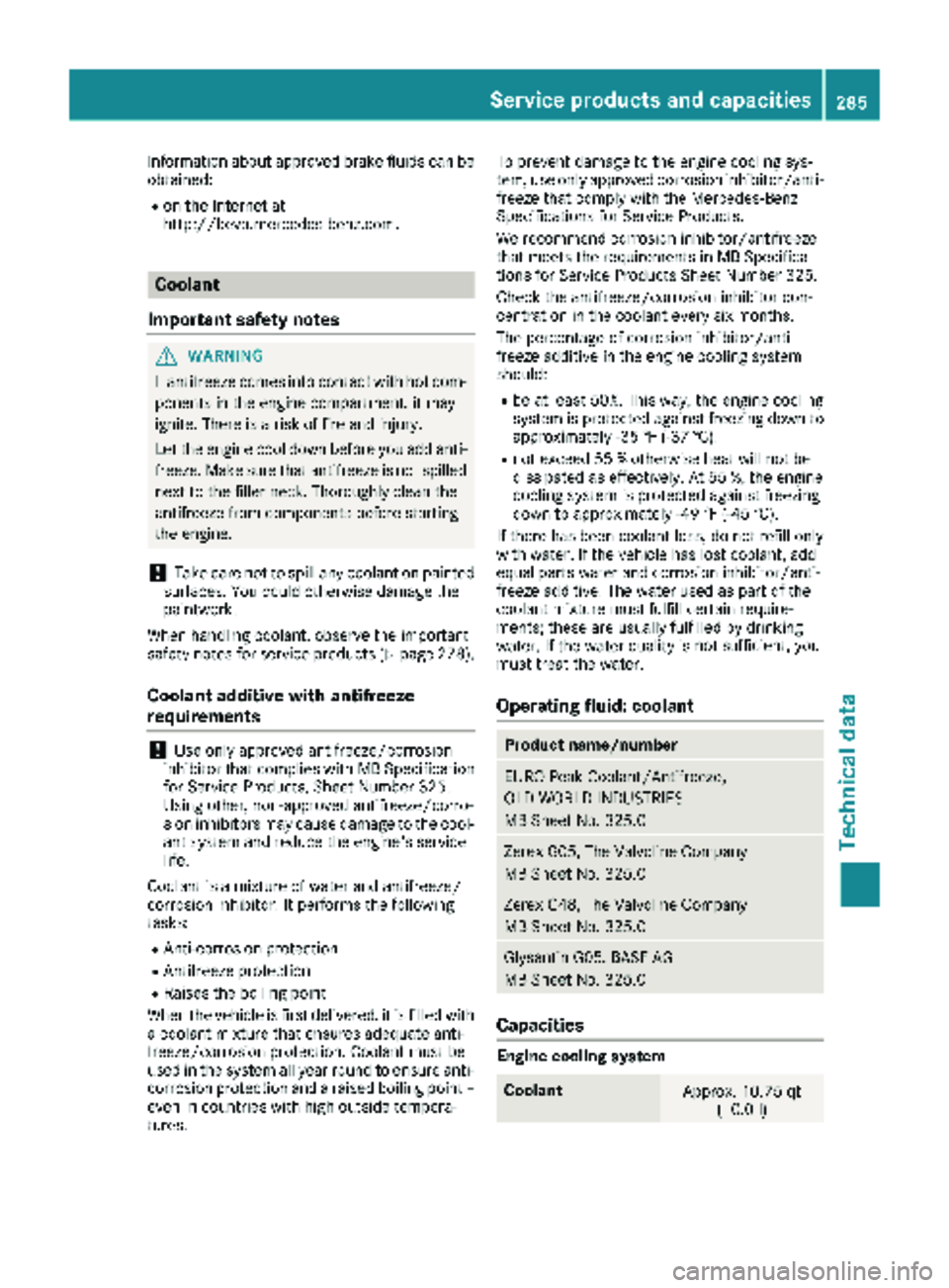
Operating fluid: coolant
Product name/number
EURO Peak Coolant/Antifreeze,
OLD WORLD INDUSTRIES
MB Sheet No. 325.0
Zerex G05, The Valvoline Company
MB Sheet No. 325.0
Zerex G48, The Valvoline Company
MB Sheet No. 325.0
Glysantin G05, BASF AG
MB Sheet No. 325.0
Capacities
Engine cooling system
CoolantApprox. 10.75 qt (10.0 l)
Service products and capacities285
Technical data
Z
Page 289 of 294
Cargo tie-down points and carrier sys-
tems
Cargo tie-down points
General notes
!Observe the information on the maximum
loading capacity of the individual cargo tie-
down points.
If you use several cargo tie-down points to
secure a load, you must always take the max-
imum loading capacity of the weakest cargo
tie-down point into account.
If you brake hard, for example, the forces act-
ing could be up to several times the weight
force of the load. Always use multiple cargo
tie-down points in order to distribute the force absorption. Load the anchorages evenly.
You will find further information about cargo tie
down points and cargo tie-down rings in the
"Transporting" section (
Ypage 215).
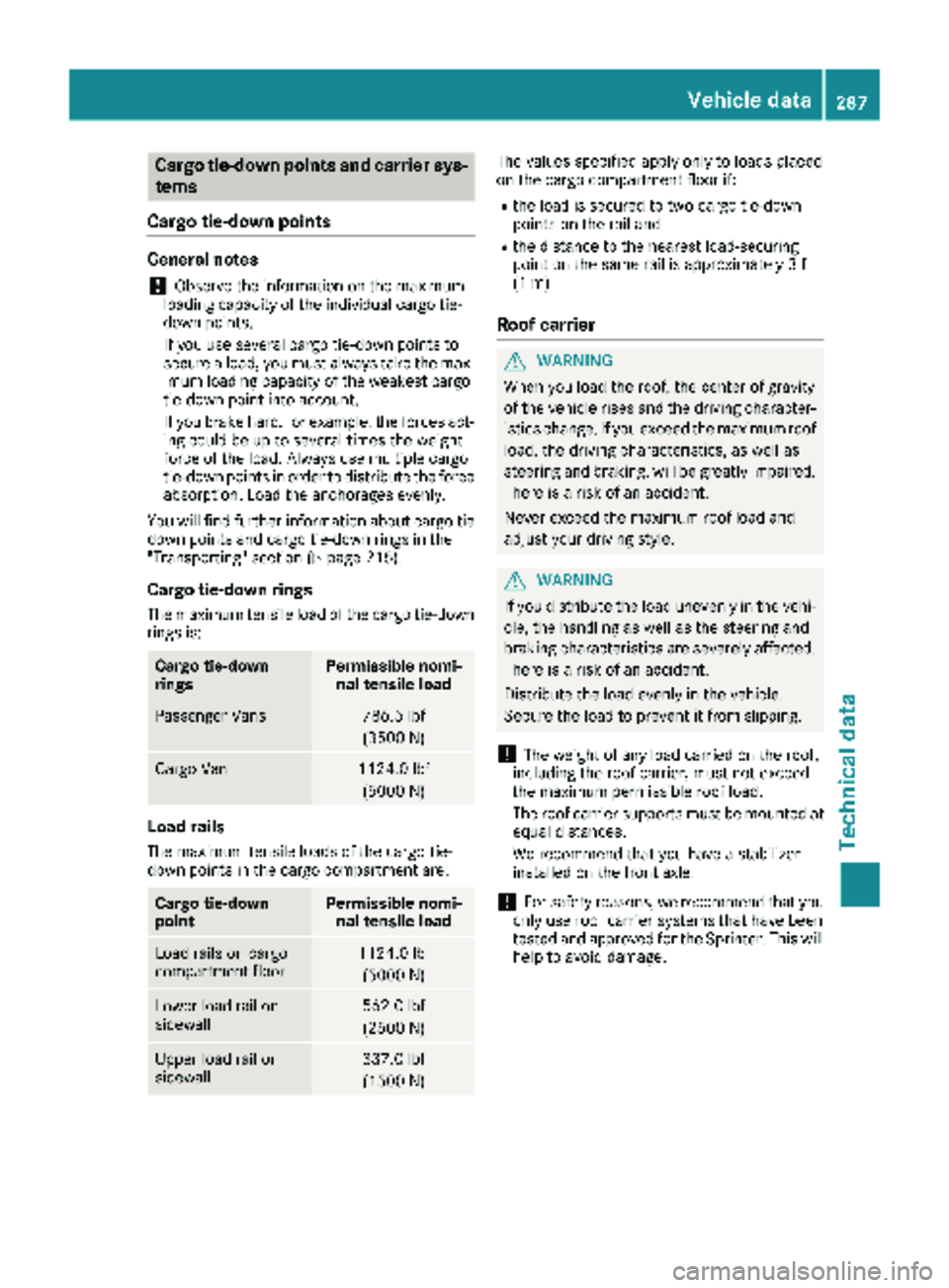
Cargo tie-down rings
The maximum tensile load of the cargo tie-down rings is:
Cargo tie-down
ringsPermissible nomi- nal tensile load
Passenger Vans786.5 lbf
(3500 N)
Cargo Van1124.0 lbf (5000 N)
Load rails
The maximum tensile loads of the cargo tie-
down points in the cargo compartment are:
Cargo tie-down
pointPermissible nomi- nal tensile load
Load rails on cargo
compartment floor1124.0 lbf
(5000 N)
Lower load rail on
sidewall562.0 lbf(2500 N)
Upper load rail on
sidewall337.0 lbf(1500 N)
The values specified apply only to loads placed
on the cargo compartment floor if:
Rthe load is secured to two cargo tie-down
points on the rail and
Rthe distance to the nearest load-securing
point on the same rail is approximately 3 ft
(1 m)
Roof carrier
GWARNING
When you load the roof, the center of gravity
of the vehicle rises and the driving character-
istics change. If you exceed the maximum roof
load, the driving characteristics, as well as
steering and braking, will be greatly impaired.
There is a risk of an accident.
Never exceed the maximum roof load and
adjust your driving style.
GWARNING
If you distribute the load unevenly in the vehi- cle, the handling as well as the steering and
braking characteristics are severely affected.
There is a risk of an accident.
Distribute the load evenly in the vehicle.
Secure the load to prevent it from slipping.
!The weight of any load carried on the roof,
including the roof carrier, must not exceed
the maximum permissible roof load.
The roof carrier supports must be mounted at
equal distances.
We recommend that you have a stabilizer
installed on the front axle.
!For safety reasons, we recommend that you
only use roof carrier systems that have been
tested and approved for the Sprinter. This will
help to avoid damage.
Vehicle data287
Technical data
Z
Page 291 of 294
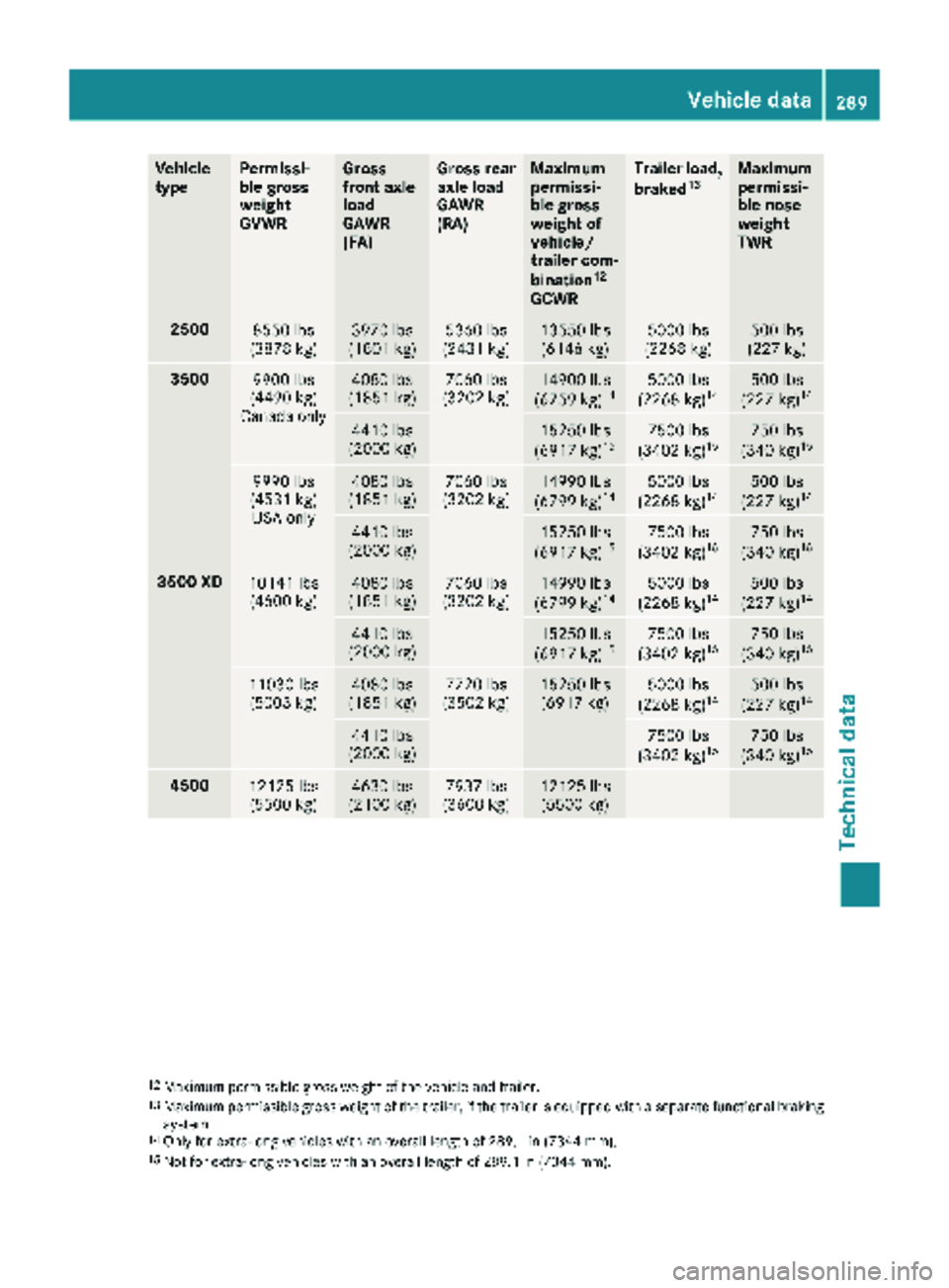
Vehicle
typePermissi-
ble gross
weight
GVWRGross
front axle
load
GAWR
(FA)Gross rear
axle load
GAWR
(RA)Maximum
permissi-
ble gross
weight of
vehicle/
trailer com-
bination
12
GCWR
Trailer load,
braked13Maximum
permissi-
ble nose
weight
TWR
25008550 lbs
(3878 kg)3970 lbs
(1801 kg)5360 lbs
(2431 kg)13550 lbs (6146 kg)5000 lbs
(2268 kg)500 lbs
(227 kg)
35009900 lbs
(4490 kg)
Canada only4080 lbs
(1851 kg)7060 lbs
(3202 kg)14900 lbs
(6759 kg)145000 lbs
(2268 kg)14500 lbs
(227 kg)14
4410 lbs
(2000 kg)15250 lbs
(6917 kg)157500 lbs
(3402 kg)15750 lbs
(340 kg)15
9990 lbs
(4531 kg) USA only4080 lbs
(1851 kg)7060 lbs
(3202 kg)14990 lbs
(6799 kg)145000 lbs
(2268 kg)14500 lbs
(227 kg)14
4410 lbs
(2000 kg)15250 lbs
(6917 kg)157500 lbs
(3402 kg)15750 lbs
(340 kg)15
3500 XD10141 lbs (4600 kg)4080 lbs
(1851 kg)7060 lbs
(3202 kg)14990 lbs
(6799 kg)145000 lbs
(2268 kg)14500 lbs
(227 kg)14
4410 lbs
(2000 kg)15250 lbs
(6917 kg)157500 lbs
(3402 kg)15750 lbs
(340 kg)15
11030 lbs (5003 kg)4080 lbs
(1851 kg)7720 lbs
(3502 kg)15250 lbs (6917 kg)5000 lbs
(2268 kg)14500 lbs
(227 kg)14
4410 lbs
(2000 kg)7500 lbs
(3402 kg)15750 lbs
(340 kg)15
450012125 lbs (5500 kg)4630 lbs
(2100 kg)7937 lbs
(3600 kg)12125 lbs (5500 kg)——
12Maximum permissible gross weight of the vehicle and trailer.13Maximum permissible gross weight of the trailer, if the trailer is equipped with a separate functional braking
system.
14Only for extra-long vehicles with an overall length of 289.1 in (7344 mm).15Not for extra-long vehicles with an overall length of 289.1 in (7344 mm).
Vehicle data289
Technical data
Z