adding oil MERCEDES-BENZ SPRINTER 2018 MY18 Operator’s Manual
[x] Cancel search | Manufacturer: MERCEDES-BENZ, Model Year: 2018, Model line: SPRINTER, Model: MERCEDES-BENZ SPRINTER 2018Pages: 294, PDF Size: 4.36 MB
Page 12 of 294
Driving systemsBlind Spot Assis t............................ 14 3
Cruis econtrol ................................ 13 9
Displa ymessage ............................ 19 1
Lan eKeepin gAssis t...................... 14 5
PARKTRONI C................................. 150
Driving tips
Automati ctransmissio n................ .125
Brakes ...........................................1 34
Break-in period .............................. 118
Checking brake lining thickness .... 135
Downhill gradient ........................... 134
Drinking and driving ....................... 132
Driving abroad ............................... 133
Driving in winter .............................1 36
Driving on flooded roads ................ 136
Driving on wet roads ......................1 36
Exhaust check ............................... 133
Fuel ................................................ 132
General .......................................... 132
Hydroplaning ................................. 136
Icy road surfaces ........................... 136
Important safety notes .................. 118
Limited braking efficiency on sal-
ted roads ....................................... 135
New brake disks ............................ 135
New brake pads/linings ................ 135
Off-road driving .............................. 137
Overrun cut-off .............................. 132
Snow chains .................................. 251
Speed limitation .............................1 33
Towing a trailer .............................. 154
Transport by rail .............................1 34
Wet road surface ........................... 135
DSR (Downhill Speed Regulation) .... 148
E
EBD (electronic brake force distri-
bution)
Display message ............................ 183
Function/notes ................................ 56
Indicator lamps .............................. 196
Electrical closing assist ......................68
Electrical step
Cleaning ........................................ .238
Display message ............................ 194
Emergency release .......................... 68 Function ...........................................6
8
Important safety notes .................... 68
Indicator lamp ................................ 204
Manual retraction ............................ 68
Obstacle detection ........................... 68
Electrical system
Battery main switch ....................... 118
Electronic brake force distribution
see EBD (electronic brake force
distribution)
Electronic Stability Program
see ESP
®(Electronic Stability Program)
Emergency exit .................................... 57
Emergency exit window .....................57
Emergency Tensioning Devices
Activation ........................................ .47
Emissions control
Service and warranty information .... 23
Engine
ADR (working speed governor) ...... 153
Changing the power output ............ .27
Check Engine warning lamp .......... .201
Cleaning instructions ..................... 235
Engine number ............................... 278
Engine speed setting (working
mode) ............................................ 154
Irregular running ............................ 122
Jump-starting ................................. 243
Operating safety .............................. 27
Starting .......................................... 120
Starting problems .......................... 122
Switching off .................................. 131
Tow-starting (vehicle) ..................... 247
Engine electronics
Notes ............................................. 276
Probl
em (malfunction) ................... 122
Engine oil
Adding ...........................................2 23
Additives ........................................ 283
Checking the oil level (on-board
computer) ...................................... 221
Checking the oil level using the
dipstick .......................................... 222
Display message ............................ 191
Filling capacity ............................... 283
Information about oil consump-
tion ................................................ 283
Mixing ............................................ 283
10Index
Page 13 of 294
Notes about oil grades ................... 282
Oil change ...................................... 283
Oil level (note) ............................... 221
Viscosity ........................................ 282
Warning lamp .................................200
Engine speed setting (working
mode) ................................................. 153
ESP
®(Electronic Stability Pro-
gram)
Crosswind Assist .............................5 7
Display message ............................ 184
Important safety information ........... 56
Indicator lamp ................................ 199
Warning lamp ................................. 195
Exhaust check ................................... 133
Exhaust gas aftertreatment
DEF level indicator .........................1 61
DEF reducing agent ....................... 281
Diesel Exhaust Fluid (DEF) ............. 281
Indicator lamp ................................ 202
Refilling DEF .................................. 128
Exterior lighting
see Lights
Exterior mirrors
Adjusting ......................................... 80
Important safety notes .................... 80
Eyeglasses compartment ................. 206
F
Fire extinguisher............................... 243
First-aid kit ......................................... 242
Flat tire
Changing a wheel/mounting the
spare wheel ................................... 268
General notes ................................ 267
Fog lamps
Switching on/off .............................. 83
Fogged up-up windows
see Climate control
Folding seat ......................................... 76
Frequencies
Mobile phone ................................. 276
Two-way radio ................................ 276
Front interior light
Replacing bulbs ............................... 95
Fuel
Additives (diesel) ........................... 280 Consumption information .............. 280
Consumption statistics .................. 173
Diesel at very low outside temper-
atures ............................................ 279
Driving tips ....................................1 32
Fuel gauge ..................................... 161
Problem (malfunction) ................... 128
Quality (diesel) ............................... 279
Refueling ........................................ 126
Showing the range (vehicles with
steering wheel buttons) ................. 173
Tank content/reserve fuel ............. 279
Fuel filter with water separator
draining ......................................... 225
Indicator lamp ................................ 203
Fuel gauge ......................................... 161
Fuel tank
Problem (malfunction) ................... 128
Fuel tank
see Fuel tank
Fuses .................................................. 247
G
Gasoline
Reserve fuel warning lamp ............. 201
General driving tips
Driving short distances .................. 133
Genuine parts ...................................... 29
Glove box ........................................... 205
GTW (Gross Trailer Weight) (defini-
tion) .................................................... 265
H
Handbrake
see Parking brake
Hazard warning lamps ........................ 85
Head restraints
Adjusting ......................................... 78
Headlamps
Adding fluid to cleaning system ..... 225
Cleaning system (function) .............. 85
Fogging up ....................................... 86
see Automatic headlamp mode
Headliner (cleaning instructions) .... 239
Heating
see Climate control
Index11
Page 23 of 294
Two-way radiosType approval/frequency .............. 276
TWR (Tongue Weight Rating) (defi-
nition) ................................................. 266
Type plate
Vehicle identification number
(VIN) .............................................. 276
U
UnlockingFrom inside the vehicle (central
unlocking button) ............................. 65
USB port ............................................. 212
V
Vehicle
Data acquisition ............................... 30
Display message ............................ 194
Electronics ..................................... 276
Equipment ....................................... 23
Individual settings (vehicles with
steering wheel buttons) ................. 167
Limited Warranty ............................. 23
Loading .......................................... 259
Locking (SmartKey) .......................... 61
Lowering ........................................ 272
Maintenance .................................... 24
Operating safety .............................. 26
Parking for a long period ................ 131
Pulling away ................................... 121
Raising ........................................... 268
Registration ..................................... 28
Reporting problems ......................... 28
Securing from rolling away ............ 129
Towing away .................................. 244
Transporting .................................. 247
Unlocking (SmartKey) ...................... 61
Vehicle battery
see Battery (vehicle)
Vehicle bodies ..................................... 28
Body/equipment mounting direc-
tives for trucks ................................. 28
Vehicle data ....................................... 286
Vehicle identification number .......... 276
Vehicle identification plate .............. 276
Vehicle tool kit .................................. 241 VIN
...................................................... 276
Voltage supply
Fuses ............................................. 247
W
WarningStickers ........................................... 25
Warning and indicator lamp
Power assistance for the steering .. 204
Warning and indicator lamps
Brakes ........................................... 197
Check Engine ................................. 201
Coolant .......................................... 200
Diesel Exhaust Fluid (DEF) ............. 198
Distance warning function ............. 195
Electrical step ................................ 204
ESP
®.............................................. 195
ESP®function ................................ 199
Lane Keeping Assist ...................... 195
Overview .......................................... 35
Seat belt ........................................ 203
Warning lamp .................................... 242
Warning triangle ................................ 242
Warning- and indicator lamps
ABS ................................................ 196
Air filter .......................................... 202
ASR ................................................ 195
BAS ................................................ 196
Battery charge ............................... 199
Brake wear .................................... 199
Bulbs .............................................. 203
Doors ............................................. 203
Engine oil level ............................... 200
Preglow .......................................... 202
Reserve fuel ................................... 201
Tire pressure monitor .................... 202
Water separator ............................. 203
Windshield washer fluid ................. 203
Warranty .............................................. 23
Washer fluid
Adding ........................................... 225
Capacities ...................................... 286
Display message ............................ 194
Indicator lamp ................................ 203
Notes ............................................. 286
Wiping with ...................................... 96
Index21
Page 225 of 294
XInsert oil dipstick:back into the guide tube
as far as it will go and remove it again.
If the level is between minimum mark =and
maximum mark ;, the oil level is correct.
XIf the oil level has dropped to or below mini-
mum mark=, open cap ?and add engine oil
(
Ypage 223).
The difference in quantity between marks ;
and =is approximately 2 qt (2 l).
XInsert the oil dipstick into the guide tube as far
as it will go.
XClose the hood (Ypage 220).
OM651 4-cylinder diesel engine:
At outside temperatures between 32 ‡ (–0 †)
and 86 ‡ (30 †), the oil level can be checked
when the engine is cold.
Measuring the engine oil when the engine is cold
is less precise than measuring when the engine
is at normal operating temperature.
When the appropriate warning is shown in the
display
XAdd engine oil (Ypage 223)
or
XHave engine oil siphoned off.
Add engine oil
GWARNING
If engine oil comes into contact with hot com- ponents in the engine compartment, it may
ignite. There is a risk of fire and injury.
Make sure that engine oil is not spilled next to
the filler neck. Let the engine cool down and
thoroughly clean the engine oil off the com-
ponents before starting the engine.
!The alternator is located below the engine
oil filler neck. If engine oil spills onto the alter-
nator, there is a danger of alternator damage.
Be very careful when adding engine oil.
HEnvironmental note
When adding oil, take care not to spill any. If
oil enters the soil or waterways, it is harmful to
the environment.
!Do not add too much oil. adding too much
engine oil can result in damage to the engine
or to the catalytic converter. Have excess
engine oil siphoned off.
!Do not use any additives in the engine oil.
This could damage the engine.
XOpen the hood (Ypage 219).
XUnscrew and remove cap ?.
XAdd engine oil.
XReplace cap?on the filler neck and tighten.
When doing so, make sure that the cap
engages correctly.
XCheck the oil level with the oil dipstick
(Ypage 222) or on the display (Ypage 221).
XClose the hood.
Coolant
GWARNING
The engine cooling system is pressurized, par-
ticularly when the engine is warm. When
opening the cap, you could be scalded by hot
coolant spraying out. There is a risk of injury.
Let the engine cool down before opening the
cap. Wear eye and hand protection when
opening the cap. Open the cap slowly half a
turn to allow pressure to escape.
Only check the coolant level and/or fill the cool-
ant if the vehicle is on a level surface and the
engine has cooled down. The coolant tempera-
ture must be below 122 ‡ (50 †).
!Check the engine cooling and heating sys-
tem regularly for leaks.
If a large quantity of coolant is lost, have the
cause traced and rectified at a qualified spe-
cialist workshop.
GWARNING
If antifreeze comes into contact with hot com- ponents in the engine compartment, it may
ignite. There is a risk of fire and injury.
Let the engine cool down before you add anti-
freeze. Make sure that antifreeze is not spilled
next to the filler neck. Thoroughly clean the
antifreeze from components before starting
the engine.
!Take care not to spill any coolant on painted
surfaces. You could otherwise damage the
paintwork.
Engine compartment223
Maintenance and care
Z
Page 226 of 294
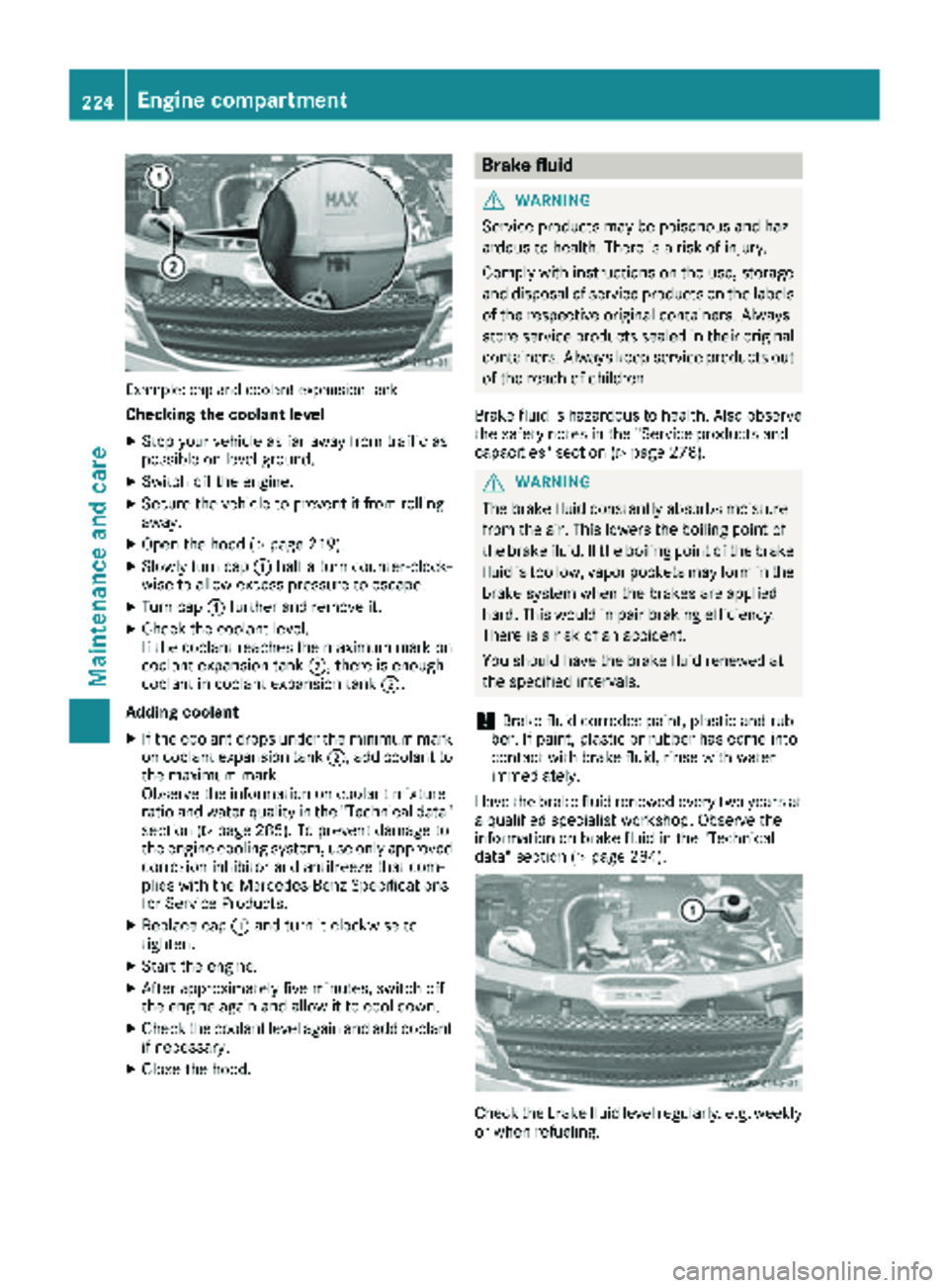
Example: cap and coolant expansion tank
Checking the coolant level
XStop your vehicle as far away from traffic as
possible on level ground.
XSwitch off the engine.
XSecure the vehicle to prevent it from rolling
away.
XOpen the hood (Ypage 219).
XSlowly turn cap:half a turn counter-clock-
wise to allow excess pressure to escape.
XTurn cap :further and remove it.
XCheck the coolant level.
If the coolant reaches the maximum mark on
coolant expansion tank ;, there is enough
coolant in coolant expansion tank ;.
Adding coolant
XIf the coolant drops under the minimum mark
on coolant expansion tank ;, add coolant to
the maximum mark.
Observe the information on coolant mixture
ratio and water quality in the "Technical data"
section (
Ypage 285). To prevent damage to
the engine cooling system, use only approved
corrosion inhibitor and antifreeze that com-
plies with the Mercedes-Benz Specifications
for Service Products.
XReplace cap :and turn it clockwise to
tighten.
XStart the engine.
XAfter approximately five minutes, switch off
the engine again and allow it to cool down.
XCheck the coolant level again and add coolant
if necessa ry.
XClose the hood.
Brake fluid
GWARNING
Service products may be poisonous and haz-
ardous to health. There is a risk of injury.
Comply with instructions on the use, storage
and disposal of service products on the labels
of the respective original containers. Always
store service products sealed in their original
containers. Always keep service products out
of the reach of children.
Brake fluid is hazardous to health. Also observe
the safety notes in the "Service products and
capacities" section (
Ypage 278).
GWARNING
The brake fluid constantly absorbs moisture
from the air. This lowers the boiling point of
the brake fluid. If the boiling point of the brake
fluid is too low, vapor pockets may form in the
brake system when the brakes are applied
hard. This would impair braking efficiency.
There is a risk of an accident.
You should have the brake fluid renewed at
the specified intervals.
!Brake fluid corrodes paint, plastic and rub-
ber. If paint, plastic or rubber has come into
contact with brake fluid, rinse with water
immediately.
Have the brake fluid renewed every two years at
a qualified specialist workshop. Observe the
information on brake fluid in the "Technical
data" section (
Ypage 284).
Check the brake fluid level regularly, e.g. weekly
or when refueling.
224Engine compartment
Maintenance and care
Page 285 of 294
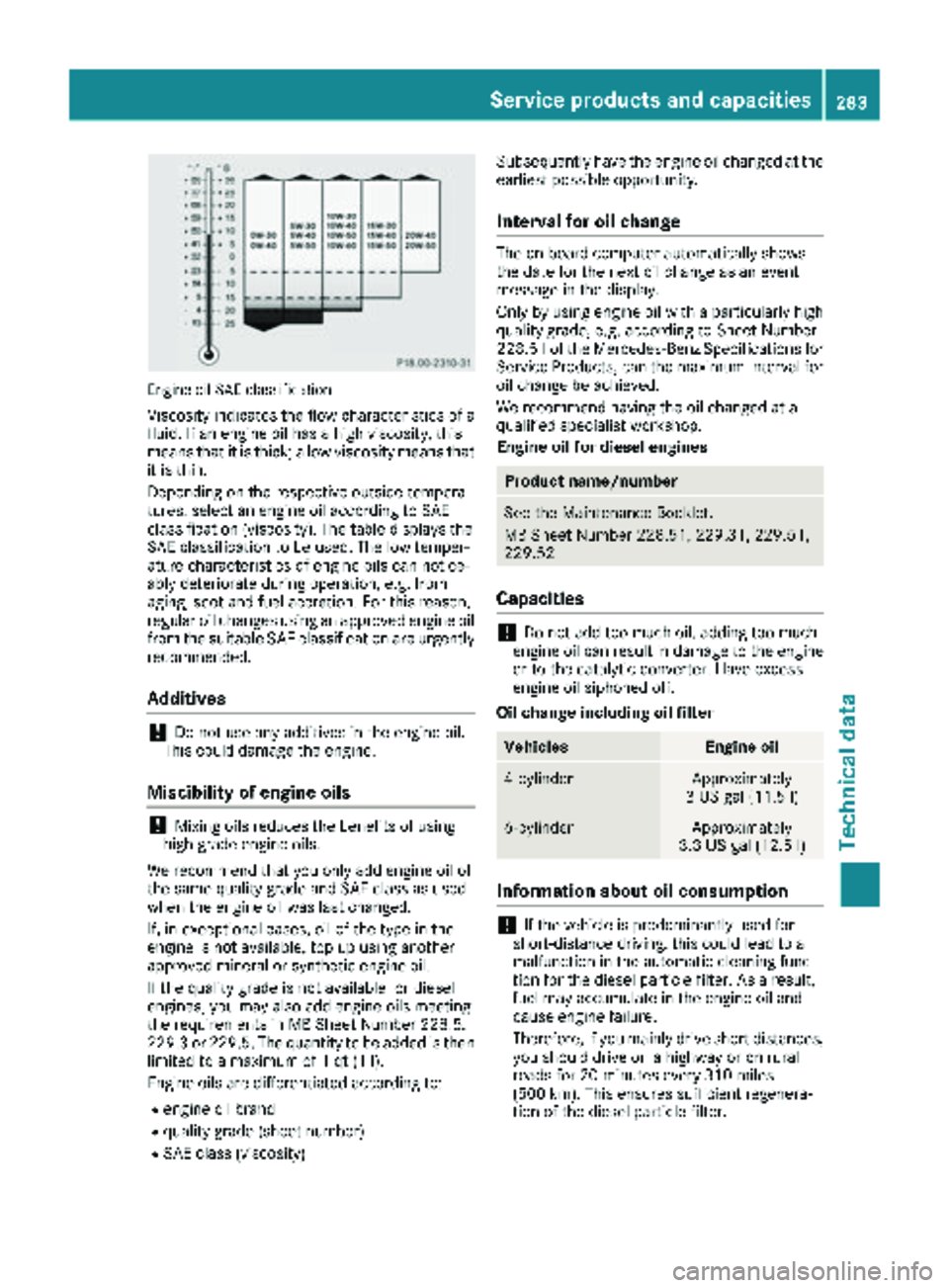
Engine oil SAE classification
Viscosity indicates the flow characteristics of a
fluid. If an engine oil has a high viscosity, this
means that it is thick; a low viscosity means thatit is thin.
Depending on the respective outside tempera-
tures, select an engine oil according to SAE
classification (viscosity). The table displays the
SAE classification to be used. The low temper-
ature characteristics of engine oils can notice-
ably deteriorate during operation, e.g. from
aging, soot and fuel accretion. For this reason,
regular oil changes using an approved engine oil
from the suitable SAE classification are urgently
recommended.
Additives
!Do not use any additives in the engine oil.
This could damage the engine.
Miscibility of engine oils
!Mixing oils reduces the benefits of using
high grade engine oils.
We recommend that you only add engine oil of
the same quality grade and SAE class as used
when the engine oil was last changed.
If, in exceptional cases, oil of the type in the
engine is not available, top up using another
approved mineral or synthetic engine oil.
If the quality grade is not available for diesel
engines, you may also add engine oils meeting
the requirements in MB Sheet Number 228.5,
229.3 or 229.5. The quantity to be added is then
limited to a maximum of 1 qt (1 l).
Engine oils are differentiated according to:
Rengine oil brand
Rquality grade (sheet number)
RSAE class (viscosity) Subsequently have the engine oil changed at the
earliest possible opportunity.
Interval for oil change
The on-board computer automatically shows
the date for the next oil change as an event
message in the display.
Only by using engine oil with a particularly high
quality grade, e.g. according to Sheet Number
228.51 of the Mercedes-Benz Specifications for
Service Products, can the maximum interval for
oil change be achieved.
We recommend having the oil changed at a
qualified specialist workshop.
Engine oil for diesel engines
Product name/number
See the Maintenance Booklet.
MB Sheet Number 228.51, 229.31, 229.51,
229.52
Capacities
!Do not add too much oil. adding too much
engine oil can result in damage to the engine
or to the catalytic converter. Have excess
engine oil siphoned off.
Oil change including oil filter
VehiclesEngine oil
4-cylinderApproximately
3 US gal (11.5 l)
6-cylinderApproximately
3.3 US gal (12.5 l)
Information about oil consumption
!If the vehicle is predominantly used for
short-distance driving, this could lead to a
malfunction in the automatic cleaning func-
tion for the diesel particle filter. As a result,
fuel may accumulate in the engine oil and
cause engine failure.
Therefore, if you mainly drive short distances,
you should drive on a highway or on rural
roads for 20 minutes every 310 miles
(500 km). This ensures sufficient regenera-
tion of the diesel particle filter.
Service products and capacities283
Technical data
Z