coolant MERCEDES-BENZ SPRINTER 2019 MY19 with 7” screen
[x] Cancel search | Manufacturer: MERCEDES-BENZ, Model Year: 2019, Model line: SPRINTER, Model: MERCEDES-BENZ SPRINTER 2019Pages: 354, PDF Size: 6.15 MB
Page 233 of 354
#
Neverto uch the danger zone sur round‐
ing moving component parts, e.g. the
ro tation area of thefa n. #
Remo vejewe lry and watches. #
Keep items of clo thing and hair away
from moving parts. &
WARNING Risk of bu rns from hot com‐
ponent parts in the engine compartment
Cer tain components in the engine compart‐
ment can be very hot, e.g. the engine, the
ra diator and parts of theex haust sy stem. #
Allow the engine tocool down and only
to uch component parts desc ribed in the
fo llowing. If
yo u ha vetocar ryout any workinthe engine
compartment, touch only thefo llowing compo‐
nents:
R Hood
R Engine oil filler opening cap
R Washer fluid reser voir cap
R Coolant expansion reser voir cap #
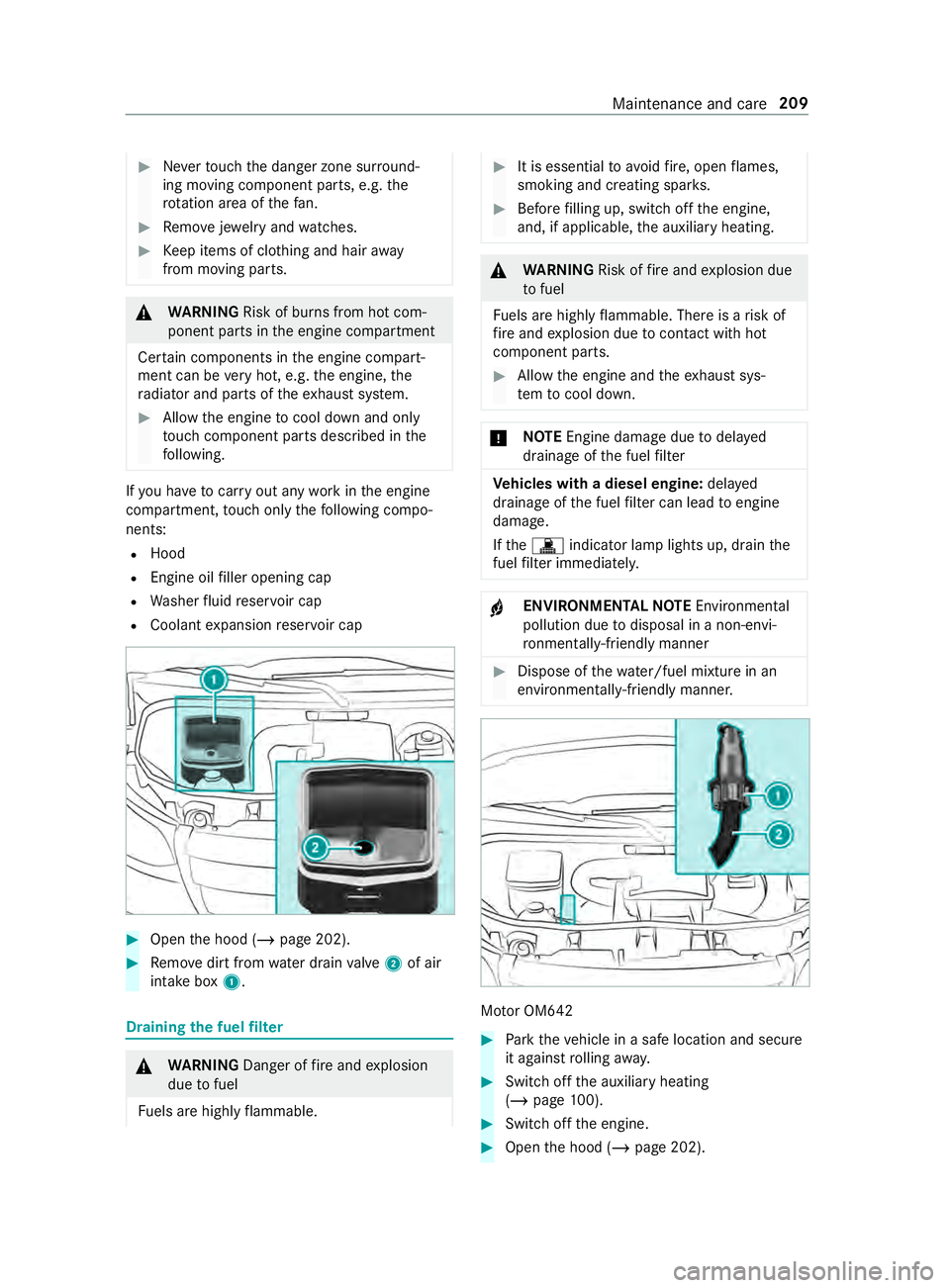
Open the hood (/ page 202). #
Remo vedirt from water drain valve 2 of air
intake box 1. Draining
the fuel filter &
WARNING Danger of fire and explosion
due tofuel
Fu els are highly flammable. #
It is essential toavoid fire , open flames,
smoking and creating spar ks. #
Before filling up, switch off the engine,
and, if applicable, the auxiliary heating. &
WARNING Risk offire and explosion due
to fuel
Fu els are highly flammable. There is a risk of
fi re and explosion due tocontact wi thhot
component parts. #
Allow the engine and theex haust sys‐
te m to cool down. *
NO
TEEngine damage due todela yed
drainage of the fuel filter Ve
hicles with a diesel engine: delayed
drainage of the fuel filter can lead toengine
damage.
If th e003A indicator lamp lights up, drain the
fuel filter immediately. +
ENVIRONMENTAL
NOTEEnvironmental
pollution due todisposal in a non-envi‐
ro nmental ly-friendly manner #
Dispose of thewate r/fuel mixture in an
environmentally-friendly manner. Mo
tor OM642 #
Park theve hicle in a safe location and secure
it against rolling away. #
Switch off the auxiliary heating
(/ page 100). #
Switch off the engine. #
Open the hood (/ page 202). Maintenance and care
209
Page 236 of 354
Obser
vethefo llowing no tes: Note
s on cleaning and car eAvoiding paintwork damage
Pa int
R
Insect remains: soak with insect
re mo ver and then wash off.
R Bird droppings: soak with water and
th en wash off.
R Remo vecoolant, tree resin, oils,
fuels and greases: rubge ntly wi th a
clo thsoaked in petroleum ether or
lighter fluid.
R Brake fluid: wash off with water.
R Tarst ains: use tarre mo ver.
R Wax: use a silicone remo ver. R
Do not af fix st icke rs,fi lms or similar.
R Remo vedirt as soon as possible.
Mat tefinish
R
Only use care products appr ovedfor
Mercedes-Benz. R
Do not polish theve hicle and alloy
wheels.
R Do not use a wash program that
ends with a hot wax treatment in
au tomatic car washes.
R Do not use paint cleaners, buf fing or
polishing products, or gloss preserv‐
ers, e.g. wax.
R Have paint repairs car ried out in a
qu alified specialist workshop onl y. Note
s onthe care of vehicle parts &
WARNING Risk of entrapment if the
windshield wipers are swit ched on while
th e windshield is being cleaned
If th e windshield wipers are set in motion
while you are cleaning the windshield or
wiper blades, you can be trapped bythe wiper
arm. #
Always switch off the windshield wipers
and the ignition before cleaning the
windshield or wiper blades. &
WARNING Risk of bu rning from theta il‐
pipe or tailpipe trim
The tailpipe and tailpipe trim can become
ve ry hot. If you come into con tact wi th these
car parts, you could burn yourself. #
Always be particularly careful when in
th e vicinity of theta ilpipe and tailpipe
trims and supervise children very
closely when in this area. #
Before any con tact, allow the car parts
to cool down. 212
Maintenance and care
Page 271 of 354
Ra
ting. You can find the Gross Axle Weight Rating
on the B-pillar on the driver's side.
Speed rating: the speed rating is pa rtof the tire
identification. It specifies the speed range for
which a tire is appr oved.
GV W (Gross Vehicle Weight): the Gross Vehicle
We ight includes thewe ight of theve hicle includ‐
ing fuel, tools, the spare wheel, accessories
ins talled, occupants, luggage and the trailer
dr aw bar nose weight if applicable. The Gross Vehi‐
cle Weight must ne verex ceed the Gross Vehicle
We ight Rating (GVWR) specified on the B-pillar on
th e driver's side.
GV WR (Gross Vehicle Weight Rating): the
GV WR is the maximum permitted gross weight of
th e fully laden vehicle (weight of theve hicle
including all accessories, occupants, fuel, lug‐
ga ge and the trailer dr awbar nose weight if appli‐
cable). The Gross Vehicle Weight Rating is speci‐
fi ed on theve hicle identification plate on the B-
pillar on the driver's side.
Maximum weight of the laden vehicle: the
maximum weight is the sum of theve hicle's curb
we ight, weight of the accessories, maximum load
and thewe ight of thefa ctory ins talled optional
equipment.
Kilopascal (kPa): metric unitfor tire pressu re.
6.9 kPa are the equivalent of 1 psi. Ano ther unit
fo r tire pressu reis bar. 100 kilopascals (kPa) are
th e equivalent of 1 bar.
Load index: in additiontothe load-bearing index,
th e load index may also be imprinted on the side‐
wa ll of the tire. This specifies the load-bearing
capacity more precisel y.
Curb weight: thewe ight of a vehicle with stand‐
ard equipment including the maximum capacity
of fuel, oil and coolant. It also includes the air-
conditioning sy stem and optional equipment if
th ese are ins talled on theve hicle, but does not
include passengers or luggage.
Maximum tire load: the maximum tire load is
th e maximum permissible weight in kilog rams or
lbs for which a tire is appro ved.
Maximum permissible tire pressure: maximum
permissible tire pressure for one tire.
Maximum load on one tire: maximum load on
one tire. This is calculated bydividing the maxi‐
mum axle load for one axle bytwo.
PSI (pounds per square in ch):standard unit of
measurement for tire pressu re. Aspect
ratio: relationship between tire height
and tire width in percent.
Ti re pressure: pressure inside the tire applying
an outward forc eto eve rysquare inch of the
tire's su rface. The tire pressure is specified in
pounds per square inch (psi), in kilopascal (kPa)
or in bar. The tire pressure should only be cor rec‐
te d when the tires are cold.
Ti re pressure on cold tires: the tires are cold
when theve hicle has been par ked with the tires
out of direct sunlight for at least thre e hours and
th eve hicle has been driven less than 1 mile
(1.6 km).
Ti re contact sur face: the part of the tire that
comes into con tact wi th thero ad.
Ti re bead: the purpose of the tire bead is to
ensure that the tire sits securely on the wheel
ri m. There are se veral wire cores in the tire bead
to preve ntthe tire from changing length on the
wheel rim.
Side wall:the part of the tire between the tread
and the tire bead.
Special equipment weight: the combined
we ight of those optional extras that we igh more
th an there placed standard parts and more than
5 lbs (2.3 kg). These op tionalextras, su chas
high-pe rformance brakes, le vel control sy stem, a
ro of luggage rack or a high-per form ance batter y,
are not included in the curb weight and the
we ight of the accessories.
TIN (Tire Identification Number): a unique iden‐
tification number which can be used bya tire
manufacturer toidentify tires, forex ample for a
product recall, and thus identify the pur chasers.
The TIN is made up of the manufacturer identifi‐
cation code, tire size, tire type code and the man‐
ufacturing date.
Load-bearing index: the load-bearing index (also
load index) is a code that con tains the maximum
load-bearing capacity of a tire.
Tr action: traction is there sult of friction between
th e tires and thero ad sur face.
We ar indicator: narrow bars (tread wear bars)
th at are distributed overth e tire tread. If the tire
tread is le vel with the bars, thewe ar limit of
1/ 16 in (1.6 mm) has been reached.
Distribution of vehicle occupants: distribution
of vehicle occupants over designated seat posi‐
tions in a vehicle. Wheels and tires
247
Page 287 of 354
Engine number
The engine number is
stamped onto the crank‐
case. You can obtain fur ther information from any
qu alified specialist workshop. Operating fluids and capacities
Note
s on operating fluids &
WARNING Risk of inju ryfrom operating
fl uids harmful to your health
Operating fluids may be poisonous and harm‐
ful to yo ur health. #
Obse rveth ete xt on the original contain‐
ers when using, storing or disposing of
operating fluids. #
Alwaysst ore operating fluids sealed in
th eir original containers. #
Alwayske ep children away from operat‐
ing fluids. +
ENVIRONMEN
TALNO TEEnvironmental
pollution due todisposing of operating
fl uids in a non-environmen tally responsi‐
ble manner Operating
fluids include thefo llowing:
R fuels
R exhaust gas af tertre atment additives, e.g.
DEF
R lubricants
Incor rect disposal of ope rating fluids can
cause considerable damage tothe environ‐
ment. #
Dispose of operating fluids in an envi‐
ro nmentally responsible manner. Operating
fluids include thefo llowing:
R fuels
R exhaust gas af tertre atment additives, e.g.
DEF
R lubricants
R coolant
R brake fluid
R windshield washer fluid
R climate control sy stem refrigerants
Use only products recommended byMercedes-
Benz. Damage caused bythe use of products that ha
ve not been appr oved is not co veredby the
Mercedes-Benz guarantee or goodwill gestures.
Yo u can identify operating fluids appr ovedby
Mercedes-Benz bythefo llowing insc ript ions on
th e container:
R MB-F reigabe (e.g. MB- Freigabe 229. 51 )
R MB-Appr oval (e.g. MB-App rova l 229.51)
Fu rther information on appr oved operating fluids:
R inthe MB Specifications for operating fluids
at http://be vo.mercedes-benz.com (by enter‐
ing the designation)
R at a qualified specialist workshop &
WARNING Risk offire or explosion from
fuel
Fu els are highly flammable. #
Fire, open flames, smoking and creation
of spar ksmust be avoided. #
Swit choff the ignition and, if available,
th est ationary heater, before and while
re fueling theve hicle. &
WARNING Risk of inju ryfrom fuels
Fu els are poisonous and hazardous to your
health. #
Do not swallow fuel or let it come into
contact wi thskin, eyes or clo thing. #
Do not inhale fuel vapor. #
Keep children away from fuel. #
Keep doors and windo wsclosed du ring
th ere fueling process.
If yo u or other people come into contact with
fuel, obser vethefo llowing: #
Immediately rinse fuel off your skin with
soap and water. #
If fuel comes into contact with your
ey es, immediately rinse them thor‐
oughly with clean water.Seek medical
attention immediately. #
Ifyo u swallow fuel, seek medical atten‐
tion immediatel y.Do not induce vomit‐
ing. #
Change immediately out of clo thing that
has come into con tact wi thfuel. Te
ch nical da ta263
Page 293 of 354
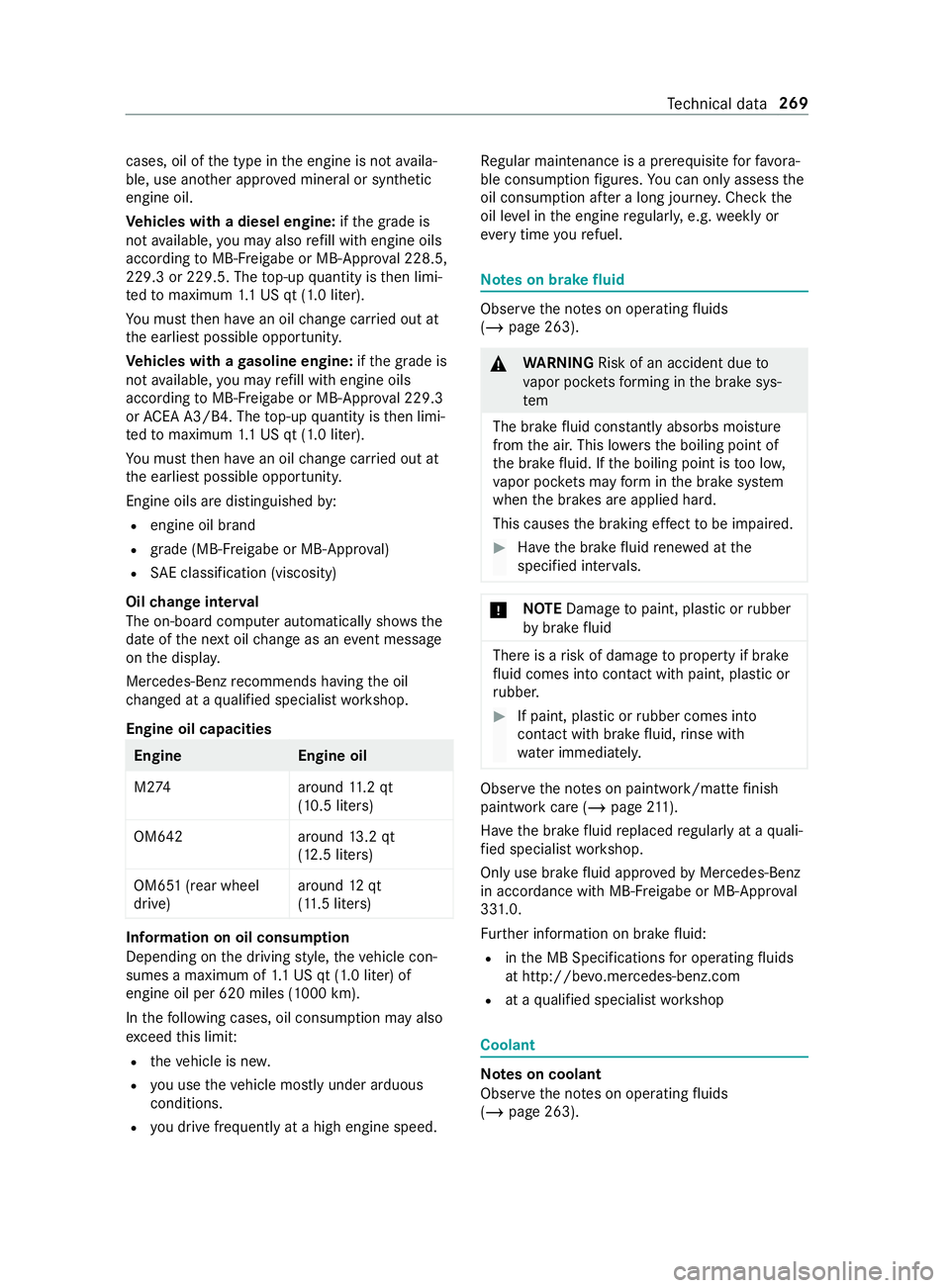
cases, oil of
the type in the engine is not availa‐
ble, use ano ther appr oved mineral or synthetic
engine oil.
Ve hicles with a diesel engine: ifth e grade is
not available, you may also refill with engine oils
acco rding toMB-F reigabe or MB-Appr oval 228.5,
229.3 or 229.5. The top-up quantity is then limi‐
te dto maximum 1.1 US qt (1.0 liter).
Yo u must then ha vean oil change car ried out at
th e earliest possible opportunit y.
Ve hicles with a gasoline engine: ifth e grade is
not available, you may refill with engine oils
acco rding toMB-F reigabe or MB-Appr oval 229.3
or AC EA A3/B4. The top-up quantity is then limi‐
te dto maximum 1.1 US qt (1.0 liter).
Yo u must then ha vean oil change car ried out at
th e earliest possible opportunit y.
Engine oils are di stinguished by:
R engine oil brand
R grade (MB-F reigabe or MB-Appr oval)
R SAE classi fication (viscosity)
Oil change inter val
The on-board computer automatically sho wsthe
date of the next oil change as an event messa ge
on the displa y.
Mercedes-Benz recommends having the oil
ch anged at a qualified specialist workshop.
Engine oil capacities Engine
Engine oil
M2 74 around11.2 qt
(10.5 li ters)
OM642 around13.2 qt
(12.5 li ters)
OM651 (rear wheel
drive) around
12qt
(1 1. 5 liters) Information on oil consum
ption
Depending on the driving style, theve hicle con‐
sumes a maximum of 1.1 US qt (1.0 liter) of
engine oil per 620 miles (1000 km).
In thefo llowing cases, oil consum ption may also
exc eed this limit:
R theve hicle is ne w.
R you use theve hicle mostly under arduous
conditions.
R you drive frequently at a high engine speed. Re
gular maintenance is a prerequisite forfa vo ra‐
ble consum ption figures. You can on lyassess the
oil consum ption af ter a long journe y.Check the
oil le vel in the engine regularly, e.g. weekly or
ev ery time youre fuel. Note
s on brake fluid Obser
vethe no tes on operating fluids
(/ page 263). &
WARNING Risk of an accident due to
va por poc kets form ing in the brake sys‐
tem
The brake fluid con stantly absorbs moisture
from the air. This lo wersthe boiling point of
th e brake fluid. If the boiling point is too lo w,
va por poc kets may form inthe brake sy stem
when the brakes are applied hard.
This causes the braking ef fect to be impaired. #
Have the brake fluid rene we d at the
specified inter vals. *
NO
TEDama getopaint, plastic or rubber
by brake fluid There is a
risk of damage toproperty if brake
fl uid comes into con tact wi thpaint, plastic or
ru bber. #
If paint, plastic or rubber comes into
con tact wi thbrake fluid, rinse wi th
wate r immediatel y. Obser
vethe no tes on paintwork/matte finish
paintwork care (/ page 211).
Ha ve the brake fluid replaced regular lyat a quali‐
fi ed specialist workshop.
Only use brake fluid appr ovedby Mercedes-Benz
in accordance with MB-F reigabe or MB-Appr oval
33 1.0.
Fu rther information on brake fluid:
R inthe MB Specifications for operating fluids
at http://be vo.mercedes-benz.com
R at a qualified specialist workshop Coolant
Note
s on coolant
Obser vethe no tes on operating fluids
(/ page 263). Te
ch nical da ta269
Page 294 of 354
&
WARNING ‑ Risk of fire and injury from
antifreeze
If antifreeze comes into con tact wi thhot com‐
ponent parts in the engine compartment, it
may ignite. #
Allow the engine tocool down before
adding antif reeze. #
Make sure that no antifreeze spills out
next tothefiller opening. #
Thoroughly clean off any antifreeze from
component parts before starting the
ve hicle. *
NO
TEDama gecaused byincor rect cool‐
ant #
Only add coolant that has been pre‐
mixed with therequ ired antifreeze pro‐
te ction. Information on coolant is
available at thefo llow‐
ing locations:
R inthe MB Specifications for operating fluids
31 0.1
- at http://be vo.mercedes-benz.com
- inthe BeVo app
R at a qualified specialist workshop
* NO
TEOverheating at high outside tem‐
peratures If an inapp
ropriate coolant is used, the engine
cooling sy stem is not suf ficiently pr otected
against overheating and cor rosion at high out‐
side temp eratures. #
Always use a coolant appr ovedby
Mercedes-Benz. #
Obser vethe instructions in the MB
Specifications for operating fluids3 10.1 . *
NO
TEPaint wo rkdamage due tocoolant #
Do not spill coolant on painted sur faces. Ha
ve the coolant regularly replaced at a qualified
specialist workshop.
No tethe proportion of anti-cor rosion agent/anti‐
freeze in the engine cooling sy stem within thefo l‐
lowing temp erature ranges:
R Atleast 50% (antifreeze pr otection up to
about -35 °F (-37 °C)) R
Maximum 55% (antifreeze pr otection up to
-49 °F (-45 °C))
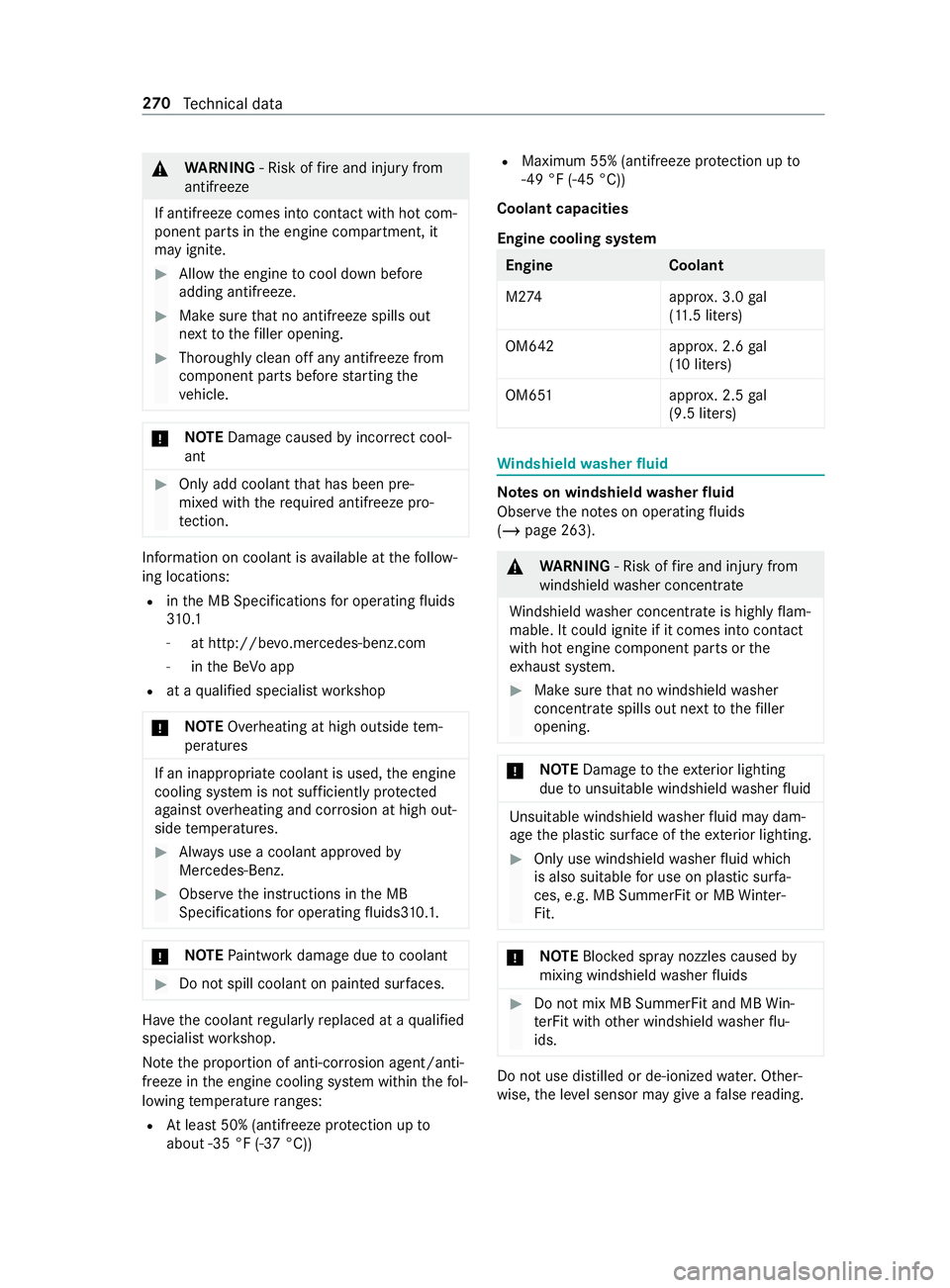
Coolant capacities
Engine cooling sy stem Engine
Coolant
M2 74 approx. 3.0 gal
(1 1. 5 liters)
OM642 approx. 2.6 gal
(10 liters)
OM65 1a pprox. 2.5 gal
(9.5 liters) Wi
ndshield washer fluid Note
s on windshield washer fluid
Obser vethe no tes on operating fluids
(/ page 263). &
WARNING ‑ Risk of fire and injury from
windshield washer concentrate
Wi ndshield washer concentrate is highly flam‐
mable. It could ignite if it comes into con tact
wi th hot engine component parts or the
ex haust sy stem. #
Make sure that no windshield washer
concentrate spills out next tothefiller
opening. *
NO
TEDama getotheex terior lighting
due tounsuitable windshield washer fluid Uns
uitable windshield washer fluid may dam‐
age the plastic sur face of theex terior lighting. #
Only use windshield washer fluid which
is also suitable for use on plast ic surfa‐
ces, e.g. MB SummerFit or MB Winter‐
Fit. *
NO
TEBlocked spr aynozzles caused by
mixing windshield washer fluids #
Do not mix MB SummerFit and MB Win‐
te rFit with other windshield washer flu‐
ids. Do not use distilled or de-ionized
water.Other‐
wise, the le vel sensor may give a false reading. 270
Tech nical da ta
Page 310 of 354
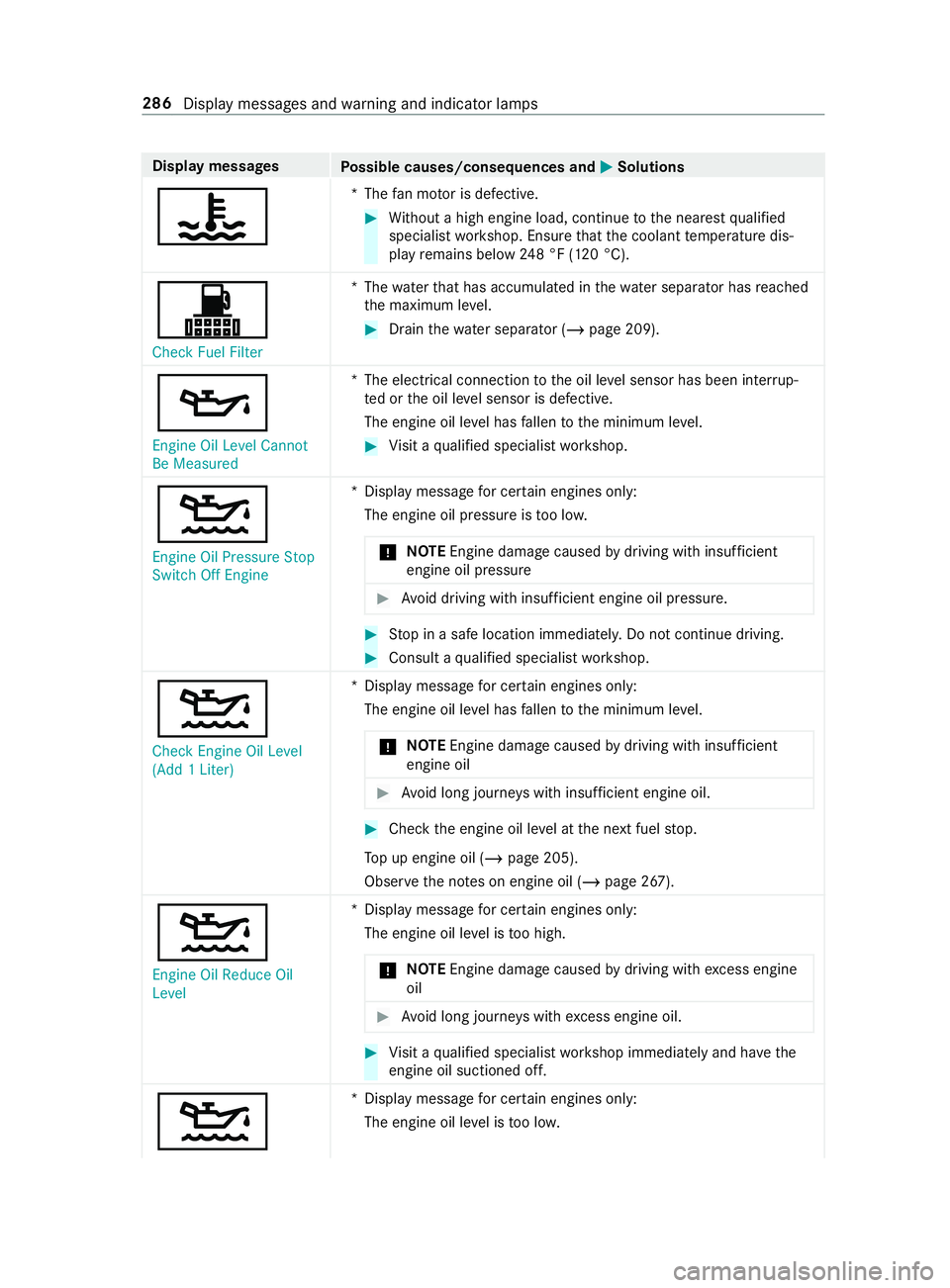
Display messages
Possible causes/consequences and 0050 0050Solutions
00AC *T
hefan mo tor is defective. #
Without a high engine load, continue tothe nearest qualified
specialist workshop. Ensure that the coolant temp erature dis‐
play remains below 248 °F (120 °C).
003A Check Fuel Filter *T
hewaterth at has accumulated in thewate r sepa rato r has reached
th e maximum le vel. #
Drain thewate r sepa rator (/ page 209).
00B3 Engine Oil Level Cannot
Be Measured *T
he electrical connection tothe oil le vel sensor has been inter rup‐
te d or the oil le vel sensor is defective.
The engine oil le vel has fallen tothe minimum le vel. #
Visit a qualified specialist workshop.
00B2
Engine Oil Pressure Stop
Switch Off Engine *D
isplay message for cer tain engines only:
The engine oil pressure is too lo w.
* NO
TEEngine damage caused bydriving with insuf ficient
engine oil pressure #
Avoid driving with insuf ficient engine oil pressure. #
Stop in a safe location immediately. Do not continue driving. #
Consult a qualified specialist workshop.
00B2
Check Engine Oil Level
(Add 1 Liter) *D
isplay message for cer tain engines only:
The engine oil le vel has fallen tothe minimum le vel.
* NO
TEEngine damage caused bydriving with insuf ficient
engine oil #
Avoid long journe yswith insuf ficient engine oil. #
Che ckthe engine oil le vel at the next fuel stop.
To p up engine oil (/ page 205).
Obser vethe no tes on engine oil (/ page 267).
00B2
Engine Oil Reduce Oil
Level *D
isplay message for cer tain engines only:
The engine oil le vel is too high.
* NO
TEEngine damage caused bydriving with excess engine
oil #
Avoid long journe yswith excess engine oil. #
Visit a qualified specialist workshop immediately and ha vethe
engine oil suctioned off.
00B2 *D
isplay message for cer tain engines only:
The engine oil le vel is too lo w. 286
Display messages and warning and indicator lamps
Page 312 of 354
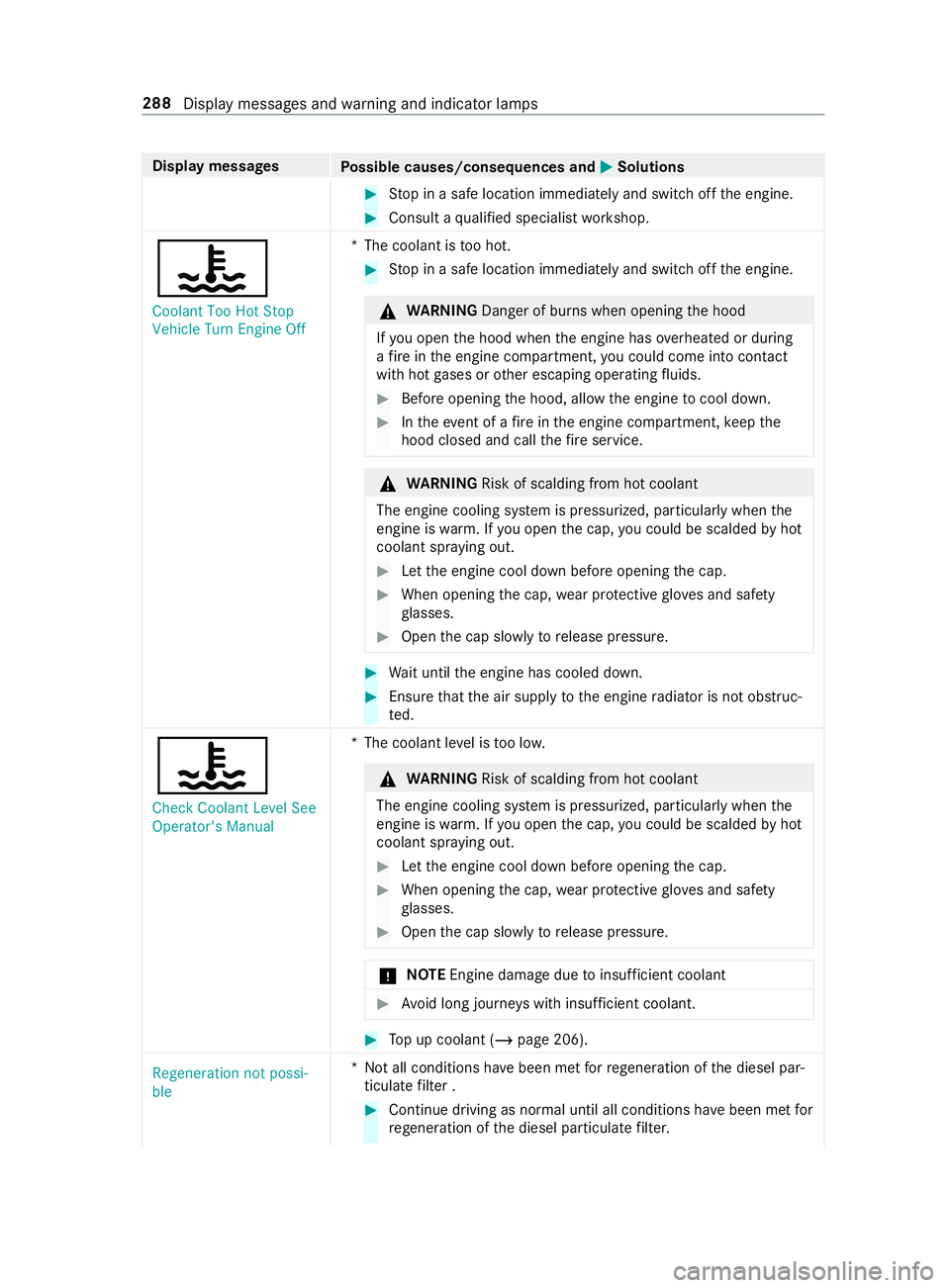
Display messages
Possible causes/consequences and 0050 0050Solutions #
Stop in a safe location immediately and switch off the engine. #
Consult a qualified specialist workshop.
00AC
Coolant Too Hot Stop
Vehicle Turn Engine Off *T
he coolant is too hot. #
Stop in a safe location immediately and switch off the engine. &
WARNING Danger of bu rns when opening the hood
If yo u open the hood when the engine has overheated or during
a fire inthe engine compartment, you could come into con tact
wi th hot gases or other escaping operating fluids. #
Before opening the hood, allow the engine tocool down. #
Intheeve nt of a fire inthe engine compartment, keep the
hood closed and call thefire service. &
WARNING Risk of scalding from hot coolant
The engine cooling sy stem is pressurized, particularly when the
engine is warm. If you open the cap, you could be scalded byhot
coolant spr aying out. #
Let the engine cool down before opening the cap. #
When opening the cap, wear pr otective glove s and saf ety
gl asses. #
Open the cap slowly torelease pressure. #
Wait until the engine has cooled down. #
Ensure that the air supply tothe engine radiator is not obstruc‐
te d.
00AC Check Coolant Level See
Operator's Manual *T
he coolant le vel is too lo w. &
WARNING Risk of scalding from hot coolant
The engine cooling sy stem is pressurized, particularly when the
engine is warm. If you open the cap, you could be scalded byhot
coolant spr aying out. #
Let the engine cool down before opening the cap. #
When opening the cap, wear pr otective glove s and saf ety
gl asses. #
Open the cap slowly torelease pressure. *
NO
TEEngine damage due toinsuf ficient coolant #
Avoid long journe yswith insuf ficient coolant. #
Top up coolant (/ page 206).
Regeneration not possi-
ble *N
otall conditions ha vebeen met forre ge neration of the diesel par‐
ticulate filter . #
Continue driving as normal until all conditions ha vebeen met for
re ge neration of the diesel particulate filter. 288
Display messages and warning and indicator lamps
Page 321 of 354
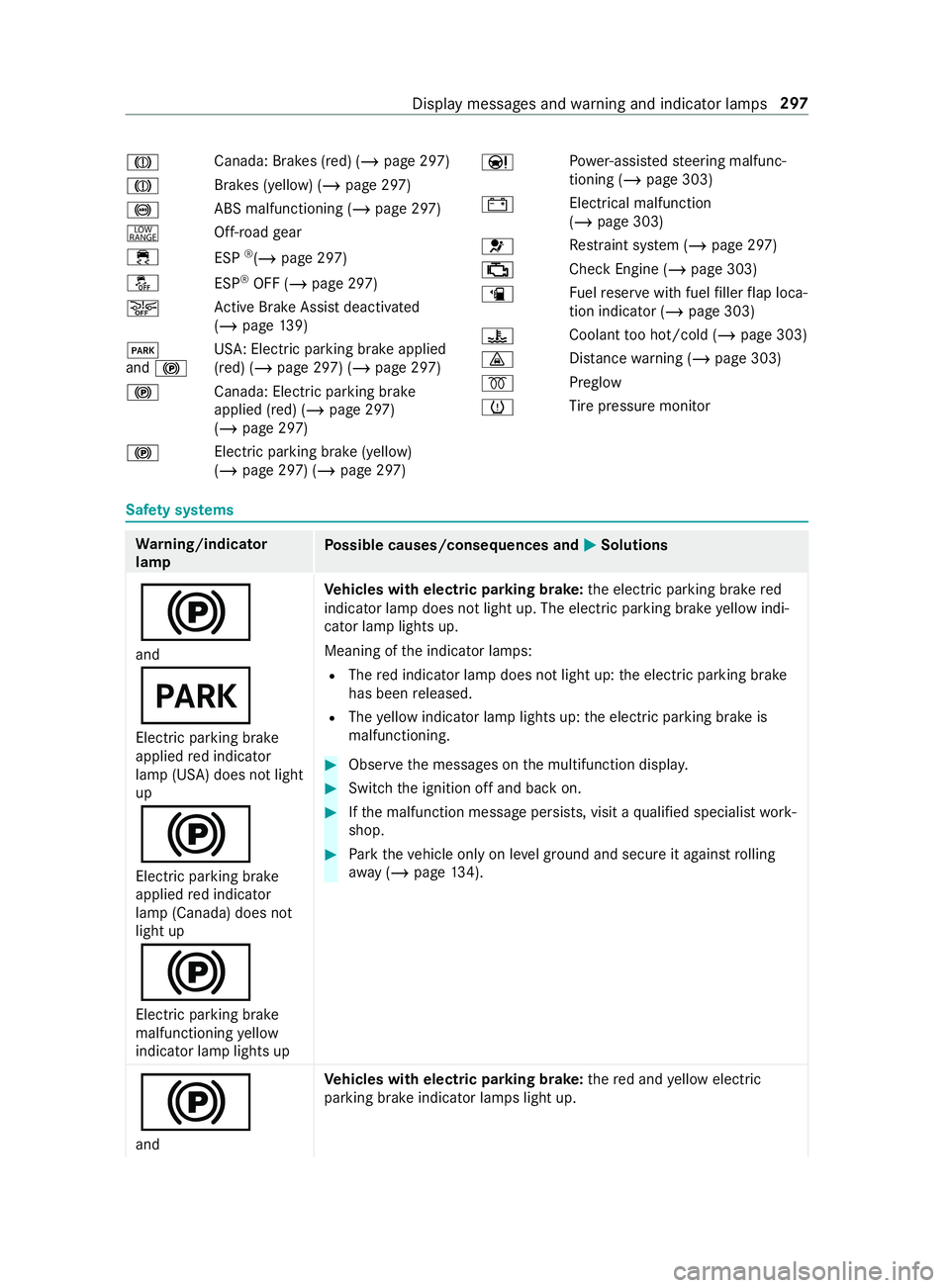
004D
Canada: Brakes (red) (/
page 297)
004D Brakes (yellow) (/
page 297)
0025 ABS malfunctioning (/
page 297)
002E Off-
road gear
00E5 ESP®
(/ page 297)
00BB ESP®
OFF (/ page 297)
00D4 Ac
tive Brake Assi stdeactivated
(/ page 139)
0049
and 0024 USA: Electric parking brake applied
(red) (/ page 297) (/ page 297)
0024 Canada: Electric parking brake
applied (red) (/
page 297)
(/ page 297)
0024 Electric parking brake (yell
ow)
( / page 297) (/ page 297) 00CC
Po
we r-assis tedsteering malfunc‐
tioning (/ page 303)
003D Elect
rical malfunction
(/ page 303)
0075 Re
stra int sy stem (/ page 297)
00B9 Check Engine (/
page 303)
00D4 Fu
elreser vewith fuel filler flap loca‐
tion indicator (/ page 303)
00AC Coolant
too hot/cold (/ page 303)
00BA Dis
tance warning (/ page 303)
0028 Preglow
0077 Ti
re pressure monitor Saf
ety sy stems Wa
rning/indicator
lamp Po
ssible causes/consequences and 0050 0050Solutions
0024
and
0049
Elect ric pa rking brake
applied red indicator
lamp (USA) does not light
up
0024 Elect ric pa rking brake
applied red indicator
lamp (Canada) does not
light up
0024 Elect ric pa rking brake
malfunctioning yellow
indicator lamp lights up Ve
hicles with electric parking brake: the electric parking brake red
indicator lamp does not light up. The elect ric pa rking brake yellow indi‐
cator lamp lights up.
Meaning of the indicator lamps:
R The red indicator lamp does not light up: the electric parking brake
has been released.
R The yellow indicator lamp lights up: the electric parking brake is
malfunctioning. #
Obser vethe messages on the multifunction displa y. #
Switch the ignition off and back on. #
Ifth e malfunction message persists, visit a qualified specialist work‐
shop. #
Park theve hicle only on le vel ground and secure it against rolling
aw ay ( /page 134).
0024 and Ve
hicles with electric parking brake: there d and yellow elect ric
parking brake indicator lamps light up. Display messages and
warning and indicator lamps 297
Page 327 of 354
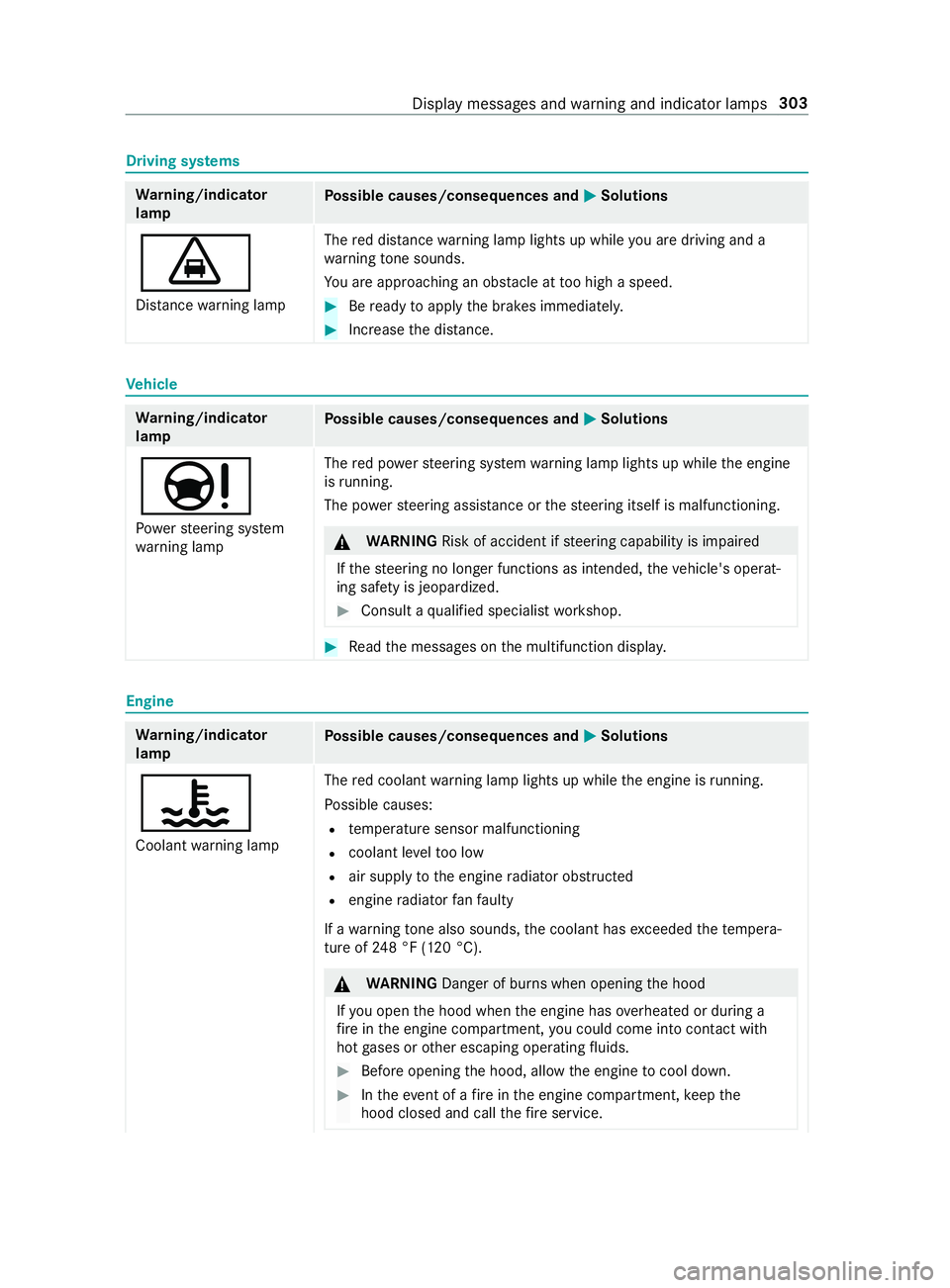
Driving sy
stems Wa
rning/indicator
lamp Po
ssible causes/consequences and 0050 0050Solutions
00BA
Dis tance warning lamp The
red dis tance warning lamp lights up while you are driving and a
wa rning tone sounds.
Yo u are approaching an obs tacle at too high a speed. #
Beready toapply the brakes immediatel y. #
Increase the dis tance. Ve
hicle Wa
rning/indicator
lamp Po
ssible causes/consequences and 0050 0050Solutions
00CC
Po we rst eering sy stem
wa rning lamp The
red po werst eering sy stem warning lamp lights up while the engine
is running.
The po werst eering assis tance or thesteering itself is malfunctioning. &
WARNING Risk of accident if steering capability is impaired
If th esteering no longer functions as intended, theve hicle's operat‐
ing saf ety is jeopardized. #
Consult a qualified specialist workshop. #
Read the messages on the multifunction displa y.Engine
Wa
rning/indicator
lamp Po
ssible causes/consequences and 0050 0050Solutions
00AC
Coolant warning lamp The
red coolant warning lamp lights up while the engine is running.
Po ssible causes:
R temp erature sensor malfunctioning
R coolant le velto o low
R air supply tothe engine radiator obstructed
R engine radiator fanfa ulty
If a warning tone also sounds, the coolant has exceeded thete mp era‐
ture of 248 °F (120 °C). &
WARNING Danger of bu rns when opening the hood
If yo u open the hood when the engine has overheated or during a
fi re inthe engine compartment, you could come into con tact wi th
hot gases or other escaping operating fluids. #
Before opening the hood, allow the engine tocool down. #
Intheeve nt of a fire inthe engine compartment, keep the
hood closed and call thefire service. Display messages and
warning and indicator lamps 303