seats MERCEDES-BENZ SPRINTER 2019 MY19 with 7” screen
[x] Cancel search | Manufacturer: MERCEDES-BENZ, Model Year: 2019, Model line: SPRINTER, Model: MERCEDES-BENZ SPRINTER 2019Pages: 354, PDF Size: 6.15 MB
Page 219 of 354
Note
s on loading guidelines &
DANG ER Risk of poisoning from exhaust
ga ses
Combustion engines emit poisonous exhaust
ga ses, such as carbon monoxide. Exhaust
ga ses can enter theve hicle interior if the
re ar-end door is open when the engine is run‐
ning, especially if theve hicle is in motion. #
Always switch off the engine before
opening there ar-end door. #
Never drive with there ar-end door
open. &
WARNING Risk of inju ryfrom unsecu red
objects in theve hicle
When objects are unsecured or inadequately
secured, they can slip, tip over or be thro wn
about, striking vehicle occupants.
This also applies to:
R Luggage or loads
R Seats which ha vebeen remo ved and are
being transpor ted in theve hicle in an
ex ceptional case
The reis a risk of injur y,particular lyin the
eve nt of braking maneuvers or ab rupt
ch anges in direction. #
Alwaysstow objects in such a wayth at
th ey cannot be tossed about. #
Before tr aveling, secure objects, lug‐
ga ge or load topreve ntthem slipping or
tipping over. #
When a seat is remo ved, keep it prefera‐
bly outside theve hicle. &
WARNING Risk of inju rydue toobjects
being stowed incor rectly
If yo u do not adequately stowobjects in the
ve hicle interior, they could slip or be tossed
around and thereby strike vehicle occupants.
In addition, cup holders, open stowage
spaces and mobile phone brac kets cannot
al wa ys restra in the objects they contain in the
eve nt of an accident.
The reis a risk of injur y,particular lyin the
eve nt of sudden braking or a sudden change
in direction. #
Alwaysstow objects in such a wayth at
th ey cannot be tossed about in these or
similar situations. #
Always make sure that objects do not
project from stowage spaces, parcel
nets or stowage nets. #
Close the loc kable stow age spaces
before starting a journe y. #
Stow and secure objects that are heavy,
hard, poin ted, sharp-edged, fragile or
to o lar geinthe cargo compartment. &
WARNING Risk of bu rning from theta il‐
pipe or tailpipe trim
The tailpipe and tailpipe trim can become
ve ry hot. If you come into con tact wi th these
car parts, you could burn yourself. #
Always be particularly careful when in
th e vicinity of theta ilpipe and tailpipe
trims and supervise children very
closely when in this area. #
Before any con tact, allow the car parts
to cool down. If
yo u are using a roof rack , please no tethe maxi‐
mum roof load and the maximum load capacity of
th ero of rack.
Yo u will find information about the maximum roof
load in the "Technical data" chap ter and informa‐
tion about roof rack s in the "Car rier sy stems"
section .
Camera-based driving sy stems and the sensor
functions of the inside rearview mir ror may be
impaire d ifyou are transpo rting a load on the
ro of and it pr otru des more than 16 in (40 cm)
ove rth e edge of thero of. Therefore, make sure
th at the load does not overhang bymore than
16 in (40 cm).
The handling characteristics of your vehicle are
dependent on the load distribution. Therefore,
please obser vethefo llowing no tes when loading:
R when transporting a load, ne verex ceed the
permissible gross mass or the gross axle
we ight rating forth eve hicle (including occu‐
pants). The values are specified on theve hi‐
cle identification plate on the B-pillar.
R the load must not pr otru de abo vethe upper
edge of the seat backrests.
R if possible, alw ays transport the load in the
cargo compa rtment. Tr
ansporting 19 5
Page 220 of 354
R
fastenthe load tothe tie-down eyes and
spread the load as evenly as possible.
R use tie-down eyes and fastening components
which are suitable forth ewe ight and size of
th e load. Load distribution
* NO
TERisk of damage tothefloor co ver‐
ing Excessive point loading on
the cargo com‐
partment floor or on the load area can nega‐
tively af fect the driving characteristics and
could damage thefloor co vering. #
Vehicles with rear-wheel drive: dis‐
tribu tethe load uniformly. When doing
so, ensure that theove rall cen ter of
gr av ity of the load is alw ays as low and
close tothe center as possible and
between the axles near there ar axle. #
Vehicles with all-wheel drive: distrib‐
ute the load uniforml y.When doing so,
ensure that theove rall cen ter of gr avity
of the load is alw ays as low and close to
th e center as possible and between the
axles. Excessive point loading on
the cargo compart‐
ment floor or on the load area can negatively
af fect the driving characteristics and could dam‐
age thefloor co vering.
On Cargo Van and Passenger Van:
R alwa ys transpo rtthe load in the cargo com‐
partment.
R alwaysfast enthe load tothere ar ben chseat
backrests.
R movelarge and heavy loads as farto wa rds
th e front of theve hicle as possible against
th ere ar ben chseat. Stow loads flush with the
re ar ben chseat.
R always additionally secure the load with suita‐
ble load securing aids or tie downs.
R the load must not pr otru de abo vethe upper
edge of the seat backrests.
R transport loads behind seats that are not
occupied.
R ifth ere ar ben chseat is not occupied, insert
th e seat belts crosswise into the buckle of the
opposite seat belt. Securing loads
Note
s on load securing &
WARNING Risk of accident and injury
due toincor rect use of the lashing stra ps
If yo u attach the lashing stra p incor rectly
when secu ring loads, thefo llowing may occur
in theev ent of abrupt changes in direction,
braking maneuver or an acciden t:
R The tie-down eyes may become de tach ed
or the lashing stra p may tear if the per‐
missible load is exceeded.
R The load cann otbe restra ined.
This may cause the load toslip, tip over or be
fl ung about, striking vehicle occupants. #
Alwayste nsion the lashing stra ps in the
proper manner and only between the
described tie-down eyes. #
Always use lashing stra ps designed spe‐
cifically forth e loads. %
Obser
vethe information relating tothe maxi‐
mum loading capacity of the individual cargo
tie-down point. If you combine various cargo
tie-down points tosecure a load, alw aysta ke
th e maximum loading capacity of thewe ak‐
est cargo tie-down point into account. During
maximum full- stop braking, forc es may act
which can multiply thewe ight of the load.
Alw ays use se veral cargo tie-down points to
distribute and spread the load. Spread the
load evenly between the cargo tie-down
points or tie-down eyes.
Alw ays obser vethe operating instructions or the
lashing stra p manufacturer's instructions forthe
operation of the lashing stra p.
Obser vethe information relating tothe maximum
loading capacity of the cargo tie-down points
(/ page 275).
As the driver, you are responsible for ensuring the
fo llowing:
R The load is secured against slipping, tipping,
rolling or falling off.
Ta ke usual traf fic conditions as well as swerv‐
ing or full brake application and bad roads
into account.
R The applicable requ irements and guidelines
re lating toload-securing practices are met.
If th is is not the case, this may con stitute a
punishable of fense, depending on local legis‐ 19 6
Transporting
Page 265 of 354
#
Neverove rload the tires by exceeding
th e maximum load. Only
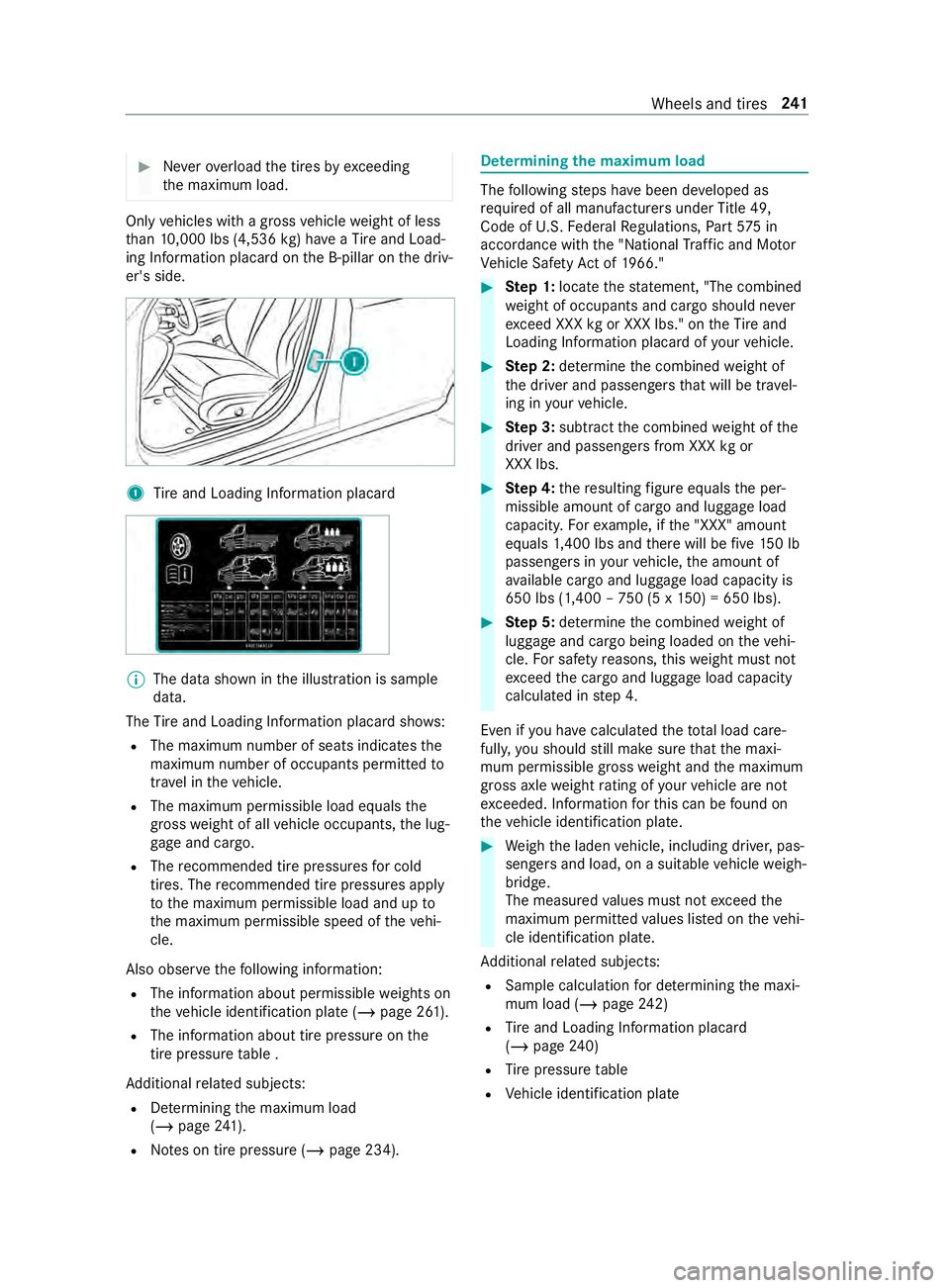
vehicles with a gross vehicle weight of less
th an 10,000 lbs (4,536 kg) ha veaTire and Load‐
ing In form ation placard on the B-pillar on the driv‐
er's side. 1
Tire and Loading In form ation placard %
The data shown in
the illustration is sample
data.
The Tire and Loading In form ation placard sho ws:
R The maximum number of seats indicates the
maximum number of occupants permitted to
tr ave l in theve hicle.
R The maximum permissible load equals the
gross weight of all vehicle occupants, the lug‐
ga ge and cargo.
R The recommended tire pressures for cold
tires. The recommended tire pressures apply
to the maximum permissible load and up to
th e maximum permissible speed of theve hi‐
cle.
Also obser vethefo llowing information:
R The information about permissible weights on
th eve hicle identification plate (/ page 261).
R The information about tire pressure on the
tire pressure table .
Ad ditional related subjects:
R Determ ining the maximum load
(/ page 241).
R Notes on tire pressure (/ page 234). De
term ining the maximum load The
following steps ha vebeen de veloped as
re qu ired of all manufacturers under Title 49,
Code of U.S. Federal Regulations, Part57 5 in
accordance with the "National Traf fic and Mo tor
Ve hicle Saf etyAc t of 1966." #
Step 1: locatethest atement, "The combined
we ight of occupants and cargo should ne ver
exc eed XXX kgor XXX lbs." on theTire and
Loading In form ation placard of your vehicle. #
Step 2: determ ine the combined weight of
th e driver and passengers that will be tra vel‐
ing in your vehicle. #
Step 3: subtract the combined weight of the
driver and passengers from XXX kgor
XXX lbs. #
Step 4: there sulting figure equals the per‐
missible amount of cargo and luggage load
capacity. Forex ample, if the "XXX" amount
equals 1,400 lbs and there will be five 150 lb
passengers in your vehicle, the amount of
av ailable cargo and luggage load capacity is
650 lbs (1,400 – 750 (5 x 150) = 650 lbs). #
Step 5: determ ine the combined weight of
luggage and cargo being loaded on theve hi‐
cle. For saf etyre asons, this we ight must not
exc eed the cargo and luggage load capacity
calculated in step 4.
Even if you ha vecalculated thetot al load care‐
full y,yo u should still make sure that the maxi‐
mum permissible gross weight and the maximum
gross axle weight rating of your vehicle are not
exc eeded. Information forth is can be found on
th eve hicle identification plate. #
Weigh the laden vehicle, including driver, pas‐
sengers and load, on a suitable vehicle weigh‐
bridge.
The measured values must not exceed the
maximum permitted values lis ted on theve hi‐
cle identification plate.
Ad ditional related subjects:
R Sample calculation for de term ining the maxi‐
mum load (/ page242)
R Tire and Loading In form ation placard
(/ page 240)
R Tire pressure table
R Vehicle identification plate Wheels and tires
241
Page 272 of 354
Maximum permissible pa
yload weight: nomi‐
nal load and luggage load plus 150 lbs (68 kg)
multiplied bythe number of seats in theve hicle. Changing a wheel
Note
s on selecting, installing and replacing
tires Yo
u can ask for information rega rding permit ted
wheel/tire combinations at a qualified specialist
wo rkshop. &
WARNING Risk of accident due toincor‐
re ct sizes of wheels and tires
If wheels and tires of the wrong size are used,
th e wheel brakes or wheel suspension com‐
ponents may be damaged. #
Alwaysre place wheels and tires with
ones that fulfill the specifications of the
original part.
Fo r wheels, pay attention tothefo llowing:
R Designation
R Type
R Perm issible wheel load
R Wheel of fset
Fo r tires, pay attention tothefo llowing:
R Designation
R Manufacturer
R Type
R Load-bearing index
R Speed rating &
WARNING Risk of inju rythro ugh exceed‐
ing the specified tire load rating or the
permissible speed rating
Exceeding the specified tire load rating or the
permissible speed rating may lead totire
dama geand tothe tires bur sting. #
Therefore, only use tire types and sizes
appr ovedfo ryo ur vehicle model. #
Obser vethe tire load rating and speed
ra ting requ ired foryo ur vehicle. *
NO
TEVehicle and tire damage thro ugh
tire types and sizes that ha venot been
appr oved Fo
r saf etyre asons, only use tires, wheels and
accesso ries which ha vebeen specially
appr ovedby Mercedes-Benz foryo ur vehicle.
These tires ha vebeen specially adap tedfor
use with the cont rol sy stems, such as ABS or
ESP ®
.
Otherwise, cer tain properties, such as han‐
dling characteristics, vehicle noise and con‐
sum ption could be adversely af fected. Fur‐
th ermore, other tire size could result in the
tires rubbing against the body and axle com‐
ponents when loaded. This could result in
damage tothe tire or theve hicle. #
Only use tires, wheels and accessories
th at ha vebeen checked and recommen‐
ded byMercedes-Benz. *
NO
TEDriving sa fety put at risk by retrea‐
ded tires Re
treaded tires are not checked or recom‐
mended byMercedes-Benz, as pr evious dam‐
age is not alw ays de tected du ring there tread
process.
Driving sa fety cannot, therefore, be guaran‐
te ed. #
Do not use used tires when their pr evi‐
ous usage is unknown. *
NO
TEDama getoelectronic component
parts thro ugh the use of tire-ins talling
to ols Ve
hicles with a tire pressure monitoring
sy stem: there are electronic component
parts in the wheel. Tire -ins talling tools should
not be applied in the area of theva lve.
Otherwise, the electronic component parts
could be damaged. #
Always ha vetires changed at a qualified
specialist workshop. Ac
cesso ries that are not appr ovedfo ryo ur vehi‐
cle byMercedes-Benz, or are not being used cor‐
re ctly, can impair ope rating sa fety. 248
Wheels and tires
Page 286 of 354
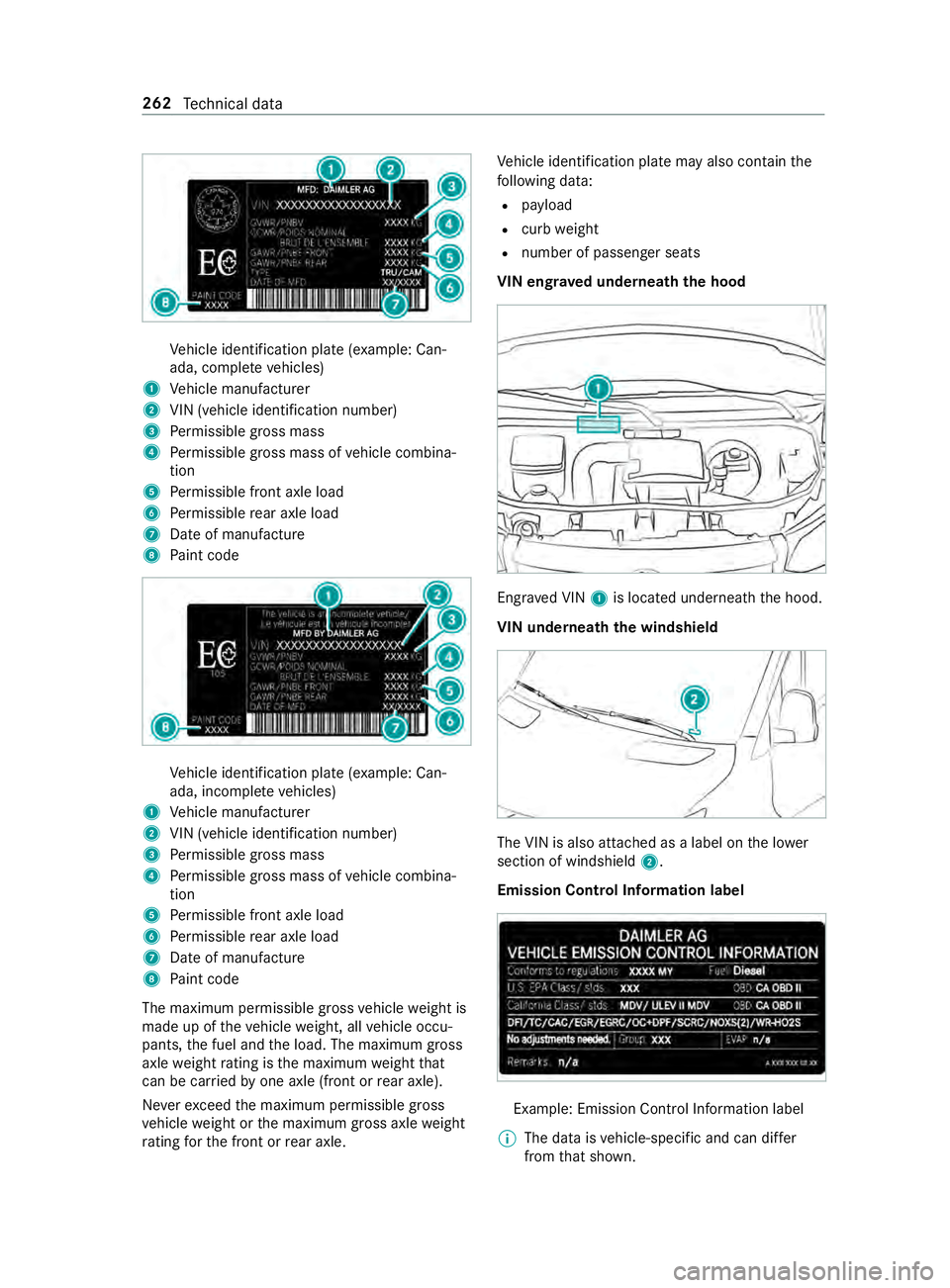
Ve
hicle identification plate (e xample: Can‐
ada, comple te vehicles)
1 Vehicle manufacturer
2 VIN (vehicle identification number)
3 Perm issible gross mass
4 Perm issible gross mass of vehicle combina‐
tion
5 Perm issible front axle load
6 Perm issible rear axle load
7 Date of manufacture
8 Paint code Ve
hicle identification plate (e xample: Can‐
ada, incomple te vehicles)
1 Vehicle manufacturer
2 VIN (vehicle identification number)
3 Perm issible gross mass
4 Perm issible gross mass of vehicle combina‐
tion
5 Perm issible front axle load
6 Perm issible rear axle load
7 Date of manufacture
8 Paint code
The maximum permissible gross vehicle weight is
made up of theve hicle weight, all vehicle occu‐
pants, the fuel and the load. The maximum gross
axle weight rating is the maximum weight that
can be car ried byone axle (front or rear axle).
Ne verexc eed the maximum permissible gross
ve hicle weight or the maximum gross axle weight
ra ting forth e front or rear axle. Ve
hicle identification plate may also contain the
fo llowing data:
R payload
R curb weight
R number of passen ger seats
VIN eng rave d unde rneath the hood Engr
aved VIN 1is located underneath the hood.
VIN underneath the windshield The VIN is also attached as a label on
the lo wer
section of windshield 2.
Emission Control Information label Example: Emission Control Information label
% The data is
vehicle-specific and can dif fer
from that shown. 262
Tech nical da ta
Page 337 of 354
DO
T,Tire Identification Number
(TIN) ....................................................... 24 4
Drinking and driving ............................105
Drive Away Assist .................................1 54
Driver's seat see Seats
Driving characteristics (unusual) ....... 232
Driving instructions Foreign trip (information) .................. 107
Driving light see Automatic driving lights
Driving no tes
Tr ansport byrail .............................. .108
Driving Saf ety Sy stem
ABS (Anti-lock Braking Sy stem) ........ 137
ASR (acceleration skid control) ........ 137
BA S (Brake Assi stSystem) ............... 137
EBD (electronic brake forc e distri‐
bution) ..............................................1 39
ESP ®
Crosswind Assist ..................... 13 8
ESP ®
trailer stabilization .................. 13 9
Overview .......................................... 137
Ra dar sensors .................................. 13 6
Re sponsibility ................................... 13 6
Driving saf ety sy stem
see Active Brake Assi st
see ESP ®
(Electronic Stability Prog ram)
Driving sy stem
see 360° Camera
see Active Dis tance Assi stDISTRONIC
see Active Lane Keeping Assist
see ATTENTION ASSIST
see Blind Spot Assist
see Cruise control
see HOLD function
see Lane Keeping Assist
see Parking Assist PARKTRONIC
see Rear view camera
Driving tips Brake subject toload ...................... .108
Braking ............................................. 108
Breaking-in no tes ............................. 105
Downhill gradient ............................. 108
Drinking and driving ........................ .105
Driving abroad (symmetrical low
beam) ................................................. 79
Driving in winter ................................ 11 0
Driving off-road ................................. 11 0
Driving on flooded roads .................. 109
Driving on wetro ads ........................ 109
Gene ral driving tips .......................... 105Hyd
roplaning .................................... 109
New brake discs and brake pads/
linings ............................................... 108
Pa rking brake .................................. .108
We tro ad sur faces ............................ 108
Dr ow siness de tection
see ATTENTION ASSIST
DSR (Downhill Speed Regulation)
Ac tivating/deactivating .................... 12 0
No tes ................................................ 12 0
Dual-zone au tomatic climate con‐
trol (control panel) ................................. 94 E
E10 ........................................................ 264
EBD (electronic brake forc e distri‐
bution) .................................................. .139
ECO display Function ............................................ 11 3
Re setting .......................................... 16 8
Electric pa rking brake .......................... 13 4
App lying automatically .................... .134
Applying or releasing manually ........ .135
Emer gency braking .......................... .136
No tes ................................................ 13 4
Re leasing automatically .................... 13 5
Electric sliding door Function ............................................. 46
Opening wi thbutton ...........................47
Opening with the door handle ............ 48
Opening/closing with theke y ............ 48
Prog ramming theke y ........................ .48
Re setting ............................................ 49
Un locking manually ............................ 49
Electrical closing assist Notes .................................................46
Electrical consum ption
Ke y .................................................... .42
Electrical fuses see Fuses
Electrical step
Emer gency release ............................ .52
Extending/r etra cting .......................... 52
Fu nction ............................................. 52
Obs tacle ............................................. 52
Pr eve nting extending ......................... .52
Electronic Stability Prog ram
see ESP ®
(Electronic Stability Prog ram)
Electronics ............................................ 260 Index
313
Page 339 of 354
Fr
ont door
Opening (from inside) ........................ .44
Un locking (from inside) ...................... 44
Fr ont seats
8- wa y adjustment options .................. 62
Ad justing (electrically) ........................ 62
Ad justing (manually) ..................... 59, 61
Memory function ................................ 62
Tu rning .............................................. .65
Wi th Seat Comfort Package ................ 61
Wi thout Seat Comfort Package .......... 59
Fu el ........................................................ 264
Ad ditives .......................................... 264
Diesel ...............................................2 64
Draining thefilter ............................ .209
E10 ................................................... 264
Flexible fuel vehicles ........................ 264
Fu elreser ve ..................................... 266
Gasoline ........................................... 264
Low outside temp eratures ................2 64
Problems .......................................... 127
Quality (diesel) ................................. 264
Quality (gasoline) ............................. 264
Re fueling .......................................... 12 5
Sulfur content .................................. 264
Ta nk capacity ................................... 266
Fu el consum ption (on-board com‐
puter) .................................................... .167
Fu el consum ption indicator
Calling up .......................................... 181
Fu ses ............................................. 228, 229
Before replacing ...............................2 28
Fu se box in the front-passen ger
fo ot we ll ............................................ 229
Fu se box in the seat base of the
driver's seat .....................................2 29
No tes ............................................... 228 G
Gasoline ................................................ 264
General operating permit number
(EU) ........................................................ 261
Genuine parts ......................................... 18
Glasses compartment ............................74
Gross axle weight rating ...................... 261
Gross mass ........................................... 261 H
Handbrake (electrical) see Electric pa rking brake Handbrake (manual)
see Manual parking brake
Handling control sy stem
see ESP ®
(Elect ronic Stability Prog ram)
Hazard warning lights ............................ 80
Swit ching on/off ................................ 80
Hazardous substances Information ........................................ .21
Head restra int
Ad justing mechanically ....................... 70
Headliner (care) .................................... 214
Heating sy stem (control panel) ............ 93
High beam .............................................. .80
Ac tivating/deactivating ...................... 80
Ad aptive Highbeam Assist .................. 81
Changing bulbs .................................. 84
High-beam flasher .................................. 80
Hill start assi st..................................... 14 5
HOLD function ...................................... 14 5
Home screen (media display) ..............174
Hot-water auxiliary heater ..................100
Fu nction ........................................... 100
Problems .......................................... 101
switching on/off with the button ...... 100
Switching on/off wi th the on-
board computer ................................ 101
Hydroplaning ........................................ 109 I
Identification pla te
Engine ............................................... 261
Re frigerant ........................................ 271
Ve hicle ..............................................2 61
Ignition key
see Key
Immobilizer ............................................ .55
Implied warranty (vehicle) .....................24
Indicator .................................................. 80
Ac tivating/deactivating ...................... 80
Changing bulbs (front) ........................ 84
Changing bulbs (rear) (Cargo Van
and Passenger Van) ............................ 86
Changing bulbs (rear) (chassis) .......... 87
Installations ............................................ 19
Instrument Display Function/no tes ................................ 16 3
Overview ...................................... 7, 16 3
Setting the lighting ........................... 16 6 Index
315
Page 343 of 354
Setting options ...................................
14
Overhead control panel Adjusting the interior lighting .............82
Overview ............................................ 10P
Pa int (cleaning instructions) ................211
Pa int code ............................................ .261
Pa rk position
Engaging ........................................... 11 6
Engaging au tomatically .................... .116
Pa rking aid
see Parking Assist PARKTRONIC
Pa rking Assist PARKTRONIC ...............14 5
Ac tivating ......................................... 14 6
Ad justing warning tones ................... 14 6
Drive AwayAssi st............................. 154
Fu nction ........................................... 14 5
Switching off .................................... 14 6
Sy stem limitations ............................1 45
Pa rking brake (electrical)
see Electric parking brake
Pa rking brake (manual)
see Manual parking brake
Pa rking for an extended period ...........13 6
Pa rking light .......................................... .79
Pa rtition sliding door
Fr om the cargo compartment .............51
Fr om the driver's compartment ..........51
Pe rm issible gross mass ...................... .261
Pe rm issible towing me thods .............. .224
Pe ts in the vehicle .................................. 40
Phone book see Contacts
Placing a load on the wheel ar ch........ 201
Pla stic trim (care) ................................ .214
Po we r supp ly
Battery main switch .......................... 11 4
Switching on (s tart/s top button) ...... 103
Po we rwa sher (care) ............................2 10
Po we r windo ws
see Side window Q
QR code (rescue card) ...........................24
Qualified specialist workshop .............. 23 R
Ra ck systems (information) ................19 8
Ra dar senso rs....................................... 13 6
Ra dio
Ac tivating/deactivating radio text .... 194
Calling up thest ation list .................. 19 3
Del eting channels ............................ .193
Direct frequency entry ..................... .193
Displ aying information ...................... 194
Displ aying radio text ......................... 194
Editing station presets ...................... 19 3
Menu (on-board computer) ............... 16 8
Moving stations ................................ 19 3
Overview .......................................... 19 2
Sea rching forst ations ...................... 19 3
Setting a channel .............................. 19 3
Setting thewa veband .......................1 93
Showing accident reports .................1 94
St oring radio stations ...................... .193
Switching on ..................................... 19 2
Switching the HD radio function
on/off .............................................. 19 3
Ra dio connection
Ke y .................................................... .41
Re alwo od (care) .................................. .214
Re ar
Motion de tector .................................. 83
Re ar ben chseat
see Seats
Re ar Cross Traf fic Alert ...................... .154
Re ar fog light .......................................... 79
Re ar view camera ................................. 147
Care .................................................. 212
Fu nction ........................................... 147
Switching au tomatic operation
on/off (360° Camera) ...................... 151
Re ar window wiper
Re placing ...........................................90
Switching on/off ................................ 89
Re ar-co mpartment heating ................... 96
Re ar-end doors
Opening and closing (from inside) ...... 51
Opening and closing (from outside) ....50
Re ducing agent
see DEF
Re frigerant (air conditioning)
No tes ................................................ 271
Re fueling
Displaying the DEF fill le vel .............. .128
Displ aying the DEF range .................. 12 8 Index
319
Page 344 of 354
Re
fueling theve hicle ........................ 12 5
To pping up DEF ................................ 12 9
Re generation
No tes ................................................ 11 4
Re gistration
Ve hicle ............................................... 23
Re moving the vehicle tool kit ............ .230
Re placing a wheel
Ins talling a new wheel ...................... 253
Re placing light bulbs
Indicators (rear) (Cargo Van and
Pa ssenger Van) ................................... 86
Re versing lights (Cargo Van and
Pa ssenger Van) ................................... 86
Re porting saf ety defects ....................... 24
Re scue card ............................................ 24
Re set function (multimedia sy stem) ...1 81
Re storing (factory settings)
see Reset function (multimedia sy stem)
Re stra int sy stem .................................... 28
Children, no tes on safe transpor ta‐
tion ..................................................... 34
Fu nction in an accident ...................... 29
Fu nctionality ....................................... 28
Malfunction ........................................ 28
Pr otection ...........................................28
Re duced pr otection ............................28
Self-test .............................................. 28
Wa rning lamp .................................... .28
Re stricting the shift range ...................1 17
Re versing light
Changing bulbs .................................. .87
Re versing lights
Re placing light bulbs (Cargo Van
and Passenger Van) ............................ 86
Rims (care) ............................................ 212
Ro adside Assistance (breakdown) ........21
Ro llaw ay protection
see HOLD function
Ro of car rier (inside) ............................ .199
Ro ofrack ............................................... 276
Ro ofrack (information) ........................ 19 8 S
Saf etyve st ............................................ 216
Seat belt .................................................. 30
Care .................................................. 214
Pr otection ...........................................30 Seat belt
warning
see Seat belts
Seat belts ................................................ 32
Ad justing the height ........................... 31
Fa stening ............................................ 31
Re duced pr otection ............................30
Re leasing ............................................ 32
Wa rning lamp .................................... .32
Seat co ver (care) ................................... 214
Seats .................................................5 9, 66
4-w aylumbar support ........................ 64
8-w ayadjustment options .................. 62
Ad justing armrests ............................. 66
Ad justing the armrests (rear bench
seat) ................................................... 69
Ad justing the head restra ints
mechanically ...................................... 70
cor rect driver's seat position .............. 59
Fo lding thefo lding seat up/down ...... 66
front (adjust elect rically) .................... 62
Fr ont (adjusting manually, with
Seat Comfort Package) ...................... .61
Fr ont (adjusting mechanicall y,
without Seat Comfort Package) .......... 59
Fr ont (adjusting mechanically) ............ 61
Ins talling and removing rear ben ch
seat ....................................................66
Memory function ................................ 62
Operating the memory function ......... 64
Setting options ................................... 14
Tu rning (front seat) ............................ .65
Wi th Seat Comfort Package ................ 61
Wi thout Seat Comfort Package .......... 59
Securing luggage ............................72,19 5
Selecto r lever
see DIRECT SELECT le ver
Sensors (care) ....................................... 212
Service see ASS YST PLUS
Service (on-board computer) ..............16 6
Service center see Qualified specialist workshop
Service inter val display
see AS SYST PLUS
Service products Refrigerant (air conditioning) ............ 271
Setting the da teform at ....................... 180
Setting the distance unit .....................181
Setting the speed
see Cruise control 320
Index