ECO mode MERCEDES-BENZ SPRINTER 2019 MY19 with Base Radio Operator’s Manual
[x] Cancel search | Manufacturer: MERCEDES-BENZ, Model Year: 2019, Model line: SPRINTER, Model: MERCEDES-BENZ SPRINTER 2019Pages: 330, PDF Size: 5.98 MB
Page 121 of 330
Switching of
fautomatic climat econtrol #
Use the0097 rocker switc htochangethe air‐
fl ow setting and air distribution
(/ page97) .
Th eo ther settingr emainsunaf fected bythe
ch ange. Au
tomaticall ycontrolling the climat econtrol
in the rear comp artment Re
quirements:
R Rear-compartment climat econtrol has been
swit ched on (/ page96).
In automatic mode, thet emperature, air flow and
air distribution ar eregulated and kept cons tant. #
Press the /
00A4 button. #
Press the0058 button.
% Even if
thef ront-compartmen tsystemisin
automatic mode, ther ear-compartment sys‐
te mc anexit automatic mode if youa djust
th eb lowe ront herear-compartment menu.
% If
th ea ir is cooled and thed rive r,front
passenger or sliding door is opened, ther ear
air conditioning sy stem blo werist urned
down af tera round 15minutes.
When all door shave been closed again, the
blo werw illber esettot he pr evious setting
af te ra round one minute. Information on
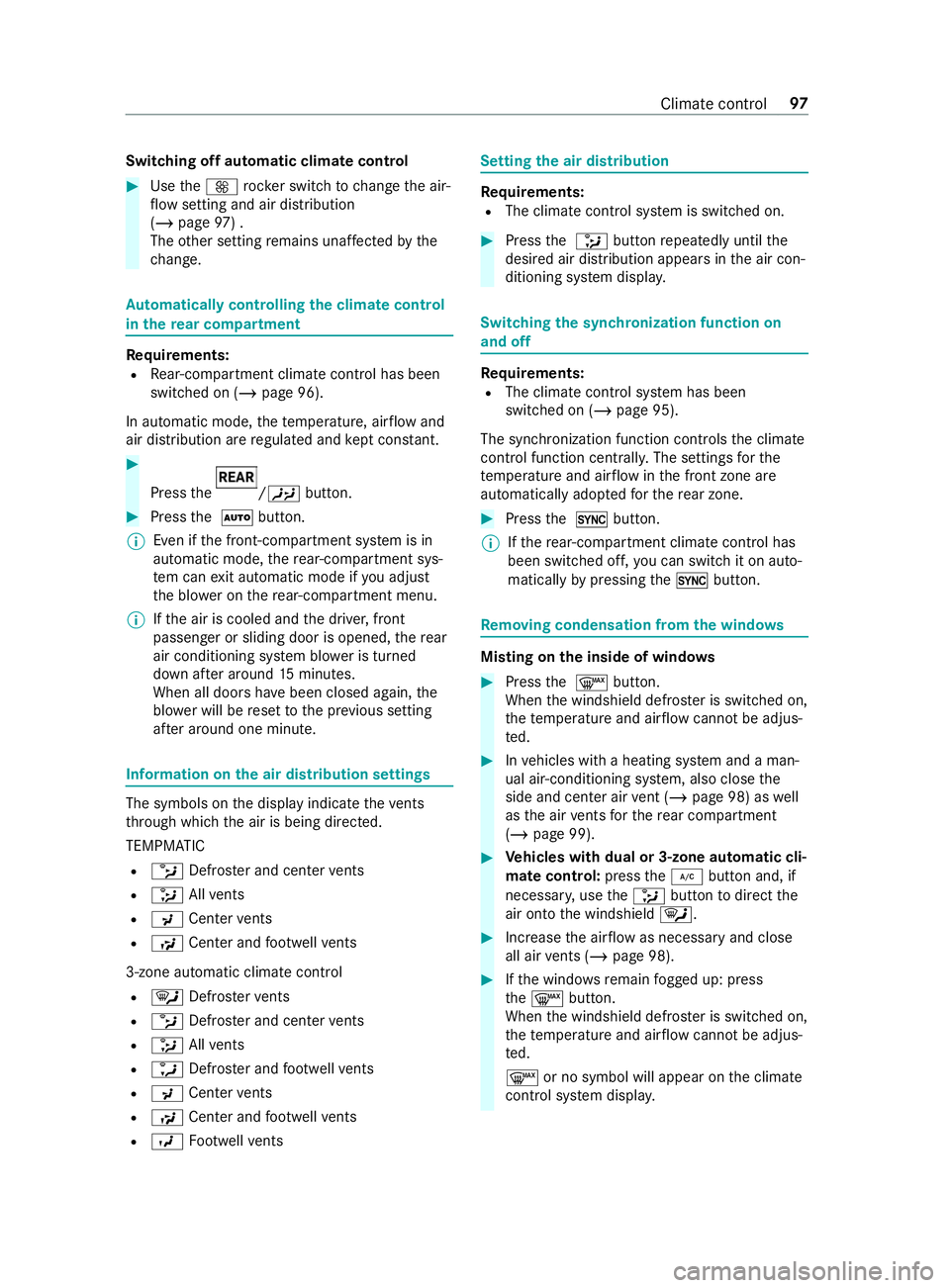
thea ir distribution settings The symbols on
thed ispla yindicat ethe vents
th ro ugh whic hthe air is being directed.
TEMPMATIC R 0087 Defros tera nd center vents
R 008F Allvents
R 009C Center vents
R 009F Center and foot we llve nts
3-zone au tomatic clima tecontrol
R 0061 Defros terv ents
R 0087 Defrost er and center vents
R 008F Allvents
R 0086 Defros tera nd foot we llve nts
R 009C Center vents
R 009F Center and foot we llve nts
R 009B Footwe llve nts Settin
gthe air distribution Re
quirements:
R The climat econtrol sy stem is switched on. #
Press the008F button repeatedl yuntil the
desired air distribution appear sinthe air con‐
ditioning sy stem displa y. Switching
thes ynchronization function on
and off Re
quirements:
R The climat econtrol sy stem has been
switched on (/ page95).
The synchronization function cont rols thec limate
cont rolfunction centrally .The settings fort he
te mp eratur eand air flow inthef ront zonea re
automaticall yadop tedf or ther ear zone. #
Press the0015 button.
% If
th er ear-compartment climat econtrol has
been swit ched off, youc an swit chit on auto‐
matically bypressing the0015 button. Re
moving condensatio nfromt he windo ws Misting on
thei nsid eofw indows #
Press the0064 button.
When thew indshield defros teriss witched on,
th et emperatur eand air flow canno tbeadjus‐
te d. #
Invehicles wit haheating sy stem and aman‐
ual air-conditionin gsystem, also close the
side and center air vent (/ page 98) as well
as thea irve nts fort he rear compartment
(/ page99). #
Vehicles with dual or 3-zone automatic cli‐
mat econtrol: pressthe005A button and, if
necessar y,use the008F button todirect the
air ont othe windshield 0061. #
Increase thea irflow as necessar yand close
all air vents (/ page 98). #
Ifth ew indo wsremain fogged up: press
the 0064 button.
When thew indshield defros teriss witched on,
th et emperatur eand air flow canno tbeadjus‐
te d.
0064 or no symbol will appear on thec limate
cont rols ystemd ispla y. Climat
econtrol 97
Page 122 of 330

#
Vehicles with windshiel dheating: press
the button.
#
Close thec enter air vent (/ page 98) and
air vents fort he headroom (/ page99) and
re ar compartment (/ page99).
Mistin gonthe outside of windo ws #
Switc hont he windshield wiper (/ page88). Switching air-recirculation mode on and off
#
Press the0089 button.
The interior air is recirculated.
The ai r-re circulation mode switches of fautom ati‐
cally.
% When air-recirculation mode is switched off,
th ew indo wsmayfog up mor equickl y.Switch
on ai r-re circulation mode only briefly.
Air-recirculation mode au tomatical lyswitches on
in thef ollowing cases:
R at high outside temp eratures
R while thev ehicle is driving in atunnel (only
ve hicles wit h3-zone automatic climat econ‐
trol)
R when thew indshield wiper sareswitched on
(/ page88)
The indicator lam ponthe0089 button will not
light up in this case. Af teram aximu mof
30 minutes, outsid eair is automatically intro‐
duced again. Switching
thew indshield heating on and off %
In
thee vent of high outsid etemperatures,
th ew indshield heating ma ynottur no n. #
Press theb utton fort he windshield heating.
If th ei ndicator lam plights up, thew indshield
heating is switched on.
% The windshield heating switches of
fautomat‐
ically af teraf ewminutes.
% If
th eb atter yvoltag eistoo lo w,it ma ynotbe
possible toswitc hthe windshield heating on.
If th eb atter yvoltag ebecomes tool ow while
th ew indshield heating is in operation, the
windshield heating will swit choffa utomati‐
cally. Switching
ther ear windo wdefros tero noro ff #
Press the006C button.
If th ei ndicator lam plights up, ther ear win‐
do wd efros teriss witched on. Operating air
vents Ad
justin gthe front-compartmen tairve nts &
WARNING ‑Danger of bu rnsorf rostbite
due tobeing tooc lose tothea irve nts
Ve ry hotorv eryc old ai rcan flow from thea ir
ve nts.
Thi scould result in burns or frostbit einthe
immediat evicinity of thea irve nts. #
Makesur ethat all vehicle occupants
alw aysm aintain asufficient dis tance to
th ea irve nts. #
If necessa ry,d irect thea irflow to
ano ther area of thev ehicle interior. #
Toopen or close: hold center2 of air
ve nt 1 and tur nittot he leftorright as far
as it will go. #
Tosetthe air direction: holdcenter 2 of
air vent 1 and swivel it up wards, down‐
wa rds, to thel eftortot heright. 98
Climat econt rol
Page 124 of 330
#
Keep thet ailpipe and thea reaa round
th ev ehicle free from sno wwhen the
engine or thes tationar yheater ar erun‐
ning. #
Open awindo wont he windwar dside of
th ev ehicle toensur eana dequat esup‐
ply of fresh air. &
WARNING Risk offire due tohots tation‐
ar yh eater components
When thes tationa ryheater is swit ched on,
parts of thev ehicle can become very hot, e.g.
th es tationa ryheater exhaus tsyst em.
Flammable materials suc hasleaves, grass or
twigs ma yignit eift heyc ome int ocontact
wi th:
R hotp arts of thes tationa ryheater exhaust
sy stem
R thee xhau stgasitself
Ther eisar isk offire. #
When thes tationar yheater is swit ched
on, mak esuret hat:
R Hotvehicle parts do no tcome into
contact wit hflammable materials.
R The exhaus tgas can flow out of the
st ationar yheater exhaus tpipe
unhindered.
R The exhaus tgas doe snotcome into
contact wit hflammable materials. *
NO
TEDama getothea uxiliar yheating If
th ea uxiliar yheating is no tused foran
ex tende dperiod of time ,itcan be damaged. #
Switc hthe auxiliar yheating on for
around tenm inutesatl eastonce a
month. *
NO
TEDama getothea uxiliar yheating
due toove rheating If
th eh otair flow is bloc ked, thea uxiliary
heating can overheat and switc hoff. #
Do no tbloc kthe ho tairflow. %
Ve
hicles with modified fuel displa ys:if an
ex tern all yo perated consume risconnec ted
via thec able fort he auxiliar yheater ,this is
no ttaken in toconside ratio nont he "range
re maining" displa yofthe on-boar dcomputer. In
this case, obser vethef uel displa y.The fuel
displa yprovide sthe cur rent le vel.
If yo ua retranspo rting hazardous materials, com‐
ply wit hthe releva nt sa fety regulations. Alw ays
place objects at asufficient dis tance from the
outle topening of thea uxiliar yheating.
Au xilia ryheating worksi ndependentl yofthe
engine and complements thec limat econt rols ys‐
te mint hevehicle. Auxilia ryheating heats thea ir
inside thev ehicle tothes ettemp erature. Hot-water auxiliar
yheater Fu
nction of theh ot-wat er auxiliar yheater
The hot-water auxiliar yheater complements your
ve hicle's climat econt rols ystem, and has a
heater boos ter,auxiliar yheating and auxiliary
ve ntilation function. In addition, thea uxiliary
heating sy stem heats thee ngine coolant topro‐
te ct thee ngine and sa vefuel during thew arming-
up phase. The auxiliar yheatin gheats thea ir
inside thev ehicle tothes ettemp erature. It is not
dependent on theh eat output of ther unning
engine .The auxilia ryheating is operated directly
using thev ehicle's fuel. Forthis reason ,the fuel
ta nk mus thave been filled abo vether eser vefuel
le ve lsot hatthea uxiliar yheating can work.T he
auxilia ryheating automatically adapts its operat‐
ing mode totheo utside temp eratur eand
we ather .Itist herefor epossible that thea uxiliary
heating ma yswitc hfromv entilation toheating
mode or from heating toventilation mode. When
th ee ngine is running ,auxilia ryventilation is not
acti ve.A uxiliar yheating automatically switches
itself of fafter am aximu mof50m inutes.Yo u
canno tuse the" auxiliar yventilation" operating
mode tocool thea ir inside thev ehicle tobelow
th eo utside temp erature. Auxilia ryheating helps
to heat up thev ehicle while thee ngine is running
and at lo woutsid etemperatures.
Operating theh ot-w ater auxiliar yheater dr aws
po we rfromt hevehicle batter y.Therefore, driv ea
re asonabl ylon gd ista nce af terh eating or ventilat‐
ing thev ehicle twice in succession at most.
Au xilia ryheating can be activated onl yattemper‐
atures belo w40°F(4.5 °C).
Switching theh ot-wat er auxiliar yheatin gon
and of fwitht he button
Re quirements:
R The fuel tank is filled abo vether eser vefuel
le ve l. 100
Climat econtrol
Page 125 of 330

Switching auxiliar
yheating on and off #
Toswitc hon:press the003B button. #
Toswitc hoff:press the003B button.
Switching on thes pecified temperature #
Swit chon thei gnition. #
Toswitc hon:press the003B button. #
Toswitc hoff:press the003B button. #
Setthe temp eratur eusing the0082 button. #
Press the003B button.
The redorb lue indicator lam ponthe003B
button goes on or off.
Color softhe indicator lamp:
R Blue: auxiliar yventilation has been switched
on.
R Red:auxilia ryheating has been switched on.
R Yello w: departur etime has been pre-selec‐
te d.
Au xilia ryheating or ventilation switches of fafter
am aximum of 50 minutes.
Swit ching heater boos term ode on and off #
Toswitc hon:star tt he engine. #
Press the003B button. #
Toswitc hoff:press the003B button.
Heater boos term ode willbes witched on at
an outsid etemperatur eoflessthan 32 °F
(0 °C) when necessar y.
% Heater boo
ster mode is available onl yfor
ve hicles wit hhot-water auxiliary heatings. Ad
justin gthe hot-water auxiliar yheaterw ith
the on-boar dcom puter
Re quirements:
R The fuel tank is filled abo vether eser vefuel
le ve l.
R The ignition is switched on.
On-boar dcomputer:
4 Settings 5
Heating
Setting thes witch-on time #
Select Settings. #
Selec tthe desired departur etime.
Ac tivatin gthe departur etime #
Activat ethe departur etime byticking the
box.
% Ensur
ethat A,Ba ndCe achc orrespond to a
programmed departur etime.
% The programmed time
remains se tonlyu ntil
th en exttime thee ngine is star ted.
Selecting prog rammed time #
Setthe requ ired programmed tim eA,BorC.
% The
requ ired prog rammed time A,BorC will
appea ronly if theb oxtoactivat ethe depar‐
tur etime is tic ked. #
Select ther equired programmed time by
swiping lef torright, e.g. A,BorC.
Problems with ho twater auxiliar yheating Problem
Possible causes/consequences and 0050 0050Solutions
FA IL00A3 Signal transmission between transmitter and
vehicle is malfunctioning. #
Chang eyour position in relation tothev ehicle, moving closer if nec‐
essar y.
FA IL Thestar terb atter yisn otsuf ficiently charge d. #
Charg ethe star terb atter y.
The fuel tank is no tfilled up tother eser veleve l. #
Refuel at then eares tgas station.
FA IL0099 Au
xilia ryheating is malfunctioning. #
Have thea uxiliar yheating checkedataq ualified specialis twork‐
shop. Climat
econtrol 101
Page 128 of 330
St
arting thee ngine St
arting thev ehicle wit hthe start/s topb ut‐
ton &
WARNING Risk of accident and inju ry
due tochildren lef tunat tende dint he
ve hicle
If ch ildren ar eleftu nat tende dint hevehicle,
th ey could:
R opendoors,t hereb yendangering other
persons or road users.
R geto utofthev ehicle and be hit by
oncomin gtraffic.
R operat evehicle equipment and become
trapped, fore xamp le.
In addition ,children could also se tthe vehicle
in motion, fore xamp le,by:
R releasing thep arking brake.
R shifting thea utomatic transmission out of
par kposition 005D.
R startin gthe engine #
Neverlea ve children and animals unat‐
te nde dint hevehicle. #
When leaving thev ehicle, alw ayst ake
th eS martK eywit hyou and loc kthe
ve hicle. #
Keep theS martK eyout of ther eac hof
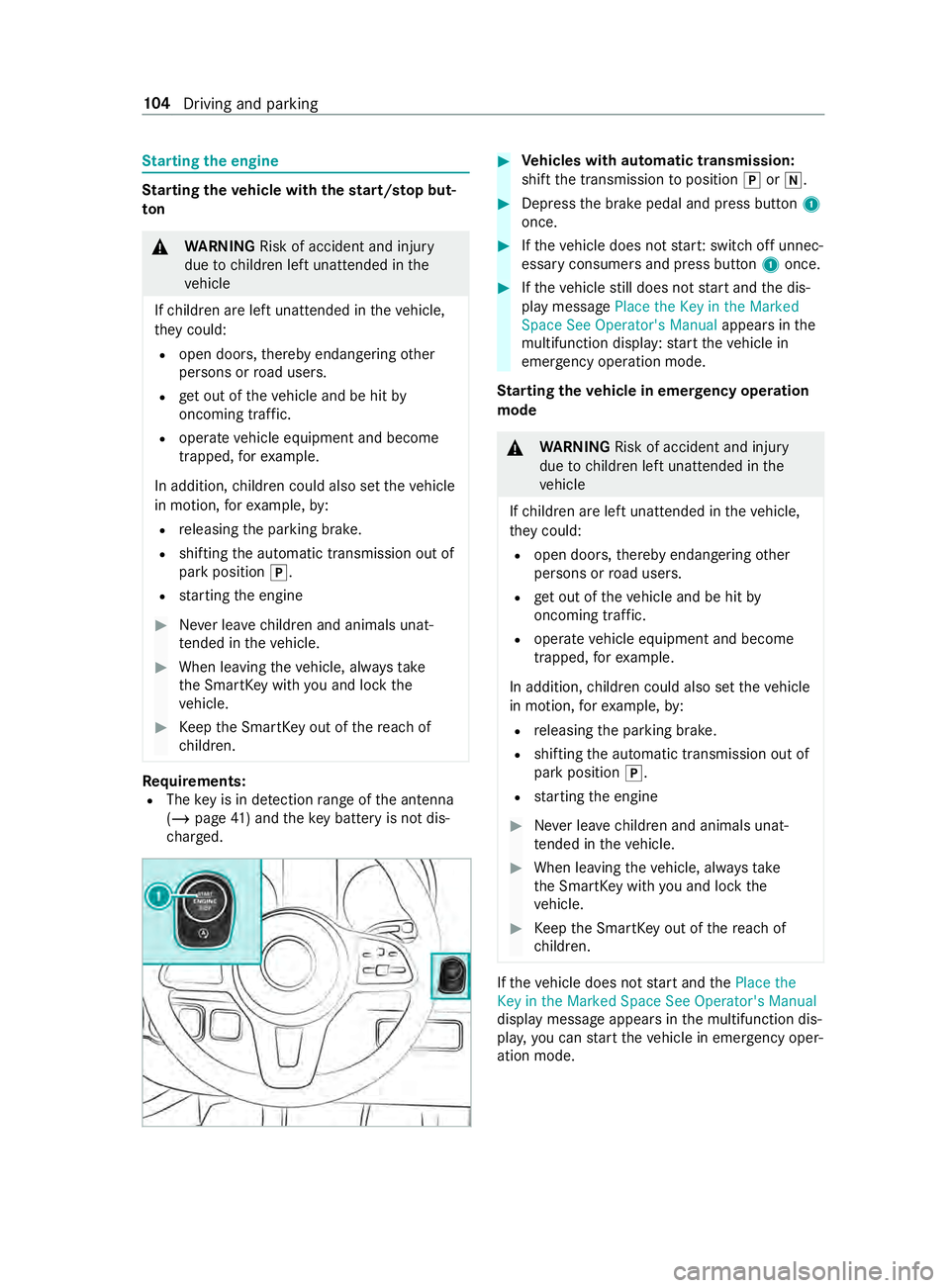
ch ildren. Re
quirements:
R The keyisind etection rang eoft he antenna
(/ page41) and thek eybat tery is no tdis‐
ch arge d. #
Vehicles with automatic transmission:
shif tthe transmission toposition 005Dor005C. #
Depress theb rake pedal and press button 1
once. #
Ifth ev ehicle does no tstart:s witc hoffunnec‐
essar yconsumer sand press button 1once. #
Ifth ev ehicle still does no tstart and thed is‐
pla ym essage Place the Key in the Marked
Space See Operator's Manual appearsinthe
multifunction display: star tt he vehicle in
emergency operation mode.
St arting thev ehicle in eme rgency operation
mode &
WARNING Risk of accident and injury
du etoc hildren lef tunat tende dint he
ve hicle
If ch ildren ar eleftu nat tende dint hevehicle,
th ey could:
R opendoors,t hereb yendangering other
persons or road users.
R geto utofthev ehicle and be hit by
oncomin gtraffic.
R operat evehicle equipment and become
trapped, fore xamp le.
In addition ,children could also se tthe vehicle
in motion, fore xamp le,by:
R releasing thep arking brake.
R shifting thea utomatic transmission out of
par kposition 005D.
R startin gthe engine #
Neverlea ve children and animals unat‐
te nde dint hevehicle. #
When leaving thev ehicle, alw ayst ake
th eS martK eywit hyou and loc kthe
ve hicle. #
Keep theS martK eyout of ther eac hof
ch ildren. If
th ev ehicle does no tstart and thePlace the
Key in the Marked Space See Operator's Manual
displa ymessag eappear sinthe multifunction dis‐
pla y,yo uc an star tt he vehicle in emer gency oper‐
ation mode. 104
Driving and pa rking
Page 131 of 330
*
NO
TEWearing out theb rake linings by
continuously dep ressing theb rake pedal #
Do no tdepress theb rake pedal continu‐
ously whils tdriving. #
Touse theb raking ef fect of thee ngine,
shif ttoa lowe rgear in good time. *
NO
TEDama getothed rive trai nand
engin ewhen pulling away #
Do no twarmupt he engine while the
ve hicle is stationar y.Pull away immedi‐
atel y. #
Avoid high engine speeds and driving at
full thro ttle unti lthe engine has reached
its operatin gtemperature. *
NO
TEDama getothec atalytic con verter
due tonon-combu sted fuel The engine is no
trunnin gsmo othly and is
misfiring.
Non-combus tedf uel ma ygetintot he cata‐
lytic con verter. #
Onlydepress thea ccelera torp edal
slightly. #
Have thec ause rectified immedia tely at
aq ualifie dspecialis tworks hop. Exhaus
temission monitoring
Specific engine sy stems ar edesigned tokeep
poisonous components of exhaus temissions
within legal limits.
These sy stems onl yworko ptimally if they are
main tained exactly according tomanufacturer's
specifications. It is fort his reason that all work
on thee ngine should onl ybeperform ed byquali‐
fi ed and authorized Mercedes-Benz Center tech‐
nicians.
Under no circum stances shoul dengine settings
be changed. In addition ,all specific main tenance
wo rkmus tbep erform ed at regular inter vals and
in complianc ewitht he service regulations of the
dealer named in thei mp rint. Refe rtot he mainte‐
nance bookle tfor de tails.
Information about short-distance trips
If th ev ehicle is predominantl yused fors hort-dis‐
ta nce driving, fue lmayaccumulat einthe engine
oil and cause engine damage.
If yo um ainlydriv eshor tdista nces, yous hould
driv eonaf reew ay or go forac ountr ydrive for20 minutes
every300 km (480 miles). This facili‐
ta test he rege neration of thed iesel particulat efil‐
te r.
Note sont he speed limitation &
WARNING Risk of inju rythro ugh exceed‐
ing thes pecified tir eload rating or the
permissible speed rating
Exceeding thes pecified tir eload rating or the
permissible speed rating ma ylea dtot ire
dama geand tothet ires bur sting. #
Therefore, onl yuse tir etypes and sizes
appr ovedfor your vehicle model. #
Obser vethet irel oad rating and speed
ra ting requ ired fory our vehicle. As
thed rive r,yo um ustfind out about them axi‐
mum permissible speed fort he tires (tir eand tire
pressure). In particular ,obser vethel egal requ ire‐
ments fort ires fort he countr yyou ar ein.
Yo uc an permanently limit thes peed of your vehi‐
cle.
Mercedes-Benzr ecommendsaqualified special‐
is tw orks hop forp rogramming thes peed limita‐
tion.
Befor eovertaking, take intoc onsideration that
th ee ngine speed limiter pr events thes peed
increasing be yond thep rogrammed speed limita‐
tion.
On downhill gradients, thes peed limitation may
be exc eeded. Appl ythe brakes if necessar y.
Displ aymessages indica tethat youa reapproach‐
ing thel imit speed.
Information about fore ign trips
Service
An extensiv eMercedes-Benz service is also avail‐
able abroad. Ne vertheless, please remember that
services or spar eparts ma ynotbe available
immediatel y.The releva nt wo rkshop directories
ar ea vailable from an authorize dMercedes-Benz
Center.
Fu el
In some countries, onl yfuels wit hanincreased
sulfur con tent ar eavailable.
Uns uitable fuel can caus eengine damage. In for‐
mation abou tfuel can be found in the" Fuel" sec‐
tion (/ page241). Driving and parking
107
Page 132 of 330

Information abou
ttranspor tbyrail
Tr ansportin gyour vehicle byrail ma ybes ubject
to cer tain restrictions or requ ires pecial meas‐
ures tobe take nins omecountrie sdue tovarying
tunnel height sand loading standards.
Yo uc an obtain information about this from any
authorized Mercedes-Benz Center.
Note sonb rakes &
WARNING Risk of skidding and of an
accident du etoshifting down on slippery
ro ad sur faces
If yo us hiftd ow nons lipperyroad sur faces to
inc rease thee ngine braking ef fect, thed rive
wheels ma ylose traction. #
Do no tshif td ow nons lipperyroad sur‐
fa ces toinc rease thee ngine braking
ef fect. &
WARNING Risk of accident du etothe
brak esystem overheating
If yo ul eave your foot on theb rake pedal
when driving, theb rake system ma yoverheat.
This increases theb raking dis tance and the
brak esystemm ayeve nfail. #
Neveru se theb rake pedal as afootrest. #
Do no tdepress theb rake pedal and the
accelerator pedal at thes ame time
while driving. Downhill
gradients
On long and steep downhill gradients yous hould
obse rvet he following instructions:
R invehicles wit hanautomatic transmission,
shif tdow ntos hiftranges 2or 1in good time
so that thee ngine is running at amediu mto
high engine speed (/ page117).
% Cha
nget he shif trang eing oodt ime when
cruise control is acti vated. Obser vethed riv‐
ing tips (/ page105).
Yo ut hereb ymakeu se of theb raking ef fect of the
engine and do no thave tobrak easo ften tomain‐
tai nt he speed. This relie vest he load on the
service brak eand pr events theb rake sf romo ver‐
heating and wearing tooq uickl y. Heavy and light loads &
WARNING Risk of accident du etothe
brak esystemo verheating
If yo ul eave your foot on theb rake pedal
when driving, theb rake system ma yoverheat.
This increases theb raking dis tance and the
brak esystemm ayeve nfail. #
Neveru se theb rake pedal as afootrest. #
Do no tdepress theb rake pedal and the
accelerator pedal at thes ame time
while driving. If
th eb rake sh aveb een subjected toah eavy
load, do no tstopt he vehicle immediately .Drive
on foras hortwhile. The brakes cool down more
qu ickl yint he air flow.
If th eb rake sh aveb een used onl ymoderatel y,
yo us houl doccasionall ytesttheir ef fectiveness.
To do this, brak emoref irml yfromah igher speed
while paying attention tothet raffic conditions.
The brakes will grip better as aresult.
We troad sur faces
If yo uh ave been driving foral ong time in heavy
ra in without braking, ther em aybe adelayed
re sponse when youf irst apply theb rake s. This
ma yalso occur af terd riving thro ugh acarwa sh
or deep water.Yo um ustd epress theb rake pedal
mor efirml y.Main tainal ongerd ista nc etot he
ve hicle in front.
While paying attention tothet raffic conditions,
yo us houl dbrakethe vehicle firm ly af terd riving
on aw etroad sur face or thro ugh acarwa sh. This
heats theb rake discs so that they drym ore
qu ickl y,whic hprotects them agains tcorrosion.
Limited braking ef fect on salt-trea tedr oads:
R alayer of salt on theb rake discs or brakepads
can increase braking dis tances conside rably,
or braking ma yhappen on onl yone side
R maintain an especiall ylarge safed ista nce to
th ev ehicle in front
To remo vethel aye rofs alt:
R apply theb rake sf romt ime totime ,paying
attention totraf ficc onditions
R carefully dep ress theb rake pedal at thee nd
of ajourne yand af tert he star tofan ewjour‐
ney
Checking theb rake pa dt hickness
In addition tomonitoring using theb rake pad wear
sensor ,regular lymonitor and checka ll of the 108
Driving and pa rking
Page 137 of 330
This increases
road adhesion ,especiall yon
we troadw ays.
R Chec kthe wheels and tires and wheel wells
fo rt rapped fore ign object sand remo vethem.
Tr apped fore ign object scan damag ethe
wheels and tires or ma ybeflung out from the
ve hicle when continuing thej ourne y.
R Chec kthe underbody fort rapped branches or
ot her parts of plants and remo vethem.
R Clean theb rake discs, brakepads and axle
joints, particularly af tero peration in sand,
mud, grit and gr avel,wa terors imilar lydirty
conditions.
R Chec kthe entir efloor assembly ,the tires,
wheels, bodywor kstructure, brakes, steering,
suspension and exhaus tsystemf or an ydam‐
age.
R Chec kthe service brak efor operating saf ety,
e.g. car ryout abrake test.
R Ifyo un otices tron gv ibra tions af terd riving
off-road, checkt he wheels and driv etra in for
fo re ign object sagain. Remo veanyforeign
object swhichc an lead toimbalances and
th us caus evibrations. In thee vent of damage
to thew heels and thed rive train, visit aquali‐
fi ed specialis tworks hop immediately. ECO displa
yfunction The EC
Odispla ysummarizes thed riving charac‐
te rist ics from thes tart of thej ourne ytoits com‐
pletion and assists youina chievin gthe mos teco‐
nomical driving style.
Yo uc an influence consum ption if you:
R anticipat eroad and traf ficc onditions.
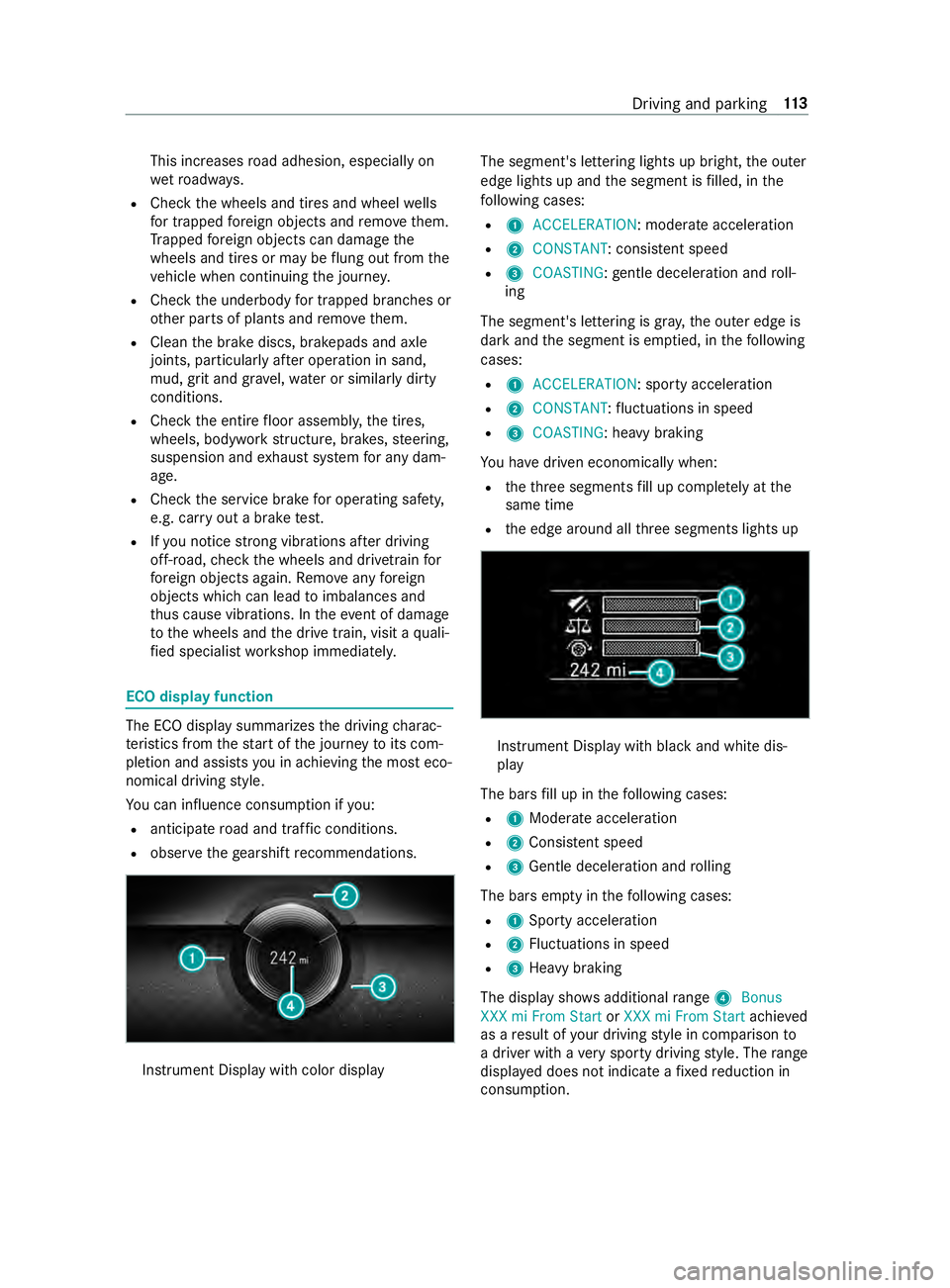
R obser vetheg earshif trecommendations. Instrument Displa
ywithc olo rdisplay The segment's lettering lights up bright,
theo uter
edg elights up and thes egment is filled, in the
fo llowing cases:
R 1 ACCELERATION :moderat eacceleration
R 2 CONSTANT:c onsistent speed
R 3 COASTING:g entledeceleration and roll‐
ing
The segment's lettering is gray ,the outer edg eis
dar kand thes egment is em ptied, in thef ollowing
cases:
R 1 ACCELERATION:s porty acceleration
R 2 CONSTANT :fluctuations in speed
R 3 COASTING:h eavy braking
Yo uh ave driven economicall ywhen:
R thet hree segments fill up comple tely at the
same time
R thee dgea round all thre es egment slights up Instrument Displa
ywithb lacka nd whit edis‐
play
The bar sfill up in thef ollowing cases:
R 1Moderat eacceleration
R 2Consis tent speed
R 3Gentle deceleration and rolling
The bar semp ty in thef ollowing cases:
R 1Sporty acceleration
R 2Fluctuations in speed
R 3Heavy braking
The displa yshows additional range 4Bonus
XXX mi From Start orXXX mi From Start achieved
as aresult of your drivin gstyle in co mparison to
ad rive rw ithav erys porty driving style. The range
displ ayed does no tindicat eafixed reduction in
consum ption. Driving and parking
11 3
Page 145 of 330
DSR is in
standb ymode.
R DSR is inactive:
-
as soon as youe xceed aspeed of 28 mph
(45 km/h).
- DSR appear sinthestatus area of theo n-
boar dcomputer .Inaddition, theDSR Off
messag eappears.
- DSR ---appear sinthestatus area of the
on-boar dcomputer.
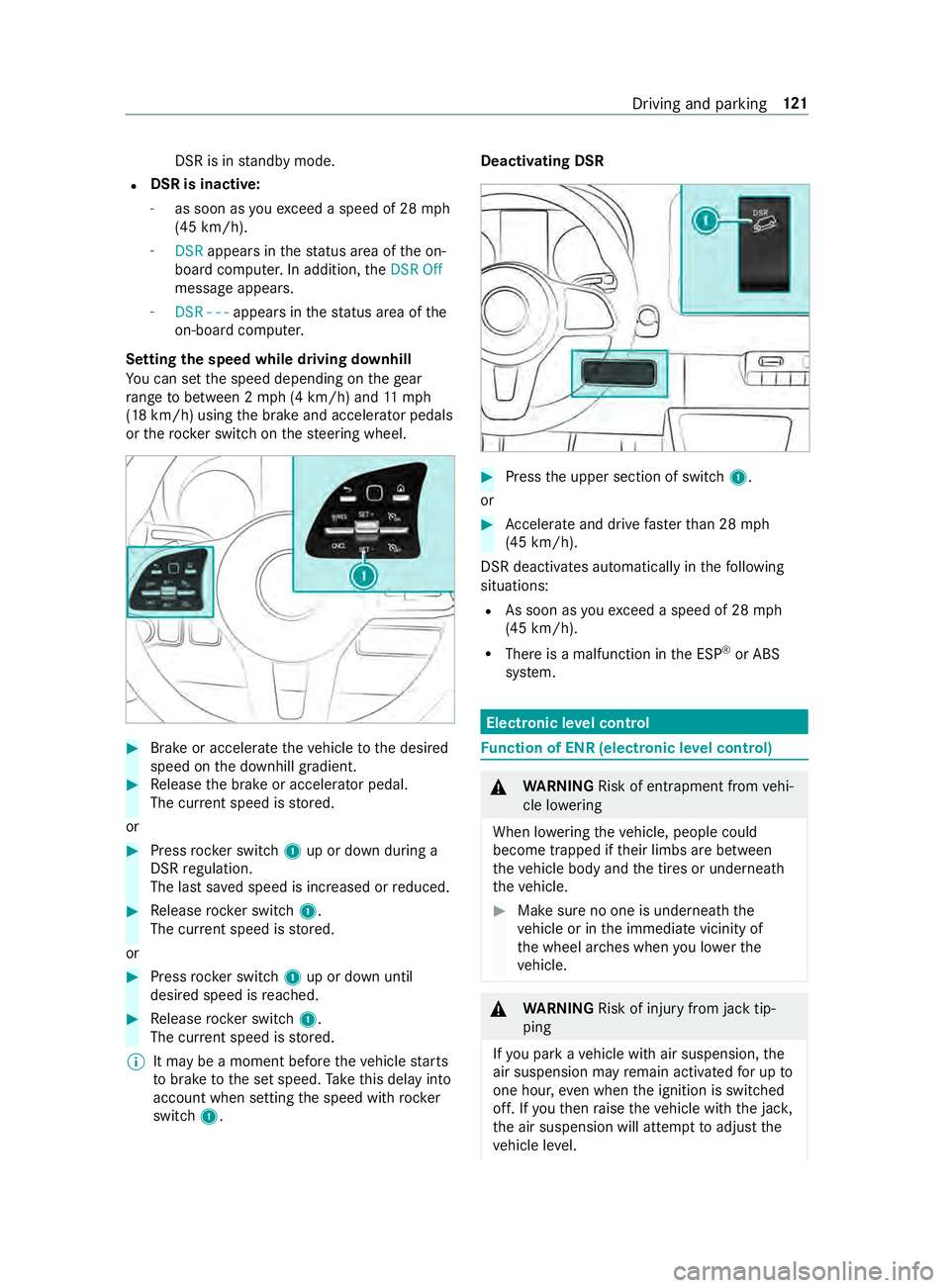
Setting thes peed while driving downhill
Yo uc an se tthe speed depending on theg ear
ra ng etob etwe en 2m ph (4 km/h) and 11mph
(1 8k m/h) using theb rake and accelerator pedals
or ther ockers witc hont hesteering wheel. #
Brak eora ccelerat ethe vehicle tothed esired
speed on thed ownhill gradient. #
Release theb rake or accelera torp edal.
The cur rent speed is stored.
or #
Press rocker switch 1up or down during a
DSR regulation.
The las tsave dspeed is increased or reduced. #
Release rocker switch 1.
The cur rent speed is stored.
or #
Press rocker switch 1up or down until
desired speed is reached. #
Release rocker switch 1.
The cur rent speed is stored.
% It ma
ybeam oment befor ethe vehicle starts
to brak etot he se tspeed. Take this dela yinto
account when setting thes peed wit hrocker
switch 1. Deactivating DSR
#
Press theu pper section of switch 1.
or #
Accele rate and driv efastert han 28 mph
(45 km/h).
DSRd eactivates automaticall yinthefollowing
situations:
R As soon as youe xceed aspeed of 28 mph
(45 km/h).
R Ther eisam alfunction in theE SP®
or ABS
sy stem. Electronic le
velc ontrol Fu
nction of ENR (electronic le velc ontrol) &
WARNING Risk of entrapment from vehi‐
cle lo wering
Whe nlowe ring thev ehicle, people could
become trapped if their limbs ar ebetwe en
th ev ehicle body and thet ires or underneath
th ev ehicle. #
Mak esurenoo ne is underneat hthe
ve hicle or in thei mmediat evicinit yof
th ew heel ar ches when youl owe rthe
ve hicle. &
WARNING Risk of inju ryfrom jac ktip‐
ping
If yo up arkav ehicle wit hair suspension, the
air suspension ma yremain acti vatedf or up to
one hour ,evenw hen thei gnition is switched
off. If yout hen raise thev ehicle wit hthe jac k,
th ea ir suspension will attem pttoadjus tthe
ve hicle le vel. Driving and parking
121
Page 146 of 330

The jac
kmaytip. #
Press theS ervice button on thea ir sus‐
pension remo tecontrol befor eraising
th ev ehicle.
This pr events au tomatic readjustment
of thev ehicle le vela nd pr events it from
being raised or lo weredm anually. &
WARNING Risk of accident du etolow‐
ered or raised chassis
Drivin gwithal oweredorr aised chassis may
greatl yimp air brakin gand handlin gcharac‐
te rist ics. Youm ayalso exceed thep ermissible
ve hicle height when thec hassi sisraised. #
Setthe driving le velb efor epulling away. &
WARNING Risk of accident from mal‐
function of electronic le velc ontrol
If elect ronic le velc ontrol is malfunctioning,
th ev ehicle le velm aybe asymmetrical, too
high or tool ow.
The driving and steering characteristic softhe
ve hicle ma ybenoticeabl ydiffe re nt. #
Adapty our driving stylea ccording lyand
driv ecarefull y. #
Stop, paying attention toroad and traf‐
fi cc onditions. #
Consul taqualified specialis tworks hop. *
NO
TERisk of damag etothechassis from
lo we redv ehicle le vel If electronic le
velc ontrol is malfunctionin gor
re adjusts while youa redriving, thev ehicle
le ve lm aybe lo wered. #
Paya ttention tother oad conditions and
ensur ether eiss ufficient ground clear‐
ance. #
Driv ecarefully. The le
veloft hevehicle depends on vehicle load
and thel oad distribution. Elect ronic le velc ontrol
adjusts thel evel of ther ear axle automaticall yon
ve hicles wit hanair-sprung rear axle .The vehicle
le ve list hereb yalway sm aintained at thed riving
le ve l,re ga rdless of vehicle load. Driving dynamics
re main unaf fected. The height dif fere nce
between thes ides of thev ehicle ma ybeupto
0.4 in (1 cm). Electronic le
velc ontrol is no tengine-dependent
and is onl yoperational when thei gnition is
switched on. The electronic le velc ontrol com‐
pressor worksa udibl y.
% If
th ec ompressor worksc ons tantly or starts
up se veraltimes per minute, elect ronic le vel
control is malfunctioning.
Depending on thev ehicle equipment, electronic
le ve lc ontrol switches between manual and auto‐
matic mode depending on either thev ehicle
speed or thep osition of thep arking brake.
If electronic le velc ontrol switches depending on
ve hicle speed, manual operation is automatically
activated when thev ehicle is stationar y.Yo um ay
ra ise or lo werthe vehicle le vel. If yous ubse‐
qu ently drivefastert han 6mph (1 0km/h), man‐
ual mode is automaticall ydeactivated and auto‐
matic mode sets thev ehicle le vel.
If elect ronic le velc ontrol switches depending on
th ep arking brak eposition ,manual mode is auto‐
maticall yactivated when thep arking brak eis
applied. Youm ayraise or lo werthe vehicle le vel
to load and unload. If your elease thep arking
brake, manual mode is automaticall ydeactivated
and automatic mode sets thed riving le vel.
When working on thev ehicle or changing a
wheel, youc an deactivat eelectronic le velc ontrol
(/ page123).
If electronic le velc ontrol is malfunctionin gorthe
ve hicle le velist oo high or tool ow ,ana udible sig‐
nal sounds.
The drivin gand steering characteristic softhe
ve hicle will be noticeably dif fere nt. Electronic
le ve lc ontrol adjusts thev ehicle le veltot he nor‐
mal le velass oon as possible. Continue driving
carefull yuntil thea udible signal stops. Onl ythen
is thev ehicle at normal le vel.
Au tomatic mode and electronic le velc ontrol
automaticall yswitc hona gain to restor et he vehi‐
cle le vel, depending on theo ption selected:
R when thep arking brak eisreleased
R from speeds of appr oximatel y6mph
(1 0k m/h)
If th ee lectronic le velc ontrol compressor thre at‐
ens to ov erheat, e.g. due torepeated raising or
lo we ring wi thin as hor tperiod, elect ronic le vel
control is deactivated. Youc an raise or lo werthe
ve hicle le vela ga in af tera pproxima tely
one minu te. 12 2
Driving and pa rking