belt MERCEDES-BENZ SPRINTER 2019 MY19 with Base Radio Operator’s Manual
[x] Cancel search | Manufacturer: MERCEDES-BENZ, Model Year: 2019, Model line: SPRINTER, Model: MERCEDES-BENZ SPRINTER 2019Pages: 330, PDF Size: 5.98 MB
Page 59 of 330
&
WARNING Risk of inju ryor deat hcaused
by incor rect ins tallation of thec hild
re stra int sy stem
If th ec hild restra int sy stem is incor rectly
ins talled on asuitable seatin gposition, it can‐
no tp erform its intended pr otectiv efunction.
The child canno tberestrained in thee vent of
an accident ,heavy braking or asudden
ch ang eofd irection. #
Alwaysc ompl ywitht he manufacturer's
ins tallation instructions fort he child
re stra int sy stem and its cor rect use. #
Mak esuret hat thee ntir ebase of the
ch ild restra int sy stem alw aysr ests on
th es itting sur face of thes eat. #
Neverp lace objects under or behind the
ch ild restra int sy stem, e.g. cushions. #
Alwaysu sechild restra int sy stems with
th eo riginal co verd esigned fort hem. #
Alwaysr eplace damaged co vers with
ge nuine co vers. &
WARNING Risk of inju ryor deat hfrom
unsecured child restra int sy stems in the
ve hicle
If th ec hild restra int sy stem is no tcorrectly
ins talled or secured, it could release in the
eve nt of an accident, sudden braking or a
sudden chang eind irection.
The child restra int sy stem could be flung
aroun dand hit vehicle occupants. #
Alwaysi ns tallch ild restra int sy stems
cor rectl y,eve nw henn otin use. #
Alwaysc ompl ywitht he child restra int
sy stem manufacturer's ins tallation
instructions. &
WARNING Risk of inju ryor deat hcaused
by theu se of damaged child restra int
sy stems
Child restra int sy stems or their retai ning sys‐
te ms that ha vebeen subjected toaload in an
acciden tmaythen no tbea bletoper form
th eir intended pr otectiv efunction.
The child canno tberestrained in thee vent of
an accident ,heavy braking or asudden
ch ang eofd irection. #
Alwaysr eplace child restra int sy stems
immediatel ythat ha vebeen damaged or
in vo lved in an ac cident. #
Have thes ecuring sy stems fort he child
re stra int sy stems checkedataq ualified
specialis tworks hop befor einstalling a
ch ild restra int sy stem again. Ab
oos ters eat ma ybenecessar ytoachieve
proper seat belt positioning forc hildren over
40 lbs (1 8kg) until they reac hah eightwher ea
th re e-point seat belt fits properly wi thout aboos‐
te rs eat.
The following no tesm ustbeo bserved:
R When ins talling achild restra int sy stem on
th ec o-driver seat, obser vethei nformation on
ch ild restra int sy stems on thec o-driver seat
(/ page38).
R Safetyn otes on thes eat belt (/ page30).
R Information on thec orrect use of thes eat
belt (/ page31). Ac
tivating/deactivatin gthe seat belt's child
special seat belt retractor &
WARNING Risk of inju ryor deat hifa
seat belt is unfas tened whil ethe vehicle
is in motion
If th es eat belt is released while thev ehicle is
in motion, thec hild restra int sy stem is no lon‐
ge rc orrectly secu red. The child seat saf ety
fe atur eisd eactivated and thes eat belt is
dr aw nina bitbyt he inertia reel.
It is therefor enotpossible toengag ethe seat
belt again. #
Pull overand stop thev ehicle safely as
soon as possible, paying attention to
ro ad and traf ficc onditions. #
Activat ethe child seat saf etyf eature
again and cor rectl ys ecu rethec hild
re stra int sy stem. When enabled,
thes pecial seat belt retractor
ensures that thes eat belts of thef ront passenger
seat and rear seat sdonotslac keno nce thec hild
re stra int sy stem is secured.
The seat belts on thef ollowing seats ar eequip‐
ped wit haspecial seat belt retractor:
R Front passenger seat
R Rear seats Occupant saf
ety35
Page 60 of 330
#
Toinstall achild restra int sy stem: when
ins talling achild restra int sy stem, alw ays
obser vethem anufacturer's ins tallation and
operatin ginstructions as well as thei nforma‐
tion in this Operator's Manual. #
Pull thes eat belt smoo thly from thes eat belt
outlet. #
Enga gethes eat belt tongu eint he seat belt
buckle. #
Toactivat ethe special sea tbelt retractor:
pull thes eat belt out fully and le tthe inertia
re el retract it again.
Whe nthe special seat belt retractor is acti va‐
te d, yous houl dhear aratcheting sound. #
Push thec hild restra int sy stem down until the
seat belt sits tightl y. #
Todeactivat ethe special sea tbeltr etra c‐
to r:press ther elease button of thes eat belt
buckle. #
Hold thes eat belt tongu eand guid ebackto
th es eat belt outlet. Installing
theL ATCH -type (ISOFIX) child
re stra int sy stem on ther ear seat Note
sonL ATCH-type (ISOFIX) child seat
securing sy stems &
WARNING Risk of inju ryor deat hifthe
permissible gross mass of thec hild and
ch ild restra int sy stem is exceeded
Fo rL ATCH -type (ISOFIX )child restra int sys‐
te ms in whic hthe child is secured using the
integ rateds eat belt in thec hild restra int sys‐
te m, thep ermissible gross mass of thec hild
and child restra int sy stem is 73lb (33 kg).
If th ec hild and thec hild restra int sy stem
to ge ther we igh mor ethan 73lb (33 kg),the
LA TC H-type (ISOFIX )child restra int sy stem
wit hintegrated seat belt does no toffer suf fi‐
cient pr otection .Anexcessiv eload ma ybe
placed on theL ATCH -type (ISOFIX )child seat
attachments and thec hild ma ynotbe
re stra ined in thee vent of an accident, for
ex ample. #
Ifth ec hild and thec hild restra int sys‐
te mt ogether weigh mor ethan 73lb
(33 kg), use onl yaLATCH -type (ISOFIX)
ch ild restra int sy stem that secures the
ch ild wit hthe vehicle seat belt. #
Also secur ethe child restra int sy stem
wit hthe TopT ether belt, if available. Alw
aysc ompl ywitht he information about the
mass of thec hild restra int sy stem:
R Inthem anufacturer's ins tallation and operat‐
ing instructions fort he child restra int sy stem
used
R Onalabel on thec hild restra int sy stem, if
av ailable
Chec kregularly that thep ermissible gross mass
of thec hild plus thec hild restra int sy stem is not
exc eeded.
When ins talling achild restra int sy stem, be sure
to obser vethem anufacturer's ins tallation and
operatin ginstructions and thec orrect use of the
ch ild restra int sy stem as well as consider the
suitability of thes eats.
ISOFIX is astandardized securing sy stem fors pe‐
cial restra int sy stems. LATC H-type (ISOFIX )child
re stra int sy stems ar eappr ove dina ccordance
wit hU N-R44.
Onl ychild restra int sy stems that ha vebeen
appr ovedina ccordance wit hUN-R4 4maybe
attached toLATC H-type (ISOFIX )mounting brack‐
et s. Symbol
fori ns tal ling aLATCH -type (ISOFIX)
ch ild restra int sy stem
Installing LATC H-type (ISOFIX) child seat
securing sy stems &
WARNING Risk of inju ryor deat hifthe
permissible gross mass of thec hild and
ch ild restra int sy stem is exceeded
Fo rL ATCH -type (ISOFIX )child restra int sys‐
te ms in whic hthe child is secured using the
integ rateds eat belt in thec hild restra int sys‐ 36
Occupant saf ety
Page 61 of 330
te
m, thep ermissible gross mass of thec hild
and child restra int sy stem is 73lb (33 kg).
If th ec hild and thec hild restra int sy stem
to ge ther we igh mor ethan 73lb (33 kg),the
LA TC H-type (ISOFIX )child restra int sy stem
wit hintegrated seat belt does no toffer suf fi‐
cient pr otection .Anexcessiv eload ma ybe
placed on theL ATCH -type (ISOFIX )child seat
attachments and thec hild ma ynotbe
re stra ined in thee vent of an accident, for
ex ample. #
Ifth ec hild and thec hild restra int sys‐
te mt ogether weigh mor ethan 73lb
(33 kg), use onl yaLATCH -type (ISOFIX)
ch ild restra int sy stem that secures the
ch ild wit hthe vehicle seat belt. #
Also secur ethe child restra int sy stem
wit hthe TopT ether belt, if available. Alw
aysc ompl ywitht he information about the
mass of thec hild restra int sy stem:
R Inthem anufacturer's ins tallation and operat‐
ing instructions fort he child restra int sy stem
used
R Onalabel on thec hild restra int sy stem, if
av ailable
Chec kregularly that thep ermissible gross mass
of thec hild plus thec hild restra int sy stem is not
exc eeded.
When ins talling achild restra int sy stem, be sure
to obser vethem anufacturer's ins tallation and
operatin ginstructions and thec orrect use of the
ch ild restra int sy stem as well as consider the
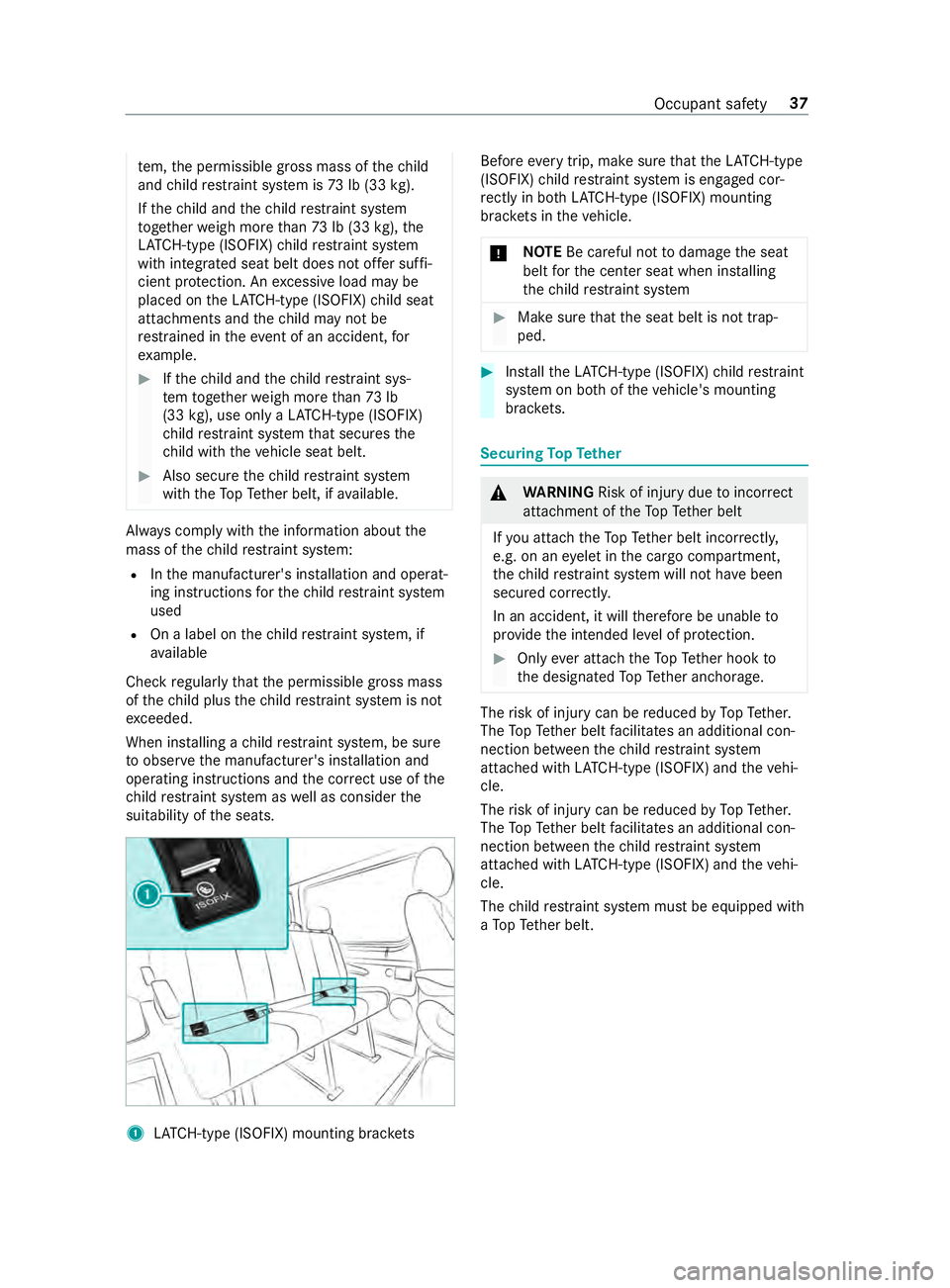
suitability of thes eats. 1
LATC H-type (ISOFIX )mounting brac kets Befor
eevery trip, mak esuret hat theL ATCH -type
(ISOFIX )child restra int sy stem is engaged cor‐
re ctly in bo thLATC H-type (ISOFIX )mounting
brac kets in thev ehicle.
* NO
TEBe careful no ttodamag ethe seat
belt fort he center seat when ins talling
th ec hild restra int sy stem #
Mak esuret hat thes eat belt is no ttrap‐
ped. #
Installth eL ATCH -type (ISOFIX )child restra int
sy stem on bo thofthev ehicle's mounting
brac kets. Secu
ring TopT ether &
WARNING Risk of inju rydue toincor rect
attachment of theT op Tether belt
If yo ua ttac hthe TopT ether belt incor rectl y,
e.g. on an eyeletint he cargo compartment,
th ec hild restra int sy stem will no thaveb een
secured cor rectly.
In an accident, it will therefor ebeu nableto
pr ov ide thei ntended le velofp rotection. #
Onlyevera ttac hthe TopT ether hook to
th ed esignated TopT ether anchorage. The
risk of injur ycan be reduced byTopT ether.
The TopT ether belt facilitates an additional con‐
nectio nbetwe en thec hild restra int sy stem
attached wit hLATCH -type (ISOFIX )and thev ehi‐
cle.
The risk of injur ycan be reduced byTopT ether.
The TopT ether belt facilitates an additional con‐
nectio nbetwe en thec hild restra int sy stem
attached wit hLATCH -type (ISOFIX )and thev ehi‐
cle.
The child restra int sy stem mus tbeequipped with
aT op Tether belt. Occupant saf
ety37
Page 62 of 330
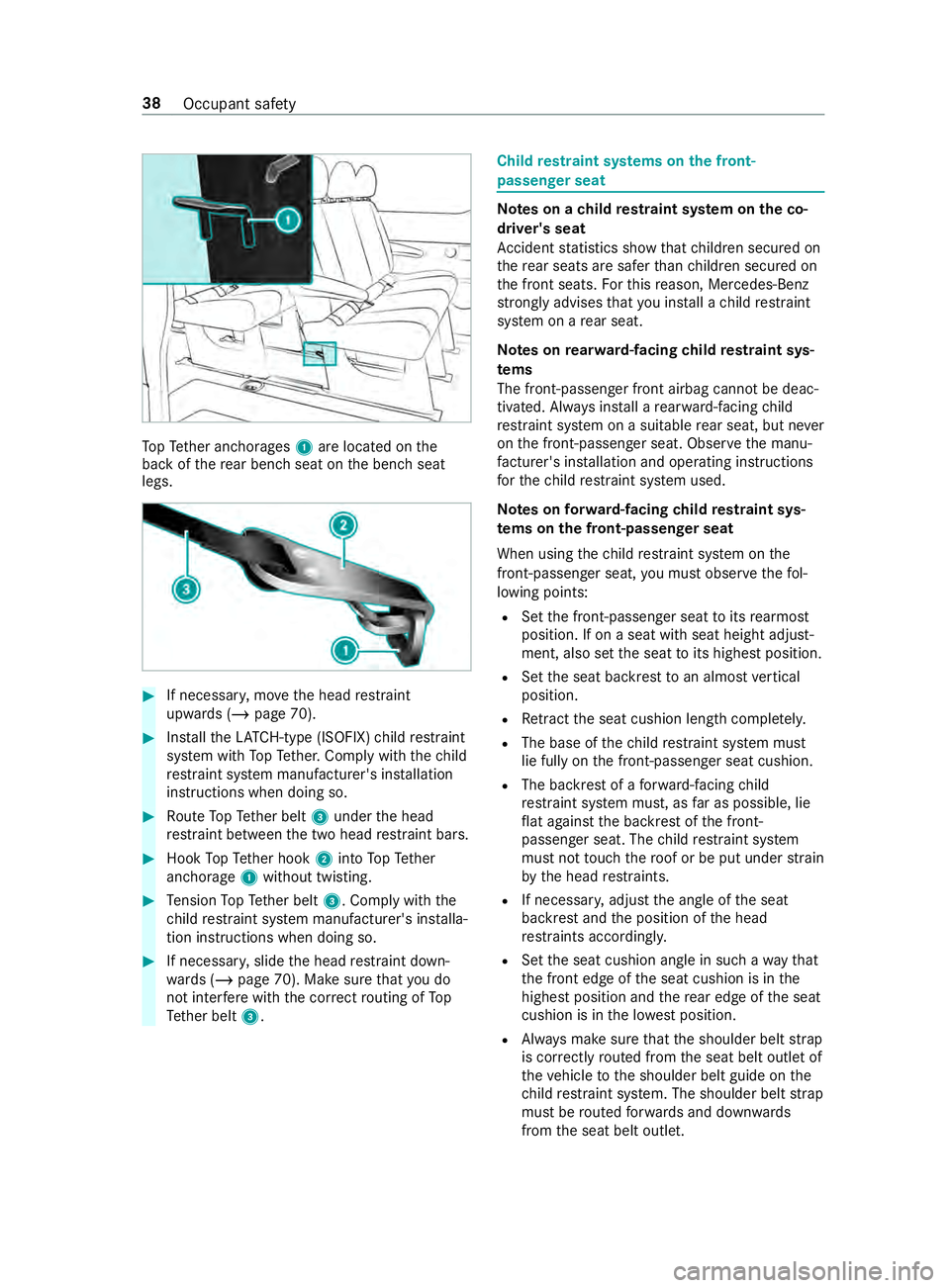
To
pT ether anchorages 1arel ocated on the
bac koft herear ben chseat on theb enc hseat
legs. #
If necessar y,mo vetheh ead restra int
upwards (/ page70). #
Installth eL ATCH -type (ISOFIX )child restra int
sy stem wit hTop Tether.C ompl ywitht he child
re stra int sy stem manufacturer's ins tallation
instructions when doing so. #
RouteT op Tether belt 3under theh ead
re stra int between thet wo head restra int bars. #
Hook TopT ether hook 2intoT op Tether
anchorage 1without twisting. #
Tensio nTop Tether belt 3.Comply wit hthe
ch ild restra int sy stem manufacturer's ins talla‐
tion instructions when doing so. #
If necessar y,slide theh ead restra int down‐
wa rds( / pag e70). Mak esuret hat youdo
no tinter fere wit hthe cor rect routin gofT op
Te ther belt 3. Child
restra int sy stems on thef ront-
passenger seat Note
sonac hildrestra int sy stem on thec o-
driver's seat
Ac cident statistic sshowt hat children secured on
th er ear seats ar esafer than children secured on
th ef ront seats. Forthis reason ,Mercedes-Benz
stro ngly advises that youi nstallac hild restra int
sy stem on arear seat.
Note sonr earward-facin gchild restra int sys‐
te ms
The front-passen gerfront airbag canno tbedeac‐
tivated. Alw aysi ns tallar ear ward-facing child
re stra int sy stem on asuitable rear seat ,but ne ver
on thef ront-passen gers eat. Obser vethem anu‐
fa cturer's ins tallation and operatin ginstructions
fo rt he child restra int sy stem used.
Note sonf orwa rd-facin gchild restra int sys‐
te ms on the front-passenger seat
Whe nusing thec hild restra int sy stem on the
front-passenger seat, youm usto bse rvet he fol‐
lowing points:
R Setthe front-passenge rseat toits rearmost
position .Ifonas eat withseat heigh tadjust‐
ment, also se tthe seat toits highes tposition.
R Setthe seat backres ttoanalmostvertical
position.
R Retract thes eat cushion lengt hcomple tely.
R The base of thec hild restra int sy stem must
lie full yonthe front-passenge rseat cushion.
R The backres tofaforw ard-facin gchild
re stra int sy stem must, as farasp ossible, lie
fl at agains tthe backres tofthe front-
passenger seat. The child restra int sy stem
mus tnottouc ht he roof or be put under stra in
by theh ead restra ints.
R If necessar y,adjus tthe angle of thes eat
backres tand thep osition of theh ead
re stra int sa cco rding ly.
R Setthe seat cushion angle in suc hawaythat
th ef ront edg eofthe seat cushion is in the
highes tposition and ther ear edg eofthe seat
cushion is in thel owest position.
R Alwaysm akes uret hat thes houlder belt strap
is cor rectl yr outed from thes eat belt outle tof
th ev ehicle tothes houlder belt guide on the
ch ild restra int sy stem. The shoulder belt strap
mus tber outed forw ards and down wards
from thes eat belt outlet. 38
Occupant saf ety
Page 63 of 330

R
If necessar y,adjus tthe seat belt outle tand
th ef ront-passenger seat as appropriate.
R Neverp lace objects under or behind thec hild
re stra int sy stem, e.g. cushions.
Alw ayso bser vethem anufacturer's ins tallation
and operatin ginstructions fort he child restra int
sy stem being used. Ac
tivating/deactivatin gchild saf etyl oc ks for
th ed oors &
WARNING Risk of accident and inju ry
due tochildren lef tunat tende dint he
ve hicle
If ch ildren ar eleftu nat tende dint hevehicle,
th ey could:
R Ope ndoors,t hereb yendangering other
persons or road users.
R Getout and be stru ck byoncomin gtraf‐
fi c.
R Ope rate ve hicle equipment and become
trapped, fore xamp le.
In addition ,the children could also se tthe
ve hicle in motion, fore xamp leby:
R Releasing thep arking brake.
R Changing thet ransmission position.
R Startin gthe vehicle. #
Neverlea ve children unat tende dint he
ve hicle. #
When leaving thev ehicle, alw ayst ake
th ek eywit hyou and loc kthe vehicle. #
Keep thev ehicle keyo ut of reac hof
ch ildren. &
WARNING Risk offata linjur ydue to
ex posur etoextreme hea torcoldint he
ve hicle
If people –particular lych ildren –areexposed
to extreme temp eratures overane xtended
perio doft ime,ther eisar isk of serious or
eve nfatal injur y. #
Neverlea ve anyone –p articularly chil‐
dren –unat tende dint hevehicle. #
Neverlea ve animals in thev ehicle unat‐
te nded. &
WARNING Risk of accident and injury
du etoc hildren lef tunat tende dint he
ve hicle
When children ar etrave ling in thev ehicle,
th ey could:
R opendoors,t hereb yendangering other
people or road users
R getout of thev ehicle and be hit bytraf fic
R operat evehicle equipment and become
trapped, fore xamp le #
When children ar etrave ling in thev ehi‐
cle, alw aysa ctivat ethe available child
saf etyl oc ks. #
Neverlea ve children unat tende dint he
ve hicle. #
When leaving thev ehicle, alw ayst ake
th ek eywit hyou and loc kthe vehicle. The
following door shave child saf etyl oc ks:
R Sliding doo rs
The child saf etyl oc ks on thed oor ssecur eeach
door separatel y.The door scan no longer be
opened from thei nside (e xception: electric slid‐
ing door). When thev ehicle is unloc ked, thed oor
can be opened from theo utside.
If th ee lectric sliding door is secured, onl ythe
sliding door contro ls inther ear ar edeactivated.
The electric slidin gdoor can be opened at any
tim eusingthe switc hinthe center console
(/ page47). Example
:sliding door child saf etyl ock #
Slide child saf etyb olt 1 toposition 0048(acti‐
va te)or0049(deactivate). Occupant saf
ety39
Page 83 of 330
Cor
rect driver' sseat position &
WARNING Risk of inju ryfrom adju sting
th ev ehicle settings while thev ehicle is in
motion
Yo uc oul dlose control of thev ehicle in the
fo llowing situations:
R ifyo ua djus tthe driver's seat, theh ead
re stra int ,the steering wheel or them irror
while thev ehicle is in motion
R ifyo uf asteny our seat belt whilet hevehi‐
cle is in motion #
Befor estarti ngthee ngine: adjus tthe
driver's seat, theh ead restra int ,the
st eering wheel or them irro ra nd fast en
yo ur seat belt. Compl
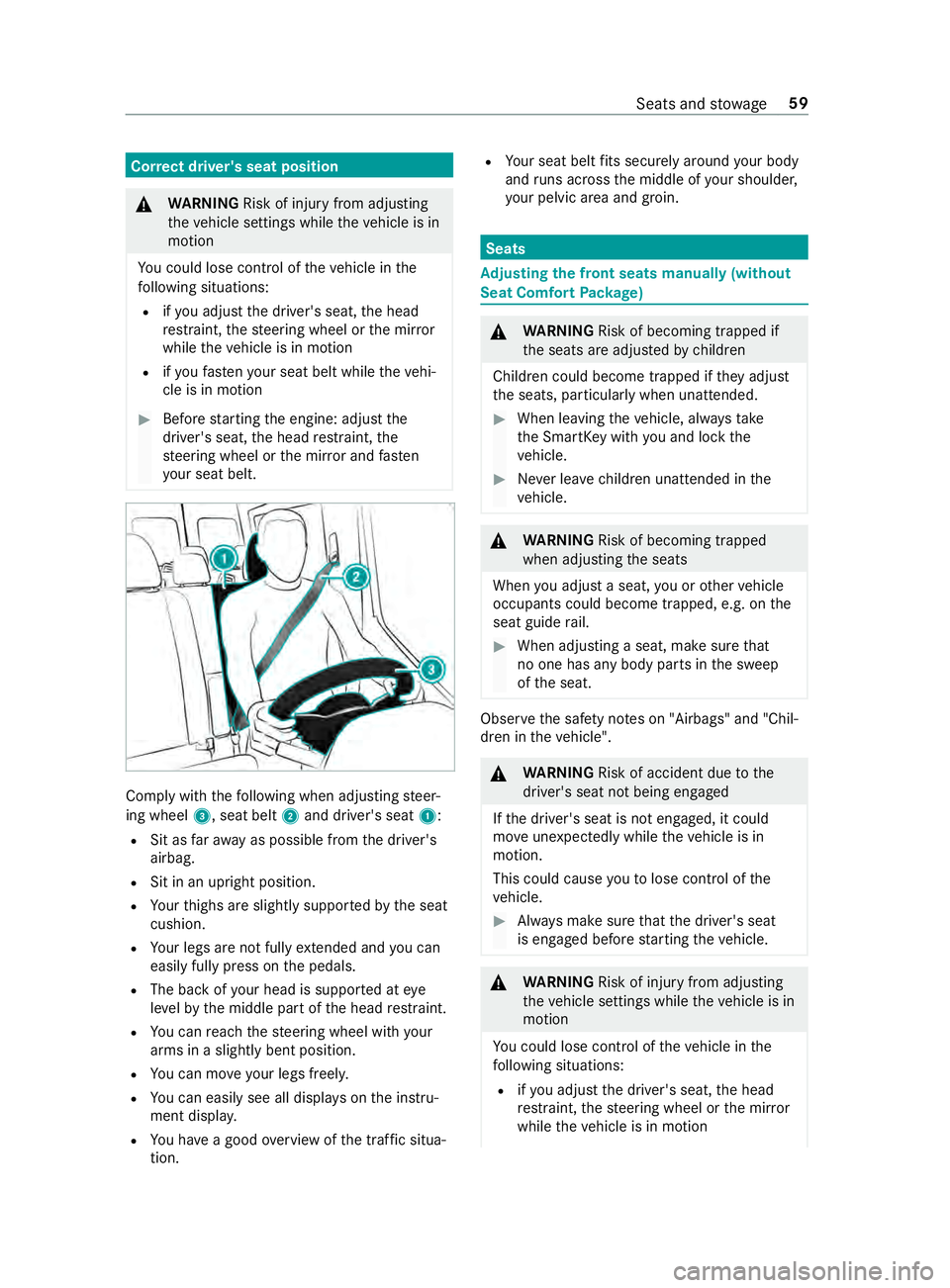
ywitht he following when adjustin gsteer‐
ing wheel 3,seat belt 2and driver's seat 1:
R Sit as fara wa yasp ossible from thed rive r's
airbag.
R Sit in an upright position.
R Your thighs ar eslight lysuppor tedbyt he seat
cushion.
R Your legs ar enotfull yextende dand youc an
easil yfullyp ress on thep edals.
R The bac kofyour head is suppor tedate ye
le ve lbyt he middle par tofthe head restra int.
R Youc an reac ht he steering wheel wit hyour
arms in aslightl ybentp osition.
R Youc an mo veyour legs freel y.
R Youc an easil ysee all displ aysont he instru‐
ment displa y.
R Youh ave agood overviewoft he traf fics itua‐
tion. R
Your seat belt fits securely around your body
and runs across them iddle of your shoulder,
yo ur pelvic area and groin. Seats
Ad
justin gthe fron tseats manuall y(without
Seat Comfor tPackage) &
WARNING Risk of becoming trapped if
th es eats ar eadjus tedbyc hildren
Childre ncould becom etrapped if they adjust
th es eats, particular lywhen unat tended. #
Whe nleaving thev ehicle, alw ayst ake
th eS martK eywit hyou and loc kthe
ve hicle. #
Neverlea ve children unat tende dint he
ve hicle. &
WARNING Risk of becoming trapped
whe nadjusting thes eats
When youa djus tas eat,you or other vehicle
occupants could become trapped, e.g. on the
seat guide rail. #
When adjustin gaseat, mak esuret hat
no one has an ybody parts in thes weep
of thes eat. Obser
vethes afet yn otes on "Airbags "and "Chil‐
dren in thev ehicle". &
WARNING Risk of accident du etothe
driver's seat no tbeing engaged
If th ed rive r's seat is no tengaged, it could
mo veunexpectedl ywhile thev ehicle is in
motion.
This could cause youtol ose control of the
ve hicle. #
Alwaysm akes uret hat thed rive r's seat
is engaged befor estartin gt he vehicle. &
WARNING Risk of inju ryfrom adju sting
th ev ehicle settings while thev ehicle is in
motion
Yo uc oul dlose control of thev ehicle in the
fo llowing situations:
R ifyo ua djus tthe driver's seat, theh ead
re stra int ,the steering wheel or them irror
while thev ehicle is in motion Seats and
stowage 59
Page 84 of 330
R
ifyo uf asteny our seat belt whilet hevehi‐
cle is in motion #
Befor estarti ngthee ngine: adjus tthe
driver's seat, theh ead restra int ,the
st eering wheel or them irro ra nd fast en
yo ur seat belt. &
WARNING Risk of becoming trapped if
th es eat height is adjus tedc arelessly
If yo ua djus tthe seat height carelessly ,you or
ot her vehicle occupants could be trapped and
th ereb yinjured.
Children in particular could accidentall ypress
th ee lectrical seat adjustmen tbuttons and
become trapped. #
While moving thes eats, mak esuret hat
hands or other body parts do no tget
unde rthe le vera ssembly of thes eat
adjustmen tsystem. &
WARNING Risk of inju rydue tohead
re stra int sw hicha renotins talled or are
adjus tedi ncor rectly
If hea drestraints ar enotins talled or are
adjus tedi ncor rectly ,the head restra int sc an‐
no tp rovide pr otection as intended.
Ther eisani ncreased risk of injur yinthe
head and nec karea, e.g. in thee vent of an
accident or when braking. #
Alwaysd rive wit hthe head restra ints
ins talled. #
Befor edriving off, mak esuref or every
ve hicle occupant that thec enter of the
head restra int supports theb ackoft he
head at about eyel eve l. Do no
tinter chang ethe head restra int soft he
front and rear seats. Otherwise, youw ill no tbe
able toadjus tthe height and angle of theh ead
re stra int sc orrectl y.
Ad jus tthe head restra int fore -and-af tposition so
th at it is as close as possible totheb ackofy our
head. &
WARNING Risk of inju ryor deat hdueto
incor rect sea tposition
The sea tbeltd oesn otoffert he intended le vel
of pr otection if youh ave notm ove dthe seat
backres ttoana lmostvertical position. When braking or in
thee vent of an accident,
yo uc oul dslide unde rneat hthe seat belt and
sus tain abdominal or nec kinjuries, fore xam‐
ple. #
Adjus tthe seat properly befor ebegin‐
ning your journe y. #
Alwayse nsur ethat thes eat backres tis
in an almos tvertical position and that
th es houlder section of your seat belt is
ro uted across thec enter of your shoul‐
der. *
NO
TEDama getothes eats when moving
th es eats back The seats ma
ybedamaged byobject swhen
moving thes eats bac k. #
When moving thes eats bac k,mak esure
th at ther ea reno object sinthefoot we ll,
under or behin dthe seats. 1
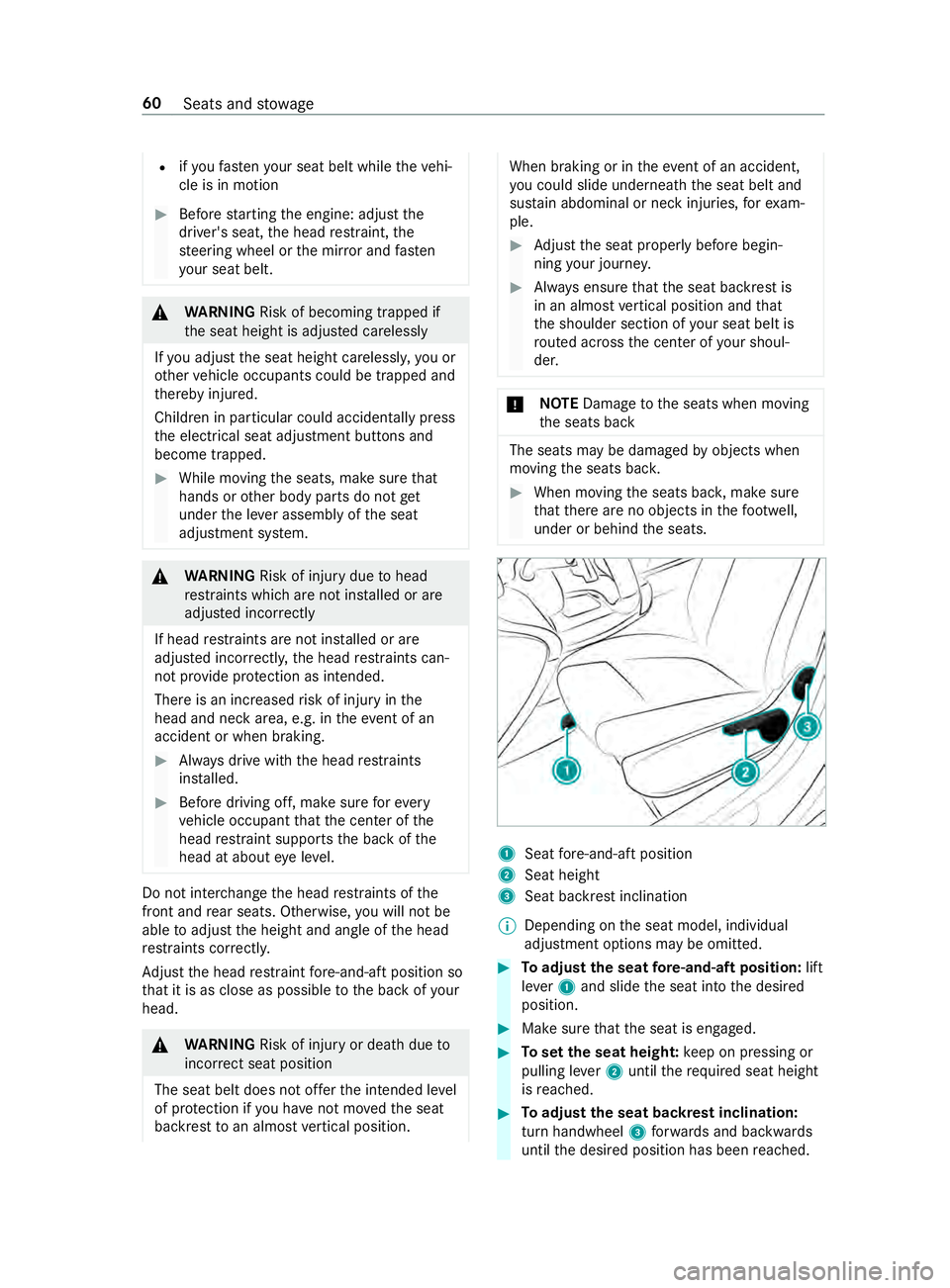
Seat fore -and-af tposition
2 Seatheight
3 Seatbackres tinclination
% Depending on
thes eat model, individual
adjustmen toptions ma ybeomitted. #
Toadjus tthe sea tfore-and-a ftposition: lift
le ver 1and slid ethe seat int othe desired
position. #
Mak esuret hat thes eat is engaged. #
Tosetthe sea theigh t:ke ep on pressing or
pulling le ver2until ther equired seat height
is reached. #
Toadjus tthe sea tbackres tinclination:
tur nh andwheel 3forw ards and backwards
until thed esired position has been reached. 60
Seatsand stow age
Page 85 of 330
Ad
justin gthe fron tseats manuall y(with Seat
Comfor tPacka ge) &
WARNING Risk of becoming trapped if
th es eats ar eadjus tedbyc hildren
Childre ncould becom etrapped if they adjust
th es eats, particularly when unattended. #
When leaving thev ehicle, alw ayst ake
th eS martK eywit hyou and loc kthe
ve hicle. #
Neverlea ve children unat tende dint he
ve hicle. &
WARNING Risk of becoming trapped
whe nadjusting thes eats
When youa djus tas eat,you or other vehicle
occupants could become trapped, e.g. on the
seat guide rail. #
When adjustin gaseat, mak esuret hat
no one has an ybody parts in thes weep
of thes eat. Obser
vethes afet yn otes on "Airbags "and "Chil‐
dren in thev ehicle". &
WARNING Risk of accident du etothe
driver's seat no tbeing engaged
If th ed rive r's seat is no tengaged, it could
mo veunexpectedl ywhile thev ehicle is in
motion.
This could cause youtol ose control of the
ve hicle. #
Alwaysm akes uret hat thed rive r's seat
is engaged befor estartin gt he vehicle. &
WARNING Risk of inju ryfrom adju sting
th ev ehicle settings while thev ehicle is in
motion
Yo uc oul dlose control of thev ehicle in the
fo llowing situations:
R ifyo ua djus tthe driver's seat, theh ead
re stra int ,the steering wheel or them irror
while thev ehicle is in motion
R ifyo uf asteny our seat belt whilet hevehi‐
cle is in motion #
Befor estarti ngthee ngine: adjus tthe
driver's seat, theh ead restra int ,the
st eering wheel or them irro ra nd fast en
yo ur seat belt. &
WARNING Risk of becoming trapped if
th es eat height is adjus tedc arelessly
If yo ua djus tthe seat height carelessly ,you or
ot her vehicle occupants could be trapped and
th ereb yinjured.
Children in particular could accidentall ypress
th ee lectrical seat adjustmen tbuttons and
become trapped. #
While moving thes eats, mak esuret hat
hands or other body parts do no tget
unde rthe le vera ssembly of thes eat
adjustmen tsystem. &
WARNING Risk of inju rydue tohead
re stra int sw hicha renotins talled or are
adjus tedi ncor rectly
If hea drestraints ar enotins talled or are
adjus tedi ncor rectly ,the head restra int sc an‐
no tp rovide pr otection as intended.
Ther eisani ncreased risk of injur yinthe
head and nec karea, e.g. in thee vent of an
accident or when braking. #
Alwaysd rive wit hthe head restra ints
ins talled. #
Befor edriving off, mak esuref or every
ve hicle occupant that thec enter of the
head restra int supports theb ackoft he
head at about eyel eve l. Do no
tinter chang ethe head restra int soft he
front and rear seats. Otherwise, youw ill no tbe
able toadjus tthe height and angle of theh ead
re stra int sc orrectl y.
Ad jus tthe head restra int fore -and-af tposition so
th at it is as close as possible totheb ackofy our
head. &
WARNING Risk of inju ryor deat hdueto
incor rect sea tposition
The sea tbeltd oesn otoffert he intended le vel
of pr otection if youh ave notm ove dthe seat
backres ttoana lmostvertical position.
When braking or in thee vent of an accident,
yo uc oul dslide unde rneat hthe seat belt and
sus tain abdominal or nec kinjuries, fore xam‐
ple. #
Adjus tthe seat properly befor ebegin‐
ning your journe y. #
Alwayse nsur ethat thes eat backres tis
in an almos tvertical position and that Seat
sand stow age 61
Page 86 of 330

th
es houlder section of your seat belt is
ro uted across thec enter of your shoul‐
der. *
NO
TEDama getothes eats when moving
th es eats back The seats ma
ybedamaged byobject swhen
moving thes eats bac k. #
When moving thes eats bac k,mak esure
th at ther ea reno object sinthefoot we ll,
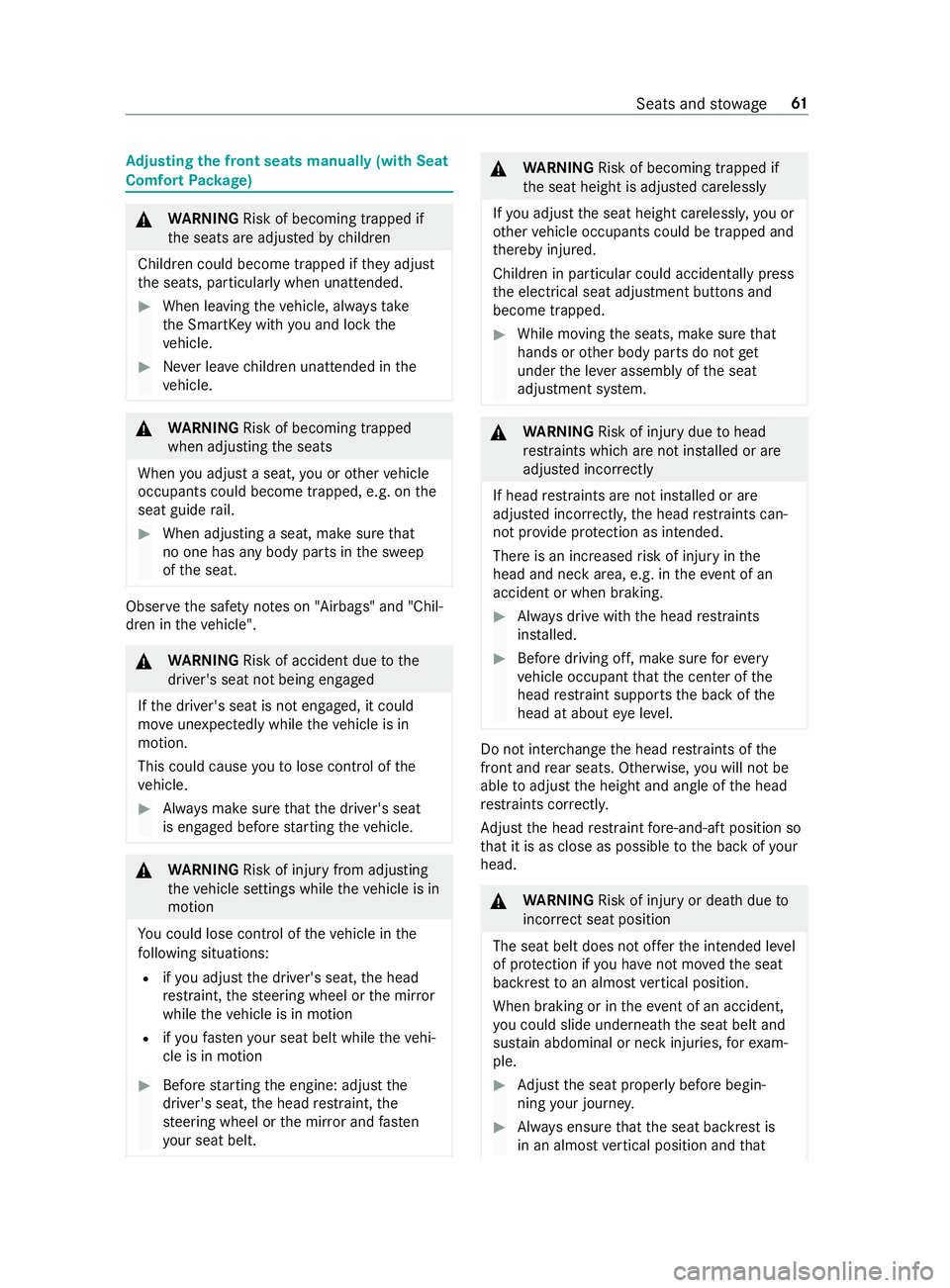
under or behin dthe seats. Sample imag
eofcomfor tsuspension seat
1 Seat cushion length
2 Seat backres tinclination
3 Seat height
4 Seat cushion inclination
5 Seat fore -and-af tposition
6 Seatsuspension
7 Vibration limiting
% Depending on
thes eat model, individual
adjustmen toptions ma ybeomitted. #
Toadjus tthe sea tcushion length: liftl ever
1 and slide thef ront section of thes eat
cushion forw ards or backwards. #
Toadjus tthe sea tbackres tinclination:
tur nh andwheel 2forw ards and backwards
until thed esired position has been reached. #
Toadjus tthe sea theigh t:push or pull le ver
3 until thed esired position has been
re ached. #
Toadjus tthe sea tcushion inclination: turn
handwheel 4forw ards and backwards until
th ed esired position has been reached. #
Toadjus tthe sea tfore-and-a ftposition: lift
le ver 5and slid ethe seat int othe desired
position. #
Mak esuret hat thes eat is engaged. #
Tosetthe sea tsuspension: take thew eight
of ft he seat. #
On handwheel 6,settheb ody weight (8 8lb
(40 kg)to2 64lb (120 kg)) so that thes eat
suspension workso ptimall y.Ifyo us et a
higher weight ,the seat suspension will
become firm er.T he seat will then no tvibrate
as much. If thes eat vibrates of tena nd signifi‐
cantly ,you can engag ethe seat in thel ower
area. #
Toengag evibration limiting: turnlever 7
upwards.
The next time thes eat vibrates, it will engage. #
Torelease vibration limiting: turnlever 7
to ther ight.
The seat can vibrate. Ad
justin gthe fron tseate lect rica lly &
WARNING Risk of becoming trapped if
th es eats ar eadjus tedbyc hildren
Childre ncould becom etrapped if they adjust
th es eats, particularly when unattended. #
When leaving thev ehicle, alw ayst ake
th eS martK eywit hyou and loc kthe
ve hicle. #
Neverlea ve children unat tende dint he
ve hicle. The seats can be adjus
tedw hile thei gnition is
off. &
WARNING Risk of becoming trapped
whe nadjusting thes eats
When youa djus tas eat,you or other vehicle
occupants could become trapped, e.g. on the
seat guide rail. #
When adjustin gaseat, mak esuret hat
no one has an ybody parts in thes weep
of thes eat. Compl
ywitht he saf etyn otes on "Airbags "and
"Children in thev ehicle". 62
Seats and stowage
Page 87 of 330
&
WARNING Risk of accident du etothe
driver's seat no tbeing engaged
If th ed rive r's seat is no tengaged, it could
mo veunexpectedl ywhile thev ehicle is in
motion.
This could cause youtol ose control of the
ve hicle. #
Alwaysm akes uret hat thed rive r's seat
is engaged befor estartin gt he vehicle. &
WARNING Risk of inju ryfrom adju sting
th ev ehicle settings while thev ehicle is in
motion
Yo uc oul dlose control of thev ehicle in the
fo llowing situations:
R ifyo ua djus tthe driver's seat, theh ead
re stra int ,the steering wheel or them irror
while thev ehicle is in motion
R ifyo uf asteny our seat belt whilet hevehi‐
cle is in motion #
Befor estarti ngthee ngine: adjus tthe
driver's seat, theh ead restra int ,the
st eering wheel or them irro ra nd fast en
yo ur seat belt. &
WARNING Risk of becoming trapped if
th es eat height is adjus tedc arelessly
If yo ua djus tthe seat height carelessly ,you or
ot her vehicle occupants could be trapped and
th ereb yinjured.
Children in particular could accidentall ypress
th ee lectrical seat adjustmen tbuttons and
become trapped. #
While moving thes eats, mak esuret hat
hands or other body parts do no tget
unde rthe le vera ssembly of thes eat
adjustmen tsystem. &
WARNING Risk of inju rydue tohead
re stra int sw hicha renotins talled or are
adjus tedi ncor rectly
If hea drestraints ar enotins talled or are
adjus tedi ncor rectly ,the head restra int sc an‐
no tp rovide pr otection as intended.
Ther eisani ncreased risk of injur yinthe
head and nec karea, e.g. in thee vent of an
accident or when braking. #
Alwaysd rive wit hthe head restra ints
ins talled. #
Befor edriving off, mak esuref or every
ve hicle occupant that thec enter of the
head restra int supports theb ackoft he
head at about eyel eve l. Do no
tinter chang ethe head restra int soft he
front and rear seats. Otherwise, youw ill no tbe
able tosetthe height and inclination of theh ead
re stra int stot he cor rect position.
Using theh ead restra int fore /af tadjustment,
adjus tthe head restra int in suc hawaythat it is
as close totheb ackoft he head as possible. &
WARNING Risk of inju ryor deat hdueto
incor rect sea tposition
The sea tbeltd oesn otoffert he intended le vel
of pr otection if youh ave notm ove dthe seat
backres ttoana lmostvertical position.
When braking or in thee vent of an accident,
yo uc oul dslide unde rneat hthe seat belt and
sus tain abdominal or nec kinjuries, fore xam‐
ple. #
Adjus tthe seat properly befor ebegin‐
ning your journe y. #
Alwayse nsur ethat thes eat backres tis
in an almos tvertical position and that
th es houlder section of your seat belt is
ro uted across thec enter of your shoul‐
der. *
NO
TEDama getothes eats when moving
th es eats back The seats ma
ybedamaged byobject swhen
moving thes eats bac k. #
When moving thes eats bac k,mak esure
th at ther ea reno object sinthefoot we ll,
under or behin dthe seats. Seats and
stowage 63