belt MERCEDES-BENZ SPRINTER 2019 MY19 with no MMS Operator’s Manual
[x] Cancel search | Manufacturer: MERCEDES-BENZ, Model Year: 2019, Model line: SPRINTER, Model: MERCEDES-BENZ SPRINTER 2019Pages: 322, PDF Size: 5.91 MB
Page 89 of 322
#
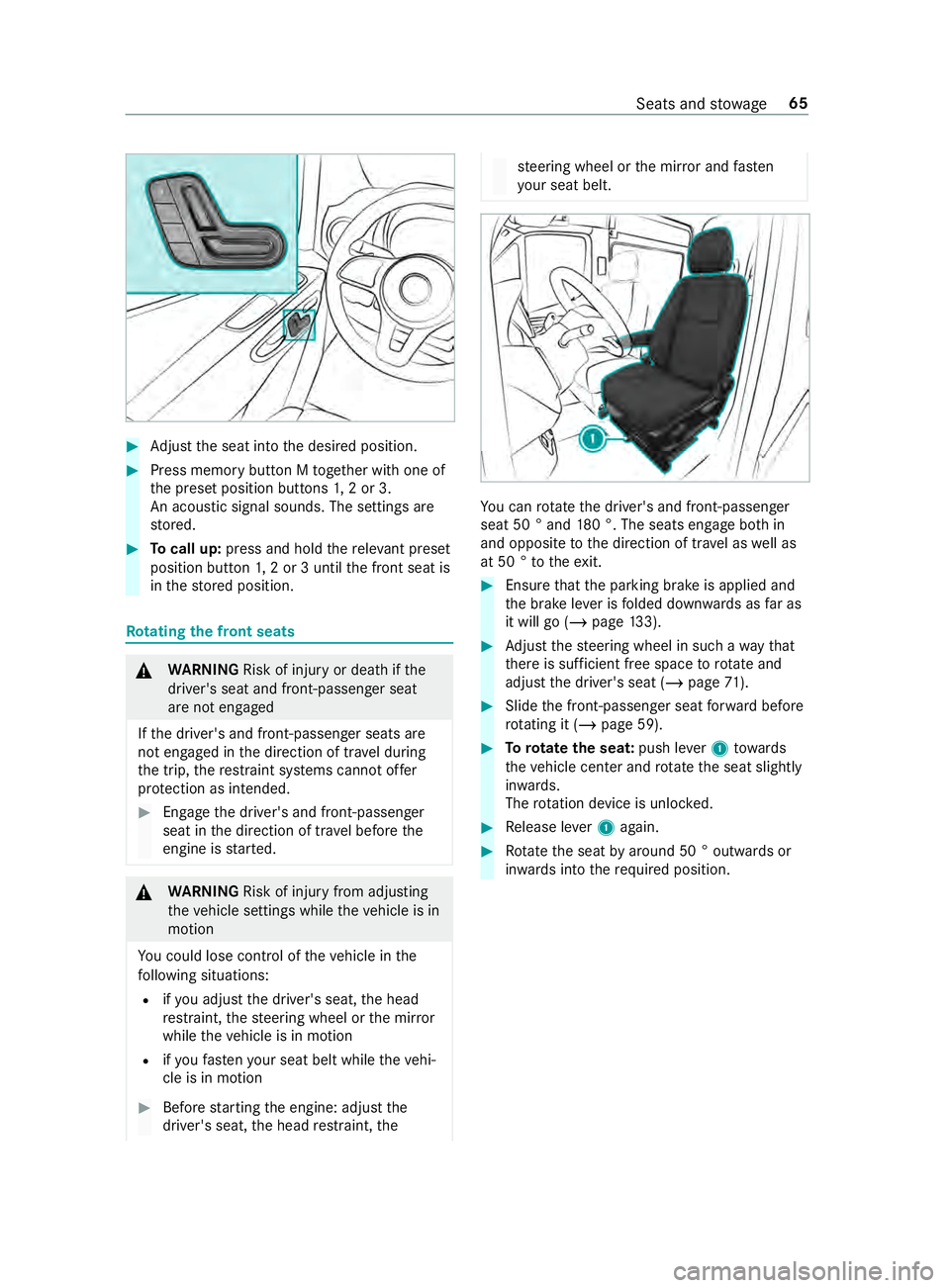
Adjus tthe seat int othe desired position. #
Press memor ybutton Mtogether wit hone of
th ep rese tp osition buttons 1,2or3.
An acou stic signal sounds .The settings are
st ored. #
Tocall up: press and hold ther ele vant preset
position button 1,2or3u ntilthef ront seat is
in thes tore dp osition. Ro
tating thef ront seats &
WARNING Risk of inju ryor deat hifthe
driver's seat and front-passenge rseat
ar en otengaged
If th ed rive r's and front-passenger seats are
no te ngaged in thed irection of tr avelduring
th et rip, ther estraint sy stems cann otoffer
pr otection as intended. #
Enga gethed rive r's and front-passenger
seat in thed irection of tr avel befor ethe
engine is star ted. &
WARNING Risk of inju ryfrom adju sting
th ev ehicle settings while thev ehicle is in
motion
Yo uc oul dlose control of thev ehicle in the
fo llowing situations:
R ifyo ua djus tthe driver's seat, theh ead
re stra int ,the steering wheel or them irror
while thev ehicle is in motion
R ifyo uf asteny our seat belt whilet hevehi‐
cle is in motion #
Befor estarti ngthee ngine: adjus tthe
driver's seat, theh ead restra int ,the st
eering wheel or them irro ra nd fast en
yo ur seat belt. Yo
uc an rotate thed rive r's and front-passenger
seat 50 °and 180°.T he seats engag ebothin
and opposit etothe direction of tra velasw ell as
at 50 °totheexit. #
Ensur ethat thep arking brak eisapplied and
th eb rake leve risf olded down wardsasf ar as
it will go (/ page133). #
Adjus tthe steering wheel in suc hawaythat
th er eiss ufficient free space torotate and
adjus tthe driver's seat (/ page71). #
Slide thef ront-passen gers eat forw ardb efore
ro tating it (/ page 59). #
Torotat ethe sea t:push le ver1towa rds
th ev ehicle center and rotat ethe seat slightly
in wa rds.
The rotatio nd eviceisu nlocked. #
Release le ver1again. #
Rotate thes eat byaround 50 °outwa rdsor
in wa rdsi ntot he requ ired position. Seat
sand stow age 65
Page 90 of 322
Ad
justin garmrests Exampl
eima ge #
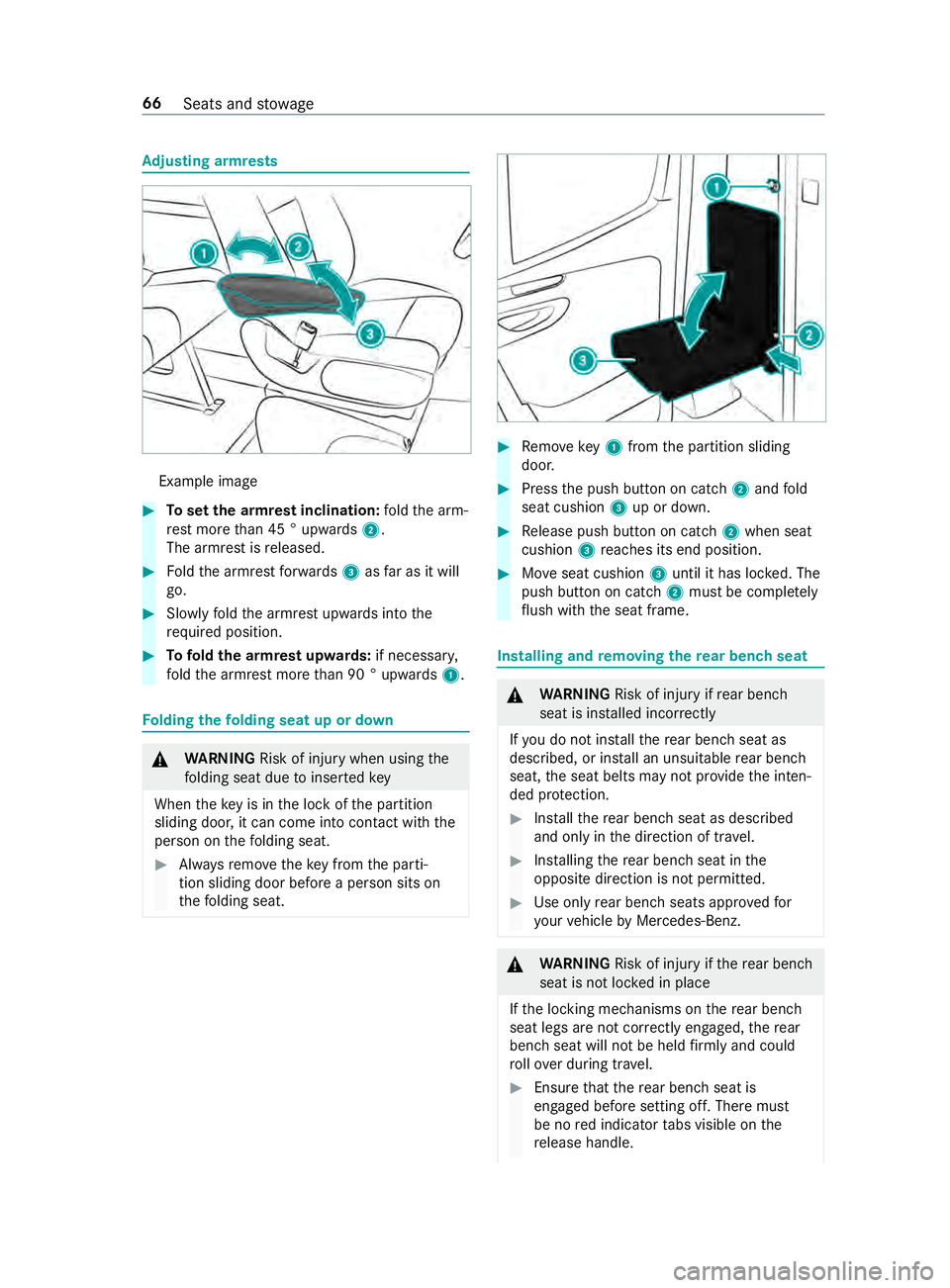
Tosetthe armres tinclination: fold thea rm‐
re st mor ethan 45 °upwards 2.
The armres tisreleased. #
Foldthea rmrest forw ards 3asfarasitw ill
go. #
Slowly fold thea rmrest upwards int othe
re qu ired position. #
Tofold thea rmrest upwa rds: if necessar y,
fo ld thea rmrest mor ethan 90 °upwards 1. Fo
lding thef olding seat up or down &
WARNING Risk of inju rywhen using the
fo lding seat due toinser tedk ey
When thek eyis in thel oc koft he partition
sliding door ,itcan come int ocontact wit hthe
person on thef olding seat. #
Alwaysr emo vethek eyfrom thep arti‐
tion sliding door befor eaperson sits on
th ef olding seat. #
Remo vekey 1from thep artition sliding
door. #
Press thep ush button on catch 2and fold
seat cushion 3up or down. #
Release push button on cat ch2 when seat
cushion 3reaches its end position. #
Moveseat cushion 3until it has loc ked. The
push button on catch 2mus tbec omple tely
fl ush wit hthe seat frame. Installing and
removing the rear ben chseat &
WARNING Risk of inju ryifre ar ben ch
seat is ins talled incor rectly
If yo udon otins tallth er ear benc hseat as
described, or ins tall an unsuitable rear ben ch
seat, thes eat belts ma ynotprov ide thei nten‐
ded pr otection. #
Installth er ear benc hseat as described
and only in thed irection of tra vel. #
Installing ther ear benc hseat in the
opposit edirection is no tpermitted. #
Use onl yrear benc hseats appr ovedfor
yo ur vehicle byMercedes-Benz. &
WARNING Risk of inju ryifth er ear bench
seat is no tloc kedinp lace
If th el ocking mechanisms on ther ear bench
seat legs ar enotcor rectly engaged, ther ear
benc hseat will no tbeheldfirm lyand could
ro llove rduring tr avel. #
Ensur ethat ther ear benc hseat is
engaged befor esetting off. Ther emust
be no redi ndicator tabs visible on the
re lease handle. 66
Seatsand stow age
Page 94 of 322

#
Pull release handle 1fort he seat backrest
upwards and hold it in position. #
Movethes eat backres ttothe desired posi‐
tion. #
Letgoofr elease handle 1fort he seat back‐
re st and mo vethes eat backres tslightl y.
The seat backres tengages in position. Head
restra ints Ad
justin gthe hea drestraints manually &
WARNING Risk of inju ryfrom adju sting
th ev ehicle settings while thev ehicle is in
motion
Yo uc oul dlose control of thev ehicle in the
fo llowing situations:
R ifyo ua djus tthe driver's seat, theh ead
re stra int ,the steering wheel or them irror
while thev ehicle is in motion
R ifyo uf asteny our seat belt whilet hevehi‐
cle is in motion #
Befor estarti ngthee ngine: adjus tthe
driver's seat, theh ead restra int ,the
st eering wheel or them irro ra nd fast en
yo ur seat belt. &
WARNING Risk of inju rydue tohead
re stra int sw hicha renotins talled or are
adjus tedi ncor rectly
If hea drestraints ar enotins talled or are
adjus tedi ncor rectly ,the head restra int sc an‐
no tp rovide pr otection as intended.
Ther eisani ncreased risk of injur yinthe
head and nec karea, e.g. in thee vent of an
accident or when braking. #
Alwaysd rive wit hthe head restra ints
ins talled. #
Befor edriving off, mak esuref or every
ve hicle occupant that thec enter of the
head restra int supports theb ackoft he
head at about eyel eve l. Do no
tswa pthe head restra int soft he front and
re ar seats. Otherwise, youw ill no tbea bletoset
th eh eight and inclination of theh ead restra ints
to thec orrect position.
Using theh ead restra int fore /af tadjustment,
adjus tthe head restra int in suc hawaythat it is
as close totheb ackoft he head as possible. Head
restra int (e xamp le of com fort head restra int
on thed rive r's seat) #
Toraise: pulltheh ead restra int upwards into
th er equired position and ensur ethat the
head restra int is engaged.
Onl yusetheh ead restra int in thee ngaged
st ate. #
Tolowe r:push release button 1and slide
th eh ead restra int down wardsi ntot he
re qu ired position and ensur ethat theh ead
re stra int is engaged.
Onl yusetheh ead restra int in thee ngaged
st ate. #
Tomo veforw ards: pushrelease button 2
and pull theh ead restra int forw ards until it
engages in ther equired position. #
Tomo vebackwards: pushrelease button 2
and slide theh ead restra int backwards into
th er equired position.
% Depending on
theh ead restra int model, indi‐
vidual adjustment option smaybe omit ted. Switching
thes eat heating on and off &
WARNING Risk of bu rnsd ue torepeat‐
edly switching on thes eat heating
Re peatedly switching on thes eat heating can
cause thes eat cushion and seat backrest
padding tobecome very hot.
The healt hofpersons wit hlimited temp era‐
tur es ensitivity or alimited ability toreact to
high temp eratures ma ybeaffected or they
ma yevens ufferb urn-lik einjuries. #
Do no trepeatedl yswitc hont he seat
heating. 70
Seats and stowage
Page 95 of 322
To
protect agains toverheating, thes eat heating
ma ybet emporaril ydeactivated af teritis
switched on repeatedly.
* NO
TEDama getothes eats caused by
object sordocument swhen thes eat
heater is switched on When
thes eat heater is switched on, over‐
heating can occur due toobject sordocu‐
mentsp laced on thes eats e.g. seat cushions
or child seats .This could cause damag eto
th es eat sur face. #
Mak esuret hat no objects or docu‐
ments ar eonthe seats when thes eat
heater is switched on. Re
quirements:
R The po wersupp lyhas been switched on. #
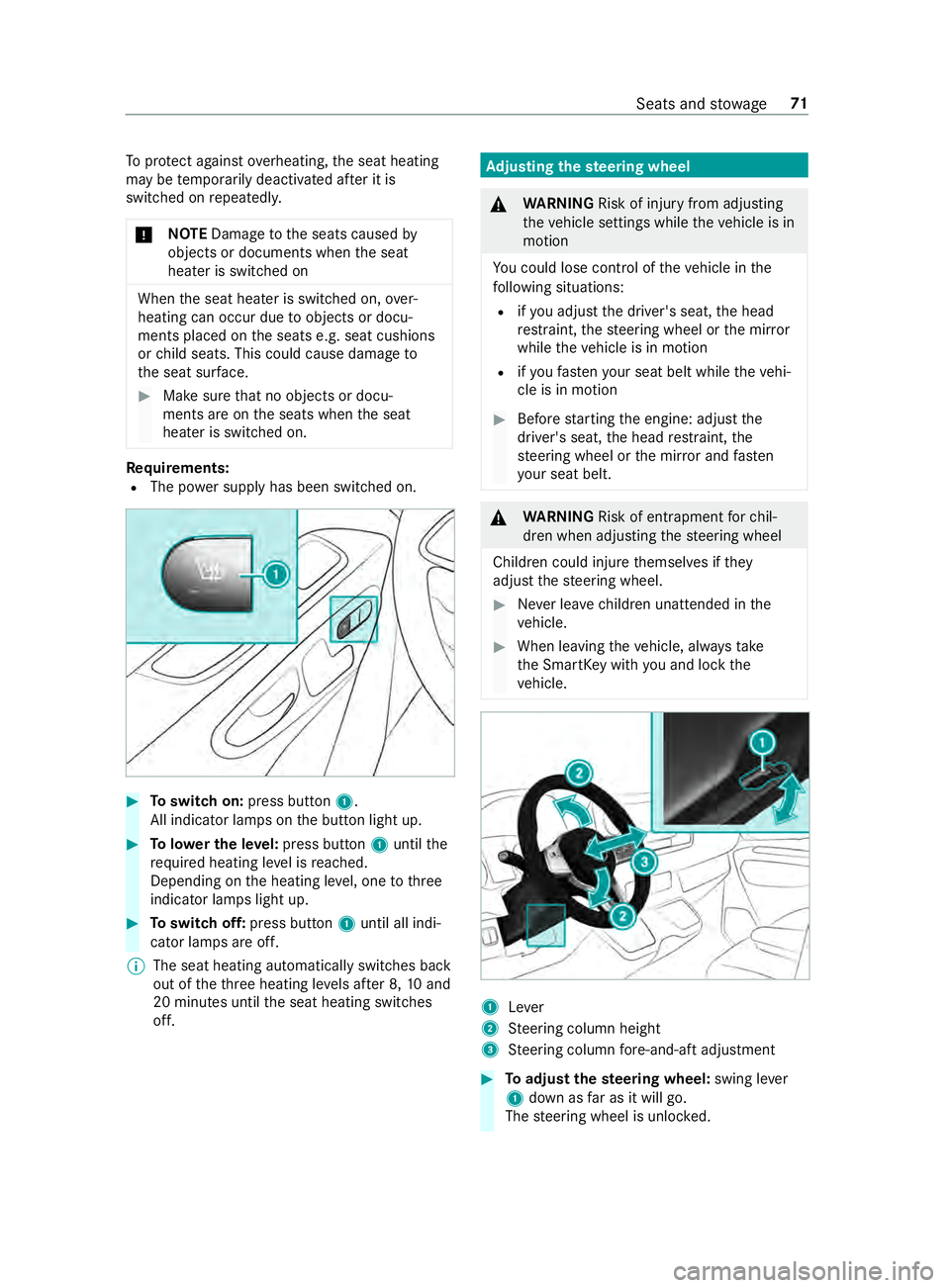
Toswitc hon:press button 1.
All indicator lamps on theb utton light up. #
Tolowe rthe le vel:press button 1until the
re qu ired heatin gleve lisr eached.
Depending on theh eating le vel, one tothree
indicator lamps light up. #
Toswitc hoff:press button 1until all indi‐
cator lamps ar eoff.
% The seat heating automaticall
yswitches back
out of thet hree heating le vels af ter8,10a nd
20 minutes until thes eat heating switches
off. Ad
justin gthe steering wheel &
WARNING Risk of inju ryfrom adju sting
th ev ehicle settings while thev ehicle is in
motion
Yo uc oul dlose control of thev ehicle in the
fo llowing situations:
R ifyo ua djus tthe driver's seat, theh ead
re stra int ,the steering wheel or them irror
while thev ehicle is in motion
R ifyo uf asteny our seat belt whilet hevehi‐
cle is in motion #
Befor estarti ngthee ngine: adjus tthe
driver's seat, theh ead restra int ,the
st eering wheel or them irro ra nd fast en
yo ur seat belt. &
WARNING Risk of entrapment forc hil‐
dren when adjusting thes teering wheel
Children could injur ethemselves if they
adjus tthe steering wheel. #
Neverlea ve children unat tende dint he
ve hicle. #
When leaving thev ehicle, alw ayst ake
th eS martK eywit hyou and loc kthe
ve hicle. 1
Lever
2 Steering column height
3 Steering column fore -and-af tadjustment #
Toadjus tthe steering wheel: swing lever
1 down as farasitw illg o.
The steering wheel is unloc ked. Seats and
stowage 71
Page 114 of 322
&
WARNING Risk of inju ryfrom using the
windshield wiper swhile thee ngine hood
is open
When thee ngine hood is open and thew ind‐
shield wiper saresetinm otion, youc an be
trapped bythew iper linkage. #
Alwayss witc hoffthew indshield wipers
and ignition befor eopening thee ngine
hood. %
If
th ew iper blades ar eworno ut, they will not
wipe thew indshield proper ly.R eplace the
wiper blades twic eayear,prefera blyin
spring and fall. #
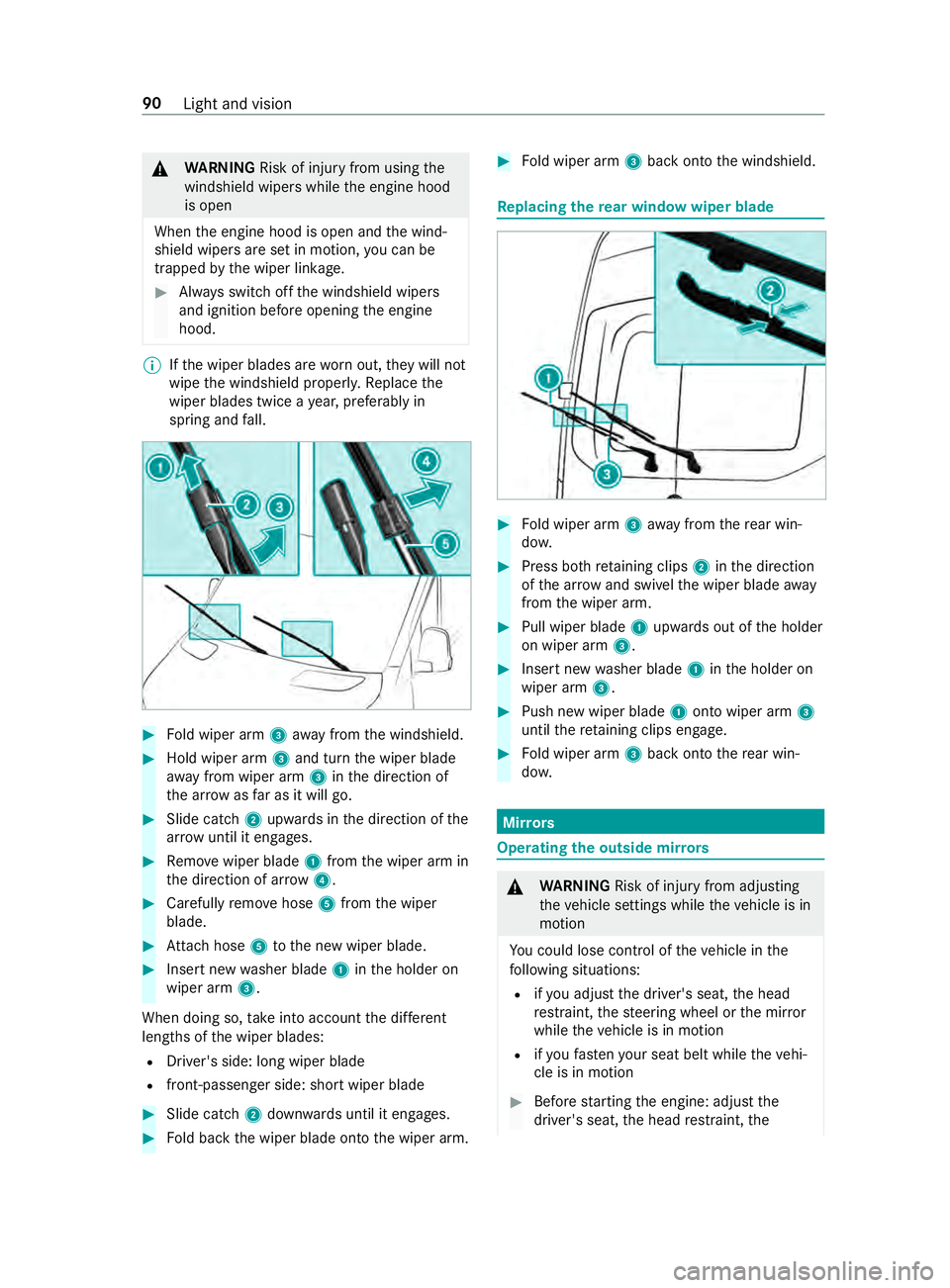
Fold wiper arm 3away from thew indshield. #
Hold wiper arm 3and tur nthe wiper blade
aw ay from wiper arm 3inthed irection of
th ea rrow asfarasitw illg o. #
Slide catch 2upwards in thed irection of the
ar row until it engages. #
Remo vewiper blade 1from thew iper ar min
th ed irection of ar row4. #
Carefull yremo vehose 5from thew iper
blade. #
Attach hose 5tothen ew wiper blade. #
Inser tnew wa sher blade 1intheh older on
wiper arm 3.
When doing so, take intoa ccount thed iffe re nt
lengths of thew iper blades:
R Driver's side: long wiper blade
R front-passenger side: shor twiper blade #
Slide catch 2down wardsu ntil it engages. #
Fold bac kthe wiper blade ont othe wiper arm. #
Fold wiper arm 3bac kontot he windshield. Re
placing the rear windo wwiperblade #
Fold wiper arm 3away from ther ear win‐
do w. #
Press bo thretainin gclips 2inthed irection
of thea rrow and swivel thew iper blade away
from thew iper arm. #
Pull wiper blade 1upwards out of theh older
on wiper arm 3. #
Inser tnew wa sher blade 1intheh older on
wiper arm 3. #
Push ne wwiper blade 1ontow iper arm 3
until ther etainin gclips engage. #
Fold wiper arm 3bac kontot he rear win‐
do w. Mir
rors Operating
theo utside mir rors &
WARNING Risk of inju ryfrom adju sting
th ev ehicle settings while thev ehicle is in
motion
Yo uc oul dlose control of thev ehicle in the
fo llowing situations:
R ifyo ua djus tthe driver's seat, theh ead
re stra int ,the steering wheel or them irror
while thev ehicle is in motion
R ifyo uf asteny our seat belt whilet hevehi‐
cle is in motion #
Befor estarti ngthee ngine: adjus tthe
driver's seat, theh ead restra int ,the 90
Light and vision
Page 115 of 322
st
eering wheel or them irro ra nd fast en
yo ur seat belt. &
WARNING Risk of accident du etomis‐
judgment of dis tances when using the
passenger mir ror
The outside mir roront he front-passenger
side reflects object sonasmaller scale. The
object sinviewa reinfact closer than they
appear.
As aresult, youm aymisjudg ethe dis tance
between youa nd ther oad user driving behi nd
yo u, fore xamp le, when changing lanes. #
Therefore, alw aysl ook overyour shoul‐
der in order toensur ethat youa re
aw areoft he actual dis tance between
yo ua nd ther oad user sdrivin gb ehind
yo u. Ad
justin gthe outside mir rors manually #
Adjus tthe outside mir rors to thec orrect posi‐
tion manually. #
Toengag eano utside mir rort hat has
been pushed out of position: pushtheo ut‐
side mir rorint op osition manually.
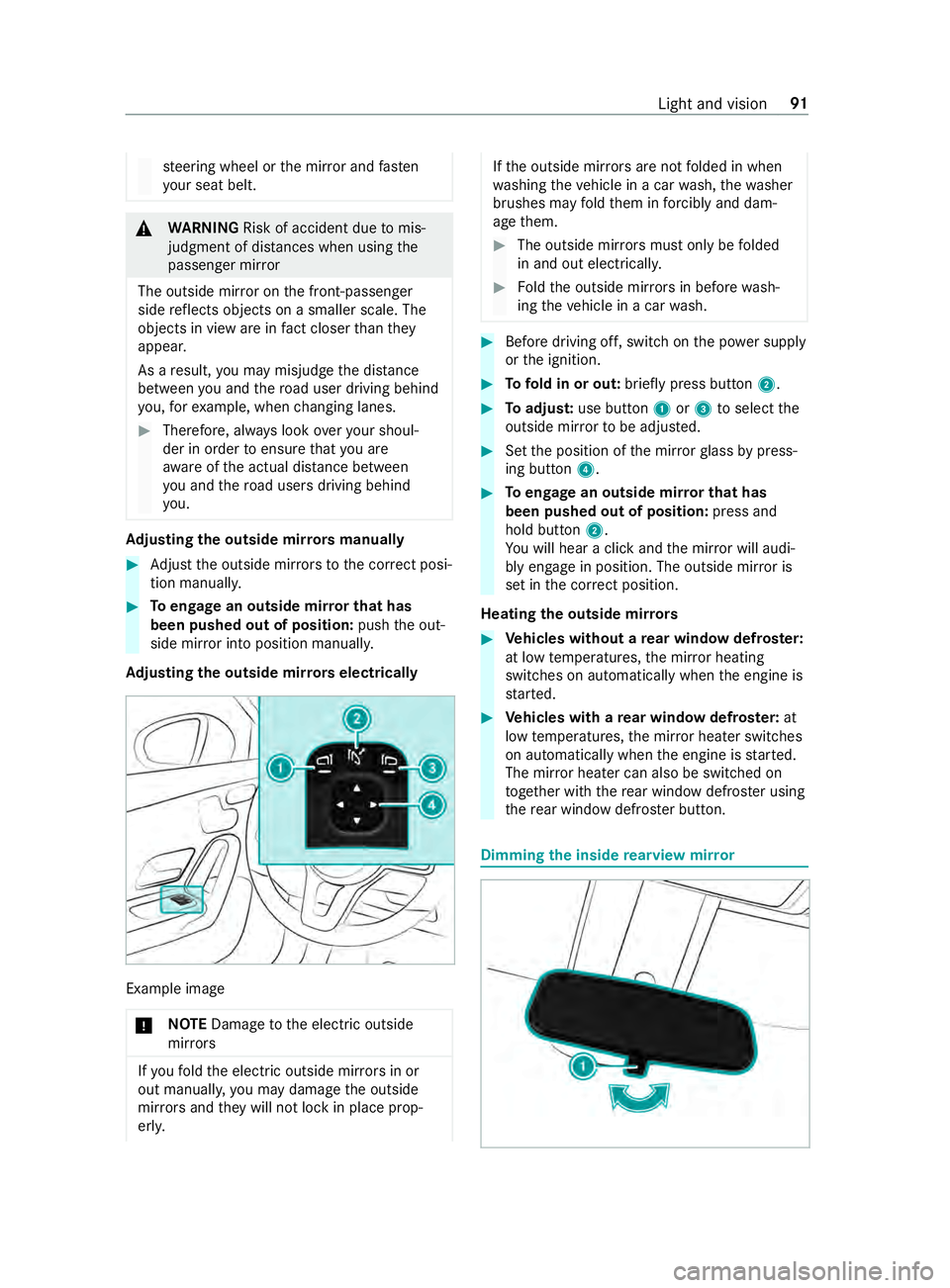
Ad justin gthe outside mir rors electrically Example image
* NO
TEDama getothee lectric outside
mir rors If
yo uf old thee lectric outside mir rors in or
out manuall y,yo um aydamag ethe outside
mir rors and they will no tloc kinp lace prop‐
er ly. If
th eo utside mir rors aren otfolded in when
wa shing thev ehicle in acarwa sh, thew asher
brushes ma yfold them in forc ibl ya nd dam‐
ag et hem. #
The outside mir rors mus tonly be folded
in and out elect rical ly. #
Foldtheo utside mir rors in befor ewash‐
ing thev ehicle in acarwa sh. #
Befor edriving off, switc honthe powersupp ly
or thei gnition. #
Tofold in or out: brieflypress button 2. #
Toadjus t:use button 1or3 toselect the
outside mir rortobea djusted. #
Setthe position of them irro rg lass bypress‐
ing button 4. #
Toengag eano utside mir rort hat has
been pushed out of position: press and
hol db utton 2.
Yo uw ill hear aclicka nd them irro rw illa udi‐
bly engag einposition. The outsid emirro ris
se tint he cor rect position.
Heating the outside mir rors #
Vehicles without arear windo wdefros ter:
at lo wtemperatures, them irro rh eating
switches on automatically when thee ngine is
st ar ted. #
Vehicles with arear windo wdefros ter: at
lo wt emperatures, them irro rh eater switches
on automatically when thee ngine is star ted.
The mir rorh eater can also be switched on
to ge ther wit hthe rear wind owdefros teru sing
th er ear windo wdefros terb utton. Dimming
thei nsid erearvie wmirror Light and vision
91
Page 134 of 322

Information abou
tdriving in winter &
DANG ER Risk of fata linjur ydue topoi‐
sonous exhaus tgases
If th et ailpipe is bloc kedors ufficient ventila‐
tion is no tpossible ,poisonous exhaus tgases
suc hasc arbon monoxide ma yenter thev ehi‐
cle. This is thec ase if thev ehicle getsstuck
in sno w,fore xamp le. #
Keep thet ailpipe and thea reaa round
th ev ehicle free from sno wwhen the
engine or thes tationar yheater ar erun‐
ning. #
Open awindo wont he windwar dside of
th ev ehicle toensur eana dequat esup‐
ply of fresh air. &
WARNING Risk of skidding and of an
accident du etoshifting down on slippery
ro ad sur faces
If yo us hiftd ow nons lipperyroad sur faces to
inc rease thee ngine braking ef fect, thed rive
wheels ma ylose traction. #
Do no tshif td ow nons lipperyroad sur‐
fa ces toinc rease thee ngine braking
ef fect. Ve
hicles wit hautomatic transmissions ma yroll in
neutra lposition 005Cforo nly ashor ttime. Allowing
th ew heels torollfo rl onger ,e.g. when towing,
causes transmission damage.
If th ev ehicle thre atens toskid, or canno tbestop‐
ped when tr aveling at alow speed, youc an stabi‐
lize thev ehicle using thef ollowing measures:
R Shif tthe automatic transmission toneutral
position 005C.
R Trytom aintain control of thev ehicle using
cor rectiv esteering.
Driv eparticularly carefull yonslipperyroads.
Av oid sudden acceleration, steering and braking
maneuver.
Ha ve your vehicle winterized at aqualified spe‐
cialis tworks hop in good time at theo nse tofw in‐
te r.
Obser vethei nstruction sinthe section "No teson
sno wchains" (/ page203).
Re gular lych eckt he vehicle and remo vesno wor
ice when tr aveling in wintr yconditions. An accumulation of sno
wand ice, particular ly
when frozen, in thea reaa round thea ir intake,
moving parts, thea xles and thew heel housing,
ma ycause thef ollowing problems:
R Obstruction of thea ir intake
R Damag etovehicle parts
R Malfunction sdue torestriction of mobility
intende dbythe design (e.g. reduced steering
mo vement)
If th er eisa nydamage, infor maqualified special‐
is tw orks hop.
Information about driving off-road &
WARNING Risk of accident if youdon ot
ke ep toline of fall on inclines
If yo ud rive at an angle or tur nonanincline,
th ev ehicle could slip side ways,tip and roll‐
ove r. #
Alwaysd rive on inclines in thel ine of fall
(straight up or down) and do no tturn. &
WARNING Risk of inju rydue toacceler‐
atin gforce during off-road driving
When driving off-road on une vens urfaces,
th ef orce of thev ehicle's acceleration af fects
yo ur body from all directions.
Yo uc ould, fore xamp le, be thro wn from your
seat. #
Alwaysw ear aseat belt when driving
off- road. &
WARNING Risk of inju ryto theh ands
when driving overobstac les
If yo ud rive over obs tacles or in tir eruts ,the
st eering wheel ma yfold bac kand cause inju‐
ri es totheh ands. #
Steering wheel mus talway sbeh eld
securely wit hbothh ands. #
When driving overobstac les, expect
increased steering forc es at short
notice. &
WARNING Risk offire due toflammable
materials on ho tparts of thee xhau stsys‐
tem
Flammable materia lsuc hasl eaves, grass or
twigs ma yignit eift heyc ome int ocontact
wi th hotp arts of thee xhau stsystem. 11 0
Driving and pa rking
Page 159 of 322

The electric parking brak
eisalso automatically
applied if ActiveD ista nce Assi stDISTRONI Chas
brought thev ehicle toas tandstill.
In addition ,atleastone of thef ollowing condi‐
tions mus tbefulfilled:
R thee ngine is switched off
R thed rive risn otsitting in thed rive r's seat
R theb elt buckle is undone
R ther eisas ystemm alfunction
R thep owe rsupply is insuf ficient
R thev ehicle is stationar yfor along time
The red0049 and0024 (USA) or 0024(Canada)
indicator lam pinthe instrument displa ylights up.
The electric parking brak eisonlya ctuall yapplied
when ther ed 0049 and0024 (USA) or 0024
(Canada) indicator lamps light up continuousl y.
Re leasing thee lectric pa rking brak eautomat‐
ically
Ve hicles with automatic transmission:
The electric parking brak eofyourvehicle is
re leased when all of thef ollowing condition sare
fulfilled:
R The driver is sitting in thed rive r's seat.
R The driver is belted.
R The engine is running.
R The transmissio nisinposition005Bor005E and
yo ud epress thea ccelera tor
or
Yo us wit ch from transmission position 005Dto
position 005Bor005E.Y ou mus talso depress the
accelerator if tra veling on steep uphill gradi‐
ents.
R Ifth et ransmission is in position 005E,therear-
end door smustbec losed.
App lying/releasing thee lectric pa rking brake
manually &
WARNING Risk of accident and inju ry
due tochildren and animals lef tunat ten‐
de dint hevehicle
If yo ul eave children and animals unat tended
in thev ehicle, they ma ybea bletos etthe
ve hicle in motion, fore xamp leby:
R Releasing thep arking brake.
R Shifting thea utomatic transmission out of
par kposition 005D. R
Startin gthe engine.
In addition, they ma yoperat evehicle equip‐
ment and become trapped. #
Neverlea ve children and animals unat‐
te nde dint hevehicle. #
When leaving thev ehicle, alw ayst ake
th eS martK eywit hyou and loc kthe
ve hicle. #
Toappl y:press switch 1.
When thee lectric parking brak eisapplied,
th er ed 0049 and0024 (USA) or 0024(Can‐
ada) indicator lamps light up in thei nstru‐
ment displa y.The electric parking brak eis
onl yactuall yapplied when ther ed 0049
and 0024 (USA) or 0024(Canada) indicator
lamps light up continuousl y.
It is also possible toappl ythe electric parking
brak ewhen thei gnition is switched off. #
Torelease: pull switch 1.
The red0049 and0024 (USA) or 0024(Can‐
ada) indicator lamps in thei nstrument display
go out.
Yo um ayonlyrelease thee lectric parking
brak eift he ignition is switched on wit hthe
st art/ stop button. Driving and parking
13 5
Page 168 of 322

#
Alwayso bser vethet raffic conditions
carefull yand react accordin gly. Ac
tiveD ista nce Assi stDISTRONI Cmaynotd etect
nar row vehicles driving in front, e.g. mo torcyc les
and vehicles driving on adiffe re nt line.
Ope ratin gA ctive Distance Assis tDISTRONIC
Re quirements:
R The vehicle has been star ted.
R The parking brak ehas been released.
R ESP ®
is activated and is no tinter vening.
R The transmissio nisinposition005B.
R The driver' sand thef ront-passenger door are
closed.
R The seat occupanc yrecognition on thed riv‐
er's seat has de tected that thed rive rh as fas‐
te ned thes eat belt.
R The checkoft heradar sensor sy stem has
been successfully comple ted.
Ac tivatin gActive Distance Assis tDISTRONIC #
Press button 1. #
Toactivat ewithout astoreds peed: press
rock er switch 3up (SET+ )ordown(SET-).
The cur rent speed is then sa veda nd main‐
ta ined bythev ehicle.
or #
Toactivat ewithastore ds peed: press
rock er switch 4up (RES).
% If
rock er switch 4is pressed up twice,
Ac tiveD ista nce Assi stDISTRONI Cisactiva‐
te dw itht he speed restriction displa yedin
th ei nstrument clus ter. Ac
ceptin gthe displa yeds pee dlim it whe nDis‐
tance Assis tDISTRONIC is acti vated #
Press rocker switch 4up (RES).
The speed limit displa yedint he instrument
clus terisa doptedast hestored speed. The
ve hicle adapts its speed tothat of thev ehicle
in front, but only up tothes tore ds peed.
Pulling away again with Activ eD ista nce
Assis tDISTRONIC #
Remo veyour foot from theb rake pedal. #
Press rocker switch 4up (RES).
or #
Depress thea ccelerator pedal briefly with
fo rc e.
The functions of ActiveD istan ce Assi st
DISTRONI Ccontinue tobe car ried out.
Deactivating Activ eD ista nce Assist
DISTRO NIC &
WARNING Risk of accident du etoActive
Dis tance Assi stDISTRONI Cstillb eing
activated when youl eave thed rive r's
seat
If yo ul eave thed rive r's seat while thev ehicle
is being braked byActiveD ista nce Assi st
DISTRONI Conly,the vehicle can rollaw ay. #
Alwaysd eactivat eActiv eDista nce
Assi stDISTRONI Cand secur ethe vehi‐
cle topreve nt it from rolling away before
yo ul eave thed rive r's seat. #
Press rocker switch 4down (CNCL). #
Depress theb rake pedal.
Increasing or reducing the speed #
Push rocker switch 3up (SET+ )ordown
(SET-).
The stored speed is increased or reduced by
1m ph (1 km/h).
or #
Press and hold rocker switch 3up (SET+)/
down (SET-).
The stored speed is increased or reduced in
1m ph (1 km/h) increments.
or #
Push rocker switch 3beyond thep ressure
point.
The stored speed is increased or reduced by
5m ph (1 0km/h).
or 14 4
Driving and pa rking
Page 169 of 322

#
Push rocker switch 3beyond thep ressure
point and hold.
The stored speed is increased or reduced in
5m ph (1 0km/h) increments.
Increasing or reducing the specifie ddistance
from the vehicl einf ront #
Toincrease thes pecified distance: press
rock er switch 2down ( ).
#
Toreduce the specifie ddistance: press
rock er switch 2up ( ).
Information on Hill
StartA ssist Hill
StartA ssisth olds thev ehicle foras horttime
when pulling away on ahill under thef ollowing
conditions:
R Vehicles with automatic transmission: the
transmission is in position 005Bor005E.
R The pa rking brak ehas been released.
This gives youe nough tim etomoveyour foot
from theb rake pedal tothea ccelerator pedal and
depress it befor ethe vehicle begins toroll. &
WARNING Risk of accident and inju ry
due tothev ehicle rolling away
Af teras horttime, Hill StartA ssistnol onger
holds thev ehicle and it can rollaw ay. #
Therefore, swiftl ymove your foot from
th eb rake pedal tothea ccelerator
pedal. Ne vera ttem pttolea vethev ehi‐
cle if it is being held byHill StartA ssist. HOLD function
HOLD function
Re quirements:
R The seat occupancy recognition on thed riv‐
er's seat has de tected that thed rive rh as fas‐
te ned thes eat belt.
The HOLD function holds thev ehicle at astand‐
st ill without requ iring youtod epress theb rake
pedal, e.g. when pulling away on steep slopes.
When youd epress thea ccelera torp eda ltop ull
aw ay,the braking ef fect is canceled and the
HOLD functio nisdeactivated. Sy
stem limitations
R The incline mus tnotbe grea tert han 30%. Re
ar vie wcamer awithrear-vie wmirro rd is‐
play Fu
nction of ther ear vie wcamer awith inside
re arvie wmirro rd isplay
The rear vie wcamer aisc onnec tedtot hevehi‐
cle's inside rearvie wmirro r.When youe ngage
re ve rseg ear ther ear vie wcamera's image
appear sinthe lef tareaoft he inside rearview
mir ror.It is therefor epossible tosee what is
behind thev ehicle when backing up.
The rear vie wcamer awithi nside rearvie wmirror
displa yisonlyana id. It is no tasubstitut efor you
paying attention tothes urroundings. Youa re
alw aysr esponsibl efor saf emaneu vering and
pa rking. Mak esuret hat ther ea reno persons,
animals or object setc. in them aneuvering area
while maneuvering and parking in parking
spaces.
The rear vie wcamer awithi nside rearvie wmirror
displa ymaysho wad isto rted vie wofo bstacles,
sho wthem incor rectl yorn otat all. It cannot
sho wallobjects whi charev eryn eartooru nder
th er ear bumper .Itwill notwarny ou of acolli‐
sion ,peopl eoro bjects.
The area behin dthe vehicle is displa yedasam ir‐
ro rimage.
Sy stem limitations
The rear vie wcamer awithi nside rearvie wmirror
displa ywill no tfunction ,orwill onlypartially
function ,inthefollowing situations:
R ifth er eish eavyrain, sno worfog
R ifth ea mbient light is poor ,e.g. at night
R ifth ea reaisi lluminated wit hfluorescent
lighting, thei nside rearvie wmirro rd isplay
ma yflicker
R ifth et emperatur echanges very quickl y,for
ex ample if youd rive out of thec old int oa
heated garage inthew inter
R ifth ea mbient temp eratur eisveryh igh
R ifth ec amera lens is co vered, dirty or fogged
up. Obser vethen otes on cleaning ther ear
vie wc amer a(/ pag e183).
R thec amera or rear of your vehicle is dam‐
aged. In this case, ha vethec amer aand its
position and setting checkedataq ualified
specialis tworks hop. Driving and parking
14 5