ECU MERCEDES-BENZ SPRINTER 2020 MY20 with 7” screen
[x] Cancel search | Manufacturer: MERCEDES-BENZ, Model Year: 2020, Model line: SPRINTER, Model: MERCEDES-BENZ SPRINTER 2020Pages: 348, PDF Size: 5.84 MB
Page 201 of 348
Exiting Apple CarPlay
®#
Press the00E2 button.
% If Apple CarPlay ®
wa sn otdispla yedf ull-
screen befor edisconnecting, thea pplication
st arts in theb ackg round when reconnected.
Yo uc an call up Apple CarPlay ®
in them ain
menu.
Connecting an iPhone ®
via Apple CarPlay ®
(wireless)
Requ irements:
R The multimedia sy stem is equipped wit hthe
function.
R The cur rent version of your device's operating
sy stem is being used (see them anufacturer's
operating instructions).
R Blue tooth ®
is activated on thed evice (see the
manufacturer's operating instructions).
R The device is "visible" foro ther devices.
R Ther eisanI nternetconnection fort he full
ra ng eoff unctions forA pple CarPlay ®
.
Multimedi asyst em:
4 © 5
Phone
Sear ching foram obilephone #
Select í. #
Select Connect New Device.
The available iPhone ®
is shown.
Connecting amobile phone #
Select thei Phone ®
. #
Select StartApple CarPlay.
% It is possible at an
ytime toswitc hbetwe en
connection via Blue tooth®
or via Apple Car‐
Play ®
(wireless) in thed evice list.
Ac cepting/rejecting thed atap rote ction pro‐
visions
Am essag ewitht he dat aprotection pr ovisions
appears. #
Select Accept &Start.
% When theA pple CarPlay ®
connection is
active, youc an swit chStart Automatically on
or off.
Exiting Appl eCarPlay ® #
Press the00E2 button.
% If Apple CarPlay ®
wa sn otdispla yedint he
fo re ground be fore disconnecting, thea pplica‐
tion starts in theb ackg round when reconnec‐ te
d. Youc an call up Apple CarPlay ®
in the
main menu.
Calling up Apple CarPlay ®
sound settings
Multimedia sy stem:
4 © 5
Smartphone 5
Apple CarPlay
5 Z #
Select sound settings.
Ending Apple CarPlay ® #
Toend thec onnection of Apple Car‐
Play ®
(cable): disconnect thec onnection via
th ec onnectin gcable between thei Phone ®
and multimedia sy stem. #
Toend thec onnection of Apple Car‐
Play ®
(wireless): de-authorize thei Phone ®
in
the í device lis tunder thea pplication.
% Re
gardless of whe ther thec onnection is via
cable or wireless, Mercedes-Benz recom‐
mends disconnection only whe nthe vehicle
is stationar y. Android
Auto Android
Autoove rview &
WARNING Risk of distraction from infor‐
mation sy stems and communications
equipment
If yo uo perat einformation and communica‐
tio ne quipment integ ratedint hevehicle when
driving, youw ill be distracted from thet raffic
situation. This could also cause youtol ose
control of thev ehicle. #
Onlyoperat ethis equipment when the
traf fics ituation permits. #
Ifyo uc anno tbes ureoft his,stop the
ve hicle whils tpaying attention toroad
and traf ficc onditions and ope rate the
equipment wit hthe vehicle stationar y. Yo
um usto bse rvet he legal requirements fort he
countr yinwhich youa recur rentl yd riving when
ope rating them ultimedia sy stem.
Mobile phone functions can be used wit hAndroid
Au tousin gthe Android operating sy stem on the
multimedia sy stem. It is operated using the
to uchsc reen or thev oice-operated control sys‐
te m. Youc an activat ethe voice-opera tedc ontrol
sy stem bypressing and holding the£ button
on them ultifunction steering wheel. MBUX multimedia sy
stem 19 9
Page 209 of 348
Note
sonl oading guidelines &
DANG ER Risk of poisonin gfrome xhau st
ga ses
Combustion engines emit poisonous exhaust
ga ses, suc hascarbon monoxide. Exhaust
ga ses can enter thev ehicle interior if the
re ar-en ddoor is open when thee ngine is run‐
ning ,especially if thev ehicle is in motion. #
Alwayss witc hoffthee ngine before
opening ther ear-end door. #
Neverd rive wit hthe rear-en ddoor
open. &
WARNING Risk of inju ryfrom unsecu red
object sinthevehicle
When objects ar eunsecured or inadequately
secured, they can slip, tip overorbet hrown
about, striking vehicle occupants.
This also appliest o:
R Luggag eorl oads
R Seats whic hhave been remo veda nd are
being transpor tedint hevehicle in an
ex ceptiona lcase
The reisar isk of injur y,particular lyin the
eve nt of braking maneuver sorabrupt
ch anges in direction. #
Alwayss towo bjectsins uchaw aythat
th ey canno tbetossed about. #
Befor etrave ling, secur eobjects, lug‐
ga ge or load topreve ntthem slipping or
tipping over. #
When aseat is remo ved, keep it prefera‐
bly outside thev ehicle. &
WARNING Risk of inju rydue toobjects
being stowedincor rectly
If yo udon otadequatel ystowo bjectsint he
ve hicle interior ,the yc ould sli porbet ossed
around and thereb ystrik evehicle occupants.
In addition, cup holders, open stowage
spaces and mobile phon ebrack etsc annot
al wa ys restra in theo bject stheyc ontai nint he
eve nt of an accident.
The reisar isk of injur y,particular lyin the
eve nt of sudden braking or asudde nchange
in direction. #
Alwayss towo bjectsins uchaw aythat
th ey canno tbetossed about in these or
similar situations. #
Alwaysm akes uret hat objects do not
project from stowages paces, parcel
nets or stowagen ets. #
Close thel oc kable stow ages paces
befor estarti ngajou rney. #
Stow and secur eobject sthat ar eheavy,
hard, poin ted, sharp-edged, fragile or
to ol arge inthec argo compartment. &
WARNING Risk of bu rnsf romt hetailpipe
and tailpipe trims
The exhaus ttailpipe and tailpipe trims can
becom everyh ot.Ify ou come int ocontact
wi th th ese parts of thev ehicle, youc ould
bur nyourself. #
Alwaysbep articularly careful around
th et ailpipe and thet ailpipe trims and
supervise children especially close lyin
th is area. #
Allowvehicle parts tocool down before
to uchin gthem. If
yo ua reusin gar oofrack ,p lease no tethem axi‐
mum roof load and them aximum load capacity of
th er oof rack ( /pag e289).
Camera-based driving sy stems and thes ensor
functions of thei nside rearvie wmirro rm aybe
impaire difyou ar etransportin gaload on the
ro of and it pr otru des mor ethan 16in (40 cm)
ov er thef ront edg eoftheroof. Therefore, make
sur ethat thel oad does no toverhang bymore
th an 16 in (40 cm).
The handlin gcharacteristics of your vehicle are
dependent on thel oad distribution.
Therefore, please obser vethef ollowing no tes
when loading:
R When transportin gaload, ne vere xceed the
permissible gross mass or theg ross axle
we ight rating fort he vehicle (including occu‐
pants). The values ar especified on thev ehi‐
cle identification plat eonthe B-pillar.
R The load mus tnotprotru de abo vetheu pper
edg eoft he seat backrests.
R If possible, alw ayst ranspor tthe load in the
cargo compa rtment. Tr
ansporting 207
Page 210 of 348
R
Fasten thel oad tothet ie-down eyes and dis‐
tribut ethe load evenlya mong them.
R Use tie-down eyes and fastening components
whic haresuitable fort he weight and size of
th el oad. Load distribution
* NO
TERisk of damag etothefloor co ver‐
ing Excessiv
epoint loading on thec argo com‐
partmen tfloor or on thel oad area can nega‐
tivel yaffect thed riving characteristic sand
could damag ethe floor co vering. #
Vehicles with rear-wheel drive: dis‐
tribu tethel oad uniformly .When doing
so, ensur ethat theo verall cen terof
gr av ity of thel oad is alw aysasl owand
close tothec enter as possible and
between thea xles near ther ear axle. #
Vehicles with all-wheel drive: distrib‐
ut et he load uniforml y.When doing so,
ensur ethat theo verall cen terofg ravity
of thel oad is alw aysasl owand close to
th ec enter as possible and between the
axles. Fo
rC argo Vans, buses and Passenger Vans:
R Alwayst ranspor tloads in thec argo compart‐
ment.
R Alwaysp lace thel oad agains tthe seat backr‐
ests of ther ear benc hseat.
R Movelarge and heavy loads as fart ow ards
th ef ront of thev ehicle as possible in the
direction of tra vela ga ins tthe rear ben ch
seat. Stow loads flush wit hthe rear ben ch
seat.
R Alwaysa dditionally secur ethe load wit hsuita‐
ble load securing aids or tie downs.
R The load mus tnotprotru de abo vetheu pper
edg eoft he seat backrests.
R Transpor tloads behin dseat sthat ar enot
occupied.
R Ifth er ear benc hseat is no toccupied, insert
th es eat belts crosswise int othe seat belt
buckle of theo pposit eseat belt. Securing loads
Note
sonl oad securing &
WARNING Risk of accident and injury
du etoi ncorrect use of thel ashing stra ps
If yo ua ttac hthe lashing stra pi ncor rectly
whe nsecu ring loads, thef ollowing ma yoccur
in thee vent of abrup tchanges in direction,
braking maneuver or an accident:
R The tie-down eyes ma ybecome de tach ed
or thel ashing stra pm aytear if thep er‐
missible load is exceeded.
R The load cann otbe restra ined.
This ma ycause thel oad toslip, tip overorbe
fl ung about ,striking vehicle occupants. #
Alwayst ension thel ashing stra ps in the
proper manner and onl ybetwe en the
described tie-down eyes. #
Alwaysu se lashing stra ps designed spe‐
cificall yfor thel oads. %
Obser
vethei nformation relatin gtot he maxi‐
mum loading capacity of thei ndividual cargo
tie-down point. If youc ombin evarious cargo
tie-down points tosecur eaload, alw ayst ake
th em aximum loading capacity of thew eak‐
es tc argo tie-down poin tint oa ccount .During
maximum full- stop braking, forc es ma yact
whic hcan multipl ythe weight of thel oad.
Alw aysu se se veralc argo tie-down point sto
distribut eand spread thel oad. Spread the
load evenly between thec argo tie-down
points or tie-down eyes.
Alw ayso bser vetheo perating instruction sorthe
lashing stra pm anufacturer's instruction sfor the
operation of thel ashing stra p.
Obser vethei nformation relatin gtot he maximum
loading capacity of thec argo tie-down points
(/ page289).
As thed rive r,yo ua re re sponsible fore nsuring the
fo llowing:
R The load is secured agains tslipping, tipping,
ro lling or falling off.
Ta ke usual traf ficc onditions as well as swerv‐
ing or full brak eapplication and bad roads
int oa ccount.
R The applicable requ irements and guidelines
re latin gtol oad-securing practices ar emet.
If th is is no tthe case, this ma yconstitut ea
punishable of fense, depending on local legis‐ 208
Transporting
Page 211 of 348
lation and an
yensuin gconsequences.
Obser vecountr y-specific la ws.
Mak esuret hat thel oad is secur ebefor eevery
jou rney and at regular inter vals during along
journe y.Ad jus tthe load securing as necessar y.
Information on ho wtosecureloads cor rectly can
be obtained from them anufacturer sofload
securing aids or tie downs forl oad-securing, for
ex ample.
When securing loads, obse rvet he following:
R Fill spaces between thel oad and thec argo
compartmen twalls or wheel wells. Forthis
purpose, use rigid load securing aids, suc has
we dges, wooden fixing sorp adding.
R Attach secured and stabilized loads in all
directions.
Use thec argo tie-down points or tie-down
ey es and thel oading rails in thec argo com‐
partmen toronthe load sur face.
Only use tie downs, suc haslashing rods, lock
ro ds or lashing nets and lashing stra ps, which
has been tested in accordance wit hcurrent
st andards (e.g. DI NEN). Alw aysu sethec argo
tie-down points closes ttothe load; pad sharp
edges.
Loads, and heavy loads in particular ,should
preferably be secured using thet ie-down
ey es.
% Yo
uc an obtain tie downs tested in accord‐
ance wit hcurrent standards (e.g. DI NEN)
from an yspecialis tcompan yorfromaq uali‐
fi ed specialis tworks hop.
Note sont he partition
Wi thout apartition ,vehicles that ar eappr ove das
commercial vehicles (N1 ,N2) do no tfulfill ISO
27 956, whi chdescribes thee quipment forp rop‐
erly securing aloa dind elivery vehicles. If the
ve hicle is used totranspo rtgoods, retrofitting the
partition is stro ng lyrecommended ,asprope rly
securing thel oad in vehicles without apartition
will alw aysbeac omplexoperation.
% Yo
um ustn otstor ea nything in thea rea
between theb ackoft he seats and thep arti‐
tion. Overvie
wofcargo tie-down points Cargo tie-down points (e
xample:Passenger
Va n)
1 Tie-down eyes Cargo tie-down points (e
xample: Cargo Van
without loadin grails)
1 Tie-down eyes
Secur eloose loads wit hanapprove dlashing net
or atarps.
Alw aysf astent he lashing ne tortarptoa llav aila‐
ble cargo tie-down points .Makes uret hat thef as‐
te ning hoo ksares ecured agains tacciden tal
opening.
If yo ur vehicle is equipped wit hloading rails in
th ec argo compartmen tfloor ,you can place lash‐
ing rods directly in front of and behind thel oad.
The lashing rods directly absorb thep otential
shifting forc es.
Securing loads on thec argo compartmen tfloor
by lashing them down is onl yrecommended for Tr
ansporting 209
Page 212 of 348
light
weight loads. La yanti-slip mats underneath
th el oad tosecur ethe load additionally. Installing and
removing tie-down eyes #
Toinstall: slidethet ie-down eyet hrough a
re cess in thel oading rail close tothel oad
until locking mechanism engages in the
re cess.
% Whe
nyou pull locking mechanism up and out
of ther ecess, thet ie-down eyeisa bleto
mo vewithin thel oading rail. Mak esuret hat
locking mechanism is alw ayse ngaged in a
re cess. #
Che ckthet ie-down eyef or firm seating. #
Toremo ve: pull lo cking mechanism up and
pull thet ie-down eyet ow ards thel ocking
mechanism and out of thel oading rail
th ro ugh arecess. Car
rier sy stems Information abou
tthe roof rack &
WARNING Risk of inju rydue tothem axi‐
mum roof load being exceeded
When youp laceal oad on ther oof as well as
all outer and inner attachments, thev ehicle's
center of gr avity will rise and thef amiliar driv‐
ing characteristic saswell asthes teering and
braking characteristic swillch ange. When
drivin garound bends, thev ehicle will tilt
mor eheavily and ma yreact mor esluggishly
to steering mo vements.
If yo ue xceed them aximum roof load, the
driving characteristics, as well as thes teering
and braking, will be greatl yimp aired. #
Nevere xceed them aximum roof load
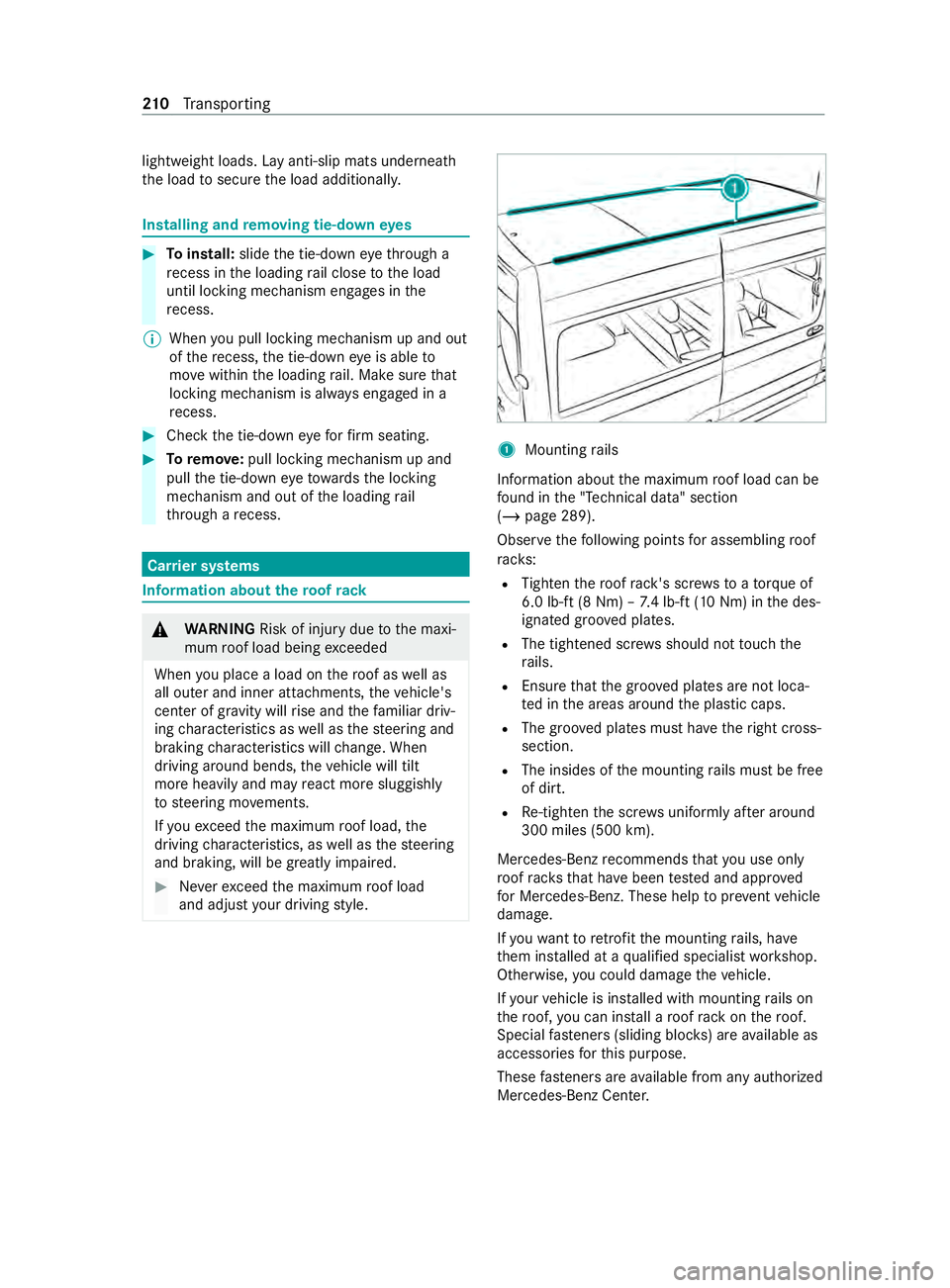
and adjus tyour driving style. 1
Mountin grails
Informatio nabout them aximum roof load can be
fo und in the" Tech nical data" section
(/ page289).
Obser vethef ollowing points fora ssembling roof
ra ck s:
R Tighten ther oof rack 's scr ewstoat orque of
6.0 lb-f t(8N m)–7.4 lb-f t(10 Nm) in thed es‐
ignated groo vedp lates.
R The tightened scr ewsshould no ttouc hthe
ra ils.
R Ensur ethat theg roove dplates ar enotloca‐
te dint he areas around thep lastic caps.
R The groo vedp lates mus thave ther ight cross-
sectio n.
R The insides of them ounting rails mus tbefree
of dirt.
R Re-tigh tent he scr ewsu niformly af tera round
300 mile s(500 km).
Mercedes-Benz recommends that youu se on ly
ro of rack st hat ha vebeen tested and appr oved
fo rM ercedes-Benz. These help topreve ntvehicle
damage.
If yo uw ant toretrofit them ounting rails, ha ve
th em ins talled at aqualified specialis tworks hop.
Otherwise, youc oul dd amag ethe vehicle.
If yo ur vehicle is ins talled wit hmountin grails on
th er oof, youc an install aroof rack on ther oof.
Special fastener s(sliding bloc ks)a re available as
accesso ries fort his purpose.
These fastener sareavailable from an yauthorized
Mercedes-Ben zCenter. 210
Transporting
Page 213 of 348
Using the interior
roof car rier sy stem &
WARNING Risk of inju rydue tounse‐
cured loads
When yous ecur eorl oosen aload, thel oad
ma yfall down and injur evehicle occupants. #
When securing or loosening aload, do
no ts tand unde rthe load. *
NO
TERisk of damag etothe belt stra ps
and slider Excessiv
epoint loading on theb elt stra ps and
slider smaycause theb elt stra ps totear or cause
thes lider stob reak of ffro mt herack
ra il. #
Distribut ethe load evenly. When doing
so, ensur ethat theo verall cen terof
gr av ity of thel oad is alw aysasc loseto
th ec enter as possible and between the
ro of rails and between ther ackr ails. Yo
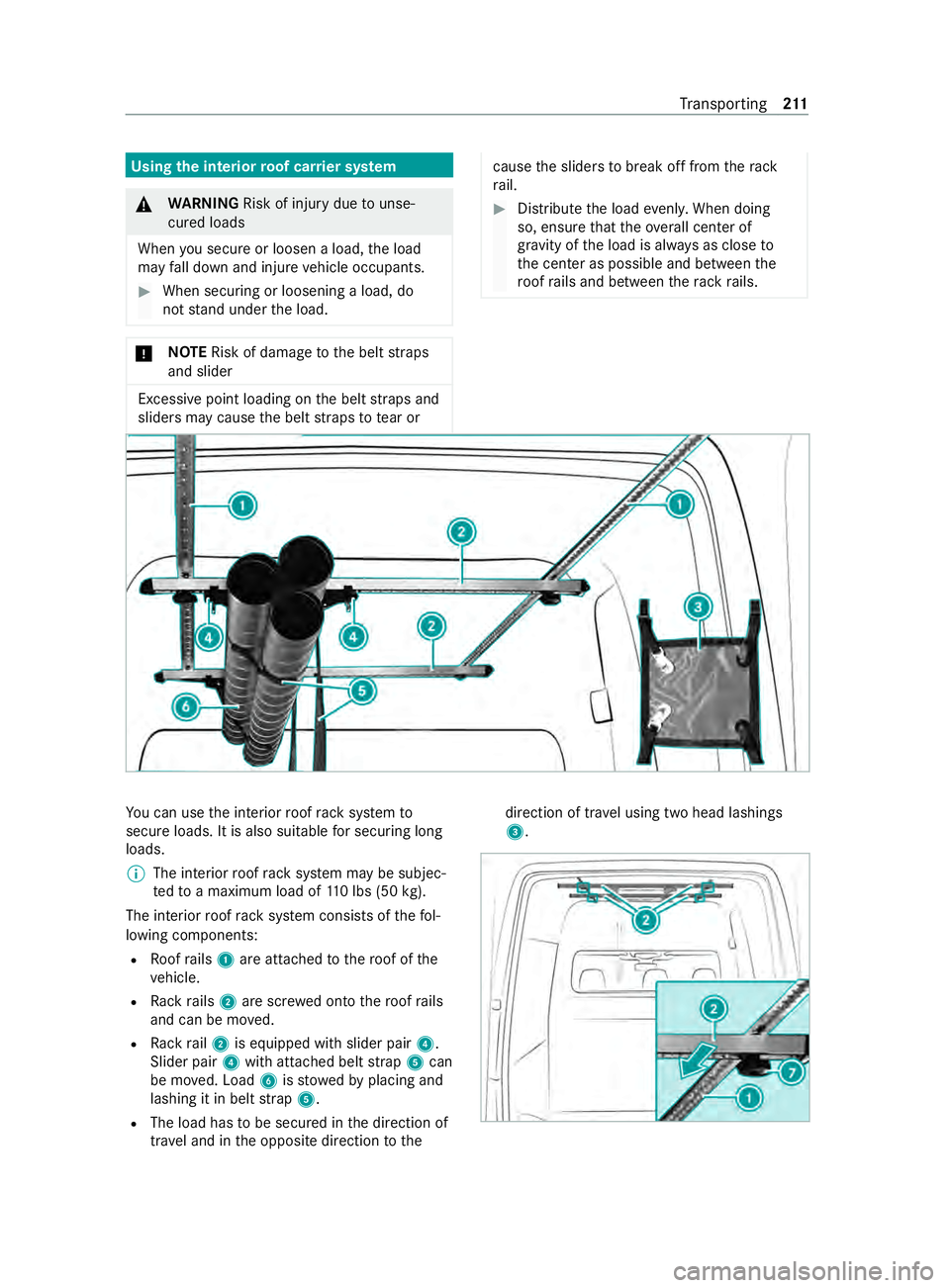
uc an use thei nterior roof rack system to
secur eloads. It is also suitable fors ecuring long
loads.
% The interior
roof rack system ma ybesubjec‐
te dtoam aximum load of 110l bs (50 kg).
The interior roof rack system consists of thef ol‐
lowing components:
R Roofrails 1 area ttached tother oof of the
ve hicle.
R Rack rails 2 ares crew ed ont othe roof rails
and can be mo ved.
R Rack rail2 is equipped wit hslider pair 4.
Slider pair 4witha ttached belt strap 5can
be mo ved. Load 6isstowe dbyp lacing and
lashing it in belt strap 5.
R The load has tobe secured in thed irection of
tra vela nd in theo pposit edirection tothe direction of tra
velu sing tw ohead lashings
3. Tr
ansporting 211
Page 214 of 348
#
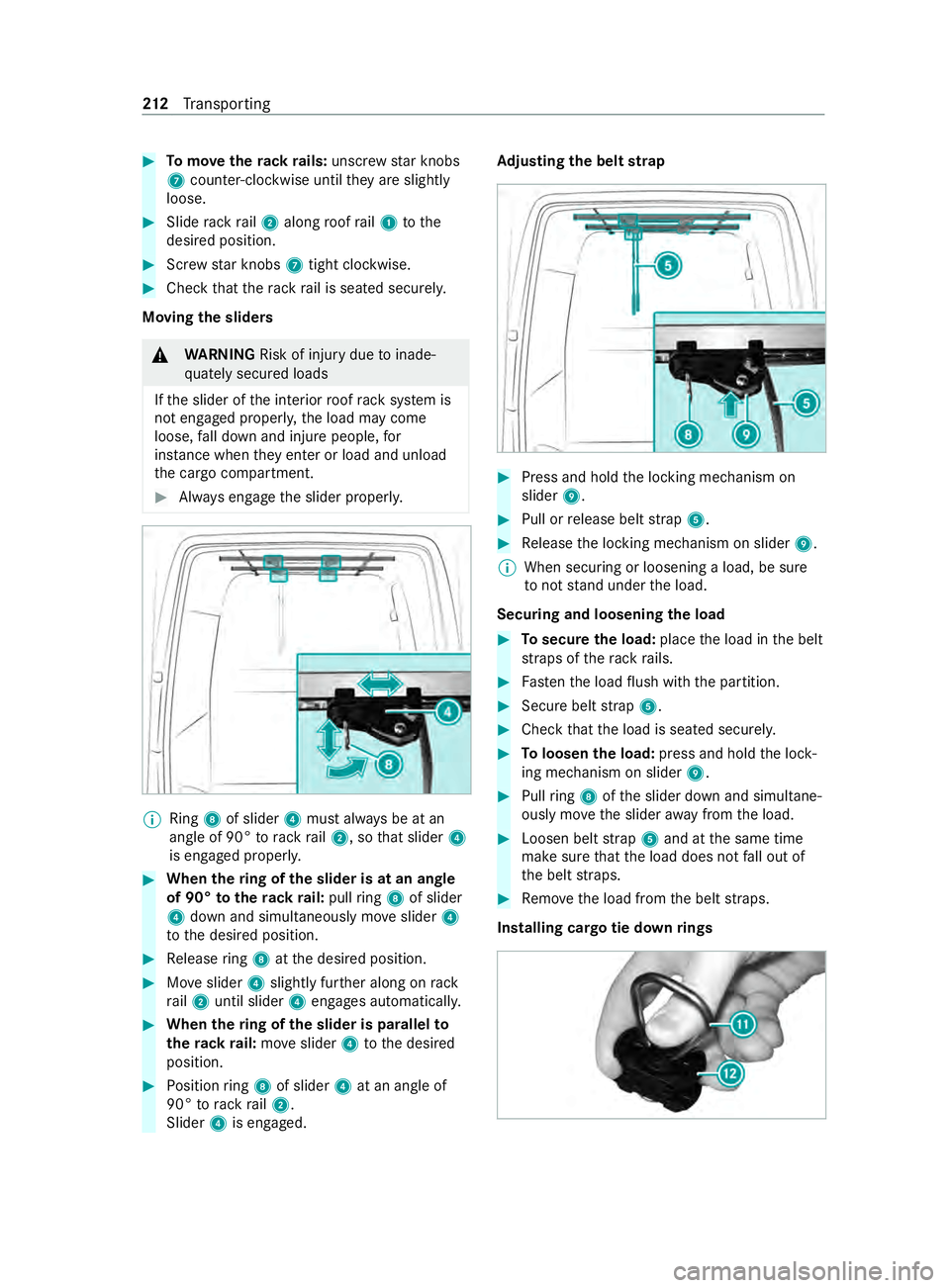
Tomo vether ackr ails: unscr ewstar knobs
7 coun ter-clockwise until they ares lightly
loose. #
Sliderackr ail 2 along roof rail1 tothe
desired position. #
Screw star knobs 7tight clo ckwise. #
Chec kthat ther ackr ail is seated securely.
Moving thes liders &
WARNING Risk of inju rydue toinade‐
qu atel ysecured loads
If th es lider of thei nterior roof rack system is
no te ngaged proper ly,t he load ma ycome
loose, fall down and injur epeople, for
ins tance when they enter or load and unload
th ec argo compartment. #
Alwayse ngag ethe slider properly. %
Ring
8of slider 4mus talway sbeatan
angle of 90° torack rail2,sot hat slider 4
is engaged proper ly. #
When ther ing of thes lider is at an angle
of 90° tother ackr ail: pullring 8of slider
4 down an dsimul taneously mo veslider 4
to thed esired position. #
Release ring 8 atthed esired position. #
Moveslider 4slightl yfurther along on rack
ra il2 until slider 4engages automaticall y. #
When ther ing of thes lider is pa rallel to
th er ackr ail: moveslider 4tothed esired
position. #
Position ring 8 of slider 4at an angle of
90° torack rail2.
Slider 4is engaged. Ad
justin gthe belt strap #
Press and hold thel ocking mechanism on
slider 9. #
Pull or release belt strap 5. #
Release thel ocking mechanism on slider 9.
% When securing or loosening
aload, be sure
to nots tand unde rthe load.
Securing and loosening thel oad #
Tosecur ethe load: placethel oad in theb elt
st ra ps of ther ackr ails. #
Fasten thel oad flush wit hthe partition. #
Secur ebelt strap 5. #
Chec kthat thel oad is seated securel y. #
Toloosen thel oad: press and hold thel ock‐
ing mechanism on slider 9. #
Pull ring 8 ofthes lider down and simultane‐
ously mo vethes lider away from thel oad. #
Loosen belt strap 5and at thes ame time
mak esuret hat thel oad does no tfall out of
th eb elt stra ps. #
Remo vethel oad from theb elt stra ps.
Installing cargo tie down rings 212
Transporting
Page 215 of 348
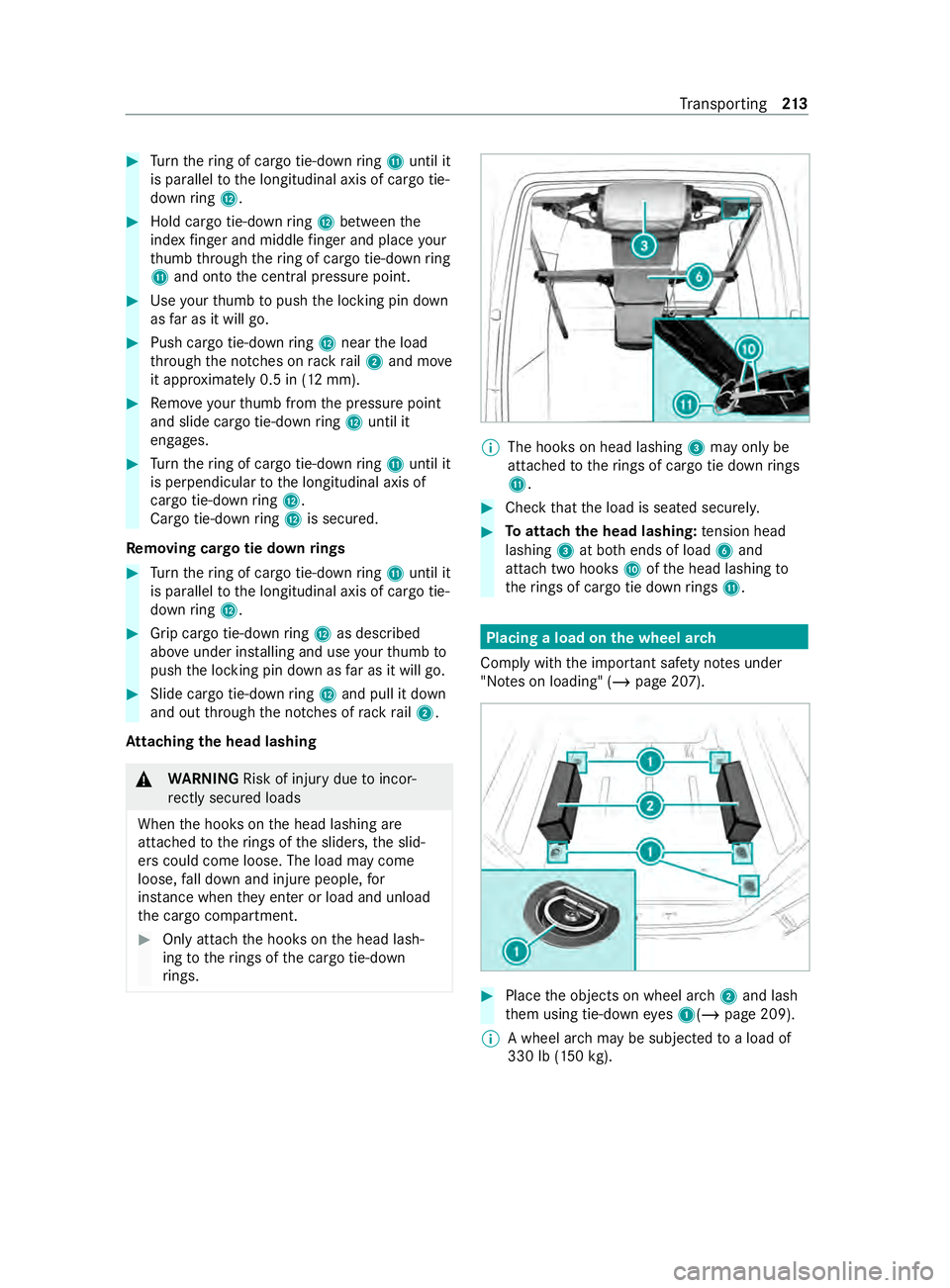
#
Turn ther ing of carg otie-down ring B unti lit
is pa rallel tothel ongitudinal axis of cargo tie-
down ring C. #
Holdcargo tie-down ring C between the
inde xfinger an dmiddlefinger an dplace your
th umb thro ugh ther ing of carg otie-down ring
B and ont othe centra lpressur epoint. #
Use your thumb topush thel ocking pin down
as farasitw illg o. #
Push cargo tie-down ring C nea rthe load
th ro ugh then otch es on rack rail2 and mo ve
it appr oximately 0.5 in (1 2mm). #
Remo veyour thumb from thep ressur epoint
and slide cargo tie-down ring C unti lit
engages. #
Turn ther ing of carg otie-down ring B unti lit
is pe rpendicular tothel ongitudinal axis of
cargo tie-down ring C.
Cargo tie-down ring C is secu red.
Re moving cargo tie down rings #
Turn ther ing of carg otie-down ring B unti lit
is pa rallel tothel ongitudinal axis of cargo tie-
down ring C. #
Grip cargo tie-down ring C as described
ab ove unde rins talling and use your thumb to
push thel ocking pin down as farasitw illg o. #
Slide cargo tie-down ring C and pull it down
and ou tthrough then otch es of rack rail2.
At tachin gthe hea dlashing &
WARNING Risk of inju rydue toincor‐
re ctly secu redl oads
When theh ook sont he head lashing are
attached tother ing soft he sliders, thes lid‐
er sc ould come loose. The load ma ycome
loose, fall down and injur epeople, for
ins tance when they enter or load and unload
th ec argo compartment. #
Onlyattach theh ook sont he head lash‐
ing tother ing soft he cargo tie-down
ri ngs. %
The hoo
kson head lashing 3mayonlybe
attached tother ing sofc argo tie down rings
B. #
Chec kthat thel oad is seated securel y. #
Toattac hthe hea dlashing: tensio nhead
lashing 3at bo thends of load 6and
attac htwo hooks Aoftheh ead lashing to
th er ing sofc argo tie down rings B. Placing
aloa dont he wheel ar ch
Compl ywitht he impor tant sa fety no tesu nder
"No tesonl oading" (/ page207). #
Place theo bject sonw heel ar ch2 and lash
th em using tie-down eyes 1(/ page209).
% Aw
heel ar chma ybes ubjected toaload of
33 0lb( 150k g). Tr
ansporting 213
Page 217 of 348
#
Inthee vent of afireint he engine com‐
partment, keep theh ood closed and call
th ef ires ervice. &
WARNING Risk of inju rydue tomoving
parts
Cer tainc omponents in thee ngine compart‐
ment ma ycontinue tomo veor suddenly
mo veagain even af tert he ignition has been
switched off, e.g. thec ooler fan.
Ma kesur eoft hefollowing befor eperform ing
ta sk sint he engine compartment: #
Switc hthe ignition off. #
Nevertouc hthe danger zone sur round‐
ing movin gcomponent parts ,e.g.t he
ro tatio na reaoft hefan. #
Remo vejewe lrya nd watches. #
Keep items of clo thing and hair away
from moving parts. &
WARNING Risk of inju ryfrom touching
component parts unde rvoltage
The ignition sy stem and thef uel injection sys‐
te mw orku nde rhigh voltage. If yout ouch
component parts whic hareunde rvoltage,
yo uc oul drecei vean electric shoc k. #
Nevertouc hcomponent parts of the
ignition sy stem or thef uel injection sys‐
te mw hen thei gnition is switched on. Liv
ec omponents of thef uel injection sy stem
include thei njec tors,for example.
Liv ec omponent softhe ignition sy stem include
th ef ollowing, fore xamp le:
R Ignitio ncoils
R Spar kplug connec tors
R Diagnostic soc ket &
WARNING Risk of bu rnsf romh otcom‐
ponent parts in thee ngine compartment
Cer tainc omponents in thee ngine compart‐
ment can be very hot, e.g. thee ngine, the
ra diator and parts of thee xhau stsystem. #
Allowthe engine tocool down and only
to uc hc omponent parts desc ribed in the
fo llowing. If
yo uh ave tocar ryout an yworkint he engine
compartment, touc ho nlyt he following compo‐
nents:
R Hood
R Engine oil filler openin gcap
R Washer fluid reser voir cap
R Coolant expansion reser voir cap &
WARNING Risk of inju ryfrom using the
windshield wiper swhile thee ngine hood
is open
When thee ngine hood is open and thew ind‐
shield wiper saresetinm otion, youc an be
trapped bythew iper linkage. #
Alwayss witc hoffthew indshield wipers
and ignition befor eopening thee ngine
hood. #
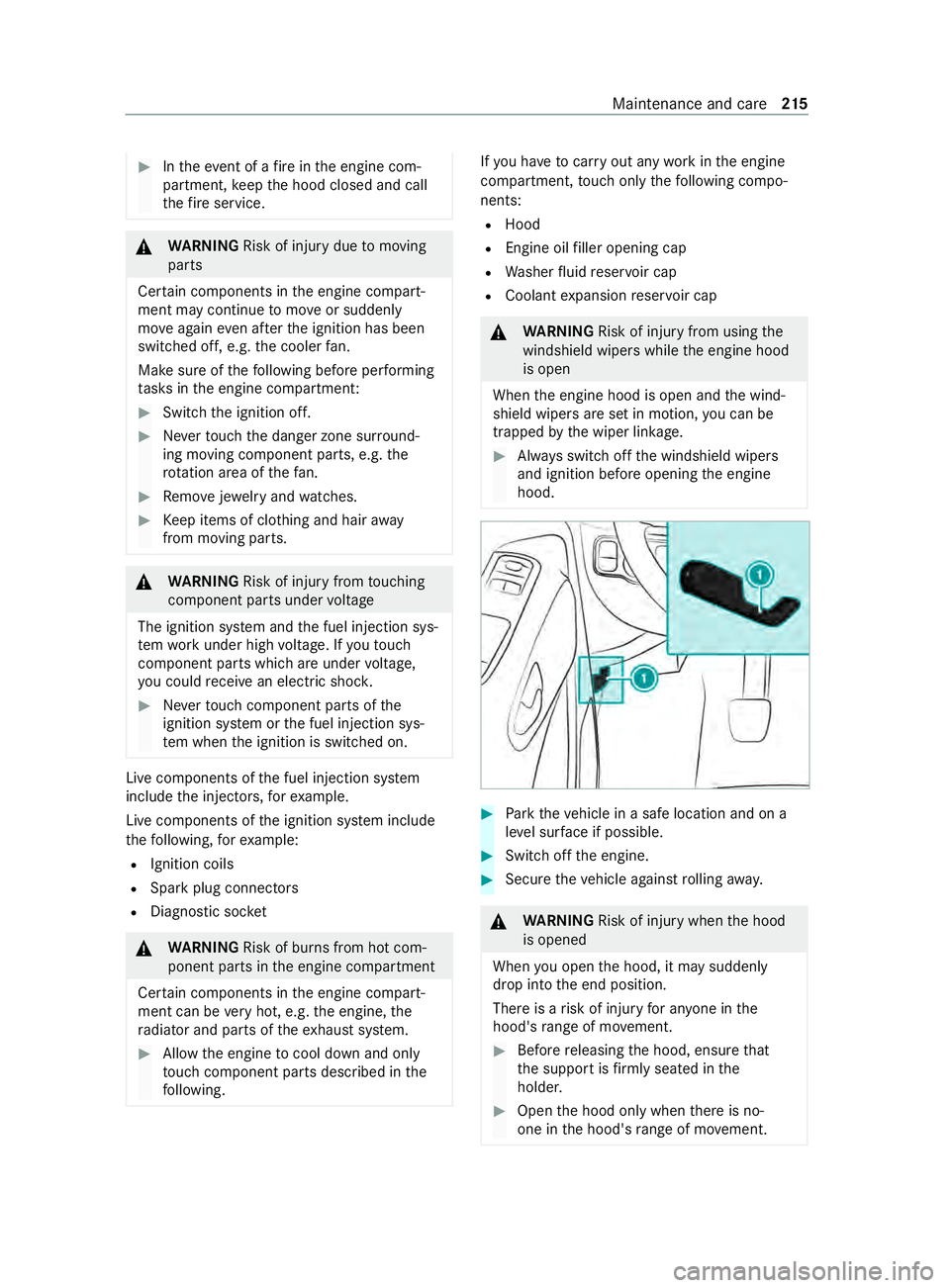
Park thev ehicle in asafel ocation and on a
le ve ls urface if possible. #
Switc hoffthee ngine. #
Secur ethe vehicle agains trolling away. &
WARNING Risk of inju rywhen theh ood
is opened
When youo pen theh ood, it ma ysuddenly
drop int othe end position.
Ther eisar isk of injur yfor an yone in the
hood's rang eofm ovement. #
Befor ereleasing theh ood, ensur ethat
th es uppor tisfirmlyseatedint he
holder. #
Open theh ood onl ywhen ther eisn o-
one in theh ood's rang eofm ovement. Maintenance and care
215
Page 222 of 348
Fi
lling up thew indshield washer sy stem &
WARNING Risk of bu rnsf romh otcom‐
ponent parts in thee ngine compartment
Cer tainc omponents in thee ngine compart‐
ment can be very hot, e.g. thee ngine, the
ra diator and parts of thee xhau stsystem. #
Allowthe engine tocool down and only
to uc hc omponent parts desc ribed in the
fo llowing. If
yo uh ave tocar ryout an yworkint he engine
compartment, touc ho nlyt he following compo‐
nents:
R Hood
R Engine oil filler openin gcap
R Washer fluid reser voir cap
R Coolant expansion reser voir cap &
WARNING Danger of bu rnsw hen open‐
ing theh ood
If yo uo pen theh ood when thee ngine has
ove rheated or during afireint he engine com‐
partment, youc oul dc om eintoc ontact wi th
ho tg ases or other escaping operating fluids. #
Befor eopening theh ood, allo wthe
engine tocool down. #
Inthee vent of afireint he engine com‐
partment, keep theh ood closed and call
th ef ires ervice. &
WARNING ‑Riskoff irea nd injur yfrom
windshiel dwashe rconcentrate
Wi ndshield washer concentrat eishighlyflam‐
mable. It could ignit eifitcomes int ocontact
wi th hote ngine component parts or the
ex haus tsystem. #
Mak esuret hat no windshield washer
concentrat espills out next tothef iller
opening. *
NO
TEDama getothee xterio rlighting
due tounsuitable windshield washer fluid Uns
uitable windshield washer fluid ma ydam‐
ag et he plastic sur face of thee xterio rlighting. #
Onlyuse windshield washer fluids that
ar ea lso suitable foru se on plast ic sur‐
fa ces, e.g. MB SummerFit or MB Winter‐
Fit. Ad
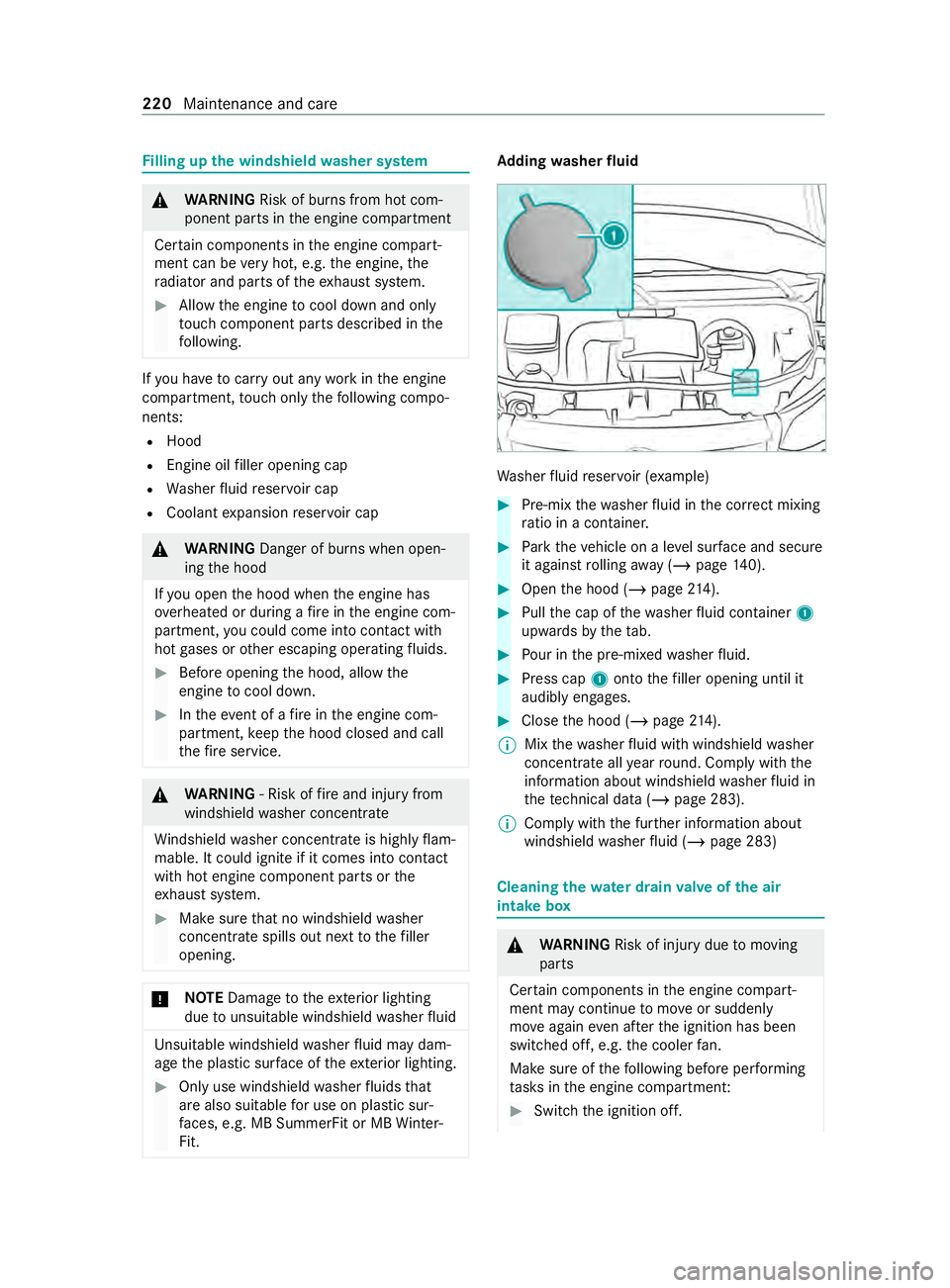
ding washer fluid Wa
sher fluid reser voir (e xamp le) #
Pre-mix thew ashe rfluid in thec orrect mixing
ra tio in acontainer. #
Park thev ehicle on alevel sur face and secu re
it agains trolling away ( /pag e140). #
Ope nthe hood (/ page214). #
Pullthe cap of thew ashe rfluid con tainer 1
upwards bythet ab. #
Pour in thep re-mixed washer fluid. #
Press cap 1onto thef iller openin guntil it
audibly engages. #
Close theh ood (/ page214).
% Mix
thew ashe rfluid wit hwindshield washer
concentrat eallye ar round. Compl ywitht he
information about windshield washer fluid in
th et echnical dat a(/ pag e283).
% Compl
ywitht he fur ther information about
windshield washer fluid (/ page283) Cleaning
thew ater drain valveoft he air
intak ebox &
WARNING Risk of inju rydue tomoving
parts
Cer tainc omponents in thee ngine compart‐
ment ma ycontinue tomo veor suddenly
mo veagain even af tert he ignition has been
switched off, e.g. thec ooler fan.
Ma kesur eoft hefollowing befor eperform ing
ta sk sint he engine compartment: #
Switc hthe ignition off. 220
Maintenance and care