light MERCEDES-BENZ V-CLASS MPV 2021 Owners Manual
[x] Cancel search | Manufacturer: MERCEDES-BENZ, Model Year: 2021, Model line: V-CLASS MPV, Model: MERCEDES-BENZ V-CLASS MPV 2021Pages: 337, PDF Size: 9.88 MB
Page 240 of 337

Obser
vethefo llowing no tes:
R Recharge the battery more frequently in the
fo llowing cases:
- You predominantly drive short dis tances.
- You predominantly drive at low outside
te mp eratures.
- You lea vetheve hicle par kedfo r a lengt hy
period.
In order forth e batteries toachie vetheir max‐
imum possible service life, they must alw ays
be suf ficiently charge d.
R Consult a qualified specialist workshop if you
wish tolea veyour vehicle par ked up for a
long period of time.
R When you park theve hicle, remo vetheke y if
yo u do not require any elect rical consumers.
The vehicle will then use very little energy,
th us conserving bat tery powe r.
R Ifyo ur vehicle requ ires jump-s tarting, or if you
wish toprov ide jump-s tarting assis tance to
ano ther vehicle, only use the jump-s tart con‐
nection point in the engine compartment
(/ page 237).
Installation locations
Yo ur vehicle may be equipped with thefo llowing
two batteries located in the seat base of the
ri ght-hand front seat, depending on the equip‐
ment version:
R Starter battery
R Suppo rtbattery St
arting assistance and charging the12 V
battery &
WARNING Risk ofexplosion from a fro‐
zen battery
A dischar ged battery may freeze at temp era‐
tures slightly abo veor below freezing point.
During starting assis tance or battery charg‐
ing, battery gas can be released. #
Always allow a battery tothaw before
ch arging it or per form ing starting assis‐
ta nce. If
th ewa rning/indicator lamps do not light up in
th e instrument clus ter at temp eratures around or
below freezing, it is highly probable that the dis‐
ch arge d battery has frozen. In
this case, obser vethefo llowing points:
R do not give theve hicle starting assis tance or
ch arge the battery
R the service life of a battery that has been
th awe d may be reduced drastically
R thest arting behaviour may de teriorate, par‐
ticularly at low temp eratures
R it is recommended that you ha veath awed
battery checked at a qualified specialist work‐
shop &
WARNING Risk ofexplosion during
ch arging process and starting assis tance
During thech arging process and starting
assis tance, the battery may release an explo‐
sive gas mixture. #
Avoid fire , naked flames, creating
spar ksand smoking. #
Make sure there is suf ficient ventilation. #
Do not lean over a batter y. &
WARNING Danger of chemical burns
from the battery acid
Battery acid is caustic. #
Avoid contact with the skin, eyes or
clo thing. #
Do not lean overth e batter y. #
Do not inhale battery gases. #
Keep children away from the batter y. #
Immedia tely rinse battery acid off thor‐
oughly with plenty of clean water and
seek medical attention immediately. St
arting assistance
* NO
TEDama gecaused bynume rous or
ex tended attempts tostart the engine Nume
rous or extended attempts tostart the
engine may damage the catalytic con verter
due tonon-combu sted fuel. #
Avoid numerous and extended attem pts
to start the engine. Do not use a
rapid charging device tostart the
ve hicle. If your vehicle's battery is dischar ged,
th e engine can be jump-s tarted from ano ther
ve hicle or from a donor battery using jump leads.
Fo rth is purpose, theve hicle has a jump-s tart
connection point in the engine compartment. Breakdown assis
tance 237
Page 242 of 337

#
Insert theke y into the ignition loc k,start the
engine and let it runfo r se veral minutes. #
Before disconnecting the jump leads, switch
on an electrical consumer in your ow nve hi‐
cle, e.g. there ar wind owheater or the light‐
ing. #
Disconnect the negative term inal clamp of
th e jump lead from ear thcontact 4and
th en from negative term inal 2ofthe donor
batter y. #
Disconnect the positive term inal clamp of the
jump lead from positive term inal 5onthe
jump-s tart connection point, and then from
positive term inal 3ofthe donor batter y.
Con tact pr otection co ver1 is automatically
re turned forw ards toits original position by
th e spring forc e and the jump-s tart connec‐
tion point is closed. #
Position the co ver on positive term inal 3of
th e donor batter y. #
Have the battery checked at a qualified spe‐
cialist workshop.
Charging the12 V battery
* NO
TEDama getothe electronics caused
by non-app rove dch arging devices Charging a
fitted battery wi tha battery
ch arge r which has not been appro vedby
Mercedes-Benz can damage the on-board
electronics. #
Only use a battery charge r which has
been appro vedby Mercedes-Benz and
which permits charging the battery
when it is fitted in theve hicle. #
Only charge the battery using the jump-
st art connection point. A battery
charge r specially adapte dfor
Mercedes-Benz vehicles and tested and appr oved
fo r Mercedes-Benz is available as an accesso ry.
Fu rther information is available from any
Mercedes-Benz Service Cent re.Re ad the operat‐
ing instructions foryo ur charge r before charging
th e batter y.
Re charge the battery more frequently if you use
th eve hicle mainly for short trips and/or drive at
low outside temp eratures. #
Connect the battery charge rto the positive
te rm inal and ear thcontact in the same order
as when connecting the donor battery in the
jump-s tarting procedure. %
If a battery is not
fitted and not in service,
yo u should charge itev ery thre e months. This
helps tocounteract self-discharging and pre‐
ve nt damage tothe batter y.
12 V battery care
* NO
TEBattery discharge due toleakage
cur rents Dirty battery
term inal clamps and battery sur‐
fa ces cause lea kage cur rents. This can lead
to the battery discharging. #
Keep the battery term inals and battery
sur faces clean and dr y. *
NO
TEDama getothe battery housing
due toimproper cleaning If
yo u use cleaning agents con taining fuel,
th ese can damage the battery housing. #
Do not use cleaning agents containing
fuel. *
NO
TEDama getothe battery due toself-
dischar ge If dirt
gets into the battery cell, the self-dis‐
ch arge ofthe battery is increased and the
battery can be damaged. #
Only clean the battery with the cell caps
scr ewed in. Obser
vethefo llowing points on battery care: #
Regular lych eck the battery term inals and the
fast ening of the negative cable tothech assis
to ensure that they are firm lyseated. #
Lightly grease the undersides of the battery
te rm inal clamps with acid- resis tant grease. #
Only clean the battery housing with commer‐
cially available cleaning agents. Disconnecting and
removing the star ter bat‐
te ry &
WARNING Risk ofexplosion from hydro‐
ge nga s igniting
There is a danger of hydrogen gas igniting
when charging the battery if there is a short
circuit or spar ksstart toform. Breakdown assis
tance 239
Page 251 of 337
#
If necessar y,fold up there ar seat. #
Turn topro tary catch 1clockwise and bot‐
to m rotary catch 1anti-clockwise. #
Remo vecover2.
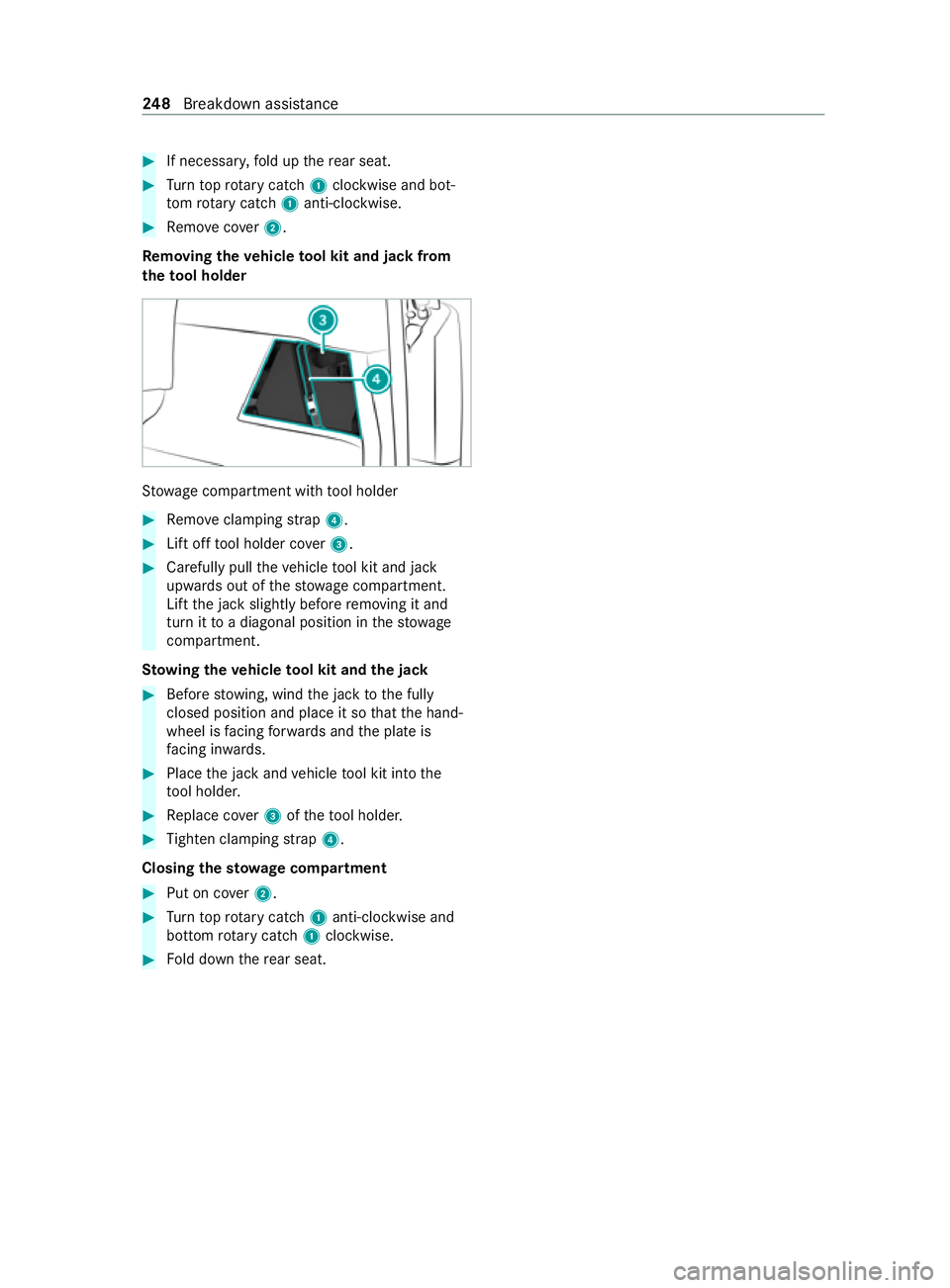
Re moving the vehicle tool kit and ja ckfrom
th eto ol holder St
ow age compartment with tool holder #
Remo vecla mp ing stra p4. #
Lift off tool holder co ver3. #
Carefully pull theve hicle tool kit and jack
upwards out of thestow age compartment.
Lift the jack slightly before removing it and
turn it toa diagonal position in thestow age
compartment.
St ow ing theve hicle tool kit and the ja ck #
Before stowing, wind the jack tothe fully
closed position and place it so that the hand‐
wheel is facing forw ards and the plate is
fa cing in wards. #
Place the jack and vehicle tool kit into the
to ol holder. #
Replace co ver3 oftheto ol holder. #
Tighten clamping stra p4.
Closing thesto wage compa rtment #
Put on co ver2. #
Turn topro tary catch 1anti-clockwise and
bottom rotary catch 1clockwise. #
Fold down there ar seat. 248
Breakdown assis tance
Page 254 of 337
Only cor
rect tyre pressures when the tyres are
cold. Conditions for cold tyres are:
R The vehicle has been par ked with the tyres
out of direct sunlight for at least thre e hours.
R The vehicle has tr avelled less than 1.6 km.
Note s on trailer operation
The applicable tyre pressure forth e tyres of the
re ar axle is alw aysth ere commended tyre pres‐
sure for a full load. Overview of
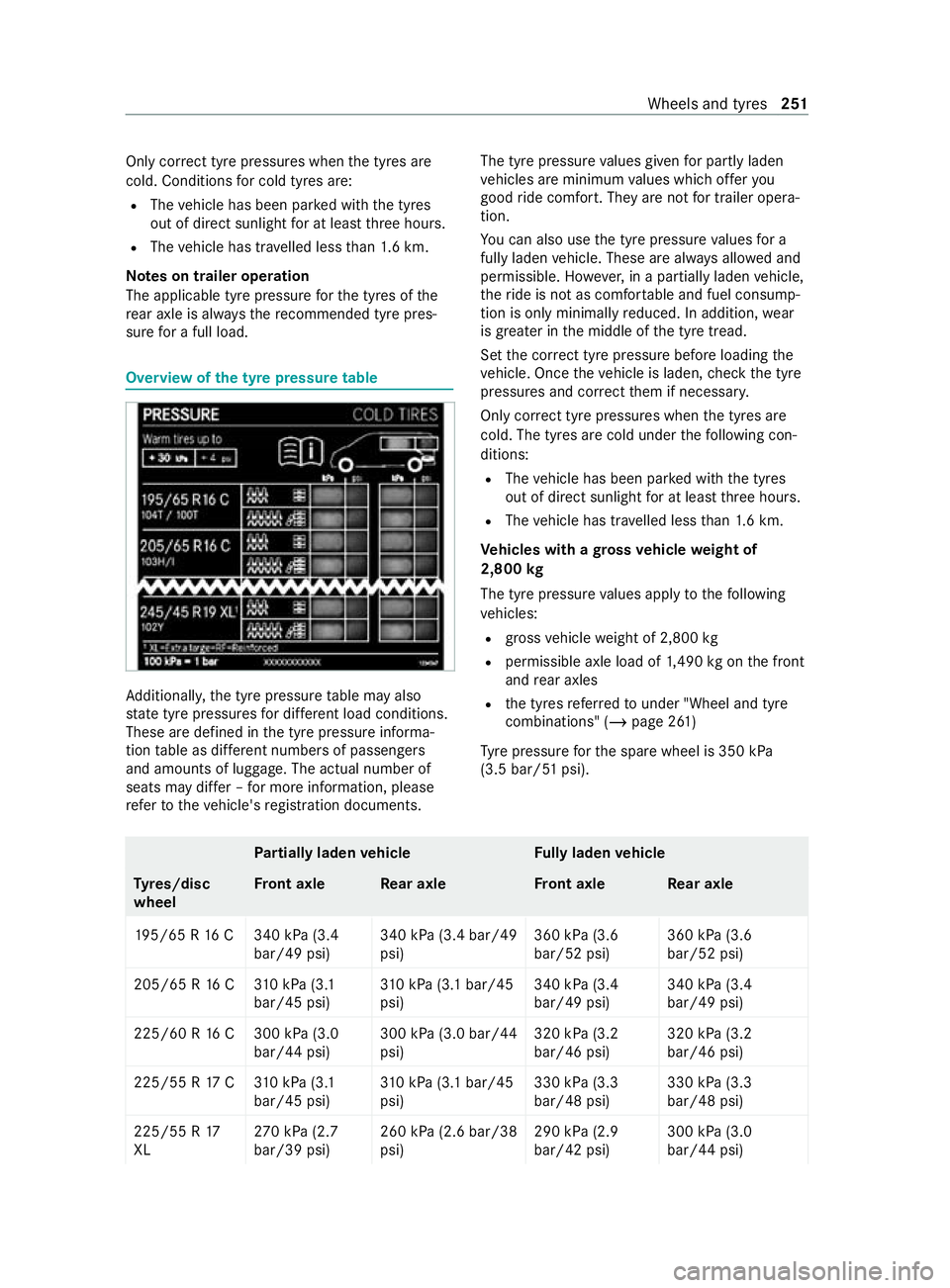
the tyre pressure table Ad
ditionall y,the tyre pressure table may also
st ate tyre pressures for dif fere nt load conditions.
These are de fined in the tyre pressure informa‐
tion table as dif fere nt numbers of passengers
and amounts of luggage. The actual number of
seats may di ffer – for more information, please
re ferto theve hicle's registration documents. The tyre pressure
values given for partly laden
ve hicles are minimum values which of feryou
good ride comfort. They are not for trailer opera‐
tion.
Yo u can also use the tyre pressure values for a
fully laden vehicle. These are alw ays allo wed and
permissible. Ho wever,in a partially laden vehicle,
th eride is not as comfor table and fuel consump‐
tion is only minimally reduced. In addition, wear
is grea ter in the middle of the tyre tread.
Set the cor rect tyre pressu rebefore loading the
ve hicle. Once theve hicle is laden, check the tyre
pressures and cor rect them if necessar y.
Only cor rect tyre pressu res when the tyres are
cold. The tyres are cold under thefo llowing con‐
ditions:
R The vehicle has been par ked with the tyres
out of direct sunlight for at least thre e hours.
R The vehicle has tr avelled less than 1.6 km.
Ve hicles with a gross vehicle weight of
2,800 kg
The tyre pressure values apply tothefo llowing
ve hicles:
R gross vehicle weight of 2,800 kg
R permissible axle load of 1,490 kgon the front
and rear axles
R the tyres referred tounder "Wheel and tyre
combinations" (/ page 261)
Ty re pressure forth e spare wheel is 350 kPa
(3.5 bar/51 psi). Pa
rtially laden vehicl eF ully ladenvehicle
Ty res/disc
wheel Fr
ont axle Rear axle Front axle Rear axle
19 5/65 R 16C3 40 kPa (3.4
bar/49 psi) 340 kPa (3.4 bar/49
psi) 360 kPa (3.6
bar/52 psi)360 kPa (3.6
bar/52 psi)
205/65 R 16C3 10kPa (3.1
bar/45 psi) 31
0 kPa (3.1 bar/45
psi) 340 kPa (3.4
bar/49 psi)340 kPa (3.4
bar/49 psi)
225/60 R 16C3 00 kPa (3.0
bar/44 psi) 300 kPa (3.0 bar/44
psi) 320 kPa (3.2
bar/46 psi)320 kPa (3.2
bar/46 psi)
225/55 R 17C3 10kPa (3.1
bar/45 psi) 31
0 kPa (3.1 bar/45
psi) 330 kPa (3.3
bar/48 psi)330 kPa (3.3
bar/48 psi)
225/55 R 17
XL 27
0 kPa (2.7
bar/39 psi) 260 kPa (2.6 bar/38
psi) 290 kPa (2.9
bar/42 psi)300 kPa (3.0
bar/44 psi) Wheels and tyres
251
Page 262 of 337

Due
tothe legally prescribed accuracy of the
speedome ter and odome ter displa ys,th efo llow‐
ing tyres are not permitte dfo rta xis and hire cars:
R Wheel size catego ry 1
- 195/65 R16C
R Wheel size category 2
- 225/55 R17XL
- 245/45 R18XL
If th e wheel size category changes, you must
ha ve your vehicle's contro l unitsrecoded at a
qu alified specialist workshop. Information on
the direction of the tyres'
ro tation Ty
res with a specified direction of rotation ha ve
additional benefits, e.g. if there is a risk of aqua‐
planing. You will on lyga in these benefits if the
cor rect direction of rotation is obser ved.
An ar row on the side wall of the tyre indicates its
cor rect direction of rotation.
Yo u may also fit a spa rewheel against the direc‐
tion of rotation. Obser vethe time restriction on
use as well as the speed limitation specified on
th e spare wheel. Information on
storing wheels Obser
vethefo llowing when storing wheels:
R Wheels that ha vebeen remo ved should be
st ored in a cool, dry and, if possible, dark
place.
R Protect the tyres from oil, grease and fuel. Preparing
theve hicle for a wheel change Requ
irements
R The tyre-change tool kit is available.
R The vehicle is not on a slope.
R The vehicle is on solid, non-slippery and le vel
ground. #
Appl yth e parking brake. #
Movethe front wheels tothest ra ight-ahead
position. #
Vehicles with manual transmission:
engage firs t or reve rsege ar 005E. #
Vehicles with automatic transmission:
shift the transmission toposition 005D. #
Switch off the engine. #
Make sure that the engine cann otbe star ted. #
On le velte rrain: place choc ks orother suita‐
ble objects under the front and rear of the
wheel that is diagonally opposite the wheel to
be changed. #
On slight inclines: placechoc ks orother
suitable objects under the wheels on the
front and rear axles opposite the wheel tobe
ch anged. #
If included in theve hicle equipment, take the
tyre-change tool kit out of theve hicle tool kit
(/ page 247). #
If included in theve hicle equipment, remo ve
th e spare wheel from the spare wheel brac ket
( / page 265). #
If necessar y,remo vethe wheel co ver. #
Using the wheel wrench, loosen the wheel
nuts/bolts on the wheel you wish tochange
by about one full turn. Do not unscr ewthe
wheel bolts/nuts comple tely. #
Raise theve hicle (/ page 259). Ra
ising theve hicle when changing a wheel &
WARNING Risk of injury from incorrect
positioning of the jack
If yo u do not position the jack cor rectly at the
appropriate jacking point of theve hicle, the
jack could tip wi th theve hicle raised. #
Only position the jack at the appropriate
jacking point of theve hicle. The base of
th e jack must be positioned vertically
under the jacking point of theve hicle. &
WARNING Risk of injury fromvehicle tip‐
ping
On slopes, the jack could tip with theve hicle
ra ised. Wheels and tyres
259
Page 264 of 337

Fi
tting a new wheel Re
quirements
R The wheel is remo ved (/ page 260). &
WARNING Risk of accident from losing a
wheel
Oiled or greased wheel bolts can cause the
wheel bolts tocome loose, as too can dam‐
aged wheel bolts or wheel hub thre ads. #
Never oil or grease theth re ads. #
Intheeve nt of damage totheth re ads,
con tact a qualified specialist workshop
immediatel y. #
Have the damaged wheel bolts or dam‐
aged hub thre ads replaced. #
Do not continue driving. &
WARNING Risk of injury from tightening
wheel bolts and nuts
If yo u tighten the wheel bolts or wheel nuts
when theve hicle is raised, the jack could tip. #
Only tighten wheel bolts or wheel nuts
when theve hicle is on the ground. #
Obser vethe information on thech oice of
tyres (/ page 256). #
Obser vethe instructions and saf ety no tes on
ch anging a wheel (/ page 256).#
For saf etyre asons, only use wheel bolts or
wheel nuts which ha vebeen appr ovedby
Mercedes-Benz and forth e wheel in question. #
Clean the wheel and wheel hub contact sur fa‐
ces. Lo
weri ngtheve hicle af ter a wheel change &
WARNING Risk of accident due toincor‐
re ct tigh tening torque
The wheels could come loose if the wheel
bolts or wheel nuts are not tightened tothe
prescribed torque. #
Ensu rethat the wheel bolts or wheel
nuts are tightened tothe prescribed
tightening torque. #
Ifyo u are not sure, do not mo vethe
ve hicle. Contact a qualified specialist
wo rkshop and ha vethe tightening tor‐
qu ech ecked immediately. Re
quirements:
R The new wheel has been fitted (/ page 261). #
Place the adap ter and thera tchet on the hex‐
agon head nut of the jack such that the letter‐
ing AB/DOWN is visible. #
Tolowe r the vehicle: turnthera tchet of the
jack anti-clo ckwise. #
Steel wheels: tightenth e wheel bolts or
wheel nuts evenly in a crosswise pattern in
th e sequence indicated (1 to5 ) and to a
maximum of 200 Nm. #
Light-alloy wheels: tightenthe wheel bolts
or wheel nuts evenly in a crosswise pattern in
th e sequence indicated (1 to5 ) and to a
maximum of 180 Nm. #
Che ckthe tyre pressure of the newly fitted
wheel and adjust it if necessa ry.
Ve hicles with the tyre pressure monitor sys‐
te m: allfitted wheels mu stbe equipped with
functioning sensors. #
Retighten the wheel bolts tothe specified
tightening torque af terth eve hicle has been
driven 50 km.
% When using a wheel or spare wheel with a
new or newly painted disk wheel, ha
vethe
wheel bolts or wheel nuts retightened again
af te r appro ximately 1,000 to5,000 km.
Obser vethe specified tightening torque. Infor
mation on wheel and tyre combinations
Gene ral no tes
Information on tyres, wheels and permissible
combinations can be obtained at a qualified spe‐
cialist workshop.
The smaller the cross-section of a tyre of a spe‐
cific wheel size, thewo rseth e driving comfort on
poor road sur faces. Ride and damp ing comfort
are reduced and therisk increases that when you
drive over obs tacles, damage towheels and tyres
may result. Wheels and tyres
261
Page 265 of 337
If
yo uch ange wheel size on your vehicle, check it
is assigned tothe cor rect wheel size catego ry
( / page 258). If the assignment changes with‐
out recoding the cont rol units in theve hicle, the
speedome ter will not display the speed accu‐
ra tely. Driving saf ety sy stems and driving sy stems
may then be operationally impaired or may de tect
a malfunction and switch themselves off.
Yo u will find a table with there commended tyre
pressures forva rious vehicle loads on the inside
of theve hicle's fuel filler flap or under "Tyre pres‐
sure tables" (/ page 251).
Check tyre pressures regularly and only when the
tyres are cold.
Obser vethefo llowing no tes:
R alwaysfit th eve hicle with tyres of the same
size on a given axle (left/right)
R alwaysfit th e same type of wheels on your
ve hicle at a given time (summer tyres, winter
tyres)
Yo u can obtain information about tyres that ha ve
been specially designed and appr ovedfo ryo ur
ve hicle from a Mercedes-Benz Service Centre.
% Not all wheel/tyre combinations can be
fitted
at thefa ctory in all countries.
Ty res
R16 Ty
resS teel or light-alloy wheels
19 5/65 R16 C 100/98T 6.5 J x16H2 ET 52
19 5/65 R16 C 104/102T (100T) 6.5 J x16H2 ET 52
205/65 R16 C 107/105T (103T) 6.5 J x16H2 ET 52
205/65 R16 C 107/105T (103H) 6.5 J x16H2 ET 52
205/65 R16 C 103/1 01H6 .5 J x16H2 ET 52
225/60 R16 C 105/103H 6.5 J x16H2 ET 52 19
5/65 R16 C 100/98T: only forve hicles with a
gross vehicle weight up to2,800 kg.
R17 Ty
resS teel wheels
225/55 R17 C 109/1 07H (104H) 6.5 J x17H2 ET 50
225/55 R17 C 104/102H (106N) 6.5 J x17H2 ET 50 262
Wheels and tyres
Page 269 of 337
#
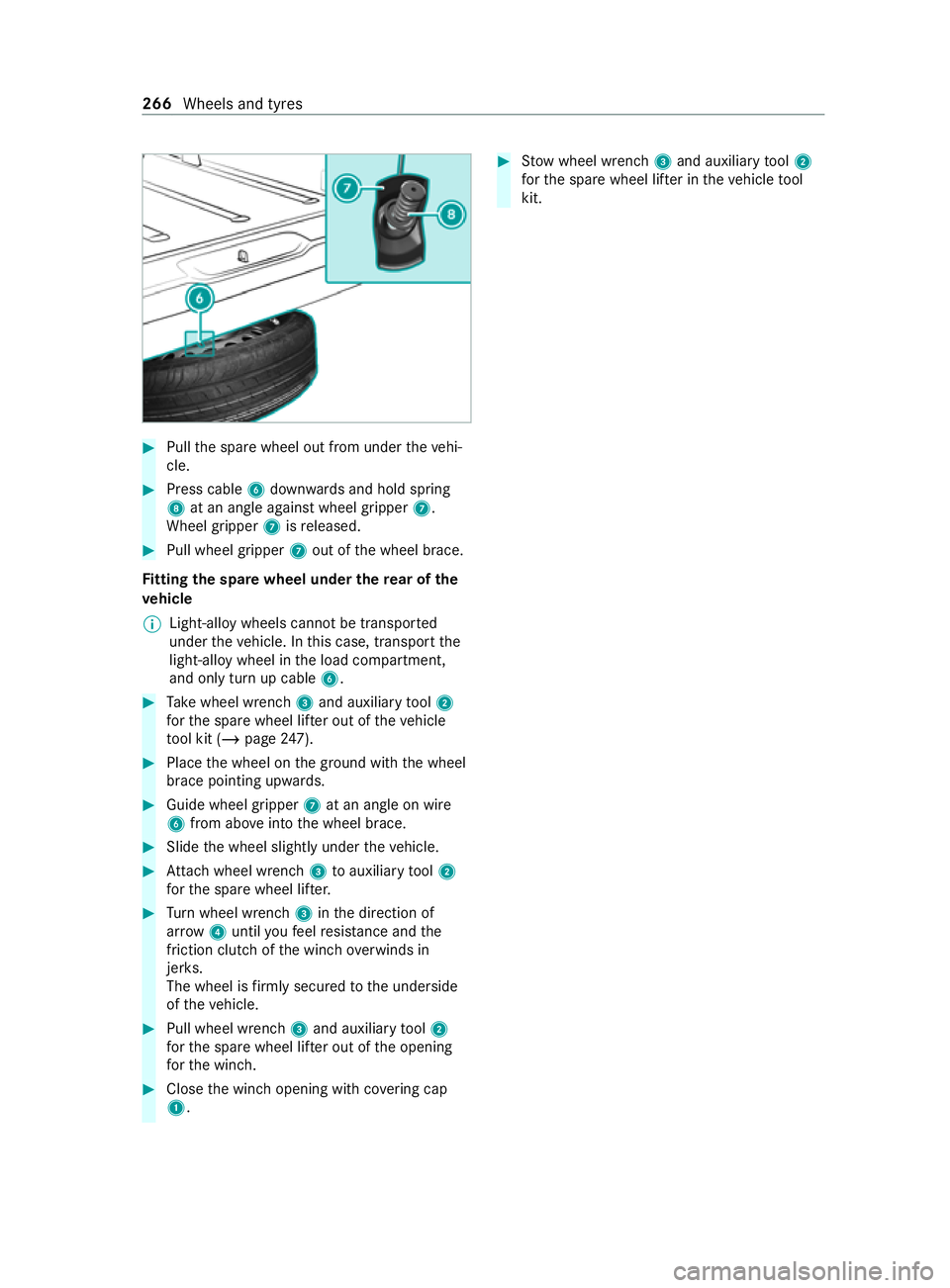
Pull the spare wheel out from under theve hi‐
cle. #
Press cable 6down wards and hold spring
8 at an angle against wheel gripper 7.
Wheel gripper 7isreleased. #
Pull wheel gripper 7out of the wheel brace.
Fi tting the spare wheel under the rear of the
ve hicle
% Light-alloy wheels cannot be transpor
ted
under theve hicle. In this case, transpo rtthe
light-alloy wheel in the load compartment,
and only turn up cable 6.#
Take wheel wrench 3and auxiliary tool 2
fo rth e spare wheel lif ter out of theve hicle
to ol kit (/ page247). #
Place the wheel on the ground with the wheel
brace pointing upwards. #
Guide wheel gripper 7at an angle on wire
6 from abo veinto the wheel brace. #
Slide the wheel slightly under theve hicle. #
Attach wheel wrench 3toauxiliary tool 2
fo rth e spare wheel lif ter. #
Turn wheel wrench 3inthe direction of
ar row 4until youfe el resis tance and the
friction clutch of the winch overwinds in
jer ks.
The wheel is firm lysecured tothe underside
of theve hicle. #
Pull wheel wrench 3and auxiliary tool 2
fo rth e spare wheel lif ter out of the opening
fo rth e winch. #
Close the winch opening with co vering cap
1. #
Stow wheel wrench 3and auxiliary tool 2
fo rth e spare wheel lif ter in theve hicle tool
kit. 266
Wheels and tyres
Page 278 of 337
*
NO
TEDama gecaused byincor rect cool‐
ant #
Only add coolant that has been pre‐
mixed with therequ ired antifreeze pro‐
te ction. Information on coolant is
available at thefo llow‐
ing locations:
R inthe Mercedes-Benz Specification for Oper‐
ating Fluids 320.1
- at https://be vo.mercedes-benz.com
- inthe Mercedes-Benz BeVo app
R at a qualified specialist workshop
* NO
TEOverheating at high outside tem‐
peratures If an inapp
ropriate coolant is used, the engine
cooling sy stem is not suf ficiently pr otected
against overheating and cor rosion at high out‐
side temp eratures. #
Always use coolant appr ovedby
Mercedes-Benz . #
Obser vethe instructions in the
Mercedes-Benz Specifications for Oper‐
ating Fluids 320. 1. *
NO
TEPaint wo rkdamage due tocoolant #
Do not spill coolant on painted sur fa‐
ces. Ha
ve the coolant regularly replaced at a qualified
specialist workshop.
No tethe proportion of anti-cor rosion agent/anti‐
freeze in the engine cooling sy stem within thefo l‐
lowing temp erature ranges:
R at least 50% (antifreeze pr otection up to
about -37°C)
R maximum 55% (antifreeze pr otection up to
-45°C)
Capacities, coolant
Coolant capacity Mode
lC apacity
All model sA pprox.10 .4 l
Appr ox.13 .4 l
on vehicles with auxil‐
iary heating Wi
ndscreen washer fluid Note
s on windscreen washer fluid
Obser vethe no tes on operating fluids
(/ page 269). &
WARNING ‑ Risk of fire and injury due to
windscreen washer concentrate
Wi ndscreen washer concentrate is highly
fl ammable. It could ignite if it comes into con‐
ta ct with hot engine component parts or the
ex haust sy stem. #
Make sure that no windscreen washer
concentrate spills out next tothefiller
opening. *
NO
TEDama getotheex terior lighting
due tounsuitable windsc reen washer
fl uid Uns
uitable windsc reen washer fluids may
damage the plastic sur face of theex terior
lighting. #
Only use windscreen washer fluids
which are also suitable for use on plas‐
tic sur faces, e.g. MB SummerFit or MB
Wi nterFit. *
NO
TEBlocked spr aynozzles caused by
mixing windscreen washer fluids #
Do not mix MB SummerFit and MB Win‐
te rFit with other windscreen washer flu‐
ids. Do not use distilled or de-ionised
water.Other‐
wise, thefill le vel sensor may give a false reading.
Re commended windscreen washer fluid:
R Abo vefreezing point: e.g. MB SummerFit
R Below freezing point: e.g. MB WinterFit
Fo rth e cor rect mixing ratio, referto the informa‐
tion on the anti-freeze container.
Mix thewa sher fluid with windsc reen washer fluid
all year round. Re
frigerant Note
s onrefrigerant
Obser vethe no tes on operating fluids
(/ page 269). Te
ch nical da ta275
Page 283 of 337

Saf
ety sy stems Display messages
Possible causes/consequences and 0050 0050Solutions
0025
00E5
inoperative See Owner's
Manual *
ABS, BAS, hill start assist and ESP ®
as well as its driving saf ety sys‐
te ms are una vailable due toa malfunction.
AT TENTION ASSIST is deactivated and other driving sy stems could
be automatically deactivated.
The brake sy stem continues tofunction normally, but without the
functions lis ted abo ve. &
WARNING Risk of skidding if ABS and ESP ®
are malfunc‐
tioning
The wheels may blo ckduring braking and ESP ®
does not per‐
fo rm any vehicle stabilization.
The steerability and braking characteristics are heavily impaired
and the braking dis tance may increase. In addition, other driving
saf ety sy stems are switched off. #
Drive on carefull y. #
Have ABS and ESP ®
ch ecked immediately at a qualified
specialist workshop. 0025
00E5
currently unavailable
See Owner's Manual *
ABS, BAS, hill start assist and ESP ®
as well as its driving saf ety sys‐
te ms are temp orarily una vailable.
AT TENTION ASSIST is deactivated and other driving sy stems could
be automatically deactivated.
The on-board electrical sy stem voltage may be insuf ficient, for
ex ample.
The brake sy stem continues tofunction normally, but without the
functions lis ted abo ve. &
WARNING Risk of skidding if ABS and ESP ®
are malfunc‐
tioning
The wheels may blo ckduring braking and ESP ®
does not per‐
fo rm any vehicle stabilization.
The steerability and braking characteristics are heavily impaired
and the braking dis tance may increase. In addition, other driving
saf ety sy stems are switched off. #
Drive on carefull y. #
Have ABS and ESP ®
ch ecked immediately at a qualified
specialist workshop. #
Drive on carefully and, on a suitable stre tch of road, make some
slight steering mo vements at a speed abo ve20 km/h. #
Che ckwhe ther the display message has disappeared and ESP ®
is operational.
If th e display message continues tobe shown: #
Drive on carefull y. #
Consult a qualified specialist workshop immediatel y. 280
Display messages and warning and indicator lamps