transmission Mercury Villager 2000 s User Guide
[x] Cancel search | Manufacturer: MERCURY, Model Year: 2000, Model line: Villager, Model: Mercury Villager 2000Pages: 256, PDF Size: 2.21 MB
Page 199 of 256

properly, i.e., if the transaxle slips or shifts slowly or if you notice some
sign of fluid leakage.
Automatic transmission fluid expands when warmed. To obtain an
accurate fluid check, drive the vehicle until it is warmed up
(approximately 30 km [20 miles]). If your vehicle has been
operated for an extended period at high speeds, in city traffic
during hot weather or pulling a trailer, the vehicle should be
turned off for about 30 minutes to allow fluid to cool before
checking.
1. Drive the vehicle 30 km (20 miles) or until it reaches normal operating
temperature.
2. Park the vehicle on a level surface and engage the parking brake.
3. With the parking brake engaged and your foot on the brake pedal,
start the engine and move the gearshift lever through all of the gear
ranges. Allow sufficient time for each gear to engage.
4. Latch the gearshift lever in P (Park) and leave the engine running.
5. Remove the dipstick, wiping it clean with a clean, dry lint free rag. If
necessary, refer toIdentifying components in the engine compartment
in this chapter for the location of the dipstick.
6. Install the dipstick making sure it is fully seated in the filler tube.
7. Remove the dipstick and inspect the fluid level. The fluid should be in
the designated areas for normal operating temperature.
Low fluid level
Do not drive the vehicle if the fluid
level is at the bottom of the dipstick
and the outside temperatures are
above 10ÉC (50ÉF).
Correct fluid level
The transmission fluid should be checked at normal operating
temperatures 66ÉC-77ÉC (150ÉF-170ÉF) on a level surface. The normal
operating temperature can be reached after approximately 30 km (20
miles) of driving.
HOT
Maintenance and care
199
Page 200 of 256
![Mercury Villager 2000 s User Guide The transmission fluid should be in
this range if at normal operating
temperature (66ÉC-77ÉC
[150ÉF-170ÉF]).
High fluid level
Fluid levels above the safe range
may result in transaxle failure. An](/img/33/11171/w960_11171-199.png "Mercury Villager 2000 s User Guide The transmission fluid should be in
this range if at normal operating
temperature (66ÉC-77ÉC
[150ÉF-170ÉF]).
High fluid level
Fluid levels above the safe range
may result in transaxle failure. An")
The transmission fluid should be in
this range if at normal operating
temperature (66ÉC-77ÉC
[150ÉF-170ÉF]).
High fluid level
Fluid levels above the safe range
may result in transaxle failure. An
overfill condition of transmission
fluid may cause shift and/or
engagement concerns and/or
possible damage.
High fluid levels can be caused by an overheating condition.
Adjusting automatic transmission fluid levels
Before adding any fluid, make sure the correct type is used. The type of
fluid used is normally indicated on the dipstick and also in the
Lubricant specificationssection in theCapacities and specifications
chapter.
Use of a non-approved automatic transmission fluid may cause
internal transaxle component damage.
If necessary, add fluid in 250 mL (1/2 pint) increments through the filler
tube until the level is correct.
If an overfill occurs, excess fluid
should be removed by a qualified
technician.
An overfill condition of
transmission fluid may cause
shift and/or engagement concerns and/or possible damage.
AIR FILTER MAINTENANCE
Refer to the Scheduled Maintenance Guide for the appropriate intervals
for changing the air filter element.
When changing the air filter element, use only the Motorcraft air filter
element listed. Refer toMotorcraft Part Numbersin theCapacities and
specificationschapter.
HOT
HOT
HOT
Maintenance and care
200
Page 220 of 256
![Mercury Villager 2000 s User Guide Conditions
²Heavily loading a vehicle or towing a trailer may reduce fuel economy
at any speed.
²Carrying unnecessary weight may reduce fuel economy (approximately
0.4 km/L [1 mpg] is lost for every](/img/33/11171/w960_11171-219.png "Mercury Villager 2000 s User Guide Conditions
²Heavily loading a vehicle or towing a trailer may reduce fuel economy
at any speed.
²Carrying unnecessary weight may reduce fuel economy (approximately
0.4 km/L [1 mpg] is lost for every")
Conditions
²Heavily loading a vehicle or towing a trailer may reduce fuel economy
at any speed.
²Carrying unnecessary weight may reduce fuel economy (approximately
0.4 km/L [1 mpg] is lost for every 180 kg [400 lb] of weight carried).
²Adding certain accessories to your vehicle (for example bug
deflectors, rollbars/light bars, running boards, ski/luggage racks) may
reduce fuel economy.
²Using fuel blended with alcohol may lower fuel economy.
²Fuel economy may decrease with lower temperatures during the first
12±16 km (8±10 miles) of driving.
²Driving on flat terrain offers improved fuel economy as compared to
driving on hilly terrain.
²Transmissions give their best fuel economy when operated in the top
cruise gear and with steady pressure on the gas pedal.
²Close windows for high speed driving.
EPA window sticker
Every new vehicle should have the EPA window sticker. Contact your
dealer if the window sticker is not supplied with your vehicle. The EPA
window sticker should be your guide for the fuel economy comparisons
with other vehicles.
It is important to note the box in the lower left corner of the window
sticker. These numbers represent the Range of L/100 km (MPG)
expected on the vehicle under optimum conditions. Your fuel economy
may vary depending upon the method of operation and conditions.
EMISSION CONTROL SYSTEM
Your vehicle is equipped with various emission control components and a
catalytic converter which will enable your vehicle to comply with
applicable exhaust emission standards. To make sure that the catalytic
converter and other emission control components continue to work
properly:
²Use only the specified fuel listed.
²Avoid running out of fuel.
²Do not turn off the ignition while your vehicle is moving, especially at
high speeds.
Maintenance and care
220
Page 237 of 256

IDENTIFYING YOUR VEHICLE
Certification label
The National Highway Traffic Safety
Administration Regulations require
that a Certification Label be affixed
to a vehicle and prescribe where the
Certification Label may be located.
The Certification Label is located on
the front door latch pillar on the
driver's side.
Vehicle identification number
The vehicle identification number is
attached to a metal tag and is
located on the driver side
instrument panel and under the
liftgate scuff plate at the bottom of
the liftgate opening. (Please note
that in the graphic XXXX is
representative of your vehicle
identification number.)
Engine and transmission serial number
The engine serial number is stamped on the engine block, and the
transmission serial number is on the transmission case.
MFD. BY FORD MOTOR CO. DATE: XX/XX GVWR: XXXXLB/ XXXXKGFRONT GAWR: XXXXLB/ XXXXKG
WITH PXXX/XXXXXXX TIRES
XXXX.XXX RIMS
AT XX PSI/ XXX kPa COLD SINGLE
VIN: XXXXXXXXXXXXXXXXX TYPE: XXX
THIS VEHICLE CONFORMS TO ALL APPLICABLE FEDERAL MOTOR VEHICLE
EXT PAINT COLORS: XX XX RC: XX DSO:
SAFETY STANDARDS IN EFFECT ON THE DATE OF MANUFACTURE SHOWN ABOVE.
AT XX PSI/ XXX kPa COLD SINGLE XXXX.XXX RIMS WITH PXXX/XXXXXXX TIRES REAR GAWR: XXXXLB/ XXXXKG
G R AXLEDRK
XXX X X X
XXX-XXXXXXX-XXfUVUXX XX
XXXXX INT TR TR SPR
FOXXX
TOXXX TP/PS
XXXXXXXXXXXXXXXXX
Capacities and specifications
237
Page 252 of 256

Clock ..................................48,60,71
Console ......................................101
overhead ....................................98
Controls
power seat ...............................113
steering column ........................86
Coolant
checking and adding ..............194
refill capacities .................197,233
specifications ...................234,235
Cruise control
(see Speed control) ....................82
Customer Assistance ................166
Ford accessories for your
vehicle .....................................245
Ford Extended
Service Plan ............................238
Getting assistance outside
the U.S. and Canada ..............244
Getting roadside assistance ...166
Getting the
service you need ....................238
Ordering additional
owner's literature ...................249
The Dispute
Settlement Board ...................241
Utilizing the Mediation/
Arbitration Program ...............244
Defrost
rear window ..............................40
Dipstick
automatic
transmission fluid ...................198
engine oil .................................189
Doors
door ajar warning .......................9
lubricant specifications ..........234
Driving under special
conditions
through water .........................159
Emergencies, roadside
jump-starting ..........................180Emission control system ..........220
Engine ........................................235
check engine/service engine
soon light ..................................11
cleaning ...................................229
coolant .....................................194
idle speed control ...................201
lubrication
specifications ...................234,235
refill capacities ........................233
service points ..........................188
starting after a collision .........167
Engine block heater .................150
Engine oil ..................................189
checking and adding ..............189
dipstick ....................................189
filter, specifications .........191,233
recommendations ...................191
refill capacities ........................233
specifications ...................234,235
Exhaust fumes ..........................150
Floor mats .................................102
Fluid capacities .........................233
Fuel ............................................212
calculating fuel economy .......217
cap ...........................................214
capacity ...................................233
choosing the right fuel ...........215
comparisons with EPA fuel
economy estimates .................220
detergent in fuel .....................216
filling your vehicle
with fuel ....................212,214,217
filter, specifications .........217,233
fuel pump shut-off switch .....167
gauge .........................................16
improving fuel economy ........217
low fuel warning light ..............10
octane rating ....................216,235
quality ......................................216
running out of fuel .................217
Index
252
Page 255 of 256

replacing ..................................211
rotating ....................................210
snow tires and chains ............212
tire grades ...............................209
treadwear ................................209
Towing ................................162,210
trailer towing ..........................162
wrecker ....................................185
Transaxle
automatic operation ...............155
fluid, refill capacities ..............233
lubricant specifications ..........235
Transmission
fluid, checking and adding
(automatic) .............................198
lubricant specifications ..........234
Trip odometer .............................15
Turn signal .............................10,87
Vehicle dimensions ...................235Vehicle Identification
Number (VIN) ...........................237
Vehicle loading ..........................160
Ventilating your vehicle ...........151
Warning chimes ......................12,13
Warning lights (see Lights) .........8
Washer fluid ..............................193
Water, Driving through .............159
Windows
power .........................................90
rear wiper/washer .....................88
Windshield washer
fluid and wipers ..........................88
checking and adding fluid .....193
checking and cleaning .....207,208
liftgate reservoir .....................193
operation ...................................87
replacing wiper blades ...........208
Wrecker towing .........................185
Index
255
Page 256 of 256
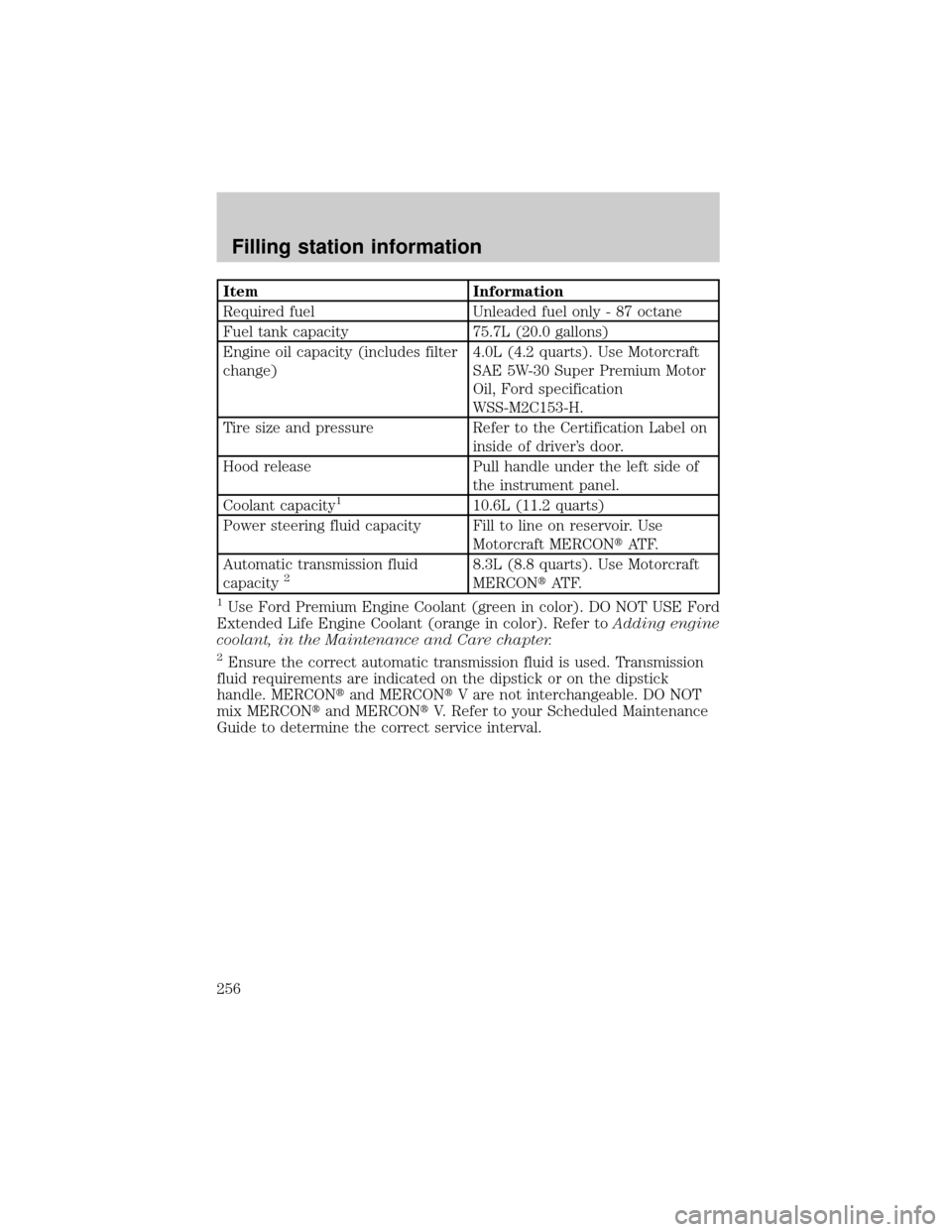
Item Information
Required fuel Unleaded fuel only - 87 octane
Fuel tank capacity 75.7L (20.0 gallons)
Engine oil capacity (includes filter
change)4.0L (4.2 quarts). Use Motorcraft
SAE 5W-30 Super Premium Motor
Oil, Ford specification
WSS-M2C153-H.
Tire size and pressure Refer to the Certification Label on
inside of driver's door.
Hood release Pull handle under the left side of
the instrument panel.
Coolant capacity
110.6L (11.2 quarts)
Power steering fluid capacity Fill to line on reservoir. Use
Motorcraft MERCONtAT F.
Automatic transmission fluid
capacity
28.3L (8.8 quarts). Use Motorcraft
MERCONtAT F.
1Use Ford Premium Engine Coolant (green in color). DO NOT USE Ford
Extended Life Engine Coolant (orange in color). Refer toAdding engine
coolant, in the Maintenance and Care chapter.
2Ensure the correct automatic transmission fluid is used. Transmission
fluid requirements are indicated on the dipstick or on the dipstick
handle. MERCONtand MERCONtV are not interchangeable. DO NOT
mix MERCONtand MERCONtV. Refer to your Scheduled Maintenance
Guide to determine the correct service interval.
Filling station information
256