warning MINI Hardtop 2 Door 2006 Owner's Guide
[x] Cancel search | Manufacturer: MINI, Model Year: 2006, Model line: Hardtop 2 Door, Model: MINI Hardtop 2 Door 2006Pages: 168, PDF Size: 2.22 MB
Page 79 of 168

77
OVERVIEW REPAIRS OPERATIONCONTROLS DATA INDEX
PARK DISTANCE CONTROL (PDC)*
The concept
The PDC assists you when you back into a
parking space. A signal tone tells you the
current distance to an object behind your
vehicle. To do this, four ultrasonic sensors
in the rear bumper measure the distance to
the nearest object.
The sensors on each side have a range of
approx. 2 ft/60 cm, the middle sensors one
of approx. 5ft/1.5m.
PDC is a parking aid that can identify
objects if they are approached slowly,
as is generally the case when parking.
Avoid driving towards objects rapidly; due
to underlying physical principles, the sys-
tem may otherwise alert you too late for
you to take evasive steps.<
Automatic function
With the ignition key in position 2, the sys-
tem starts to operate automatically about
one second after you select reverse gear or
place the selector lever in position R.
Wait for this one second before you
drive backwards.<
The system is deactivated when you shift
away from Reverse.
You can have a signal tone set as a
confirmation that PDC has been acti-
vated.<
Acoustical signals
The distance to an object is indicated by a
tone sounding at intervals. As the distance
between vehicle and object decreases, the
intervals between the tones become
shorter. A continuous tone indicates the
presence of an object less than 12 in/30 cm
away.
The warning signal is canceled after
approx. three seconds if the distance to the
object remains constant during this time,
for instance if you are moving parallel to a
wall.
Malfunction
A continuous high-pitched tone will sound
during initial activation. The system is mal-
functioning. Have the system checked.
Volume control
The volume of the Park Distance Control
signal can be adjusted from level 1, soft, to
level 6, loud.
You can have this function set.<
System limitations
Even with PDC, final responsibility for
estimating the distance between the
vehicle and any objects always remains
with the driver.
Even when sensors are involved, there is a
blind spot in which objects cannot be
detected. Recognition of some objects can
be beyond the limits of physical ultrasonic
measurement, for example with towing
bars or hitches or with thin or wedge-
shaped objects. It is also possible that low
objects already detected, such as a curb
edge, can disappear in the blind spot of the
sensors before a continuous tone is
sounded, or that protruding objects higher
above the ground, such as ledges, are not
detected.
Loud sources of sound outside and inside
your vehicle can drown the PDC signal
tone.<
Keep the sensors clean and free of ice
or snow in order to ensure that they
will continue to operate effectively.
Do not apply high pressure spray to the
sensors for a prolonged period of time.
Always maintain a distance which is
greater than 4 in/10 cm.<
Page 101 of 168
99
OVERVIEW REPAIRSOPERATIONCONTROLS DATA INDEX
REFUELING
Always switch off the engine before
refueling; otherwise no fuel can be
added to the tank and the SERVICE ENGINE
SOON lamp may come on.<
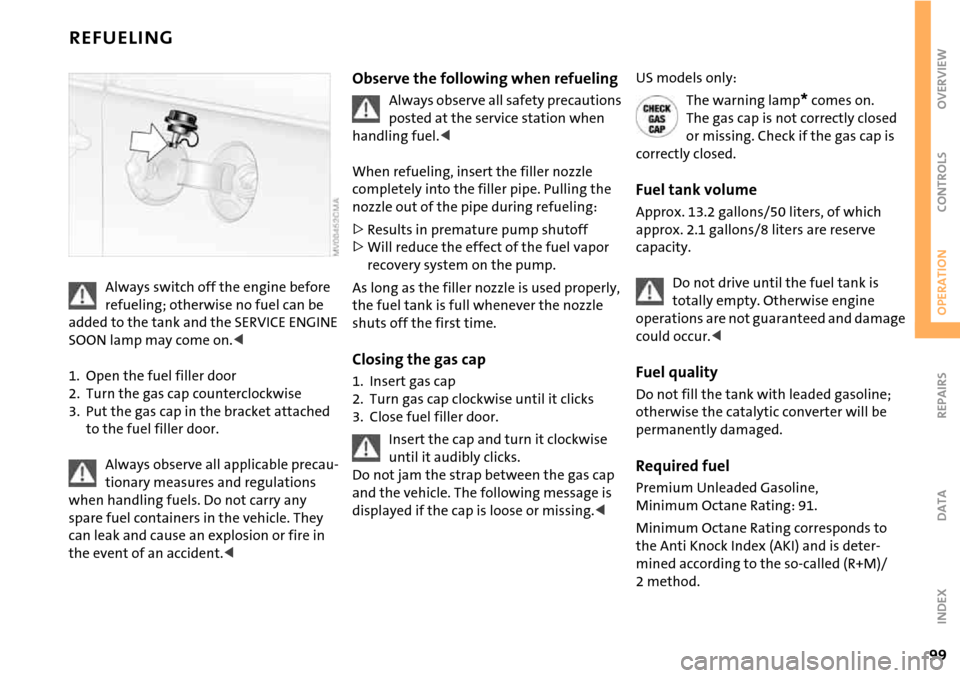
1. Open the fuel filler door
2. Turn the gas cap counterclockwise
3. Put the gas cap in the bracket attached
to the fuel filler door.
Always observe all applicable precau-
tionary measures and regulations
when handling fuels. Do not carry any
spare fuel containers in the vehicle. They
can leak and cause an explosion or fire in
the event of an accident.<
Observe the following when refueling
Always observe all safety precautions
posted at the service station when
handling fuel.<
When refueling, insert the filler nozzle
completely into the filler pipe. Pulling the
nozzle out of the pipe during refueling:
>Results in premature pump shutoff
>Will reduce the effect of the fuel vapor
recovery system on the pump.
As long as the filler nozzle is used properly,
the fuel tank is full whenever the nozzle
shuts off the first time.
Closing the gas cap
1. Insert gas cap
2. Turn gas cap clockwise until it clicks
3. Close fuel filler door.
Insert the cap and turn it clockwise
until it audibly clicks.
Do not jam the strap between the gas cap
and the vehicle. The following message is
displayed if the cap is loose or missing.<
US models only:
The warning lamp
* comes on.
The gas cap is not correctly closed
or missing. Check if the gas cap is
correctly closed.
Fuel tank volume
Approx. 13.2 gallons/50 liters, of which
approx. 2.1 gallons/8 liters are reserve
capacity.
Do not drive until the fuel tank is
totally empty. Otherwise engine
operations are not guaranteed and damage
could occur.<
Fuel quality
Do not fill the tank with leaded gasoline;
otherwise the catalytic converter will be
permanently damaged.
Required fuel
Premium Unleaded Gasoline,
Minimum Octane Rating: 91.
Minimum Octane Rating corresponds to
the Anti Knock Index (AKI) and is deter-
mined according to the so-called (R+M)/
2method.
Page 110 of 168
108
RUN FLAT TIRES*
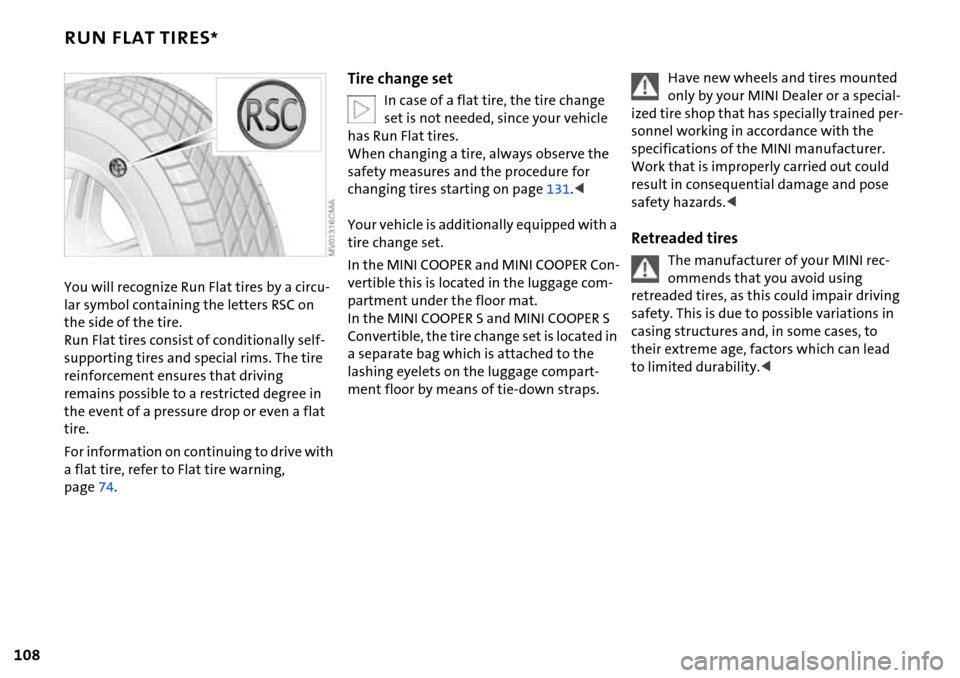
You will recognize Run Flat tires by a circu-
lar symbol containing the letters RSC on
the side of the tire.
Run Flat tires consist of conditionally self-
supporting tires and special rims. The tire
reinforcement ensures that driving
remains possible to a restricted degree in
the event of a pressure drop or even a flat
tire.
For information on continuing to drive with
a flat tire, refer to Flat tire warning,
page74.
Tire change set
In case of a flat tire, the tire change
set is not needed, since your vehicle
has Run Flat tires.
When changing a tire, always observe the
safety measures and the procedure for
changing tires starting on page131.<
Your vehicle is additionally equipped with a
tire change set.
In the MINI COOPER and MINI COOPER Con-
vertible this is located in the luggage com-
partment under the floor mat.
In the MINI COOPER S and MINI COOPER S
Convertible, the tire change set is located in
a separate bag which is attached to the
lashing eyelets on the luggage compart-
ment floor by means of tie-down straps.
Have new wheels and tires mounted
only by your MINI Dealer or a special-
ized tire shop that has specially trained per-
sonnel working in accordance with the
specifications of the MINI manufacturer.
Work that is improperly carried out could
result in consequential damage and pose
safety hazards.<
Retreaded tires
The manufacturer of your MINI rec-
ommends that you avoid using
retreaded tires, as this could impair driving
safety. This is due to possible variations in
casing structures and, in some cases, to
their extreme age, factors which can lead
to limited durability.<
Page 116 of 168

114
ENGINE OIL
Measuring the oil level
1. With the vehicle's engine at normal
operating temperature, i.e. after unin-
terrupted driving for at least 6 miles/
10 km, park the vehicle on a level surface
2. Switch off the engine
3. Pull the dipstick out after approx.
5minutes and wipe it off with a lint-free
cloth, paper towel, or similar material
4. Carefully push the dipstick all the way
into the guide tube and pull it out again.
The oil level should be between the two
marks on the dipstick.
As with fuel economy, oil consumption is
directly influenced by your driving style and
vehicle operating conditions.
The oil volume between the two marks
MIN, MAX on the dipstick corresponds to
approx. 1.1 quarts/1 liter.
Do not fill beyond the upper mark on
the dipstick. Excess oil will damage
the engine.<
Adding engine oil
Only top up oil when the oil level has
dropped to just above the lower mark
of the dipstick. However, never allow the
level to drop below the lower mark.<
Add oil within the next 30 miles/
50 km, otherwise the engine could be
damaged.<
Always store oil, grease, etc., out of
reach of children. Comply with all
warning labels and information on lubri-
cant containers, otherwise health risks may
result.<
Oil change
Have the oil changed only by a MINI Dealer
or a workshop that has specially trained
personnel working in accordance with the
specifications of the MINI manufacturer.
Page 119 of 168
117
OVERVIEW REPAIRSOPERATIONCONTROLS DATA INDEX
BRAKE SYSTEM
Brake fluid level
The warning lamp comes on
although the parking brake is
released:
The brake fluid level in the reservoir is too
low, refer to page16. At the same time,
brake pedal travel may become signifi-
cantly longer.
Have the system checked immediately.
If the brake fluid level is too low and brake
pedal travel has become longer, there may
be a defect in one of the brake system's
hydraulic circuits.
Display of the malfunction
described above in Canadian mod-
els.
If you continue driving, higher brake
application pressure may be neces-
sary, and there may be a slight pull to one
side. Brake pedal travel may also be longer.
Please remember to adapt your driving
style accordingly.<
Brake pads
Brake pad sensors in the left brake pads of
the front axle and in the right brake pads of
the rear axle monitor the brake pad condi-
tion. When the brake pads reach the wear
limit, the brake wear warning lights up,
refer to page18.
Use brake pads which the manufac-
turer of your MINI has approved for
your particular vehicle model. The manu-
facturer of your MINI cannot evaluate non-
approved brake pads to determine if they
are suitable for use, and therefore cannot
ensure the operating safety of the vehicle
in the event of their use.<
Page 121 of 168

119
OVERVIEW REPAIRSOPERATIONCONTROLS DATA INDEX
SOCKET FOR ONBOARD DIAGNOSTICS OBD CARING FOR YOUR VEHICLE
Primary components of exhaust emissions
can be checked by a device via the OBD
socket.
This socket is located to the left of the
driver's side, on the bottom of the instru-
ment panel underneath a cover.
Exhaust emission values
The warning lamp comes on. The
exhaust emissions have deterio-
rated. Have the vehicle checked as
soon as possible.
Display of the malfunction
described above in Canadian mod-
els.
Under some circumstances, the lamp will
flash. This indicates severe engine misfir-
ing. In this case, you should reduce your
speed and visit your nearest MINI Dealer as
soon as possible. Severe engine misfiring
can quickly lead to serious damage of emis-
sions-related components, especially the
catalytic converter.
If the fuel filler cap is not properly
tightened, the OBD system may con-
clude that fuel vapors are escaping, causing
an indicator to light up. If the filler cap is
then tightened, the indicator should go out
within a few days.
ucts available at your MINI Dealer.<
Washing your vehicle
You can wash your new MINI or MINI Con-
vertible in automatic car washes from the
beginning. Preference should be for cloth
car washes. If, due to lack of availability,
brush car washes must be used, modern
systems with soft brushes should be given
preference.
When using steam cleaners or high-
pressure cleaners, maintain sufficient
distance to the vehicle and do not exceed a
maximum temperature of 1407/606. If
the jet is too close or the pressure is too
high, this can lead to damage or initial
damage that can develop into more serious
damage. Water that enters vehicle compo-
nents can lead to damage over the long
term.
After washing the vehicle, apply the brakes
briefly to dry them, otherwise water can
reduce braking efficiency over the short
term and the brake rotors can corrode.
Switch the rain sensor off when passing
through an automatic car wash, refer to
page62. Failure to do so could result in
Page 133 of 168

131
OVERVIEW REPAIRSOPERATION CONTROLS DATA INDEX
REPAIRING A FLAT TIRE SPACE-SAVER SPARE TIRE*
Safety measures in the event of a flat
tire:
Stop the vehicle as far as possible from
passing traffic. Switch on the hazard warn-
ing flashers.
Turn the steering wheel to the straight-
ahead wheel position and engage the
steering lock. Engage the parking brake and
shift into 1st or reverse gear – selector lever
in P.
All passengers should be outside the vehi-
cle and well away from your immediate
working area – behind a guardrail, for
instance.
If a portable hazard warning lamp is avail-
able, set it up on the roadside at an appro-
priate distance from the rear of the vehicle.
Comply with all safety guidelines and regu-
lations.<
In the event of a flat tire, different proce-
dures should be followed depending on the
equipment included in your vehicle:
>Vehicles with Run Flat tires, refer to
page108
>Vehicles with a space-saver spare tire,
refer to the following section
>Vehicles with MINI Mobility System,
refer to page135.To change a space-saver spare tire, proceed
as follows:
>Remove space-saver spare tire, refer to
the section after the next one
>Prepare for tire change, refer to page133
>Jack up the vehicle, refer to page134
>Mount the space-saver spare tire, refer
to page134
>Tighten the lug bolts, refer to page134
>Drive with space-saver spare tire, refer to
page133.
Tire change set
On vehicles with a space-saver spare tire,
the tire change set with onboard tools is
stored in the luggage compartment under
the floor mat.
1 Chock, folding
2 Hubcap remover
3 Wheel stud wrench
4Jack
5 Special wrench for removing the space-
saver spare tire
6 Towing eyelet
7 Lifting handle
The onboard tool kit includes a pouch with
a plastic bag in which you can place the
damaged wheel.
Page 137 of 168
135
OVERVIEW REPAIRSOPERATION CONTROLS DATA INDEX
MINI MOBILITY SYSTEM*
MINI Mobility System
The MINI Mobility System is provided to
help you repair a flat tire. With the help of
this system you can apply a liquid sealant
on the inside of the tire, which seals the
damaged area and enables you to continue
to drive.
Preparing for tire repair
Before using the MINI Mobility Sys-
tem read the warning and danger
precautions on the equipment.<
If possible, leave objects in which have
been forced into the tire.
Take off the tag regarding speed limits and
stick it onto the steering wheel.
Using the MINI Mobility System
In order to repair a flat tire with the MINI
Mobility System, proceed as follows:
>Pump in liquid sealant, refer to page136
>Reinflate the tire, refer to page136
>Distribute liquid sealant, refer to
page137
>Check tire inflation pressure, refer to
page137
>Drive on, refer to page137.
MINI Mobility System with onboard
tools
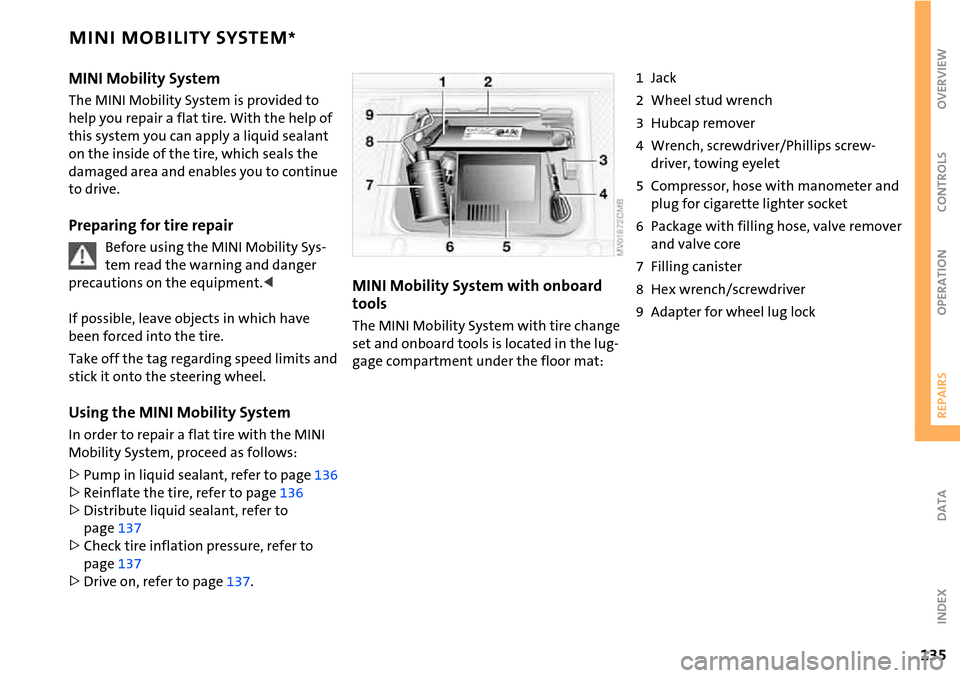
The MINI Mobility System with tire change
set and onboard tools is located in the lug-
gage compartment under the floor mat:
1Jack
2 Wheel stud wrench
3 Hubcap remover
4 Wrench, screwdriver/Phillips screw-
driver, towing eyelet
5 Compressor, hose with manometer and
plug for cigarette lighter socket
6 Package with filling hose, valve remover
and valve core
7 Filling canister
8 Hex wrench/screwdriver
9 Adapter for wheel lug lock
Page 144 of 168
142
TOWING AND TOW-STARTING
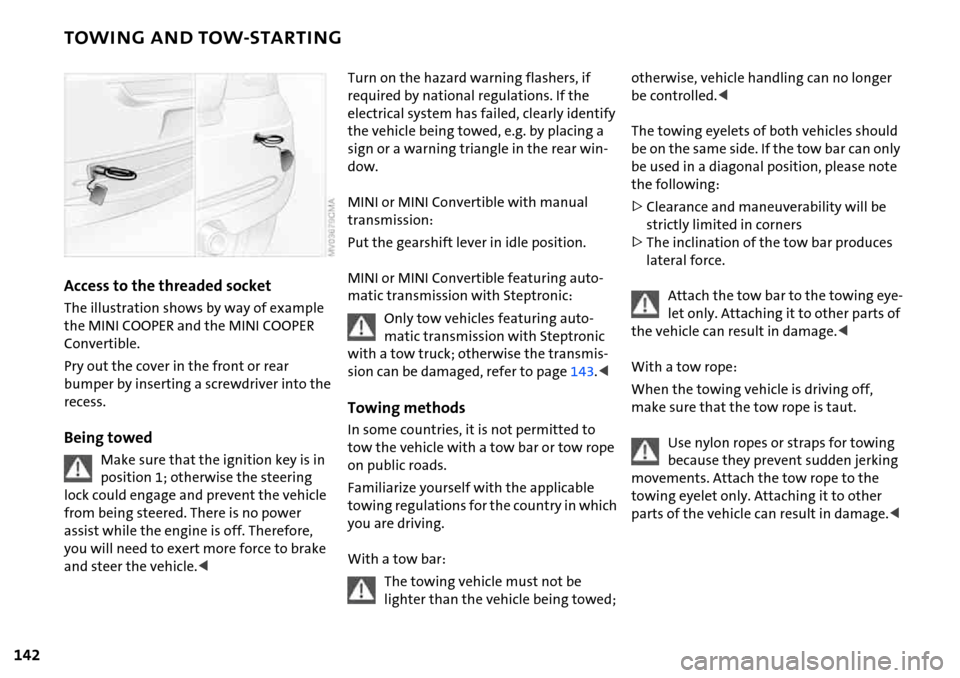
Access to the threaded socket
The illustration shows by way of example
the MINI COOPER and the MINI COOPER
Convertible.
Pry out the cover in the front or rear
bumper by inserting a screwdriver into the
recess.
Being towed
Make sure that the ignition key is in
position 1; otherwise the steering
lock could engage and prevent the vehicle
from being steered. There is no power
assist while the engine is off. Therefore,
you will need to exert more force to brake
and steer the vehicle.<
Turn on the hazard warning flashers, if
required by national regulations. If the
electrical system has failed, clearly identify
the vehicle being towed, e.g. by placing a
sign or a warning triangle in the rear win-
dow.
MINI or MINI Convertible with manual
transmission:
Put the gearshift lever in idle position.
MINI or MINI Convertible featuring auto-
matic transmission with Steptronic:
Only tow vehicles featuring auto-
matic transmission with Steptronic
with a tow truck; otherwise the transmis-
sion can be damaged, refer to page143.<
Towing methods
In some countries, it is not permitted to
tow the vehicle with a tow bar or tow rope
on public roads.
Familiarize yourself with the applicable
towing regulations for the country in which
you are driving.
With a tow bar:
The towing vehicle must not be
lighter than the vehicle being towed;
otherwise, vehicle handling can no longer
be controlled.<
The towing eyelets of both vehicles should
be on the same side. If the tow bar can only
be used in a diagonal position, please note
the following:
>Clearance and maneuverability will be
strictly limited in corners
>The inclination of the tow bar produces
lateral force.
Attach the tow bar to the towing eye-
let only. Attaching it to other parts of
the vehicle can result in damage.<
With a tow rope:
When the towing vehicle is driving off,
make sure that the tow rope is taut.
Use nylon ropes or straps for towing
because they prevent sudden jerking
movements. Attach the tow rope to the
towing eyelet only. Attaching it to other
parts of the vehicle can result in damage.<
Page 145 of 168

143
OVERVIEW REPAIRSOPERATION CONTROLS DATA INDEX
TOWING AND TOW-STARTING
With a tow truck:
Have the MINI or MINI Convertible trans-
ported by a tow truck with a lift sling, or on
a flatbed.
Only tow vehicles featuring auto-
matic transmission with Steptronic
with the front wheels raised or on a special
transport vehicle; otherwise the transmis-
sion can be damaged.
Do not lift the vehicle by the towing eyelet,
nor by parts of the body or chassis. Other-
wise damage could result.<
Tow-starting
Do not tow-start vehicles featuring
automatic transmission with Step-
tronic.
Jump-starting, refer to page140.<
Only tow-start vehicles with catalytic con-
verters if the engine is cold. It is better to
have the engine jump-started, refer to
page140.
1. Turn on the hazard warning flashers;
comply with national regulations
2. Turn the ignition key to position 2
3. Engage the 3rd gear
4. Have the vehicle towed with the clutch
completely depressed and then slowly
release the clutch. After the engine has
started, immediately depress the clutch
again completely
5. Pull over at a suitable location, remove
the tow bar or tow rope, and turn off the
hazard warning flashers
6. Have the vehicle checked.