engine oil MITSUBISHI 3000GT 1991 Owners Manual
[x] Cancel search | Manufacturer: MITSUBISHI, Model Year: 1991, Model line: 3000GT, Model: MITSUBISHI 3000GT 1991Pages: 1146, PDF Size: 76.68 MB
Page 482 of 1146
23-30AUTOMATIC TRANSAXLE - Troubleshooting
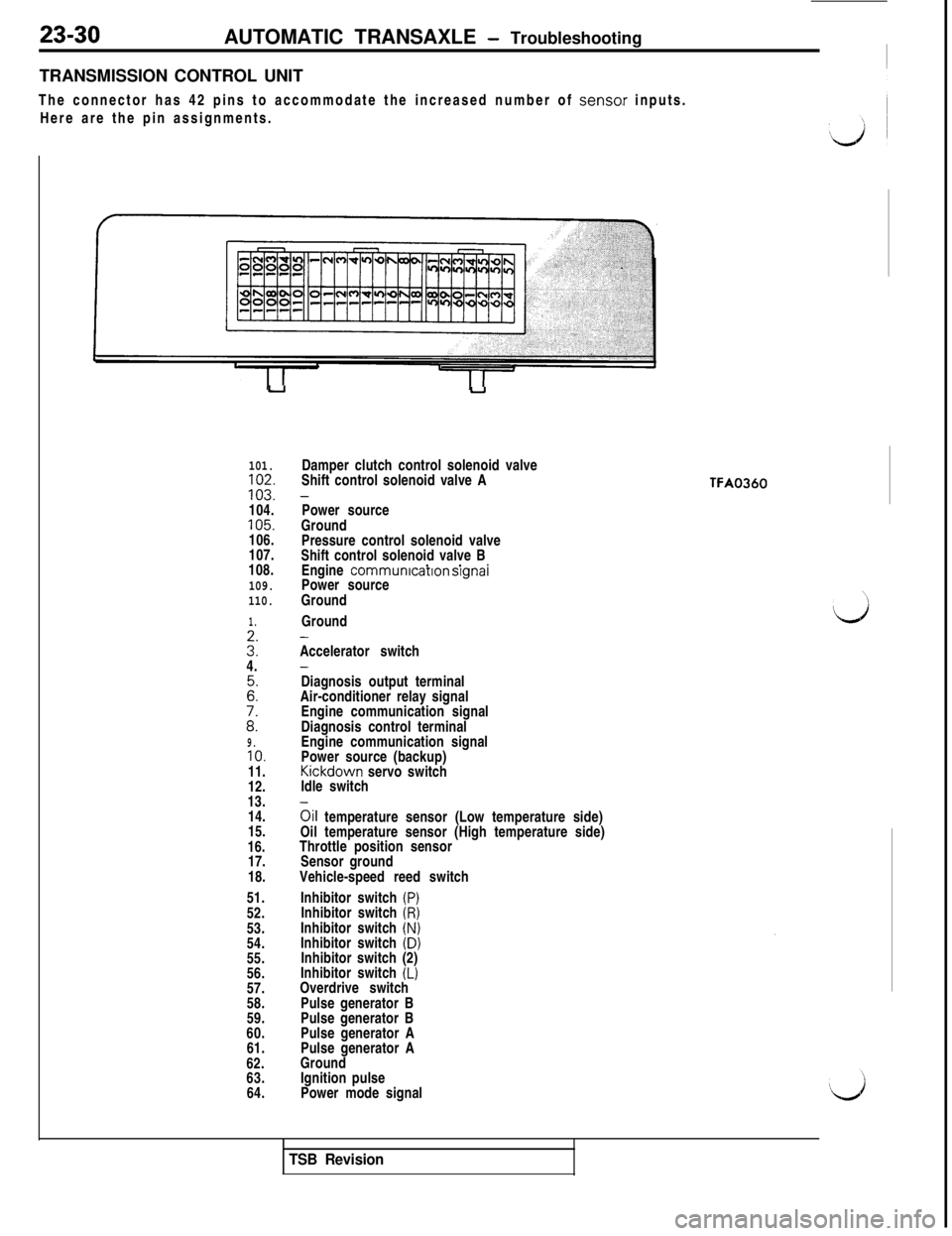
TRANSMISSION CONTROL UNIT
The connector has 42 pins to accommodate the increased number of senso.r inputs.
Here are the pin assignments.
uu
101.102.103.
104.105.
106.
107.
108.
109.
110.
1.
3':4.
Z:
i:9.10.11.
12.
13.
14.
15.
16.
17.
18.
51.
52.
53.
54.
55.
56.
57.
58.
59.
60.
61.
62.
63.
64.Damper clutch control solenoid valve
Shift control solenoid valve A
-Power source
Ground
Pressure control solenoid valve
Shift control solenoid valve B
. .
*Engine communrcatron srgnaiPower source
Ground
Ground
-Accelerator switch
-Diagnosis output terminal
Air-conditioner relay signal
Engine communication signal
Diagnosis control terminal
Engine communication signal
Power source (backup)Kickdown servo switch
Idle switch
oil temperature sensor (Low temperature side)
Oil temperature sensor (High temperature side)
Throttle position sensor
Sensor ground
Vehicle-speed reed switch
Inhibitor switch
(P)Inhibitor switch (R)Inhibitor switch (N)Inhibitor switch (D)
Inhibitor switch (2)
Inhibitor switch
(L)Overdrive switch
Pulse generator B
Pulse generator B
Pulse generator A
Pulse generator A
Ground
Ignition pulse
Power mode signal
TFA0360
TSB Revision
Page 484 of 1146
23-32AUTOMATIC TRANSAXLE - Troubleshooting
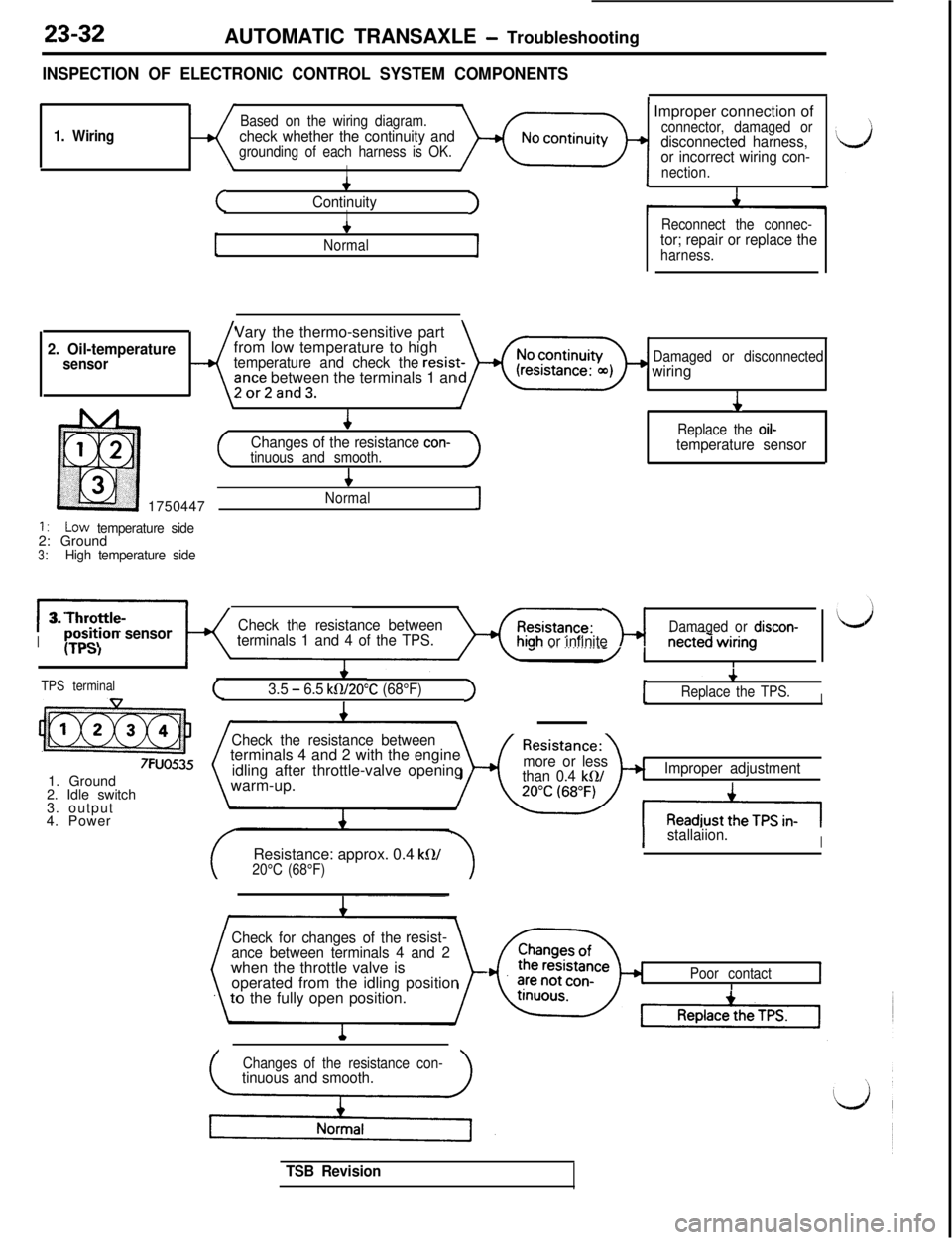
INSPECTION OF ELECTRONIC CONTROL SYSTEM COMPONENTS
1. WiringBased on the wiring diagram.check whether the continuity andgrounding of each harness is OK.
I
(
4
ContinuityII
+
Normal~ Improper connection of
connector, damaged ordisconnected harness,
or incorrect wiring con-
nection.
I
Reconnect the connec-tor; repair or replace theharness.Vary the thermo-sensitive part
2. Oil-temperaturefrom low temperature to highsensortemperature and check theresist-Damaged or disconnected
ante between the terminals 1 anwiring2or2and3.
4
J
Changes of the resistance con-Replace the oil-
tinuous and smooth.temperature sensor
41750447
Normal1
1:LOW temperature side2: Ground
3:High temperature side
I:3. Throttle-
K
Check the resistance between
Ip~~~t,ion sensorterminals 1 and 4 of the TPS.hiah or infinitem- -----inecteciI-
\ IDamaged or discon-..----Awiring
I
c3.5 - 6.5 kW20”C (68°F)t
v
Replace the TPS.I>ITPS terminal
7FUO5351. Ground
2. Idle switch
3. output
4. Power
Check the resistance betweenterminals 4 and 2 with the engine
idling after throttle-valve opening
warm-up.
Resistance: approx. 0.4
kR/20°C (68°F)
Changes of the resistance con-
tinuous and smooth.
/Resistance:\more or less
than 0.4 kQ/Improper adjustment
Istallaiion.I
Check for changes of theresist-ance between terminals 4 and 2when the throttle valve is
operated from the idling position
o the fully open position.
Poor contactII
TSB Revision
Page 491 of 1146
AUTOMATIC TRANSAXLE - Troubleshooting23-39
//!’ 6Rear@FrontclutchpressureI
@Kickdown brakeoressure (Release)
e
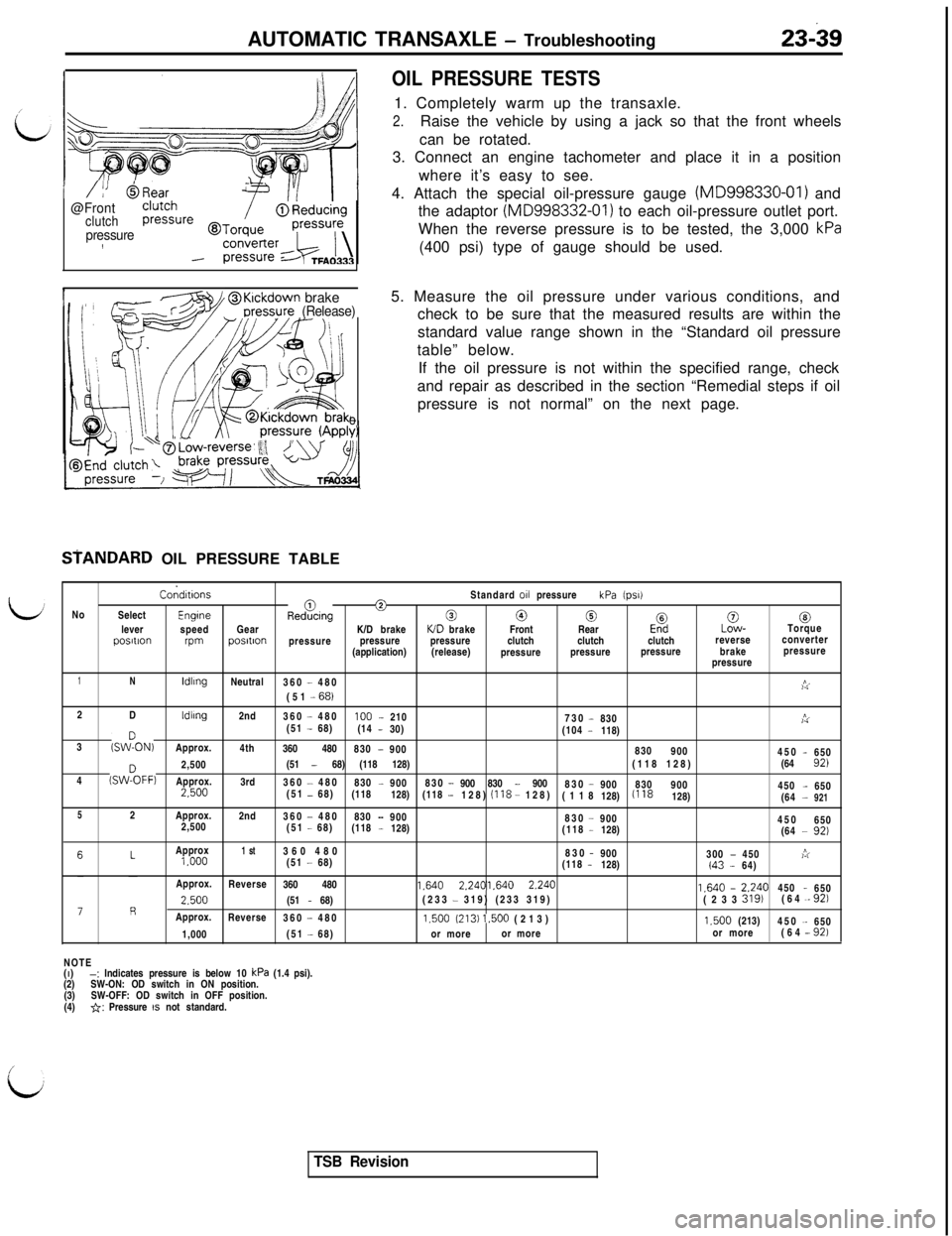
OIL PRESSURE TESTS1. Completely warm up the transaxle.
2.Raise the vehicle by using a jack so that the front wheels
can be rotated.
3. Connect an engine tachometer and place it in a position
where it’s easy to see.
4. Attach the special oil-pressure gauge (MD998330-01) and
the adaptor (MD998332-01) to each oil-pressure outlet port.
When the reverse pressure is to be tested, the 3,000
kPa(400 psi) type of gauge should be used.
5. Measure the oil pressure under various conditions, and
check to be sure that the measured results are within the
standard value range shown in the “Standard oil pressure
table” below.
If the oil pressure is not within the specified range, check
and repair as described in the section “Remedial steps if oil
pressure is not normal” on the next page.
STANDARD OIL PRESSURE TABLECondtttonsStandard
011 pressurekPa (PSI)No
SelectEngme
Red&g@000E%00leverspeedGearK/D brakeWD brakeFrontRearLow-TorqueposItlollvposltlon
pressurepressurepressureclutchclutchclutchreverseconverter
(application)(release)
pressurepressurepressurebrakepressure
pressure
1Nldlmg
Neutral
360 - 4808,(51 - 6812
Dldlmg
2nd
360
- 480100-210
730 -830k(51 - 68)
(14-30)
(104 -118)
3(SWFON,
Approx.
4th
360 480
830
-900
830
900
450-650
2,500(51 - 68) (118 128)(118 128)(64 92)
(SWZFF)Approx.
3rd
360 - 480
830
900830 -900 830 - 900
830 -900830
900
450-4
650-2.500(51 - 68)
(118
128)(118 -128) (118 - 128)
(118
128)(118128)
(64-921
52
Approx.
2nd
360
- 480
830--900
830 -900
450
650
2,500
(51 - 68)
(118-128)
(118 -128)
(64-921
Approx
1 st360 480
830 -900
300-450A1.000(51 - 68)
(118 -128)I43 .-64)
Approx.
Reverse
360 480
1.6402.2401.640 2.2401.640 -2.240450-6502.500(51 - 68)(233 - 319) (233 319)(233 319)(64 ~- 921
Approx.
Reverse
360
- 4801.500(213) 1.500 (213)1.500(213)
450~-650
1,000(51 - 68)or moreor moreor more(64 - 92)NOTE
(I)
-: Indicates pressure is below 10 kPa (1.4 psi).
(2)SW-ON: OD switch in ON position.
(3)SW-OFF: OD switch in OFF position.
(4)
a: Pressure IS not standard.
TSB Revision
Page 514 of 1146
23-62AUTOMATIC TRANSAXLE - Transaxle AssemblyTRANSAXLE ASSEMBLY
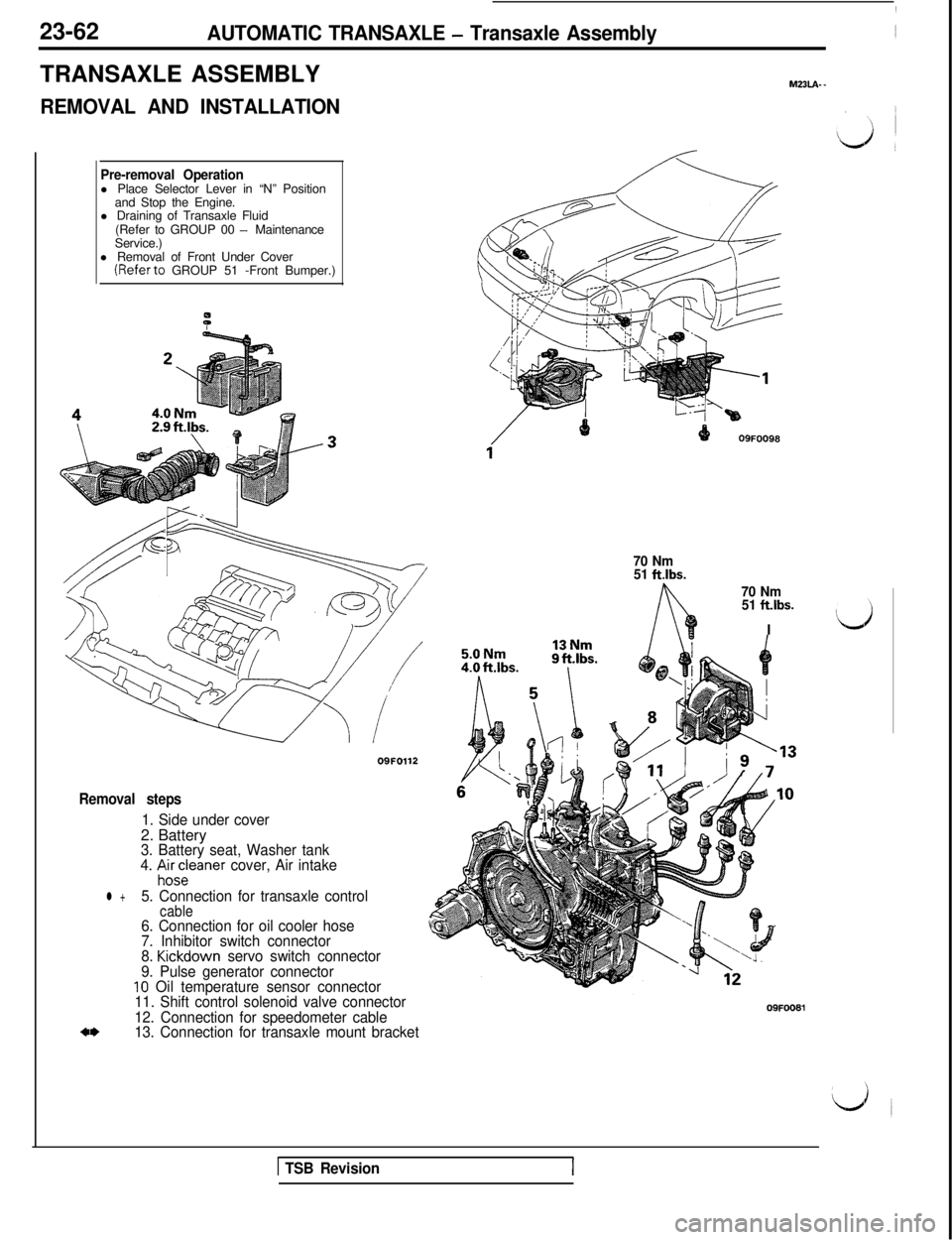
REMOVAL AND INSTALLATION
MZJLA- -
Pre-removal Operationl Place Selector Lever in “N” Position
and Stop the Engine.
l Draining of Transaxle Fluid
(Refer to GROUP 00
- Maintenance
Service.)
l Removal of Front Under Cover
(Referto GROUP 51 -Front Bumper.)09FO112
Removal steps
1. Side under cover2. Battery
3. Battery seat, Washer tank
4. kiorsteaner cover, Air intake
l +5. Connection for transaxle controlcable
4*
6. Connection for oil cooler hose
7. Inhibitor switch connector
8.
Kickdown servo switch connector
9. Pulse generator connector
10 Oil temperature sensor connector
11. Shift control solenoid valve connector
12. Connection for speedometer cable
13. Connection for transaxle mount bracket70 Nm
51
ft.lbs.
70 Nm
51 ft.lbs.I
09FOO81
1 TSB Revision
Page 516 of 1146
23-64
AUTOMATIC, TRANSAXLE - Transaxle Assembly
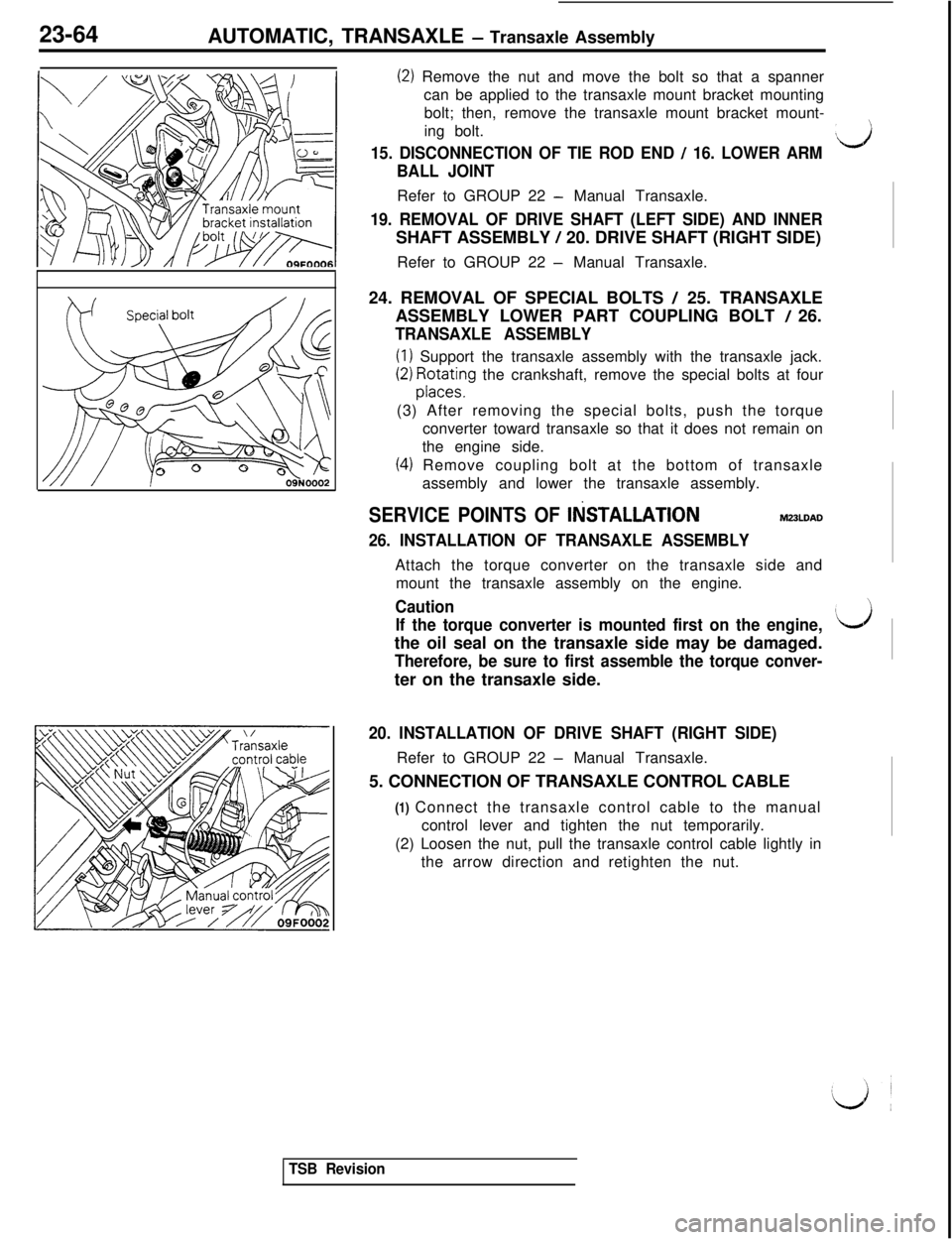
(2) Remove the nut and move the bolt so that a spanner
can be applied to the transaxle mount bracket mounting
bolt; then, remove the transaxle mount bracket mount-
ing bolt.
15. DISCONNECTION OF TIE ROD END / 16. LOWER ARM$3
BALL JOINTRefer to GROUP 22
- Manual Transaxle.
19. REMOVAL OF DRIVE SHAFT (LEFT SIDE) AND INNERSHAFT ASSEMBLY
/ 20. DRIVE SHAFT (RIGHT SIDE)
Refer to GROUP 22
- Manual Transaxle.
24. REMOVAL OF SPECIAL BOLTS
/ 25. TRANSAXLE
ASSEMBLY LOWER PART COUPLING BOLT
/ 26.
TRANSAXLE ASSEMBLY
(1) Support the transaxle assembly with the transaxle jack.
(2) ;;F;ng the crankshaft, remove the special bolts at four
(3) After removing the special bolts, push the torque
converter toward transaxle so that it does not remain on
the engine side.
(4) Remove coupling bolt at the bottom of transaxle
assembly and lower the transaxle assembly.
SERVICE POINTS OF IliSTALLATlONM23LDAD
26. INSTALLATION OF TRANSAXLE ASSEMBLYAttach the torque converter on the transaxle side and
mount the transaxle assembly on the engine.
Caution
If the torque converter is mounted first on the engine,
Idthe oil seal on the transaxle side may be damaged.
Therefore, be sure to first assemble the torque conver-ter on the transaxle side.
20. INSTALLATION OF DRIVE SHAFT (RIGHT SIDE)Refer to GROUP 22
- Manual Transaxle.
5. CONNECTION OF TRANSAXLE CONTROL CABLE
(1) Connect the transaxle control cable to the manual
control lever and tighten the nut temporarily.
(2) Loosen the nut, pull the transaxle control cable lightly in
the arrow direction and retighten the nut.
TSB Revision
Page 607 of 1146
li
LREAR AXLE
TROUBLESHOOTINGM27EAAH
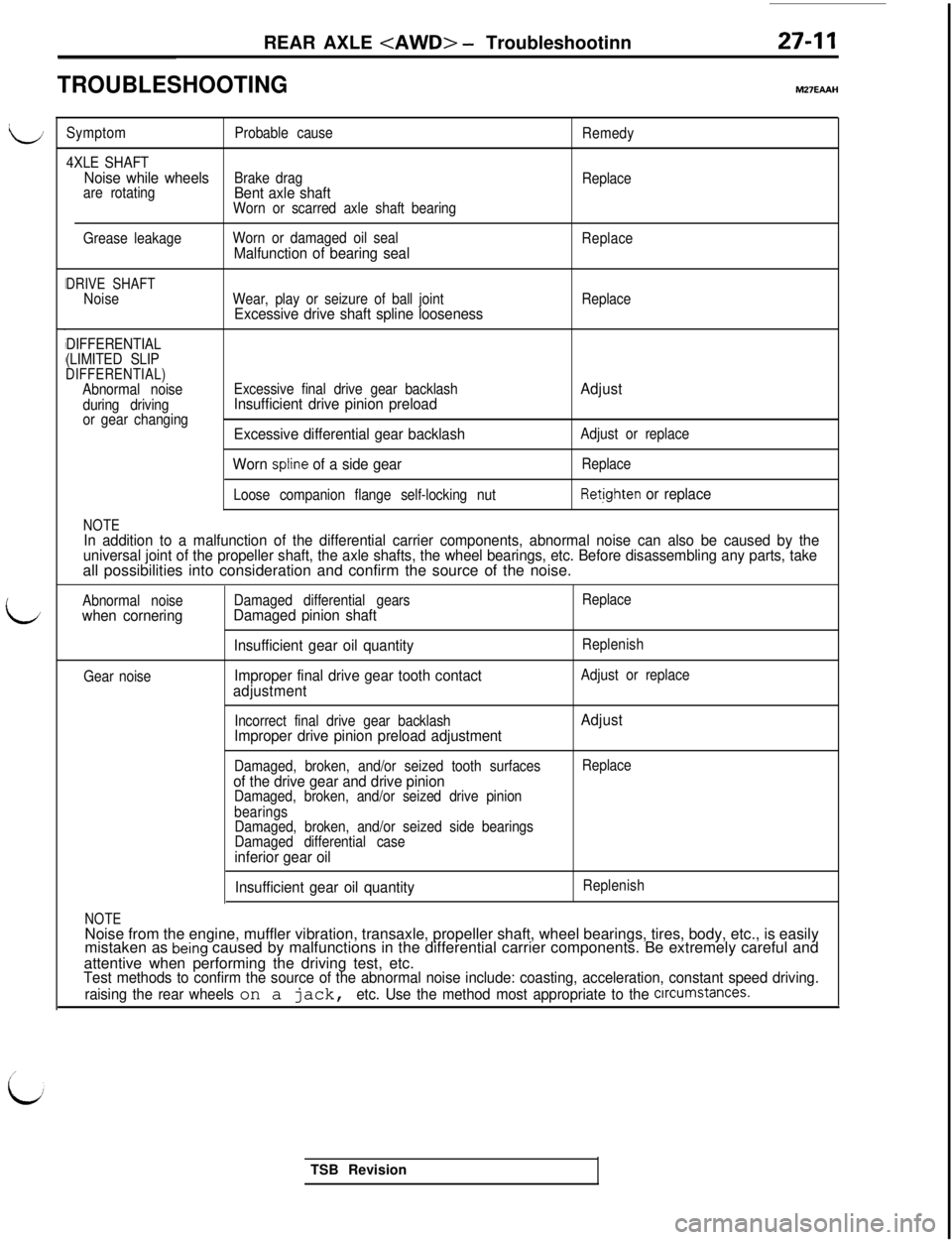
SymptomProbable cause
Remedy
4XLE SHAFT
Noise while wheelsBrake drag
Replace
are rotatingBent axle shaftWorn or scarred axle shaft bearing
Grease leakageWorn or damaged oil seal
Malfunction of bearing sealReplace
DRIVE SHAFTNoiseWear, play or seizure of ball jointExcessive drive shaft spline loosenessReplace
DIFFERENTIAL
(LIMITED SLIP
DIFFERENTIAL)Abnormal noise
during driving
or gear changing
NOTE
Excessive final drive gear backlashInsufficient drive pinion preload
Excessive differential gear backlash
Worn
spline of a side gear
Loose companion flange self-locking nut
Adjust
Adjust or replace
Replace
Retighten or replace
In addition to a malfunction of the differential carrier components, abnormal noise can also be caused by the
universal joint of the propeller shaft, the axle shafts, the wheel bearings, etc. Before disassembling any parts, takeall possibilities into consideration and confirm the source of the noise.
Abnormal noisewhen cornering
Gear noiseDamaged differential gears
Damaged pinion shaft
Insufficient gear oil quantity
Improper final drive gear tooth contact
adjustment
Replace
Replenish
Adjust or replace
Incorrect final drive gear backlash
Improper drive pinion preload adjustmentAdjust
Damaged, broken, and/or seized tooth surfacesof the drive gear and drive pinionDamaged, broken, and/or seized drive pinion
bearingsReplace
Damaged, broken, and/or seized side bearings
Damaged differential case
inferior gear oil
NOTE
Insufficient gear oil quantityReplenishNoise from the engine, muffler vibration, transaxle, propeller shaft, wheel bearings, tires, body, etc., is easily
mistaken as
being caused by malfunctions in the differential carrier components. Be extremely careful and
attentive when performing the driving test, etc.
Test methods to confirm the source of the abnormal noise include: coasting, acceleration, constant speed driving.
raising the rear wheels
on a jack, etc. Use the method most appropriate to the crrcumstances.TSB Revision
Page 830 of 1146
37A-2SPECIFICATIONS
STEERING - Specifications
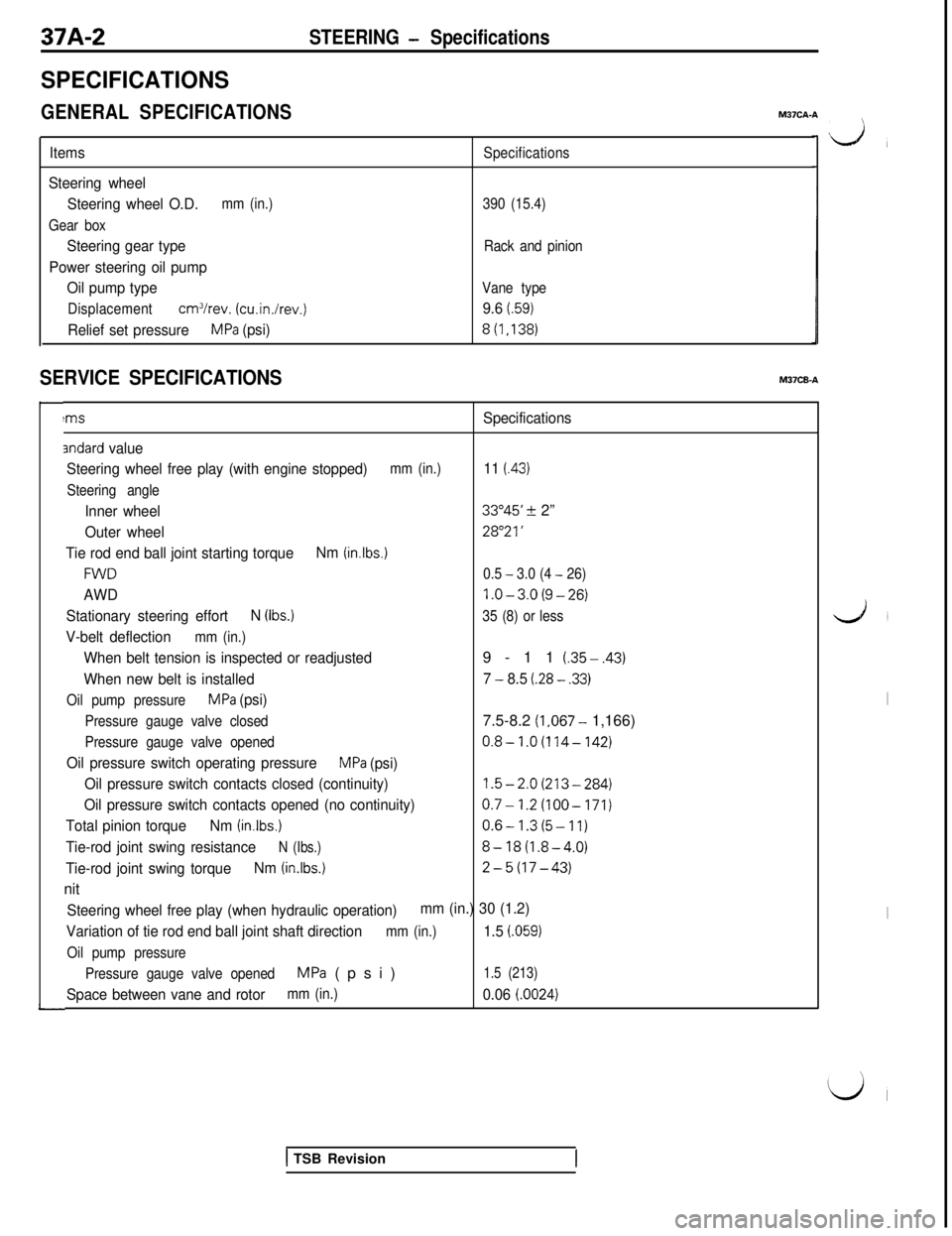
GENERAL SPECIFICATIONS
M37CA-A
LA,Items
Steering wheel
Steering wheel O.D.
mm (in.)
Gear box
Steering gear type
Power steering oil pump
Oil pump type
Displacementcm3/rev. (cu.in./rev.)
Relief set pressureMPa (psi)
Specifications
390 (15.4)
Rack and pinion
Vane type
9.6 t.59)
8(1,138)
SERVICE SPECIFICATIONSM37CB-A
!msSpecifications
andard value
Steering wheel free play (with engine stopped)
mm (in.)11 (43)
Steering angle
Inner wheel33”45’ 2 2”
Outer wheel28”21’
Tie rod end ball joint starting torqueNm (in.lbs.)
FWD0.5 - 3.0 (4 - 26)
AWDl.O-3.0(9-26)
Stationary steering effortN (Ibs.)35 (8) or less
V-belt deflectionmm (in.)
When belt tension is inspected or readjusted9-11 (.35-.43)
When new belt is installed7 - 8.5 (.28 - .33)
Oil pump pressureMPa (psi)
Pressure gauge valve closed7.5-8.2 (1,067- 1,166)
Pressure gauge valve opened0.8-1.0(114-142)
Oil pressure switch operating pressureMPa (psi)
Oil pressure switch contacts closed (continuity)
1.5-2.0(213-284)
Oil pressure switch contacts opened (no continuity)0.7-1.2(100-171)
Total pinion torqueNm (in.lbs.)0.6-1.3(5-11)
Tie-rod joint swing resistanceN (Ibs.)8-18(1.8-4.0)
Tie-rod joint swing torqueNm (in.lbs.)2-5(17-43)nit
Steering wheel free play (when hydraulic operation)mm (in.) 30 (1.2)
Variation of tie rod end ball joint shaft direction
mm (in.)1.5 i.059)
Oil pump pressure
Pressure gauge valve opened
MPa (psi)1.5 (213)
Space between vane and rotormm (in.)0.06 (0024)
LJ’
I
I
L’l
1 TSB Revision
Page 836 of 1146
37A-8STEERING - Service Adjustment Procedures13FOOO3
13FOOOl
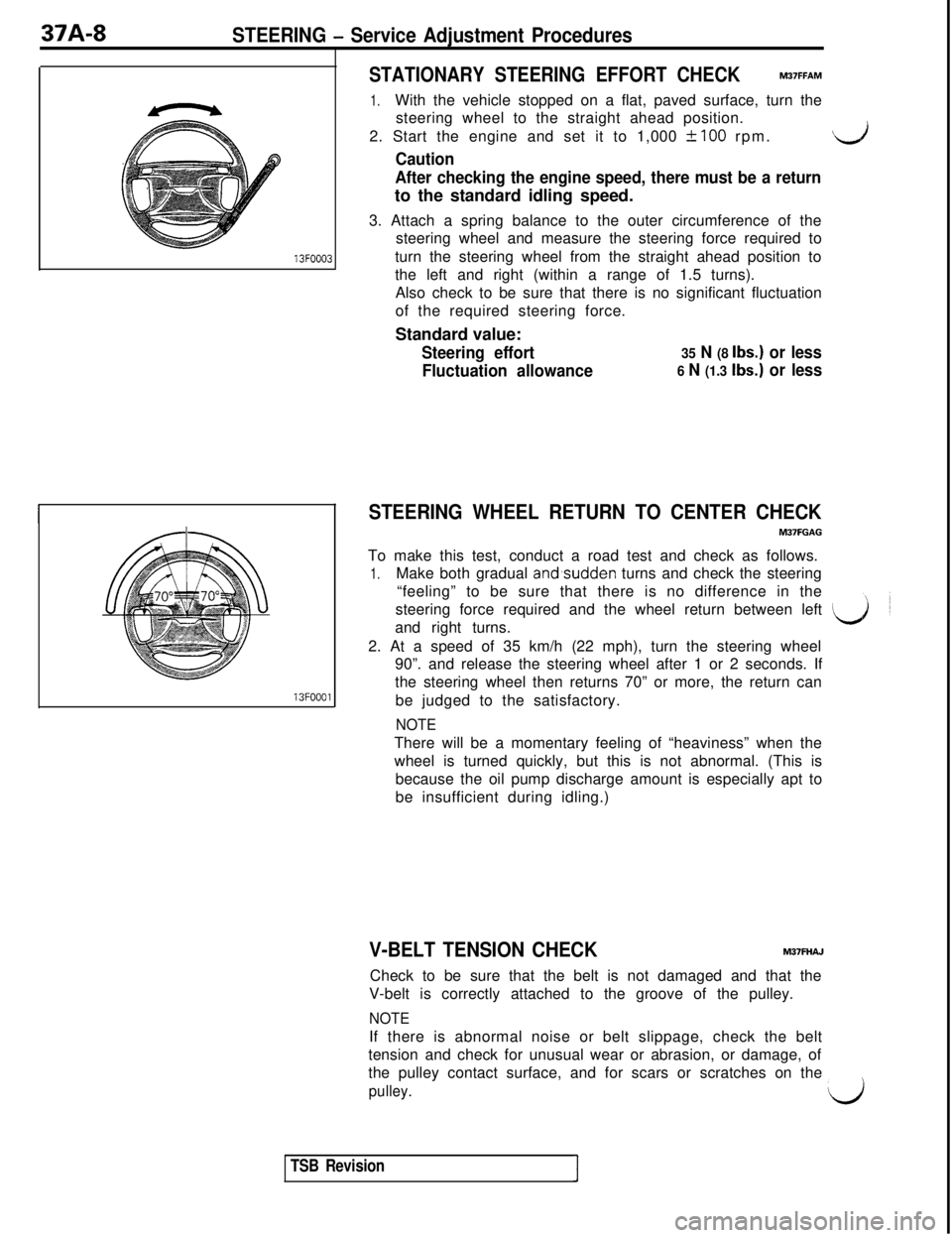
STATIONARY STEERING EFFORT CHECKM37FFAM
1.With the vehicle stopped on a flat, paved surface, turn the
steering wheel to the straight ahead position.
2. Start the engine and set it to 1,000
+ 100 rpm.d
Caution
After checking the engine speed, there must be a returnto the standard idling speed.
3. Attach a spring balance to the outer circumference of the
steering wheel and measure the steering force required to
turn the steering wheel from the straight ahead position to
the left and right (within a range of 1.5 turns).
Also check to be sure that there is no significant fluctuation
of the required steering force.
Standard value:
Steering effort35 N (8 Ibs.) or less
Fluctuation allowance
6 N (1.3 Ibs.) or less
STEERING WHEEL RETURN TO CENTER CHECK
M37FGACiTo make this test, conduct a road test and check as follows.
1.Make both gradual and,sudden turns and check the steering
“feeling” to be sure that there is no difference in the
steering force required and the wheel return between left
and right turns.
2. At a speed of 35 km/h (22 mph), turn the steering wheel
90”. and release the steering wheel after 1 or 2 seconds. If
the steering wheel then returns 70” or more, the return can
be judged to the satisfactory.
NOTEThere will be a momentary feeling of “heaviness” when the
wheel is turned quickly, but this is not abnormal. (This is
because the oil pump discharge amount is especially apt to
be insufficient during idling.)
V-BELT TENSION CHECKM37FHAJCheck to be sure that the belt is not damaged and that the
V-belt is correctly attached to the groove of the pulley.
NOTEIf there is abnormal noise or belt slippage, check the belt
tension and check for unusual wear or abrasion, or damage, of
the pulley contact surface, and for scars or scratches on the
pulley.d
TSB RevisionI
Page 837 of 1146
STEERING - Service Adjustment Procedures37A-9
LL:13N002E
FluId f[uctuatlon
While
engineWhile engme
runningstopped13uo13:
Return ho
Vinyl hose13AO142
j
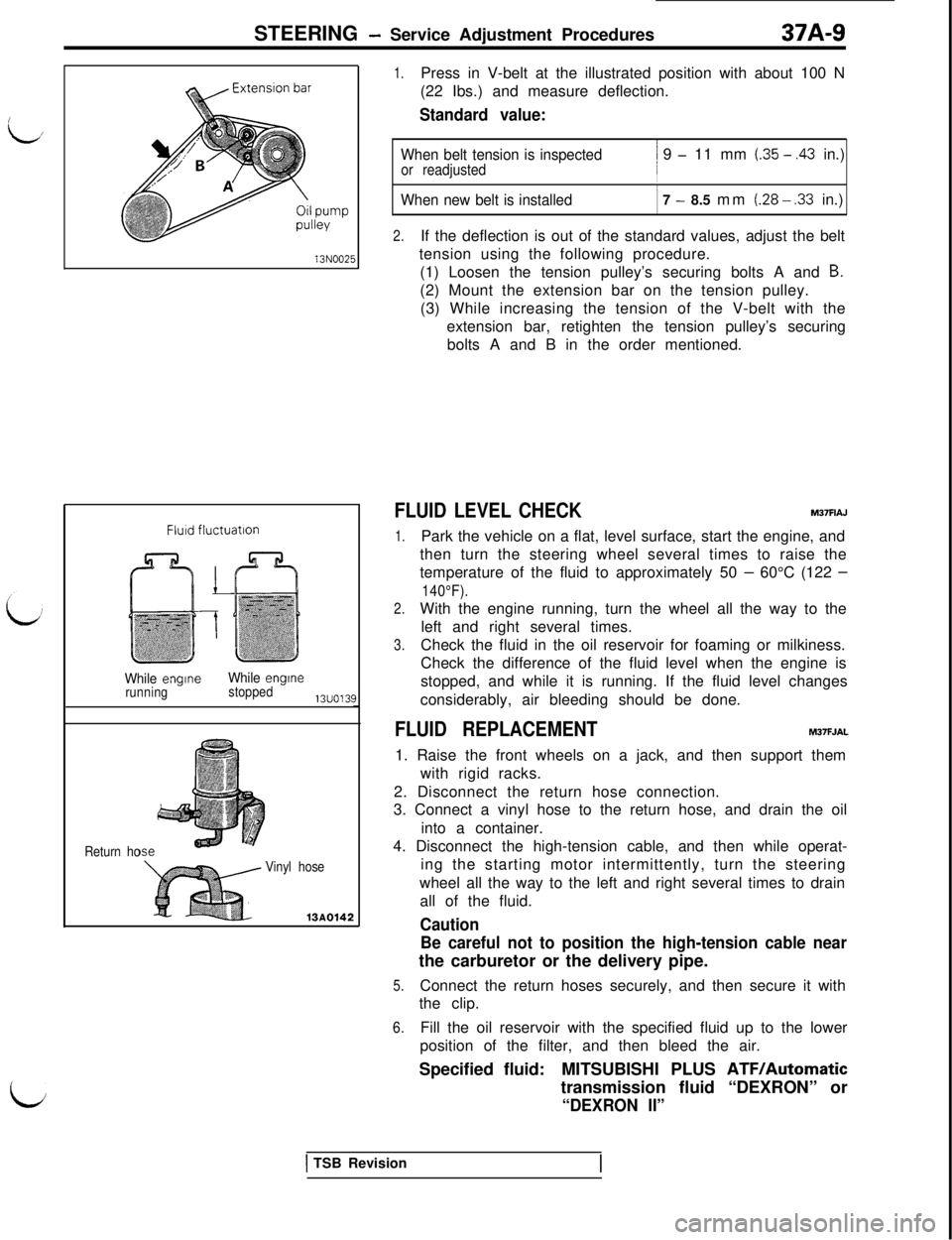
1.Press in V-belt at the illustrated position with about 100 N
(22 Ibs.) and measure deflection.
Standard value:
When belt tension is inspectedor readjusted
When new belt is installed
/ 9 - 11 mm (.35 - .43 in.)
I
’ 7 - 8.5 mm (.28 - .33 in.)
2.If the deflection is out of the standard values, adjust the belt
tension using the following procedure.
(1) Loosen the tension pulley’s securing bolts A and
B.(2) Mount the extension bar on the tension pulley.
(3) While increasing the tension of the V-belt with the
extension bar, retighten the tension pulley’s securing
bolts A and B in the order mentioned.
FLUID LEVEL CHECKM37FlAJ
1.Park the vehicle on a flat, level surface, start the engine, and
then turn the steering wheel several times to raise the
temperature of the fluid to approximately 50
- 60°C (122 -
140°F).
2.With the engine running, turn the wheel all the way to the
left and right several times.
3.Check the fluid in the oil reservoir for foaming or milkiness.
Check the difference of the fluid level when the engine is
stopped, and while it is running. If the fluid level changes
considerably, air bleeding should be done.
FLUID REPLACEMENTM37FJAL1. Raise the front wheels on a jack, and then support them
with rigid racks.
2. Disconnect the return hose connection.
3. Connect a vinyl hose to the return hose, and drain the oil
into a container.
4. Disconnect the high-tension cable, and then while operat-
ing the starting motor intermittently, turn the steering
wheel all the way to the left and right several times to drain
all of the fluid.
Caution
Be careful not to position the high-tension cable nearthe carburetor or the delivery pipe.
5.Connect the return hoses securely, and then secure it with
the clip.
6.Fill the oil reservoir with the specified fluid up to the lower
position of the filter, and then bleed the air.
Specified fluid:MITSUBISHI PLUS ATF/Automatic
transmission fluid “DEXRON” or
“DEXRON II”
1 TSB Revision
Page 838 of 1146
37A-10STEERING - Service Adjustment Procedures
BLEEDINGM37FKAl
1.Jack up the front wheels and support them by using a floor
stand.
2. Manually turn the oil pump pulley a few times.
3. Turn the steering wheel all the way to the left and to the
right several times.
4. Disconnect the high-tension cable, and then, while operat-
ing the starting motor intermittently, turn the steering
wheel all the way to the left and right several times (for 15
to 20 seconds).
Caution1. During air bleeding, replenish the fluid supply so
that the level never falls below the lower position ofthe filter.
2. If air bleeding is done while engine is running, the
air will be broken up and absorbed into the fluid; besure to do the bleeding only while cranking.
5. Connect the ignition cable, and then start the engine
(idling).
6.Turn the steering wheel to the left and right until there are
no air bubbles in the oil reservoir.
7.Confirm that the fluid is not milky, and that the level is up to
the specified position on the level gauge.
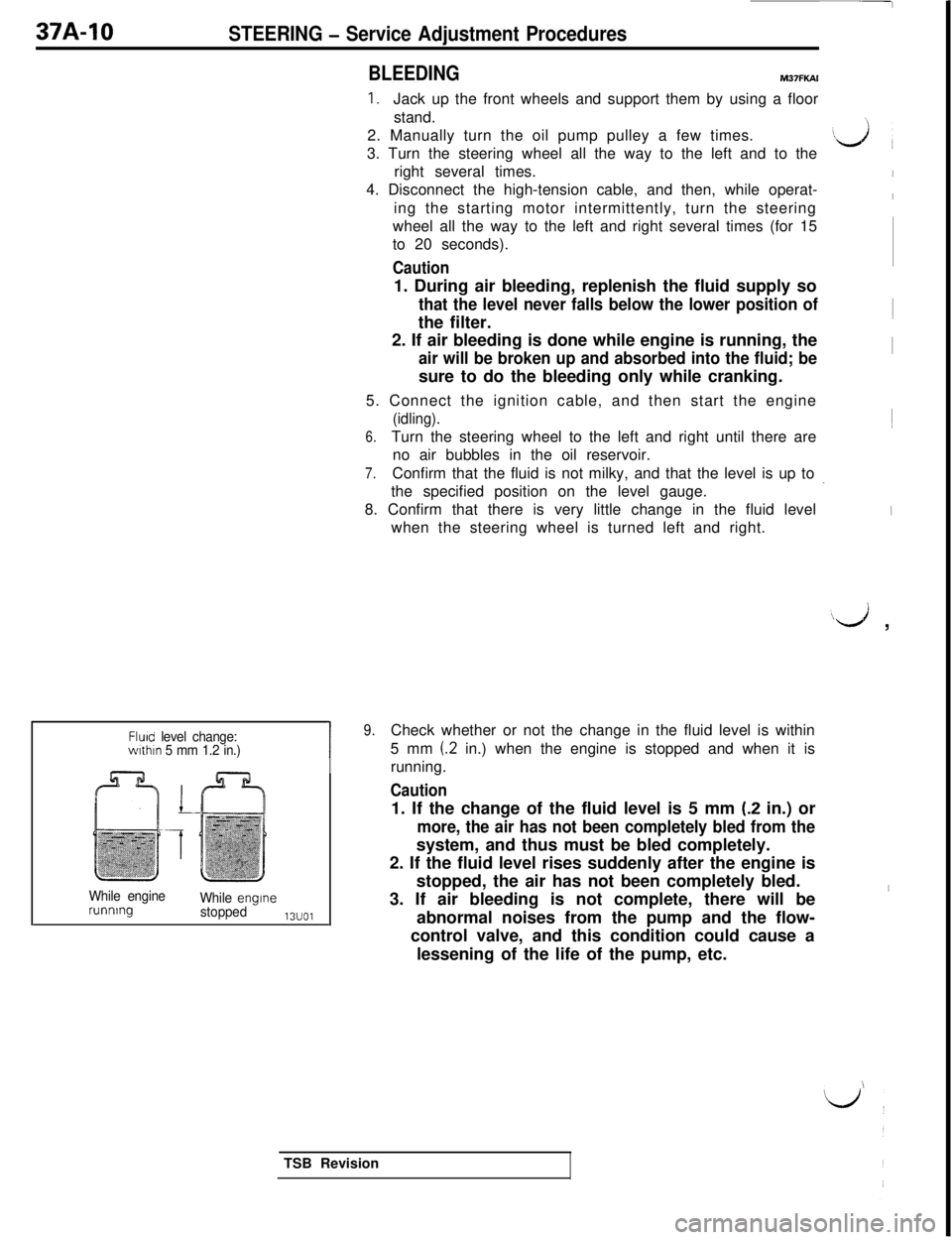
8. Confirm that there is very little change in the fluid level
when the steering wheel is turned left and right.
Fluid level change:wlthln 5 mm 1.2 in.)I
9.Check whether or not the change in the fluid level is within
5 mm
(.2 in.) when the engine is stopped and when it is
Irunning.
Caution
While enginerunningWhile enginestopped13UOl1. If the change of the fluid level is 5 mm
I.2 in.) or
more, the air has not been completely bled from thesystem, and thus must be bled completely.
2. If the fluid level rises suddenly after the engine is
stopped, the air has not been completely bled.
3. If air bleeding is not complete, there will be
abnormal noises from the pump and the flow-
control valve, and this condition could cause a
lessening of the life of the pump, etc.
LJ
I
I~
I~
I
LJ ,
I
\TSB Revision