engine oil MITSUBISHI 3000GT 1991 Workshop Manual
[x] Cancel search | Manufacturer: MITSUBISHI, Model Year: 1991, Model line: 3000GT, Model: MITSUBISHI 3000GT 1991Pages: 1146, PDF Size: 76.68 MB
Page 147 of 1146
FUEL SYSTEM - On-vehicle Inspection of MPI Components13-41
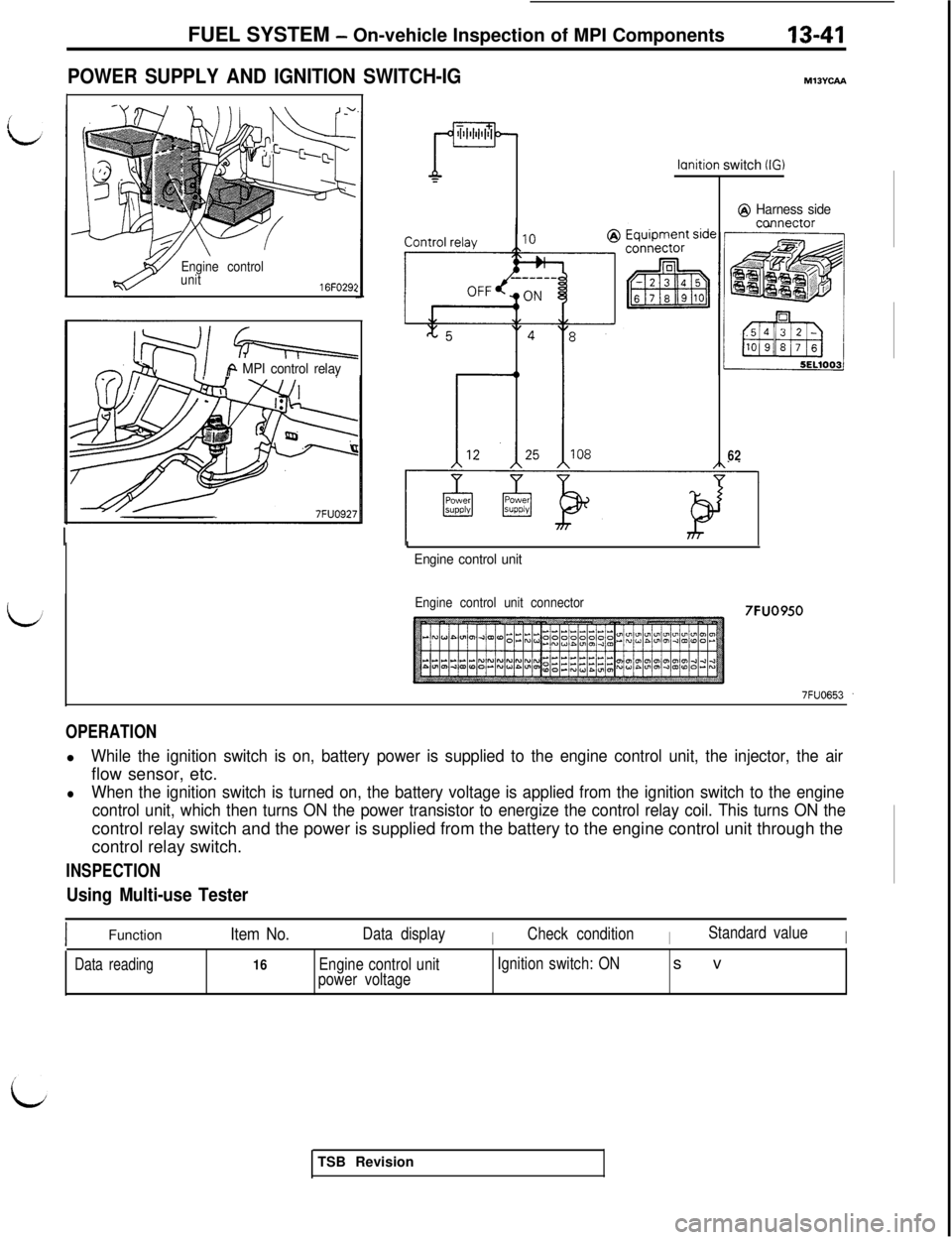
POWER SUPPLY AND IGNITION SWITCH-IG
Engine control
unit
16FO29:
Q-i=++=
iA MPI control relay
ml3Yuu
lcmition switch (IG)
@ Harness sideccmnector
62
I
Engine control unit
Engine control unit connector7FUO950
OPERATIONl
While the ignition switch is on, battery power is supplied to the engine control unit, the injector, the airflow sensor, etc.
lWhen the ignition switch is turned on, the battery voltage is applied from the ignition switch to the engine
control unit, which then turns ON the power transistor to energize the control relay coil. This turns ON thecontrol relay switch and the power is supplied from the battery to the engine control unit through the
control relay switch.
INSPECTION
Using Multi-use Tester
IFunctionItem No.Data displayICheck conditionIStandard valueI
Data reading16Engine control unit
power voltageIgnition switch: ONsv
TSB Revision
Page 151 of 1146
FUEL SYSTEM -On-vehicle Inspection of MPI Components13-45
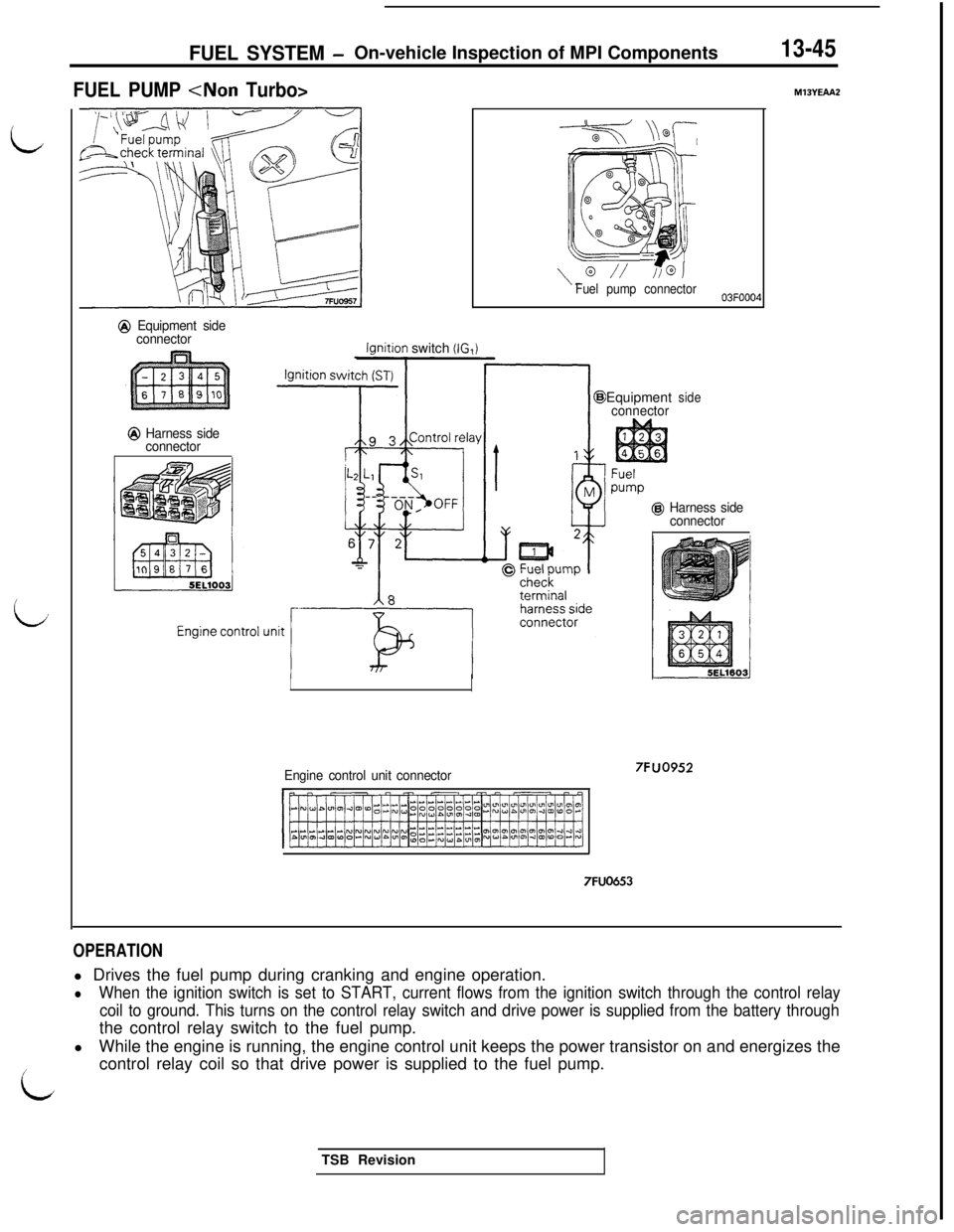
FUEL PUMP
@ Equipment side
connector
@ Harness side
connector
lqnition switch (IG,i
LL--- /A&
\“// //@JFuel pump connector
Engine control unit connectorEquipment
connectorside
@ Harness side
connector
7FUO653
7FUO952
M13YEAA2
OPERATIONl Drives the fuel pump during cranking and engine operation.
lWhen the ignition switch is set to START, current flows from the ignition switch through the control relay
coil to ground. This turns on the control relay switch and drive power is supplied from the battery throughthe control relay switch to the fuel pump.
lWhile the engine is running, the engine control unit keeps the power transistor on and energizes the
icontrol relay coil so that drive power is supplied to the fuel pump.
LTSB Revision
Page 156 of 1146
13-50FUEL SYSTEM - 0
n-vehicle Inspection of MPI Components
OPERATIONControl Relay Operation
l Drives the fuel pump during cranking and engine operation.
l
When the ignition switch is set to START, current flows from the ignition switch through the control relay
coil to ground. This turns on the control relay switch and drive power is supplied from the battery throughthe control relay switch to the fuel pump.
lWhile the engine is running, the engine control unit keeps the power transistor on and energizes the
control relay coil so that drive power is supplied to the fuel pump.
Fuel Pump Relay No. 2 Operation
lChange the fuel pump discharge in two stages by ON-OFF operation of the relay switch for fuel pumprelay No. 2.
lIf the amount of inlet air is small (the engine load is low), the engine control unit turns on the power
transistor to energize the coil of fuel pump relay No. 2, sending drive power to the fuel pump through the
resistor. If the amount of inlet air is large (the engine load is high), the engine control unit turns off thepower transistor to send drive power directly to the fuel pump without passing through the resistor.
INSPECTIONUsing Multi-use Tester
Function
ActuatortestItem No.
Operation
Check conditionCheck itemNormal condition
07Fuel pump isdriven to cir-l Engine crankingHold return hose withl Forced drive of fuelPulsation is felt
culate fuelfingers to feel pulsationpump
Check is made for aboveindicating fuel flow
two conditionsListen to pump operating
sound near fuel tankOperating sound isheard
I/IIII
cFunctionItem No.Operation
Check conditionNormal condition
Actuatortest
13Turn the fuel pump relayNo. 2 from OFF to ONIgnition switch: ONOperating soundis heard.
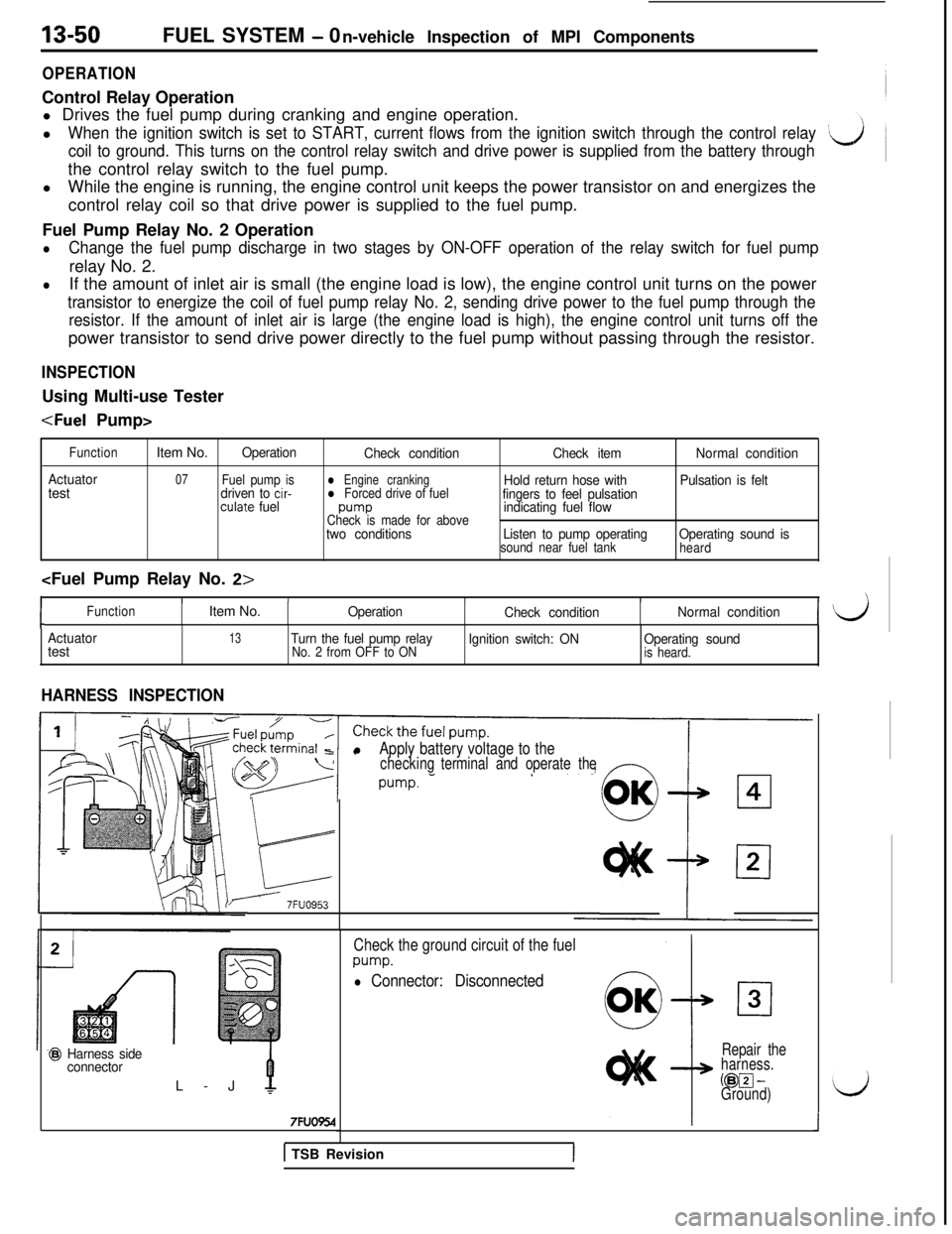
HARNESS INSPECTION
k
J------ 7FUO953
lApply battery voltage to thecheckingterminal and operate the
Check the ground circuit of the fuel
pump.
l Connector: Disconnected
@I Harness side
connectorL-J
7FUO554
Repair the
harness.
@pJ-Ground)
J
1 TSB Revision
Page 160 of 1146
FUEL SYSTEM - 0
n-vehicle Inspection of MPI Components
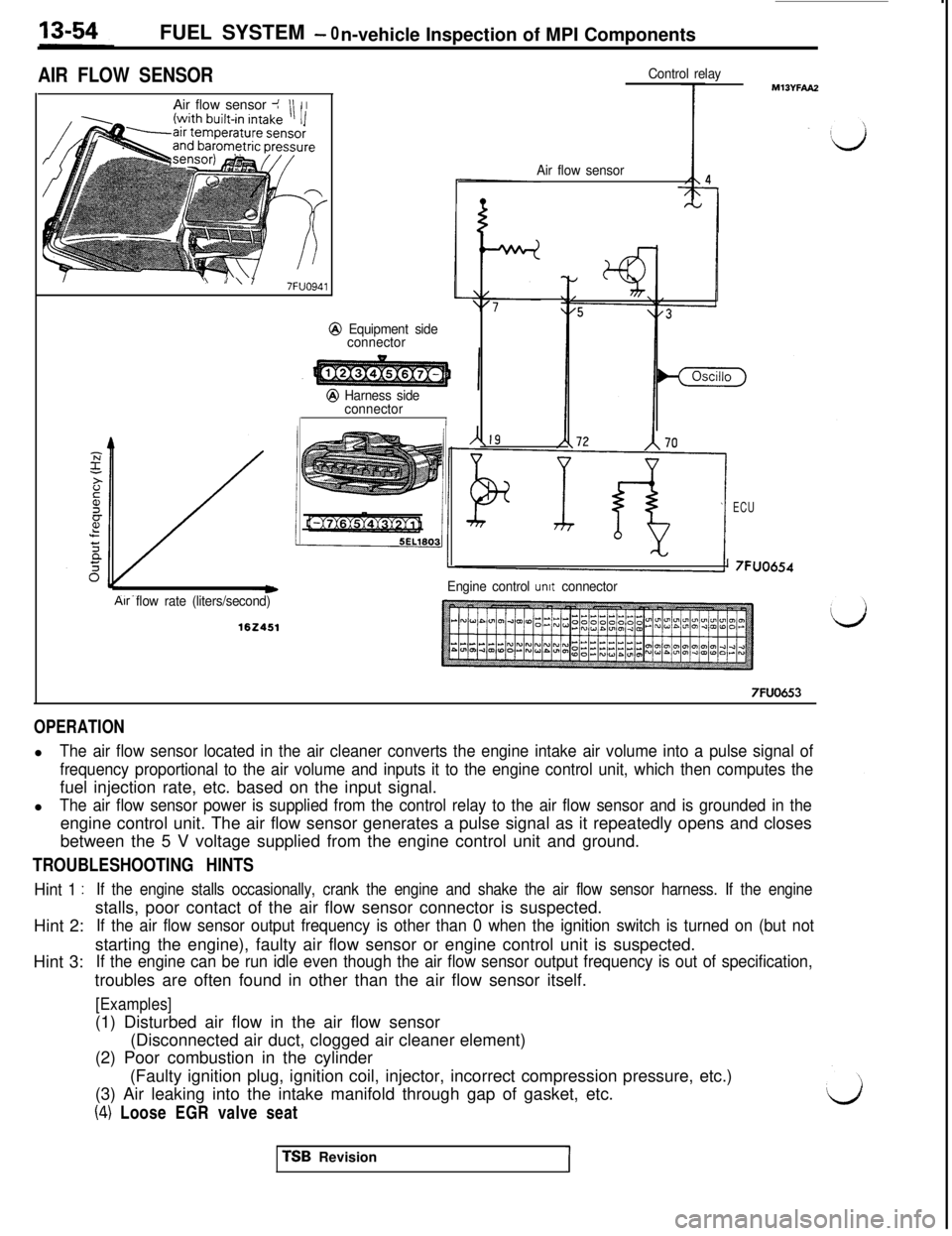
AIR FLOW SENSORAir flow sensor J
III I
\I\Y7FUO941
@ Equipment side
connector
Air flow rate (liters/second)
@ Harness side
connector
I
Control relay
I
Air flow sensor
ECU
’ 7FUO654
Engine control
unit connector
7FUO653
OPERATIONl
The air flow sensor located in the air cleaner converts the engine intake air volume into a pulse signal of
frequency proportional to the air volume and inputs it to the engine control unit, which then computes thefuel injection rate, etc. based on the input signal.
l
The air flow sensor power is supplied from the control relay to the air flow sensor and is grounded in theengine control unit. The air flow sensor generates a pulse signal as it repeatedly opens and closes
between the 5 V voltage supplied from the engine control unit and ground.
TROUBLESHOOTING HINTS
Hint 1 :If the engine stalls occasionally, crank the engine and shake the air flow sensor harness. If the engineHint 2:stalls, poor contact of the air flow sensor connector is suspected.
If the air flow sensor output frequency is other than 0 when the ignition switch is turned on (but notHint 3:starting the engine), faulty air flow sensor or engine control unit is suspected.
If the engine can be run idle even though the air flow sensor output frequency is out of specification,troubles are often found in other than the air flow sensor itself.
[Examples](1) Disturbed air flow in the air flow sensor
(Disconnected air duct, clogged air cleaner element)
(2) Poor combustion in the cylinder
(Faulty ignition plug, ignition coil, injector, incorrect compression pressure, etc.)
(3) Air leaking into the intake manifold through gap of gasket, etc.
(4) Loose EGR valve seatTSB Revision
Page 178 of 1146

13-72FUEL SYSTEM - On-vehicle Inspection of MPI Components
CRANK ANGLE SENSOR
co.ntiector
Output characteristic
LTime
7FUO682
MllYiAC
Control relay-I-
Crank angle sensorsideA3
Crank angle sensor/\
‘=
Engine controlunft69I
1
h5v
7FUO499
OPERATIONl
The crank angle sensor senses the crank angle (piston position) of each cylinder, converts it into a pulse
signal and inputs it to the engine control unit, which then computes the engine speed and controls the fuelinjection timing and ignition timing based on the input signal.
lPower to the crank angle sensor is supplied from the control relay and is grounded to the body. The crank
angle sensor generates a pulse signal as it repeatedly connects and disconnects between 5 V voltagesupplied from the engine control unit and ground.
TROUBLESHOOTING HINTSHint 1: If unexpected shocks are felt during driving or the engine stalls suddenly during idling, shake the
crank angle sensor harness. If this causes the engine to stall, poor contact of the sensor connector is
suspected.Hint 2: If the crank angle sensor outputs a pulse signal when the ignition switch is turned ON (with the
engine not running), a faulty crank angle sensor or engine control unit is suspected.
Hint 3:
If the tachometer reads 0 rpm when the engine that has failed to start is cranked, faulty crank angleHint 4:sensor or broken timing belt is suspected.
If the tachometer reads 0 rpm when the engine that has failed to start is cranked, the primary current
of the ignition coil is not turned on and off. Therefore, troubles in the ignition circuit and ignition coil orfaulty power transistor is suspected.
Hint 5: If the engine can be run at idle even though the crank angle sensor reading is out of specification,troubles are often in other than the crank angle sensor.
[Examples](1) Faulty engine coolant temperature sensor
(2) Faulty idle speed control servo
(3) Poorly adjusted reference idle speed
TSB Revision
Page 179 of 1146
FUEL SYSTEM - On-vehicle Inspection of MPI Components13-73
INSPECTION
Using Multi-use Tester
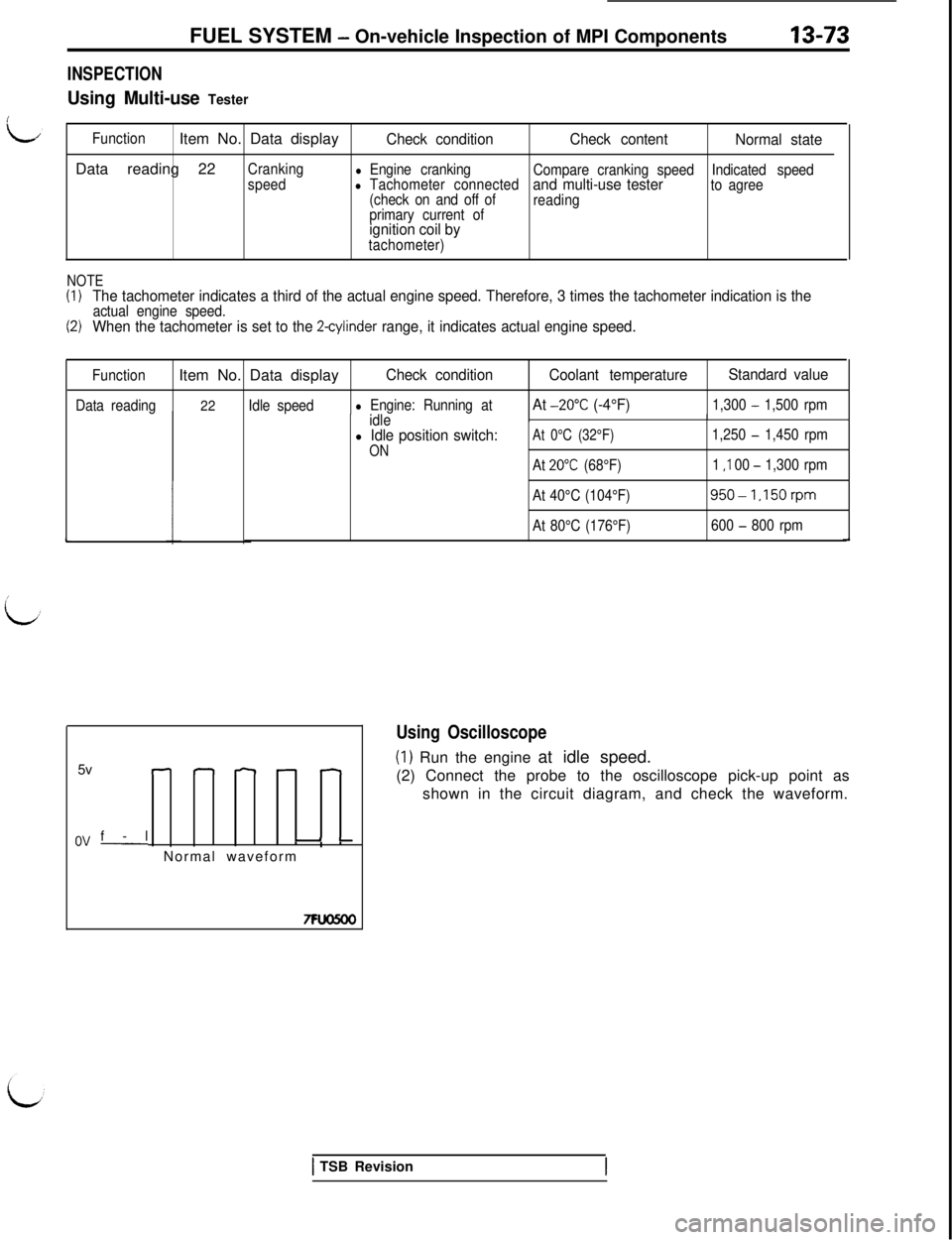
FunctionItem No. Data displayCheck conditionCheck content
Normal stateData reading 22
Crankingl Engine cranking
Compare cranking speedIndicated speed
speedl Tachometer connectedand multi-use tester(check on and off ofto agree
reading
primary current of
ignition coil bytachometer)
NOTE(1)The tachometer indicates a third of the actual engine speed. Therefore, 3 times the tachometer indication is theactual engine speed.(2)When the tachometer is set to the 2-cylinder range, it indicates actual engine speed.
FunctionItem No. Data displayCheck conditionCoolant temperatureStandard value
Data reading22Idle speedl Engine: Running atAt -20°C (-4°F)1,300 - 1,500 rpm
idle
l Idle position switch:ONAt 0°C (32°F)At 20°C (68°F)
At 40°C (104°F)
At 80°C (176°F)1,250
- 1,450 rpm
1
,I 00 - 1,300 rpm
950-1,150rpm
600 - 800 rpm
-m-2,-5v
f-lov
---Normal waveform
Using Oscilloscope
(1) Run the engine at idle speed.
(2) Connect the probe to the oscilloscope pick-up point as
shown in the circuit diagram, and check the waveform.
1 TSB Revision
Page 186 of 1146

13-80FUEL SYSTEM - 0
n-vehicle Inspection of MPI Components
POWER STEERING OIL PRESSURE SWITCHMlOYQAA
B
$-
Engine control unit
'107
@ Harness side
connector
ml-
Power steering oil
Pressure switch
7FUO536700-2.000 1.500-2.000(100-284) (213-284)Pressure [kPa (psi)]
0, l.oIu
OPERATIONl
The power steering oil pressure switch converts presence/absence of power steering load into low/high
voltage and inputs it to the engine control unit, which then controls the idle speed control servo based on
this signal.l The battery voltage in the engine control unit is applied through a resistor to the power steering oil
pressure switch. Steering operation causes the power steering oil pressure to increase, turning the
switch on. As a result, continuity is produced between the battery voltage applied and ground. This
causes the power steering oil pressure terminal voltage to go from high to low.
TSB Revision
Page 187 of 1146
FUEL SYSTEM- On-vehicle Inspection of MPI Components13-81
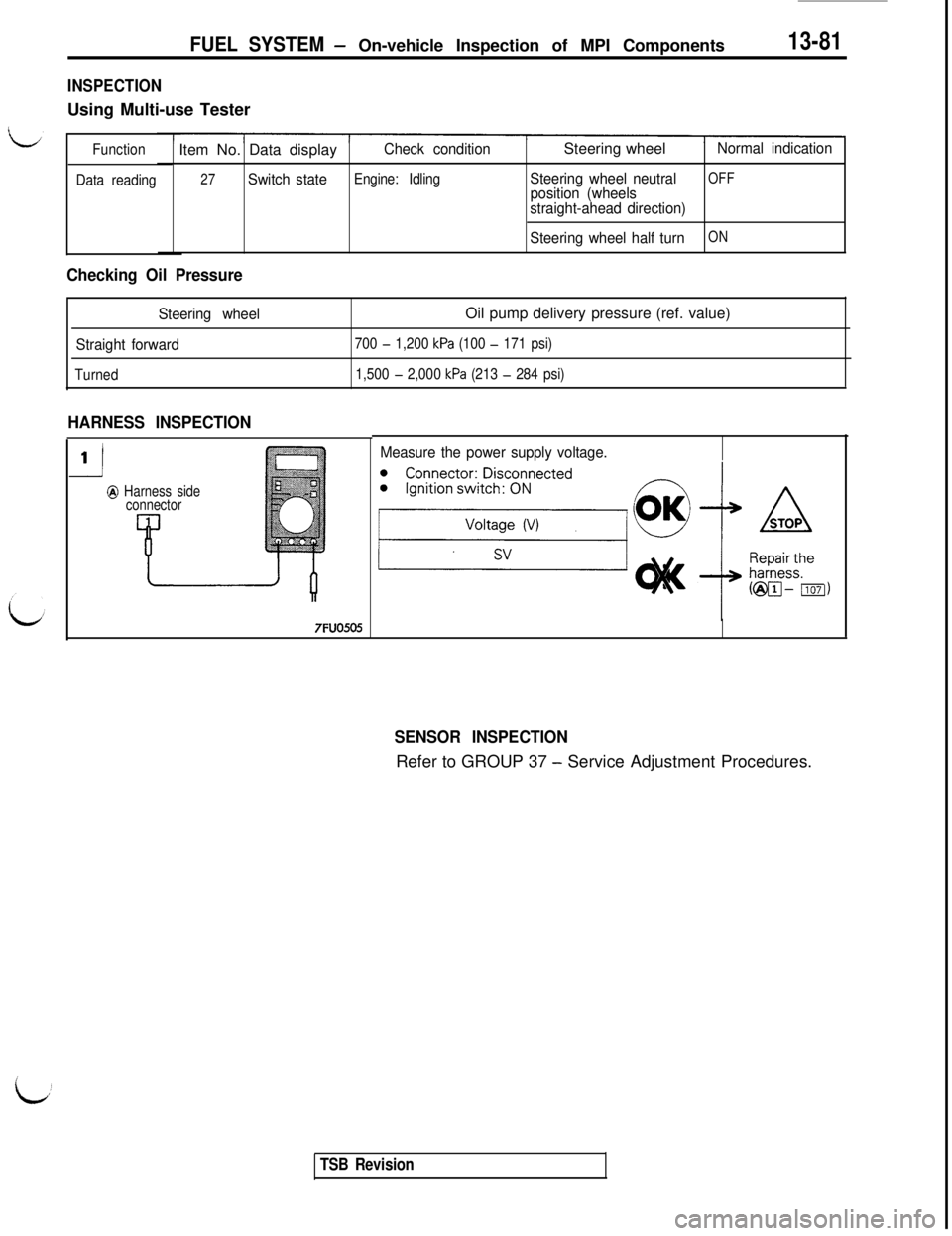
INSPECTIONUsing Multi-use Tester
Function
Data readingItem No. Data displayCheck conditionSteering wheelNormal indication
27Switch stateEngine: IdlingSteering wheel neutralOFFposition (wheels
straight-ahead direction)
Steering wheel half turn
ON
Checking Oil Pressure
Steering wheelOil pump delivery pressure (ref. value)
Straight forward700 - 1,200 kPa (100 - 171 psi)
Turned1,500
- 2,000 kPa (213 - 284 psi)
HARNESS INSPECTION
i1
@ Harness side
connector
Measure the power supply voltage.
SENSOR INSPECTIONRefer to GROUP 37
- Service Adjustment Procedures.
TSB Revision
Page 188 of 1146

13-82FUEL SYSTEM - On-vehicle Inspection of MPI Components
AIR CONDITIONER SWITCH AND POWER RELAY
\
*I \\-- \
Air conditronerAir conditioner
control unitAir conditioner
compressor lock
controllerr
Engine control unit
Dual pressureswitch
M13YRAA2
b1IFF
Air conditioner
compressor
Engine control
unit connector
7FUO966
7FUO653
OPERATION
lThe air conditioner switch applies the battery voltage to the engine control unit when the air conditioner is
turned on.
lWhen the air conditioner ON signal is input, the engine control unit drives the idle speed control servo and
turns ON the power transistor. As a result, the air conditioner power relay coil is energized to turn on therelay switch, which activates the air compressor magnetic clutch.
TROUBLESHOOTING HINTS
If the air compressor magnet clutch is not activated when the air conditioner switch is turned on during idling,faulty air conditioner control system is suspected.
INSPECTION
Using Multi-use Tester
AIR CONDITIONER SWITCH
Function1 Item No. 1 Data display 1Check condition) Air conditioner switch 1 Normal indication IData reading 28
Switch stateEngine: Idling (airOFFOFFcompressor to be running
when air conditionerONONswitch is ON)\k”JTSB Revision
Page 207 of 1146
FUEL SYSTEM - On-vehicle Inspection of MPI Components13-101INJECTORS
M13YTAC2
IInjectorII\- 7FUO803
7FI
FuelFilter
@Injection
7FUO83:2Connector for
rear bank
Engine control unit7FUO833
Engine control unit connector
7FUO653
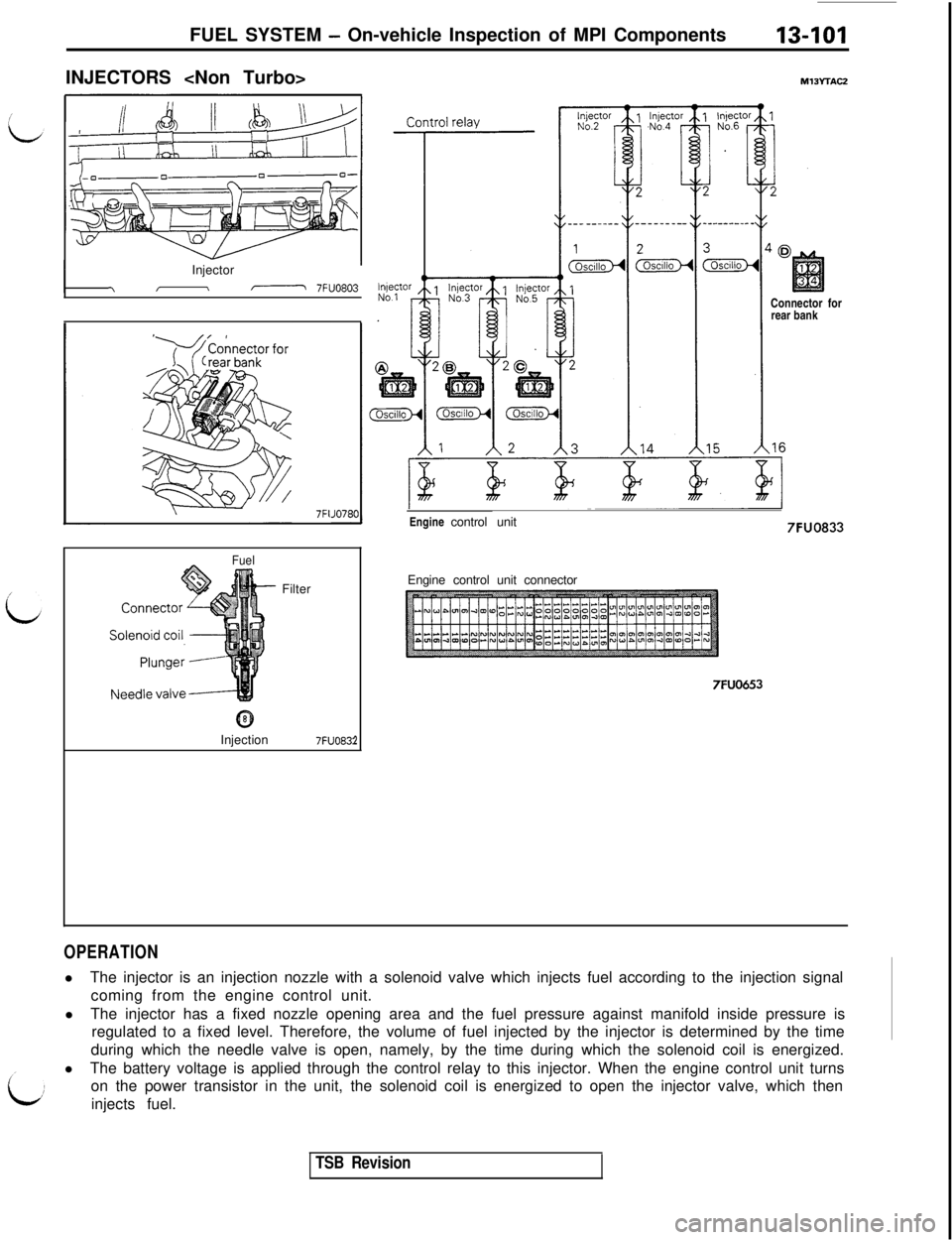
OPERATIONlThe injector is an injection nozzle with a solenoid valve which injects fuel according to the injection signal
coming from the engine control unit.
lThe injector has a fixed nozzle opening area and the fuel pressure against manifold inside pressure is
regulated to a fixed level. Therefore, the volume of fuel injected by the injector is determined by the time
during which the needle valve is open, namely, by the time during which the solenoid coil is energized.
lThe battery voltage is applied through the control relay to this injector. When the engine control unit turns
on the power transistor in the unit, the solenoid coil is energized to open the injector valve, which then
injects fuel.
TSB Revision