change wheel MITSUBISHI 3000GT 1991 User Guide
[x] Cancel search | Manufacturer: MITSUBISHI, Model Year: 1991, Model line: 3000GT, Model: MITSUBISHI 3000GT 1991Pages: 1146, PDF Size: 76.68 MB
Page 781 of 1146
SERVICE BRAKES- Service Adiustment Procedures35-59
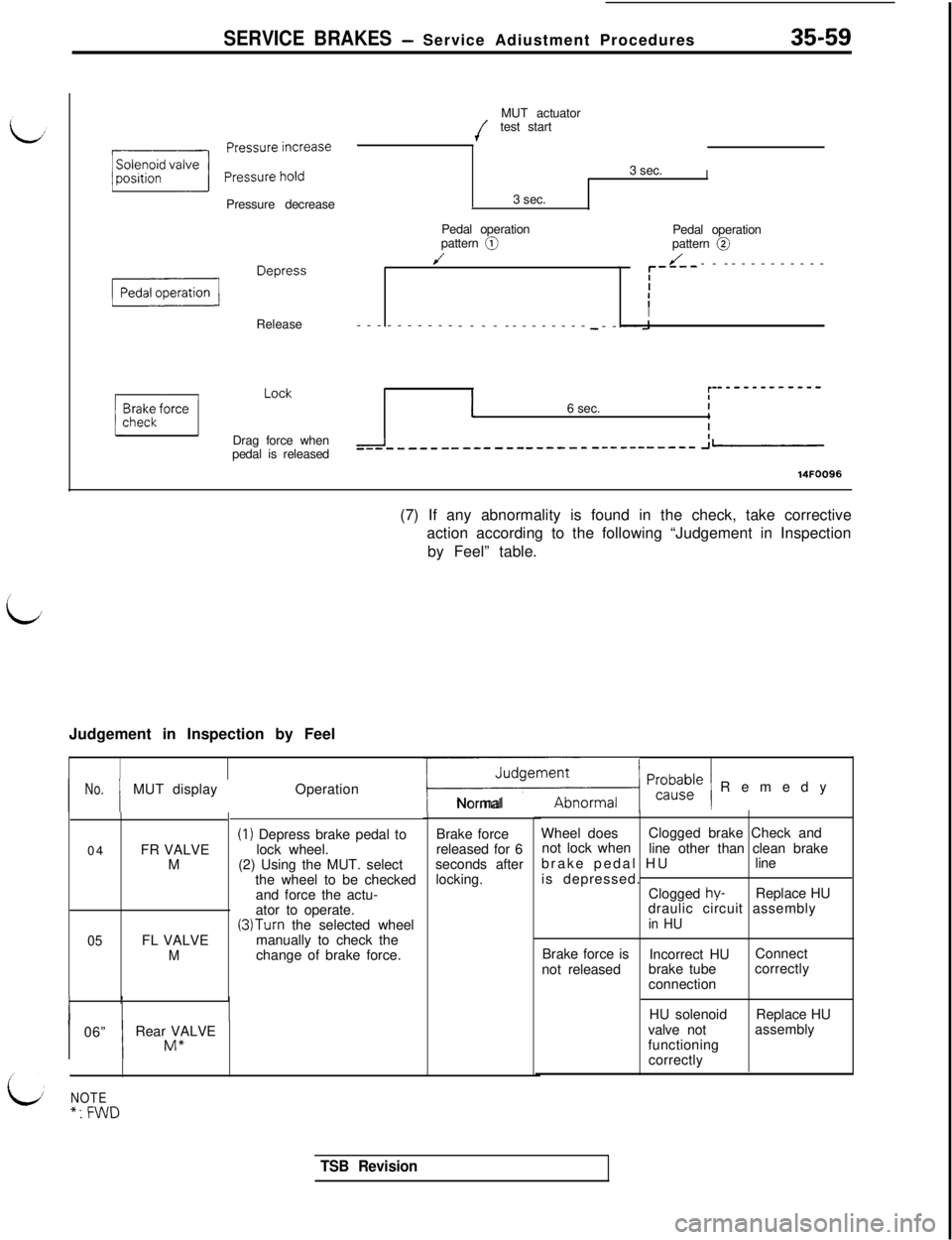
iPressure decrease
Release
pjgKq LockDrag force when
pedal is releasedMUT actuator
itest start
3 sec.
I3 sec.
Pedal operation
Pedal operation
pattern @
pattern @
JJ.r__---------------
I
I
I
I----------
------------------4
I1r-’ - - - - - - - - - a -I6 sec.
1------ __---____-__ - --___-__--_ ---J’-
14FOO96(7) If any abnormality is found in the check, take corrective
action according to the following “Judgement in Inspection
by Feel” table.
Judgement in Inspection by Feel
No.
I IMUT display
04FR VALVE
M
05FL VALVEM
t
106”
I IRear VALVEM”Operation
(1) Depress brake pedal to
lock wheel.
(2) Using the MUT. select
the wheel to be checked
and force the actu-
ator to operate.
(3)Turn the selected wheel
manually to check the
change of brake force.
1-1 ‘gkte / Remedy
Normal
Brake force
released for 6
seconds after
locking.Wheel doesClogged brake Check and
not lock when
line other than clean brake
brake pedal HUline
is depressed.
Clogged
hy-Replace HU
draulic circuit assembly
in HUBrake force is
Incorrect HUConnect
not releasedbrake tubecorrectly
connection
HU solenoid
valve not
functioning
correctlyReplace HU
assembly
NOTE*: FWD
TSB Revision
Page 782 of 1146
35-60SERVICE BRAKES - Service Adjustment Procedures
INSPECTION BY USING BRAKE FORCE TESTER
NOTE
(1) The brake force tester roller and tire must be dry during the
test.
(2) When testing the front brakes, apply the parking brake and
when testing the rear brakes, apply chocks to the front
wheels to lock them.
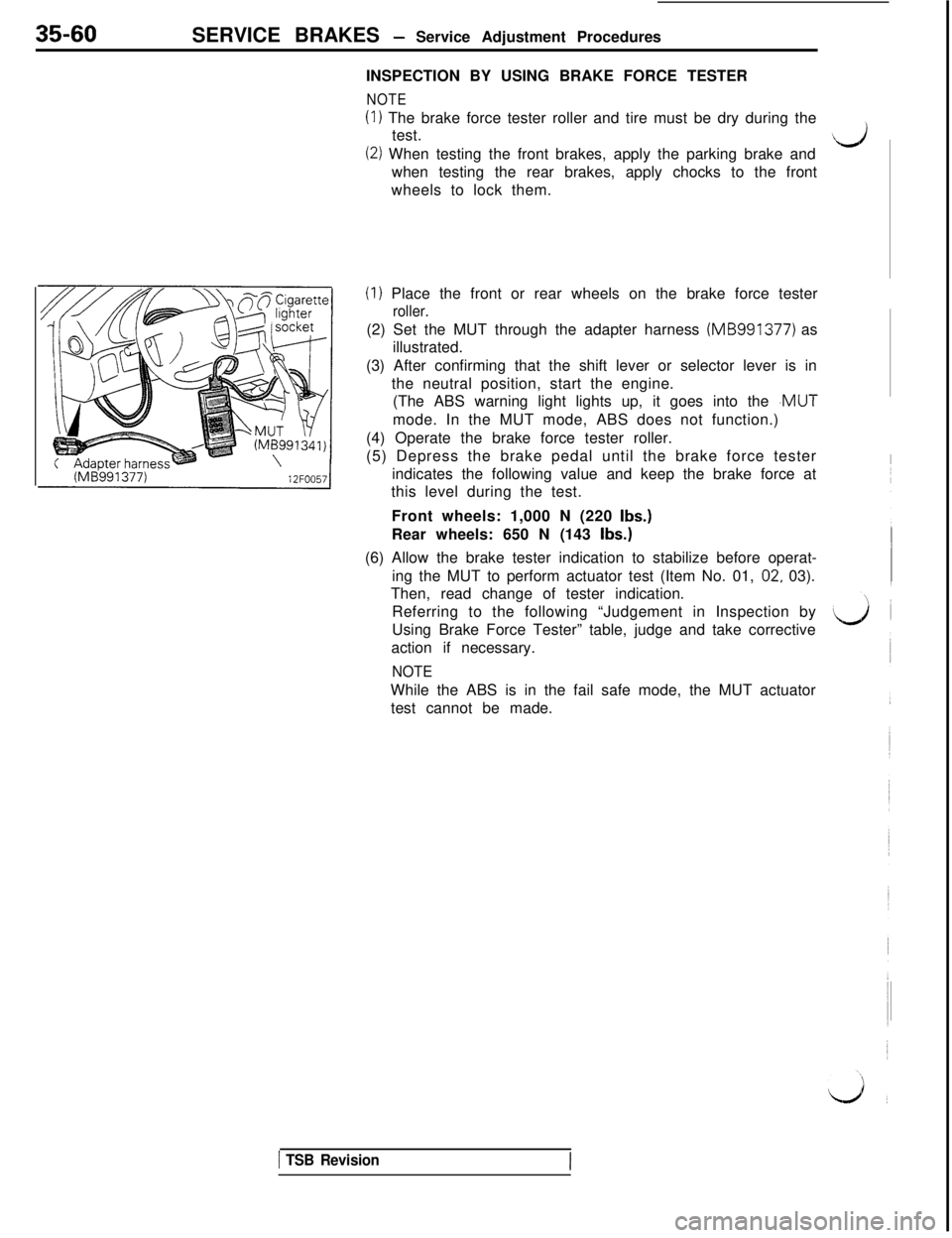
(I) Place the front or rear wheels on the brake force tester
roller.(2) Set the MUT through the adapter harness
(MB9913771 as
illustrated.
(3) After confirming that the shift lever or selector lever is in
the neutral position, start the engine.
(The ABS warning light lights up, it goes into the
-MUTmode. In the MUT mode, ABS does not function.)
(4) Operate the brake force tester roller.
(5) Depress the brake pedal until the brake force tester
indicates the following value and keep the brake force at
this level during the test.
Front wheels: 1,000 N (220
Ibs.)Rear wheels: 650 N (143
Ibs.)(6) Allow the brake tester indication to stabilize before operat-
ing the MUT to perform actuator test (Item No. 01,
02, 03).
Then, read change of tester indication.
Referring to the following “Judgement in Inspection by
Using Brake Force Tester” table, judge and take corrective
action if necessary.
NOTEWhile the ABS is in the fail safe mode, the MUT actuator
test cannot be made.
1 TSB Revision
Page 837 of 1146
STEERING - Service Adjustment Procedures37A-9
LL:13N002E
FluId f[uctuatlon
While
engineWhile engme
runningstopped13uo13:
Return ho
Vinyl hose13AO142
j
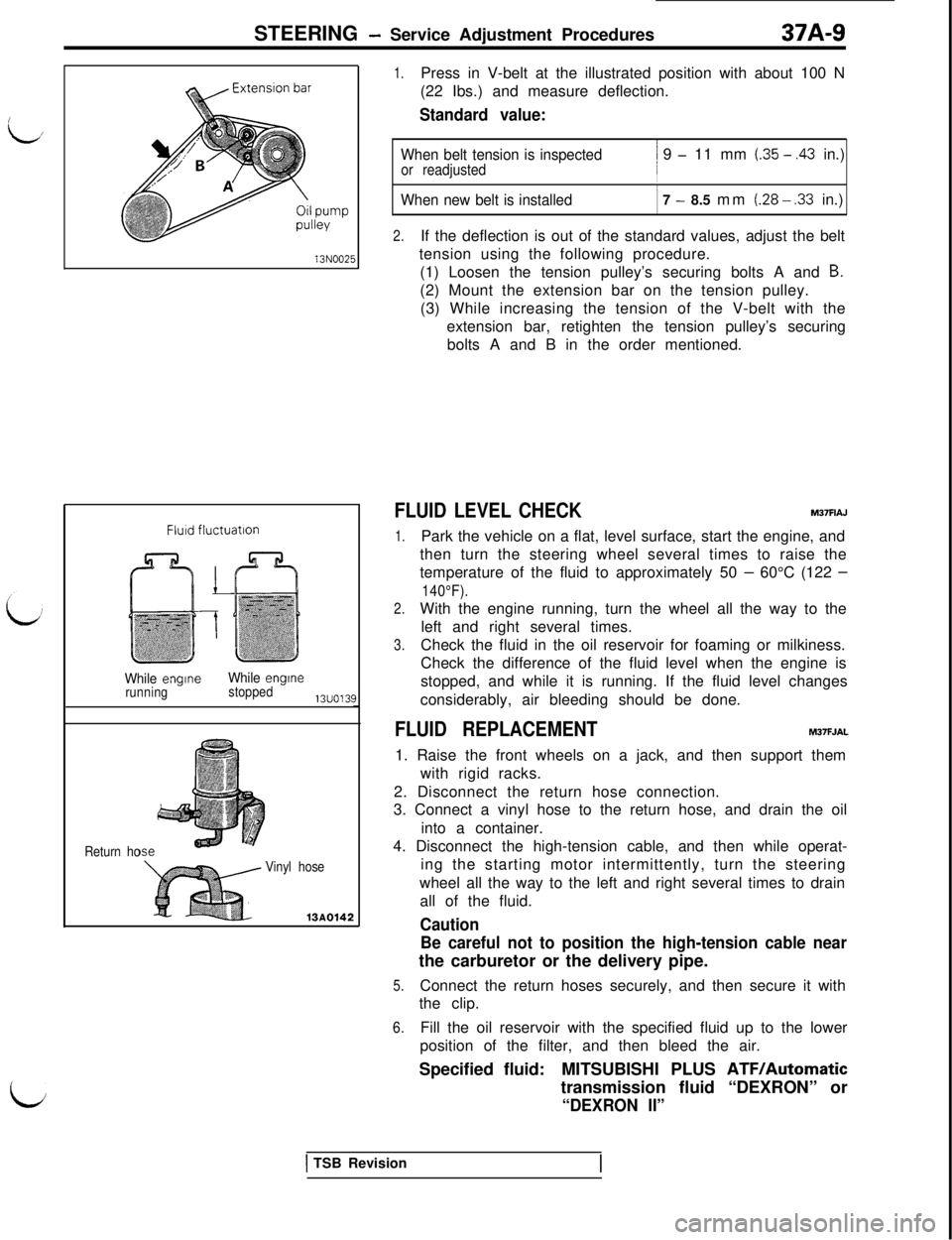
1.Press in V-belt at the illustrated position with about 100 N
(22 Ibs.) and measure deflection.
Standard value:
When belt tension is inspectedor readjusted
When new belt is installed
/ 9 - 11 mm (.35 - .43 in.)
I
’ 7 - 8.5 mm (.28 - .33 in.)
2.If the deflection is out of the standard values, adjust the belt
tension using the following procedure.
(1) Loosen the tension pulley’s securing bolts A and
B.(2) Mount the extension bar on the tension pulley.
(3) While increasing the tension of the V-belt with the
extension bar, retighten the tension pulley’s securing
bolts A and B in the order mentioned.
FLUID LEVEL CHECKM37FlAJ
1.Park the vehicle on a flat, level surface, start the engine, and
then turn the steering wheel several times to raise the
temperature of the fluid to approximately 50
- 60°C (122 -
140°F).
2.With the engine running, turn the wheel all the way to the
left and right several times.
3.Check the fluid in the oil reservoir for foaming or milkiness.
Check the difference of the fluid level when the engine is
stopped, and while it is running. If the fluid level changes
considerably, air bleeding should be done.
FLUID REPLACEMENTM37FJAL1. Raise the front wheels on a jack, and then support them
with rigid racks.
2. Disconnect the return hose connection.
3. Connect a vinyl hose to the return hose, and drain the oil
into a container.
4. Disconnect the high-tension cable, and then while operat-
ing the starting motor intermittently, turn the steering
wheel all the way to the left and right several times to drain
all of the fluid.
Caution
Be careful not to position the high-tension cable nearthe carburetor or the delivery pipe.
5.Connect the return hoses securely, and then secure it with
the clip.
6.Fill the oil reservoir with the specified fluid up to the lower
position of the filter, and then bleed the air.
Specified fluid:MITSUBISHI PLUS ATF/Automatic
transmission fluid “DEXRON” or
“DEXRON II”
1 TSB Revision
Page 838 of 1146
37A-10STEERING - Service Adjustment Procedures
BLEEDINGM37FKAl
1.Jack up the front wheels and support them by using a floor
stand.
2. Manually turn the oil pump pulley a few times.
3. Turn the steering wheel all the way to the left and to the
right several times.
4. Disconnect the high-tension cable, and then, while operat-
ing the starting motor intermittently, turn the steering
wheel all the way to the left and right several times (for 15
to 20 seconds).
Caution1. During air bleeding, replenish the fluid supply so
that the level never falls below the lower position ofthe filter.
2. If air bleeding is done while engine is running, the
air will be broken up and absorbed into the fluid; besure to do the bleeding only while cranking.
5. Connect the ignition cable, and then start the engine
(idling).
6.Turn the steering wheel to the left and right until there are
no air bubbles in the oil reservoir.
7.Confirm that the fluid is not milky, and that the level is up to
the specified position on the level gauge.
8. Confirm that there is very little change in the fluid level
when the steering wheel is turned left and right.
Fluid level change:wlthln 5 mm 1.2 in.)I
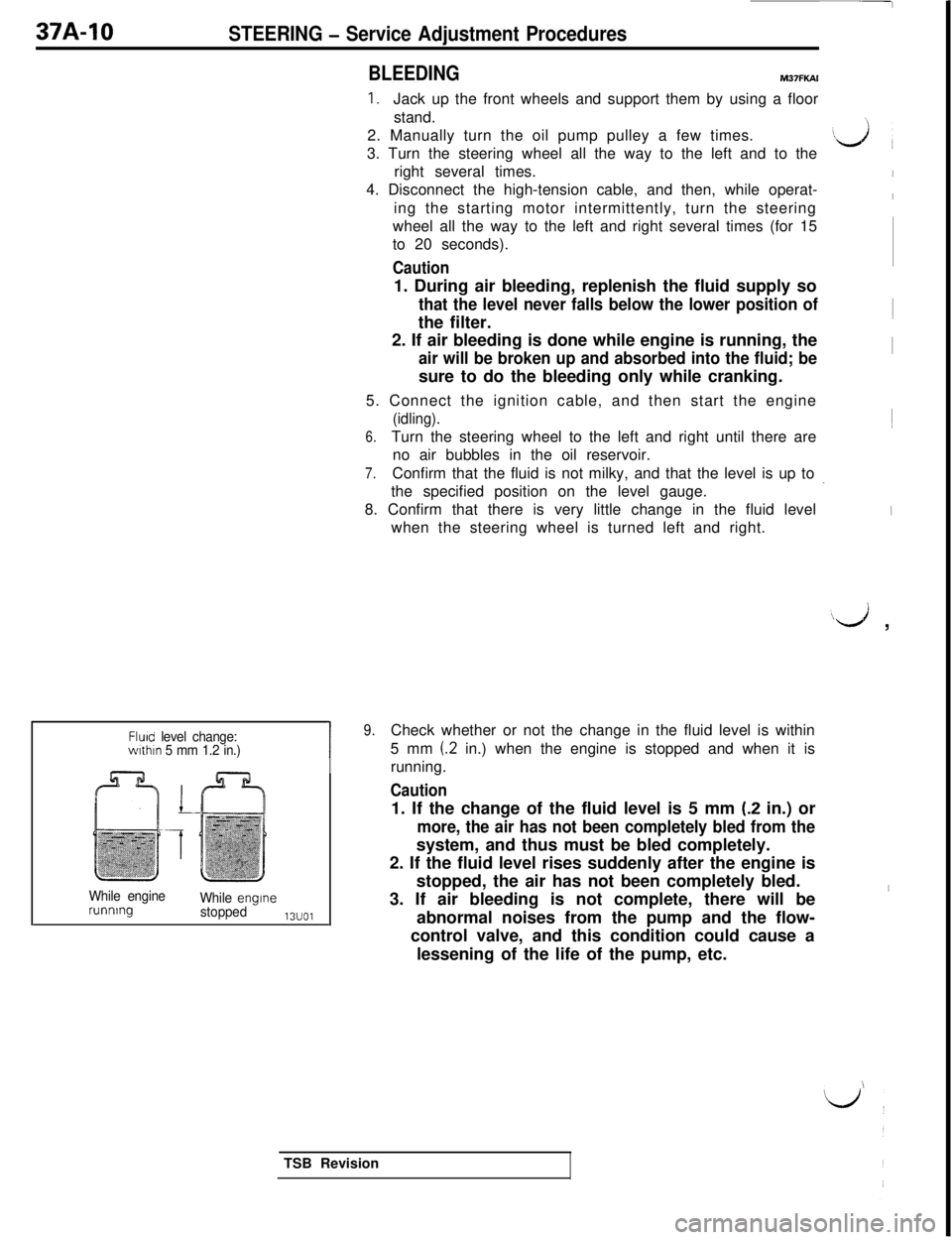
9.Check whether or not the change in the fluid level is within
5 mm
(.2 in.) when the engine is stopped and when it is
Irunning.
Caution
While enginerunningWhile enginestopped13UOl1. If the change of the fluid level is 5 mm
I.2 in.) or
more, the air has not been completely bled from thesystem, and thus must be bled completely.
2. If the fluid level rises suddenly after the engine is
stopped, the air has not been completely bled.
3. If air bleeding is not complete, there will be
abnormal noises from the pump and the flow-
control valve, and this condition could cause a
lessening of the life of the pump, etc.
LJ
I
I~
I~
I
LJ ,
I
\TSB Revision