fuel type MITSUBISHI 3000GT 1991 User Guide
[x] Cancel search | Manufacturer: MITSUBISHI, Model Year: 1991, Model line: 3000GT, Model: MITSUBISHI 3000GT 1991Pages: 1146, PDF Size: 76.68 MB
Page 225 of 1146
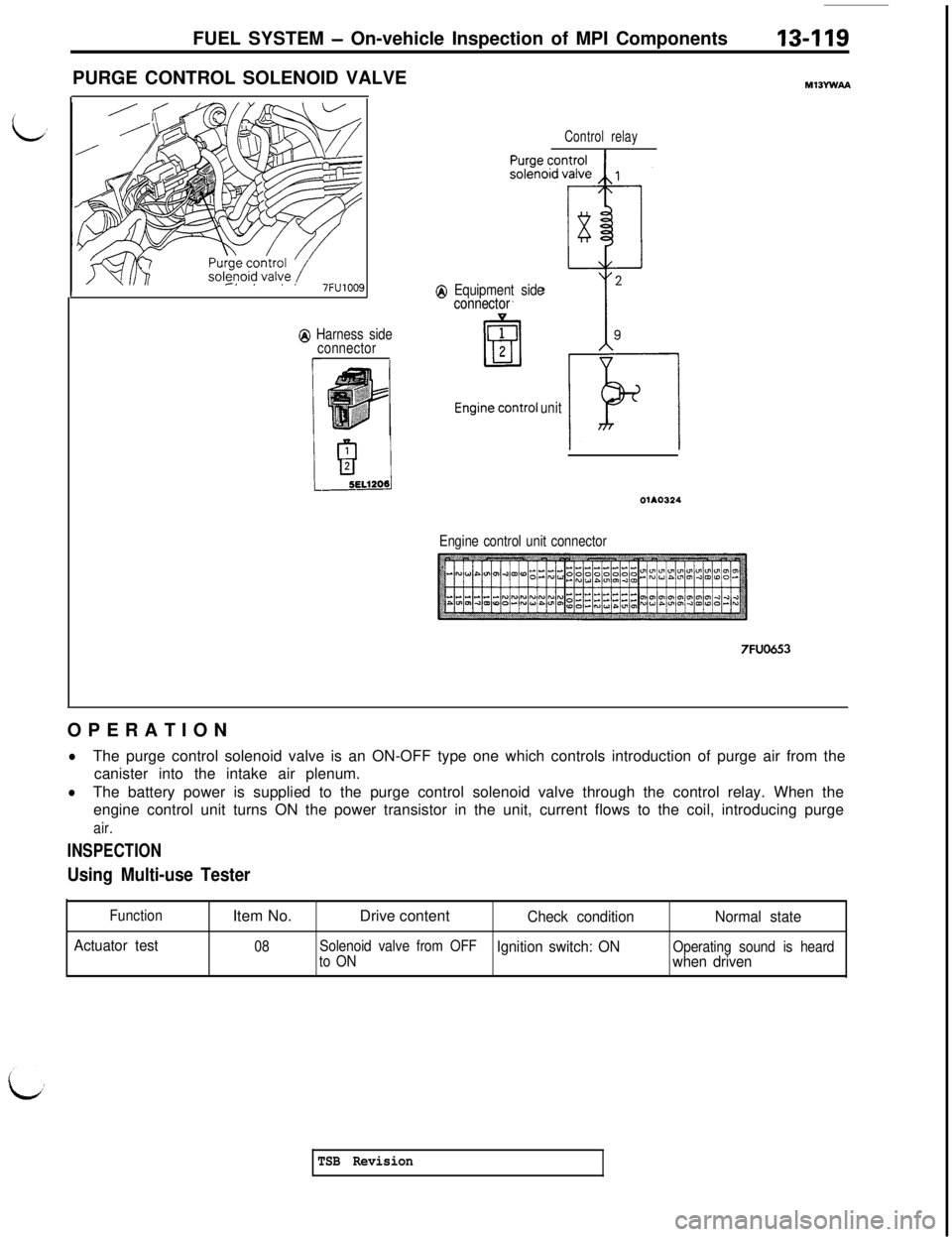
FUEL SYSTEM - On-vehicle Inspection of MPI Components13-119PURGE CONTROL SOLENOID VALVE
Q Harness side
connector
I
Control relay
@ Equipment side
connector connector
unit
OlAO324
Engine control unit connector
7FUO653OPERATION
lThe purge control solenoid valve is an ON-OFF type one which controls introduction of purge air from the
canister into the intake air plenum.
lThe battery power is supplied to the purge control solenoid valve through the control relay. When the
engine control unit turns ON the power transistor in the unit, current flows to the coil, introducing purge
air.
INSPECTION
Using Multi-use Tester
Function
Actuator testItem No.Drive content
Check conditionNormal state
08Solenoid valve from OFFIgnition switch: ONOperating sound is heard
to ONwhen driven
TSB Revision
Page 227 of 1146
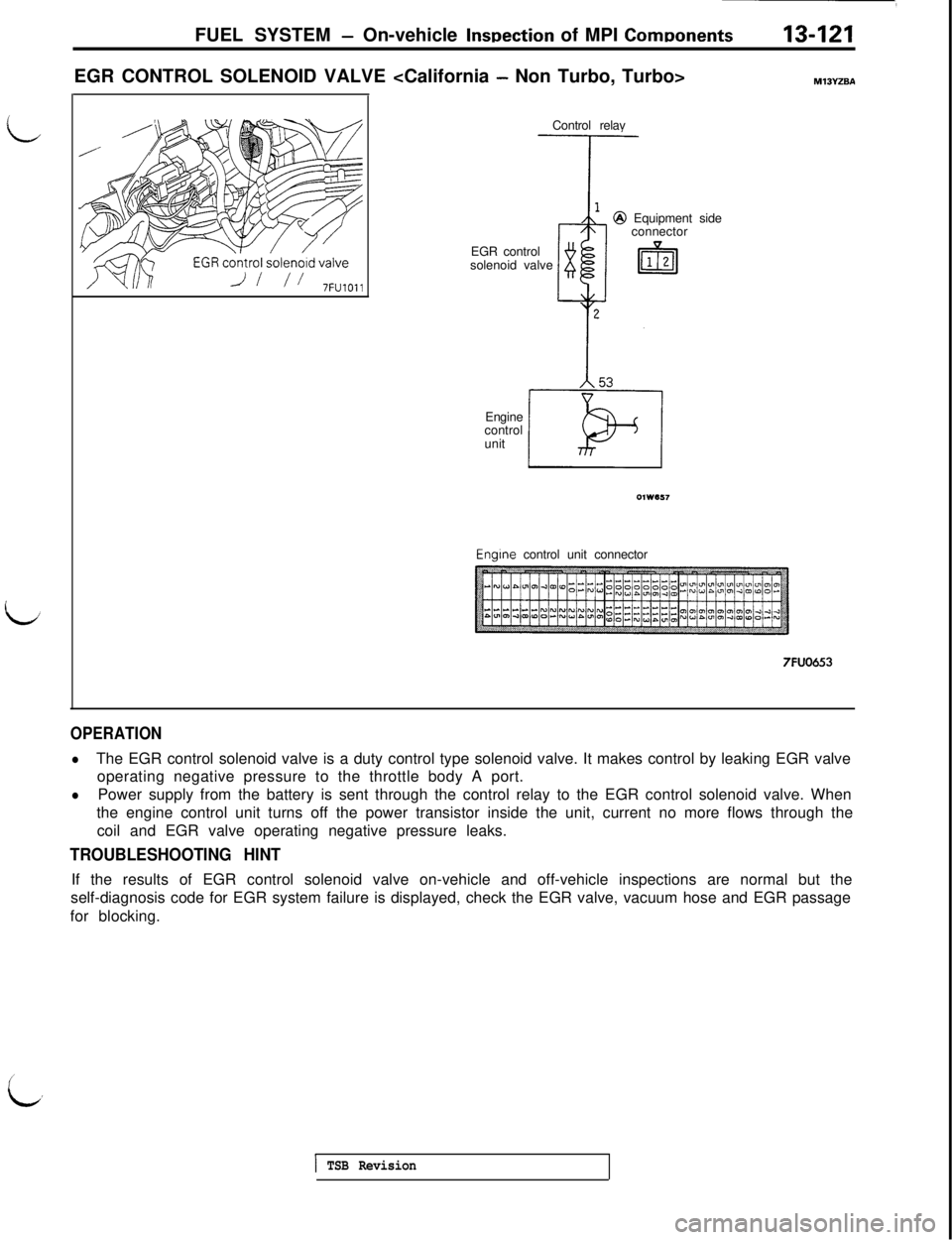
FUEL SYSTEM - On-vehicle lnwection of MPI ComDonents13-121
LEGR CONTROL SOLENOID VALVE
EGR control
solenoid valve@ Equipment side
connector
Engine
control
unitEngine control unit connector
7FUO653
OPERATION
lThe EGR control solenoid valve is a duty control type solenoid valve. It makes control by leaking EGR valve
operating negative pressure to the throttle body A port.
lPower supply from the battery is sent through the control relay to the EGR control solenoid valve. When
the engine control unit turns off the power transistor inside the unit, current no more flows through the
coil and EGR valve operating negative pressure leaks.
TROUBLESHOOTING HINTIf the results of EGR control solenoid valve on-vehicle and off-vehicle inspections are normal but the
self-diagnosis code for EGR system failure is displayed, check the EGR valve, vacuum hose and EGR passage
for blocking.
c.
1 TSB Revision
Page 229 of 1146
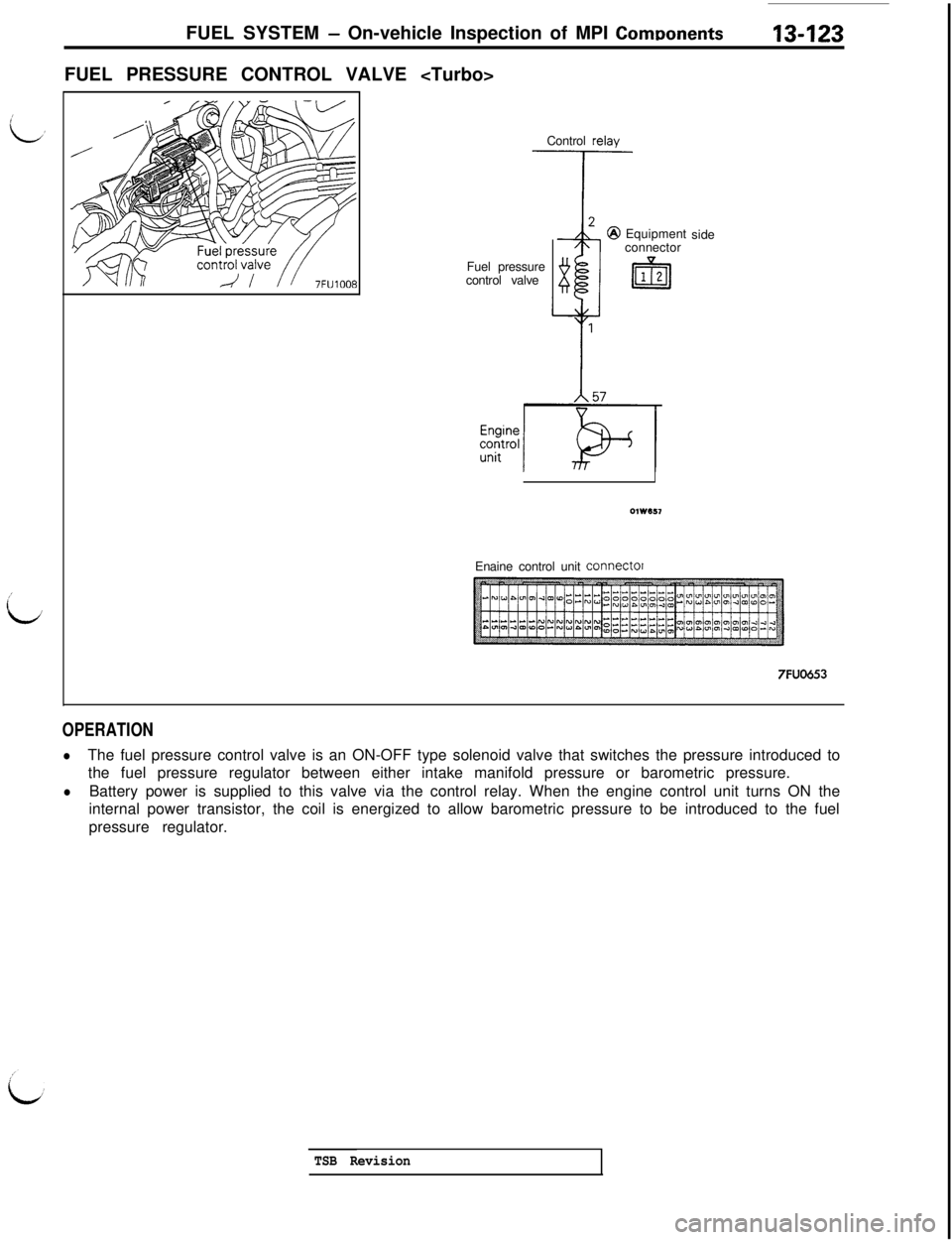
FUEL SYSTEM - On-vehicle Inspection of MPI ComDonents13-123FUEL PRESSURE CONTROL VALVE
Control relay
Fuel pressure
control valveEquipment
connectorside
Enaine control unit
connector
7FUO653
OPERATION
lThe fuel pressure control valve is an ON-OFF type solenoid valve that switches the pressure introduced to
the fuel pressure regulator between either intake manifold pressure or barometric pressure.
lBattery power is supplied to this valve via the control relay. When the engine control unit turns ON the
internal power transistor, the coil is energized to allow barometric pressure to be introduced to the fuel
pressure regulator.
TSB Revision
Page 232 of 1146
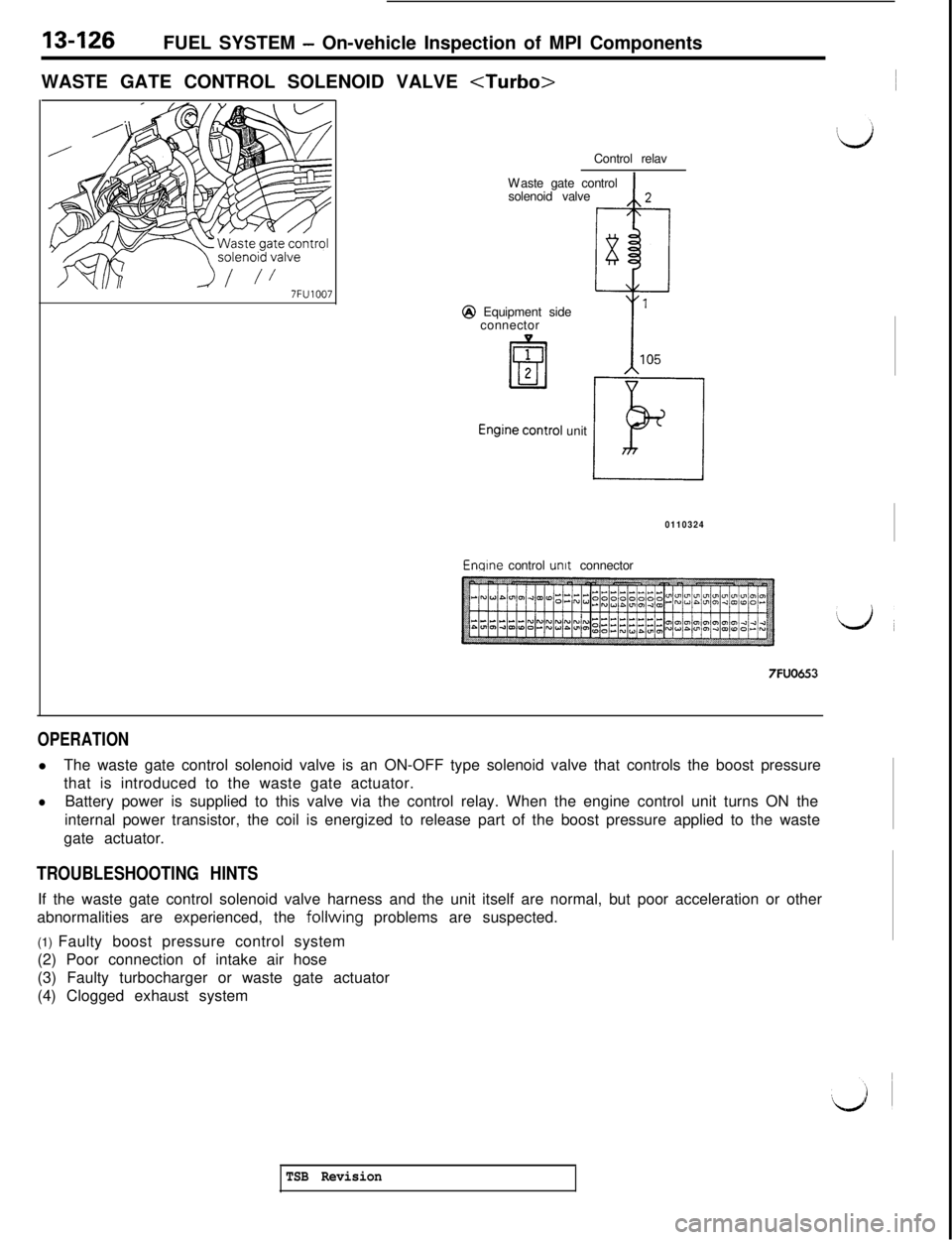
13-126FUEL SYSTEM - On-vehicle Inspection of MPI Components
WASTE GATE CONTROL SOLENOID VALVE
7FU1007Control relav
Waste gate control
solenoid valve
Q Equipment side
connector
unit
0110324Enqlne control unit connector
7FUO653
OPERATIONlThe waste gate control solenoid valve is an ON-OFF type solenoid valve that controls the boost pressure
that is introduced to the waste gate actuator.
lBattery power is supplied to this valve via the control relay. When the engine control unit turns ON the
internal power transistor, the coil is energized to release part of the boost pressure applied to the waste
gate actuator.
TROUBLESHOOTING HINTSIf the waste gate control solenoid valve harness and the unit itself are normal, but poor acceleration or other
abnormalities are experienced, the
follwing problems are suspected.
(1) Faulty boost pressure control system
(2) Poor connection of intake air hose
(3) Faulty turbocharger or waste gate actuator
(4) Clogged exhaust system
TSB Revision
Page 253 of 1146
FUEL SYSTEM - Fuel Tank13-147
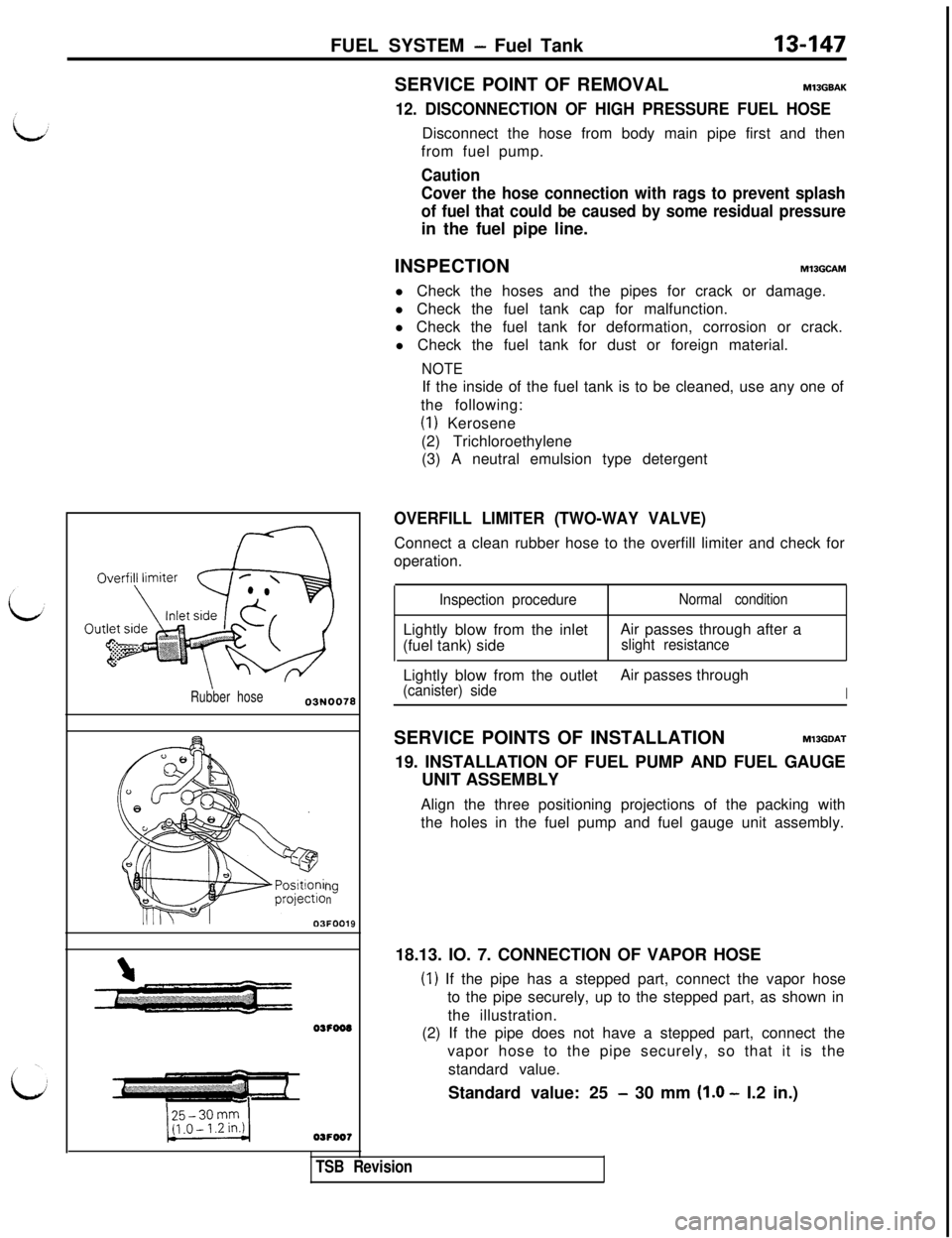
Rubber hose
ngn
03FOOl
9
OSFOOB
05FOO7SERVICE POINT OF REMOVAL
MlBGBAK
12. DISCONNECTION OF HIGH PRESSURE FUEL HOSEDisconnect the hose from body main pipe first and then
from fuel pump.
Caution
Cover the hose connection with rags to prevent splash
of fuel that could be caused by some residual pressurein the fuel pipe line.
INSPECTION
MlBGCAMl Check the hoses and the pipes for crack or damage.
l Check the fuel tank cap for malfunction.
l Check the fuel tank for deformation, corrosion or crack.
l Check the fuel tank for dust or foreign material.
NOTEIf the inside of the fuel tank is to be cleaned, use any one of
the following:
(1) Kerosene
(2) Trichloroethylene
(3) A neutral emulsion type detergent
OVERFILL LIMITER (TWO-WAY VALVE)Connect a clean rubber hose to the overfill limiter and check for
operation.
Inspection procedureLightly blow from the inlet
(fuel tank) sideNormal conditionAir passes through after a
slight resistanceLightly blow from the outletAir passes through
(canister) sideISERVICE POINTS OF INSTALLATION
MlSGDAT19. INSTALLATION OF FUEL PUMP AND FUEL GAUGE
UNIT ASSEMBLY
Align the three positioning projections of the packing with
the holes in the fuel pump and fuel gauge unit assembly.
TSB Revision18.13. IO. 7. CONNECTION OF VAPOR HOSE
(1) If the pipe has a stepped part, connect the vapor hose
to the pipe securely, up to the stepped part, as shown in
the illustration.
(2) If the pipe does not have a stepped part, connect the
vapor hose to the pipe securely, so that it is the
standard value.
Standard value: 25
- 30 mm (1.0 - I.2 in.)
Page 346 of 1146

17-2EMISSION CONTROL - Specifications / Troubleshooting
SPECIFICATIONS
GENERAL SPECIFICATIONSMl’ICA- -\
Items
Crankcase emission control systemSpecifications
Closed type with positive crankcase ventilationvalve
Evaporative emission control systemCanister storage type
Canister
Charcoal type
Purge control solenoid valve
ON/OFF solenoid valve
Exhaust emission control system
Exhaust gas recirculation system
EGR valveVacuum-activated diaphragm type
EGR temperature sensor
EGR control solenoid valve
Catalytic converter
Monolith type
Location
Under floor
Turbocharger outlet (front bank and rear bank,)
and under floor
SERVICE SPECIFICATIONSMl7CB-.
ItemsSpecifications
Purge control solenoid valve coil resistance
036 - 44 [at 20°C (68”F)I\
EGR temperature sensor resistancekfl60 - 83 [at 50°C (I 22”F)]
11 - 14 [at 100°C (212”F)l
EGR control solenoid valve coil resistance1236 - 44 [at 20°C (68”F)lI
TROUBLESHOOTING
Symptom
Engine will not start
or hard to start
Rough idle or engine
stalls
Probable cause
Vacuum hose disconnected or damaged
The EGR valve is not closed
Malfunction of the purge control solenoid valve
The EGR valve is not closed
Vacuum hose disconnected or damaged
Malfunction of the positive crankcase ventilationvalveRemedy
Repair or replace
Repair or replace
Repair or replace
Repair or replace
Repair or replace
Replace
Malfunction of the purge control systemCheck the system; if there is a
problem, check its component parts
Engine hesitates or3oor acceleration
Zxcessive oil:onsumptron
Malfunction of the exhaust gas recirculation
system
Positive crankcase ventilation line cloggedCheck the system; if there is a
problem, check its component parts
Check positive crankcase
ventila-tion system
Ioor fuel mileageMalfunction of the exhaust gas recirculation
systemTSB RevisionCheck the system; if there is a
problem, check its component parts
d
Page 358 of 1146
17-14 EMISSION CONTROL -Exhaust Gas Recirculation (EGR) System / Catalytic Converter
6EM01871
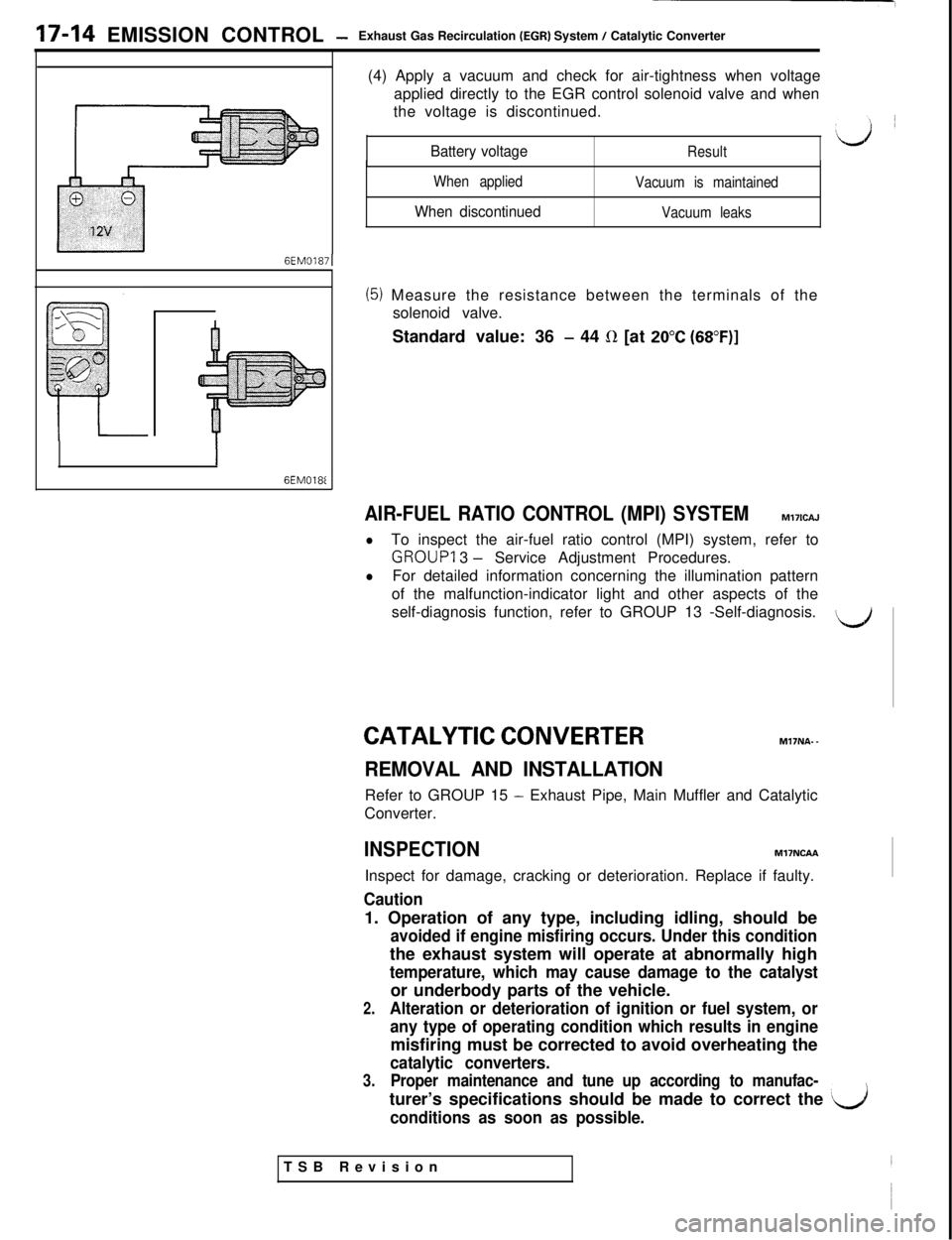
6EM0181(4) Apply a vacuum and check for air-tightness when voltage
applied directly to the EGR control solenoid valve and when
the voltage is discontinued.
Battery voltageResult
When applied
When discontinued
Vacuum is maintained
Vacuum leaks
(5) Measure the resistance between the terminals of the
solenoid valve.
Standard value: 36
- 44 R [at 20°C (68”F)]
AIR-FUEL RATIO CONTROL (MPI) SYSTEMM17ICAJ
lTo inspect the air-fuel ratio control (MPI) system, refer to
GROUP1 3 - Service Adjustment Procedures.
lFor detailed information concerning the illumination pattern
of the malfunction-indicator light and other aspects of the
self-diagnosis function, refer to GROUP 13 -Self-diagnosis.
\.J
CATALYTIC CONVERTERMl7N& -
REMOVAL AND INSTALLATIONRefer to GROUP 15
- Exhaust Pipe, Main Muffler and Catalytic
Converter.
INSPECTIONMl7NCAA
Inspect for damage, cracking or deterioration. Replace if faulty.
Caution1. Operation of any type, including idling, should be
avoided if engine misfiring occurs. Under this conditionthe exhaust system will operate at abnormally high
temperature, which may cause damage to the catalystor underbody parts of the vehicle.
2.Alteration or deterioration of ignition or fuel system, or
any type of operating condition which results in enginemisfiring must be corrected to avoid overheating the
catalytic converters.
3.Proper maintenance and tune up according to manufac-turer’s specifications should be made to correct the
‘bi
conditions as soon as possible.TSB Revision
Page 682 of 1146
33B-20 ELECTRONIC CONTROL SUSPENSION (ECS)-llwmtk Positkm .semor I stop tight switch I POriticm DetsctionSWitEh 1 DPmping Force changeover Acluatc., / EC3 Indii.ar l.igil*
THROTTLE POSITION SENSORM33ZKA6
INSPECTION AND ADJUSTMENTIRefer to GROUP 13
- Fuel System.‘lJ ’
STOP LIGHT SWITCHM33ZCAC
To remove or mount the stop light switch, refer to GROUP 35 -
Brake Pedal.
INSPECTIONRefer to GROUP 35
- Brake Pedal.
POSITION DETECTION SWITCH and
DAMPING FORCE CHANGEOVER
ACTUATORM33ZCAD
To remove or mount the position detection switch and dampingforce changeover actuator, refer to GROUP 33A
- Strut LJAssembly and GROUP 34
- Shock Absorber Assembly.
CautionThe position detection switch and damping force
changeover actuator are built into the shock absorber
assemblies of front and rear suspensions. Since they are ofthe non-disassembly type, remove or mount them in the
form of a strut assembly or shock absorber assembly.
ECS INDICATOR LIGHTM33ZLAB
To remove or mount the ECS indicator lights, refer to GROUP54
- Meters and Gauges.
TSB Revision