engine oil MITSUBISHI 3000GT 1991 Service Manual
[x] Cancel search | Manufacturer: MITSUBISHI, Model Year: 1991, Model line: 3000GT, Model: MITSUBISHI 3000GT 1991Pages: 1146, PDF Size: 76.68 MB
Page 5 of 1146
,
b
00-I
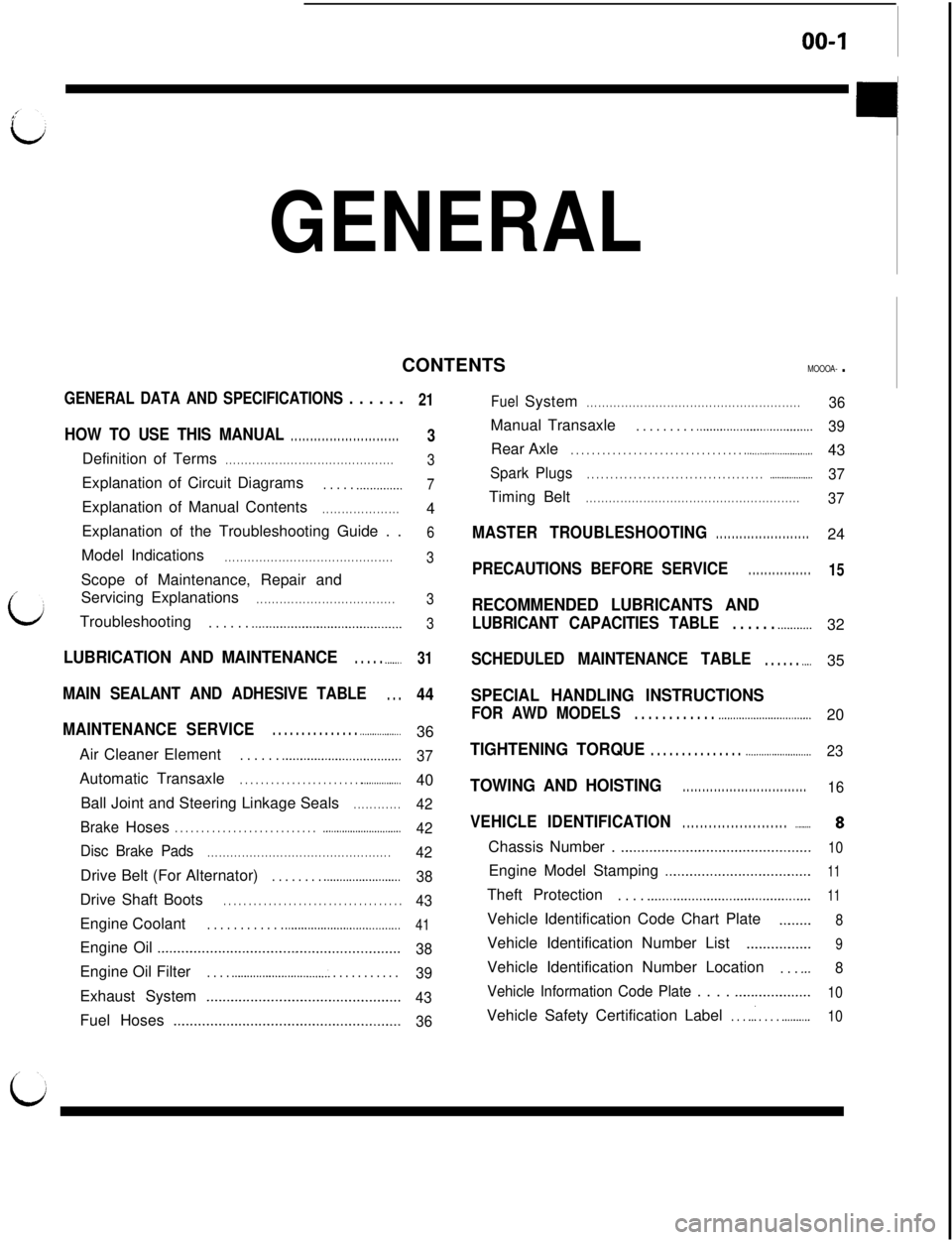
GENERALCONTENTS
MOOOA- .
GENERAL DATA AND SPECIFICATIONS . . . . . .21
HOW TO USE THIS MANUAL. . . . . . . . . . . . . . . . . . . . . . . . . . . .3Definition of Terms
. . . . . . . . . . . . . . . . . . . . . . . . . . . . . . . . . . . . . . . . . . . .3Explanation of Circuit Diagrams
. . . . . .._...........7Explanation of Manual Contents
. . . . . . . . . . . . . . . . . . . .4
Explanation of the Troubleshooting Guide . .
6ModelIndications
. . . . . . . . . . . . . . . . . . . . . . . . . . . . . . . . . . . . . . . . . . . .3Scope of Maintenance, Repair and
ServicingExplanations
. . . . . . . . . . . . . . . . . . . . . . . . . . . . . . . . . . . .3Troubleshooting
. . . . . . .._.......................................3
LUBRICATION AND MAINTENANCE. . . . . .._....31SCHEDULED MAINTENANCE TABLE. . . . . . .._.
MAIN SEALANT AND ADHESIVE TABLE. . .44
MAINTENANCE SERVICE
. . . . . . . . . . . . . . . .._......_.....__Air Cleaner Element
. . . . . . .._......._......_................Automatic Transaxle
. . . . . . . . . . . . . . . . . . . . . . . . .._......._.....Ball Joint and Steering Linkage Seals
. . . . . . . . . . . .
BrakeHoses. . . . . . . . . . . . . . . . . . . . . . . . . . . .._......._.._...._......._..
Disc Brake Pads. . . . . . . . . . . . . . . . . . . . . . . . . . . . . . . . . . . . . . . . . . . . . . . .Drive Belt (For Alternator)
. . . . . . . . .._.........._..........Drive Shaft Boots
. . . . . . . . . . . . . . . . . . . . . . . . . . . . . . . . . . . .Engine Coolant
. . . . . . . . . . . . ..__.._.............................Engine Oil
.._....__._.................................................Engine Oil Filter
. . . . .._._.......__.................. . . . . . . . . . . .Exhaust System
_....._......._.....__._............,...........Fuel Hoses
..__......__............................................36
3740
42
42
42
38
43
41
38
39
43
36
FuelSystem. . . . . . . . . . . . . . . . . . . . . . . . . . . . . . . . . . . . . . . . . . . . . . . . . . . . . . . .Manual Transaxle
. . . . . . . . . .._........................_.......Rear Axle
. . . . . . . . . . . . . . . . . . . . . . . . . . . . . . . . . . .._..._.._..____.._.......
SparkPlugs. . . . . . . . . . . . . . . . . . . . . . . . . . . . . . . . . . . . . . .._...............TimingBelt
. . . . . . . . . . . . . . . . . . . . . . . . . . . . . . . . . . . . . . . . . . . . . . . . . . . . . . . .
MASTER TROUBLESHOOTING. . . . . . . . . . . . . . . . . . . . . . . .
PRECAUTIONS BEFORE SERVICE. . . . . . . . . . . . . . . .
RECOMMENDED LUBRICANTS AND
LUBRICANT CAPACITIES TABLE. . . . . . .._........
SPECIAL HANDLING INSTRUCTIONS
FOR AWD MODELS. . . . . . . . . . . . .._...._........................
TIGHTENING TORQUE. . . . . . . . . . . . . . . ..__.....................
TOWING AND HOISTING. . . . . . . . . . . . . . . . . . . . . . . . . . . . . . . .
VEHICLE IDENTIFICATION. . . . . . . . . . . . . . . . . . . . . . . . .._.....Chassis Number .
.._............................................Engine Model Stamping
.._..........................._...._Theft Protection
. . . . .._.........................................Vehicle Identification Code Chart Plate
.._.....Vehicle Identification Number List
.._._....._..._.Vehicle Identification Number Location
. . . .._
Vehicle Information Code Plate . . . . .._._......_.......Vehicle Safety Certification Label
. . . ..I . . . . .._..._...
36
3943
37
3724
1532
35
20
23
16
8
10
11
11
8
9
8
10
10
Page 8 of 1146
GENERAL - How to Use This Manual
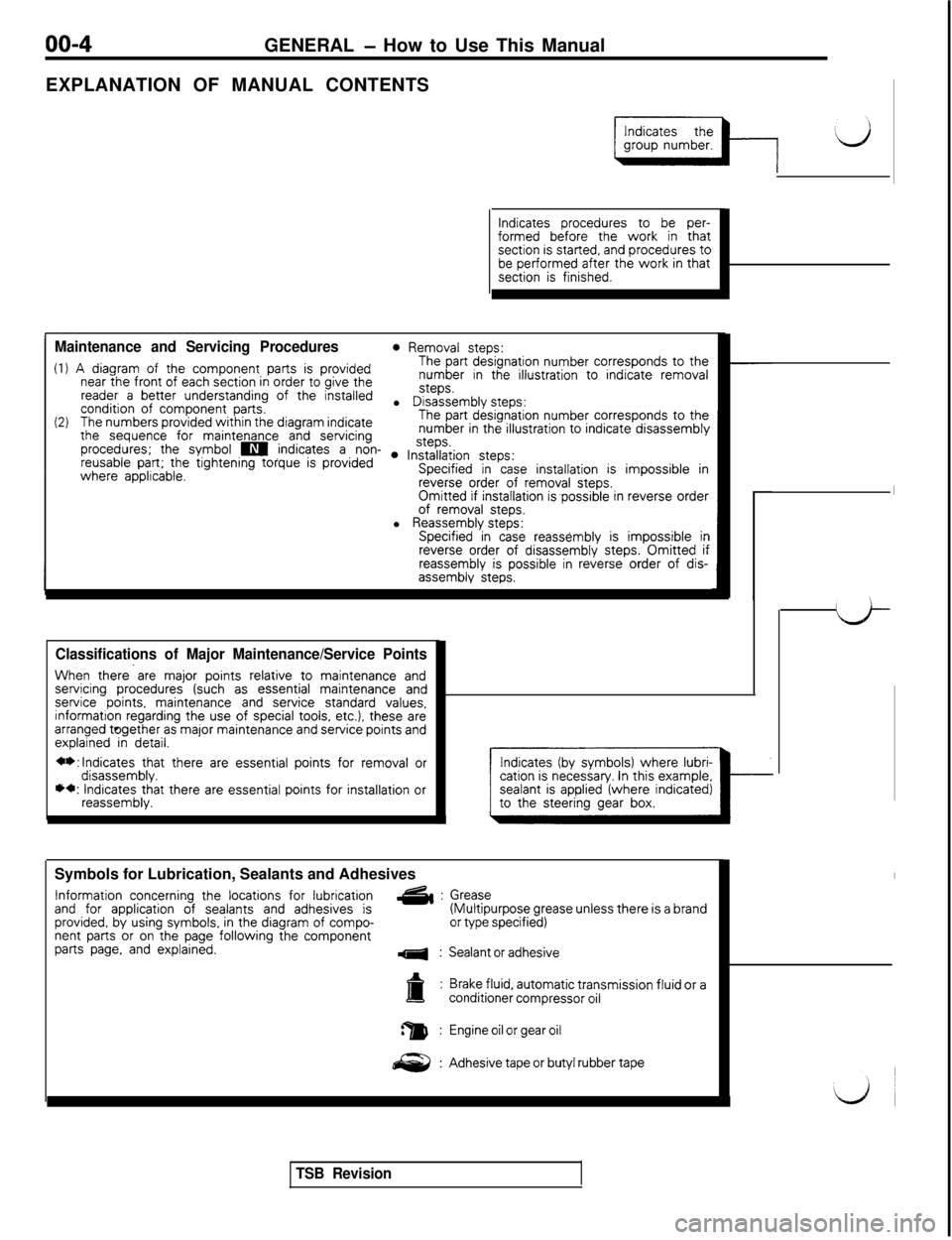
EXPLANATION OF MANUAL CONTENTS
Indicates procedures to be per-formed before the work in thatsection is started, and procedures tobe performed after the work in thatsection is finished.
Maintenance and Servicing Procedures0 Removal steps:
(1) A diagram of the component parts is providedThe part designation number corresponds to the
near the front of each section in order to give thenumber in the illustration to indicate removal
reader a better understanding of the installedsteps.
condition of component parts.l Disassembly steps:
(2)The numbers provided within the diagram indicateThe part designation number corresponds to the
the sequence for maintenance and servicingnumber in the illustration to indicate disassembly
procedures; the symbol m indicates a non- . ln~~~~iion steps:reusable part; the tightening torque is providedwhere applicable.Specified in case installation is impossible inreverse order of removal steps.Omitted if installation is,possible in reverse orderof removal steps.l Reassembly steps:Specified in case reassembly is impossible inreverse order of disassembly steps. Omitted ifreassembly is possible in reverse order of dis-assembly steps.
Classifications of Major Maintenance/Service Points
When there’are major points relative to maintenance andservicing procedures (such as essential maintenance andservice points, maintenance and service standard values,informatton regarding the use of special toois, etc.), these arearranged together as major maintenance and service points andexplained in detail.
**:lndicates that there are essential points for removal ordisassembly.*+: Indicates that there are essential points for installation orreassembly.Symbols for Lubrication, Sealants and Adhesives
Information concerning the locations for lubricationand for application of sealants and adhesives isG&:
provided, by using symbols, in the diagram of compo-nent parts or on the page following the componentparts page, and explained.4:
Indicates (by symbols) where lubri-cation is necessary. In this example,
Grease(Multipurpose grease unless there is a brandor type specified)
Sealant or adhesive
Brake fluid, automatic transmission fluid or aconditioner compressor oil
Engine oil or gear oil
Adhesive tape or butyl rubber tape
TSB Revision
Page 30 of 1146
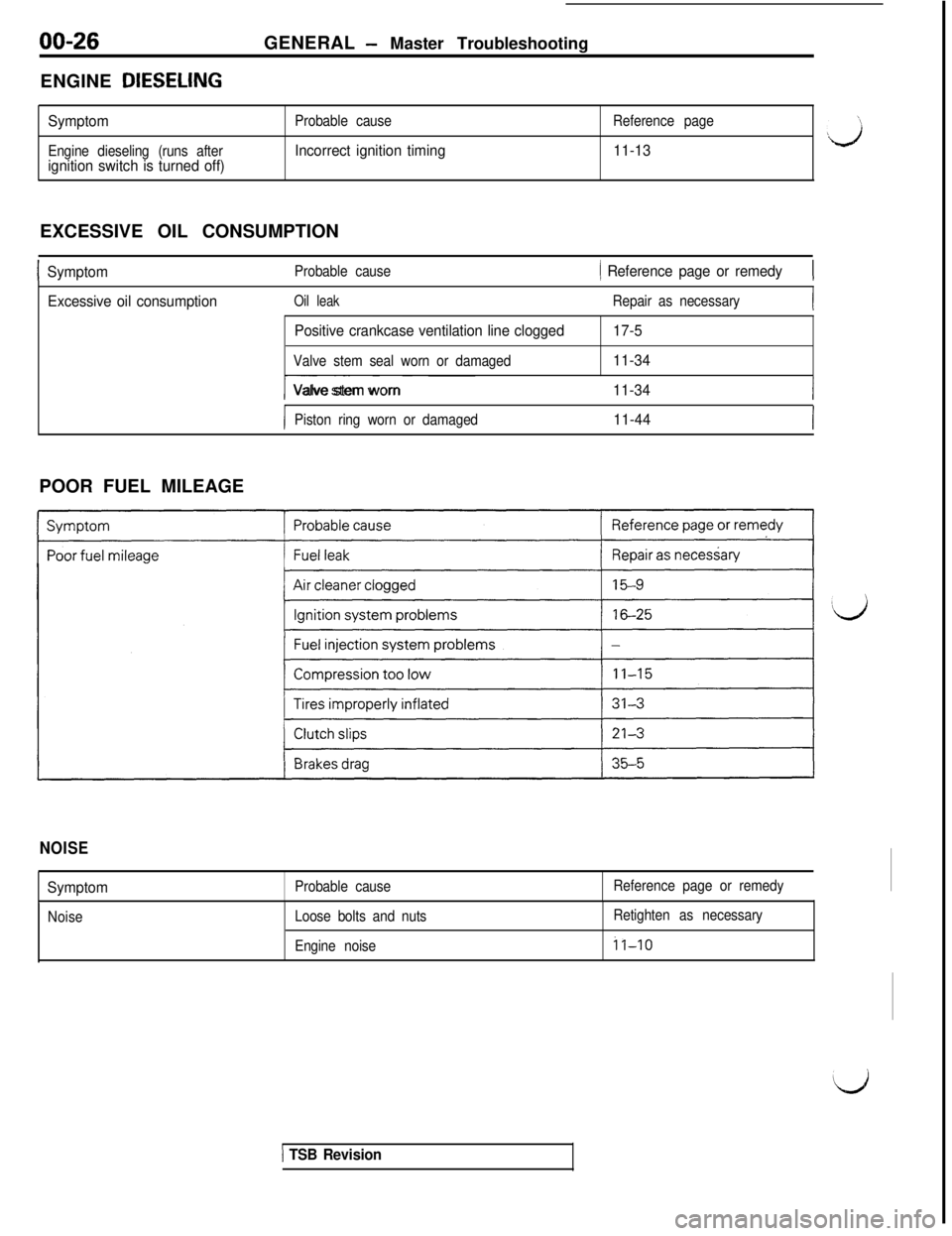
00-26GENERAL - Master Troubleshooting
ENGINE DIESELING
Symptom
Engine dieseling (runs afterignition switch is turned off)
Probable cause
Incorrect ignition timing
Reference page
11-13EXCESSIVE OIL CONSUMPTION
ISymptomProbable cause( Reference page or remedy(
Excessive oil consumptionOil leakRepair as necessary
Positive crankcase ventilation line clogged
Valve stem seal worn or damaged
17-5
11-34
I----Valve stem worn11-34I
IPiston ring worn or damaged11-44IPOOR FUEL MILEAGE
NOISE
SymptomProbable causeReference page or remedy
NoiseLoose bolts and nutsRetighten as necessary
Engine noise
il-10
) TSB Revision
Page 35 of 1146
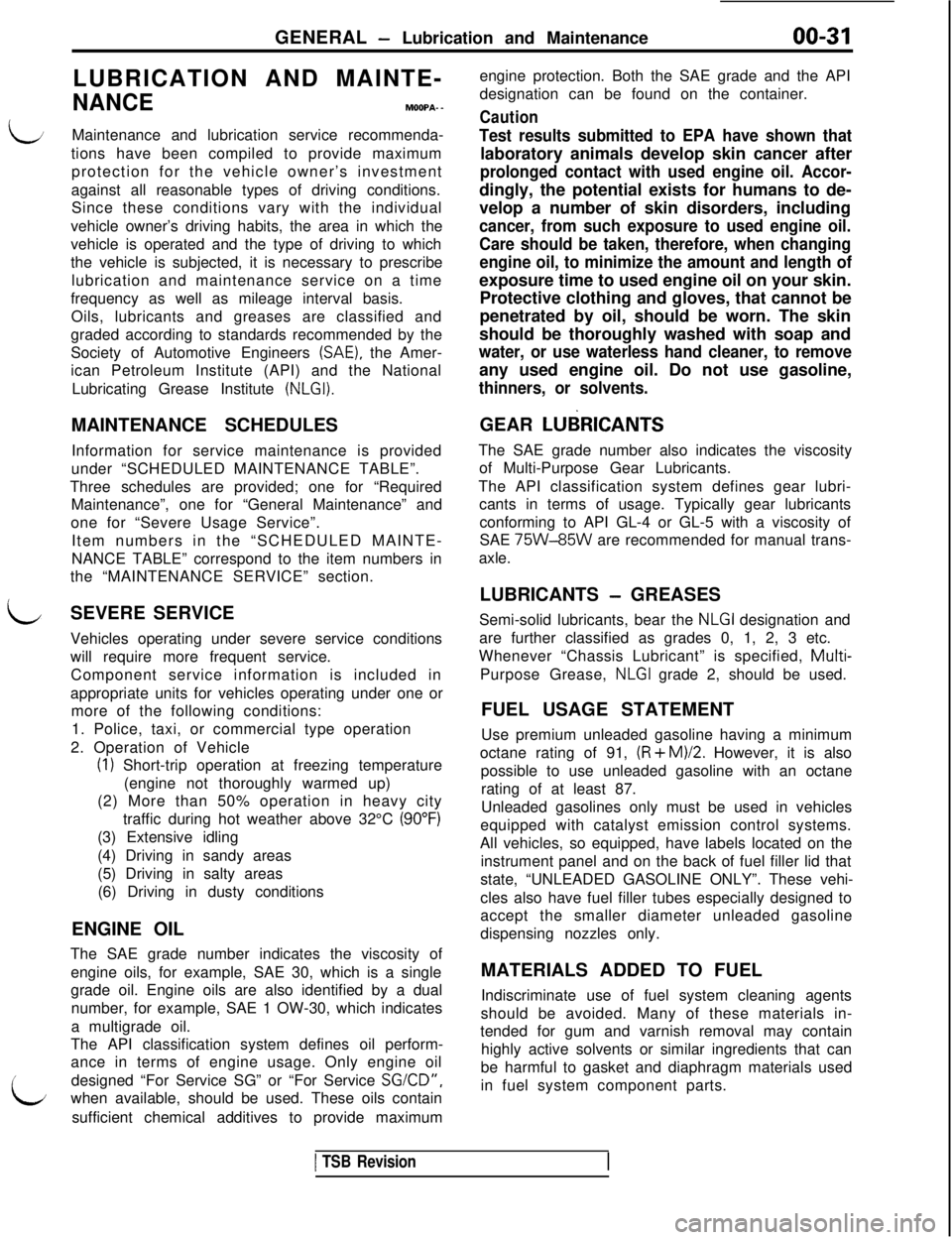
GENERAL - Lubrication and Maintenance00-31LUBRICATION AND MAINTE-
NANCEMOOPA- -
iiMaintenance and lubrication service recommenda-
tions have been compiled to provide maximum
protection for the vehicle owner’s investment
against all reasonable types of driving conditions.
Since these conditions vary with the individual
vehicle owner’s driving habits, the area in which the
vehicle is operated and the type of driving to which
the vehicle is subjected, it is necessary to prescribe
lubrication and maintenance service on a time
frequency as well as mileage interval basis.
Oils, lubricants and greases are classified and
graded according to standards recommended by the
Society of Automotive Engineers
(SAE), the Amer-
ican Petroleum Institute (API) and the National
Lubricating Grease Institute
(NLGI).MAINTENANCE SCHEDULES
Information for service maintenance is provided
under “SCHEDULED MAINTENANCE TABLE”.
Three schedules are provided; one for “Required
Maintenance”, one for “General Maintenance” and
one for “Severe Usage Service”.
Item numbers in the “SCHEDULED MAINTE-
NANCE TABLE” correspond to the item numbers in
the “MAINTENANCE SERVICE” section.
LSEVERE SERVICE
Vehicles operating under severe service conditions
will require more frequent service.
Component service information is included in
appropriate units for vehicles operating under one or
more of the following conditions:
1. Police, taxi, or commercial type operation
2. Operation of Vehicle
(1) Short-trip operation at freezing temperature
(engine not thoroughly warmed up)
(2) More than 50% operation in heavy city
traffic during hot weather above 32°C
(90°F)(3) Extensive idling
(4) Driving in sandy areas
(5) Driving in salty areas
(6) Driving in dusty conditions
ENGINE OIL
The SAE grade number indicates the viscosity of
engine oils, for example, SAE 30, which is a single
grade oil. Engine oils are also identified by a dual
number, for example, SAE 1 OW-30, which indicates
a multigrade oil.
The API classification system defines oil perform-
ance in terms of engine usage. Only engine oil
idesigned “For Service SG” or “For Service
SGXD”,when available, should be used. These oils contain
sufficient chemical additives to provide maximumengine protection. Both the SAE grade and the API
designation can be found on the container.
Caution
Test results submitted to EPA have shown thatlaboratory animals develop skin cancer after
prolonged contact with used engine oil. Accor-dingly, the potential exists for humans to de-
velop a number of skin disorders, including
cancer, from such exposure to used engine oil.
Care should be taken, therefore, when changing
engine oil, to minimize the amount and length ofexposure time to used engine oil on your skin.
Protective clothing and gloves, that cannot be
penetrated by oil, should be worn. The skin
should be thoroughly washed with soap and
water, or use waterless hand cleaner, to removeany used engine oil. Do not use gasoline,
thinners, or solvents.GEAR
LUEiRlCANTSThe SAE grade number also indicates the viscosity
of Multi-Purpose Gear Lubricants.
The API classification system defines gear lubri-
cants in terms of usage. Typically gear lubricants
conforming to API GL-4 or GL-5 with a viscosity of
SAE
75W-85W are recommended for manual trans-
axle.
LUBRICANTS
- GREASES
Semi-solid lubricants, bear the
NLGI designation and
are further classified as grades 0, 1, 2, 3 etc.
Whenever “Chassis Lubricant” is specified,
Multi-Purpose Grease,
NLGI grade 2, should be used.
FUEL USAGE STATEMENT
Use premium unleaded gasoline having a minimum
octane rating of 91,
(R + M)/2. However, it is also
possible to use unleaded gasoline with an octane
rating of at least 87.
Unleaded gasolines only must be used in vehicles
equipped with catalyst emission control systems.
All vehicles, so equipped, have labels located on the
instrument panel and on the back of fuel filler lid that
state, “UNLEADED GASOLINE ONLY”. These vehi-
cles also have fuel filler tubes especially designed to
accept the smaller diameter unleaded gasoline
dispensing nozzles only.
MATERIALS ADDED TO FUEL
Indiscriminate use of fuel system cleaning agents
should be avoided. Many of these materials in-
tended for gum and varnish removal may contain
highly active solvents or similar ingredients that can
be harmful to gasket and diaphragm materials used
in fuel system component parts.
1 TSB Revision
Page 36 of 1146
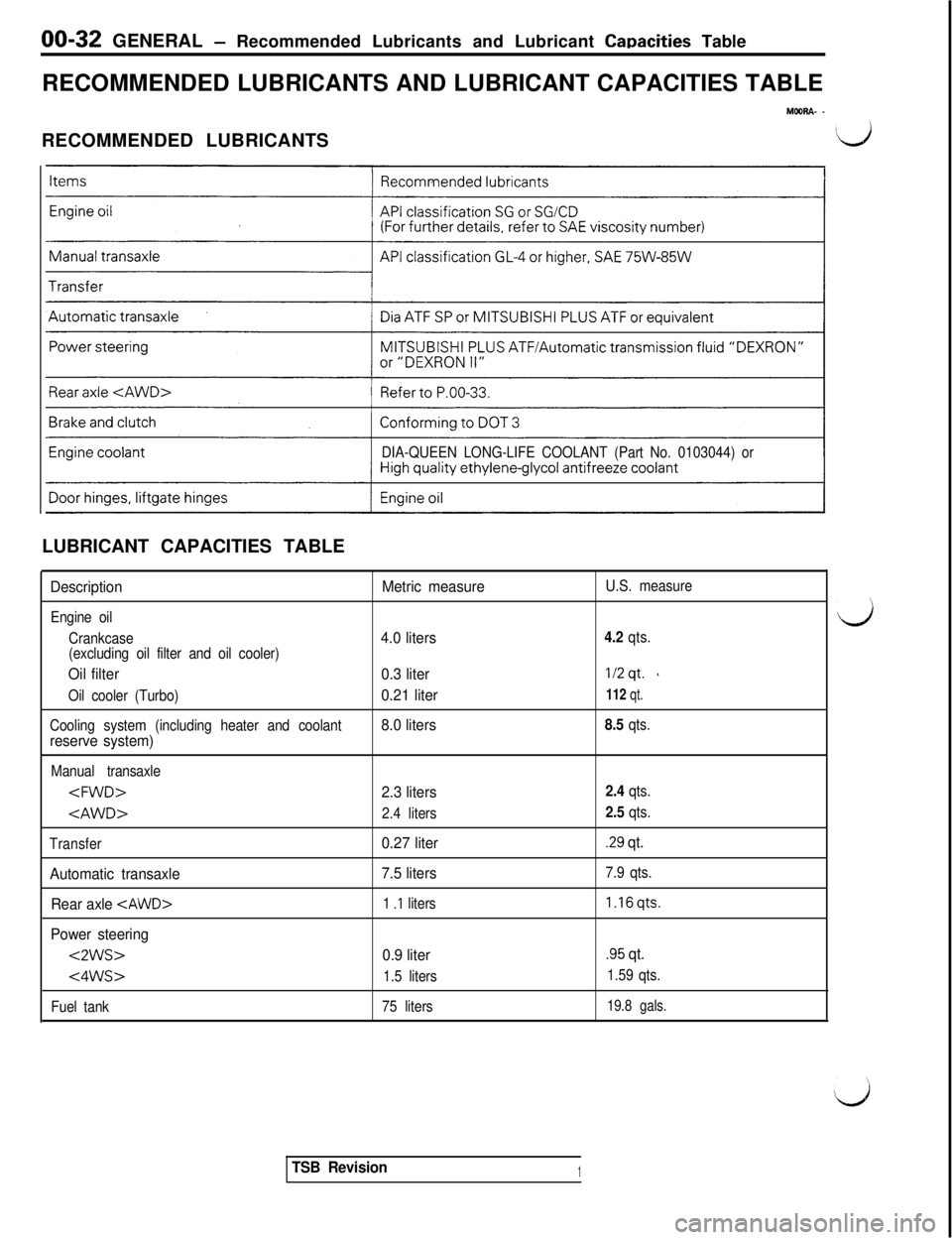
00-32 GENERAL - Recommended Lubricants and Lubricant Capacities Table
RECOMMENDED LUBRICANTS AND LUBRICANT CAPACITIES TABLE
MOORA- -RECOMMENDED LUBRICANTS
\L/
DIA-QUEEN LONG-LIFE COOLANT (Part No. 0103044) orLUBRICANT CAPACITIES TABLE
Description
Engine oil
Crankcase
(excluding oil filter and oil cooler)
Oil filter
Oil cooler (Turbo)
Cooling system (including heater and coolant
reserve system)
Manual transaxle
Transfer
Automatic transaxle
Rear axle
Power steering
<2ws>
<4ws>
Fuel tank
Metric measureU.S. measure
4.0 liters4.2 qts.
0.3 liter1/2qt. s
0.21 liter112 qt.
8.0 liters8.5 qts.
2.3 liters2.4 qts.
2.4 liters
2.5 qts.
0.27 liter.29 qt.
7.5 liters
7.9 qts.
1
.I liters1.16qts.
0.9 liter
.95 qt.
1.5 liters1.59 qts.
75 liters
19.8 gals.
TSB Revision1
d
Page 37 of 1146
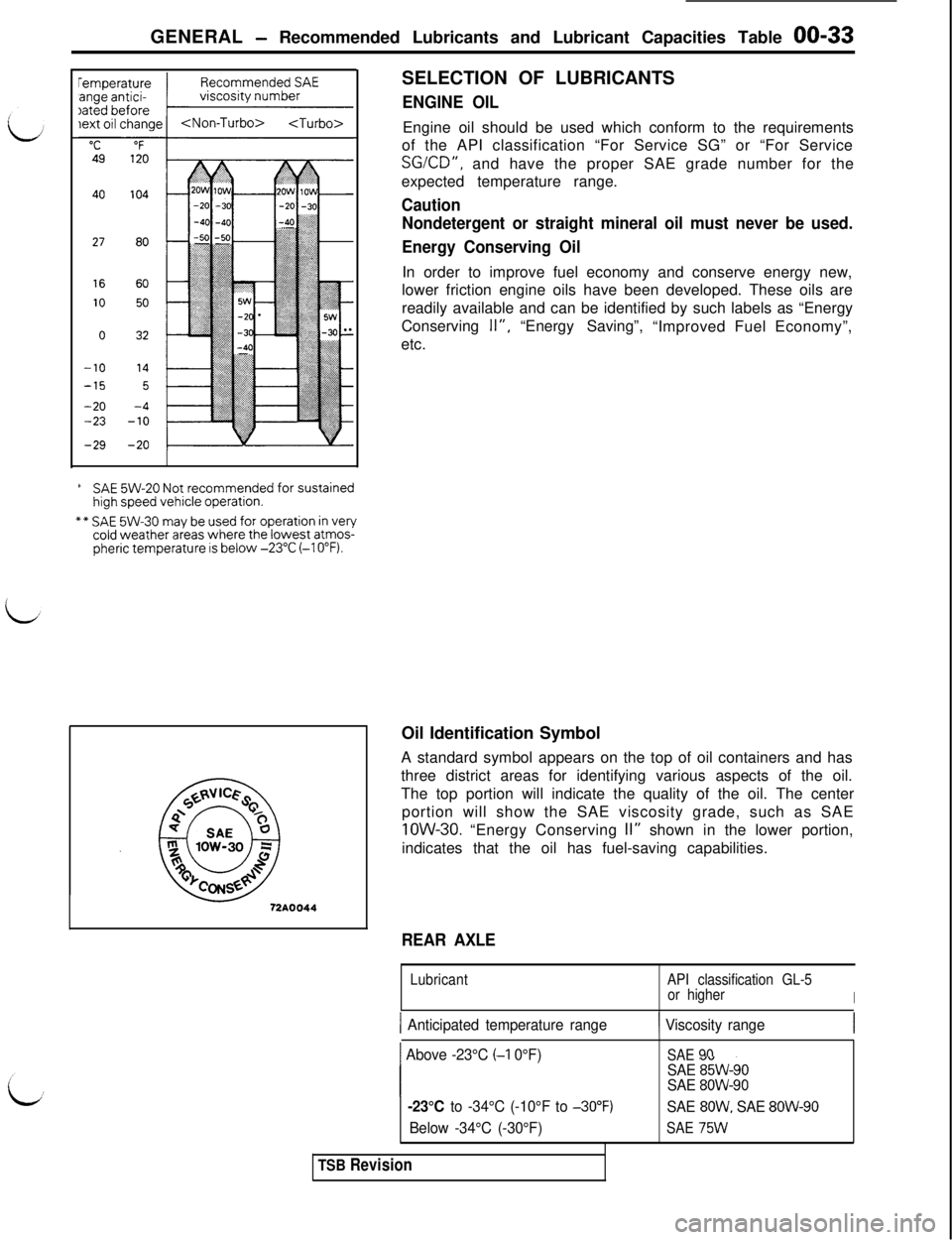
GENERAL - Recommended Lubricants and Lubricant Capacities Table 00-334027
8016
60
1050032
-1014
-155
-20-4-23-10
-29-20104
6SAE 5W-20 Not recommended for sustainedhigh speed vehicle operation.
** SAE 5W-30 may be used for operation in verycold weather areas where the lowest atmos-pheric temperature is below -23°C (-10°F).SELECTION OF LUBRICANTS
ENGINE OILEngine oil should be used which conform to the requirements
of the API classification “For Service SG” or “For Service
SGKD”, and have the proper SAE grade number for the
expected temperature range.
Caution
Nondetergent or straight mineral oil must never be used.
Energy Conserving OilIn order to improve fuel economy and conserve energy new,
lower friction engine oils have been developed. These oils are
readily available and can be identified by such labels as “Energy
Conserving
II”,“Energy Saving”,
“Improved Fuel Economy”,
etc.
Oil Identification Symbol
A standard symbol appears on the top of oil containers and has
three district areas for identifying various aspects of the oil.
The top portion will indicate the quality of the oil. The center
portion will show the SAE viscosity grade, such as SAEIOW-30. “Energy Conserving
II” shown in the lower portion,
indicates that the oil has fuel-saving capabilities.
72AOO.34
REAR AXLE
LubricantAPI classification GL-5
or higher
I
1 Anticipated temperature range
1 Above -23°C k-1 0°F)
1 Viscosity range
-23°C to -34°C (-10°F to -30°F)
Below -34°C (-30°F)
SAE 90SAE 85W-90SAE 8OW-90
SAE 80W. SAE 8OW-90
SAE 75W
TSB Revision
Page 40 of 1146
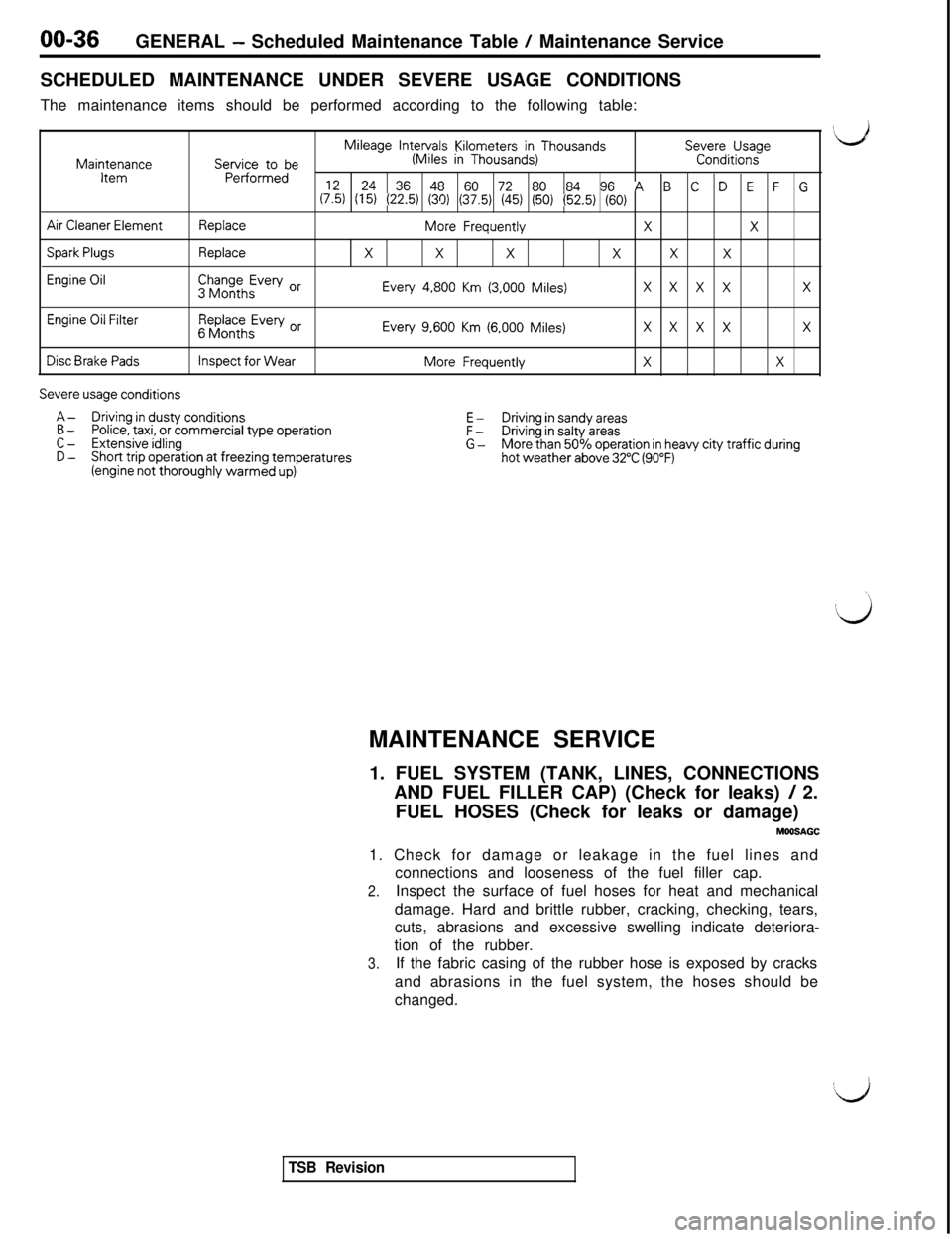
00-36GENERAL - Scheduled Maintenance Table / Maintenance Service
SCHEDULED MAINTENANCE UNDER SEVERE USAGE CONDITIONS
The maintenance items should be performed according to the following table:
Mileage Intervals Kilometers in ThousandsSevere Usage
MaintenanceService to be(Miles in Thousands)Conditions
itemPerformed
(6 (15) (22.5) (30) (37.5) (45) (50) (52.5) (60)24 36 48 60 72 80 84 96 A B C D E F G
Air Cleaner ElementReplaceMore FrequentlyXX
Spark PlugsReplaceXXXXXX
Engine OilChange Every Or3 MonthsEvery 4,800 Km (3,000 Miles)x x x xX
Engine Oil FilterReplace Every or6 MonthsEvery 9,600 Km (6.000 Miles)x x x xX
Disc Brake PadsInspect for WearMore FrequentlyXX
Severe usage conditions
A-Driving in dusty conditionsE -B -Police, taxi, or commercial type operationF -Driving in sandy areas
C -Extensive idlingG -Driving in salty areas
D -Short trip operation at freezing temperaturesMore than 50% operation in heavy city traffic during
(engine not thoroughly warmed up)hot weather above 32°C (90°F)MAINTENANCE SERVICE
1. FUEL SYSTEM (TANK, LINES, CONNECTIONS
AND FUEL FILLER CAP) (Check for leaks)
/ 2.
FUEL HOSES (Check for leaks or damage)MWShGC
1. Check for damage or leakage in the fuel lines and
connections and looseness of the fuel filler cap.
2.Inspect the surface of fuel hoses for heat and mechanical
damage. Hard and brittle rubber, cracking, checking, tears,
cuts, abrasions and excessive swelling indicate deteriora-
tion of the rubber.
3.If the fabric casing of the rubber hose is exposed by cracks
and abrasions in the fuel system, the hoses should be
changed.
TSB Revision
Page 42 of 1146
00-38GENERAL - Maintenance Service
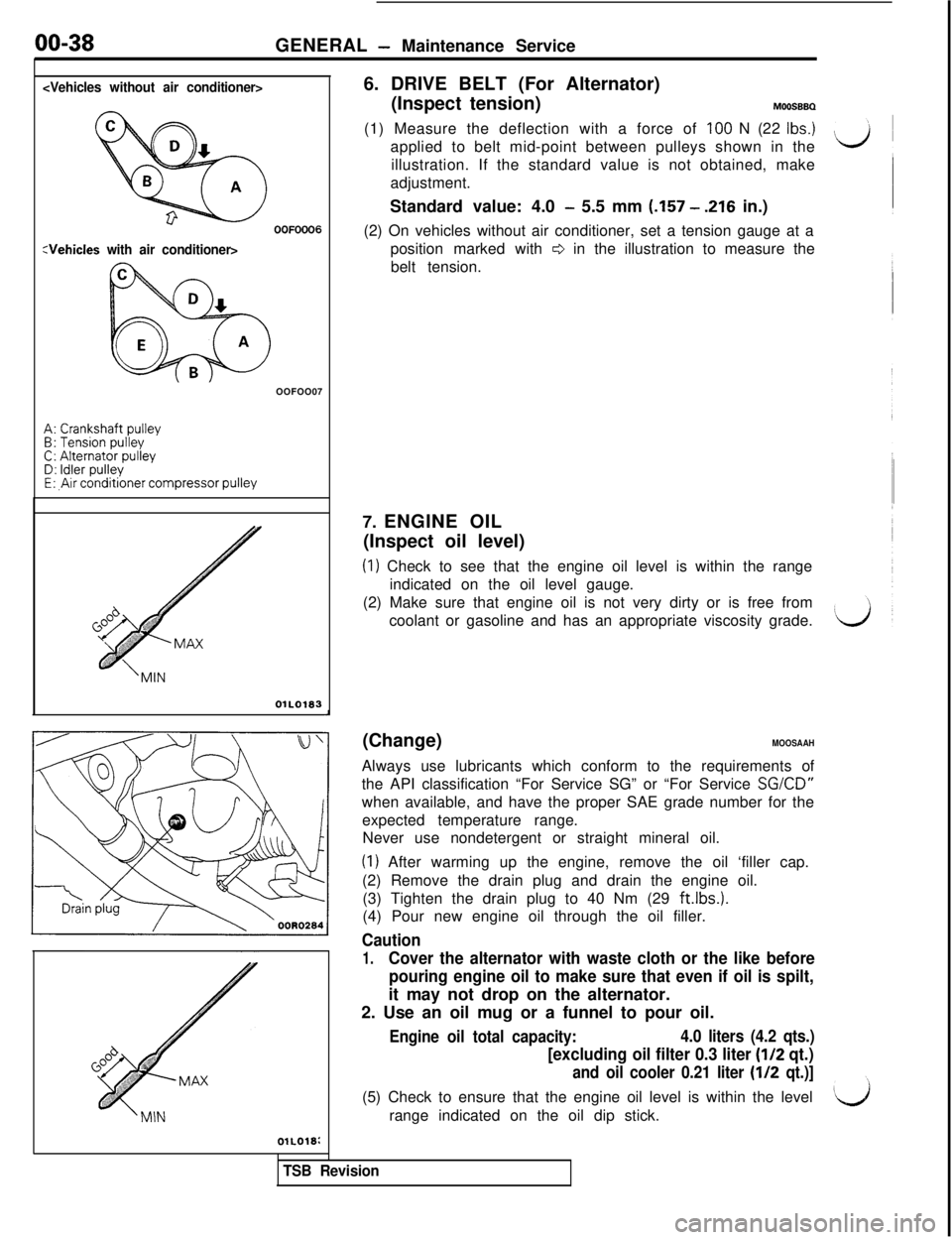
00F0006
:Vehicles with air conditioner>OOFOO07
A: Crankshaft pulleyB: Tension pulleyC: Alternator pulleyD: Idler pulleyE: ,Air conditioner compressor pulley
OlLO183
OlLO18:(Inspect tension)
MOOS88(1(1) Measure the deflection with a force of
100 N (22 Ibs.)applied to belt mid-point between pulleys shown in the
illustration. If the standard value is not obtained, make
adjustment.
Standard value: 4.0
- 5.5 mm (.157 - 216 in.)
(2) On vehicles without air conditioner, set a tension gauge at a
position marked with
r3 in the illustration to measure the
belt tension.
7. ENGINE OIL
(Inspect oil level)
(I) Check to see that the engine oil level is within the range
indicated on the oil level gauge.
(2) Make sure that engine oil is not very dirty or is free from
coolant or gasoline and has an appropriate viscosity grade.J
(Change)
MOOSAAHAlways use lubricants which conform to the requirements of
the API classification “For Service SG” or “For Service
SGKD”when available, and have the proper SAE grade number for the
expected temperature range.
Never use nondetergent or straight mineral oil.
(1) After warming up the engine, remove the oil ‘filler cap.
(2) Remove the drain plug and drain the engine oil.
(3) Tighten the drain plug to 40 Nm (29 ft.lbs.).
(4) Pour new engine oil through the oil filler.
Caution
1.Cover the alternator with waste cloth or the like before
pouring engine oil to make sure that even if oil is spilt,it may not drop on the alternator.
2. Use an oil mug or a funnel to pour oil.
Engine oil total capacity:4.0 liters (4.2 qts.)
[excluding oil filter 0.3 liter (l/2 qt.)
and oil cooler 0.21 liter (l/2 qt.)](5) Check to ensure that the engine oil level is within the level
range indicated on the oil dip stick.
TSB Revision
Page 43 of 1146
GENERAL - Maintenance Service00-39ogPOO268. ENGINE OIL FILTER (Change)
MOOEAEJThe quality of replacement filters varies considerably. Only high
quality filters should be used to assure most efficient service.
Genuine oil filters require that the filter be capable of
withstanding a pressure of 256 psi are high quality filters and
are recommended as follows:
Oil Filter Part No.
MITSUBISHI Genuine Parts: MD136790
ENGINE OIL FILTER SELECTIONThis vehicle is equipped with a full-flow, throw-away oil filter.
The same type of replacement filter is recommended as a
replacement filter for this vehicle. It is possible, particularly in
cold weather, that this vehicle may develop high oil pressure
for a short duration. You should be sure that any replacement
filter used on this vehicle is a high-quality filter and is capable of
withstanding a pressure of 256 psi (1,765
kpa) (manufacturer’s
specifications) to avoid filter and engine damage. The following
is a highquality filter and is strongly recommended for use on
this vehicle: Mitsubishi Engine Oil Filter P/N MD136790.
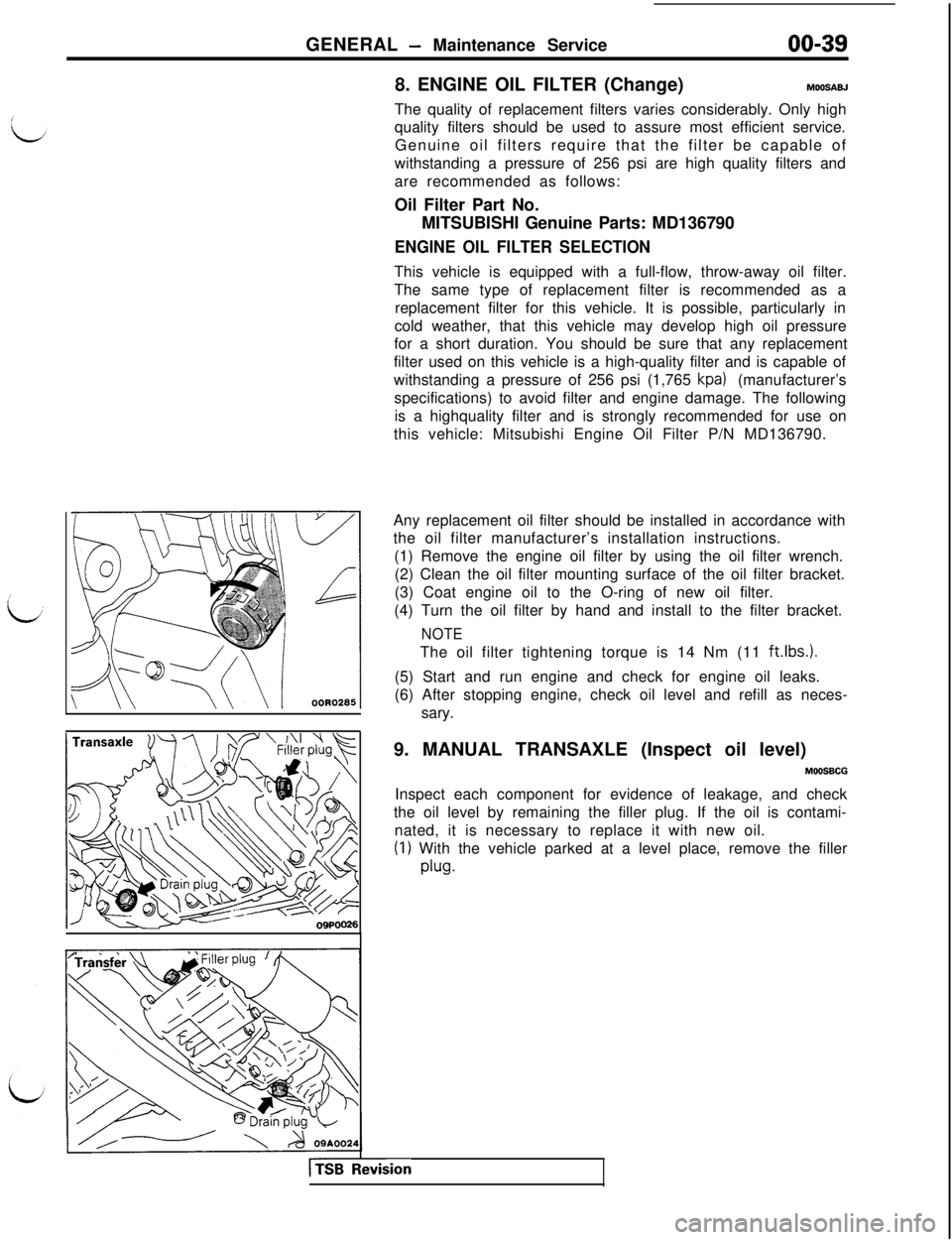
Any replacement oil filter should be installed in accordance with
the oil filter manufacturer’s installation instructions.
(1) Remove the engine oil filter by using the oil filter wrench.
(2) Clean the oil filter mounting surface of the oil filter bracket.
(3) Coat engine oil to the O-ring of new oil filter.
(4) Turn the oil filter by hand and install to the filter bracket.
NOTEThe oil filter tightening torque is 14 Nm (11
ft.lbs.1.(5) Start and run engine and check for engine oil leaks.
(6) After stopping engine, check oil level and refill as neces-
sary.
9. MANUAL TRANSAXLE (Inspect oil level)
MOOSBCGInspect each component for evidence of leakage, and check
the oil level by remaining the filler plug. If the oil is contami-
nated, it is necessary to replace it with new oil.
(1) With the vehicle parked at a level place, remove the filler
plug.
-Revision
Page 45 of 1146
GENERAL - Maintenance Service00-41
Good
t-lVA0283
I04FOOOd(4) Check the oil filter for clogging and damage and replace if
necessary.
(5) Clean drain plug and tighten drain plug with gasket to 30
-35 Nm (22
- 25 ft.lbs.).
(6) Clean both gasket surfaces of transaxle case and oil pan.
(7) Install oil pan with new gasket and tighten oil pan bolts to
10 - 12 Nm (7.5 - 8.5 ft.lbs.).
(8) Pour 4.5 liters (4.8 qts.) of specified ATF into case through
dipstick hole. [Total quantity of ATF required is approx. 7.5
liters (7.9 qts.). Actually however, approx. 4.5 liters (4.8 qts.)
of fluid can be replaced because rest of fluid remains in
torque converter.]
Specified fluid: Dia ATF SP or MITSUBISHI PLUS ATF or
equivalent(9) Start engine and allow to idle for at least two minutes.
Then, with parking brake on, move selector lever momen-
tarily to each position, ending in “N” Neutral position.
(lO)Add sufficient ATF to bring fluid level to lower mark.
Recheck fluid level after transaxle is at normal operating
temperature. Fluid level should be between upper and
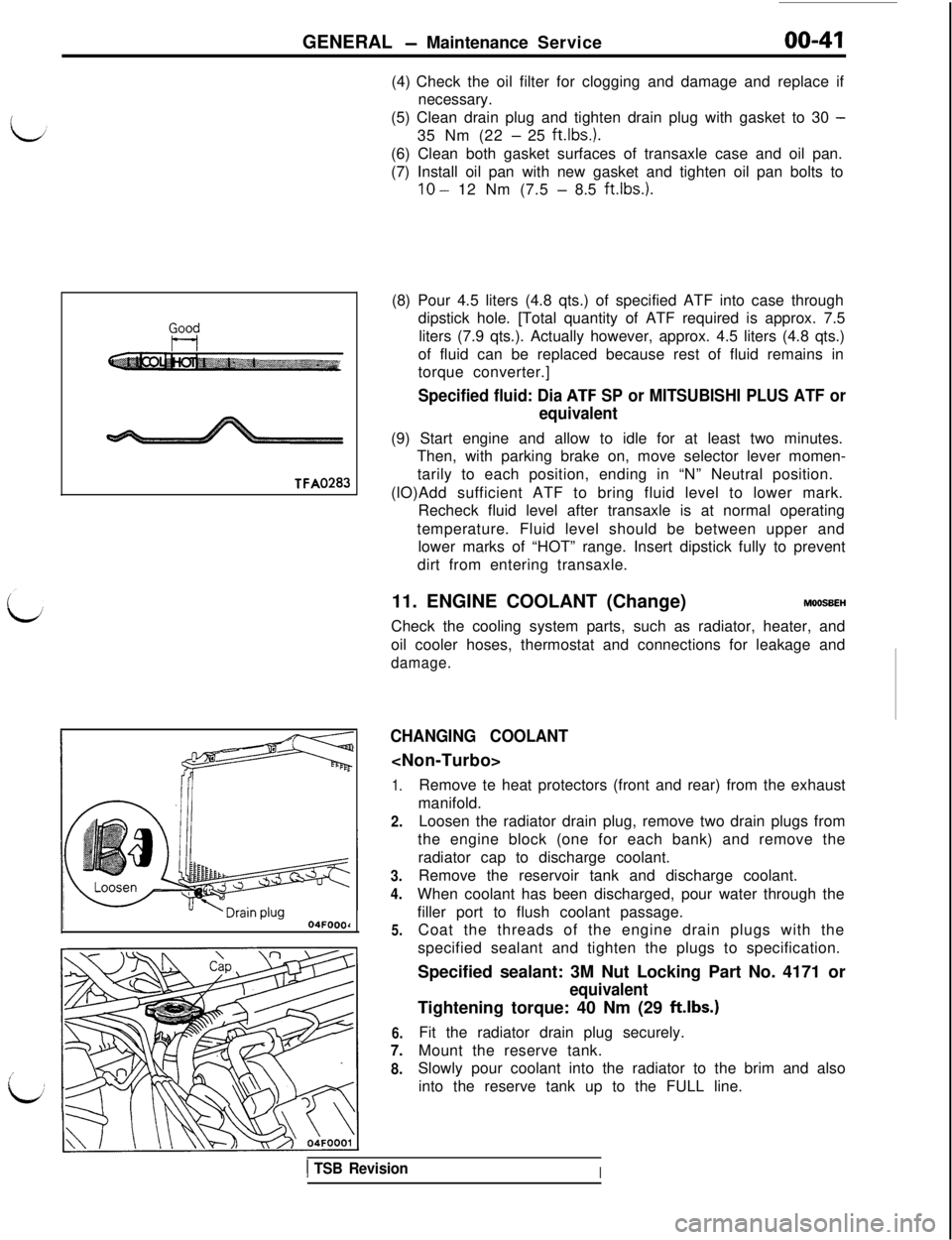
lower marks of “HOT” range. Insert dipstick fully to prevent
dirt from entering transaxle.
11. ENGINE COOLANT (Change)
MOOSBEHCheck the cooling system parts, such as radiator, heater, and
oil cooler hoses, thermostat and connections for leakage and
damage.
CHANGING COOLANT
1.
2.
3.
4.
5.
6.
7.
8.Remove te heat protectors (front and rear) from the exhaust
manifold.
Loosen the radiator drain plug, remove two drain plugs from
the engine block (one for each bank) and remove the
radiator cap to discharge coolant.
Remove the reservoir tank and discharge coolant.
When coolant has been discharged, pour water through the
filler port to flush coolant passage.
Coat the threads of the engine drain plugs with the
specified sealant and tighten the plugs to specification.
Specified sealant: 3M Nut Locking Part No. 4171 or
equivalentTightening torque: 40 Nm (29
ftlbs.)Fit the radiator drain plug securely.
Mount the reserve tank.
Slowly pour coolant into the radiator to the brim and also
into the reserve tank up to the FULL line.
1 TSB RevisionI