maintenance MITSUBISHI 3000GT 1991 User Guide
[x] Cancel search | Manufacturer: MITSUBISHI, Model Year: 1991, Model line: 3000GT, Model: MITSUBISHI 3000GT 1991Pages: 1146, PDF Size: 76.68 MB
Page 44 of 1146
00-40
GENERAL - Maintenance Service
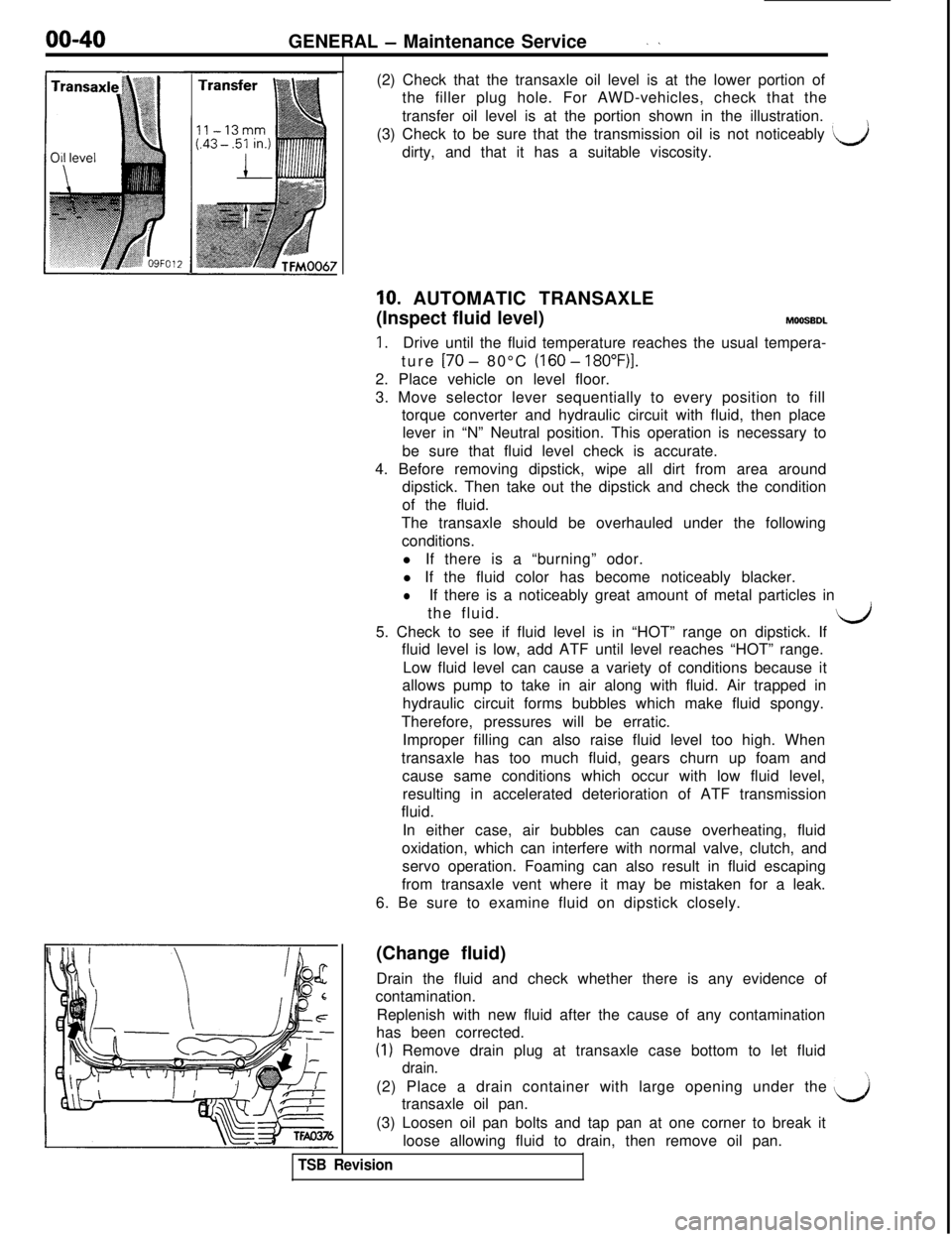
(2) Check that the transaxle oil level is at the lower portion of
the filler plug hole. For AWD-vehicles, check that the
transfer oil level is at the portion shown in the illustration.
(3) Check to be sure that the transmission oil is not noticeably
‘ddirty, and that it has a suitable viscosity.
10. AUTOMATIC TRANSAXLE
(Inspect fluid level)
MOOSEDL
1.Drive until the fluid temperature reaches the usual tempera-
ture
[70 - 80°C (160 - 18O”F)I.2. Place vehicle on level floor.
3. Move selector lever sequentially to every position to fill
torque converter and hydraulic circuit with fluid, then place
lever in “N” Neutral position. This operation is necessary to
be sure that fluid level check is accurate.
4. Before removing dipstick, wipe all dirt from area around
dipstick. Then take out the dipstick and check the condition
of the fluid.
The transaxle should be overhauled under the following
conditions.
l If there is a “burning” odor.
l If the fluid color has become noticeably blacker.
lIf there is a noticeably great amount of metal particles in
the fluid.
5. Check to see if fluid level is in “HOT” range on dipstick. If
fluid level is low, add ATF until level reaches “HOT” range.
Low fluid level can cause a variety of conditions because it
allows pump to take in air along with fluid. Air trapped in
hydraulic circuit forms bubbles which make fluid spongy.
Therefore, pressures will be erratic.
Improper filling can also raise fluid level too high. When
transaxle has too much fluid, gears churn up foam and
cause same conditions which occur with low fluid level,
resulting in accelerated deterioration of ATF transmission
fluid.
In either case, air bubbles can cause overheating, fluid
oxidation, which can interfere with normal valve, clutch, and
servo operation. Foaming can also result in fluid escaping
from transaxle vent where it may be mistaken for a leak.
6. Be sure to examine fluid on dipstick closely.
L/(Change fluid)
Drain the fluid and check whether there is any evidence of
contamination.
Replenish with new fluid after the cause of any contamination
has been corrected.
(1) Remove drain plug at transaxle case bottom to let fluid
drain.(2) Place a drain container with large opening under the
transaxle oil pan.
(3) Loosen oil pan bolts and tap pan at one corner to break it
loose allowing fluid to drain, then remove oil pan.
d
TSB Revision
Page 45 of 1146
GENERAL - Maintenance Service00-41
Good
t-lVA0283
I04FOOOd(4) Check the oil filter for clogging and damage and replace if
necessary.
(5) Clean drain plug and tighten drain plug with gasket to 30
-35 Nm (22
- 25 ft.lbs.).
(6) Clean both gasket surfaces of transaxle case and oil pan.
(7) Install oil pan with new gasket and tighten oil pan bolts to
10 - 12 Nm (7.5 - 8.5 ft.lbs.).
(8) Pour 4.5 liters (4.8 qts.) of specified ATF into case through
dipstick hole. [Total quantity of ATF required is approx. 7.5
liters (7.9 qts.). Actually however, approx. 4.5 liters (4.8 qts.)
of fluid can be replaced because rest of fluid remains in
torque converter.]
Specified fluid: Dia ATF SP or MITSUBISHI PLUS ATF or
equivalent(9) Start engine and allow to idle for at least two minutes.
Then, with parking brake on, move selector lever momen-
tarily to each position, ending in “N” Neutral position.
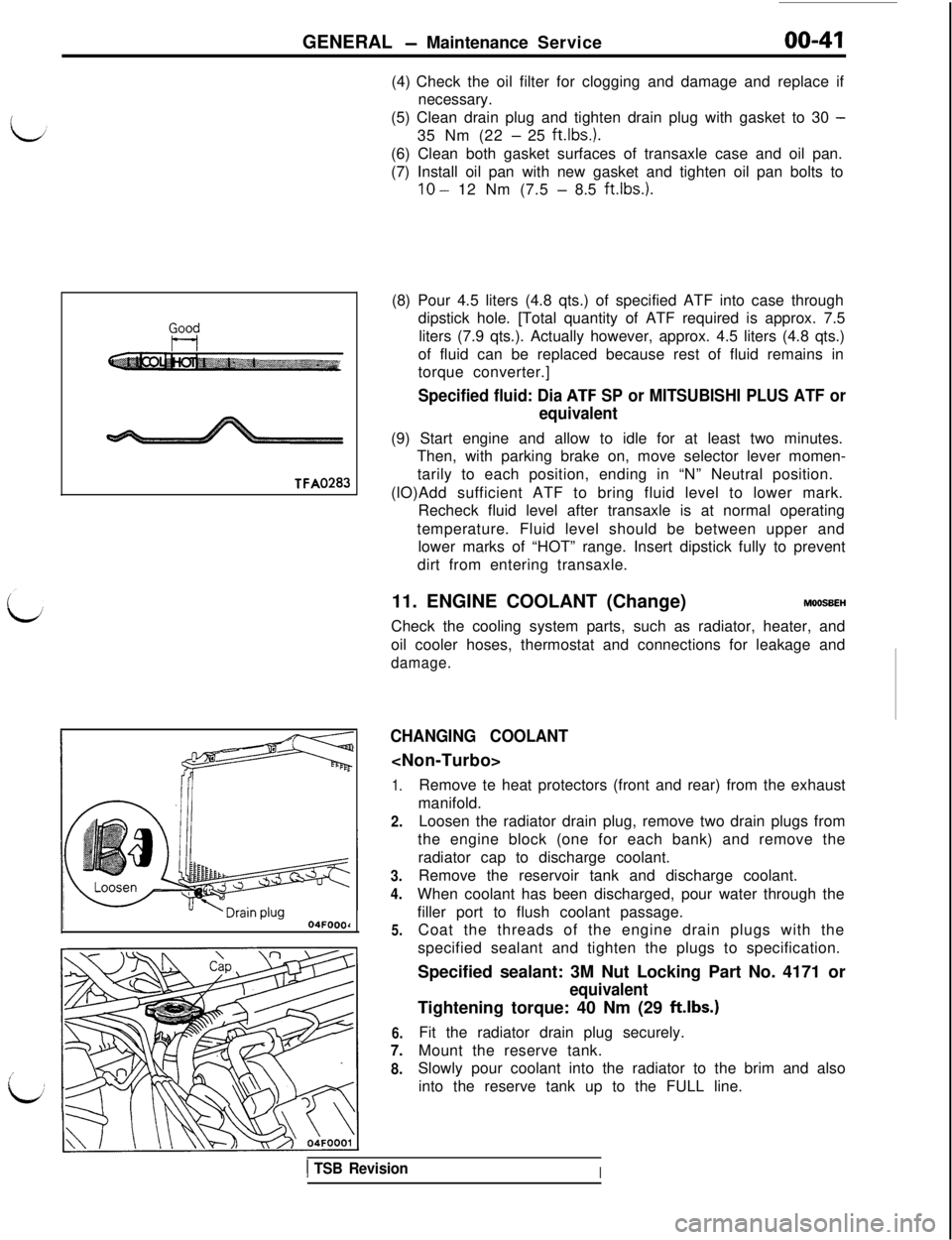
(lO)Add sufficient ATF to bring fluid level to lower mark.
Recheck fluid level after transaxle is at normal operating
temperature. Fluid level should be between upper and
lower marks of “HOT” range. Insert dipstick fully to prevent
dirt from entering transaxle.
11. ENGINE COOLANT (Change)
MOOSBEHCheck the cooling system parts, such as radiator, heater, and
oil cooler hoses, thermostat and connections for leakage and
damage.
CHANGING COOLANT
1.
2.
3.
4.
5.
6.
7.
8.Remove te heat protectors (front and rear) from the exhaust
manifold.
Loosen the radiator drain plug, remove two drain plugs from
the engine block (one for each bank) and remove the
radiator cap to discharge coolant.
Remove the reservoir tank and discharge coolant.
When coolant has been discharged, pour water through the
filler port to flush coolant passage.
Coat the threads of the engine drain plugs with the
specified sealant and tighten the plugs to specification.
Specified sealant: 3M Nut Locking Part No. 4171 or
equivalentTightening torque: 40 Nm (29
ftlbs.)Fit the radiator drain plug securely.
Mount the reserve tank.
Slowly pour coolant into the radiator to the brim and also
into the reserve tank up to the FULL line.
1 TSB RevisionI
Page 46 of 1146
00-42GENERAL - Maintenance Service
14UOO729. Install the radiator cap securely.
10.
Start’the engine and warm up until the thermostat opens.
11. Race the engine up to around 3,000 rpm several times, then
stop the engine.,12. When the enkine has cooled down, remove the radiator cap
L/and add coolant up to the brim. Add coolant to the reserve
tank up to the FULL line.
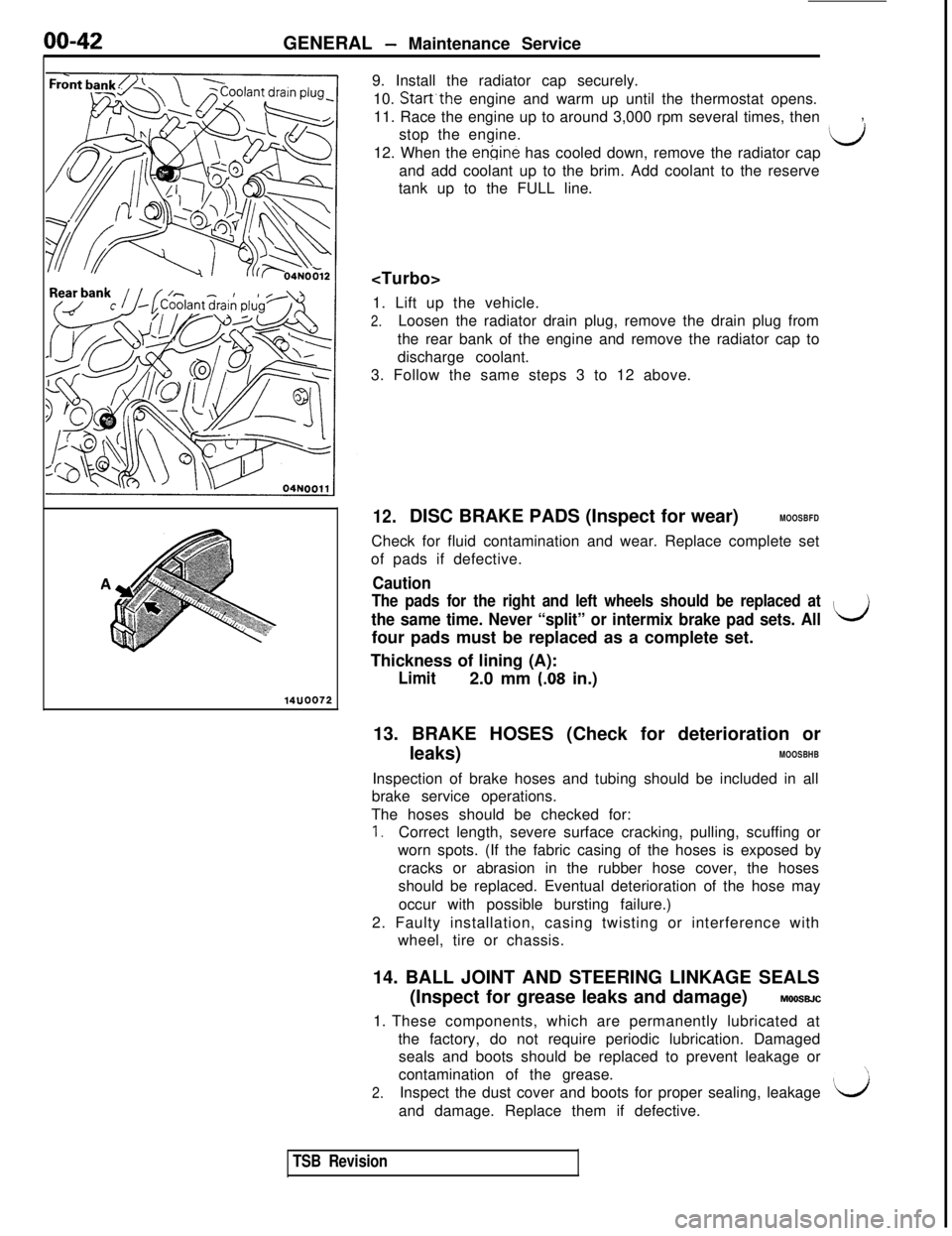
1. Lift up the vehicle.
2.Loosen the radiator drain plug, remove the drain plug from
the rear bank of the engine and remove the radiator cap to
discharge coolant.
3. Follow the same steps 3 to 12 above.
12.DISC BRAKE PADS (Inspect for wear)MOOSBFDCheck for fluid contamination and wear. Replace complete set
of pads if defective.
Caution
The pads for the right and left wheels should be replaced atIIthe same time. Never “split” or intermix brake pad sets. AllUfour pads must be replaced as a complete set.
Thickness of lining (A):
Limit2.0 mm (.08 in.)
13. BRAKE HOSES (Check for deterioration or
leaks)
MOOSBHBInspection of brake hoses and tubing should be included in all
brake service operations.
The hoses should be checked for:
1.Correct length, severe surface cracking, pulling, scuffing or
worn spots. (If the fabric casing of the hoses is exposed by
cracks or abrasion in the rubber hose cover, the hoses
should be replaced. Eventual deterioration of the hose may
occur with possible bursting failure.)
2. Faulty installation, casing twisting or interference with
wheel, tire or chassis.
14. BALL JOINT AND STEERING LINKAGE SEALS
(Inspect for grease leaks and damage)
MOOSglC1. These components, which are permanently lubricated at
the factory, do not require periodic lubrication. Damaged
seals and boots should be replaced to prevent leakage or
contamination of the grease.
2.Inspect the dust cover and boots for proper sealing, leakageIdand damage. Replace them if defective.
TSB Revision
Page 47 of 1146
GENERAL - Maintenance Service00-43
15. DRIVE SHAFT BOOTS (Inspect for grease
leaks and damage)
MOOSBJD1. These components, which are permanently lubricated at
the factory, do not require periodic lubrication. Damaged
boots should be replaced to prevent leakage or contamina-
tion of the, grease.
2.Inspect the boots for proper sealing, leakage and damage.
Replace it if defective.
16. REAR AXLE (CONVENTIONAL DIFFEREN-
TIAL) (Inspect oil level)
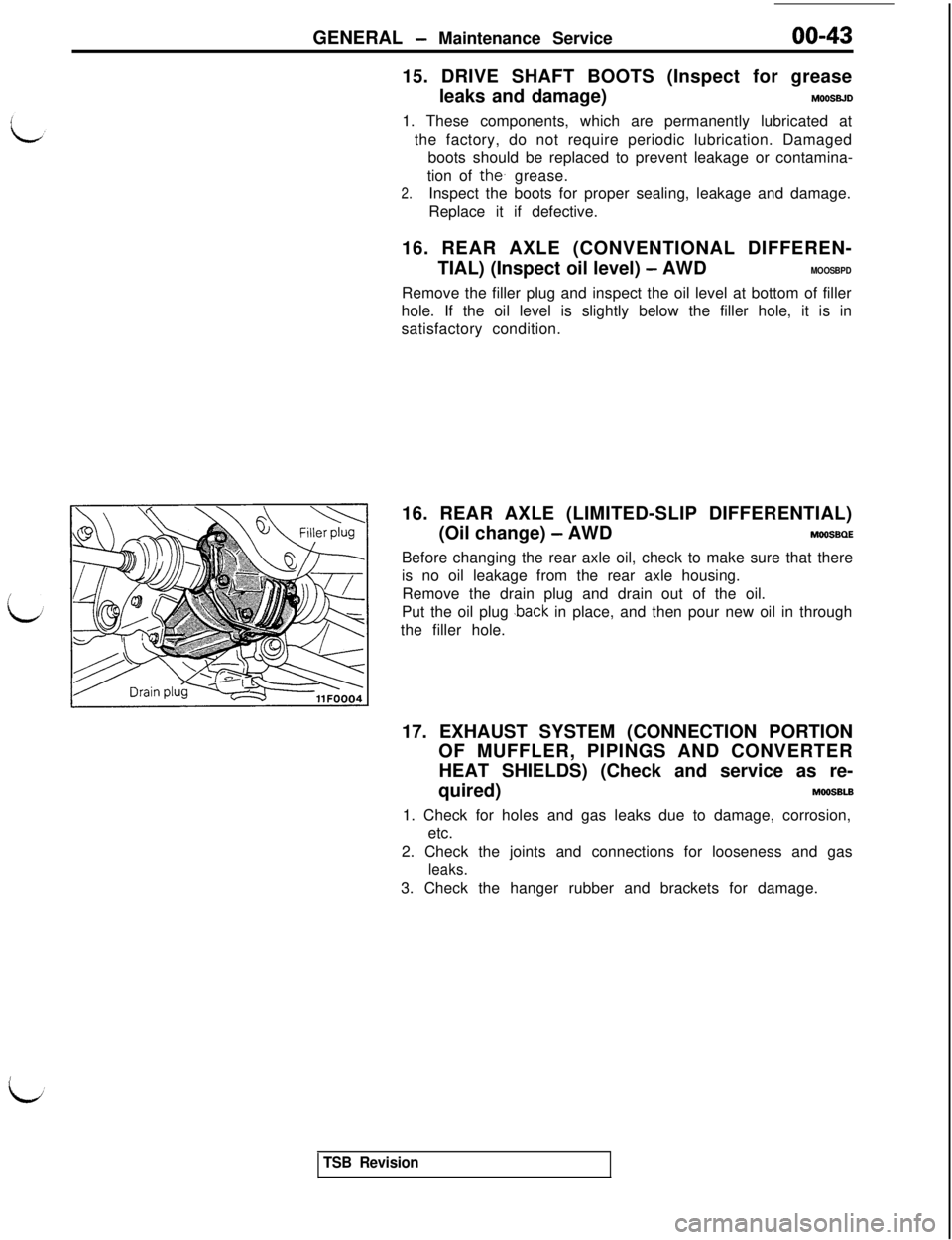
- AWDMOOSBPDRemove the filler plug and inspect the oil level at bottom of filler
hole. If the oil level is slightly below the filler hole, it is in
satisfactory condition.
16. REAR AXLE (LIMITED-SLIP DIFFERENTIAL)
(Oil change)
- AWDMOOSBQEBefore changing the rear axle oil, check to make sure that there
is no oil leakage from the rear axle housing.
Remove the drain plug and drain out of the oil.
Put the oil plug
,back in place, and then pour new oil in through
the filler hole.
17. EXHAUST SYSTEM (CONNECTION PORTION
OF MUFFLER, PIPINGS AND CONVERTER
HEAT SHIELDS) (Check and service as re-
quired)
MOOSBLB1. Check for holes and gas leaks due to damage, corrosion,
etc.
2. Check the joints and connections for looseness and gas
leaks.3. Check the hanger rubber and brackets for damage.
TSB Revision
Page 67 of 1146
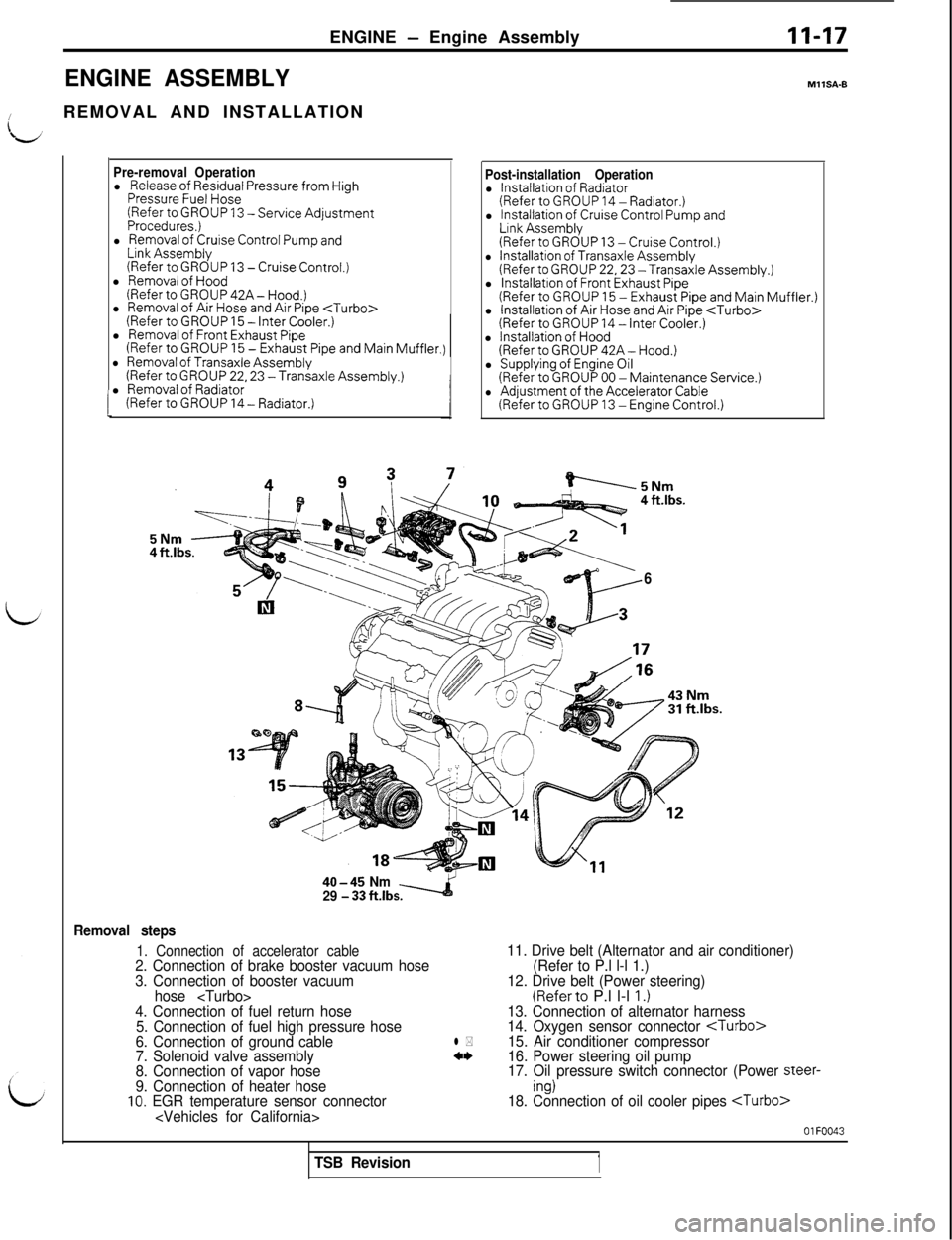
ENGINE - Engine AssemblyII-17
ENGINE ASSEMBLY
/REMOVAL AND INSTALLATION
I
Pre-removal Operationl Release of Residual Pressure from HighPressure Fuel Hose(Refer to GROUP 13 -Service AdjustmentProcedures,)l Removal of Cruise Control Pump andLink Assembly(Refer to GROUP 13 - Cruise Control.)l Removal of Hood(RefertoGROUP42A-Hood.)
l
Removal of Air Hose and Air Pipe
Post-installation Operationl Installation of Radiator(Refer to GROUP 14 - Radiator.)l Installation of Cruise Control Pump andLink Assembly(Refer to GROUP 13 -Cruise Control.)l Installation of Transaxle Assembly(Refer to GROUP 22,23 -Transaxle Assembly.)l lnstallatron of Front Exhaust Pipe(Refer to GROUP 15 - Exhaust Pipe and Main Muffler.)l Installation of Air Hose and Air Pipe
MllSA-B
4 ft.lbs.
6
40-45 Nm
29 - 33 fklbs.
Removal steps
1. Connection of accelerator cable11. Drive belt (Alternator and air conditioner)
2. Connection of brake booster vacuum hose(Refer to P.l l-l 1.)
3. Connection of booster vacuum12. Drive belt (Power steering)
hose
(Referto P.l l-l I.)4. Connection of fuel return hose13. Connection of alternator harness
5. Connection of fuel high pressure hose14. Oxygen sensor connector
6. Connection of ground cablel *15. Air conditioner compressor
7. Solenoid valve assembly4w
16. Power steering oil pump
8. Connection of vapor hose17. Oil pressure switch connector (Power steer-9. Connection of heater hoseing)10. EGR temperature sensor connector18. Connection of oil cooler pipes
OlFOO43
TSB Revision1
Page 72 of 1146
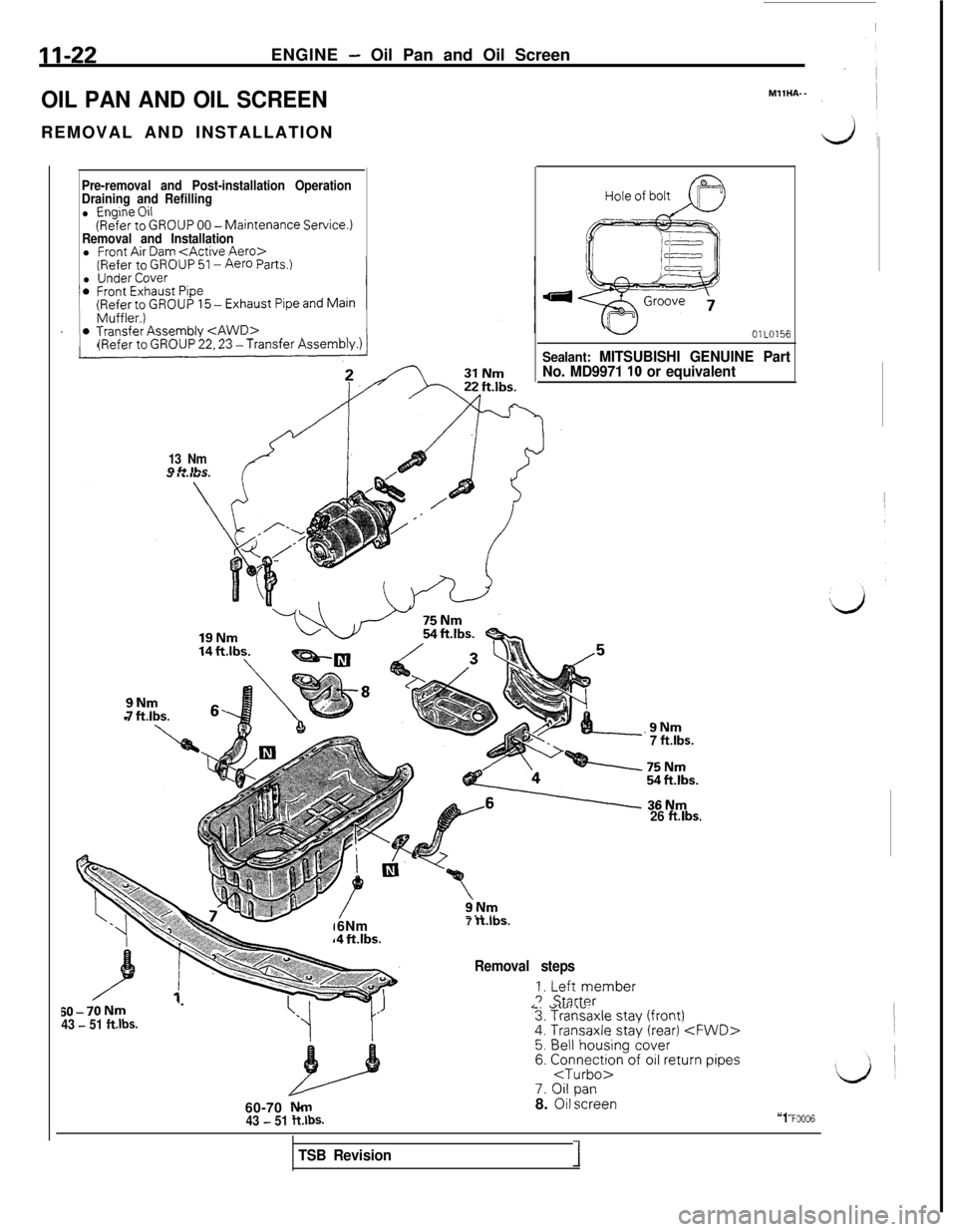
II-22ENGINE - Oil Pan and Oil Screen
OIL PAN AND OIL SCREENREMOVAL AND INSTALLATION
Pre-removal and Post-installation Operation
Draining and Refilling
l Engine Oil(Refer to GROUP 00 -Maintenance Service.)Removal and Installationl Front Air Dam
,
(Refer to GROUP 22, 23 -Transfer Assembly.)
13 NmPI, ll.r
wOlLO156
Sealant: MITSUBISHI GENUINE Part
No. MD9971 10 or equivalent
9Nm- . .. .
60-70Nm -43 - 51 ft.lbs.
MllHA--
,9Nm7 ft.lbs.
26 ft.lbs.6Nm4ft.lbs.7
lt.lbS.
Removal steps
1. Left member7 Ctclrtny
3. Transaxle stay (front)4. Transaxle stay (rear)
Nm_ .43 - 51 ftms.
TSB Revision
7. Oil pan8. Oil screen^.L^^“1 wu06
1
Page 73 of 1146
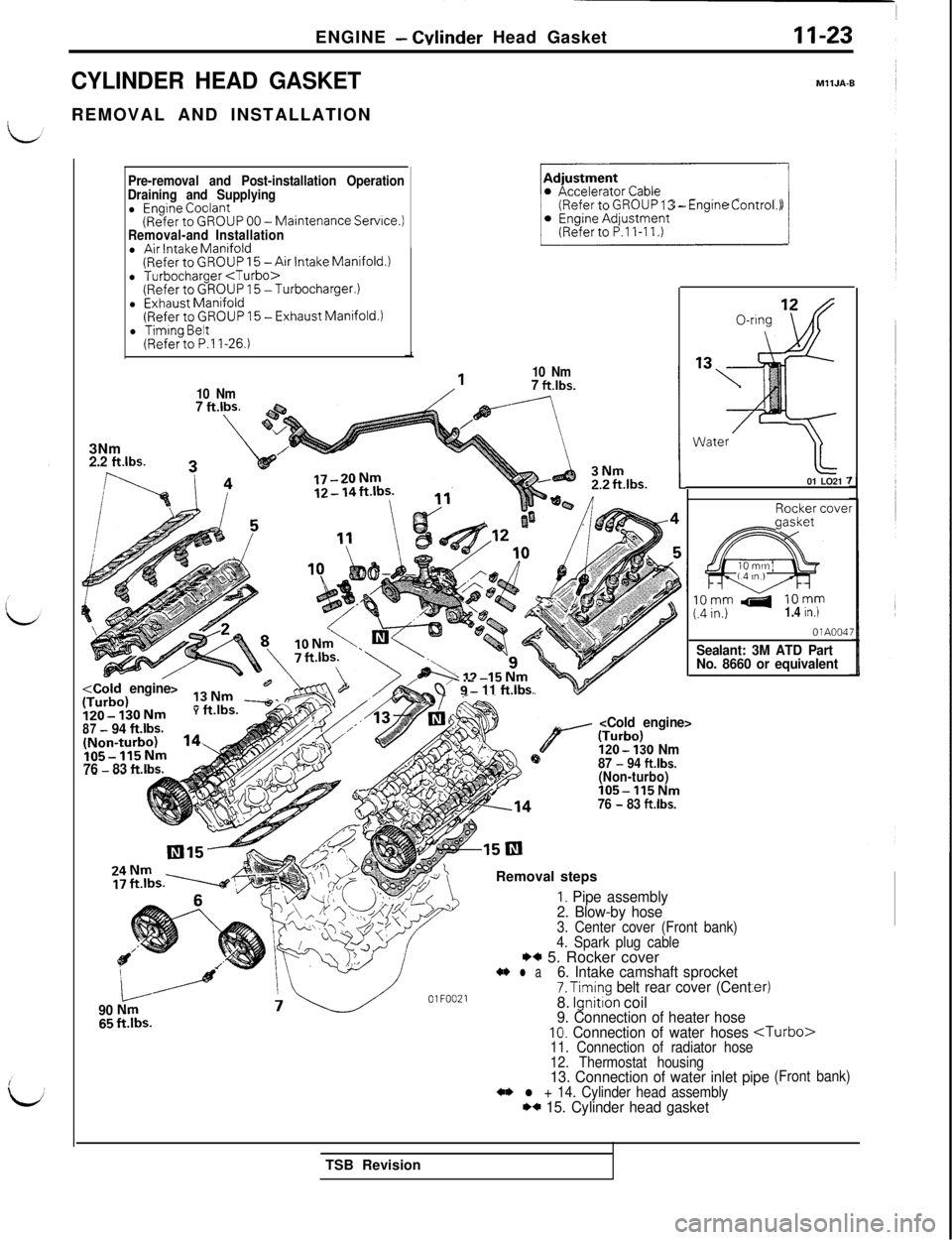
ENGINE - Winder Head Gasket11-23
CYLINDER HEAD GASKETREMOVAL AND INSTALLATION
MllJA-6
Pre-removal and Post-installation Operation
Draining and Supplying
l Engine Coolant(Refer to GROUP 00 -Maintenance Service.)Removal-and Installationl Air Intake Manifold(Refer to GROUP 15 -Air intake Manifold.)l Turbocharger
10 Nm3Nm
2.2 klbs.P
~~(Refer to GROUP 13 - Engrne Control.)
10 Nm7 ft.lbs.
7 ft.lbs.\
120-nng
‘3, ;
%
;;
Water01 LO21
7
i2o-IjONmY rt.lDS.
87
- 94 ft.lbs.
76 - 83 ft.lbs.d
I. Pipe assembly
2. Blow-by hose
90
Nm3. Center cover (Front bank)
4. Spark plug cable
HI 5. Rocker cover4* l a
I
6. Intake camshaft sprocket7. Timing belt rear cover (Cent
7.----A//OlFOO218. Ignition coil9. Connection of heater hose10. Connection of water hoses
Rocker coverIOmm
410mm(.4 in.)1.4 in.)
OlA004;
Sealant: 3M ATD Part
No. 8660 or equivalent
.er)
tl-urbo>11. Connection of radiator hose
12. Thermostat housing
13. Connection of water inlet pipe** l + 14. Cylinder head assembly** 15. Cylinder head gasket
(Front bank)TSB Revision
Page 107 of 1146
FUEL
SYSTEM
CONTENTSM13AA- _
CRUISE CONTROL SYSTEM. . . . . . . . . . . . . . . . . . . . . . . . . . . .158SPECIFICATIONS. . . . . . . .._._....................................................155
CRUISE CONTROL SYSTEM*................................................185
SERVICE ADJUSTMENT PROCEDURES............................178
Cruise Control Cables Inspection and Adjustment........178Cruise Control SystemInspection....................................179individual Parts Inspection....................................................181
SPECIAL TOOLS........................................................................159
SPECIFICATIONS....................................................................158
General Specifications........................................................158Service Specifications........................................................158
TROUBLESHOOTING............................................................159
Check Chart............................................................................163Harness and Components Layout....................................176Preliminary Inspection........................................................159Self-diagnosis Checking........................................................172Troubleshooting Quick Reference Chart............................159
ENGINE CONTROL............................................155
ENGINE CONTROL................................................................157
SERVICE ADJUSTMENT PROCEDURES............................156
Accelerator Cable Inspection and Adjustment................156Accelerator Switch Inspection and Adjustment................156
Service Specifications........................................................
155
TROUBLESHOOTING............................................................
155
Accelerator Cable and Accelerator Pedal........................155
FUEL SYSTEM....................................................3
DETONATION SENSOR........................................................154
FUEL FILTER............................................................................
153
FUEL LINE AND VAPOR LINE................................................151
FUEL PUMP AND FUEL GAUGE UNIT ASSEMBLYAND OVERFILL LIMITER (TWO-WAY VALVE)................149
FUEL TANK.................................................................................146
GENERAL INFORMATION
....................................................
3
MPI System Diagram............................................................3
INJECTOR................................................................................141
ON-VEHICLE INSPECTION OF MPI COMPONENTS........36
Active Exhaust Control Unit
SUPPLEMENTAL RESTRAINT SYSTEM (SRS)
(1)A Supplemental Restraint System (SRS), which uses a driver-side air bag, has been installed in the 3000GT.(2)The SRS includes the following components: impact sensors, SRS diagnosis unit: SRS warning light, air bagmodule, clock spring, interconnecting wiring. Other SRS-related components (that may have to be
removed/installed in connection with SRS service or maintenance) are indicated in the table of contents byan asterisk (*).
WARNING!(I)Improper service or maintenance of any component of the SRS, or any SRS-related component, can lead to
personal injury or death to service personnel (from inadvertent firing of the air bag) or to the driver (from
rendering the SRS inoperative).
(2) Service or maintenance of any SRS component or SRS-related component must be performed only at anauthorized MITSUBISHI dealer.
(3) MITSUBISHI dealer personnel must thoroughly review this manual, and especially its GROUP
528 -Supplemental Restraint System (SRS), before beginning any service or maintenance of any component of theSRS or any SRS-related component.
Page 247 of 1146
FUEL SYSTEM - Injector13-141
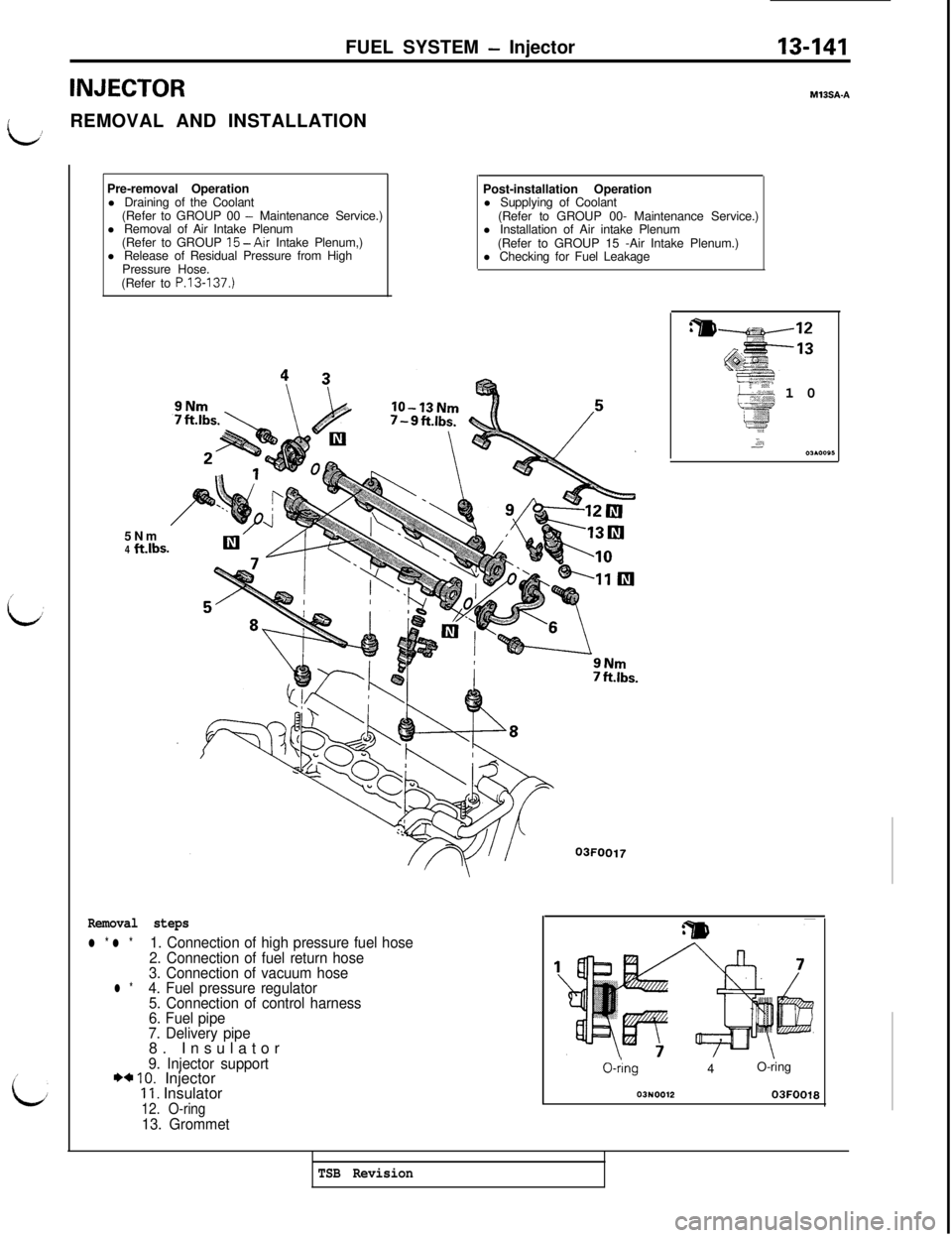
INJECTOR
LREMOVAL AND INSTALLATION
!
MlBSA-A
/
LPre-removal Operation
l Draining of the Coolant
(Refer to GROUP 00
- Maintenance Service.)
l Removal of Air Intake Plenum
(Refer to GROUP
15-Air Intake Plenum,)
l Release of Residual Pressure from High
Pressure Hose.
(Refer to P.13-137.)
5Nm
4
WbsPost-installation Operation
l Supplying of Coolant
(Refer to GROUP 00- Maintenance Service.)
l Installation of Air intake Plenum
(Refer to GROUP 15 -Air Intake Plenum.)
l Checking for Fuel Leakage
03FOO17
Removal steps
l * l *1. Connection of high pressure fuel hose
2. Connection of fuel return hose
3. Connection of vacuum hose
l *4. Fuel pressure regulator
5. Connection of control harness
6. Fuel pipe
7. Delivery pipe8. Insulator
9. Injector support*+ IO. Injector11. Insulator12. O-ring13. Grommet
:m
*:”
-aI : %~’.1X.-10p$
y&,*,,A200A0005
0-hng4O-ring
03N001203FOO18
TSB Revision
Page 249 of 1146
FUEL SYSTEM - Throttle Body13-143Pre-removal and Post-installation Operation
l Draining and Supplying of Engine Coolant
(Refer to GROUP 00 -Maintenance Service.)
3
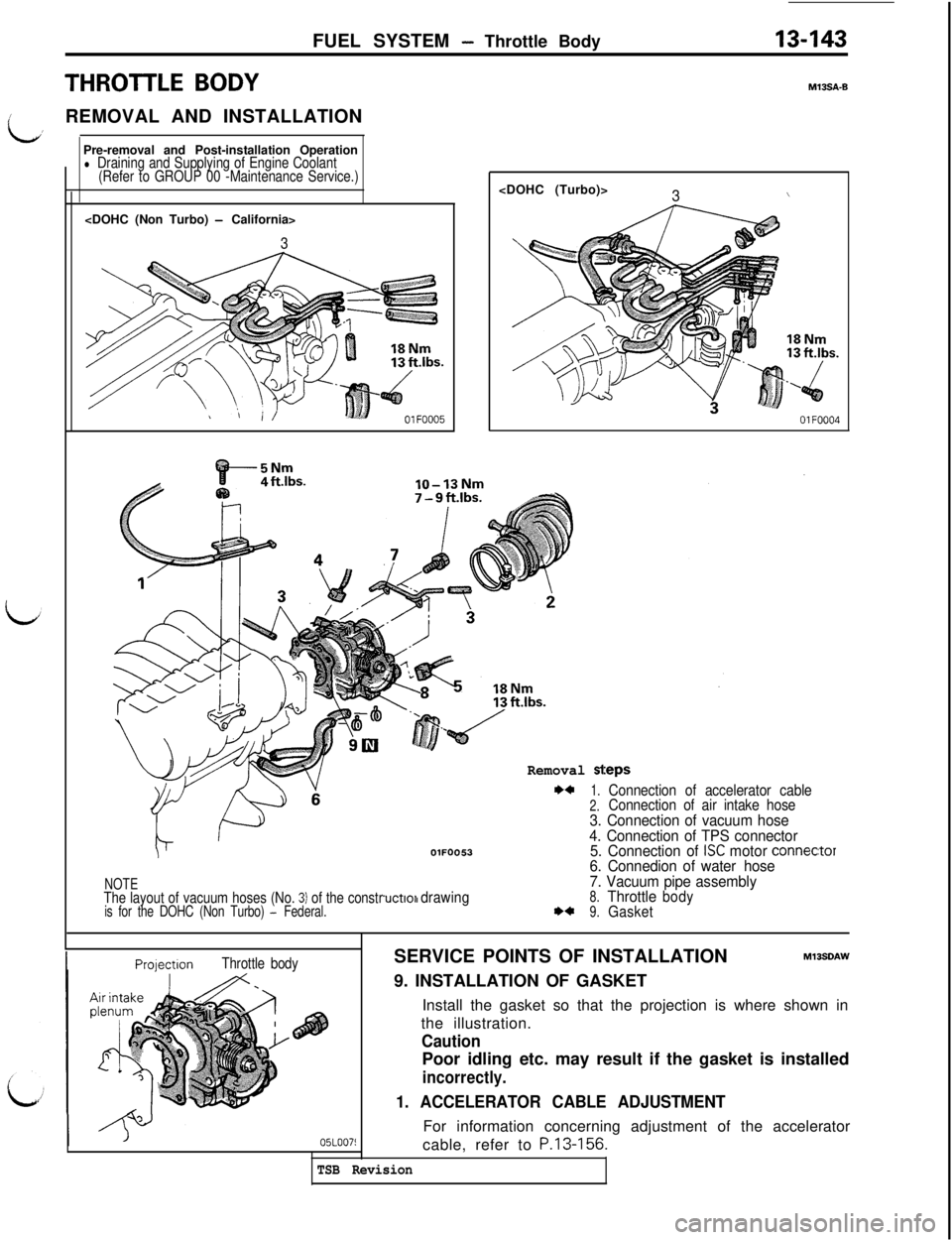
THROTTLE BODY
I
idREMOVAL AND INSTALLATION
MIOSA-0
3\
OlFOOO4
NOTEThe layout of vacuum hoses (No. 3) of the constris for the DOHC (Non Turbo) - Federal.
OlFOO53
I drawing
Removal sl
+*1.Connection of accelerator cable2.Connection of air intake hose3. Connection of vacuum hose
4. Connection of TPS connector
5. Connection of
ISC motor connec6. Connedion of water hose
7. Vacuum pipe assembly
8.ThrottlebodyI)*9.Gasket
:eps
:tor
PrelectionThrottle bodySERVICE POINTS OF INSTALLATIONMlBSDAW9. INSTALLATION OF GASKET
Install the gasket so that the projection is where shown in
the illustration.
CautionPoor idling etc. may result if the gasket is installed
incorrectly.
1. ACCELERATOR CABLE ADJUSTMENTFor information concerning adjustment of the accelerator
cable, refer to
P.13-156.
TSB Revision