power steering MITSUBISHI 3000GT 1991 User Guide
[x] Cancel search | Manufacturer: MITSUBISHI, Model Year: 1991, Model line: 3000GT, Model: MITSUBISHI 3000GT 1991Pages: 1146, PDF Size: 76.68 MB
Page 135 of 1146
![MITSUBISHI 3000GT 1991 User Guide FUEL SYSTEM - Troubleshooting13-29
ENGINE
CONTROL
RELAYF
1 7=2
c----IIIIIIII2,(2Io FUEL
) SE
PRESSURE
SOLENOID
VALVE
IfII
I
I
I
I
J
]i#&B,D i
A-20
1
WASTE
GATE
SOLENOIDVALVE
/
7 EGRi ~XE~~OID
I
; A-21](/img/19/57085/w960_57085-134.png "MITSUBISHI 3000GT 1991 User Guide FUEL SYSTEM - Troubleshooting13-29
ENGINE
CONTROL
RELAYF
1 7=2
c----IIIIIIII2,(2Io FUEL
) SE
PRESSURE
SOLENOID
VALVE
IfII
I
I
I
I
J
]i#&B,D i
A-20
1
WASTE
GATE
SOLENOIDVALVE
/
7 EGRi ~XE~~OID
I
; A-21")
FUEL SYSTEM - Troubleshooting13-29
ENGINE
CONTROL
RELAYF
1 7=2
c----IIIIIIII2,(2Io FUEL
) SE
PRESSURE
SOLENOID
VALVE
IfII
I
I
I
I
J
]i#&B,D i
A-20
1
WASTE
GATE
SOLENOIDVALVE
/
7 EGRi ~XE~~OID
I
; A-21
L
1 A-70
j A-72
f ENGINEj jXICI$ROL
I
-------13s
3.------
s
10
/\1
>
J
c
”-_-
1 A-18
3P
~;~E&DIAGNOSIS #Fjhl;;ON
CONNECTORADJUSTMENT
EFfq&@gCONNECTOR
d
Efpggggg]
I B-OS
ENGINE
COOLANT
Q&;EEATURE ,,'I/\FOR AIR)/@ICONDITIONEROFF --xOlJ
POWER STEERING;tK;BESSURETSB Revision
Page 186 of 1146

13-80FUEL SYSTEM - 0
n-vehicle Inspection of MPI Components
POWER STEERING OIL PRESSURE SWITCHMlOYQAA
B
$-
Engine control unit
'107
@ Harness side
connector
ml-
Power steering oil
Pressure switch
7FUO536700-2.000 1.500-2.000(100-284) (213-284)Pressure [kPa (psi)]
0, l.oIu
OPERATIONl
The power steering oil pressure switch converts presence/absence of power steering load into low/high
voltage and inputs it to the engine control unit, which then controls the idle speed control servo based on
this signal.l The battery voltage in the engine control unit is applied through a resistor to the power steering oil
pressure switch. Steering operation causes the power steering oil pressure to increase, turning the
switch on. As a result, continuity is produced between the battery voltage applied and ground. This
causes the power steering oil pressure terminal voltage to go from high to low.
TSB Revision
Page 187 of 1146
FUEL SYSTEM- On-vehicle Inspection of MPI Components13-81
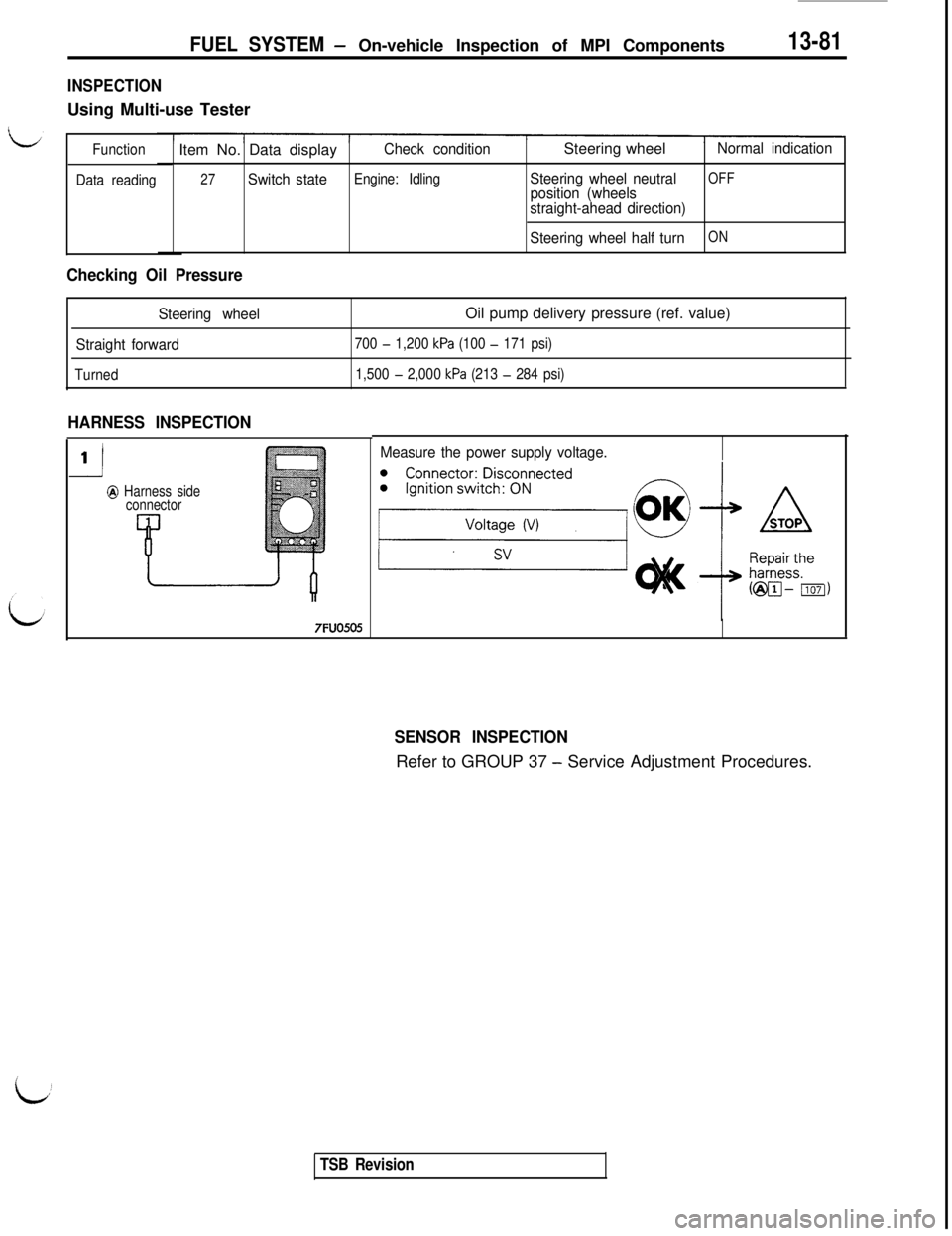
INSPECTIONUsing Multi-use Tester
Function
Data readingItem No. Data displayCheck conditionSteering wheelNormal indication
27Switch stateEngine: IdlingSteering wheel neutralOFFposition (wheels
straight-ahead direction)
Steering wheel half turn
ON
Checking Oil Pressure
Steering wheelOil pump delivery pressure (ref. value)
Straight forward700 - 1,200 kPa (100 - 171 psi)
Turned1,500
- 2,000 kPa (213 - 284 psi)
HARNESS INSPECTION
i1
@ Harness side
connector
Measure the power supply voltage.
SENSOR INSPECTIONRefer to GROUP 37
- Service Adjustment Procedures.
TSB Revision
Page 208 of 1146
13-102FUEL SYSTEM - On-vehicle Inspection of MPI Components
TROUBLESHOOTING HINTSHint 1: If the engine is hard to start when hot, check fuel pressure and check the injector for leaks.
Hint 2:If the injector does not when the engine that is hard to start is cranked, the following as well as the
Iinjector itself may be responsible.
(1) Faulty power supply circuit to the engine control unit, faulty ground circuit
\-J
-(2) Faulty control relay
Hint 3:(3) Faulty crank angle sensor, top dead center sensor
If there is any cylinder whose idle state remains unchanged when the fuel injection of injectors is cut
one after another during idling, make following checks about such cylinder.
(1) Injector and harness check
(2) Ignition plug and high tension cable check
(3) Compression pressure check
Hint 4: If the injector harness and individual part checks have resulted normal but the injector drive time is
out of specification, the following troubles are suspected.
(1)Poor combustion in the cylinder (faulty ignition plug, ignition coil, compression pressure, etc.)
(2) Loose EGR valve seating
(3) High engine resistance
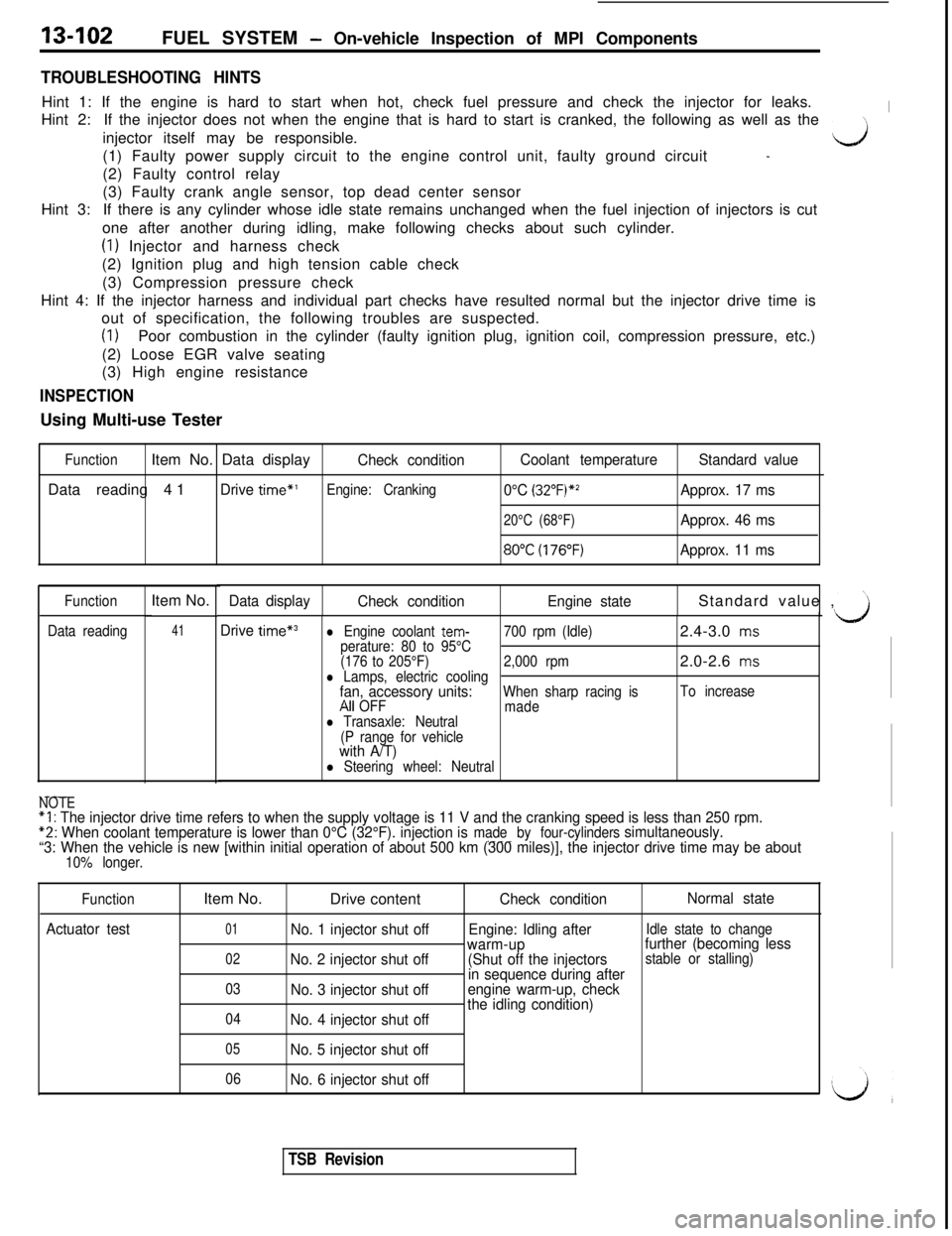
INSPECTIONUsing Multi-use Tester
FunctionItem No. Data displayCheck conditionCoolant temperatureStandard valueData reading 41
Drive time”’Engine: Cranking0°C (32”F)*zApprox. 17 ms
20°C (68°F)Approx. 46 ms
8O"C(176"F)Approx. 11 ms
Function
Data readingItem No.Data display
41Drive time*3l Engine coolant tem-perature: 80 to 95°C700 rpm (Idle)2.4-3.0 ms
(176 to 205°F)2,000 rpm2.0-2.6
msl Lamps, electric coolingfan, accessory units:When sharp racing isTo increaseAll OFF
madel Transaxle: Neutral
(P range for vehicle
with A/T)l Steering wheel: Neutral
Check conditionEngine stateStandard value ,
.---NOTE“I : The injector drive time refers to when the supply voltage is 11 V and the cranking speed is less than 250 rpm.*2: When coolant temperature is lower than 0°C (32°F). injection ismade by four-cylinders.---simultaneously.
“3: When the vehicle is new [within initial operation of about 500 km (300 miles)], the injector drive time may be about
10% longer.
Function
Actuator testItem No.
Drive content
Check conditionNormal state
01No. 1 injector shut offEngine: Idling afterIdle state to change
02No. 2 injector shut offwarm-up
(Shut off the injectorsfurther (becoming less
in sequence during afterstable or stalling)
03
No. 3 injector shut offengine warm-up, check
04No. 4 injector shut offthe idling condition)
05No. 5 injector shut off
06No. 6 injector shut off
TSB Revision
Page 648 of 1146
32-6POWER PLANT MOUNT -Right Member, Left Member and Crossmember
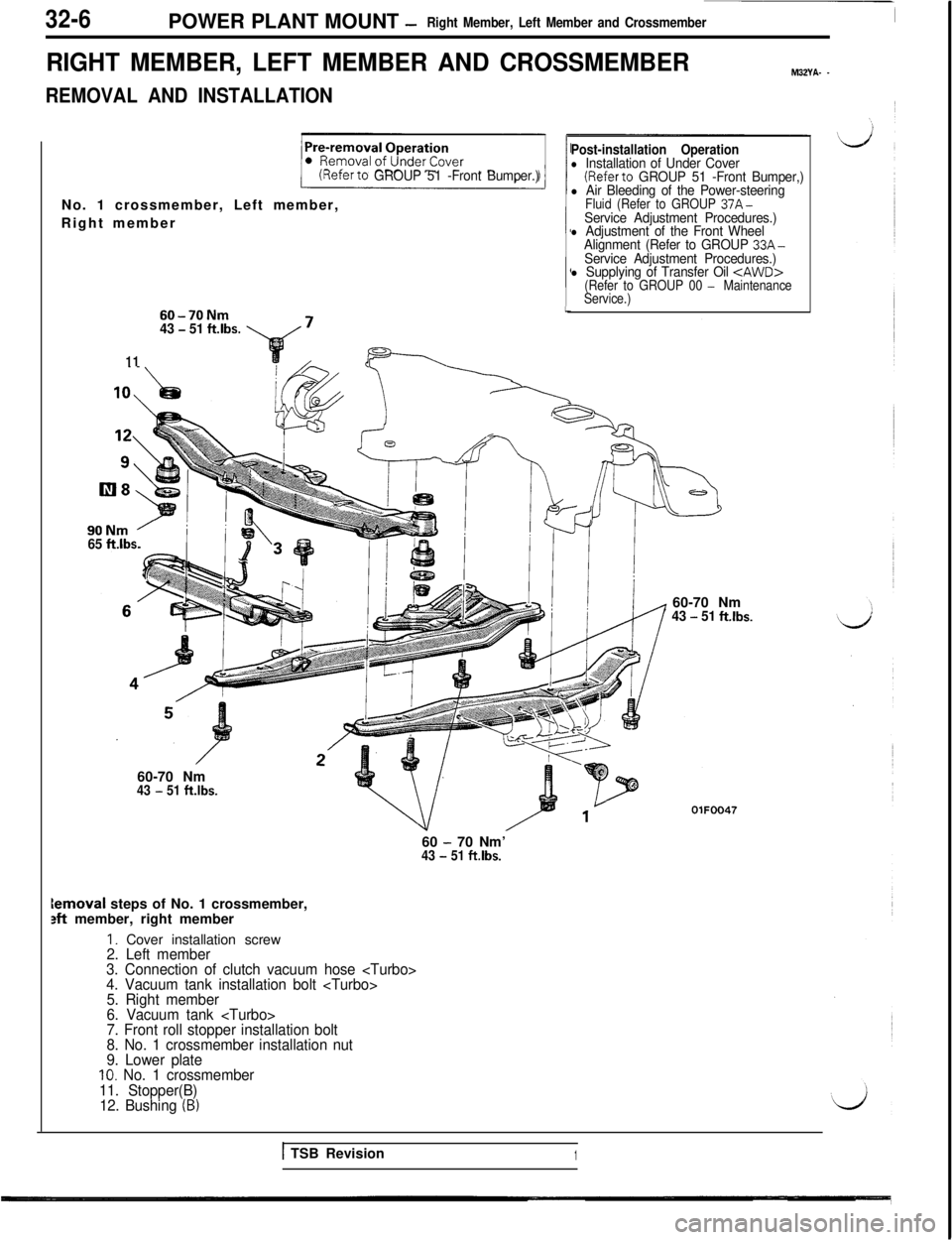
RIGHT MEMBER, LEFT MEMBER AND CROSSMEMBER
I
M32YA- _
REMOVAL AND INSTALLATION
(Referto GROUP 51 -Front Bumper.)No. 1 crossmember, Left member,
Right member
60-70Nm43 - 51 ft.lbs.
11
F=----lL90Nm
’65 ft.lbs.
/I
Post-installation Operationl Installation of Under Cover(Referto GROUP 51 -Front Bumper,)l Air Bleeding of the Power-steeringFluid (Refer to GROUP 37A-Service Adjustment Procedures.)l Adjustment of the Front Wheel
Alignment (Refer to GROUP 33A-Service Adjustment Procedures.)l Supplying of Transfer Oil
Service.)60-70 Nm
43 - 51 ft.lbs.60-70 Nm
43 - 51 ftlbs.
/aa lVOiFOO4760
- 70 Nm’43 - 51 ft.lbs.lemoval steps of No. 1 crossmember,
M member, right member
I. Cover installation screw2. Left member
3. Connection of clutch vacuum hose
4. Vacuum tank installation bolt
5. Right member
6. Vacuum tank
7. Front roll stopper installation bolt
8. No. 1 crossmember installation nut
9. Lower plate
10. No. 1 crossmember
11. Stopper(B)
12. Bushing
(B)
1 TSB Revision1
Page 649 of 1146
POWER PLANT MOUNT -Right Member, Left Member and Crossmember32-7
L
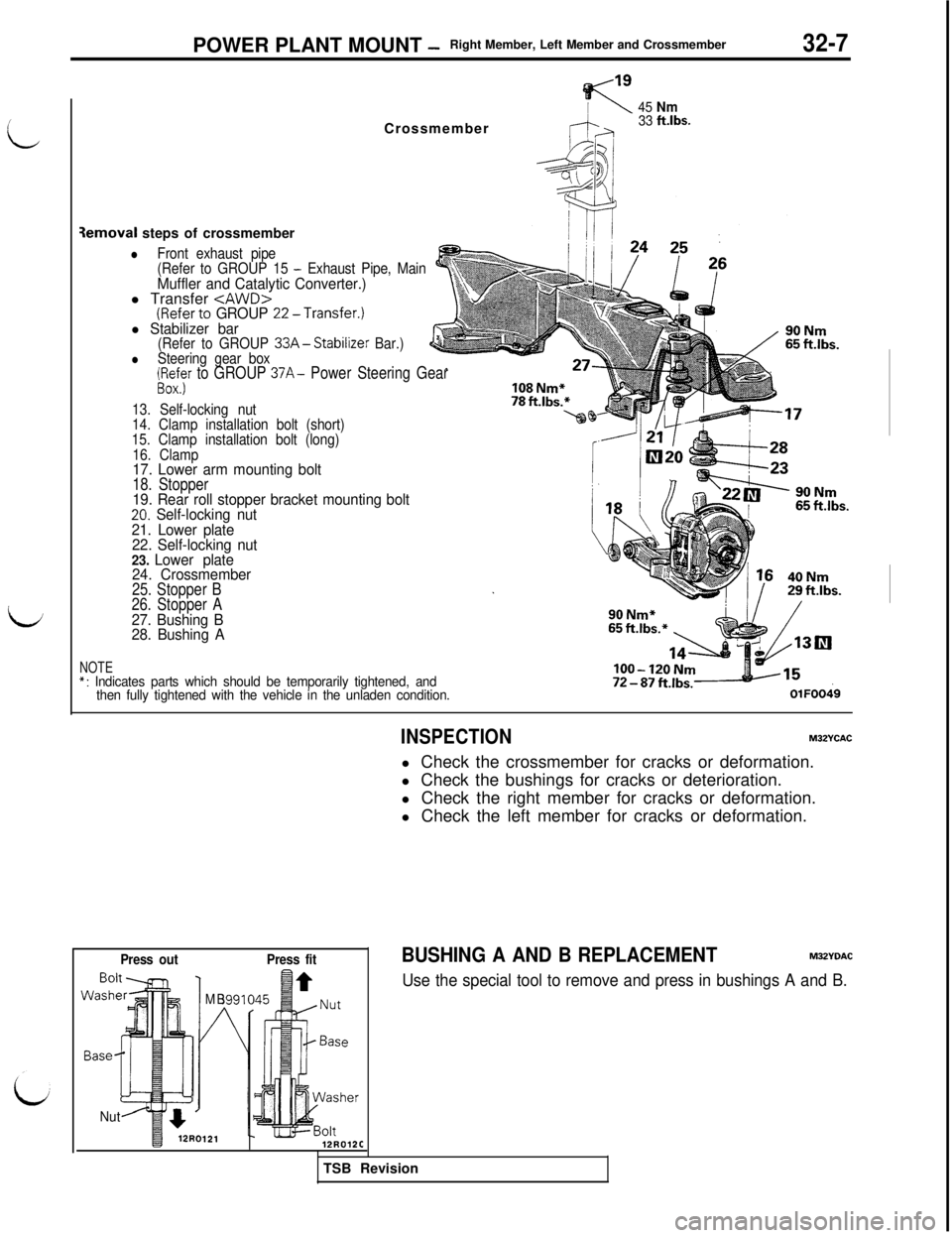
L;Crossmember
45 Nm
r-f33 ftlbs.;13emoval steps of crossmember
lFront exhaust pipe
(Refer to GROUP 15 - Exhaust Pipe, MainMuffler and Catalytic Converter.)l Transfer
(Referto GROUP 22-Transfer.)l Stabilizer bar(Refer to GROUP 33A-Stabilizer Bar.)lSteering gear boxro:,Tr to GROUP 37A- Power Steering Gear
13. Self-locking nut
14. Clamp installation bolt (short)
15. Clamp installation bolt (long)
16. Clamp
17. Lower arm mounting bolt18. Stopper19. Rear roll stopper bracket mounting bolt20. Self-locking nut
21. Lower plate
22. Self-locking nut
23. Lower plate
24. Crossmember
25. Stopper B
26. Stopper A
27. Bushing B
28. Bushing A
NOTE*: Indicates parts which should be temporarily tightened, and
then fully tightened with the vehicle in the unladen condition.
Press out
Nut12R0121
Press fit
1MB
INSPECTIONM32YCAC
l Check the crossmember for cracks or deformation.
l Check the bushings for cracks or deterioration.
l Check the right member for cracks or deformation.
l Check the left member for cracks or deformation.
BUSHING A AND B REPLACEMENTM32YDAC
Use the special tool to remove and press in bushings A and B.TSB Revision
Page 666 of 1146
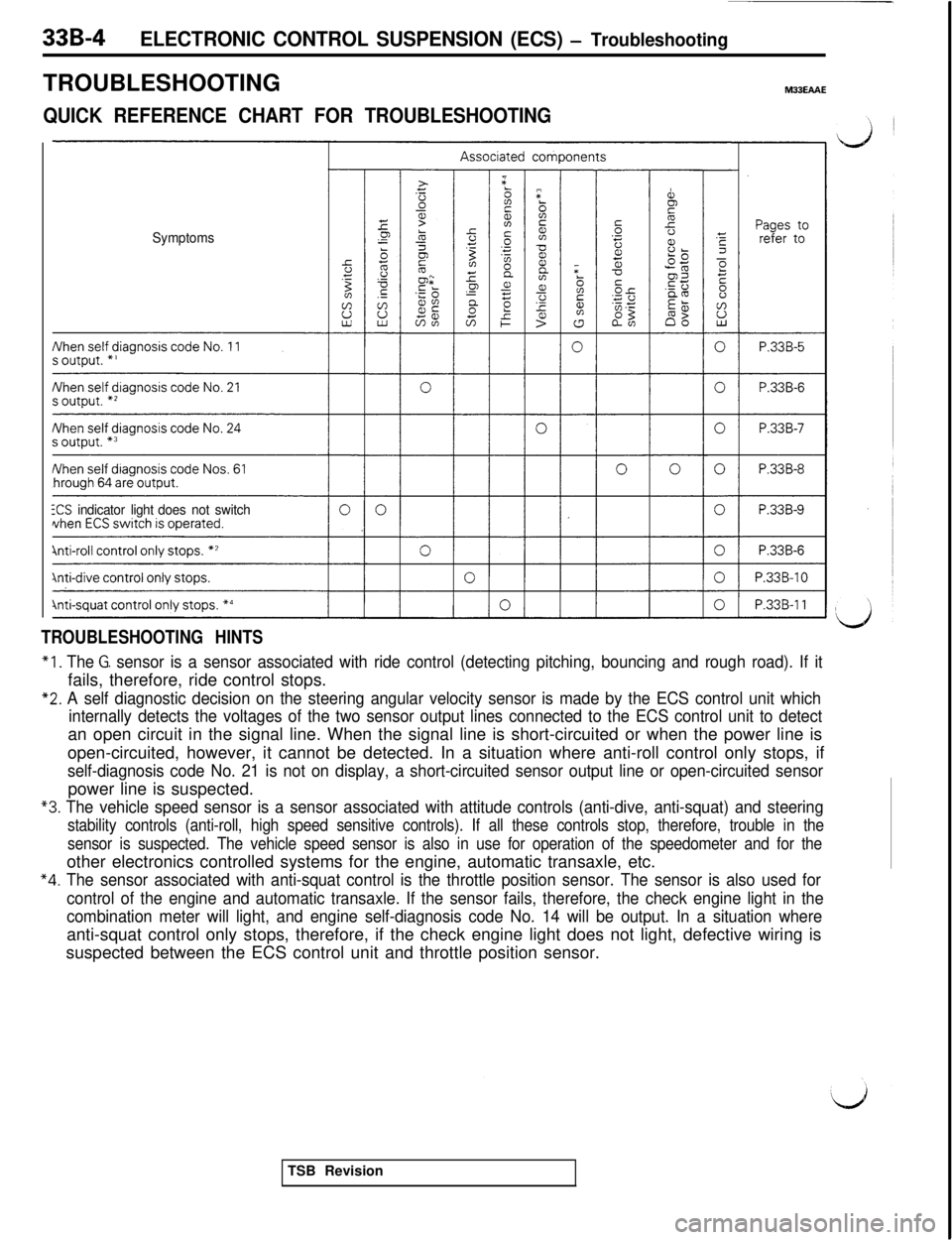
33B-4ELECTRONIC CONTROL SUSPENSION (ECS) - TroubleshootingTROUBLESHOOTING
M33EAAE
QUICK REFERENCE CHART FOR TROUBLESHOOTING
SymptomsXS
indicator lightdoes not switch
TROUBLESHOOTING HINTS
“1. The G. sensor is a sensor associated with ride control (detecting pitching, bouncing and rough road). If itfails, therefore, ride control stops.
“2. A self diagnostic decision on the steering angular velocity sensor is made by the ECS control unit which
internally detects the voltages of the two sensor output lines connected to the ECS control unit to detectan open circuit in the signal line. When the signal line is short-circuited or when the power line is
open-circuited, however, it cannot be detected. In a situation where anti-roll control only stops, if
self-diagnosis code No. 21 is not on display, a short-circuited sensor output line or open-circuited sensorpower line is suspected.
“3. The vehicle speed sensor is a sensor associated with attitude controls (anti-dive, anti-squat) and steering
stability controls (anti-roll, high speed sensitive controls). If all these controls stop, therefore, trouble in the
sensor is suspected. The vehicle speed sensor is also in use for operation of the speedometer and for theother electronics controlled systems for the engine, automatic transaxle, etc.
“4. The sensor associated with anti-squat control is the throttle position sensor. The sensor is also used for
control of the engine and automatic transaxle. If the sensor fails, therefore, the check engine light in the
combination meter will light, and engine self-diagnosis code No. 14 will be output. In a situation whereanti-squat control only stops, therefore, if the check engine light does not light, defective wiring is
suspected between the ECS control unit and throttle position sensor.
TSB Revision
Page 675 of 1146
![MITSUBISHI 3000GT 1991 User Guide Service AdjustmentELECTRONIC CONTROL SUSPENSION (ECS) - Procedures33B-13Fail Safe and Diagnosis List
Output Code
Diagnosis Item
Fail SafeCode No.Indication Pattern
0[Good]
[Good]
l-l
11G sensor defect](/img/19/57085/w960_57085-674.png "MITSUBISHI 3000GT 1991 User Guide Service AdjustmentELECTRONIC CONTROL SUSPENSION (ECS) - Procedures33B-13Fail Safe and Diagnosis List
Output Code
Diagnosis Item
Fail SafeCode No.Indication Pattern
0[Good]
[Good]
l-l
11G sensor defect")
Service AdjustmentELECTRONIC CONTROL SUSPENSION (ECS) - Procedures33B-13Fail Safe and Diagnosis List
Output Code
Diagnosis Item
Fail SafeCode No.Indication Pattern
0[Good]
[Good]
l-l
11G sensor defective*l Ride controls (pinching and bouncingcontrol, bad road detection control) sl:op.
21Steering angularvelocity sensor open-circuited*
l Anti-roll control stops.
24Vehicle speed sensor*nn open-crrcurtedl Steering stability controls (anti-roll, high
speed sensitive controls) and attitude
controls (anti-dive, anti-squat) stop.l Shock absorber damping force fixed
F. L. damping forcefl-~-~-j 11c$i;z;;Fr actuator
R. R. damping force
I /
64 j-jMJ-~-~-~ ~t$ec~Z$rn&ftYrrZ& /
NOTE(1)Control stop, warning indication and fixed damping force return to normal when the ignition switch is set to OFF.
When any of the problems marked* occurs, if no subsequent problem occurs (for example, when the problem IStransient) normal operation will be restored even if the ignition switch is not set to OFF.(2)Even if control stop warning indication and fixed damping force return to normal as described above, the
self-diagnosis code’is stored in the memory in the ECS control unrt.
(3)The self-diagnosis code can be force-cleared by use of the MUT or by stopping the power supply to the ECS controlunit. In addition
it is automatically cleared if the ON/OFF control of the ignition swatch is repeated 60 times after the
self-diagnosis code has been output, provided that no new self-diagnosis code is output during the period.TSB Revision
Page 710 of 1146
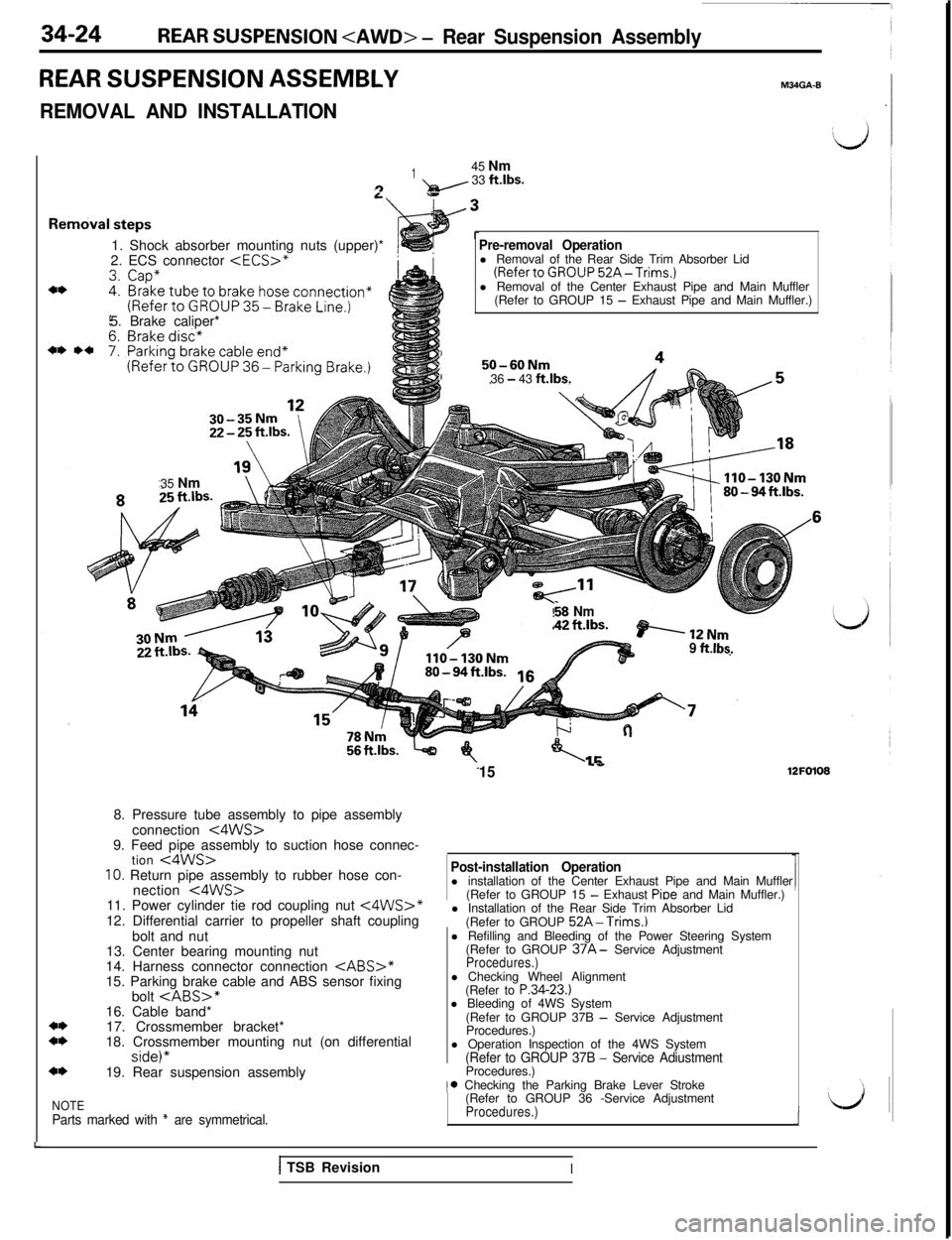
34-24REAR SUSPENSION
REAR SUSPENSION ASSEMBLY
REMOVAL AND INSTALLATION
M34GA-B
L
Rel
145 Nm9- 33 ftlbs.
1. Shock absorber mounting nuts (upper)*
2. ECS connector
(RefertoGROUP52A-Trims.)l Removal of the Center Exhaust Pipe and Main Muffler
(Refer to GROUP 15
- Exhaust Pipe and Main Muffler.)
5. Brake caliper*
1,50-60NmI36 - 43 ft.lbs.35 Nm
$8 Nm“?C,ILc. ashwez I,..“=.BP’----12Nm9 ftlbs.
15..e12FO1088. Pressure tube assembly to pipe assembly
connection
<4WS>9. Feed pipe assembly to suction hose connec-
tion
<4WS>10. Return pipe assembly to rubber hose con-
nection t4WS>11. Power cylinder tie rod coupling nut <4WS>*12. Differential carrier to propeller shaft coupling
bolt and nut
Post-installation Operationl installation of the Center Exhaust Pipe and Main Muffler
(Refer to GROUP 15
- Exhaust Pioe and Main Muffler.)
l Installation of the Rear Side Trim Absorber Lid
(Refer to GROUP
52A-Trims.)13. Center bearing mounting nut
14. Harness connector connection
CABS>*15. Parking brake cable and ABS sensor fixingl Refilling and Bleeding of the Power Steering System
(Refer to GROUP
37A- Service AdjustmentProcedures.)bolt
17. Crossmember bracket*
18. Crossmember mounting nut (on differential
side)”19. Rear suspension assemblyl Checking Wheel Alignment
(Refer to P.34-23.)
l Bleeding of 4WS System
(Refer to GROUP 37B
- Service Adjustment
Procedures.)
l Operation Inspection of the 4WS System
(Refer to GROUP 37B - Service AdiustmentProcedures.)
NOTEParts marked with * are symmetrical.
,* Checking the Parking Brake Lever Stroke
(Refer to GROUP 36 -Service Adjustment
Procedures.)i
1 TSB RevisionI
Page 829 of 1146
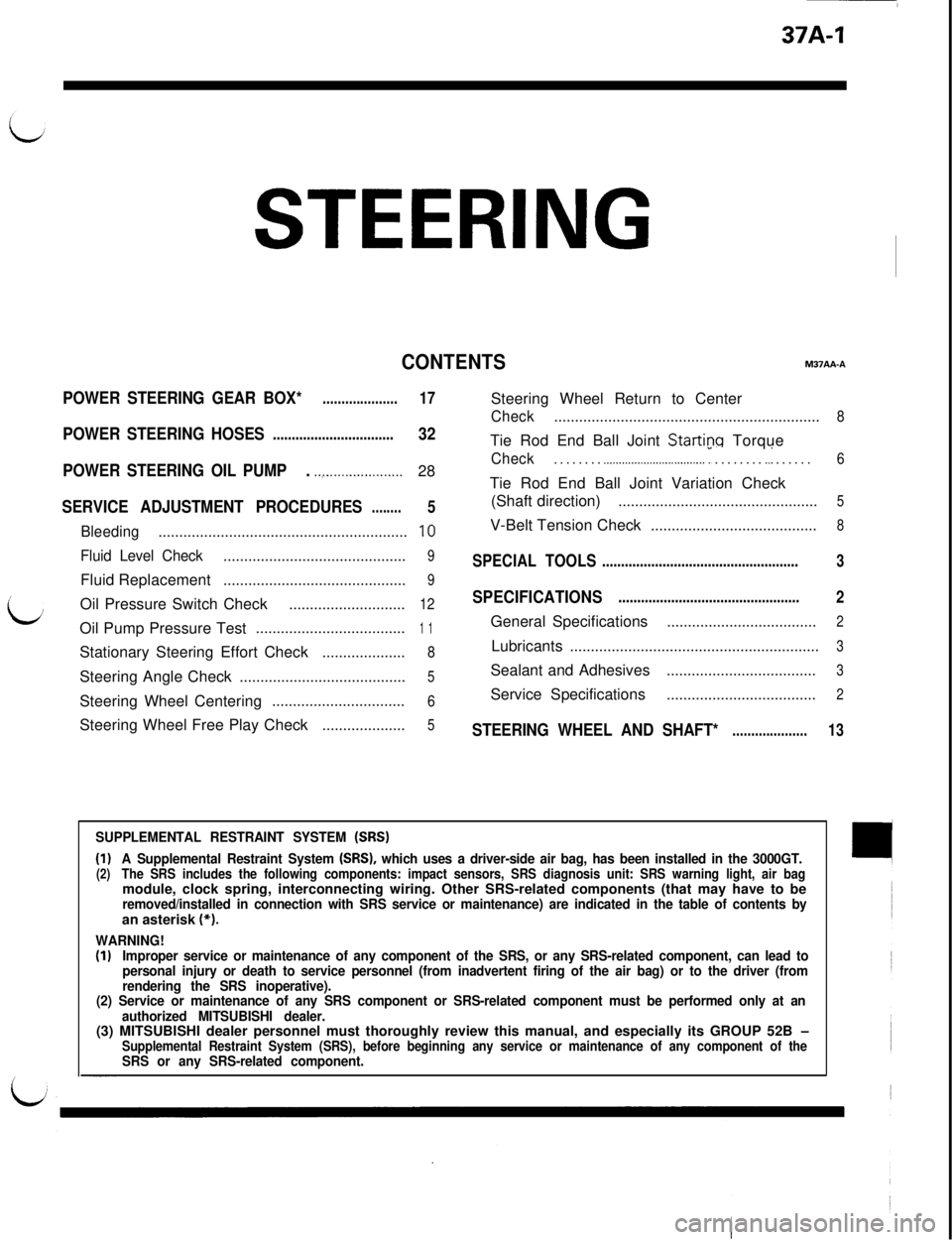
37A-1
STEERING
CONTENTSM37AA-A
POWER STEERING GEAR BOX*....................17Steering Wheel Return to Center
Check................................................................8
POWER STEERING HOSES................................32Tie Rod End Ball Joint Startinq Torque
POWER STEERING OIL PUMP. .._....................28Check. . . . . . . . .._.............................. r . . . . . . . . ..I . . . . . .6Tie Rod End Ball Joint Variation Check
SERVICE ADJUSTMENT PROCEDURES5(Shaft direction)................................................5........
Bleeding............................................................10V-Belt Tension Check........................................8
Fluid Level Check............................................9SPECIAL TOOLS....................................................3Fluid Replacement
............................................9
/
bOil Pressure Switch Check
SPECIFICATIONS2............................12................................................Oil Pump Pressure Test
....................................1 1General Specifications....................................2Stationary Steering Effort Check
....................8Lubricants............................................................3Steering Angle Check
5Sealant and Adhesives....................................3........................................Steering Wheel Centering
6Service Specifications....................................2................................Steering Wheel Free Play Check
....................5STEERING WHEEL AND SHAFT*....................13
SUPPLEMENTAL RESTRAINT SYSTEM (SRS)
(1)A Supplemental Restraint System (SRS), which uses a driver-side air bag, has been installed in the 3000GT.(2)The SRS includes the following components: impact sensors, SRS diagnosis unit: SRS warning light, air bagmodule, clock spring, interconnecting wiring. Other SRS-related components (that may have to be
removed/installed in connection with SRS service or maintenance) are indicated in the table of contents byan asterisk (*).
WARNING!(I)Improper service or maintenance of any component of the SRS, or any SRS-related component, can lead to
personal injury or death to service personnel (from inadvertent firing of the air bag) or to the driver (from
rendering the SRS inoperative).
(2) Service or maintenance of any SRS component or SRS-related component must be performed only at an
authorized MITSUBISHI dealer.(3) MITSUBISHI dealer personnel must thoroughly review this manual, and especially its GROUP 52B
-Supplemental Restraint System (SRS), before beginning any service or maintenance of any component of theSRS or any SRS-related component.