timing belt MITSUBISHI 3000GT 1991 User Guide
[x] Cancel search | Manufacturer: MITSUBISHI, Model Year: 1991, Model line: 3000GT, Model: MITSUBISHI 3000GT 1991Pages: 1146, PDF Size: 76.68 MB
Page 78 of 1146
11-28ENGINE - Timing Belt
Tlmlng mark01 N009E
A : :y,y;i;,$yi *&:;.~:;>
Exhaust valveside
*
/’*
120"* -1"
(*
6
7.^^^J‘c;Y
1zv w**
Intake valveside
Front bank
* : Approx. 35” o1 N0, og
Rockercoverslde
Exhaust valveside
Front bank
t~mng markOlNOlO
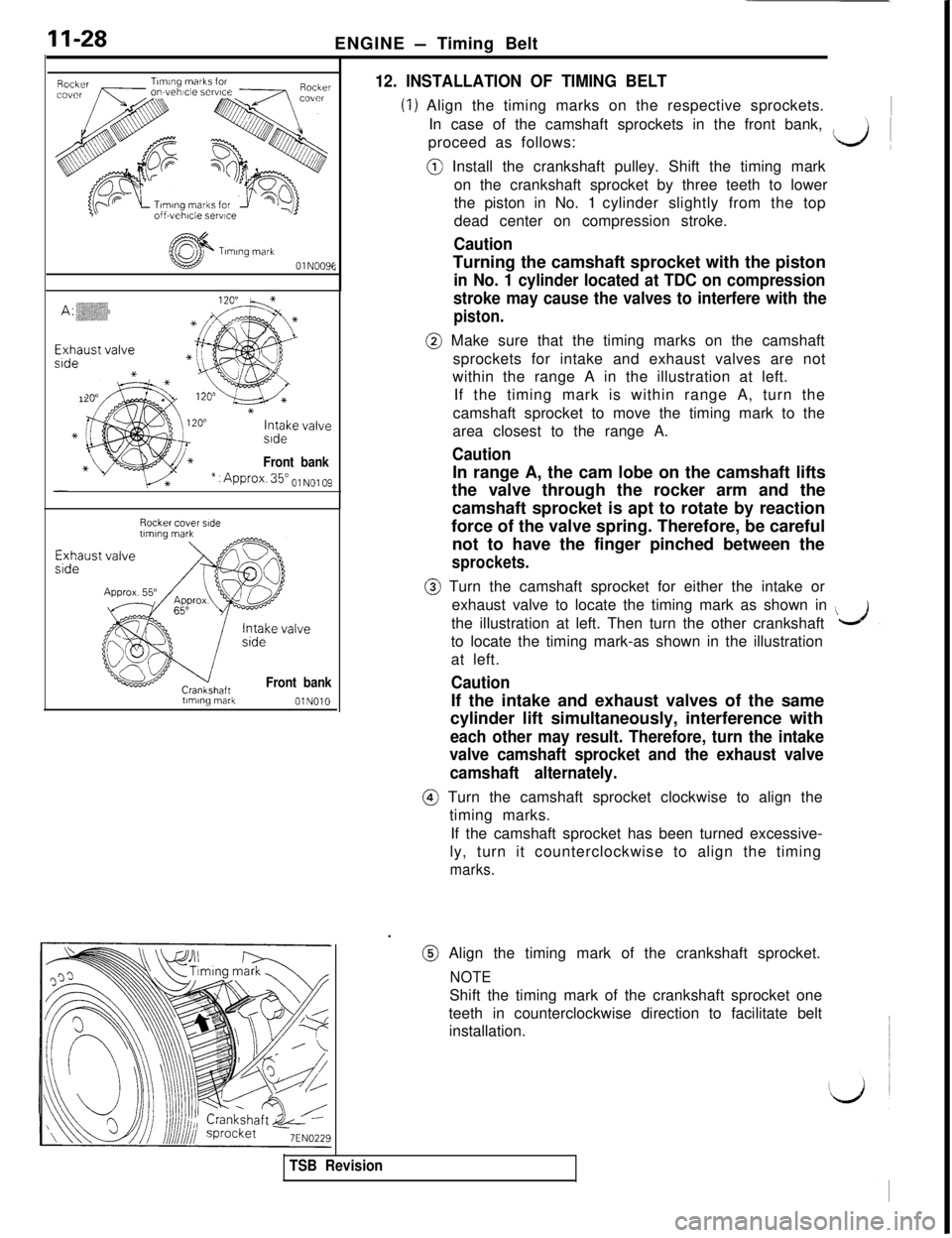
12. INSTALLATION OF TIMING BELT
(1) Align the timing marks on the respective sprockets.
In case of the camshaft sprockets in the front bank,
I~
proceed as follows:@ Install the crankshaft pulley. Shift the timing mark
on the crankshaft sprocket by three teeth to lower
the piston in No. 1 cylinder slightly from the top
dead center on compression stroke.
CautionTurning the camshaft sprocket with the piston
in No. 1 cylinder located at TDC on compression
stroke may cause the valves to interfere with the
piston.@ Make sure that the timing marks on the camshaft
sprockets for intake and exhaust valves are not
within the range A in the illustration at left.
If the timing mark is within range A, turn the
camshaft sprocket to move the timing mark to the
area closest to the range A.
CautionIn range A, the cam lobe on the camshaft lifts
the valve through the rocker arm and the
camshaft sprocket is apt to rotate by reaction
force of the valve spring. Therefore, be careful
not to have the finger pinched between the
sprockets.@ Turn the camshaft sprocket for either the intake or
exhaust valve to locate the timing mark as shown in
\the illustration at left. Then turn the other crankshaft
to locate the timing mark-as shown in the illustration
at left.
CautionIf the intake and exhaust valves of the same
cylinder lift simultaneously, interference with
each other may result. Therefore, turn the intake
valve camshaft sprocket and the exhaust valve
camshaft alternately.@ Turn the camshaft sprocket clockwise to align the
timing marks.
If the camshaft sprocket has been turned excessive-
ly, turn it counterclockwise to align the timing
marks.
TSB Revision
.@ Align the timing mark of the crankshaft sprocket.
NOTEShift the timing mark of the crankshaft sprocket one
teeth in counterclockwise direction to facilitate belt
installation.
Page 79 of 1146
ENGINE - Timing Belt11-29
OlN004t
& Pin hole
nilnq
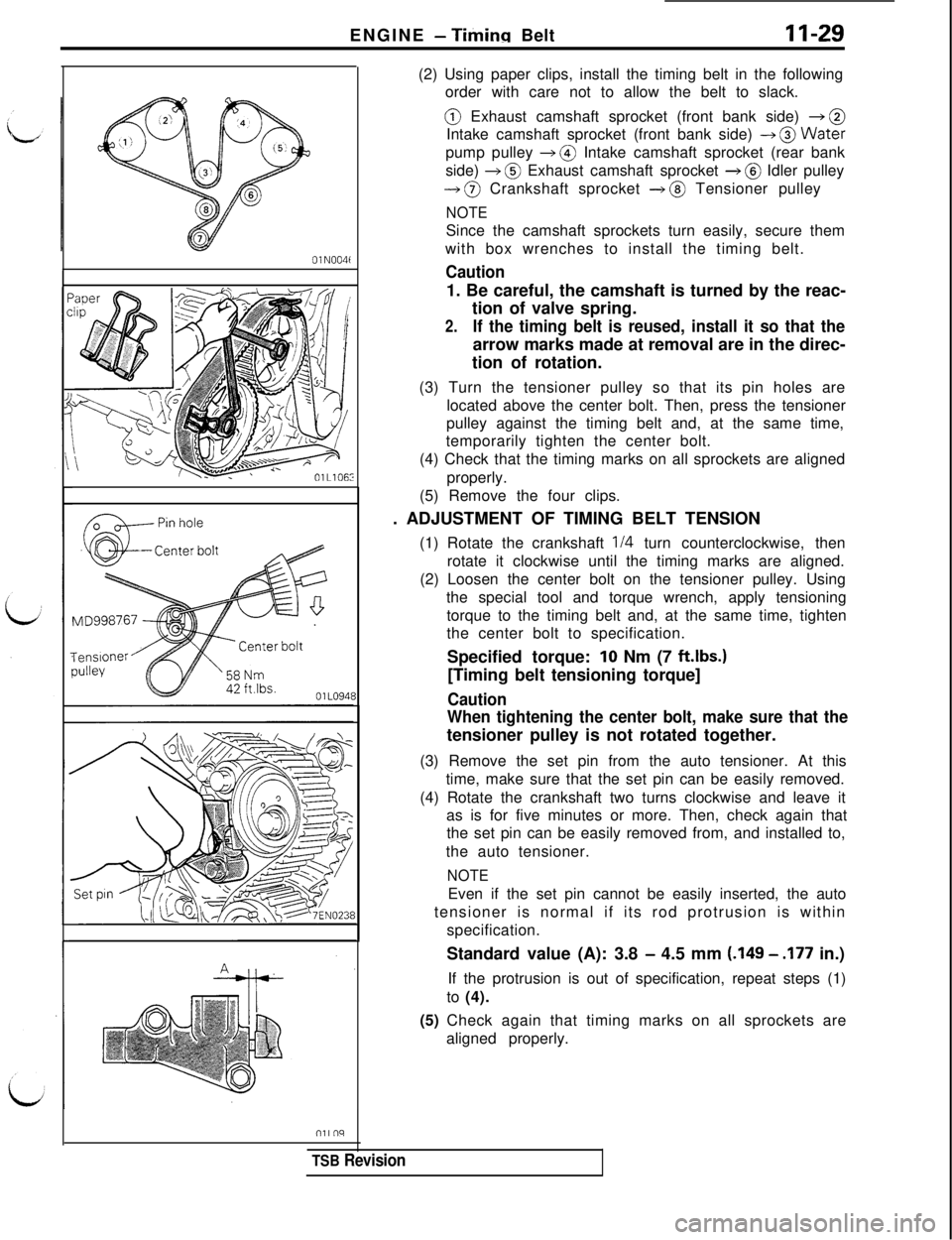
8(2) Using paper clips, install the timing belt in the following
order with care not to allow the belt to slack.@ Exhaust camshaft sprocket (front bank side)
+ @
Intake camshaft sprocket (front bank side)
-+ @Waterpump pulley
+ @ Intake camshaft sprocket (rear bank
side)
+ @ Exhaust camshaft sprocket + @ Idler pulley
-+ @ Crankshaft sprocket + @ Tensioner pulley
NOTESince the camshaft sprockets turn easily, secure them
with box wrenches to install the timing belt.
Caution1. Be careful, the camshaft is turned by the reac-
tion of valve spring.
2.If the timing belt is reused, install it so that thearrow marks made at removal are in the direc-
tion of rotation.
(3) Turn the tensioner pulley so that its pin holes are
located above the center bolt. Then, press the tensioner
pulley against the timing belt and, at the same time,
temporarily tighten the center bolt.
(4) Check that the timing marks on all sprockets are aligned
properly.
(5) Remove the four clips.
. ADJUSTMENT OF TIMING BELT TENSION
(1) Rotate the crankshaft
114 turn counterclockwise, then
rotate it clockwise until the timing marks are aligned.
(2) Loosen the center bolt on the tensioner pulley. Using
the special tool and torque wrench, apply tensioning
torque to the timing belt and, at the same time, tighten
the center bolt to specification.
Specified torque:
10 Nm (7 ftlbs.)
[Timing belt tensioning torque]
Caution
When tightening the center bolt, make sure that thetensioner pulley is not rotated together.
(3) Remove the set pin from the auto tensioner. At this
time, make sure that the set pin can be easily removed.
(4) Rotate the crankshaft two turns clockwise and leave it
as is for five minutes or more. Then, check again that
the set pin can be easily removed from, and installed to,
the auto tensioner.
NOTEEven if the set pin cannot be easily inserted, the auto
tensioner is normal if its rod protrusion is within
specification.
Standard value (A): 3.8
- 4.5 mm (.I49 - .I77 in.)
If the protrusion is out of specification, repeat steps (1)
to (4).
(5) Check again that timing marks on all sprockets are
aligned properly.
TSB Revision
Page 80 of 1146
II-30ENGINE - Timing Belt
hread diameter x length
mm (In.)
6x201.23 x ,781fllllO4F
1 Thread diameter x Lengthmm (in.)
2(39
x1.06)l.47 x 2.50)OlN0072
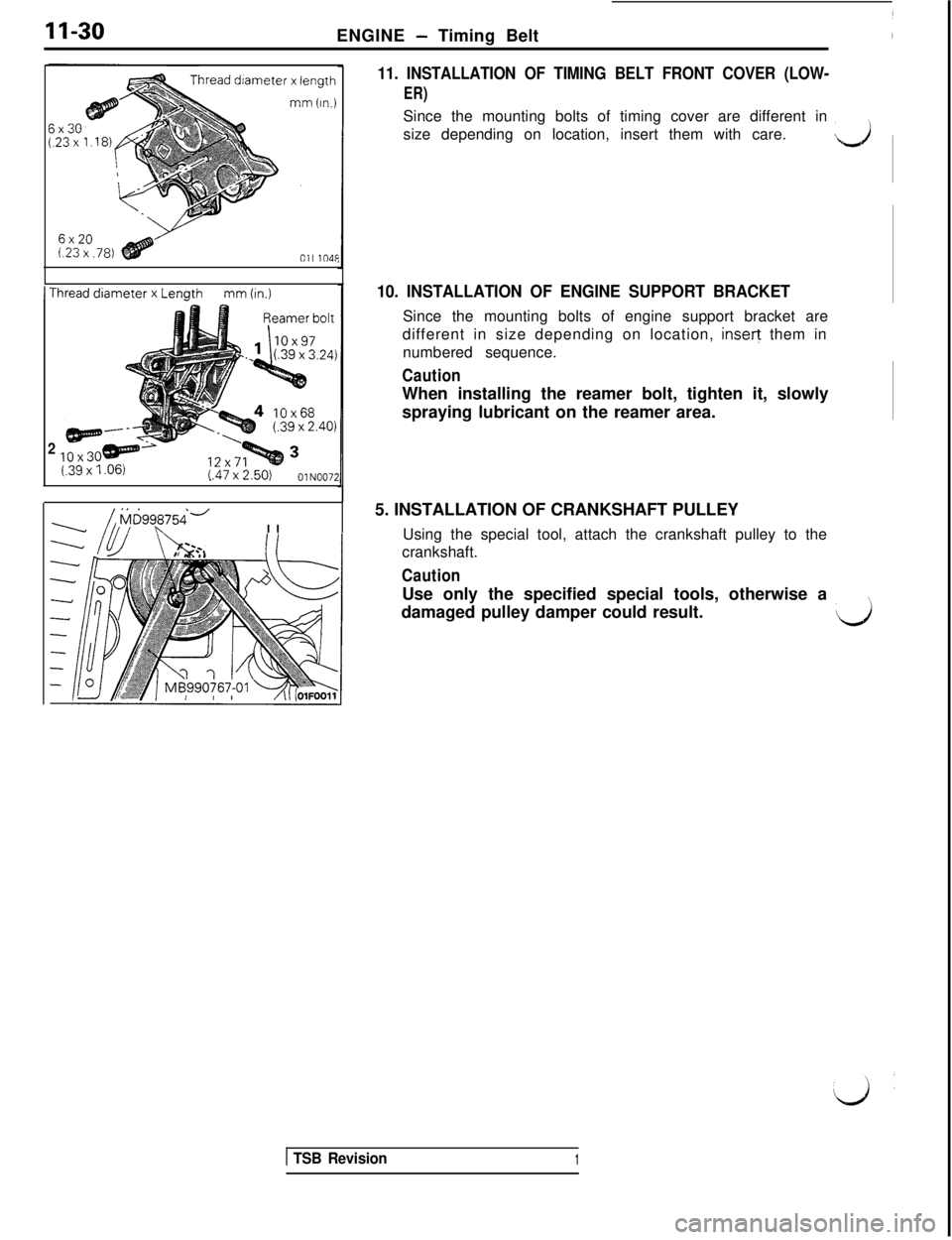
11. INSTALLATION OF TIMING BELT FRONT COVER (LOW-
ER)Since the mounting bolts of timing cover are different in
size depending on location, insert them with care.
.\J
10. INSTALLATION OF ENGINE SUPPORT BRACKETSince the mounting bolts of engine support bracket are
different in size depending on location, insert them in
numbered sequence.
CautionWhen installing the reamer bolt, tighten it, slowly
spraying lubricant on the reamer area.
\/,,fjd99p54-II5. INSTALLATION OF CRANKSHAFT PULLEY
Using the special tool, attach the crankshaft pulley to the
crankshaft.
CautionUse only the specified special tools, otherwise a
:damaged pulley damper could result.
d
1 TSB Revision1
Page 93 of 1146
/
iENGINE
- Oil Pan and Oil Pump11-43
Tlghtenlng sequence of flange bolts(bottom view)
iTiming beltside)7EN030f
7EN030
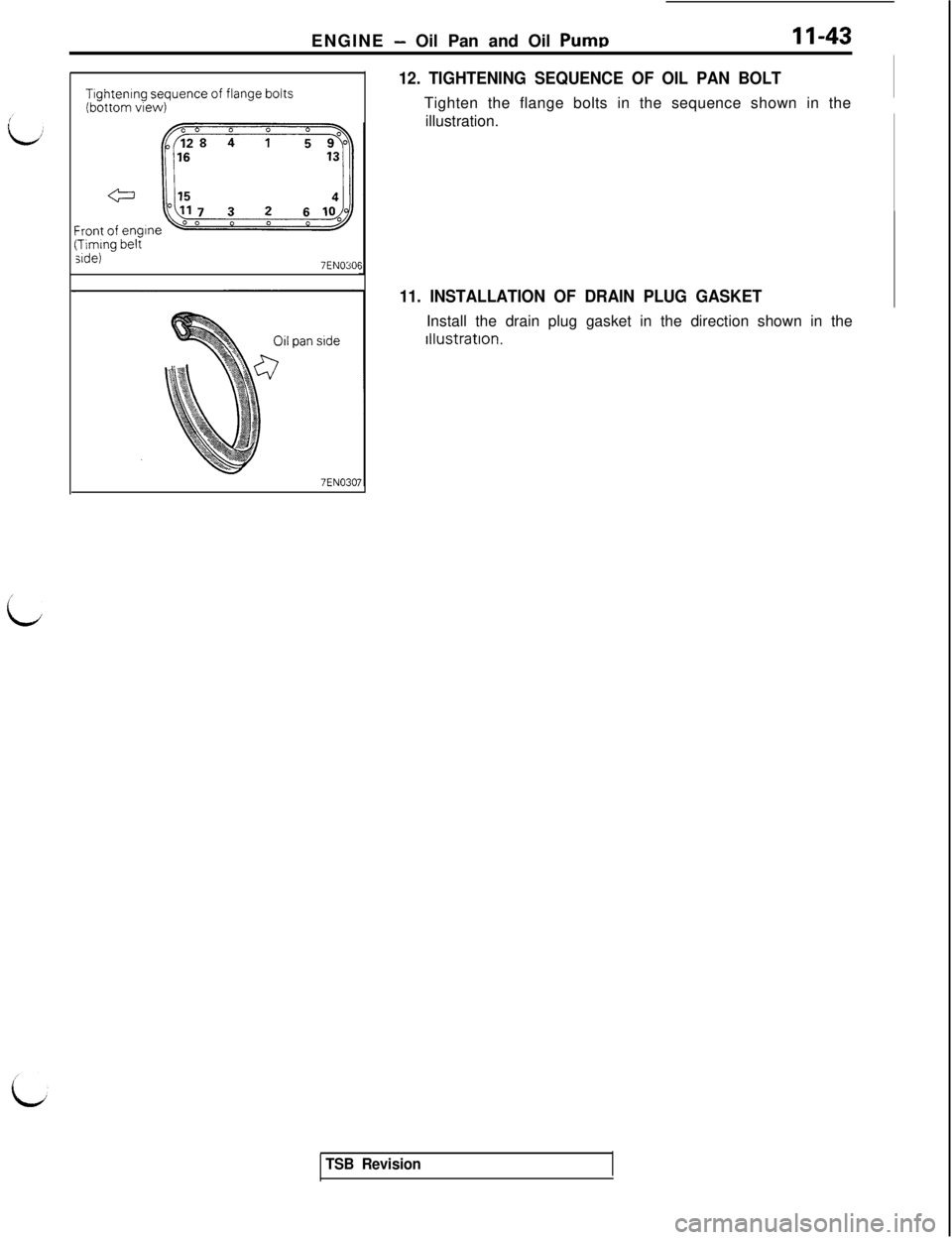
12. TIGHTENING SEQUENCE OF OIL PAN BOLTTighten the flange bolts in the sequence shown in the
illustration.illustration.
11. INSTALLATION OF DRAIN PLUG GASKETInstall the drain plug gasket in the direction shown in the
TSB Revision
Page 98 of 1146
11-48ENGINE - Piston and Connecting Rod
Side railNo.1
spacer slotrail
6ENO41
7EN0032
Cylindcnumbe
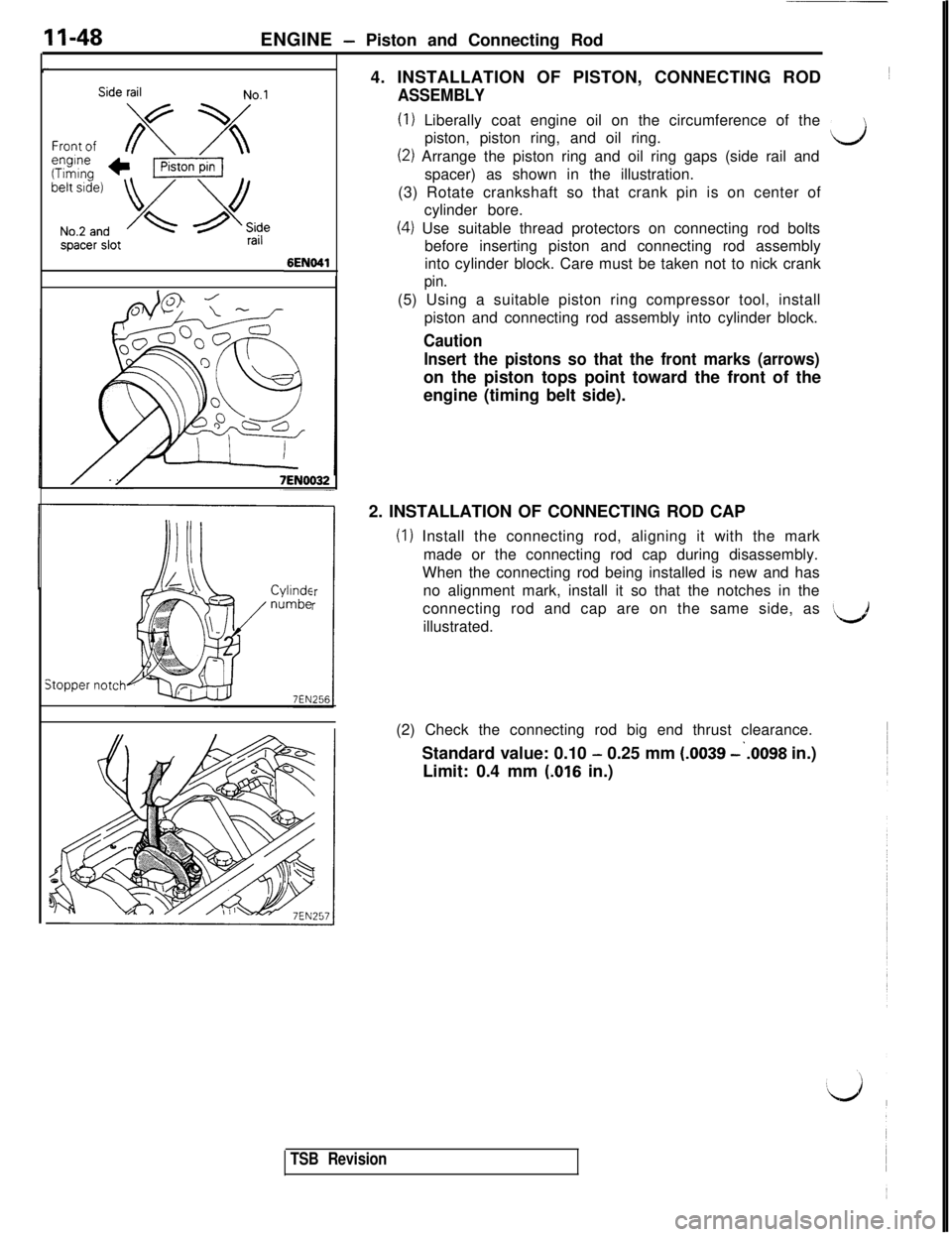
Stopper notch4. INSTALLATION OF PISTON, CONNECTING ROD~
ASSEMBLY
(1) Liberally coat engine oil on the circumference of the
piston, piston ring, and oil ring.
d
(2) Arrange the piston ring and oil ring gaps (side rail and
spacer) as shown in the illustration.
(3) Rotate crankshaft so that crank pin is on center of
cylinder bore.
(4) Use suitable thread protectors on connecting rod bolts
before inserting piston and connecting rod assembly
into cylinder block. Care must be taken not to nick crank
pin.(5) Using a suitable piston ring compressor tool, install
piston and connecting rod assembly into cylinder block.
Caution
Insert the pistons so that the front marks (arrows)on the piston tops point toward the front of the
engine (timing belt side).
2. INSTALLATION OF CONNECTING ROD CAP
(1) Install the connecting rod, aligning it with the mark
made or the connecting rod cap during disassembly.
When the connecting rod being installed is new and has
no alignment mark, install it so that the notches in the
connecting rod and cap are on the same side, as
illustrated.
‘d(2) Check the connecting rod big end thrust clearance.
Standard value: 0.10
- 0.25 mm (.0039 -‘.0098 in.)
Limit: 0.4 mm
(-016 in.)
TSB Revision
Page 102 of 1146
11-52ENGINE - Crankshaft, Flywheel and Drive Plate
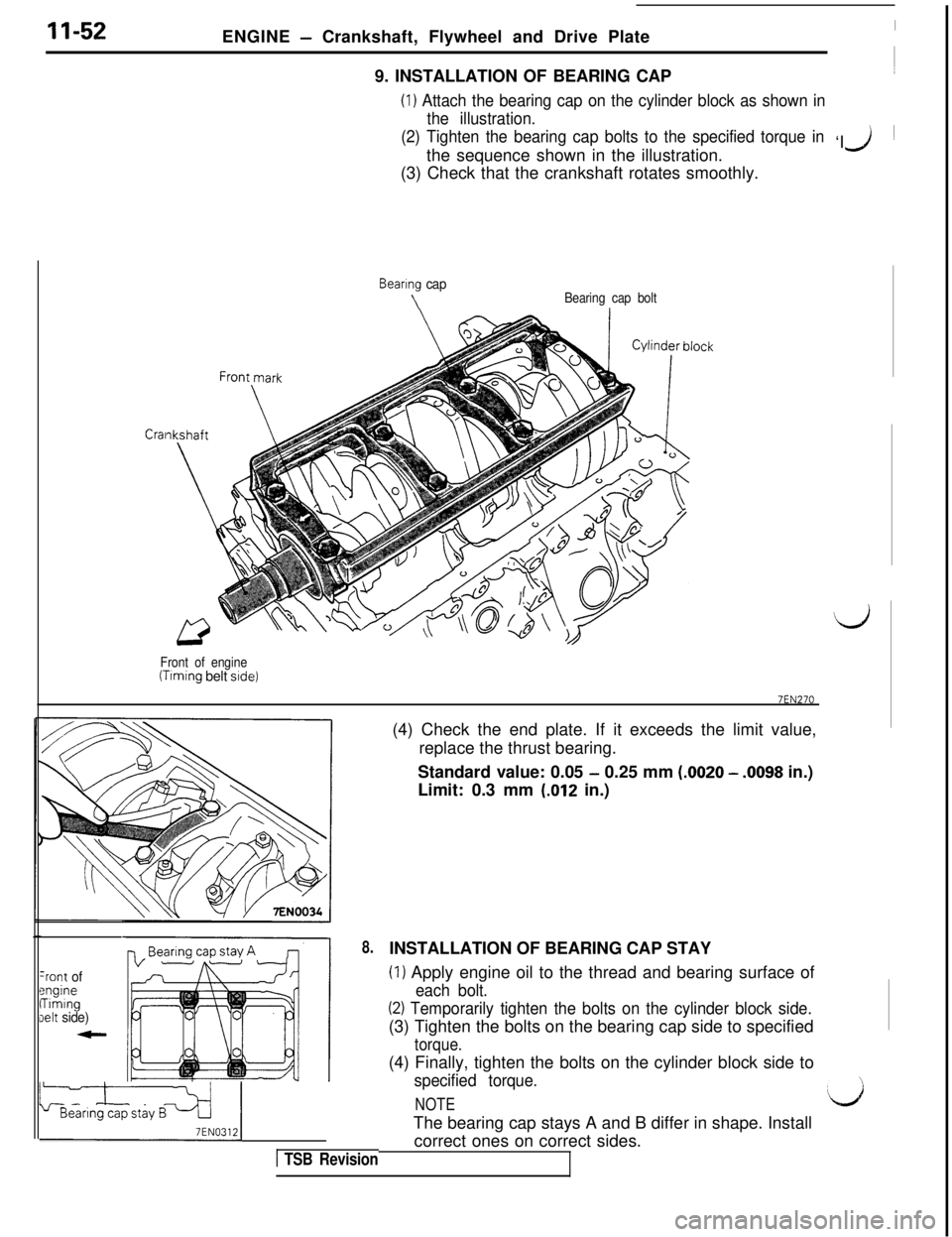
9. INSTALLATION OF BEARING CAP
(1) Attach the bearing cap on the cylinder block as shown in
the illustration.
(2) Tighten the bearing cap bolts to the specified torque in‘I
the sequence shown in the illustration.
J ~
(3) Check that the crankshaft rotates smoothly.
Cral
Bearing cap
\Bearing cap bolt
Front of engine
(Timing belt side)
7EN270(4) Check the end plate. If it exceeds the limit value,
replace the thrust bearing.
Standard value: 0.05
- 0.25 mm (.0020 - .0098 in.)
Limit: 0.3 mm
(.012 in.)
-rent ofengineTimingIelt side)
8.
LLiN03,ij
1 TSB RevisionINSTALLATION OF BEARING CAP STAY
(1) Apply engine oil to the thread and bearing surface of
each bolt.
(2) Temporarily tighten the bolts on the cylinder block side.(3) Tighten the bolts on the bearing cap side to specified
torque.(4) Finally, tighten the bolts on the cylinder block side to
specified torque.
NOTEThe bearing cap stays A and B differ in shape. Install
correct ones on correct sides.d
Page 178 of 1146

13-72FUEL SYSTEM - On-vehicle Inspection of MPI Components
CRANK ANGLE SENSOR
co.ntiector
Output characteristic
LTime
7FUO682
MllYiAC
Control relay-I-
Crank angle sensorsideA3
Crank angle sensor/\
‘=
Engine controlunft69I
1
h5v
7FUO499
OPERATIONl
The crank angle sensor senses the crank angle (piston position) of each cylinder, converts it into a pulse
signal and inputs it to the engine control unit, which then computes the engine speed and controls the fuelinjection timing and ignition timing based on the input signal.
lPower to the crank angle sensor is supplied from the control relay and is grounded to the body. The crank
angle sensor generates a pulse signal as it repeatedly connects and disconnects between 5 V voltagesupplied from the engine control unit and ground.
TROUBLESHOOTING HINTSHint 1: If unexpected shocks are felt during driving or the engine stalls suddenly during idling, shake the
crank angle sensor harness. If this causes the engine to stall, poor contact of the sensor connector is
suspected.Hint 2: If the crank angle sensor outputs a pulse signal when the ignition switch is turned ON (with the
engine not running), a faulty crank angle sensor or engine control unit is suspected.
Hint 3:
If the tachometer reads 0 rpm when the engine that has failed to start is cranked, faulty crank angleHint 4:sensor or broken timing belt is suspected.
If the tachometer reads 0 rpm when the engine that has failed to start is cranked, the primary current
of the ignition coil is not turned on and off. Therefore, troubles in the ignition circuit and ignition coil orfaulty power transistor is suspected.
Hint 5: If the engine can be run at idle even though the crank angle sensor reading is out of specification,troubles are often in other than the crank angle sensor.
[Examples](1) Faulty engine coolant temperature sensor
(2) Faulty idle speed control servo
(3) Poorly adjusted reference idle speed
TSB Revision
Page 307 of 1146
COOLING - Water Pump, Water Pipe and Water Hose
WATER PUMP, WATER PIPE AND WATER HOSE
14-13
M14MB-B
/REMOVAL AND INSTALLATION
Pre-removal and Post-installation
Operation
l Draining and Supplying of the Engine Coolant
(Refer to GROUP 00 - Maintenance Service.)l Removal and Installation of Power Transistor
Unit and Ignition Coil
(Refer to GROUP 16 - Engine Electrical)l Removal and lnstallatlon of Timing Belt
(Refer to GROUP 11 -Timing Belt)17-20 Nm17-20 Nm
12-14ft.lbs.
1
12-15Nm9-11 ft.1bs.q
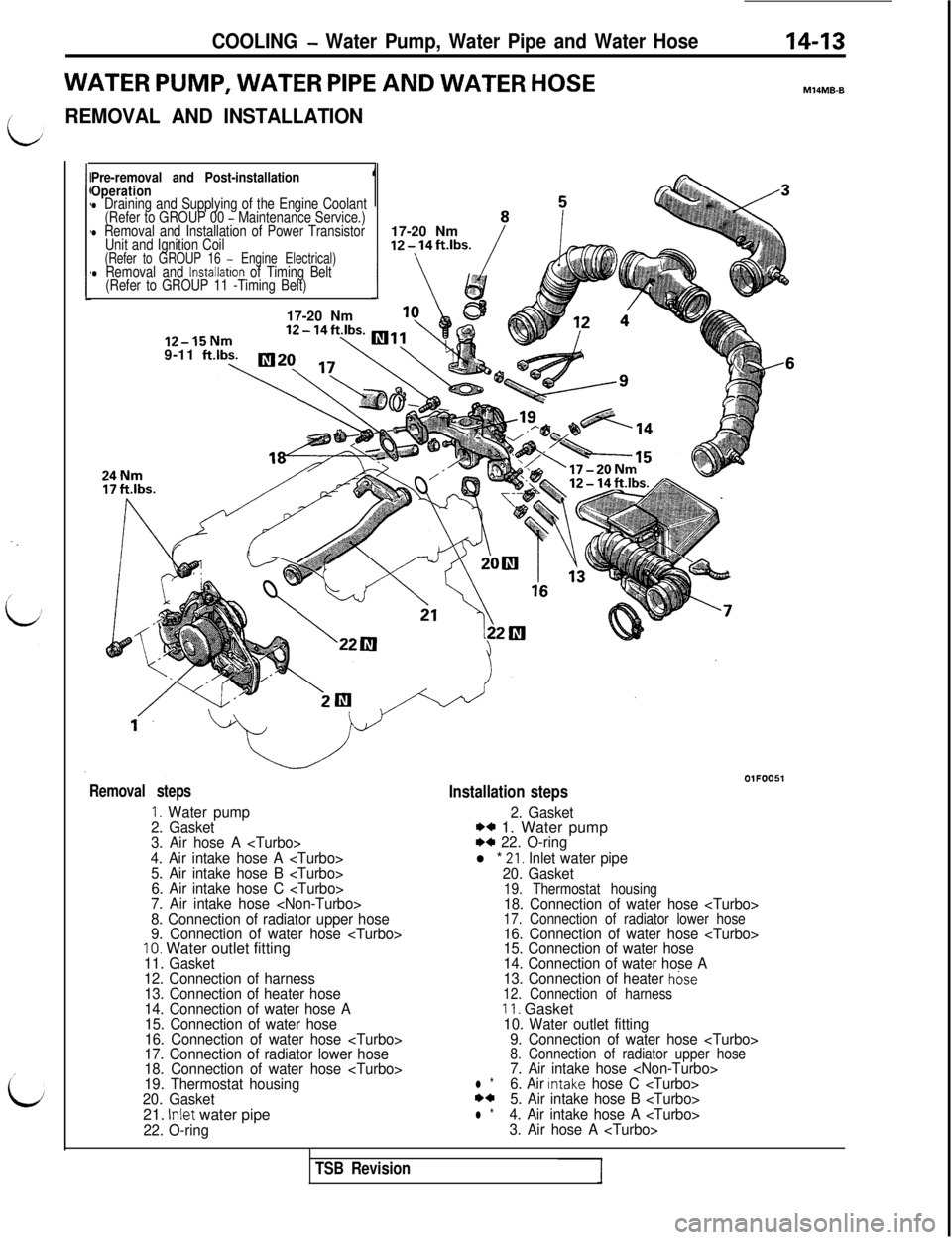
Removal steps
1. Water pump
2. Gasket
3. Air hose A
4. Air intake hose A
5. Air intake hose B
6. Air intake hose C
7. Air intake hose
8. Connection of radiator upper hose
9. Connection of water hose
IO. Water outlet fitting11. Gasket
12. Connection of harness
13. Connection of heater hose
14. Connection of water hose A
15. Connection of water hose
16. Connection of water hose
17. Connection of radiator lower hose
18. Connection of water hose
19. Thermostat housing
20. Gasket21.
Her water pipe22. O-ringOlFOO51
Installation steps
2. Gasket** 1. Water pumpI)+ 22. O-ring
l * 21. Inlet water pipe
20. Gasket
19. Thermostat housing18. Connection of water hose
15. Connection of water hose
14. Connection of water hose A
13. Connection of heater h&e
12. Connection of harness11. Gasket10. Water outlet fitting
9. Connection of water hose
8. Connection of radiator upper hose7. Air intake hose
3. Air hose A
TSB Revision
Page 326 of 1146
15-16INTAKE AND EXHAUST - Intake Manifold
INTAKE MANIFOLD
REMOVAL AND INSTALLATION
Pre-removal Operationl Release of Residual Pressure fromHigh Pressure Fuel Hose(Refer to GROUP 13-ServiceAdjustment Procedures.)l Draining of Engine Coolant (Refer
to GROUP 00 -Maintenance Service,)
l Removal of Air Intake Plenum(Referto P.15-13, 14.)5Nm
lo-13Nm4 ft.lbs.8-9ftJbs. w2\I
Post-installation Operationl Installation of Air Intake Plenum
(Refer to P.1.5-13. 14.)l Filling of Engine Coolant
(Refer to GROUP 00 - Maintenance
Service.)
l Adjustment of Accelerator Cable(Referto GROUP 13-EngineControl.). Checkina for Fuel Leakage6
5
2 :‘;bs.)
gp,.qgs ~-zt!EJ8OSFOO24
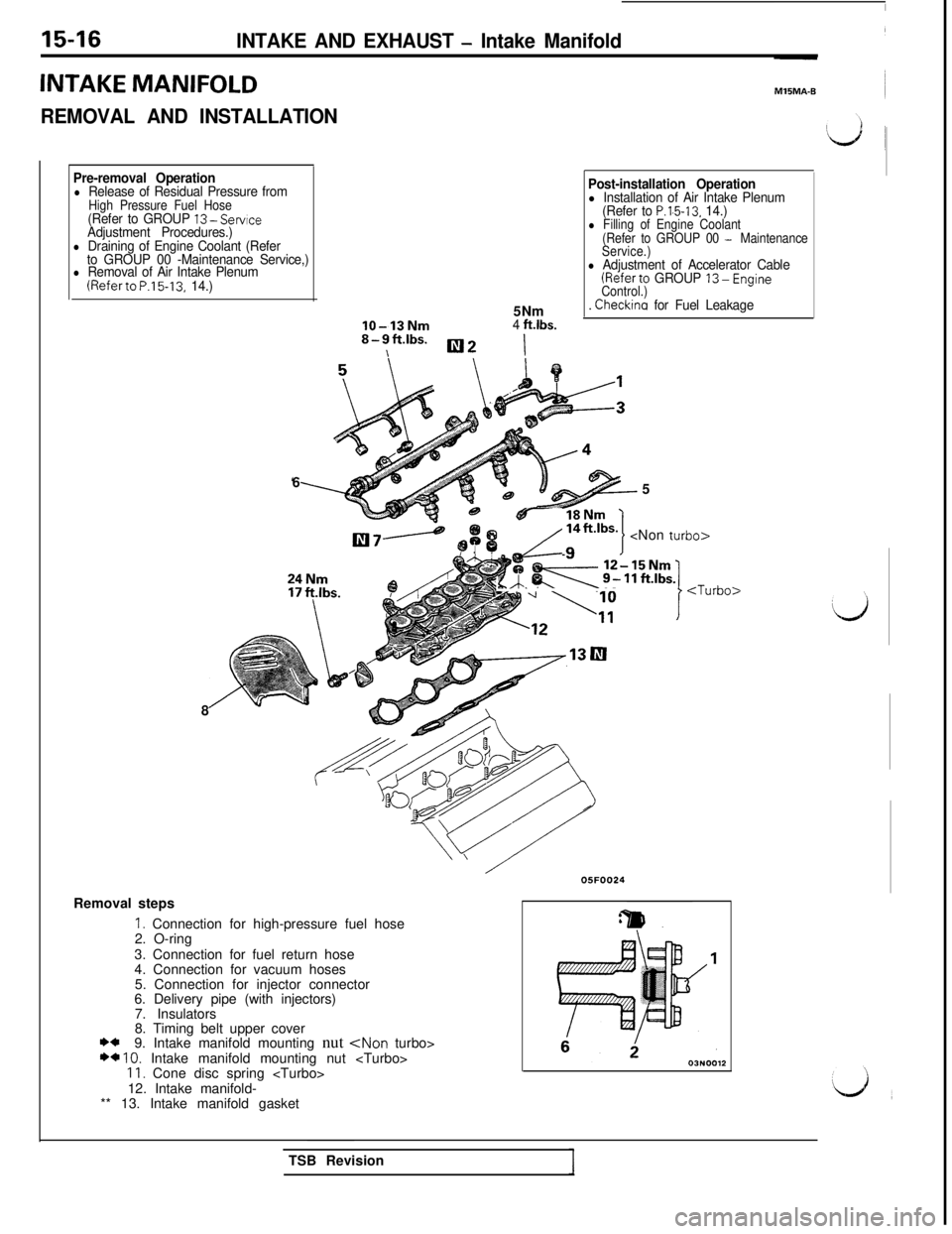
Removal steps
I. Connection for high-pressure fuel hose
2. O-ring
3. Connection for fuel return hose
4. Connection for vacuum hoses
5. Connection for injector connector
6. Delivery pipe (with injectors)
7. Insulators
8. Timing belt upper cover
I)*9. Intake manifold mounting nut
12. Intake manifold-
** 13. Intake manifold gasket
TSB Revision