tire pressure MITSUBISHI 3000GT 1991 Service Manual
[x] Cancel search | Manufacturer: MITSUBISHI, Model Year: 1991, Model line: 3000GT, Model: MITSUBISHI 3000GT 1991Pages: 1146, PDF Size: 76.68 MB
Page 31 of 1146
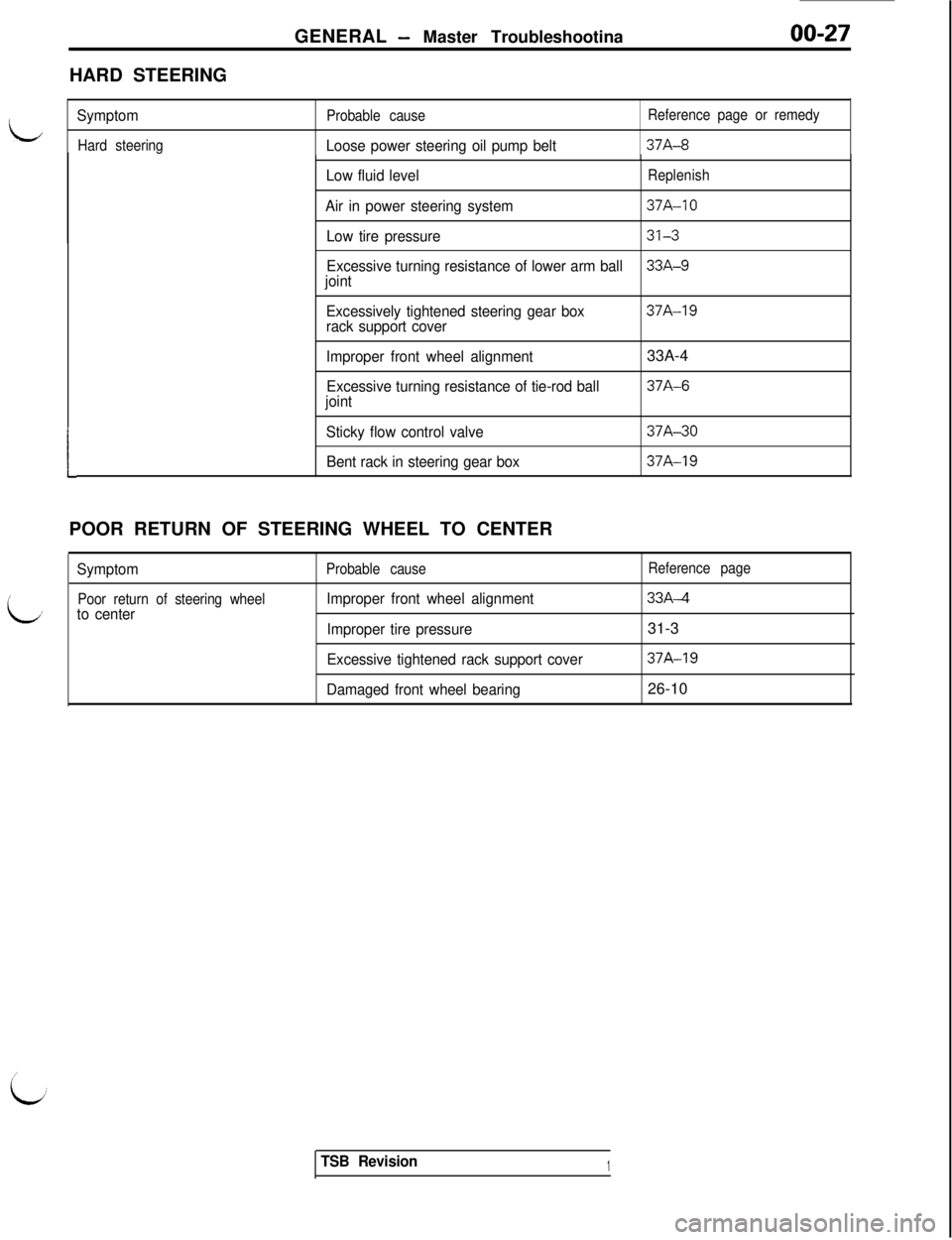
GENERAL - Master Troubleshootina00-27HARD STEERING
L
L
Symptom
Hard steeringProbable causeLoose power steering oil pump belt
Reference page or remedy37A-8
1POOR RETURN OF STEERING WHEEL TO CENTER
Symptom
Poor return of steering wheelto center
Probable cause
Improper front wheel alignment
Improper tire pressure
Excessive tightened rack support cover
Damaged front wheel bearing
Reference page33A-4
31-3
37A-1926-10
Low fluid levelReplenish
Air in power steering system37A-10
Low tire pressure
313
Excessive turning resistance of lower arm ball33A-9joint
Excessively tightened steering gear box
rack support cover
37A-19
Improper front wheel alignment
Excessive turning resistance of tie-rod ball
joint
Sticky flow control valve
Bent rack in steering gear box33A-437A-6
37A-30
37A-19
TSB Revision1
Page 32 of 1146
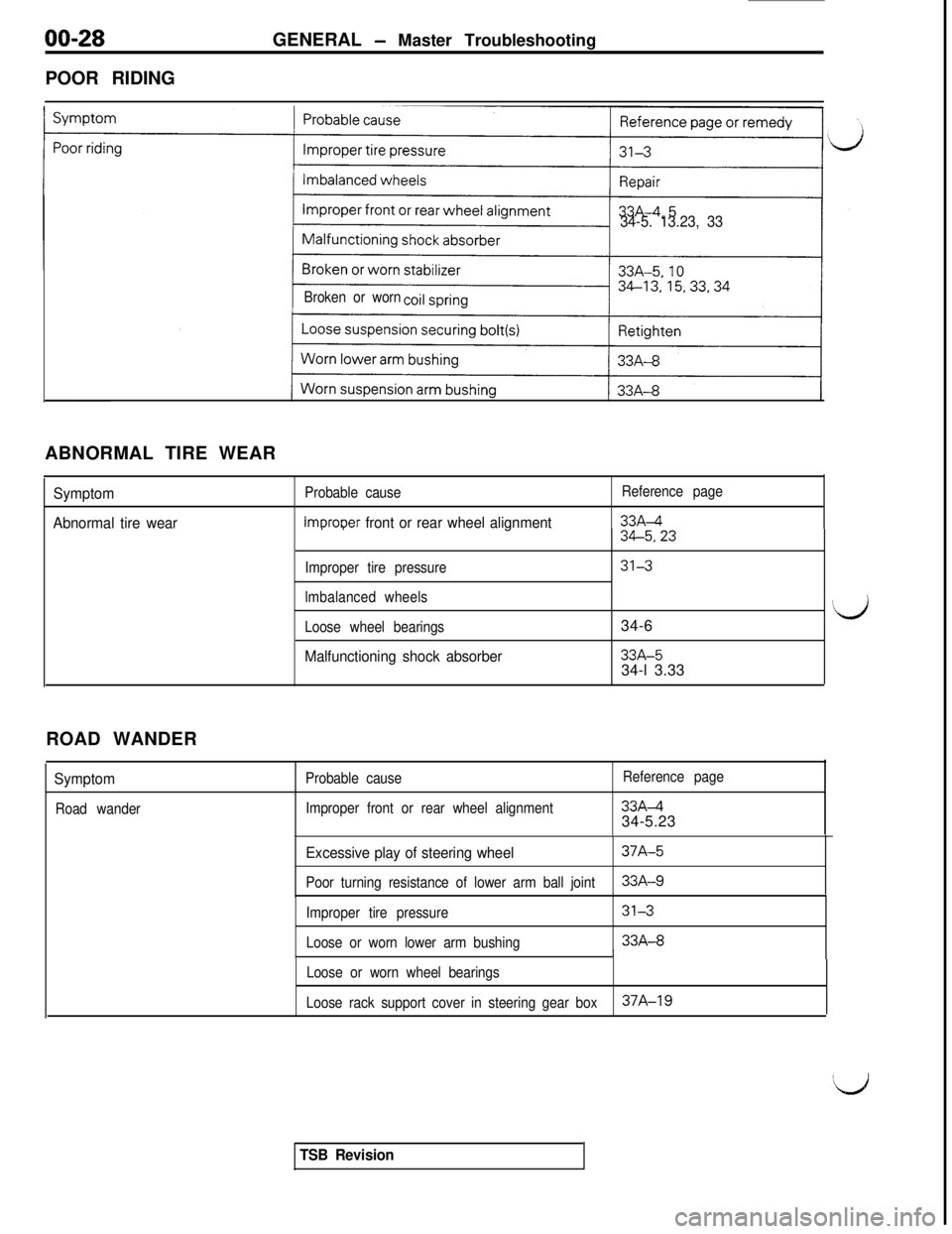
00-28GENERAL - Master Troubleshooting
POOR RIDING
34-5. 13.23, 33
Broken or wornABNORMAL TIRE WEAR
Symptom
Abnormal tire wearProbable cause
lmorooer front or rear wheel alignment, ,
Improper tire pressure
lmbalanced wheels
Loose wheel bearings
Malfunctioning shock absorber
Reference page
33Ad34-5,23
31334-6
LJ33A-5
34-l 3.33
ROAD WANDER
Symptom
Road wanderProbable cause
Improper front or rear wheel alignmentReference page33A&34-5.23
Excessive play of steering wheel
Poor turning resistance of lower arm ball joint37A-533A-9
Improper tire pressure
Loose or worn lower arm bushing31333A-8
III
Loose or worn wheel bearings
Loose rack support cover in steering gear box37A-19
TSB Revision
Page 33 of 1146
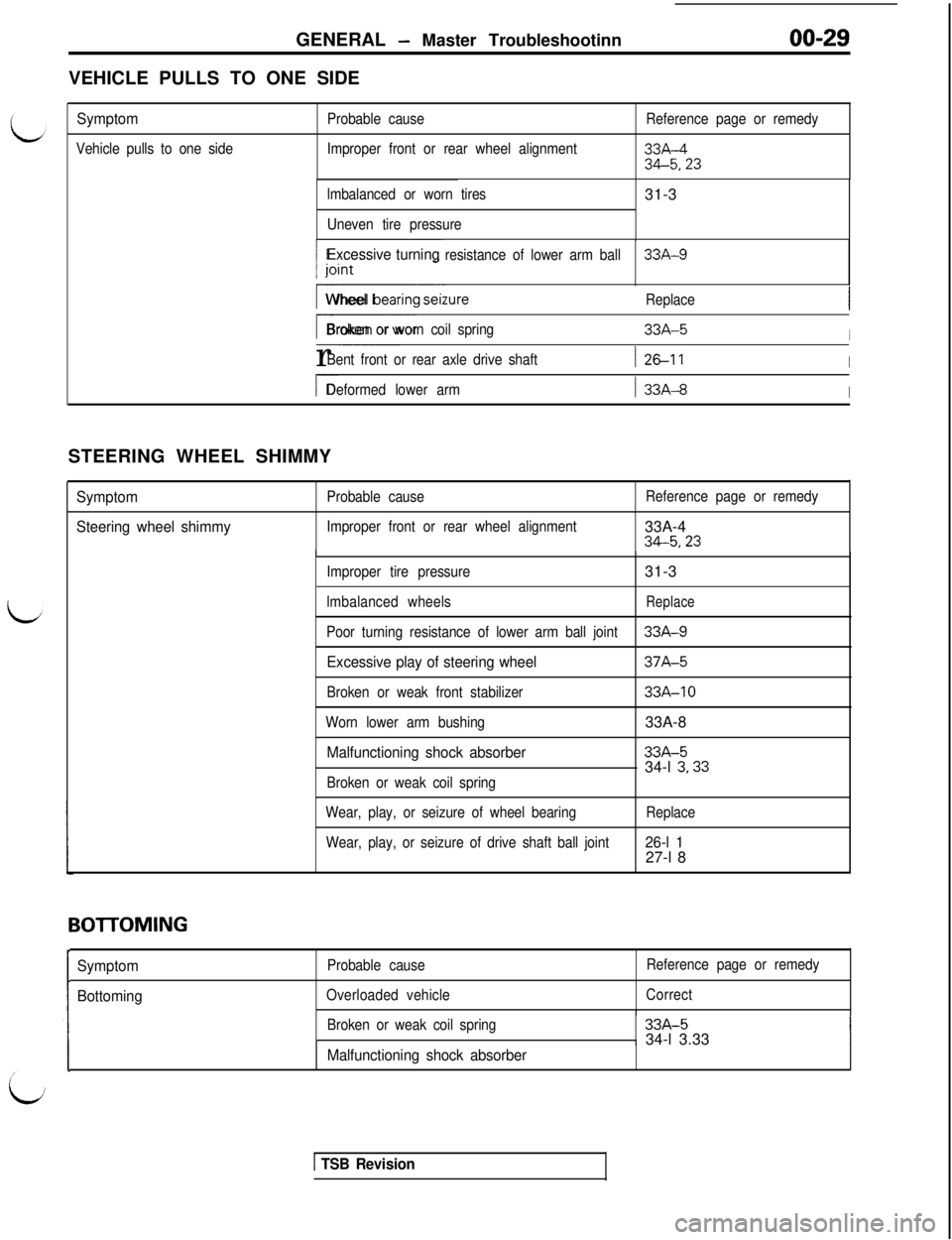
GENERAL - Master Troubleshootinn
VEHICLE PULLS TO ONE SIDE
Symptom
Vehicle pulls to one sideProbable cause
Improper front or rear wheel alignmentReference page or remedy33A-4
34-5,23
lmbalanced or worn tires
Uneven tire pressure31-3
Excessive turningresistance of lower arm ball33A-9
I--_Wheel beanng serzureReplace
I---Broken or worn coil spring33A-5Ir
~~~~~~Bent front or rear axle drive shaft126-11I
I-Deformed lower arm1 33A-8I
Improper tire pressure31-3
lmbalanced wheelsReplace
Poor turning resistance of lower arm ball joint33A-9
Excessive play of steering wheel37A-5
Broken or weak front stabilizer33A-10
Worn lower arm bushing33A-8
Malfunctioning shock absorber33A-5
34-l 3,33
Broken or weak coil spring
Wear, play, or seizure of wheel bearing
Wear, play, or seizure of drive shaft ball jointReplace
26-l 127-l 8 STEERING WHEEL SHIMMY
SymptomProbable cause
Steering wheel shimmyImproper front or rear wheel alignmentReference page or remedy33A-434-5,23
Boll-OMING
Symptom
BottomingProbable cause
Overloaded vehicleReference page or remedy
Correct
Broken or weak coil spring33A-5
34-l 3.33
IMalfunctioning shock absorber
1 TSB Revision
Page 548 of 1146
23-96AUTOMATIC TRANSAXLE - Front Clutch Assembly
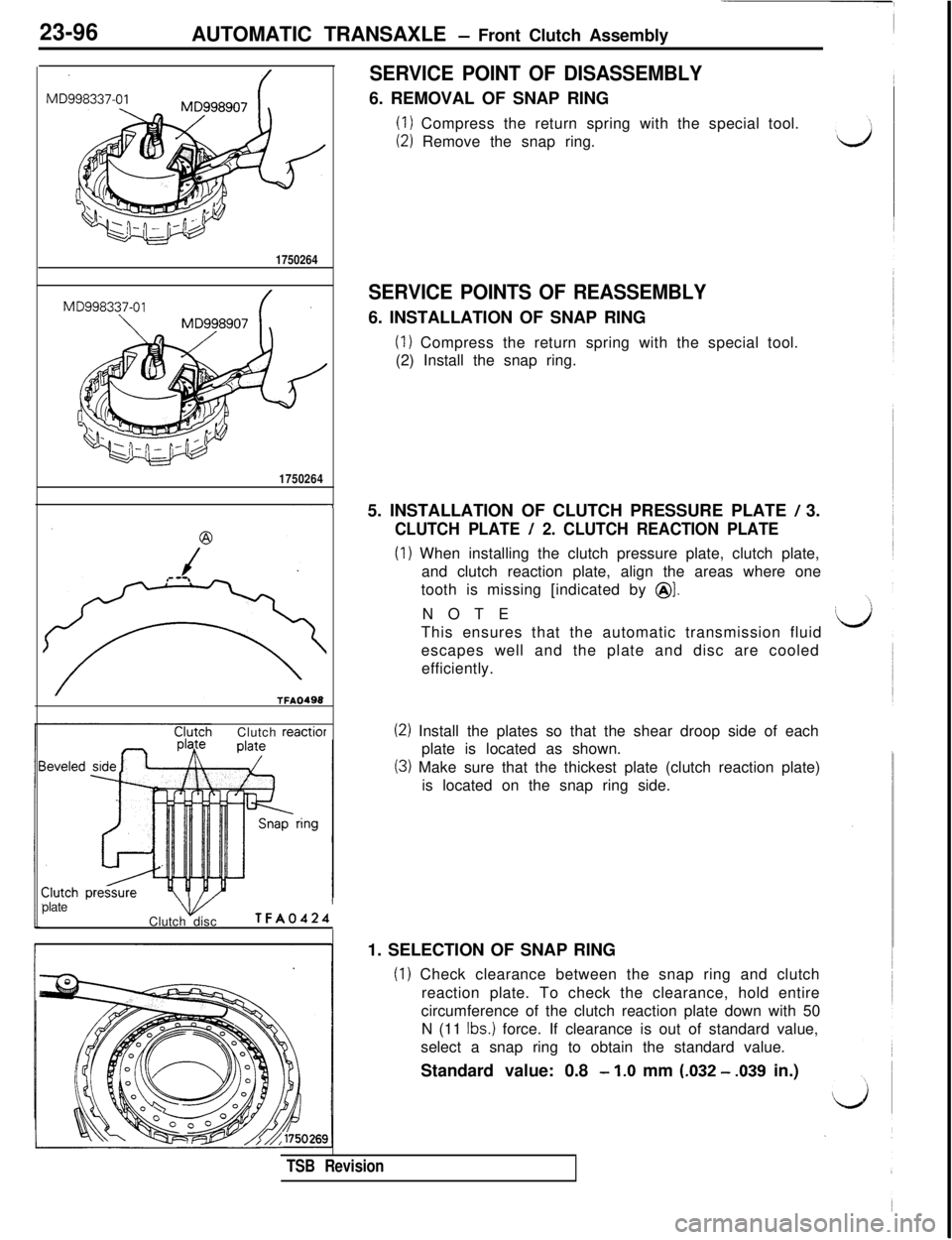
SERVICE POINT OF DISASSEMBLY6. REMOVAL OF SNAP RING
(I) Compress the return spring with the special tool.
(2) Remove the snap ring.
1750264
1750264
7Clutch
reactiorplate
’vClutch discTFAQ424
SERVICE POINTS OF REASSEMBLY6. INSTALLATION OF SNAP RING
(I) Compress the return spring with the special tool.
(2) Install the snap ring.
5. INSTALLATION OF CLUTCH PRESSURE PLATE
/ 3.
CLUTCH PLATE / 2. CLUTCH REACTION PLATE
(1) When installing the clutch pressure plate, clutch plate,
and clutch reaction plate, align the areas where one
tooth is missing [indicated by @I.
NOTE
This ensures that the automatic transmission fluid
escapes well and the plate and disc are cooled
efficiently.
(2) Install the plates so that the shear droop side of each
plate is located as shown.
(3) Make sure that the thickest plate (clutch reaction plate)
is located on the snap ring side.
1. SELECTION OF SNAP RING
(1) Check clearance between the snap ring and clutch
reaction plate. To check the clearance, hold entire
circumference of the clutch reaction plate down with 50
N (11
Ibs.) force. If clearance is out of standard value,
select a snap ring to obtain the standard value.
Standard value: 0.8
- 1.0 mm (.032 - .039 in.)
TSB Revision
Page 639 of 1146
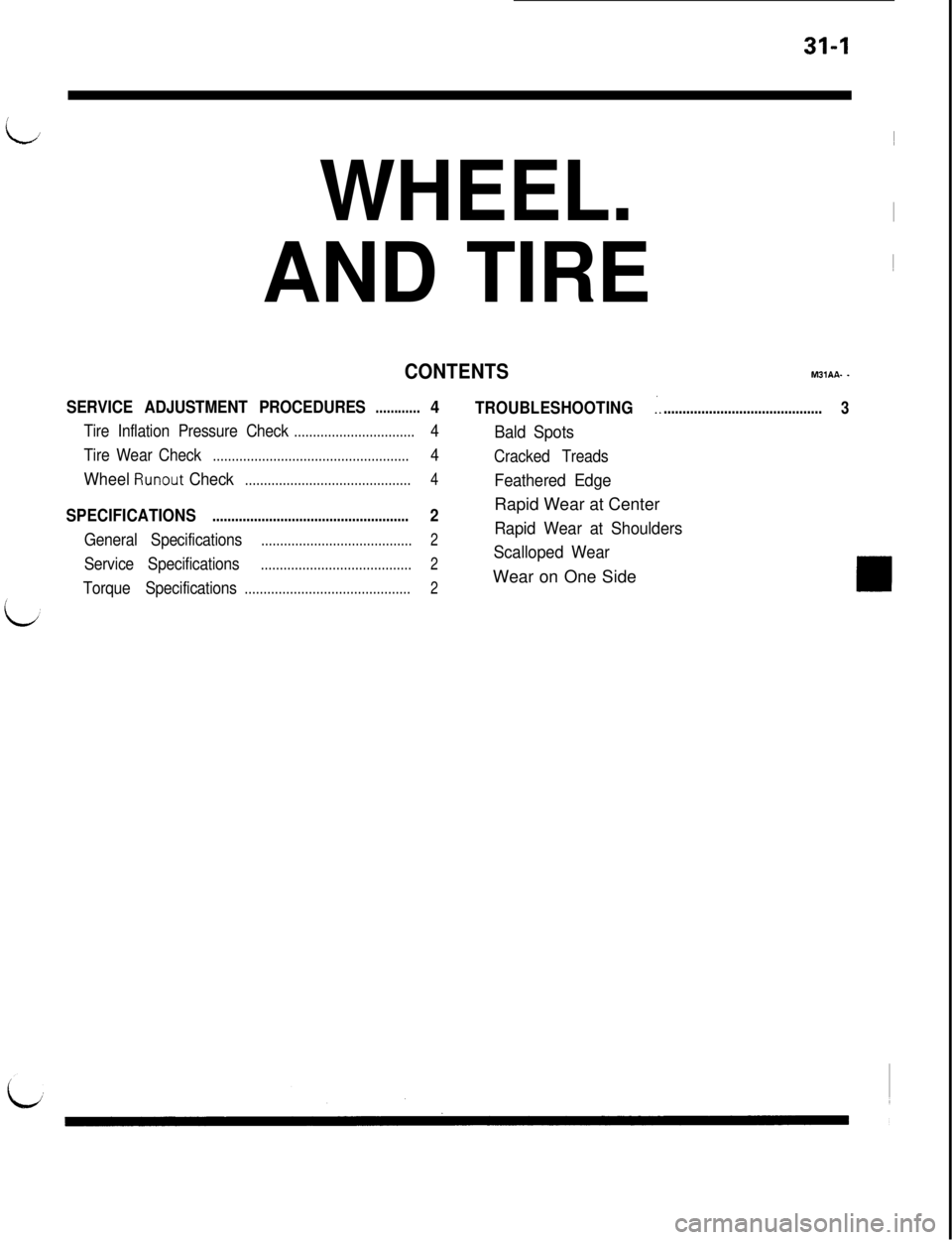
31-1
ii~
WHEEL.I
AND TIRE~
CONTENTSM3IA& -
SERVICE ADJUSTMENT PROCEDURES............4TROUBLESHOOTING:...........................................3
Tire Inflation Pressure Check................................4Bald Spots
Tire Wear Check....................................................4
Cracked Treads
Wheel Runout Check............................................4Feathered Edge
SPECIFICATIONS2Rapid Wear at Center....................................................
General Specifications2Rapid Wear at Shoulders........................................
Service Specifications........................................2Scalloped Wear
Torque Specifications2Wear on One Side............................................
Page 640 of 1146

Tire inflation pressure
kPa (psi)
Fro")
31-2WHEEL AND TIRE - Specifications
SPECIFICATIONS
GENERAL SPECIFICATIONS
MOICA- -
‘\
Items
Wheel
Tire size
Wheel type
Wheel size
Amount of wheel offsetmm (in.)
Tire inflation pressure
kPa (psi)
Front
Rear
DOHC-N/A
225l55R 16 93U
Aluminum type
16X8J ’
46 (1.8)
220 (32)
200 (29)DOHC-T/C
245145ZR 17
Aluminum type
17 x
8.5J
46 (1.8)
220 (32)
200 (29)
Spare wheel
Tire size
T125190D16T135/90D16
Wheel size
l6x4Tl6x4T
Amount of wheel offsetmm (in.)46 (1.8)46 (1.8)
Tire inflation pressurekPa (psi)
420 (60)420 (60)
SERVICE SPECIFICATIONSM31CB. -
Items
Specifications
Limit
Wheel
runout
Radialmm (in.)2.0 (.08)
Lateralmm (in.)2.0 t.08)
Tread depth of tiremm (in.)1.6 (.06)
TORQUE SPECIFICATIONSMBlCC- -
ItemsNm
Hub nuts120- 140
ft.lbs.
87-iO1TSB Revision
Page 642 of 1146
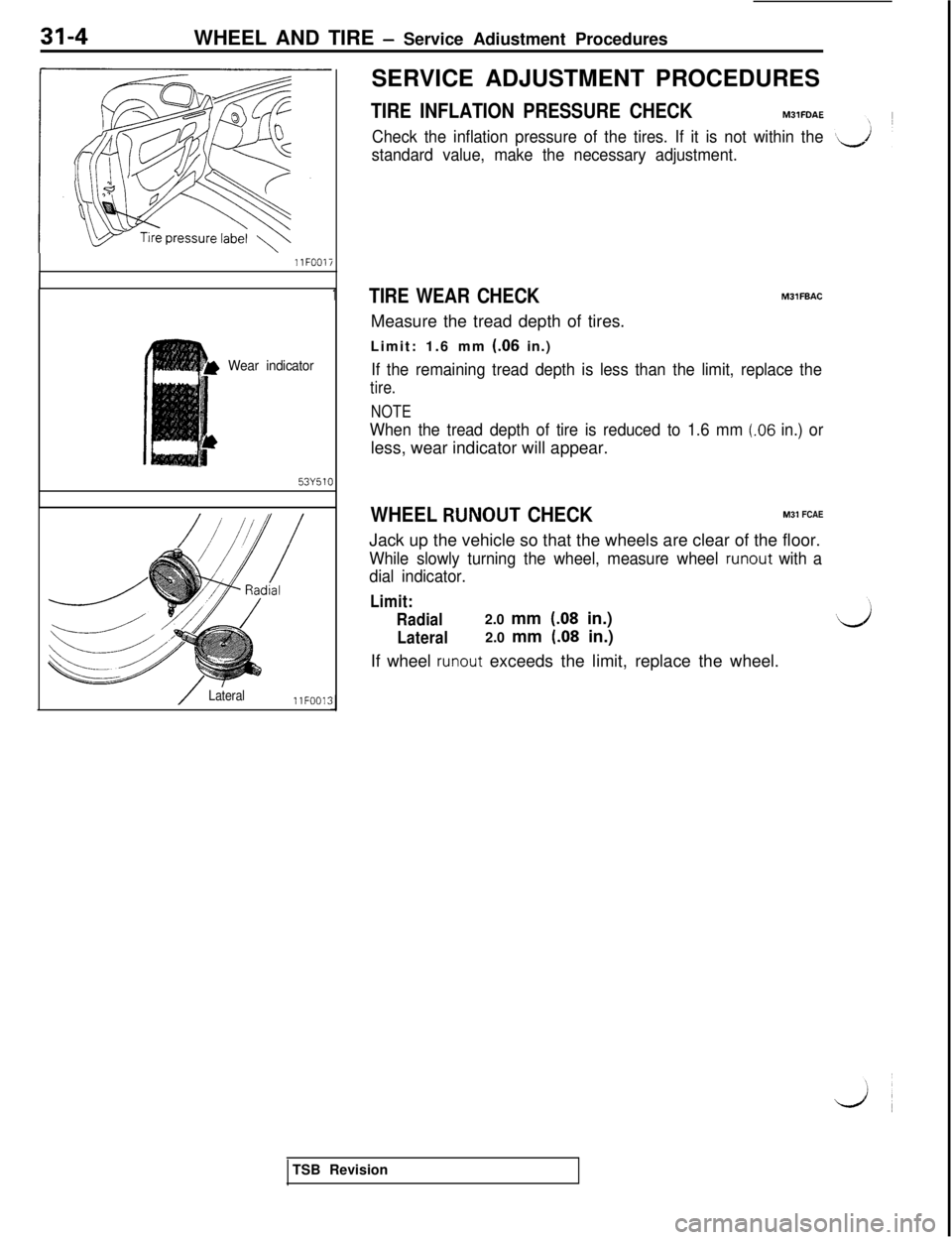
WHEEL AND TIRE - Service Adiustment ProceduresllFOO1753Y510
Wear indicator
/LateralllFOO1:
1SERVICE ADJUSTMENT PROCEDURES
TIRE INFLATION PRESSURE CHECKM3lFDA.E
Check the inflation pressure of the tires. If it is not within the
standard value, make the necessary adjustment.
TIRE WEAR CHECKMJlFBAC
Measure the tread depth of tires.
Limit: 1.6 mm
(.06 in.)
If the remaining tread depth is less than the limit, replace the
tire.
NOTE
When the tread depth of tire is reduced to 1.6 mm (.06 in.) orless, wear indicator will appear.
WHEEL RUNOUT CHECKM31 FCAEJack up the vehicle so that the wheels are clear of the floor.
While slowly turning the wheel, measure wheel runout with a
dial indicator.
Limit:
Radial2.0 mm
(.08 in.)
Lateral2.0 mm (.08 in.)
If wheel
runout exceeds the limit, replace the wheel.
TSB Revision
Page 653 of 1146
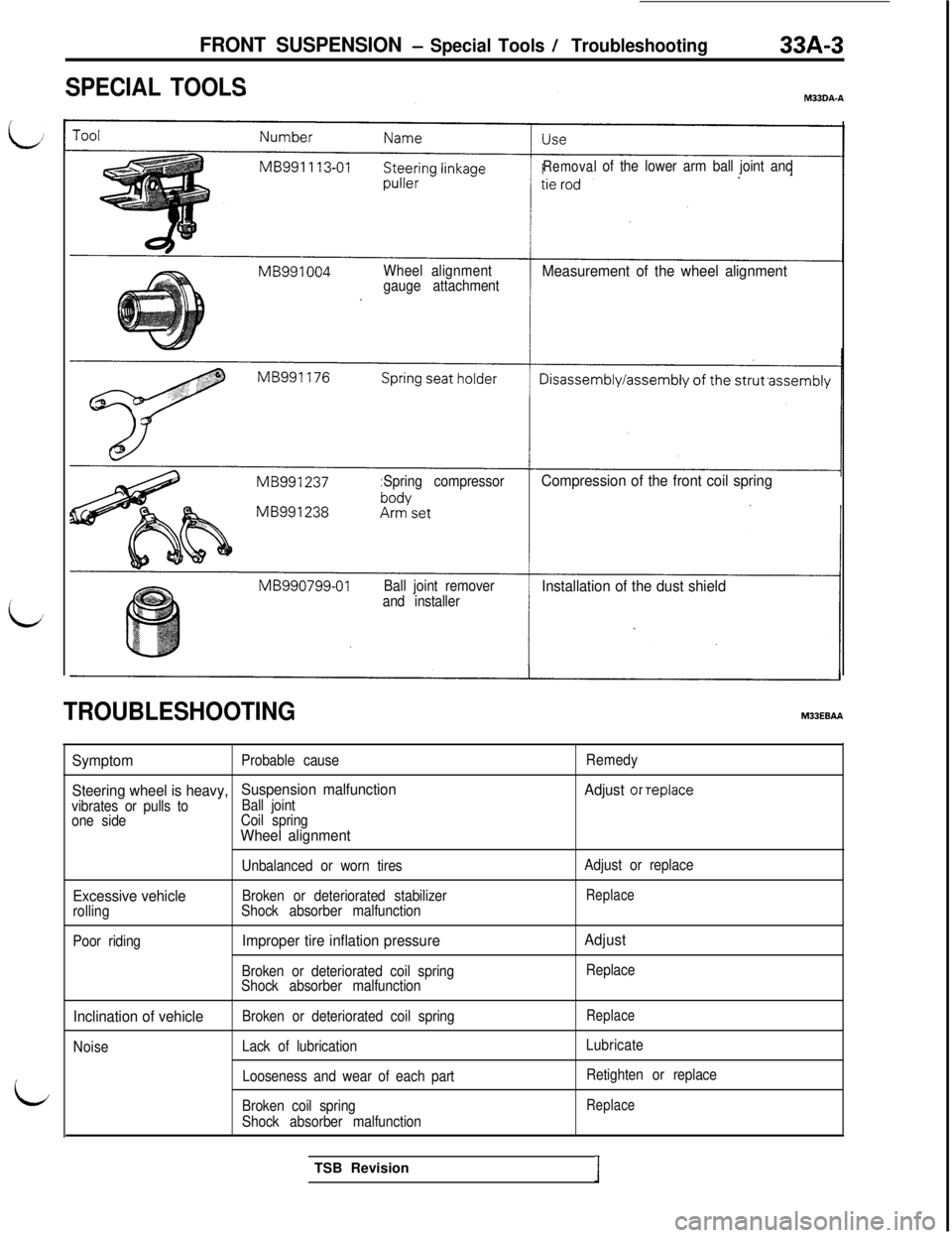
FRONT SUSPENSION - Special Tools / Troubleshooting
SPECIAL TOOLS
L
L
Removalof the lower arm ball joint and
Wheel alignment
gauge attachment
Measurement of the wheel alignment
Spring compressorCompression of the front coil spring
MB990799-01Ball joint remover
and installerInstallation of the dust shield
TROUBLESHOOTINGM33EBAA
SymptomProbable causeRemedy
Steering wheel is heavy,Suspension malfunctionvibrates or pulls toBall joint
Adjust orreplace
one sideCoil springWheel alignment
Unbalanced or worn tiresAdjust or replace
Excessive vehicleBroken or deteriorated stabilizer
rollingShock absorber malfunctionReplace
Poor ridingImproper tire inflation pressureAdjust
Broken or deteriorated coil spring
Shock absorber malfunctionReplace
Inclination of vehicleBroken or deteriorated coil springReplace
NoiseLack of lubricationLubricate
Looseness and wear of each partRetighten or replace
Broken coil spring
Shock absorber malfunction
ReplaceTSB Revision
I
Page 690 of 1146
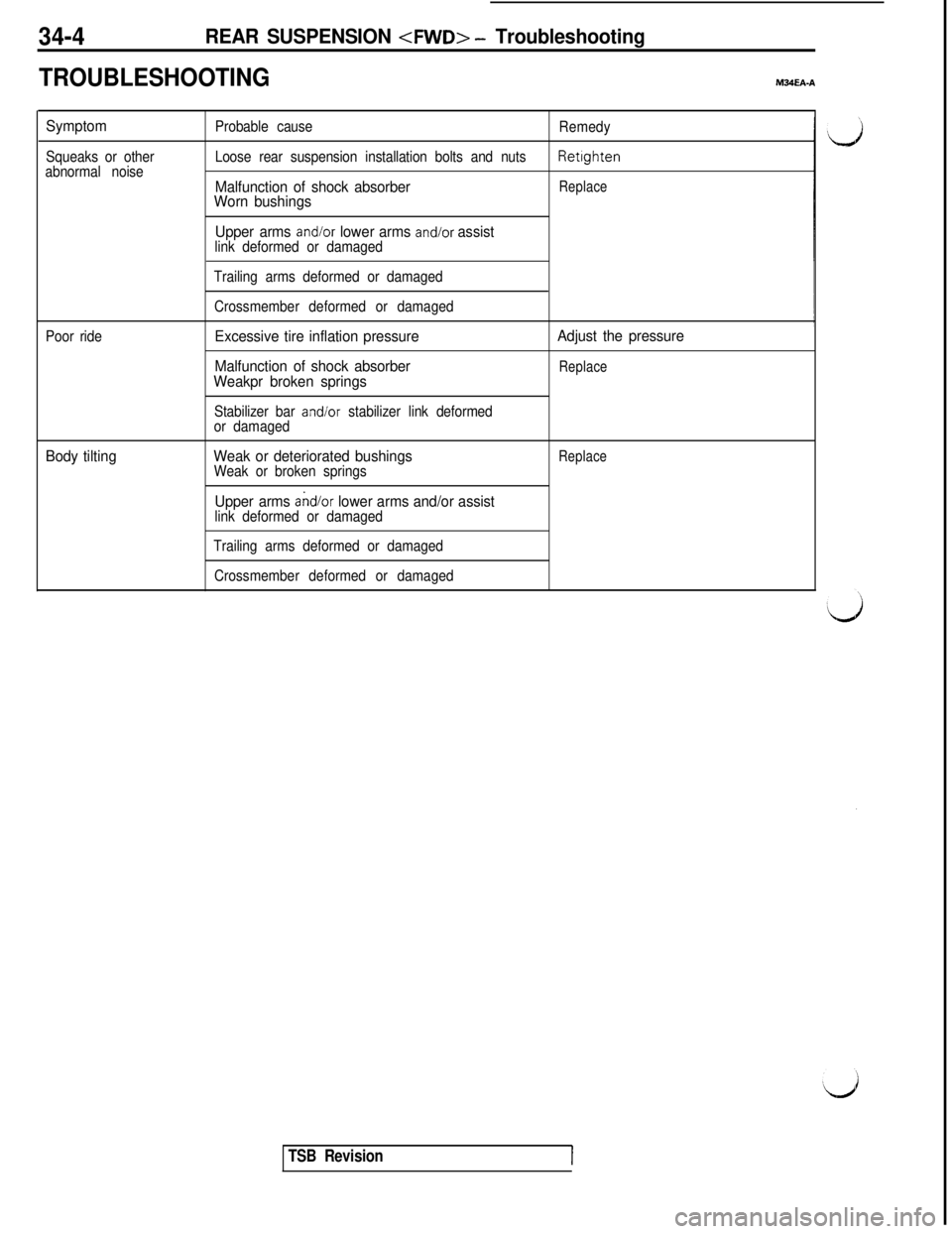
34-4REAR SUSPENSION
TROUBLESHOOTING
Symptom
Squeaks or other
abnormal noiseProbable cause
Loose rear suspension installation bolts and nuts
Malfunction of shock absorber
Worn bushings
Upper arms
and/or lower arms and/or assistlink deformed or damaged
Trailing arms deformed or damaged
Crossmember deformed or damaged
Excessive tire inflation pressure
Malfunction of shock absorber
Weakpr broken springs
Stabilizer bar and/or stabilizer link deformed
or damaged
Weak or deteriorated bushingsWeak or broken springs
Upper arms and/or lower arms and/or assistlink deformed or damaged
Trailing arms deformed or damaged
Crossmember deformed or damagedRemedy
Retrghten
Replace
Poor ride
Body tiltingAdjust the pressure
Replace
Replace
TSB Revision
Page 863 of 1146
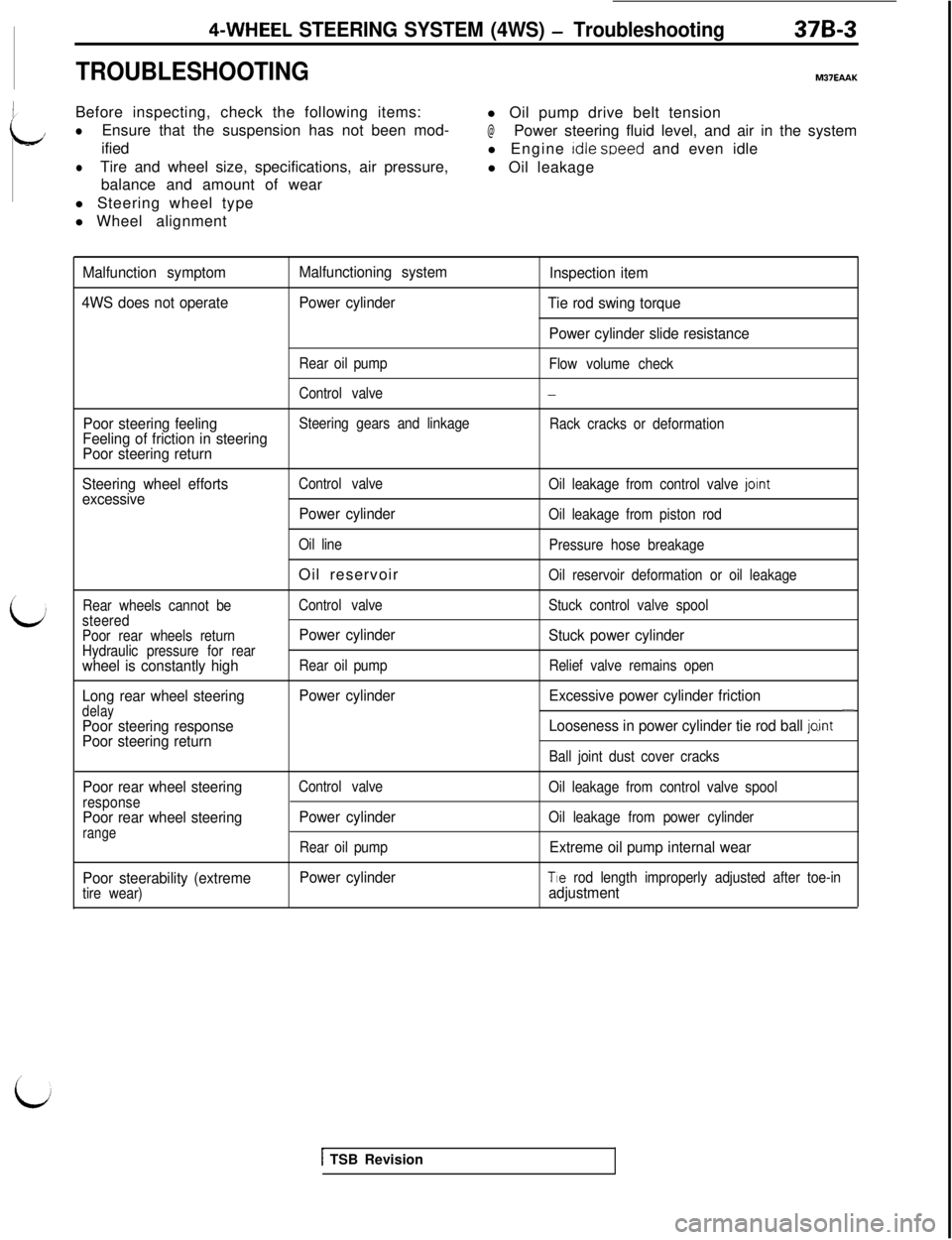
4-WHEEL STEERING SYSTEM (4WS) - Troubleshooting
TROUBLESHOOTING
37B-3
M37EMKBefore inspecting, check the following items:
l Oil pump drive belt tension
lEnsure that the suspension has not been mod-@Power steering fluid level, and air in the system
ified
l Engine
Idle soeed and even idle
lTire and wheel size, specifications, air pressure,
l Oil leakage
balance and amount of wear
l Steering wheel type
l Wheel alignment
Malfunction symptom
4WS does not operateMalfunctioning system
Power cylinderInspection item
Tie rod swing torque
Power cylinder slide resistance
Rear oil pump
Flow volume check
Control valve
-
Poor steering feelingSteering gears and linkage
Rack cracks or deformationFeeling of friction in steering
Poor steering return
Steering wheel efforts
excessive
Control valve
Oil leakage from control valve jornt
Rear wheels cannot be
steered
Poor rear wheels return
Hydraulic pressure for rear
wheel is constantly high
Long rear wheel steering
delayPoor steering response
Poor steering returnPower cylinder
Oil lineOil reservoir
Control valve
Power cylinder
Rear oil pump
Power cylinder
Oil leakage from piston rod
Pressure hose breakage
Oil reservoir deformation or oil leakage
Stuck control valve spool
Stuck power cylinder
Relief valve remains open
Excessive power cylinder friction-
Looseness in power cylinder tie rod ball jo.int
Ball joint dust cover cracks
Poor rear wheel steeringresponsePoor rear wheel steeringrange
Poor steerability (extremetire wear)Control valve
Power cylinder
Rear oil pump
Power cylinder
Oil leakage from control valve spool
Oil leakage from power cylinder
Extreme oil pump internal wear
Tie rod length improperly adjusted after toe-inadjustment
[ TSB Revision