check engine light MITSUBISHI 3000GT 1991 Owner's Manual
[x] Cancel search | Manufacturer: MITSUBISHI, Model Year: 1991, Model line: 3000GT, Model: MITSUBISHI 3000GT 1991Pages: 1146, PDF Size: 76.68 MB
Page 358 of 1146
17-14 EMISSION CONTROL -Exhaust Gas Recirculation (EGR) System / Catalytic Converter
6EM01871
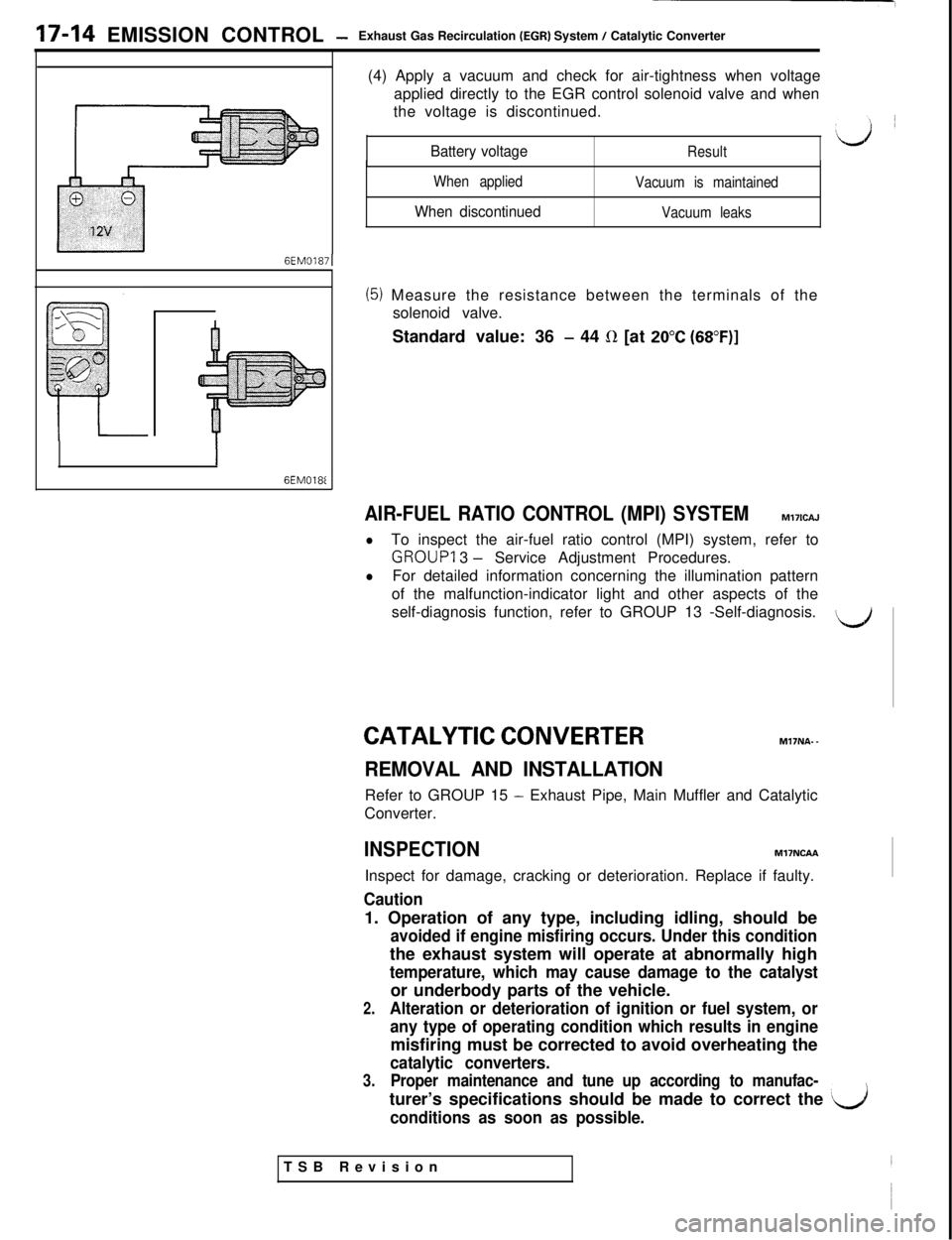
6EM0181(4) Apply a vacuum and check for air-tightness when voltage
applied directly to the EGR control solenoid valve and when
the voltage is discontinued.
Battery voltageResult
When applied
When discontinued
Vacuum is maintained
Vacuum leaks
(5) Measure the resistance between the terminals of the
solenoid valve.
Standard value: 36
- 44 R [at 20°C (68”F)]
AIR-FUEL RATIO CONTROL (MPI) SYSTEMM17ICAJ
lTo inspect the air-fuel ratio control (MPI) system, refer to
GROUP1 3 - Service Adjustment Procedures.
lFor detailed information concerning the illumination pattern
of the malfunction-indicator light and other aspects of the
self-diagnosis function, refer to GROUP 13 -Self-diagnosis.
\.J
CATALYTIC CONVERTERMl7N& -
REMOVAL AND INSTALLATIONRefer to GROUP 15
- Exhaust Pipe, Main Muffler and Catalytic
Converter.
INSPECTIONMl7NCAA
Inspect for damage, cracking or deterioration. Replace if faulty.
Caution1. Operation of any type, including idling, should be
avoided if engine misfiring occurs. Under this conditionthe exhaust system will operate at abnormally high
temperature, which may cause damage to the catalystor underbody parts of the vehicle.
2.Alteration or deterioration of ignition or fuel system, or
any type of operating condition which results in enginemisfiring must be corrected to avoid overheating the
catalytic converters.
3.Proper maintenance and tune up according to manufac-turer’s specifications should be made to correct the
‘bi
conditions as soon as possible.TSB Revision
Page 364 of 1146
21-6CLUTCH - Service Adjustment Procedures
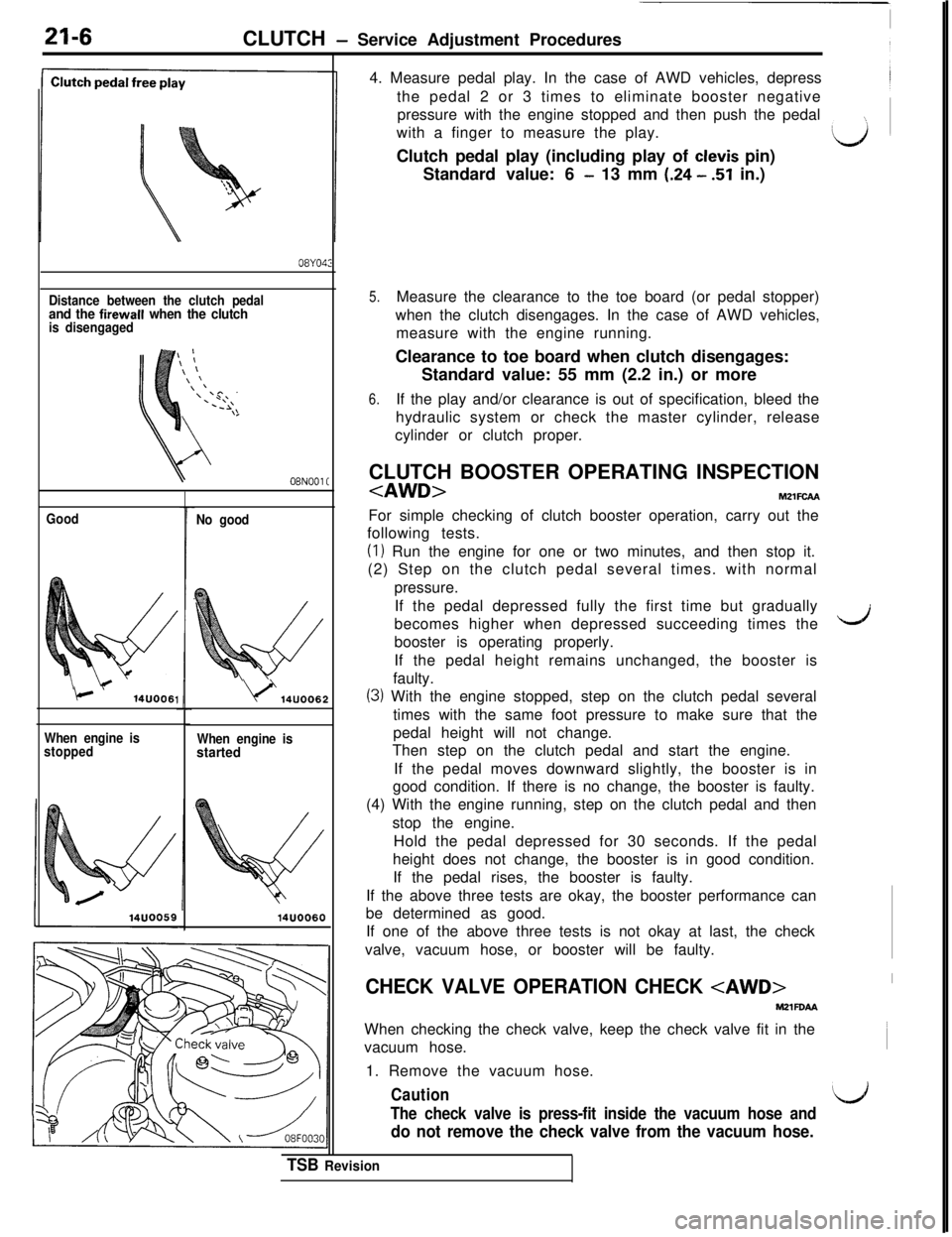
08YO4Z
Distance between the clutch pedaland the firewall when the clutchis disengaged
08NOOl C
Good
c1‘14UOO61
When engine is
stoppedNo good
\)‘14UOO6:
When engine isstarted
14UOO604. Measure pedal play. In the case of AWD vehicles, depress~
the pedal 2 or 3 times to eliminate booster negative
pressure with the engine stopped and then push the pedal
with a finger to measure the play.
LJClutch pedal play (including play of clevis pin)
Standard value: 6
- 13 mm (.24 - 51 in.)
2
CHECK VALVE OPERATION CHECK
MZlFOAAWhen checking the check valve, keep the check valve fit in the
vacuum hose.
1. Remove the vacuum hose.
CautionL’The check valve is press-fit inside the vacuum hose and
do not remove the check valve from the vacuum hose.
5.Measure the clearance to the toe board (or pedal stopper)
when the clutch disengages. In the case of AWD vehicles,
measure with the engine running.
Clearance to toe board when clutch disengages:
Standard value: 55 mm (2.2 in.) or more
6.If the play and/or clearance is out of specification, bleed the
hydraulic system or check the master cylinder, release
cylinder or clutch proper.
CLUTCH BOOSTER OPERATING INSPECTION
following tests.
(I) Run the engine for one or two minutes, and then stop it.
(2) Step on the clutch pedal several times. with normal
pressure.
If the pedal depressed fully the first time but gradually
becomes higher when depressed succeeding times the
dbooster is operating properly.
If the pedal height remains unchanged, the booster is
faulty.
(3) With the engine stopped, step on the clutch pedal several
times with the same foot pressure to make sure that the
pedal height will not change.
Then step on the clutch pedal and start the engine.
If the pedal moves downward slightly, the booster is in
good condition. If there is no change, the booster is faulty.
(4) With the engine running, step on the clutch pedal and then
stop the engine.
Hold the pedal depressed for 30 seconds. If the pedal
height does not change, the booster is in good condition.
If the pedal rises, the booster is faulty.
If the above three tests are okay, the booster performance can
be determined as good.
If one of the above three tests is not okay at last, the check
valve, vacuum hose, or booster will be faulty.
TSB Revision
Page 647 of 1146
POWER PLANT MOUNT - Engine Roll Stopper
ENGINE ROLL STOPPER
REMOVAL ANDINSTALLATION
32-5
MJZGF- .
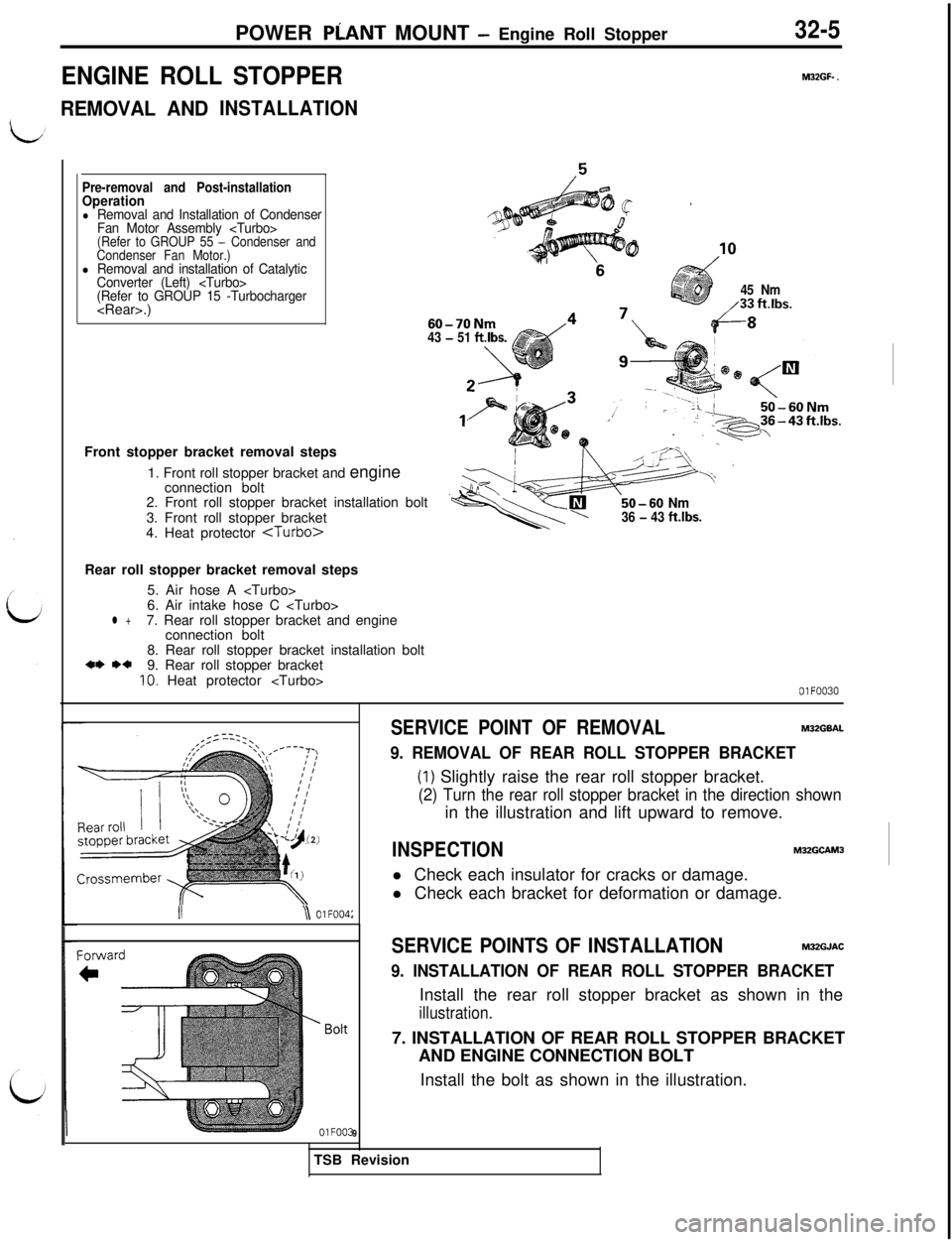
Pre-removal and Post-installationOperationl Removal and Installation of Condenser
Fan Motor Assembly
(Refer to GROUP 55 - Condenser and
Condenser Fan Motor.)
l Removal and installation of Catalytic
Converter (Left)
(Refer to GROUP 15 -Turbocharger
45 Nm/33 ft.lbs.
43
- 51 ftlbs.Front stopper bracket removal steps
1. Front roll stopper bracket and engine
connection bolt
2. Front roll stopper bracket installation bolt
3. Front roll stopper bracket
4. Heat protector
50-60 Nm36 - 43 ft.lbs.Rear roll stopper bracket removal steps
5. Air hose A
6. Air intake hose C
l +7. Rear roll stopper bracket and engine
connection bolt
8. Rear roll stopper bracket installation bolt
+* *+9. Rear roll stopper bracketIO. Heat protector
II\ OlFOO4:
SERVICE POINT OF REMOVALM32GEAL
9. REMOVAL OF REAR ROLL STOPPER BRACKET
(1) Slightly raise the rear roll stopper bracket.
(2) Turn the rear roll stopper bracket in the direction shownin the illustration and lift upward to remove.
INSPECTIONM32GCAM3l Check each insulator for cracks or damage.
l Check each bracket for deformation or damage.
9TSB Revision
SERVICE POINTS OF INSTALLATIONM32GJAC
9. INSTALLATION OF REAR ROLL STOPPER BRACKETInstall the rear roll stopper bracket as shown in the
illustration.7. INSTALLATION OF REAR ROLL STOPPER BRACKET
AND ENGINE CONNECTION BOLT
Install the bolt as shown in the illustration.
Page 666 of 1146
33B-4ELECTRONIC CONTROL SUSPENSION (ECS) - TroubleshootingTROUBLESHOOTING
M33EAAE
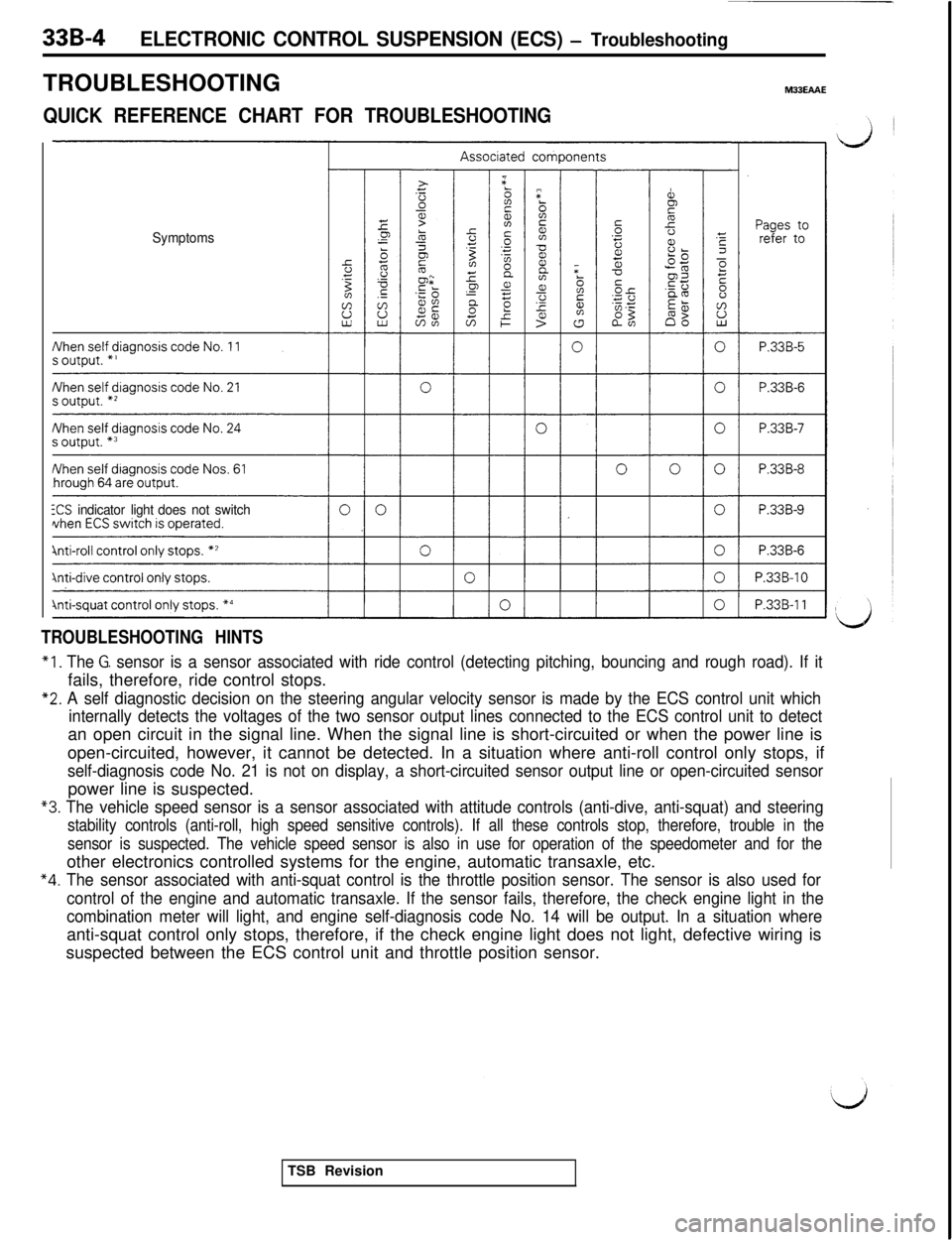
QUICK REFERENCE CHART FOR TROUBLESHOOTING
SymptomsXS
indicator lightdoes not switch
TROUBLESHOOTING HINTS
“1. The G. sensor is a sensor associated with ride control (detecting pitching, bouncing and rough road). If itfails, therefore, ride control stops.
“2. A self diagnostic decision on the steering angular velocity sensor is made by the ECS control unit which
internally detects the voltages of the two sensor output lines connected to the ECS control unit to detectan open circuit in the signal line. When the signal line is short-circuited or when the power line is
open-circuited, however, it cannot be detected. In a situation where anti-roll control only stops, if
self-diagnosis code No. 21 is not on display, a short-circuited sensor output line or open-circuited sensorpower line is suspected.
“3. The vehicle speed sensor is a sensor associated with attitude controls (anti-dive, anti-squat) and steering
stability controls (anti-roll, high speed sensitive controls). If all these controls stop, therefore, trouble in the
sensor is suspected. The vehicle speed sensor is also in use for operation of the speedometer and for theother electronics controlled systems for the engine, automatic transaxle, etc.
“4. The sensor associated with anti-squat control is the throttle position sensor. The sensor is also used for
control of the engine and automatic transaxle. If the sensor fails, therefore, the check engine light in the
combination meter will light, and engine self-diagnosis code No. 14 will be output. In a situation whereanti-squat control only stops, therefore, if the check engine light does not light, defective wiring is
suspected between the ECS control unit and throttle position sensor.
TSB Revision
Page 673 of 1146
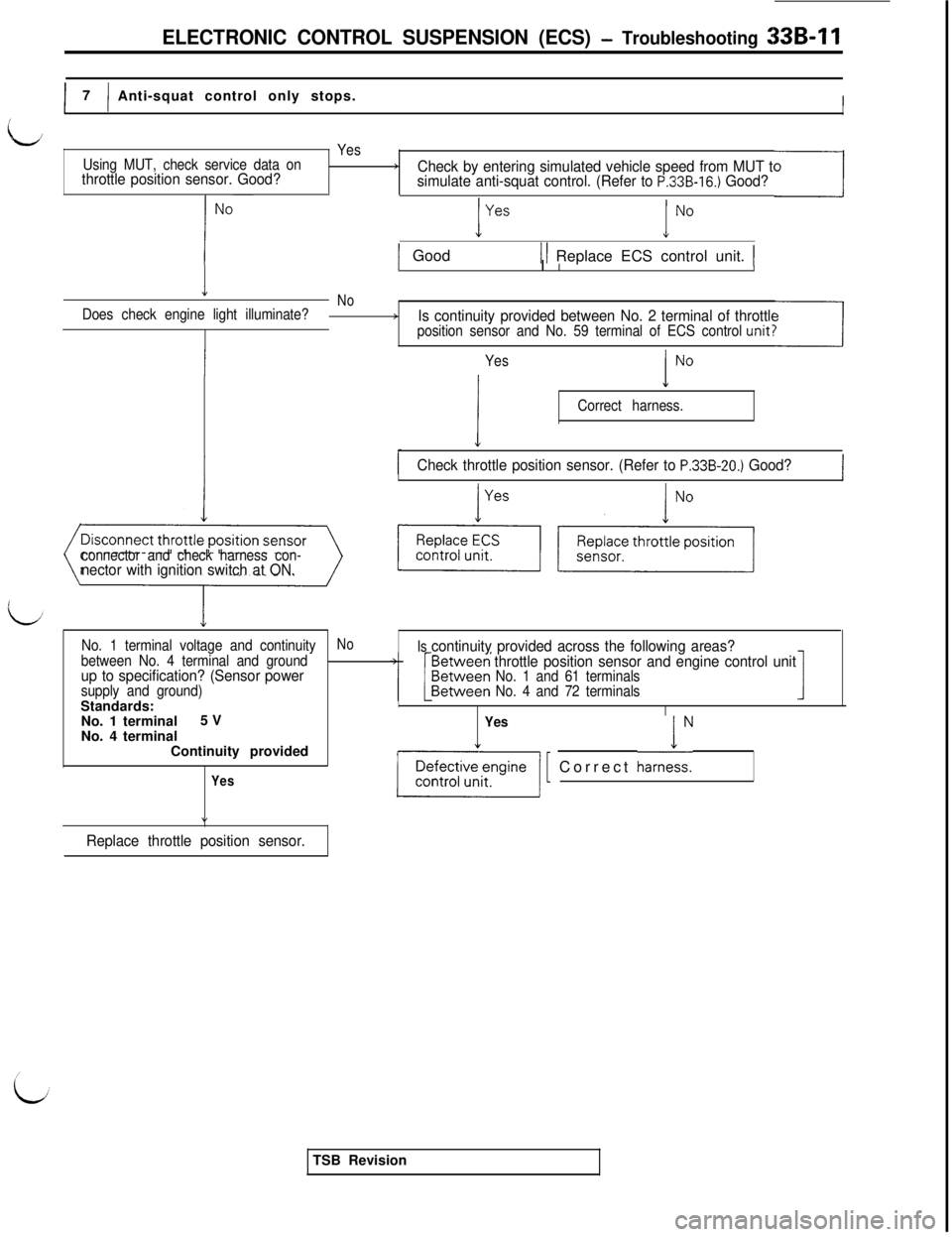
ELECTRONIC CONTROL SUSPENSION (ECS) - Troubleshooting 33B-11
I I7
Anti-squat control only stops.III
L,
I
Using MUT, check service data onthrottle position sensor. Good?
Yes
rCheck by entering simulated vehicle speed from MUT to
simulate anti-squat control. (Refer to P.33B-16.) Good?!
1 Good1 ) Replace ECS control unit. 1
I
1I II
NoDoes check engine light illuminate?>Is continuity provided between No. 2 terminal of throttleposition sensor and No. 59 terminal of ECS controlunityII
Yes
i
Correct harness.
1Check throttle position sensor. (Refer to P.33B-20.) Good?III1
connector and check harness con-nector with ignition switch at ON.
No. 1 terminal voltage and continuityNo
Is
between No. 4 terminal and groundcontinuity provided across the following areas?
up to specification? (Sensor powerthrottle position sensor and engine control unit
No. 1 and 61 terminals
supply and ground)
No. 4 and 72 terminalsStandards:
INo. 1 terminal5 V
YesNo. 4 terminal
Continuity provided
Yes-1 1 Correct harnei:
”
Replace throttle position sensor.TSB Revision
Page 729 of 1146
SERVICE BRAKES -Anti-lock Braking System Troubleshooting35-7
ANTI-LOCK BRAKING SYSTEM TROUBLESHOOTlilGPARTICULAR PHENOMENA OF THE
LANTI-LOCK BRAKING SYSTEMModels equipped with the anti-lock braking system
(ABS) may exhibit one or more of the following
phenomena from time to time, but none of these
are abnormal.
(1) A pulsing feeling in the brake pedal, or vibration
of the body or the steering wheel, when the
anti-lock braking system is activated by sudden
braking or by braking on a slippery road surface.
.9ctually, this phenomenon is an indication that
the anti-lock braking system is functioning nor-
mally.(2) When the vehicle speed reaches approximately
6 km/h (4 mph) after the engine is started and
the vehicle starts off (for the first time), a
whining motor noise may be heard from the
engine compartment if the vehicle is traveling in
a quiet place, but this noise is simply the result
of a self-check being made of the anti-lock
braking system operation.
TROUBLESHOOTING METHODSProblems related to the anti-lock braking system
(ABS) can be classified into two general categories:
problems in the electrical system and those in the
Lhydraulic system.For problems in the electrical system, the
self-diagnosis function is built into the electronic control
unit (E.C.U.) causing the ABS warning light to
illuminate as a warning to the driver. In this instance,
checks can be made by using the multi-use tester
and oscilloscope.
Problems in the hydraulic system (poor braking,
etc.) can be located in the same way as for ordinary
brakes. There is, however, the necessity to check to
determine whether the problem is related to ordin-
ary brake components or to the components related
to the ABS. To make this check, use the multi-use
tester.
HOW TO USE THE TROUBLESHOOTING
FLOW CHART(1) Using the flow chart, check the ABS warning
light light-up sequence. Read the diagnosis
codes and check the condition of braking opera-
tion.
(2) Following the check chart listed in the remedy
column, perform the checks. There are [Explana-
tion] and [Hint] in each check chart. Refer to
them when troubleshooting.
NOTEECU: Electronic control unit
HU: Hydraulic unit
MUT: Multi-use tester
1 TSB Revision
Page 730 of 1146
35-8SERVICE BRAKES -Anti-lock Braking System Troubleshooting
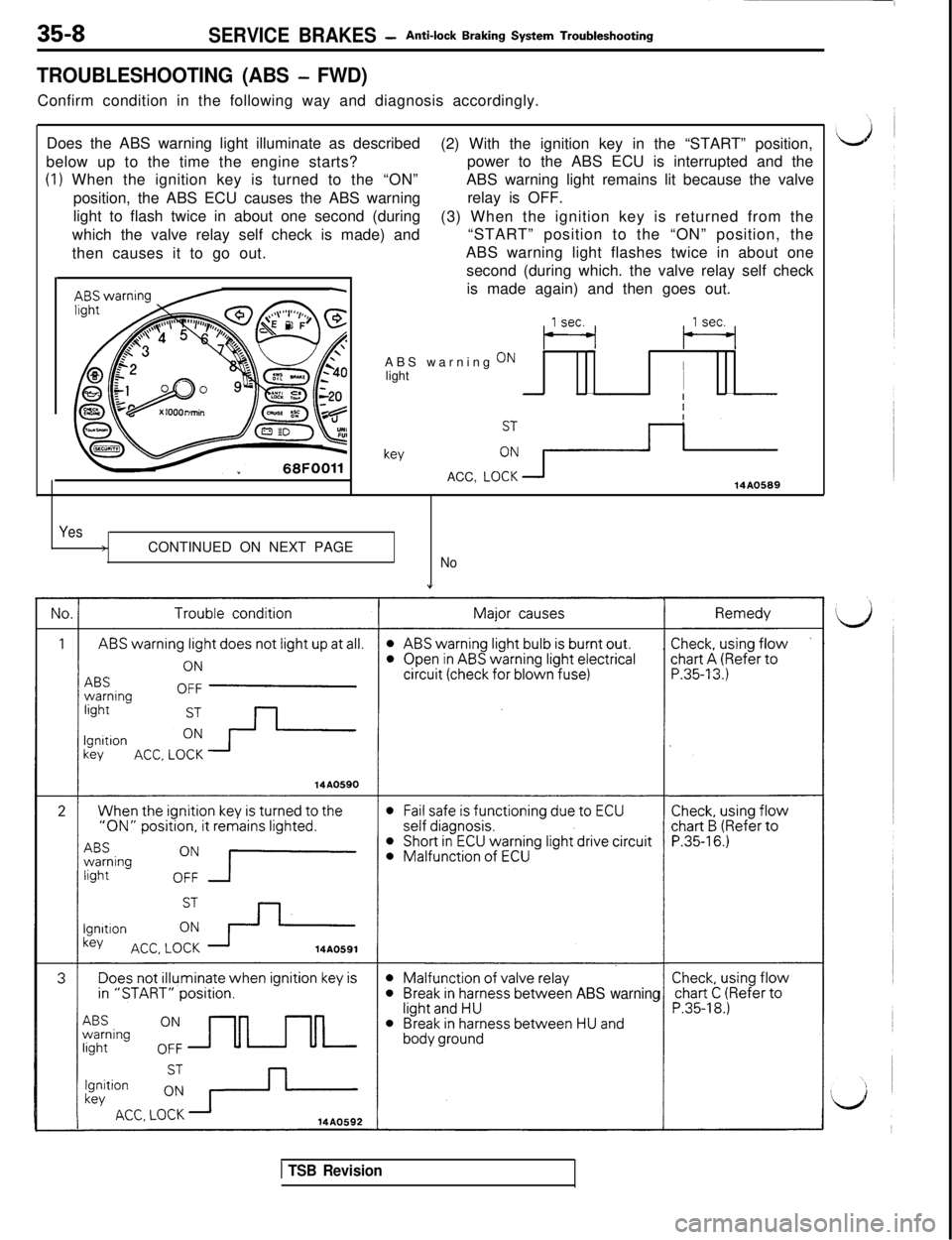
TROUBLESHOOTING (ABS - FWD)Confirm condition in the following way and diagnosis accordingly.
Does the ABS warning light illuminate as described
(2) With the ignition key in the “START” position,
below up to the time the engine starts?power to the ABS ECU is interrupted and the
(1) When the ignition key is turned to the “ON”ABS warning light remains lit because the valve
position, the ABS ECU causes the ABS warningrelay is OFF.
light to flash twice in about one second (during
(3) When the ignition key is returned from the
which the valve relay self check is made) and“START” position to the “ON” position, the
then causes it to go out.ABS warning light flashes twice in about one
second (during which. the valve relay self check
-is made again) and then goes out.
ABS warning
ONlightII
-I
keyACC,
LO!: +--14A0589
Yes>CONTINUED ON NEXT PAGE
No
”
weenABS warning
1 TSB Revision
Page 738 of 1146
![MITSUBISHI 3000GT 1991 Owners Manual 35-16SERVICE BRAKES -Anti-lock Braking System Troubleshooting
BABS warning light stays on when the ignition key is in the “ON” position.
[Explanation]
[Hint]
This is the symptom when the ABS ECU d](/img/19/57085/w960_57085-737.png "MITSUBISHI 3000GT 1991 Owners Manual 35-16SERVICE BRAKES -Anti-lock Braking System Troubleshooting
BABS warning light stays on when the ignition key is in the “ON” position.
[Explanation]
[Hint]
This is the symptom when the ABS ECU d")
35-16SERVICE BRAKES -Anti-lock Braking System Troubleshooting
BABS warning light stays on when the ignition key is in the “ON” position.
[Explanation]
[Hint]
This is the symptom when the ABS ECU does not
Check the diagnosis output and if there is no output
power up due to broken ECU power circuit, etc.,
voltage or if the MUT and ABS ECU cannot
when the fail safe function operates and isolates thecommunicate, there is a good possibility that power
system or when the warning light drive circuit is
is not flowing to the ECU.
short circuited.
!8IGNIISWIT(-
:Et
J’B @
C151
:
E
COMBINATION
METER
-19
7
------____-_---1
2
610 2
~;@lizEFgIIc,
6227J
r bL-1
IN(IGl)
1
,
ig
)
158
7
r-TSB iCaution
lIf the trouble code is output, the system can
be in the fail safe mode. in such a case, erase
the trouble code and then restart the engine
to check if the system is currently in a fault
condition.
~~~~
~~~~1
I,No ,I
Yes6
Replace ECU.
41,No rIDoes the ABS warning light
remain illuminated even with
the HU connector discon-
nected?
Yes
Short-circuit in harness
between HU or ECU and ABS
warning light
> Repair harness or replace
combination meter.
bvision
Page 748 of 1146
35-26SERVICE BRAKES -Anti-lock Braking System TroubleshootingI
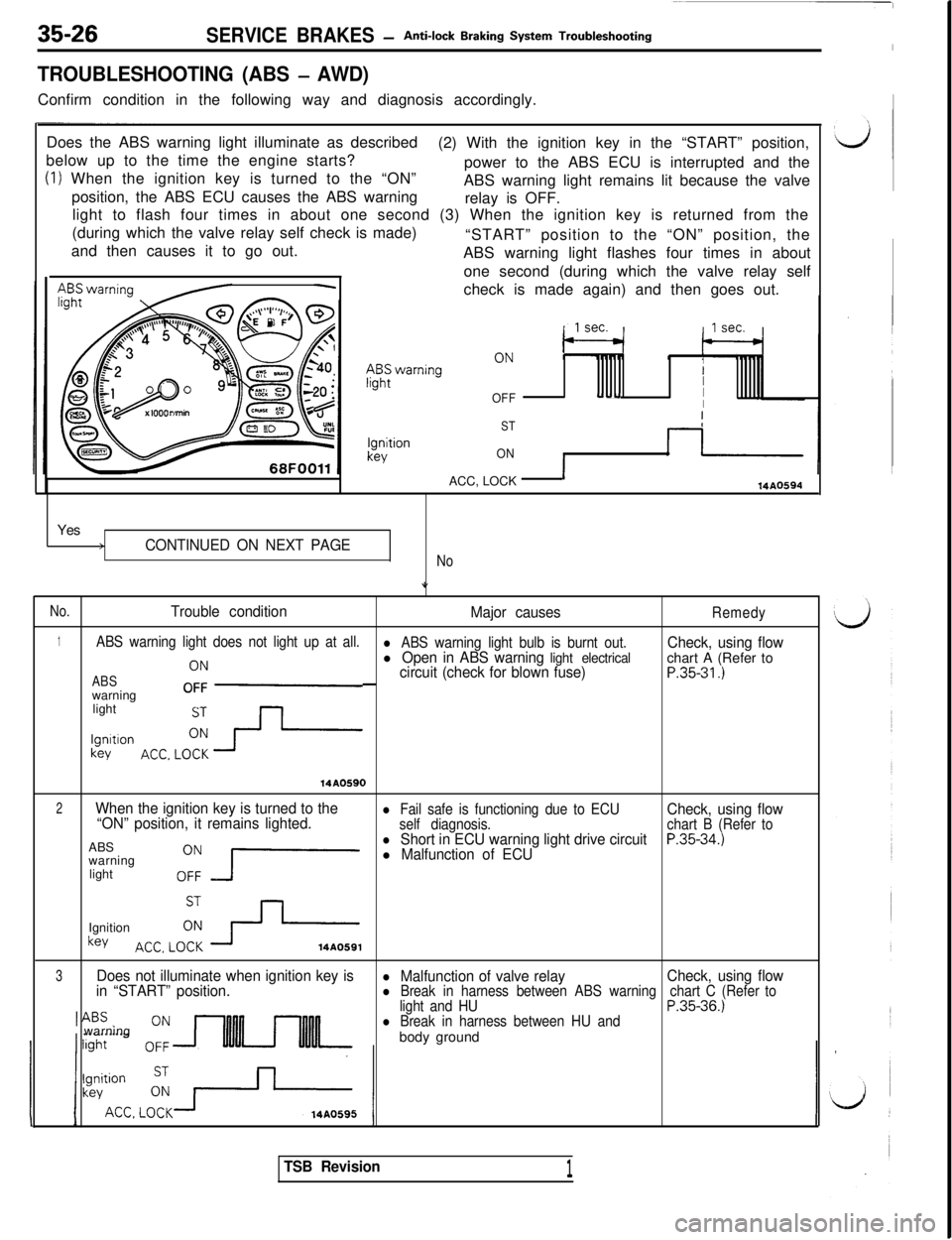
TROUBLESHOOTING (ABS - AWD)Confirm condition in the following way and diagnosis accordingly.
Does the ABS warning light illuminate as described
below up to the time the engine starts?(2) With the ignition key in the “START” position,
(1) When the ignition key is turned to the “ON”power to the ABS ECU is interrupted and the
position, the ABS ECU causes the ABS warningABS warning light remains lit because the valve
relay is OFF.
light to flash four times in about one second (3) When the ignition key is returned from the
(during which the valve relay self check is made)
and then causes it to go out.“START” position to the “ON” position, the
ABS warning light flashes four times in about
one second (during which the valve relay self
-check is made again) and then goes out.
III
OFFu--I-II
ST
ONACC, LOCK
114A0594Yes
>CONTINUED ON NEXT PAGE
No
No.
Trouble condition
Major causesRemedy
1ABS warning light does not light up at all.l ABS warning light bulb is burnt out.
ACC,LOb--
l Open in ABS warning light electricalCheck, using flowchart A (Refer to
ABScircuit (check for blown fuse)P.35-31.)warningOFFlight
lgmtlon
key
14AO590
2When the ignition key is turned to the
“ON” position, it remains lighted.l Fail safe is functioning due to ECU
self diagnosis.Check, using flowchart B (Refer toABS,“,F
J-l Short in ECU warning light drive circuitP.35-34.)warningl Malfunction of ECUlight
Ignition
key.;i,LOi h
3Does not illuminate when ignition key is
in “START” position.l Malfunction of valve relayl Break in harness between ABS warningCheck, using flowchart C (Refer to
light and HUP.35-36.)l Break in harness between HU andwarning
body ground
TSB Revision1
Page 756 of 1146
![MITSUBISHI 3000GT 1991 Owners Manual 35-34SERVICE BRAKES -Anti-lock Braking System Troubleshooting
II1
1 B 1 ABS warning light stays on when the ignition key is in the “ON” position.1II\[Explanation]
[Hint]
k.JThis is the symptom whe](/img/19/57085/w960_57085-755.png "MITSUBISHI 3000GT 1991 Owners Manual 35-34SERVICE BRAKES -Anti-lock Braking System Troubleshooting
II1
1 B 1 ABS warning light stays on when the ignition key is in the “ON” position.1II\[Explanation]
[Hint]
k.JThis is the symptom whe")
35-34SERVICE BRAKES -Anti-lock Braking System Troubleshooting
II1
1 B 1 ABS warning light stays on when the ignition key is in the “ON” position.1II\[Explanation]
[Hint]
k.JThis is the symptom when the ABS ECU does not
power up due to broken ECU power circuit, etc.,Check the diagnosis output and if there is no output
when the fail safe function operates and isolates thevoltage or if the MUT and ABS ECU cannot
system or when the warning light drive circuit iscommunicate, there is a good possibility that power
short circuited.is not flowing to the ECU.
IGNITIONSWITCH(IG1)Caution
lIf the trouble code is output, the system can
be in the fail safe mode. In such a case, erase
the trouble code and then restart the engine
to check if the system is currently in a fault
condition.
f
j @
?
j 0
:ml-
I2a-----11 g:I aI7
:I1
-_307a
-
I-=_-. -----------1
P
Y
4 a:&
I25ABS
ECU
iz- 11213 ia1516j7j819~10~11~12~13~14~15~16~17~1819l20l21C2C3Ca~25~~7~3~29~0~1~32~3~35
:95-AK-R9502
4
Replace ECU.
I YesI.
Replace HU or replace
valve relay.
I
_
ai.. .
ITSB hevIsIon