service MITSUBISHI 3000GT 1991 Owner's Manual
[x] Cancel search | Manufacturer: MITSUBISHI, Model Year: 1991, Model line: 3000GT, Model: MITSUBISHI 3000GT 1991Pages: 1146, PDF Size: 76.68 MB
Page 47 of 1146
GENERAL - Maintenance Service00-43
15. DRIVE SHAFT BOOTS (Inspect for grease
leaks and damage)
MOOSBJD1. These components, which are permanently lubricated at
the factory, do not require periodic lubrication. Damaged
boots should be replaced to prevent leakage or contamina-
tion of the, grease.
2.Inspect the boots for proper sealing, leakage and damage.
Replace it if defective.
16. REAR AXLE (CONVENTIONAL DIFFEREN-
TIAL) (Inspect oil level)
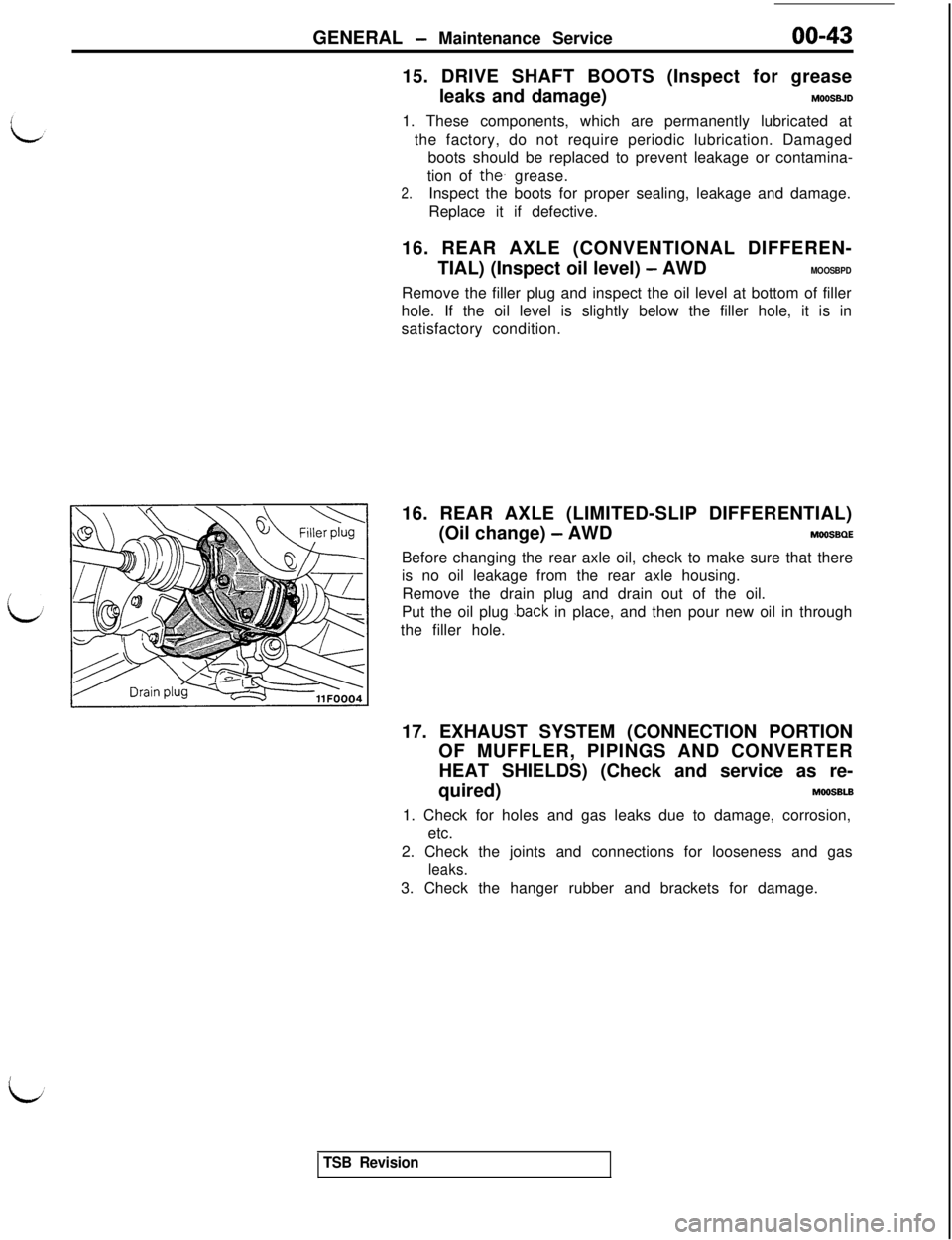
- AWDMOOSBPDRemove the filler plug and inspect the oil level at bottom of filler
hole. If the oil level is slightly below the filler hole, it is in
satisfactory condition.
16. REAR AXLE (LIMITED-SLIP DIFFERENTIAL)
(Oil change)
- AWDMOOSBQEBefore changing the rear axle oil, check to make sure that there
is no oil leakage from the rear axle housing.
Remove the drain plug and drain out of the oil.
Put the oil plug
,back in place, and then pour new oil in through
the filler hole.
17. EXHAUST SYSTEM (CONNECTION PORTION
OF MUFFLER, PIPINGS AND CONVERTER
HEAT SHIELDS) (Check and service as re-
quired)
MOOSBLB1. Check for holes and gas leaks due to damage, corrosion,
etc.
2. Check the joints and connections for looseness and gas
leaks.3. Check the hanger rubber and brackets for damage.
TSB Revision
Page 51 of 1146

11-I
ENGINECONTENTS
IMllAA--
CAMSHAFT OIL SEALS....................................
CRANKSHAFT, FLYWHEEL AND
DRIVEPLATE........................................................
CYLINDER BLOCK................................................
CYLINDER HEAD AND VALVE........................
CYLINDER HEAD GASKET................................
ENGINE ASSEMBLY............................................
ENGINE OIL COOLER........................................
GENERAL INFORMATION................................
lbLubricationSystem............................................SectionalView
....................................................
OIL PAN AND OIL PUMP....................................
OIL PAN AND OIL SCREEN................................20
49
5334
23
17
552
3
240
22
PISTON AND CONNECTING ROD....................
ROCKER ARM AND CAMSHAFT....................
SERVICE ADJUSTMENT PROCEDURES........Compression Pressure Check
........................Curb Idle Speed Inspection
............................Drive Belts Tension Adjustment
....................Ignition Timing Adjustment
............................
LashAdjusters
Check........................................Manifold Vacuum
Inspection
.............................
SPECIAL TOOLS....................................................
SPECIFICATIONS................................................General Specifications
....................................
Sealants
.......................................
.....................Service Specifications
....................................
TIMING BELT........................................................
TROUBLESHOOTING........................................44
31
11
15
14
11
13
16
16
84
4
84
26
10
Page 54 of 1146
II-4ENGINE - Specifications
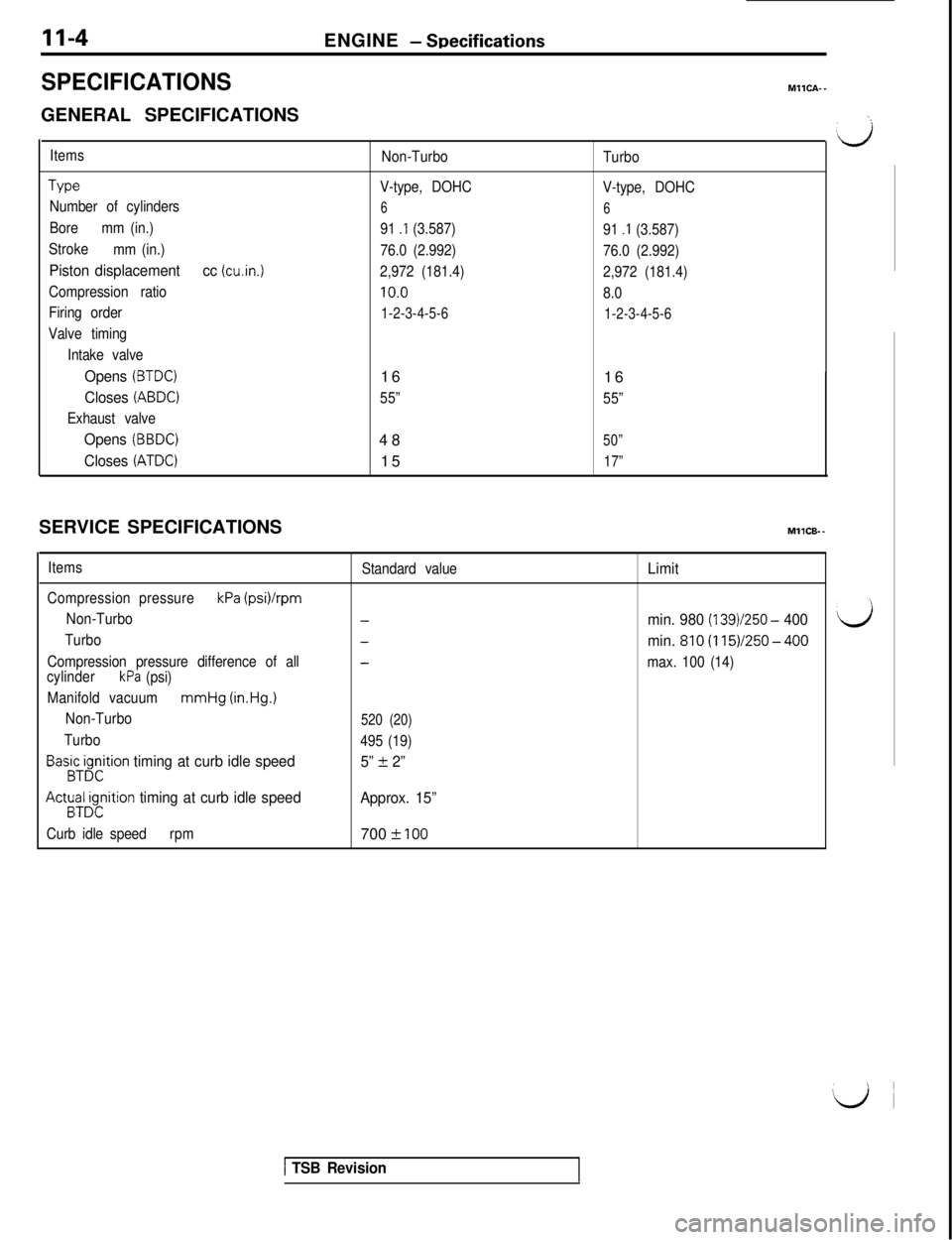
SPECIFICATIONSMllCA--GENERAL SPECIFICATIONS
‘,
‘dItems
Non-Turbo
Turbo
TypeV-type, DOHC
V-type, DOHC
Number of cylinders
6
6
Boremm (in.)
91 .I (3.587)
91 .I (3.587)
Stroke
mm (in.)
76.0 (2.992)
76.0 (2.992)
Piston displacementcc (win.)2,972 (181.4)
2,972 (181.4)
Compression ratio
10.08.0
Firing order
1-2-3-4-5-6
1-2-3-4-5-6
Valve timing
Intake valve
Opens (BTDC)16
16
Closes (ABDC)55”
55”
Exhaust valve
Opens (BBDC)4850”
Closes (ATDC)1517”SERVICE SPECIFICATIONS
MllCE -
Items
Compression pressure
kPa (psi)/rpm
Non-Turbo
Turbo
Compression pressure difference of all
cylinder
kPa (psi)
Manifold vacuum
mmHg (in.Hg.)
Non-Turbo
Turbo
Bas2Tig;ition timing at curb idle speedAct;ir-&yition
timing at curb idle speed
Curb idle speedrpmStandard value
-
-
-
520 (20)
495 (19)
5” f 2”
Approx. 15”700
ZII 100
Limit
min. 980
(139)/250 - 400
min. 810(115)/250-400
max. 100 (14)
d
1 TSB Revision
Page 56 of 1146
11-6ENGINE - Specifications
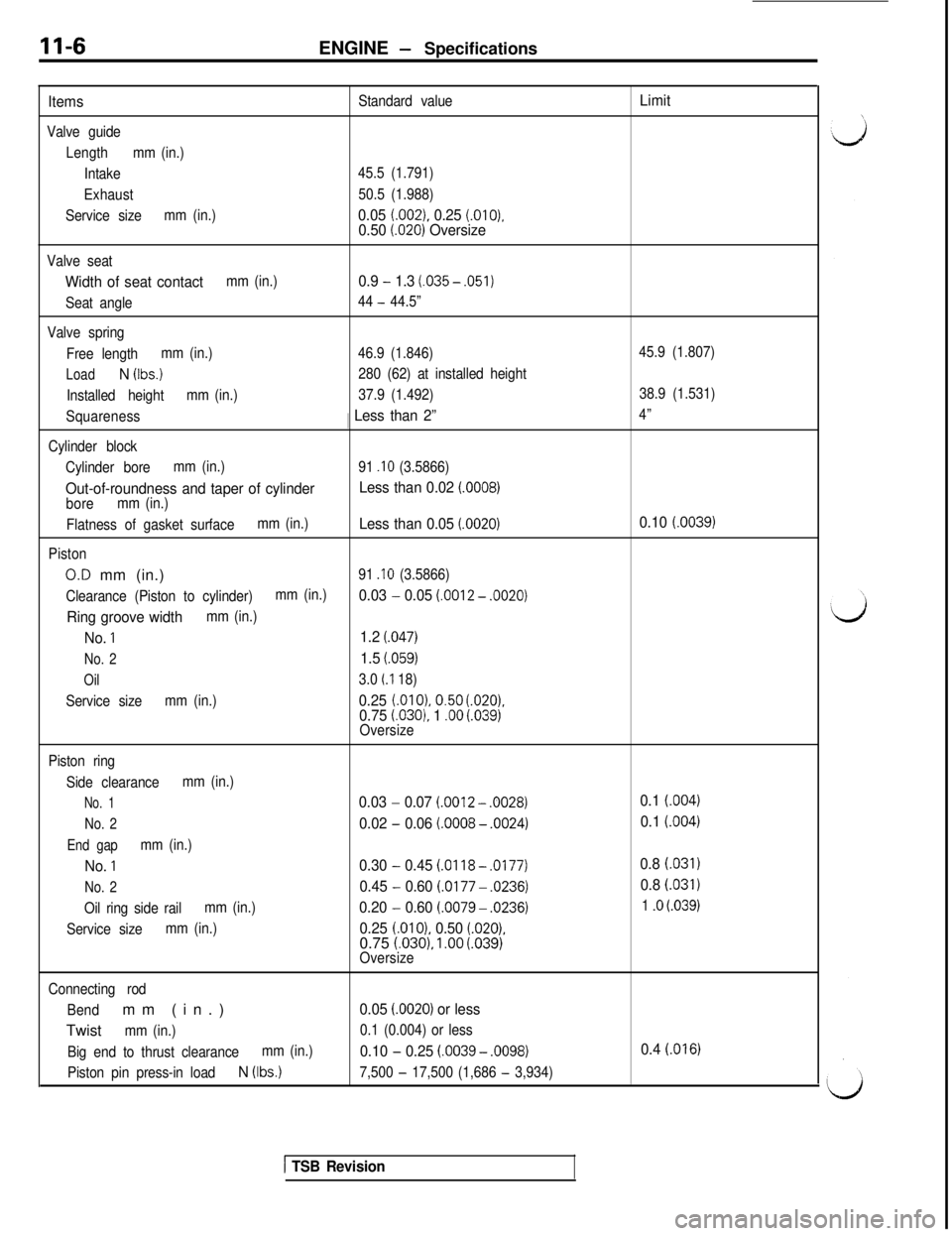
Items
Valve guide
Lengthmm (in.)
Intake
Exhaust
Service sizemm (in.)Standard value
45.5 (1.791)
50.5 (1.988)
0.05 f.002). 0.25 (.OlO),0.50 f.020) OversizeLimit
Valve seat
Width of seat contactmm (in.)0.9 - 1.3 (.035 - ,051)
Seat angle44 - 44.5”
Valve spring
Free lengthmm (in.)46.9 (1.846)45.9 (1.807)
LoadN (Ibs.)280 (62) at installed height
Installed heightmm (in.)37.9 (1.492)38.9 (1.531)
Squareness1
Less than 2”4”
Cylinder block
Cylinder boremm (in.)
91 .I0
(3.5866)
Out-of-roundness and taper of cylinderLess than 0.02 i.0008)
boremm (in.)
Flatness of gasket surfacemm (in.)
Less than 0.05 t.0020)0.10 (.0039)
Piston0.D mm (in.)
91 .I0 (3.5866)
Clearance (Piston to cylinder)mm (in.)
0.03 - 0.05 (.0012 - .0020)
Ring groove widthmm (in.)
No. 11.2 (.047)
No. 21.5 f.059)
Oil
3.0 (.I 18)
Service sizemm (in.)
0.25 LO1 0),0.50 (.020),0.75 (.030), 1 .oo l.039)Oversize
Piston ring
Side clearancemm (in.)
No. 1
No. 2
End gap
mm (in.)
No. 1
No. 2
Oil ring side railmm (in.)
Service sizemm (in.)
0.03 - 0.07 (.0012 - .0028)
0.02 - 0.06 l.0008 - .0024)
0.30 - 0.45 (.0118 - .0177)
0.45 - 0.60 (.0177 - .0236)
0.20 - 0.60 (.0079 - .0236)
0.25 (.OlO), 0.50 (.020),0.75 (.030), 1 .oo (.039)Oversize
0.1 (.004)
0.1 (.004)
0.8 i.031)
0.8 l.031)
1 .o (.039)
Connecting rod
Bendmm (in.)
Twist
mm (in.)
Big end to thrust clearancemm (in.)
Piston pin press-in load
N (Ibs.)
0.05 i.0020) or less
0.1 (0.004) or less
0.10 - 0.25 (.0039 - .0098)
7,500 - 17,500 (1,686 - 3,934)
0.4 l.016)
1 TSB Revision
Page 61 of 1146
ENGINE - Service Adjustment ProceduresII-IISERVICE ADJUSTMENT PROCEDURES
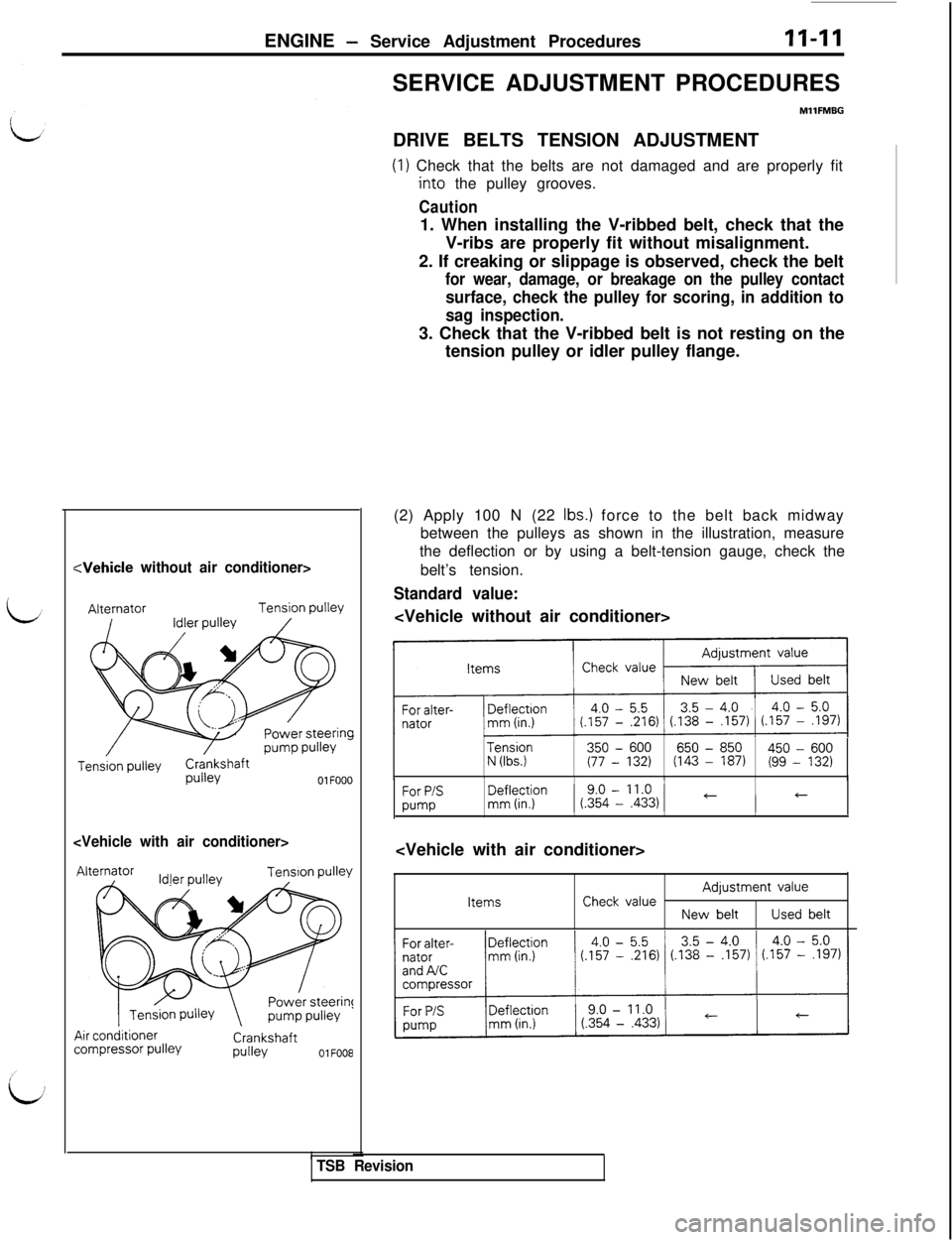
AlternatorTension pulley
IIdler pulley/
Tension pulleyCrankshaftpulleyOlFOOO
Tenston pulley
Air conditionerCrankshaftcompressor pulleypulleyOlFOO8
,
MllFMBGDRIVE BELTS TENSION ADJUSTMENT
(1) Check that the belts are not damaged and are properly fit
,into the pulley grooves.
Caution1. When installing the V-ribbed belt, check that the
V-ribs are properly fit without misalignment.
2. If creaking or slippage is observed, check the belt
for wear, damage, or breakage on the pulley contact
surface, check the pulley for scoring, in addition to
sag inspection.3. Check that the V-ribbed belt is not resting on the
tension pulley or idler pulley flange.
(2) Apply 100 N (22
Ibs.) force to the belt back midway
between the pulleys as shown in the illustration, measure
the deflection or by using a belt-tension gauge, check the
belt’s tension.
Standard value:
Tension350-600650-850450-600N (Ibs.)(77-132)(143-187)(99-132)
For P/S
pump
ItemsAdjustment valueCheck valueNew beltUsed belt
TSB Revision
Page 62 of 1146
II-12ENGINE - Service Adjustment Procedures-
r
AdJl
bolt
Alternator wllev
haft
Fixing nutOlFOOO8
Alternator pulley
Adjusting bolt
/Crankshaftpulley
Air contionercompressorpulleyw Tension pulleyFlxtng nutOlN007.
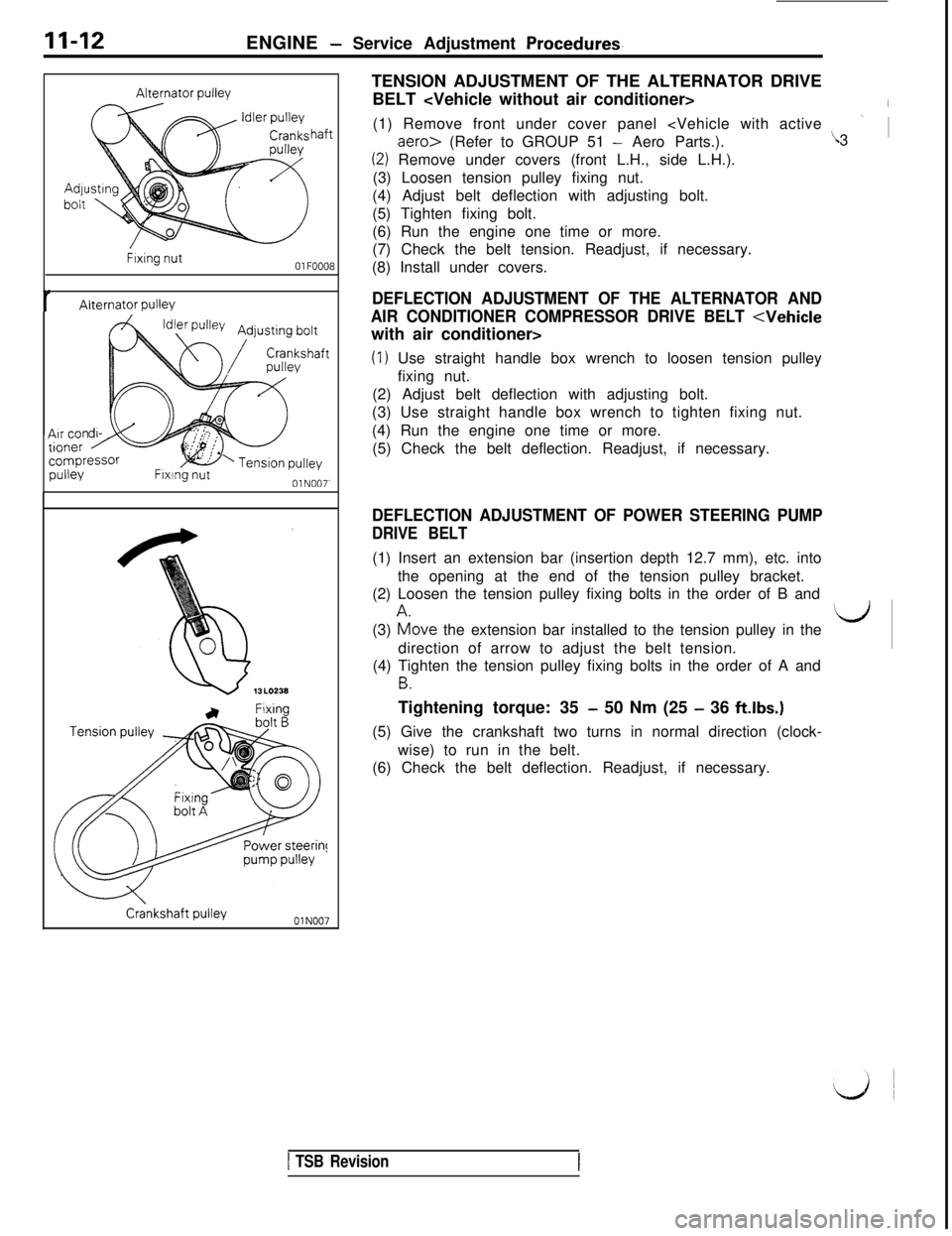
Crankshaft pulleyOlN007TENSION ADJUSTMENT OF THE ALTERNATOR DRIVE
BELT
I(1) Remove front under cover panel
aero> (Refer to GROUP 51 - Aero Parts.).\\
3 ’
(2) Remove under covers (front L.H., side L.H.).
(3) Loosen tension pulley fixing nut.
(4) Adjust belt deflection with adjusting bolt.
(5) Tighten fixing bolt.
(6) Run the engine one time or more.
(7) Check the belt tension. Readjust, if necessary.
(8) Install under covers.
DEFLECTION ADJUSTMENT OF THE ALTERNATOR AND
AIR CONDITIONER COMPRESSOR DRIVE BELT
(1) Use straight handle box wrench to loosen tension pulley
fixing nut.
(2) Adjust belt deflection with adjusting bolt.
(3) Use straight handle box wrench to tighten fixing nut.
(4) Run the engine one time or more.
(5) Check the belt deflection. Readjust, if necessary.
DEFLECTION ADJUSTMENT OF POWER STEERING PUMP
DRIVE BELT(1) Insert an extension bar (insertion depth 12.7 mm), etc. into
the opening at the end of the tension pulley bracket.
(2) Loosen the tension pulley fixing bolts in the order of B and
(3)
iove the extension bar installed to the tension pulley in the‘LJdirection of arrow to adjust the belt tension.
(4) Tighten the tension pulley fixing bolts in the order of A and
8.Tightening torque: 35
- 50 Nm (25 - 36 ftlbs,)(5) Give the crankshaft two turns in normal direction (clock-
wise) to run in the belt.
(6) Check the belt deflection. Readjust, if necessary.
1 TSB Revision
Page 63 of 1146
ENGINE - Service Adiustment ProceduresII-13
I_ ianltion tlminaI!H Connector for Igdpstment 6rown)
4tll II -7FUO9371IGNITION TIMING ADJUSTMENTMllFLAF
(1) The vehicle should be prepared as follows before the
inspection and adjustment.
lEngine coolant temperature: 80 - 95°C (176 - 205°F)
l Lights, electric cooling fan and accessories: OFF
l Transaxle: neutral
(P for A/T)l Steering wheel: neutral position
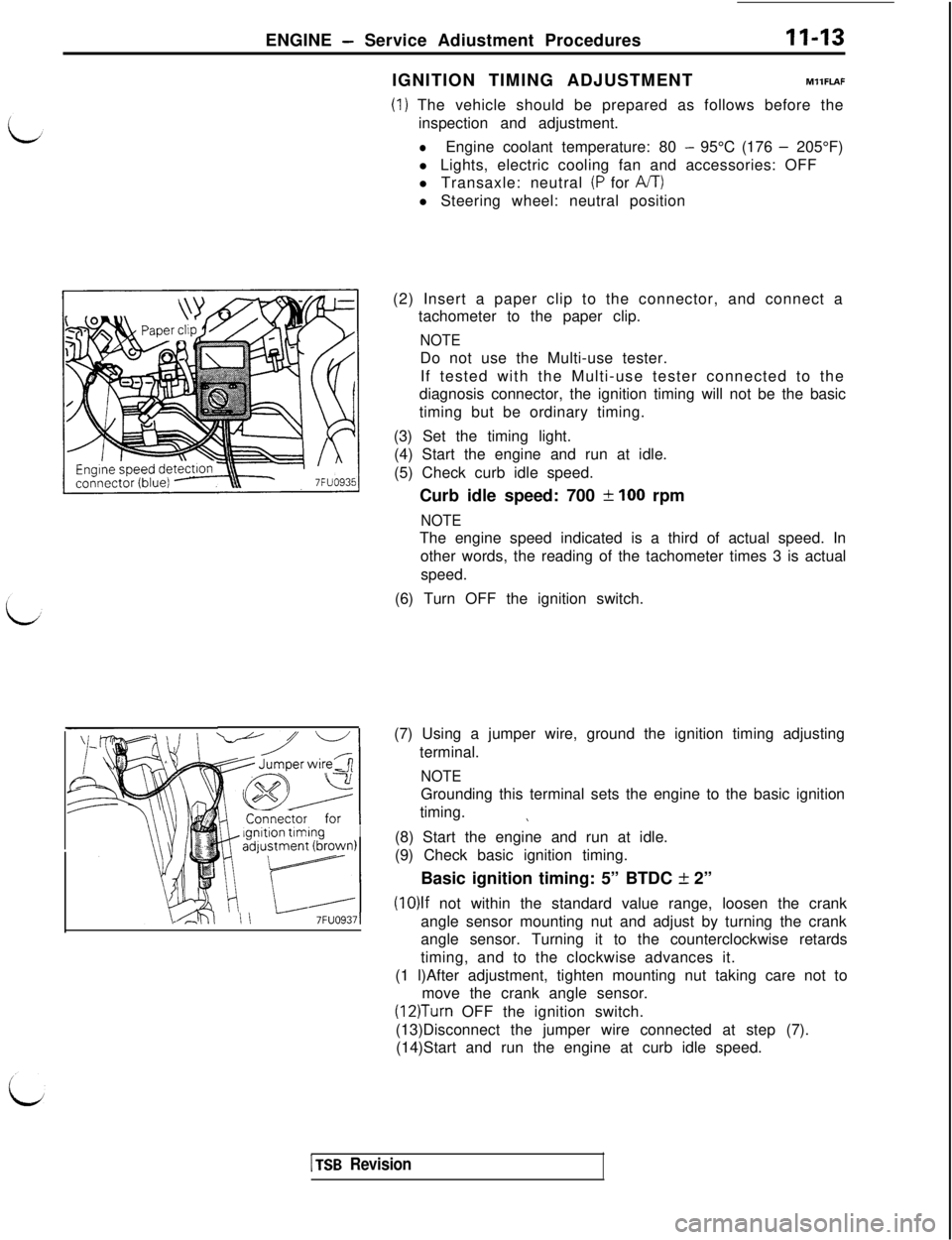
(2) Insert a paper clip to the connector, and connect a
tachometer to the paper clip.
NOTEDo not use the Multi-use tester.
If tested with the Multi-use tester connected to the
diagnosis connector, the ignition timing will not be the basic
timing but be ordinary timing.
(3) Set the timing light.
(4) Start the engine and run at idle.
(5) Check curb idle speed.
Curb idle speed: 700
f 100 rpm
NOTEThe engine speed indicated is a third of actual speed. In
other words, the reading of the tachometer times 3 is actual
speed.
(6) Turn OFF the ignition switch.
(7) Using a jumper wire, ground the ignition timing adjusting
terminal.
NOTEGrounding this terminal sets the engine to the basic ignition
timing.
\(8) Start the engine and run at idle.
(9) Check basic ignition timing.
Basic ignition timing: 5” BTDC
k 2”
(10)lf not within the standard value range, loosen the crank
angle sensor mounting nut and adjust by turning the crank
angle sensor. Turning it to the counterclockwise retards
timing, and to the clockwise advances it.
(1 l)After adjustment, tighten mounting nut taking care not to
move the crank angle sensor.
(12)Turn OFF the ignition switch.
(13)Disconnect the jumper wire connected at step (7).
(14)Start and run the engine at curb idle speed.
1 TSB Revision
Page 64 of 1146
11-14ENGINE - Service Adjustment Procedures
(15)Check to be sure that the idling ignition timing is the correct
timing.
Actual ignition timing: Approx. 15” BTDC
NOTE:d
(1) Ignition timing is variable even under normal operation.
(2) And it is automatically advanced at higher altitudes.
CURB IDLE SPEED INSPECTIONMllFMAB
(1) The vehicle should be prepared as follows before the
inspection.
lEngine coolant temperature: 80 - 95°C (176 - 205°F)
l Lights, electric cooling fan and accessories: OFF
l Transaxle: neutral
(P for A/T)l Steering wheel: neutral position
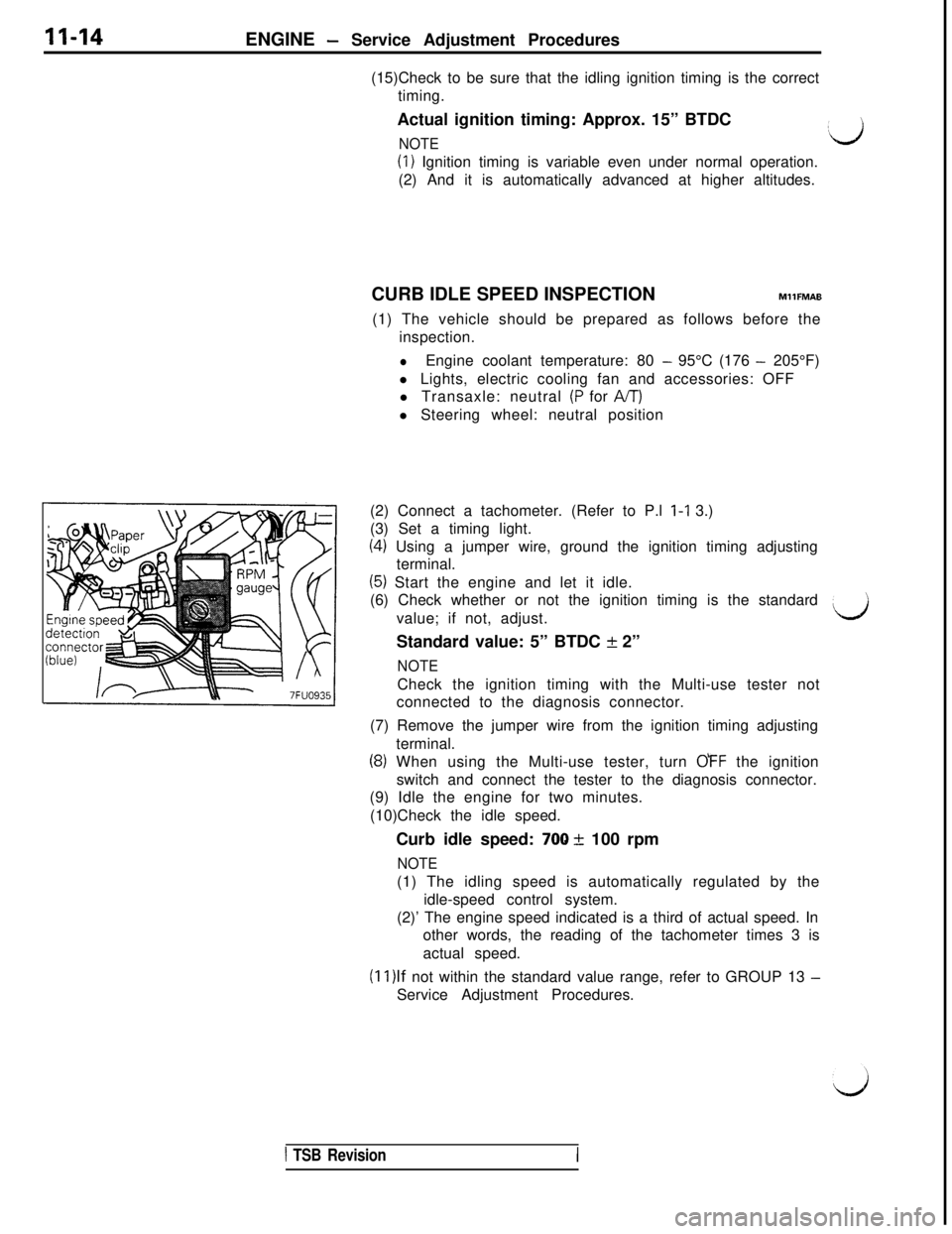
(2) Connect a tachometer. (Refer to P.l l-1 3.)
(3) Set a timing light.
(4) Using a jumper wire, ground the ignition timing adjusting
terminal.
(5) Start the engine and let it idle.
(6) Check whether or not the ignition timing is the standard
value; if not, adjust.
Standard value: 5” BTDC + 2”
NOTECheck the ignition timing with the Multi-use tester not
connected to the diagnosis connector.
(7) Remove the jumper wire from the ignition timing adjusting
terminal.
(8) When using the Multi-use tester, turn OFF the ignition
switch and connect the tester to the diagnosis connector.
(9) Idle the engine for two minutes.
(10)Check the idle speed.
Curb idle speed:
700 + 100 rpm
NOTE(1) The idling speed is automatically regulated by the
idle-speed control system.
(2)’ The engine speed indicated is a third of actual speed. In
other words, the reading of the tachometer times 3 is
actual speed.
(1l)lf not within the standard value range, refer to GROUP 13 -Service Adjustment Procedures.
d
1 TSB RevisionI
Page 65 of 1146
ENGINE - Service Adjustment Procedures11-15COMPRESSION PRESSURE CHECKMllFFAK
(1) Before checking compression, ensure that engine oil, the
starter motor, and battery are all in normal operating
condition.
(2) Start the engine and wait until engine coolant temperature
has risen to 80
- 95°C (176 - 205°F).
(3) Remove the all spark plugs.
(4) Crank the engine to remove any foreign objects in the
cylinders.
CautionCover the spark plug holes with shop towel, etc., in
order to keep expelled foreign objects from flying out,and keep away from the holes. When measuring
compression with water, oil, or fuel having entered the
cylinder through a crack, etc., these will come flying out
of the spark plug hole hot and fast, so be sure to take
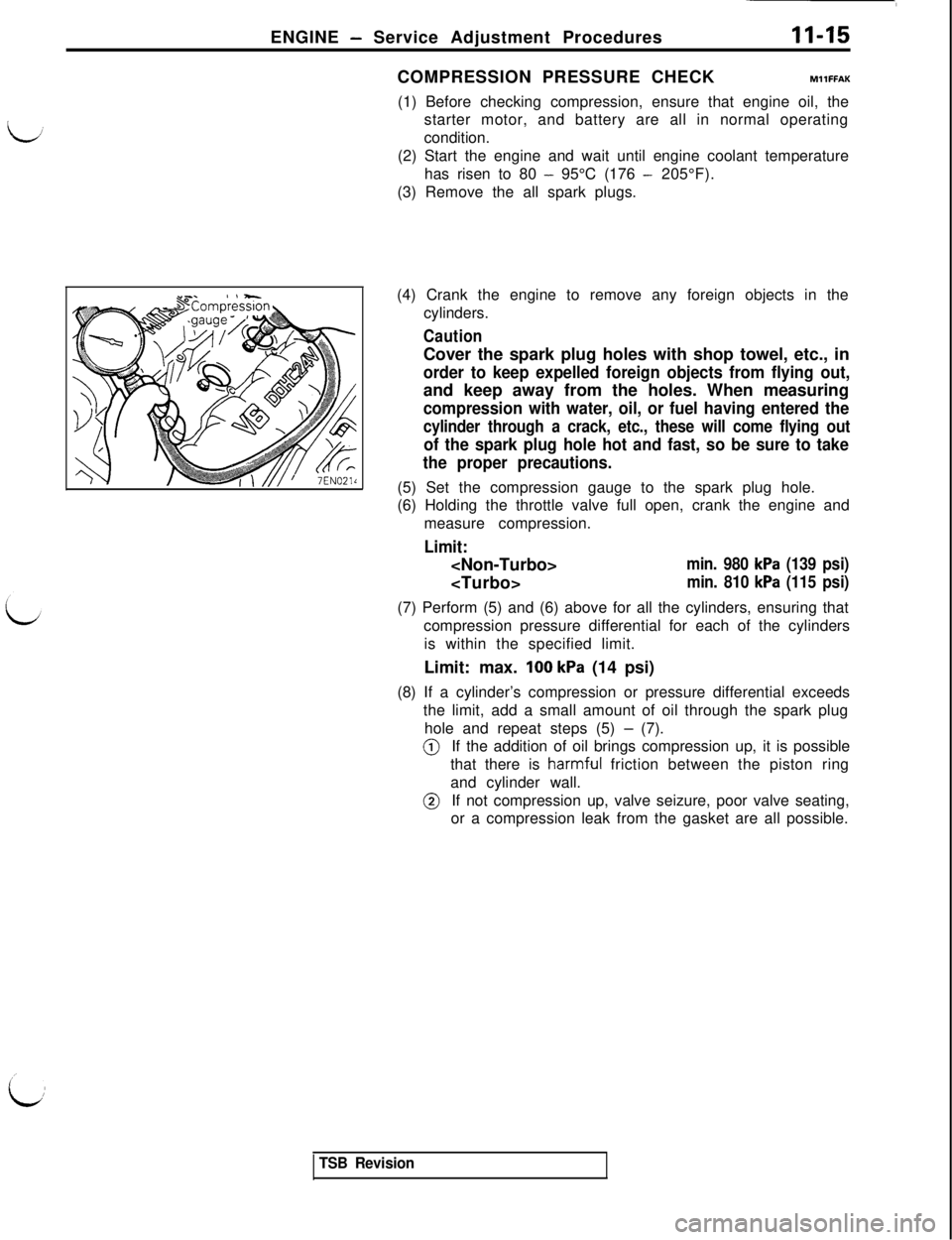
the proper precautions.(5) Set the compression gauge to the spark plug hole.
(6) Holding the throttle valve full open, crank the engine and
measure compression.
Limit:
min. 980 kPa (139 psi)
min. 810 kPa (115 psi)(7) Perform (5) and (6) above for all the cylinders, ensuring that
compression pressure differential for each of the cylinders
is within the specified limit.
Limit: max.
100 kPa (14 psi)
(8) If a cylinder’s compression or pressure differential exceeds
the limit, add a small amount of oil through the spark plug
hole and repeat steps (5)
- (7).@If the addition of oil brings compression up, it is possible
that there is
harmf,uI friction between the piston ring
and cylinder wall.@If not compression up, valve seizure, poor valve seating,
or a compression leak from the gasket are all possible.
TSB Revision
Page 66 of 1146
11-16ENGINE - Service Adjustment Procedures
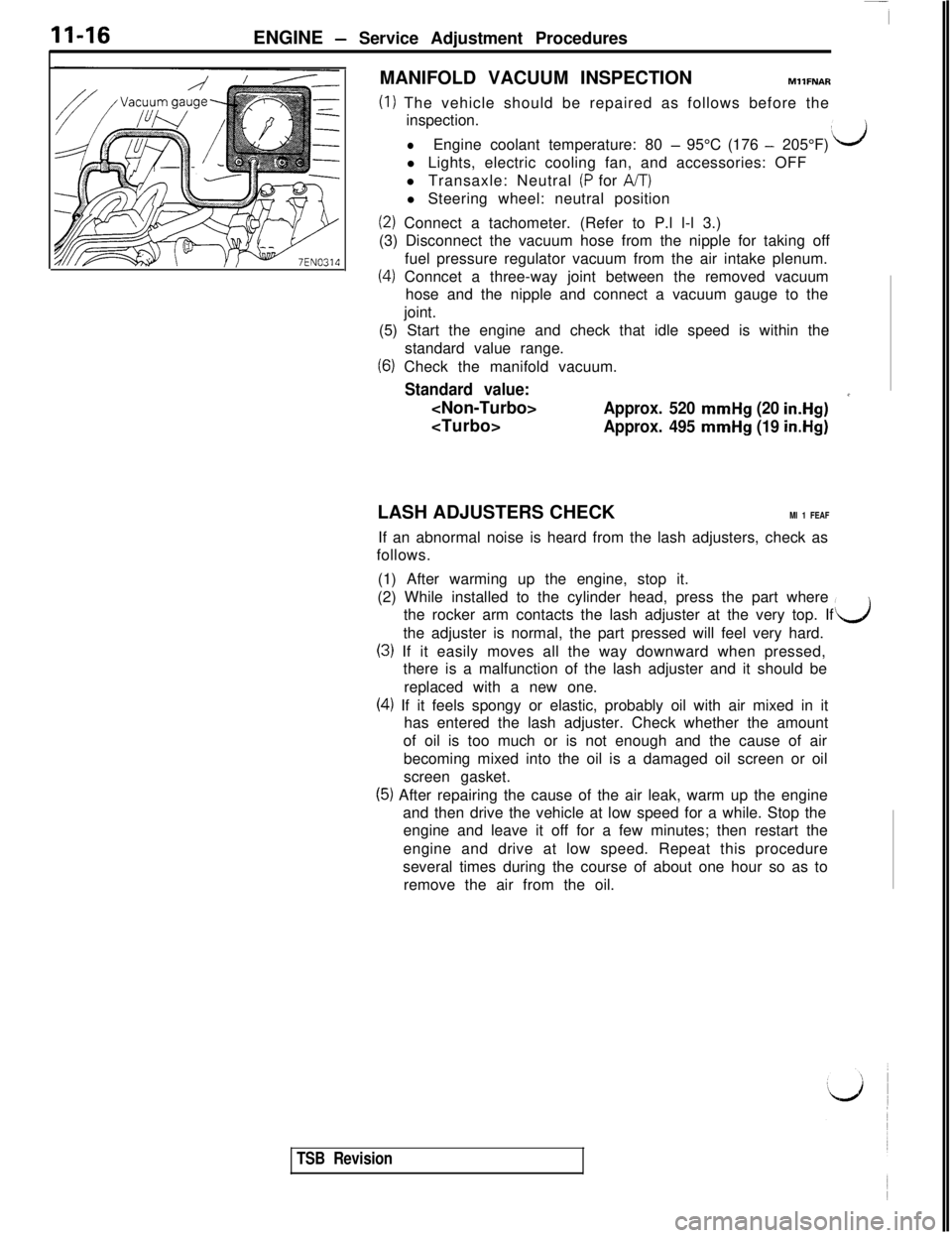
MANIFOLD VACUUM INSPECTION
MllFNAR
(1) The vehicle should be repaired as follows before the
inspection.
lEngine coolant temperature: 80 - 95°C (176 - 205°F)‘dl Lights, electric cooling fan, and accessories: OFF
l Transaxle: Neutral
(P for A/T)l Steering wheel: neutral position
(2) Connect a tachometer. (Refer to P.l l-l 3.)
(3) Disconnect the vacuum hose from the nipple for taking off
fuel pressure regulator vacuum from the air intake plenum.
(4) Conncet a three-way joint between the removed vacuum
hose and the nipple and connect a vacuum gauge to the
joint.
(5) Start the engine and check that idle speed is within the
standard value range.
(6) Check the manifold vacuum.
Standard value:
*
Approx. 495 mmHg (19 in.Hg)LASH ADJUSTERS CHECK
Ml 1 FEAFIf an abnormal noise is heard from the lash adjusters, check as
follows.
(1) After warming up the engine, stop it.
(2) While installed to the cylinder head, press the part where
the rocker arm contacts the lash adjuster at the very top. If
the adjuster is normal, the part pressed will feel very hard.
d
(3) If it easily moves all the way downward when pressed,
there is a malfunction of the lash adjuster and it should be
replaced with a new one.
(4) If it feels spongy or elastic, probably oil with air mixed in it
has entered the lash adjuster. Check whether the amount
of oil is too much or is not enough and the cause of air
becoming mixed into the oil is a damaged oil screen or oil
screen gasket.
(5) After repairing the cause of the air leak, warm up the engine
and then drive the vehicle at low speed for a while. Stop the
engine and leave it off for a few minutes; then restart the
engine and drive at low speed. Repeat this procedure
several times during the course of about one hour so as to
remove the air from the oil.
TSB Revision